
Normal Labour and Birth Objectives Define normal
KB
Published · 35 slides · 0 views
1 / 1



Description
Normal Labour and Birth Objectives Define normal labour and birth Describe the physiology of 1st stage Describe the care of the woman and baby Discuss common non-pharmacological and pharmacological strategies to support women during labour
Related Topics
Share
Embed code
Download this presentation From Below
"Normal Labour and Birth Objectives Define normal" is the property of its rightful owner. Permission is granted to download and print the materials on this website for personal, non-commercial use only, and to display it on your personal computer provided you do not modify the materials and that you retain all copyright notices contained in the materials. By downloading content from our website, you accept the terms of this agreement.
Presentation Transcript
01
Normal Labour and Birth<br>
02
Objectives Define normal labour and birth
Describe the physiology of 1st stage
Describe the care of the woman and baby
Discuss common non-pharmacological and pharmacological strategies to support women during labour
Describe the mechanisms of normal birth<br>
Describe the physiology of 1st stage
Describe the care of the woman and baby
Discuss common non-pharmacological and pharmacological strategies to support women during labour
Describe the mechanisms of normal birth<br>
03
The birth space Birth rooms should be designed to induce feelings of calm and safety
Most women do not need rooms set up for high-tech, interventionist birthing
Women often report feeling that they have limited control of their environment and their ability to actively participate in their birth.<br>
Most women do not need rooms set up for high-tech, interventionist birthing
Women often report feeling that they have limited control of their environment and their ability to actively participate in their birth.<br>
04
Facilitate women’s experiences Ensure women are full participants:
Respect privacy
Acknowledge her loved ones and support people
Acknowledge how women say they feel
Normalise what is normal
Avoid medical jargon like (eg VE, PROM)
Focusing on her not the machines
Support her to make decisions<br>
Respect privacy
Acknowledge her loved ones and support people
Acknowledge how women say they feel
Normalise what is normal
Avoid medical jargon like (eg VE, PROM)
Focusing on her not the machines
Support her to make decisions<br>
05
Intrapartum support Provision of support is a key factor in positive birth outcomes.
Choice of companion during labour and birth
Continuous physical and emotional support during labour facilitates improved health outcomes for mother and baby
Information and advice
Advocacy: protecting the woman and assisting her to make informed choices<br>
Choice of companion during labour and birth
Continuous physical and emotional support during labour facilitates improved health outcomes for mother and baby
Information and advice
Advocacy: protecting the woman and assisting her to make informed choices<br>
06
Neurohormonal influences on labour Physiological labour and birth involves a complex interplay between fetal and maternal hormones
Endogenous oxytocin and adrenaline play major roles in labour and birth
Adrenaline released during episodes of maternal fear, stress and anxiety interrupts the release of oxytocin
“High oxytocin, low adrenaline”<br>
Endogenous oxytocin and adrenaline play major roles in labour and birth
Adrenaline released during episodes of maternal fear, stress and anxiety interrupts the release of oxytocin
“High oxytocin, low adrenaline”<br>
07
Endorphins Precise relationships are still unclear but oxytocin affects the production of endorphins
possible that as endorphins build up in labour they can help the woman transcend pain
As hormonal levels rise they have an increased hypnotic and analgesic effect during labour
Immediately after birth:
elevated levels reward and reinforce mother-baby interactions and contribute to intensely pleasurable, even ecstatic feelings<br>
possible that as endorphins build up in labour they can help the woman transcend pain
As hormonal levels rise they have an increased hypnotic and analgesic effect during labour
Immediately after birth:
elevated levels reward and reinforce mother-baby interactions and contribute to intensely pleasurable, even ecstatic feelings<br>
08
Stages of Labour 1st Stage: establishment of regular painful uterine contractions with progressive effacement & dilatation of the cervix up to the time of full cervical dilatation
2nd Stage: full dilatation of the cervix to the birth of the baby
3rd Stage: after the birth of the baby to the completed birth of placenta & membranes
4th Stage: begins after the birth of the placenta and membranes and lasts 1-4 hours<br>
2nd Stage: full dilatation of the cervix to the birth of the baby
3rd Stage: after the birth of the baby to the completed birth of placenta & membranes
4th Stage: begins after the birth of the placenta and membranes and lasts 1-4 hours<br>
09
First Stage Two main physiological processes occurring are:
Effacement
Dilatation
Latent phase – (Passive), contractions may be irregular continues until labour establishes when the cervix is 4-5cms dilated & effaced/effacing
Active phase – contractions become more regular & stronger causing rapid cervical changes ending with complete dilatation.<br>
Effacement
Dilatation
Latent phase – (Passive), contractions may be irregular continues until labour establishes when the cervix is 4-5cms dilated & effaced/effacing
Active phase – contractions become more regular & stronger causing rapid cervical changes ending with complete dilatation.<br>
10
Approximate length of time for the first stage Primigravida: 12 -14 hours
Multigravida: 6 – 10 hours<br>
Multigravida: 6 – 10 hours<br>
11
Assessment in the first stage Maternal wellbeing
Vital signs
Input and output
Maternal response to pain
Fetal well being
Fetal heart rate / CTG / fetal blood sampling
Liquor colour
Progress in labour
Contractions
Abdominal palpation / descent
Cervical dilatation<br>
Vital signs
Input and output
Maternal response to pain
Fetal well being
Fetal heart rate / CTG / fetal blood sampling
Liquor colour
Progress in labour
Contractions
Abdominal palpation / descent
Cervical dilatation<br>
12
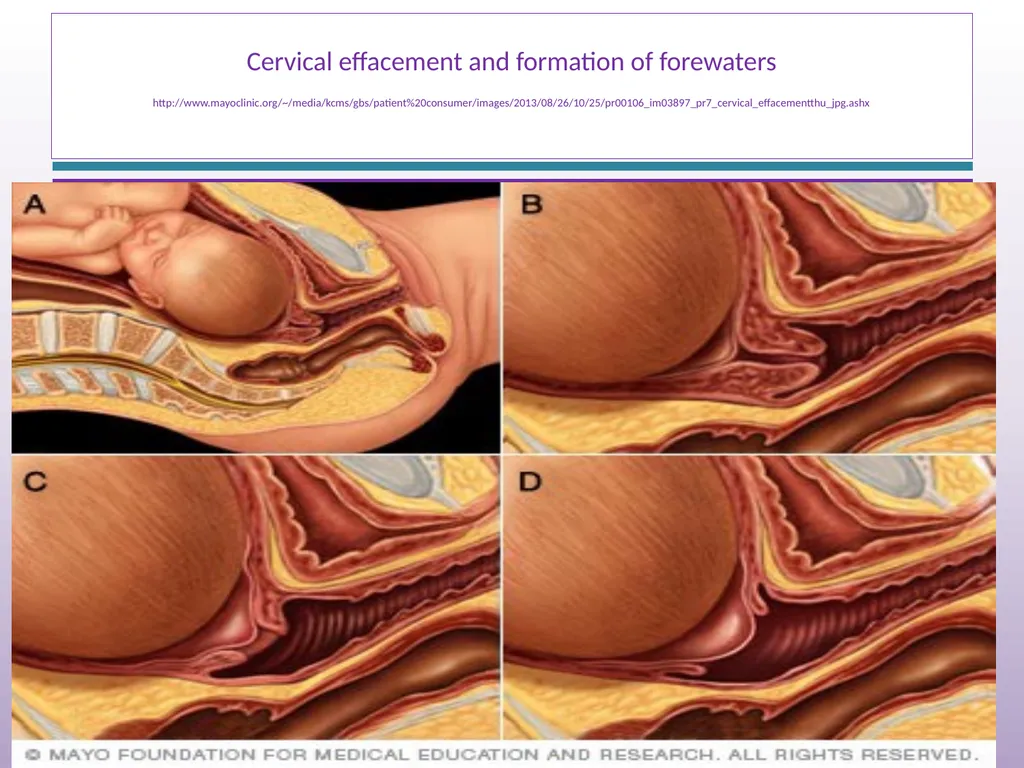
Cervical effacement and formation of forewaters
http://www.mayoclinic.org/~/media/kcms/gbs/patient%20consumer/images/2013/08/26/10/25/pr00106_im03897_pr7_cervical_effacementthu_jpg.ashx<br>
13
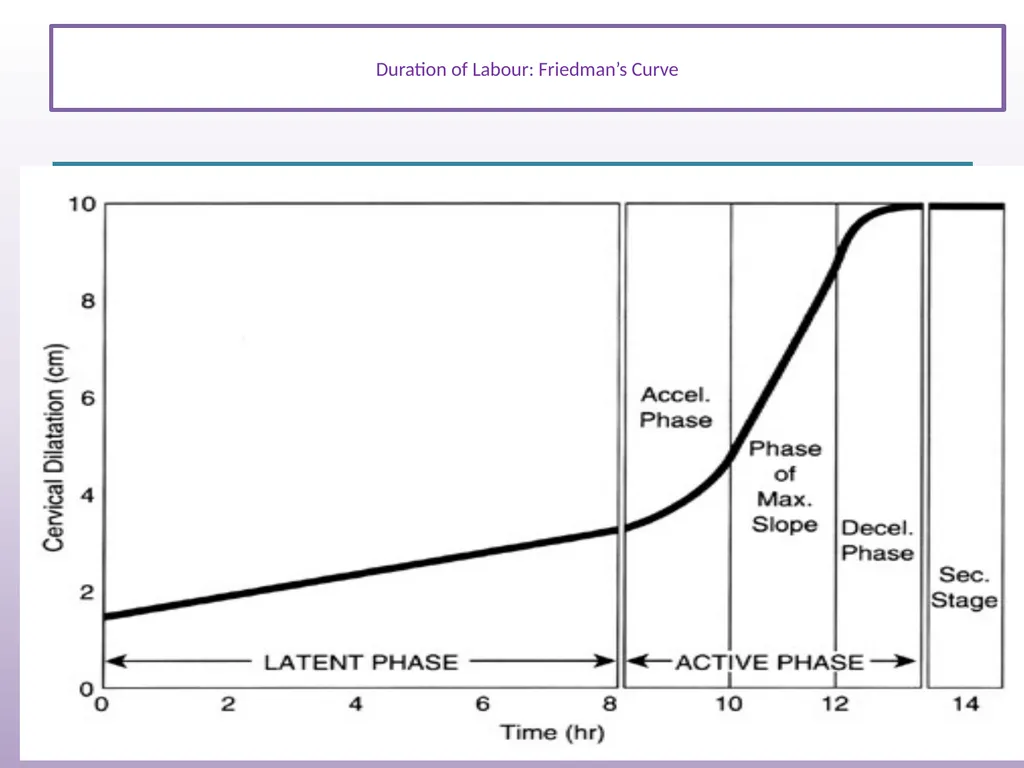
Duration of Labour: Friedman’s Study The average length of time it took primips to get from 0 cm to 4 cm was 8.6 hours (± 6 hours);
The mean length of the time it took to get from 4 to 10 cm was 4.9 hours (± 4 hours);
The mean duration of pushing in 2nd stage was 1 hour (± 0.8 hours);
At 4 cm, labours sped up—meaning that they hit “active labour”—and they dilated on average 3 cm per hour (± 2 cm) until they reached 9 cm, after which there was a slight slowing down between 9 cm and 10 cm.<br>
The mean length of the time it took to get from 4 to 10 cm was 4.9 hours (± 4 hours);
The mean duration of pushing in 2nd stage was 1 hour (± 0.8 hours);
At 4 cm, labours sped up—meaning that they hit “active labour”—and they dilated on average 3 cm per hour (± 2 cm) until they reached 9 cm, after which there was a slight slowing down between 9 cm and 10 cm.<br>
14
Duration of Labour: Friedman’s Curve<br>
15
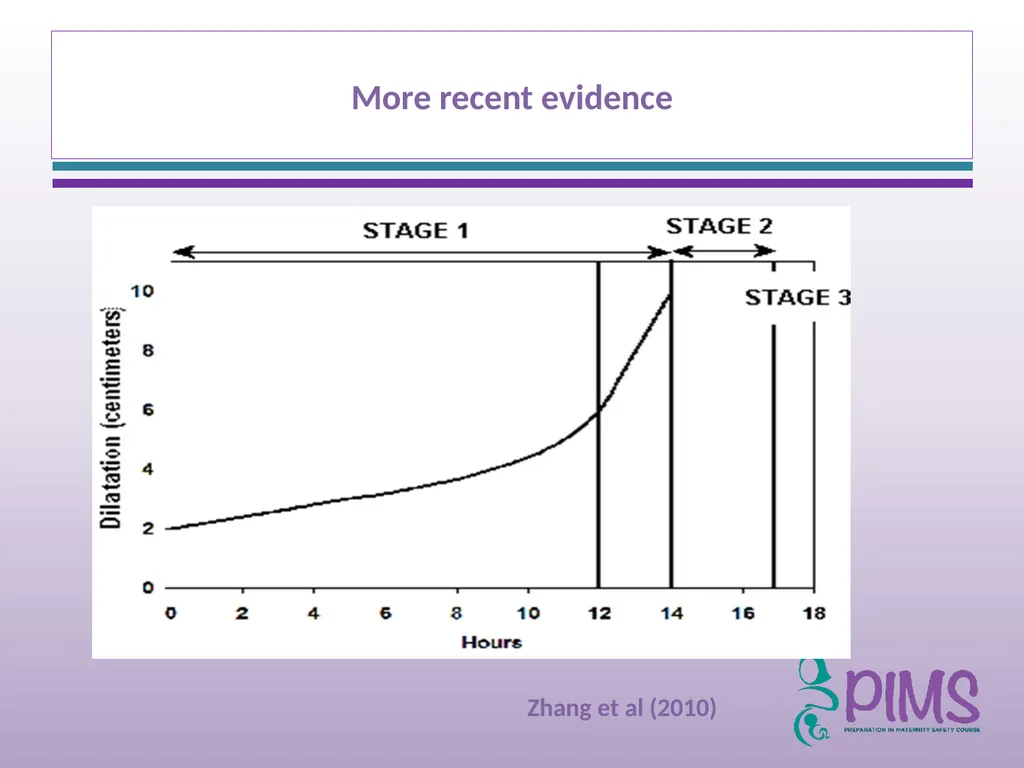
More recent evidence Zhang’s work showed that Cx dil. is not linear & the rate accelerates after 6 cm (not 3cms);
Progress from 4 to 6 cm was far slower than previously thought;
The average time for primips to dilate during active labour was 30 mins for each cm after 6 cm;
Many women went long periods in the latent phase without any dilation— normal for them
Zhang J, Landy HJ, Branch DW, et al (2010)<br>
Progress from 4 to 6 cm was far slower than previously thought;
The average time for primips to dilate during active labour was 30 mins for each cm after 6 cm;
Many women went long periods in the latent phase without any dilation— normal for them
Zhang J, Landy HJ, Branch DW, et al (2010)<br>
16
More recent evidence Zhang et al (2010)<br>
17
Implications of these findings Consideration should be made to redefining active labour from 4cm to 6 cms
Expectations that the cervix will dilate at 1.2cm/hr may contribute to the over-use of interventions aimed at accelerating labour with potential consequences
Allowing labour to continue for a longer period before 6 cm of cervical dilation may reduce the rate of intrapartum and subsequent repeat CS<br>
Expectations that the cervix will dilate at 1.2cm/hr may contribute to the over-use of interventions aimed at accelerating labour with potential consequences
Allowing labour to continue for a longer period before 6 cm of cervical dilation may reduce the rate of intrapartum and subsequent repeat CS<br>
18
Contractions There is often a brief lull in uterine activity at the end of the 1st stage before the contractions become expulsive
Contractions become longer and stronger but may be less frequent
There should always be a resting phase between contractions
Continued contraction and retraction of the myometrium aids fetal descent<br>
Contractions become longer and stronger but may be less frequent
There should always be a resting phase between contractions
Continued contraction and retraction of the myometrium aids fetal descent<br>
19
Pain and discomfort in labour Pain in labour is normal
unbearable pain is not
There is a wide range of perceptions of labour pain and responses to this pain
Influences on women’s experiences of labour and pain
Anxiety, fear, fatigue, feelings of self-efficacy, individual coping skills and quality of support.<br>
unbearable pain is not
There is a wide range of perceptions of labour pain and responses to this pain
Influences on women’s experiences of labour and pain
Anxiety, fear, fatigue, feelings of self-efficacy, individual coping skills and quality of support.<br>
20
Non-pharmacologic pain relief Continuous positive support during labour
Massage
Sterile water injections
TENS
Music
Water immersion
Acupuncture and Acupressure
Hypno/calm birthing<br>
Massage
Sterile water injections
TENS
Music
Water immersion
Acupuncture and Acupressure
Hypno/calm birthing<br>
21
Water immersion in labour Advantages of immersion in water during labour and/or birth can include:
reduced pain
sense of calm
increased quality of contractions
increased release of endorphins
decreased need for opiates
Water immersion during first stage reduces the need for epidural/spinal analgesia with no adverse labour or neonatal outcomes<br>
reduced pain
sense of calm
increased quality of contractions
increased release of endorphins
decreased need for opiates
Water immersion during first stage reduces the need for epidural/spinal analgesia with no adverse labour or neonatal outcomes<br>
22
Pharmacological pain relief Inhalational (N2O2)
Intramuscular/ intravenous opioids
Regional analgesia/anaesthesia<br>
Intramuscular/ intravenous opioids
Regional analgesia/anaesthesia<br>
23
Maternal Assessment Woman’s emotional and psychological needs
Coping strategies
Interpretation of the woman’s experience
4-hourly Temp, BP, Maternal PR (take with FHS recording)
Urinary output (assess retention)
Hydration<br>
Coping strategies
Interpretation of the woman’s experience
4-hourly Temp, BP, Maternal PR (take with FHS recording)
Urinary output (assess retention)
Hydration<br>
24
Labour and Fetal Assessment Abdominal palpation – 4-hourly and prior to every vaginal examination
Assessment of progress, may include vaginal examination depending on fetal wellbeing and the woman’s wishes
Half-hourly assessment of contractions, vaginal loss
Intermittent auscultation of the FHR after a contraction for at least 1 minute, at least every 5 minutes.
Palpate maternal pulse
Intermittent auscultation of the FHR after a contraction for at least 1 minute, every 15-30 minutes<br>
Assessment of progress, may include vaginal examination depending on fetal wellbeing and the woman’s wishes
Half-hourly assessment of contractions, vaginal loss
Intermittent auscultation of the FHR after a contraction for at least 1 minute, at least every 5 minutes.
Palpate maternal pulse
Intermittent auscultation of the FHR after a contraction for at least 1 minute, every 15-30 minutes<br>
25
The transitional period Challenging period between late first stage & onset of active pushing
Characterised by
Irritability, restlessness, vocalisation
Vocal demands for additional pain relief
Loss of focus & control – ‘labour seems never ending’
Wants baby to come immediately
Heavy ‘show’
Variable urge to push<br>
Characterised by
Irritability, restlessness, vocalisation
Vocal demands for additional pain relief
Loss of focus & control – ‘labour seems never ending’
Wants baby to come immediately
Heavy ‘show’
Variable urge to push<br>
26
Signs of the second stage Involuntary pushing at peak of contraction
Vocalisation increases
Woman states that she has rectal pressure or ‘has to push’
Heavy blood stained mucoid vaginal discharge
Anal and perineal dilatation
Membranes may break at this point
Presenting part visible<br>
Vocalisation increases
Woman states that she has rectal pressure or ‘has to push’
Heavy blood stained mucoid vaginal discharge
Anal and perineal dilatation
Membranes may break at this point
Presenting part visible<br>
27
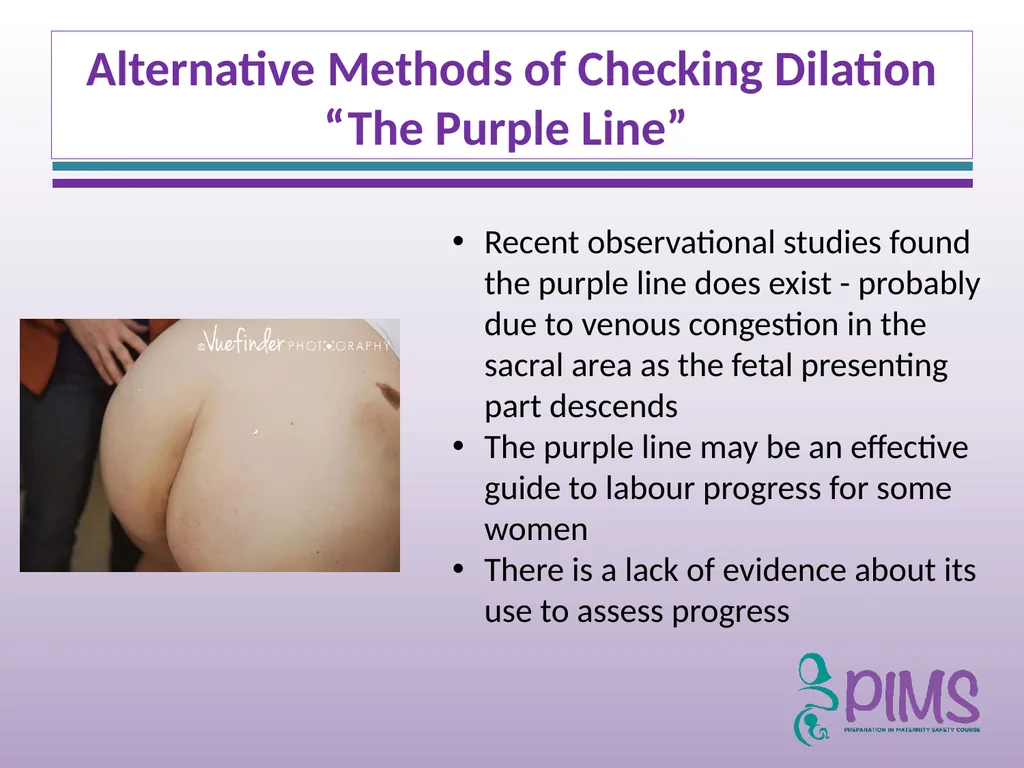
Alternative Methods of Checking Dilation “The Purple Line” Recent observational studies found the purple line does exist - probably due to venous congestion in the sacral area as the fetal presenting part descends
The purple line may be an effective guide to labour progress for some women
There is a lack of evidence about its use to assess progress<br>
The purple line may be an effective guide to labour progress for some women
There is a lack of evidence about its use to assess progress<br>
28
To push or not to push This is the question….
Active, coached pushing should be avoided
Important to allow women to involuntarily push when they feel the urge
Women may need to be given some direction to push, deep down into their bottom
In the presence of an epidural more directive pushing may be needed<br>
Active, coached pushing should be avoided
Important to allow women to involuntarily push when they feel the urge
Women may need to be given some direction to push, deep down into their bottom
In the presence of an epidural more directive pushing may be needed<br>
29
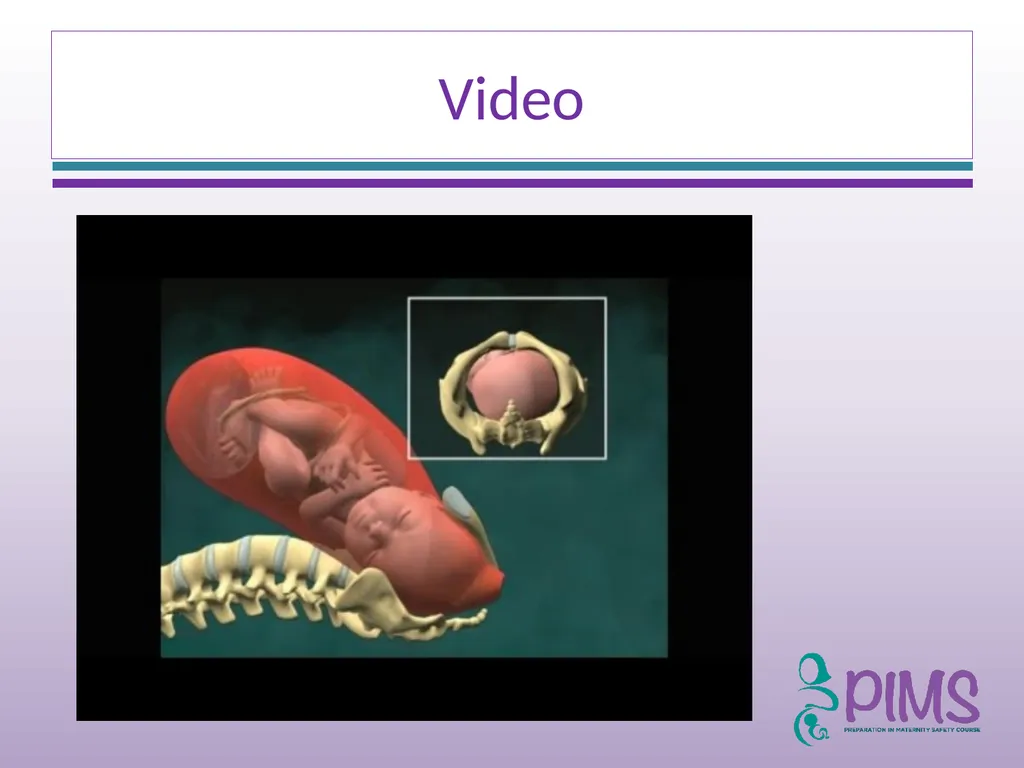
Mechanisms of birth Descent of the fetal head
Flexion of the head reduces the presenting diameter
Internal rotation of the fetal head
Crowning the widest diameter of the fetal head distends the vulva and no longer recedes
Extension the head is born by extension<br>
Flexion of the head reduces the presenting diameter
Internal rotation of the fetal head
Crowning the widest diameter of the fetal head distends the vulva and no longer recedes
Extension the head is born by extension<br>
30
Mechanisms of birth Restitution occurs as the head realigns with the shoulders
Internal rotation of the shoulders combined with external rotation of the head
Lateral flexion the anterior shoulder is born first and the baby’s body is born by lateral flexion<br>
Internal rotation of the shoulders combined with external rotation of the head
Lateral flexion the anterior shoulder is born first and the baby’s body is born by lateral flexion<br>
31
Video<br>
32
Positions during the 2nd stage and birth Gravity assists in bringing the baby down & out;
Less likelihood of maternal supine hypotension;
Helps the uterus to contract more effectively so the baby passes through the pelvis;
Pelvic outlet dimensions become wider in the squatting and kneeling/hands-knees positions.<br>
Less likelihood of maternal supine hypotension;
Helps the uterus to contract more effectively so the baby passes through the pelvis;
Pelvic outlet dimensions become wider in the squatting and kneeling/hands-knees positions.<br>
33
Duration of the second stage and birth Available evidence does not support arbitrary time limits for the second stage of labour
Studies show little association between length of the second stage and outcome
Any assessment should take into consideration the wellbeing of the woman and the fetus<br>
Studies show little association between length of the second stage and outcome
Any assessment should take into consideration the wellbeing of the woman and the fetus<br>
34
Assessment - timings Birth would be expected to take place within 3 hours (nuliparous) and 2hrs for (multiparous) of the start of second stage
Escalation of care with active involuntary pushing for 1 hr
Assisted birth may be warranted if there is a delay in birth
Appropriate consultation and referral is necessary<br>
Escalation of care with active involuntary pushing for 1 hr
Assisted birth may be warranted if there is a delay in birth
Appropriate consultation and referral is necessary<br>
35
Conclusion The birth environment can impact on women’s experiences and feelings
Birth is a normal physiological process
The definitions of “normal labour” and “labour dystocia” have profound effects on management
Clear referral pathways should be in place to enable clinicians to communicate with senior staff and seek advice
There should be no barriers to care escalation or rapid transfer in an emergency<br>
Birth is a normal physiological process
The definitions of “normal labour” and “labour dystocia” have profound effects on management
Clear referral pathways should be in place to enable clinicians to communicate with senior staff and seek advice
There should be no barriers to care escalation or rapid transfer in an emergency<br>