Note Taking Success Coaching Academic Success Workshop Important and Benefits of Effective Note Taking Note-taking is crucial for academic success, why: It helps students actively engage with material Enhances your understanding and allows
"Note Taking Success Coaching Academic Success" is the property of its rightful owner. Permission is granted to
download and print the materials on this website for personal, non-commercial use only, and to display it
on your personal computer provided you do not modify the materials and that you retain all copyright
notices contained in the materials. By downloading content from our website, you accept the terms of this
agreement.
Important and Benefits of Effective Note Taking Note-taking is crucial for academic success, why:
It helps students actively engage with material
Enhances your understanding and allows you to put things into your own words and include tips, drawings, and key words
Benefits:
Well organized notes help you review before quizzes & exams
Taking notes helps you retain the information
Taking notes allows you to develop critical thinking skills about the information at hand (ie. what are the main ideas), this helps enhance your understanding<br>
03
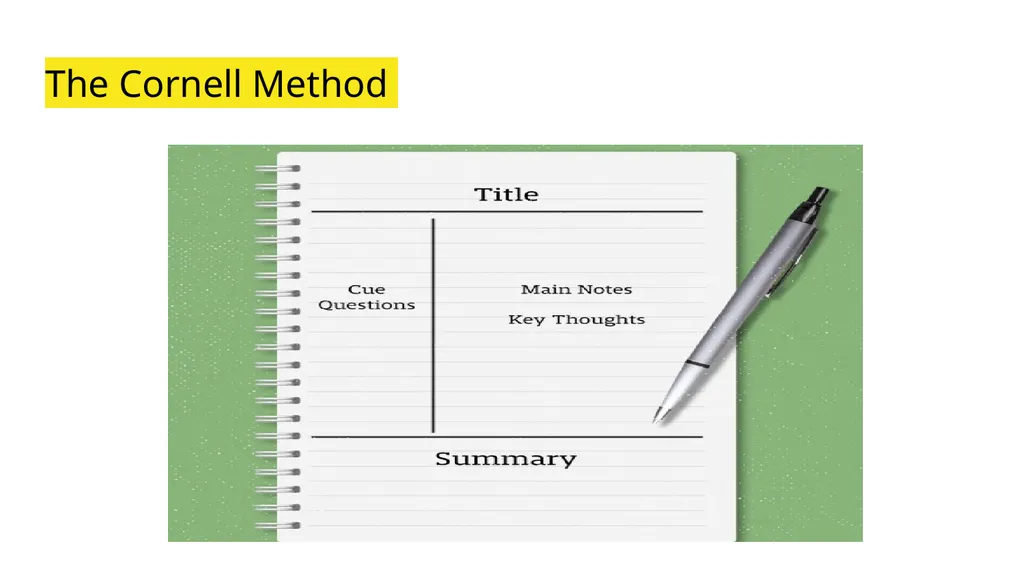
Ways to Take Notes The Cornell Method - cue column, thoughts column, summary beneath
Good for -> Auditory learners
Outlines - hierarchical method (main topic, sub topic, supporting details)
Good for -> Organizing a lot of information and creating study guides
Concept Mapping - drawing connections between ideas using visual aids
Good for -> Visual learners and complex ideas
Sentence Method - writing down each idea on a new line
Good for -> Fast paced lectures and lessons
Typing vs Writing
Typing -> tends to be faster, can turn your notes into other digital study aids (ex. quizlet)
Writing -> best way to solidify information in your brain and develop recall; best for math and science notes (often require diagrams and drawing)<br>
04
The Cornell Method<br>
05
Note Taking Tools Traditional Handwritten Notes
Notebook, pens, highlighters, rulers
Make sure to keep notes legible, organized, and in their place
Digital Notes
Google Drive - create folders for each class, docs for notes and study guides
OneNote - Microsoft Office’s notebook platform, allows you to add tabs and pages, college ruled lines or graph paper, syncs with other Office Suite apps
Make sure to keep notes for each class organized and not in one giant doc<br>
06
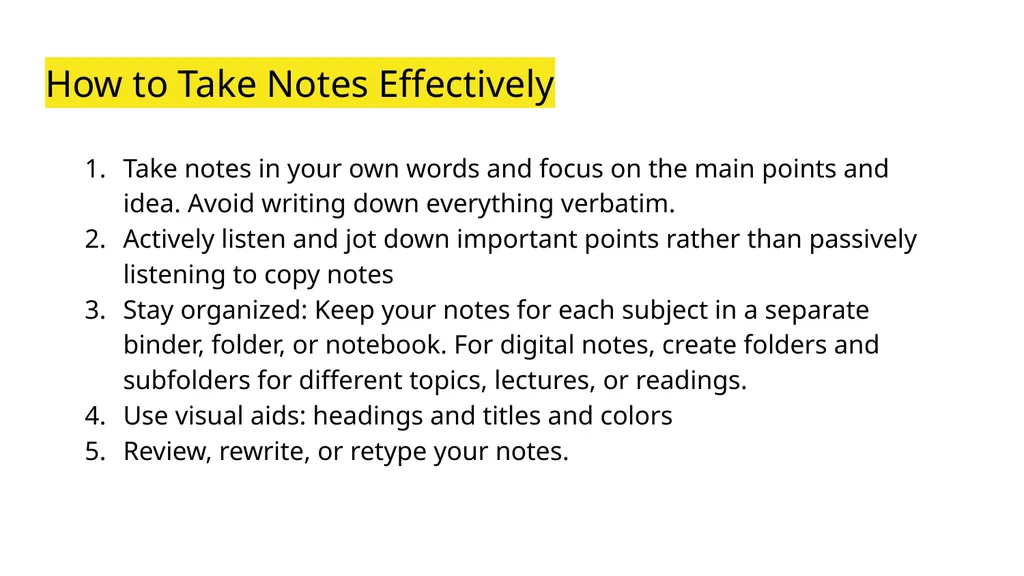
How to Take Notes Effectively Take notes in your own words and focus on the main points and idea. Avoid writing down everything verbatim.
Actively listen and jot down important points rather than passively listening to copy notes
Stay organized: Keep your notes for each subject in a separate binder, folder, or notebook. For digital notes, create folders and subfolders for different topics, lectures, or readings.
Use visual aids: headings and titles and colors
Review, rewrite, or retype your notes.<br>
07
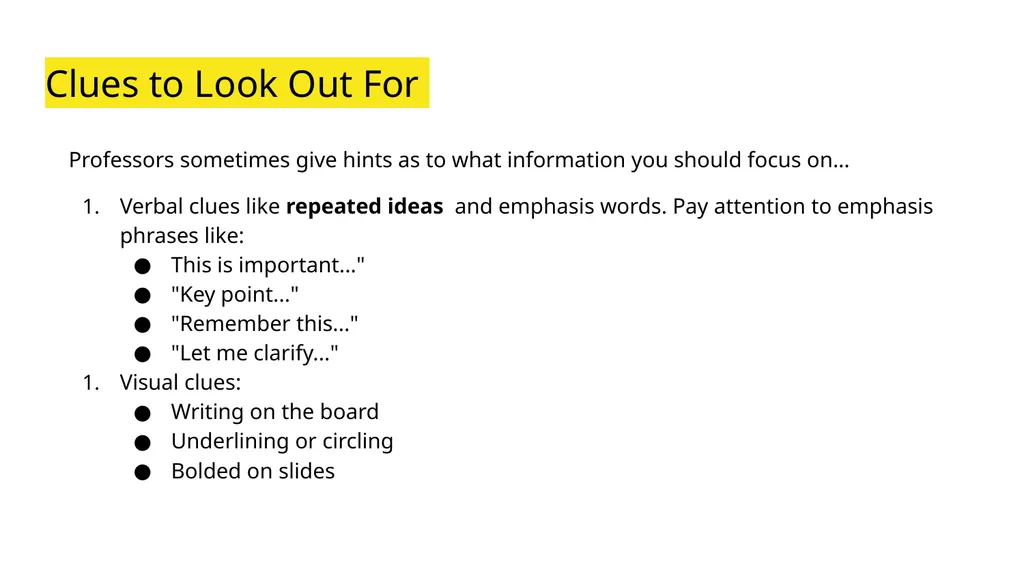
Clues to Look Out For Professors sometimes give hints as to what information you should focus on…
Verbal clues like repeated ideas and emphasis words. Pay attention to emphasis phrases like:
This is important..."
"Key point..."
"Remember this..."
"Let me clarify..."
Visual clues:
Writing on the board
Underlining or circling
Bolded on slides<br>
08
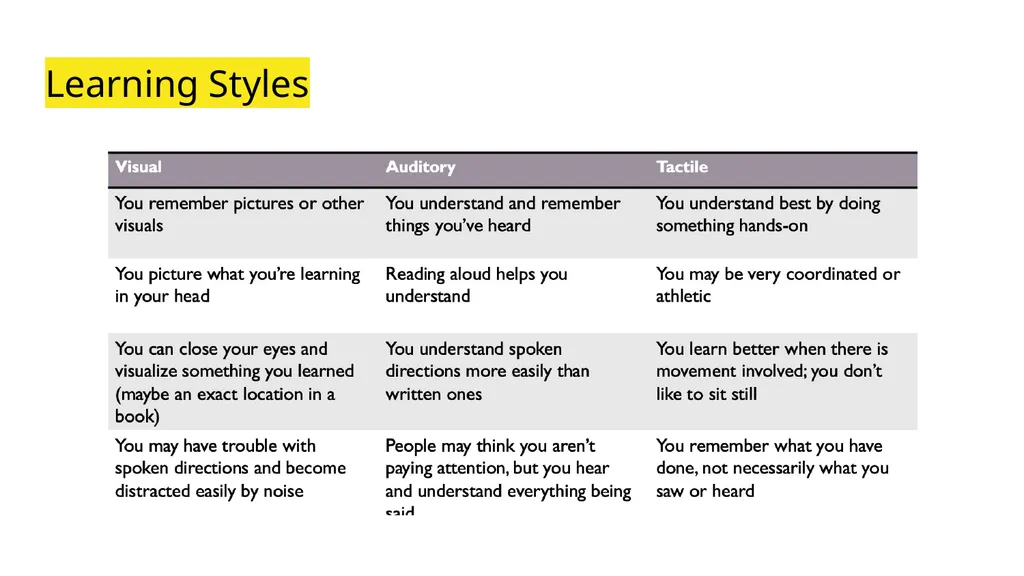
Learning Styles<br>
09
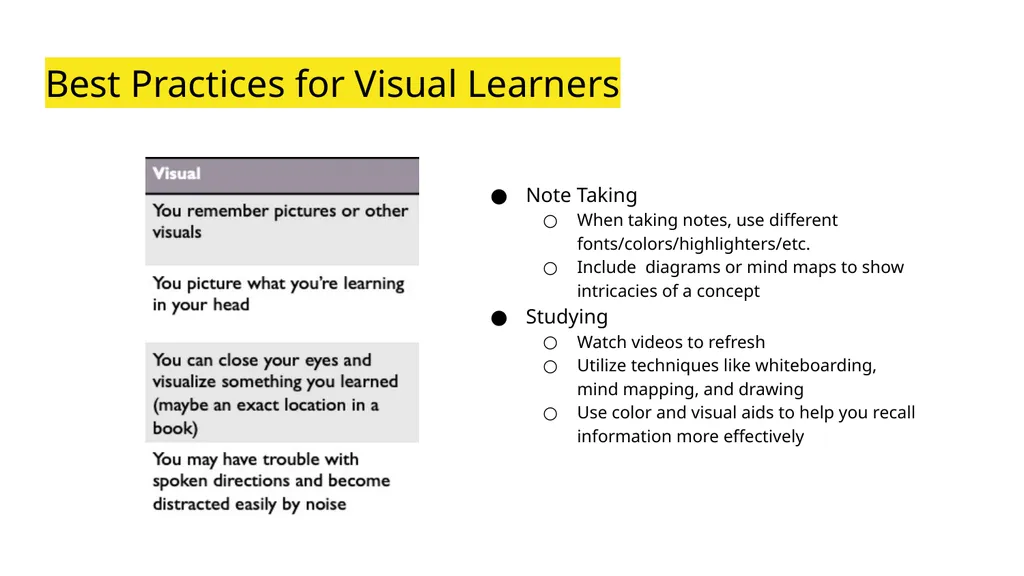
Best Practices for Visual Learners Note Taking
When taking notes, use different fonts/colors/highlighters/etc.
Include diagrams or mind maps to show intricacies of a concept
Studying
Watch videos to refresh
Utilize techniques like whiteboarding, mind mapping, and drawing
Use color and visual aids to help you recall information more effectively<br>
10
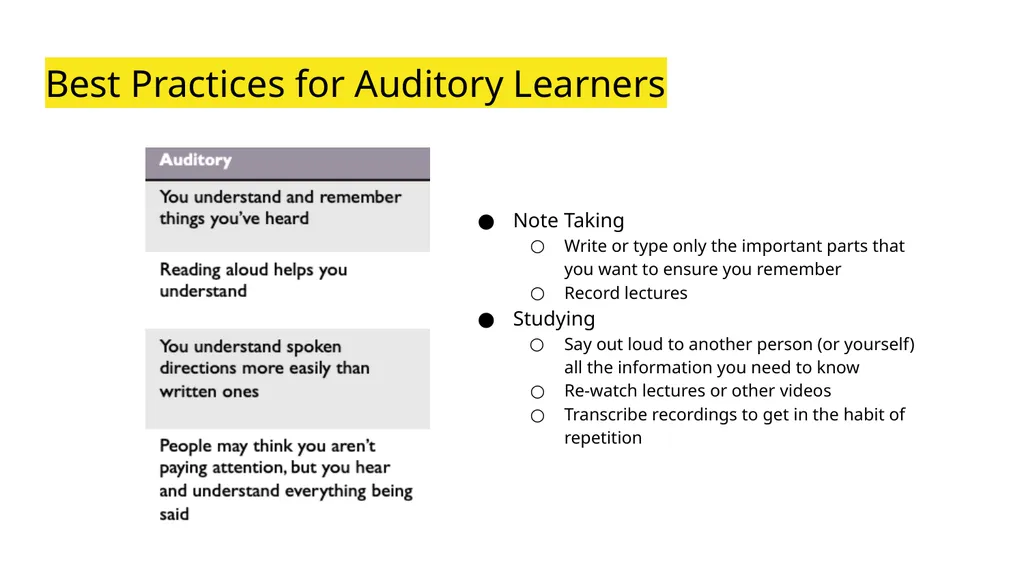
Best Practices for Auditory Learners Note Taking
Write or type only the important parts that you want to ensure you remember
Record lectures
Studying
Say out loud to another person (or yourself) all the information you need to know
Re-watch lectures or other videos
Transcribe recordings to get in the habit of repetition<br>
11
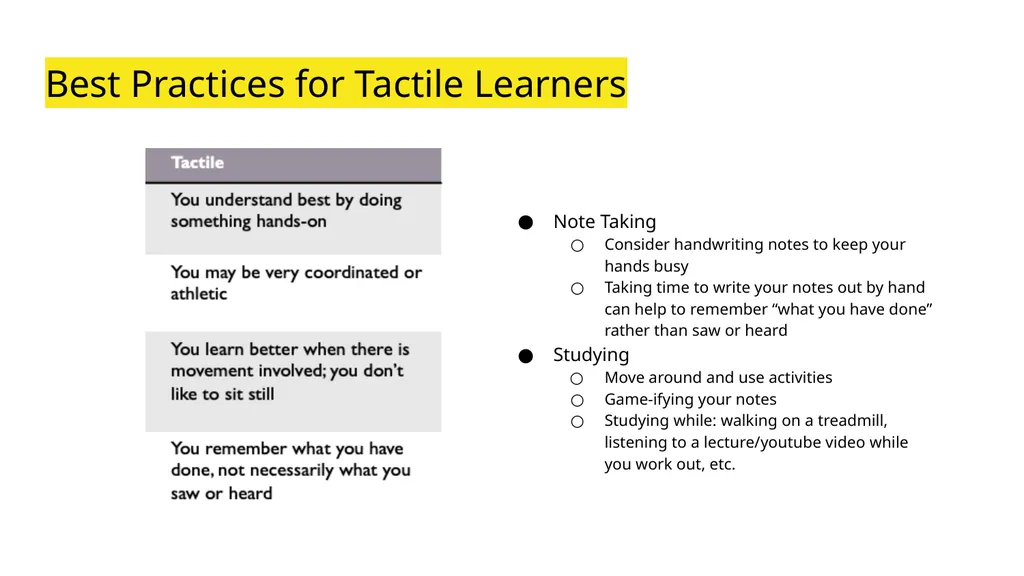
Best Practices for Tactile Learners Note Taking
Consider handwriting notes to keep your hands busy
Taking time to write your notes out by hand can help to remember “what you have done” rather than saw or heard
Studying
Move around and use activities
Game-ifying your notes
Studying while: walking on a treadmill, listening to a lecture/youtube video while you work out, etc.<br>
12
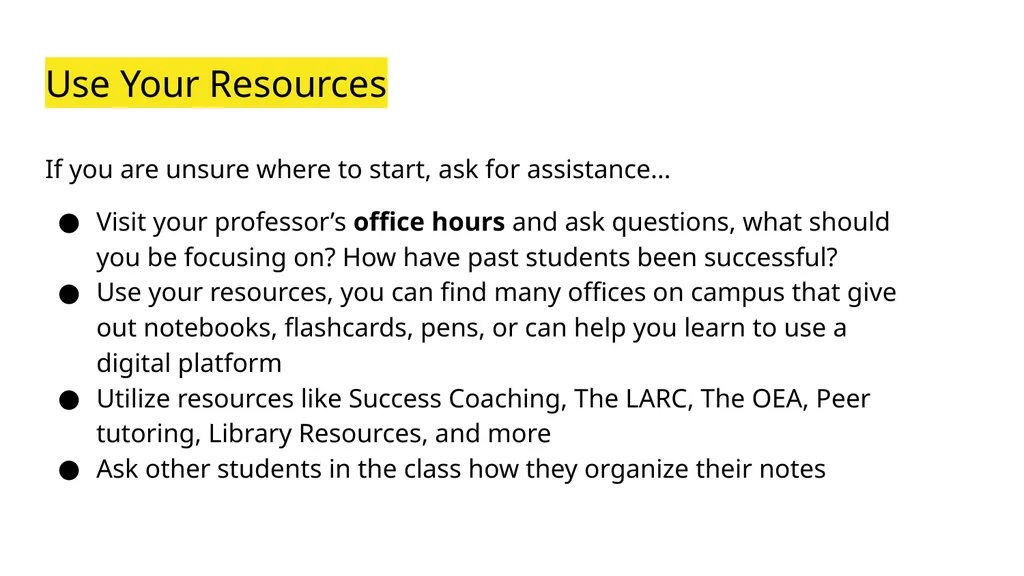
Use Your Resources If you are unsure where to start, ask for assistance…
Visit your professor’s office hours and ask questions, what should you be focusing on? How have past students been successful?
Use your resources, you can find many offices on campus that give out notebooks, flashcards, pens, or can help you learn to use a digital platform
Utilize resources like Success Coaching, The LARC, The OEA, Peer tutoring, Library Resources, and more
Ask other students in the class how they organize their notes<br>
13
Thank You! To receive more individualized Note Taking Assistance, Schedule an appointment with a Success Coach! 220 Lawrence Center
Phone: (610) 436-1067
Email: successcoaching@wcupa.edu<br>