
Note To Presenters: This PowerPoint is designed to
LO
Published · 49 slides · 0 views
1 / 1



Description
Note To Presenters: This PowerPoint is designed to be an adaptable resource. Presenters may use the full deck or select slides based on audience, time, and local priorities. The accompanying implementation guide provides suggestions for how
Related Topics
Share
Embed code
Download this presentation From Below
"Note To Presenters: This PowerPoint is designed to" is the property of its rightful owner. Permission is granted to download and print the materials on this website for personal, non-commercial use only, and to display it on your personal computer provided you do not modify the materials and that you retain all copyright notices contained in the materials. By downloading content from our website, you accept the terms of this agreement.
Presentation Transcript
01
Note To Presenters:
This PowerPoint is designed to be an adaptable resource. Presenters may use the full deck or select slides based on audience, time, and local priorities. The accompanying implementation guide provides suggestions for how to best use these materials. This slide deck is intended to be iterative. Please share feedback on how this slide deck could be improved by emailing community@theschwartzcenter.org.
Last Updated: July 2026
Hide this instructional slide before presenting.<br>
This PowerPoint is designed to be an adaptable resource. Presenters may use the full deck or select slides based on audience, time, and local priorities. The accompanying implementation guide provides suggestions for how to best use these materials. This slide deck is intended to be iterative. Please share feedback on how this slide deck could be improved by emailing community@theschwartzcenter.org.
Last Updated: July 2026
Hide this instructional slide before presenting.<br>
02
The Schwartz Rounds® Program An Evidence-Based Strategy To Strengthen Staff Well-being, Connection, and Cultures of Compassionate Care<br>
03
About the
Schwartz Center Our programs increase compassion in healthcare and create more meaningful connections between patients and healthcare professionals.
We work with more than 700 healthcare partners in the U.S., the U.K., Ireland, Canada, Australia, and New Zealand to advance compassion for patients, care teams, and their healing relationships.
Healthcare organizations face unprecedented challenges: staffing shortages, widespread provider burnout, mounting financial pressures, and deepening health disparities. We deliver evidence-based solutions that restore purpose to healthcare work, reduce burnout, and ensure that compassion remains at the heart of healing.<br>
We work with more than 700 healthcare partners in the U.S., the U.K., Ireland, Canada, Australia, and New Zealand to advance compassion for patients, care teams, and their healing relationships.
Healthcare organizations face unprecedented challenges: staffing shortages, widespread provider burnout, mounting financial pressures, and deepening health disparities. We deliver evidence-based solutions that restore purpose to healthcare work, reduce burnout, and ensure that compassion remains at the heart of healing.<br>
04
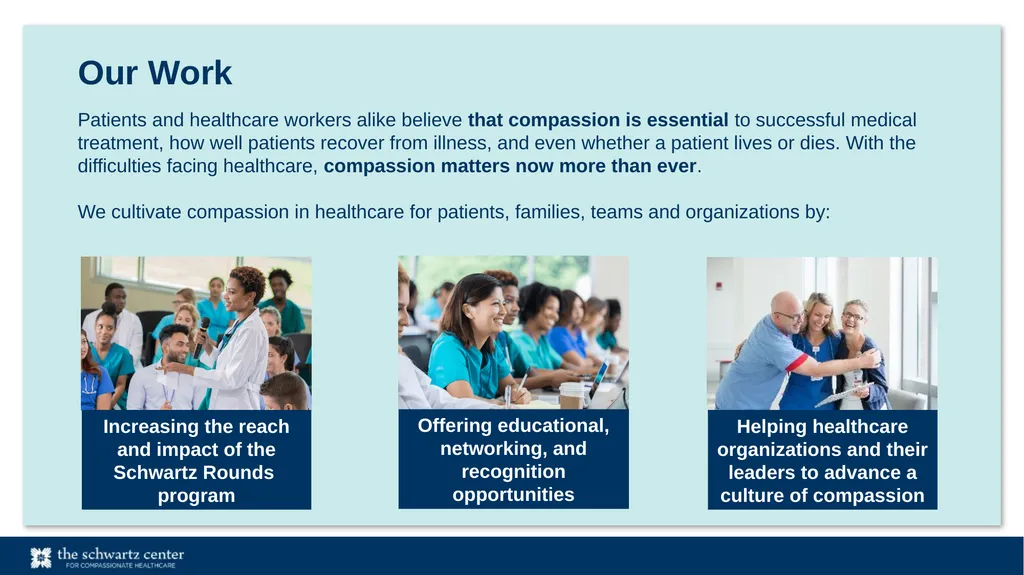
Our Work Patients and healthcare workers alike believe that compassion is essential to successful medical treatment, how well patients recover from illness, and even whether a patient lives or dies. With the difficulties facing healthcare, compassion matters now more than ever.
We cultivate compassion in healthcare for patients, families, teams and organizations by:<br>
We cultivate compassion in healthcare for patients, families, teams and organizations by:<br>
05
The Strategic Imperative<br>
06
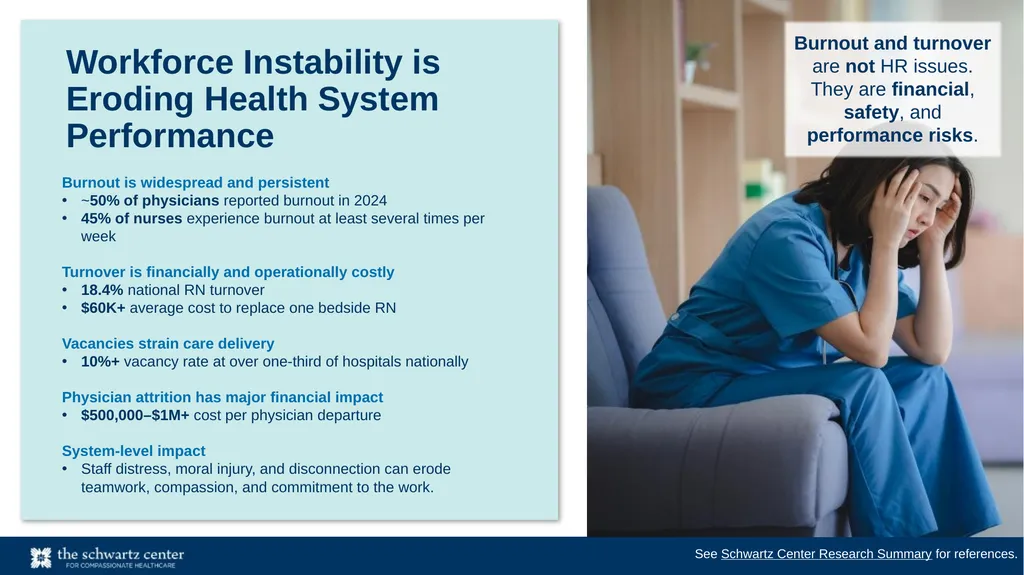
Workforce Instability is
Eroding Health System
Performance Burnout is widespread and persistent
~50% of physicians reported burnout in 2024
45% of nurses experience burnout at least several times per week
Turnover is financially and operationally costly
18.4% national RN turnover
$60K+ average cost to replace one bedside RN
Vacancies strain care delivery
10%+ vacancy rate at over one-third of hospitals nationally
Physician attrition has major financial impact
$500,000–$1M+ cost per physician departure
System-level impact
Staff distress, moral injury, and disconnection can erode teamwork, compassion, and commitment to the work. See Schwartz Center Research Summary for references.<br>
~50% of physicians reported burnout in 2024
45% of nurses experience burnout at least several times per week
Turnover is financially and operationally costly
18.4% national RN turnover
$60K+ average cost to replace one bedside RN
Vacancies strain care delivery
10%+ vacancy rate at over one-third of hospitals nationally
Physician attrition has major financial impact
$500,000–$1M+ cost per physician departure
System-level impact
Staff distress, moral injury, and disconnection can erode teamwork, compassion, and commitment to the work. See Schwartz Center Research Summary for references.<br>
07
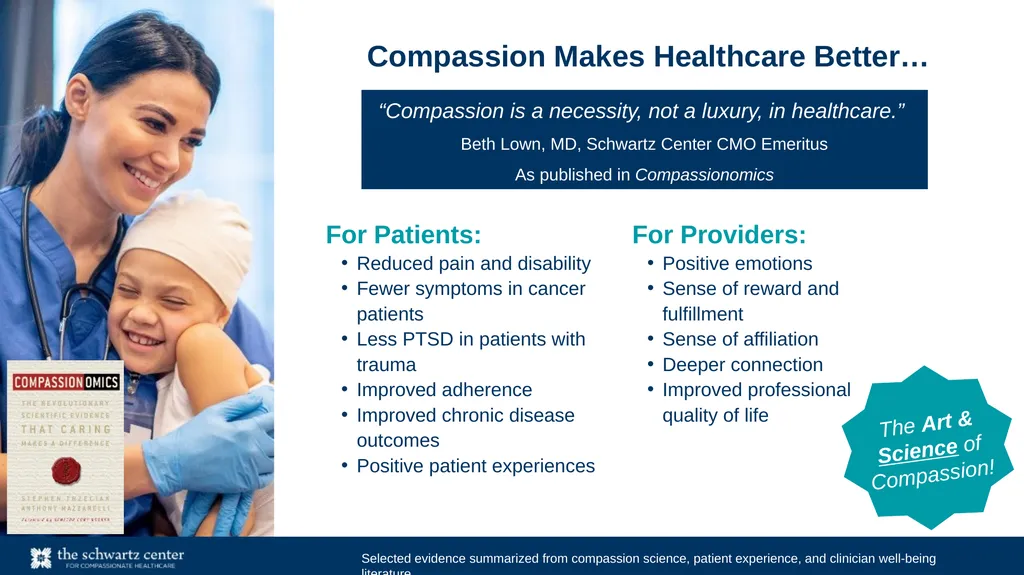
Compassion Makes Healthcare Better… For Patients:
Reduced pain and disability
Fewer symptoms in cancer patients
Less PTSD in patients with trauma
Improved adherence
Improved chronic disease outcomes
Positive patient experiences Selected evidence summarized from compassion science, patient experience, and clinician well-being literature. For Providers:
Positive emotions
Sense of reward and fulfillment
Sense of affiliation
Deeper connection
Improved professional quality of life<br>
Reduced pain and disability
Fewer symptoms in cancer patients
Less PTSD in patients with trauma
Improved adherence
Improved chronic disease outcomes
Positive patient experiences Selected evidence summarized from compassion science, patient experience, and clinician well-being literature. For Providers:
Positive emotions
Sense of reward and fulfillment
Sense of affiliation
Deeper connection
Improved professional quality of life<br>
08
Connect the Schwartz Rounds Program
to Local Strategic Priorities Presenter:
Customize this slide with 2-3 local priorities such as: workforce retention, staff well-being, patient experience, safety culture, teamwork and communication, and organizational culture.<br>
Customize this slide with 2-3 local priorities such as: workforce retention, staff well-being, patient experience, safety culture, teamwork and communication, and organizational culture.<br>
09
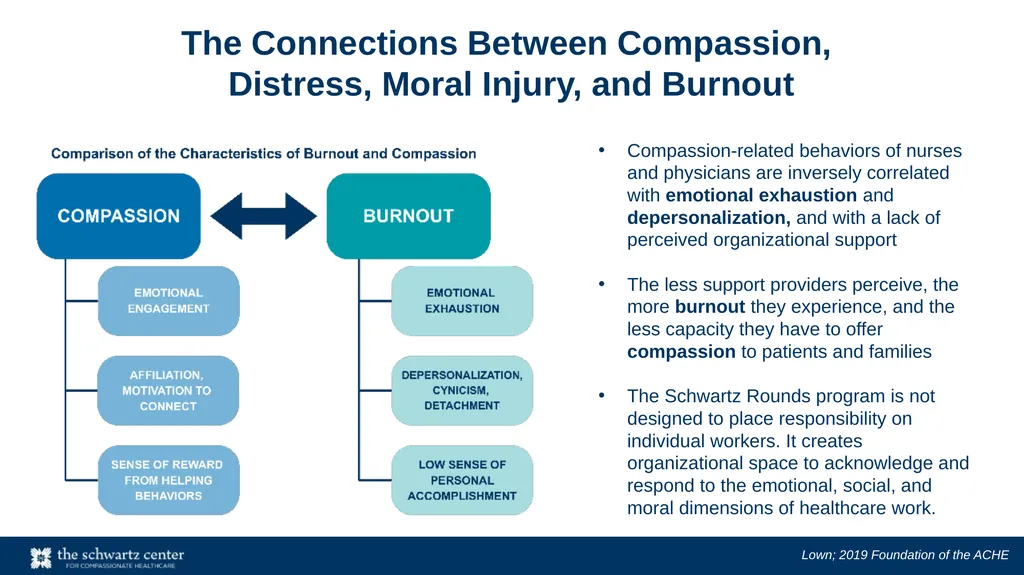
Lown; 2019 Foundation of the ACHE Compassion-related behaviors of nurses and physicians are inversely correlated with emotional exhaustion and depersonalization, and with a lack of perceived organizational support
The less support providers perceive, the more burnout they experience, and the less capacity they have to offer compassion to patients and families
The Schwartz Rounds program is not designed to place responsibility on individual workers. It creates organizational space to acknowledge and respond to the emotional, social, and moral dimensions of healthcare work. The Connections Between Compassion,
Distress, Moral Injury, and Burnout<br>
The less support providers perceive, the more burnout they experience, and the less capacity they have to offer compassion to patients and families
The Schwartz Rounds program is not designed to place responsibility on individual workers. It creates organizational space to acknowledge and respond to the emotional, social, and moral dimensions of healthcare work. The Connections Between Compassion,
Distress, Moral Injury, and Burnout<br>
10
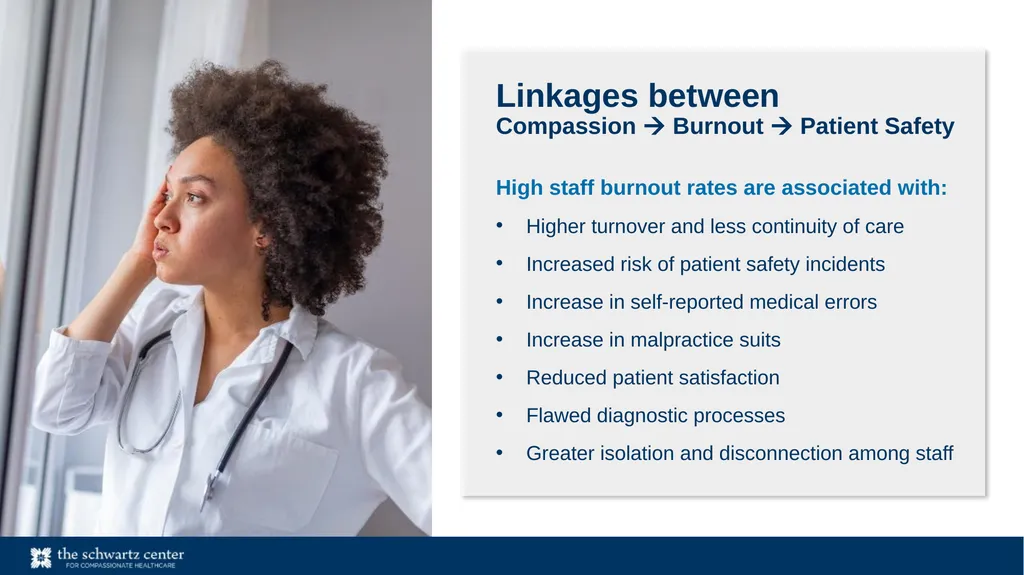
High staff burnout rates are associated with:
Higher turnover and less continuity of care
Increased risk of patient safety incidents
Increase in self-reported medical errors
Increase in malpractice suits
Reduced patient satisfaction
Flawed diagnostic processes
Greater isolation and disconnection among staff Linkages between Compassion Burnout Patient Safety<br>
Higher turnover and less continuity of care
Increased risk of patient safety incidents
Increase in self-reported medical errors
Increase in malpractice suits
Reduced patient satisfaction
Flawed diagnostic processes
Greater isolation and disconnection among staff Linkages between Compassion Burnout Patient Safety<br>
11
The Evidence-Based Solution<br>
12
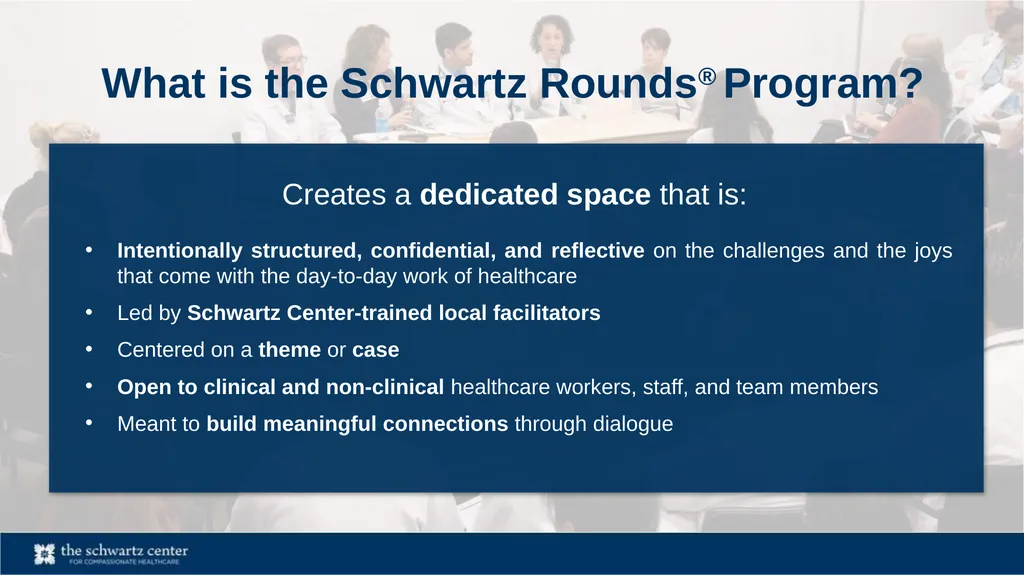
What is the Schwartz Rounds® Program? Creates a dedicated space that is:
Intentionally structured, confidential, and reflective on the challenges and the joys that come with the day-to-day work of healthcare
Led by Schwartz Center-trained local facilitators
Centered on a theme or case
Open to clinical and non-clinical healthcare workers, staff, and team members
Meant to build meaningful connections through dialogue<br>
Intentionally structured, confidential, and reflective on the challenges and the joys that come with the day-to-day work of healthcare
Led by Schwartz Center-trained local facilitators
Centered on a theme or case
Open to clinical and non-clinical healthcare workers, staff, and team members
Meant to build meaningful connections through dialogue<br>
13
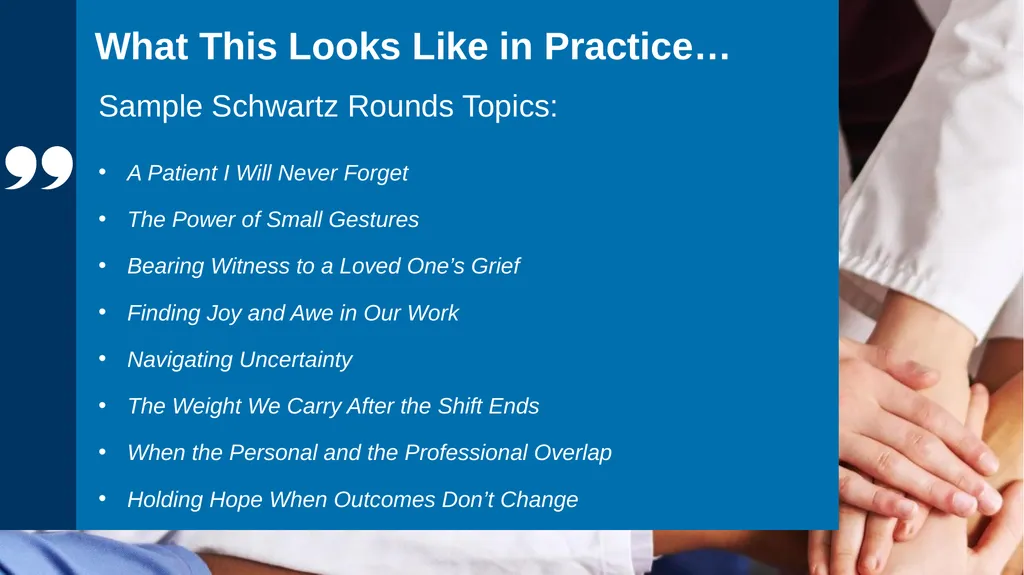
Sample Schwartz Rounds Topics:
A Patient I Will Never Forget
The Power of Small Gestures
Bearing Witness to a Loved One’s Grief
Finding Joy and Awe in Our Work
Navigating Uncertainty
The Weight We Carry After the Shift Ends
When the Personal and the Professional Overlap
Holding Hope When Outcomes Don’t Change What This Looks Like in Practice…<br>
A Patient I Will Never Forget
The Power of Small Gestures
Bearing Witness to a Loved One’s Grief
Finding Joy and Awe in Our Work
Navigating Uncertainty
The Weight We Carry After the Shift Ends
When the Personal and the Professional Overlap
Holding Hope When Outcomes Don’t Change What This Looks Like in Practice…<br>
14
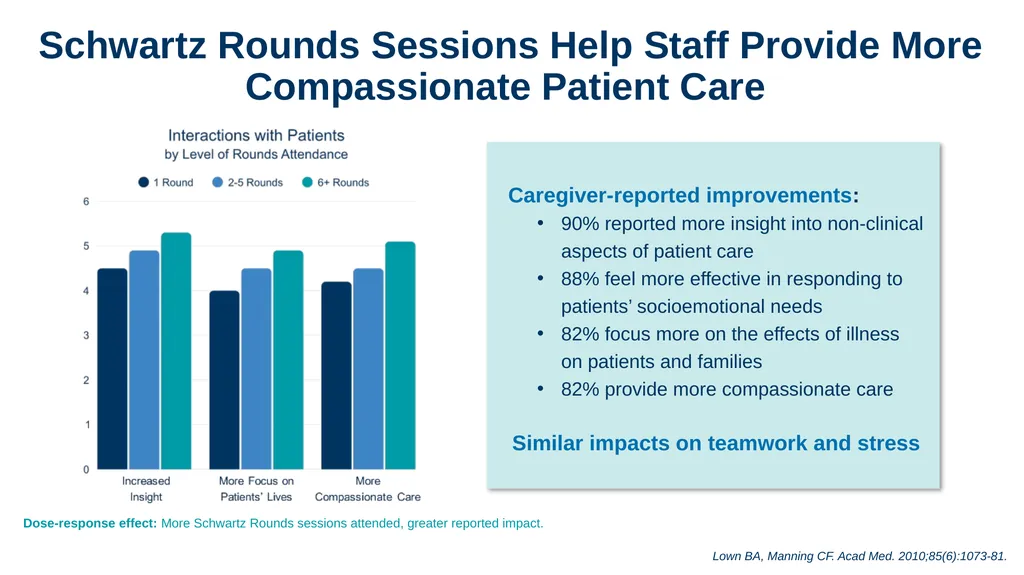
Schwartz Rounds Sessions Help Staff Provide More Compassionate Patient Care Lown BA, Manning CF. Acad Med. 2010;85(6):1073-81. Caregiver-reported improvements:
90% reported more insight into non-clinical aspects of patient care
88% feel more effective in responding to patients’ socioemotional needs
82% focus more on the effects of illness on patients and families
82% provide more compassionate care
Similar impacts on teamwork and stress Dose-response effect: More Schwartz Rounds sessions attended, greater reported impact.<br>
90% reported more insight into non-clinical aspects of patient care
88% feel more effective in responding to patients’ socioemotional needs
82% focus more on the effects of illness on patients and families
82% provide more compassionate care
Similar impacts on teamwork and stress Dose-response effect: More Schwartz Rounds sessions attended, greater reported impact.<br>
15
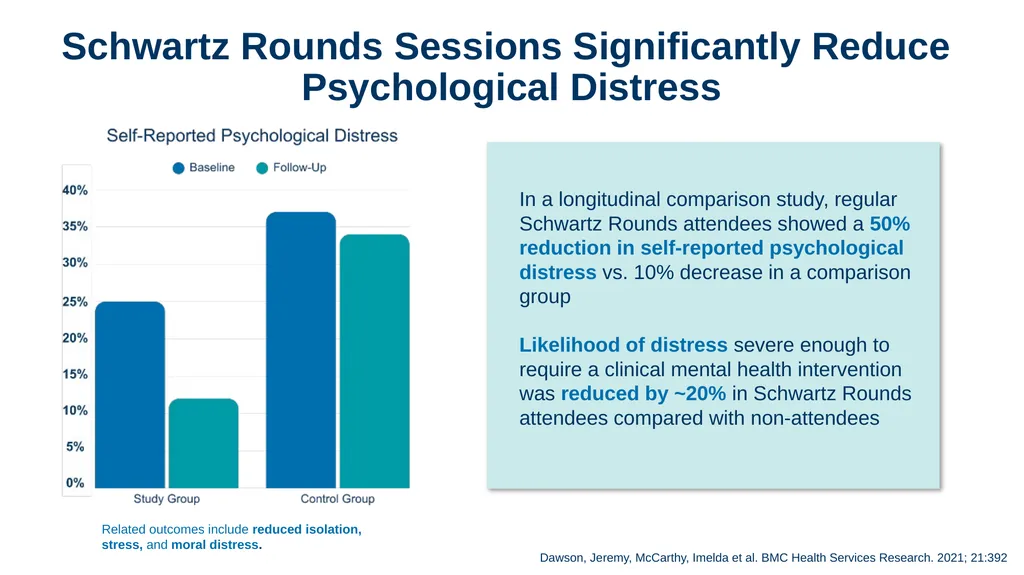
Schwartz Rounds Sessions Significantly Reduce
Psychological Distress Dawson, Jeremy, McCarthy, Imelda et al. BMC Health Services Research. 2021; 21:392 In a longitudinal comparison study, regular Schwartz Rounds attendees showed a 50% reduction in self-reported psychological distress vs. 10% decrease in a comparison group
Likelihood of distress severe enough to require a clinical mental health intervention was reduced by ~20% in Schwartz Rounds attendees compared with non-attendees Related outcomes include reduced isolation, stress, and moral distress.<br>
Psychological Distress Dawson, Jeremy, McCarthy, Imelda et al. BMC Health Services Research. 2021; 21:392 In a longitudinal comparison study, regular Schwartz Rounds attendees showed a 50% reduction in self-reported psychological distress vs. 10% decrease in a comparison group
Likelihood of distress severe enough to require a clinical mental health intervention was reduced by ~20% in Schwartz Rounds attendees compared with non-attendees Related outcomes include reduced isolation, stress, and moral distress.<br>
16
Individual Attendees Care Team Patient Care Organizations The Impact of the Schwartz Rounds 50% reduction in severe
psychological distress
Renewed passion and commitment
Reduced mental health stigma
Decreased isolation and stress
Reduced moral distress Improved understanding of
others' roles/perspectives
Increased teamwork and
communication
Leadership engagement and
flattening of hierarchy
Sense of shared purpose Increased compassion and empathy
Improved insight into patient
needs and concerns
Increased sensitivity to illness
impacts
Better patient satisfaction Changes in policies and practices
Positive/supportive work and
learning environment
Bridging and de-siloing of depts.
Visible leadership support
Ripple effects on culture<br>
psychological distress
Renewed passion and commitment
Reduced mental health stigma
Decreased isolation and stress
Reduced moral distress Improved understanding of
others' roles/perspectives
Increased teamwork and
communication
Leadership engagement and
flattening of hierarchy
Sense of shared purpose Increased compassion and empathy
Improved insight into patient
needs and concerns
Increased sensitivity to illness
impacts
Better patient satisfaction Changes in policies and practices
Positive/supportive work and
learning environment
Bridging and de-siloing of depts.
Visible leadership support
Ripple effects on culture<br>
17
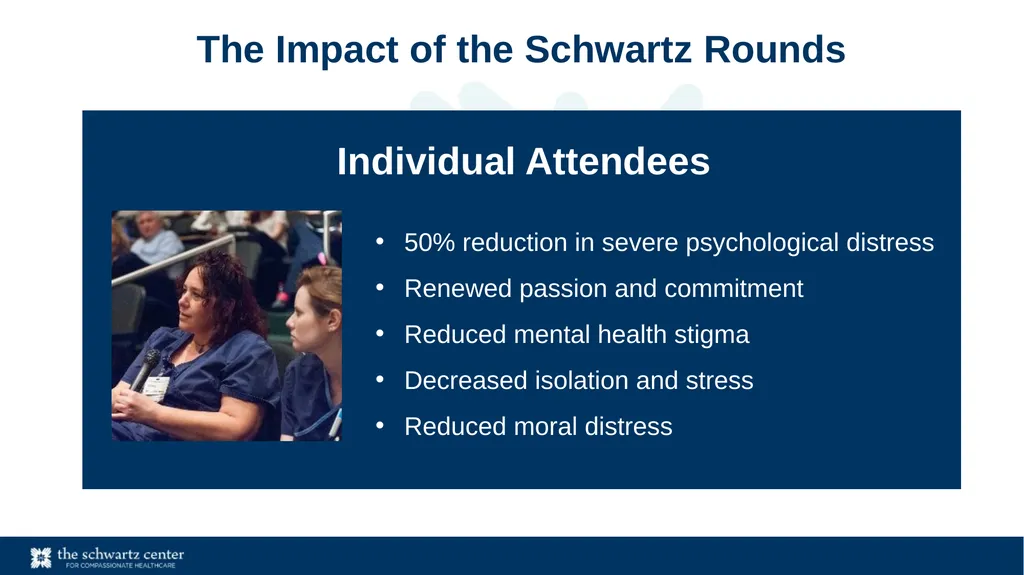
Individual Attendees The Impact of the Schwartz Rounds 50% reduction in severe psychological distress
Renewed passion and commitment
Reduced mental health stigma
Decreased isolation and stress
Reduced moral distress<br>
Renewed passion and commitment
Reduced mental health stigma
Decreased isolation and stress
Reduced moral distress<br>
18
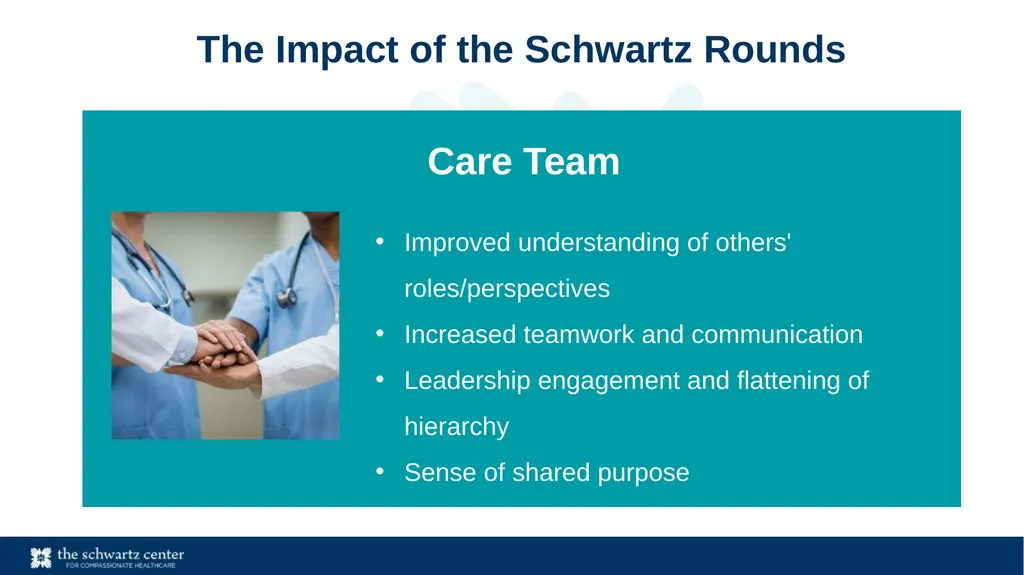
Care Team The Impact of the Schwartz Rounds Improved understanding of others' roles/perspectives
Increased teamwork and communication
Leadership engagement and flattening of hierarchy
Sense of shared purpose<br>
Increased teamwork and communication
Leadership engagement and flattening of hierarchy
Sense of shared purpose<br>
19
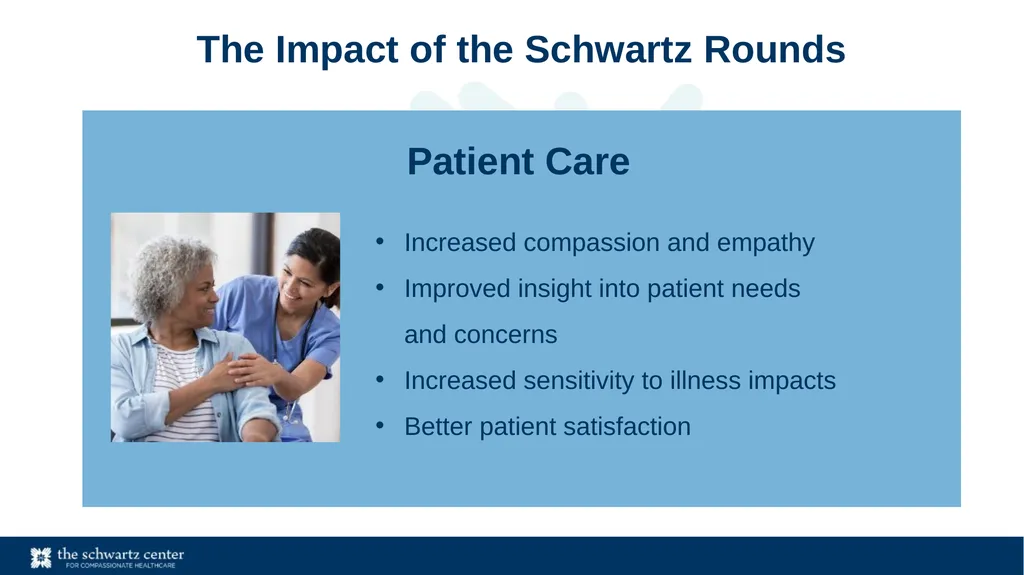
Patient Care The Impact of the Schwartz Rounds Increased compassion and empathy
Improved insight into patient needs and concerns
Increased sensitivity to illness impacts
Better patient satisfaction<br>
Improved insight into patient needs and concerns
Increased sensitivity to illness impacts
Better patient satisfaction<br>
20
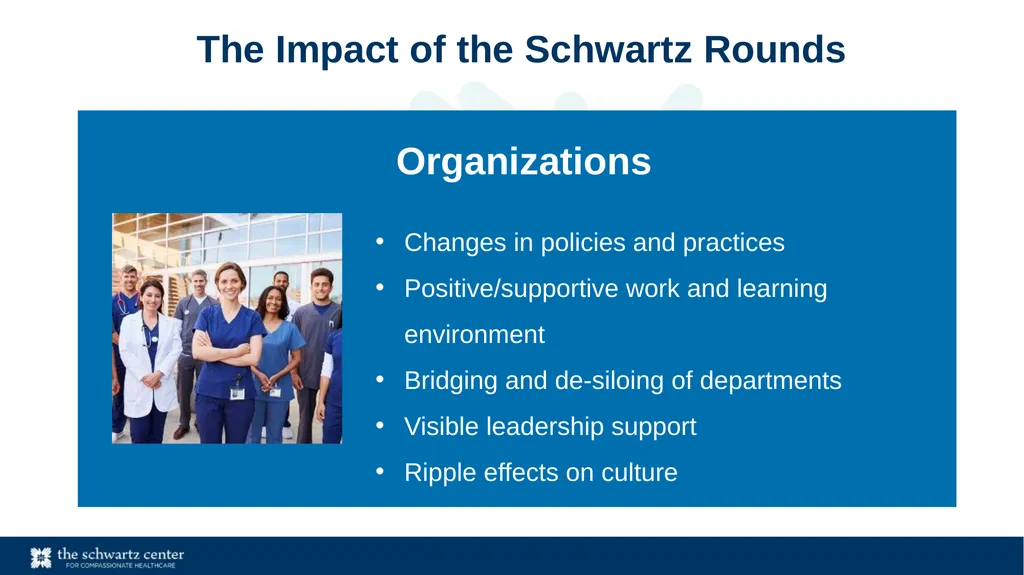
Organizations The Impact of the Schwartz Rounds Changes in policies and practices
Positive/supportive work and learning environment
Bridging and de-siloing of departments
Visible leadership support
Ripple effects on culture<br>
Positive/supportive work and learning environment
Bridging and de-siloing of departments
Visible leadership support
Ripple effects on culture<br>
21
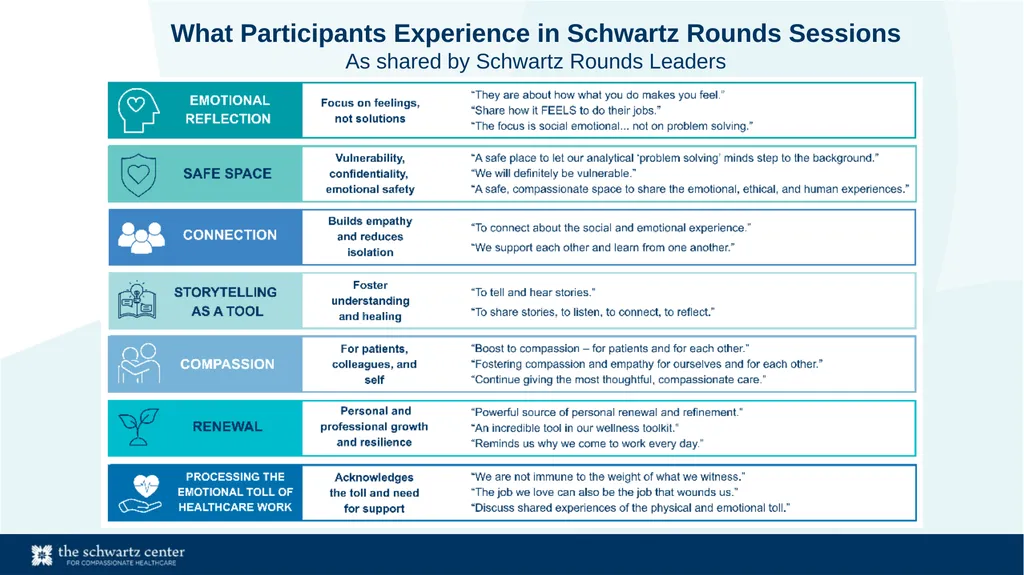
What Participants Experience in Schwartz Rounds Sessions
As shared by Schwartz Rounds Leaders<br>
As shared by Schwartz Rounds Leaders<br>
22
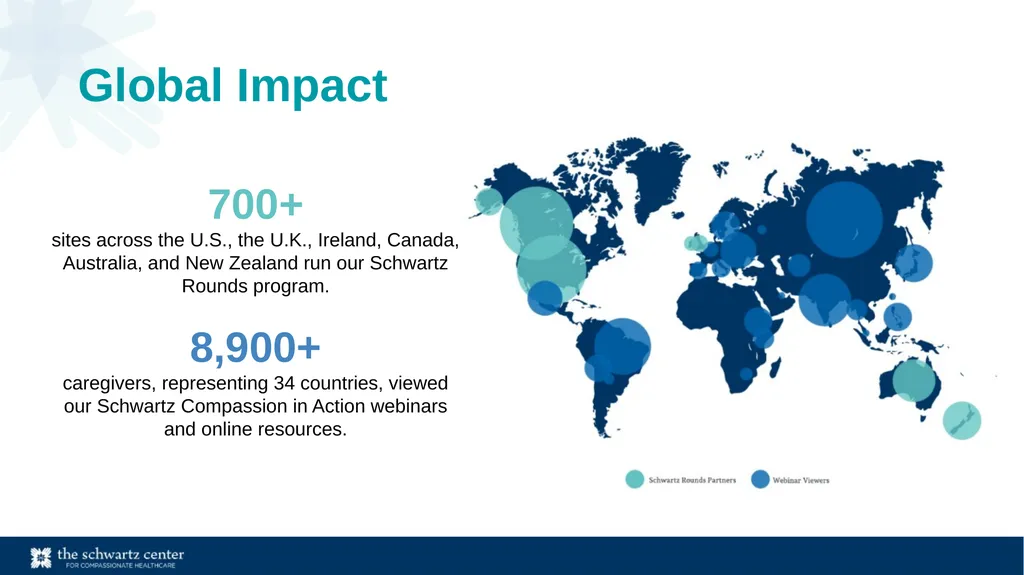
Global Impact 700+
sites across the U.S., the U.K., Ireland, Canada, Australia, and New Zealand run our Schwartz Rounds program.
8,900+
caregivers, representing 34 countries, viewed our Schwartz Compassion in Action webinars and online resources.<br>
sites across the U.S., the U.K., Ireland, Canada, Australia, and New Zealand run our Schwartz Rounds program.
8,900+
caregivers, representing 34 countries, viewed our Schwartz Compassion in Action webinars and online resources.<br>
23
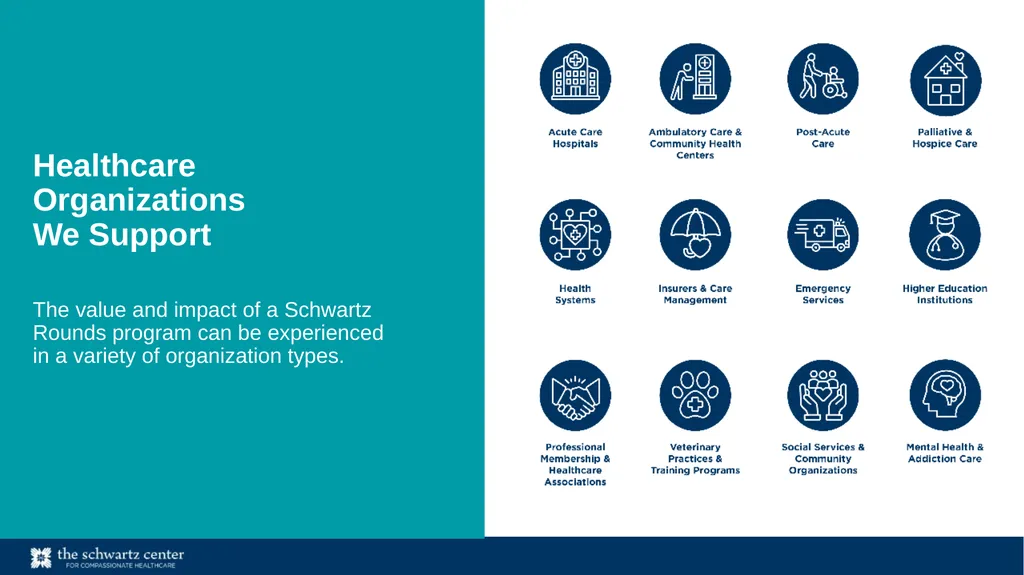
The value and impact of a Schwartz Rounds program can be experienced in a variety of organization types. Healthcare Organizations
We Support<br>
24
The Case for Adoption NOW<br>
25
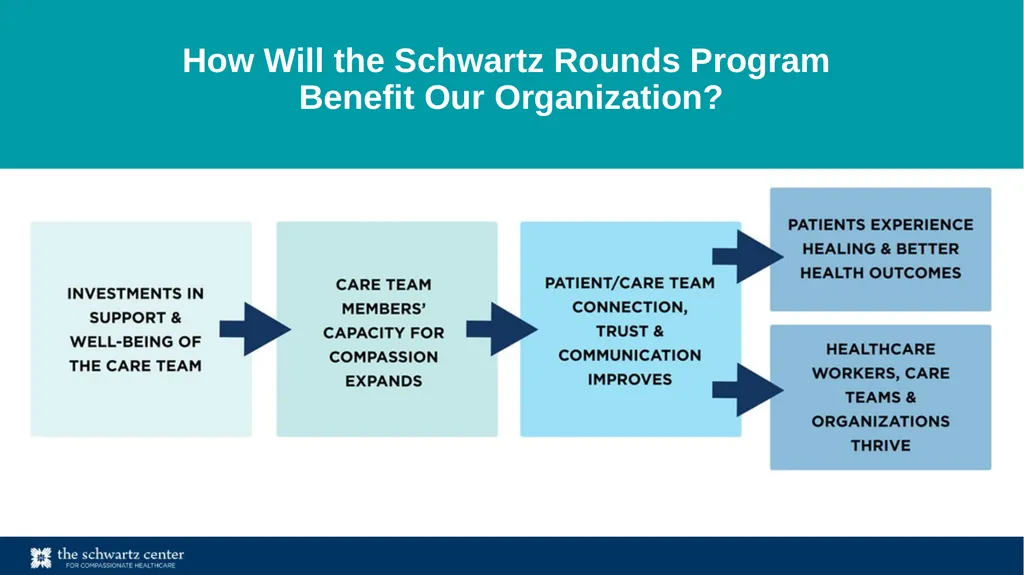
How Will the Schwartz Rounds Program
Benefit Our Organization?<br>
26
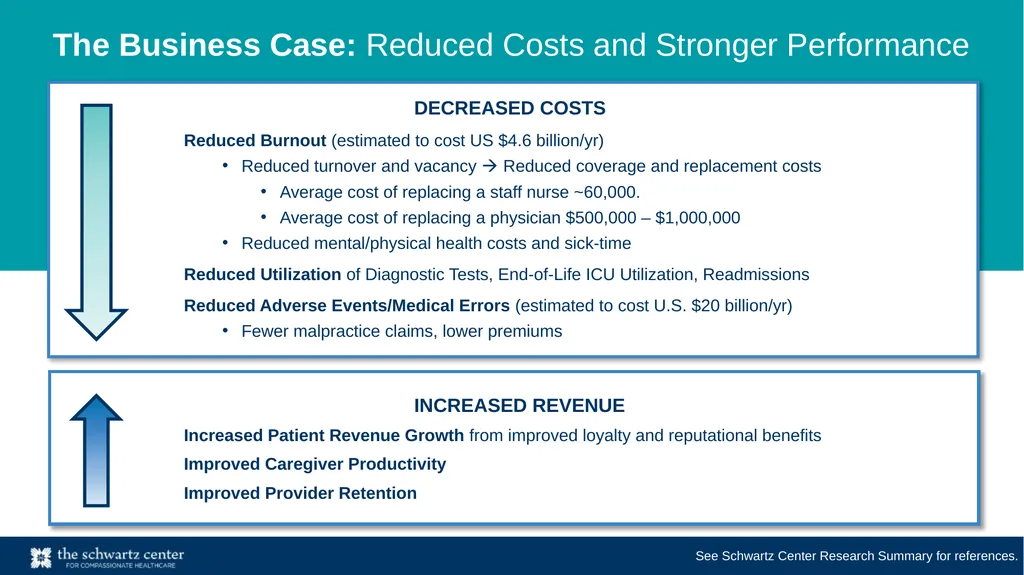
DECREASED COSTS
Reduced Burnout (estimated to cost US $4.6 billion/yr)
Reduced turnover and vacancy Reduced coverage and replacement costs
Average cost of replacing a staff nurse ~60,000.
Average cost of replacing a physician $500,000 – $1,000,000
Reduced mental/physical health costs and sick-time
Reduced Utilization of Diagnostic Tests, End-of-Life ICU Utilization, Readmissions
Reduced Adverse Events/Medical Errors (estimated to cost U.S. $20 billion/yr)
Fewer malpractice claims, lower premiums The Business Case: Reduced Costs and Stronger Performance INCREASED REVENUE
Increased Patient Revenue Growth from improved loyalty and reputational benefits
Improved Caregiver Productivity
Improved Provider Retention See Schwartz Center Research Summary for references.<br>
Reduced Burnout (estimated to cost US $4.6 billion/yr)
Reduced turnover and vacancy Reduced coverage and replacement costs
Average cost of replacing a staff nurse ~60,000.
Average cost of replacing a physician $500,000 – $1,000,000
Reduced mental/physical health costs and sick-time
Reduced Utilization of Diagnostic Tests, End-of-Life ICU Utilization, Readmissions
Reduced Adverse Events/Medical Errors (estimated to cost U.S. $20 billion/yr)
Fewer malpractice claims, lower premiums The Business Case: Reduced Costs and Stronger Performance INCREASED REVENUE
Increased Patient Revenue Growth from improved loyalty and reputational benefits
Improved Caregiver Productivity
Improved Provider Retention See Schwartz Center Research Summary for references.<br>
27
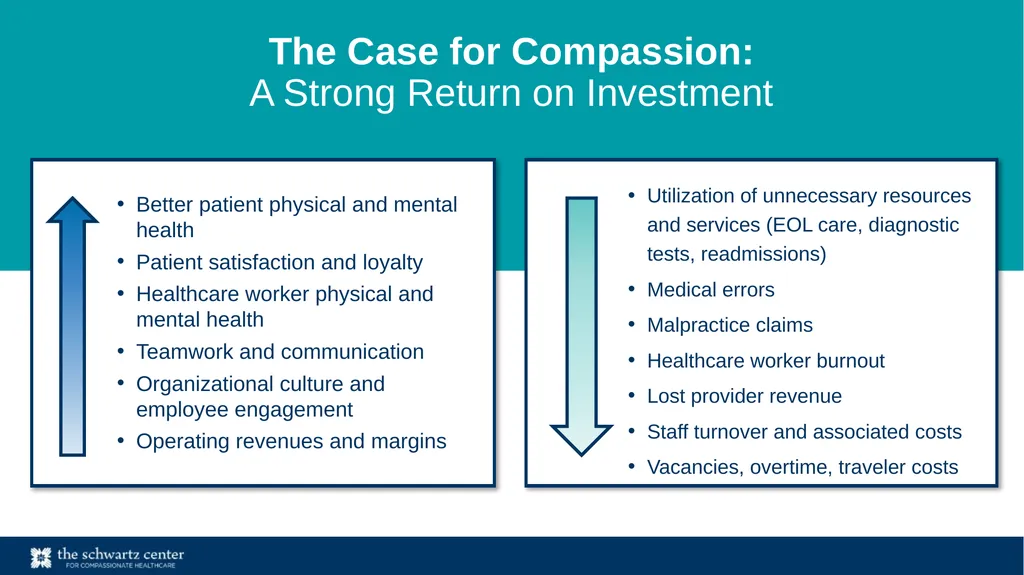
The Case for Compassion:
A Strong Return on Investment Utilization of unnecessary resources and services (EOL care, diagnostic tests, readmissions)
Medical errors
Malpractice claims
Healthcare worker burnout
Lost provider revenue
Staff turnover and associated costs
Vacancies, overtime, traveler costs Better patient physical and mental health
Patient satisfaction and loyalty
Healthcare worker physical and mental health
Teamwork and communication
Organizational culture and employee engagement
Operating revenues and margins<br>
Medical errors
Malpractice claims
Healthcare worker burnout
Lost provider revenue
Staff turnover and associated costs
Vacancies, overtime, traveler costs Better patient physical and mental health
Patient satisfaction and loyalty
Healthcare worker physical and mental health
Teamwork and communication
Organizational culture and employee engagement
Operating revenues and margins<br>
28
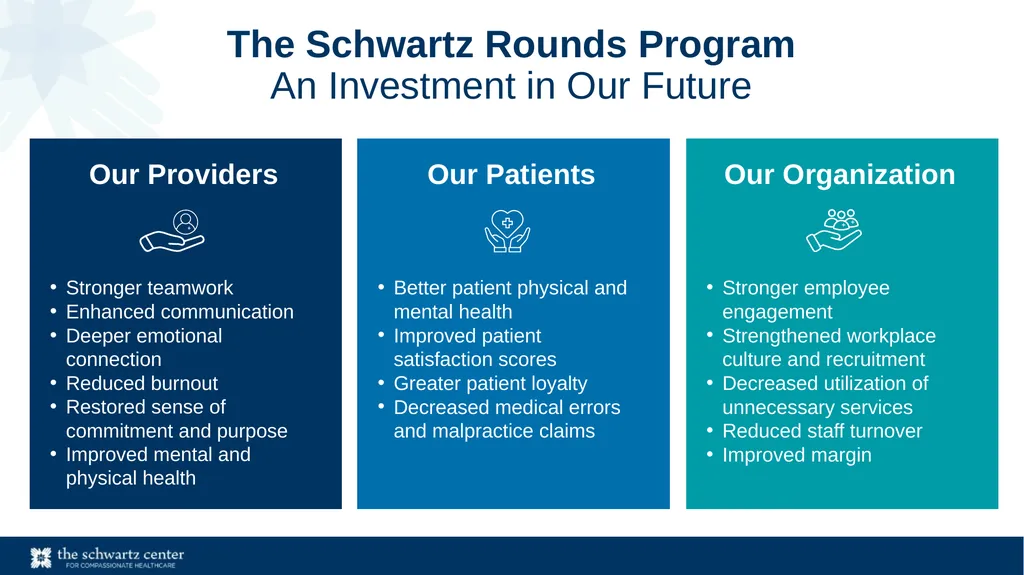
The Schwartz Rounds Program
An Investment in Our Future<br>
29
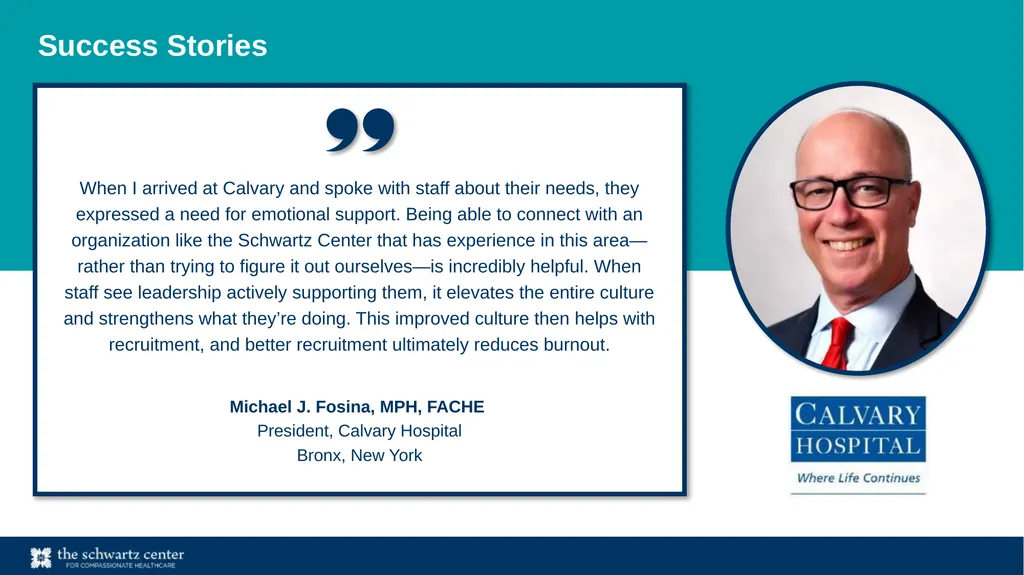
Success Stories When I arrived at Calvary and spoke with staff about their needs, they expressed a need for emotional support. Being able to connect with an organization like the Schwartz Center that has experience in this area—rather than trying to figure it out ourselves—is incredibly helpful. When staff see leadership actively supporting them, it elevates the entire culture and strengthens what they’re doing. This improved culture then helps with recruitment, and better recruitment ultimately reduces burnout.
Michael J. Fosina, MPH, FACHE
President, Calvary Hospital
Bronx, New York<br>
Michael J. Fosina, MPH, FACHE
President, Calvary Hospital
Bronx, New York<br>
30
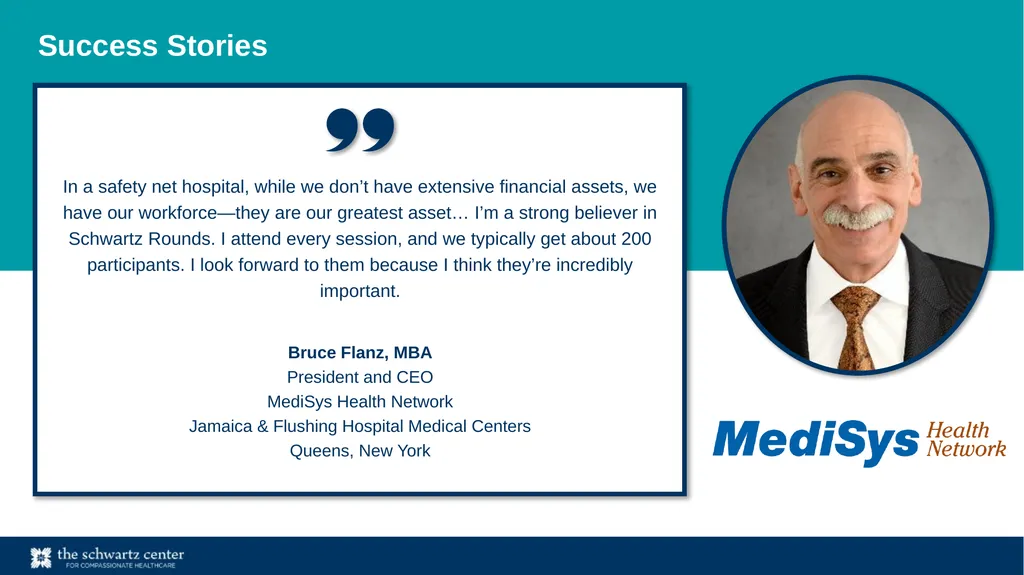
Success Stories In a safety net hospital, while we don’t have extensive financial assets, we have our workforce—they are our greatest asset… I’m a strong believer in Schwartz Rounds. I attend every session, and we typically get about 200 participants. I look forward to them because I think they’re incredibly important.
Bruce Flanz, MBA
President and CEO
MediSys Health Network
Jamaica & Flushing Hospital Medical Centers
Queens, New York<br>
Bruce Flanz, MBA
President and CEO
MediSys Health Network
Jamaica & Flushing Hospital Medical Centers
Queens, New York<br>
31
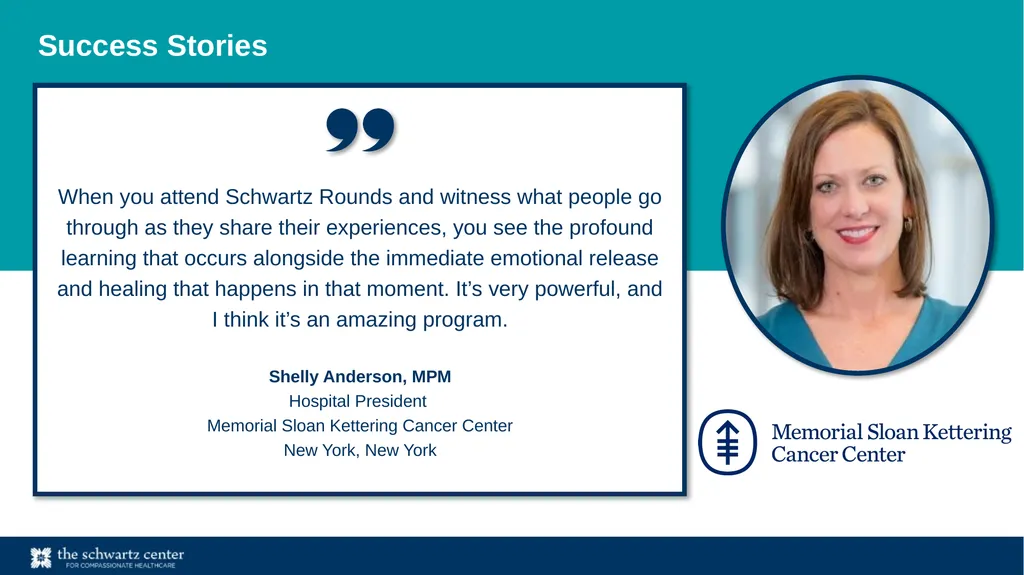
When you attend Schwartz Rounds and witness what people go through as they share their experiences, you see the profound learning that occurs alongside the immediate emotional release and healing that happens in that moment. It’s very powerful, and I think it’s an amazing program.
Shelly Anderson, MPM
Hospital President
Memorial Sloan Kettering Cancer Center
New York, New York Success Stories<br>
Shelly Anderson, MPM
Hospital President
Memorial Sloan Kettering Cancer Center
New York, New York Success Stories<br>
32
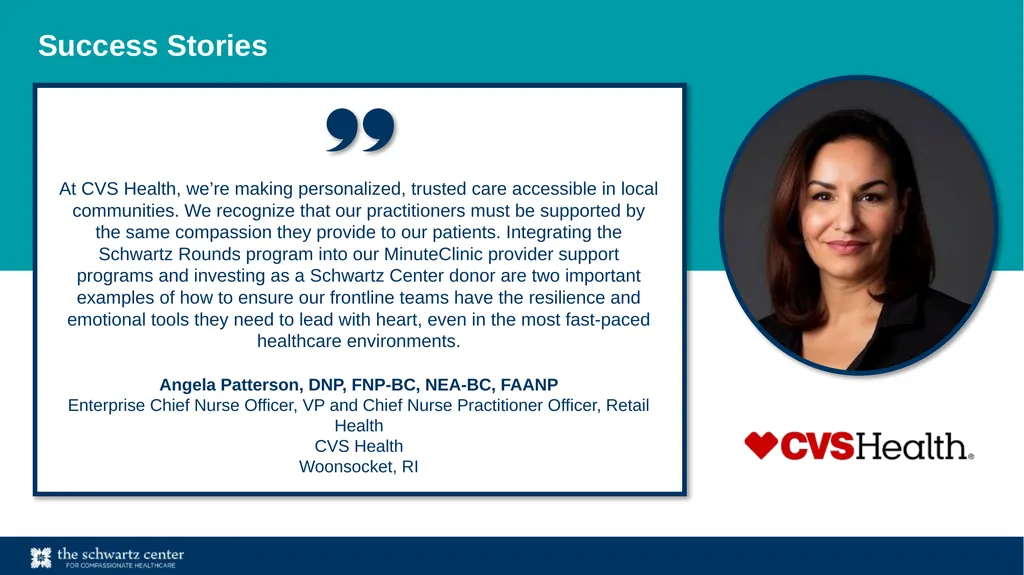
Success Stories At CVS Health, we’re making personalized, trusted care accessible in local communities. We recognize that our practitioners must be supported by the same compassion they provide to our patients. Integrating the Schwartz Rounds program into our MinuteClinic provider support programs and investing as a Schwartz Center donor are two important examples of how to ensure our frontline teams have the resilience and emotional tools they need to lead with heart, even in the most fast-paced healthcare environments.
Angela Patterson, DNP, FNP-BC, NEA-BC, FAANP
Enterprise Chief Nurse Officer, VP and Chief Nurse Practitioner Officer, Retail Health CVS Health
Woonsocket, RI<br>
Angela Patterson, DNP, FNP-BC, NEA-BC, FAANP
Enterprise Chief Nurse Officer, VP and Chief Nurse Practitioner Officer, Retail Health CVS Health
Woonsocket, RI<br>
33
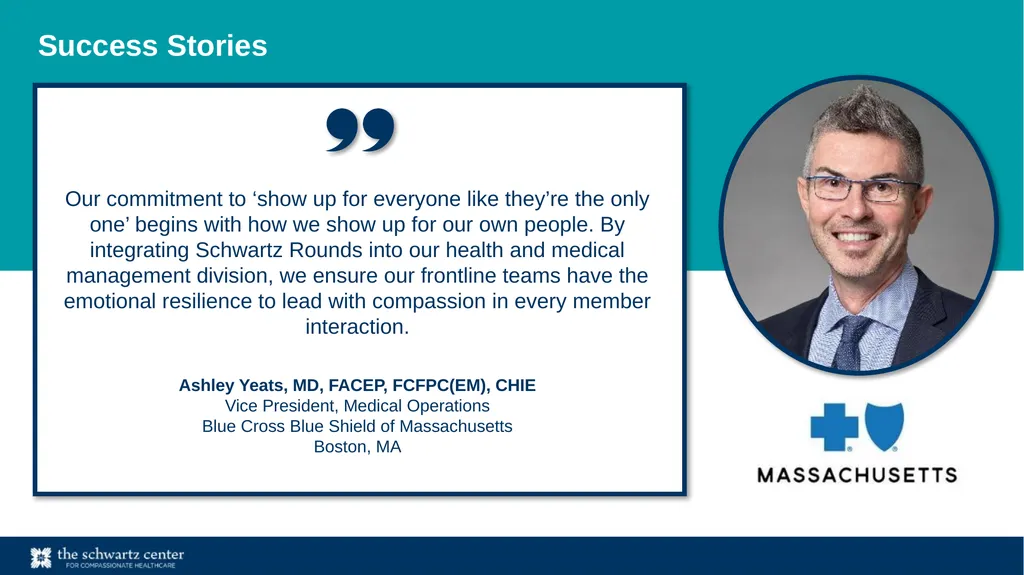
Success Stories Our commitment to ‘show up for everyone like they’re the only one’ begins with how we show up for our own people. By integrating Schwartz Rounds into our health and medical management division, we ensure our frontline teams have the emotional resilience to lead with compassion in every member interaction.
Ashley Yeats, MD, FACEP, FCFPC(EM), CHIE
Vice President, Medical Operations
Blue Cross Blue Shield of Massachusetts
Boston, MA<br>
Ashley Yeats, MD, FACEP, FCFPC(EM), CHIE
Vice President, Medical Operations
Blue Cross Blue Shield of Massachusetts
Boston, MA<br>
34
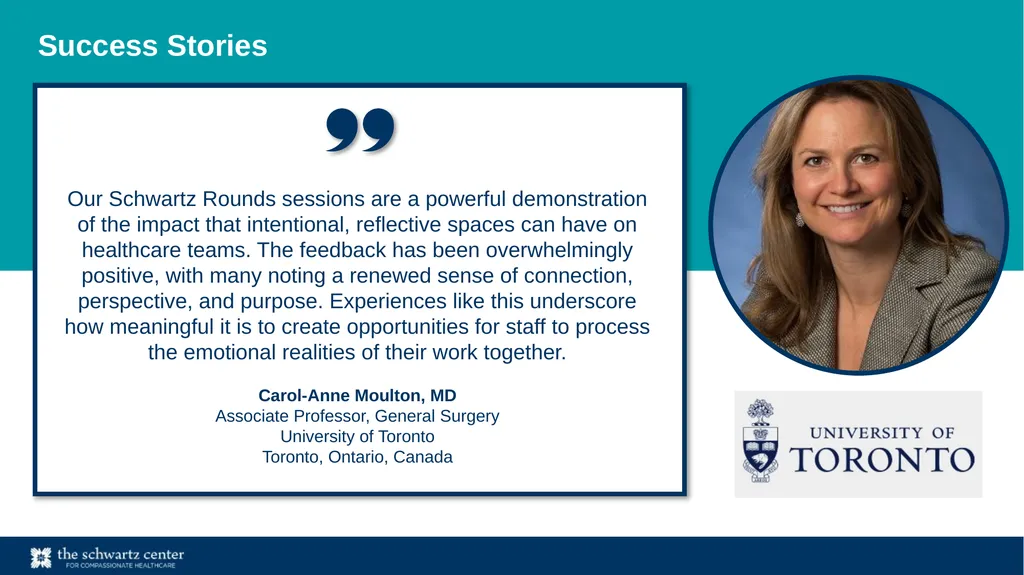
Success Stories Our Schwartz Rounds sessions are a powerful demonstration of the impact that intentional, reflective spaces can have on healthcare teams. The feedback has been overwhelmingly positive, with many noting a renewed sense of connection, perspective, and purpose. Experiences like this underscore how meaningful it is to create opportunities for staff to process the emotional realities of their work together.
Carol-Anne Moulton, MD
Associate Professor, General Surgery
University of Toronto
Toronto, Ontario, Canada<br>
Carol-Anne Moulton, MD
Associate Professor, General Surgery
University of Toronto
Toronto, Ontario, Canada<br>
35
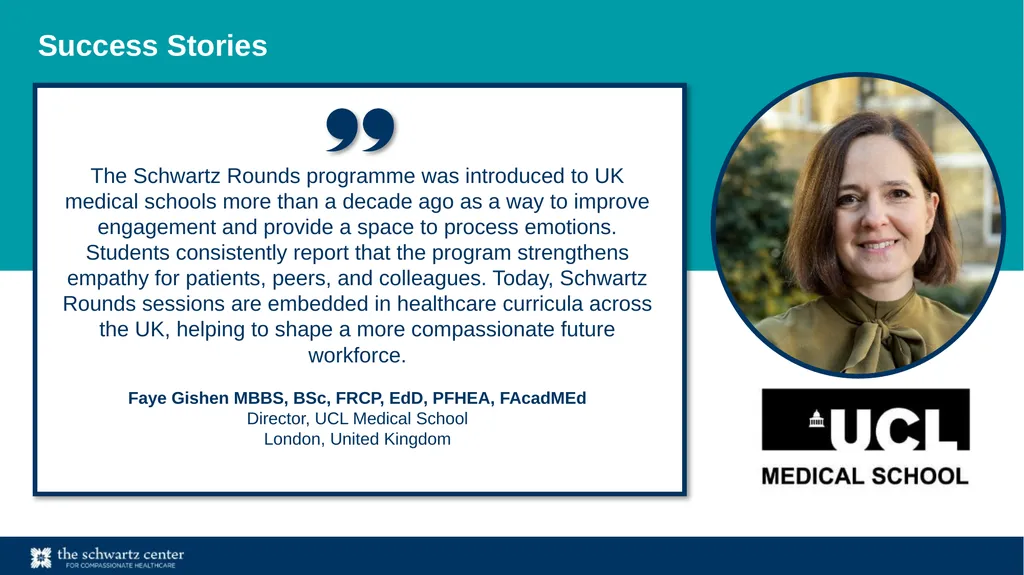
Success Stories The Schwartz Rounds programme was introduced to UK medical schools more than a decade ago as a way to improve engagement and provide a space to process emotions. Students consistently report that the program strengthens empathy for patients, peers, and colleagues. Today, Schwartz Rounds sessions are embedded in healthcare curricula across the UK, helping to shape a more compassionate future workforce.
Faye Gishen MBBS, BSc, FRCP, EdD, PFHEA, FAcadMEd
Director, UCL Medical School
London, United Kingdom<br>
Faye Gishen MBBS, BSc, FRCP, EdD, PFHEA, FAcadMEd
Director, UCL Medical School
London, United Kingdom<br>
36
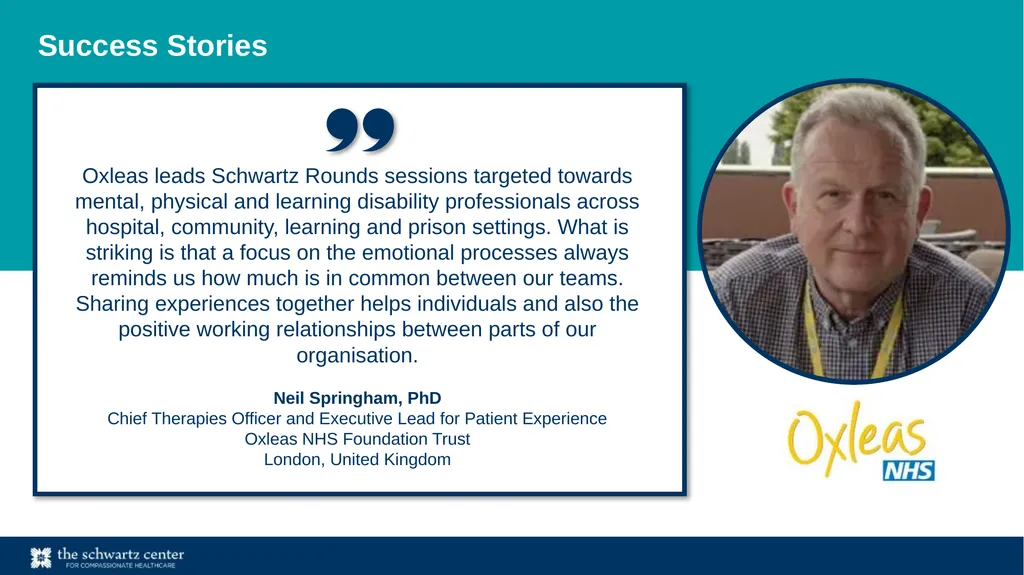
Success Stories Oxleas leads Schwartz Rounds sessions targeted towards mental, physical and learning disability professionals across hospital, community, learning and prison settings. What is striking is that a focus on the emotional processes always reminds us how much is in common between our teams. Sharing experiences together helps individuals and also the positive working relationships between parts of our organisation.
Neil Springham, PhD
Chief Therapies Officer and Executive Lead for Patient Experience
Oxleas NHS Foundation Trust
London, United Kingdom<br>
Neil Springham, PhD
Chief Therapies Officer and Executive Lead for Patient Experience
Oxleas NHS Foundation Trust
London, United Kingdom<br>
37
Adoption Pathway Getting started is simpler than many leaders expect, and the Schwartz Center for Compassionate Healthcare provides support throughout the journey.<br>
38
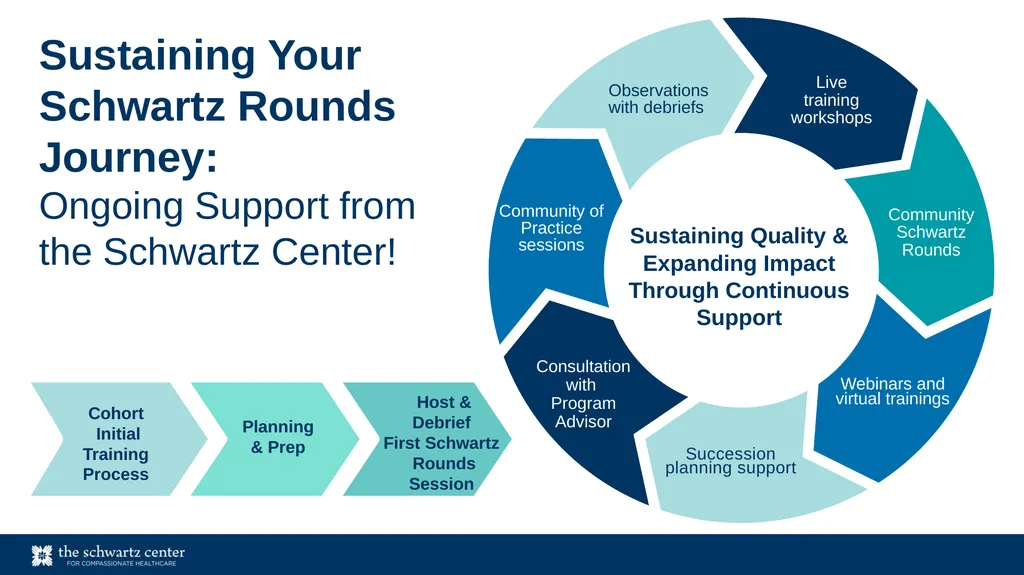
Observations with debriefs Live training workshops Community of Practice sessions Community Schwartz Rounds Webinars and virtual trainings Succession planning support Consultation with
Program Advisor Sustaining Quality &
Expanding Impact Through Continuous Support Sustaining Your Schwartz Rounds Journey:
Ongoing Support from the Schwartz Center!<br>
Program Advisor Sustaining Quality &
Expanding Impact Through Continuous Support Sustaining Your Schwartz Rounds Journey:
Ongoing Support from the Schwartz Center!<br>
39
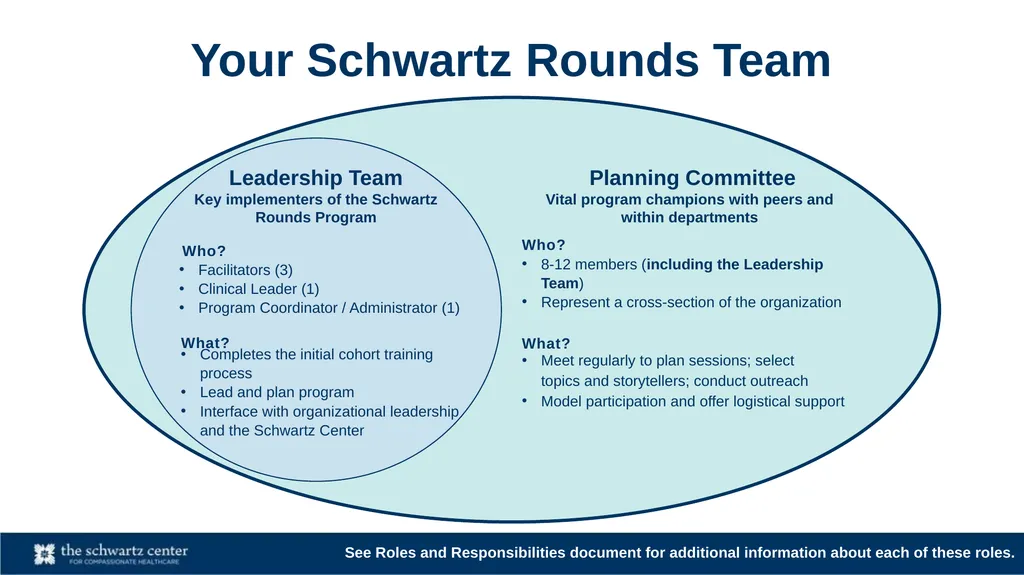
Your Schwartz Rounds Team See Roles and Responsibilities document for additional information about each of these roles.<br>
40
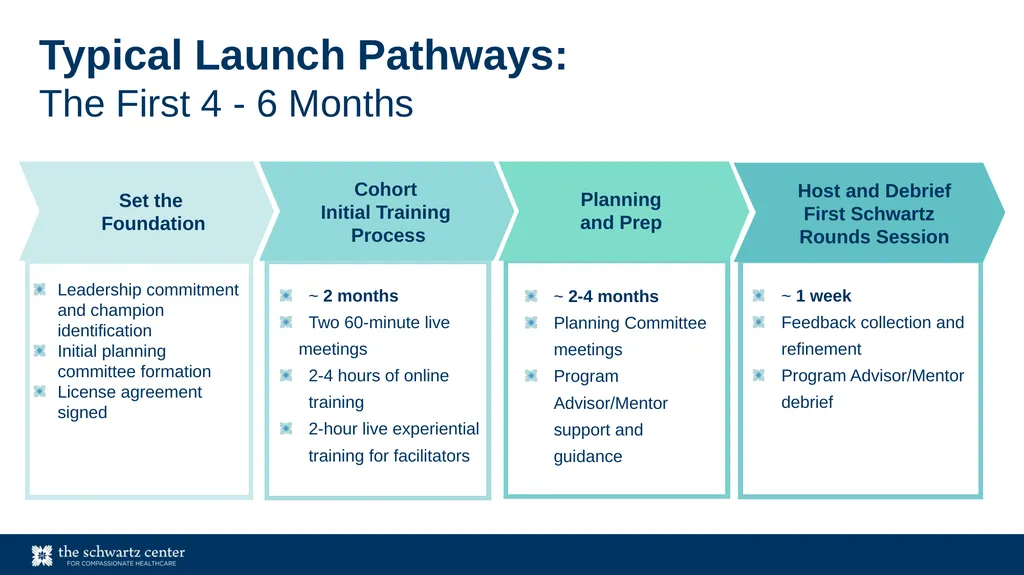
Typical Launch Pathways:
The First 4 - 6 Months<br>
The First 4 - 6 Months<br>
41
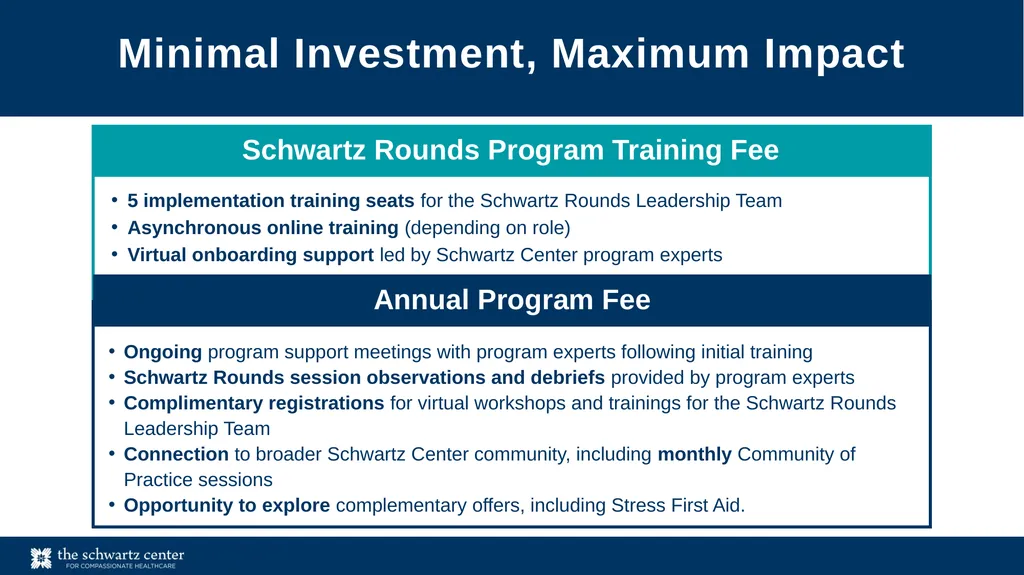
Minimal Investment, Maximum Impact<br>
42
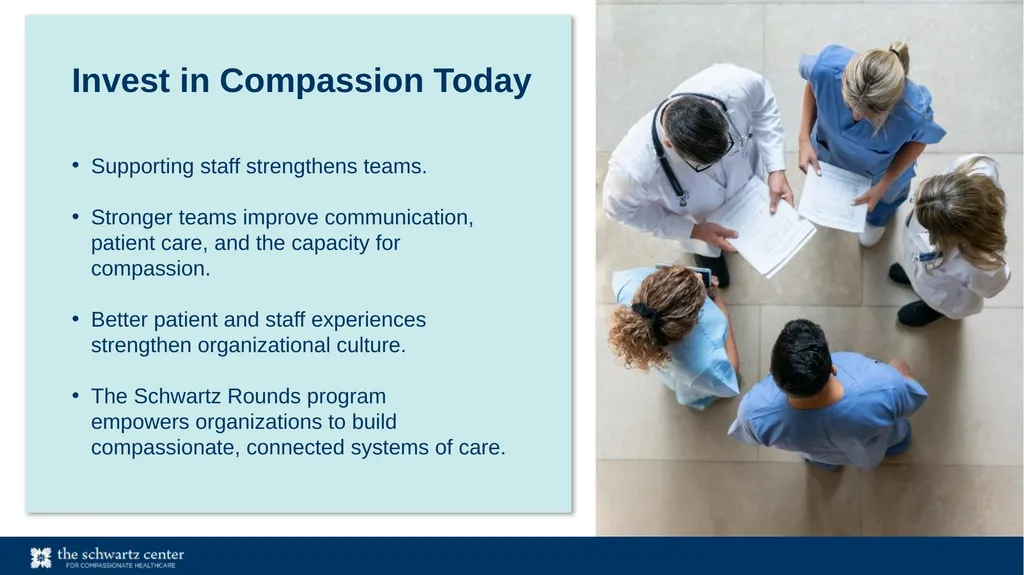
Invest in Compassion Today Supporting staff strengthens teams.
Stronger teams improve communication, patient care, and the capacity for compassion.
Better patient and staff experiences strengthen organizational culture.
The Schwartz Rounds program empowers organizations to build compassionate, connected systems of care.<br>
Stronger teams improve communication, patient care, and the capacity for compassion.
Better patient and staff experiences strengthen organizational culture.
The Schwartz Rounds program empowers organizations to build compassionate, connected systems of care.<br>
43
Placeholder
Thank You / Questions? Thank you!
Questions?<br>
Questions?<br>
44
Appendix<br>
45
References An extensive bibliography including references to data and information shared in this presentation can be found at the following two resources:
Schwartz Rounds Research Summary
Schwartz Center Case for Compassion<br>
Schwartz Rounds Research Summary
Schwartz Center Case for Compassion<br>
46
American Medical Association. 2024 AMA Joy in Medicine™ Health System Recognition Program Overview. American Medical Association; 2024.
National Academy of Medicine. National Plan for Health Workforce Well-Being. National Academy of Medicine; 2022.
NSI Nursing Solutions, Inc. 2024 National Health Care Retention & RN Staffing Report. NSI Nursing Solutions; 2024.
Association of American Medical Colleges. The Complexities of Physician Supply and Demand: Projections From 2021 to 2036. Association of American Medical Colleges; 2024.
Aiken LH, Lasater KB, Sloane DM, et al. Physician and nurse well-being and preferred interventions to address burnout in hospital practice: factors associated with turnover, outcomes, and patient safety. JAMA Health Forum. 2023;4(7):e231809.
Aiken LH, Sermeus W, McKee M, et al. Physician and nurse well-being, patient safety and recommendations for interventions: cross-sectional survey in hospitals in six European countries. BMJ Open. 2024;14(2):e079931.
Han S, Shanafelt TD, Sinsky CA, et al. Estimating the attributable cost of physician burnout in the United States. Ann Intern Med. 2019;170(11):784-790.
Owoc J, Mańczak M, Jabłońska M, Tombarkiewicz M, Olszewski R. Association between physician burnout and self-reported errors: meta-analysis. J Patient Saf. 2022;18(1):e180-e188.
Al-Ghunaim TA, Johnson J, Biyani CS, Alshahrani KM, Dunning A, O’Connor DB. Surgeon burnout, impact on patient safety and professionalism: a systematic review and meta-analysis. Am J Surg. 2022;224(1 Pt A):228-238.
Tawfik DS, Scheid A, Profit J, et al. Evidence relating health care provider burnout and quality of care: a systematic review and meta-analysis. Ann Intern Med. 2019;171(8):555-567.
Sullivan EE, Khazen M, Arabadjis SD, et al. Exploring relationships between physician stress, burnout, and diagnostic elements in clinician notes. Diagnosis (Berl). 2023;10(3):309-312. Additional References<br>
National Academy of Medicine. National Plan for Health Workforce Well-Being. National Academy of Medicine; 2022.
NSI Nursing Solutions, Inc. 2024 National Health Care Retention & RN Staffing Report. NSI Nursing Solutions; 2024.
Association of American Medical Colleges. The Complexities of Physician Supply and Demand: Projections From 2021 to 2036. Association of American Medical Colleges; 2024.
Aiken LH, Lasater KB, Sloane DM, et al. Physician and nurse well-being and preferred interventions to address burnout in hospital practice: factors associated with turnover, outcomes, and patient safety. JAMA Health Forum. 2023;4(7):e231809.
Aiken LH, Sermeus W, McKee M, et al. Physician and nurse well-being, patient safety and recommendations for interventions: cross-sectional survey in hospitals in six European countries. BMJ Open. 2024;14(2):e079931.
Han S, Shanafelt TD, Sinsky CA, et al. Estimating the attributable cost of physician burnout in the United States. Ann Intern Med. 2019;170(11):784-790.
Owoc J, Mańczak M, Jabłońska M, Tombarkiewicz M, Olszewski R. Association between physician burnout and self-reported errors: meta-analysis. J Patient Saf. 2022;18(1):e180-e188.
Al-Ghunaim TA, Johnson J, Biyani CS, Alshahrani KM, Dunning A, O’Connor DB. Surgeon burnout, impact on patient safety and professionalism: a systematic review and meta-analysis. Am J Surg. 2022;224(1 Pt A):228-238.
Tawfik DS, Scheid A, Profit J, et al. Evidence relating health care provider burnout and quality of care: a systematic review and meta-analysis. Ann Intern Med. 2019;171(8):555-567.
Sullivan EE, Khazen M, Arabadjis SD, et al. Exploring relationships between physician stress, burnout, and diagnostic elements in clinician notes. Diagnosis (Berl). 2023;10(3):309-312. Additional References<br>
47
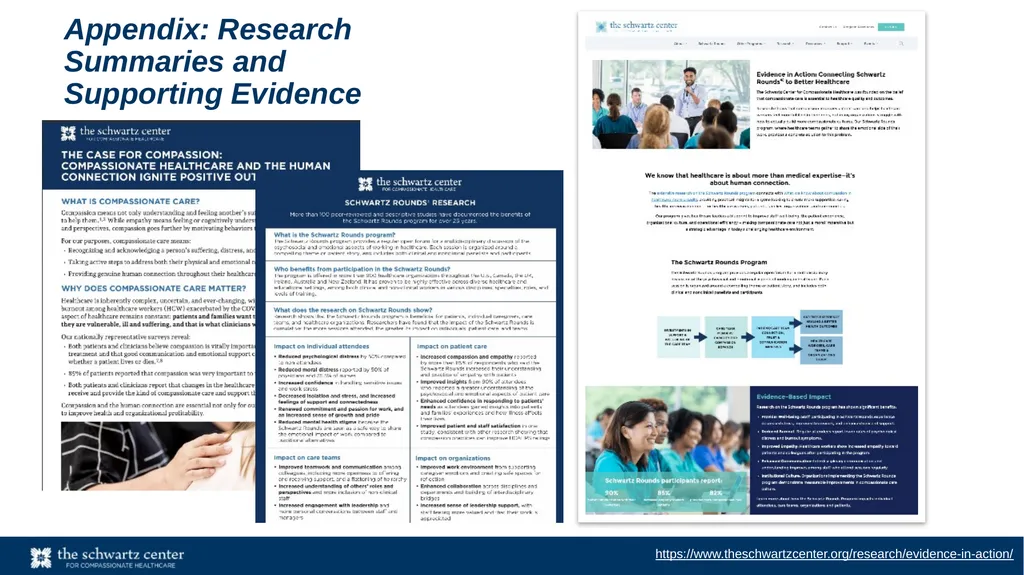
Appendix: Research Summaries and Supporting Evidence https://www.theschwartzcenter.org/research/evidence-in-action/<br>