Nuclear Deterrence and Israels Nuclear Weapons www.peaceeducationscotland.org Peace Education Scotland Background about nuclear weapons Some video links What if We Nuke a City? - YouTube (approx. 9 mins) shows the destructive power of a
"Nuclear Deterrence and Israel’s Nuclear Weapons" is the property of its rightful owner. Permission is granted to
download and print the materials on this website for personal, non-commercial use only, and to display it
on your personal computer provided you do not modify the materials and that you retain all copyright
notices contained in the materials. By downloading content from our website, you accept the terms of this
agreement.
Presentation Transcript
01
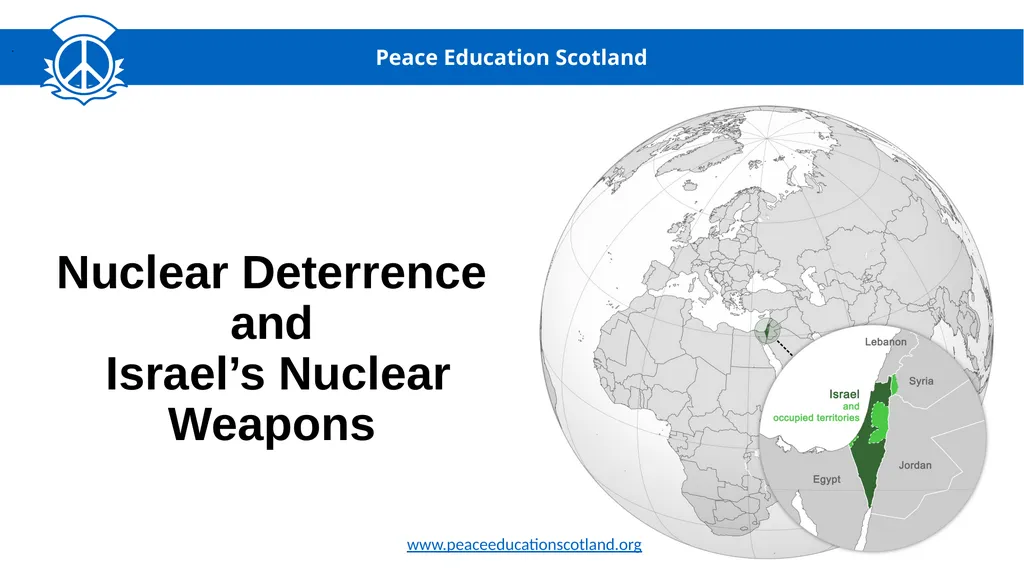
Nuclear Deterrence and Israel’s Nuclear Weapons www.peaceeducationscotland.org Peace Education Scotland<br>
02
Background about nuclear weapons Some video links
What if We Nuke a City? - YouTube (approx. 9 mins) shows the destructive power of a nuclear bomb
Mutually Assured Destruction - YouTube (approx. 3 mins) ‘MAD’
Mutually Assured Destruction - Nuclear Fallout - YouTube (approx. 9 mins) includes the Cold War and Cuban Missile Crisis
Nuclear Explosions - Vimeo (approx. 3 mins)
The Nuclear Weapons Debate – Vimeo (approx. 2 mins)<br>
03
What is ‘nuclear deterrence’? Nuclear deterrence is the idea that possessing nuclear weapons prevents others from attacking because of the threat of devastating retaliation.
Many countries, including Israel, possess nuclear weapons.
States who possess nuclear weapons claim that this deters other states from attacking them. Deterrence, threat and credibility in the nuclear age - Youtube (approx. 4mins)<br>
04
What is ‘nuclear deterrence’? (contd.) Despite having nuclear weapons, states that have them have been attacked or drawn into a war. The Falklands War when Argentina attacked the British dependency, the Falkland Islands, is a good example: The Falklands War – Youtube Short (approx. 1 min)
Also:
Why Nuclear Deterrence Does Not Work – Youtube (approx. 7 mins)<br>
05
Case Study: Israel’s Nuclear Weapons and the Yom Kippur War The Yom Kippur War (1973) Egypt and Syria launched a surprise attack on Israel in a bid to regain lost territory. It is generally agreed that both countries knew that Israel possessed nuclear weapons. Yom Kippur War - YouTube (approx. 3mins)<br>
06
Exploring the Dangers and Destabilising Influence of Nuclear Weapons .
Why might Israel want to have nuclear weapons? False Sense of Security? Can having nuclear weapons create a false sense of security? The possession of nuclear weapons does not give Israel a sense of security at all, false or real. The public live with an overarching sense of insecurity, despite having nuclear weapons. Poll after poll reveals that Israelis live in a constant state of fear from their neighbours and the position of nuclear weapons does not lessen that sense of fear. Being in that sense of fear does not of course mean that Israelis want to give up nuclear weapons but equally it contributes nothing to a sense of security.<br>
07
Escalation:
Possession of nuclear weapons have not always prevented smaller conflicts or tensions from escalating in different regions. An example to consider: India and Pakistan - Youtube (approx 9mins) Regional Tensions:
Israel’s possession of nuclear weapons has led to increased tensions in the Middle East. This may encourage other countries, such as Iran, to develop a nuclear weapons programme. The more countries that have nuclear weapons (nuclear proliferation) the more difficult it is to pursue international nuclear arms treaties. Accidents and Miscalculations:
Possessing nuclear weapons increases the risks of accidents, misunderstandings, or the possibility of nuclear weapons falling into the wrong hands, which could have catastrophic consequences. The history of the Cuban Missile Crisis – YouTube (approx. 5mins) Exploring the Dangers and Destabilising Influence of Nuclear Weapons (contd.)<br>
08
Nuclear deterrence does not always prevent conflict.
Nuclear weapons can increase the risk of war, accidents, and regional instability. Summary<br>
09
Short infographic video about Israel-Palestine The Israel-Palestine conflict: a brief, simple history - Youtube (approx. 10mins)
A 10 minute video history of Israel-Palestine Rory Stewart Attempts to Explain the History of Israel-Palestine in 10 Minutes - YouTube (approx. 10mins) Background into the conflict<br>