
Nuclear Power No Solution to Climate Change
Description: Nuclear Power No Solution to Climate Change Australias leading climate scientists: Nuclear power stations are not appropriate for Australia and probably never will be. Climate Council of Australia NUCLEAR POWER AS A CLIMATE SOLUTION?
Related Topics
Download Presentation
"Nuclear Power No Solution to Climate Change" is the property of its rightful owner. Permission is granted to download and print the materials on this website for personal, non-commercial use only, and to display it on your personal computer provided you do not modify the materials and that you retain all copyright notices contained in the materials. By downloading content from our website, you accept the terms of this agreement.
Presentation Transcript
slide1. Nuclear Power
No Solution to
Climate Change Australia’s leading climate scientists:
“Nuclear power stations are not appropriate for Australia – and probably never will be.”
‒ Climate Council of Australia<br>
slide2. NUCLEAR POWER AS A CLIMATE SOLUTION?
1. Too slow
nuclear power could begin contributing to climate change abatement in Australia in the late 2050s
2. Too risky
weapons proliferation
attacks on nuclear plants
nuclear accidents
3. Too expensive
more expensive than renewables + transmission + storage<br>
slide3. 1. TOO SLOW … a slow response to an urgent problem 10 years to gain political support for nuclear power in Australia + repeal of legal bans
10 years for planning, site selection, licensing approvals
10 years for construction
6.5 years to repay the energy/carbon debt from construction
So nuclear power could begin contributing to climate change abatement in the late 2050s
… if and only if nuclear displaces fossil fuels<br>
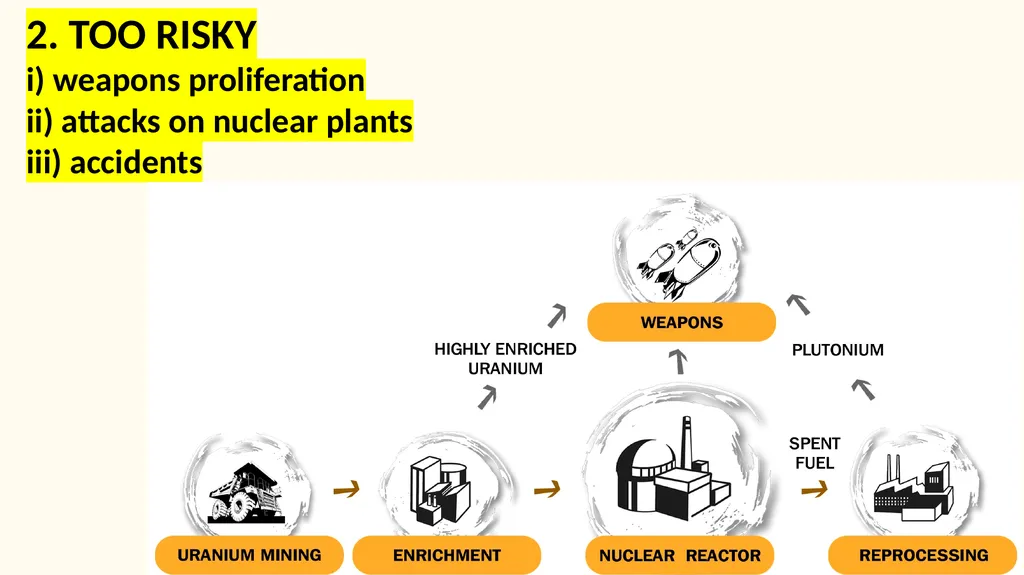
slide4. 2. TOO RISKY
i) weapons proliferation
ii) attacks on nuclear plants
iii) accidents<br>
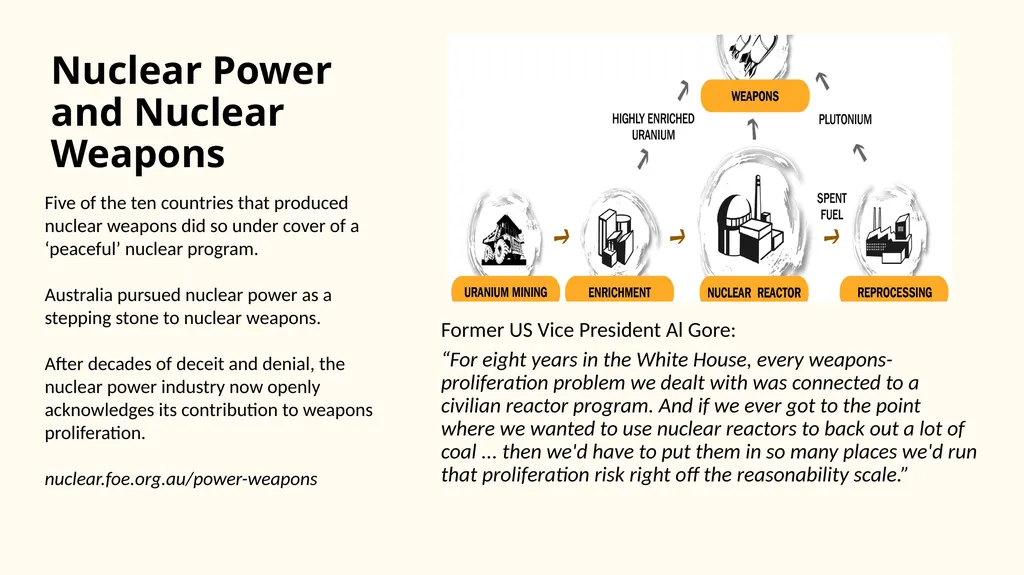
slide5. Nuclear Power and Nuclear Weapons Former US Vice President Al Gore:
“For eight years in the White House, every weapons-proliferation problem we dealt with was connected to a civilian reactor program. And if we ever got to the point where we wanted to use nuclear reactors to back out a lot of coal ... then we'd have to put them in so many places we'd run that proliferation risk right off the reasonability scale.” Five of the ten countries that produced nuclear weapons did so under cover of a ‘peaceful’ nuclear program.
Australia pursued nuclear power as a stepping stone to nuclear weapons.
After decades of deceit and denial, the nuclear power industry now openly acknowledges its contribution to weapons proliferation.
nuclear.foe.org.au/power-weapons<br>
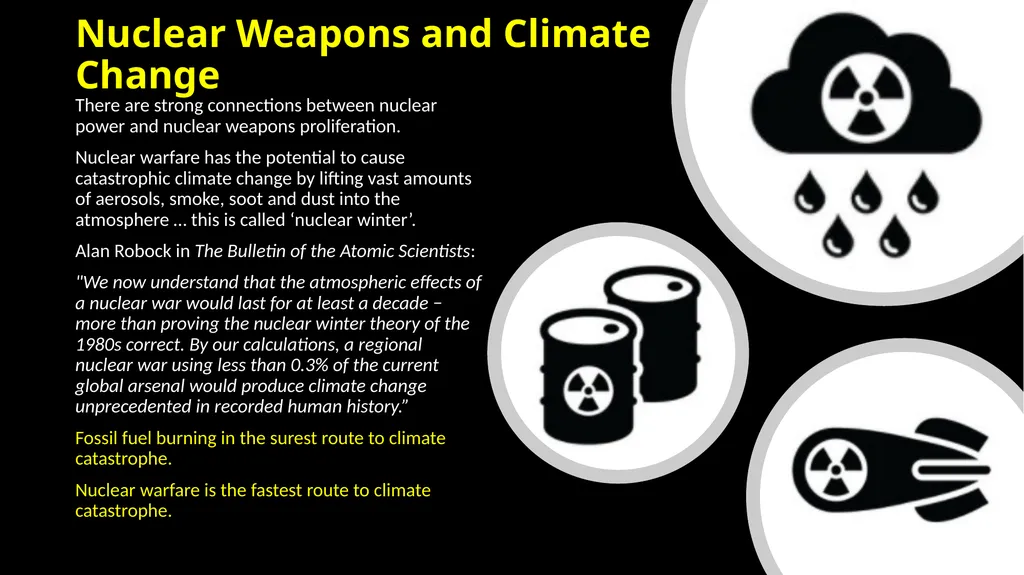
slide6. Nuclear Weapons and Climate Change There are strong connections between nuclear power and nuclear weapons proliferation.
Nuclear warfare has the potential to cause catastrophic climate change by lifting vast amounts of aerosols, smoke, soot and dust into the atmosphere … this is called ‘nuclear winter’.
Alan Robock in The Bulletin of the Atomic Scientists:
"We now understand that the atmospheric effects of a nuclear war would last for at least a decade − more than proving the nuclear winter theory of the 1980s correct. By our calculations, a regional nuclear war using less than 0.3% of the current global arsenal would produce climate change unprecedented in recorded human history.”
Fossil fuel burning in the surest route to climate catastrophe.
Nuclear warfare is the fastest route to climate catastrophe.<br>
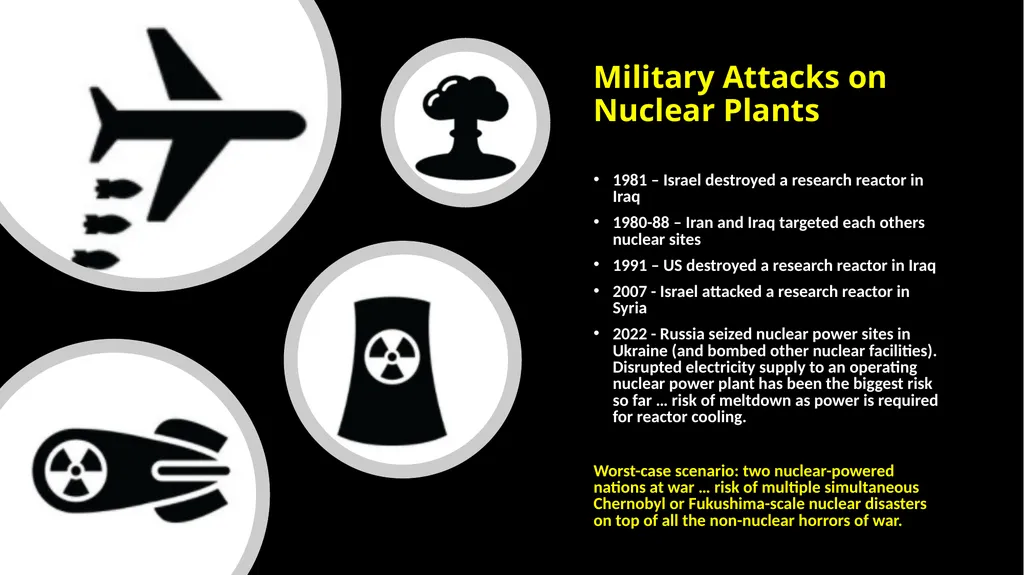
slide7. Military Attacks on Nuclear Plants 1981 – Israel destroyed a research reactor in Iraq
1980-88 – Iran and Iraq targeted each others nuclear sites
1991 – US destroyed a research reactor in Iraq
2007 - Israel attacked a research reactor in Syria
2022 - Russia seized nuclear power sites in Ukraine (and bombed other nuclear facilities). Disrupted electricity supply to an operating nuclear power plant has been the biggest risk so far … risk of meltdown as power is required for reactor cooling.
Worst-case scenario: two nuclear-powered nations at war … risk of multiple simultaneous Chernobyl or Fukushima-scale nuclear disasters on top of all the non-nuclear horrors of war.<br>
slide8. Nuclear Accidents Over half a million people were evacuated after the Chernobyl (350,000) and Fukushima (160,000) disasters.
The economic costs of the Chernobyl and Fukushima disasters amounted to around A$1 trillion each. Trillion-dollar accidents are unique to the nuclear industry.
The lowest scientific estimate of the Chernobyl cancer death toll across Europe is the estimate of 16,000 deaths in a study published in the International Journal of Cancer.
Radioactive fallout from Fukushima will cause around 5,000 fatal cancers, in addition to the indirect death toll of at least 2,000 people resulting from the botched evacuation and mistreatment of evacuees.<br>
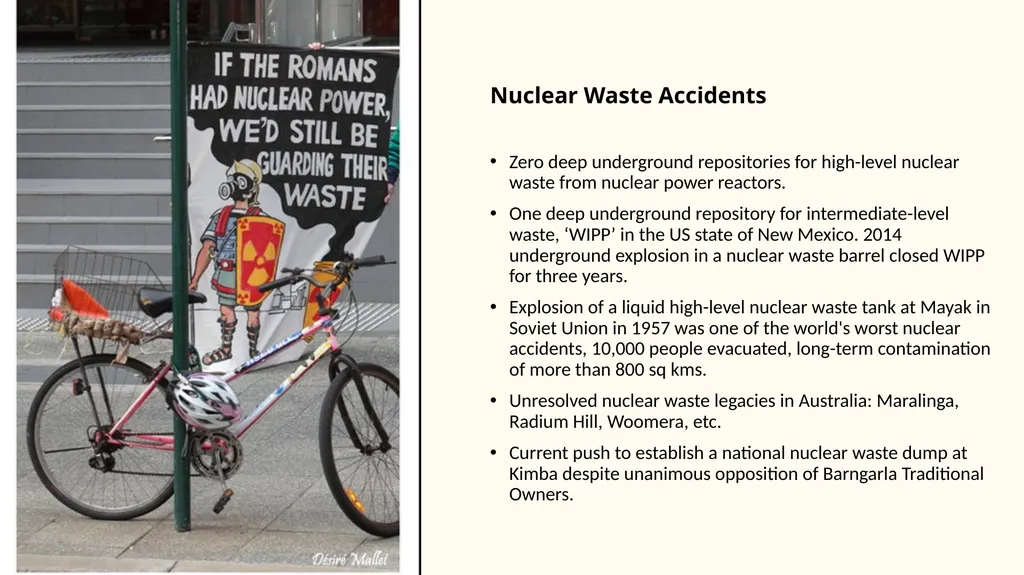
slide9. Nuclear Waste Accidents Zero deep underground repositories for high-level nuclear waste from nuclear power reactors.
One deep underground repository for intermediate-level waste, ‘WIPP’ in the US state of New Mexico. 2014 underground explosion in a nuclear waste barrel closed WIPP for three years.
Explosion of a liquid high-level nuclear waste tank at Mayak in Soviet Union in 1957 was one of the world's worst nuclear accidents, 10,000 people evacuated, long-term contamination of more than 800 sq kms.
Unresolved nuclear waste legacies in Australia: Maralinga, Radium Hill, Woomera, etc.
Current push to establish a national nuclear waste dump at Kimba despite unanimous opposition of Barngarla Traditional Owners.<br>
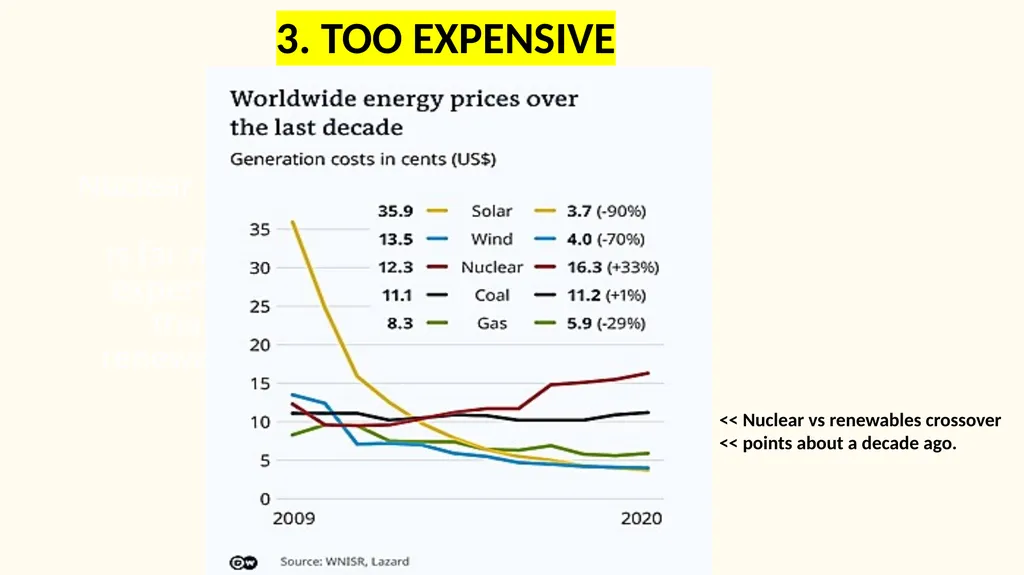
slide10. Nuclear power is far more expensive than renewables 3. TOO EXPENSIVE << Nuclear vs renewables crossover << points about a decade ago.<br>
slide11. Nuclear Power vs Renewables Global figures
2021: renewables growth 290 gigawatts (Australia’s total electricity generating capacity is 66 GW) compared to nuclear decline of 2.5 GW
Nuclear has fallen from a peak of 17.5% of global electricity generation to 10% now, while renewables have grown to 29%
Economics of nuclear vs renewables in Australia
Research by the CSIRO and the Australian Energy Market Operator demonstrates that nuclear power is far more expensive than renewables plus integration costs (storage and transmission and synchronous condensers).
In its 2021 GenCost report, CSIRO provides these 2030 cost estimates:
Nuclear (small modular reactors): A$128‒322 / MWh
90% wind and solar PV with integration costs: A$55‒80 / MWh
Progress in Australia
South Australia 67% renewable electricity supply and on track to meet target of 100% net renewable electricity supply by 2030.
The federal Department of Industry, Science, Energy and Resources expects 69% renewable supply to the National Electricity Market by 2030.<br>
slide12. Australia’s leading climate scientists say: nuclear is no solution Climate Council of Australia:
“Nuclear power stations are not appropriate for Australia – and probably never will be.
“Nuclear power stations are highly controversial, can't be built under existing law in any Australian state or territory, are a more expensive source of power than renewable energy, and present significant challenges in terms of the storage and transport of nuclear waste, and use of water.”
climatecouncil.org.au<br>
slide13. Conservative politicians wedging themselves on nuclear power Growing conservative opposition to nuclear power:
SA Liberal government's 2019 submission said that "nuclear power remains unviable now and into the foreseeable future".
Tasmanian Liberal government's 2019 submission said that "Tasmania will not pursue nuclear energy … and considers that Australia's energy needs are best met by pursuing renewable energy options ..."
Queensland Liberal-National Party's 2019 submission said that "Australia's rich renewable energy resources are more affordable and bring less risk than the elevated cost and risk associated with nuclear energy".
NSW Treasurer Matt Kean says that nuclear power is like "chasing a unicorn" and "doesn't stack up at the moment on practical grounds or on economic grounds".
Malcolm Turnbull describes nuclear power as the "loopy current fad … which is the current weapon of mass distraction for the backbench".
Liberal Prime Minister John Howard banned nuclear power in Australia and that ban was retained by the Abbott, Turnbull and Morrison Coalition governments. Pro-nuclear conservatives:
1. Trying to slow the transition from fossil fuels to renewables. Australian economist Prof. John Quiggin notes that, in practice, support for nuclear power in Australia is support for coal.
2. Ignorant culture warriors trying to wedge Labor and environmentalists … but only end up wedging themselves.<br>
slide14. One last thing … could ‘advanced’ or ‘Generation IV’ nuclear power come to the rescue? In a word: NO
Old, failed technology being dressed up as ‘advanced’ or ‘Generation IV’
Do not improve safety or weapons proliferation or nuclear waste risks … could even be worse than conventional nuclear power
Poor track record + poor economics explains the lack of investment from both governments and industry
Decades away from large-scale deployment … if ever<br>
slide15. ‘Advanced’ or ‘Generation IV’ nuclear Failures, false promises, no results Fusion … decades away from being proven and then decades more from being commercially viable – if at all. See online articles by fusion scientist Dr. Daniel Jassby.
Thorium … much the same as uranium … still produces long-lived nuclear wastes, could have catastrophic meltdowns, produces uranium-233 which can be and has been used in nuclear weapons.
Small Modular Reactors … not new … do not reduce safety or proliferation risks … more expensive than large nuclear reactors per unit of energy produced, and far more expensive than renewables … used in some cases to power fossil fuel mining (e.g. Russia’s floating plant in the Arctic)
Fast Breeder Reactors … not new … in theory they could reduce weapons and waste risks but in reality they do neither. After 70 years of R&D there are still only half a dozen trial reactors. Expensive and accident-prone.<br>
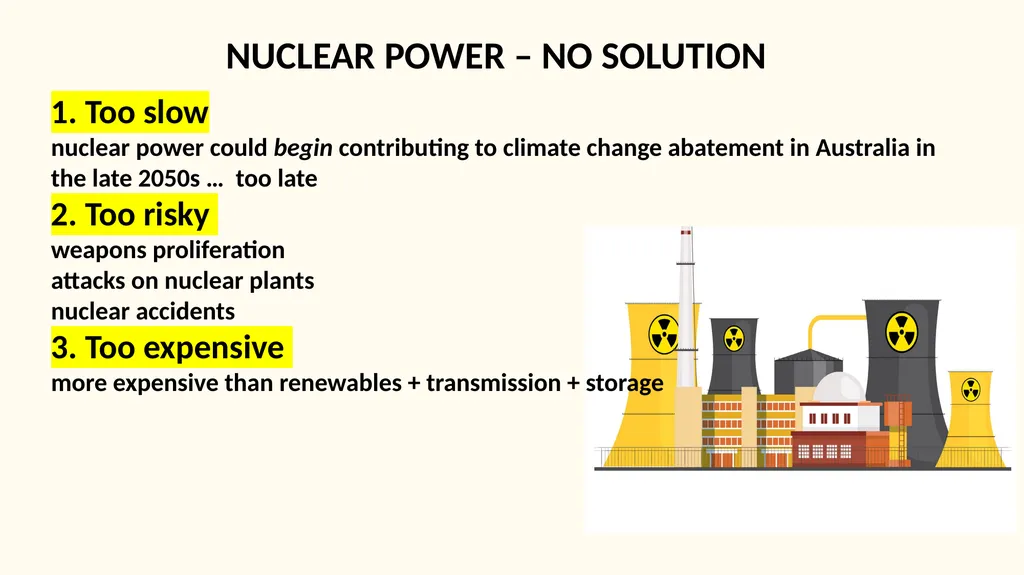
slide16. NUCLEAR POWER – NO SOLUTION
1. Too slow
nuclear power could begin contributing to climate change abatement in Australia in the late 2050s … too late
2. Too risky
weapons proliferation
attacks on nuclear plants
nuclear accidents
3. Too expensive
more expensive than renewables + transmission + storage<br>
slide17. more info dont-nuke-the-climate.org.au (including useful ‘myth busting’ info)
dont-nuke-the-climate.org (international)
nuclear.foe.org.au/climate
/power
/fusion
/thorium
/smr (small modular reactors)
/fast-breeder-reactors
/economics
/propaganda (responses to ‘pro-nuclear environmentalists’)<br>
“Nuclear power stations are not appropriate for Australia – and probably never will be.”
‒ Climate Council of Australia<br>
slide2. NUCLEAR POWER AS A CLIMATE SOLUTION?
1. Too slow
nuclear power could begin contributing to climate change abatement in Australia in the late 2050s
2. Too risky
weapons proliferation
attacks on nuclear plants
nuclear accidents
3. Too expensive
more expensive than renewables + transmission + storage<br>
slide3. 1. TOO SLOW … a slow response to an urgent problem 10 years to gain political support for nuclear power in Australia + repeal of legal bans
10 years for planning, site selection, licensing approvals
10 years for construction
6.5 years to repay the energy/carbon debt from construction
So nuclear power could begin contributing to climate change abatement in the late 2050s
… if and only if nuclear displaces fossil fuels<br>
slide4. 2. TOO RISKY
i) weapons proliferation
ii) attacks on nuclear plants
iii) accidents<br>
slide5. Nuclear Power and Nuclear Weapons Former US Vice President Al Gore:
“For eight years in the White House, every weapons-proliferation problem we dealt with was connected to a civilian reactor program. And if we ever got to the point where we wanted to use nuclear reactors to back out a lot of coal ... then we'd have to put them in so many places we'd run that proliferation risk right off the reasonability scale.” Five of the ten countries that produced nuclear weapons did so under cover of a ‘peaceful’ nuclear program.
Australia pursued nuclear power as a stepping stone to nuclear weapons.
After decades of deceit and denial, the nuclear power industry now openly acknowledges its contribution to weapons proliferation.
nuclear.foe.org.au/power-weapons<br>
slide6. Nuclear Weapons and Climate Change There are strong connections between nuclear power and nuclear weapons proliferation.
Nuclear warfare has the potential to cause catastrophic climate change by lifting vast amounts of aerosols, smoke, soot and dust into the atmosphere … this is called ‘nuclear winter’.
Alan Robock in The Bulletin of the Atomic Scientists:
"We now understand that the atmospheric effects of a nuclear war would last for at least a decade − more than proving the nuclear winter theory of the 1980s correct. By our calculations, a regional nuclear war using less than 0.3% of the current global arsenal would produce climate change unprecedented in recorded human history.”
Fossil fuel burning in the surest route to climate catastrophe.
Nuclear warfare is the fastest route to climate catastrophe.<br>
slide7. Military Attacks on Nuclear Plants 1981 – Israel destroyed a research reactor in Iraq
1980-88 – Iran and Iraq targeted each others nuclear sites
1991 – US destroyed a research reactor in Iraq
2007 - Israel attacked a research reactor in Syria
2022 - Russia seized nuclear power sites in Ukraine (and bombed other nuclear facilities). Disrupted electricity supply to an operating nuclear power plant has been the biggest risk so far … risk of meltdown as power is required for reactor cooling.
Worst-case scenario: two nuclear-powered nations at war … risk of multiple simultaneous Chernobyl or Fukushima-scale nuclear disasters on top of all the non-nuclear horrors of war.<br>
slide8. Nuclear Accidents Over half a million people were evacuated after the Chernobyl (350,000) and Fukushima (160,000) disasters.
The economic costs of the Chernobyl and Fukushima disasters amounted to around A$1 trillion each. Trillion-dollar accidents are unique to the nuclear industry.
The lowest scientific estimate of the Chernobyl cancer death toll across Europe is the estimate of 16,000 deaths in a study published in the International Journal of Cancer.
Radioactive fallout from Fukushima will cause around 5,000 fatal cancers, in addition to the indirect death toll of at least 2,000 people resulting from the botched evacuation and mistreatment of evacuees.<br>
slide9. Nuclear Waste Accidents Zero deep underground repositories for high-level nuclear waste from nuclear power reactors.
One deep underground repository for intermediate-level waste, ‘WIPP’ in the US state of New Mexico. 2014 underground explosion in a nuclear waste barrel closed WIPP for three years.
Explosion of a liquid high-level nuclear waste tank at Mayak in Soviet Union in 1957 was one of the world's worst nuclear accidents, 10,000 people evacuated, long-term contamination of more than 800 sq kms.
Unresolved nuclear waste legacies in Australia: Maralinga, Radium Hill, Woomera, etc.
Current push to establish a national nuclear waste dump at Kimba despite unanimous opposition of Barngarla Traditional Owners.<br>
slide10. Nuclear power is far more expensive than renewables 3. TOO EXPENSIVE << Nuclear vs renewables crossover << points about a decade ago.<br>
slide11. Nuclear Power vs Renewables Global figures
2021: renewables growth 290 gigawatts (Australia’s total electricity generating capacity is 66 GW) compared to nuclear decline of 2.5 GW
Nuclear has fallen from a peak of 17.5% of global electricity generation to 10% now, while renewables have grown to 29%
Economics of nuclear vs renewables in Australia
Research by the CSIRO and the Australian Energy Market Operator demonstrates that nuclear power is far more expensive than renewables plus integration costs (storage and transmission and synchronous condensers).
In its 2021 GenCost report, CSIRO provides these 2030 cost estimates:
Nuclear (small modular reactors): A$128‒322 / MWh
90% wind and solar PV with integration costs: A$55‒80 / MWh
Progress in Australia
South Australia 67% renewable electricity supply and on track to meet target of 100% net renewable electricity supply by 2030.
The federal Department of Industry, Science, Energy and Resources expects 69% renewable supply to the National Electricity Market by 2030.<br>
slide12. Australia’s leading climate scientists say: nuclear is no solution Climate Council of Australia:
“Nuclear power stations are not appropriate for Australia – and probably never will be.
“Nuclear power stations are highly controversial, can't be built under existing law in any Australian state or territory, are a more expensive source of power than renewable energy, and present significant challenges in terms of the storage and transport of nuclear waste, and use of water.”
climatecouncil.org.au<br>
slide13. Conservative politicians wedging themselves on nuclear power Growing conservative opposition to nuclear power:
SA Liberal government's 2019 submission said that "nuclear power remains unviable now and into the foreseeable future".
Tasmanian Liberal government's 2019 submission said that "Tasmania will not pursue nuclear energy … and considers that Australia's energy needs are best met by pursuing renewable energy options ..."
Queensland Liberal-National Party's 2019 submission said that "Australia's rich renewable energy resources are more affordable and bring less risk than the elevated cost and risk associated with nuclear energy".
NSW Treasurer Matt Kean says that nuclear power is like "chasing a unicorn" and "doesn't stack up at the moment on practical grounds or on economic grounds".
Malcolm Turnbull describes nuclear power as the "loopy current fad … which is the current weapon of mass distraction for the backbench".
Liberal Prime Minister John Howard banned nuclear power in Australia and that ban was retained by the Abbott, Turnbull and Morrison Coalition governments. Pro-nuclear conservatives:
1. Trying to slow the transition from fossil fuels to renewables. Australian economist Prof. John Quiggin notes that, in practice, support for nuclear power in Australia is support for coal.
2. Ignorant culture warriors trying to wedge Labor and environmentalists … but only end up wedging themselves.<br>
slide14. One last thing … could ‘advanced’ or ‘Generation IV’ nuclear power come to the rescue? In a word: NO
Old, failed technology being dressed up as ‘advanced’ or ‘Generation IV’
Do not improve safety or weapons proliferation or nuclear waste risks … could even be worse than conventional nuclear power
Poor track record + poor economics explains the lack of investment from both governments and industry
Decades away from large-scale deployment … if ever<br>
slide15. ‘Advanced’ or ‘Generation IV’ nuclear Failures, false promises, no results Fusion … decades away from being proven and then decades more from being commercially viable – if at all. See online articles by fusion scientist Dr. Daniel Jassby.
Thorium … much the same as uranium … still produces long-lived nuclear wastes, could have catastrophic meltdowns, produces uranium-233 which can be and has been used in nuclear weapons.
Small Modular Reactors … not new … do not reduce safety or proliferation risks … more expensive than large nuclear reactors per unit of energy produced, and far more expensive than renewables … used in some cases to power fossil fuel mining (e.g. Russia’s floating plant in the Arctic)
Fast Breeder Reactors … not new … in theory they could reduce weapons and waste risks but in reality they do neither. After 70 years of R&D there are still only half a dozen trial reactors. Expensive and accident-prone.<br>
slide16. NUCLEAR POWER – NO SOLUTION
1. Too slow
nuclear power could begin contributing to climate change abatement in Australia in the late 2050s … too late
2. Too risky
weapons proliferation
attacks on nuclear plants
nuclear accidents
3. Too expensive
more expensive than renewables + transmission + storage<br>
slide17. more info dont-nuke-the-climate.org.au (including useful ‘myth busting’ info)
dont-nuke-the-climate.org (international)
nuclear.foe.org.au/climate
/power
/fusion
/thorium
/smr (small modular reactors)
/fast-breeder-reactors
/economics
/propaganda (responses to ‘pro-nuclear environmentalists’)<br>