01
Numerical study on heat dissipation and structure optimization of immersed liquid cooling used in 280Ah LiFePO4 batteries Jiamin Tian, Wenxin Mei, Jing Tang, Haowen Wang, Longbao Wang, Qingsong Wang, Jinhua Sun, Qiangling Duan
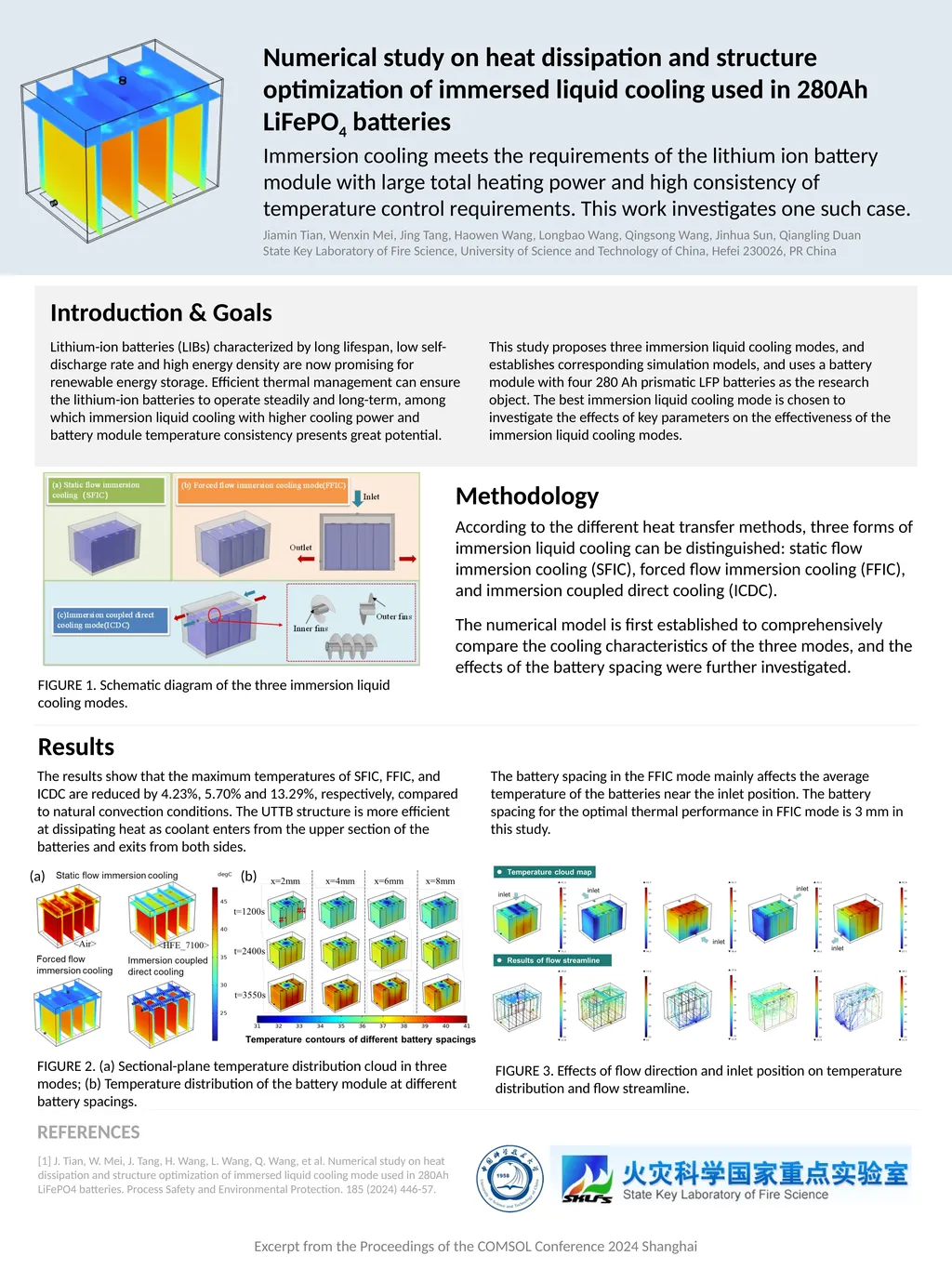
State Key Laboratory of Fire Science, University of Science and Technology of China, Hefei 230026, PR China According to the different heat transfer methods, three forms of immersion liquid cooling can be distinguished: static flow immersion cooling (SFIC), forced flow immersion cooling (FFIC), and immersion coupled direct cooling (ICDC).
The numerical model is first established to comprehensively compare the cooling characteristics of the three modes, and the effects of the battery spacing were further investigated. [1] J. Tian, W. Mei, J. Tang, H. Wang, L. Wang, Q. Wang, et al. Numerical study on heat dissipation and structure optimization of immersed liquid cooling mode used in 280Ah LiFePO4 batteries. Process Safety and Environmental Protection. 185 (2024) 446-57. Immersion cooling meets the requirements of the lithium ion battery module with large total heating power and high consistency of temperature control requirements. This work investigates one such case. Lithium-ion batteries (LIBs) characterized by long lifespan, low self-discharge rate and high energy density are now promising for renewable energy storage. Efficient thermal management can ensure the lithium-ion batteries to operate steadily and long-term, among which immersion liquid cooling with higher cooling power and battery module temperature consistency presents great potential.
This study proposes three immersion liquid cooling modes, and establishes corresponding simulation models, and uses a battery module with four 280 Ah prismatic LFP batteries as the research object. The best immersion liquid cooling mode is chosen to investigate the effects of key parameters on the effectiveness of the immersion liquid cooling modes. Introduction & Goals Methodology FIGURE 1. Schematic diagram of the three immersion liquid cooling modes. The results show that the maximum temperatures of SFIC, FFIC, and ICDC are reduced by 4.23%, 5.70% and 13.29%, respectively, compared to natural convection conditions. The UTTB structure is more efficient at dissipating heat as coolant enters from the upper section of the batteries and exits from both sides.
The battery spacing in the FFIC mode mainly affects the average temperature of the batteries near the inlet position. The battery spacing for the optimal thermal performance in FFIC mode is 3 mm in this study. Results FIGURE 2. (a) Sectional-plane temperature distribution cloud in three modes; (b) Temperature distribution of the battery module at different battery spacings. FIGURE 3. Effects of flow direction and inlet position on temperature distribution and flow streamline. (a) (b)<br>