
Nursing Information Meeting Presented by the
GB
Published · 30 slides · 0 views

1 / 1



Description
Nursing Information Meeting Presented by the counseling Department to help you understand, plan and successfully complete the prerequisites for SRJCs ADN program. Nursing Information Meeting Topics Nursing Career Pathways Preparation for
Related Topics
Share
Embed code
Download this presentation From Below
"Nursing Information Meeting Presented by the" is the property of its rightful owner. Permission is granted to download and print the materials on this website for personal, non-commercial use only, and to display it on your personal computer provided you do not modify the materials and that you retain all copyright notices contained in the materials. By downloading content from our website, you accept the terms of this agreement.
Presentation Transcript
01
Nursing Information Meeting Presented by the counseling Department to help you understand, plan and successfully complete the prerequisites for SRJC’s ADN program.<br>
02
Nursing Information Meeting Topics Nursing Career Pathways
Preparation for SRJC’s program
ADN Screening and Selection Criteria
Transferring Coursework
Strategies for Success<br>
Preparation for SRJC’s program
ADN Screening and Selection Criteria
Transferring Coursework
Strategies for Success<br>
03
Nursing Career Pathways
healthsciences.santarosa.edu/<br>
04
Certified Nursing Assistant The Certified Nurse Assistant (CNA) is an important member of the health-care team who assists the nurses with the care of patients in skilled nursing facilities, home health agencies, clinics, and hospitals. Experience is gained during this program at a long-term care facility.
Requirements:
16 years of age or older
CPR Certification (for health care providers)
Day and evening hours required for classes and clinical assignments<br>
Requirements:
16 years of age or older
CPR Certification (for health care providers)
Day and evening hours required for classes and clinical assignments<br>
05
Licensed Vocational Nurse (LVN) The LVN program is currently undergoing curriculum review and will be on hiatus until further notice.
We will not be accepting any LVN applications during this time.
Please check back on the website in Fall 2021 for updates and changes.
vocational-nursing.santarosa.edu/<br>
We will not be accepting any LVN applications during this time.
Please check back on the website in Fall 2021 for updates and changes.
vocational-nursing.santarosa.edu/<br>
06
Registered Nurse (RN) According to the American Nurses Association, nursing is defined as "the protection, promotion, and optimization of health and abilities, prevention of illness and injury, alleviation of suffering through the diagnosis and treatment of human response, and advocacy in the care of individuals, families, communities, and populations."
Professional nurses have the designation of Registered Nurse (RN), which is achieved through the completion of a rigorous educational program and successfully passing a licensing examination. Nurses may have associate, baccalaureate, master's or doctorate degrees. SRJC prepares professional nurses at the associate degree level.<br>
Professional nurses have the designation of Registered Nurse (RN), which is achieved through the completion of a rigorous educational program and successfully passing a licensing examination. Nurses may have associate, baccalaureate, master's or doctorate degrees. SRJC prepares professional nurses at the associate degree level.<br>
07
Registered Nurse (RN) The SRJC Associate Degree Nursing (ADN) Program is one of the top ADN programs in California. Since beginning in 1959, the program has enjoyed a wonderful working relationship with numerous clinical agencies in Sonoma County. Approximately 60 new students are admitted each fall and spring semester. Our nursing students come from varied educational and culturally diverse backgrounds and life experiences. Nurses that graduate from our program are prepared to work in a variety of health care settings.
Please read through the SRJC’s ADN website and FAQ’s:
https://adn.santarosa.edu/ (check this website often)
https://adn.santarosa.edu/frequently-asked-questions<br>
Please read through the SRJC’s ADN website and FAQ’s:
https://adn.santarosa.edu/ (check this website often)
https://adn.santarosa.edu/frequently-asked-questions<br>
08
How to become a Registered Nurse<br>
09
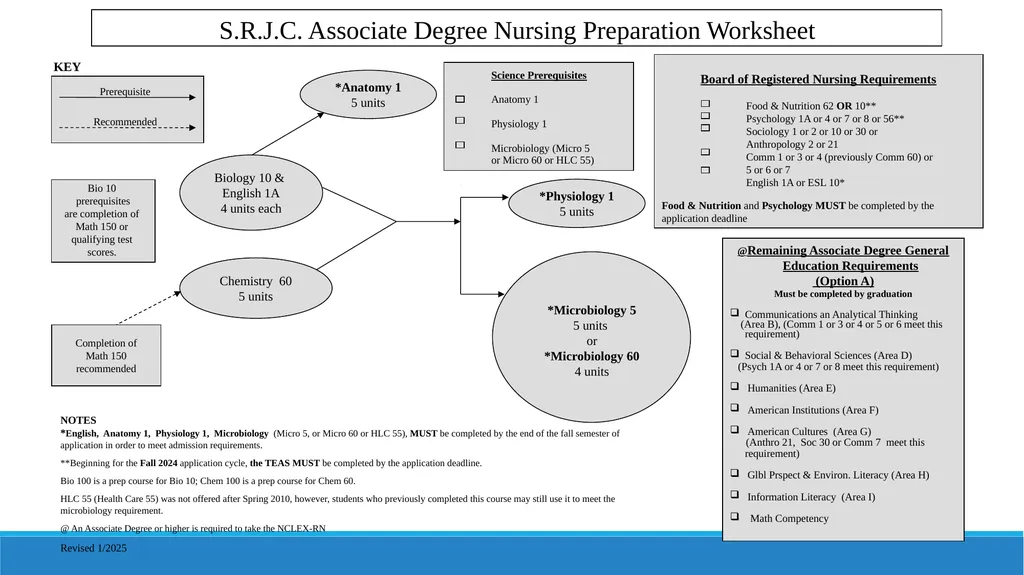
Preparation for SRJC’s ADN Program Board of Nursing Requirements
Associate Degree Graduation Requirements
Science Prerequisites<br>
Associate Degree Graduation Requirements
Science Prerequisites<br>
10
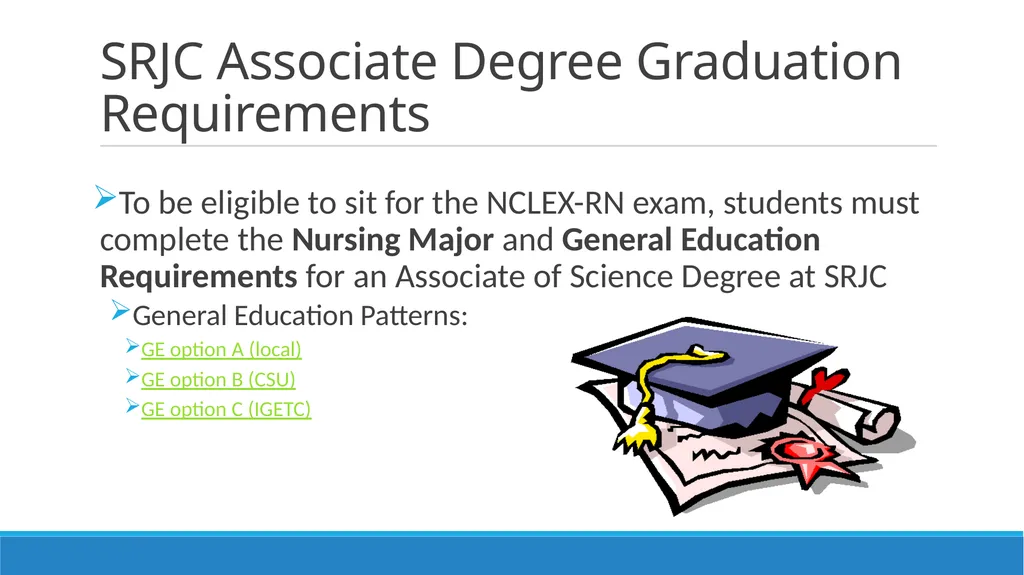
SRJC Associate Degree Graduation Requirements To be eligible to sit for the NCLEX-RN exam, students must complete the Nursing Major and General Education Requirements for an Associate of Science Degree at SRJC
General Education Patterns:
GE option A (local)
GE option B (CSU)
GE option C (IGETC)<br>
General Education Patterns:
GE option A (local)
GE option B (CSU)
GE option C (IGETC)<br>
11
SRJC Associate Degree Graduation Requirements It is important to work with a counselor to make sure all prerequisites for admission to the ADN program are met by application deadline and that a education plan is made for general education and graduation requirements.
Students with an Associate Degree from SRJC may need to meet new general education areas if there has been a break in enrollment.
Students with an Associate Degree from another Community College must complete any missing SRJC general education and graduation requirements not fulfilled at the previous institution.
Students with a Bachelor Degree from a Regionally Accredited University are exempt from SRJC’s general education requirements.
Official transcripts must be sent to SRJC Admissions and Records office with an evaluation request.<br>
Students with an Associate Degree from SRJC may need to meet new general education areas if there has been a break in enrollment.
Students with an Associate Degree from another Community College must complete any missing SRJC general education and graduation requirements not fulfilled at the previous institution.
Students with a Bachelor Degree from a Regionally Accredited University are exempt from SRJC’s general education requirements.
Official transcripts must be sent to SRJC Admissions and Records office with an evaluation request.<br>
12
ADN Screening and Selection Criteria College GPA within 5 years prior to the fall semester of application to the nursing program (degree applicable courses only)
If a student has not completed at least 24 units within the past 5 years, the overall GPA will be calculated using all prior college courses
Grade in English 1A or equivalent
Students who tested out of or have an AP score for English 1A may use English 1B or 5 to meet this requirement
The most recent English 1A or equivalent will be used for the cut-score
GPA in the core science classes: anatomy, physiology and microbiology
English, anatomy, physiology, and microbiology must be completed by the end of the fall semester of application to be considered for the applicant pool
Food & Nutrition and Psychology must be completed by application deadline
Core Biology Repetitions
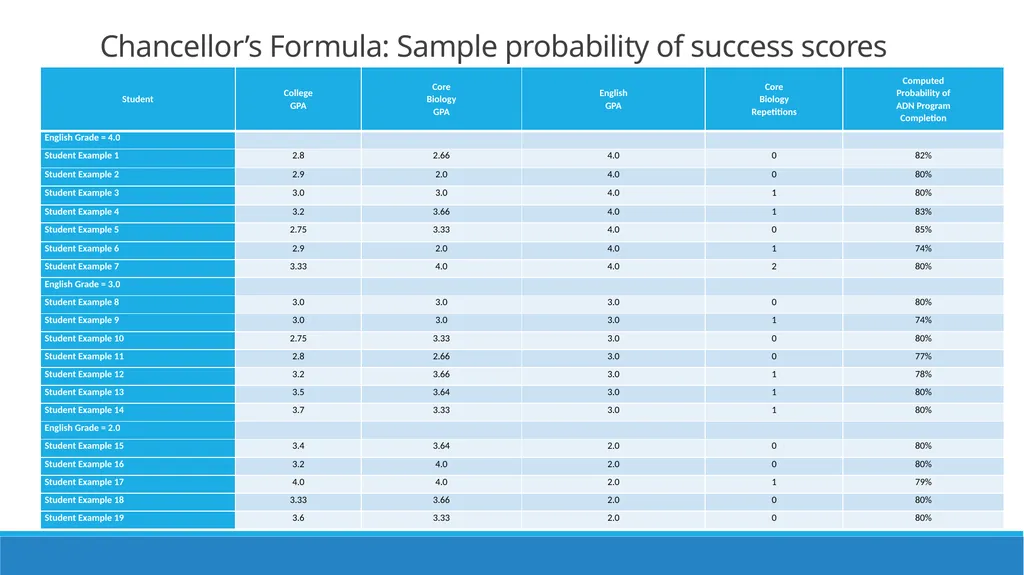
The number of repeats (including W’s and NC) in the core science classes within last 5 years prior to the fall semester of application earns a deduction<br>
If a student has not completed at least 24 units within the past 5 years, the overall GPA will be calculated using all prior college courses
Grade in English 1A or equivalent
Students who tested out of or have an AP score for English 1A may use English 1B or 5 to meet this requirement
The most recent English 1A or equivalent will be used for the cut-score
GPA in the core science classes: anatomy, physiology and microbiology
English, anatomy, physiology, and microbiology must be completed by the end of the fall semester of application to be considered for the applicant pool
Food & Nutrition and Psychology must be completed by application deadline
Core Biology Repetitions
The number of repeats (including W’s and NC) in the core science classes within last 5 years prior to the fall semester of application earns a deduction<br>
13
Chancellor’s Formula: Sample probability of success scores<br>
14
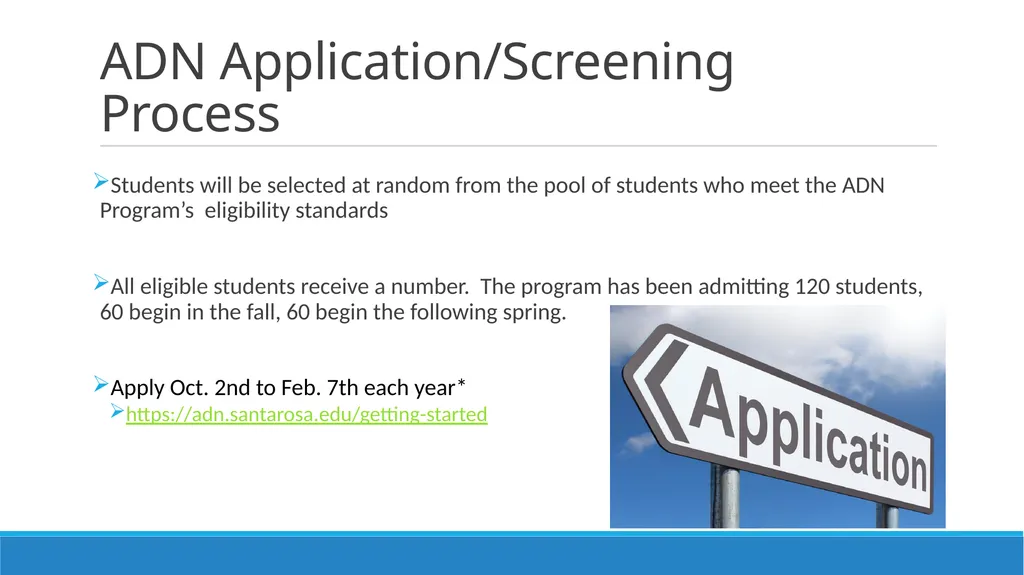
ADN Application/Screening Process Students will be selected at random from the pool of students who meet the ADN Program’s eligibility standards
All eligible students receive a number. The program has been admitting 120 students, 60 begin in the fall, 60 begin the following spring.
Apply Oct. 2nd to Feb. 7th each year*
https://adn.santarosa.edu/getting-started<br>
All eligible students receive a number. The program has been admitting 120 students, 60 begin in the fall, 60 begin the following spring.
Apply Oct. 2nd to Feb. 7th each year*
https://adn.santarosa.edu/getting-started<br>
15
TEAS Information The ATI-TEAS is a test of essential academic skills for nursing students. It tests science, math, reading, and English language and usage.
SRJC requires a score of 62 to enter the ADN program.
TEAS needs to be done by application deadline.<br>
SRJC requires a score of 62 to enter the ADN program.
TEAS needs to be done by application deadline.<br>
16
TEAS Information If a student does not earn the required score of 62, they will be referred for remedial coursework that will prepare the student to retest
The student has a year to retest and will be able to begin the ADN program as soon as possible after earning the required TEAS score<br>
The student has a year to retest and will be able to begin the ADN program as soon as possible after earning the required TEAS score<br>
17
TEAS Information Also required for CSU nursing programs. The cut score is 78 at SSU (this can vary by CSU). If a student has taken the test for CSU, they can have the results sent to SRJC (must be the same version currently being used at SRJC)
Students can prepare for the TEAS test by purchasing the review package and online practice test at www.atitesting.com
There are 2 study guides for the TEAS on reserve in the Doyle and Mahoney Libraries<br>
Students can prepare for the TEAS test by purchasing the review package and online practice test at www.atitesting.com
There are 2 study guides for the TEAS on reserve in the Doyle and Mahoney Libraries<br>
18
Starting SRJC’s ADN Program Upon acceptance into the ADN program, the student must complete or obtain the following:
Physical examination
Required documentation including proof of vaccinations
Current Health Care Providers CPR certification for adults, children and infants
Background check<br>
Physical examination
Required documentation including proof of vaccinations
Current Health Care Providers CPR certification for adults, children and infants
Background check<br>
19
Background Checks An identity confirmation (fingerprinting) and background check will be conducted on all students admitted to health science programs before they begin
The background check looks for:
Valid Social Security Number
Felony and misdemeanor convictions
Government fraud convictions<br>
The background check looks for:
Valid Social Security Number
Felony and misdemeanor convictions
Government fraud convictions<br>
20
Background Checks Local hospitals will not accept students who do not have a valid social security number or tax id number, or who have a recent DUI
A criminal conviction is not considered complete until the probation period is over (some DUI convictions have 3-4 years of probation)
Students with more than one DUI or an arrest related to violence are automatically denied for clinical
The California Board of Registered Nursing may deny licensure to anyone who has been convicted of a felony or misdemeanor. Contact the Board of Registered Nursing web site for more information www.rn.ca.gov<br>
A criminal conviction is not considered complete until the probation period is over (some DUI convictions have 3-4 years of probation)
Students with more than one DUI or an arrest related to violence are automatically denied for clinical
The California Board of Registered Nursing may deny licensure to anyone who has been convicted of a felony or misdemeanor. Contact the Board of Registered Nursing web site for more information www.rn.ca.gov<br>
21
SRJC’s ADN Program Facts Costs are approximately $6,000 and include SRJC fees, books, lab kits, stethoscopes, equipment, and uniforms
A personal computer with Internet access is highly recommended
Students are required to travel to many different clinical sites, so reliable transportation is also necessary<br>
A personal computer with Internet access is highly recommended
Students are required to travel to many different clinical sites, so reliable transportation is also necessary<br>
22
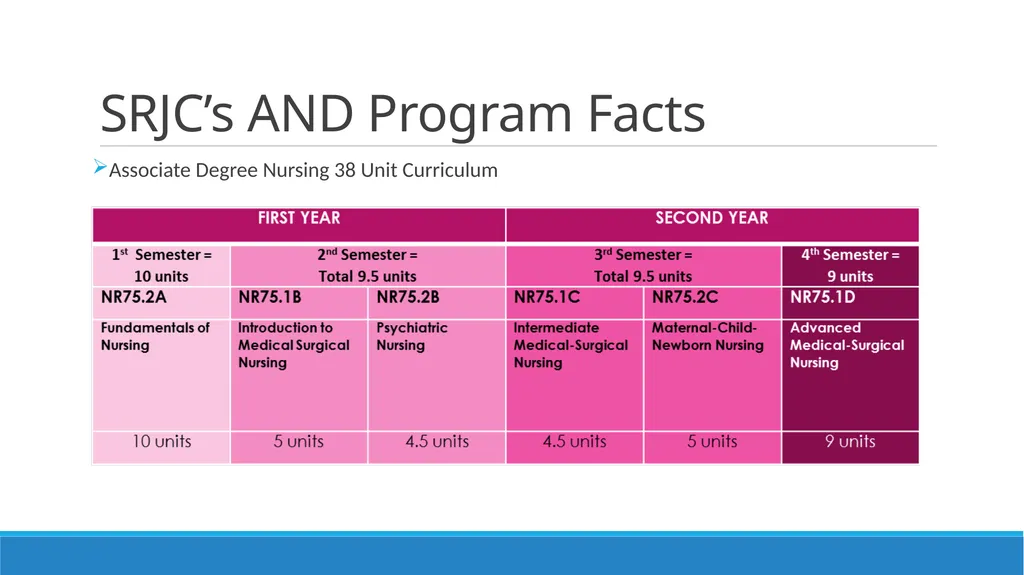
SRJC’s AND Program Facts Associate Degree Nursing 38 Unit Curriculum<br>
23
SRJC’s ADN Program Facts Breakdown of Semester Hours by Course Component<br>
24
SRJC’s ADN Program Facts Average Weekly Time Commitment for ADN Program<br>
25
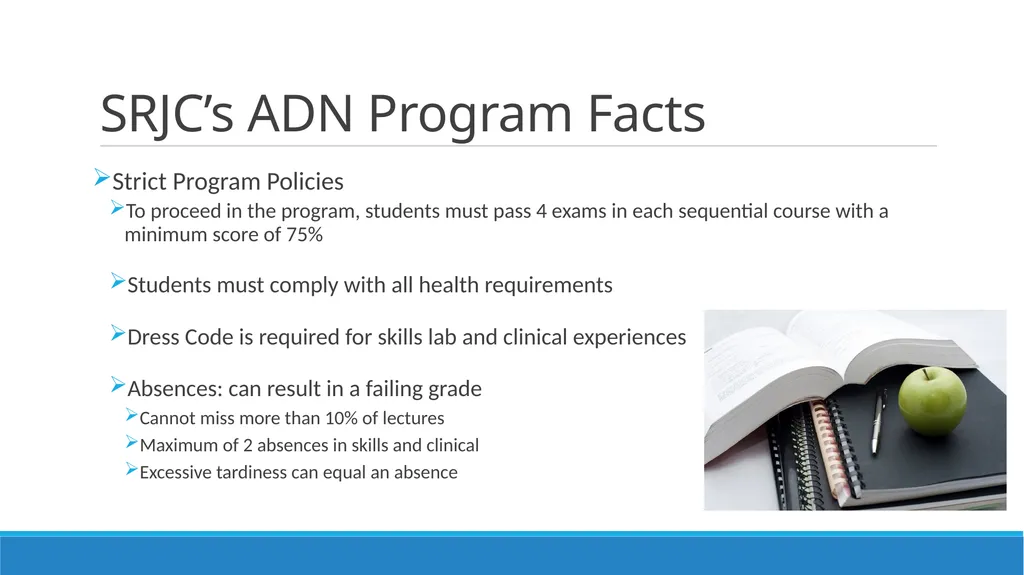
SRJC’s ADN Program Facts Strict Program Policies
To proceed in the program, students must pass 4 exams in each sequential course with a minimum score of 75%
Students must comply with all health requirements
Dress Code is required for skills lab and clinical experiences
Absences: can result in a failing grade
Cannot miss more than 10% of lectures
Maximum of 2 absences in skills and clinical
Excessive tardiness can equal an absence<br>
To proceed in the program, students must pass 4 exams in each sequential course with a minimum score of 75%
Students must comply with all health requirements
Dress Code is required for skills lab and clinical experiences
Absences: can result in a failing grade
Cannot miss more than 10% of lectures
Maximum of 2 absences in skills and clinical
Excessive tardiness can equal an absence<br>
26
SRJC’s ADN Program Facts General Workload
Read 60-100 per week
Written assignments: Nursing Care Plans, Journals
First Semester
Approximately 50 hours per week for the 1st semester and slightly decreases in the later semesters
1st semester is 5 days per week on campus for the first 6 weeks. Hours vary between 2-6 hours each day in either lecture or skills lab
Final Semester Preceptorship
The preceptorship during the last semester requires each student to work the same schedule as the nurse to whom they are assigned<br>
Read 60-100 per week
Written assignments: Nursing Care Plans, Journals
First Semester
Approximately 50 hours per week for the 1st semester and slightly decreases in the later semesters
1st semester is 5 days per week on campus for the first 6 weeks. Hours vary between 2-6 hours each day in either lecture or skills lab
Final Semester Preceptorship
The preceptorship during the last semester requires each student to work the same schedule as the nurse to whom they are assigned<br>
27
SRJC’s ADN Program Facts Clinical = two 8 hour days a week
Tues/Wed OR Sat/Sun from 6:30-2:30 or 1:30-10:30
Clinical assignments can be anywhere in Sonoma county
Student work schedules are not considered when making assignments
Students must go to their assigned hospital the day before clinical to assess patient records (2-3 hours)
Students must then prepare documents and care plans for the next day’s work (2-4 hours)<br>
Tues/Wed OR Sat/Sun from 6:30-2:30 or 1:30-10:30
Clinical assignments can be anywhere in Sonoma county
Student work schedules are not considered when making assignments
Students must go to their assigned hospital the day before clinical to assess patient records (2-3 hours)
Students must then prepare documents and care plans for the next day’s work (2-4 hours)<br>
28
ADN-BSN Bridge at SSU CNECM or CPOST –
Partnership between SSU and Community College
Qualified and admitted ADN students enroll in BSN courses at Sonoma State University while enrolled in the ADN program
https://nursing.sonoma.edu/academic-programs/post-licensure-bsn/post-licensure-requirements
TPOST-
Traditional Bridge Program for Licensed RN’s
Currently on hold at SSU
Many other options for post bridge programs<br>
Partnership between SSU and Community College
Qualified and admitted ADN students enroll in BSN courses at Sonoma State University while enrolled in the ADN program
https://nursing.sonoma.edu/academic-programs/post-licensure-bsn/post-licensure-requirements
TPOST-
Traditional Bridge Program for Licensed RN’s
Currently on hold at SSU
Many other options for post bridge programs<br>
29
Sonoma State’s BSN Program Admit approximately 24 students each Fall
https://nursing.sonoma.edu/academic-programs/pre-licensure-bsn
Selection criteria:
https://docs.google.com/document/d/1KOXCKj2ia0Do8JtEXLu1iXL7mkD_CV4z/edit<br>
https://nursing.sonoma.edu/academic-programs/pre-licensure-bsn
Selection criteria:
https://docs.google.com/document/d/1KOXCKj2ia0Do8JtEXLu1iXL7mkD_CV4z/edit<br>
30
Strategies for Success It is recommended that students take one science per semester along with other non-science prerequisites if needed
The core science courses are rigorous and time consuming
If you must take two sciences, the following sequence is suggested:
Bio 10 and Chem 60
Anat 1
Physio 1
Micro 5 or 60<br>
The core science courses are rigorous and time consuming
If you must take two sciences, the following sequence is suggested:
Bio 10 and Chem 60
Anat 1
Physio 1
Micro 5 or 60<br>
31
Strategies for Success Be realistic about your schedule
Successful completion of the prerequisites requires outside planning and work
If you are working full-time or have family responsibilities, you may want to limit your units
Get help from the Tutorial Center early in the semester
Form your own student groups to assist with your learning<br>
Successful completion of the prerequisites requires outside planning and work
If you are working full-time or have family responsibilities, you may want to limit your units
Get help from the Tutorial Center early in the semester
Form your own student groups to assist with your learning<br>
32
Submitting Transcripts Submit official transcripts to Admissions and Records for evaluation as soon as possible
Request an evaluation:
https://admissions.santarosa.edu/transfer-credit-evaluation-form
Official transcripts of coursework completed at another institution must also be submitted to the nursing department at the time of application to the Nursing Program
Unofficial transcripts for coursework completed at SRJC must be submitted to the nursing department at the time of application to the Nursing Program<br>
Request an evaluation:
https://admissions.santarosa.edu/transfer-credit-evaluation-form
Official transcripts of coursework completed at another institution must also be submitted to the nursing department at the time of application to the Nursing Program
Unofficial transcripts for coursework completed at SRJC must be submitted to the nursing department at the time of application to the Nursing Program<br>
33
SRJC has services to help you be successful! https://www.santarosa.edu/students Career Center/Hub
Counseling
Disability Resources
EOPS
Financial Aid/Scholarship Office
Learning Communities
Student Health and Psychological Services
Student Life Student Employment
Tutorial Center
Transfer Center
Veteran’s Affairs
Welcome and Connect Center
Work Experience<br>
Counseling
Disability Resources
EOPS
Financial Aid/Scholarship Office
Learning Communities
Student Health and Psychological Services
Student Life Student Employment
Tutorial Center
Transfer Center
Veteran’s Affairs
Welcome and Connect Center
Work Experience<br>
34
Remember to check in with your counselor each semester.<br>