
Nutrition &Digestion Ass.Prof.Dr. Suhad Faisal
BR
Published · 22 slides · 0 views

1 / 1
Description
Nutrition Digestion Ass.Prof.Dr. Suhad Faisal Hatem Nutrients : substances obtained from the environment that organisms need for growth ,repair ,regulation and survival. Six type of nutrients help to maintain homeostasis Carbohydrates
Related Topics
Share
Embed code
Download this presentation From Below
"Nutrition &Digestion Ass.Prof.Dr. Suhad Faisal" is the property of its rightful owner. Permission is granted to download and print the materials on this website for personal, non-commercial use only, and to display it on your personal computer provided you do not modify the materials and that you retain all copyright notices contained in the materials. By downloading content from our website, you accept the terms of this agreement.
Presentation Transcript
01
Nutrition &Digestion Ass.Prof.Dr. Suhad Faisal Hatem<br>
02
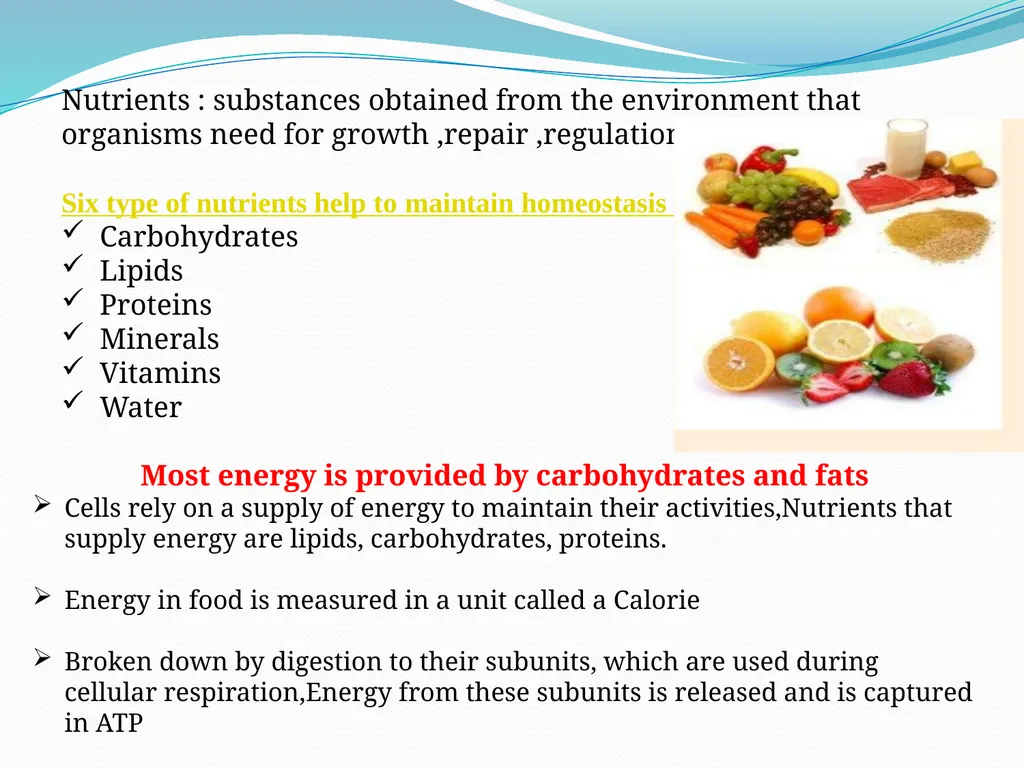
Nutrients : substances obtained from the environment that organisms need for growth ,repair ,regulation and survival.
Six type of nutrients help to maintain homeostasis
Carbohydrates
Lipids
Proteins
Minerals
Vitamins
Water Most energy is provided by carbohydrates and fats
Cells rely on a supply of energy to maintain their activities,Nutrients that supply energy are lipids, carbohydrates, proteins.
Energy in food is measured in a unit called a Calorie
Broken down by digestion to their subunits, which are used during cellular respiration,Energy from these subunits is released and is captured in ATP<br>
03
Micronutrients :
Nutrients the body needs in relatively small amounts are called Micronutrients. They include vitamins and minerals. Macronutrients :
Nutrients the body needs in relatively large amounts are called macronutrients. They include carbohydrates, proteins, lipids, and water<br>
Nutrients the body needs in relatively small amounts are called Micronutrients. They include vitamins and minerals. Macronutrients :
Nutrients the body needs in relatively large amounts are called macronutrients. They include carbohydrates, proteins, lipids, and water<br>
04
1-Carbohydrates Functions
Energy source for plants and animals
Source of carbon in metabolic processes
Storage form of energy
Structural elements of cells and tissues
One gram of carbohydrates provides 4 Calories of energy.<br>
Energy source for plants and animals
Source of carbon in metabolic processes
Storage form of energy
Structural elements of cells and tissues
One gram of carbohydrates provides 4 Calories of energy.<br>
05
1-Carbohydrates a source of quick energy
glucose, sucrose (simple carbohydrate )
polysaccharides, long chains of sugar molecules
Cellulose, starch, and glycogen are polysaccharides composed of glucose chains (complex carbohydrate)
Cellulose - structural component of plant cell walls
Starch -storage material of plants
Glycogen - used by animals for short-term energy storage.it is converted glucose by body<br>
06
Essential Nutrients Provide raw materials
Our cells can synthesize most of the molecules our bodies require, but they cannot synthesize certain raw materials, called essential nutrients, which must be supplied in the diet
Essential Nutrients for humans include certain
fatty acids, amino acids, a variety of minerals, vitamins, water<br>
Our cells can synthesize most of the molecules our bodies require, but they cannot synthesize certain raw materials, called essential nutrients, which must be supplied in the diet
Essential Nutrients for humans include certain
fatty acids, amino acids, a variety of minerals, vitamins, water<br>
07
Essential Fatty Acids:Certain fatty acids are essential in the human diet
Fats and oils provide a source of energy and essential fatty acids
Similar to carbohydrates but include less O2 and not dissolved in water
They help us absorb fat-soluble vitamins, are important in cell division, fetal development, and immune response
Sources of essential fatty acids are fish oils, canola oil, soybean oil, flaxseed, walnuts
One gram of lipids provides 9 Calories of energy Lipdes<br>
08
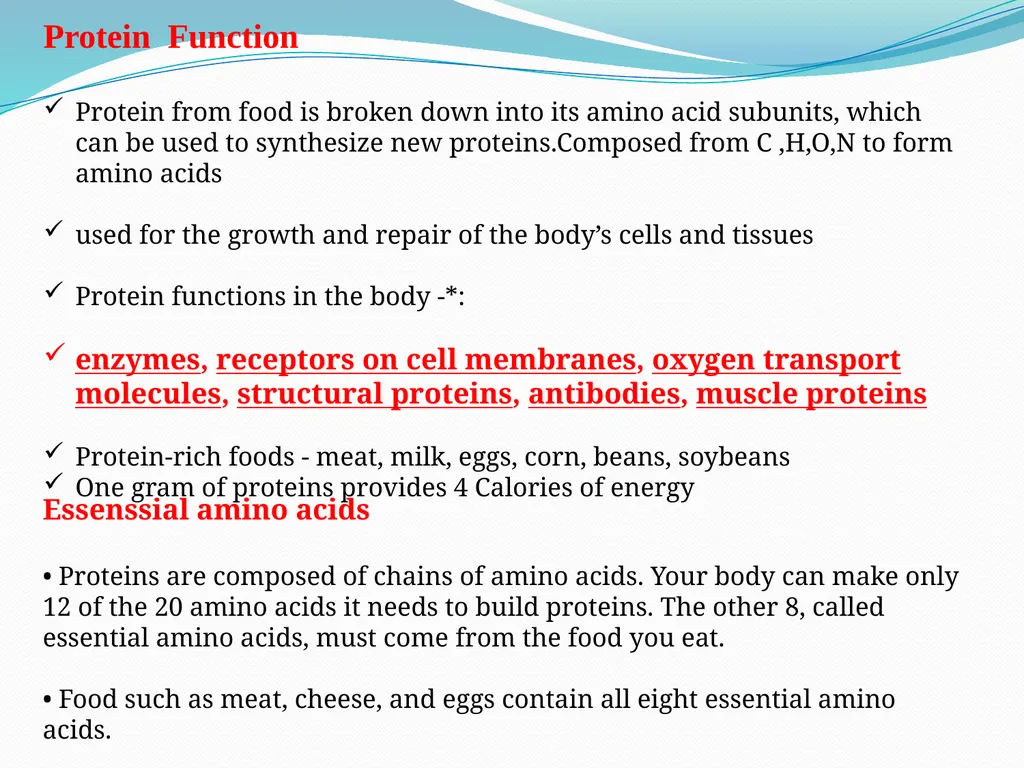
Protein Function
Protein from food is broken down into its amino acid subunits, which can be used to synthesize new proteins.Composed from C ,H,O,N to form amino acids
used for the growth and repair of the body’s cells and tissues
Protein functions in the body -*:
enzymes, receptors on cell membranes, oxygen transport molecules, structural proteins, antibodies, muscle proteins
Protein-rich foods - meat, milk, eggs, corn, beans, soybeans
One gram of proteins provides 4 Calories of energy Essenssial amino acids
• Proteins are composed of chains of amino acids. Your body can make only 12 of the 20 amino acids it needs to build proteins. The other 8, called essential amino acids, must come from the food you eat.
• Food such as meat, cheese, and eggs contain all eight essential amino acids.<br>
09
Vitamins
It organic molecules that animals require in small amounts for normal cell function, growth, development and Help change carbohydrate and fats to energy
Vitamins are required for the proper functioning of enzymes that control metabolic reactions in the body
Vitamins are essential nutrients that the body cannot synthesize and must be obtained in the diet
They are grouped into two categories: water soluble or fat soluble<br>
10
Minerals
Elements that play a role in animal nutrition and can only be obtained in diet or drinking water
Calcium, magnesium, and phosphorus are components of bone and teeth
Sodium, calcium, and potassium - needed for muscle contraction and nerve impulses
Iron - hemoglobin in the blood
Iodine - hormones produced by the thyroid gland
Major Minerals includes Calcium, magnesium, phosphorus ,Sodium, and potassium
Trace Minerals includes Iron, Iodine,Zinc,Copper<br>
11
Water :The human body is about 60% water
carries dissolved nutrients by our body and help in digesting food
All metabolic reactions occur in solution, and water participates directly in hydrolysis reactions that break down proteins, carbohydrates, fats
Water is the principal component of saliva, blood, lymph, extracellular fluid, and cytoplasmic fluid
By sweating, evaporation of water , prevent over heating
Urine, mostly water, is necessary to eliminate cellular waste products<br>
12
Weight Gain and Obesity
Any unused energy in food, whether it comes from carbohydrates, proteins, or lipids, is stored in the body as fat.
An extra 3,500 Calories of energy results in the storage of almost half a kilogram (1 pound) of stored body fat.
People who consistently consume more food may become obese.
Obesity occurs when the body mass index is 30.0 kg/m2 or greater. Body mass index (BMI) is an estimate of the fat content of the body. It is calculated by dividing a person’s weight (in kilograms) by the square of the person’s height (in meters).
Obesity increases the risk of health problems such as type 2 diabetes and hypertension.<br>
13
Digestion
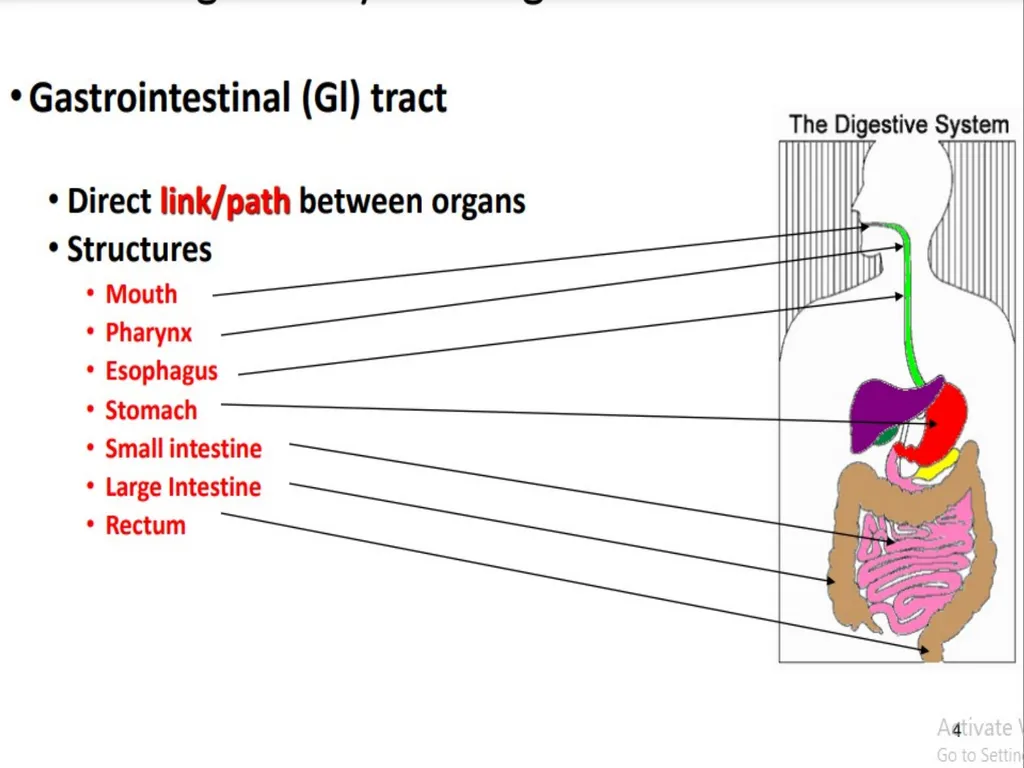
is the process by which the large complex molecules in food are broken down into smaller molecules that can be used by the body. • The digestive system includes the gastrointestinal tract and the associated glands.
Ingestion: the process of taking in food into the digestive tract through an opening, usually called a mouth is known as ingestion
Digestion consists of two types of processes
1- Mechanical breakdown: The process of breaking down food into smaller pieces by teeth and tongue mixed food with saliva (contains bacteria-killing enzyme and antibodies). Also the mucus help food to move from throat to stomach using muscle movement called peristalsis.
2- Chemical breakdown: The particles of food are acted upon by enzymes that break them down into simpler subunits.<br>
14
4- Digestion in Stomach
Stores food and releases it gradually into the small intestine, Stomach helps in the mechanical breakdown of large pieces of food and Chemical breakdown
Gastric fluid includes:
1-Pepsinogen (inactive)------------ Pepsin -------Proteins --------Peptides.
2- HCL :Activates inactive pepsinogen into active pepsin.
• Kills bacteria.
• Makes the medium acidic which is suitable for pepsin to act on proteins.
3- The stomach secretes a layer of mucus to protect itself from its own acidic
Sphincters : circular muscles help food movement in and out stomach (pyloric & cardiac)
Digested juices and enzymes turn the partly digested food in the stomach into a semi liquid mixture called chyme
food takes six hours to empty the stomach after a meal.water&alchohol will be absorbed in stomach<br>
15
5- Absorption: The main function of small intestine is to digest food and absorb the digested food into the bloodstream with liver and pancreas. Absorption occur in small and large intestine
Small intestine: include bile juice & pancreatic juice & digestive enzymes
1- bile juice Liver secretes bile which is stored in the gall bladder and released when needed through the bile duct, Bile helps in emulsification of fats.
2- pancreatic juice : neutralizes the acidic chyme and enzyme digests carbohydrates, proteins and lipids.
Pancreatic proteases(trypsin): break down protein into peptides , Pancreatic lipases break down fats into fatty acid and glycerol.
3-Digestive Enzymes
• The walls of the small intestine secrete digestive enzymes to digest food.
• Peptidases to split small peptides into amino acids.
• Maltase acts on maltose and converts it into glucose.
• Sucrase acts on sucrose and converts it into glucose and fructose.
• Lactase acts on lactose and converts it into glucose and galactose.
• Lipases acts on lipids and convert it into fatty acid and glycerol.<br>
16
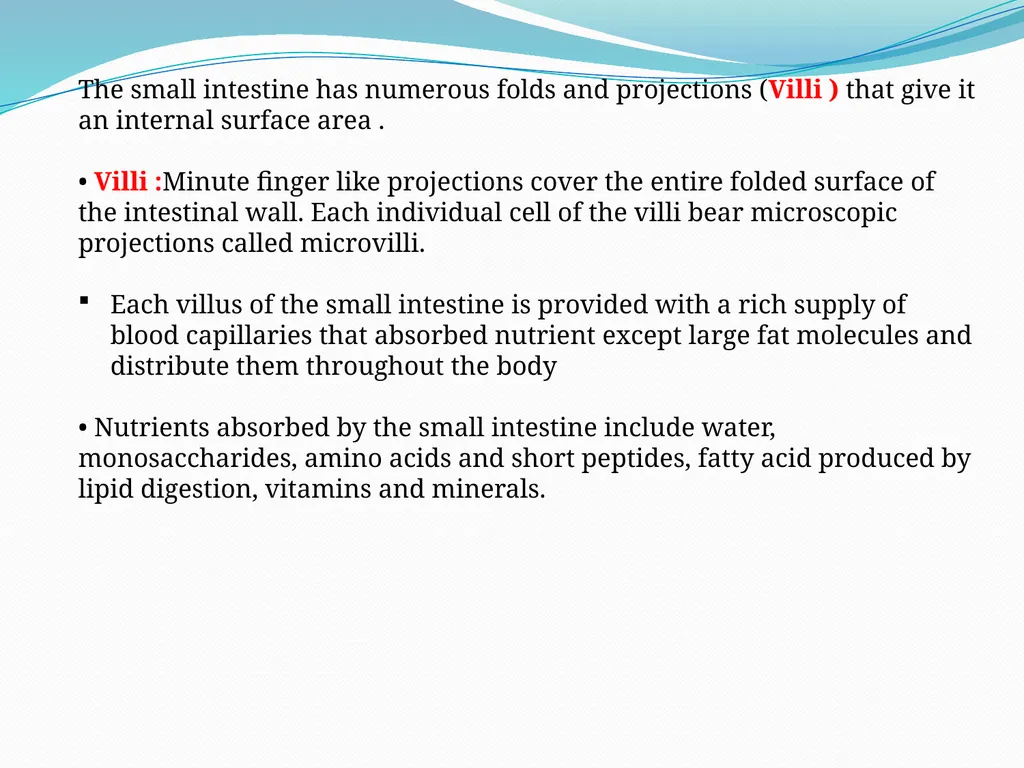
The small intestine has numerous folds and projections (Villi ) that give it an internal surface area .
• Villi :Minute finger like projections cover the entire folded surface of the intestinal wall. Each individual cell of the villi bear microscopic projections called microvilli.
Each villus of the small intestine is provided with a rich supply of blood capillaries that absorbed nutrient except large fat molecules and distribute them throughout the body
• Nutrients absorbed by the small intestine include water, monosaccharides, amino acids and short peptides, fatty acid produced by lipid digestion, vitamins and minerals.<br>
17
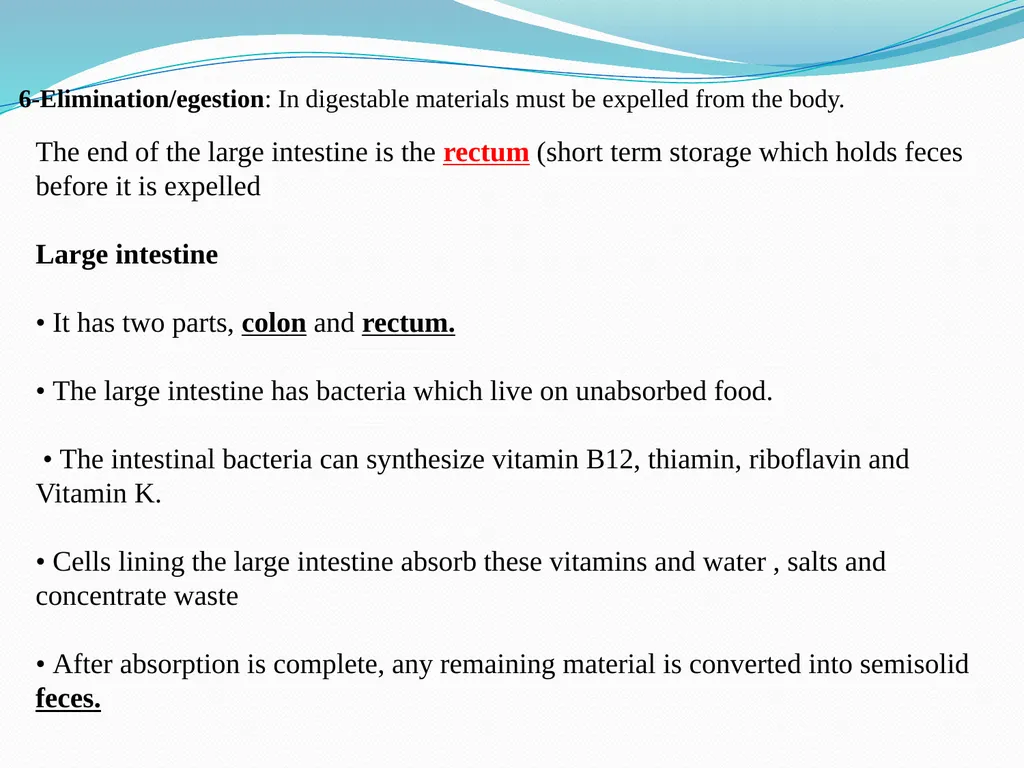
The end of the large intestine is the rectum (short term storage which holds feces before it is expelled
Large intestine
• It has two parts, colon and rectum.
• The large intestine has bacteria which live on unabsorbed food.
• The intestinal bacteria can synthesize vitamin B12, thiamin, riboflavin and Vitamin K.
• Cells lining the large intestine absorb these vitamins and water , salts and concentrate waste
• After absorption is complete, any remaining material is converted into semisolid feces. 6-Elimination/egestion: In digestable materials must be expelled from the body.<br>
18
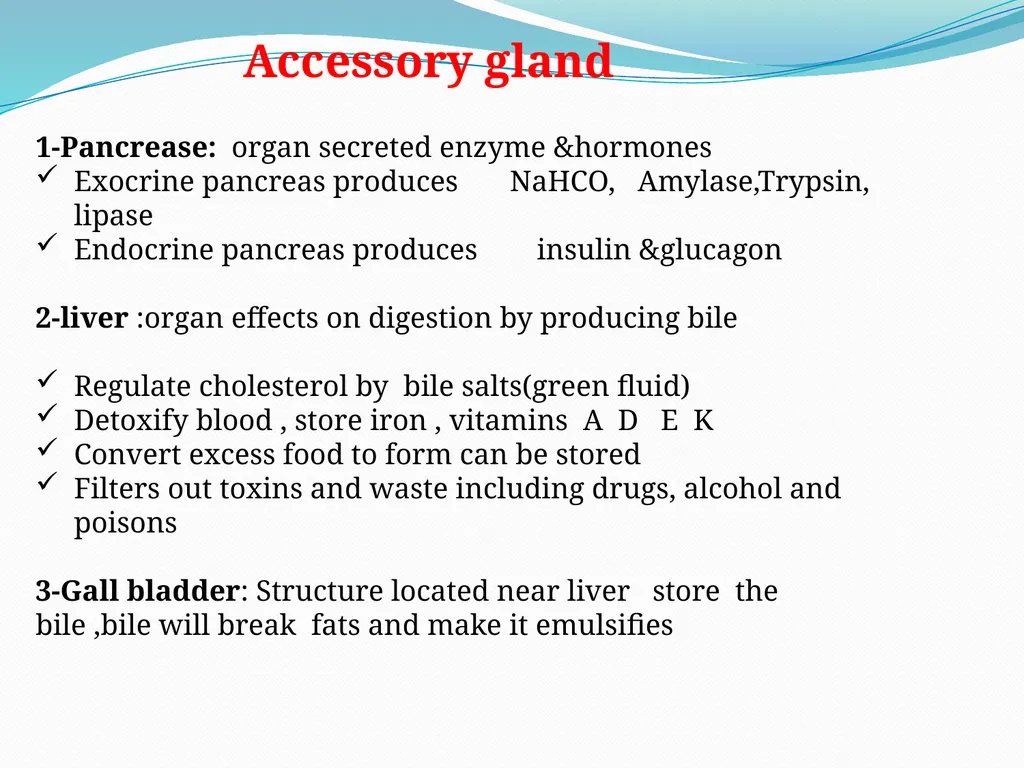
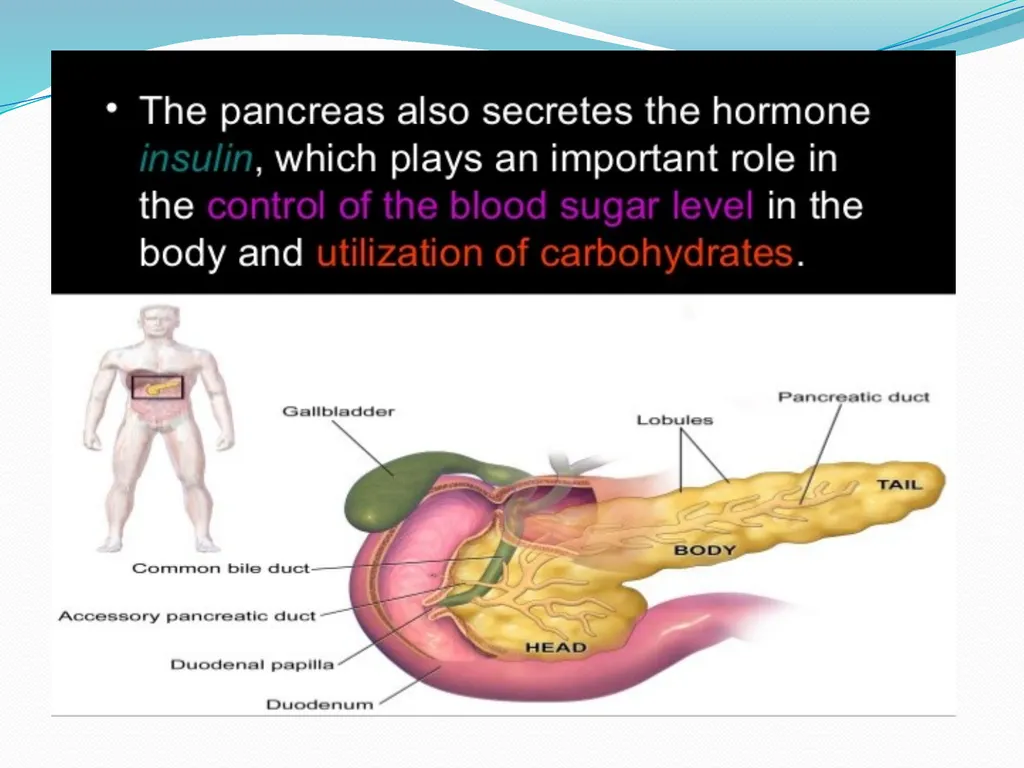
Accessory gland 1-Pancrease: organ secreted enzyme &hormones
Exocrine pancreas produces NaHCO, Amylase,Trypsin, lipase
Endocrine pancreas produces insulin &glucagon
2-liver :organ effects on digestion by producing bile
Regulate cholesterol by bile salts(green fluid)
Detoxify blood , store iron , vitamins A D E K
Convert excess food to form can be stored
Filters out toxins and waste including drugs, alcohol and poisons
3-Gall bladder: Structure located near liver store the bile ,bile will break fats and make it emulsifies<br>
19
Thank You<br>