
NY State Office for People with Developmental



Description: NY State Office for People with Developmental Disabilities Navigating Eligibility, Services Supports Presented By: Matthew Faulkner Westchester County Department of Community Mental Health Developmental Disabilities Unit Tuesday, January
Related Topics
Download Presentation
"NY State Office for People with Developmental" is the property of its rightful owner. Permission is granted to download and print the materials on this website for personal, non-commercial use only, and to display it on your personal computer provided you do not modify the materials and that you retain all copyright notices contained in the materials. By downloading content from our website, you accept the terms of this agreement.
Presentation Transcript
slide1. NY State Office for People with Developmental Disabilities
Navigating Eligibility, Services & Supports
Presented By: Matthew Faulkner
Westchester County Department of Community Mental Health
Developmental Disabilities Unit Tuesday, January 21, 2025
HASTINGS SEPTA George Latimer
County Executive
Department of Community Mental Health
Michael Orth, M.S.W.,
Commissioner<br>
slide2. What is the NYS-OPWDD?
New York State Office for People with Developmental Disabilities. OPWDD provides funding, supports and services for individuals with a developmental disability (according to Mental Hygiene Law) (MHL) 1.03 (22) and who have been determined eligible to apply for those services.
Eligibility for New York State – Office for People with Developmental Disabilities (OPWDD) Services
Why is it important to apply for eligibility?
So that individuals can access the services that they may need These services and supports provided by OPWDD can be life-long.
What is the OPWDD eligibility criteria?
1).The applicant has a documented developmental disability, a qualifying diagnosis:
1). Intellectual Disability, 2). Autism Spectrum Disorder (ASD), 3). Cerebral Palsy, 4). Epilepsy/Seizure Disorder, 5). Neurological Impairments, 6). Familial Dysautonomia, and
7). Prader-Willi Syndrome.
What is not a Developmental Disability?
1). Mental Illness by itself (i.e bi-polar, schizophrenia, severe depression, etc.
2). Learning Disability, ADHD by itself
3). Mild forms of epilepsy or brain injury and no evidence of a substantial handicap
4). Loss of motor skills or physical disabilities.<br>
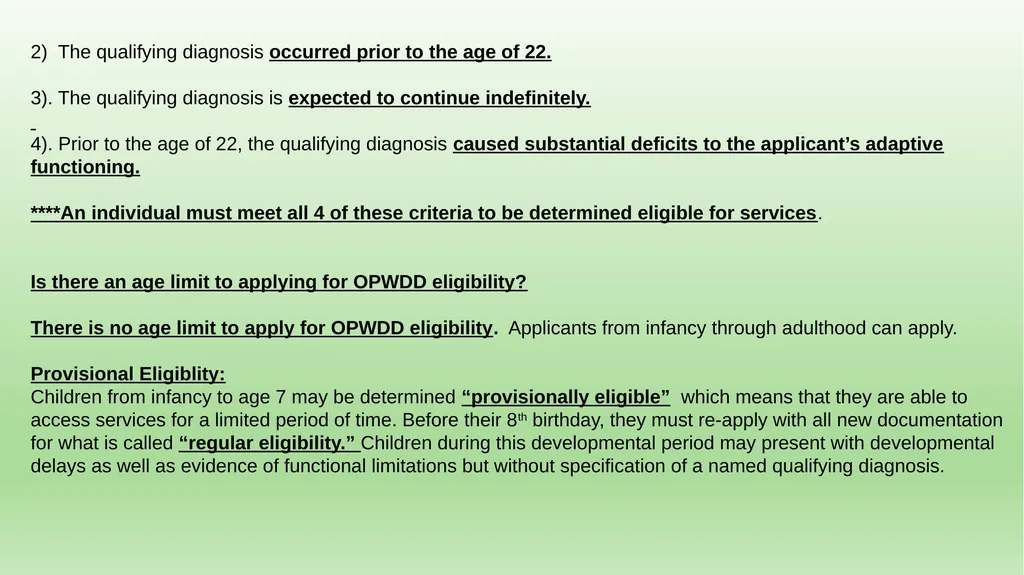
slide3. 2) The qualifying diagnosis occurred prior to the age of 22.
3). The qualifying diagnosis is expected to continue indefinitely.
4). Prior to the age of 22, the qualifying diagnosis caused substantial deficits to the applicant’s adaptive functioning.
****An individual must meet all 4 of these criteria to be determined eligible for services.
Is there an age limit to applying for OPWDD eligibility?
There is no age limit to apply for OPWDD eligibility. Applicants from infancy through adulthood can apply.
Provisional Eligiblity:
Children from infancy to age 7 may be determined “provisionally eligible” which means that they are able to access services for a limited period of time. Before their 8th birthday, they must re-apply with all new documentation for what is called “regular eligibility.” Children during this developmental period may present with developmental delays as well as evidence of functional limitations but without specification of a named qualifying diagnosis.<br>
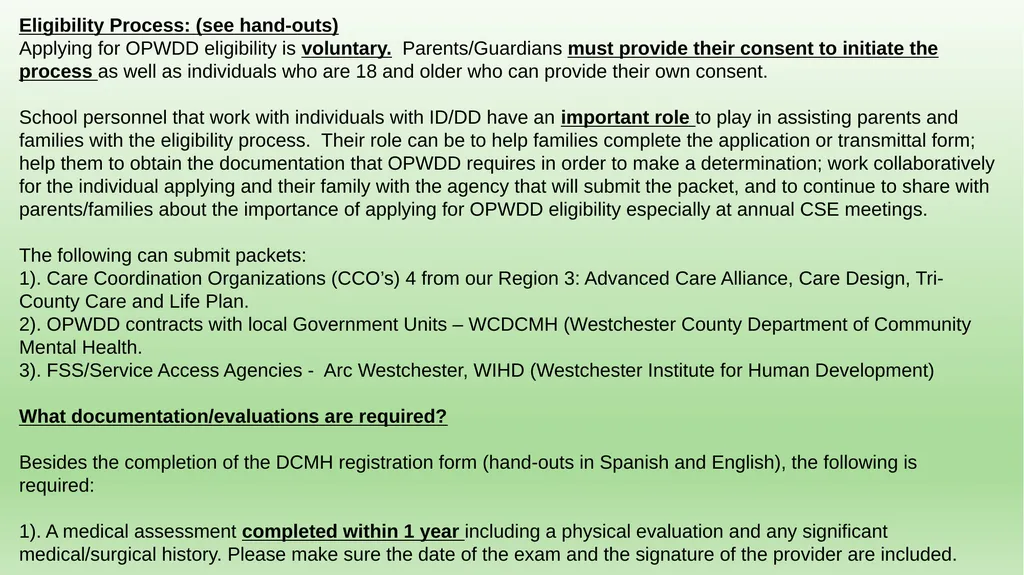
slide4. Eligibility Process: (see hand-outs)
Applying for OPWDD eligibility is voluntary. Parents/Guardians must provide their consent to initiate the process as well as individuals who are 18 and older who can provide their own consent.
School personnel that work with individuals with ID/DD have an important role to play in assisting parents and families with the eligibility process. Their role can be to help families complete the application or transmittal form; help them to obtain the documentation that OPWDD requires in order to make a determination; work collaboratively for the individual applying and their family with the agency that will submit the packet, and to continue to share with parents/families about the importance of applying for OPWDD eligibility especially at annual CSE meetings.
The following can submit packets:
1). Care Coordination Organizations (CCO’s) 4 from our Region 3: Advanced Care Alliance, Care Design, Tri-County Care and Life Plan.
2). OPWDD contracts with local Government Units – WCDCMH (Westchester County Department of Community Mental Health.
3). FSS/Service Access Agencies - Arc Westchester, WIHD (Westchester Institute for Human Development)
What documentation/evaluations are required?
Besides the completion of the DCMH registration form (hand-outs in Spanish and English), the following is required:
1). A medical assessment completed within 1 year including a physical evaluation and any significant medical/surgical history. Please make sure the date of the exam and the signature of the provider are included.<br>
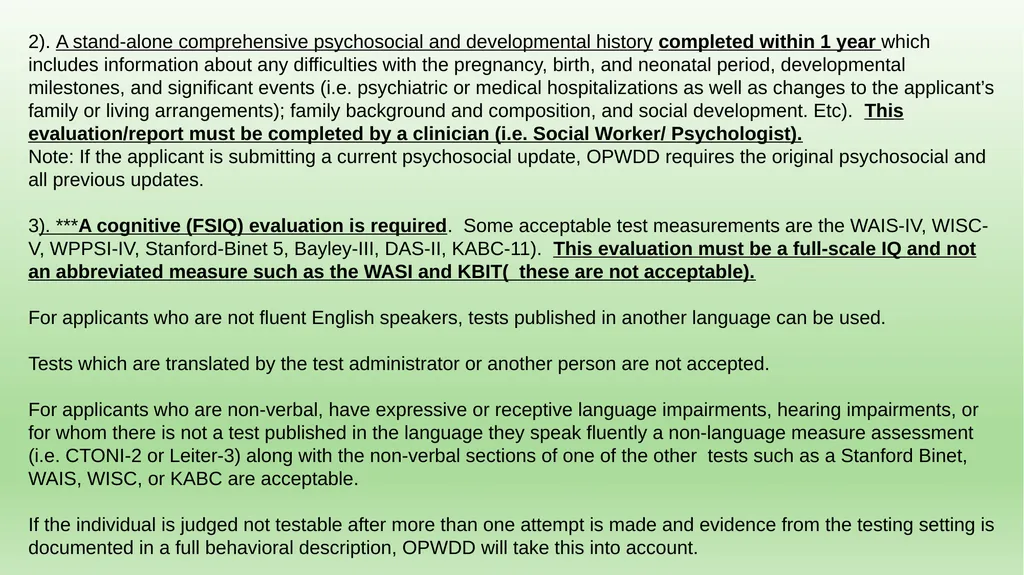
slide5. 2). A stand-alone comprehensive psychosocial and developmental history completed within 1 year which includes information about any difficulties with the pregnancy, birth, and neonatal period, developmental milestones, and significant events (i.e. psychiatric or medical hospitalizations as well as changes to the applicant’s family or living arrangements); family background and composition, and social development. Etc). This evaluation/report must be completed by a clinician (i.e. Social Worker/ Psychologist).
Note: If the applicant is submitting a current psychosocial update, OPWDD requires the original psychosocial and all previous updates.
3). ***A cognitive (FSIQ) evaluation is required. Some acceptable test measurements are the WAIS-IV, WISC-V, WPPSI-IV, Stanford-Binet 5, Bayley-III, DAS-II, KABC-11). This evaluation must be a full-scale IQ and not an abbreviated measure such as the WASI and KBIT( these are not acceptable).
For applicants who are not fluent English speakers, tests published in another language can be used.
Tests which are translated by the test administrator or another person are not accepted.
For applicants who are non-verbal, have expressive or receptive language impairments, hearing impairments, or for whom there is not a test published in the language they speak fluently a non-language measure assessment (i.e. CTONI-2 or Leiter-3) along with the non-verbal sections of one of the other tests such as a Stanford Binet, WAIS, WISC, or KABC are acceptable.
If the individual is judged not testable after more than one attempt is made and evidence from the testing setting is documented in a full behavioral description, OPWDD will take this into account.<br>
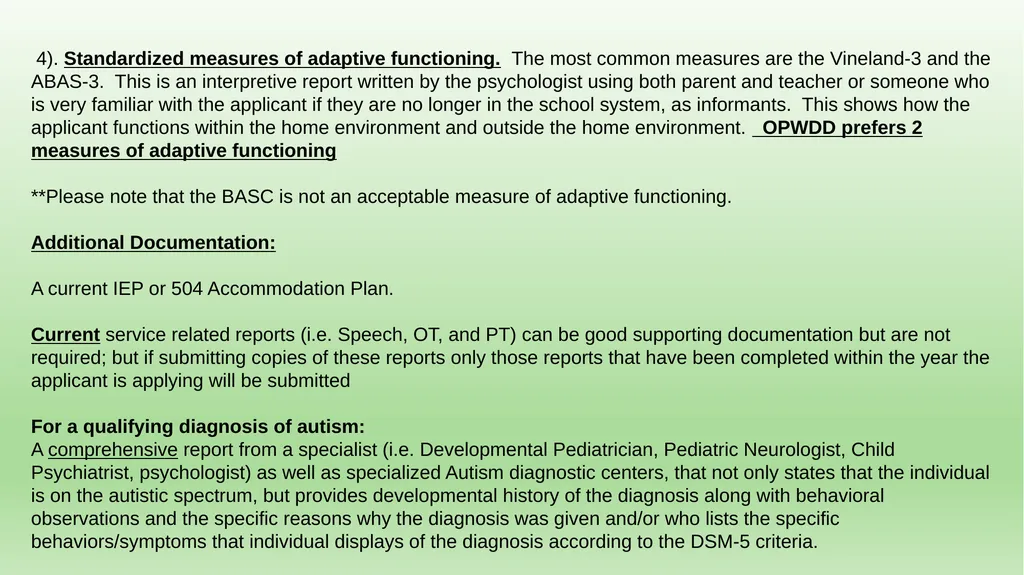
slide6. 4). Standardized measures of adaptive functioning. The most common measures are the Vineland-3 and the ABAS-3. This is an interpretive report written by the psychologist using both parent and teacher or someone who is very familiar with the applicant if they are no longer in the school system, as informants. This shows how the applicant functions within the home environment and outside the home environment. OPWDD prefers 2 measures of adaptive functioning
**Please note that the BASC is not an acceptable measure of adaptive functioning.
Additional Documentation:
A current IEP or 504 Accommodation Plan.
Current service related reports (i.e. Speech, OT, and PT) can be good supporting documentation but are not required; but if submitting copies of these reports only those reports that have been completed within the year the applicant is applying will be submitted
For a qualifying diagnosis of autism:
A comprehensive report from a specialist (i.e. Developmental Pediatrician, Pediatric Neurologist, Child Psychiatrist, psychologist) as well as specialized Autism diagnostic centers, that not only states that the individual is on the autistic spectrum, but provides developmental history of the diagnosis along with behavioral observations and the specific reasons why the diagnosis was given and/or who lists the specific behaviors/symptoms that individual displays of the diagnosis according to the DSM-5 criteria.<br>
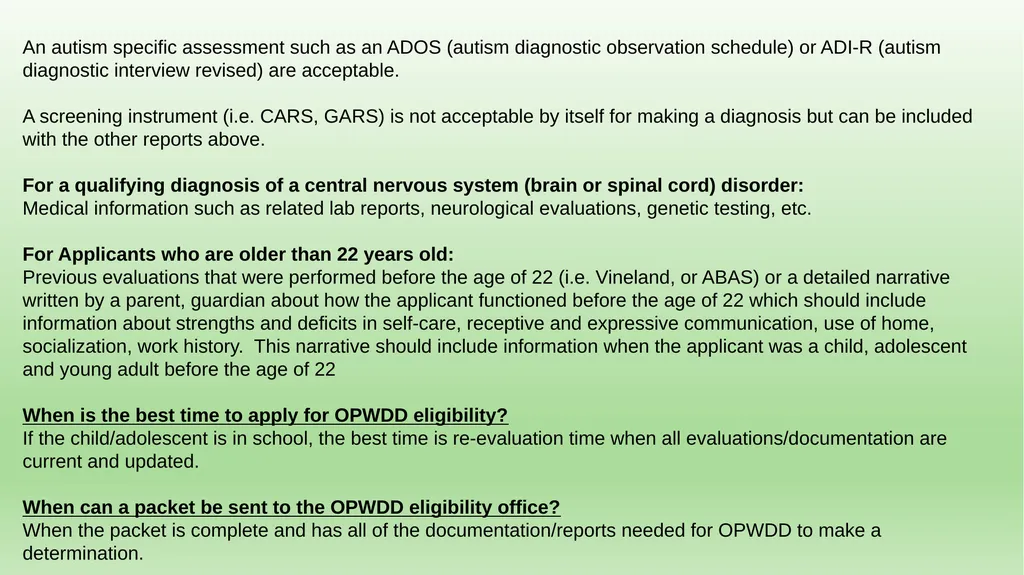
slide7. An autism specific assessment such as an ADOS (autism diagnostic observation schedule) or ADI-R (autism diagnostic interview revised) are acceptable.
A screening instrument (i.e. CARS, GARS) is not acceptable by itself for making a diagnosis but can be included with the other reports above.
For a qualifying diagnosis of a central nervous system (brain or spinal cord) disorder:
Medical information such as related lab reports, neurological evaluations, genetic testing, etc.
For Applicants who are older than 22 years old:
Previous evaluations that were performed before the age of 22 (i.e. Vineland, or ABAS) or a detailed narrative written by a parent, guardian about how the applicant functioned before the age of 22 which should include information about strengths and deficits in self-care, receptive and expressive communication, use of home, socialization, work history. This narrative should include information when the applicant was a child, adolescent and young adult before the age of 22
When is the best time to apply for OPWDD eligibility?
If the child/adolescent is in school, the best time is re-evaluation time when all evaluations/documentation are current and updated.
When can a packet be sent to the OPWDD eligibility office?
When the packet is complete and has all of the documentation/reports needed for OPWDD to make a determination.<br>
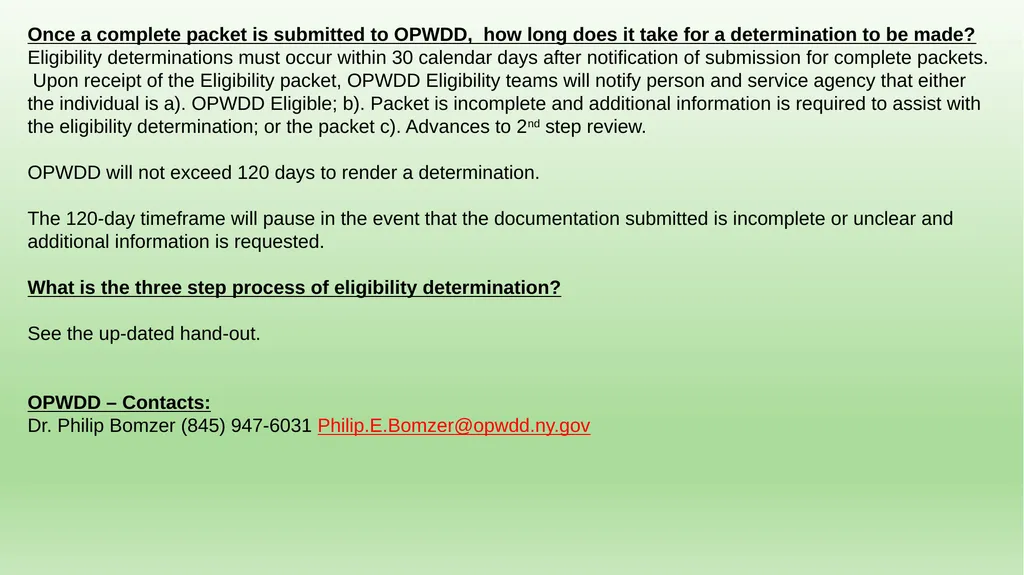
slide8. Once a complete packet is submitted to OPWDD, how long does it take for a determination to be made?
Eligibility determinations must occur within 30 calendar days after notification of submission for complete packets. Upon receipt of the Eligibility packet, OPWDD Eligibility teams will notify person and service agency that either the individual is a). OPWDD Eligible; b). Packet is incomplete and additional information is required to assist with the eligibility determination; or the packet c). Advances to 2nd step review.
OPWDD will not exceed 120 days to render a determination.
The 120-day timeframe will pause in the event that the documentation submitted is incomplete or unclear and additional information is requested.
What is the three step process of eligibility determination?
See the up-dated hand-out.
OPWDD – Contacts:
Dr. Philip Bomzer (845) 947-6031 Philip.E.Bomzer@opwdd.ny.gov<br>
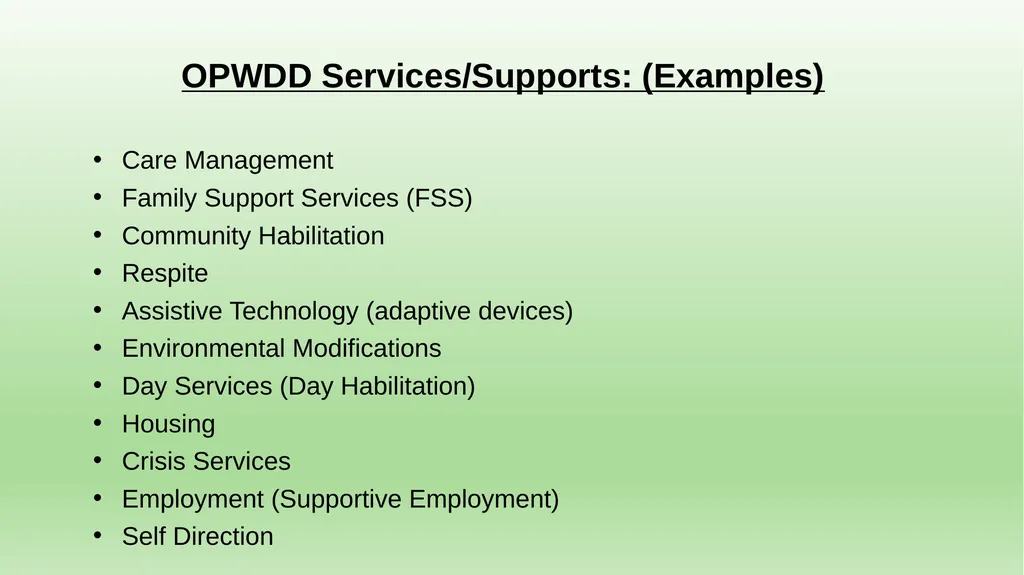
slide9. Care Management
Family Support Services (FSS)
Community Habilitation
Respite
Assistive Technology (adaptive devices)
Environmental Modifications
Day Services (Day Habilitation)
Housing
Crisis Services
Employment (Supportive Employment)
Self Direction OPWDD Services/Supports: (Examples)<br>
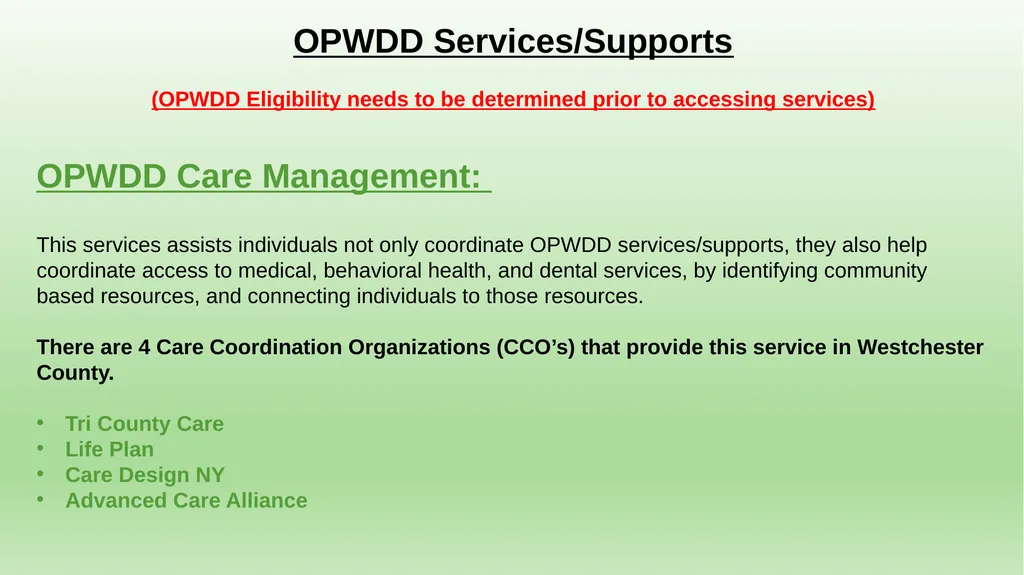
slide10. OPWDD Services/Supports
(OPWDD Eligibility needs to be determined prior to accessing services) OPWDD Care Management:
This services assists individuals not only coordinate OPWDD services/supports, they also help coordinate access to medical, behavioral health, and dental services, by identifying community based resources, and connecting individuals to those resources.
There are 4 Care Coordination Organizations (CCO’s) that provide this service in Westchester County.
Tri County Care
Life Plan
Care Design NY
Advanced Care Alliance<br>
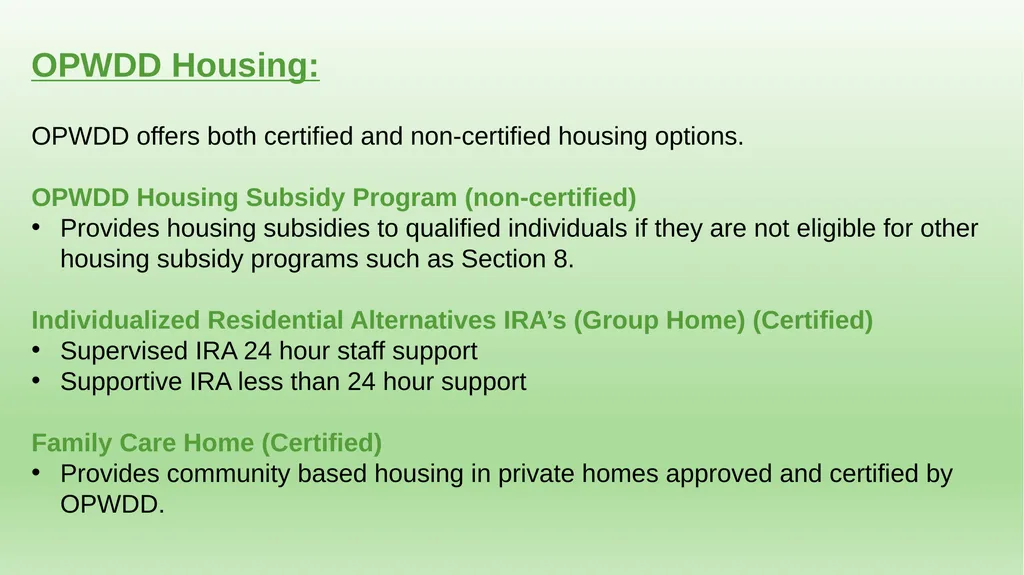
slide11. OPWDD Housing:
OPWDD offers both certified and non-certified housing options.
OPWDD Housing Subsidy Program (non-certified)
Provides housing subsidies to qualified individuals if they are not eligible for other housing subsidy programs such as Section 8.
Individualized Residential Alternatives IRA’s (Group Home) (Certified)
Supervised IRA 24 hour staff support
Supportive IRA less than 24 hour support
Family Care Home (Certified)
Provides community based housing in private homes approved and certified by OPWDD.<br>
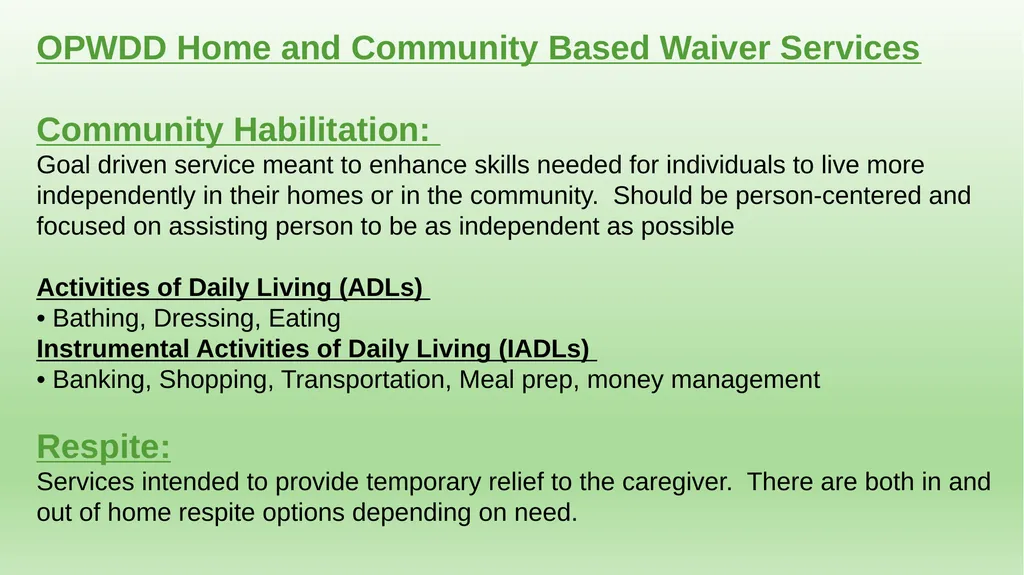
slide12. OPWDD Home and Community Based Waiver Services
Community Habilitation:
Goal driven service meant to enhance skills needed for individuals to live more independently in their homes or in the community. Should be person-centered and focused on assisting person to be as independent as possible
Activities of Daily Living (ADLs)
• Bathing, Dressing, Eating
Instrumental Activities of Daily Living (IADLs)
• Banking, Shopping, Transportation, Meal prep, money management
Respite:
Services intended to provide temporary relief to the caregiver. There are both in and out of home respite options depending on need.<br>
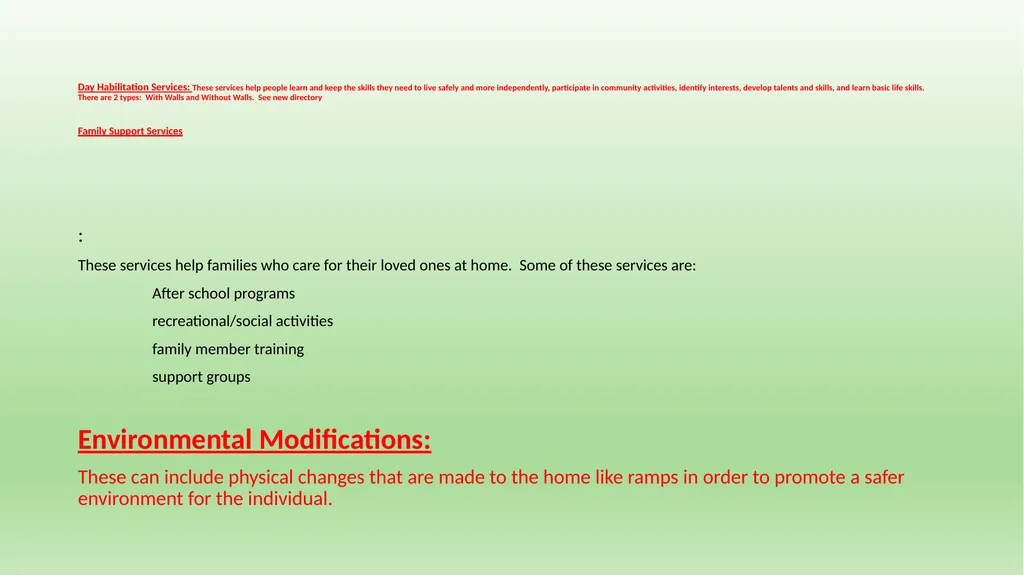
slide13. Day Habilitation Services: These services help people learn and keep the skills they need to live safely and more independently, participate in community activities, identify interests, develop talents and skills, and learn basic life skills. There are 2 types: With Walls and Without Walls. See new directory Family Support Services :
These services help families who care for their loved ones at home. Some of these services are:
After school programs
recreational/social activities
family member training
support groups
Environmental Modifications:
These can include physical changes that are made to the home like ramps in order to promote a safer environment for the individual.<br>
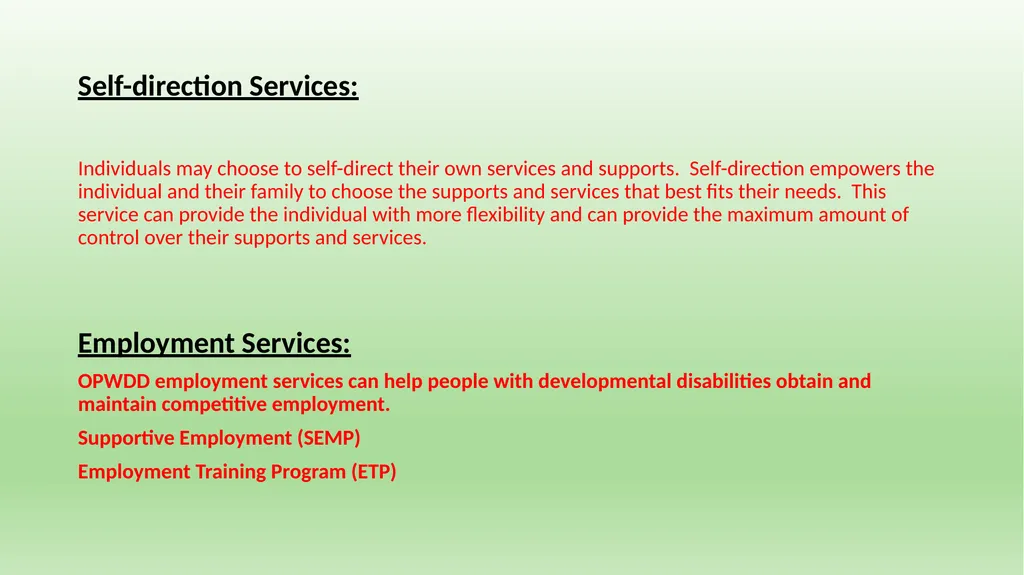
slide14. Self-direction Services: Individuals may choose to self-direct their own services and supports. Self-direction empowers the individual and their family to choose the supports and services that best fits their needs. This service can provide the individual with more flexibility and can provide the maximum amount of control over their supports and services.
Employment Services:
OPWDD employment services can help people with developmental disabilities obtain and maintain competitive employment.
Supportive Employment (SEMP)
Employment Training Program (ETP)<br>
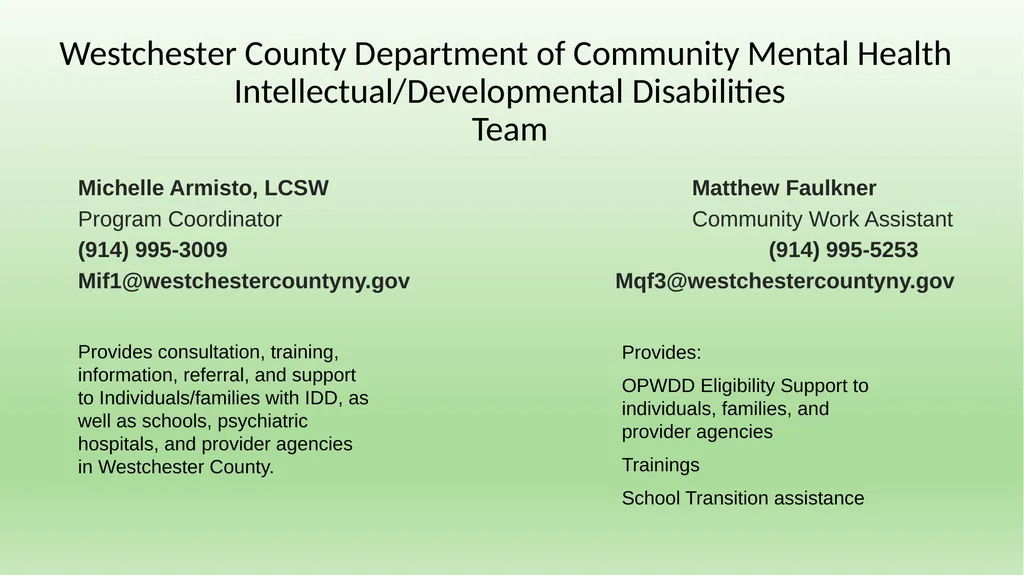
slide15. Westchester County Department of Community Mental Health Intellectual/Developmental Disabilities Team Michelle Armisto, LCSW Matthew Faulkner
Program Coordinator Community Work Assistant
(914) 995-3009 (914) 995-5253
Mif1@westchestercountyny.gov Mqf3@westchestercountyny.gov Provides consultation, training, information, referral, and support to Individuals/families with IDD, as well as schools, psychiatric hospitals, and provider agencies in Westchester County. Provides:
OPWDD Eligibility Support to individuals, families, and provider agencies
Trainings
School Transition assistance<br>
slide16. Questions?<br>
slide17. Thank You!! SCAN TO ACCESS OUR ONLINE SERVICE DIRECTORY<br>
HASTINGS SEPTA George Latimer
County Executive
Department of Community Mental Health
Michael Orth, M.S.W.,
Commissioner<br>
slide2. What is the NYS-OPWDD?
New York State Office for People with Developmental Disabilities. OPWDD provides funding, supports and services for individuals with a developmental disability (according to Mental Hygiene Law) (MHL) 1.03 (22) and who have been determined eligible to apply for those services.
Eligibility for New York State – Office for People with Developmental Disabilities (OPWDD) Services
Why is it important to apply for eligibility?
So that individuals can access the services that they may need These services and supports provided by OPWDD can be life-long.
What is the OPWDD eligibility criteria?
1).The applicant has a documented developmental disability, a qualifying diagnosis:
1). Intellectual Disability, 2). Autism Spectrum Disorder (ASD), 3). Cerebral Palsy, 4). Epilepsy/Seizure Disorder, 5). Neurological Impairments, 6). Familial Dysautonomia, and
7). Prader-Willi Syndrome.
What is not a Developmental Disability?
1). Mental Illness by itself (i.e bi-polar, schizophrenia, severe depression, etc.
2). Learning Disability, ADHD by itself
3). Mild forms of epilepsy or brain injury and no evidence of a substantial handicap
4). Loss of motor skills or physical disabilities.<br>
slide3. 2) The qualifying diagnosis occurred prior to the age of 22.
3). The qualifying diagnosis is expected to continue indefinitely.
4). Prior to the age of 22, the qualifying diagnosis caused substantial deficits to the applicant’s adaptive functioning.
****An individual must meet all 4 of these criteria to be determined eligible for services.
Is there an age limit to applying for OPWDD eligibility?
There is no age limit to apply for OPWDD eligibility. Applicants from infancy through adulthood can apply.
Provisional Eligiblity:
Children from infancy to age 7 may be determined “provisionally eligible” which means that they are able to access services for a limited period of time. Before their 8th birthday, they must re-apply with all new documentation for what is called “regular eligibility.” Children during this developmental period may present with developmental delays as well as evidence of functional limitations but without specification of a named qualifying diagnosis.<br>
slide4. Eligibility Process: (see hand-outs)
Applying for OPWDD eligibility is voluntary. Parents/Guardians must provide their consent to initiate the process as well as individuals who are 18 and older who can provide their own consent.
School personnel that work with individuals with ID/DD have an important role to play in assisting parents and families with the eligibility process. Their role can be to help families complete the application or transmittal form; help them to obtain the documentation that OPWDD requires in order to make a determination; work collaboratively for the individual applying and their family with the agency that will submit the packet, and to continue to share with parents/families about the importance of applying for OPWDD eligibility especially at annual CSE meetings.
The following can submit packets:
1). Care Coordination Organizations (CCO’s) 4 from our Region 3: Advanced Care Alliance, Care Design, Tri-County Care and Life Plan.
2). OPWDD contracts with local Government Units – WCDCMH (Westchester County Department of Community Mental Health.
3). FSS/Service Access Agencies - Arc Westchester, WIHD (Westchester Institute for Human Development)
What documentation/evaluations are required?
Besides the completion of the DCMH registration form (hand-outs in Spanish and English), the following is required:
1). A medical assessment completed within 1 year including a physical evaluation and any significant medical/surgical history. Please make sure the date of the exam and the signature of the provider are included.<br>
slide5. 2). A stand-alone comprehensive psychosocial and developmental history completed within 1 year which includes information about any difficulties with the pregnancy, birth, and neonatal period, developmental milestones, and significant events (i.e. psychiatric or medical hospitalizations as well as changes to the applicant’s family or living arrangements); family background and composition, and social development. Etc). This evaluation/report must be completed by a clinician (i.e. Social Worker/ Psychologist).
Note: If the applicant is submitting a current psychosocial update, OPWDD requires the original psychosocial and all previous updates.
3). ***A cognitive (FSIQ) evaluation is required. Some acceptable test measurements are the WAIS-IV, WISC-V, WPPSI-IV, Stanford-Binet 5, Bayley-III, DAS-II, KABC-11). This evaluation must be a full-scale IQ and not an abbreviated measure such as the WASI and KBIT( these are not acceptable).
For applicants who are not fluent English speakers, tests published in another language can be used.
Tests which are translated by the test administrator or another person are not accepted.
For applicants who are non-verbal, have expressive or receptive language impairments, hearing impairments, or for whom there is not a test published in the language they speak fluently a non-language measure assessment (i.e. CTONI-2 or Leiter-3) along with the non-verbal sections of one of the other tests such as a Stanford Binet, WAIS, WISC, or KABC are acceptable.
If the individual is judged not testable after more than one attempt is made and evidence from the testing setting is documented in a full behavioral description, OPWDD will take this into account.<br>
slide6. 4). Standardized measures of adaptive functioning. The most common measures are the Vineland-3 and the ABAS-3. This is an interpretive report written by the psychologist using both parent and teacher or someone who is very familiar with the applicant if they are no longer in the school system, as informants. This shows how the applicant functions within the home environment and outside the home environment. OPWDD prefers 2 measures of adaptive functioning
**Please note that the BASC is not an acceptable measure of adaptive functioning.
Additional Documentation:
A current IEP or 504 Accommodation Plan.
Current service related reports (i.e. Speech, OT, and PT) can be good supporting documentation but are not required; but if submitting copies of these reports only those reports that have been completed within the year the applicant is applying will be submitted
For a qualifying diagnosis of autism:
A comprehensive report from a specialist (i.e. Developmental Pediatrician, Pediatric Neurologist, Child Psychiatrist, psychologist) as well as specialized Autism diagnostic centers, that not only states that the individual is on the autistic spectrum, but provides developmental history of the diagnosis along with behavioral observations and the specific reasons why the diagnosis was given and/or who lists the specific behaviors/symptoms that individual displays of the diagnosis according to the DSM-5 criteria.<br>
slide7. An autism specific assessment such as an ADOS (autism diagnostic observation schedule) or ADI-R (autism diagnostic interview revised) are acceptable.
A screening instrument (i.e. CARS, GARS) is not acceptable by itself for making a diagnosis but can be included with the other reports above.
For a qualifying diagnosis of a central nervous system (brain or spinal cord) disorder:
Medical information such as related lab reports, neurological evaluations, genetic testing, etc.
For Applicants who are older than 22 years old:
Previous evaluations that were performed before the age of 22 (i.e. Vineland, or ABAS) or a detailed narrative written by a parent, guardian about how the applicant functioned before the age of 22 which should include information about strengths and deficits in self-care, receptive and expressive communication, use of home, socialization, work history. This narrative should include information when the applicant was a child, adolescent and young adult before the age of 22
When is the best time to apply for OPWDD eligibility?
If the child/adolescent is in school, the best time is re-evaluation time when all evaluations/documentation are current and updated.
When can a packet be sent to the OPWDD eligibility office?
When the packet is complete and has all of the documentation/reports needed for OPWDD to make a determination.<br>
slide8. Once a complete packet is submitted to OPWDD, how long does it take for a determination to be made?
Eligibility determinations must occur within 30 calendar days after notification of submission for complete packets. Upon receipt of the Eligibility packet, OPWDD Eligibility teams will notify person and service agency that either the individual is a). OPWDD Eligible; b). Packet is incomplete and additional information is required to assist with the eligibility determination; or the packet c). Advances to 2nd step review.
OPWDD will not exceed 120 days to render a determination.
The 120-day timeframe will pause in the event that the documentation submitted is incomplete or unclear and additional information is requested.
What is the three step process of eligibility determination?
See the up-dated hand-out.
OPWDD – Contacts:
Dr. Philip Bomzer (845) 947-6031 Philip.E.Bomzer@opwdd.ny.gov<br>
slide9. Care Management
Family Support Services (FSS)
Community Habilitation
Respite
Assistive Technology (adaptive devices)
Environmental Modifications
Day Services (Day Habilitation)
Housing
Crisis Services
Employment (Supportive Employment)
Self Direction OPWDD Services/Supports: (Examples)<br>
slide10. OPWDD Services/Supports
(OPWDD Eligibility needs to be determined prior to accessing services) OPWDD Care Management:
This services assists individuals not only coordinate OPWDD services/supports, they also help coordinate access to medical, behavioral health, and dental services, by identifying community based resources, and connecting individuals to those resources.
There are 4 Care Coordination Organizations (CCO’s) that provide this service in Westchester County.
Tri County Care
Life Plan
Care Design NY
Advanced Care Alliance<br>
slide11. OPWDD Housing:
OPWDD offers both certified and non-certified housing options.
OPWDD Housing Subsidy Program (non-certified)
Provides housing subsidies to qualified individuals if they are not eligible for other housing subsidy programs such as Section 8.
Individualized Residential Alternatives IRA’s (Group Home) (Certified)
Supervised IRA 24 hour staff support
Supportive IRA less than 24 hour support
Family Care Home (Certified)
Provides community based housing in private homes approved and certified by OPWDD.<br>
slide12. OPWDD Home and Community Based Waiver Services
Community Habilitation:
Goal driven service meant to enhance skills needed for individuals to live more independently in their homes or in the community. Should be person-centered and focused on assisting person to be as independent as possible
Activities of Daily Living (ADLs)
• Bathing, Dressing, Eating
Instrumental Activities of Daily Living (IADLs)
• Banking, Shopping, Transportation, Meal prep, money management
Respite:
Services intended to provide temporary relief to the caregiver. There are both in and out of home respite options depending on need.<br>
slide13. Day Habilitation Services: These services help people learn and keep the skills they need to live safely and more independently, participate in community activities, identify interests, develop talents and skills, and learn basic life skills. There are 2 types: With Walls and Without Walls. See new directory Family Support Services :
These services help families who care for their loved ones at home. Some of these services are:
After school programs
recreational/social activities
family member training
support groups
Environmental Modifications:
These can include physical changes that are made to the home like ramps in order to promote a safer environment for the individual.<br>
slide14. Self-direction Services: Individuals may choose to self-direct their own services and supports. Self-direction empowers the individual and their family to choose the supports and services that best fits their needs. This service can provide the individual with more flexibility and can provide the maximum amount of control over their supports and services.
Employment Services:
OPWDD employment services can help people with developmental disabilities obtain and maintain competitive employment.
Supportive Employment (SEMP)
Employment Training Program (ETP)<br>
slide15. Westchester County Department of Community Mental Health Intellectual/Developmental Disabilities Team Michelle Armisto, LCSW Matthew Faulkner
Program Coordinator Community Work Assistant
(914) 995-3009 (914) 995-5253
Mif1@westchestercountyny.gov Mqf3@westchestercountyny.gov Provides consultation, training, information, referral, and support to Individuals/families with IDD, as well as schools, psychiatric hospitals, and provider agencies in Westchester County. Provides:
OPWDD Eligibility Support to individuals, families, and provider agencies
Trainings
School Transition assistance<br>
slide16. Questions?<br>
slide17. Thank You!! SCAN TO ACCESS OUR ONLINE SERVICE DIRECTORY<br>