Nyaya Philosophy Inference InferenceAnumana literally means a cognition which follows some other knowledge. Example: The hill is fiery, because it smokes and whatever smokes is fiery. In this example, we pass from the perception of smoke
"Nyaya Philosophy Inference Inference/Anumana" is the property of its rightful owner. Permission is granted to
download and print the materials on this website for personal, non-commercial use only, and to display it
on your personal computer provided you do not modify the materials and that you retain all copyright
notices contained in the materials. By downloading content from our website, you accept the terms of this
agreement.
Presentation Transcript
01
Nyaya Philosophy Inference<br>
02
Inference/Anumana literally means a cognition which follows some other knowledge. Example: The hill is fiery, because it smokes and whatever smokes is fiery. In this example, we pass from the perception of smoke in the hill to the knowledge of the existence of fire in it, on the ground of our previous knowledge of the universal relation between smoke and fire. Nyaya Philosophy Inference<br>
03
Inference is svartha or parartha according as it is meant for oneself or for others. An inference may be intended either for the acquisition of some knowledge on our part or for the demonstration of a known truth to other persons. Nyaya Philosophy Inference<br>
04
On the other hand, an inference is parartha when in making it a man aims at proving or demonstrating the truth of the conclusion to other men. Nyaya Philosophy Inference<br>
05
This is illustrated when a man, having inferred or known the existence of fire in a hill. tries to convince another man who doubts or questions the truth of his knowledge, and argues like this:
“The hill must be fiery; because it smokes; and whatever is smoky is fiery, e.g. the kitchen: so also the hill is smoky; therefore, the hill is fiery. Nyaya Philosophy Inference<br>
06
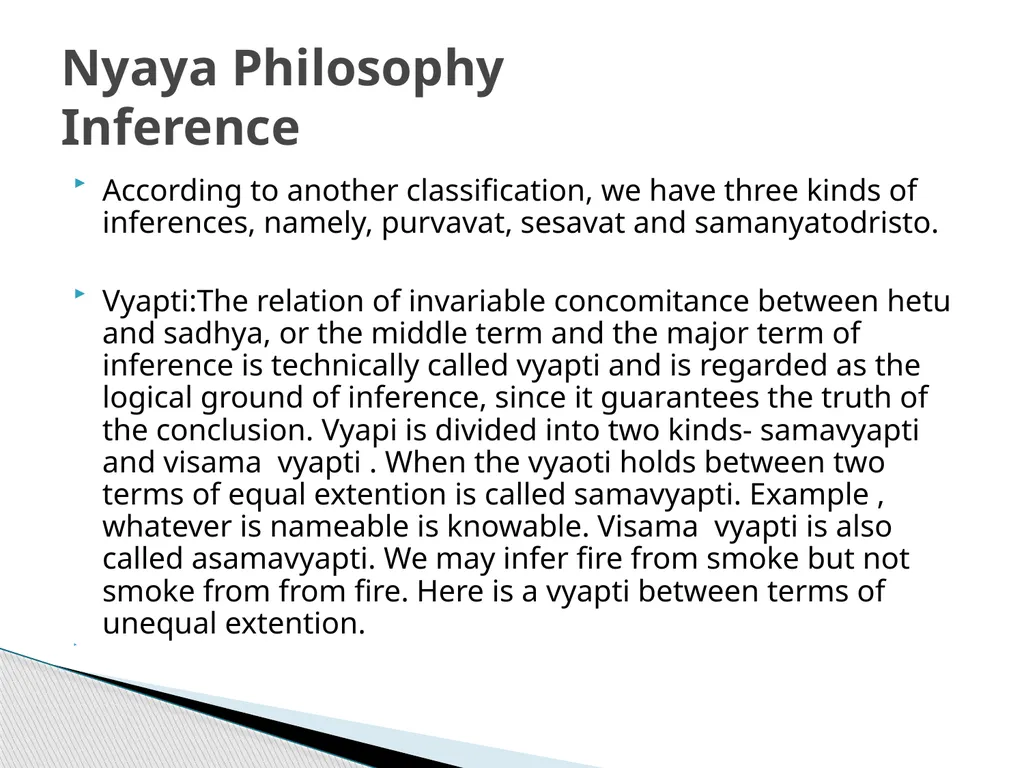
According to another classification, we have three kinds of inferences, namely, purvavat, sesavat and samanyatodristo.
Vyapti:The relation of invariable concomitance between hetu and sadhya, or the middle term and the major term of inference is technically called vyapti and is regarded as the logical ground of inference, since it guarantees the truth of the conclusion. Vyapi is divided into two kinds- samavyapti and visama vyapti . When the vyaoti holds between two terms of equal extention is called samavyapti. Example , whatever is nameable is knowable. Visama vyapti is also called asamavyapti. We may infer fire from smoke but not smoke from from fire. Here is a vyapti between terms of unequal extention. Nyaya Philosophy Inference<br>
07
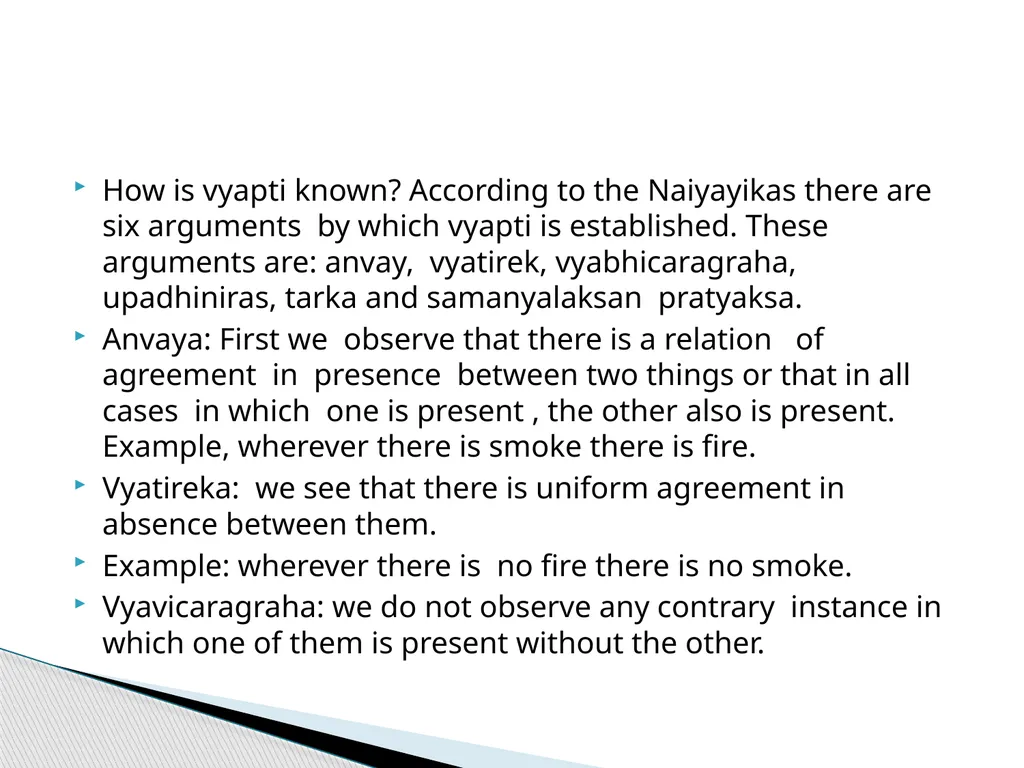
How is vyapti known? According to the Naiyayikas there are six arguments by which vyapti is established. These arguments are: anvay, vyatirek, vyabhicaragraha, upadhiniras, tarka and samanyalaksan pratyaksa.
Anvaya: First we observe that there is a relation of agreement in presence between two things or that in all cases in which one is present , the other also is present. Example, wherever there is smoke there is fire.
Vyatireka: we see that there is uniform agreement in absence between them.
Example: wherever there is no fire there is no smoke.
Vyavicaragraha: we do not observe any contrary instance in which one of them is present without the other.<br>
08
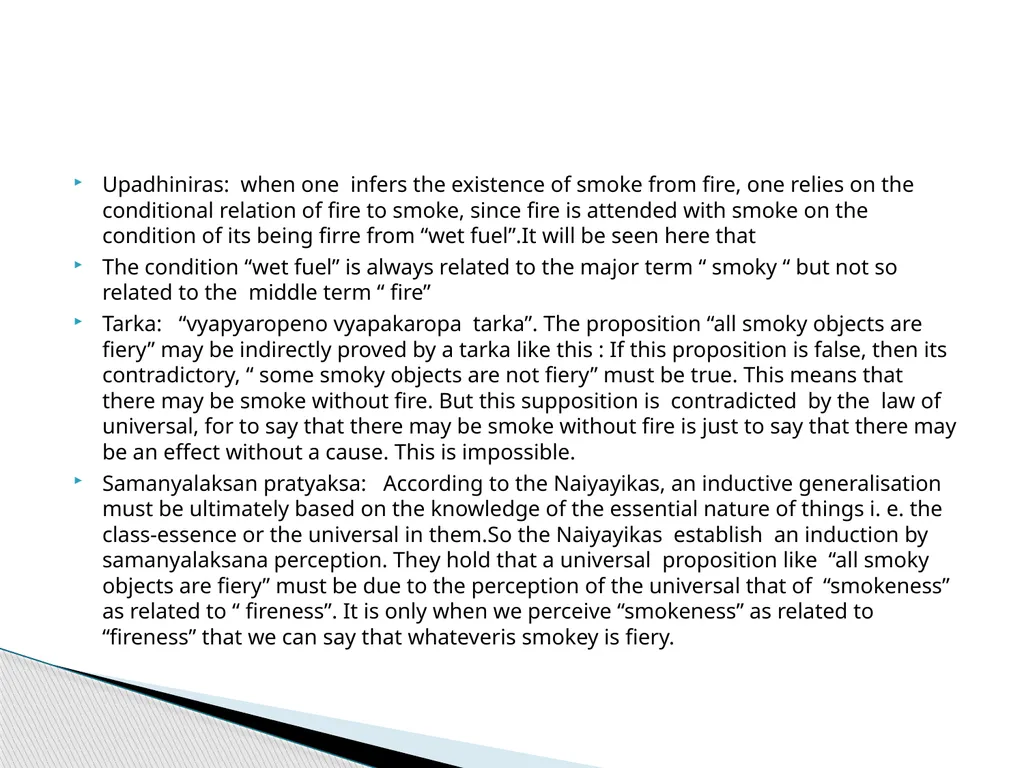
Upadhiniras: when one infers the existence of smoke from fire, one relies on the conditional relation of fire to smoke, since fire is attended with smoke on the condition of its being firre from “wet fuel”.It will be seen here that
The condition “wet fuel” is always related to the major term “ smoky “ but not so related to the middle term “ fire”
Tarka: “vyapyaropeno vyapakaropa tarka”. The proposition “all smoky objects are fiery” may be indirectly proved by a tarka like this : If this proposition is false, then its contradictory, “ some smoky objects are not fiery” must be true. This means that there may be smoke without fire. But this supposition is contradicted by the law of universal, for to say that there may be smoke without fire is just to say that there may be an effect without a cause. This is impossible.
Samanyalaksan pratyaksa: According to the Naiyayikas, an inductive generalisation must be ultimately based on the knowledge of the essential nature of things i. e. the class-essence or the universal in them.So the Naiyayikas establish an induction by samanyalaksana perception. They hold that a universal proposition like “all smoky objects are fiery” must be due to the perception of the universal that of “smokeness” as related to “ fireness”. It is only when we perceive “smokeness” as related to “fireness” that we can say that whateveris smokey is fiery.<br>
09
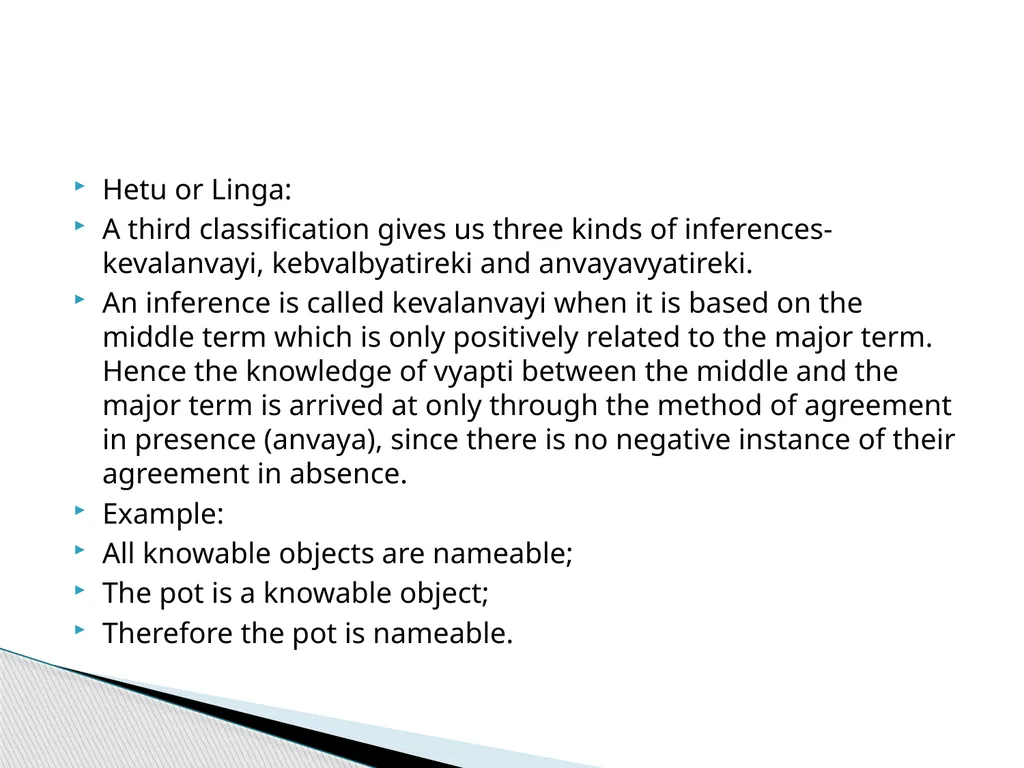
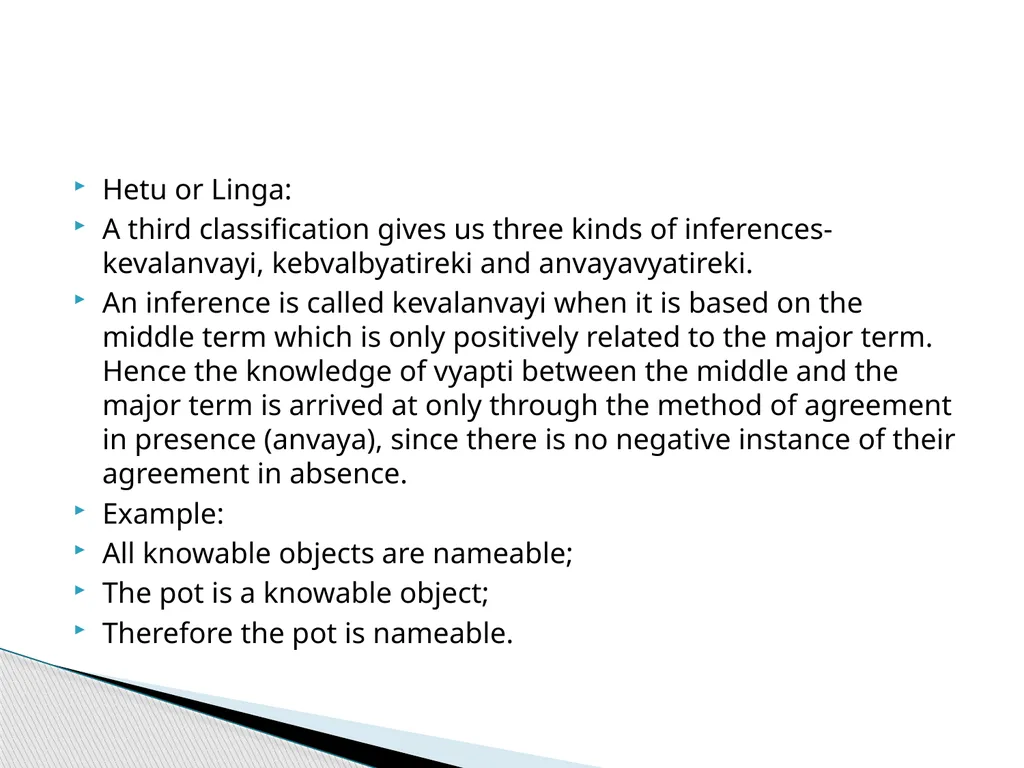
Hetu or Linga:
A third classification gives us three kinds of inferences-kevalanvayi, kebvalbyatireki and anvayavyatireki.
An inference is called kevalanvayi when it is based on the middle term which is only positively related to the major term. Hence the knowledge of vyapti between the middle and the major term is arrived at only through the method of agreement in presence (anvaya), since there is no negative instance of their agreement in absence.
Example:
All knowable objects are nameable;
The pot is a knowable object;
Therefore the pot is nameable.<br>
10
Hetu or Linga:
A third classification gives us three kinds of inferences-kevalanvayi, kebvalbyatireki and anvayavyatireki.
An inference is called kevalanvayi when it is based on the middle term which is only positively related to the major term. Hence the knowledge of vyapti between the middle and the major term is arrived at only through the method of agreement in presence (anvaya), since there is no negative instance of their agreement in absence.
Example:
All knowable objects are nameable;
The pot is a knowable object;
Therefore the pot is nameable.<br>
11
Here the predicate of the major premise is nameable is affirmed of all knowable objects.
Kevala vyatireki: A kevalavyatireki inference is that in which the middle term is only negatively related to the major term. It depends on the vyapti between the absence of the major term and that of the middle term. Accordingly, the knowledge of vyapti is here arrived at only through the method of agreement in absence.
What is not different- from- other elements has no smell;
The earth has smell;
Therefore the earth is different-from other elements.<br>
12
Here the predicate of the major premise is nameable is affirmed of all knowable objects.
Kevala vyatireki: A kevalavyatireki inference is that in which the middle term is only negatively related to the major term. It depends on the vyapti between the absence of the major term and that of the middle term. Accordingly, the knowledge of vyapti is here arrived at only through the method of agreement in absence. Example:
What is not different- from- other elements has no smell;
The earth has smell;
Therefore the earth is different-from other elements.<br>
13
Here the predicate of the major premise( middle term) “smell” is denied of the subject( major term) different-from-other-elements. It is not possible for us to affirm the predicate “smell” of any other subject excepting the earth which is the minor term of the inference. Hence the major premise is a universal negative proposition arrived at only through the method of agreement in absence between the major and the middle term. The special feature of this argument is that one of the premise is negative but the conclusion is affirmative.<br>
14
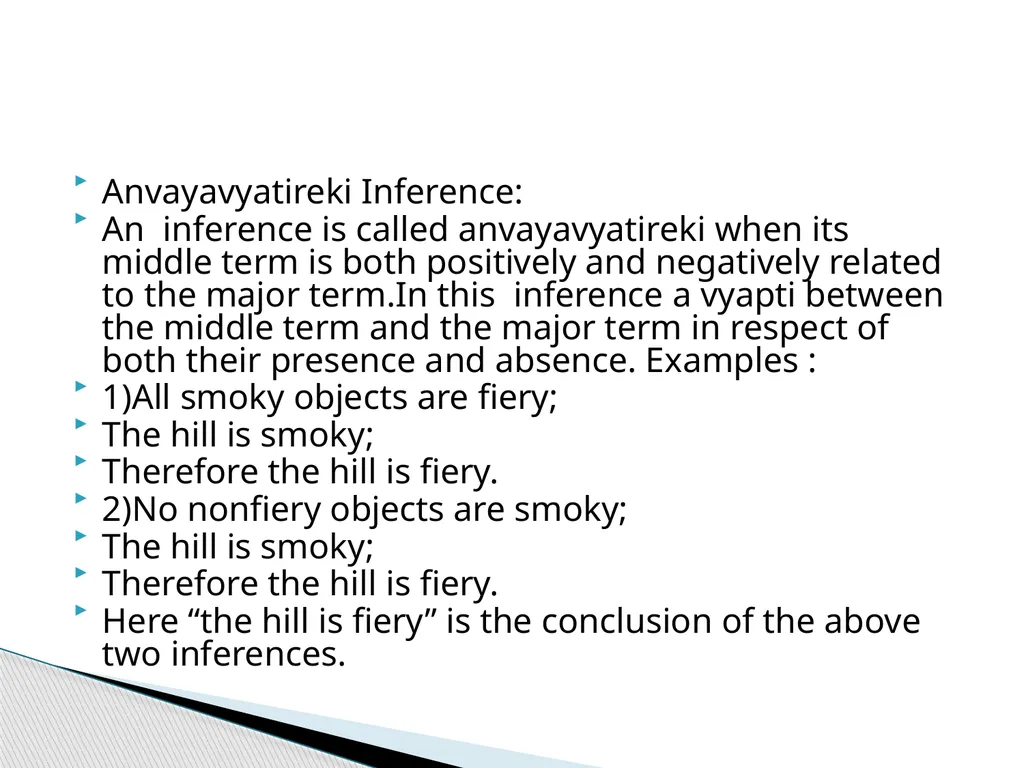
Anvayavyatireki Inference:
An inference is called anvayavyatireki when its middle term is both positively and negatively related to the major term.In this inference a vyapti between the middle term and the major term in respect of both their presence and absence. Examples :
1)All smoky objects are fiery;
The hill is smoky;
Therefore the hill is fiery.
2)No nonfiery objects are smoky;
The hill is smoky;
Therefore the hill is fiery.
Here “the hill is fiery” is the conclusion of the above two inferences.<br>