
Occupational Specialism: Gas Engineering K1.16
YM
Published · 31 slides · 0 views

1 / 1
Description
Occupational Specialism: Gas Engineering K1.16 Scientific principles and concepts as applied to gas engineering PowerPoint 1.16a: Introduction to combustion science Starter Today were going to explore what takes place inside a gas
Related Topics
Share
Embed code
Download this presentation From Below
"Occupational Specialism: Gas Engineering K1.16" is the property of its rightful owner. Permission is granted to download and print the materials on this website for personal, non-commercial use only, and to display it on your personal computer provided you do not modify the materials and that you retain all copyright notices contained in the materials. By downloading content from our website, you accept the terms of this agreement.
Presentation Transcript
01
Occupational Specialism: Gas Engineering
K1.16 Scientific principles and concepts as applied to gas engineering
PowerPoint 1.16a: Introduction to combustion science<br>
K1.16 Scientific principles and concepts as applied to gas engineering
PowerPoint 1.16a: Introduction to combustion science<br>
02
Starter Today we're going to explore what takes place inside a gas appliance the moment it's switched on, a process that’s critical to both safety and performance in gas engineering.
Let’s start by thinking about these two questions:
What happens inside a gas appliance when it’s turned on?
What do you think is actually ‘burning’?
Take a minute to discuss with a partner or jot down your thoughts. We’ll share ideas before diving into the science behind combustion.<br>
Let’s start by thinking about these two questions:
What happens inside a gas appliance when it’s turned on?
What do you think is actually ‘burning’?
Take a minute to discuss with a partner or jot down your thoughts. We’ll share ideas before diving into the science behind combustion.<br>
03
Objectives By the end of this session, you should be able to:
Recall the chemical principles of combustion.
Explain the differences between complete and incomplete combustion.
Identify combustion by-products and their hazards.
Interpret why excess air is needed for safe combustion.<br>
Recall the chemical principles of combustion.
Explain the differences between complete and incomplete combustion.
Identify combustion by-products and their hazards.
Interpret why excess air is needed for safe combustion.<br>
04
What is combustion? Combustion is a key scientific concept in gas engineering, describing a chemical reaction that occurs between a fuel (usually a hydrocarbon gas like natural gas or LPG) and oxygen, which produces heat and light.
This process is essential for the functioning of gas appliances utilised in heating, cooking, and hot water systems.
In the following slides, we will explore the various types of combustion.<br>
This process is essential for the functioning of gas appliances utilised in heating, cooking, and hot water systems.
In the following slides, we will explore the various types of combustion.<br>
05
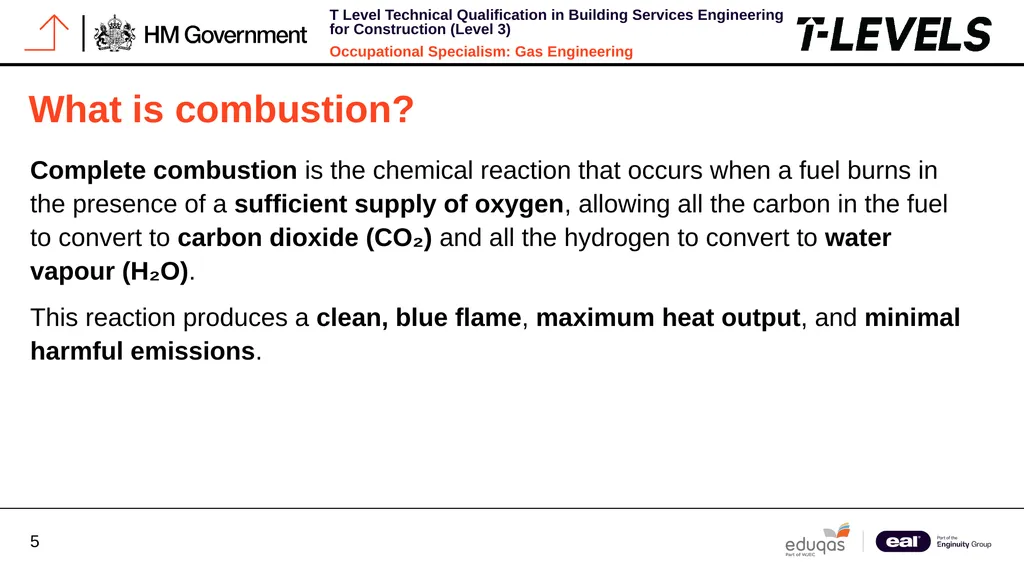
What is combustion? Complete combustion is the chemical reaction that occurs when a fuel burns in the presence of a sufficient supply of oxygen, allowing all the carbon in the fuel to convert to carbon dioxide (CO₂) and all the hydrogen to convert to water vapour (H₂O).
This reaction produces a clean, blue flame, maximum heat output, and minimal harmful emissions.<br>
This reaction produces a clean, blue flame, maximum heat output, and minimal harmful emissions.<br>
06
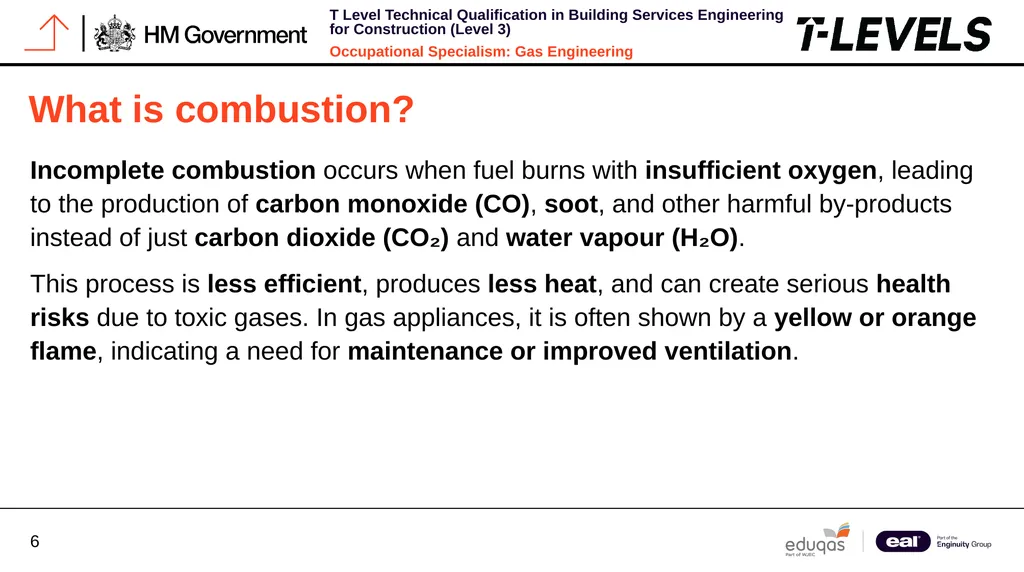
What is combustion? Incomplete combustion occurs when fuel burns with insufficient oxygen, leading to the production of carbon monoxide (CO), soot, and other harmful by-products instead of just carbon dioxide (CO₂) and water vapour (H₂O).
This process is less efficient, produces less heat, and can create serious health risks due to toxic gases. In gas appliances, it is often shown by a yellow or orange flame, indicating a need for maintenance or improved ventilation.<br>
This process is less efficient, produces less heat, and can create serious health risks due to toxic gases. In gas appliances, it is often shown by a yellow or orange flame, indicating a need for maintenance or improved ventilation.<br>
07
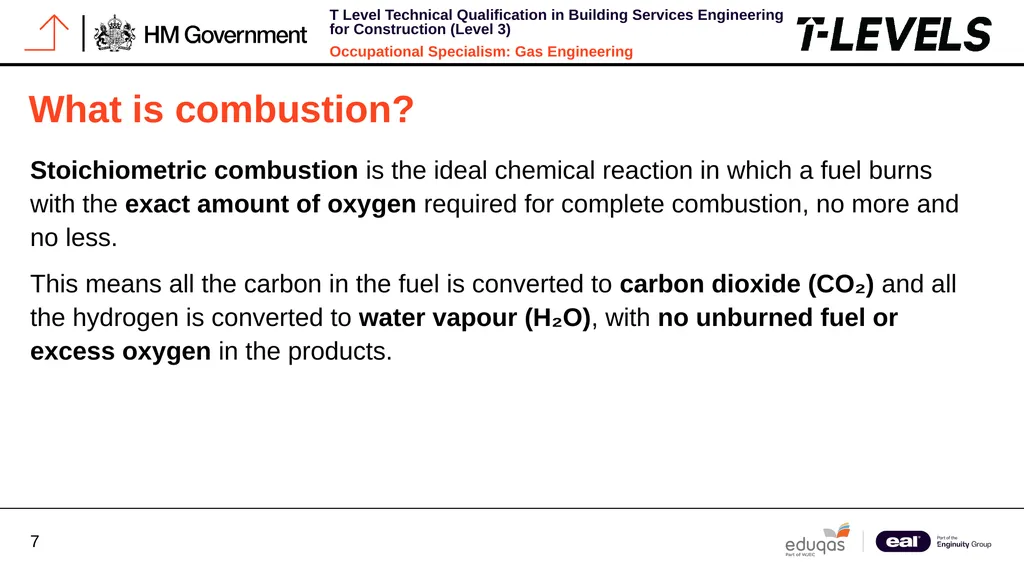
What is combustion? Stoichiometric combustion is the ideal chemical reaction in which a fuel burns with the exact amount of oxygen required for complete combustion, no more and no less.
This means all the carbon in the fuel is converted to carbon dioxide (CO₂) and all the hydrogen is converted to water vapour (H₂O), with no unburned fuel or excess oxygen in the products.<br>
This means all the carbon in the fuel is converted to carbon dioxide (CO₂) and all the hydrogen is converted to water vapour (H₂O), with no unburned fuel or excess oxygen in the products.<br>
08
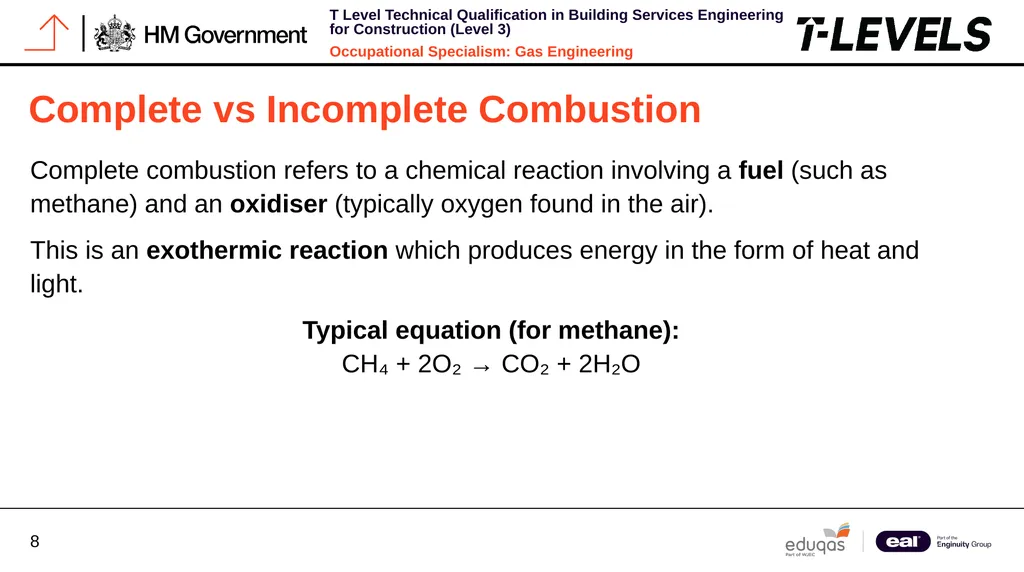
Complete vs Incomplete Combustion Complete combustion refers to a chemical reaction involving a fuel (such as methane) and an oxidiser (typically oxygen found in the air).
This is an exothermic reaction which produces energy in the form of heat and light.
Typical equation (for methane): CH₄ + 2O₂ → CO₂ + 2H₂O
<br>
This is an exothermic reaction which produces energy in the form of heat and light.
Typical equation (for methane): CH₄ + 2O₂ → CO₂ + 2H₂O
<br>
09
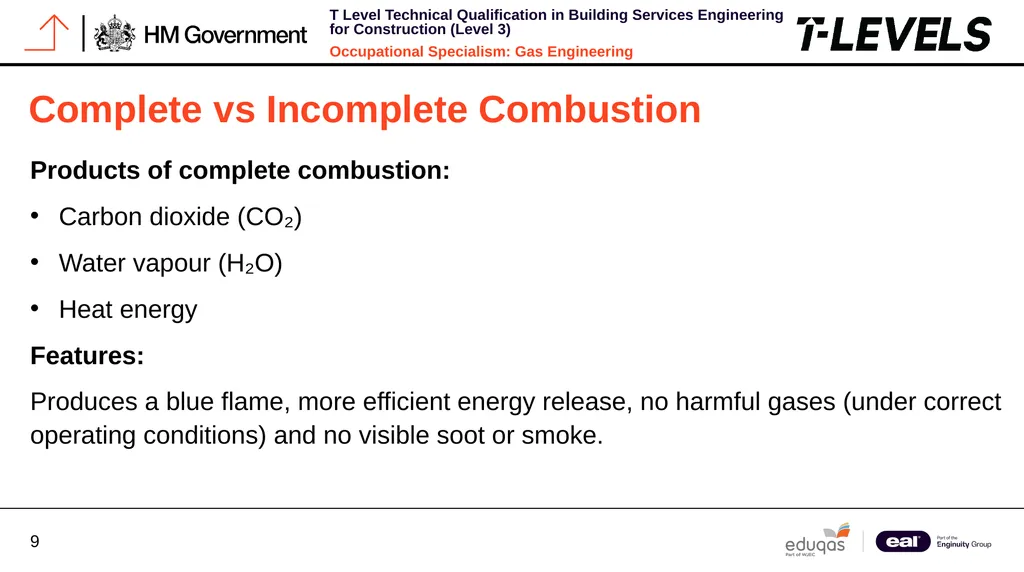
Complete vs Incomplete Combustion Products of complete combustion:
Carbon dioxide (CO₂)
Water vapour (H₂O)
Heat energy
Features:
Produces a blue flame, more efficient energy release, no harmful gases (under correct operating conditions) and no visible soot or smoke.<br>
Carbon dioxide (CO₂)
Water vapour (H₂O)
Heat energy
Features:
Produces a blue flame, more efficient energy release, no harmful gases (under correct operating conditions) and no visible soot or smoke.<br>
10
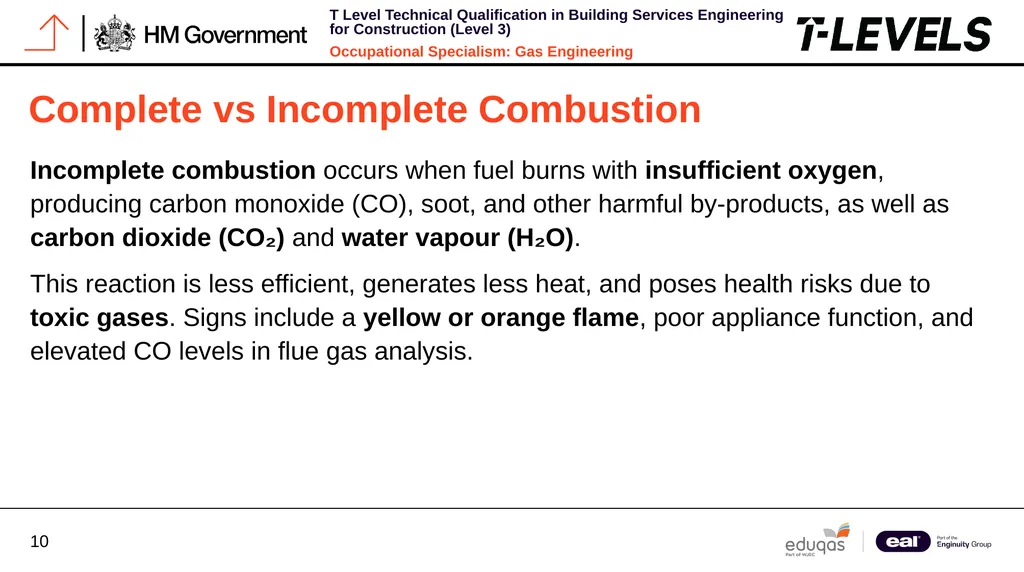
Complete vs Incomplete Combustion Incomplete combustion occurs when fuel burns with insufficient oxygen, producing carbon monoxide (CO), soot, and other harmful by-products, as well as carbon dioxide (CO₂) and water vapour (H₂O).
This reaction is less efficient, generates less heat, and poses health risks due to toxic gases. Signs include a yellow or orange flame, poor appliance function, and elevated CO levels in flue gas analysis.<br>
This reaction is less efficient, generates less heat, and poses health risks due to toxic gases. Signs include a yellow or orange flame, poor appliance function, and elevated CO levels in flue gas analysis.<br>
11
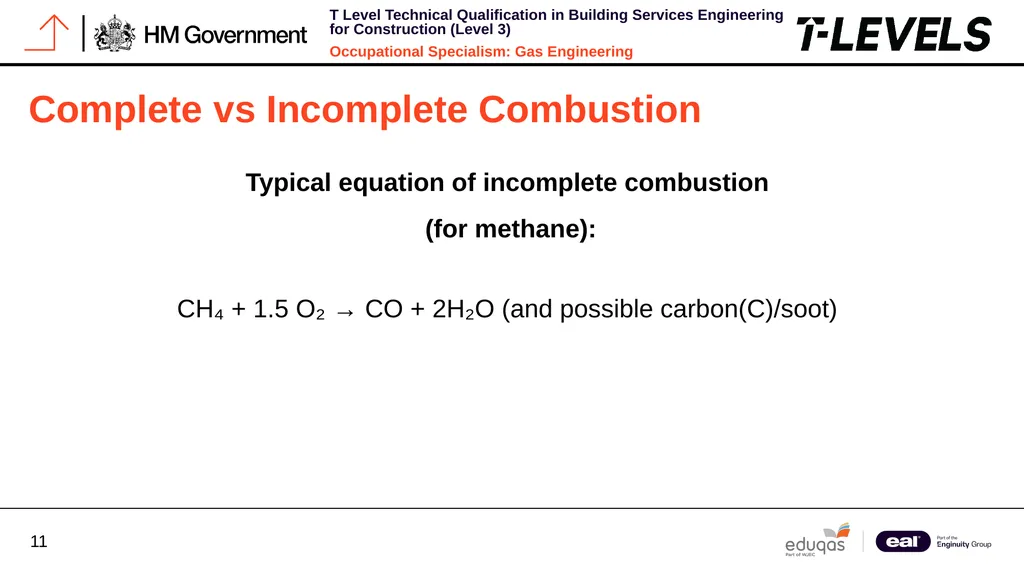
Complete vs Incomplete Combustion Typical equation of incomplete combustion
(for methane):
CH₄ + 1.5 O₂ → CO + 2H₂O (and possible carbon(C)/soot)<br>
(for methane):
CH₄ + 1.5 O₂ → CO + 2H₂O (and possible carbon(C)/soot)<br>
12
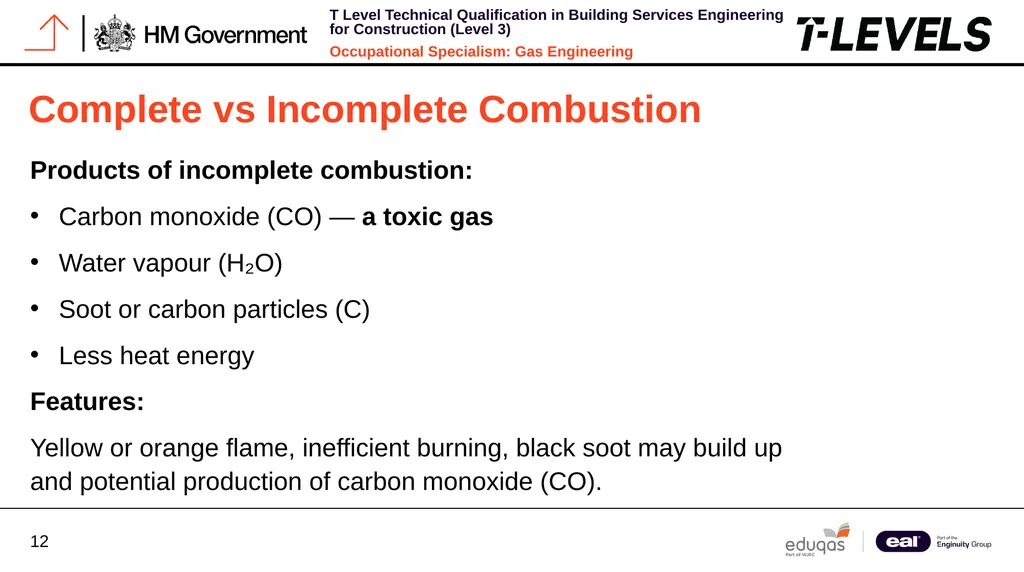
Complete vs Incomplete Combustion Products of incomplete combustion:
Carbon monoxide (CO) — a toxic gas
Water vapour (H₂O)
Soot or carbon particles (C)
Less heat energy
Features:
Yellow or orange flame, inefficient burning, black soot may build up and potential production of carbon monoxide (CO).<br>
Carbon monoxide (CO) — a toxic gas
Water vapour (H₂O)
Soot or carbon particles (C)
Less heat energy
Features:
Yellow or orange flame, inefficient burning, black soot may build up and potential production of carbon monoxide (CO).<br>
13
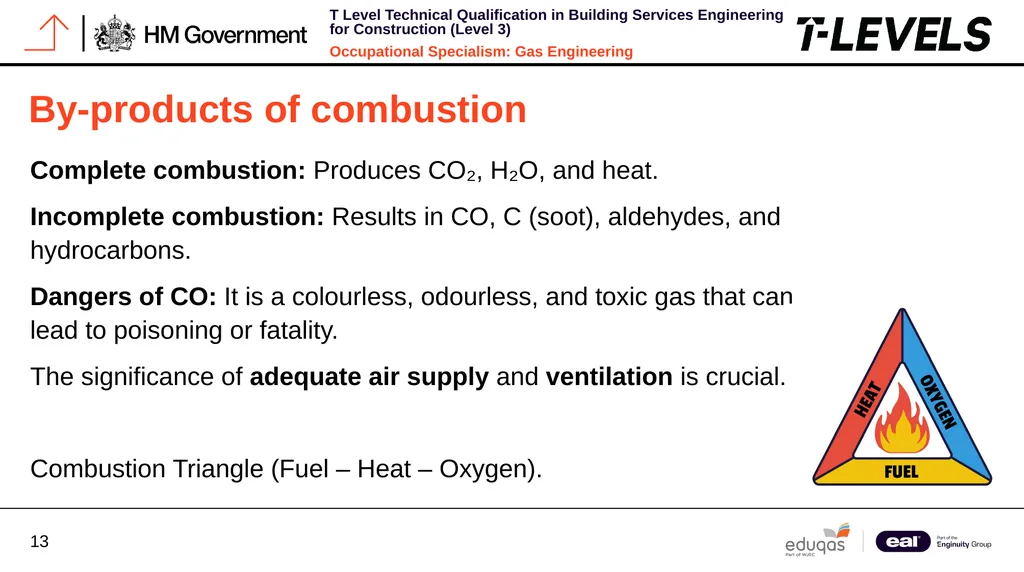
By-products of combustion Complete combustion: Produces CO₂, H₂O, and heat.
Incomplete combustion: Results in CO, C (soot), aldehydes, and hydrocarbons.
Dangers of CO: It is a colourless, odourless, and toxic gas that can lead to poisoning or fatality.
The significance of adequate air supply and ventilation is crucial.
Combustion Triangle (Fuel – Heat – Oxygen).<br>
Incomplete combustion: Results in CO, C (soot), aldehydes, and hydrocarbons.
Dangers of CO: It is a colourless, odourless, and toxic gas that can lead to poisoning or fatality.
The significance of adequate air supply and ventilation is crucial.
Combustion Triangle (Fuel – Heat – Oxygen).<br>
14
Stoichiometric combustion Stoichiometric combustion refers to a particular kind of chemical reaction in which the reactants, fuel and oxidiser, usually air, are available in precise amounts to ensure the complete burning of the fuel without any surplus of either component.
Essentially, this process represents a balanced form of combustion where all the fuel is oxidised, and all the oxidiser is utilised.<br>
Essentially, this process represents a balanced form of combustion where all the fuel is oxidised, and all the oxidiser is utilised.<br>
15
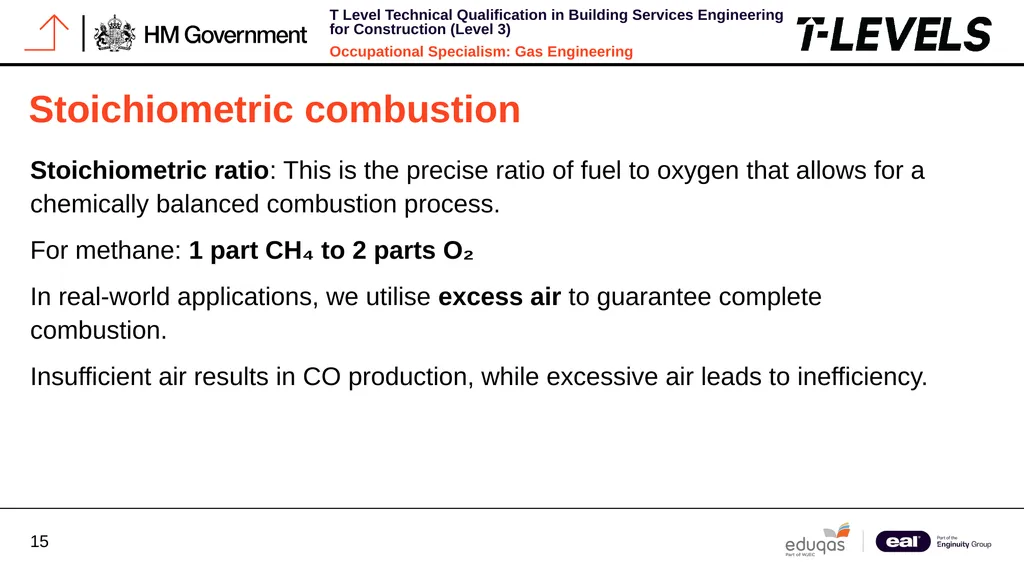
Stoichiometric combustion Stoichiometric ratio: This is the precise ratio of fuel to oxygen that allows for a chemically balanced combustion process.
For methane: 1 part CH₄ to 2 parts O₂
In real-world applications, we utilise excess air to guarantee complete combustion.
Insufficient air results in CO production, while excessive air leads to inefficiency.<br>
For methane: 1 part CH₄ to 2 parts O₂
In real-world applications, we utilise excess air to guarantee complete combustion.
Insufficient air results in CO production, while excessive air leads to inefficiency.<br>
16
Role of air in combustion To achieve complete combustion of gases such as methane, propane, and butane, a precise balance of oxygen (from air) and fuel gas is essential.
Complete combustion occurs when there is sufficient oxygen to fully react with the fuel, producing only carbon dioxide (CO₂) and water vapour (H₂O) as by-products, with a clean blue flame and maximum heat efficiency.<br>
Complete combustion occurs when there is sufficient oxygen to fully react with the fuel, producing only carbon dioxide (CO₂) and water vapour (H₂O) as by-products, with a clean blue flame and maximum heat efficiency.<br>
17
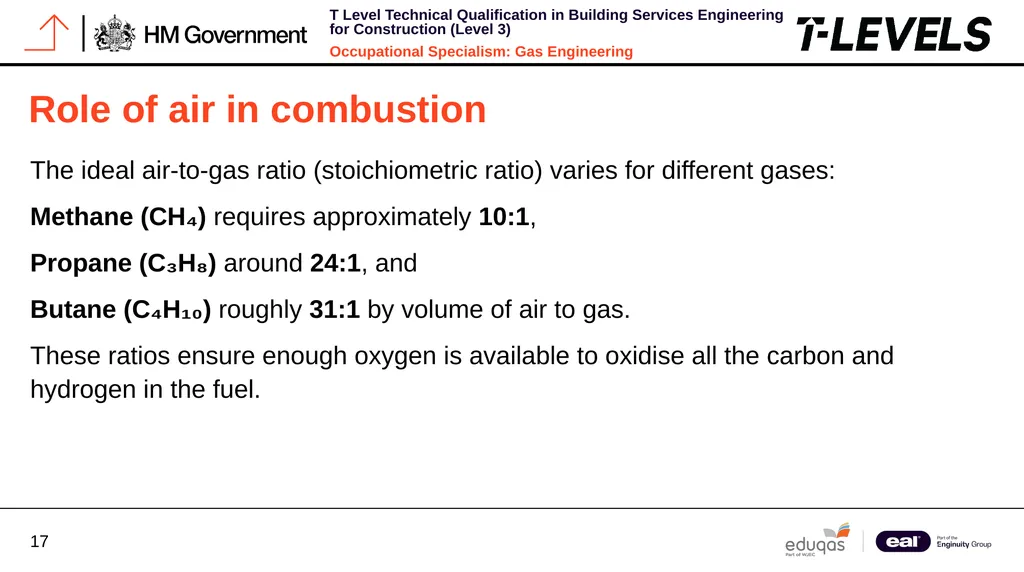
Role of air in combustion The ideal air-to-gas ratio (stoichiometric ratio) varies for different gases:
Methane (CH₄) requires approximately 10:1,
Propane (C₃H₈) around 24:1, and
Butane (C₄H₁₀) roughly 31:1 by volume of air to gas.
These ratios ensure enough oxygen is available to oxidise all the carbon and hydrogen in the fuel.<br>
Methane (CH₄) requires approximately 10:1,
Propane (C₃H₈) around 24:1, and
Butane (C₄H₁₀) roughly 31:1 by volume of air to gas.
These ratios ensure enough oxygen is available to oxidise all the carbon and hydrogen in the fuel.<br>
18
Role of air in combustion If less air is supplied, incomplete combustion can occur, producing carbon monoxide (CO), soot, and lower heat output, all of which compromise safety and appliance performance.
Therefore, maintaining correct air and gas supply is critical in gas appliance setup, servicing, and combustion analysis.<br>
Therefore, maintaining correct air and gas supply is critical in gas appliance setup, servicing, and combustion analysis.<br>
19
Role of air in combustion Air consists of approximately 21% oxygen and 78% nitrogen.
To achieve complete combustion, we require excess air (1.1 to 1.5 times stoichiometric).
Different types of air include:
Primary air – mixed prior to ignition
Secondary air – introduced at the burner
Tertiary air – envelops the flame<br>
To achieve complete combustion, we require excess air (1.1 to 1.5 times stoichiometric).
Different types of air include:
Primary air – mixed prior to ignition
Secondary air – introduced at the burner
Tertiary air – envelops the flame<br>
20
Flame characteristics In the context of gas engineering, flame characteristics refer to the observable properties of a flame during combustion.
Understanding these characteristics is essential for assessing the combustion quality, appliance efficiency, and safety of gas systems.
Let’s look at the key flame characteristics on the next slides.<br>
Understanding these characteristics is essential for assessing the combustion quality, appliance efficiency, and safety of gas systems.
Let’s look at the key flame characteristics on the next slides.<br>
21
Flame characteristics 1. Flame colour
Blue flame: Indicates complete combustion, where the fuel is burning efficiently with sufficient oxygen.
Yellow/orange flame: Indicates incomplete combustion, often due to a lack of oxygen or improper air-to-gas ratio. This can lead to the production of carbon monoxide (CO), which is dangerous.<br>
Blue flame: Indicates complete combustion, where the fuel is burning efficiently with sufficient oxygen.
Yellow/orange flame: Indicates incomplete combustion, often due to a lack of oxygen or improper air-to-gas ratio. This can lead to the production of carbon monoxide (CO), which is dangerous.<br>
22
Flame characteristics 2. Flame shape
Stable flame: A smooth, steady flame attached to the burner port indicates good burner performance.
Lifting flame: The flame rises off the burner port, suggesting too much primary air.
Lazy or floppy flame: A weak, unstable flame may point to inadequate primary air or a blocked injector.
Flame lift: When the flame detaches and may extinguish—can occur with excessive air or high velocity gas flow.<br>
Stable flame: A smooth, steady flame attached to the burner port indicates good burner performance.
Lifting flame: The flame rises off the burner port, suggesting too much primary air.
Lazy or floppy flame: A weak, unstable flame may point to inadequate primary air or a blocked injector.
Flame lift: When the flame detaches and may extinguish—can occur with excessive air or high velocity gas flow.<br>
23
Flame characteristics 3. Flame noise
A quiet flame is usually a sign of proper combustion.
A roaring flame can indicate excessive air.
A hissing sound might suggest high gas pressure or a partially blocked jet.<br>
A quiet flame is usually a sign of proper combustion.
A roaring flame can indicate excessive air.
A hissing sound might suggest high gas pressure or a partially blocked jet.<br>
24
Flame characteristics 4. Flame stability
The flame should remain constant and consistent under normal operating conditions.
Unstable flames may flicker, pop, or extinguish, posing a safety risk.<br>
The flame should remain constant and consistent under normal operating conditions.
Unstable flames may flicker, pop, or extinguish, posing a safety risk.<br>
25
Flame characteristics 5. Flame length and size
A correctly adjusted flame has a short, defined cone.
Excessively long or short flames can affect heat transfer efficiency and increase wear on the appliance.<br>
A correctly adjusted flame has a short, defined cone.
Excessively long or short flames can affect heat transfer efficiency and increase wear on the appliance.<br>
26
Flame characteristics 6. Flame luminosity
Blue flames are typically non-luminous and clean.
Luminous flames (glowing yellow/orange) can result in soot production and potential safety hazards.<br>
Blue flames are typically non-luminous and clean.
Luminous flames (glowing yellow/orange) can result in soot production and potential safety hazards.<br>
27
Flame characteristics 7. Ignition and flame retention
The flame should ignite quickly and remain lit.
Delayed ignition or failure to retain flame can indicate faults in ignition systems or flame detection devices.<br>
The flame should ignite quickly and remain lit.
Delayed ignition or failure to retain flame can indicate faults in ignition systems or flame detection devices.<br>
28
Flame characteristics Visual indicators:
Blue flame = signifies efficient and clean combustion.
Yellow flame = indicates a poor air/gas mixture.
Key points:
Heat Production: A stable blue flame ensures optimal heat output, while yellow flames reduce efficiency.
Emissions Levels: A blue flame mainly releases CO₂ and water vapour, whereas yellow flames can lead to harmful emissions like carbon monoxide and soot.
Appliance Safety: Flame issues may cause gas leaks and pose explosion risks, making consistent flame monitoring essential for safety.<br>
Blue flame = signifies efficient and clean combustion.
Yellow flame = indicates a poor air/gas mixture.
Key points:
Heat Production: A stable blue flame ensures optimal heat output, while yellow flames reduce efficiency.
Emissions Levels: A blue flame mainly releases CO₂ and water vapour, whereas yellow flames can lead to harmful emissions like carbon monoxide and soot.
Appliance Safety: Flame issues may cause gas leaks and pose explosion risks, making consistent flame monitoring essential for safety.<br>
29
Knowledge check Quick recap quiz:
What is the main by-product of complete combustion?
What does a yellow flame indicate?
Why is excess air required?
What toxic gas is produced in incomplete combustion?<br>
What is the main by-product of complete combustion?
What does a yellow flame indicate?
Why is excess air required?
What toxic gas is produced in incomplete combustion?<br>
30
Summary You should now be able to:
Recall the chemical principles of combustion.
Explain the differences between complete and incomplete combustion.
Identify combustion by-products and their hazards.
Interpret why excess air is needed for safe combustion.<br>
Recall the chemical principles of combustion.
Explain the differences between complete and incomplete combustion.
Identify combustion by-products and their hazards.
Interpret why excess air is needed for safe combustion.<br>
31
Any questions? Copyright in this document belongs to and is used under licence from the Department for Education, © 2025.
‘T-LEVELS’ and ‘T Level’ are registered trademarks of the Department for Education.
WJEC is authorised by the Department for Education to develop and deliver this T Level Technical Qualification.
WJEC operates in England under the name Eduqas which is a registered trademark of WJEC.<br>
‘T-LEVELS’ and ‘T Level’ are registered trademarks of the Department for Education.
WJEC is authorised by the Department for Education to develop and deliver this T Level Technical Qualification.
WJEC operates in England under the name Eduqas which is a registered trademark of WJEC.<br>