
Occupational Therapy and Mental Health Helping
KB
Published · 25 slides · 0 views

1 / 1


Description
Occupational Therapy and Mental Health Helping Clients with Mental Health Concerns Return to Work Kale Lutomsky Subcontracted Occupational Therapist Roadmap Today, we will cover: What is OT? What role the OT has in supporting their clients
Related Topics
Share
Embed code
Download this presentation From Below
"Occupational Therapy and Mental Health Helping" is the property of its rightful owner. Permission is granted to download and print the materials on this website for personal, non-commercial use only, and to display it on your personal computer provided you do not modify the materials and that you retain all copyright notices contained in the materials. By downloading content from our website, you accept the terms of this agreement.
Presentation Transcript
01
Occupational Therapy
and
Mental Health Helping Clients with Mental Health Concerns Return to Work Kale Lutomsky
Subcontracted Occupational Therapist<br>
Subcontracted Occupational Therapist<br>
02
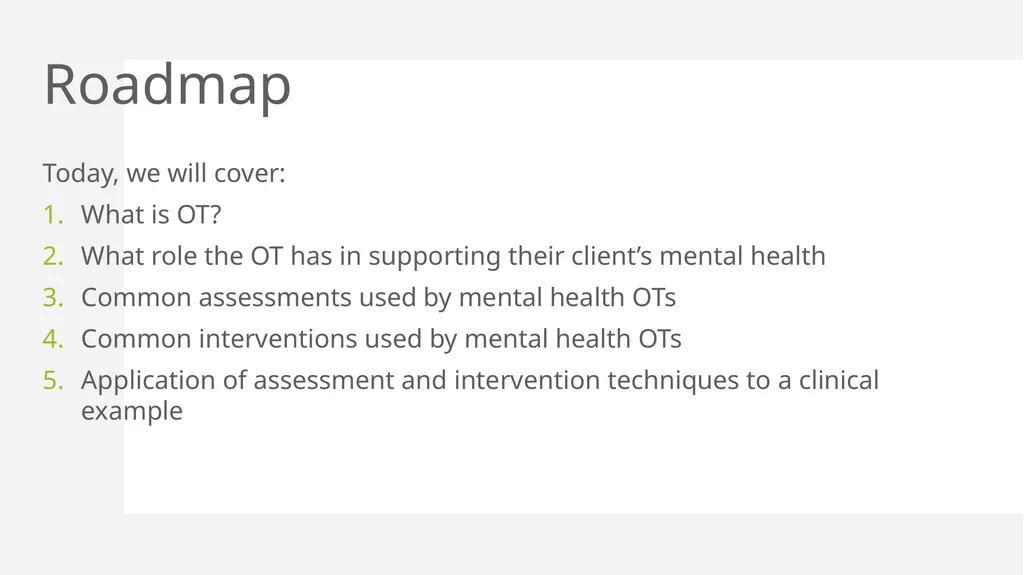
Roadmap Today, we will cover:
What is OT?
What role the OT has in supporting their client’s mental health
Common assessments used by mental health OTs
Common interventions used by mental health OTs
Application of assessment and intervention techniques to a clinical example<br>
What is OT?
What role the OT has in supporting their client’s mental health
Common assessments used by mental health OTs
Common interventions used by mental health OTs
Application of assessment and intervention techniques to a clinical example<br>
03
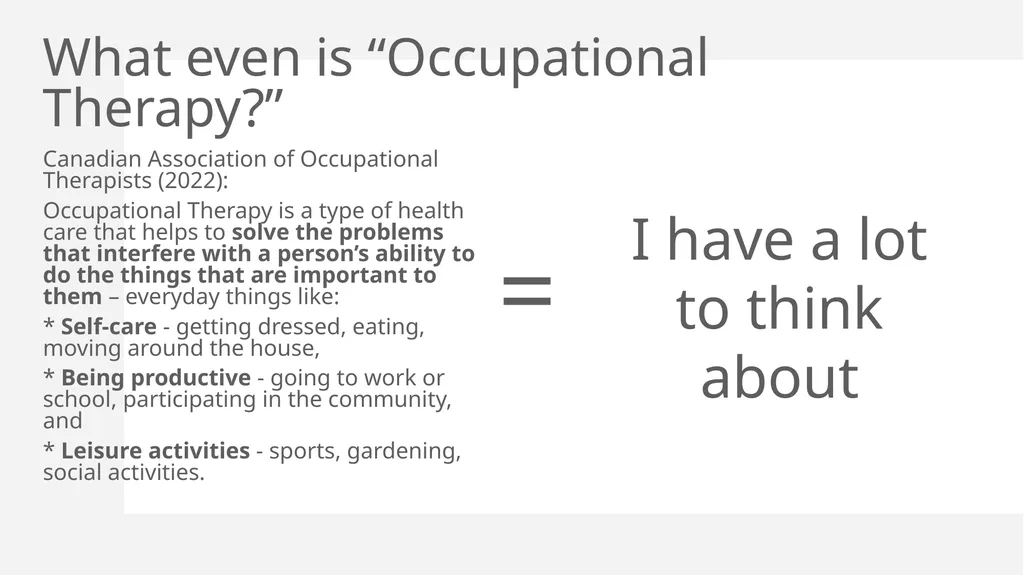
What even is “Occupational Therapy?” Canadian Association of Occupational Therapists (2022):
Occupational Therapy is a type of health care that helps to solve the problems that interfere with a person’s ability to do the things that are important to them – everyday things like:
* Self-care - getting dressed, eating, moving around the house,
* Being productive - going to work or school, participating in the community, and
* Leisure activities - sports, gardening, social activities. = I have a lot to think about<br>
Occupational Therapy is a type of health care that helps to solve the problems that interfere with a person’s ability to do the things that are important to them – everyday things like:
* Self-care - getting dressed, eating, moving around the house,
* Being productive - going to work or school, participating in the community, and
* Leisure activities - sports, gardening, social activities. = I have a lot to think about<br>
04
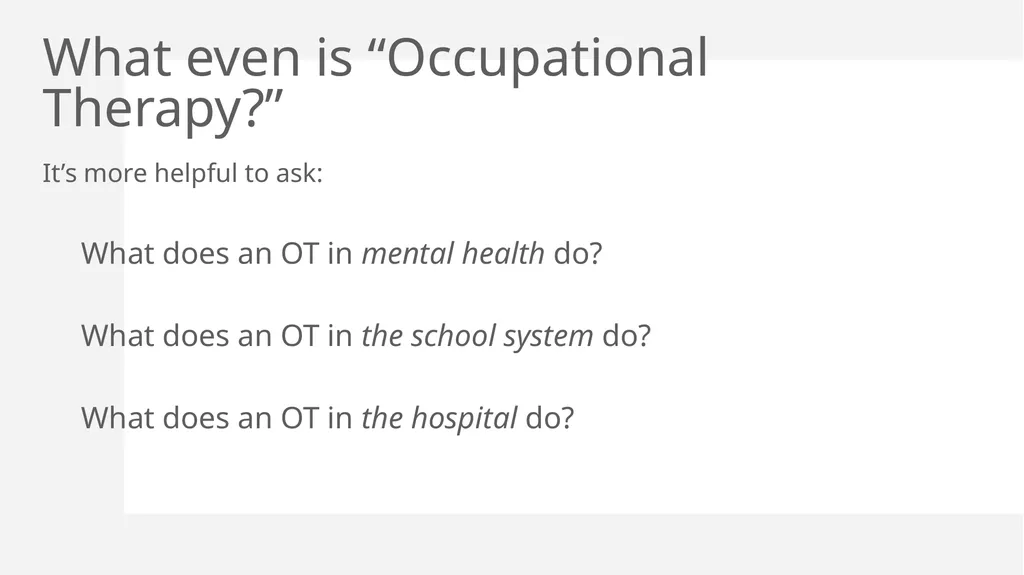
What even is “Occupational Therapy?” It’s more helpful to ask:
What does an OT in mental health do?
What does an OT in the school system do?
What does an OT in the hospital do?<br>
What does an OT in mental health do?
What does an OT in the school system do?
What does an OT in the hospital do?<br>
05
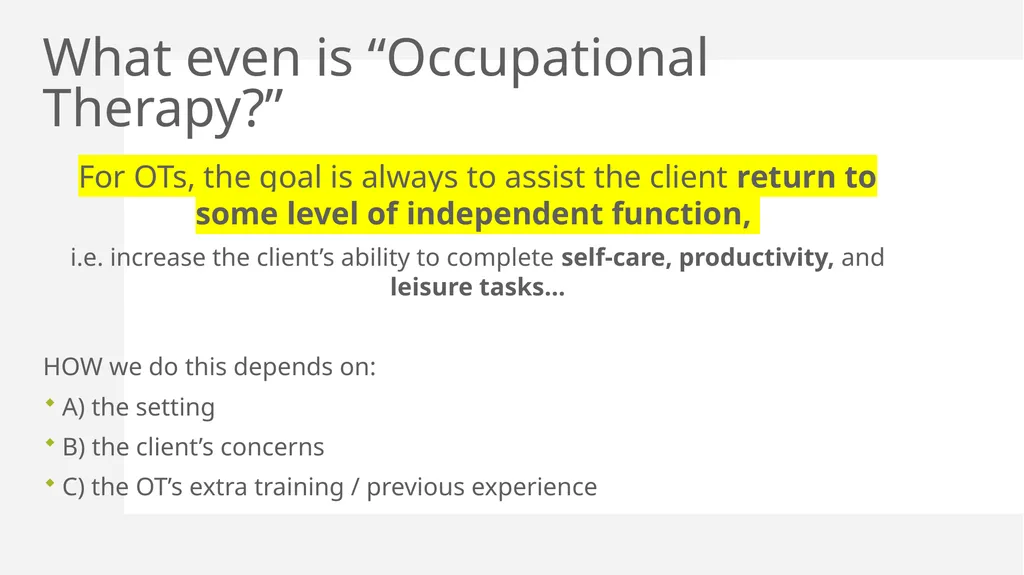
What even is “Occupational Therapy?” For OTs, the goal is always to assist the client return to some level of independent function,
i.e. increase the client’s ability to complete self-care, productivity, and leisure tasks…
HOW we do this depends on:
A) the setting
B) the client’s concerns
C) the OT’s extra training / previous experience<br>
i.e. increase the client’s ability to complete self-care, productivity, and leisure tasks…
HOW we do this depends on:
A) the setting
B) the client’s concerns
C) the OT’s extra training / previous experience<br>
06
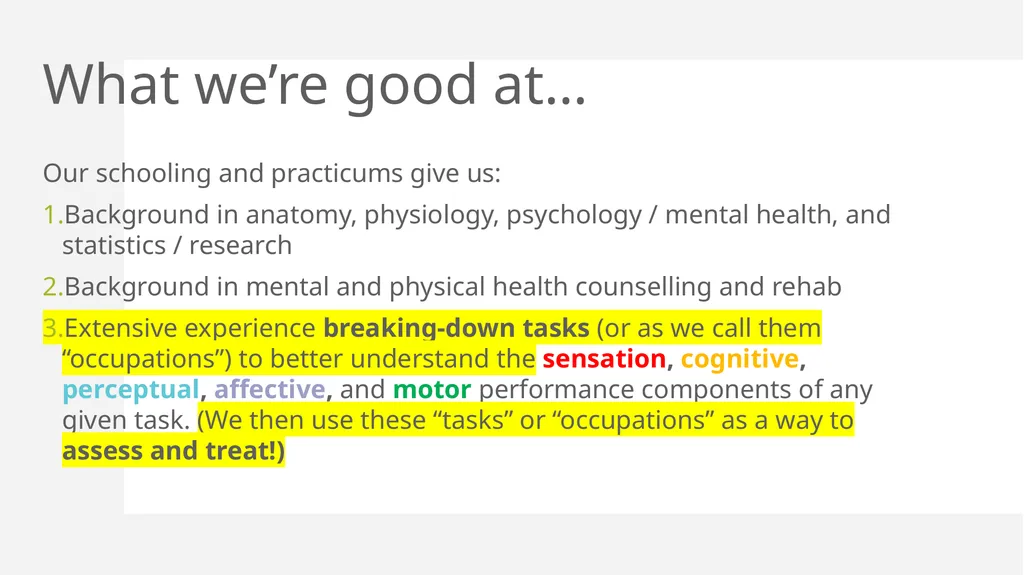
What we’re good at… Our schooling and practicums give us:
Background in anatomy, physiology, psychology / mental health, and statistics / research
Background in mental and physical health counselling and rehab
Extensive experience breaking-down tasks (or as we call them “occupations”) to better understand the sensation, cognitive, perceptual, affective, and motor performance components of any given task. (We then use these “tasks” or “occupations” as a way to assess and treat!)<br>
Background in anatomy, physiology, psychology / mental health, and statistics / research
Background in mental and physical health counselling and rehab
Extensive experience breaking-down tasks (or as we call them “occupations”) to better understand the sensation, cognitive, perceptual, affective, and motor performance components of any given task. (We then use these “tasks” or “occupations” as a way to assess and treat!)<br>
07
My focus with mental health clients:
Cognition Affect<br>
Cognition Affect<br>
08
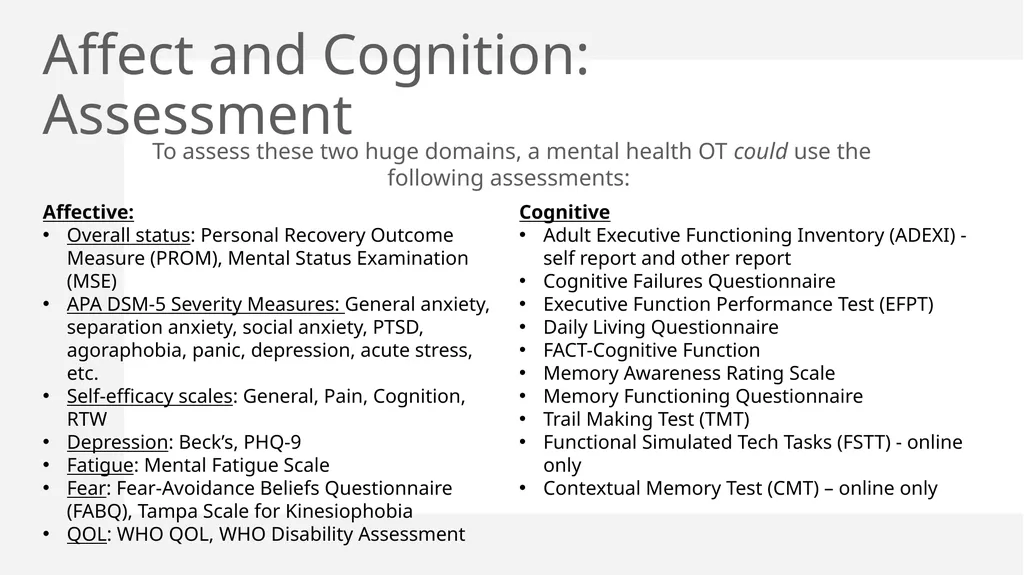
Affect and Cognition: Assessment To assess these two huge domains, a mental health OT could use the following assessments: Affective:
Overall status: Personal Recovery Outcome Measure (PROM), Mental Status Examination (MSE)
APA DSM-5 Severity Measures: General anxiety, separation anxiety, social anxiety, PTSD, agoraphobia, panic, depression, acute stress, etc.
Self-efficacy scales: General, Pain, Cognition, RTW
Depression: Beck’s, PHQ-9
Fatigue: Mental Fatigue Scale
Fear: Fear-Avoidance Beliefs Questionnaire (FABQ), Tampa Scale for Kinesiophobia
QOL: WHO QOL, WHO Disability Assessment Cognitive
Adult Executive Functioning Inventory (ADEXI) - self report and other report
Cognitive Failures Questionnaire
Executive Function Performance Test (EFPT)
Daily Living Questionnaire
FACT-Cognitive Function
Memory Awareness Rating Scale
Memory Functioning Questionnaire
Trail Making Test (TMT)
Functional Simulated Tech Tasks (FSTT) - online only
Contextual Memory Test (CMT) – online only<br>
Overall status: Personal Recovery Outcome Measure (PROM), Mental Status Examination (MSE)
APA DSM-5 Severity Measures: General anxiety, separation anxiety, social anxiety, PTSD, agoraphobia, panic, depression, acute stress, etc.
Self-efficacy scales: General, Pain, Cognition, RTW
Depression: Beck’s, PHQ-9
Fatigue: Mental Fatigue Scale
Fear: Fear-Avoidance Beliefs Questionnaire (FABQ), Tampa Scale for Kinesiophobia
QOL: WHO QOL, WHO Disability Assessment Cognitive
Adult Executive Functioning Inventory (ADEXI) - self report and other report
Cognitive Failures Questionnaire
Executive Function Performance Test (EFPT)
Daily Living Questionnaire
FACT-Cognitive Function
Memory Awareness Rating Scale
Memory Functioning Questionnaire
Trail Making Test (TMT)
Functional Simulated Tech Tasks (FSTT) - online only
Contextual Memory Test (CMT) – online only<br>
09
Affect and Cognition: Assessment …but ultimately, it is most helpful to actually see the client complete ACTIVITIES in their home or community environment… This is called a Functional Assessment <br>
10
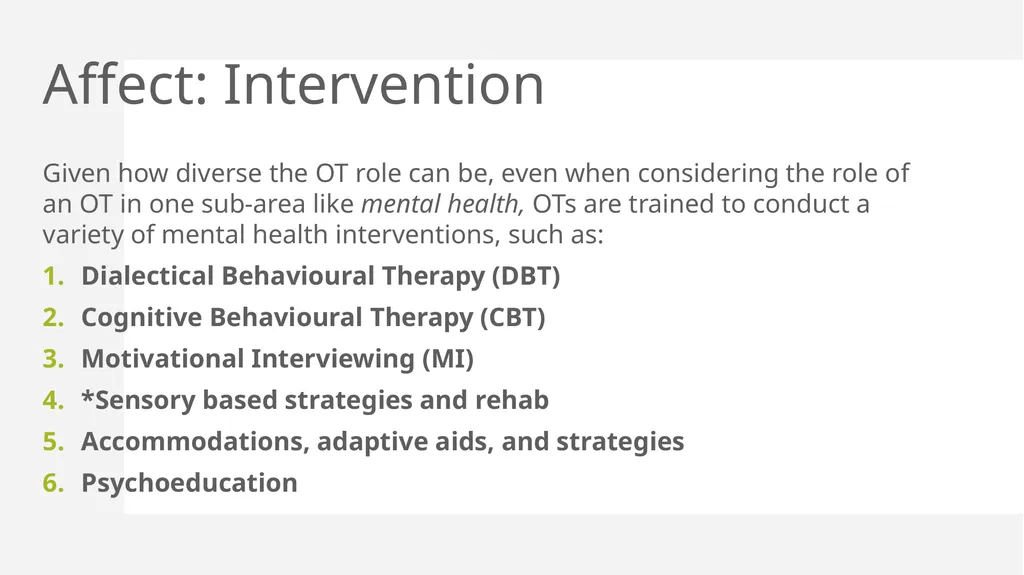
Affect: Intervention Given how diverse the OT role can be, even when considering the role of an OT in one sub-area like mental health, OTs are trained to conduct a variety of mental health interventions, such as:
Dialectical Behavioural Therapy (DBT)
Cognitive Behavioural Therapy (CBT)
Motivational Interviewing (MI)
*Sensory based strategies and rehab
Accommodations, adaptive aids, and strategies
Psychoeducation<br>
Dialectical Behavioural Therapy (DBT)
Cognitive Behavioural Therapy (CBT)
Motivational Interviewing (MI)
*Sensory based strategies and rehab
Accommodations, adaptive aids, and strategies
Psychoeducation<br>
11
Affect: Intervention If you’re interested in learning more about Sensory Processing and mental health, take a look at this paper:
https://www.ncbi.nlm.nih.gov/pmc/articles/PMC6370662/<br>
https://www.ncbi.nlm.nih.gov/pmc/articles/PMC6370662/<br>
12
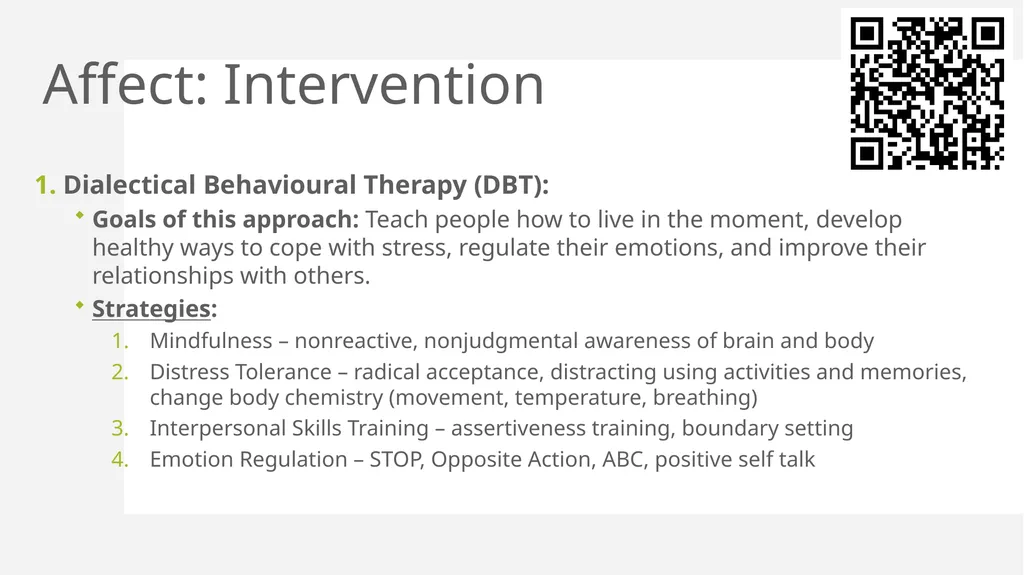
Affect: Intervention 1. Dialectical Behavioural Therapy (DBT):
Goals of this approach: Teach people how to live in the moment, develop healthy ways to cope with stress, regulate their emotions, and improve their relationships with others.
Strategies:
Mindfulness – nonreactive, nonjudgmental awareness of brain and body
Distress Tolerance – radical acceptance, distracting using activities and memories, change body chemistry (movement, temperature, breathing)
Interpersonal Skills Training – assertiveness training, boundary setting
Emotion Regulation – STOP, Opposite Action, ABC, positive self talk<br>
Goals of this approach: Teach people how to live in the moment, develop healthy ways to cope with stress, regulate their emotions, and improve their relationships with others.
Strategies:
Mindfulness – nonreactive, nonjudgmental awareness of brain and body
Distress Tolerance – radical acceptance, distracting using activities and memories, change body chemistry (movement, temperature, breathing)
Interpersonal Skills Training – assertiveness training, boundary setting
Emotion Regulation – STOP, Opposite Action, ABC, positive self talk<br>
13
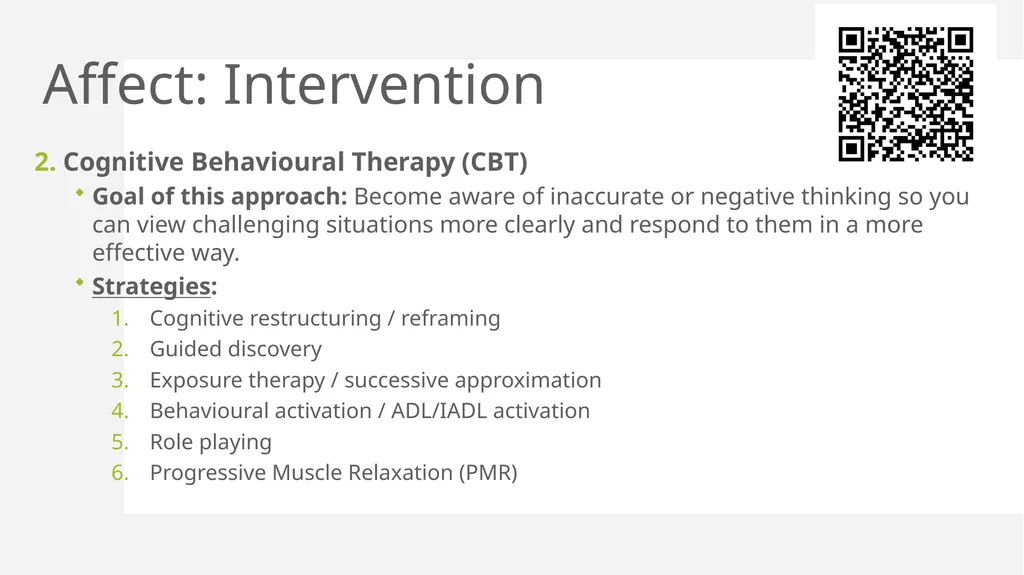
Affect: Intervention 2. Cognitive Behavioural Therapy (CBT)
Goal of this approach: Become aware of inaccurate or negative thinking so you can view challenging situations more clearly and respond to them in a more effective way.
Strategies:
Cognitive restructuring / reframing
Guided discovery
Exposure therapy / successive approximation
Behavioural activation / ADL/IADL activation
Role playing
Progressive Muscle Relaxation (PMR)<br>
Goal of this approach: Become aware of inaccurate or negative thinking so you can view challenging situations more clearly and respond to them in a more effective way.
Strategies:
Cognitive restructuring / reframing
Guided discovery
Exposure therapy / successive approximation
Behavioural activation / ADL/IADL activation
Role playing
Progressive Muscle Relaxation (PMR)<br>
14
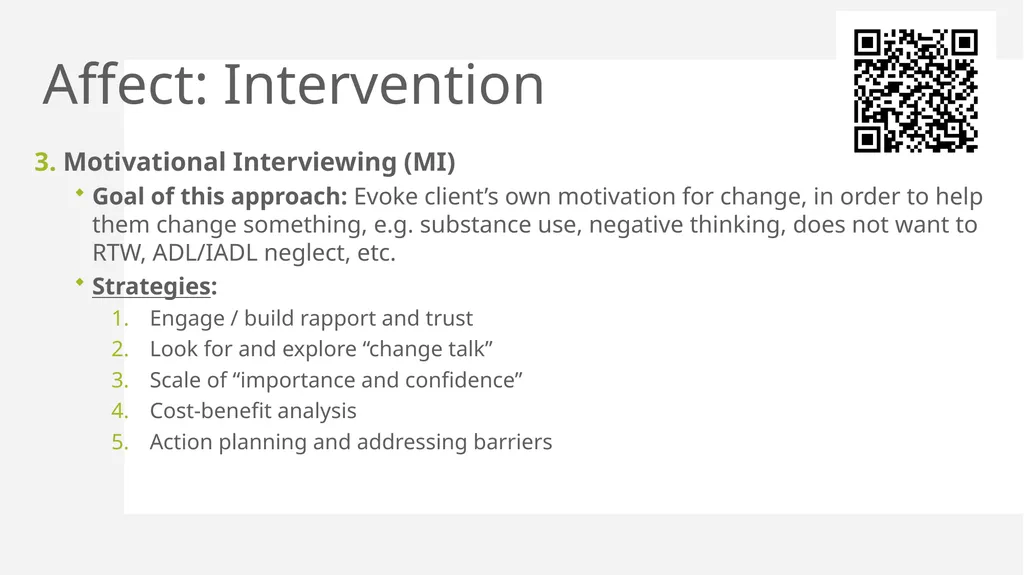
Affect: Intervention 3. Motivational Interviewing (MI)
Goal of this approach: Evoke client’s own motivation for change, in order to help them change something, e.g. substance use, negative thinking, does not want to RTW, ADL/IADL neglect, etc.
Strategies:
Engage / build rapport and trust
Look for and explore “change talk”
Scale of “importance and confidence”
Cost-benefit analysis
Action planning and addressing barriers<br>
Goal of this approach: Evoke client’s own motivation for change, in order to help them change something, e.g. substance use, negative thinking, does not want to RTW, ADL/IADL neglect, etc.
Strategies:
Engage / build rapport and trust
Look for and explore “change talk”
Scale of “importance and confidence”
Cost-benefit analysis
Action planning and addressing barriers<br>
15
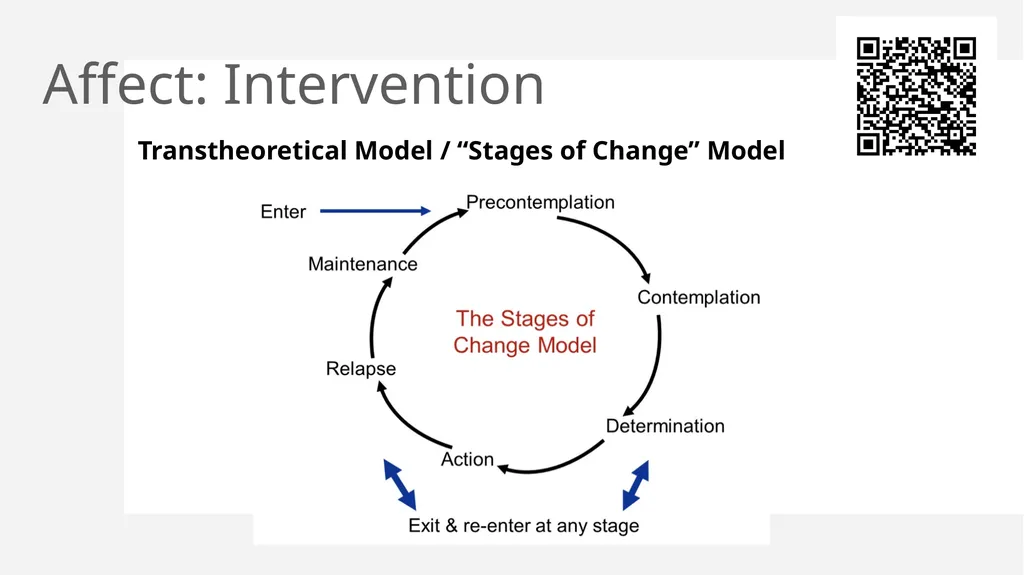
Affect: Intervention Transtheoretical Model / “Stages of Change” Model<br>
16
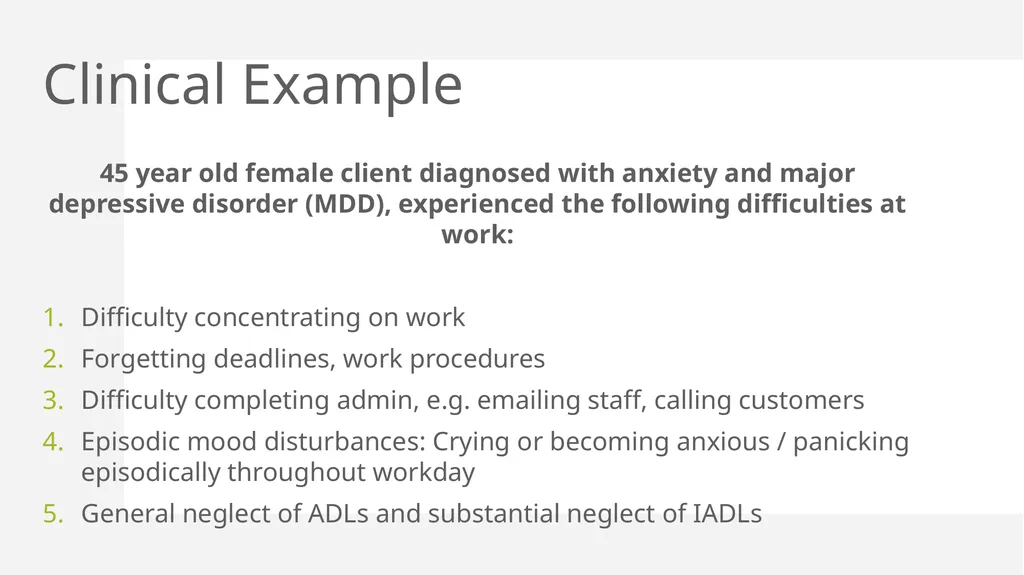
Clinical Example 45 year old female client diagnosed with anxiety and major depressive disorder (MDD), experienced the following difficulties at work:
Difficulty concentrating on work
Forgetting deadlines, work procedures
Difficulty completing admin, e.g. emailing staff, calling customers
Episodic mood disturbances: Crying or becoming anxious / panicking episodically throughout workday
General neglect of ADLs and substantial neglect of IADLs<br>
Difficulty concentrating on work
Forgetting deadlines, work procedures
Difficulty completing admin, e.g. emailing staff, calling customers
Episodic mood disturbances: Crying or becoming anxious / panicking episodically throughout workday
General neglect of ADLs and substantial neglect of IADLs<br>
17
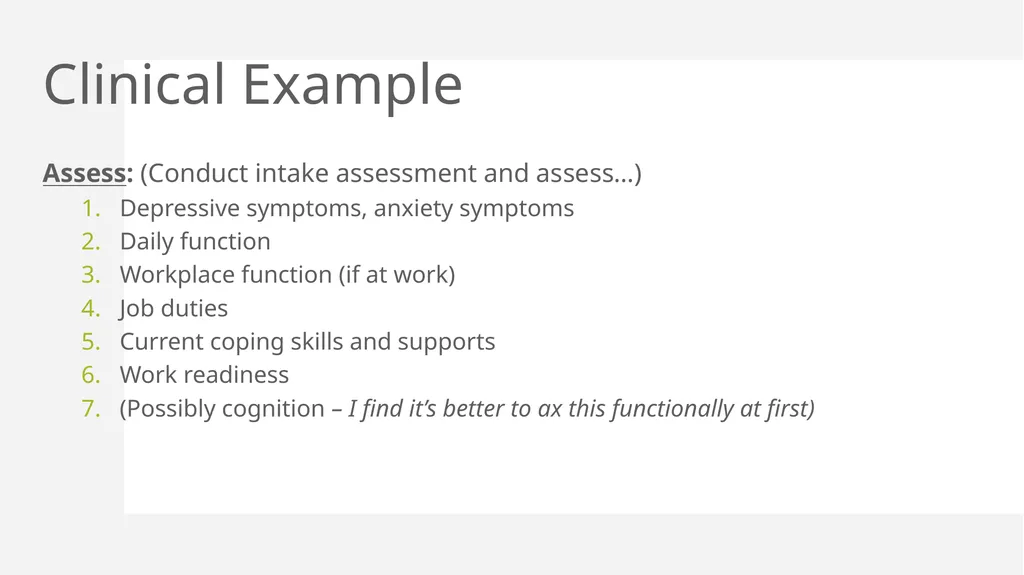
Clinical Example Assess: (Conduct intake assessment and assess…)
Depressive symptoms, anxiety symptoms
Daily function
Workplace function (if at work)
Job duties
Current coping skills and supports
Work readiness
(Possibly cognition – I find it’s better to ax this functionally at first)<br>
Depressive symptoms, anxiety symptoms
Daily function
Workplace function (if at work)
Job duties
Current coping skills and supports
Work readiness
(Possibly cognition – I find it’s better to ax this functionally at first)<br>
18
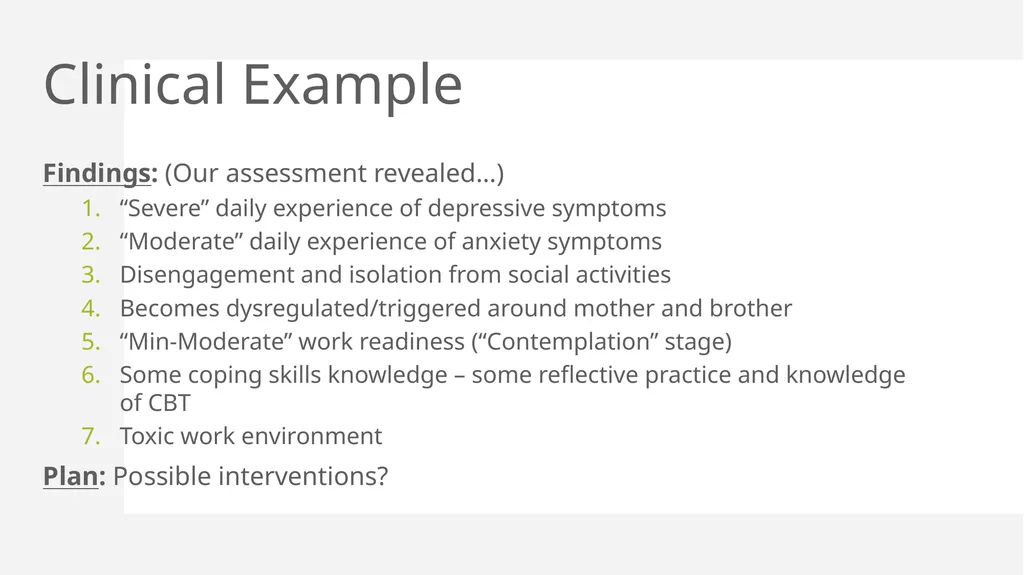
Clinical Example Findings: (Our assessment revealed…)
“Severe” daily experience of depressive symptoms
“Moderate” daily experience of anxiety symptoms
Disengagement and isolation from social activities
Becomes dysregulated/triggered around mother and brother
“Min-Moderate” work readiness (“Contemplation” stage)
Some coping skills knowledge – some reflective practice and knowledge of CBT
Toxic work environment
Plan: Possible interventions?<br>
“Severe” daily experience of depressive symptoms
“Moderate” daily experience of anxiety symptoms
Disengagement and isolation from social activities
Becomes dysregulated/triggered around mother and brother
“Min-Moderate” work readiness (“Contemplation” stage)
Some coping skills knowledge – some reflective practice and knowledge of CBT
Toxic work environment
Plan: Possible interventions?<br>
19
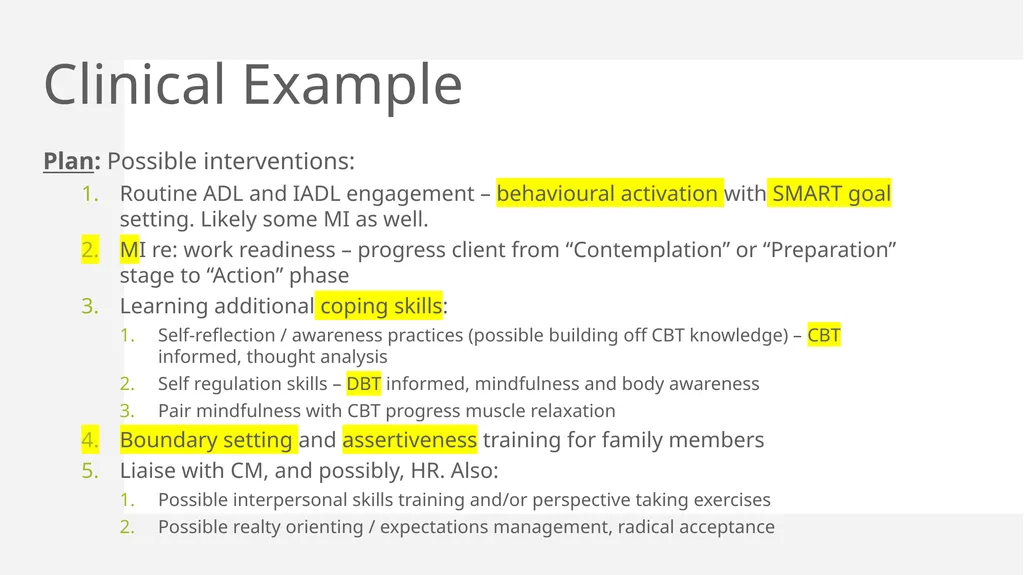
Clinical Example Plan: Possible interventions:
Routine ADL and IADL engagement – behavioural activation with SMART goal setting. Likely some MI as well.
MI re: work readiness – progress client from “Contemplation” or “Preparation” stage to “Action” phase
Learning additional coping skills:
Self-reflection / awareness practices (possible building off CBT knowledge) – CBT informed, thought analysis
Self regulation skills – DBT informed, mindfulness and body awareness
Pair mindfulness with CBT progress muscle relaxation
Boundary setting and assertiveness training for family members
Liaise with CM, and possibly, HR. Also:
Possible interpersonal skills training and/or perspective taking exercises
Possible realty orienting / expectations management, radical acceptance<br>
Routine ADL and IADL engagement – behavioural activation with SMART goal setting. Likely some MI as well.
MI re: work readiness – progress client from “Contemplation” or “Preparation” stage to “Action” phase
Learning additional coping skills:
Self-reflection / awareness practices (possible building off CBT knowledge) – CBT informed, thought analysis
Self regulation skills – DBT informed, mindfulness and body awareness
Pair mindfulness with CBT progress muscle relaxation
Boundary setting and assertiveness training for family members
Liaise with CM, and possibly, HR. Also:
Possible interpersonal skills training and/or perspective taking exercises
Possible realty orienting / expectations management, radical acceptance<br>
20
Above all else… All theories / modalities aside, my experiences and book-learning has taught me that simply taking the time to establish a trusting, supportive relationship with the client is massively therapeutic in itself.<br>
21
Many times getting “buy-in” is half the battle!
This is why it’s so important to take the time to understand the client and answer the many “whys” they might have.
If we don’t know why we’re feeling the way we are and why doing something will help help us, we simply will not do it.<br>
This is why it’s so important to take the time to understand the client and answer the many “whys” they might have.
If we don’t know why we’re feeling the way we are and why doing something will help help us, we simply will not do it.<br>
22
What I want you to remember… OTs use meaningful activities (“occupations”) to assess AND rehabilitate.
OTs have extensive training in understanding and assessing various factors which could be impacting a client’s function – mental, physical, cognitive, social factors, etc.
Mental health OTs can use evidence-based treatment modalities such as CBT, DBT, and MI to help our clients regain their independence.<br>
OTs have extensive training in understanding and assessing various factors which could be impacting a client’s function – mental, physical, cognitive, social factors, etc.
Mental health OTs can use evidence-based treatment modalities such as CBT, DBT, and MI to help our clients regain their independence.<br>
23
Roadmap – revisited Today, we’ve covered:
What is OT?
What role the OT has in supporting their client’s mental health
Common assessments used by mental health OTs
Common interventions used by mental health OTs
Application of assessment and intervention techniques to a clinical example<br>
What is OT?
What role the OT has in supporting their client’s mental health
Common assessments used by mental health OTs
Common interventions used by mental health OTs
Application of assessment and intervention techniques to a clinical example<br>
24
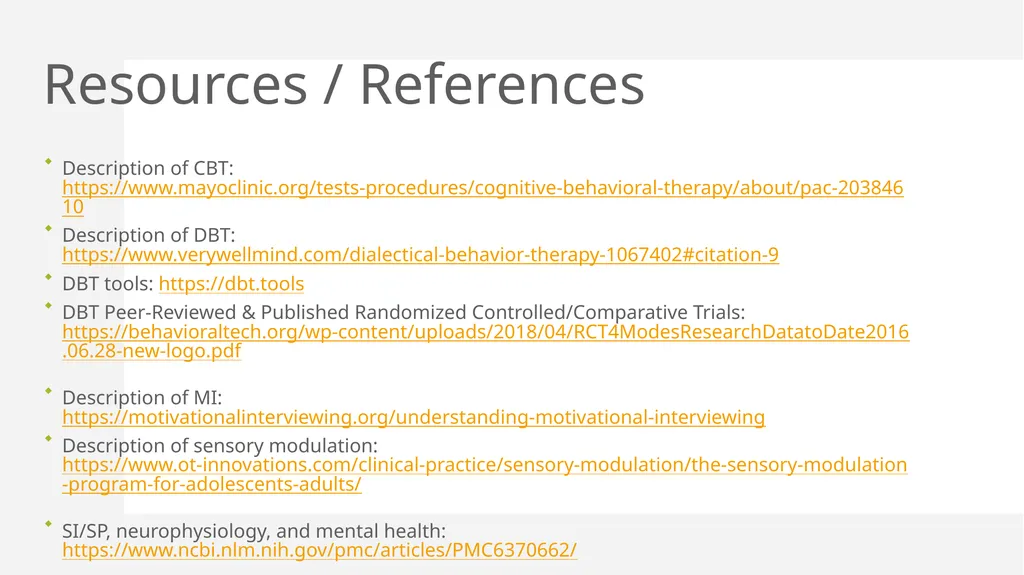
Resources / References Description of CBT: https://www.mayoclinic.org/tests-procedures/cognitive-behavioral-therapy/about/pac-20384610
Description of DBT: https://www.verywellmind.com/dialectical-behavior-therapy-1067402#citation-9
DBT tools: https://dbt.tools
DBT Peer-Reviewed & Published Randomized Controlled/Comparative Trials: https://behavioraltech.org/wp-content/uploads/2018/04/RCT4ModesResearchDatatoDate2016.06.28-new-logo.pdf
Description of MI: https://motivationalinterviewing.org/understanding-motivational-interviewing
Description of sensory modulation: https://www.ot-innovations.com/clinical-practice/sensory-modulation/the-sensory-modulation-program-for-adolescents-adults/
SI/SP, neurophysiology, and mental health: https://www.ncbi.nlm.nih.gov/pmc/articles/PMC6370662/<br>
Description of DBT: https://www.verywellmind.com/dialectical-behavior-therapy-1067402#citation-9
DBT tools: https://dbt.tools
DBT Peer-Reviewed & Published Randomized Controlled/Comparative Trials: https://behavioraltech.org/wp-content/uploads/2018/04/RCT4ModesResearchDatatoDate2016.06.28-new-logo.pdf
Description of MI: https://motivationalinterviewing.org/understanding-motivational-interviewing
Description of sensory modulation: https://www.ot-innovations.com/clinical-practice/sensory-modulation/the-sensory-modulation-program-for-adolescents-adults/
SI/SP, neurophysiology, and mental health: https://www.ncbi.nlm.nih.gov/pmc/articles/PMC6370662/<br>
25
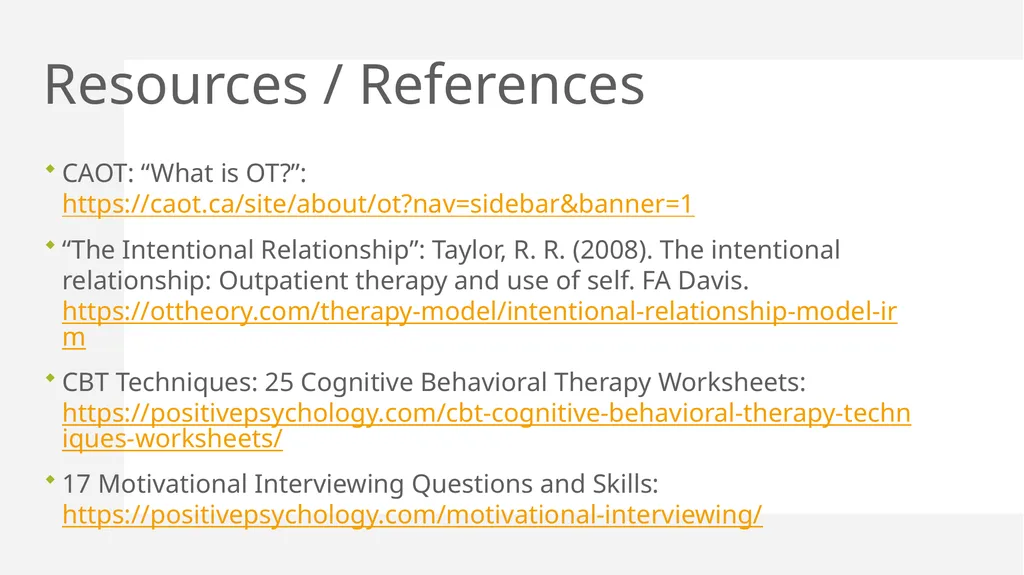
Resources / References CAOT: “What is OT?”: https://caot.ca/site/about/ot?nav=sidebar&banner=1
“The Intentional Relationship”: Taylor, R. R. (2008). The intentional relationship: Outpatient therapy and use of self. FA Davis. https://ottheory.com/therapy-model/intentional-relationship-model-irm
CBT Techniques: 25 Cognitive Behavioral Therapy Worksheets: https://positivepsychology.com/cbt-cognitive-behavioral-therapy-techniques-worksheets/
17 Motivational Interviewing Questions and Skills: https://positivepsychology.com/motivational-interviewing/<br>
“The Intentional Relationship”: Taylor, R. R. (2008). The intentional relationship: Outpatient therapy and use of self. FA Davis. https://ottheory.com/therapy-model/intentional-relationship-model-irm
CBT Techniques: 25 Cognitive Behavioral Therapy Worksheets: https://positivepsychology.com/cbt-cognitive-behavioral-therapy-techniques-worksheets/
17 Motivational Interviewing Questions and Skills: https://positivepsychology.com/motivational-interviewing/<br>