04
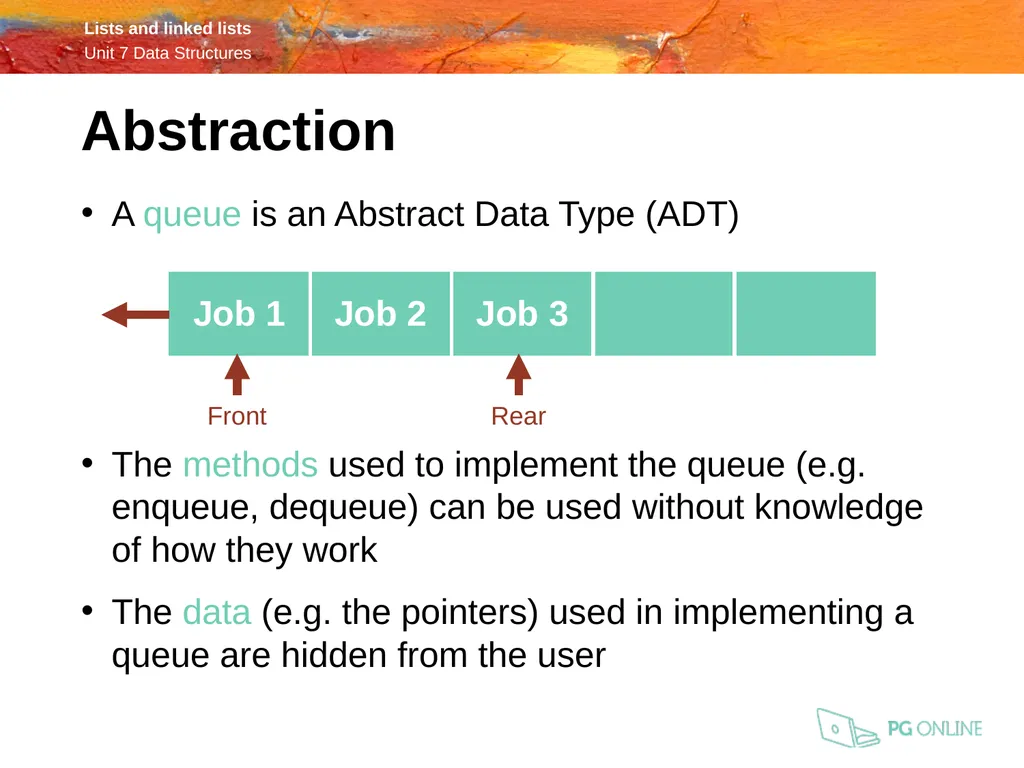
Abstraction A queue is an Abstract Data Type (ADT)
The methods used to implement the queue (e.g. enqueue, dequeue) can be used without knowledge of how they work
The data (e.g. the pointers) used in implementing a queue are hidden from the user Front Rear<br>
05
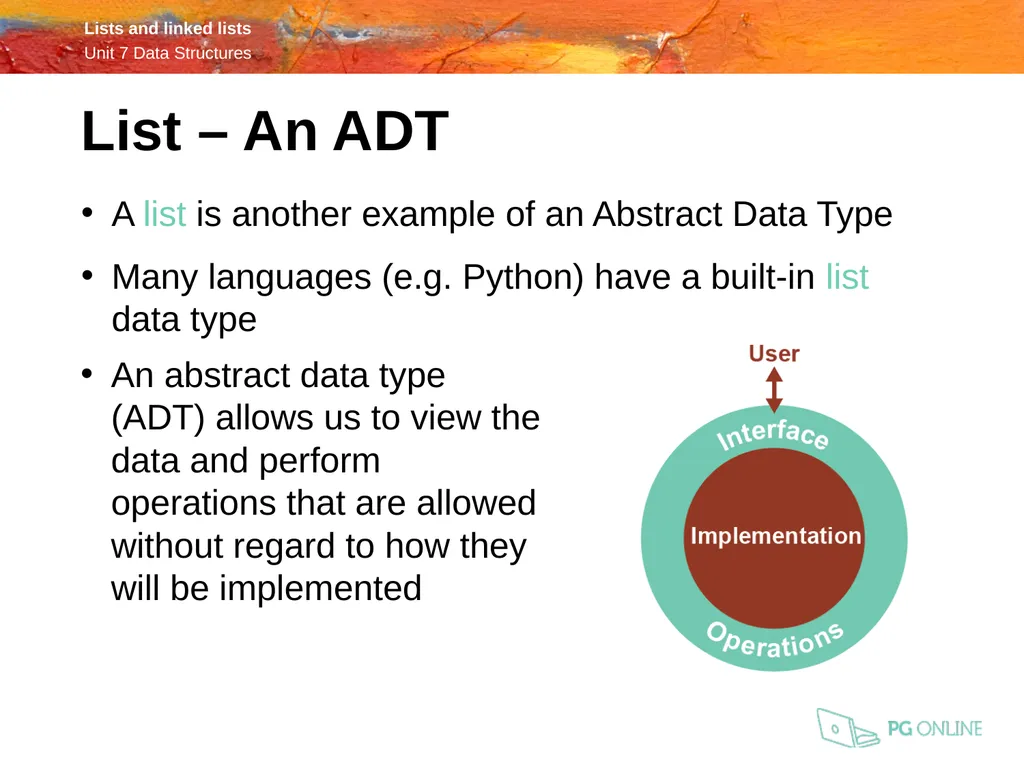
List – An ADT A list is another example of an Abstract Data Type
Many languages (e.g. Python) have a built-in list data type An abstract data type (ADT) allows us to view the data and perform operations that are allowed without regard to how they will be implemented<br>
06
Dynamic vs static In relation to size, what does static mean?
In relation to size, what does dynamic mean?<br>
07
Dynamic vs static A static data structure cannot change size after it has been created
A dynamic data structure can grow or shrink
Programming languages often have an inbuilt dynamic list
Python, Java, VB.Net, and Delphi all have dynamic list support
What controls how many items can be added to a dynamic list?<br>
08
Implementation of a �dynamic list The implementation of an inbuilt list ADT is hidden from the user
A new location is taken from the ‘heap’ - memory locations used for dynamic allocation
When an item is deleted from a list, the memory location is freed up and returned to the ‘heap’
A system of pointers keeps the list in the order specified by the user<br>
09
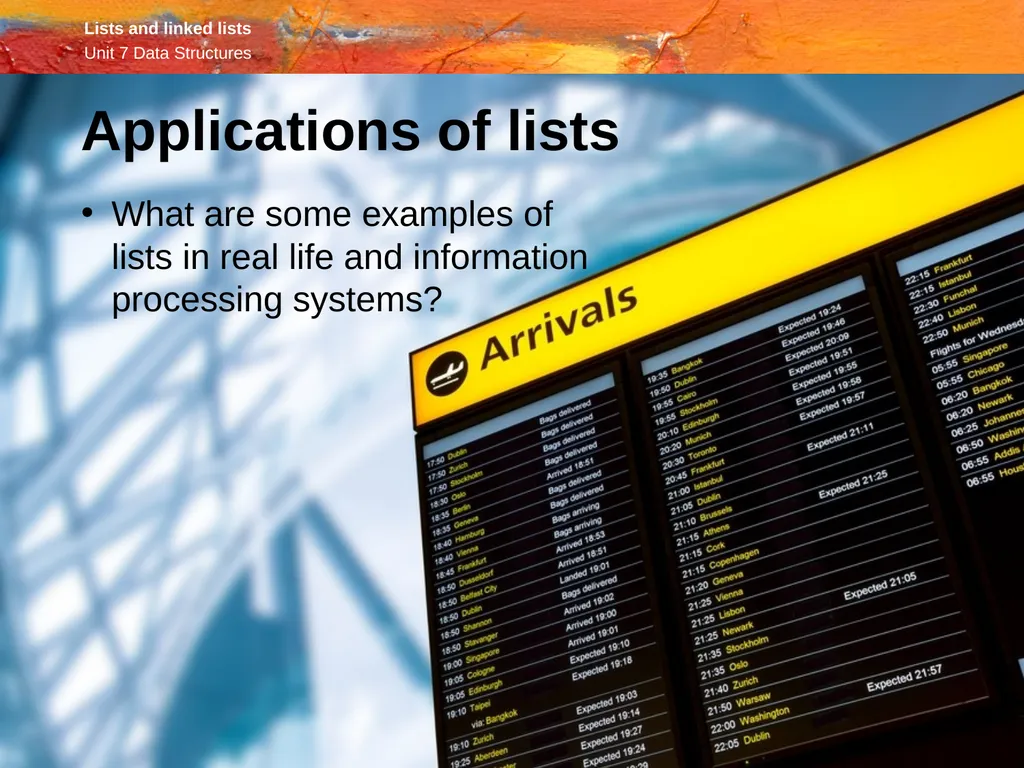
Applications of lists What are some examples of lists in real life and information processing systems?<br>
10
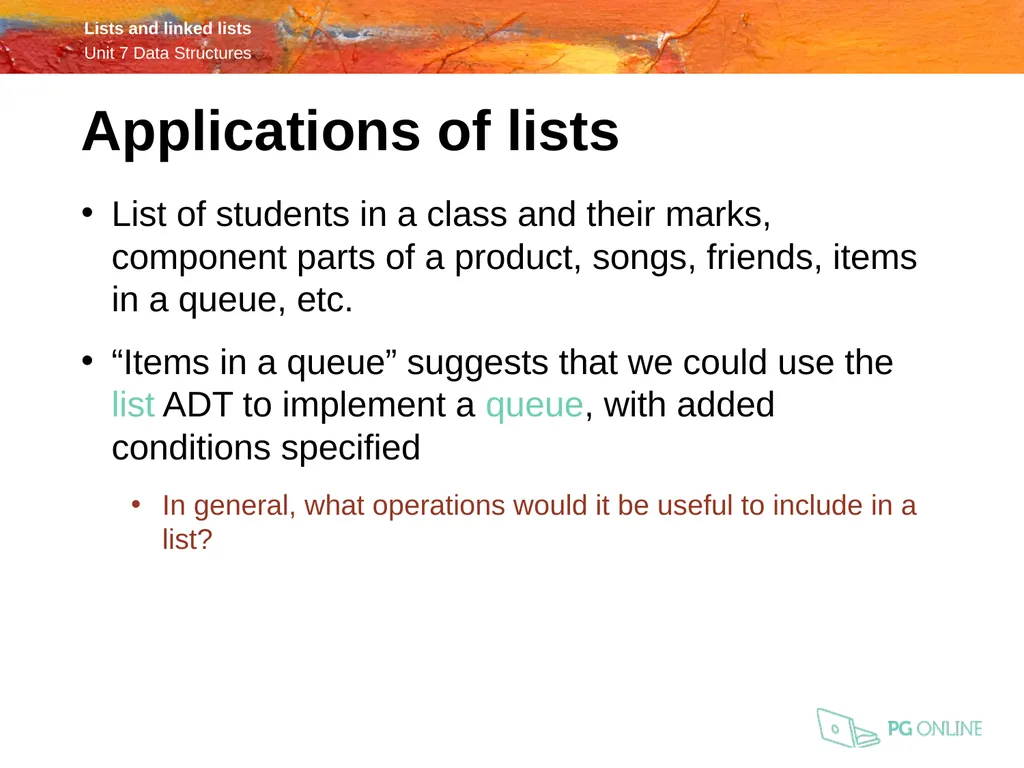
Applications of lists List of students in a class and their marks, component parts of a product, songs, friends, items in a queue, etc.
“Items in a queue” suggests that we could use the list ADT to implement a queue, with added conditions specified
In general, what operations would it be useful to include in a list?<br>
11
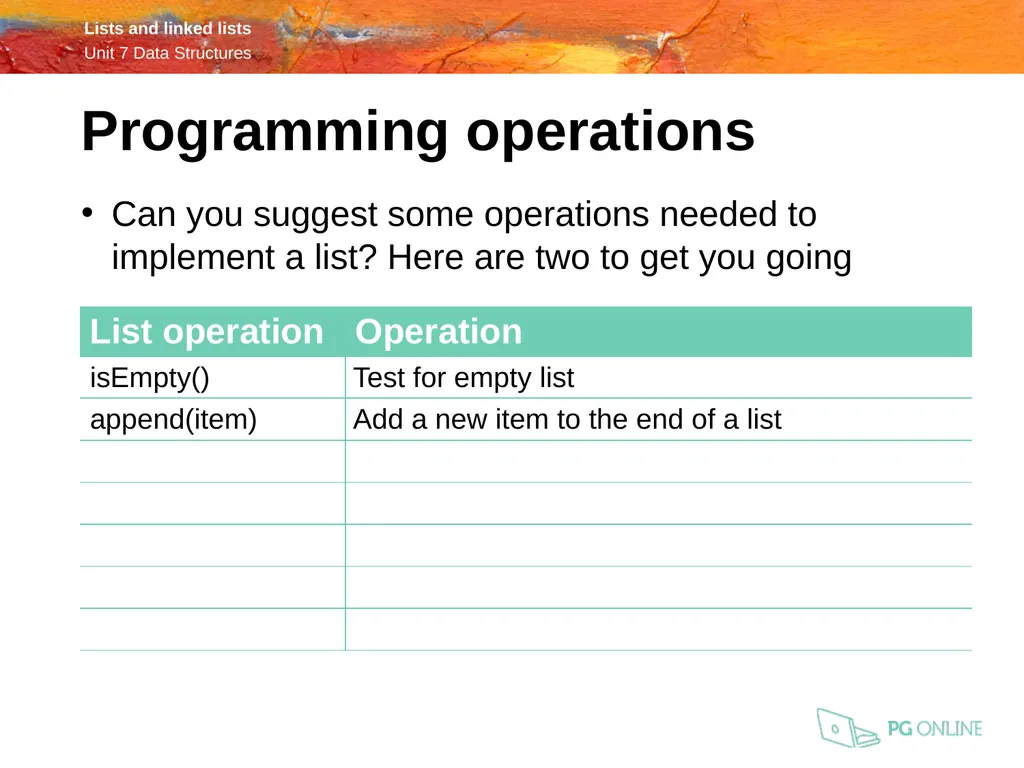
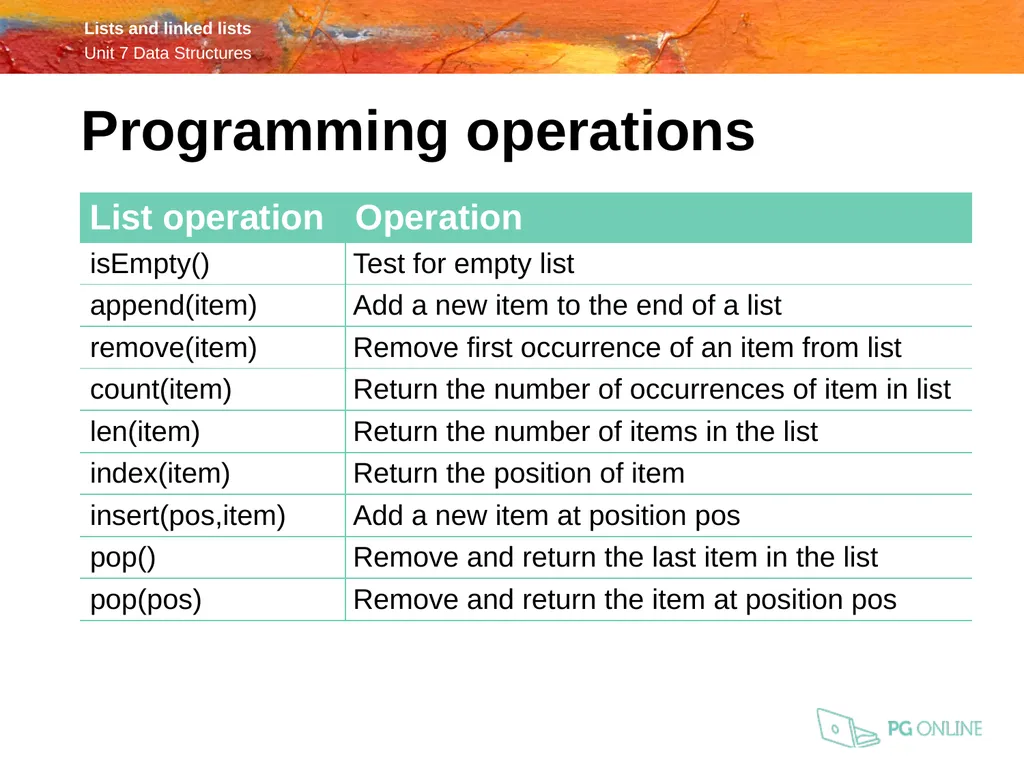
Programming operations Can you suggest some operations needed to implement a list? Here are two to get you going<br>
12
Programming operations<br>
13
Worksheet 3 Complete the ‘Random Clothing’ Task 1 on the worksheet<br>
14
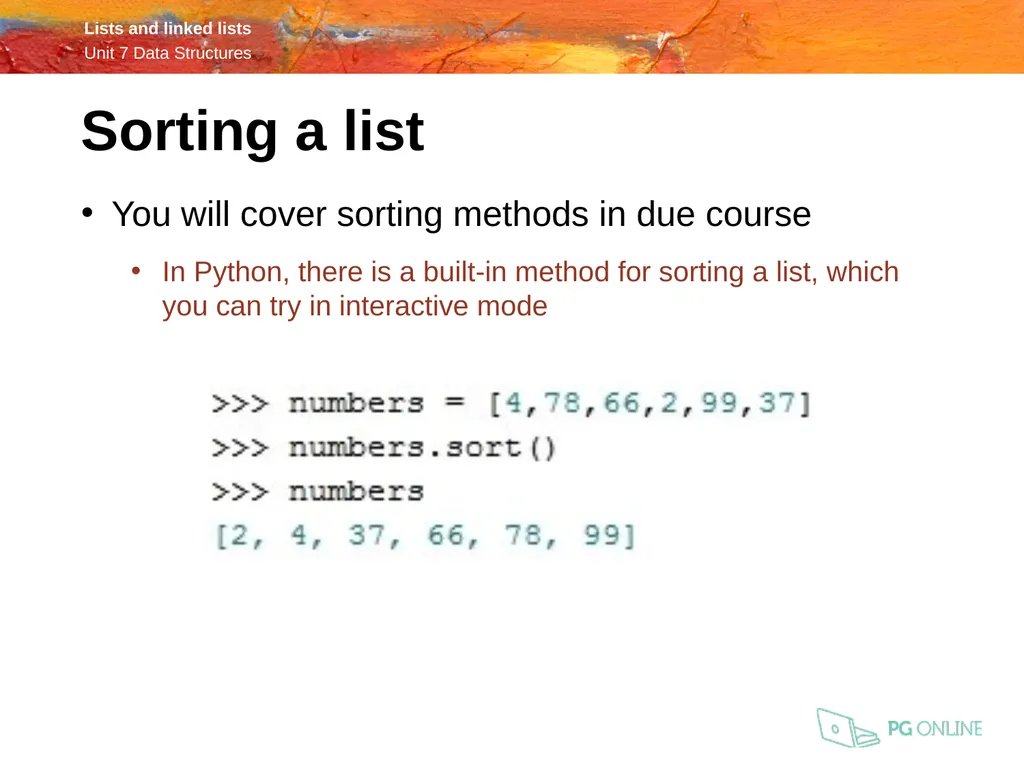
Sorting a list You will cover sorting methods in due course
In Python, there is a built-in method for sorting a list, which you can try in interactive mode<br>
15
Implementing a queue as a list Using a dynamic data structure such as a list to implement a queue, is there any point in holding items in a circular queue?
Is it necessary to update the size variable as items are added and removed?
Do we need a variable maxSize?
Do we need a function isFull?<br>
16
Functions to implement a linear queue as a dynamic list Write pseudocode to implement the following operations for a queue which can hold a maximum of maxSize items:
enqueue
dequeue
isEmpty
isFull<br>
17
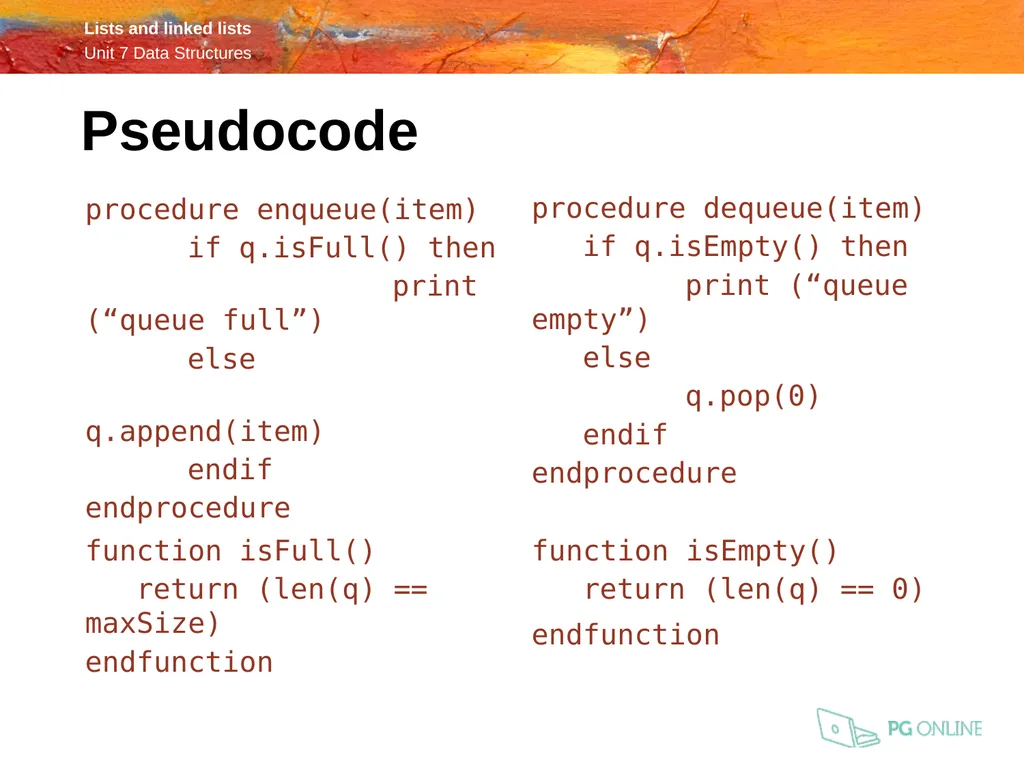
Pseudocode procedure enqueue(item)
if q.isFull() then
print (“queue full”)
else
q.append(item)
endif
endprocedure procedure dequeue(item)
if q.isEmpty() then
print (“queue empty”)
else
q.pop(0)
endif
endprocedure function isFull()
return (len(q) == maxSize)
endfunction function isEmpty()
return (len(q) == 0)
endfunction<br>
18
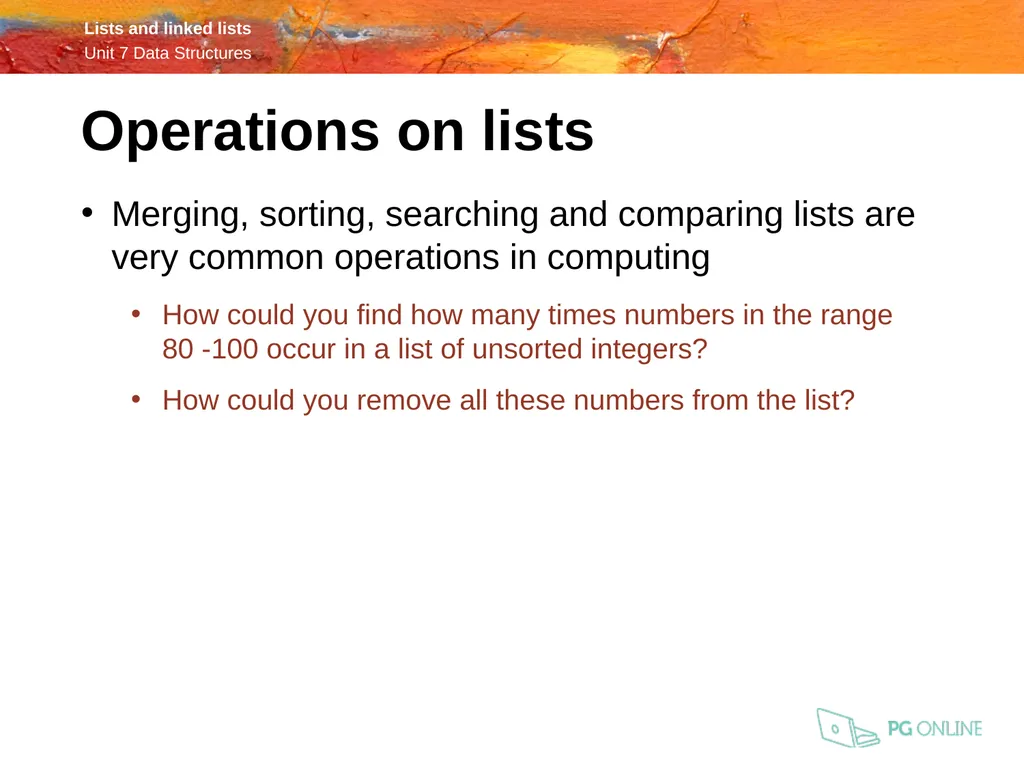
Operations on lists Merging, sorting, searching and comparing lists are very common operations in computing
How could you find how many times numbers in the range �80 -100 occur in a list of unsorted integers?
How could you remove all these numbers from the list?<br>
19
Worksheet 3 Try these operations in Task 2 on the worksheet<br>
20
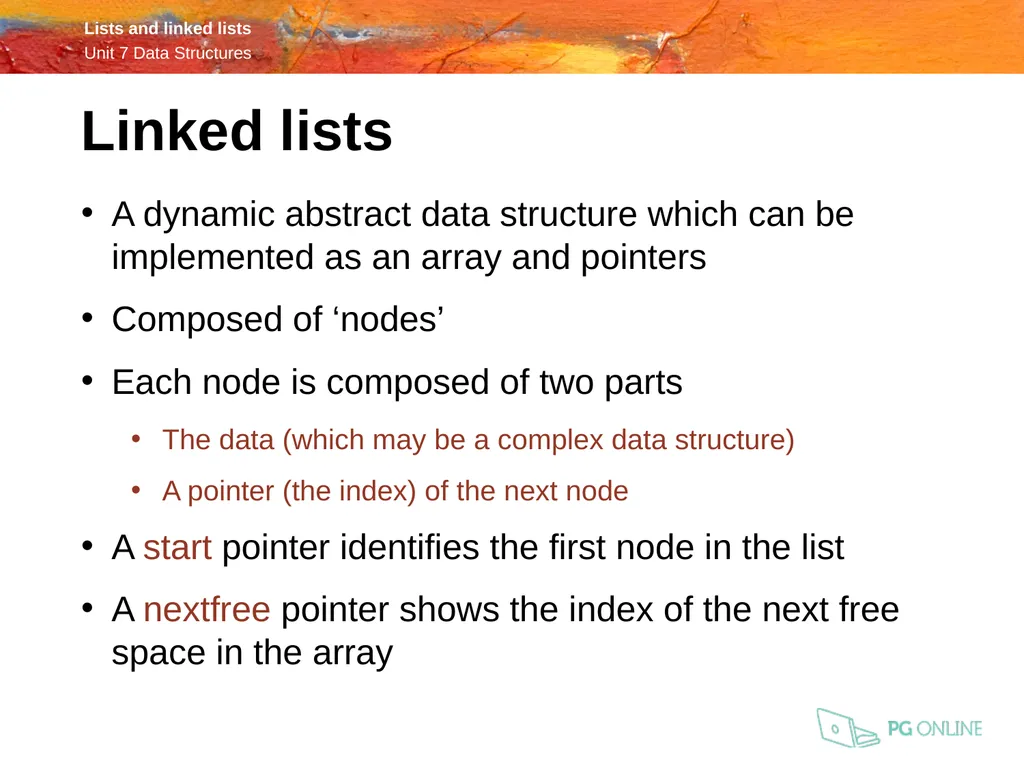
Linked lists A dynamic abstract data structure which can be implemented as an array and pointers
Composed of ‘nodes’
Each node is composed of two parts
The data (which may be a complex data structure)
A pointer (the index) of the next node
A start pointer identifies the first node in the list
A nextfree pointer shows the index of the next free space in the array<br>
21
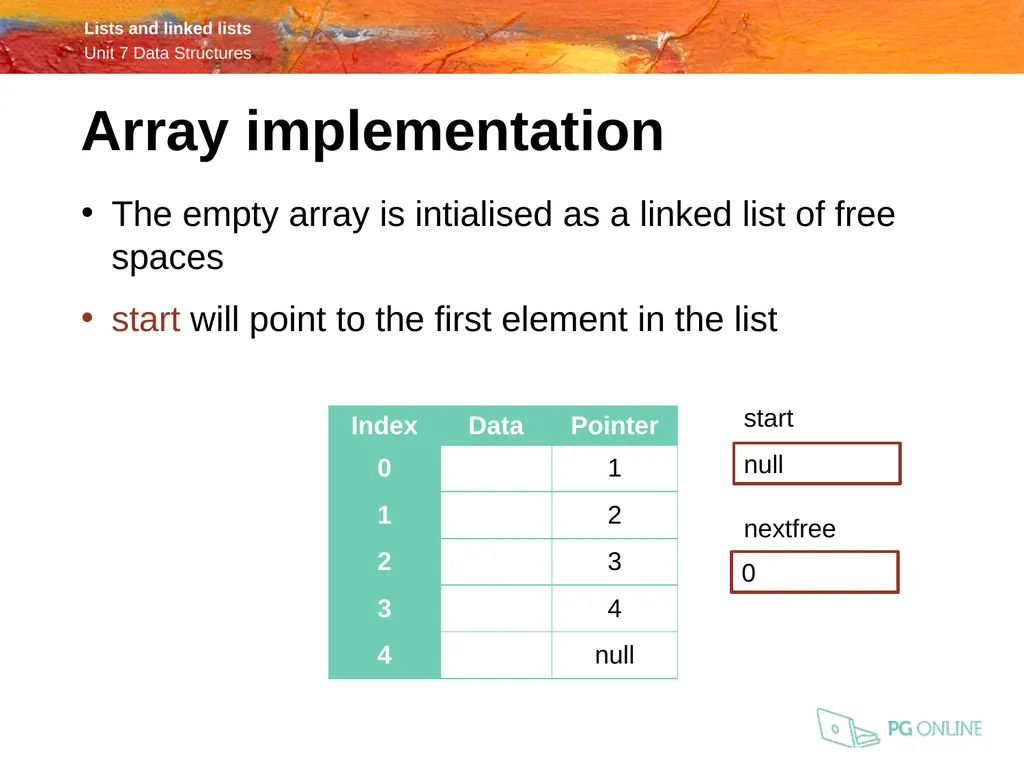
Array implementation The empty array is intialised as a linked list of free spaces
start will point to the first element in the list null start 0 nextfree<br>
22
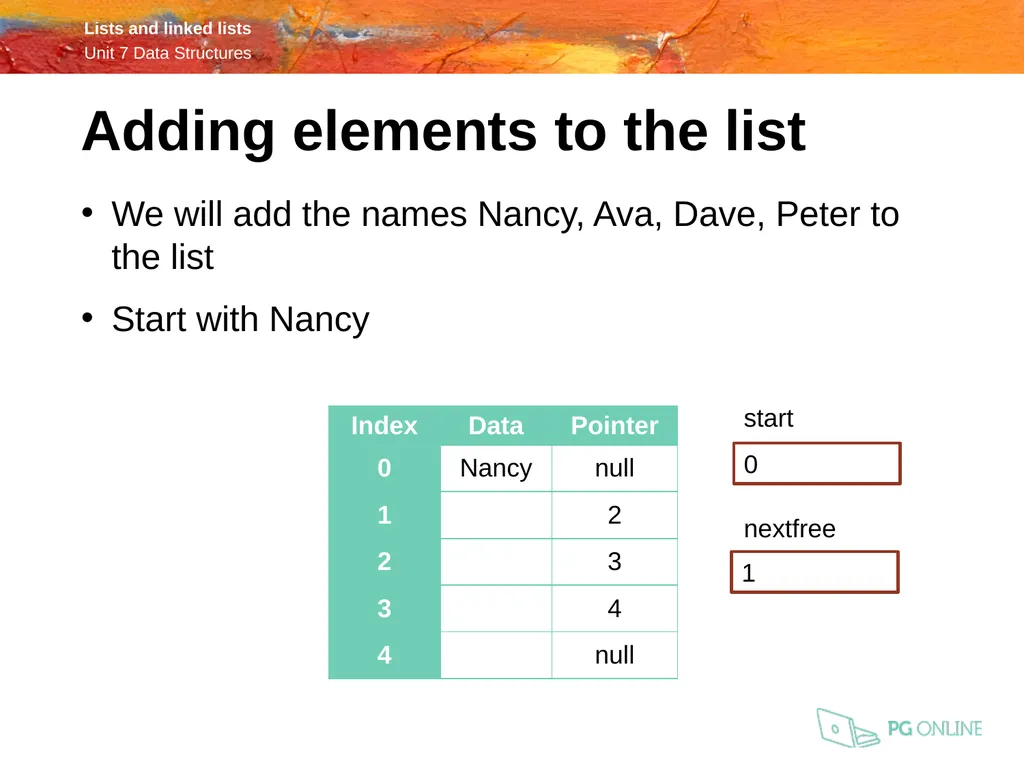
Adding elements to the list We will add the names Nancy, Ava, Dave, Peter to the list
Start with Nancy 0 start 1 nextfree<br>
23
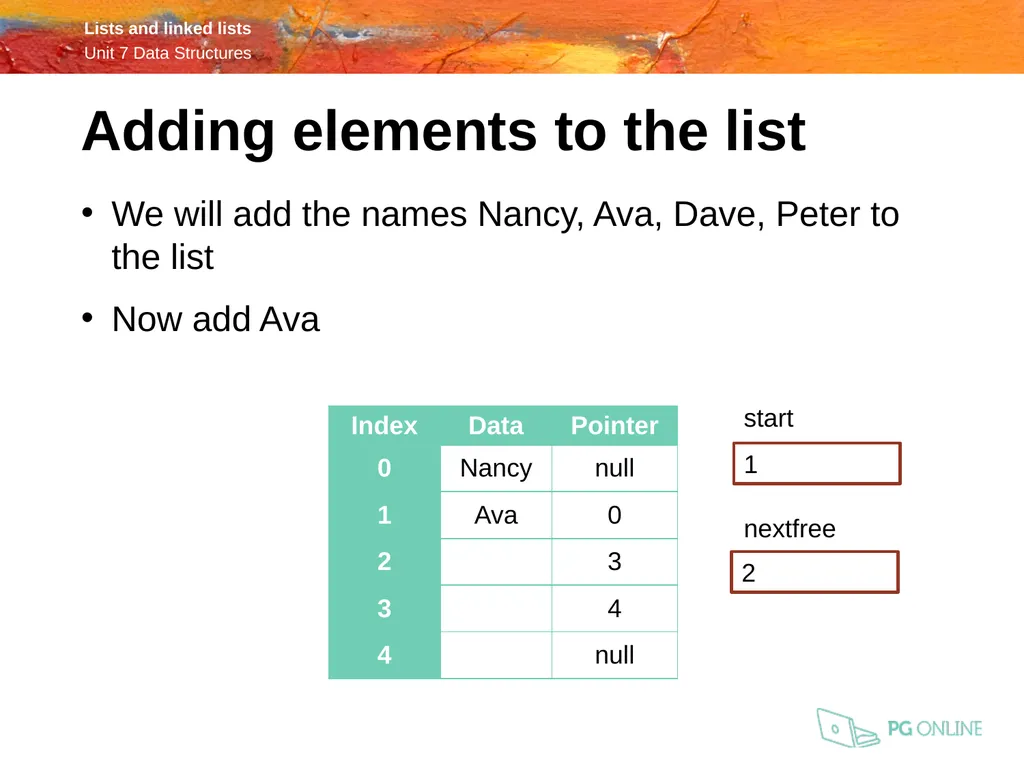
Adding elements to the list We will add the names Nancy, Ava, Dave, Peter to the list
Now add Ava 1 start 2 nextfree<br>
24
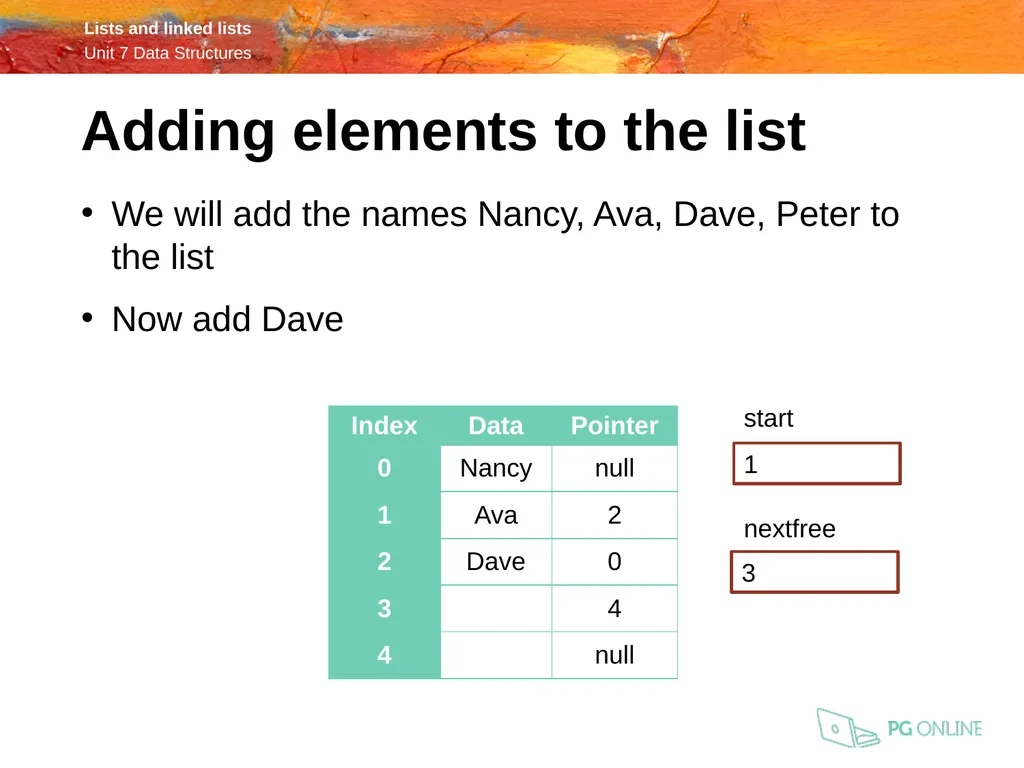
Adding elements to the list We will add the names Nancy, Ava, Dave, Peter to the list
Now add Dave 1 start 3 nextfree<br>
25
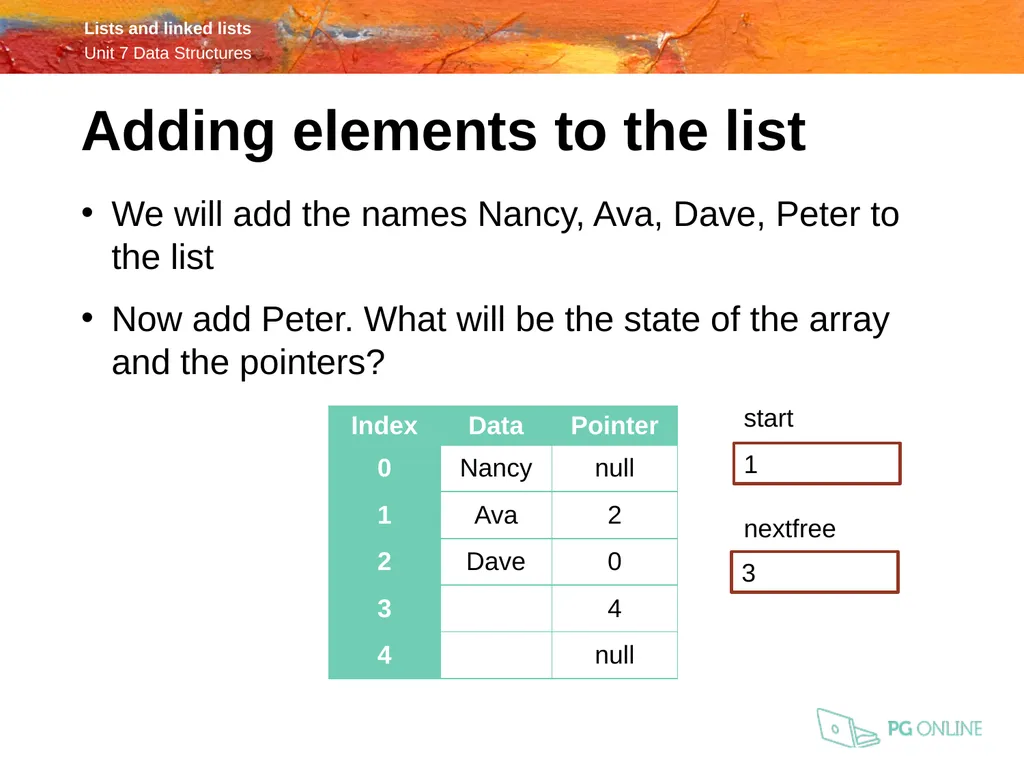
Adding elements to the list We will add the names Nancy, Ava, Dave, Peter to the list
Now add Peter. What will be the state of the array and the pointers? 1 start 3 nextfree<br>
26
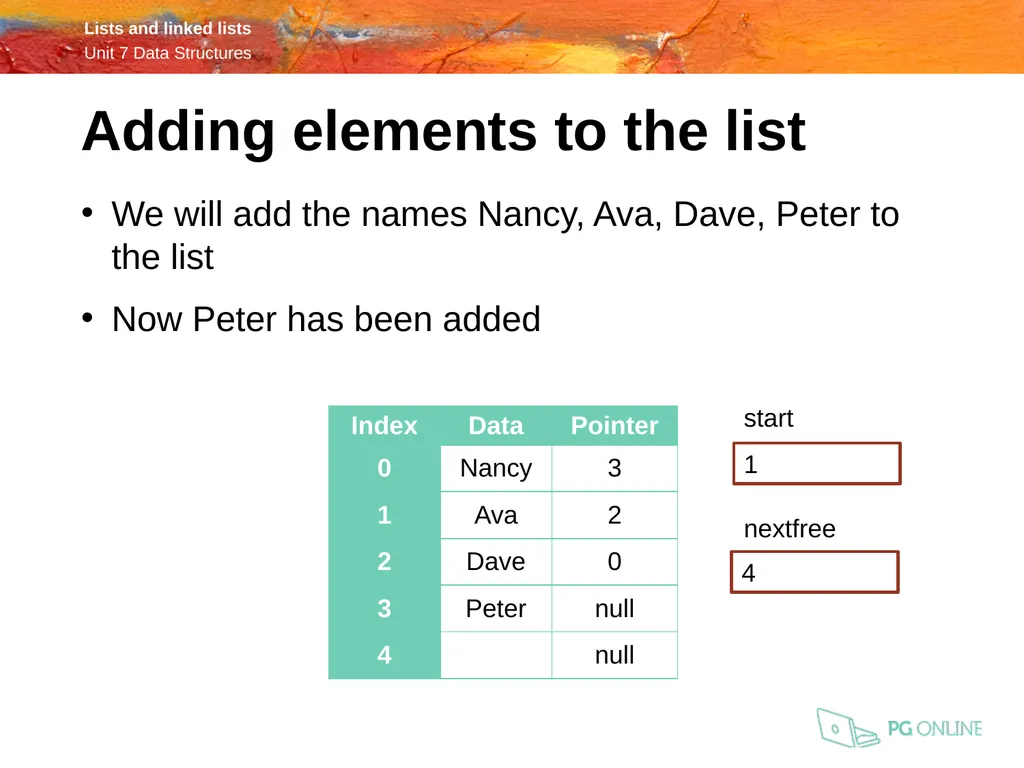
Adding elements to the list We will add the names Nancy, Ava, Dave, Peter to the list
Now Peter has been added 1 start 4 nextfree<br>
27
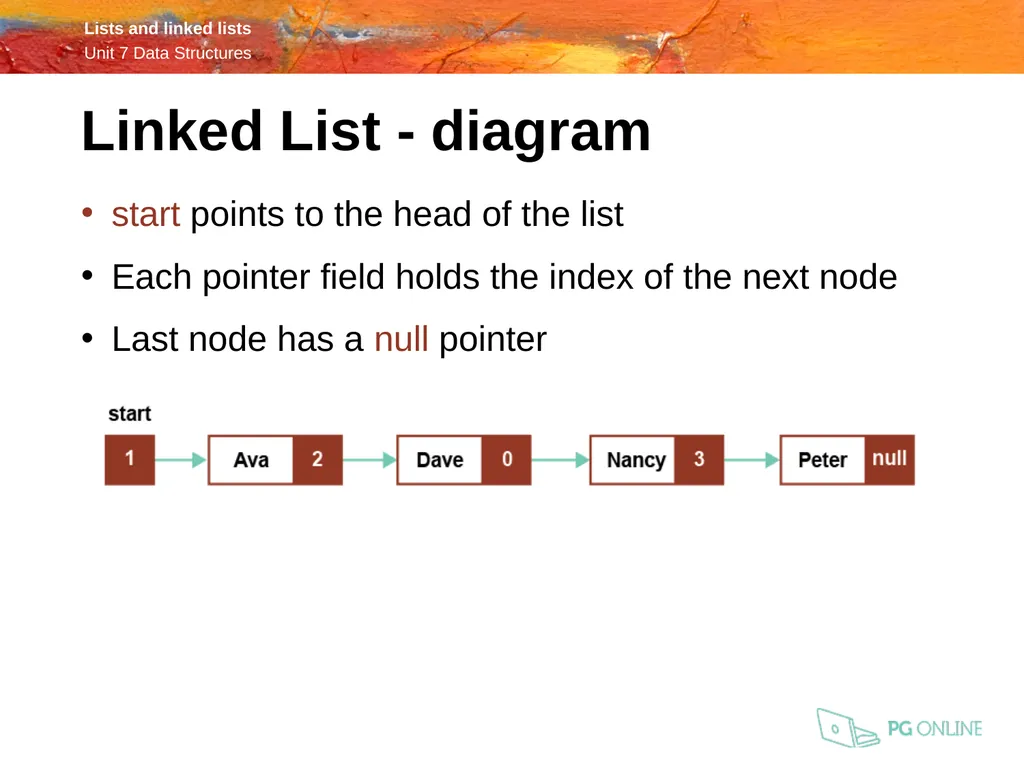
Linked List - diagram start points to the head of the list
Each pointer field holds the index of the next node
Last node has a null pointer<br>
28
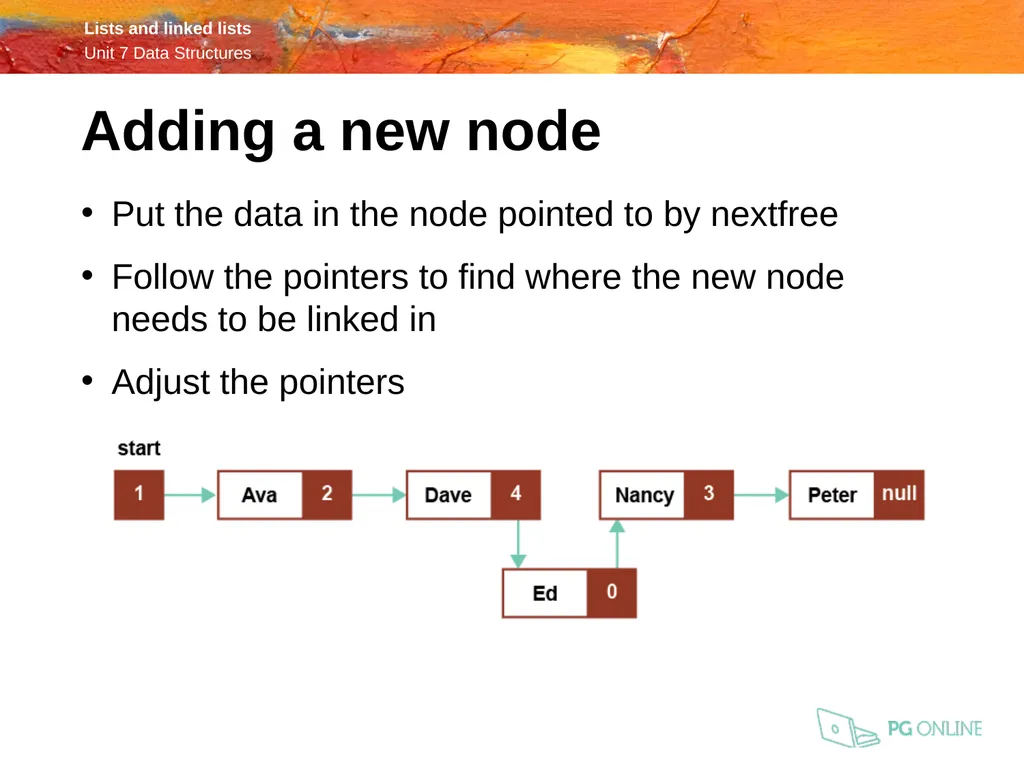
Adding a new node Put the data in the node pointed to by nextfree
Follow the pointers to find where the new node needs to be linked in
Adjust the pointers<br>
29
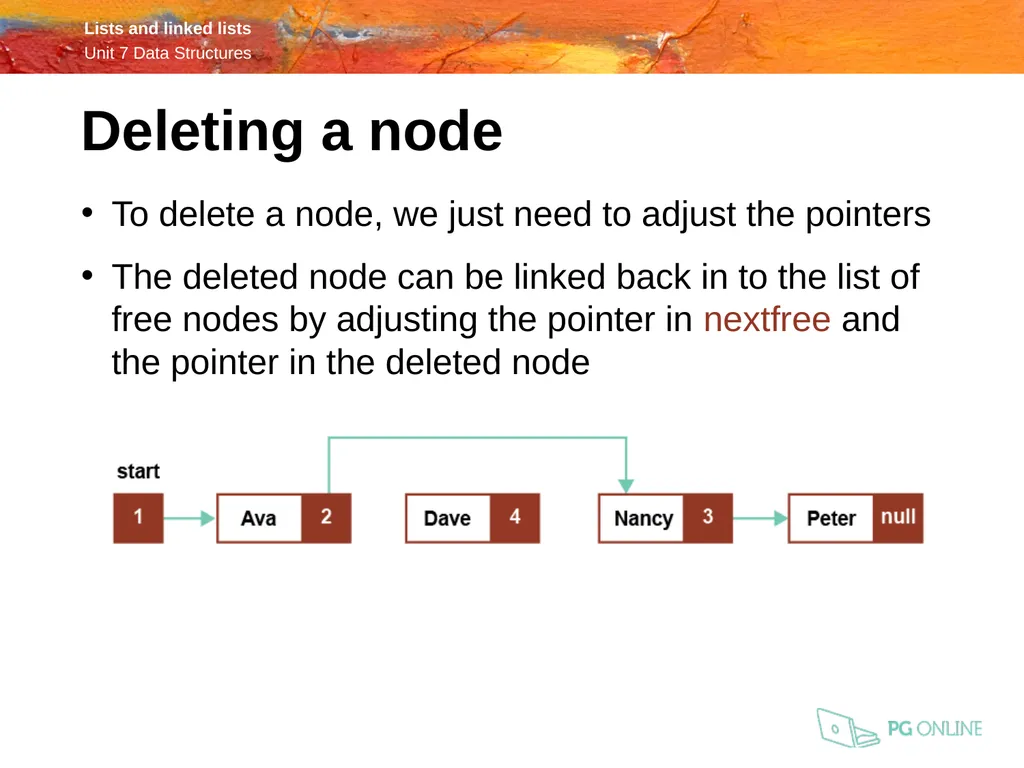
Deleting a node To delete a node, we just need to adjust the pointers
The deleted node can be linked back in to the list of free nodes by adjusting the pointer in nextfree and the pointer in the deleted node<br>
30
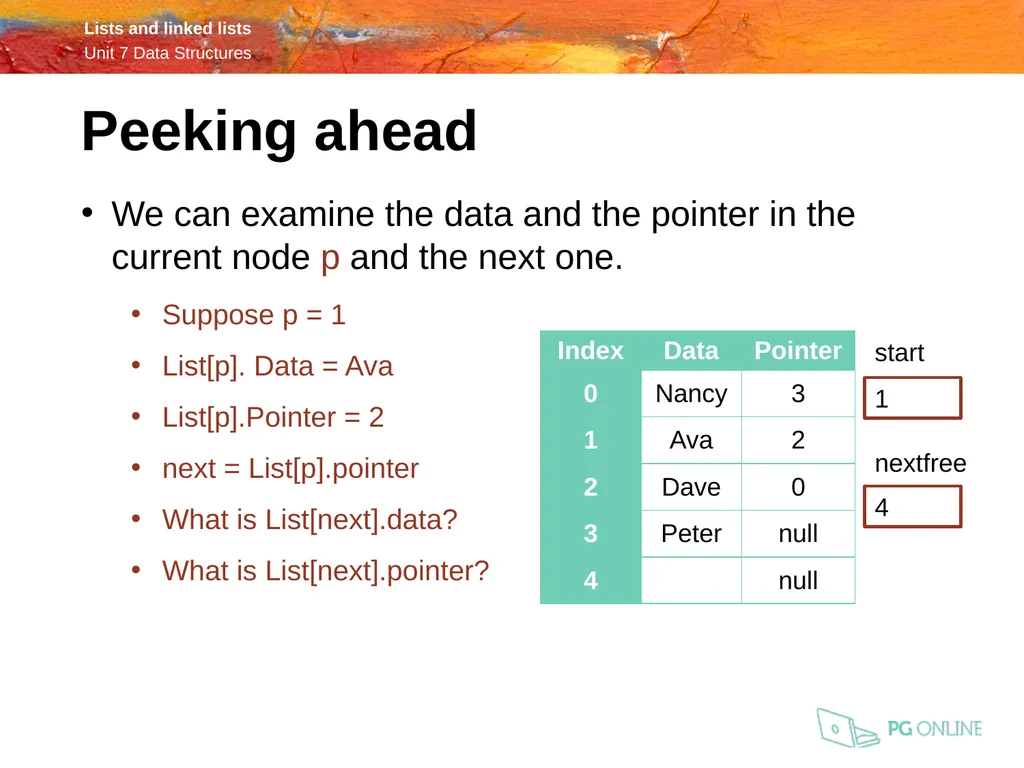
Peeking ahead We can examine the data and the pointer in the current node p and the next one.
Suppose p = 1
List[p]. Data = Ava
List[p].Pointer = 2
next = List[p].pointer
What is List[next].data?
What is List[next].pointer? 1 start 4 nextfree<br>
31
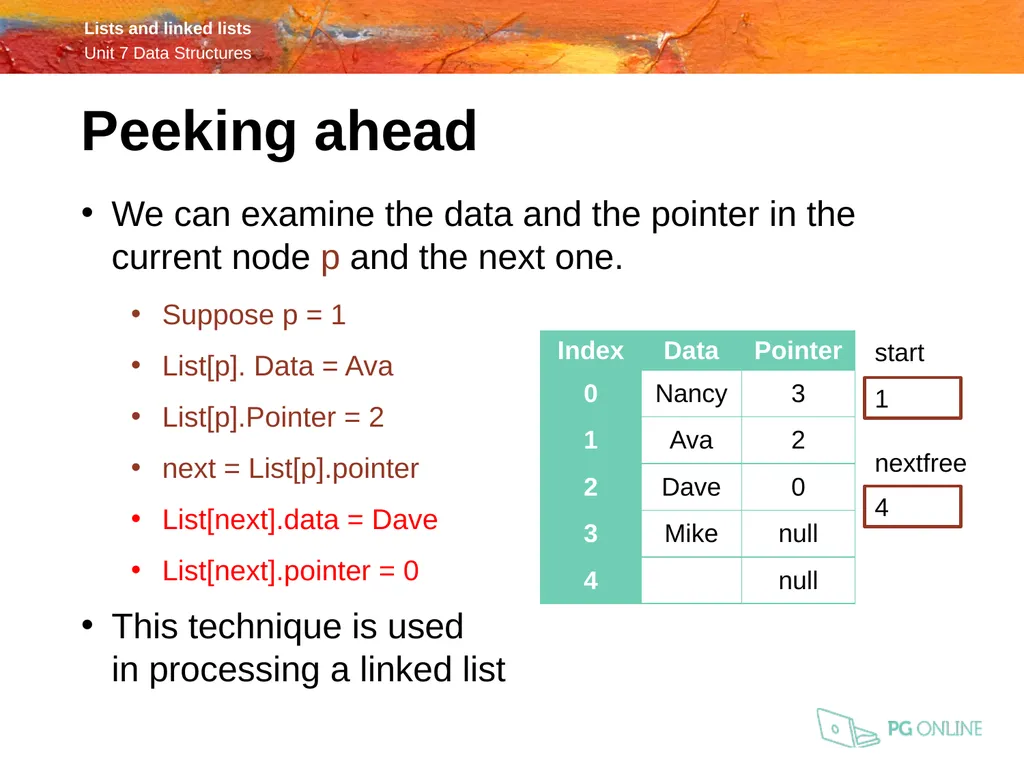
Peeking ahead We can examine the data and the pointer in the current node p and the next one.
Suppose p = 1
List[p]. Data = Ava
List[p].Pointer = 2
next = List[p].pointer
List[next].data = Dave
List[next].pointer = 0
This technique is used�in processing a linked list 1 start 4 nextfree<br>
32
Worksheet 3 - Operations Complete Task 3 on the worksheet to develop the algorithms for:
Inserting a node
Deleting a node<br>
33
Plenary A dynamic data structure such as list is useful for implementing other ADTs such as queues, stacks and trees
What is the difference between a static and dynamic data structure?
What operations can be performed on a dynamic list?
You should practise writing and tracing through algorithms for processing a linked list implemented as an array of records<br>