04
Journalism The simple answer is:
Journalism is any non-fiction or documentary narrative that reports or analyzes facts and events firmly rooted in time (either topical or historical) which are selected and arranged by reporters, writers, and editors to tell a story from a particular point of view.<br>
05
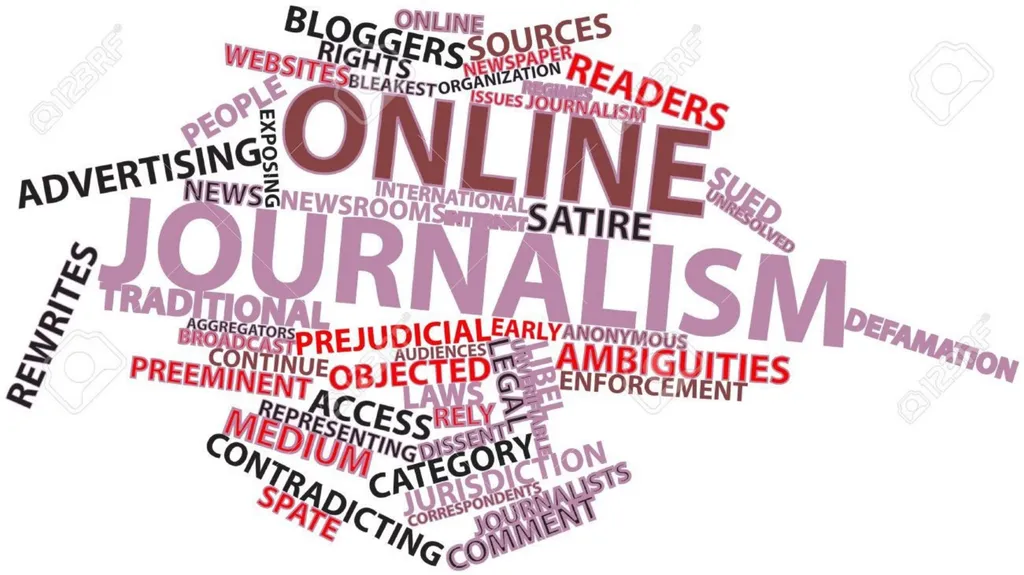
Definition Online journalism is defined the reporting of facts when produced and distributed via the Internet.
Digital journalism also known as online journalism. Online journalism is a contemporary form of journalism where editorial content is distributed via the Internet as opposed to publishing via print or broadcast.<br>
06
Introduction Online journalism is a process that has been in use for the past years by newspapers industries, journalist report facts produced and distributed through the INTERNET. It has been noticed that people no longer buy the printed out newspapers except they want to keep it for reference purposes but the internet users sees it has a readily available and less costly network.<br>
07
Multimedia journalism involves the use of text, images, sound, video clips, graphics to tell stories in an engaging way. Professionals who work in multimedia journalism leverage digital tools and social media platforms to share their stories with a particular audience online. The purpose of these stories is to inform, educate or entertain that specific audience.
Multimedia journalism also requires using research skills to find newsworthy stories and to learn more about niche markets. Once their stories have been live for some time, multimedia journalists use analysis skills and tools to measure their content’s success.<br>
08
Forms of Online Journalism Main Stream News sites
Index and Category Sites
Meta and Comment sites
Share and Discussion Sites<br>
09
Main Stream News sites:
The mainstream news site was the most extensive form of news media production online, in general it offers a selection of editorial content either be it moved from a linked medium or originally created for the Web, often considered as a moderated form of participatory communication. Examples were the much acclaimed sites of CNN, the BBC and MSNBC.
Index and Category Sites:
A second type of online journalism was least found within the mainstream media organizations, whereas it was frequently attributed to a number of search engines like Yahoo or Altavista. At this stage online journalists provide deep links to existing news sites elsewhere on the World Wide Web.<br>
10
Meta and Comment sites:
The third category of news sites was sites regarding news media and media issues in general; at times intended index as well as category site. A number of journalists often produce the editorial content and typically discuss other content found anywhere on the Internet.
Share and Discussion Sites:
Online journalism makes use of this potential of the Internet in that it mainly provides platforms for the exchange of ideas, stories and so on. This type of online journalism have also been described as “group weblogs”, which offers personal accounts of a more or less limitless individual regarding their experiences on the Internet.<br>
11
Characteristics of Online Journalism Hyper textuality
Multimodality
Interactivity
Storage and retrieval
Immediacy<br>
12
Hypertextuality:
Hypertext means text that links to other content. Texts interconnected through links hyperlinks can refer internally to other texts within the text’s domain or externally to texts located elsewhere on the Internet.
Multimodality:
Multimodality is an inter-disciplinary approach that recognizes communication and representation to be more than concerning languages. Multimodality includes the convergence of texts, audio, video and graphics.<br>
13
Interactivity:
The more interactive opportunities given by the websites to users, the more involved the users will feel about the website. It provides different sites to consumer to interact each other. It includes the actively public participation in discussion and construction of contents.
Storage and retrieval:
Contents are storable permanently and can be searched on demand easily.
Immediacy:
Online journalism can be published in real time, updating breaking news and events as they happen. Nothing new here -- we've had this ability with telegraph, teletype, radio, and TV. Just as we gather around the TV or radio, so we can gather and attend real-time events online in chat rooms and auditorium facilities.<br>
14
Advantages Cost-effective:
The cost of publishing online is affordable compared to the huge financial commitments involved in setting up a conventional newspaper house, including daily publication costs and staff salaries.
Convergence of roles:
The roles of a reporter and an editor are blurred as one person can perform such duties and others as computer typesetting.
Fast and convenient:
Publishing online is both fast and convenient. You post news updates at the click of a button without stress.<br>
15
Checks waste:
The loss of resources arising from unsold copies of newspapers is prevented.
Quick feedback:
The feedback mechanism in online journalism is better and faster, as against the Letter to the Editor section of a mainstream newspaper. Admins can almost immediately respond to comments and feel the pulse of their visitors.
Humanness:
The audience can feel the human ‘presence’ behind an online publication because of the interaction possible at both ends.<br>
16
Global Distribution:
Global reach is basic feature of online media.
Hypertext:
Text that links to other content.
Permanency
Timelessness
Unlimited space
Easy Publication<br>
17
Disadvantages Biased Opinion:
Just because the article is online, it doesn’t mean it is no longer biased. Most media is biased – views expressed are almost always one sided.
Access:
Websites could crash if lots of people try accessing them for a major news story; if the site crashes, nobody can access it for a short while.
Technical issues:
Some technical issues regarding the website could occur, resulting in the website having to go offline temporarily. This will ultimately mean that people will not be able to access the website, and so could turn to competitors of the offline news site.<br>
18
Lack of credibility:
Its not easy to distinguish between good and bad news sites. The internet world delivered manipulated and fake news, thus the integrity of the media is lost. The credibility of the digital media is questioned.
Lack of opportunities:
With more and more news outlets putting a greater focus on providing online news services, this could result in a cut in jobs, as to operate on the internet, fewer personnel are required.
Ethical questions:
Content of websites has no privacy and accuracy. They publish the news just for the sake of rating, so they focused on speed, copyright and advertising.<br>
19
Mushroom:
News sites, journalist and news/opinion
Information overloaded:
Information Overload leads to spend more time on internet to catch the necessary information. This reduces available time and causes stress and anxiety.
Individual
Manipulative<br>