OPEN ACCESS CHALLENGES FOR SMALL PUBLISHERS August 25, 2022 WEBINAR OPEN ACCESS CHALLENGES FOR SMALL PUBLISHERS 2 Romy Beard Our moderator Head of Publisher Relations ChronosHub CHRONOSHUB WEBINAR Toni Gunnison Journals Manager Wisconsin
"OPEN ACCESS CHALLENGES FOR SMALL PUBLISHERS August" is the property of its rightful owner. Permission is granted to
download and print the materials on this website for personal, non-commercial use only, and to display it
on your personal computer provided you do not modify the materials and that you retain all copyright
notices contained in the materials. By downloading content from our website, you accept the terms of this
agreement.
Presentation Transcript
01
OPEN ACCESS CHALLENGES
FOR SMALL PUBLISHERS August 25, 2022 WEBINAR<br>
02
OPEN ACCESS CHALLENGES
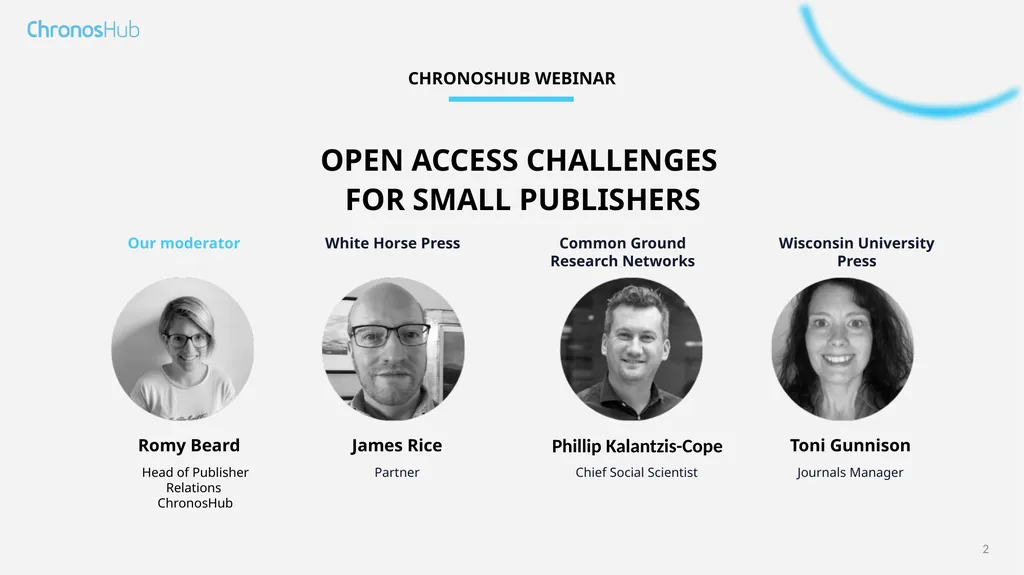
FOR SMALL PUBLISHERS 2 Romy Beard Our moderator Head of Publisher Relations
ChronosHub CHRONOSHUB WEBINAR Toni Gunnison Journals Manager Wisconsin University Press Phillip Kalantzis-Cope Chief Social Scientist Common Ground Research Networks James Rice Partner White Horse Press<br>
03
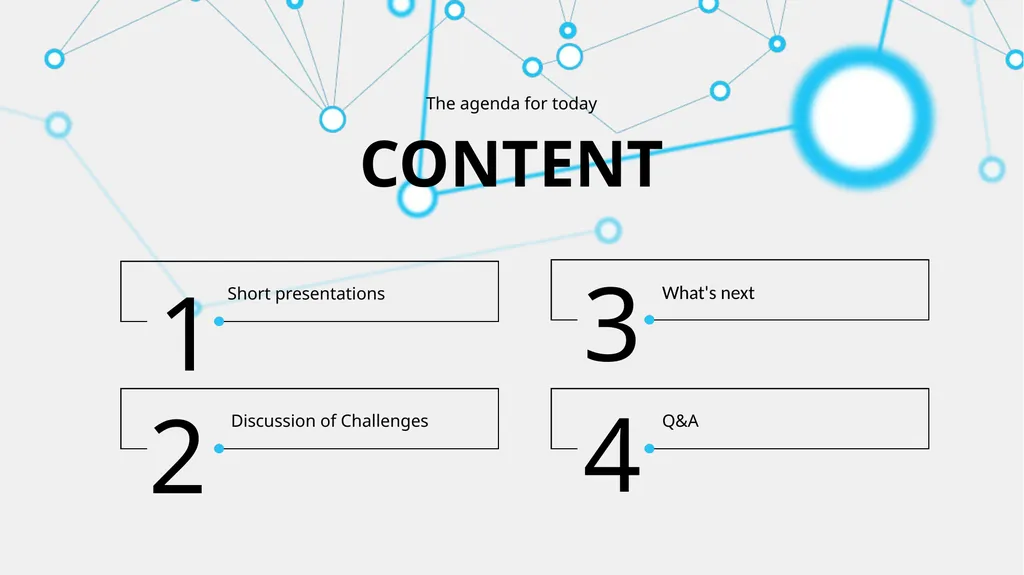
CONTENT The agenda for today Short presentations Discussion of Challenges Q&A What's next 1 2 3 4<br>
04
COMMON GROUND RESEARCH NETWORKS Journals
67 journals – 53 hybrid, 14 fully open access OA business models
Green OA for all titles; Gold OA for Spanish Language; Hybrid Open Access; Membership; (attempting) Read & Publish Agreements and Subscribe to Open Main Drivers for OA:
Forecasting the future: organizational sustainability, considering our authors and research communities Overview Our Data
2021: 843 articles published in total – 130 open access (15.4%)
2022: 410 articles published in total – 75 open access (18.2%) Other OA initiatives Your Organisation is Involved In:
Internally: “Open Presentations” – for our Research Network conferences on our CGScholar.com platform (developed by the Common Ground Media Lab)<br>
05
COMMON GROUND RESEARCH NETWORKS Small Publisher Challenges The Front Line
Our dedicated, professional (but small) editorial and production staff need to be OA translators in disciplinary (arts, design, humanities and social sciences) or international scholarly communities with differing understandings and mandates for OA
New Data Infrastructures
The collection and sharing of data to OA indexing databases and journal comparison platforms present significant labor and cost challenges -- and, at times, a Kafkaesque experience!
The Open Community
Support from the new institutions of OA; the competitive landscape in the "business" of OA -- who might be privileged? What's the place for small publishers?<br>
06
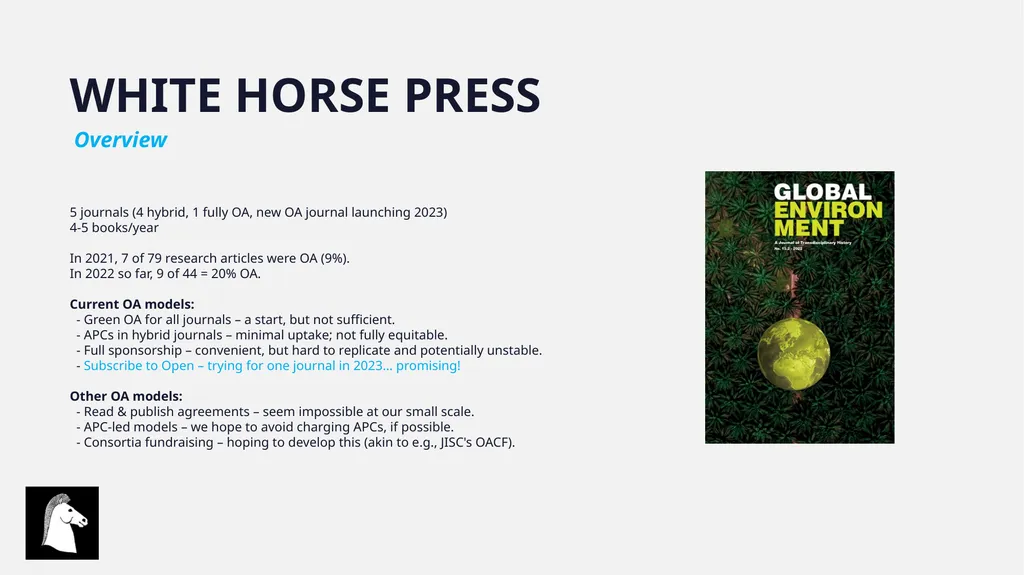
WHITE HORSE PRESS 5 journals (4 hybrid, 1 fully OA, new OA journal launching 2023)
4-5 books/year
In 2021, 7 of 79 research articles were OA (9%).
In 2022 so far, 9 of 44 = 20% OA.
Current OA models:
- Green OA for all journals – a start, but not sufficient.
- APCs in hybrid journals – minimal uptake; not fully equitable.
- Full sponsorship – convenient, but hard to replicate and potentially unstable.
- Subscribe to Open – trying for one journal in 2023... promising!
Other OA models:
- Read & publish agreements – seem impossible at our small scale.
- APC-led models – we hope to avoid charging APCs, if possible.
- Consortia fundraising – hoping to develop this (akin to e.g., JISC's OACF).
Overview<br>
07
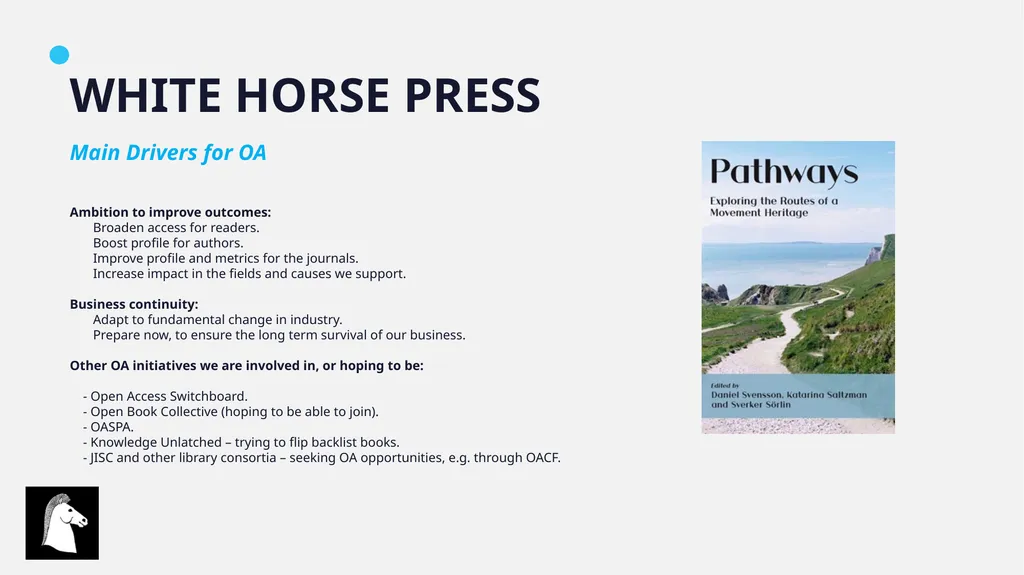
WHITE HORSE PRESS Ambition to improve outcomes:
Broaden access for readers.
Boost profile for authors.
Improve profile and metrics for the journals.
Increase impact in the fields and causes we support.
Business continuity:
Adapt to fundamental change in industry.
Prepare now, to ensure the long term survival of our business.
Other OA initiatives we are involved in, or hoping to be:
- Open Access Switchboard.
- Open Book Collective (hoping to be able to join).
- OASPA.
- Knowledge Unlatched – trying to flip backlist books.
- JISC and other library consortia – seeking OA opportunities, e.g. through OACF.
Main Drivers for OA<br>
08
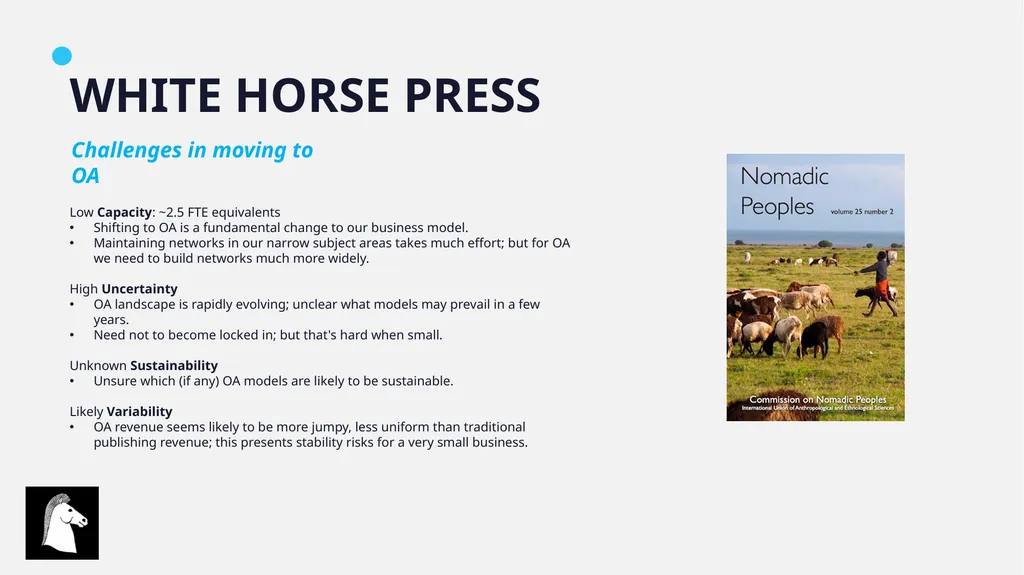
WHITE HORSE PRESS Low Capacity: ~2.5 FTE equivalents
Shifting to OA is a fundamental change to our business model.
Maintaining networks in our narrow subject areas takes much effort; but for OA we need to build networks much more widely.
High Uncertainty
OA landscape is rapidly evolving; unclear what models may prevail in a few years.
Need not to become locked in; but that's hard when small.
Unknown Sustainability
Unsure which (if any) OA models are likely to be sustainable.
Likely Variability
OA revenue seems likely to be more jumpy, less uniform than traditional publishing revenue; this presents stability risks for a very small business.
Challenges in moving to OA<br>
09
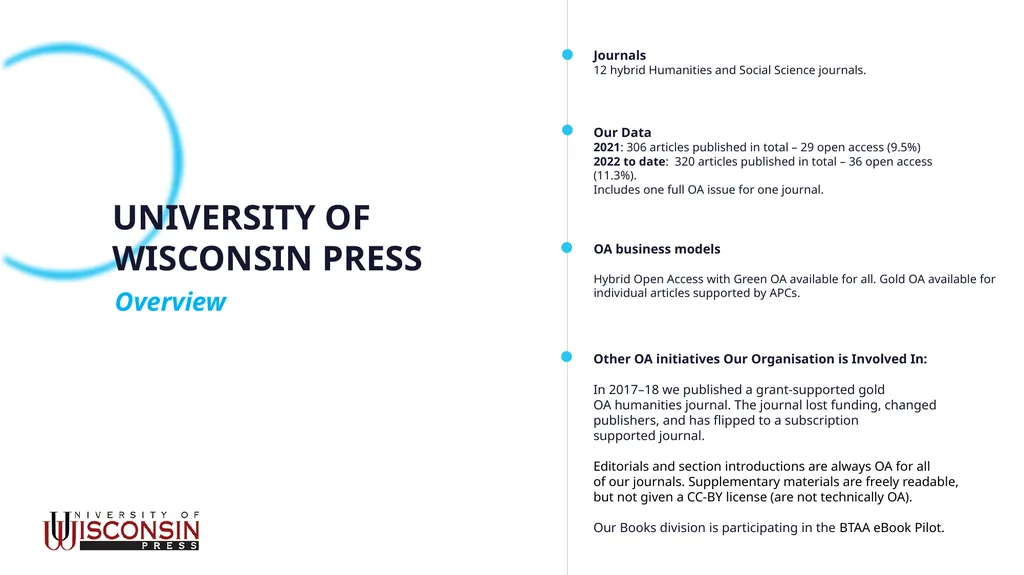
UNIVERSITY OF WISCONSIN PRESS Journals
12 hybrid Humanities and Social Science journals. OA business models
Hybrid Open Access with Green OA available for all. Gold OA available for individual articles supported by APCs. Overview Our Data
2021: 306 articles published in total – 29 open access (9.5%)
2022 to date: 320 articles published in total – 36 open access (11.3%).
Includes one full OA issue for one journal. Other OA initiatives Our Organisation is Involved In:
In 2017–18 we published a grant-supported gold OA humanities journal. The journal lost funding, changed publishers, and has flipped to a subscription supported journal.
Editorials and section introductions are always OA for all of our journals. Supplementary materials are freely readable, but not given a CC-BY license (are not technically OA).
Our Books division is participating in the BTAA eBook Pilot.<br>
10
UNIVERSITY OF WISCONSIN PRESS Challenges Little funding in HSS = no substantial funder demands for OA. The majority of our authors are located within the US, where there is less funding (and funder demands) for OA.
Lack of author interest for OA. In some cases, humanities authors do not wish to publish OA, because they would like to republish (in a monograph) at a later date. The article is the research, not the product of the research.
In some cases, subscription revenue financially supports a scholarly society.<br>
11
Discussion of Challenges Differences in author demands – due to funder requirements?
Staff capacity & relationships with libraries and agents
Technical demands & infrastructure
Organisation's OA mission
Org<br>
12
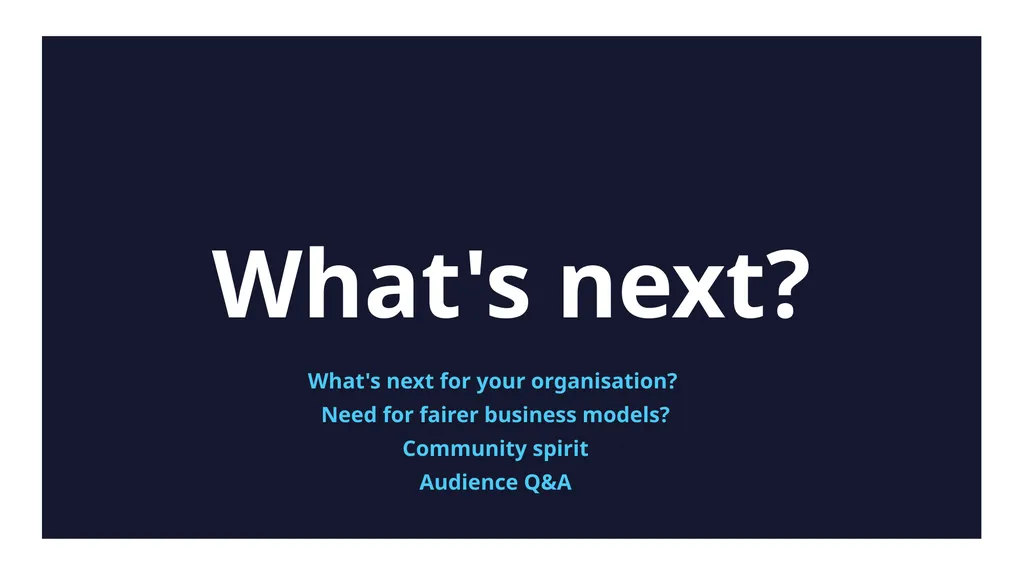
What's next? What's next for your organisation?
Need for fairer business models?
Community spirit
Audience Q&A<br>
13
Sign up for our newsletter to stay informed on the latest developments in research publishing, open access complexities, customer case stories, future webinars, events, and much more.
We only send out our newsletter once a month – less is much more.
Newsletter: https://chronoshub.io/newsletter/
Event list: https://chronoshub.io/events/ NEWSLETTER & EVENTS LIST 13<br>
14
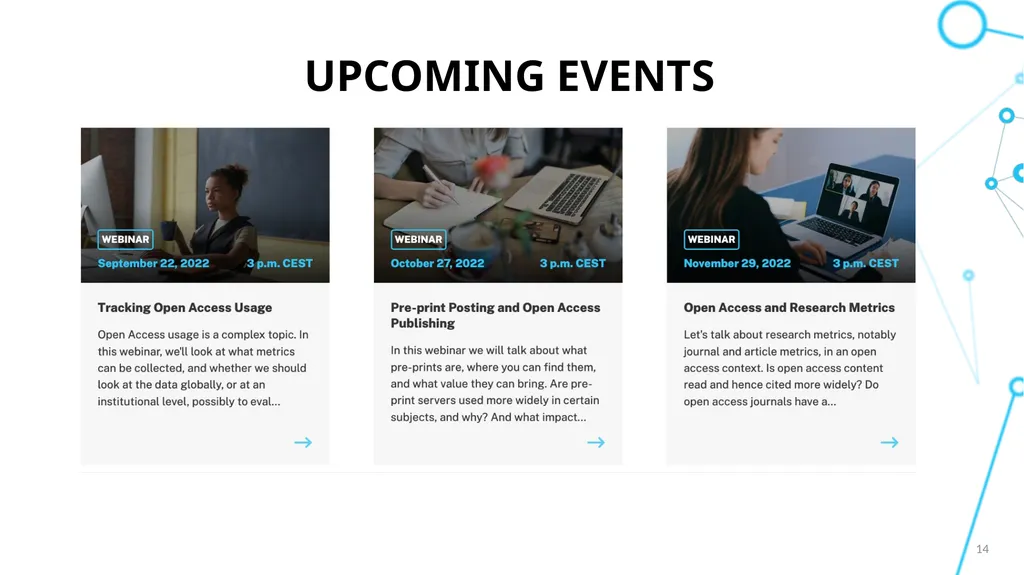
14 UPCOMING EVENTS<br>
15
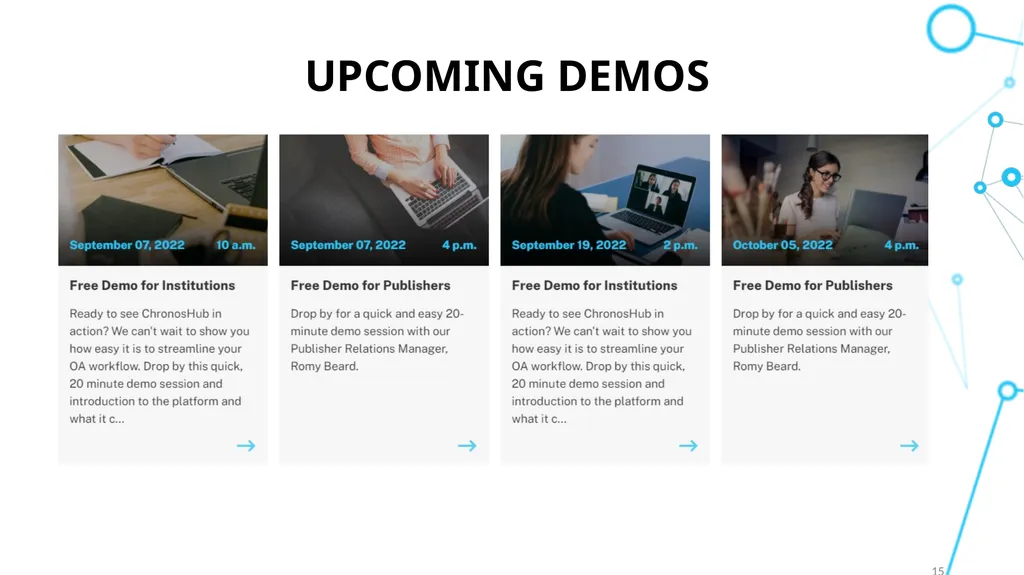
15 UPCOMING DEMOS<br>
16
@Chronoslimited @chronoshub @chronoshub Romy Beard
Head of Publisher Relations rb@chronoshub.io Martin Jagerhorn
Head of Business Development
mj@chronoshub.io PLEASE CONNECT WITH US QUESTIONS<br>