Open Session Foundation Optional Course POLITICAL SCIENCE International Relations Optional Classroom Programme 2025 Dr. Shruti Joshi 1) Factors for deciding optional in UPSC Mains What are the key factors one should consider while
"Open Session Foundation Optional Course POLITICAL" is the property of its rightful owner. Permission is granted to
download and print the materials on this website for personal, non-commercial use only, and to display it
on your personal computer provided you do not modify the materials and that you retain all copyright
notices contained in the materials. By downloading content from our website, you accept the terms of this
agreement.
Presentation Transcript
01
Open Session
Foundation Optional Course
POLITICAL SCIENCE & International Relations
Optional Classroom Programme 2025
Dr. Shruti Joshi<br>
02
1) Factors for deciding optional in UPSC Mains
What are the key factors one should consider while deciding an optional in Mains:
Interest
Relevance during preparation
At level of Prelims
At level of Mains
At level of Personality test
Familiarity
Space for innovation<br>
03
2)Why to opt Political Science and International Relations (PSIR) as a Mains optional?
(i)High Scoring Potential: How?
PSIR has a well-defined/ structured syllabus.
Relatively straightforward, easily understood and familiar concepts.
Syllabus is clear and not very elaborate (against the common perception that syllabus of PSIR is very wide
(ii)Being a non technical subject, easily comprehendible even by non humanities students.<br>
04
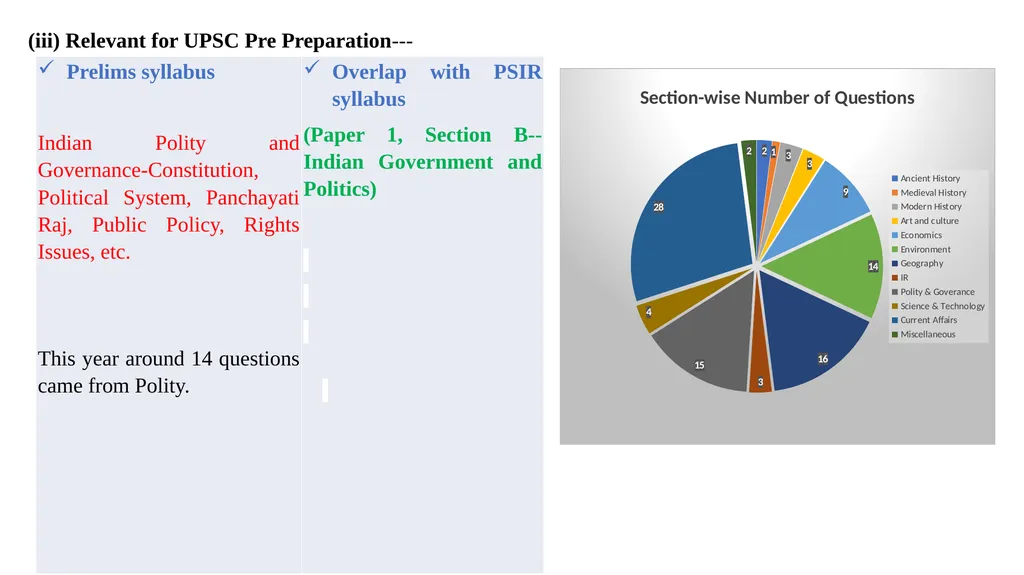
(iii) Relevant for UPSC Pre Preparation---<br>
05
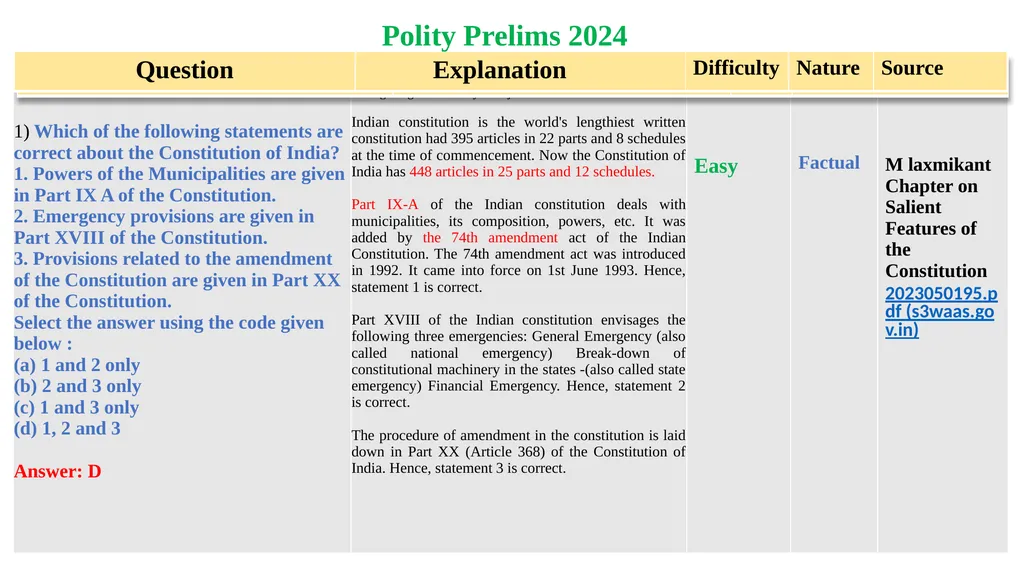
Polity Prelims 2024
1) International Relations (IR) is all about understanding how countries cooperate, compete, and manage their relationships on the global stage.<br>
06
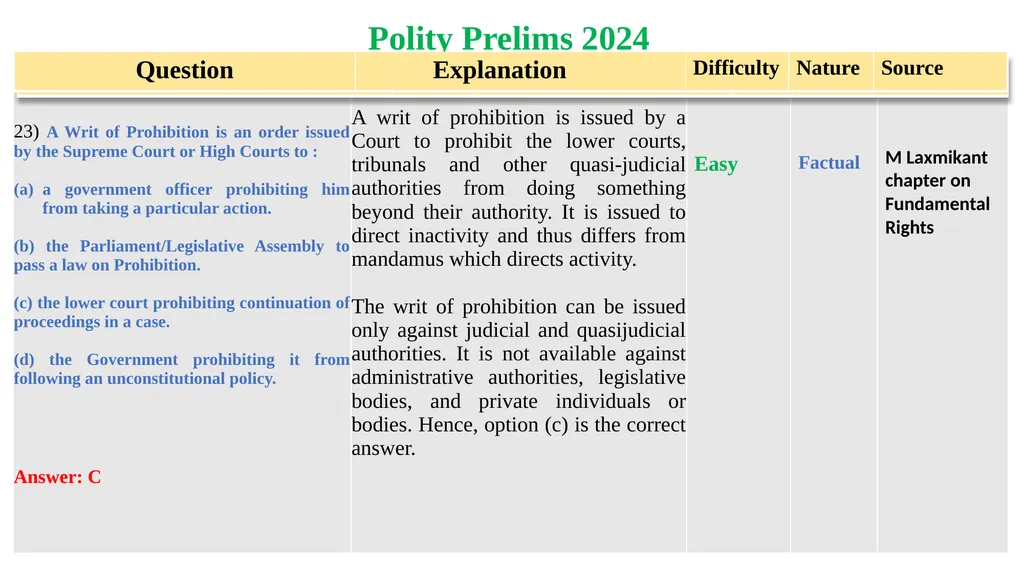
Polity Prelims 2024
1) International Relations (IR) is all about understanding<br>
07
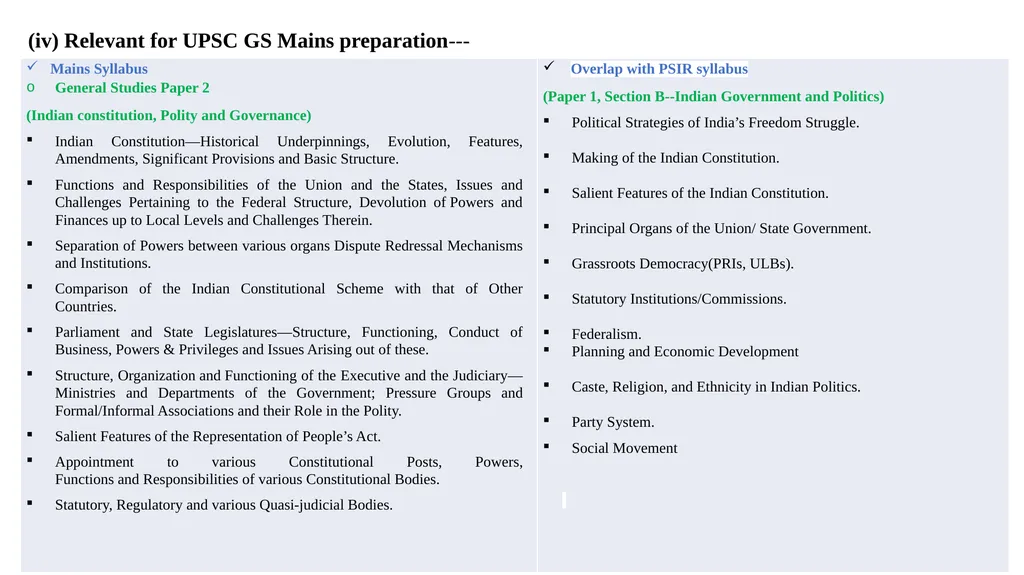
(iv) Relevant for UPSC GS Mains preparation---<br>
08
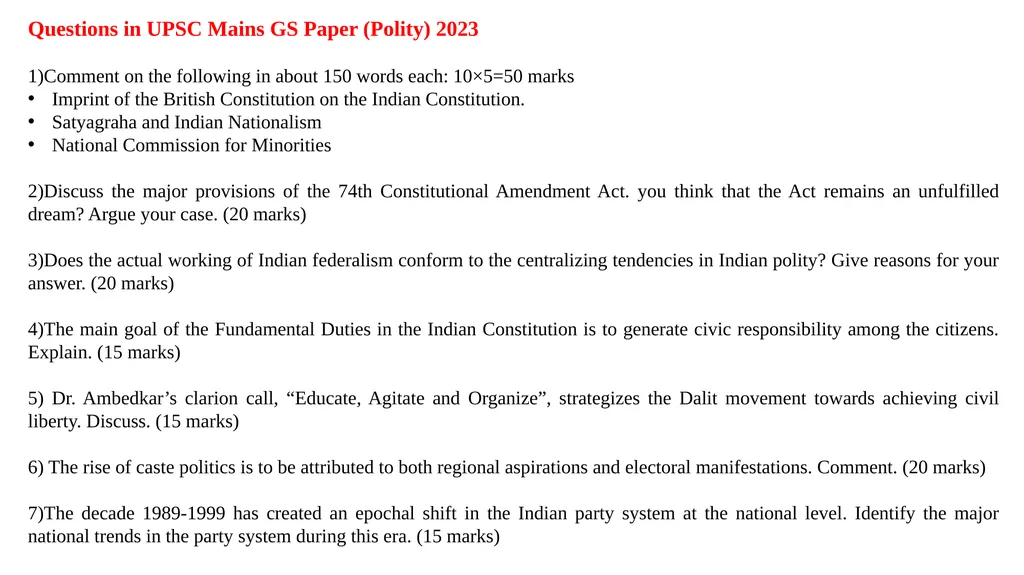
Questions in UPSC Mains GS Paper (Polity) 2023
1)Comment on the following in about 150 words each: 10×5=50 marks
Imprint of the British Constitution on the Indian Constitution.
Satyagraha and Indian Nationalism
National Commission for Minorities
2)Discuss the major provisions of the 74th Constitutional Amendment Act. you think that the Act remains an unfulfilled dream? Argue your case. (20 marks)
3)Does the actual working of Indian federalism conform to the centralizing tendencies in Indian polity? Give reasons for your answer. (20 marks)
4)The main goal of the Fundamental Duties in the Indian Constitution is to generate civic responsibility among the citizens. Explain. (15 marks)
5) Dr. Ambedkar’s clarion call, “Educate, Agitate and Organize”, strategizes the Dalit movement towards achieving civil liberty. Discuss. (15 marks)
6) The rise of caste politics is to be attributed to both regional aspirations and electoral manifestations. Comment. (20 marks)
7)The decade 1989-1999 has created an epochal shift in the Indian party system at the national level. Identify the major national trends in the party system during this era. (15 marks)<br>
09
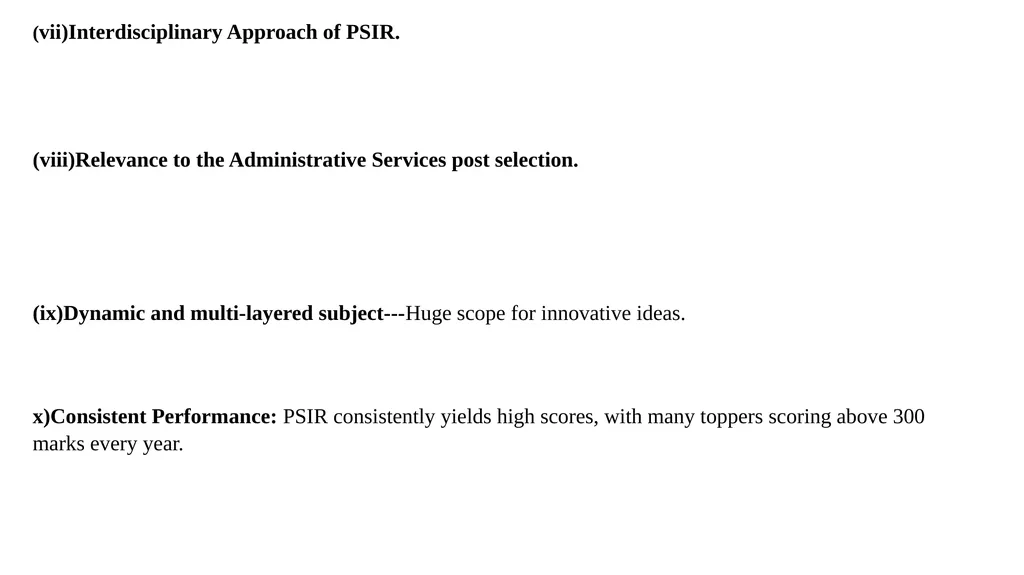
(vii)Interdisciplinary Approach of PSIR.
(viii)Relevance to the Administrative Services post selection.
(ix)Dynamic and multi-layered subject---Huge scope for innovative ideas.
x)Consistent Performance: PSIR consistently yields high scores, with many toppers scoring above 300 marks every year.<br>
10
3) Who can opt PSIR as MAINS optional?<br>
11
4)Decoding Political Science and International Relations/Understanding the scope of the subject<br>
12
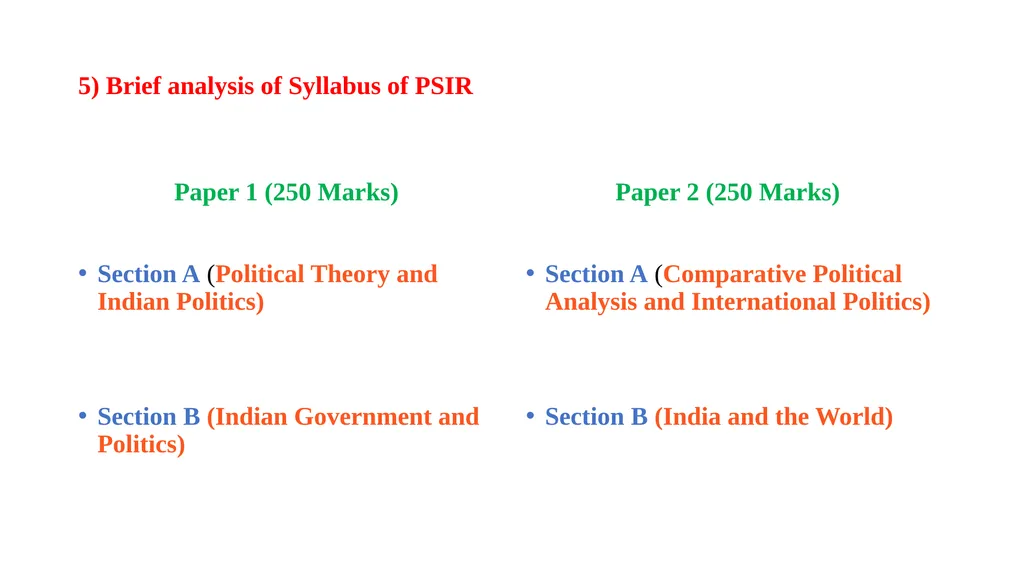
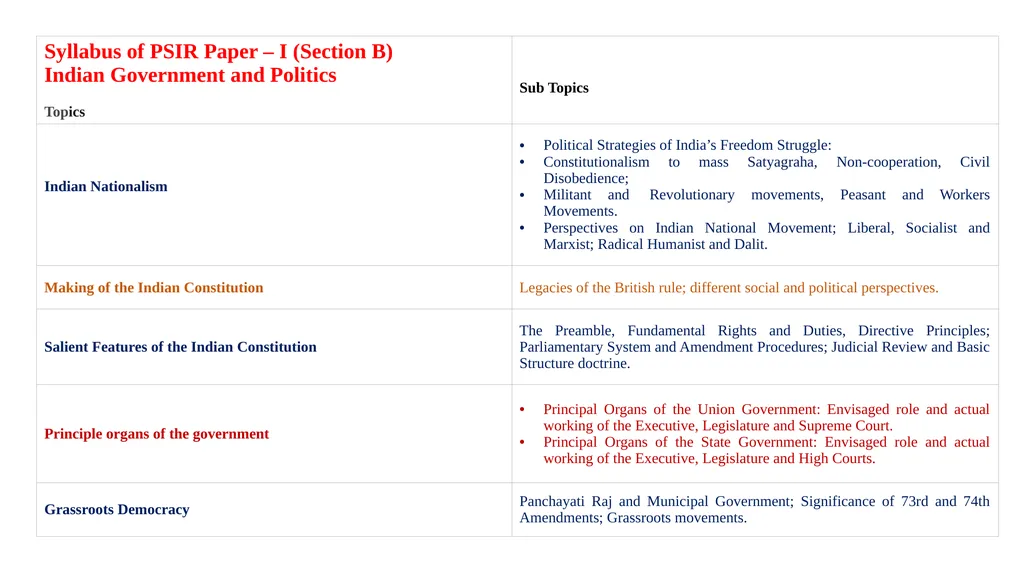
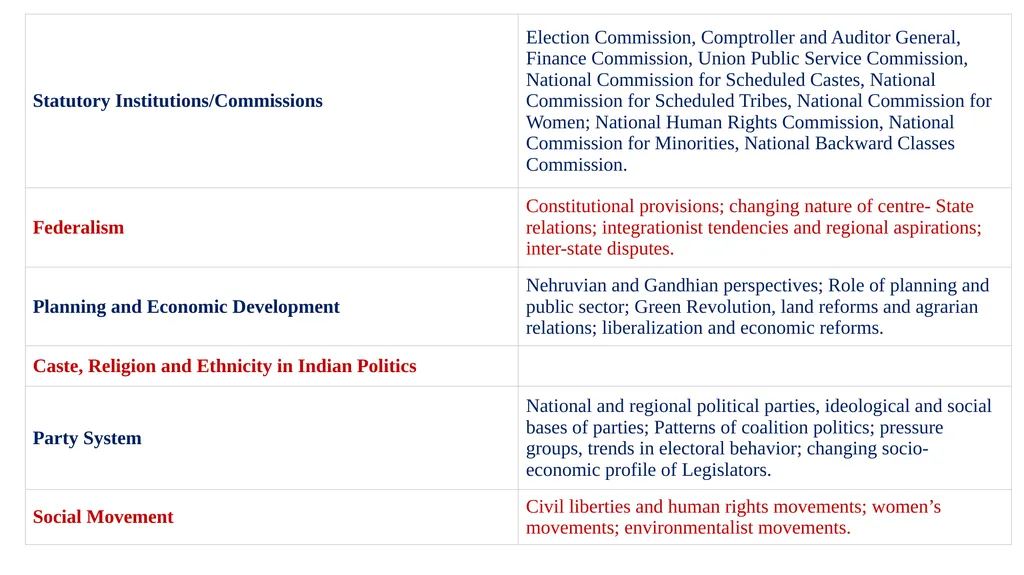
5) Brief analysis of Syllabus of PSIR Paper 1 (250 Marks) Section A (Political Theory and Indian Politics)
Section B (Indian Government and Politics) Paper 2 (250 Marks) Section A (Comparative Political Analysis and International Politics)
Section B (India and the World)<br>
13
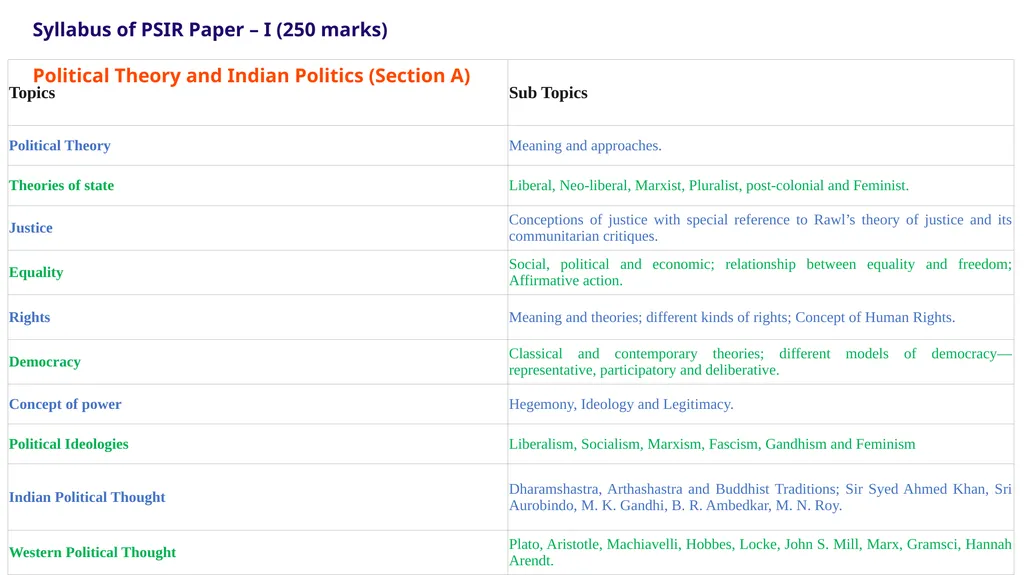
Syllabus of PSIR Paper – I (250 marks)
Political Theory and Indian Politics (Section A)<br>
14
6)How should students approach effective preparation of PSIR/ What should be the strategy?<br>
15
7) How to identify recurring/ important themes in PSIR<br>
16
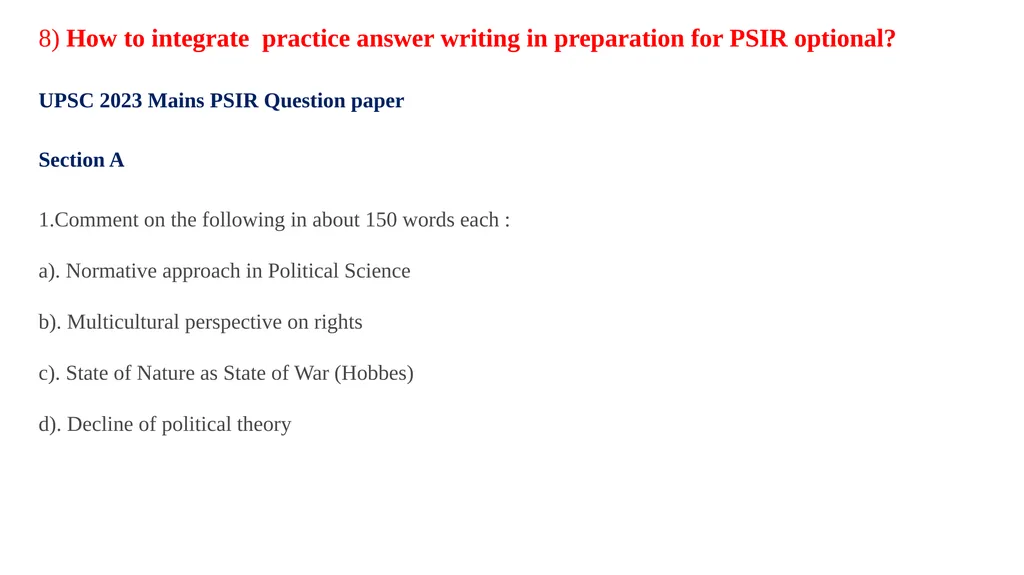
8) How to integrate practice answer writing in preparation for PSIR optional?
UPSC 2023 Mains PSIR Question paper
Section A
Comment on the following in about 150 words each : a). Normative approach in Political Science b). Multicultural perspective on rights c). State of Nature as State of War (Hobbes) d). Decline of political theory<br>
17
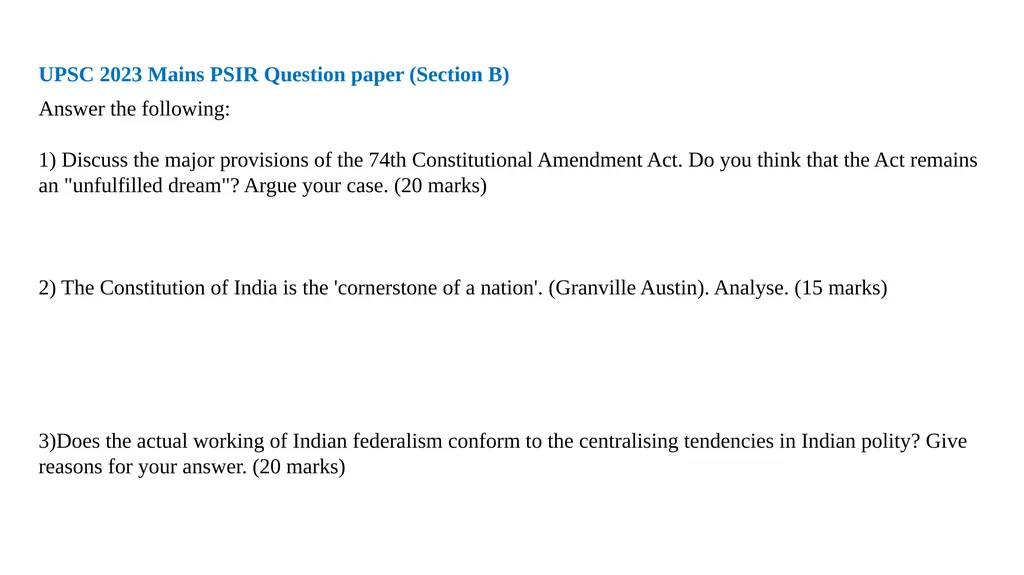
UPSC 2023 Mains PSIR Question paper (Section B)
Answer the following:
1) Discuss the major provisions of the 74th Constitutional Amendment Act. Do you think that the Act remains an "unfulfilled dream"? Argue your case. (20 marks)
2) The Constitution of India is the 'cornerstone of a nation'. (Granville Austin). Analyse. (15 marks)
3)Does the actual working of Indian federalism conform to the centralising tendencies in Indian polity? Give reasons for your answer. (20 marks)<br>
18
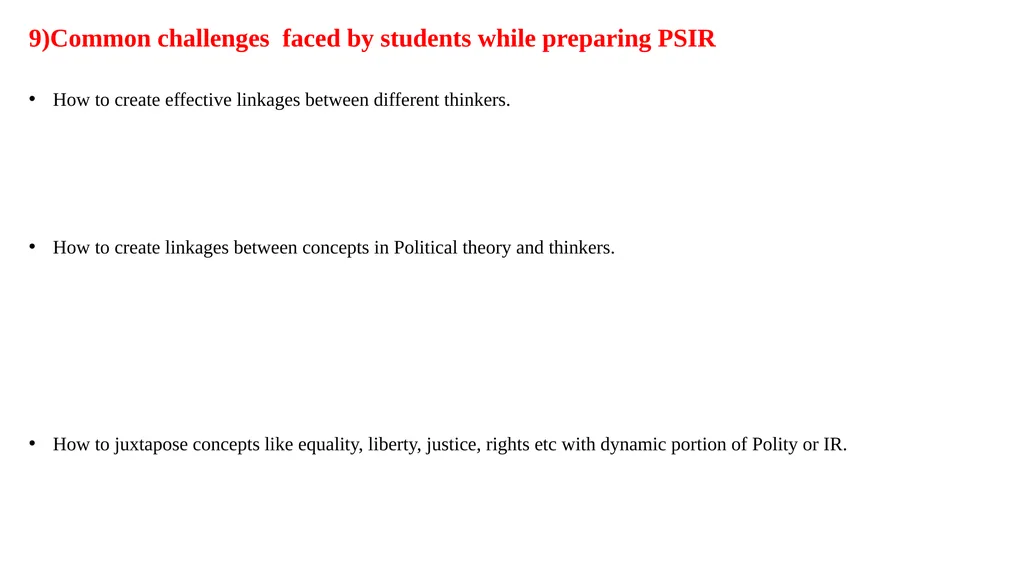
9)Common challenges faced by students while preparing PSIR
How to create effective linkages between different thinkers.
How to create linkages between concepts in Political theory and thinkers.
How to juxtapose concepts like equality, liberty, justice, rights etc with dynamic portion of Polity or IR.<br>
19
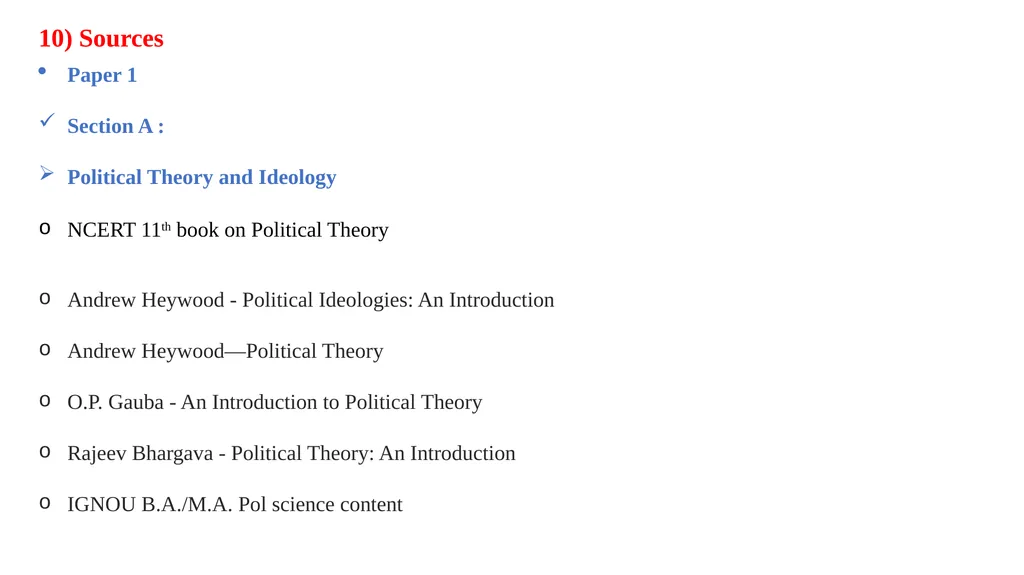
10) Sources
Paper 1
Section A :
Political Theory and Ideology
NCERT 11th book on Political Theory
Andrew Heywood - Political Ideologies: An Introduction
Andrew Heywood—Political Theory
O.P. Gauba - An Introduction to Political Theory
Rajeev Bhargava - Political Theory: An Introduction
IGNOU B.A./M.A. Pol science content<br>
20
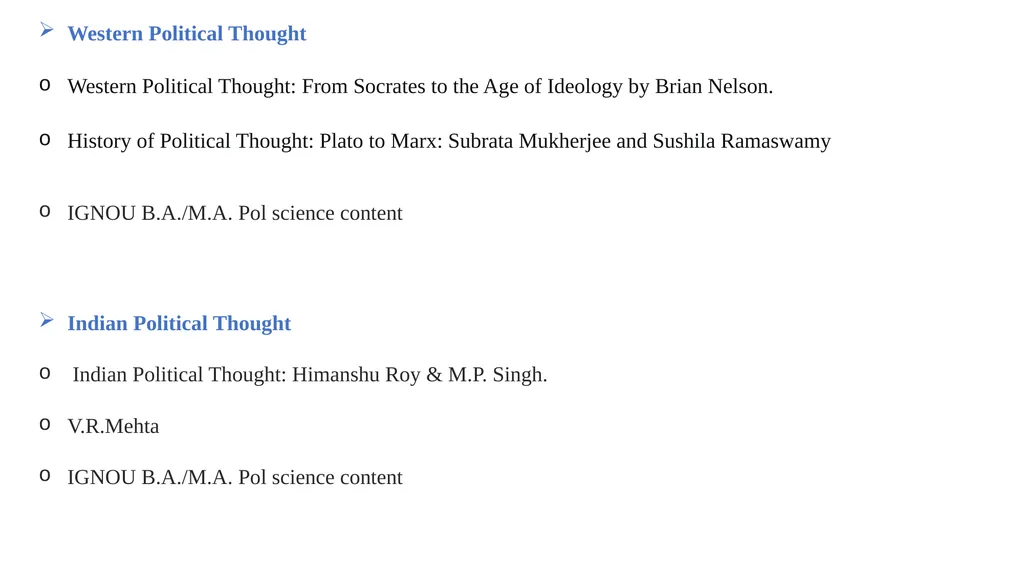
Western Political Thought
Western Political Thought: From Socrates to the Age of Ideology by Brian Nelson.
History of Political Thought: Plato to Marx: Subrata Mukherjee and Sushila Ramaswamy
IGNOU B.A./M.A. Pol science content
Indian Political Thought
Indian Political Thought: Himanshu Roy & M.P. Singh.
V.R.Mehta
IGNOU B.A./M.A. Pol science content<br>
21
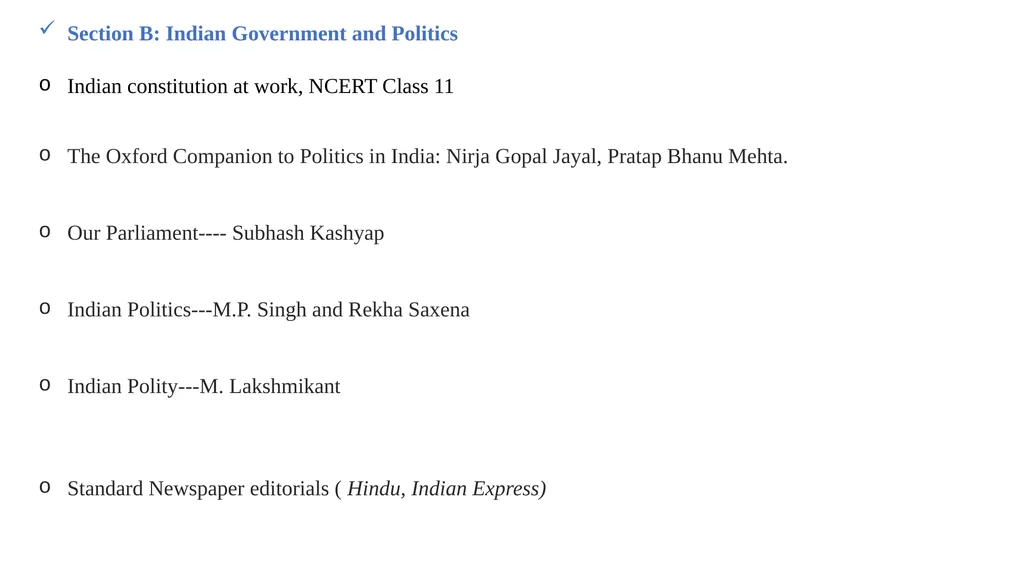
Section B: Indian Government and Politics
Indian constitution at work, NCERT Class 11
The Oxford Companion to Politics in India: Nirja Gopal Jayal, Pratap Bhanu Mehta.
Our Parliament---- Subhash Kashyap
Indian Politics---M.P. Singh and Rekha Saxena
Indian Polity---M. Lakshmikant
Standard Newspaper editorials ( Hindu, Indian Express)<br>
22
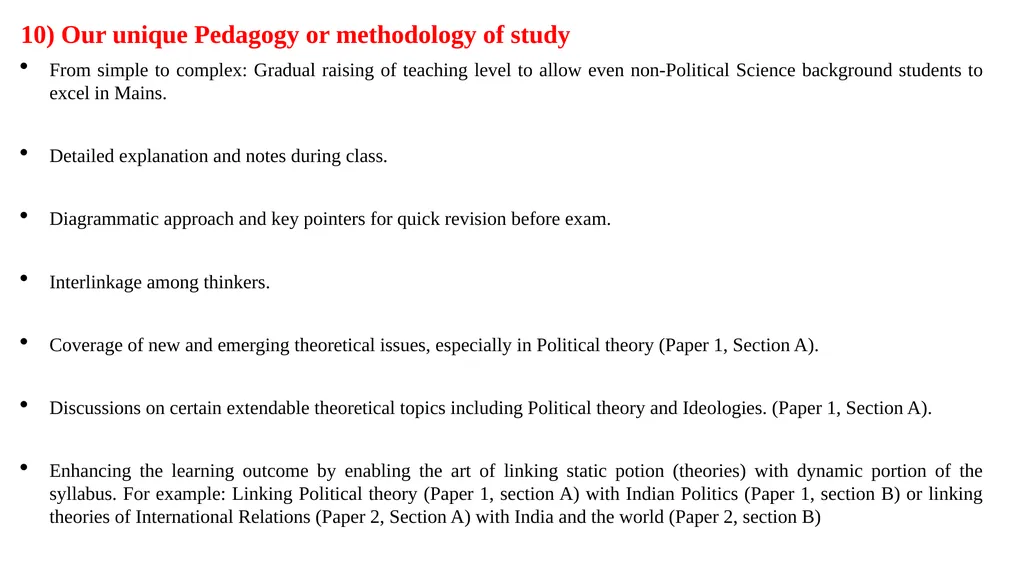
10) Our unique Pedagogy or methodology of study
From simple to complex: Gradual raising of teaching level to allow even non-Political Science background students to excel in Mains.
Detailed explanation and notes during class.
Diagrammatic approach and key pointers for quick revision before exam.
Interlinkage among thinkers.
Coverage of new and emerging theoretical issues, especially in Political theory (Paper 1, Section A).
Discussions on certain extendable theoretical topics including Political theory and Ideologies. (Paper 1, Section A).
Enhancing the learning outcome by enabling the art of linking static potion (theories) with dynamic portion of the syllabus. For example: Linking Political theory (Paper 1, section A) with Indian Politics (Paper 1, section B) or linking theories of International Relations (Paper 2, Section A) with India and the world (Paper 2, section B)<br>
23
11) Key Highlights of our PSIR Course
Comprehensive coverage of UPSC syllabus of PSIR.
In-depth classroom lectures of 3 hours.
Course duration: Approx. 6 months.
Personalised attention and mentoring.
Effective doubt resolution.<br>
24
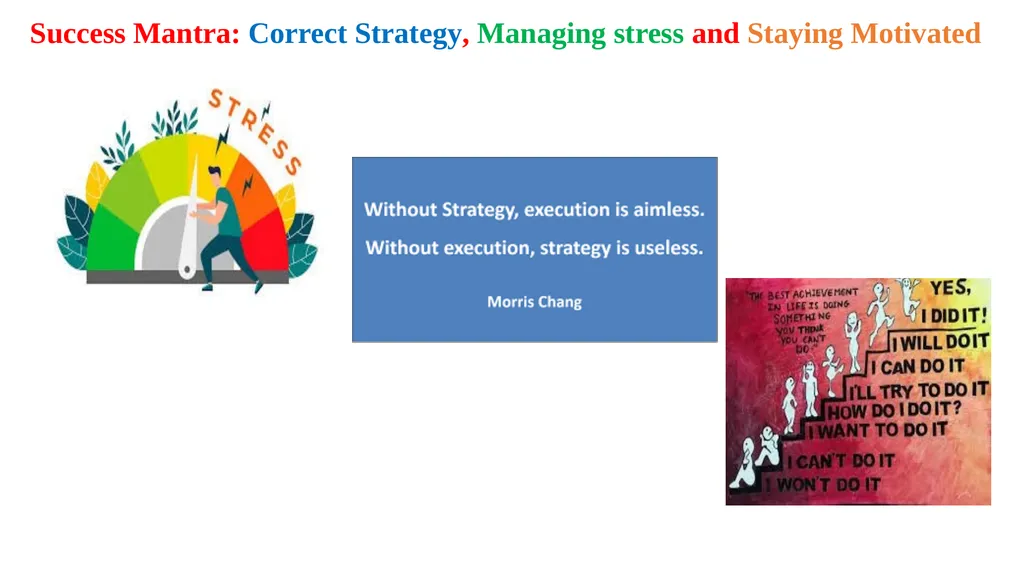
Success Mantra: Correct Strategy, Managing stress and Staying Motivated<br>