
Organizational Behavior Eighteenth Edition Chapter
DP
Published · 36 slides · 0 views
1 / 1
Description
Organizational Behavior Eighteenth Edition Chapter 16 Organizational Culture Copyright 2019, 2017, 2015, 2013 Pearson Education, Inc. All Rights Reserved. Learning Objectives 16.1 Describe the common characteristics of organizational
Related Topics
Share
Embed code
Download this presentation From Below
"Organizational Behavior Eighteenth Edition Chapter" is the property of its rightful owner. Permission is granted to download and print the materials on this website for personal, non-commercial use only, and to display it on your personal computer provided you do not modify the materials and that you retain all copyright notices contained in the materials. By downloading content from our website, you accept the terms of this agreement.
Presentation Transcript
01
Organizational Behavior Eighteenth Edition Chapter 16 Organizational Culture Copyright © 2019, 2017, 2015, 2013 Pearson Education, Inc. All Rights Reserved.<br>
02
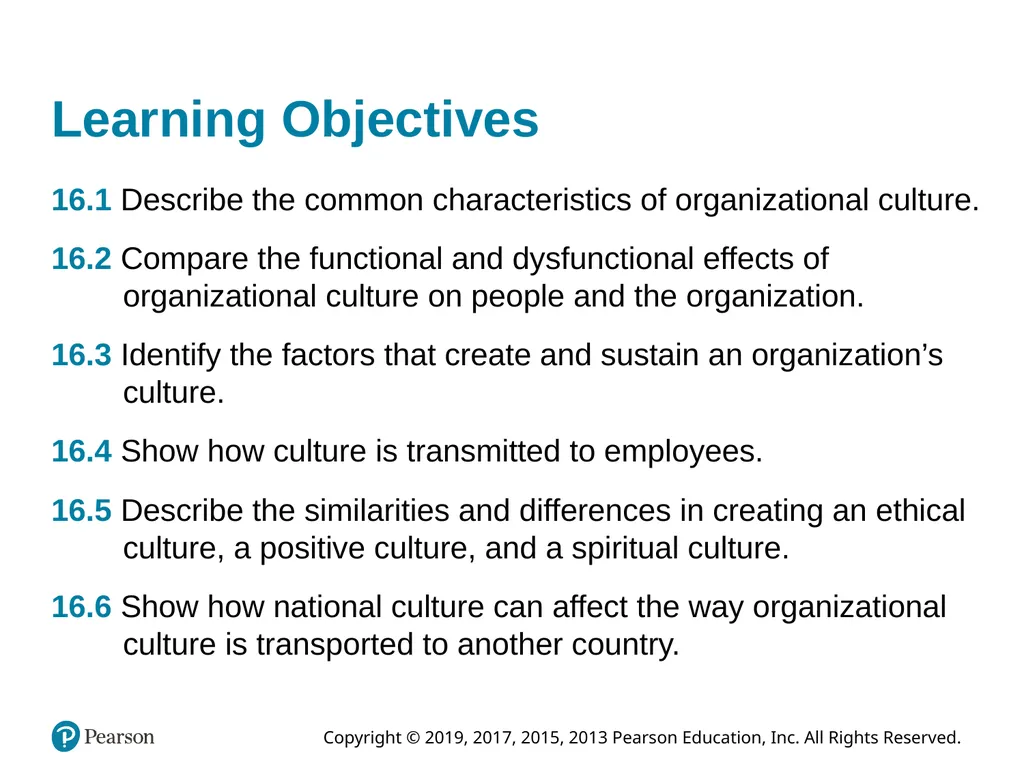
Learning Objectives 16.1 Describe the common characteristics of organizational culture.
16.2 Compare the functional and dysfunctional effects of organizational culture on people and the organization.
16.3 Identify the factors that create and sustain an organization’s culture.
16.4 Show how culture is transmitted to employees.
16.5 Describe the similarities and differences in creating an ethical culture, a positive culture, and a spiritual culture.
16.6 Show how national culture can affect the way organizational culture is transported to another country.<br>
16.2 Compare the functional and dysfunctional effects of organizational culture on people and the organization.
16.3 Identify the factors that create and sustain an organization’s culture.
16.4 Show how culture is transmitted to employees.
16.5 Describe the similarities and differences in creating an ethical culture, a positive culture, and a spiritual culture.
16.6 Show how national culture can affect the way organizational culture is transported to another country.<br>
03
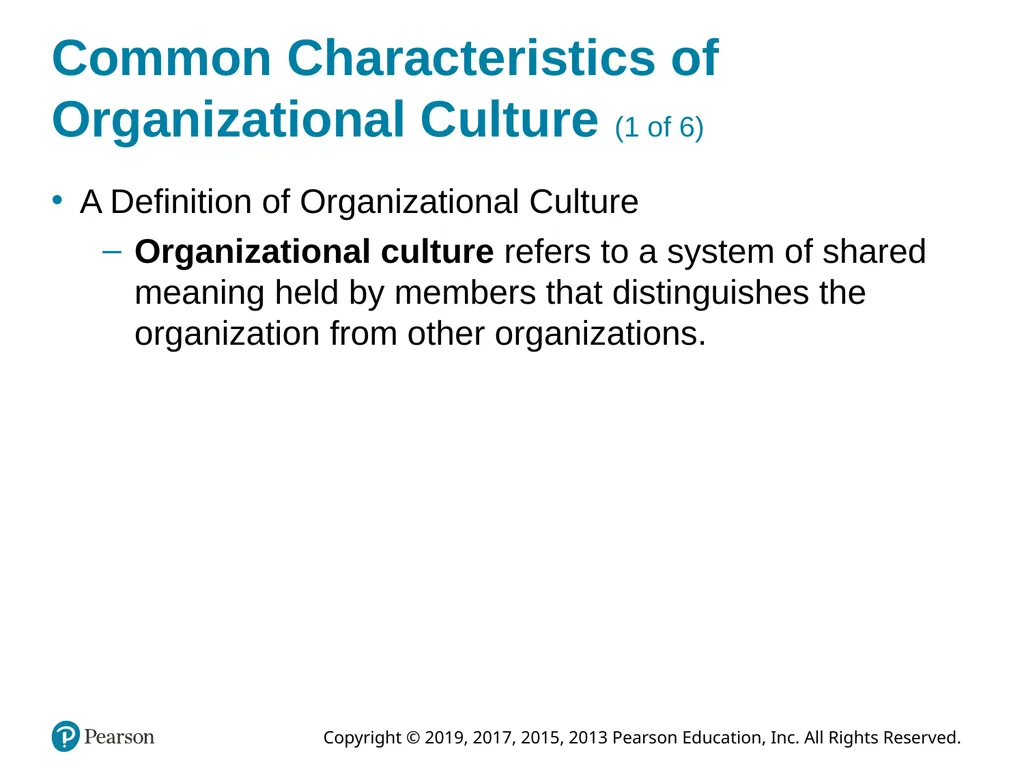
Common Characteristics of Organizational Culture (1 of 6) A Definition of Organizational Culture
Organizational culture refers to a system of shared meaning held by members that distinguishes the organization from other organizations.<br>
Organizational culture refers to a system of shared meaning held by members that distinguishes the organization from other organizations.<br>
04
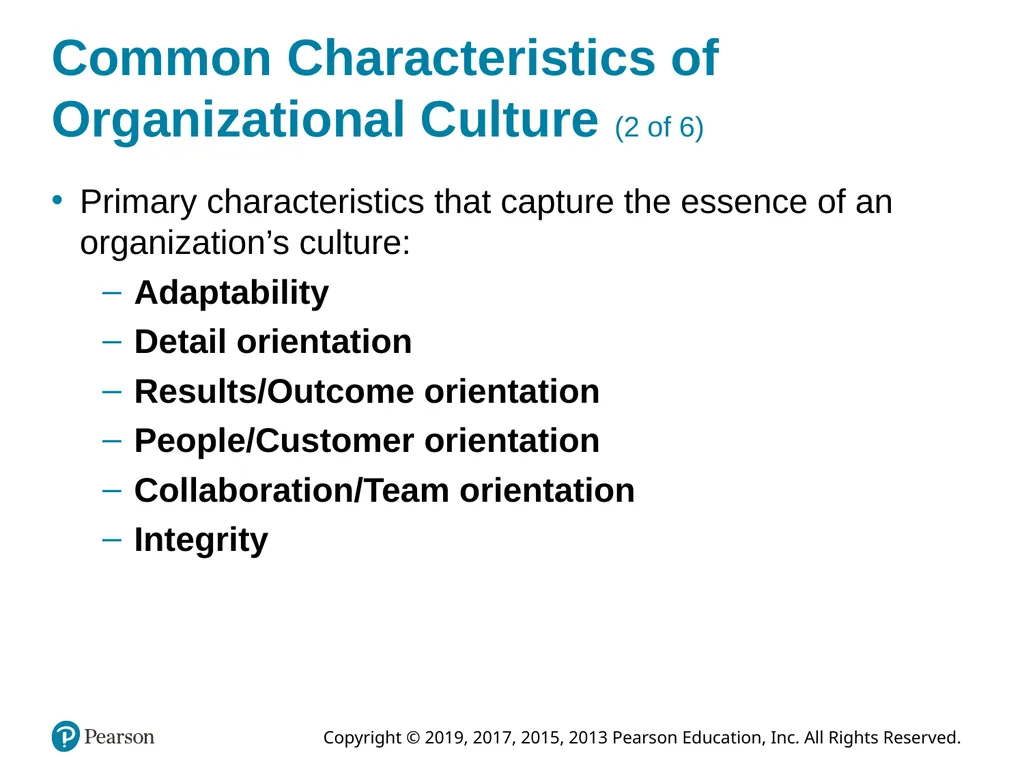
Common Characteristics of Organizational Culture (2 of 6) Primary characteristics that capture the essence of an organization’s culture:
Adaptability
Detail orientation
Results/Outcome orientation
People/Customer orientation
Collaboration/Team orientation
Integrity<br>
Adaptability
Detail orientation
Results/Outcome orientation
People/Customer orientation
Collaboration/Team orientation
Integrity<br>
05
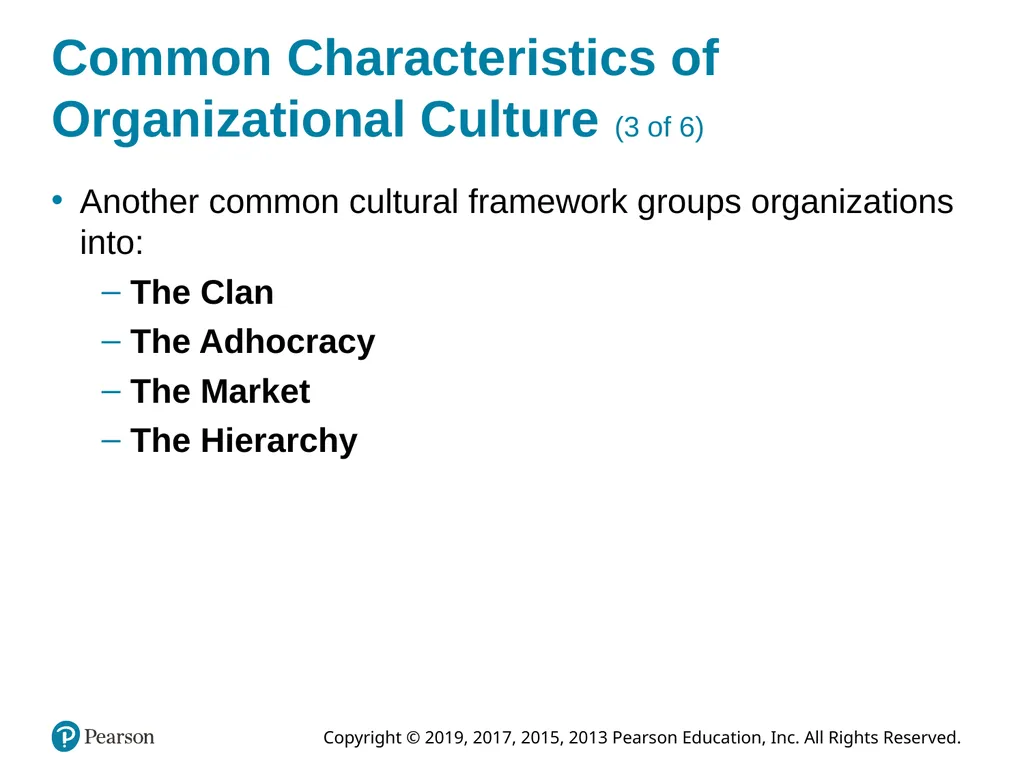
Common Characteristics of Organizational Culture (3 of 6) Another common cultural framework groups organizations into:
The Clan
The Adhocracy
The Market
The Hierarchy<br>
The Clan
The Adhocracy
The Market
The Hierarchy<br>
06
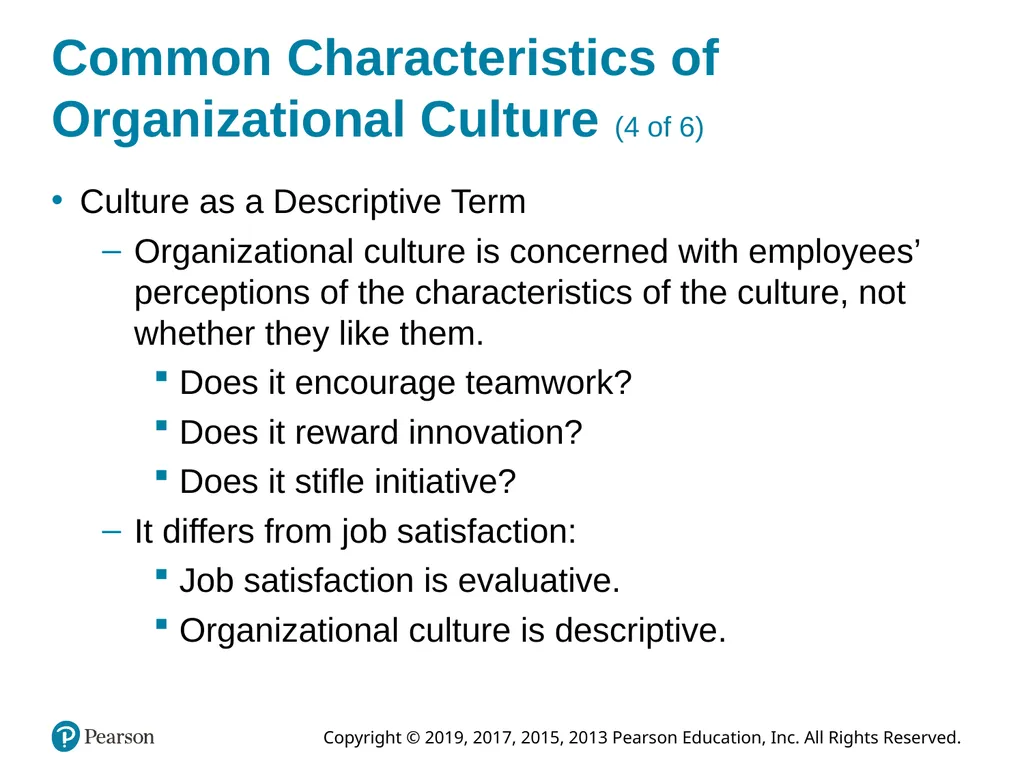
Common Characteristics of Organizational Culture (4 of 6) Culture as a Descriptive Term
Organizational culture is concerned with employees’ perceptions of the characteristics of the culture, not whether they like them.
Does it encourage teamwork?
Does it reward innovation?
Does it stifle initiative?
It differs from job satisfaction:
Job satisfaction is evaluative.
Organizational culture is descriptive.<br>
Organizational culture is concerned with employees’ perceptions of the characteristics of the culture, not whether they like them.
Does it encourage teamwork?
Does it reward innovation?
Does it stifle initiative?
It differs from job satisfaction:
Job satisfaction is evaluative.
Organizational culture is descriptive.<br>
07
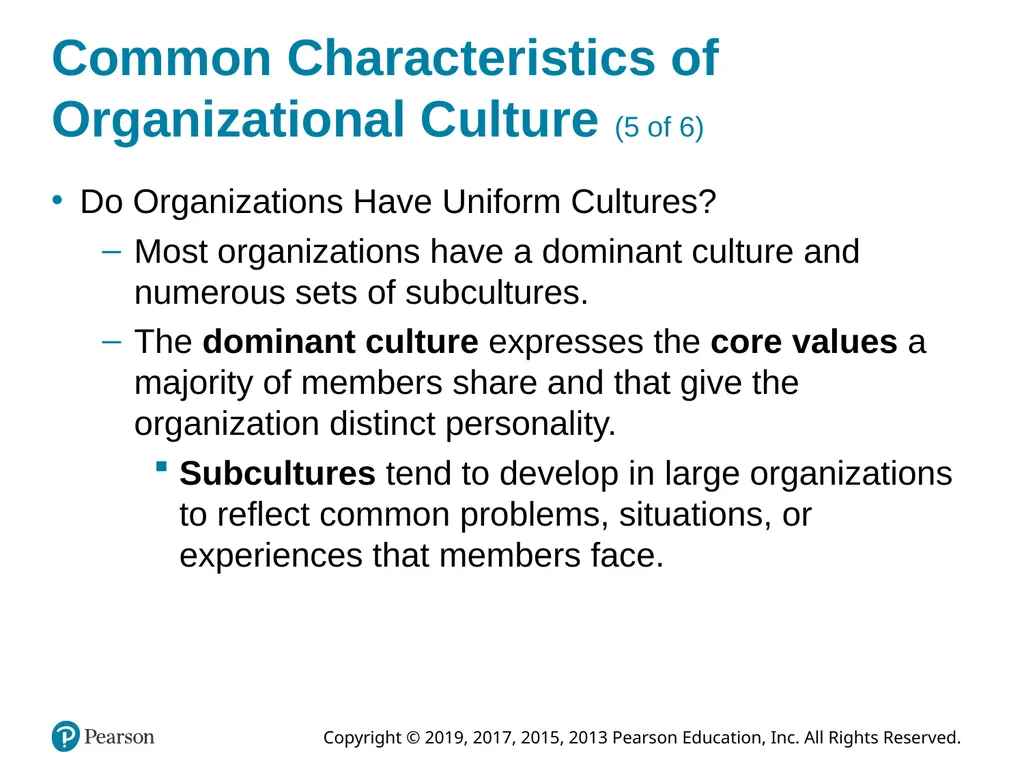
Common Characteristics of Organizational Culture (5 of 6) Do Organizations Have Uniform Cultures?
Most organizations have a dominant culture and numerous sets of subcultures.
The dominant culture expresses the core values a majority of members share and that give the organization distinct personality.
Subcultures tend to develop in large organizations to reflect common problems, situations, or experiences that members face.<br>
Most organizations have a dominant culture and numerous sets of subcultures.
The dominant culture expresses the core values a majority of members share and that give the organization distinct personality.
Subcultures tend to develop in large organizations to reflect common problems, situations, or experiences that members face.<br>
08
Common Characteristics of Organizational Culture (6 of 6) Strong versus Weak Cultures
Strong culture: core values are intensely held and widely shared.
The more members who accept the core values and the greater their commitment, the stronger the culture and the greater its influence on member behavior.<br>
Strong culture: core values are intensely held and widely shared.
The more members who accept the core values and the greater their commitment, the stronger the culture and the greater its influence on member behavior.<br>
09
What Do Cultures Do? (1 of 9) The Functions of Culture
Boundary-defining role.
Conveys a sense of identity for members.
Facilitates the generation of commitment.
Enhances the stability of the social system.
Serves as a sense-making and control mechanism.<br>
Boundary-defining role.
Conveys a sense of identity for members.
Facilitates the generation of commitment.
Enhances the stability of the social system.
Serves as a sense-making and control mechanism.<br>
10
What Do Cultures Do? (2 of 9) Culture Creates Climate
Organizational climate is shared perceptions about the organization and work environment.
Team spirit at the organizational level.
Climates can interact with one another to produce behavior.
Climate also influences the habits people adopt.<br>
Organizational climate is shared perceptions about the organization and work environment.
Team spirit at the organizational level.
Climates can interact with one another to produce behavior.
Climate also influences the habits people adopt.<br>
11
What Do Cultures Do? (3 of 9) The Ethical Dimension of Culture
Organizational cultures are not neutral in their ethical orientation, even when they are not openly pursuing ethical goals.
Over time, the ethical culture, or the shared concept of right and wrong behavior in that workplace, develops as part of the organizational climate.
The ethical climate reflects the true values of the organization and shapes the ethical decision making of its members.<br>
Organizational cultures are not neutral in their ethical orientation, even when they are not openly pursuing ethical goals.
Over time, the ethical culture, or the shared concept of right and wrong behavior in that workplace, develops as part of the organizational climate.
The ethical climate reflects the true values of the organization and shapes the ethical decision making of its members.<br>
12
What Do Cultures Do? (4 of 9) Ethical climate theory (ECT) and the ethical climate index (ECI) categorize and measure the ethical dimensions of organizational cultures.
Five climate categories: instrumental, caring, independence, law and code, and rules.
Each explains the general mindset, expectations, and values of the managers and employees in relationship to their organization.
Ethical climate powerfully influences the way its individual members feel they should behave.<br>
Five climate categories: instrumental, caring, independence, law and code, and rules.
Each explains the general mindset, expectations, and values of the managers and employees in relationship to their organization.
Ethical climate powerfully influences the way its individual members feel they should behave.<br>
13
What Do Cultures Do? (5 of 9) Studies of ethical climates and workplace outcomes suggest that some climate categories are likely to be found in certain organizations.
By measuring the collective levels of moral sensitivity, judgment, motivation, and character of our organizations, we may be able to judge the strength of the influence our ethical climates have on us.<br>
By measuring the collective levels of moral sensitivity, judgment, motivation, and character of our organizations, we may be able to judge the strength of the influence our ethical climates have on us.<br>
14
What Do Cultures Do? (6 of 9) Sustainability: practices that can be maintained over very long periods of time because the tools or structures that support the practices are not damaged by the processes.
Social sustainability practices.
Sustainable management doesn’t need to be purely altruistic.
To create a truly sustainable business, an organization must develop a long-term culture and put its values into practice.
Like other cultural practices we’ve discussed, sustainability needs time and nurturing to grow.<br>
Social sustainability practices.
Sustainable management doesn’t need to be purely altruistic.
To create a truly sustainable business, an organization must develop a long-term culture and put its values into practice.
Like other cultural practices we’ve discussed, sustainability needs time and nurturing to grow.<br>
15
What Do Cultures Do? (7 of 9) Culture and Innovation
The most innovative companies have open, unconventional, collaborative, vision-driven, and accelerating cultures.
Startup firms often have innovative cultures.
They are usually small, agile, and focused on solving problems in order to survive and grow.<br>
The most innovative companies have open, unconventional, collaborative, vision-driven, and accelerating cultures.
Startup firms often have innovative cultures.
They are usually small, agile, and focused on solving problems in order to survive and grow.<br>
16
What Do Cultures Do? (8 of 9) Culture as an Asset
Culture can significantly contribute to an organization’s bottom line in many ways.
There are many more cases of business success stories because of excellent organizational cultures than there are of success stories despite bad cultures, and almost no success stories because of bad ones.<br>
Culture can significantly contribute to an organization’s bottom line in many ways.
There are many more cases of business success stories because of excellent organizational cultures than there are of success stories despite bad cultures, and almost no success stories because of bad ones.<br>
17
What Do Cultures Do? (9 of 9) Culture as a Liability
Institutionalization
Barriers to Change
Barriers to Diversity
Toxicity and Dysfunctions
Barriers to Acquisitions and Mergers<br>
Institutionalization
Barriers to Change
Barriers to Diversity
Toxicity and Dysfunctions
Barriers to Acquisitions and Mergers<br>
18
Creating and Sustaining Culture (1 of 6) How a Culture Begins
Ultimate source of an organization’s culture is its founders.
Founders have the vision of what the organization should be.
New organizations are typically small, which facilitates the founders’ imparting of their vision on all organizational members.<br>
Ultimate source of an organization’s culture is its founders.
Founders have the vision of what the organization should be.
New organizations are typically small, which facilitates the founders’ imparting of their vision on all organizational members.<br>
19
Creating and Sustaining Culture (2 of 6) Culture creation occurs in three ways:
Founders hire employees who think and feel the way they do.
Employees are indoctrinated and socialized into the founders’ way of thinking.
Founders’ own behavior encourages employees to identify with them and internalize their beliefs, values, and assumptions.<br>
Founders hire employees who think and feel the way they do.
Employees are indoctrinated and socialized into the founders’ way of thinking.
Founders’ own behavior encourages employees to identify with them and internalize their beliefs, values, and assumptions.<br>
20
Creating and Sustaining Culture (3 of 6) Keeping a Culture Alive
Selection
Identify and hire individuals with the knowledge, skills, and abilities to perform successfully.
Two-way street.
Top Management
Establish norms of behavior.<br>
Selection
Identify and hire individuals with the knowledge, skills, and abilities to perform successfully.
Two-way street.
Top Management
Establish norms of behavior.<br>
21
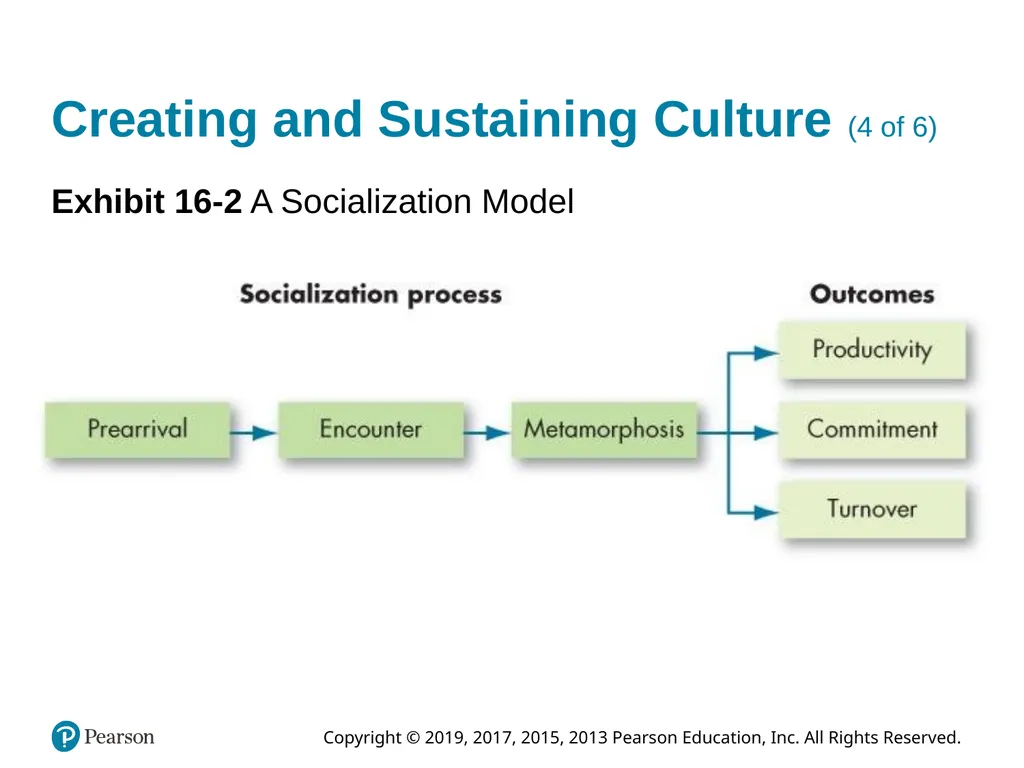
Creating and Sustaining Culture (4 of 6) Exhibit 16-2 A Socialization Model<br>
22
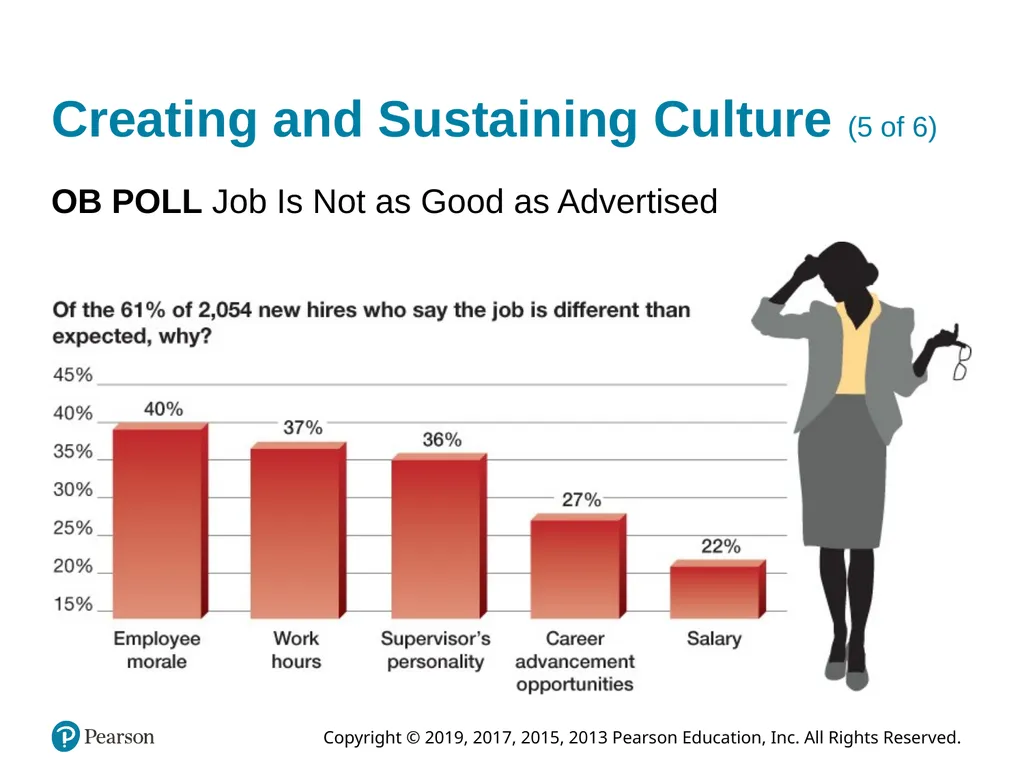
Creating and Sustaining Culture (5 of 6) OB POLL Job Is Not as Good as Advertised<br>
23
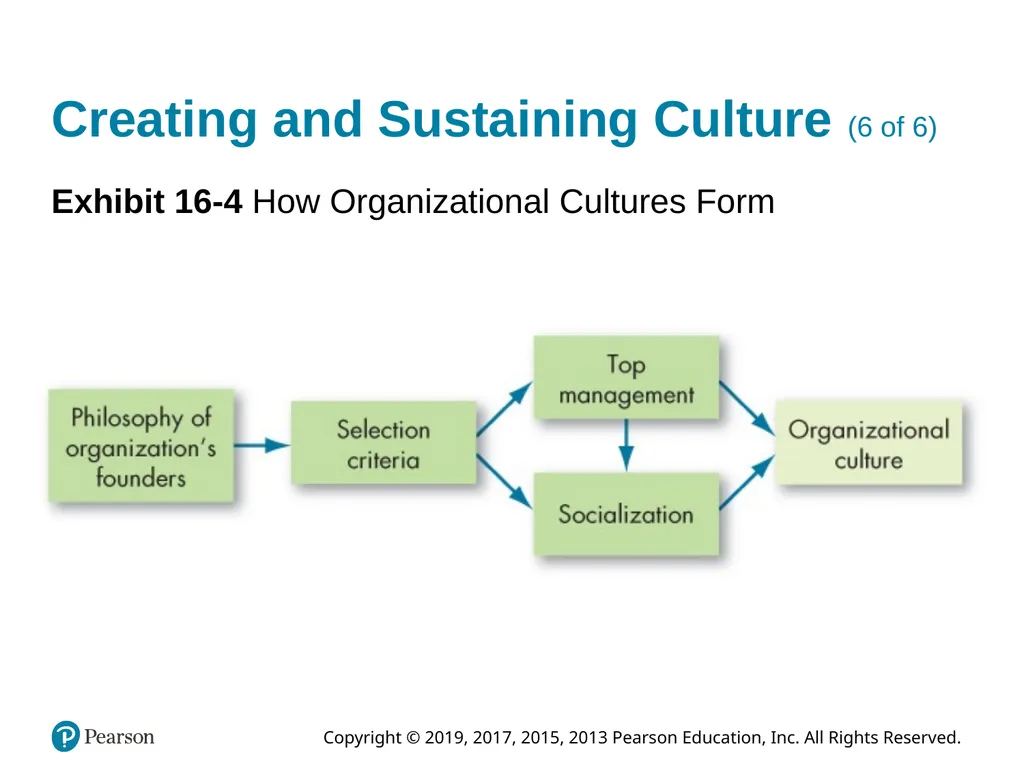
Creating and Sustaining Culture (6 of 6) Exhibit 16-4 How Organizational Cultures Form<br>
24
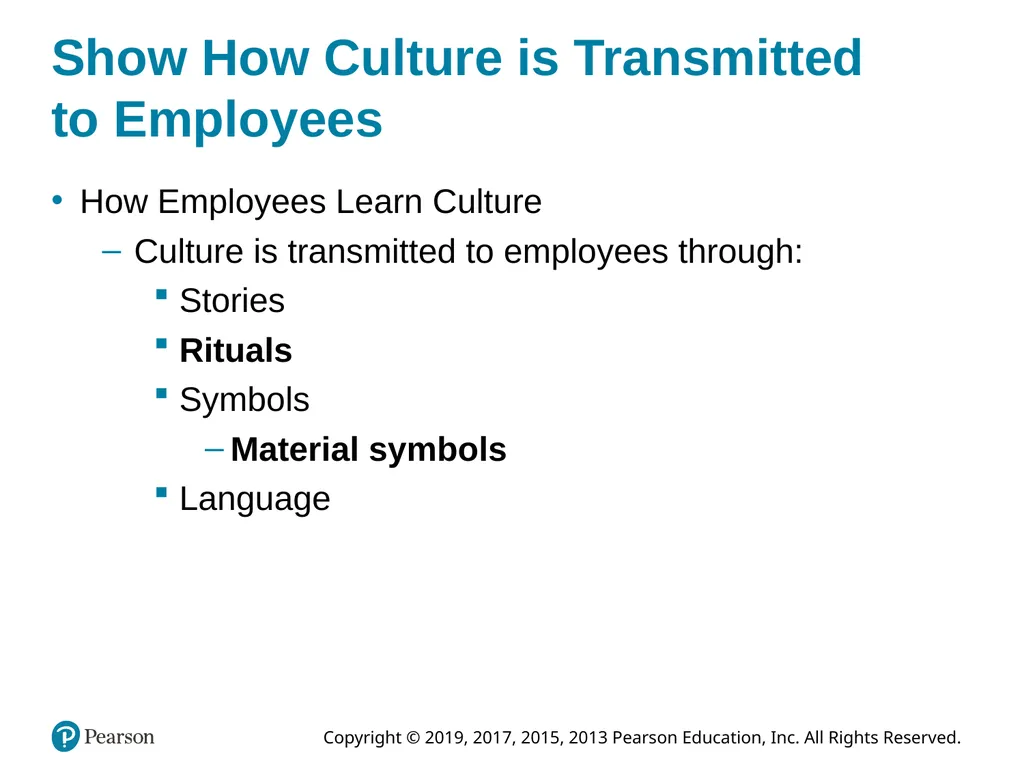
Show How Culture is Transmitted to Employees How Employees Learn Culture
Culture is transmitted to employees through:
Stories
Rituals
Symbols
Material symbols
Language<br>
Culture is transmitted to employees through:
Stories
Rituals
Symbols
Material symbols
Language<br>
25
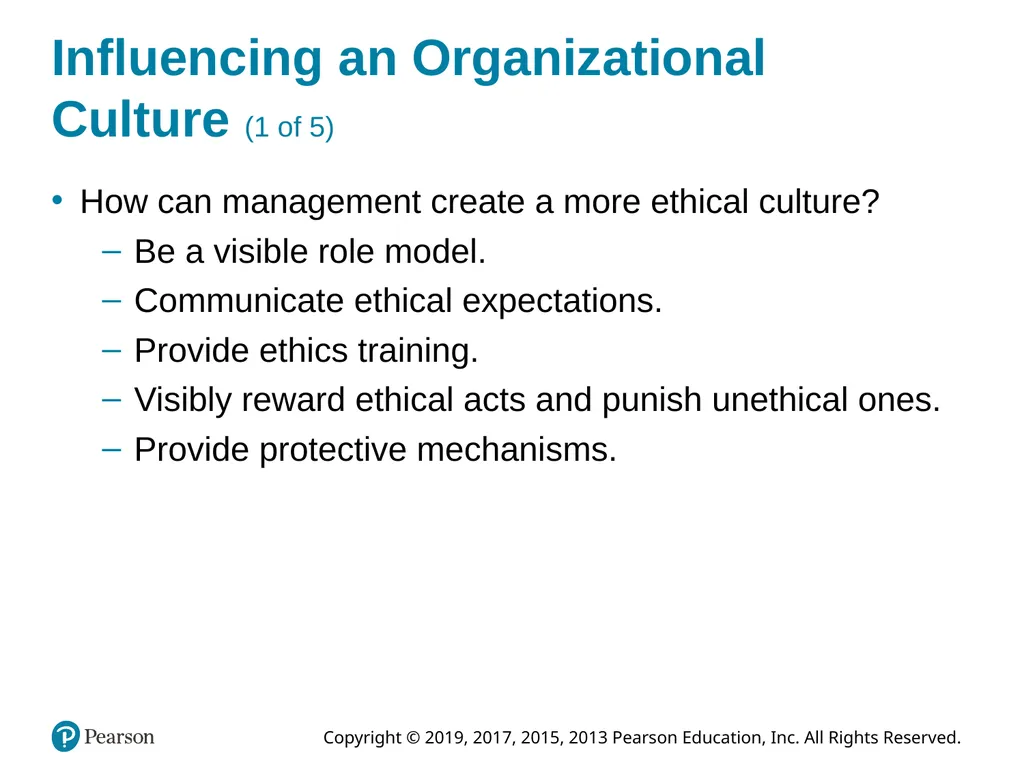
Influencing an Organizational Culture (1 of 5) How can management create a more ethical culture?
Be a visible role model.
Communicate ethical expectations.
Provide ethics training.
Visibly reward ethical acts and punish unethical ones.
Provide protective mechanisms.<br>
Be a visible role model.
Communicate ethical expectations.
Provide ethics training.
Visibly reward ethical acts and punish unethical ones.
Provide protective mechanisms.<br>
26
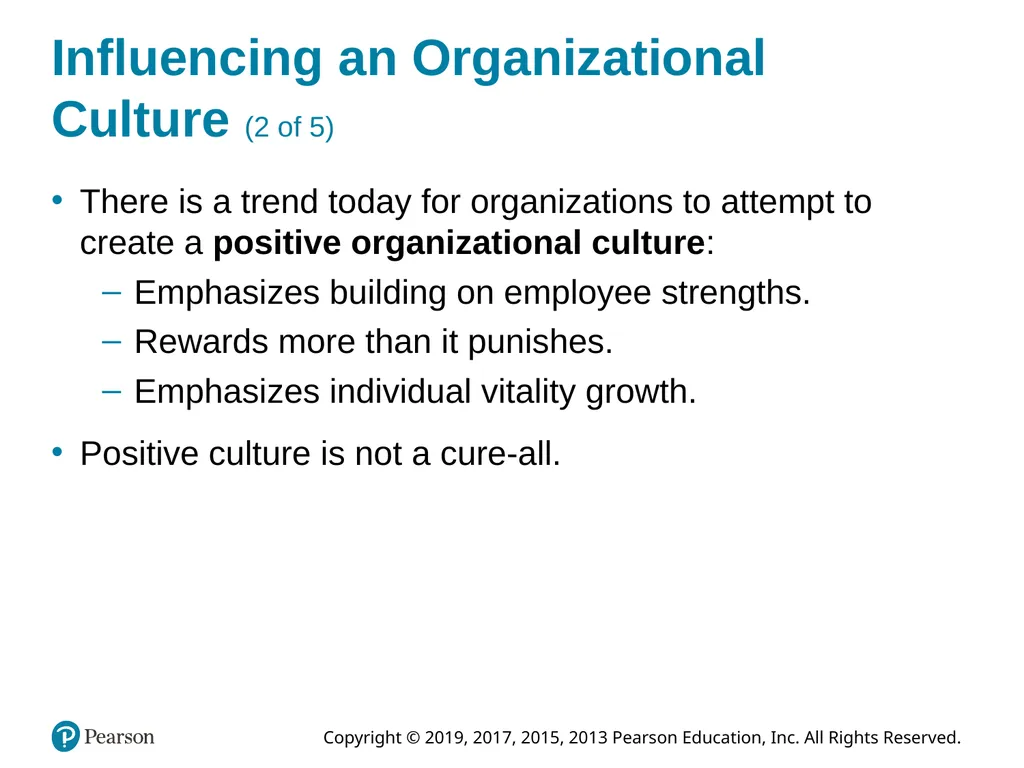
Influencing an Organizational Culture (2 of 5) There is a trend today for organizations to attempt to create a positive organizational culture:
Emphasizes building on employee strengths.
Rewards more than it punishes.
Emphasizes individual vitality growth.
Positive culture is not a cure-all.<br>
Emphasizes building on employee strengths.
Rewards more than it punishes.
Emphasizes individual vitality growth.
Positive culture is not a cure-all.<br>
27
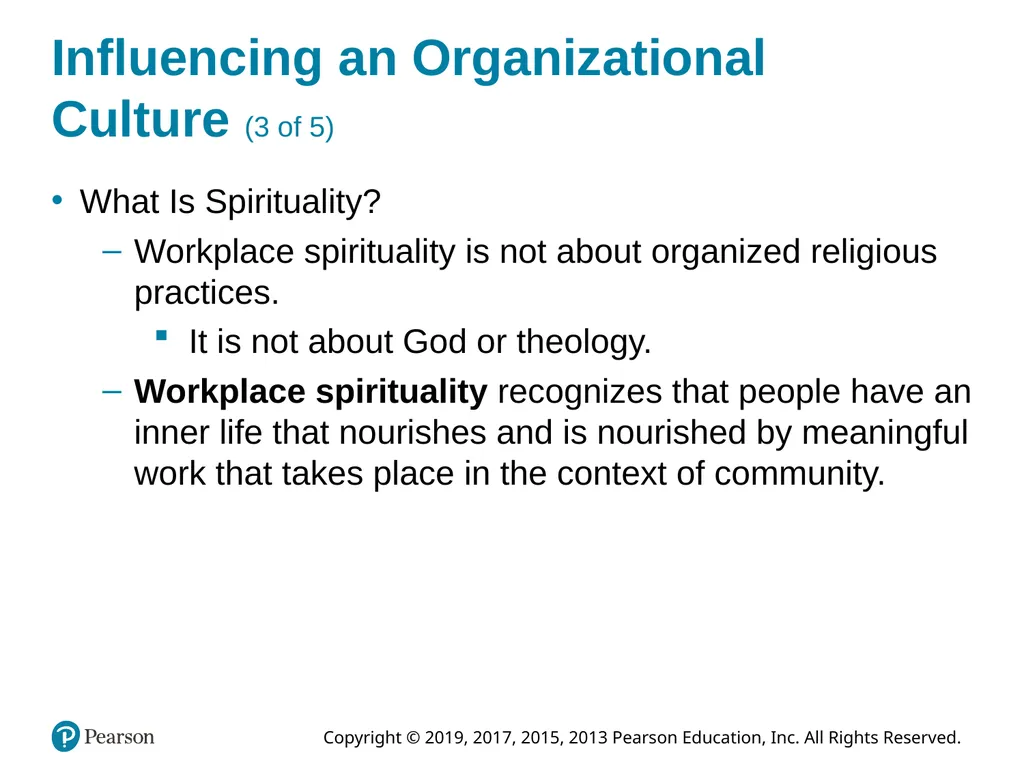
Influencing an Organizational Culture (3 of 5) What Is Spirituality?
Workplace spirituality is not about organized religious practices.
It is not about God or theology.
Workplace spirituality recognizes that people have an inner life that nourishes and is nourished by meaningful work that takes place in the context of community.<br>
Workplace spirituality is not about organized religious practices.
It is not about God or theology.
Workplace spirituality recognizes that people have an inner life that nourishes and is nourished by meaningful work that takes place in the context of community.<br>
28
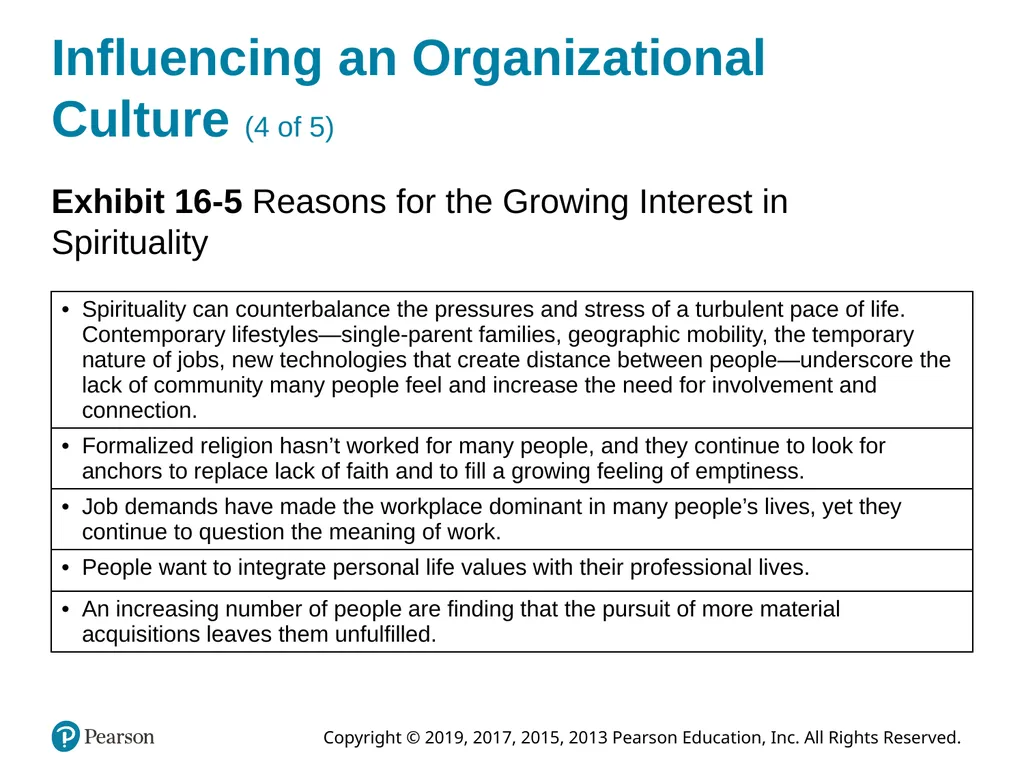
Influencing an Organizational Culture (4 of 5) Exhibit 16-5 Reasons for the Growing Interest in Spirituality<br>
29
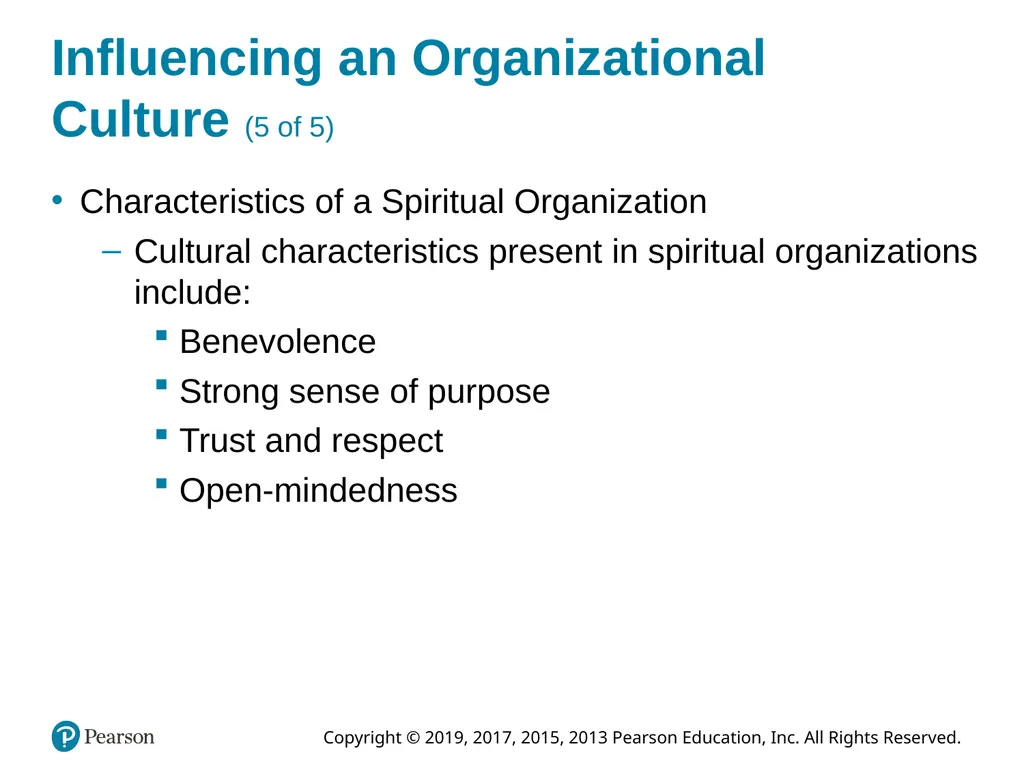
Influencing an Organizational Culture (5 of 5) Characteristics of a Spiritual Organization
Cultural characteristics present in spiritual organizations include:
Benevolence
Strong sense of purpose
Trust and respect
Open-mindedness<br>
Cultural characteristics present in spiritual organizations include:
Benevolence
Strong sense of purpose
Trust and respect
Open-mindedness<br>
30
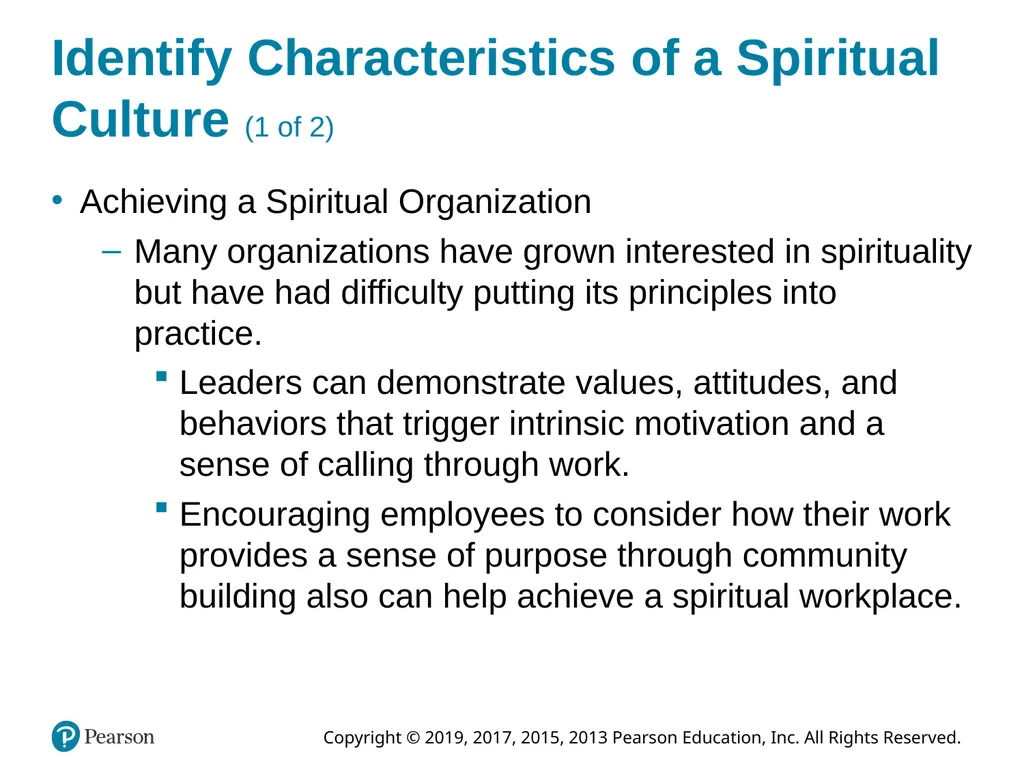
Identify Characteristics of a Spiritual Culture (1 of 2) Achieving a Spiritual Organization
Many organizations have grown interested in spirituality but have had difficulty putting its principles into practice.
Leaders can demonstrate values, attitudes, and behaviors that trigger intrinsic motivation and a sense of calling through work.
Encouraging employees to consider how their work provides a sense of purpose through community building also can help achieve a spiritual workplace.<br>
Many organizations have grown interested in spirituality but have had difficulty putting its principles into practice.
Leaders can demonstrate values, attitudes, and behaviors that trigger intrinsic motivation and a sense of calling through work.
Encouraging employees to consider how their work provides a sense of purpose through community building also can help achieve a spiritual workplace.<br>
31
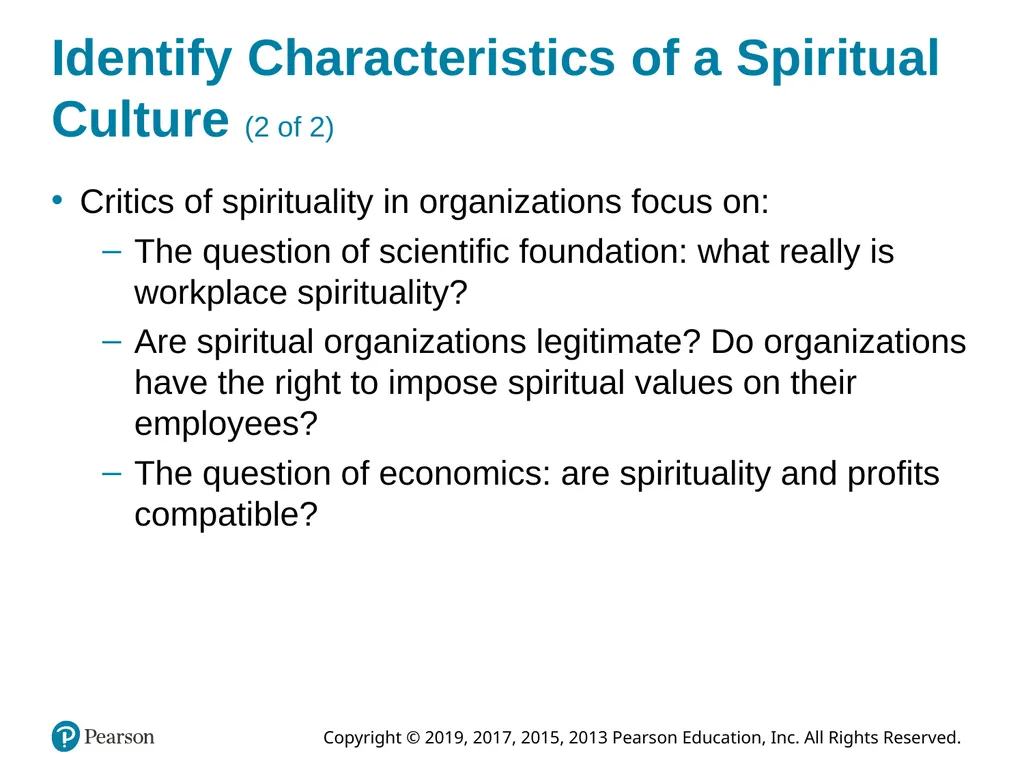
Identify Characteristics of a Spiritual Culture (2 of 2) Critics of spirituality in organizations focus on:
The question of scientific foundation: what really is workplace spirituality?
Are spiritual organizations legitimate? Do organizations have the right to impose spiritual values on their employees?
The question of economics: are spirituality and profits compatible?<br>
The question of scientific foundation: what really is workplace spirituality?
Are spiritual organizations legitimate? Do organizations have the right to impose spiritual values on their employees?
The question of economics: are spirituality and profits compatible?<br>
32
The Global Context Organizational cultures often reflect national culture.
One of the primary things U.S. managers can do is to be culturally sensitive.
The management of ethical behavior is one area where national culture can rub up against corporate culture.<br>
One of the primary things U.S. managers can do is to be culturally sensitive.
The management of ethical behavior is one area where national culture can rub up against corporate culture.<br>
33
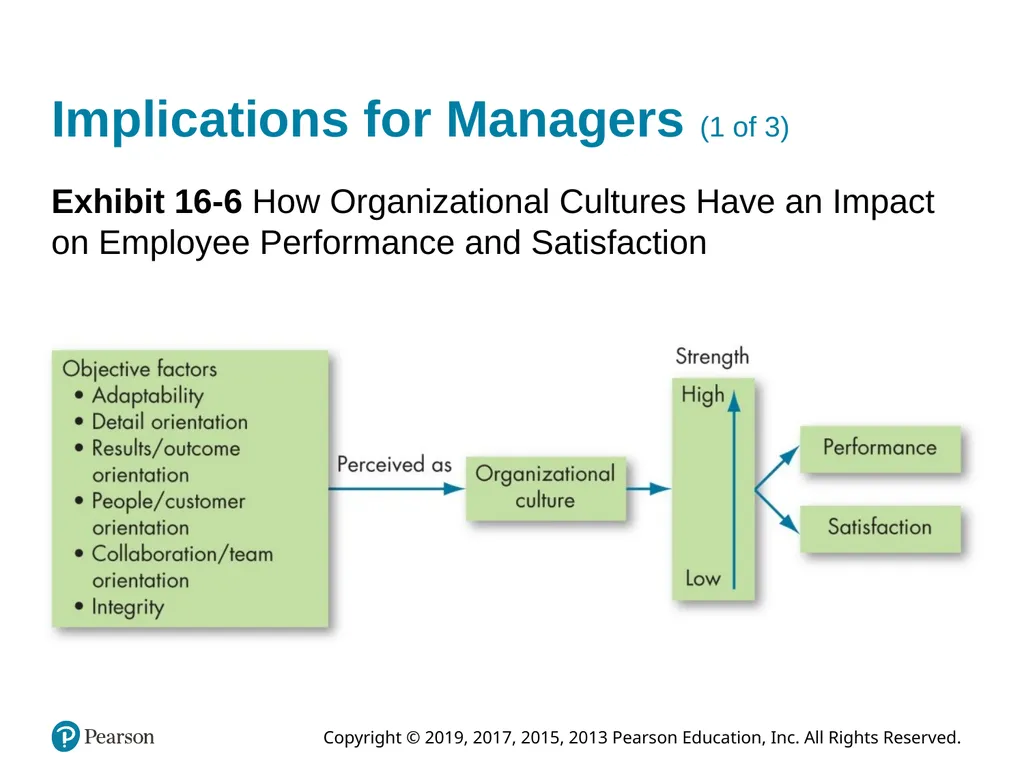
Implications for Managers (1 of 3) Exhibit 16-6 How Organizational Cultures Have an Impact on Employee Performance and Satisfaction<br>
34
Implications for Managers (2 of 3) Realize that an organization’s culture is relatively fixed in the short term. To effect change, involve top management and strategize a long-term plan.
Hire individuals whose values align with those of the organization; these employees will tend to remain committed and satisfied. Not surprisingly, “misfits” have considerably higher turnover rates.
Understand that employees’ performance and socialization depend to a considerable degree on their knowing what to do and not do. Train your employees well and keep them informed of changes to their job roles.<br>
Hire individuals whose values align with those of the organization; these employees will tend to remain committed and satisfied. Not surprisingly, “misfits” have considerably higher turnover rates.
Understand that employees’ performance and socialization depend to a considerable degree on their knowing what to do and not do. Train your employees well and keep them informed of changes to their job roles.<br>
35
Implications for Managers (3 of 3) You can shape the culture of your work environment, sometimes as much as it shapes you. All managers can especially do their part to create an ethical culture and to consider spirituality and its role in creating a positive organizational culture.
Be aware that your company’s organizational culture may not be “transportable” to other countries. Understand the cultural relevance of your organization’s norms before introducing new plans or initiatives overseas.<br>
Be aware that your company’s organizational culture may not be “transportable” to other countries. Understand the cultural relevance of your organization’s norms before introducing new plans or initiatives overseas.<br>
36
Copyright<br>