
Organizational Behavior Eighteenth Edition, Global



Description: Organizational Behavior Eighteenth Edition, Global Edition Chapter 9 Foundations of Group Behavior Copyright 2019 Pearson Education, Ltd. All Rights Reserved. Learning Objectives (1 of 2) 9.1 Distinguish between the different types of
Related Topics
Download Presentation
"Organizational Behavior Eighteenth Edition, Global" is the property of its rightful owner. Permission is granted to download and print the materials on this website for personal, non-commercial use only, and to display it on your personal computer provided you do not modify the materials and that you retain all copyright notices contained in the materials. By downloading content from our website, you accept the terms of this agreement.
Presentation Transcript
slide1. Organizational Behavior Eighteenth Edition, Global Edition Chapter 9 Foundations of Group Behavior Copyright © 2019 Pearson Education, Ltd. All Rights Reserved.<br>
slide2. Learning Objectives (1 of 2) 9.1 Distinguish between the different types of groups.
9.2 Describe the punctuated-equilibrium model of group development.
9.3 Show how role requirements change in different situations.
9.4 Demonstrate how norms exert influence on an individual’s behavior.<br>
slide3. Learning Objectives (2 of 2) 9.5 Show how status and size differences affect group performance.
9.6 Describe how issues of cohesiveness and diversity can be integrated for group effectiveness.
9.7 Contrast the strengths and weaknesses of group decision making.<br>
slide4. Distinguish Between Different Types of Groups (1 of 5) A group is defined as two or more individuals, interacting and interdependent, who have come together to achieve particular objectives.
Groups can be either formal or informal.
Formal groups: those defined by the organization’s structure.
Informal groups: alliances that are neither formally structured nor organizationally determined.<br>
slide5. Distinguish Between Different Types of Groups (2 of 5) Social identity theory: considers when and why individuals consider themselves members of groups.
People have emotional reactions to the failure or success of their group because their self-esteem gets tied into the performance of the group.
Social identities help us understand who we are and where we fit in with people.<br>
slide6. Distinguish Between Different Types of Groups (4 of 5) Ingroups and Outgroups
Ingroup favoritism occurs when we see members of our group as better than other people, and people not in our group as all the same.
Whenever there is an ingroup, there is by necessity an outgroup, which is sometimes everyone else, but is usually an identified group known by the ingroup’s members.<br>
slide7. Distinguish Between Different Types of Groups (5 of 5) Social Identity Threat
Ingroups and outgroups pave the way for social identity threat, which is akin to stereotype threat.
Individuals believe they will be personally negatively evaluated due to their association with a devalued group, and they may lose confidence and performance effectiveness.<br>
slide8. Describe the Punctuated Equilibrium Model Exhibit 9-1 The Punctuated-Equilibrium Model<br>
slide9. Show How Role Requirements Change (1 of 3) Role: a set of expected behavior patterns attributed to someone occupying a given position in a social unit.
Role perception: one’s perception of how to act in a given situation.
Role expectations: how others believe one should act in a given situation.
Psychological contract<br>
slide10. Show How Role Requirements Change (2 of 3) Role conflict: situation in which an individual faces divergent role expectations.
We can experience interrole conflict when the expectations of our different, separate groups are in opposition.<br>
slide11. Show How Role Requirements Change (3 of 3) Role Play and Assimilation
Philip Zimbardo’s prison experiment.
Participants easily and rapidly assumed roles that were very different from their inherent personalities.<br>
slide12. Show How Norms Exert Influence On An Individual’s Behavior (1 of 7) Norms:
Acceptable standards of behavior within a group that are shared by the group’s members.<br>
slide13. Show How Norms Exert Influence On An Individual’s Behavior (2 of 7) Norms and Emotions
A recent study found that, in a task group, individuals’ emotions influenced the group’s emotions and vice versa.
Researchers have also found that norms dictated the experience of emotions for the individuals and for the groups – in other words, people grew to interpret their shared emotions in the same way.<br>
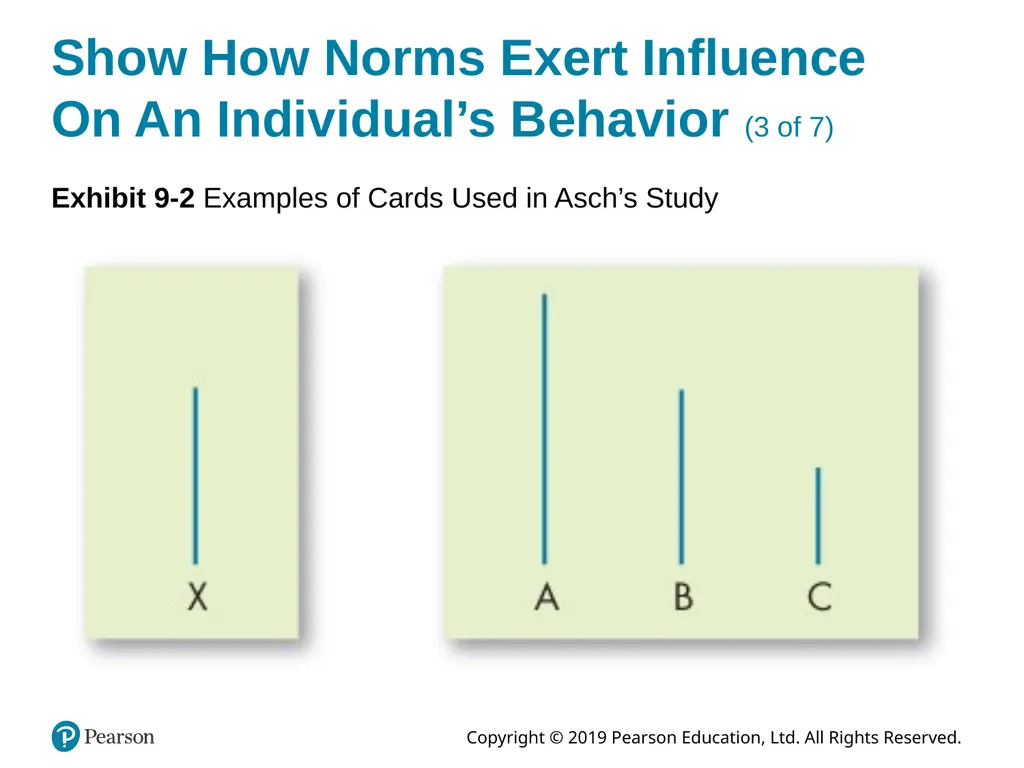
slide14. Show How Norms Exert Influence On An Individual’s Behavior (3 of 7) Exhibit 9-2 Examples of Cards Used in Asch’s Study<br>
slide15. Show How Norms Exert Influence On An Individual’s Behavior (4 of 7) Norms and Emotions
A recent study found that, in a task group, individuals’ emotions influenced the group’s emotions and vice versa.
Researchers have also found that norms dictated the experience of emotions for the individuals and for the groups – in other words, people grew to interpret their shared emotions in the same way.<br>
slide16. Show How Norms Exert Influence On An Individual’s Behavior (5 of 7) Positive Norms and Group Outcomes
One goal of every organization with corporate social responsibility (CSR) initiatives is for its values to hold normative sway over employees.
If employees aligned their thinking with positive norms, these norms would become stronger and the probability of positive impact would grow exponentially.
Positive group norms may well beget positive outcomes, but only if other factors are present.<br>
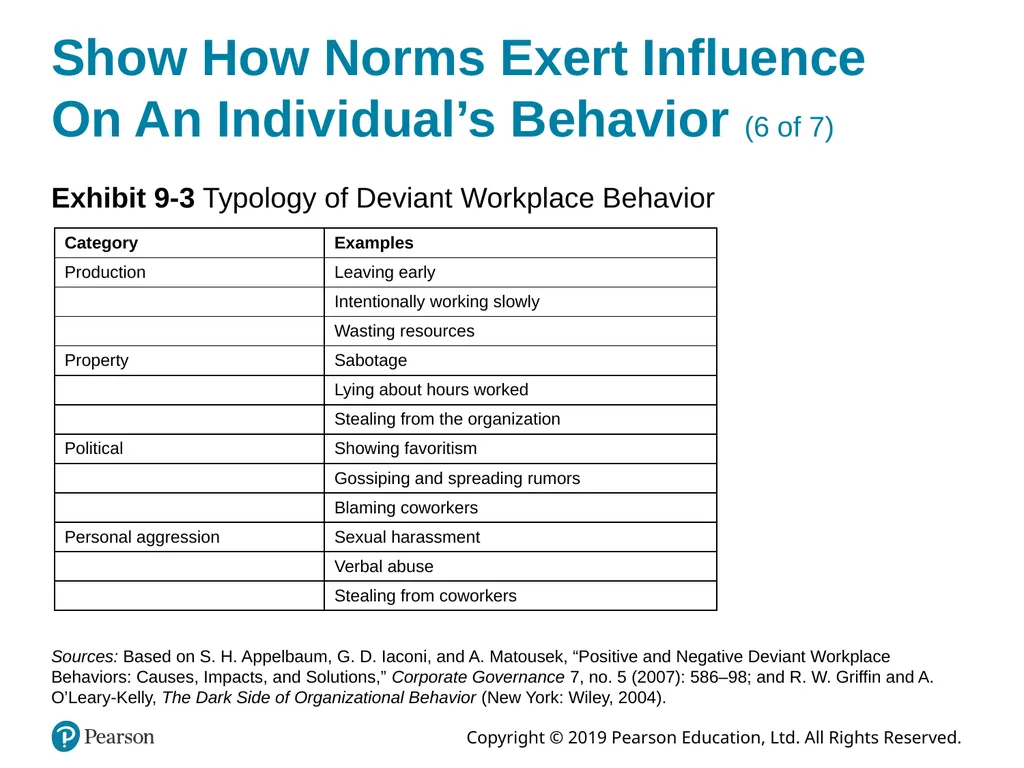
slide17. Show How Norms Exert Influence On An Individual’s Behavior (6 of 7) Exhibit 9-3 Typology of Deviant Workplace Behavior Sources: Based on S. H. Appelbaum, G. D. Iaconi, and A. Matousek, “Positive and Negative Deviant Workplace Behaviors: Causes, Impacts, and Solutions,” Corporate Governance 7, no. 5 (2007): 586–98; and R. W. Griffin and A. O’Leary-Kelly, The Dark Side of Organizational Behavior (New York: Wiley, 2004).<br>
slide18. Show How Norms Exert Influence On An Individual’s Behavior (7 of 7) Norms and Culture
Do people in collectivist cultures have different norms than people in individualist cultures? Of course they do.
But did you know that our orientation may be changed, even after years of living in one society.<br>
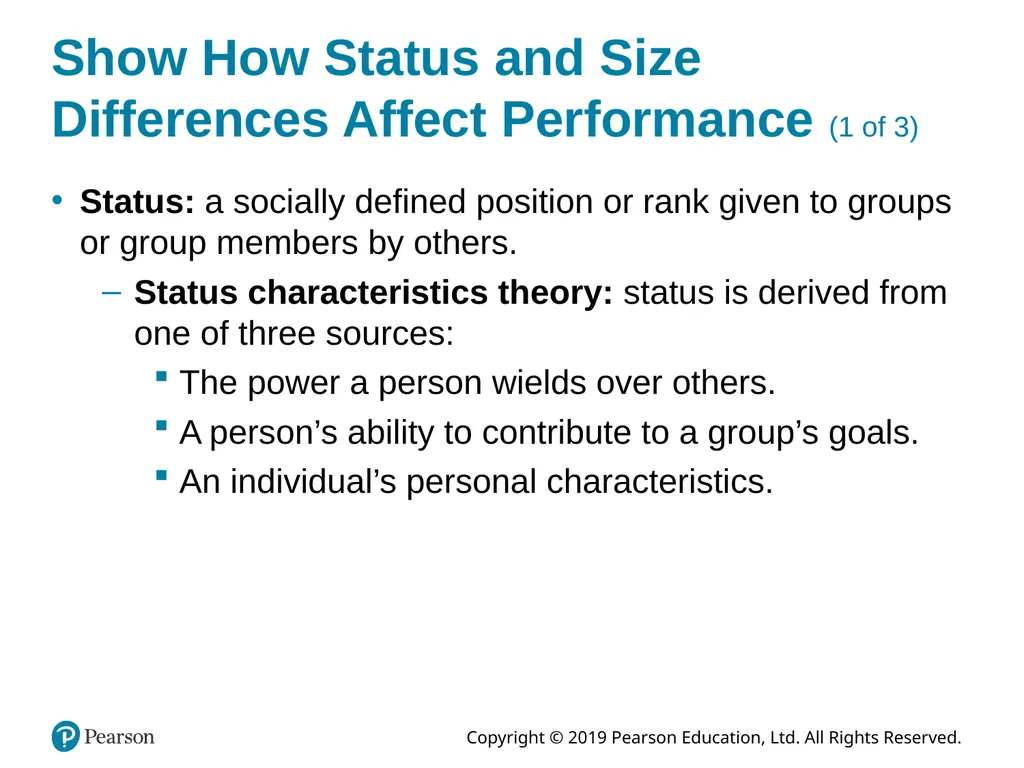
slide19. Show How Status and Size Differences Affect Performance (1 of 3) Status: a socially defined position or rank given to groups or group members by others.
Status characteristics theory: status is derived from one of three sources:
The power a person wields over others.
A person’s ability to contribute to a group’s goals.
An individual’s personal characteristics.<br>
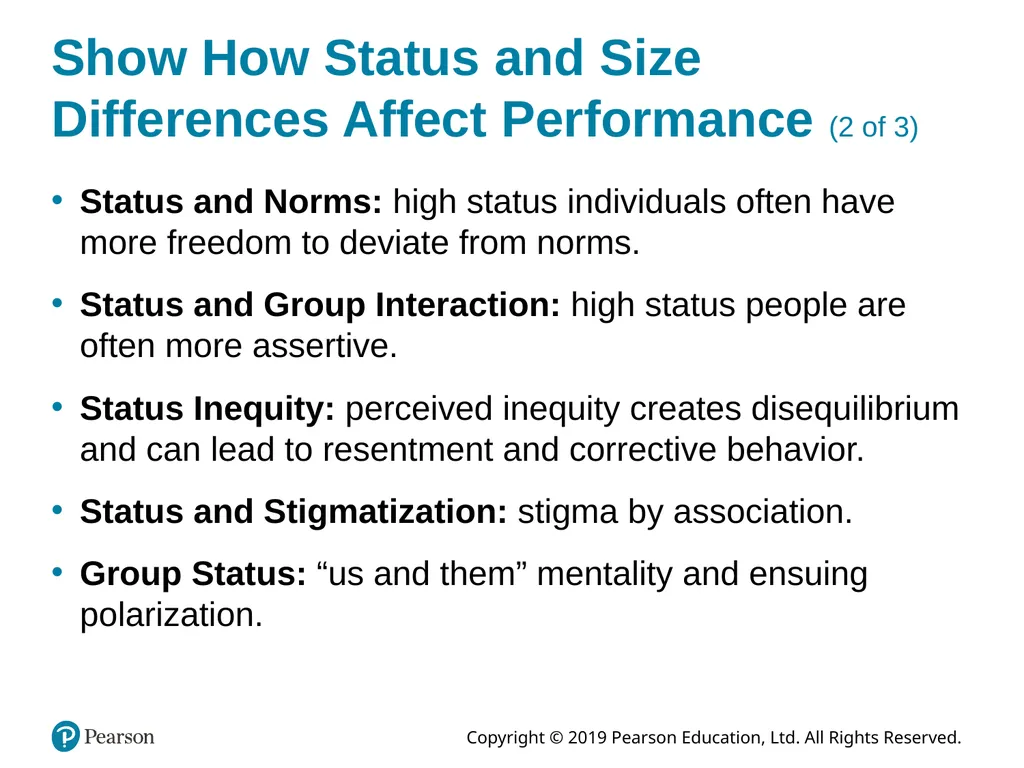
slide20. Show How Status and Size Differences Affect Performance (2 of 3) Status and Norms: high status individuals often have more freedom to deviate from norms.
Status and Group Interaction: high status people are often more assertive.
Status Inequity: perceived inequity creates disequilibrium and can lead to resentment and corrective behavior.
Status and Stigmatization: stigma by association.
Group Status: “us and them” mentality and ensuing polarization.<br>
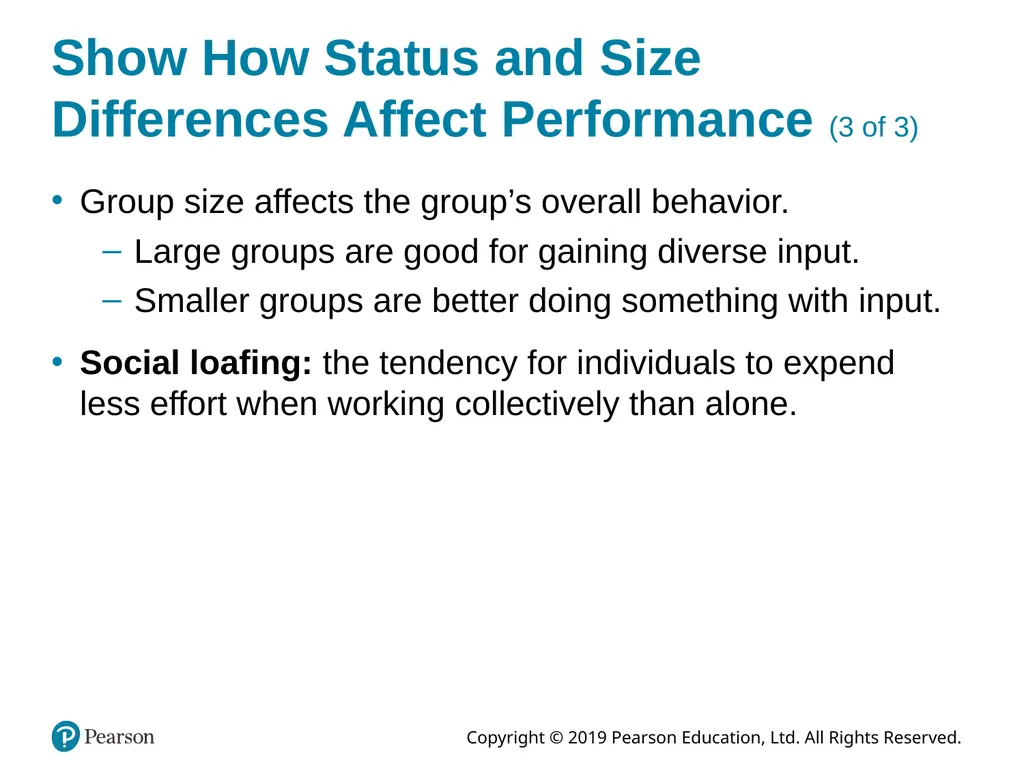
slide21. Show How Status and Size Differences Affect Performance (3 of 3) Group size affects the group’s overall behavior.
Large groups are good for gaining diverse input.
Smaller groups are better doing something with input.
Social loafing: the tendency for individuals to expend less effort when working collectively than alone.<br>
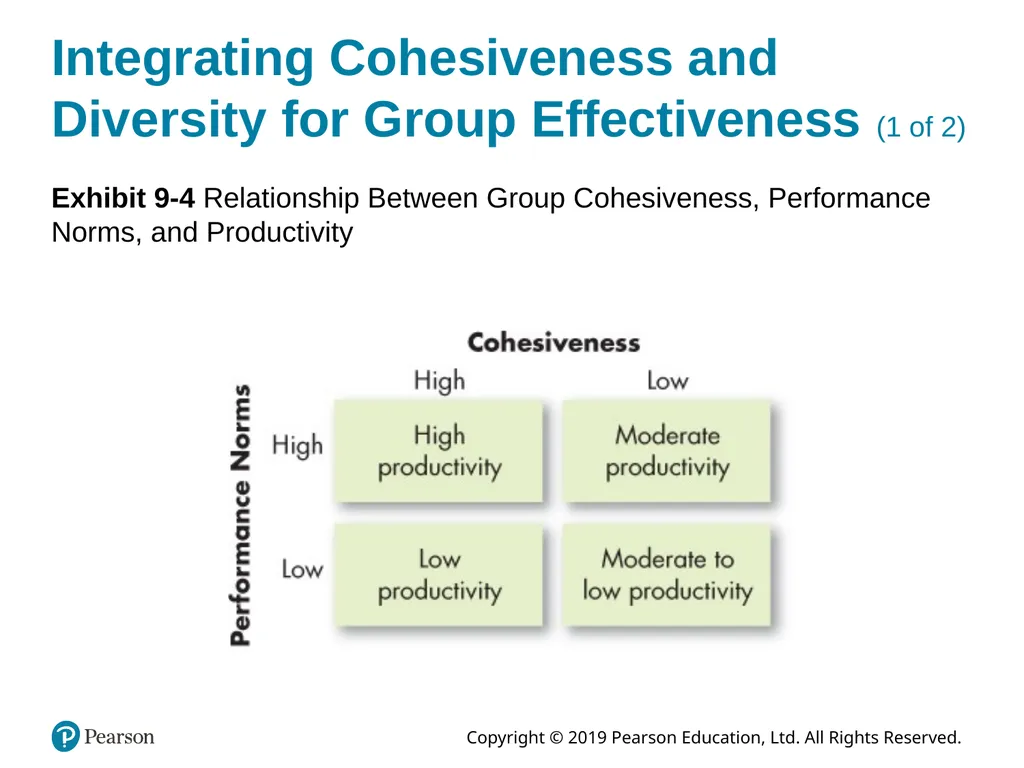
slide22. Integrating Cohesiveness and Diversity for Group Effectiveness (1 of 2) Exhibit 9-4 Relationship Between Group Cohesiveness, Performance Norms, and Productivity<br>
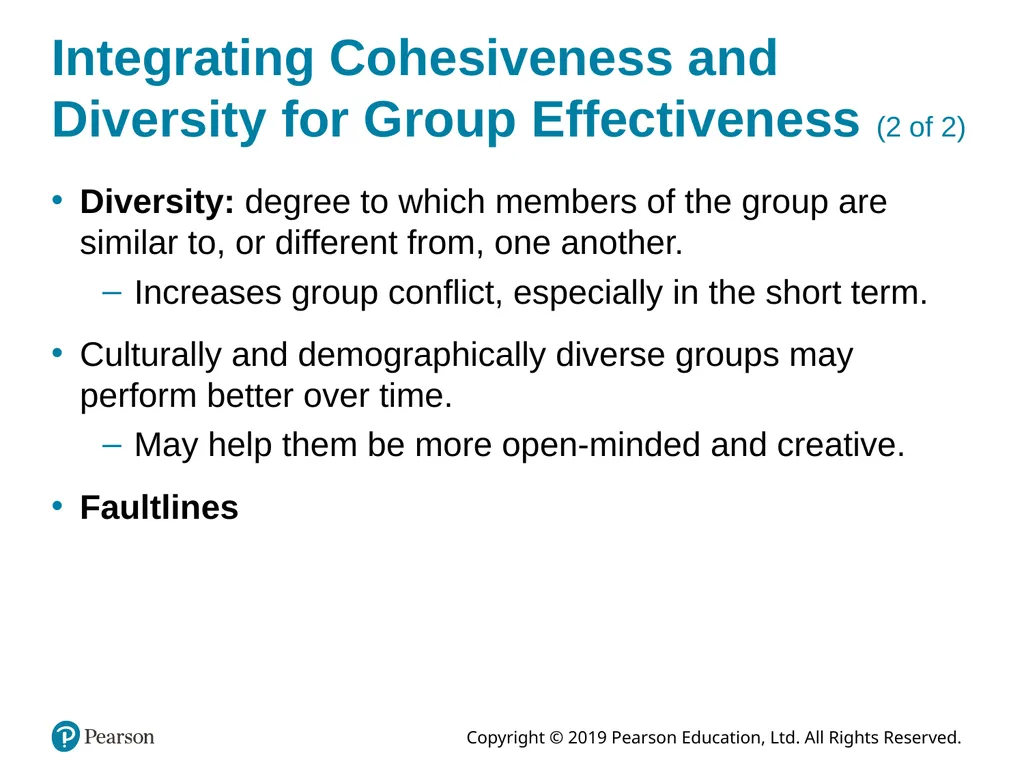
slide23. Integrating Cohesiveness and Diversity for Group Effectiveness (2 of 2) Diversity: degree to which members of the group are similar to, or different from, one another.
Increases group conflict, especially in the short term.
Culturally and demographically diverse groups may perform better over time.
May help them be more open-minded and creative.
Faultlines<br>
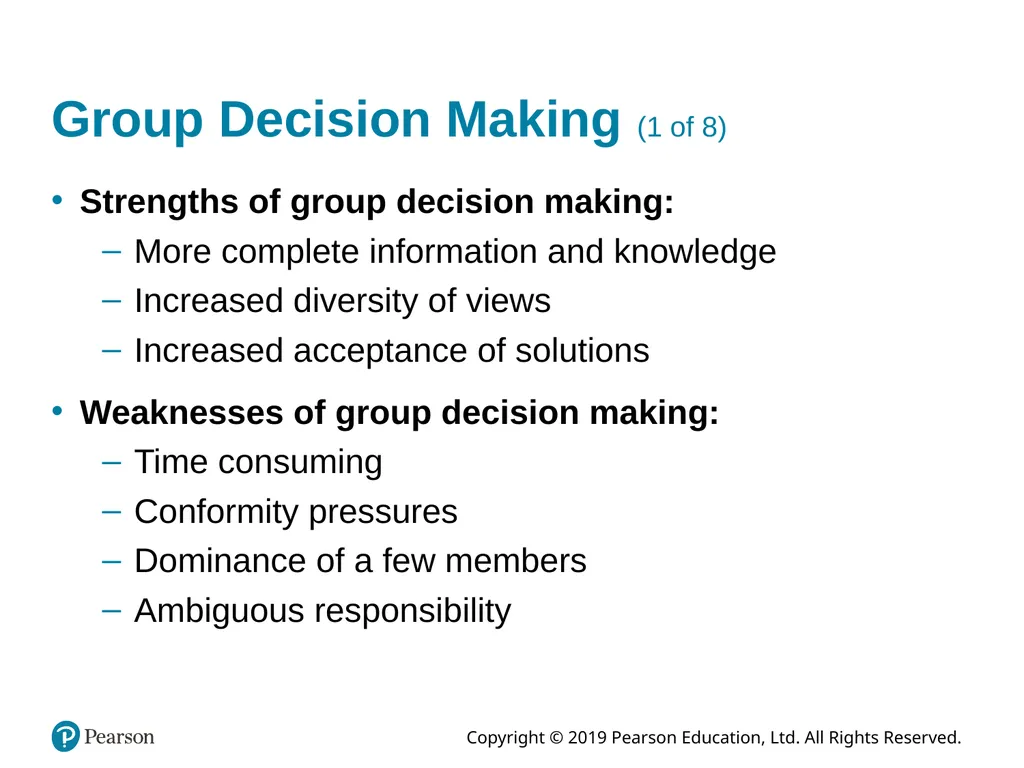
slide24. Group Decision Making (1 of 8) Strengths of group decision making:
More complete information and knowledge
Increased diversity of views
Increased acceptance of solutions
Weaknesses of group decision making:
Time consuming
Conformity pressures
Dominance of a few members
Ambiguous responsibility<br>
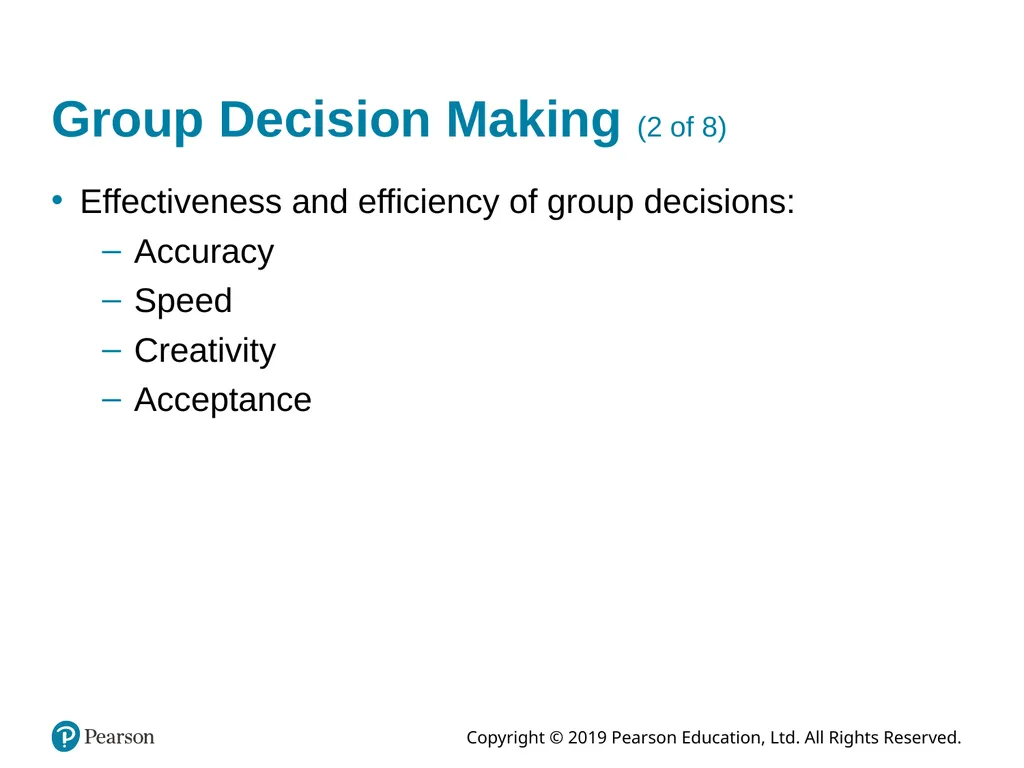
slide25. Group Decision Making (2 of 8) Effectiveness and efficiency of group decisions:
Accuracy
Speed
Creativity
Acceptance<br>
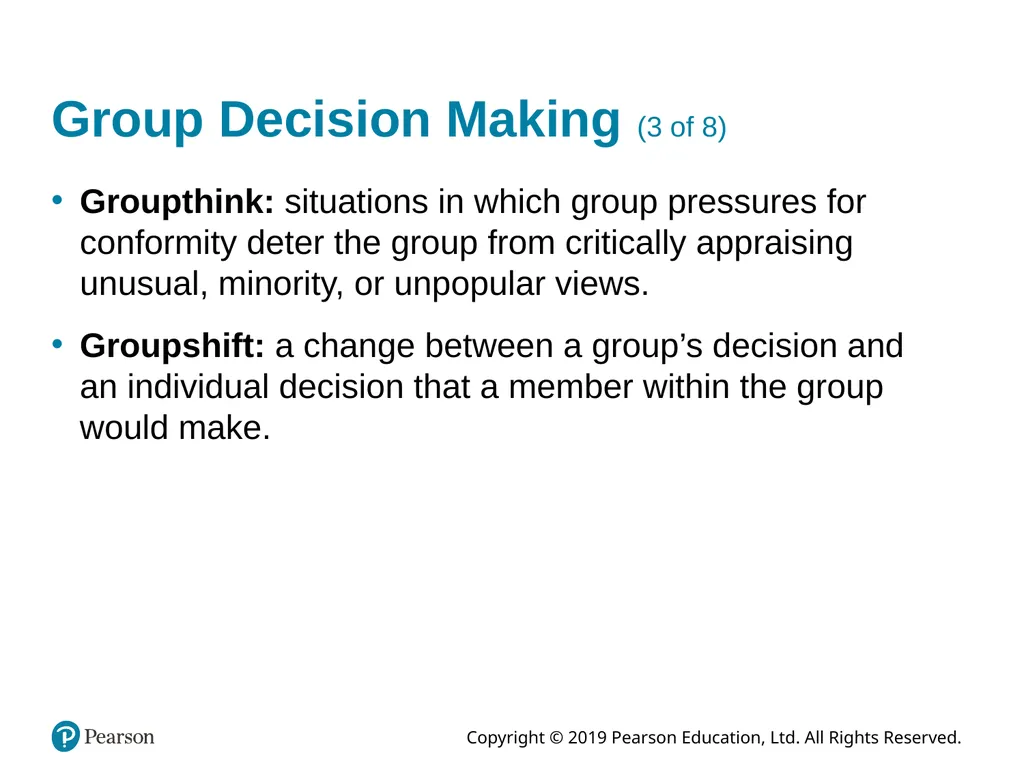
slide26. Group Decision Making (3 of 8) Groupthink: situations in which group pressures for conformity deter the group from critically appraising unusual, minority, or unpopular views.
Groupshift: a change between a group’s decision and an individual decision that a member within the group would make.<br>
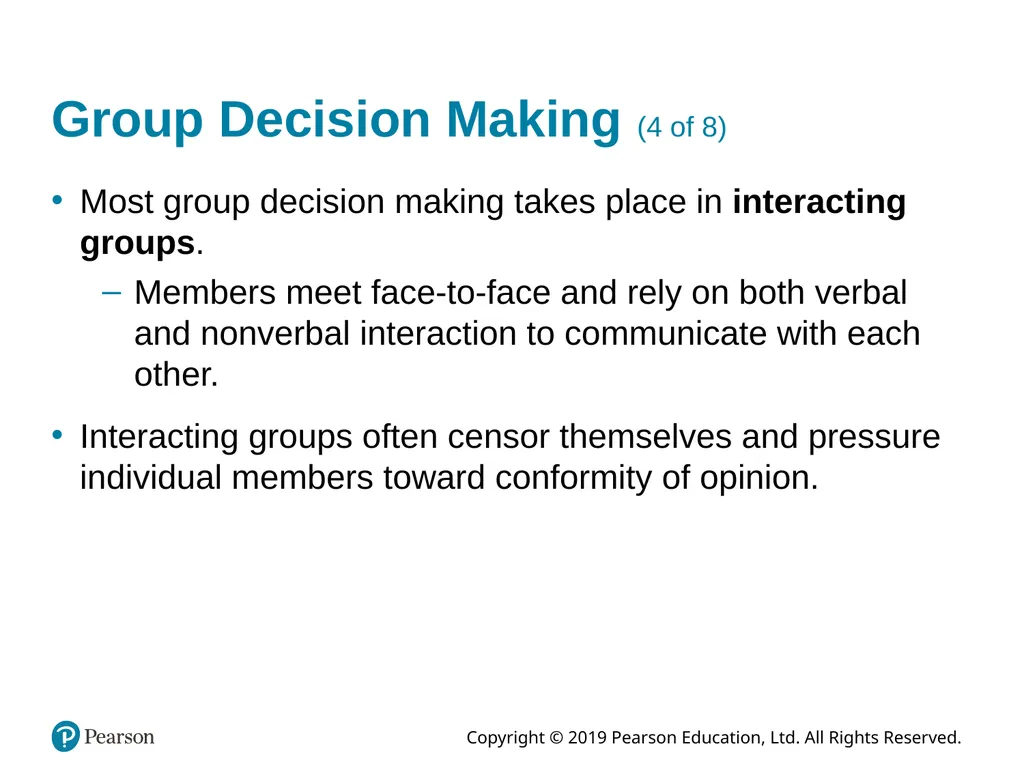
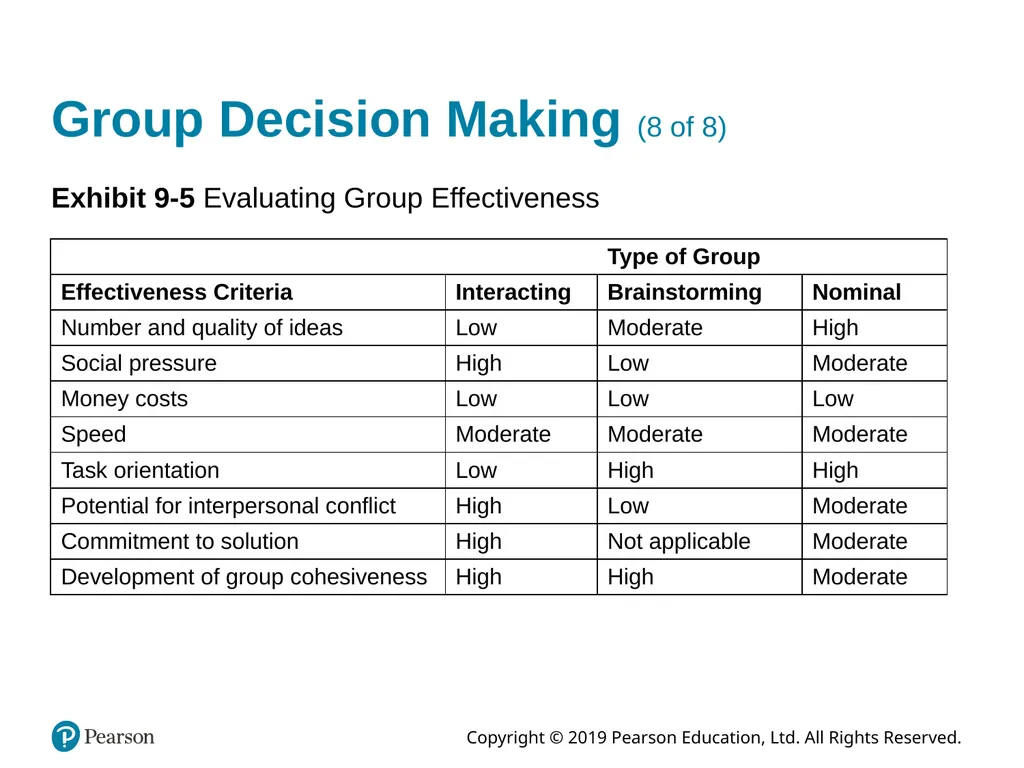
slide27. Group Decision Making (4 of 8) Most group decision making takes place in interacting groups.
Members meet face-to-face and rely on both verbal and nonverbal interaction to communicate with each other.
Interacting groups often censor themselves and pressure individual members toward conformity of opinion.<br>
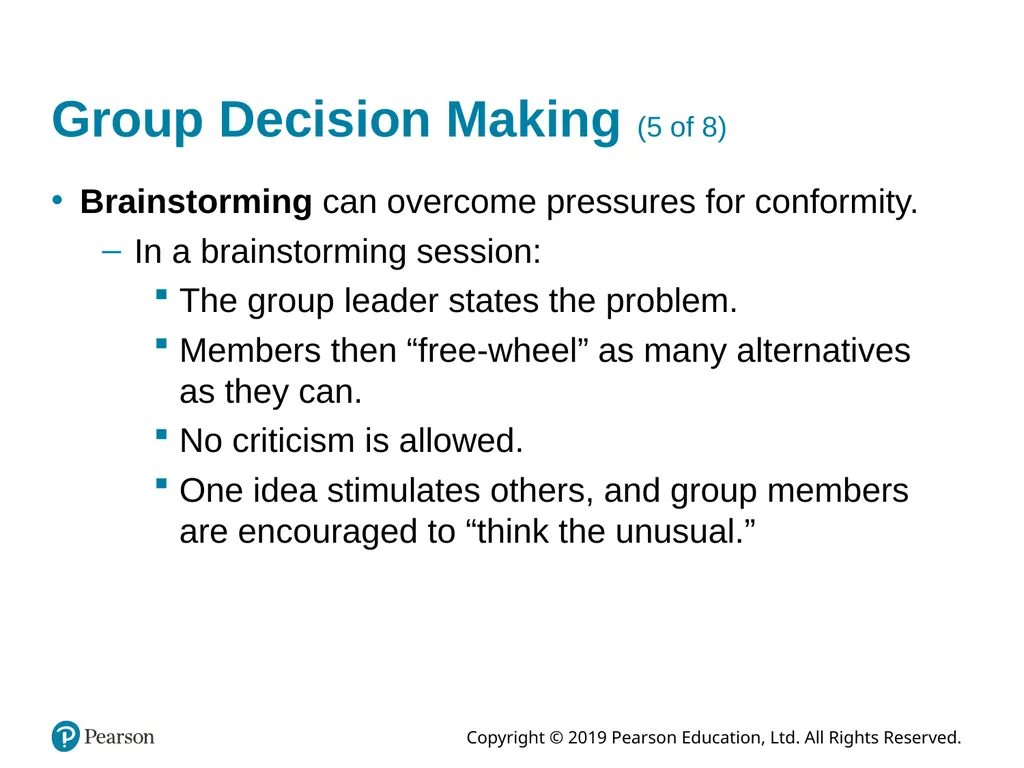
slide28. Group Decision Making (5 of 8) Brainstorming can overcome pressures for conformity.
In a brainstorming session:
The group leader states the problem.
Members then “free-wheel” as many alternatives as they can.
No criticism is allowed.
One idea stimulates others, and group members are encouraged to “think the unusual.”<br>
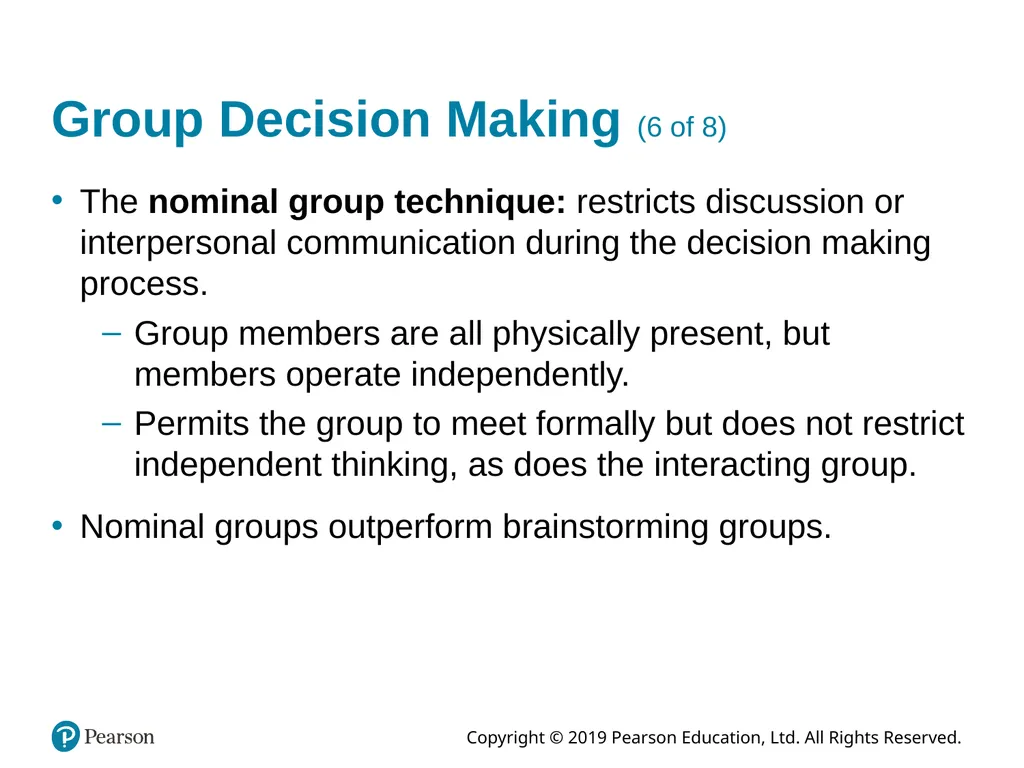
slide29. Group Decision Making (6 of 8) The nominal group technique: restricts discussion or interpersonal communication during the decision making process.
Group members are all physically present, but members operate independently.
Permits the group to meet formally but does not restrict independent thinking, as does the interacting group.
Nominal groups outperform brainstorming groups.<br>
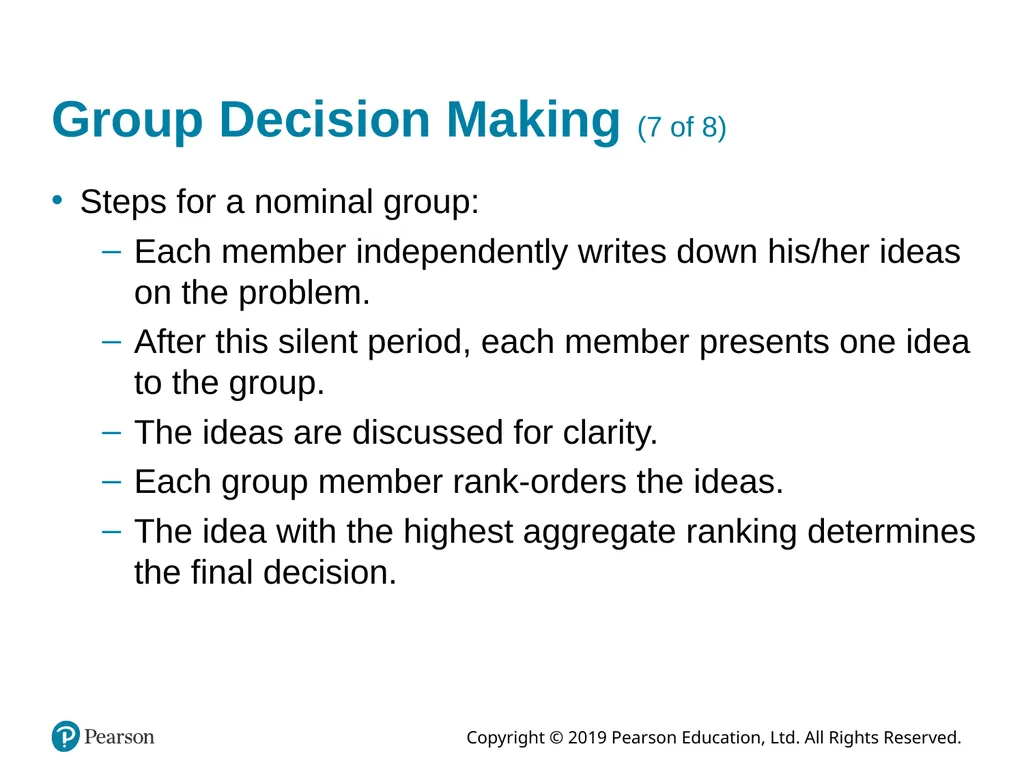
slide30. Group Decision Making (7 of 8) Steps for a nominal group:
Each member independently writes down his/her ideas on the problem.
After this silent period, each member presents one idea to the group.
The ideas are discussed for clarity.
Each group member rank-orders the ideas.
The idea with the highest aggregate ranking determines the final decision.<br>
slide31. Group Decision Making (8 of 8) Exhibit 9-5 Evaluating Group Effectiveness<br>
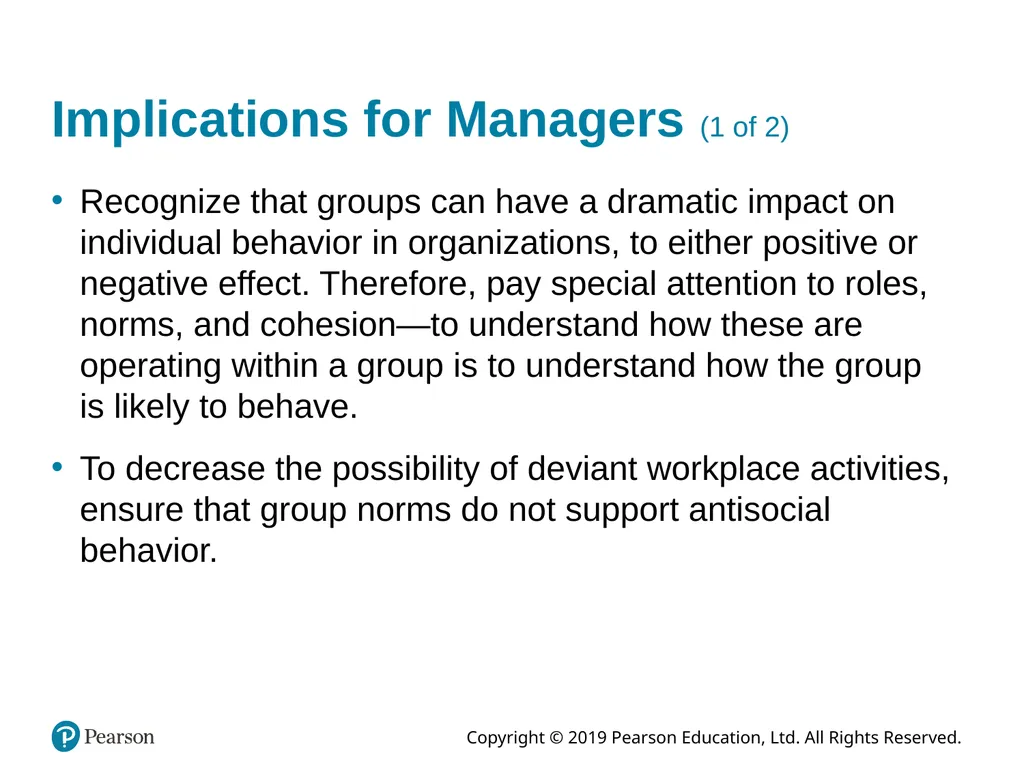
slide32. Implications for Managers (1 of 2) Recognize that groups can have a dramatic impact on individual behavior in organizations, to either positive or negative effect. Therefore, pay special attention to roles, norms, and cohesion—to understand how these are operating within a group is to understand how the group is likely to behave.
To decrease the possibility of deviant workplace activities, ensure that group norms do not support antisocial behavior.<br>
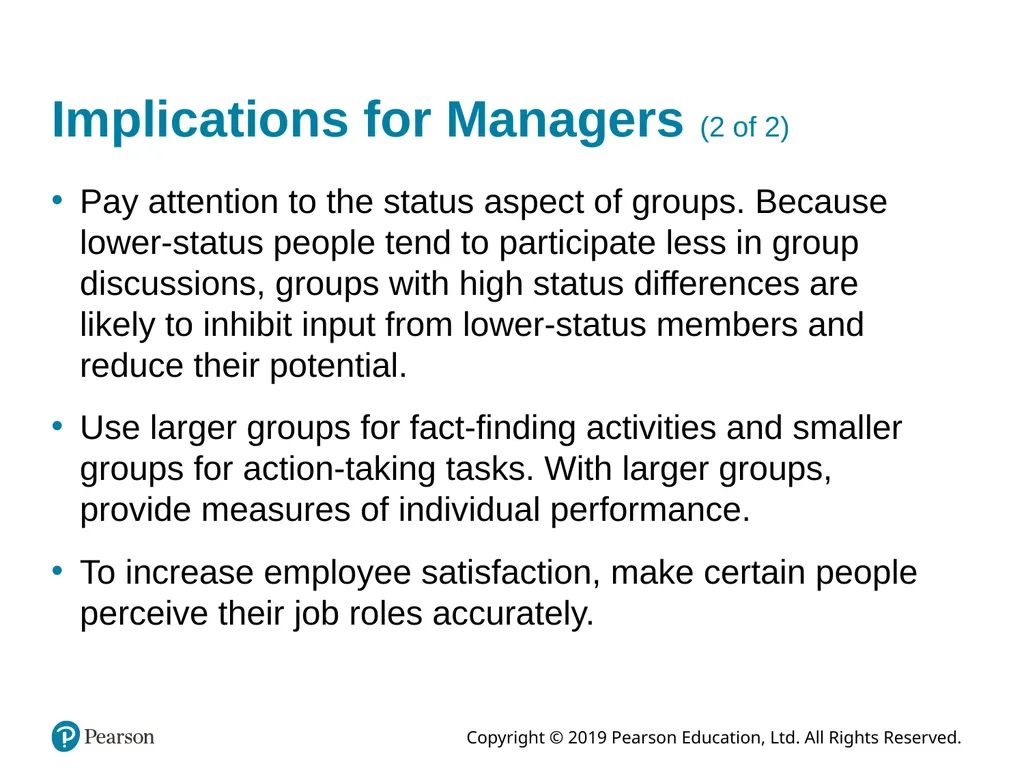
slide33. Implications for Managers (2 of 2) Pay attention to the status aspect of groups. Because lower-status people tend to participate less in group discussions, groups with high status differences are likely to inhibit input from lower-status members and reduce their potential.
Use larger groups for fact-finding activities and smaller groups for action-taking tasks. With larger groups, provide measures of individual performance.
To increase employee satisfaction, make certain people perceive their job roles accurately.<br>
slide34. Learning Objectives (1 of 2) 9.1 Distinguish between the different types of groups.
9.2 Describe the punctuated-equilibrium model of group development.
9.3 Show how role requirements change in different situations.
9.4 Demonstrate how norms exert influence on an individual’s behavior.<br>
slide35. Learning Objectives (2 of 2) 9.5 Show how status and size differences affect group performance.
9.6 Describe how issues of cohesiveness and diversity can be integrated for group effectiveness.
9.7 Contrast the strengths and weaknesses of group decision making.<br>
slide36. Questions?<br>
slide2. Learning Objectives (1 of 2) 9.1 Distinguish between the different types of groups.
9.2 Describe the punctuated-equilibrium model of group development.
9.3 Show how role requirements change in different situations.
9.4 Demonstrate how norms exert influence on an individual’s behavior.<br>
slide3. Learning Objectives (2 of 2) 9.5 Show how status and size differences affect group performance.
9.6 Describe how issues of cohesiveness and diversity can be integrated for group effectiveness.
9.7 Contrast the strengths and weaknesses of group decision making.<br>
slide4. Distinguish Between Different Types of Groups (1 of 5) A group is defined as two or more individuals, interacting and interdependent, who have come together to achieve particular objectives.
Groups can be either formal or informal.
Formal groups: those defined by the organization’s structure.
Informal groups: alliances that are neither formally structured nor organizationally determined.<br>
slide5. Distinguish Between Different Types of Groups (2 of 5) Social identity theory: considers when and why individuals consider themselves members of groups.
People have emotional reactions to the failure or success of their group because their self-esteem gets tied into the performance of the group.
Social identities help us understand who we are and where we fit in with people.<br>
slide6. Distinguish Between Different Types of Groups (4 of 5) Ingroups and Outgroups
Ingroup favoritism occurs when we see members of our group as better than other people, and people not in our group as all the same.
Whenever there is an ingroup, there is by necessity an outgroup, which is sometimes everyone else, but is usually an identified group known by the ingroup’s members.<br>
slide7. Distinguish Between Different Types of Groups (5 of 5) Social Identity Threat
Ingroups and outgroups pave the way for social identity threat, which is akin to stereotype threat.
Individuals believe they will be personally negatively evaluated due to their association with a devalued group, and they may lose confidence and performance effectiveness.<br>
slide8. Describe the Punctuated Equilibrium Model Exhibit 9-1 The Punctuated-Equilibrium Model<br>
slide9. Show How Role Requirements Change (1 of 3) Role: a set of expected behavior patterns attributed to someone occupying a given position in a social unit.
Role perception: one’s perception of how to act in a given situation.
Role expectations: how others believe one should act in a given situation.
Psychological contract<br>
slide10. Show How Role Requirements Change (2 of 3) Role conflict: situation in which an individual faces divergent role expectations.
We can experience interrole conflict when the expectations of our different, separate groups are in opposition.<br>
slide11. Show How Role Requirements Change (3 of 3) Role Play and Assimilation
Philip Zimbardo’s prison experiment.
Participants easily and rapidly assumed roles that were very different from their inherent personalities.<br>
slide12. Show How Norms Exert Influence On An Individual’s Behavior (1 of 7) Norms:
Acceptable standards of behavior within a group that are shared by the group’s members.<br>
slide13. Show How Norms Exert Influence On An Individual’s Behavior (2 of 7) Norms and Emotions
A recent study found that, in a task group, individuals’ emotions influenced the group’s emotions and vice versa.
Researchers have also found that norms dictated the experience of emotions for the individuals and for the groups – in other words, people grew to interpret their shared emotions in the same way.<br>
slide14. Show How Norms Exert Influence On An Individual’s Behavior (3 of 7) Exhibit 9-2 Examples of Cards Used in Asch’s Study<br>
slide15. Show How Norms Exert Influence On An Individual’s Behavior (4 of 7) Norms and Emotions
A recent study found that, in a task group, individuals’ emotions influenced the group’s emotions and vice versa.
Researchers have also found that norms dictated the experience of emotions for the individuals and for the groups – in other words, people grew to interpret their shared emotions in the same way.<br>
slide16. Show How Norms Exert Influence On An Individual’s Behavior (5 of 7) Positive Norms and Group Outcomes
One goal of every organization with corporate social responsibility (CSR) initiatives is for its values to hold normative sway over employees.
If employees aligned their thinking with positive norms, these norms would become stronger and the probability of positive impact would grow exponentially.
Positive group norms may well beget positive outcomes, but only if other factors are present.<br>
slide17. Show How Norms Exert Influence On An Individual’s Behavior (6 of 7) Exhibit 9-3 Typology of Deviant Workplace Behavior Sources: Based on S. H. Appelbaum, G. D. Iaconi, and A. Matousek, “Positive and Negative Deviant Workplace Behaviors: Causes, Impacts, and Solutions,” Corporate Governance 7, no. 5 (2007): 586–98; and R. W. Griffin and A. O’Leary-Kelly, The Dark Side of Organizational Behavior (New York: Wiley, 2004).<br>
slide18. Show How Norms Exert Influence On An Individual’s Behavior (7 of 7) Norms and Culture
Do people in collectivist cultures have different norms than people in individualist cultures? Of course they do.
But did you know that our orientation may be changed, even after years of living in one society.<br>
slide19. Show How Status and Size Differences Affect Performance (1 of 3) Status: a socially defined position or rank given to groups or group members by others.
Status characteristics theory: status is derived from one of three sources:
The power a person wields over others.
A person’s ability to contribute to a group’s goals.
An individual’s personal characteristics.<br>
slide20. Show How Status and Size Differences Affect Performance (2 of 3) Status and Norms: high status individuals often have more freedom to deviate from norms.
Status and Group Interaction: high status people are often more assertive.
Status Inequity: perceived inequity creates disequilibrium and can lead to resentment and corrective behavior.
Status and Stigmatization: stigma by association.
Group Status: “us and them” mentality and ensuing polarization.<br>
slide21. Show How Status and Size Differences Affect Performance (3 of 3) Group size affects the group’s overall behavior.
Large groups are good for gaining diverse input.
Smaller groups are better doing something with input.
Social loafing: the tendency for individuals to expend less effort when working collectively than alone.<br>
slide22. Integrating Cohesiveness and Diversity for Group Effectiveness (1 of 2) Exhibit 9-4 Relationship Between Group Cohesiveness, Performance Norms, and Productivity<br>
slide23. Integrating Cohesiveness and Diversity for Group Effectiveness (2 of 2) Diversity: degree to which members of the group are similar to, or different from, one another.
Increases group conflict, especially in the short term.
Culturally and demographically diverse groups may perform better over time.
May help them be more open-minded and creative.
Faultlines<br>
slide24. Group Decision Making (1 of 8) Strengths of group decision making:
More complete information and knowledge
Increased diversity of views
Increased acceptance of solutions
Weaknesses of group decision making:
Time consuming
Conformity pressures
Dominance of a few members
Ambiguous responsibility<br>
slide25. Group Decision Making (2 of 8) Effectiveness and efficiency of group decisions:
Accuracy
Speed
Creativity
Acceptance<br>
slide26. Group Decision Making (3 of 8) Groupthink: situations in which group pressures for conformity deter the group from critically appraising unusual, minority, or unpopular views.
Groupshift: a change between a group’s decision and an individual decision that a member within the group would make.<br>
slide27. Group Decision Making (4 of 8) Most group decision making takes place in interacting groups.
Members meet face-to-face and rely on both verbal and nonverbal interaction to communicate with each other.
Interacting groups often censor themselves and pressure individual members toward conformity of opinion.<br>
slide28. Group Decision Making (5 of 8) Brainstorming can overcome pressures for conformity.
In a brainstorming session:
The group leader states the problem.
Members then “free-wheel” as many alternatives as they can.
No criticism is allowed.
One idea stimulates others, and group members are encouraged to “think the unusual.”<br>
slide29. Group Decision Making (6 of 8) The nominal group technique: restricts discussion or interpersonal communication during the decision making process.
Group members are all physically present, but members operate independently.
Permits the group to meet formally but does not restrict independent thinking, as does the interacting group.
Nominal groups outperform brainstorming groups.<br>
slide30. Group Decision Making (7 of 8) Steps for a nominal group:
Each member independently writes down his/her ideas on the problem.
After this silent period, each member presents one idea to the group.
The ideas are discussed for clarity.
Each group member rank-orders the ideas.
The idea with the highest aggregate ranking determines the final decision.<br>
slide31. Group Decision Making (8 of 8) Exhibit 9-5 Evaluating Group Effectiveness<br>
slide32. Implications for Managers (1 of 2) Recognize that groups can have a dramatic impact on individual behavior in organizations, to either positive or negative effect. Therefore, pay special attention to roles, norms, and cohesion—to understand how these are operating within a group is to understand how the group is likely to behave.
To decrease the possibility of deviant workplace activities, ensure that group norms do not support antisocial behavior.<br>
slide33. Implications for Managers (2 of 2) Pay attention to the status aspect of groups. Because lower-status people tend to participate less in group discussions, groups with high status differences are likely to inhibit input from lower-status members and reduce their potential.
Use larger groups for fact-finding activities and smaller groups for action-taking tasks. With larger groups, provide measures of individual performance.
To increase employee satisfaction, make certain people perceive their job roles accurately.<br>
slide34. Learning Objectives (1 of 2) 9.1 Distinguish between the different types of groups.
9.2 Describe the punctuated-equilibrium model of group development.
9.3 Show how role requirements change in different situations.
9.4 Demonstrate how norms exert influence on an individual’s behavior.<br>
slide35. Learning Objectives (2 of 2) 9.5 Show how status and size differences affect group performance.
9.6 Describe how issues of cohesiveness and diversity can be integrated for group effectiveness.
9.7 Contrast the strengths and weaknesses of group decision making.<br>
slide36. Questions?<br>