
Organizational Behavior Eighteenth Edition, Global


Description: Organizational Behavior Eighteenth Edition, Global Edition Chapter 4 Personality and Values Copyright 2019 Pearson Education, Ltd. All Rights Reserved. Learning Objectives (1 of 2) 4.1 Describe personality, the way it is measured, and the
Related Topics
Download Presentation
"Organizational Behavior Eighteenth Edition, Global" is the property of its rightful owner. Permission is granted to download and print the materials on this website for personal, non-commercial use only, and to display it on your personal computer provided you do not modify the materials and that you retain all copyright notices contained in the materials. By downloading content from our website, you accept the terms of this agreement.
Presentation Transcript
slide1. Organizational Behavior Eighteenth Edition, Global Edition Chapter 4 Personality and Values Copyright © 2019 Pearson Education, Ltd. All Rights Reserved.<br>
slide2. Learning Objectives (1 of 2) 4.1 Describe personality, the way it is measured, and the factors that shape it.
4.2 Describe the strengths and weaknesses of the Myers-Briggs Type Indicator (MBTI) personality framework and the Big Five model.
4.3 Discuss how the concepts of core self-evaluation (CSE), self-monitoring, and proactive personality contribute to the understanding of personality.
4.4 Describe how personality affects job search and unemployment.<br>
slide3. Learning Objectives (2 of 2) 4.5 Describe how the situation affects whether personality predicts behavior.
4.6 Contrast terminal and instrumental values.
4.7 Describe the differences between person-job fit and person-organization fit.
4.8 Compare Hofstede’s five value dimensions and the GLOBE framework.<br>
slide4. Describe Personality, the Way It Is Measured, and the Factors that Shape It (1 of 4) Defining Personality
Personality is a dynamic concept describing the growth and development of a person’s whole psychological system.
The sum of ways in which an individual reacts to and interacts with others.<br>
slide5. Describe Personality, the Way It Is Measured, and the Factors that Shape It (2 of 4) Measuring Personality
Managers need to know how to measure personality.
Personality tests are useful in hiring decisions and help managers forecast who is best for a job.
The most common means of measuring personality is through self-report surveys.<br>
slide6. Describe Personality, the Way It Is Measured, and the Factors that Shape It (3 of 4) Personality Determinants
Is personality the result of heredity or environment?
The debate is about nature vs nurture.
Heredity refers to those factors that were determined at conception.
The heredity approach argues that the ultimate explanation of an individual’s personality is the molecular structure of the genes, located in the chromosomes.<br>
slide7. Describe Personality, the Way It Is Measured, and the Factors that Shape It (4 of 4) Early research tried to identify and label enduring personality characteristics.
Shy, aggressive, submissive, lazy, ambitious, loyal, and timid.
These are personality traits.<br>
slide8. Strengths and Weakness of the MBTI and Big Five Model (1 of 7) The most widely used personality framework is the Myers-Briggs Type Indicator (MBTI).
Individuals are classified as:
Extroverted or Introverted (E or I)
Sensing or Intuitive (S or N)
Thinking or Feeling (T or F)
Perceiving or Judging (P or J)
INTJs are visionaries.
ESTJs are organizers.
ENTPs are conceptualizers.<br>
slide9. Strengths and Weakness of the MBTI and Big Five Model (2 of 7) The Big Five Model
Extraversion
Agreeableness
Conscientiousness
Emotional stability
Openness to experience<br>
slide10. Strengths and Weakness of the MBTI and Big Five Model (3 of 7) Exhibit 4-1 Traits That Matter Most to Business Success at Buyout Companies Source: Based on S. N. Kaplan, M. M. Klebanov, and M. Sorensen, “Which CEO Characteristics and Abilities Matter?” The Journal of Finance 67, no. 3 (2012): 973–1007.<br>
slide11. Strengths and Weakness of the MBTI and Big Five Model (4 of 7) Exhibit 4-2 Model of How Big Five Traits Influence OB Criteria<br>
slide12. Strengths and Weakness of the MBTI and Big Five Model (5 of 7) The Dark Triad
Machiavellianism: the degree to which an individual is pragmatic, maintains emotional distance, and believes that ends can justify means.
Narcissism: the tendency to be arrogant, have a grandiose sense of self-importance, require excessive admiration, and have a sense of entitlement.
Psychopathy: the tendency for a lack of concern for others and a lack of guilt or remorse when their actions cause harm.<br>
slide13. Strengths and Weakness of the MBTI and Big Five Model (6 of 7) An emerging framework to study dark side traits:
First, antisocial people are indifferent and callous toward others.
Second, borderline people have low self-esteem and high uncertainty.<br>
slide14. Strengths and Weakness of the MBTI and Big Five Model (7 of 7) Third, schizotypal individuals are eccentric and disorganized.
Fourth, obsessive compulsive people are perfectionists and can be stubborn, yet they attend to details, carry a strong work ethic, and may be motivated by achievement.
Fifth, avoidant individuals feel inadequate and hate criticism.<br>
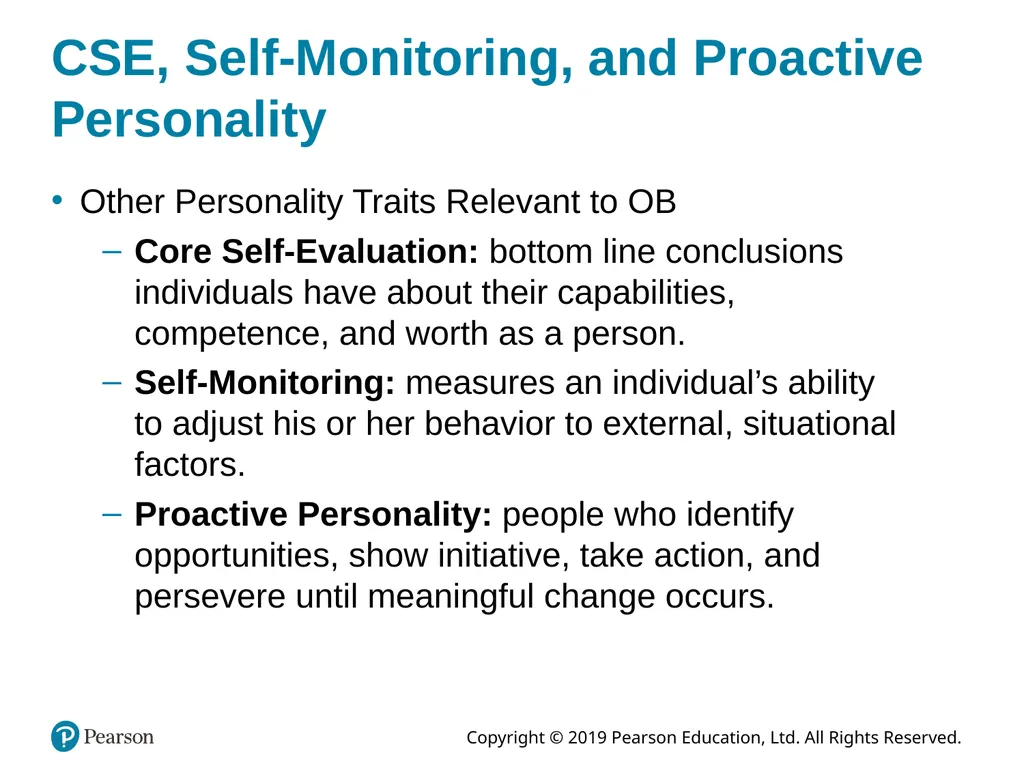
slide15. CSE, Self-Monitoring, and Proactive Personality Other Personality Traits Relevant to OB
Core Self-Evaluation: bottom line conclusions individuals have about their capabilities, competence, and worth as a person.
Self-Monitoring: measures an individual’s ability to adjust his or her behavior to external, situational factors.
Proactive Personality: people who identify opportunities, show initiative, take action, and persevere until meaningful change occurs.<br>
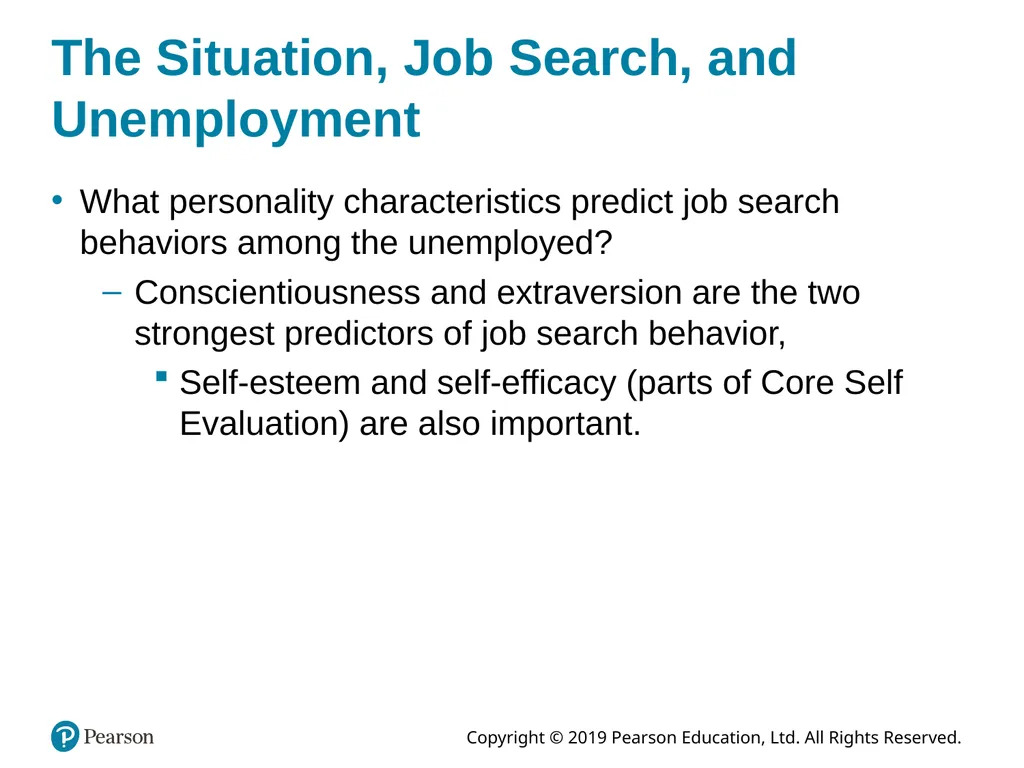
slide16. The Situation, Job Search, and Unemployment What personality characteristics predict job search behaviors among the unemployed?
Conscientiousness and extraversion are the two strongest predictors of job search behavior,
Self-esteem and self-efficacy (parts of Core Self Evaluation) are also important.<br>
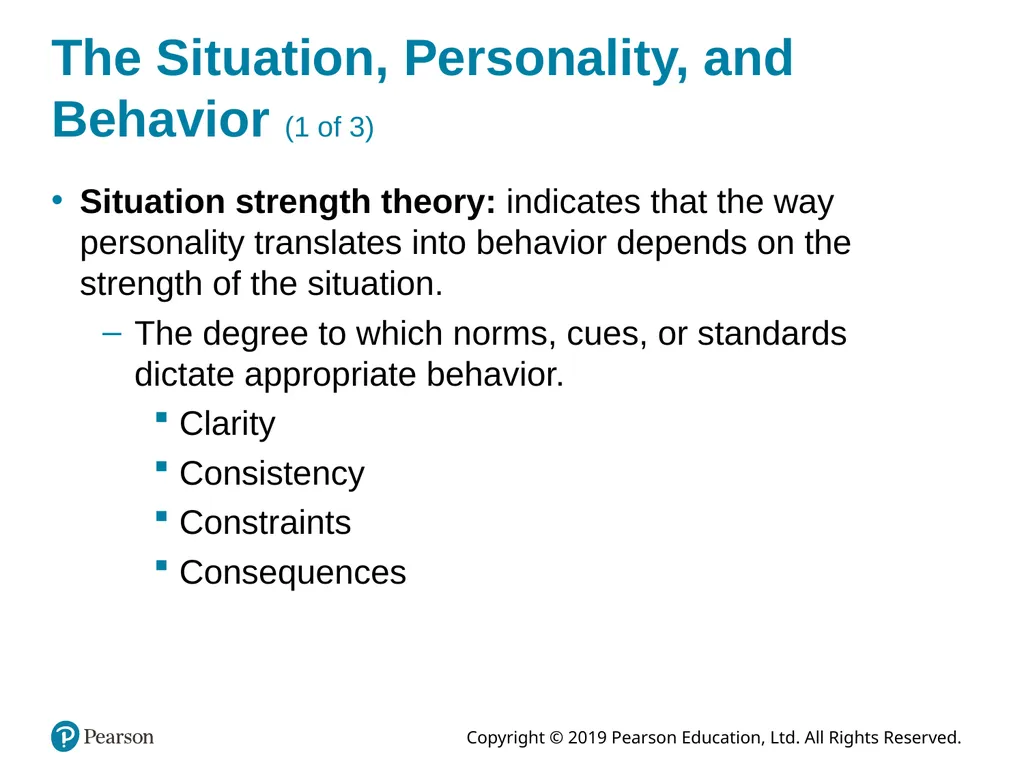
slide17. The Situation, Personality, and Behavior (1 of 3) Situation strength theory: indicates that the way personality translates into behavior depends on the strength of the situation.
The degree to which norms, cues, or standards dictate appropriate behavior.
Clarity
Consistency
Constraints
Consequences<br>
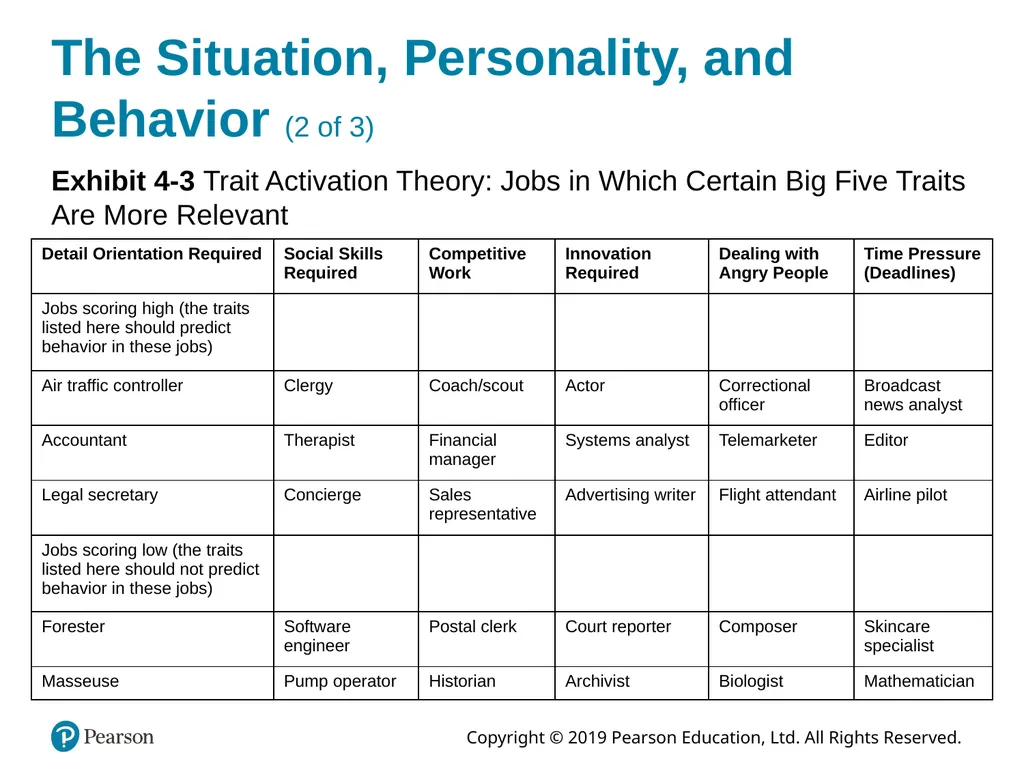
slide18. The Situation, Personality, and Behavior (2 of 3) Exhibit 4-3 Trait Activation Theory: Jobs in Which Certain Big Five Traits Are More Relevant<br>
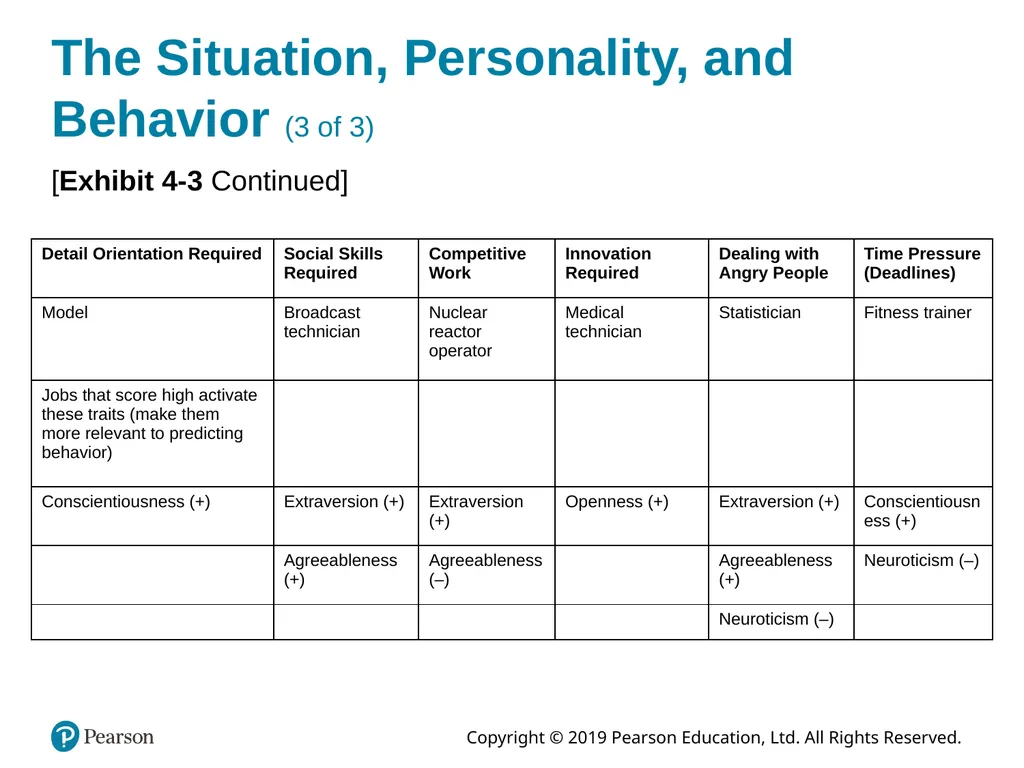
slide19. The Situation, Personality, and Behavior (3 of 3) [Exhibit 4-3 Continued]<br>
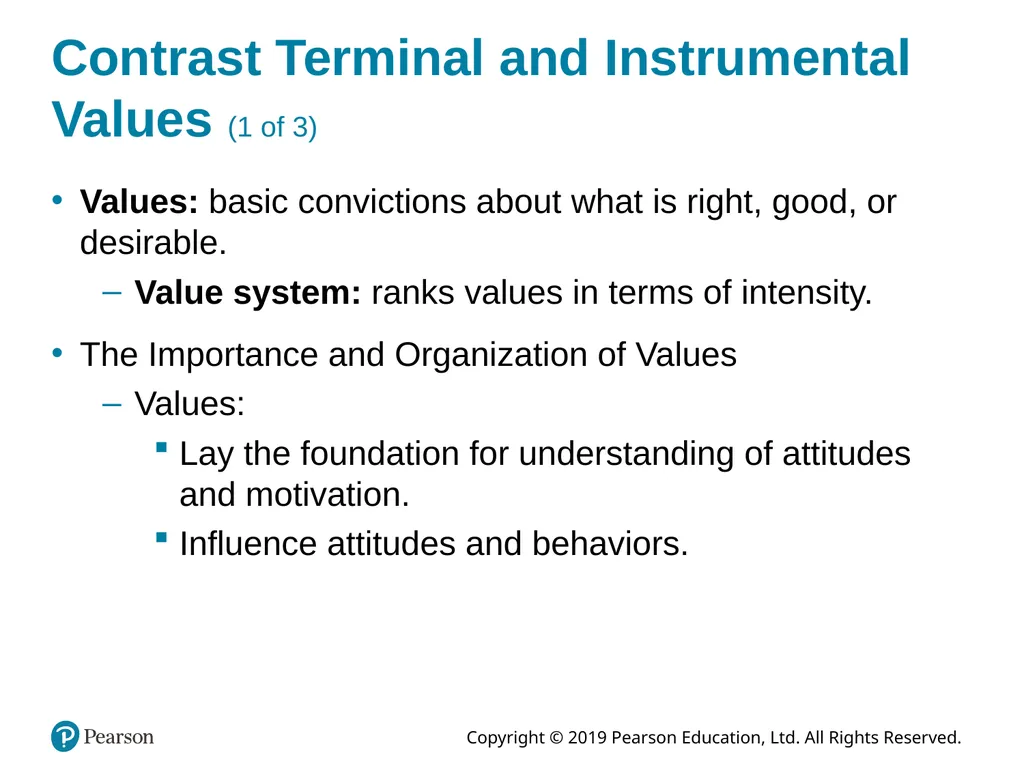
slide20. Contrast Terminal and Instrumental Values (1 of 3) Values: basic convictions about what is right, good, or desirable.
Value system: ranks values in terms of intensity.
The Importance and Organization of Values
Values:
Lay the foundation for understanding of attitudes and motivation.
Influence attitudes and behaviors.<br>
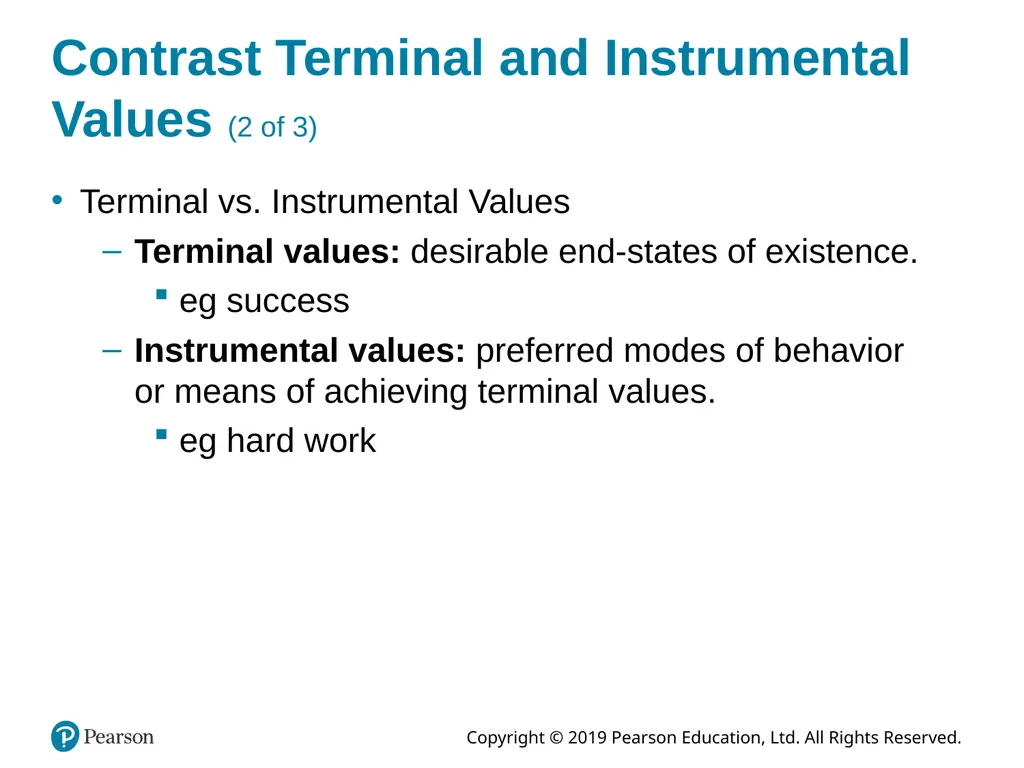
slide21. Contrast Terminal and Instrumental Values (2 of 3) Terminal vs. Instrumental Values
Terminal values: desirable end-states of existence.
eg success
Instrumental values: preferred modes of behavior or means of achieving terminal values.
eg hard work<br>
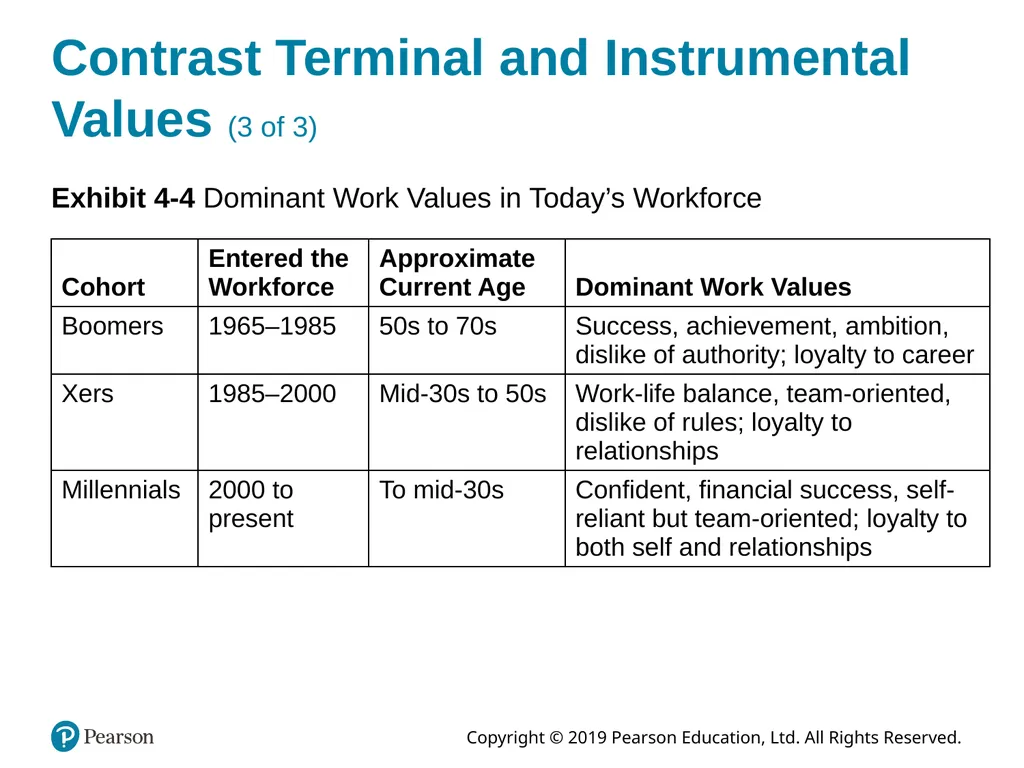
slide22. Contrast Terminal and Instrumental Values (3 of 3) Exhibit 4-4 Dominant Work Values in Today’s Workforce<br>
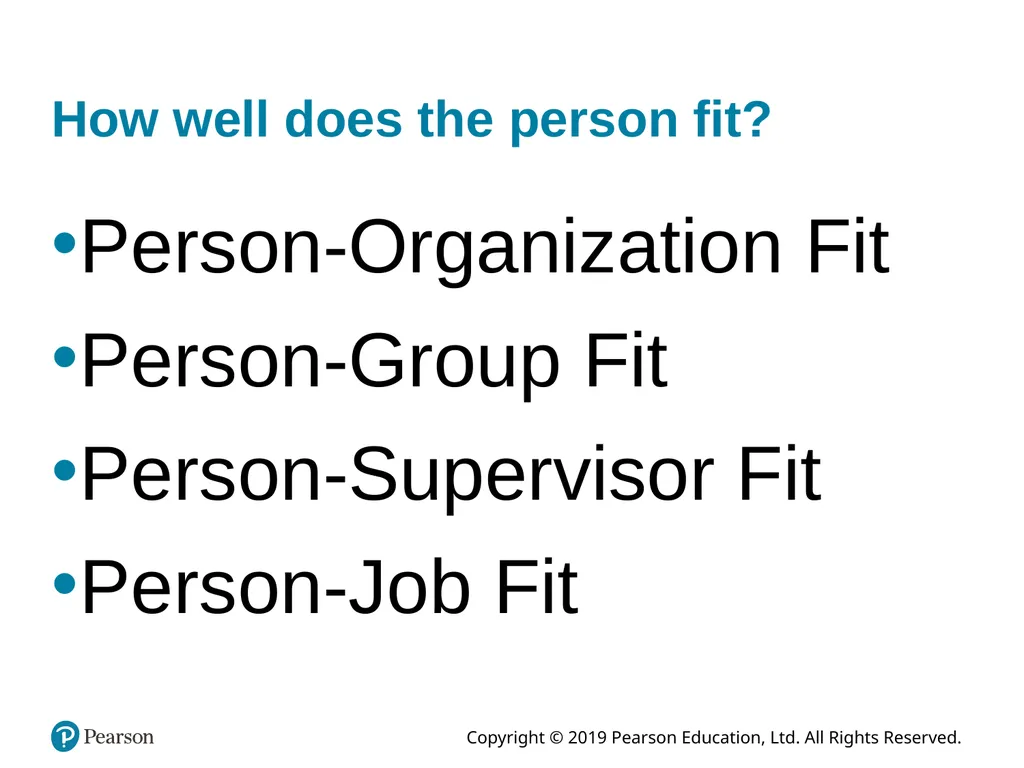
slide23. How well does the person fit? Person-Organization Fit
Person-Group Fit
Person-Supervisor Fit
Person-Job Fit<br>
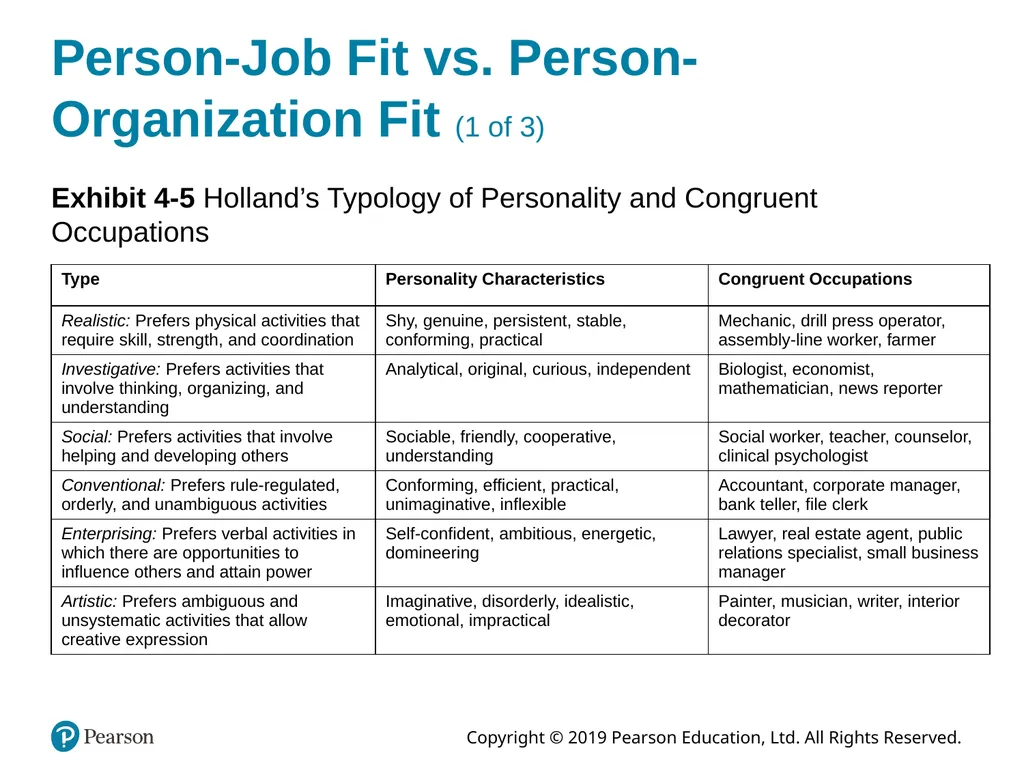
slide24. Person-Job Fit vs. Person-Organization Fit (1 of 3) Exhibit 4-5 Holland’s Typology of Personality and Congruent Occupations<br>
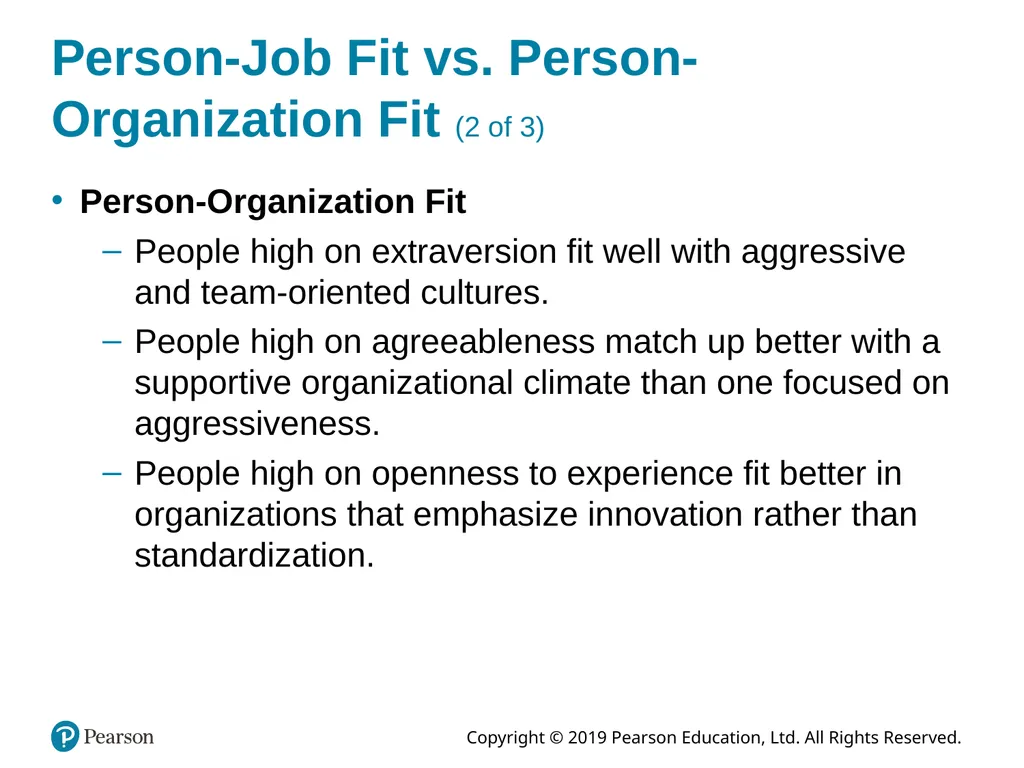
slide25. Person-Job Fit vs. Person-Organization Fit (2 of 3) Person-Organization Fit
People high on extraversion fit well with aggressive and team-oriented cultures.
People high on agreeableness match up better with a supportive organizational climate than one focused on aggressiveness.
People high on openness to experience fit better in organizations that emphasize innovation rather than standardization.<br>
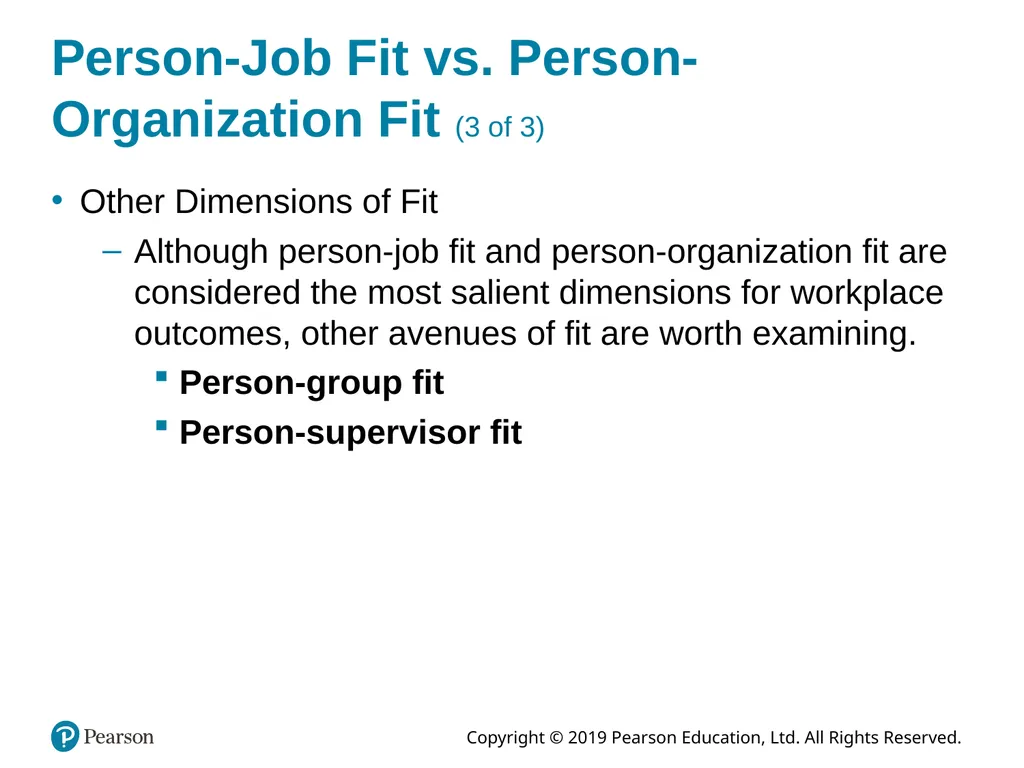
slide26. Person-Job Fit vs. Person-Organization Fit (3 of 3) Other Dimensions of Fit
Although person-job fit and person-organization fit are considered the most salient dimensions for workplace outcomes, other avenues of fit are worth examining.
Person-group fit
Person-supervisor fit<br>
slide27. Hofstede’s Five Value Dimensions and GLOBE (1 of 2) Hofstede’s Framework
Power distance
Individualism versus collectivism
Masculinity versus femininity
Uncertainty avoidance
Long-term versus short-term orientation
How do you rate Kuwait in each of these?<br>
slide28. Hofstede’s Five Value Dimensions and GLOBE (2 of 2) The GLOBE Framework for Assessing Culture (2014)
The Global Leadership and Organizational Behavior Effectiveness (GLOBE) research program updated Hofstede’s research.
Data from 825 organizations and 62 countries.
Used variables similar to Hofstede’s.
Added some news ones.
https://globeproject.com<br>
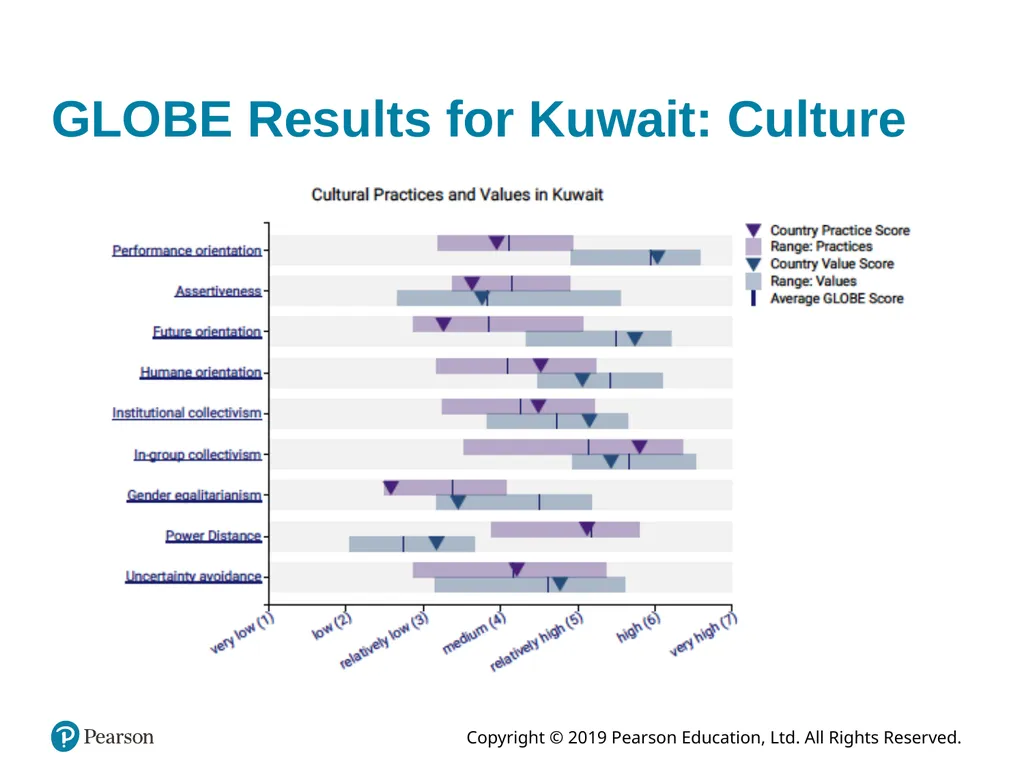
slide29. GLOBE Results for Kuwait: Culture<br>
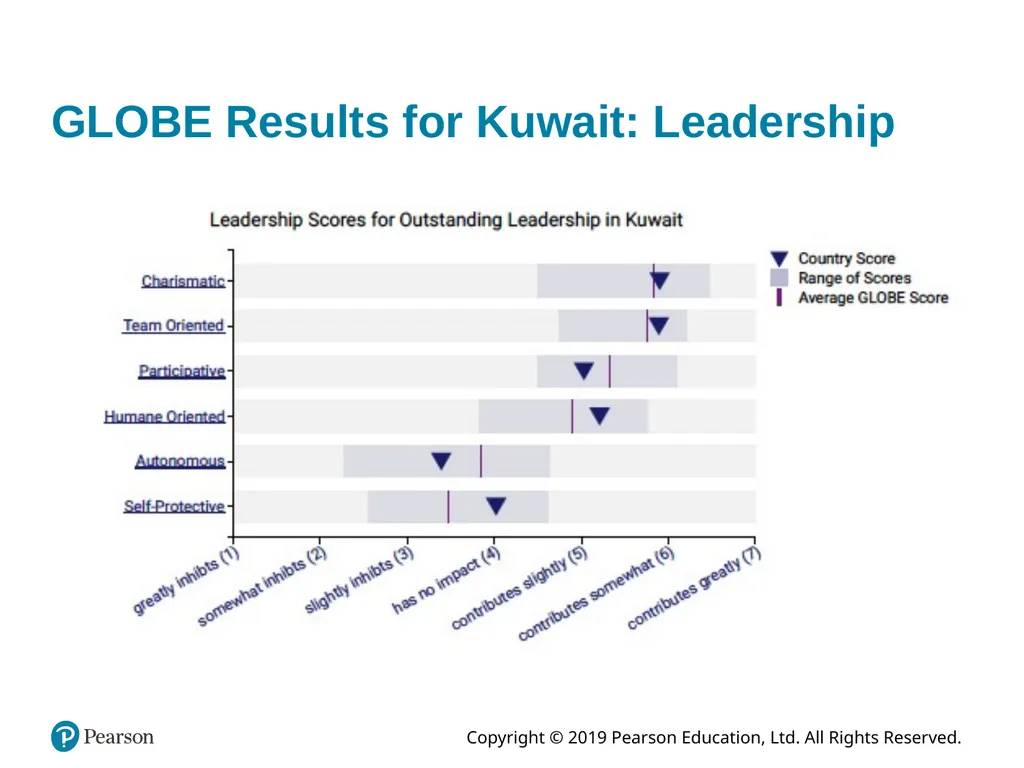
slide30. GLOBE Results for Kuwait: Leadership<br>
slide31. Implications for Managers (1 of 2) Consider screening job candidates for high conscientiousness—and the other Big Five traits—depending on the criteria your organization finds most important. Other aspects, such as core self-evaluation or narcissism, may be relevant in certain situations.
Although the MBTI has faults, you can use it for training and development; to help employees better understand each other, open communication in work groups, and possibly reduce conflicts.<br>
slide32. Implications for Managers (2 of 2) Evaluate jobs, work groups, and your organization to determine the optimal personality fit.
Consider situational factors when evaluating observable personality traits, and lower the situation strength to better ascertain personality characteristics more closely.
The more you consider people’s different cultures, the better you will be able to determine their work behavior and create a positive organizational climate that performs well.<br>
slide33. Learning Objectives (1 of 2) 4.1 Describe personality, the way it is measured, and the factors that shape it.
4.2 Describe the strengths and weaknesses of the Myers-Briggs Type Indicator (MBTI) personality framework and the Big Five model.
4.3 Discuss how the concepts of core self-evaluation (CSE), self-monitoring, and proactive personality contribute to the understanding of personality.
4.4 Describe how personality affects job search and unemployment.<br>
slide34. Learning Objectives (2 of 2) 4.5 Describe how the situation affects whether personality predicts behavior.
4.6 Contrast terminal and instrumental values.
4.7 Describe the differences between person-job fit and person-organization fit.
4.8 Compare Hofstede’s five value dimensions and the GLOBE framework.<br>
slide35. Questions Consider Hofstede’s Five Dimensions in more detail and think about them in Kuwait.
Look at the Generations Defined for a more clear idea of differences between age gaps.
Do the Big Five questionnaire after class and include result summary in your journal.
Do the Myers Briggs questionnaire after class and include result summary in your journal.<br>
slide2. Learning Objectives (1 of 2) 4.1 Describe personality, the way it is measured, and the factors that shape it.
4.2 Describe the strengths and weaknesses of the Myers-Briggs Type Indicator (MBTI) personality framework and the Big Five model.
4.3 Discuss how the concepts of core self-evaluation (CSE), self-monitoring, and proactive personality contribute to the understanding of personality.
4.4 Describe how personality affects job search and unemployment.<br>
slide3. Learning Objectives (2 of 2) 4.5 Describe how the situation affects whether personality predicts behavior.
4.6 Contrast terminal and instrumental values.
4.7 Describe the differences between person-job fit and person-organization fit.
4.8 Compare Hofstede’s five value dimensions and the GLOBE framework.<br>
slide4. Describe Personality, the Way It Is Measured, and the Factors that Shape It (1 of 4) Defining Personality
Personality is a dynamic concept describing the growth and development of a person’s whole psychological system.
The sum of ways in which an individual reacts to and interacts with others.<br>
slide5. Describe Personality, the Way It Is Measured, and the Factors that Shape It (2 of 4) Measuring Personality
Managers need to know how to measure personality.
Personality tests are useful in hiring decisions and help managers forecast who is best for a job.
The most common means of measuring personality is through self-report surveys.<br>
slide6. Describe Personality, the Way It Is Measured, and the Factors that Shape It (3 of 4) Personality Determinants
Is personality the result of heredity or environment?
The debate is about nature vs nurture.
Heredity refers to those factors that were determined at conception.
The heredity approach argues that the ultimate explanation of an individual’s personality is the molecular structure of the genes, located in the chromosomes.<br>
slide7. Describe Personality, the Way It Is Measured, and the Factors that Shape It (4 of 4) Early research tried to identify and label enduring personality characteristics.
Shy, aggressive, submissive, lazy, ambitious, loyal, and timid.
These are personality traits.<br>
slide8. Strengths and Weakness of the MBTI and Big Five Model (1 of 7) The most widely used personality framework is the Myers-Briggs Type Indicator (MBTI).
Individuals are classified as:
Extroverted or Introverted (E or I)
Sensing or Intuitive (S or N)
Thinking or Feeling (T or F)
Perceiving or Judging (P or J)
INTJs are visionaries.
ESTJs are organizers.
ENTPs are conceptualizers.<br>
slide9. Strengths and Weakness of the MBTI and Big Five Model (2 of 7) The Big Five Model
Extraversion
Agreeableness
Conscientiousness
Emotional stability
Openness to experience<br>
slide10. Strengths and Weakness of the MBTI and Big Five Model (3 of 7) Exhibit 4-1 Traits That Matter Most to Business Success at Buyout Companies Source: Based on S. N. Kaplan, M. M. Klebanov, and M. Sorensen, “Which CEO Characteristics and Abilities Matter?” The Journal of Finance 67, no. 3 (2012): 973–1007.<br>
slide11. Strengths and Weakness of the MBTI and Big Five Model (4 of 7) Exhibit 4-2 Model of How Big Five Traits Influence OB Criteria<br>
slide12. Strengths and Weakness of the MBTI and Big Five Model (5 of 7) The Dark Triad
Machiavellianism: the degree to which an individual is pragmatic, maintains emotional distance, and believes that ends can justify means.
Narcissism: the tendency to be arrogant, have a grandiose sense of self-importance, require excessive admiration, and have a sense of entitlement.
Psychopathy: the tendency for a lack of concern for others and a lack of guilt or remorse when their actions cause harm.<br>
slide13. Strengths and Weakness of the MBTI and Big Five Model (6 of 7) An emerging framework to study dark side traits:
First, antisocial people are indifferent and callous toward others.
Second, borderline people have low self-esteem and high uncertainty.<br>
slide14. Strengths and Weakness of the MBTI and Big Five Model (7 of 7) Third, schizotypal individuals are eccentric and disorganized.
Fourth, obsessive compulsive people are perfectionists and can be stubborn, yet they attend to details, carry a strong work ethic, and may be motivated by achievement.
Fifth, avoidant individuals feel inadequate and hate criticism.<br>
slide15. CSE, Self-Monitoring, and Proactive Personality Other Personality Traits Relevant to OB
Core Self-Evaluation: bottom line conclusions individuals have about their capabilities, competence, and worth as a person.
Self-Monitoring: measures an individual’s ability to adjust his or her behavior to external, situational factors.
Proactive Personality: people who identify opportunities, show initiative, take action, and persevere until meaningful change occurs.<br>
slide16. The Situation, Job Search, and Unemployment What personality characteristics predict job search behaviors among the unemployed?
Conscientiousness and extraversion are the two strongest predictors of job search behavior,
Self-esteem and self-efficacy (parts of Core Self Evaluation) are also important.<br>
slide17. The Situation, Personality, and Behavior (1 of 3) Situation strength theory: indicates that the way personality translates into behavior depends on the strength of the situation.
The degree to which norms, cues, or standards dictate appropriate behavior.
Clarity
Consistency
Constraints
Consequences<br>
slide18. The Situation, Personality, and Behavior (2 of 3) Exhibit 4-3 Trait Activation Theory: Jobs in Which Certain Big Five Traits Are More Relevant<br>
slide19. The Situation, Personality, and Behavior (3 of 3) [Exhibit 4-3 Continued]<br>
slide20. Contrast Terminal and Instrumental Values (1 of 3) Values: basic convictions about what is right, good, or desirable.
Value system: ranks values in terms of intensity.
The Importance and Organization of Values
Values:
Lay the foundation for understanding of attitudes and motivation.
Influence attitudes and behaviors.<br>
slide21. Contrast Terminal and Instrumental Values (2 of 3) Terminal vs. Instrumental Values
Terminal values: desirable end-states of existence.
eg success
Instrumental values: preferred modes of behavior or means of achieving terminal values.
eg hard work<br>
slide22. Contrast Terminal and Instrumental Values (3 of 3) Exhibit 4-4 Dominant Work Values in Today’s Workforce<br>
slide23. How well does the person fit? Person-Organization Fit
Person-Group Fit
Person-Supervisor Fit
Person-Job Fit<br>
slide24. Person-Job Fit vs. Person-Organization Fit (1 of 3) Exhibit 4-5 Holland’s Typology of Personality and Congruent Occupations<br>
slide25. Person-Job Fit vs. Person-Organization Fit (2 of 3) Person-Organization Fit
People high on extraversion fit well with aggressive and team-oriented cultures.
People high on agreeableness match up better with a supportive organizational climate than one focused on aggressiveness.
People high on openness to experience fit better in organizations that emphasize innovation rather than standardization.<br>
slide26. Person-Job Fit vs. Person-Organization Fit (3 of 3) Other Dimensions of Fit
Although person-job fit and person-organization fit are considered the most salient dimensions for workplace outcomes, other avenues of fit are worth examining.
Person-group fit
Person-supervisor fit<br>
slide27. Hofstede’s Five Value Dimensions and GLOBE (1 of 2) Hofstede’s Framework
Power distance
Individualism versus collectivism
Masculinity versus femininity
Uncertainty avoidance
Long-term versus short-term orientation
How do you rate Kuwait in each of these?<br>
slide28. Hofstede’s Five Value Dimensions and GLOBE (2 of 2) The GLOBE Framework for Assessing Culture (2014)
The Global Leadership and Organizational Behavior Effectiveness (GLOBE) research program updated Hofstede’s research.
Data from 825 organizations and 62 countries.
Used variables similar to Hofstede’s.
Added some news ones.
https://globeproject.com<br>
slide29. GLOBE Results for Kuwait: Culture<br>
slide30. GLOBE Results for Kuwait: Leadership<br>
slide31. Implications for Managers (1 of 2) Consider screening job candidates for high conscientiousness—and the other Big Five traits—depending on the criteria your organization finds most important. Other aspects, such as core self-evaluation or narcissism, may be relevant in certain situations.
Although the MBTI has faults, you can use it for training and development; to help employees better understand each other, open communication in work groups, and possibly reduce conflicts.<br>
slide32. Implications for Managers (2 of 2) Evaluate jobs, work groups, and your organization to determine the optimal personality fit.
Consider situational factors when evaluating observable personality traits, and lower the situation strength to better ascertain personality characteristics more closely.
The more you consider people’s different cultures, the better you will be able to determine their work behavior and create a positive organizational climate that performs well.<br>
slide33. Learning Objectives (1 of 2) 4.1 Describe personality, the way it is measured, and the factors that shape it.
4.2 Describe the strengths and weaknesses of the Myers-Briggs Type Indicator (MBTI) personality framework and the Big Five model.
4.3 Discuss how the concepts of core self-evaluation (CSE), self-monitoring, and proactive personality contribute to the understanding of personality.
4.4 Describe how personality affects job search and unemployment.<br>
slide34. Learning Objectives (2 of 2) 4.5 Describe how the situation affects whether personality predicts behavior.
4.6 Contrast terminal and instrumental values.
4.7 Describe the differences between person-job fit and person-organization fit.
4.8 Compare Hofstede’s five value dimensions and the GLOBE framework.<br>
slide35. Questions Consider Hofstede’s Five Dimensions in more detail and think about them in Kuwait.
Look at the Generations Defined for a more clear idea of differences between age gaps.
Do the Big Five questionnaire after class and include result summary in your journal.
Do the Myers Briggs questionnaire after class and include result summary in your journal.<br>