
Osmotic Fragility Test Physiology Lab-3 Practical



Description: Osmotic Fragility Test Physiology Lab-3 Practical physiology teachers Mustansiriyah University Pharmacy College Practical Physiology 2023-2024 Second Stage osmosis Osmosis is the spontaneous net movement of solvent molecules through a
Related Topics
Download Presentation
"Osmotic Fragility Test Physiology Lab-3 Practical" is the property of its rightful owner. Permission is granted to download and print the materials on this website for personal, non-commercial use only, and to display it on your personal computer provided you do not modify the materials and that you retain all copyright notices contained in the materials. By downloading content from our website, you accept the terms of this agreement.
Presentation Transcript
slide1. Osmotic Fragility Test
Physiology Lab-3
Practical physiology teachers Mustansiriyah University / Pharmacy College Practical Physiology 2023-2024 Second Stage<br>
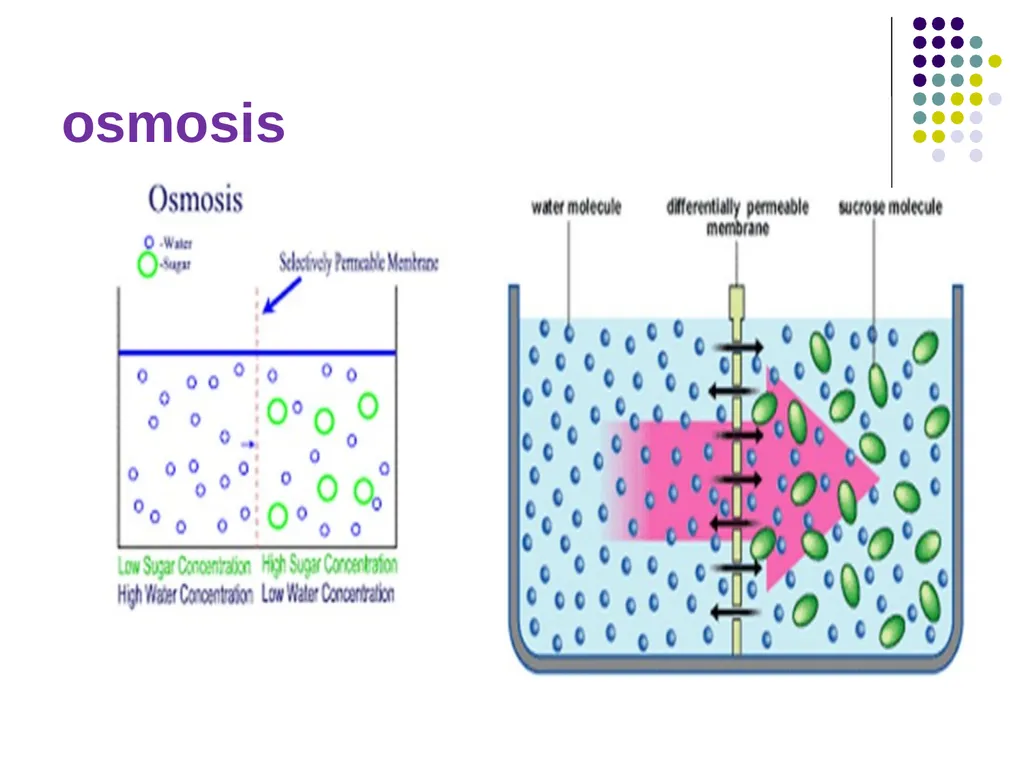
slide2. osmosis Osmosis is the spontaneous net movement of solvent molecules through a semi-permeable membrane into a region of higher solute concentration, in the direction that tends to equalize the solute concentrations on the two sides.<br>
slide3. osmosis<br>
slide4. Erythrocyte fragility Erythrocyte fragility refers to the tendency of erythrocytes (red blood cells, RBC) to hemolyse (rupture) under stress(commonly osmosis).<br>
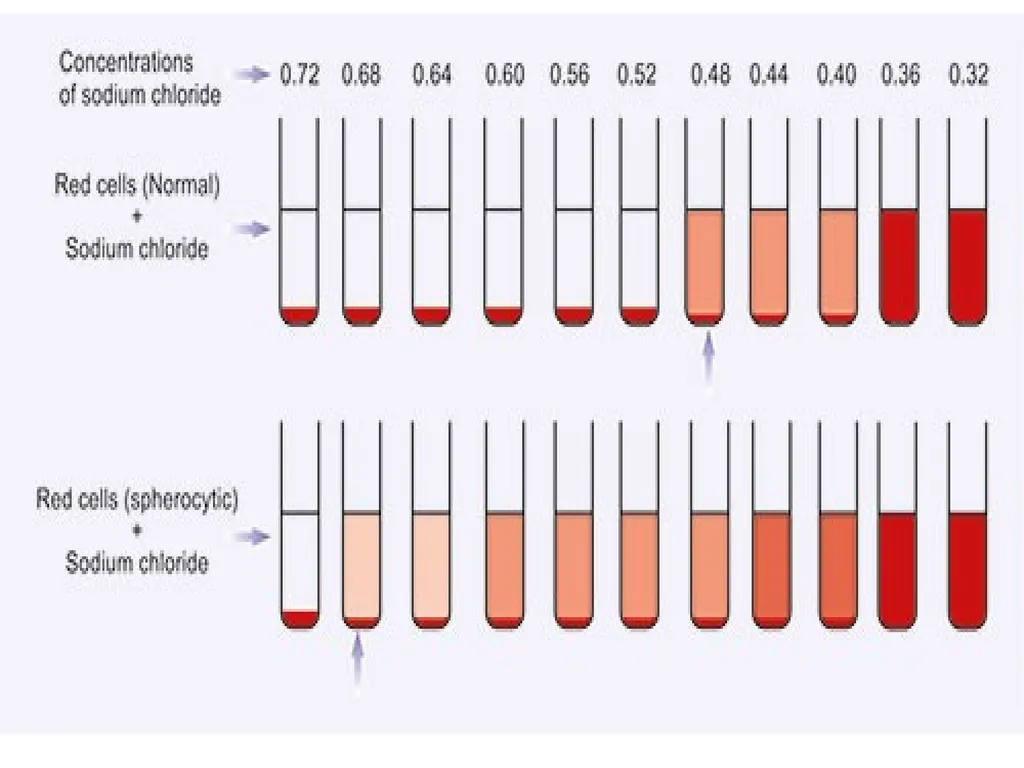
slide5. Osmotic fragility Osmotic fragility:- is a test to measures red blood cell (RBC) resistance to hemolysis when exposed to a series of increasingly dilute saline solutions. This term refers to the susceptibility of red cells to being broken down by osmotic stress.
Hemolysis:- This term refers to the breaking down (bursting) of red cells resulting in release of Hb into the surrounding fluid.
The sooner hemolysis occurs, the greater the osmotic fragility of the cells.<br>
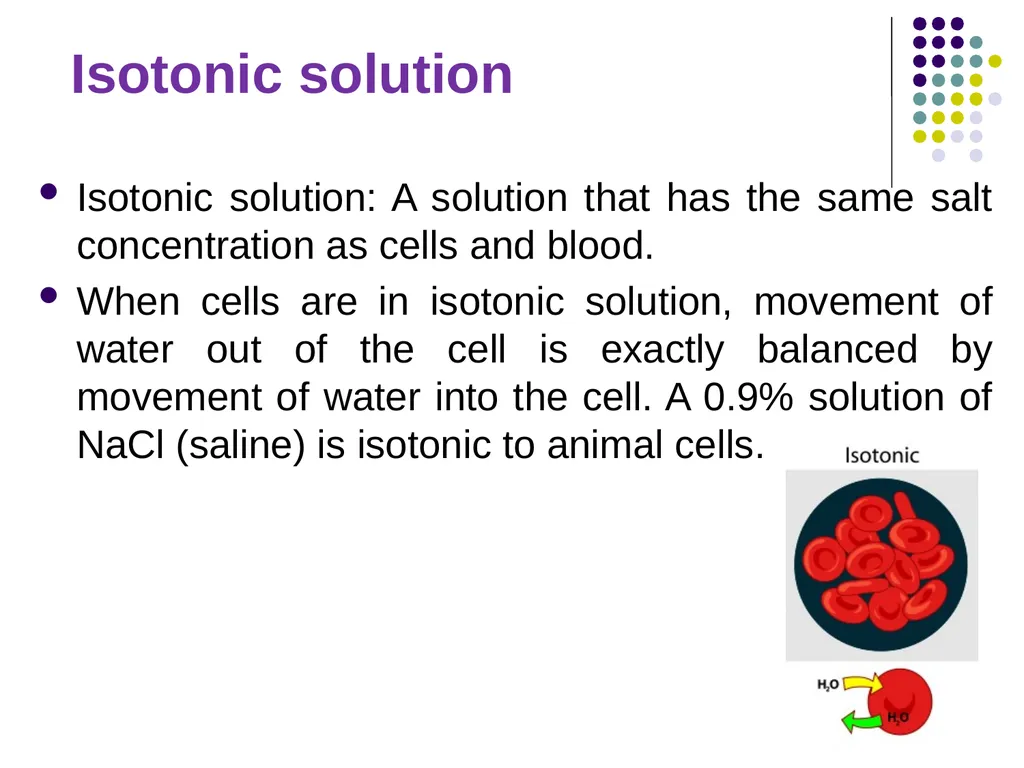
slide6. Isotonic solution Isotonic solution: A solution that has the same salt concentration as cells and blood.
When cells are in isotonic solution, movement of water out of the cell is exactly balanced by movement of water into the cell. A 0.9% solution of NaCl (saline) is isotonic to animal cells.<br>
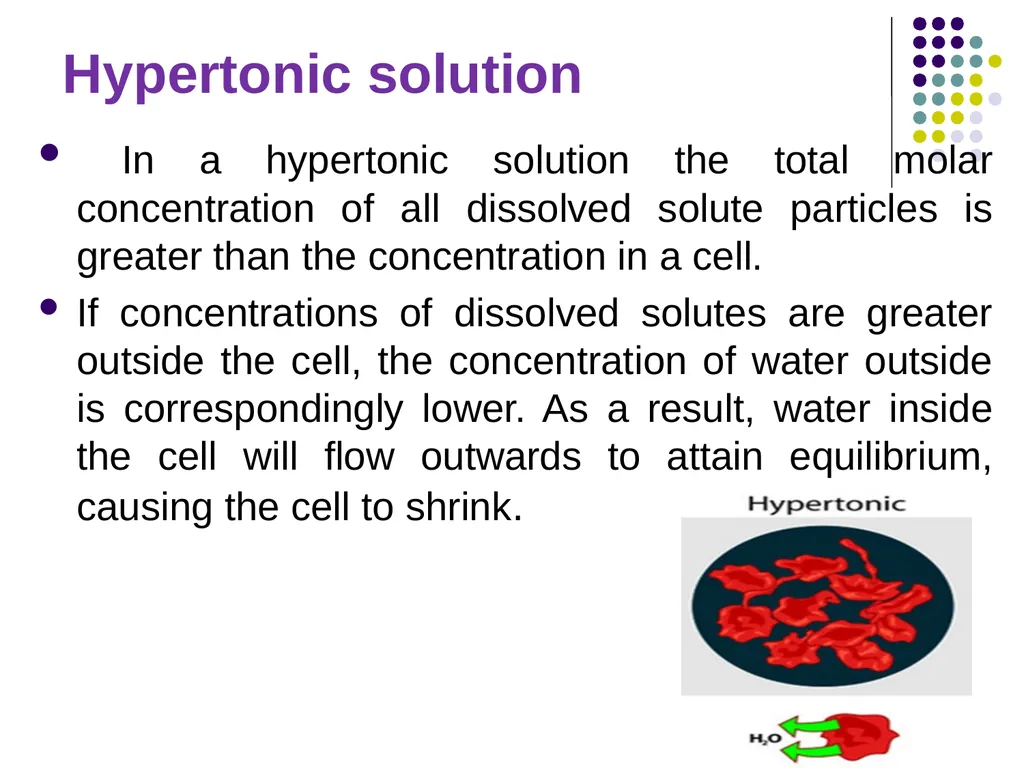
slide7. Hypertonic solution In a hypertonic solution the total molar concentration of all dissolved solute particles is greater than the concentration in a cell.
If concentrations of dissolved solutes are greater outside the cell, the concentration of water outside is correspondingly lower. As a result, water inside the cell will flow outwards to attain equilibrium, causing the cell to shrink.<br>
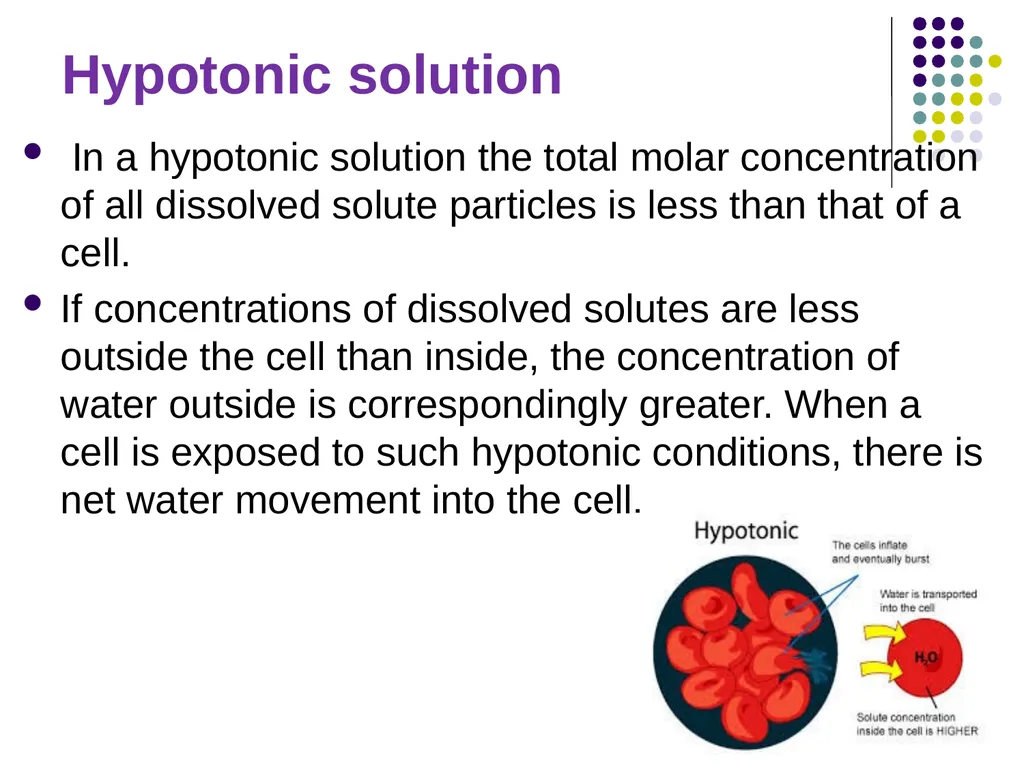
slide8. Hypotonic solution In a hypotonic solution the total molar concentration of all dissolved solute particles is less than that of a cell.
If concentrations of dissolved solutes are less outside the cell than inside, the concentration of water outside is correspondingly greater. When a cell is exposed to such hypotonic conditions, there is net water movement into the cell.<br>
slide9. PRINCIPLE
The normal red cells can remain suspended in normal saline (0.9% NaCl solution) for hours without rupturing or any change in their size or shape.
But when they are placed in decreasing strengths of hypotonic saline, they absorb water (due to osmosis) and finally burst. The ability of RBCs to resist this type of hemolysis can be determined quantitatively.<br>
slide10. Notes:
When RBC's are placed in distilled water they will swell, burst & the hemoglobin will be released and the hemoglobin will color the plasma {haemolysis}
If the RBC's are placed in 0.9%NaCl nothing happens to them because it is isotonic with the cells
If we put the RBC's in a hypertonic solution they will shrink
Factors affect the osmotic fragility:
The main factors affecting the osmotic fragility test is the shape of the RBC's which in turn is dependent on the
1. Cell membrane permeability.
2. Surface-to – volume ratio Osmotic Fragility Test<br>
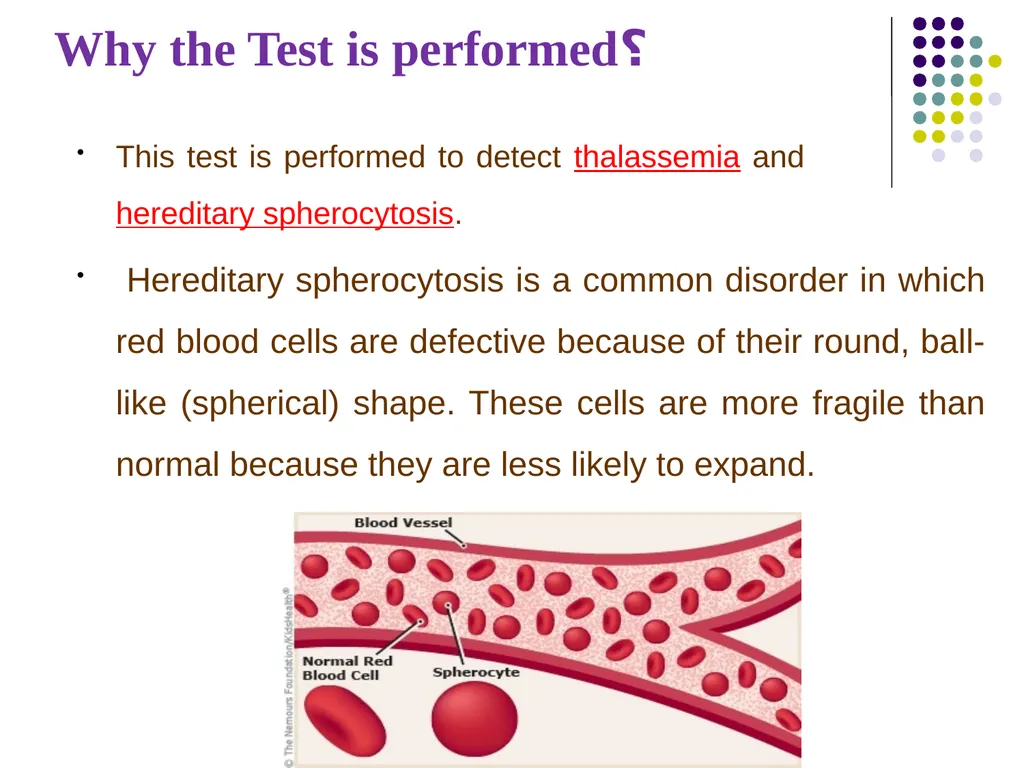
slide11. Why the Test is performed؟ This test is performed to detect thalassemia and hereditary spherocytosis.
Hereditary spherocytosis is a common disorder in which red blood cells are defective because of their round, ball-like (spherical) shape. These cells are more fragile than normal because they are less likely to expand.<br>
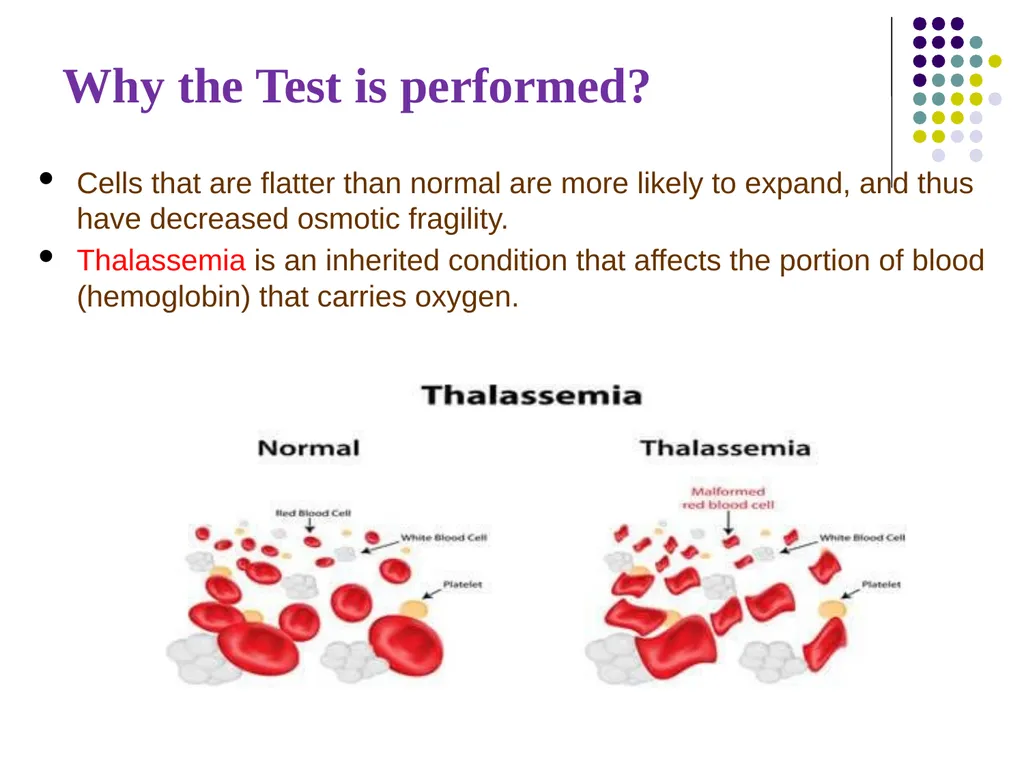
slide12. Why the Test is performed? Cells that are flatter than normal are more likely to expand, and thus have decreased osmotic fragility.
Thalassemia is an inherited condition that affects the portion of blood (hemoglobin) that carries oxygen.<br>
slide13. Why the Test is performed? The test only indicates that a proportion of the red cells have decreased surface-to-volume ratios and are more susceptible to lysis in hypo- osmotic solutions.
Cells with increased surface-to-volume ratios, such as occur in thalassemia and iron deficiency, may show decreased osmotic fragility.<br>
slide14. Osmotic Fragility Test Purpose:
1- To aid diagnosis of hereditary spherocytosis & Thalassemia.
Method
Manual osmotic fragility test
Material &instruments
1. Test tubes
2. NaCl with different concentrations
3. Heparinized venous blood
4. Distteld water<br>
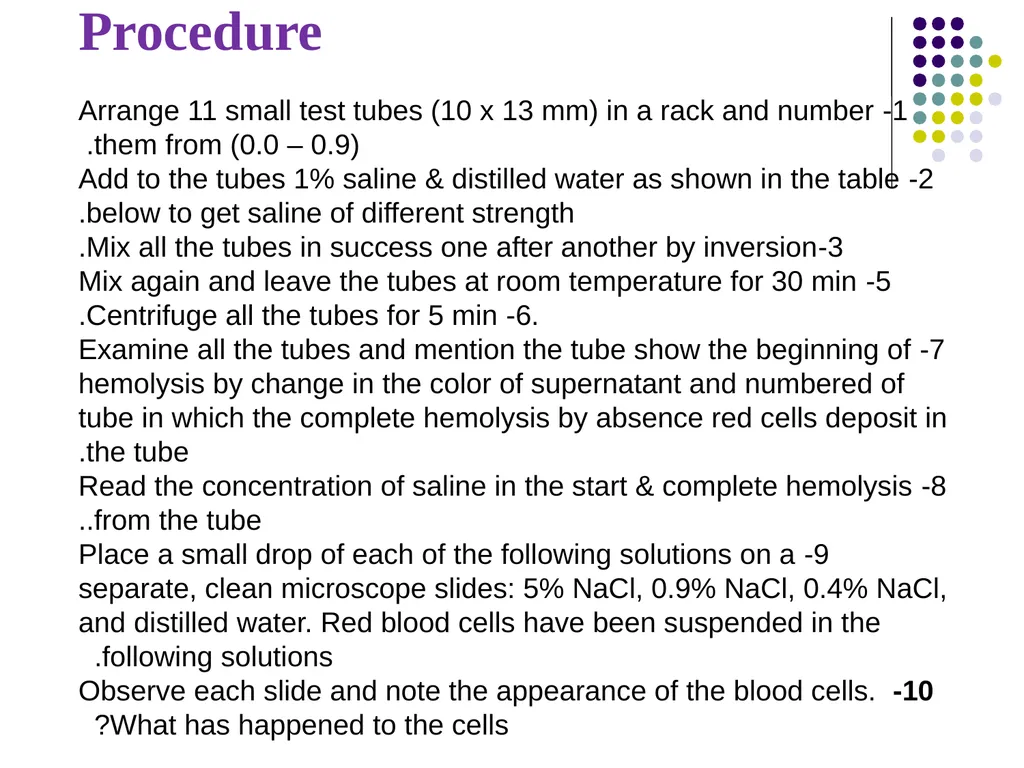
slide15. Procedure 1- Arrange 11 small test tubes (10 x 13 mm) in a rack and number them from (0.0 – 0.9).
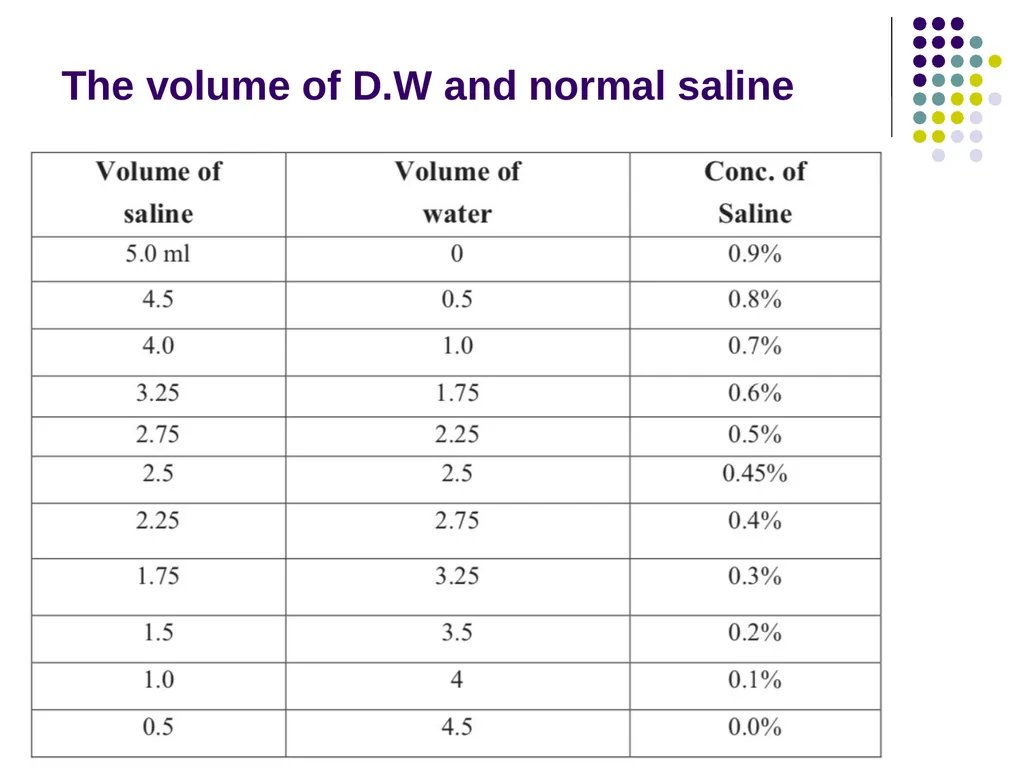
2- Add to the tubes 1% saline & distilled water as shown in the table below to get saline of different strength.
3-Mix all the tubes in success one after another by inversion.
5- Mix again and leave the tubes at room temperature for 30 min
.6- Centrifuge all the tubes for 5 min.
7- Examine all the tubes and mention the tube show the beginning of hemolysis by change in the color of supernatant and numbered of tube in which the complete hemolysis by absence red cells deposit in the tube.
8- Read the concentration of saline in the start & complete hemolysis from the tube..
9- Place a small drop of each of the following solutions on a separate, clean microscope slides: 5% NaCl, 0.9% NaCl, 0.4% NaCl, and distilled water. Red blood cells have been suspended in the following solutions.
10- Observe each slide and note the appearance of the blood cells. What has happened to the cells?<br>
slide16. The volume of D.W and normal saline<br>
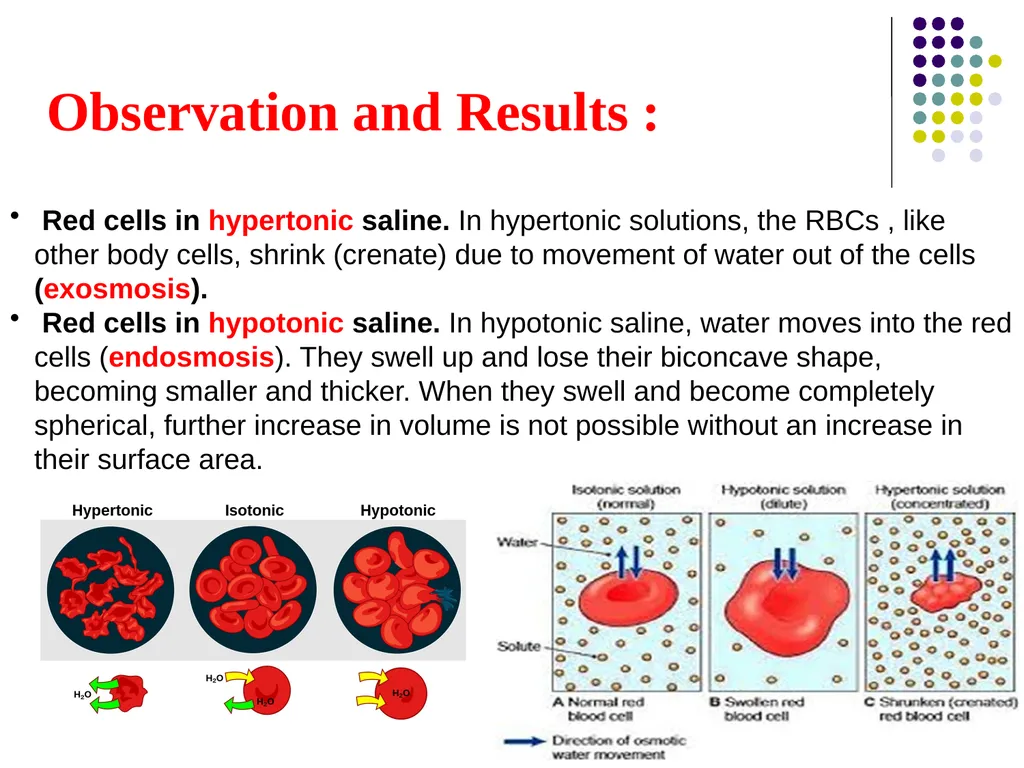
slide17. Observation and Results : Red cells in hypertonic saline. In hypertonic solutions, the RBCs , like other body cells, shrink (crenate) due to movement of water out of the cells (exosmosis).
Red cells in hypotonic saline. In hypotonic saline, water moves into the red cells (endosmosis). They swell up and lose their biconcave shape, becoming smaller and thicker. When they swell and become completely spherical, further increase in volume is not possible without an increase in their surface area.<br>
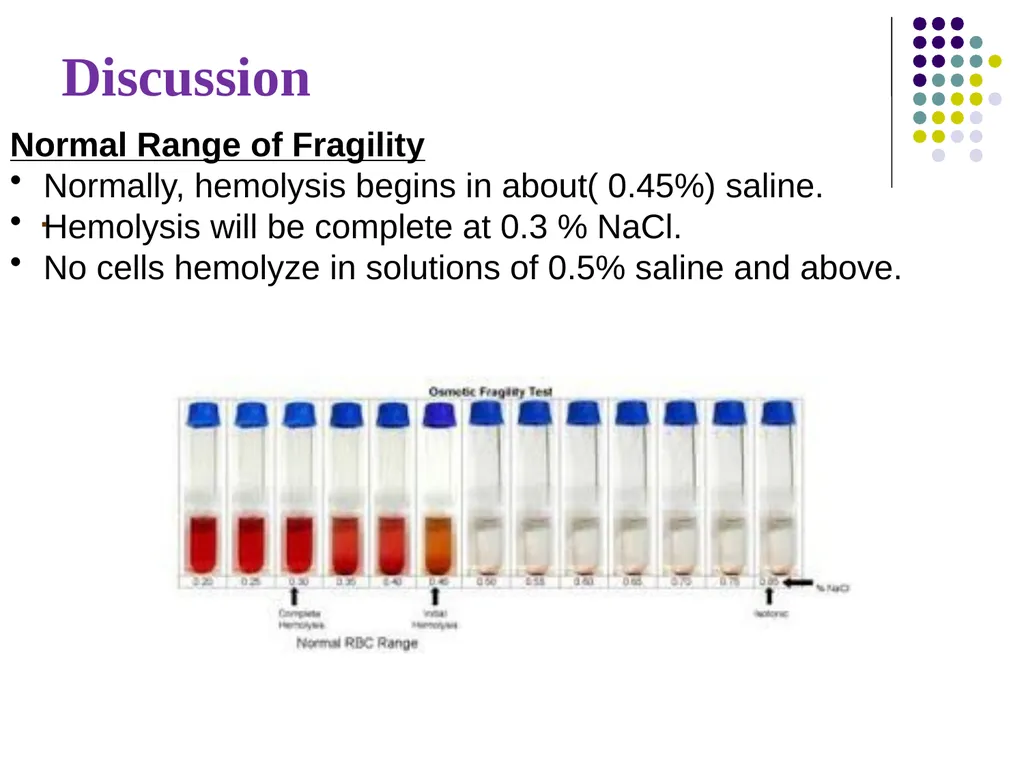
slide18. Discussion . Normal Range of Fragility
Normally, hemolysis begins in about( 0.45%) saline.
Hemolysis will be complete at 0.3 % NaCl.
No cells hemolyze in solutions of 0.5% saline and above.<br>
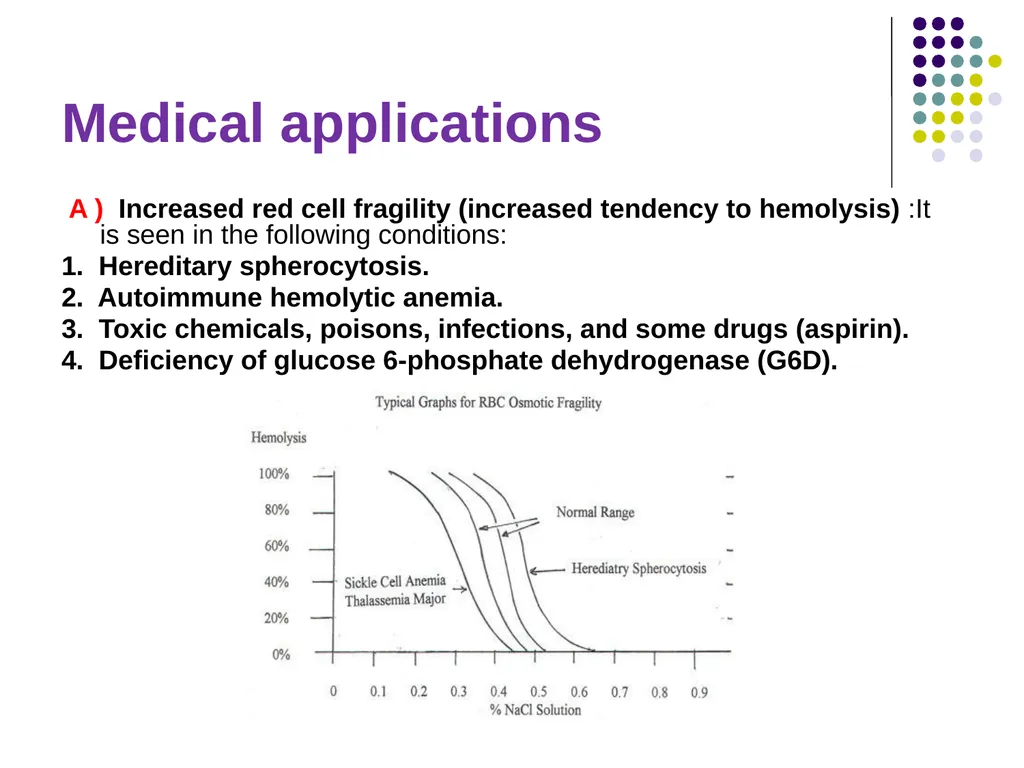
slide20. Medical applications A ) Increased red cell fragility (increased tendency to hemolysis) :It is seen in the following conditions:
1. Hereditary spherocytosis.
2. Autoimmune hemolytic anemia.
3. Toxic chemicals, poisons, infections, and some drugs (aspirin).
4. Deficiency of glucose 6-phosphate dehydrogenase (G6D).<br>
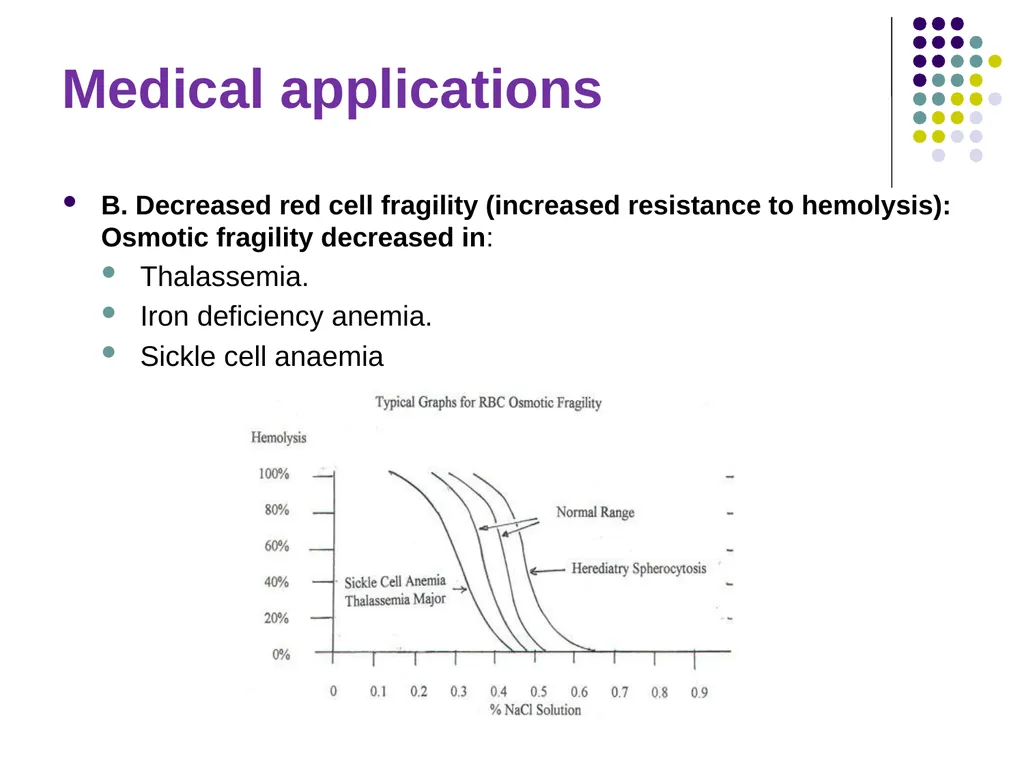
slide21. B. Decreased red cell fragility (increased resistance to hemolysis): Osmotic fragility decreased in:
Thalassemia.
Iron deficiency anemia.
Sickle cell anaemia Medical applications<br>
slide22. Physiology worksheet (Lab-3) Date---------- Names of the students: Group-------- Name of the experiment: Aim of the experiment:
Materials
Result: Draw main features of RBC in each salt concentrations
Discussion:<br>
Practical physiology teachers Mustansiriyah University / Pharmacy College Practical Physiology 2023-2024 Second Stage<br>
slide2. osmosis Osmosis is the spontaneous net movement of solvent molecules through a semi-permeable membrane into a region of higher solute concentration, in the direction that tends to equalize the solute concentrations on the two sides.<br>
slide3. osmosis<br>
slide4. Erythrocyte fragility Erythrocyte fragility refers to the tendency of erythrocytes (red blood cells, RBC) to hemolyse (rupture) under stress(commonly osmosis).<br>
slide5. Osmotic fragility Osmotic fragility:- is a test to measures red blood cell (RBC) resistance to hemolysis when exposed to a series of increasingly dilute saline solutions. This term refers to the susceptibility of red cells to being broken down by osmotic stress.
Hemolysis:- This term refers to the breaking down (bursting) of red cells resulting in release of Hb into the surrounding fluid.
The sooner hemolysis occurs, the greater the osmotic fragility of the cells.<br>
slide6. Isotonic solution Isotonic solution: A solution that has the same salt concentration as cells and blood.
When cells are in isotonic solution, movement of water out of the cell is exactly balanced by movement of water into the cell. A 0.9% solution of NaCl (saline) is isotonic to animal cells.<br>
slide7. Hypertonic solution In a hypertonic solution the total molar concentration of all dissolved solute particles is greater than the concentration in a cell.
If concentrations of dissolved solutes are greater outside the cell, the concentration of water outside is correspondingly lower. As a result, water inside the cell will flow outwards to attain equilibrium, causing the cell to shrink.<br>
slide8. Hypotonic solution In a hypotonic solution the total molar concentration of all dissolved solute particles is less than that of a cell.
If concentrations of dissolved solutes are less outside the cell than inside, the concentration of water outside is correspondingly greater. When a cell is exposed to such hypotonic conditions, there is net water movement into the cell.<br>
slide9. PRINCIPLE
The normal red cells can remain suspended in normal saline (0.9% NaCl solution) for hours without rupturing or any change in their size or shape.
But when they are placed in decreasing strengths of hypotonic saline, they absorb water (due to osmosis) and finally burst. The ability of RBCs to resist this type of hemolysis can be determined quantitatively.<br>
slide10. Notes:
When RBC's are placed in distilled water they will swell, burst & the hemoglobin will be released and the hemoglobin will color the plasma {haemolysis}
If the RBC's are placed in 0.9%NaCl nothing happens to them because it is isotonic with the cells
If we put the RBC's in a hypertonic solution they will shrink
Factors affect the osmotic fragility:
The main factors affecting the osmotic fragility test is the shape of the RBC's which in turn is dependent on the
1. Cell membrane permeability.
2. Surface-to – volume ratio Osmotic Fragility Test<br>
slide11. Why the Test is performed؟ This test is performed to detect thalassemia and hereditary spherocytosis.
Hereditary spherocytosis is a common disorder in which red blood cells are defective because of their round, ball-like (spherical) shape. These cells are more fragile than normal because they are less likely to expand.<br>
slide12. Why the Test is performed? Cells that are flatter than normal are more likely to expand, and thus have decreased osmotic fragility.
Thalassemia is an inherited condition that affects the portion of blood (hemoglobin) that carries oxygen.<br>
slide13. Why the Test is performed? The test only indicates that a proportion of the red cells have decreased surface-to-volume ratios and are more susceptible to lysis in hypo- osmotic solutions.
Cells with increased surface-to-volume ratios, such as occur in thalassemia and iron deficiency, may show decreased osmotic fragility.<br>
slide14. Osmotic Fragility Test Purpose:
1- To aid diagnosis of hereditary spherocytosis & Thalassemia.
Method
Manual osmotic fragility test
Material &instruments
1. Test tubes
2. NaCl with different concentrations
3. Heparinized venous blood
4. Distteld water<br>
slide15. Procedure 1- Arrange 11 small test tubes (10 x 13 mm) in a rack and number them from (0.0 – 0.9).
2- Add to the tubes 1% saline & distilled water as shown in the table below to get saline of different strength.
3-Mix all the tubes in success one after another by inversion.
5- Mix again and leave the tubes at room temperature for 30 min
.6- Centrifuge all the tubes for 5 min.
7- Examine all the tubes and mention the tube show the beginning of hemolysis by change in the color of supernatant and numbered of tube in which the complete hemolysis by absence red cells deposit in the tube.
8- Read the concentration of saline in the start & complete hemolysis from the tube..
9- Place a small drop of each of the following solutions on a separate, clean microscope slides: 5% NaCl, 0.9% NaCl, 0.4% NaCl, and distilled water. Red blood cells have been suspended in the following solutions.
10- Observe each slide and note the appearance of the blood cells. What has happened to the cells?<br>
slide16. The volume of D.W and normal saline<br>
slide17. Observation and Results : Red cells in hypertonic saline. In hypertonic solutions, the RBCs , like other body cells, shrink (crenate) due to movement of water out of the cells (exosmosis).
Red cells in hypotonic saline. In hypotonic saline, water moves into the red cells (endosmosis). They swell up and lose their biconcave shape, becoming smaller and thicker. When they swell and become completely spherical, further increase in volume is not possible without an increase in their surface area.<br>
slide18. Discussion . Normal Range of Fragility
Normally, hemolysis begins in about( 0.45%) saline.
Hemolysis will be complete at 0.3 % NaCl.
No cells hemolyze in solutions of 0.5% saline and above.<br>
slide20. Medical applications A ) Increased red cell fragility (increased tendency to hemolysis) :It is seen in the following conditions:
1. Hereditary spherocytosis.
2. Autoimmune hemolytic anemia.
3. Toxic chemicals, poisons, infections, and some drugs (aspirin).
4. Deficiency of glucose 6-phosphate dehydrogenase (G6D).<br>
slide21. B. Decreased red cell fragility (increased resistance to hemolysis): Osmotic fragility decreased in:
Thalassemia.
Iron deficiency anemia.
Sickle cell anaemia Medical applications<br>
slide22. Physiology worksheet (Lab-3) Date---------- Names of the students: Group-------- Name of the experiment: Aim of the experiment:
Materials
Result: Draw main features of RBC in each salt concentrations
Discussion:<br>