OUR 2024 Bioinformatics Workshop Friday June 14th:
Description: OUR 2024 Bioinformatics Workshop Friday June 14th: 8AM PST TO 1PM PST (11AM EST TO 4PM EST) Zoom Link: MOLECULAR Life Sciences is inviting you to a scheduled Zoom meeting. Topic: June 14th Bioinformatics Workshop Time: Jun 14, 2024 08:00 AM
Related Topics
Download Presentation
"OUR 2024 Bioinformatics Workshop Friday June 14th:" is the property of its rightful owner. Permission is granted to download and print the materials on this website for personal, non-commercial use only, and to display it on your personal computer provided you do not modify the materials and that you retain all copyright notices contained in the materials. By downloading content from our website, you accept the terms of this agreement.
Presentation Transcript
slide1. OUR 2024 Bioinformatics Workshop Friday June 14th:
8AM PST TO 1PM PST (11AM EST TO 4PM EST)
Zoom Link:
MOLECULAR Life Sciences is inviting you to a scheduled Zoom meeting.
Topic: June 14th Bioinformatics Workshop
Time: Jun 14, 2024 08:00 AM Pacific Time (US and Canada)
Join Zoom Meeting
https://us02web.zoom.us/j/86248952486?pwd=Pkz6FXSCJwz1Nre7HuoerIjF4Wpaoj.1
Meeting ID: 862 4895 2486
Passcode: 802153<br>
slide2. From a Protein Sequence to Structure and Function Predications: Suitable for Faculty or Students
This workshop will illustrate the types of structural information that can be gleaned from protein sequence information, including secondary, tertiary and quaternary structures, stability and flexibility as well as exploring predications of post-translational modification, domain and tertiary structure, protein-protein interactions and potential function.
All approaches discussed are available on free publically accessible web servers<br>
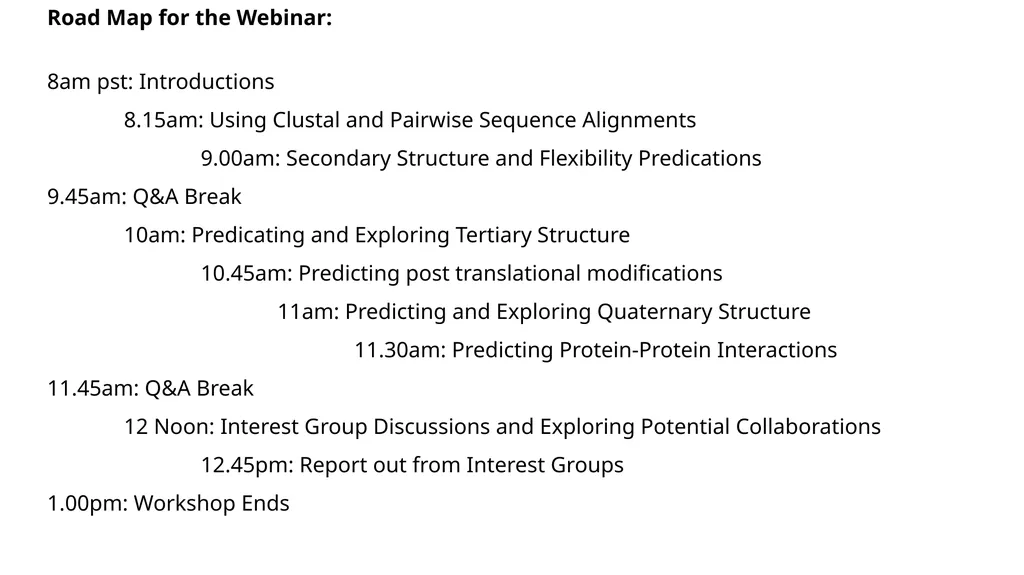
slide3. Road Map for the Webinar:
8am pst: Introductions
8.15am: Using Clustal and Pairwise Sequence Alignments
9.00am: Secondary Structure and Flexibility Predications
9.45am: Q&A Break
10am: Predicating and Exploring Tertiary Structure
10.45am: Predicting post translational modifications
11am: Predicting and Exploring Quaternary Structure
11.30am: Predicting Protein-Protein Interactions
11.45am: Q&A Break
12 Noon: Interest Group Discussions and Exploring Potential Collaborations
12.45pm: Report out from Interest Groups
1.00pm: Workshop Ends<br>
slide4. Macromolecular Structure Visualization Programs
PyMol: https://www.pymol.org/
PyMol Users Guide: https://pymol.sourceforge.net/newman/userman.pdf
Getting Pymol for Educational Use: https://pymol.org/edu/
PyMol Tutorials
https://dasher.wustl.edu/bio5357/software/pymol/simple-tutorial.pdf
https://sites.pitt.edu/~epolinko/IntroPyMOL.pdf
https://fitzkee.chemistry.msstate.edu/sites/default/files/ch4403/pymol-tutorial.pdf
Chimera: https://www.cgl.ucsf.edu/chimera/
Getting Chimera: https://www.cgl.ucsf.edu/chimera/download.html
Chimera Tutorials
https://www.cgl.ucsf.edu/chimera/tutorials.html
https://pdb101.rcsb.org/learn/videos/visualizing-pdb-structures-with-ucsf-chimera
https://osf.io/82n73/wiki/Chimera%20Tutorials/<br>
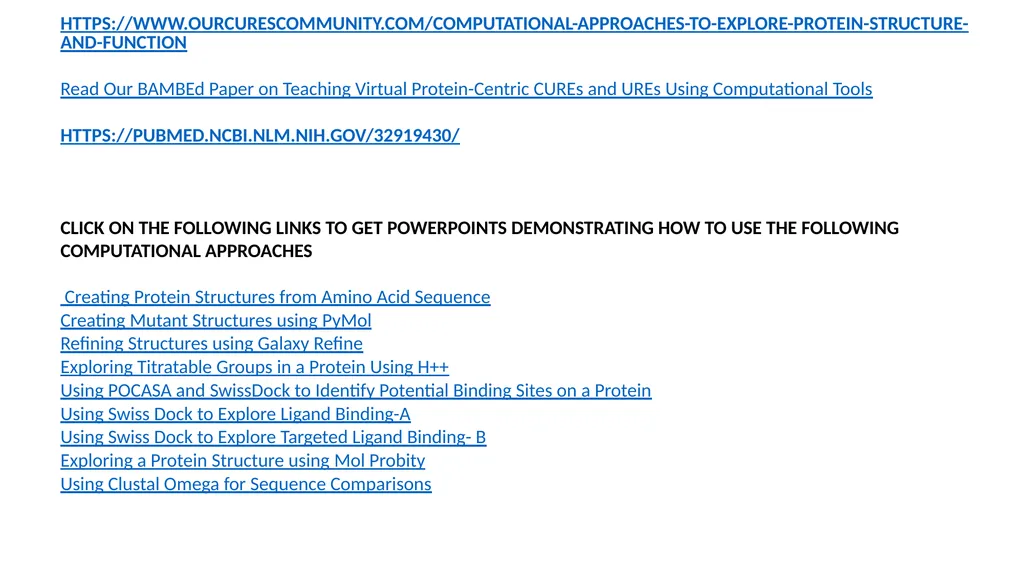
slide5. https://www.ourcurescommunity.com/computational-approaches-to-explore-protein-structure-and-function
Read Our BAMBEd Paper on Teaching Virtual Protein-Centric CUREs and UREs Using Computational Tools
https://pubmed.ncbi.nlm.nih.gov/32919430/
CLICK ON THE FOLLOWING LINKS TO GET POWERPOINTS DEMONSTRATING HOW TO USE THE FOLLOWING COMPUTATIONAL APPROACHES
Creating Protein Structures from Amino Acid Sequence
Creating Mutant Structures using PyMol
Refining Structures using Galaxy Refine
Exploring Titratable Groups in a Protein Using H++
Using POCASA and SwissDock to Identify Potential Binding Sites on a Protein
Using Swiss Dock to Explore Ligand Binding-A
Using Swiss Dock to Explore Targeted Ligand Binding- B
Exploring a Protein Structure using Mol Probity
Using Clustal Omega for Sequence Comparisons<br>
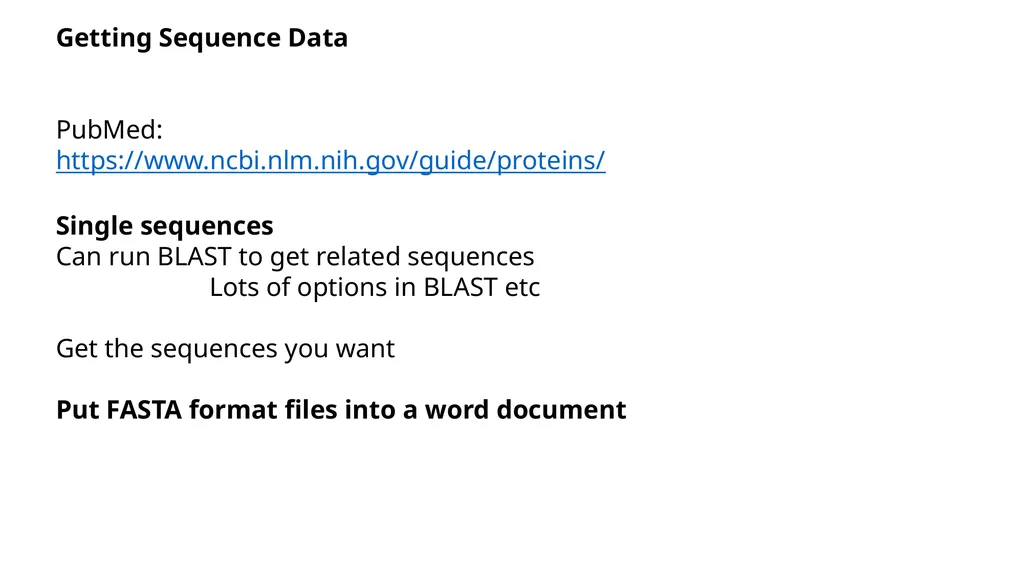
slide6. Getting Sequence Data
PubMed:
https://www.ncbi.nlm.nih.gov/guide/proteins/
Single sequences
Can run BLAST to get related sequences
Lots of options in BLAST etc
Get the sequences you want
Put FASTA format files into a word document<br>
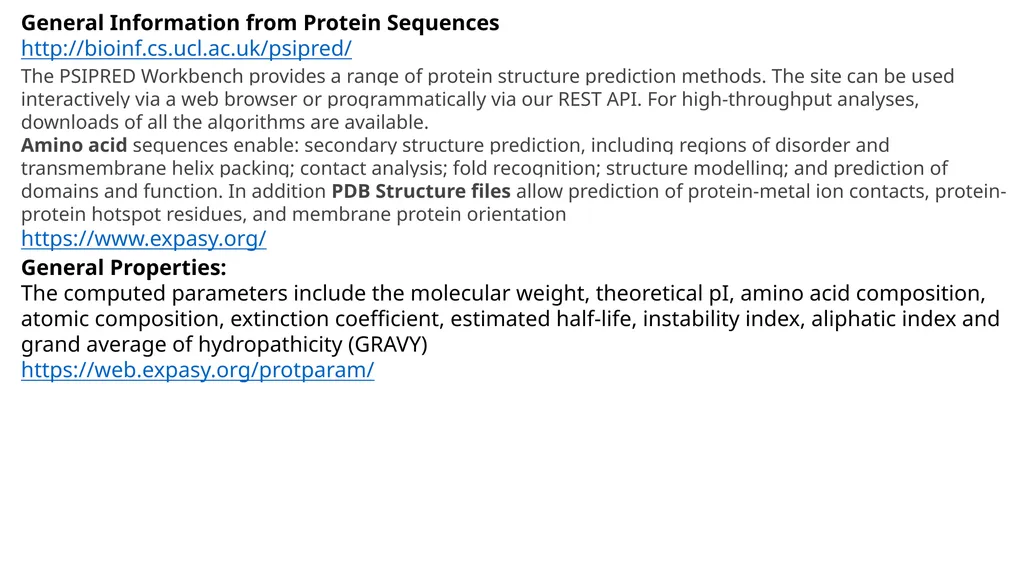
slide7. General Information from Protein Sequences
http://bioinf.cs.ucl.ac.uk/psipred/
The PSIPRED Workbench provides a range of protein structure prediction methods. The site can be used interactively via a web browser or programmatically via our REST API. For high-throughput analyses, downloads of all the algorithms are available.
Amino acid sequences enable: secondary structure prediction, including regions of disorder and transmembrane helix packing; contact analysis; fold recognition; structure modelling; and prediction of domains and function. In addition PDB Structure files allow prediction of protein-metal ion contacts, protein-protein hotspot residues, and membrane protein orientation
https://www.expasy.org/
General Properties:
The computed parameters include the molecular weight, theoretical pI, amino acid composition, atomic composition, extinction coefficient, estimated half-life, instability index, aliphatic index and grand average of hydropathicity (GRAVY)
https://web.expasy.org/protparam/<br>
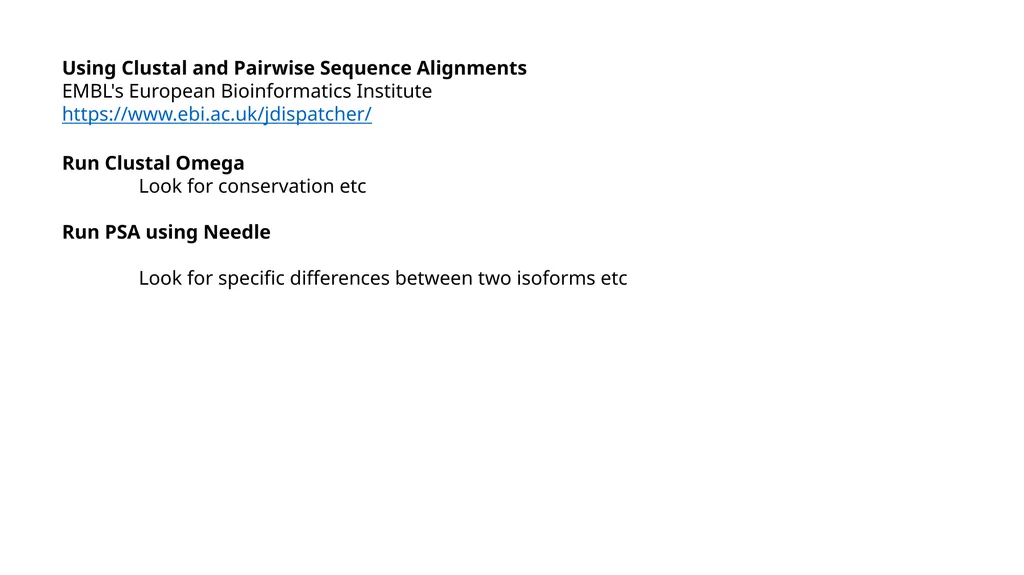
slide8. Using Clustal and Pairwise Sequence Alignments
EMBL's European Bioinformatics Institute
https://www.ebi.ac.uk/jdispatcher/
Run Clustal Omega
Look for conservation etc
Run PSA using Needle
Look for specific differences between two isoforms etc<br>
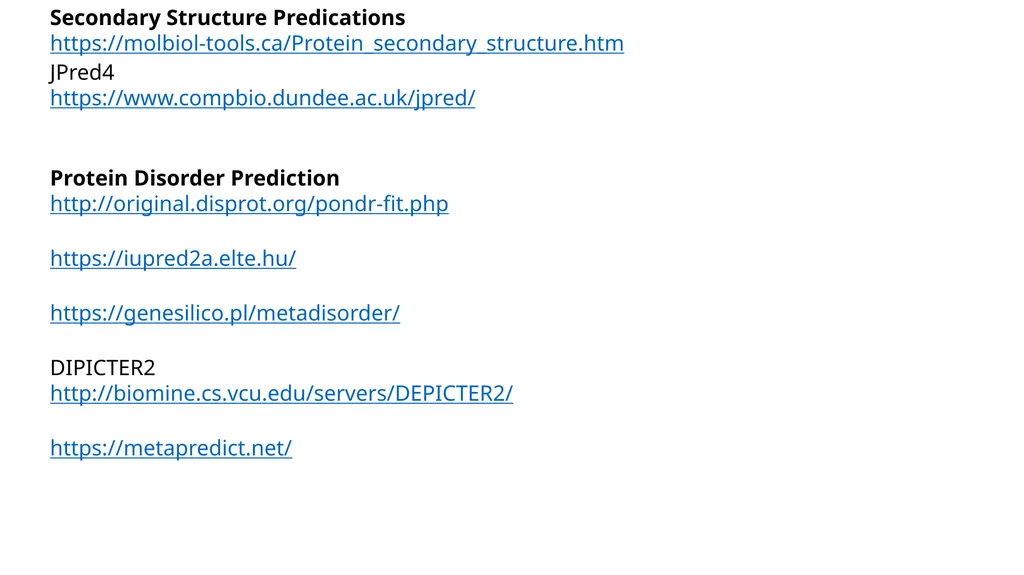
slide9. Secondary Structure Predications
https://molbiol-tools.ca/Protein_secondary_structure.htm
JPred4
https://www.compbio.dundee.ac.uk/jpred/
Protein Disorder Prediction
http://original.disprot.org/pondr-fit.php
https://iupred2a.elte.hu/
https://genesilico.pl/metadisorder/
DIPICTER2
http://biomine.cs.vcu.edu/servers/DEPICTER2/
https://metapredict.net/<br>
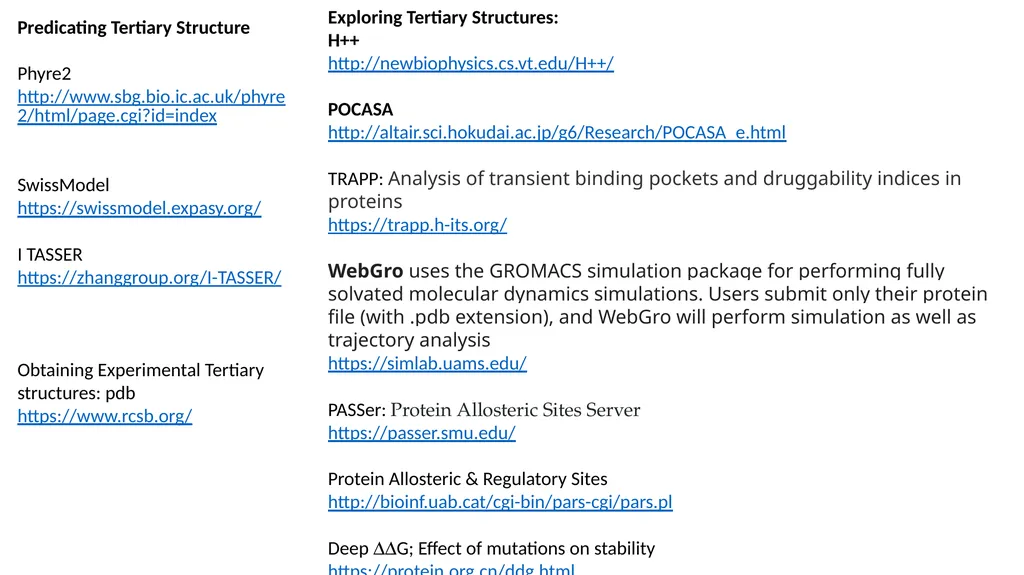
slide10. Exploring Tertiary Structures:
H++
http://newbiophysics.cs.vt.edu/H++/
POCASA
http://altair.sci.hokudai.ac.jp/g6/Research/POCASA_e.html
TRAPP: Analysis of transient binding pockets and druggability indices in proteins
https://trapp.h-its.org/
WebGro uses the GROMACS simulation package for performing fully solvated molecular dynamics simulations. Users submit only their protein file (with .pdb extension), and WebGro will perform simulation as well as trajectory analysis
https://simlab.uams.edu/
PASSer: Protein Allosteric Sites Server
https://passer.smu.edu/
Protein Allosteric & Regulatory Sites
http://bioinf.uab.cat/cgi-bin/pars-cgi/pars.pl
Deep DDG; Effect of mutations on stability
https://protein.org.cn/ddg.html Predicating Tertiary Structure
Phyre2
http://www.sbg.bio.ic.ac.uk/phyre2/html/page.cgi?id=index
SwissModel
https://swissmodel.expasy.org/
I TASSER
https://zhanggroup.org/I-TASSER/
Obtaining Experimental Tertiary structures: pdb
https://www.rcsb.org/<br>
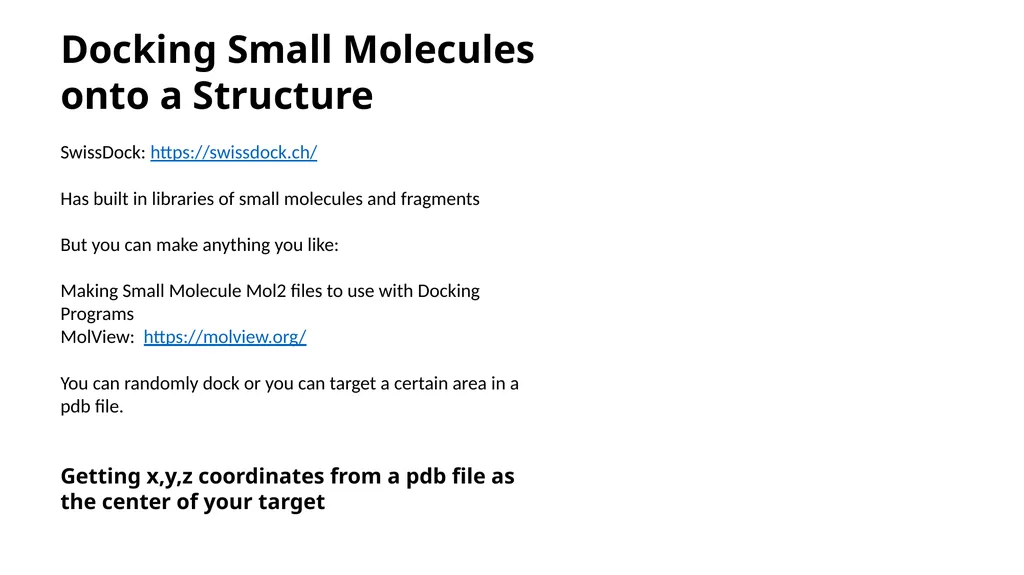
slide11. Docking Small Molecules onto a Structure
SwissDock: https://swissdock.ch/
Has built in libraries of small molecules and fragments
But you can make anything you like:
Making Small Molecule Mol2 files to use with Docking Programs
MolView: https://molview.org/
You can randomly dock or you can target a certain area in a pdb file.
Getting x,y,z coordinates from a pdb file as the center of your target<br>
slide12. http://predictor.nchu.edu.tw/QUATgo/ Predicting Quaternary Structure from Amino Acid Sequence<br>
slide13. Predicting post translational modifications
https://www.musite.net/<br>
slide14. Predicting and Exploring Quaternary Structure
https://predictprotein.org/
Prosite
https://prosite.expasy.org/<br>
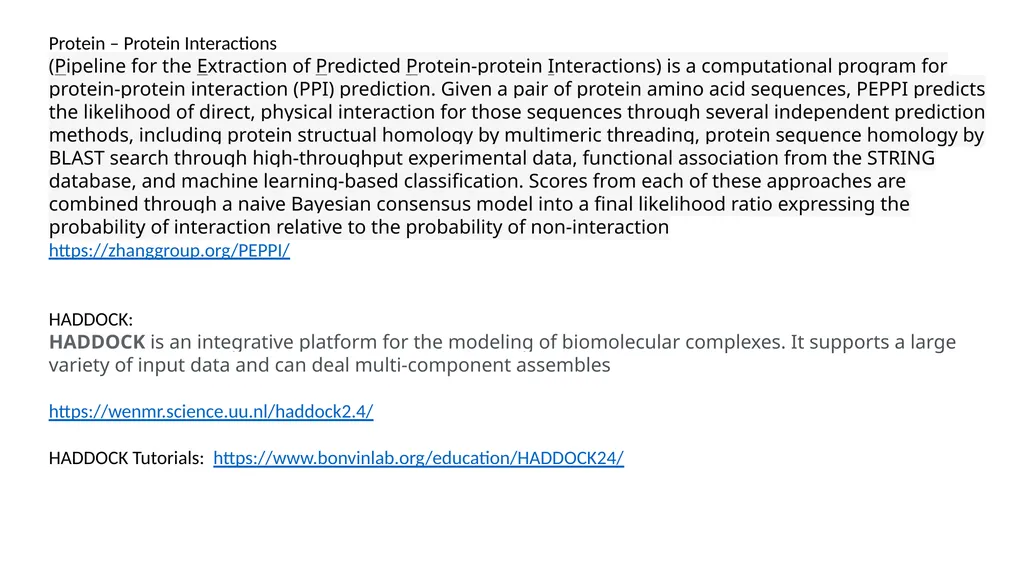
slide15. Protein – Protein Interactions
(Pipeline for the Extraction of Predicted Protein-protein Interactions) is a computational program for protein-protein interaction (PPI) prediction. Given a pair of protein amino acid sequences, PEPPI predicts the likelihood of direct, physical interaction for those sequences through several independent prediction methods, including protein structual homology by multimeric threading, protein sequence homology by BLAST search through high-throughput experimental data, functional association from the STRING database, and machine learning-based classification. Scores from each of these approaches are combined through a naive Bayesian consensus model into a final likelihood ratio expressing the probability of interaction relative to the probability of non-interaction
https://zhanggroup.org/PEPPI/
HADDOCK:
HADDOCK is an integrative platform for the modeling of biomolecular complexes. It supports a large variety of input data and can deal multi-component assembles

https://wenmr.science.uu.nl/haddock2.4/
HADDOCK Tutorials: https://www.bonvinlab.org/education/HADDOCK24/<br>
8AM PST TO 1PM PST (11AM EST TO 4PM EST)
Zoom Link:
MOLECULAR Life Sciences is inviting you to a scheduled Zoom meeting.
Topic: June 14th Bioinformatics Workshop
Time: Jun 14, 2024 08:00 AM Pacific Time (US and Canada)
Join Zoom Meeting
https://us02web.zoom.us/j/86248952486?pwd=Pkz6FXSCJwz1Nre7HuoerIjF4Wpaoj.1
Meeting ID: 862 4895 2486
Passcode: 802153<br>
slide2. From a Protein Sequence to Structure and Function Predications: Suitable for Faculty or Students
This workshop will illustrate the types of structural information that can be gleaned from protein sequence information, including secondary, tertiary and quaternary structures, stability and flexibility as well as exploring predications of post-translational modification, domain and tertiary structure, protein-protein interactions and potential function.
All approaches discussed are available on free publically accessible web servers<br>
slide3. Road Map for the Webinar:
8am pst: Introductions
8.15am: Using Clustal and Pairwise Sequence Alignments
9.00am: Secondary Structure and Flexibility Predications
9.45am: Q&A Break
10am: Predicating and Exploring Tertiary Structure
10.45am: Predicting post translational modifications
11am: Predicting and Exploring Quaternary Structure
11.30am: Predicting Protein-Protein Interactions
11.45am: Q&A Break
12 Noon: Interest Group Discussions and Exploring Potential Collaborations
12.45pm: Report out from Interest Groups
1.00pm: Workshop Ends<br>
slide4. Macromolecular Structure Visualization Programs
PyMol: https://www.pymol.org/
PyMol Users Guide: https://pymol.sourceforge.net/newman/userman.pdf
Getting Pymol for Educational Use: https://pymol.org/edu/
PyMol Tutorials
https://dasher.wustl.edu/bio5357/software/pymol/simple-tutorial.pdf
https://sites.pitt.edu/~epolinko/IntroPyMOL.pdf
https://fitzkee.chemistry.msstate.edu/sites/default/files/ch4403/pymol-tutorial.pdf
Chimera: https://www.cgl.ucsf.edu/chimera/
Getting Chimera: https://www.cgl.ucsf.edu/chimera/download.html
Chimera Tutorials
https://www.cgl.ucsf.edu/chimera/tutorials.html
https://pdb101.rcsb.org/learn/videos/visualizing-pdb-structures-with-ucsf-chimera
https://osf.io/82n73/wiki/Chimera%20Tutorials/<br>
slide5. https://www.ourcurescommunity.com/computational-approaches-to-explore-protein-structure-and-function
Read Our BAMBEd Paper on Teaching Virtual Protein-Centric CUREs and UREs Using Computational Tools
https://pubmed.ncbi.nlm.nih.gov/32919430/
CLICK ON THE FOLLOWING LINKS TO GET POWERPOINTS DEMONSTRATING HOW TO USE THE FOLLOWING COMPUTATIONAL APPROACHES
Creating Protein Structures from Amino Acid Sequence
Creating Mutant Structures using PyMol
Refining Structures using Galaxy Refine
Exploring Titratable Groups in a Protein Using H++
Using POCASA and SwissDock to Identify Potential Binding Sites on a Protein
Using Swiss Dock to Explore Ligand Binding-A
Using Swiss Dock to Explore Targeted Ligand Binding- B
Exploring a Protein Structure using Mol Probity
Using Clustal Omega for Sequence Comparisons<br>
slide6. Getting Sequence Data
PubMed:
https://www.ncbi.nlm.nih.gov/guide/proteins/
Single sequences
Can run BLAST to get related sequences
Lots of options in BLAST etc
Get the sequences you want
Put FASTA format files into a word document<br>
slide7. General Information from Protein Sequences
http://bioinf.cs.ucl.ac.uk/psipred/
The PSIPRED Workbench provides a range of protein structure prediction methods. The site can be used interactively via a web browser or programmatically via our REST API. For high-throughput analyses, downloads of all the algorithms are available.
Amino acid sequences enable: secondary structure prediction, including regions of disorder and transmembrane helix packing; contact analysis; fold recognition; structure modelling; and prediction of domains and function. In addition PDB Structure files allow prediction of protein-metal ion contacts, protein-protein hotspot residues, and membrane protein orientation
https://www.expasy.org/
General Properties:
The computed parameters include the molecular weight, theoretical pI, amino acid composition, atomic composition, extinction coefficient, estimated half-life, instability index, aliphatic index and grand average of hydropathicity (GRAVY)
https://web.expasy.org/protparam/<br>
slide8. Using Clustal and Pairwise Sequence Alignments
EMBL's European Bioinformatics Institute
https://www.ebi.ac.uk/jdispatcher/
Run Clustal Omega
Look for conservation etc
Run PSA using Needle
Look for specific differences between two isoforms etc<br>
slide9. Secondary Structure Predications
https://molbiol-tools.ca/Protein_secondary_structure.htm
JPred4
https://www.compbio.dundee.ac.uk/jpred/
Protein Disorder Prediction
http://original.disprot.org/pondr-fit.php
https://iupred2a.elte.hu/
https://genesilico.pl/metadisorder/
DIPICTER2
http://biomine.cs.vcu.edu/servers/DEPICTER2/
https://metapredict.net/<br>
slide10. Exploring Tertiary Structures:
H++
http://newbiophysics.cs.vt.edu/H++/
POCASA
http://altair.sci.hokudai.ac.jp/g6/Research/POCASA_e.html
TRAPP: Analysis of transient binding pockets and druggability indices in proteins
https://trapp.h-its.org/
WebGro uses the GROMACS simulation package for performing fully solvated molecular dynamics simulations. Users submit only their protein file (with .pdb extension), and WebGro will perform simulation as well as trajectory analysis
https://simlab.uams.edu/
PASSer: Protein Allosteric Sites Server
https://passer.smu.edu/
Protein Allosteric & Regulatory Sites
http://bioinf.uab.cat/cgi-bin/pars-cgi/pars.pl
Deep DDG; Effect of mutations on stability
https://protein.org.cn/ddg.html Predicating Tertiary Structure
Phyre2
http://www.sbg.bio.ic.ac.uk/phyre2/html/page.cgi?id=index
SwissModel
https://swissmodel.expasy.org/
I TASSER
https://zhanggroup.org/I-TASSER/
Obtaining Experimental Tertiary structures: pdb
https://www.rcsb.org/<br>
slide11. Docking Small Molecules onto a Structure
SwissDock: https://swissdock.ch/
Has built in libraries of small molecules and fragments
But you can make anything you like:
Making Small Molecule Mol2 files to use with Docking Programs
MolView: https://molview.org/
You can randomly dock or you can target a certain area in a pdb file.
Getting x,y,z coordinates from a pdb file as the center of your target<br>
slide12. http://predictor.nchu.edu.tw/QUATgo/ Predicting Quaternary Structure from Amino Acid Sequence<br>
slide13. Predicting post translational modifications
https://www.musite.net/<br>
slide14. Predicting and Exploring Quaternary Structure
https://predictprotein.org/
Prosite
https://prosite.expasy.org/<br>
slide15. Protein – Protein Interactions
(Pipeline for the Extraction of Predicted Protein-protein Interactions) is a computational program for protein-protein interaction (PPI) prediction. Given a pair of protein amino acid sequences, PEPPI predicts the likelihood of direct, physical interaction for those sequences through several independent prediction methods, including protein structual homology by multimeric threading, protein sequence homology by BLAST search through high-throughput experimental data, functional association from the STRING database, and machine learning-based classification. Scores from each of these approaches are combined through a naive Bayesian consensus model into a final likelihood ratio expressing the probability of interaction relative to the probability of non-interaction
https://zhanggroup.org/PEPPI/
HADDOCK:
HADDOCK is an integrative platform for the modeling of biomolecular complexes. It supports a large variety of input data and can deal multi-component assembles
https://wenmr.science.uu.nl/haddock2.4/
HADDOCK Tutorials: https://www.bonvinlab.org/education/HADDOCK24/<br>