
Overview and Process Workshop on IRRS and SARIS





Description: Overview and Process Workshop on IRRS and SARIS Department of Nuclear Safety Security Content Overview Objectives Structure Overall Process Request of a Mission Preparatory Phase Conduct of a Mission Post IRRS Activities Follow-up
Related Topics
Download Presentation
"Overview and Process Workshop on IRRS and SARIS" is the property of its rightful owner. Permission is granted to download and print the materials on this website for personal, non-commercial use only, and to display it on your personal computer provided you do not modify the materials and that you retain all copyright notices contained in the materials. By downloading content from our website, you accept the terms of this agreement.
Presentation Transcript
slide1. Overview and Process Workshop on IRRS and SARIS
Department of Nuclear Safety & Security<br>
slide2. Content Overview & Objectives
Structure
Overall Process
Request of a Mission
Preparatory Phase
Conduct of a Mission
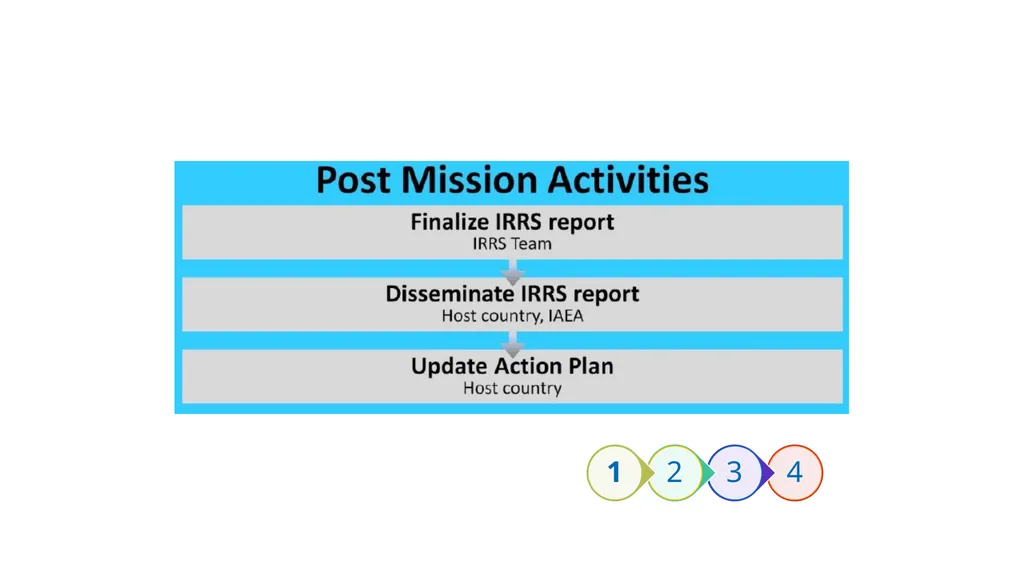
Post IRRS Activities
Follow-up Mission<br>
slide3. IRRS, part of the IAEA Peer Review Service family, aims at:
evaluating the status of compliance of national Governmental, Legal and Regulatory Framework for Safety in accordance with the IAEA safety standards
enhancing the effectiveness of the national infrastructure for safety
All IRRS missions are conducted in English Overview and Objectives<br>
slide4. Overview and Objectives Identifying Recommendations and Suggestions for improvement, and Good Practices
Developing good understanding of the IAEA safety standards
Providing a forum for discussion among senior regulators regarding both technical and policy issues
Sharing regulatory experiences
Creating mutual learning opportunities among regulators
Harmonizing regulatory approaches among States<br>
slide5. An Integrated Peer Review Service
Covering all regulatory aspects for a sound infrastructure for safety
Combining common regulatory infrastructure elements of various IAEA safety review services, resulting in a cross-cutting review of the regulatory oversight of all facilities, activities and exposure situations
The integrated nature of IRRS prevents potential overlaps by successive thematic reviews in the State Overview and Objectives<br>
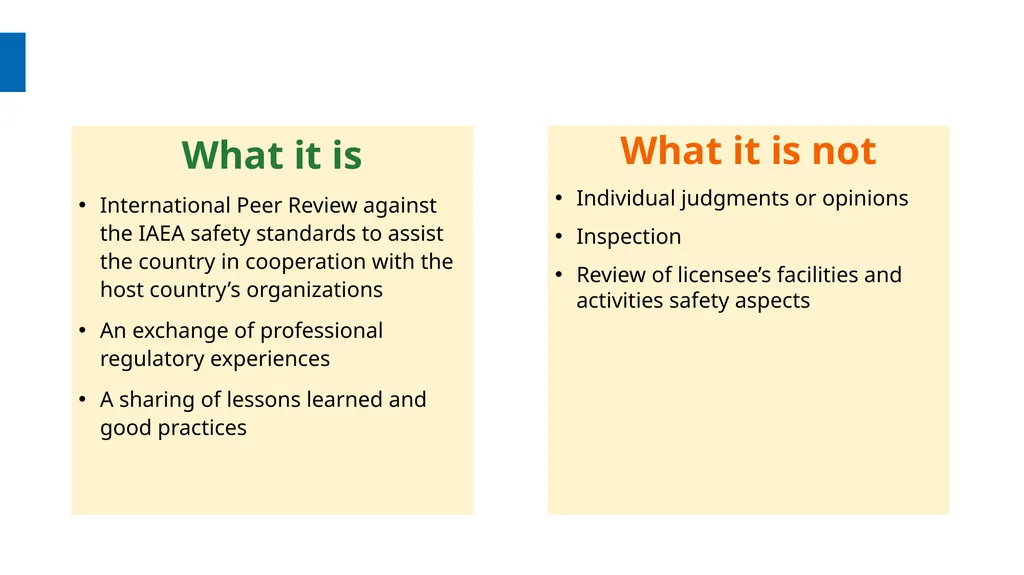
slide6. What it is
International Peer Review against the IAEA safety standards to assist the country in cooperation with the host country’s organizations
An exchange of professional regulatory experiences
A sharing of lessons learned and good practices What it is not
Individual judgments or opinions
Inspection
Review of licensee’s facilities and activities safety aspects<br>
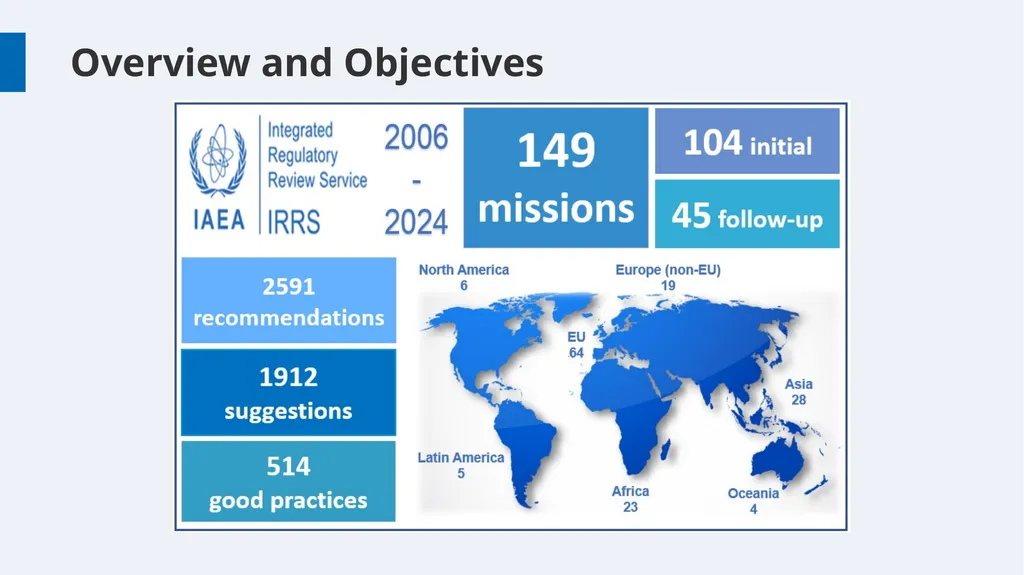
slide7. Overview and Objectives<br>
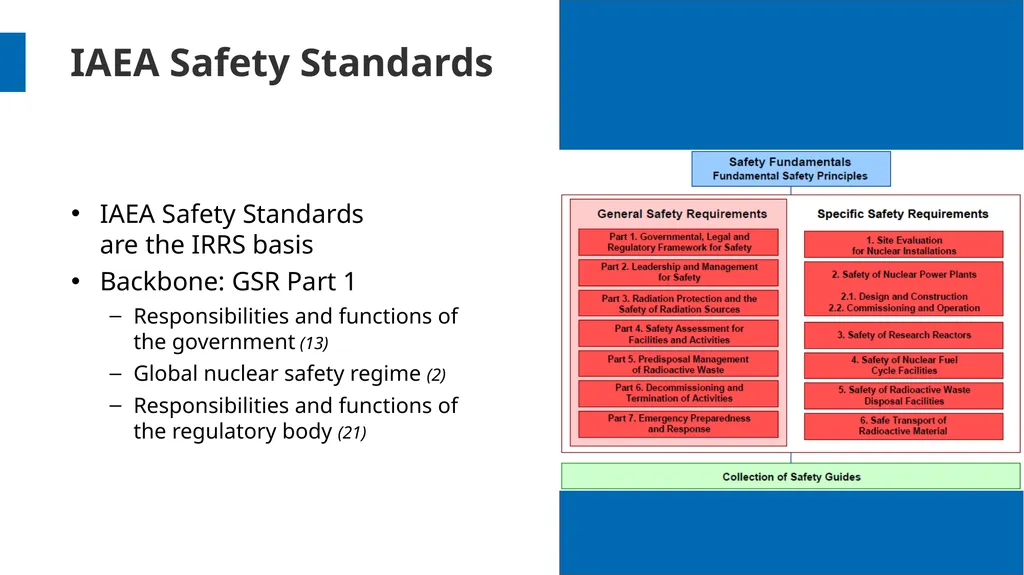
slide8. IAEA Safety Standards IAEA Safety Standards are the IRRS basis
Backbone: GSR Part 1
Responsibilities and functions of the government (13)
Global nuclear safety regime (2)
Responsibilities and functions of the regulatory body (21)<br>
slide9. Structure Integrated Regulatory Review Service<br>
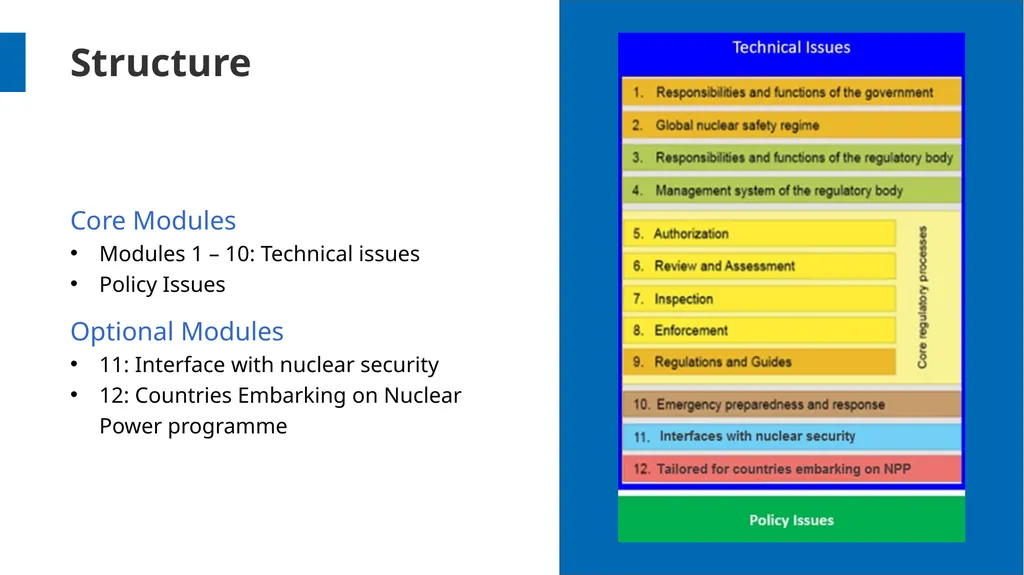
slide10. Structure Core Modules
Modules 1 – 10: Technical issues
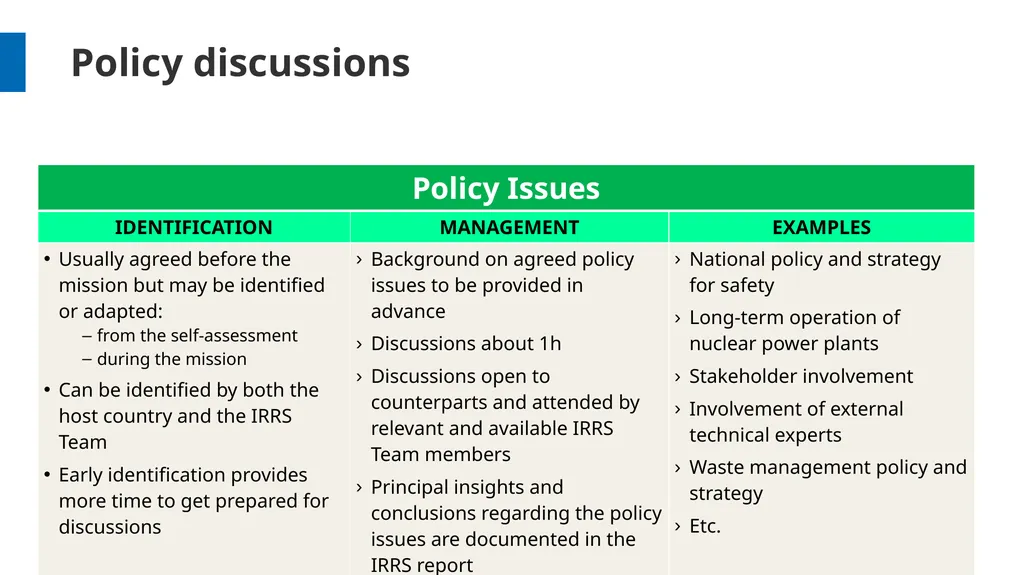
Policy Issues
Optional Modules
11: Interface with nuclear security
12: Countries Embarking on Nuclear Power programme<br>
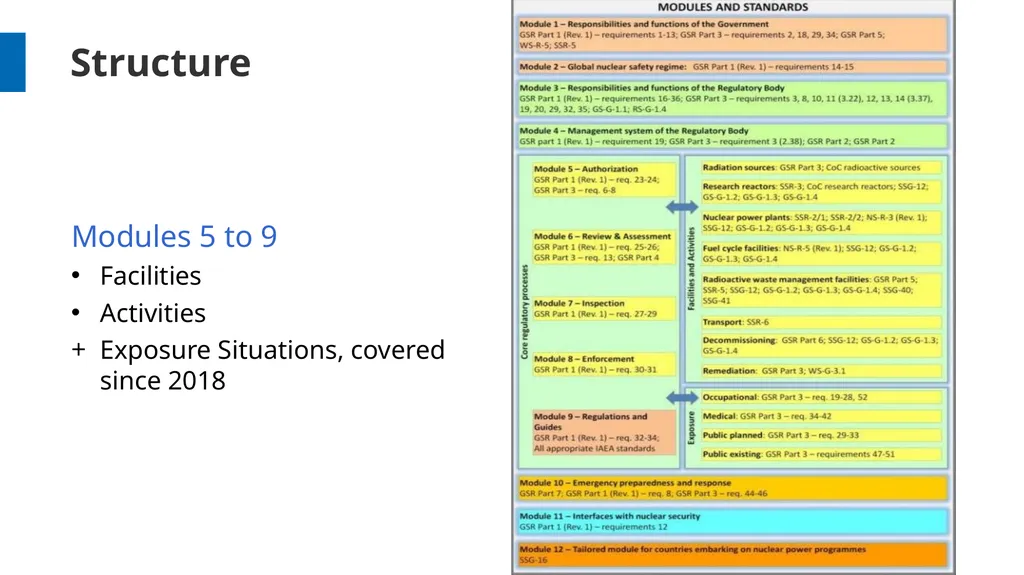
slide11. Structure Modules 5 to 9
Facilities
Activities
Exposure Situations, covered since 2018<br>
slide12. To prevent duplications within Modules 5 to 9, each of them comprises two levels of analysis
Level 1 addresses cross-cutting issues - identification of Generic Findings -
Level 2 covers specific issues per facility, activity and exposure situations
E.g., Module 9
Level 1: Evaluation of process of drafting regulations and guides
Level 2: Review of content of regulations and guides for facilities, activities and exposure situations Structure Report Template and Self-Assessment Question-sets reflects this structure<br>
slide13. Policy discussions<br>
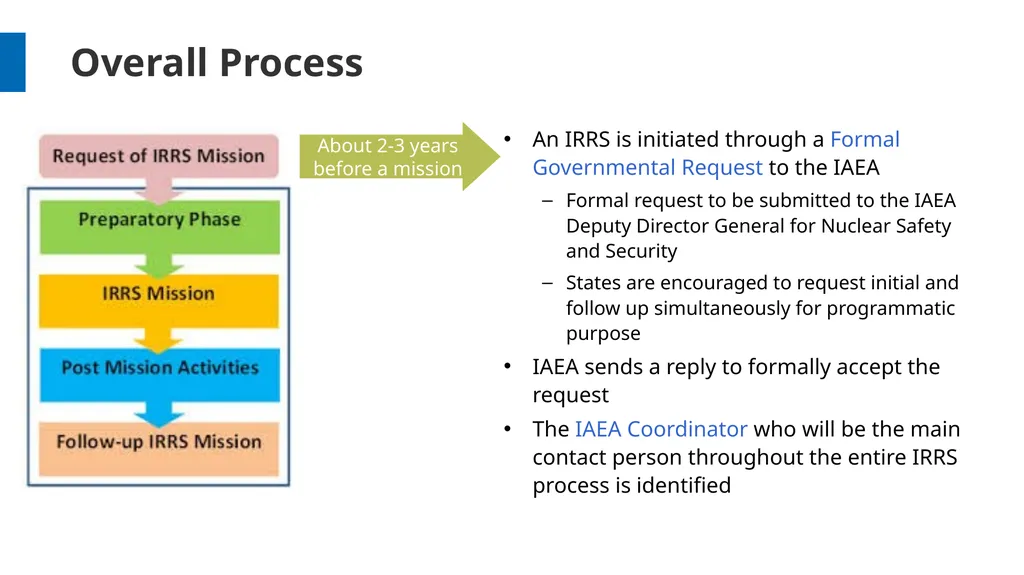
slide14. Overall Process An IRRS is initiated through a Formal Governmental Request to the IAEA
Formal request to be submitted to the IAEA Deputy Director General for Nuclear Safety and Security
States are encouraged to request initial and follow up simultaneously for programmatic purpose
IAEA sends a reply to formally accept the request
The IAEA Coordinator who will be the main contact person throughout the entire IRRS process is identified About 2-3 years before a mission<br>
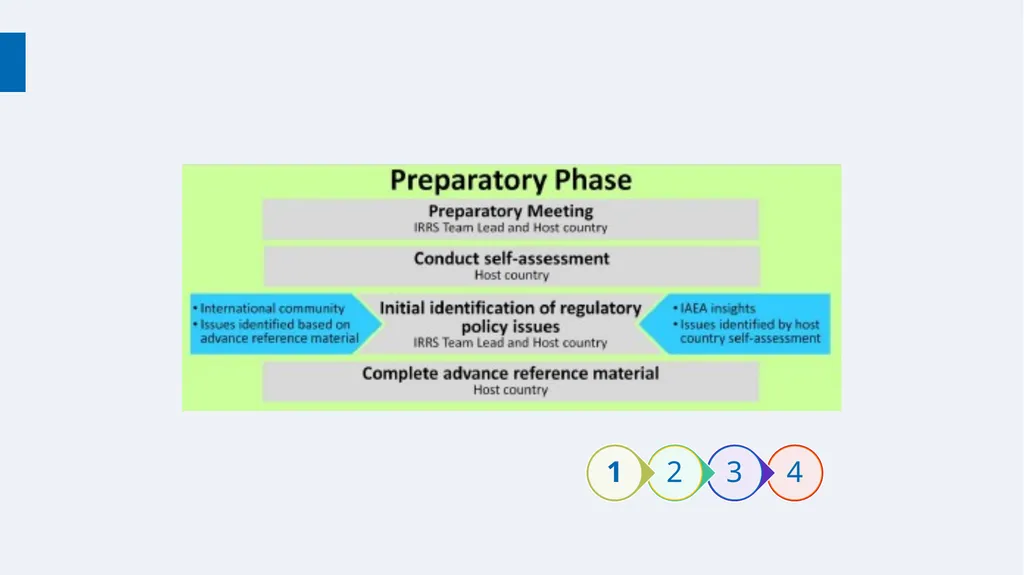
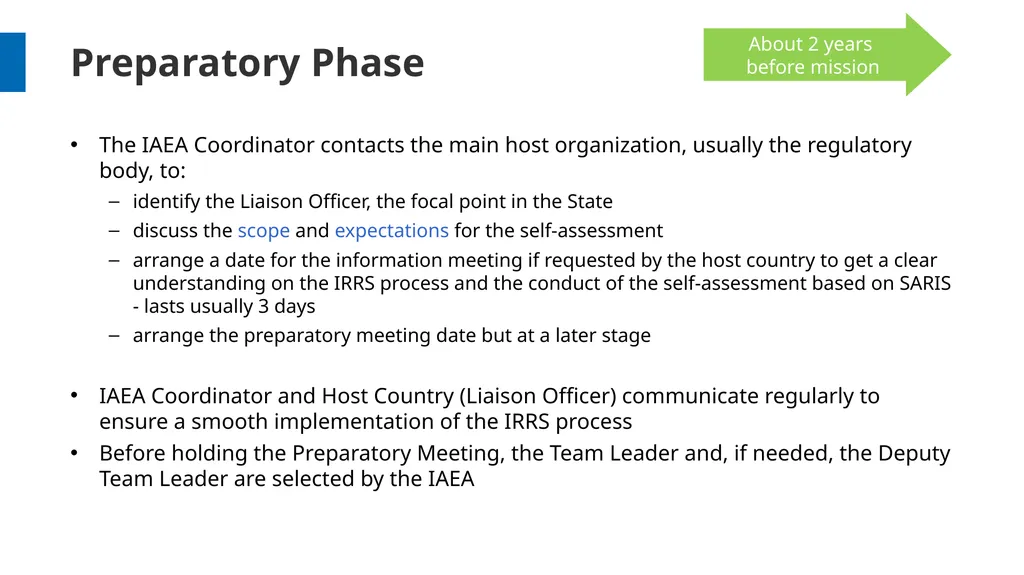
slide16. The IAEA Coordinator contacts the main host organization, usually the regulatory body, to:
identify the Liaison Officer, the focal point in the State
discuss the scope and expectations for the self-assessment
arrange a date for the information meeting if requested by the host country to get a clear understanding on the IRRS process and the conduct of the self-assessment based on SARIS - lasts usually 3 days
arrange the preparatory meeting date but at a later stage
IAEA Coordinator and Host Country (Liaison Officer) communicate regularly to ensure a smooth implementation of the IRRS process
Before holding the Preparatory Meeting, the Team Leader and, if needed, the Deputy Team Leader are selected by the IAEA Preparatory Phase About 2 years before mission<br>
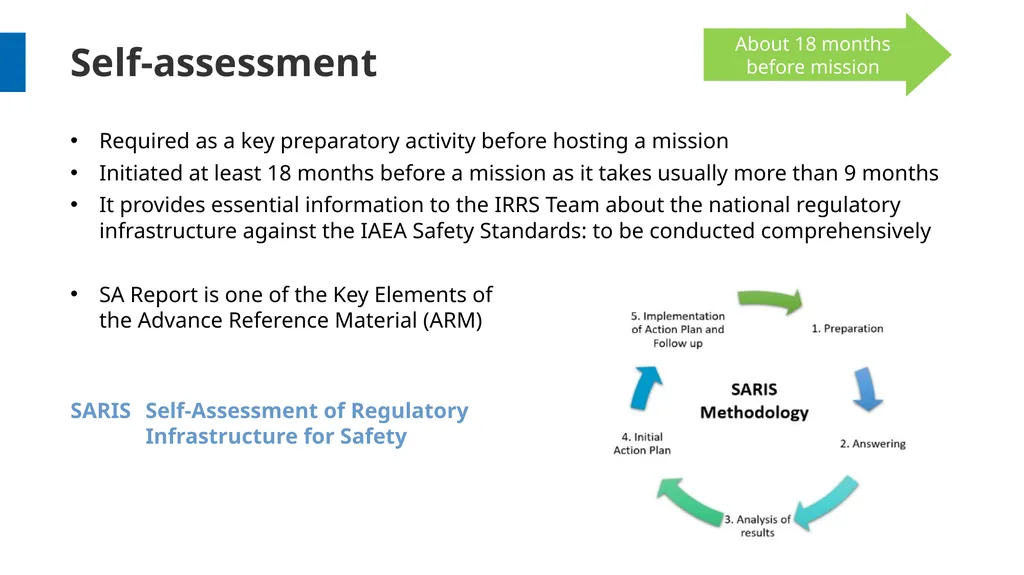
slide17. Required as a key preparatory activity before hosting a mission
Initiated at least 18 months before a mission as it takes usually more than 9 months
It provides essential information to the IRRS Team about the national regulatory infrastructure against the IAEA Safety Standards: to be conducted comprehensively
SA Report is one of the Key Elements of the Advance Reference Material (ARM)
SARIS Self-Assessment of Regulatory Infrastructure for Safety Self-assessment About 18 months before mission<br>
slide18. Usually lasts 2 days
Participants: Senior Governmental Officials, Senior Management, other Host Country Stakeholder Organizations, Counterparts, IRRS Team Leader and Deputy, IAEA Coordinator and Deputy
Confirm the IRRS date and scope
Discuss technical issues to be addressed during IRRS
Discuss financial issues (Funding of the mission)
Discussion and agreement on advanced reference material (ARM)
Discussion about IRRS logistics and agenda Preparatory Meeting About 6-9 months before mission<br>
slide19. For the mission itself, the host should:
arrange for working facilities for individuals and team (Interviews, meeting rooms, site visits, communication between reviewers…)
arrange secretariat and IT support, Internet access (office and hotel)
provide data projectors, printing facilities where applicable
provide translators and technical escorts, if required
arrange local transportation, including site visits
make the necessary hotel reservations Logistics and Admin About 3-12 months before mission<br>
slide20. General information for the IRRS Team
Key Contacts (emails, phones, etc.)
Emergency telephone number
Safety tips
IT requirements
Dietary and medical
Restaurants and cafeterias
Transport: airport transfer, daily transfers, public transport
Currency, Power Supply, Telephone (country code…), Time Zone, Weather
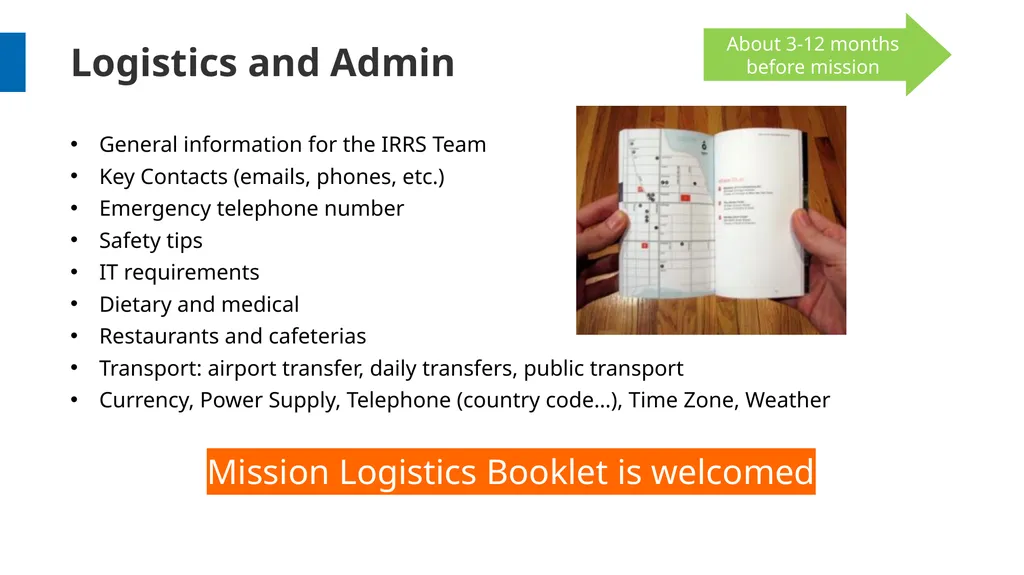
Mission Logistics Booklet is welcomed Logistics and Admin About 3-12 months before mission<br>
slide21. The IAEA Coordinator:
Prepare the mission schedule in relation with the Team Leads and Liaison Officer
Set up the Review Team in relation with the Team Leads
The IRRS team size and mission duration are influenced by:
National infrastructure for nuclear, radiation, radioactive waste and transport safety
Number of organizations undertake the role of the Regulatory Body
Mission scope IRRS team and Schedule<br>
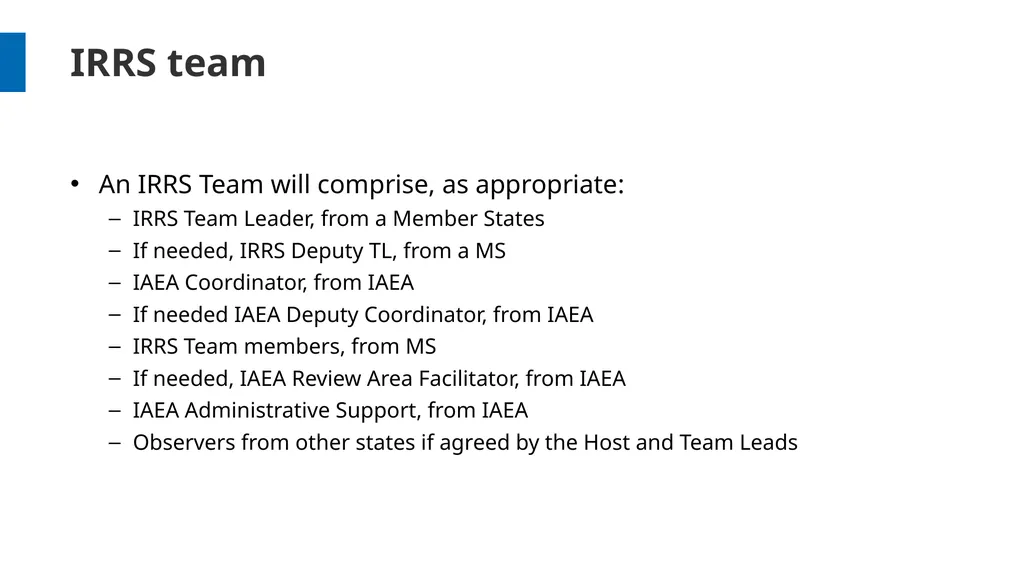
slide22. An IRRS Team will comprise, as appropriate:
IRRS Team Leader, from a Member States
If needed, IRRS Deputy TL, from a MS
IAEA Coordinator, from IAEA
If needed IAEA Deputy Coordinator, from IAEA
IRRS Team members, from MS
If needed, IAEA Review Area Facilitator, from IAEA
IAEA Administrative Support, from IAEA
Observers from other states if agreed by the Host and Team Leads IRRS team<br>
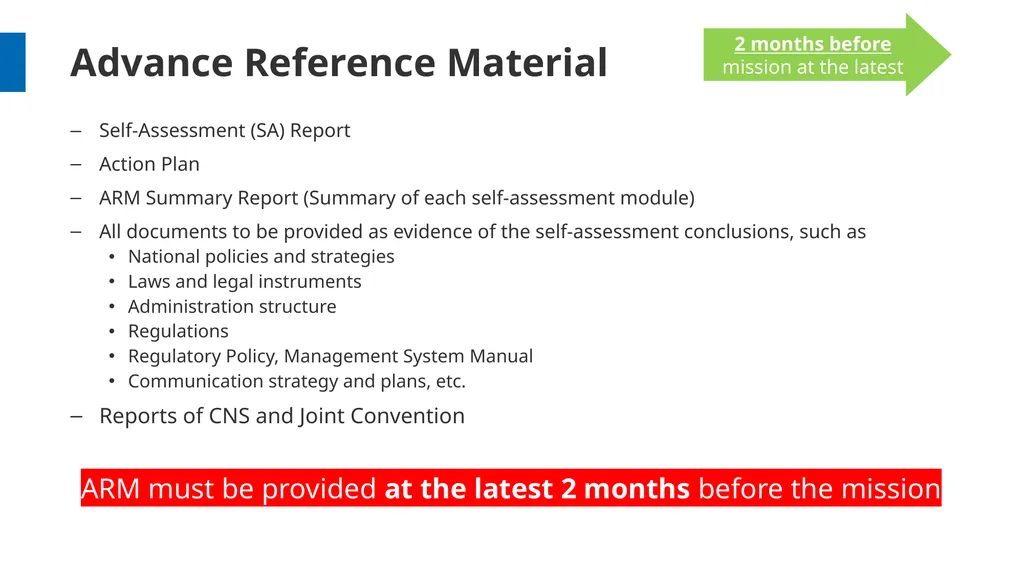
slide23. Self-Assessment (SA) Report
Action Plan
ARM Summary Report (Summary of each self-assessment module)
All documents to be provided as evidence of the self-assessment conclusions, such as
National policies and strategies
Laws and legal instruments
Administration structure
Regulations
Regulatory Policy, Management System Manual
Communication strategy and plans, etc.
Reports of CNS and Joint Convention
ARM must be provided at the latest 2 months before the mission Advance Reference Material 2 months before mission at the latest<br>
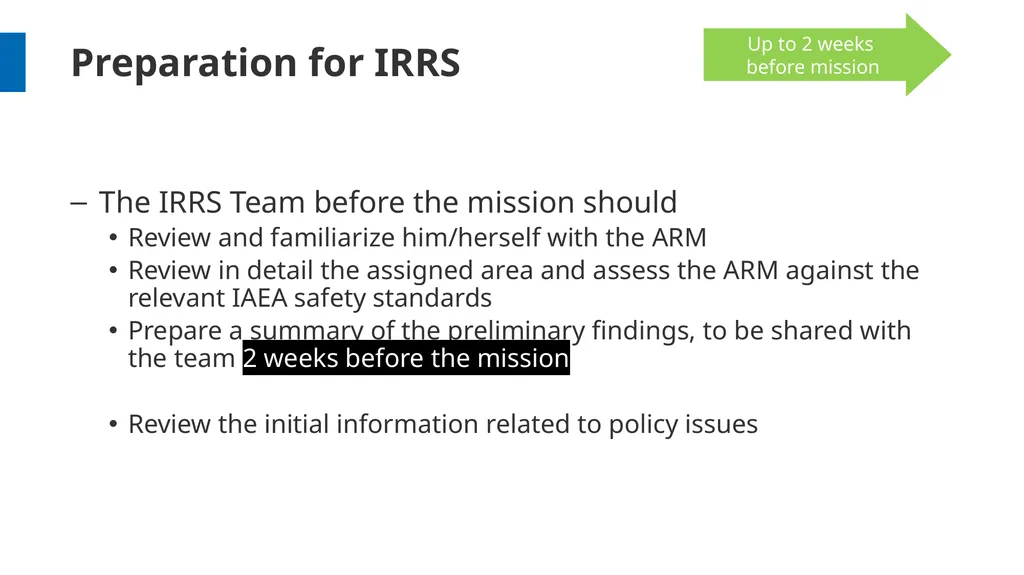
slide24. The IRRS Team before the mission should
Review and familiarize him/herself with the ARM
Review in detail the assigned area and assess the ARM against the relevant IAEA safety standards
Prepare a summary of the preliminary findings, to be shared with the team 2 weeks before the mission
Review the initial information related to policy issues Preparation for IRRS Up to 2 weeks before mission<br>
slide25. Good mission requires good preparation by
The Host Country
The IAEA
The IRRS Review Team
Require effective interaction and communication between the IAEA (Coordinator) and the Host (Liaison Officer)
Timelines has to be complied with (Self-Assessment, ARM, Logistics…) Preparation for IRRS<br>
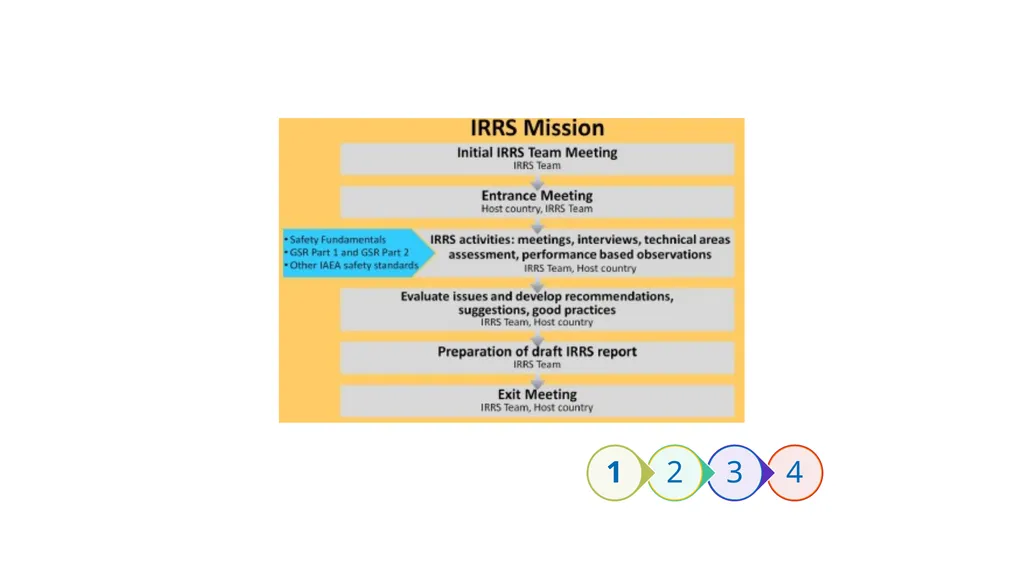
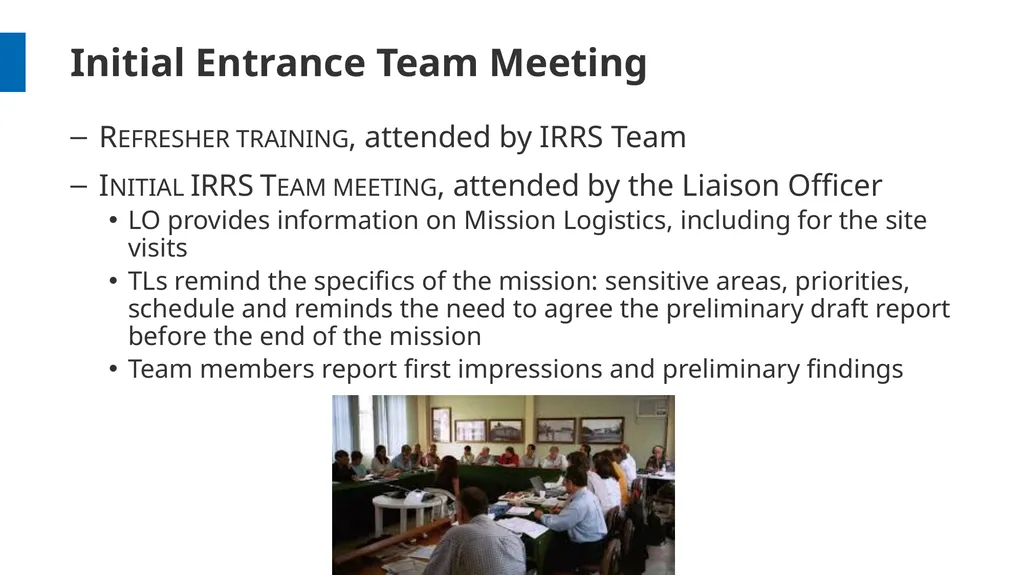
slide27. Refresher training, attended by IRRS Team
Initial IRRS Team meeting, attended by the Liaison Officer
LO provides information on Mission Logistics, including for the site visits
TLs remind the specifics of the mission: sensitive areas, priorities, schedule and reminds the need to agree the preliminary draft report before the end of the mission
Team members report first impressions and preliminary findings Initial Entrance Team Meeting<br>
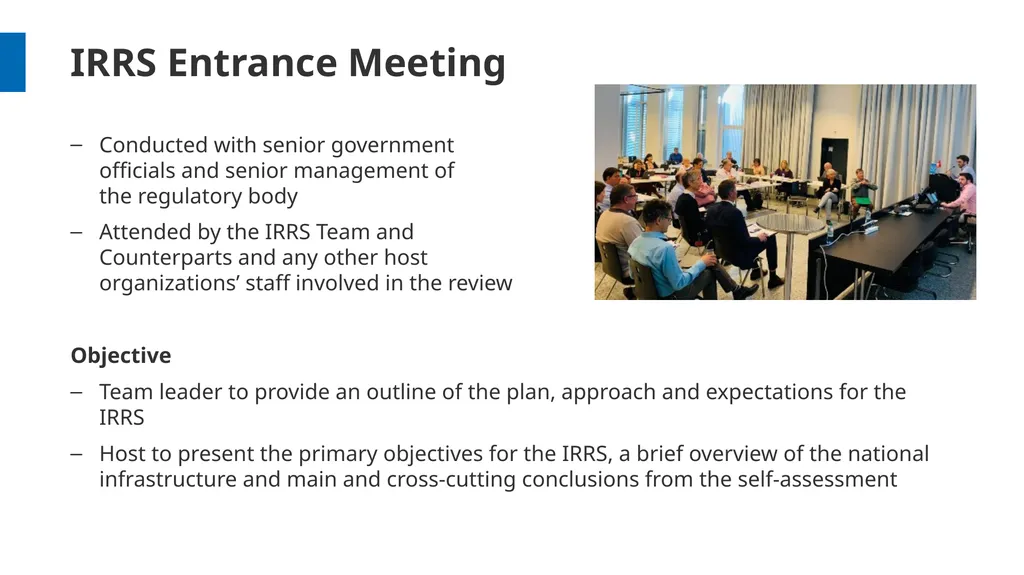
slide28. Conducted with senior government officials and senior management of the regulatory body
Attended by the IRRS Team and Counterparts and any other host organizations’ staff involved in the review
Objective
Team leader to provide an outline of the plan, approach and expectations for the IRRS
Host to present the primary objectives for the IRRS, a brief overview of the national infrastructure and main and cross-cutting conclusions from the self-assessment IRRS Entrance Meeting<br>
slide29. 3 methods are used to acquire information
Review of written material
Interviews with personnel
Direct observation of practices and activities
Direct observation of practices / activities can be in the form of
Observation of the inspectors during the regulatory inspections (site visits)
Observation of the documented regulatory practices: examples of protocols, licenses, inspections reports, meeting minutes, training records, etc.
Practices are reviewed against the IAEA Safety Standards IRRS Review Methodology<br>
slide30. IRRS may include meetings of Team Leaders, Reviewers and IAEA Coordinators with: High Governmental officials and other than Regulatory Governmental Agencies Other Meetings<br>
slide31. Attended by the IRRS Team and liaison officer is held at the end of each day to discuss:
Key findings, significant concerns or positive features that may form the basis for recommendations, suggestions or good practices
Issues to be brought to the attention of the team, including cross-cutting between modules
Gaps, overlaps or areas where information is not clear or consistent
Checking whether any of the observations of the day with might affect the remaining mission schedule
The IRRS team seeks for CONSENSUS Daily Review Team Meetings<br>
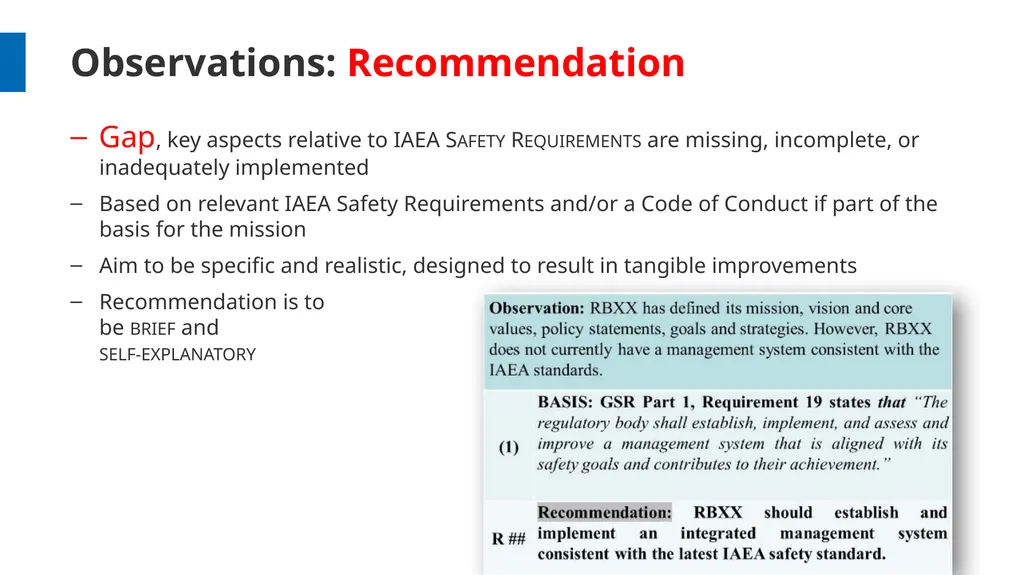
slide32. Gap, key aspects relative to IAEA Safety Requirements are missing, incomplete, or inadequately implemented
Based on relevant IAEA Safety Requirements and/or a Code of Conduct if part of the basis for the mission
Aim to be specific and realistic, designed to result in tangible improvements
Recommendation is to be brief and self-explanatory Observations: Recommendation<br>
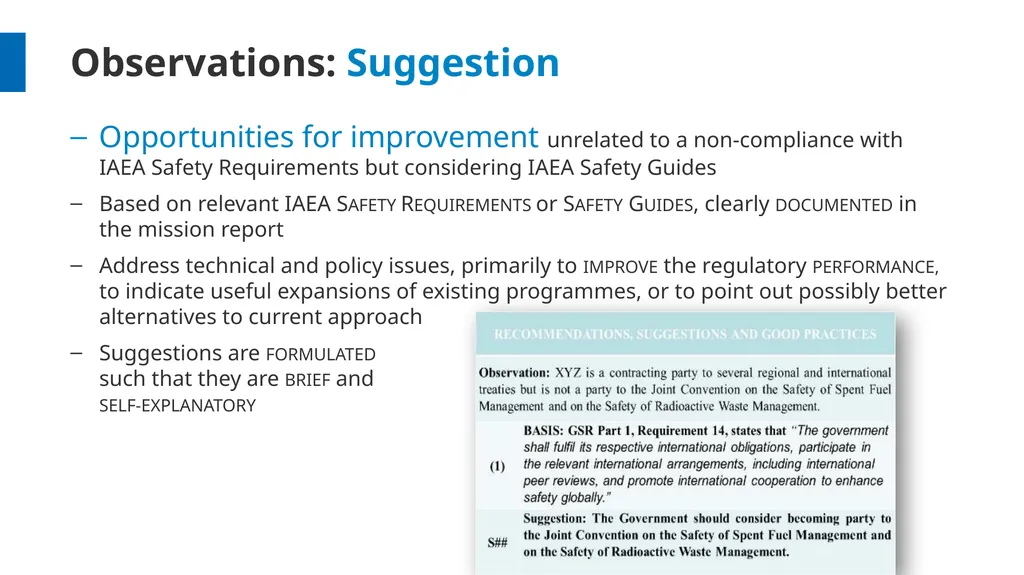
slide33. Opportunities for improvement unrelated to a non-compliance with IAEA Safety Requirements but considering IAEA Safety Guides
Based on relevant IAEA Safety Requirements or Safety Guides, clearly documented in the mission report
Address technical and policy issues, primarily to improve the regulatory performance, to indicate useful expansions of existing programmes, or to point out possibly better alternatives to current approach
Suggestions are formulated such that they are brief and self-explanatory Observations: Suggestion<br>
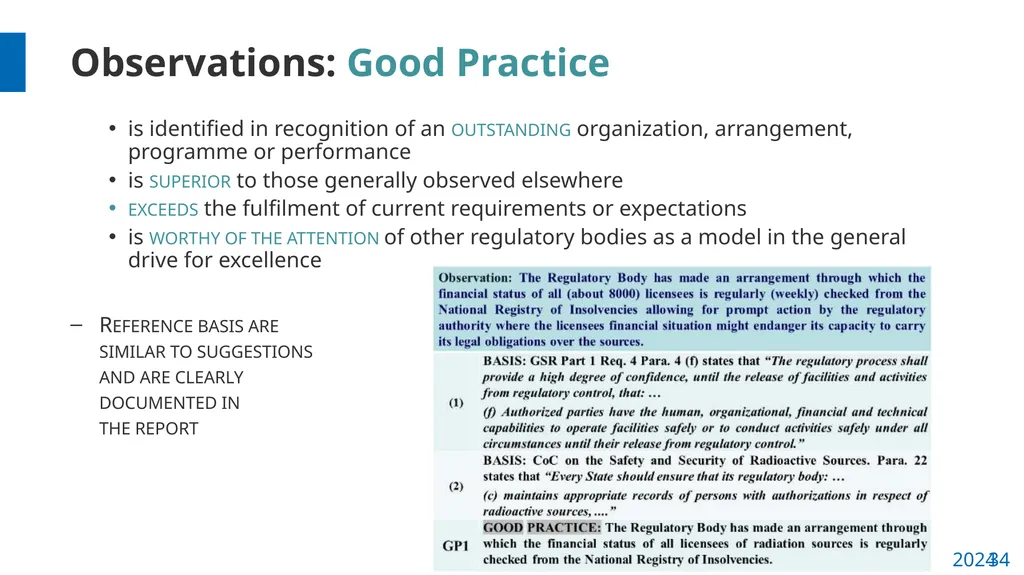
slide34. is identified in recognition of an outstanding organization, arrangement, programme or performance
is superior to those generally observed elsewhere
exceeds the fulfilment of current requirements or expectations
is worthy of the attention of other regulatory bodies as a model in the general drive for excellence
Reference basis are similar to suggestions and are clearly documented in the report Observations: Good Practice 2024 IRRS - Overview and Process 34<br>
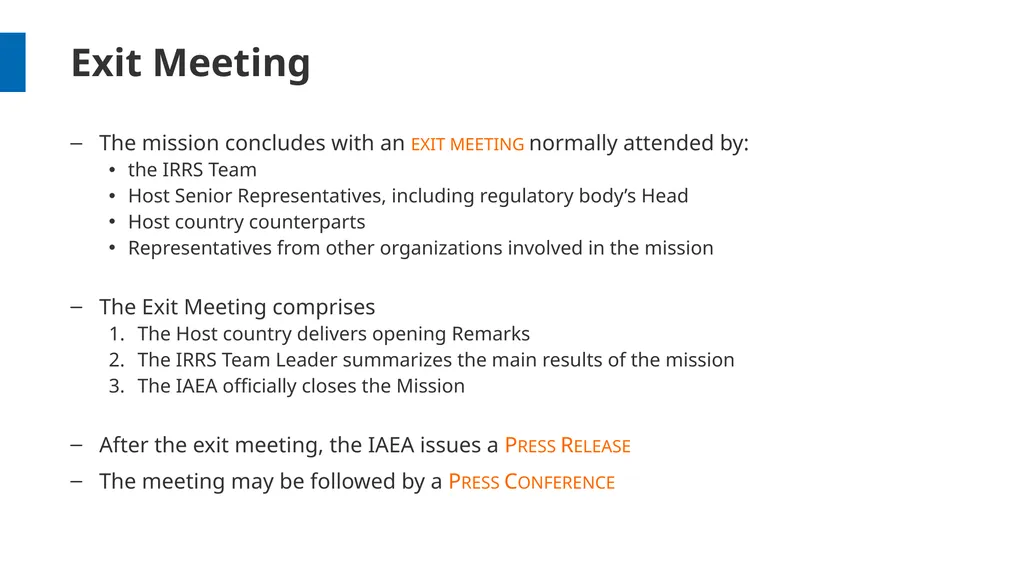
slide35. The mission concludes with an exit meeting normally attended by:
the IRRS Team
Host Senior Representatives, including regulatory body’s Head
Host country counterparts
Representatives from other organizations involved in the mission
The Exit Meeting comprises
The Host country delivers opening Remarks
The IRRS Team Leader summarizes the main results of the mission
The IAEA officially closes the Mission
After the exit meeting, the IAEA issues a Press Release
The meeting may be followed by a Press Conference Exit Meeting<br>
slide37. IRRS Report is built up progressively throughout the mission
IRRS Team agrees on Rec., Sug. and Good Practices
Host country is invited to comment the report: technical accuracy Clarity and understanding, wording
The IRRS Preliminary Report is given to the host for comment purpose at the end of the mission, but limited to editorial aspects and issues relating to the factual correctness
The Preliminary Report with comments is returned to the IAEA Coordinator for finalization
IRRS Mission Report (Final Report) is sent officially to the host country
Derestricted unless the host country specifically requests otherwise, within 90 days of the IAEA transmittal letter
In the interest of openness, countries are encouraged to make the IRRS report public IRRS Mission Report<br>
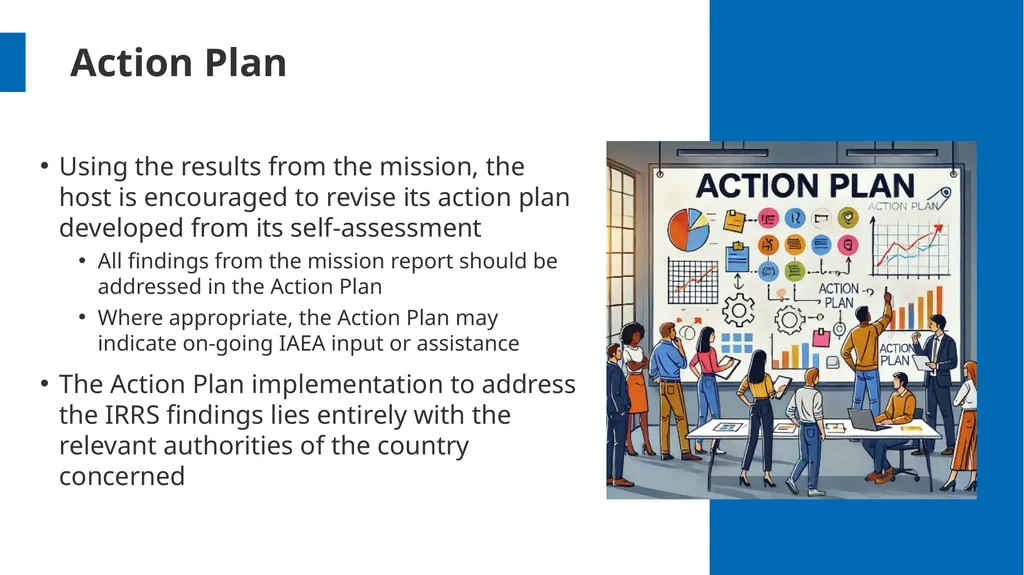
slide38. Action Plan Using the results from the mission, the host is encouraged to revise its action plan developed from its self-assessment
All findings from the mission report should be addressed in the Action Plan
Where appropriate, the Action Plan may indicate on-going IAEA input or assistance
The Action Plan implementation to address the IRRS findings lies entirely with the relevant authorities of the country concerned<br>
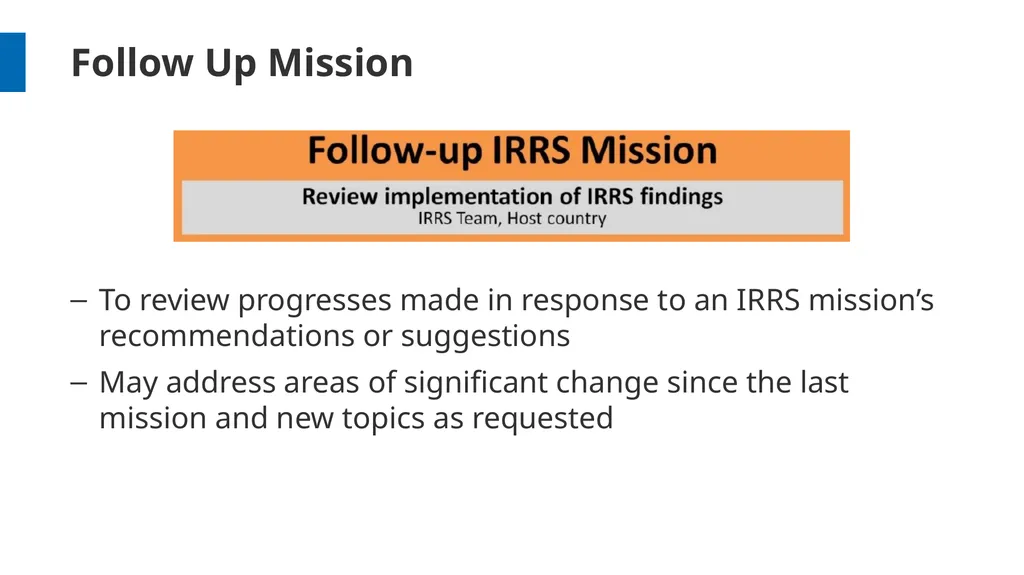
slide39. To review progresses made in response to an IRRS mission’s recommendations or suggestions
May address areas of significant change since the last mission and new topics as requested Follow Up Mission<br>
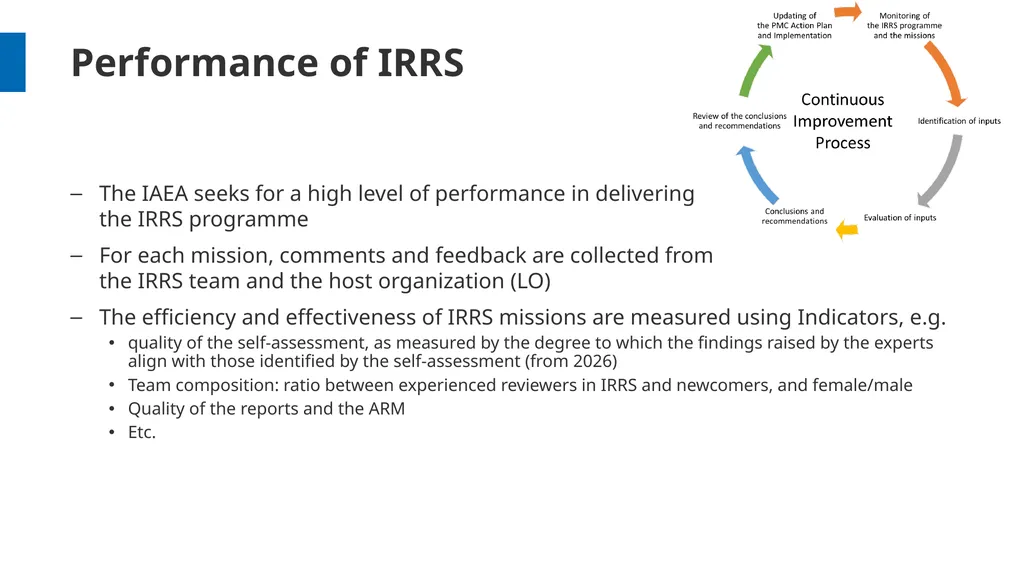
slide40. The IAEA seeks for a high level of performance in delivering the IRRS programme
For each mission, comments and feedback are collected from the IRRS team and the host organization (LO)
The efficiency and effectiveness of IRRS missions are measured using Indicators, e.g.
quality of the self-assessment, as measured by the degree to which the findings raised by the experts align with those identified by the self-assessment (from 2026)
Team composition: ratio between experienced reviewers in IRRS and newcomers, and female/male
Quality of the reports and the ARM
Etc. Performance of IRRS<br>
slide41. Number of Recommendations, Suggestions and Good Practices is no way a measure of the status of a regulatory infrastructure
Comparison of such numbers between missions to different countries should not be attempted! Reminder!<br>
Department of Nuclear Safety & Security<br>
slide2. Content Overview & Objectives
Structure
Overall Process
Request of a Mission
Preparatory Phase
Conduct of a Mission
Post IRRS Activities
Follow-up Mission<br>
slide3. IRRS, part of the IAEA Peer Review Service family, aims at:
evaluating the status of compliance of national Governmental, Legal and Regulatory Framework for Safety in accordance with the IAEA safety standards
enhancing the effectiveness of the national infrastructure for safety
All IRRS missions are conducted in English Overview and Objectives<br>
slide4. Overview and Objectives Identifying Recommendations and Suggestions for improvement, and Good Practices
Developing good understanding of the IAEA safety standards
Providing a forum for discussion among senior regulators regarding both technical and policy issues
Sharing regulatory experiences
Creating mutual learning opportunities among regulators
Harmonizing regulatory approaches among States<br>
slide5. An Integrated Peer Review Service
Covering all regulatory aspects for a sound infrastructure for safety
Combining common regulatory infrastructure elements of various IAEA safety review services, resulting in a cross-cutting review of the regulatory oversight of all facilities, activities and exposure situations
The integrated nature of IRRS prevents potential overlaps by successive thematic reviews in the State Overview and Objectives<br>
slide6. What it is
International Peer Review against the IAEA safety standards to assist the country in cooperation with the host country’s organizations
An exchange of professional regulatory experiences
A sharing of lessons learned and good practices What it is not
Individual judgments or opinions
Inspection
Review of licensee’s facilities and activities safety aspects<br>
slide7. Overview and Objectives<br>
slide8. IAEA Safety Standards IAEA Safety Standards are the IRRS basis
Backbone: GSR Part 1
Responsibilities and functions of the government (13)
Global nuclear safety regime (2)
Responsibilities and functions of the regulatory body (21)<br>
slide9. Structure Integrated Regulatory Review Service<br>
slide10. Structure Core Modules
Modules 1 – 10: Technical issues
Policy Issues
Optional Modules
11: Interface with nuclear security
12: Countries Embarking on Nuclear Power programme<br>
slide11. Structure Modules 5 to 9
Facilities
Activities
Exposure Situations, covered since 2018<br>
slide12. To prevent duplications within Modules 5 to 9, each of them comprises two levels of analysis
Level 1 addresses cross-cutting issues - identification of Generic Findings -
Level 2 covers specific issues per facility, activity and exposure situations
E.g., Module 9
Level 1: Evaluation of process of drafting regulations and guides
Level 2: Review of content of regulations and guides for facilities, activities and exposure situations Structure Report Template and Self-Assessment Question-sets reflects this structure<br>
slide13. Policy discussions<br>
slide14. Overall Process An IRRS is initiated through a Formal Governmental Request to the IAEA
Formal request to be submitted to the IAEA Deputy Director General for Nuclear Safety and Security
States are encouraged to request initial and follow up simultaneously for programmatic purpose
IAEA sends a reply to formally accept the request
The IAEA Coordinator who will be the main contact person throughout the entire IRRS process is identified About 2-3 years before a mission<br>
slide16. The IAEA Coordinator contacts the main host organization, usually the regulatory body, to:
identify the Liaison Officer, the focal point in the State
discuss the scope and expectations for the self-assessment
arrange a date for the information meeting if requested by the host country to get a clear understanding on the IRRS process and the conduct of the self-assessment based on SARIS - lasts usually 3 days
arrange the preparatory meeting date but at a later stage
IAEA Coordinator and Host Country (Liaison Officer) communicate regularly to ensure a smooth implementation of the IRRS process
Before holding the Preparatory Meeting, the Team Leader and, if needed, the Deputy Team Leader are selected by the IAEA Preparatory Phase About 2 years before mission<br>
slide17. Required as a key preparatory activity before hosting a mission
Initiated at least 18 months before a mission as it takes usually more than 9 months
It provides essential information to the IRRS Team about the national regulatory infrastructure against the IAEA Safety Standards: to be conducted comprehensively
SA Report is one of the Key Elements of the Advance Reference Material (ARM)
SARIS Self-Assessment of Regulatory Infrastructure for Safety Self-assessment About 18 months before mission<br>
slide18. Usually lasts 2 days
Participants: Senior Governmental Officials, Senior Management, other Host Country Stakeholder Organizations, Counterparts, IRRS Team Leader and Deputy, IAEA Coordinator and Deputy
Confirm the IRRS date and scope
Discuss technical issues to be addressed during IRRS
Discuss financial issues (Funding of the mission)
Discussion and agreement on advanced reference material (ARM)
Discussion about IRRS logistics and agenda Preparatory Meeting About 6-9 months before mission<br>
slide19. For the mission itself, the host should:
arrange for working facilities for individuals and team (Interviews, meeting rooms, site visits, communication between reviewers…)
arrange secretariat and IT support, Internet access (office and hotel)
provide data projectors, printing facilities where applicable
provide translators and technical escorts, if required
arrange local transportation, including site visits
make the necessary hotel reservations Logistics and Admin About 3-12 months before mission<br>
slide20. General information for the IRRS Team
Key Contacts (emails, phones, etc.)
Emergency telephone number
Safety tips
IT requirements
Dietary and medical
Restaurants and cafeterias
Transport: airport transfer, daily transfers, public transport
Currency, Power Supply, Telephone (country code…), Time Zone, Weather
Mission Logistics Booklet is welcomed Logistics and Admin About 3-12 months before mission<br>
slide21. The IAEA Coordinator:
Prepare the mission schedule in relation with the Team Leads and Liaison Officer
Set up the Review Team in relation with the Team Leads
The IRRS team size and mission duration are influenced by:
National infrastructure for nuclear, radiation, radioactive waste and transport safety
Number of organizations undertake the role of the Regulatory Body
Mission scope IRRS team and Schedule<br>
slide22. An IRRS Team will comprise, as appropriate:
IRRS Team Leader, from a Member States
If needed, IRRS Deputy TL, from a MS
IAEA Coordinator, from IAEA
If needed IAEA Deputy Coordinator, from IAEA
IRRS Team members, from MS
If needed, IAEA Review Area Facilitator, from IAEA
IAEA Administrative Support, from IAEA
Observers from other states if agreed by the Host and Team Leads IRRS team<br>
slide23. Self-Assessment (SA) Report
Action Plan
ARM Summary Report (Summary of each self-assessment module)
All documents to be provided as evidence of the self-assessment conclusions, such as
National policies and strategies
Laws and legal instruments
Administration structure
Regulations
Regulatory Policy, Management System Manual
Communication strategy and plans, etc.
Reports of CNS and Joint Convention
ARM must be provided at the latest 2 months before the mission Advance Reference Material 2 months before mission at the latest<br>
slide24. The IRRS Team before the mission should
Review and familiarize him/herself with the ARM
Review in detail the assigned area and assess the ARM against the relevant IAEA safety standards
Prepare a summary of the preliminary findings, to be shared with the team 2 weeks before the mission
Review the initial information related to policy issues Preparation for IRRS Up to 2 weeks before mission<br>
slide25. Good mission requires good preparation by
The Host Country
The IAEA
The IRRS Review Team
Require effective interaction and communication between the IAEA (Coordinator) and the Host (Liaison Officer)
Timelines has to be complied with (Self-Assessment, ARM, Logistics…) Preparation for IRRS<br>
slide27. Refresher training, attended by IRRS Team
Initial IRRS Team meeting, attended by the Liaison Officer
LO provides information on Mission Logistics, including for the site visits
TLs remind the specifics of the mission: sensitive areas, priorities, schedule and reminds the need to agree the preliminary draft report before the end of the mission
Team members report first impressions and preliminary findings Initial Entrance Team Meeting<br>
slide28. Conducted with senior government officials and senior management of the regulatory body
Attended by the IRRS Team and Counterparts and any other host organizations’ staff involved in the review
Objective
Team leader to provide an outline of the plan, approach and expectations for the IRRS
Host to present the primary objectives for the IRRS, a brief overview of the national infrastructure and main and cross-cutting conclusions from the self-assessment IRRS Entrance Meeting<br>
slide29. 3 methods are used to acquire information
Review of written material
Interviews with personnel
Direct observation of practices and activities
Direct observation of practices / activities can be in the form of
Observation of the inspectors during the regulatory inspections (site visits)
Observation of the documented regulatory practices: examples of protocols, licenses, inspections reports, meeting minutes, training records, etc.
Practices are reviewed against the IAEA Safety Standards IRRS Review Methodology<br>
slide30. IRRS may include meetings of Team Leaders, Reviewers and IAEA Coordinators with: High Governmental officials and other than Regulatory Governmental Agencies Other Meetings<br>
slide31. Attended by the IRRS Team and liaison officer is held at the end of each day to discuss:
Key findings, significant concerns or positive features that may form the basis for recommendations, suggestions or good practices
Issues to be brought to the attention of the team, including cross-cutting between modules
Gaps, overlaps or areas where information is not clear or consistent
Checking whether any of the observations of the day with might affect the remaining mission schedule
The IRRS team seeks for CONSENSUS Daily Review Team Meetings<br>
slide32. Gap, key aspects relative to IAEA Safety Requirements are missing, incomplete, or inadequately implemented
Based on relevant IAEA Safety Requirements and/or a Code of Conduct if part of the basis for the mission
Aim to be specific and realistic, designed to result in tangible improvements
Recommendation is to be brief and self-explanatory Observations: Recommendation<br>
slide33. Opportunities for improvement unrelated to a non-compliance with IAEA Safety Requirements but considering IAEA Safety Guides
Based on relevant IAEA Safety Requirements or Safety Guides, clearly documented in the mission report
Address technical and policy issues, primarily to improve the regulatory performance, to indicate useful expansions of existing programmes, or to point out possibly better alternatives to current approach
Suggestions are formulated such that they are brief and self-explanatory Observations: Suggestion<br>
slide34. is identified in recognition of an outstanding organization, arrangement, programme or performance
is superior to those generally observed elsewhere
exceeds the fulfilment of current requirements or expectations
is worthy of the attention of other regulatory bodies as a model in the general drive for excellence
Reference basis are similar to suggestions and are clearly documented in the report Observations: Good Practice 2024 IRRS - Overview and Process 34<br>
slide35. The mission concludes with an exit meeting normally attended by:
the IRRS Team
Host Senior Representatives, including regulatory body’s Head
Host country counterparts
Representatives from other organizations involved in the mission
The Exit Meeting comprises
The Host country delivers opening Remarks
The IRRS Team Leader summarizes the main results of the mission
The IAEA officially closes the Mission
After the exit meeting, the IAEA issues a Press Release
The meeting may be followed by a Press Conference Exit Meeting<br>
slide37. IRRS Report is built up progressively throughout the mission
IRRS Team agrees on Rec., Sug. and Good Practices
Host country is invited to comment the report: technical accuracy Clarity and understanding, wording
The IRRS Preliminary Report is given to the host for comment purpose at the end of the mission, but limited to editorial aspects and issues relating to the factual correctness
The Preliminary Report with comments is returned to the IAEA Coordinator for finalization
IRRS Mission Report (Final Report) is sent officially to the host country
Derestricted unless the host country specifically requests otherwise, within 90 days of the IAEA transmittal letter
In the interest of openness, countries are encouraged to make the IRRS report public IRRS Mission Report<br>
slide38. Action Plan Using the results from the mission, the host is encouraged to revise its action plan developed from its self-assessment
All findings from the mission report should be addressed in the Action Plan
Where appropriate, the Action Plan may indicate on-going IAEA input or assistance
The Action Plan implementation to address the IRRS findings lies entirely with the relevant authorities of the country concerned<br>
slide39. To review progresses made in response to an IRRS mission’s recommendations or suggestions
May address areas of significant change since the last mission and new topics as requested Follow Up Mission<br>
slide40. The IAEA seeks for a high level of performance in delivering the IRRS programme
For each mission, comments and feedback are collected from the IRRS team and the host organization (LO)
The efficiency and effectiveness of IRRS missions are measured using Indicators, e.g.
quality of the self-assessment, as measured by the degree to which the findings raised by the experts align with those identified by the self-assessment (from 2026)
Team composition: ratio between experienced reviewers in IRRS and newcomers, and female/male
Quality of the reports and the ARM
Etc. Performance of IRRS<br>
slide41. Number of Recommendations, Suggestions and Good Practices is no way a measure of the status of a regulatory infrastructure
Comparison of such numbers between missions to different countries should not be attempted! Reminder!<br>