
Overview Centrifugal Nuclear Thermal Propulsion
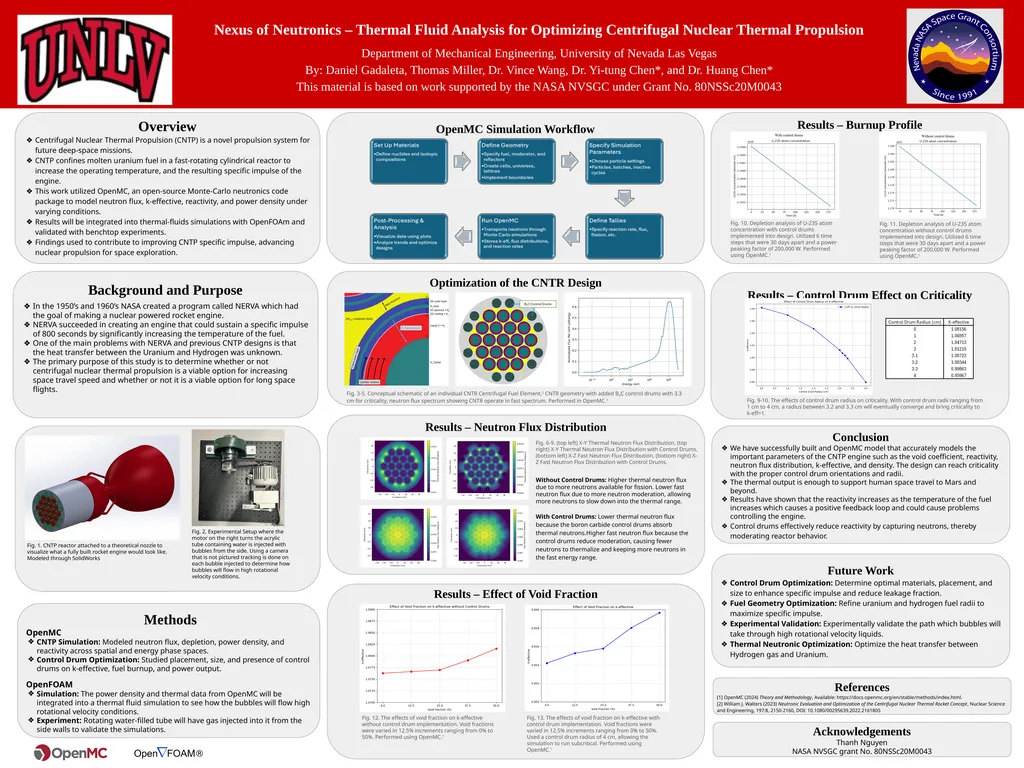
Description: Overview Centrifugal Nuclear Thermal Propulsion (CNTP) is a novel propulsion system for future deep-space missions. CNTP confines molten uranium fuel in a fast-rotating cylindrical reactor to increase the operating temperature, and the
Related Topics
Download Presentation
"Overview Centrifugal Nuclear Thermal Propulsion" is the property of its rightful owner. Permission is granted to download and print the materials on this website for personal, non-commercial use only, and to display it on your personal computer provided you do not modify the materials and that you retain all copyright notices contained in the materials. By downloading content from our website, you accept the terms of this agreement.
Presentation Transcript
slide1. Overview
Centrifugal Nuclear Thermal Propulsion (CNTP) is a novel propulsion system for future deep-space missions.
CNTP confines molten uranium fuel in a fast-rotating cylindrical reactor to increase the operating temperature, and the resulting specific impulse of the engine.
This work utilized OpenMC, an open-source Monte-Carlo neutronics code package to model neutron flux, k-effective, reactivity, and power density under varying conditions.
Results will be integrated into thermal-fluids simulations with OpenFOAm and validated with benchtop experiments.
Findings used to contribute to improving CNTP specific impulse, advancing nuclear propulsion for space exploration. Nexus of Neutronics – Thermal Fluid Analysis for Optimizing Centrifugal Nuclear Thermal Propulsion
Department of Mechanical Engineering, University of Nevada Las Vegas
By: Daniel Gadaleta, Thomas Miller, Dr. Vince Wang, Dr. Yi-tung Chen*, and Dr. Huang Chen*
This material is based on work supported by the NASA NVSGC under Grant No. 80NSSc20M0043 OpenMC Simulation Workflow Results – Neutron Flux Distribution Fig. 6-9. (top left) X-Y Thermal Neutron Flux Distribution, (top right) X-Y Thermal Neutron Flux Distribution with Control Drums, (bottom left) X-Z Fast Neutron Flux Distribution, (bottom right) X-Z Fast Neutron Flux Distribution with Control Drums. Fig. 1. CNTP reactor attached to a theoretical nozzle to visualize what a fully built rocket engine would look like. Modeled through SolidWorks Fig. 2. Experimental Setup where the motor on the right turns the acrylic tube containing water is injected with bubbles from the side. Using a camera that is not pictured tracking is done on each bubble injected to determine how bubbles will flow in high rotational velocity conditions. Optimization of the CNTR Design Without Control Drums: Higher thermal neutron flux due to more neutrons available for fission. Lower fast neutron flux due to more neutron moderation, allowing more neutrons to slow down into the thermal range.
With Control Drums: Lower thermal neutron flux because the boron carbide control drums absorb thermal neutrons.Higher fast neutron flux because the control drums reduce moderation, causing fewer neutrons to thermalize and keeping more neutrons in the fast energy range. References
[1] OpenMC (2024) Theory and Methodology, Available: https://docs.openmc.org/en/stable/methods/index.html.
[2] William J. Walters (2023) Neutronic Evaluation and Optimization of the Centrifugal Nuclear Thermal Rocket Concept, Nuclear Science and Engineering, 197:8, 2150-2160, DOI: 10.1080/00295639.2022.2161805 Acknowledgements
Thanh Nguyen
NASA NVSGC grant No. 80NSSc20M0043 Future Work
Control Drum Optimization: Determine optimal materials, placement, and size to enhance specific impulse and reduce leakage fraction.
Fuel Geometry Optimization: Refine uranium and hydrogen fuel radii to maximize specific impulse.
Experimental Validation: Experimentally validate the path which bubbles will take through high rotational velocity liquids.
Thermal Neutronic Optimization: Optimize the heat transfer between Hydrogen gas and Uranium. Results – Effect of Void Fraction Fig. 12. The effects of void fraction on k-effective without control drum implementation. Void fractions were varied in 12.5% increments ranging from 0% to 50%. Performed using OpenMC.1 Fig. 13. The effects of void fraction on k-effective with control drum implementation. Void fractions were varied in 12.5% increments ranging from 0% to 50%. Used a control drum radius of 4 cm, allowing the simulation to run subcritical. Performed using OpenMC.1 Fig. 3-5. Conceptual schematic of an individual CNTR Centrifugal Fuel Element,2 CNTR geometry with added B4C control drums with 3.3 cm for criticality, neutron flux spectrum showing CNTR operate in fast spectrum. Performed in OpenMC.1 Conclusion
We have successfully built and OpenMC model that accurately models the important parameters of the CNTP engine such as the void coefficient, reactivity, neutron flux distribution, k-effective, and density. The design can reach criticality with the proper control drum orientations and radii.
The thermal output is enough to support human space travel to Mars and beyond.
Results have shown that the reactivity increases as the temperature of the fuel increases which causes a positive feedback loop and could cause problems controlling the engine.
Control drums effectively reduce reactivity by capturing neutrons, thereby moderating reactor behavior. Results – Control Drum Effect on Criticality Fig. 9-10. The effects of control drum radius on criticality. With control drum radii ranging from 1 cm to 4 cm, a radius between 3.2 and 3.3 cm will eventually converge and bring criticality to k-eff=1. Background and Purpose
In the 1950’s and 1960’s NASA created a program called NERVA which had the goal of making a nuclear powered rocket engine.
NERVA succeeded in creating an engine that could sustain a specific impulse of 800 seconds by significantly increasing the temperature of the fuel.
One of the main problems with NERVA and previous CNTP designs is that the heat transfer between the Uranium and Hydrogen was unknown.
The primary purpose of this study is to determine whether or not centrifugal nuclear thermal propulsion is a viable option for increasing space travel speed and whether or not it is a viable option for long space flights. Methods
OpenMC
CNTP Simulation: Modeled neutron flux, depletion, power density, and reactivity across spatial and energy phase spaces.
Control Drum Optimization: Studied placement, size, and presence of control drums on k-effective, fuel burnup, and power output.
OpenFOAM
Simulation: The power density and thermal data from OpenMC will be integrated into a thermal fluid simulation to see how the bubbles will flow high rotational velocity conditions.
Experiment: Rotating water-filled tube will have gas injected into it from the side walls to validate the simulations.<br>
Centrifugal Nuclear Thermal Propulsion (CNTP) is a novel propulsion system for future deep-space missions.
CNTP confines molten uranium fuel in a fast-rotating cylindrical reactor to increase the operating temperature, and the resulting specific impulse of the engine.
This work utilized OpenMC, an open-source Monte-Carlo neutronics code package to model neutron flux, k-effective, reactivity, and power density under varying conditions.
Results will be integrated into thermal-fluids simulations with OpenFOAm and validated with benchtop experiments.
Findings used to contribute to improving CNTP specific impulse, advancing nuclear propulsion for space exploration. Nexus of Neutronics – Thermal Fluid Analysis for Optimizing Centrifugal Nuclear Thermal Propulsion
Department of Mechanical Engineering, University of Nevada Las Vegas
By: Daniel Gadaleta, Thomas Miller, Dr. Vince Wang, Dr. Yi-tung Chen*, and Dr. Huang Chen*
This material is based on work supported by the NASA NVSGC under Grant No. 80NSSc20M0043 OpenMC Simulation Workflow Results – Neutron Flux Distribution Fig. 6-9. (top left) X-Y Thermal Neutron Flux Distribution, (top right) X-Y Thermal Neutron Flux Distribution with Control Drums, (bottom left) X-Z Fast Neutron Flux Distribution, (bottom right) X-Z Fast Neutron Flux Distribution with Control Drums. Fig. 1. CNTP reactor attached to a theoretical nozzle to visualize what a fully built rocket engine would look like. Modeled through SolidWorks Fig. 2. Experimental Setup where the motor on the right turns the acrylic tube containing water is injected with bubbles from the side. Using a camera that is not pictured tracking is done on each bubble injected to determine how bubbles will flow in high rotational velocity conditions. Optimization of the CNTR Design Without Control Drums: Higher thermal neutron flux due to more neutrons available for fission. Lower fast neutron flux due to more neutron moderation, allowing more neutrons to slow down into the thermal range.
With Control Drums: Lower thermal neutron flux because the boron carbide control drums absorb thermal neutrons.Higher fast neutron flux because the control drums reduce moderation, causing fewer neutrons to thermalize and keeping more neutrons in the fast energy range. References
[1] OpenMC (2024) Theory and Methodology, Available: https://docs.openmc.org/en/stable/methods/index.html.
[2] William J. Walters (2023) Neutronic Evaluation and Optimization of the Centrifugal Nuclear Thermal Rocket Concept, Nuclear Science and Engineering, 197:8, 2150-2160, DOI: 10.1080/00295639.2022.2161805 Acknowledgements
Thanh Nguyen
NASA NVSGC grant No. 80NSSc20M0043 Future Work
Control Drum Optimization: Determine optimal materials, placement, and size to enhance specific impulse and reduce leakage fraction.
Fuel Geometry Optimization: Refine uranium and hydrogen fuel radii to maximize specific impulse.
Experimental Validation: Experimentally validate the path which bubbles will take through high rotational velocity liquids.
Thermal Neutronic Optimization: Optimize the heat transfer between Hydrogen gas and Uranium. Results – Effect of Void Fraction Fig. 12. The effects of void fraction on k-effective without control drum implementation. Void fractions were varied in 12.5% increments ranging from 0% to 50%. Performed using OpenMC.1 Fig. 13. The effects of void fraction on k-effective with control drum implementation. Void fractions were varied in 12.5% increments ranging from 0% to 50%. Used a control drum radius of 4 cm, allowing the simulation to run subcritical. Performed using OpenMC.1 Fig. 3-5. Conceptual schematic of an individual CNTR Centrifugal Fuel Element,2 CNTR geometry with added B4C control drums with 3.3 cm for criticality, neutron flux spectrum showing CNTR operate in fast spectrum. Performed in OpenMC.1 Conclusion
We have successfully built and OpenMC model that accurately models the important parameters of the CNTP engine such as the void coefficient, reactivity, neutron flux distribution, k-effective, and density. The design can reach criticality with the proper control drum orientations and radii.
The thermal output is enough to support human space travel to Mars and beyond.
Results have shown that the reactivity increases as the temperature of the fuel increases which causes a positive feedback loop and could cause problems controlling the engine.
Control drums effectively reduce reactivity by capturing neutrons, thereby moderating reactor behavior. Results – Control Drum Effect on Criticality Fig. 9-10. The effects of control drum radius on criticality. With control drum radii ranging from 1 cm to 4 cm, a radius between 3.2 and 3.3 cm will eventually converge and bring criticality to k-eff=1. Background and Purpose
In the 1950’s and 1960’s NASA created a program called NERVA which had the goal of making a nuclear powered rocket engine.
NERVA succeeded in creating an engine that could sustain a specific impulse of 800 seconds by significantly increasing the temperature of the fuel.
One of the main problems with NERVA and previous CNTP designs is that the heat transfer between the Uranium and Hydrogen was unknown.
The primary purpose of this study is to determine whether or not centrifugal nuclear thermal propulsion is a viable option for increasing space travel speed and whether or not it is a viable option for long space flights. Methods
OpenMC
CNTP Simulation: Modeled neutron flux, depletion, power density, and reactivity across spatial and energy phase spaces.
Control Drum Optimization: Studied placement, size, and presence of control drums on k-effective, fuel burnup, and power output.
OpenFOAM
Simulation: The power density and thermal data from OpenMC will be integrated into a thermal fluid simulation to see how the bubbles will flow high rotational velocity conditions.
Experiment: Rotating water-filled tube will have gas injected into it from the side walls to validate the simulations.<br>