
Overview for VA Providers Helen Midouhas, MS Ed,
SN
Published · 24 slides · 0 views

1 / 1
Description
Overview for VA Providers Helen Midouhas, MS Ed, LPC FFT Implementation Specialist Seattle USA www.fftllc.com Agenda: FFT What is FFT Requirements for Clinicians Training and Technical Assistance How Teams are Chosen Next Steps Agenda: What
Related Topics
Share
Embed code
Download this presentation From Below
"Overview for VA Providers Helen Midouhas, MS Ed," is the property of its rightful owner. Permission is granted to download and print the materials on this website for personal, non-commercial use only, and to display it on your personal computer provided you do not modify the materials and that you retain all copyright notices contained in the materials. By downloading content from our website, you accept the terms of this agreement.
Presentation Transcript
01
Overview for VA Providers
Helen Midouhas, MS Ed, LPC
FFT Implementation Specialist
Seattle USA
www.fftllc.com<br>
02
Agenda: FFT What is FFT
Requirements for Clinicians
Training and Technical Assistance
How Teams are Chosen
Next Steps<br>
Requirements for Clinicians
Training and Technical Assistance
How Teams are Chosen
Next Steps<br>
03
Agenda: What is FFT? Overview
Targeted population
Average length of treatment
Goal of Treatment
Therapist Caseload
Where are services provided<br>
Targeted population
Average length of treatment
Goal of Treatment
Therapist Caseload
Where are services provided<br>
04
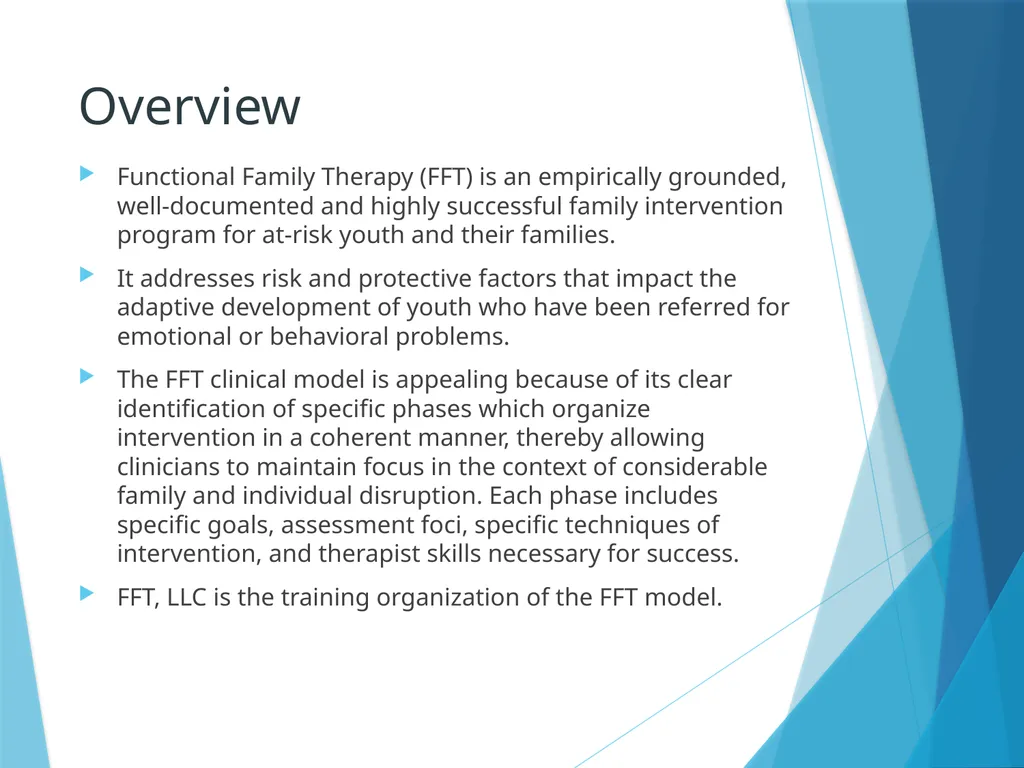
Overview Functional Family Therapy (FFT) is an empirically grounded, well-documented and highly successful family intervention program for at-risk youth and their families.
It addresses risk and protective factors that impact the adaptive development of youth who have been referred for emotional or behavioral problems.
The FFT clinical model is appealing because of its clear identification of specific phases which organize intervention in a coherent manner, thereby allowing clinicians to maintain focus in the context of considerable family and individual disruption. Each phase includes specific goals, assessment foci, specific techniques of intervention, and therapist skills necessary for success.
FFT, LLC is the training organization of the FFT model.<br>
It addresses risk and protective factors that impact the adaptive development of youth who have been referred for emotional or behavioral problems.
The FFT clinical model is appealing because of its clear identification of specific phases which organize intervention in a coherent manner, thereby allowing clinicians to maintain focus in the context of considerable family and individual disruption. Each phase includes specific goals, assessment foci, specific techniques of intervention, and therapist skills necessary for success.
FFT, LLC is the training organization of the FFT model.<br>
05
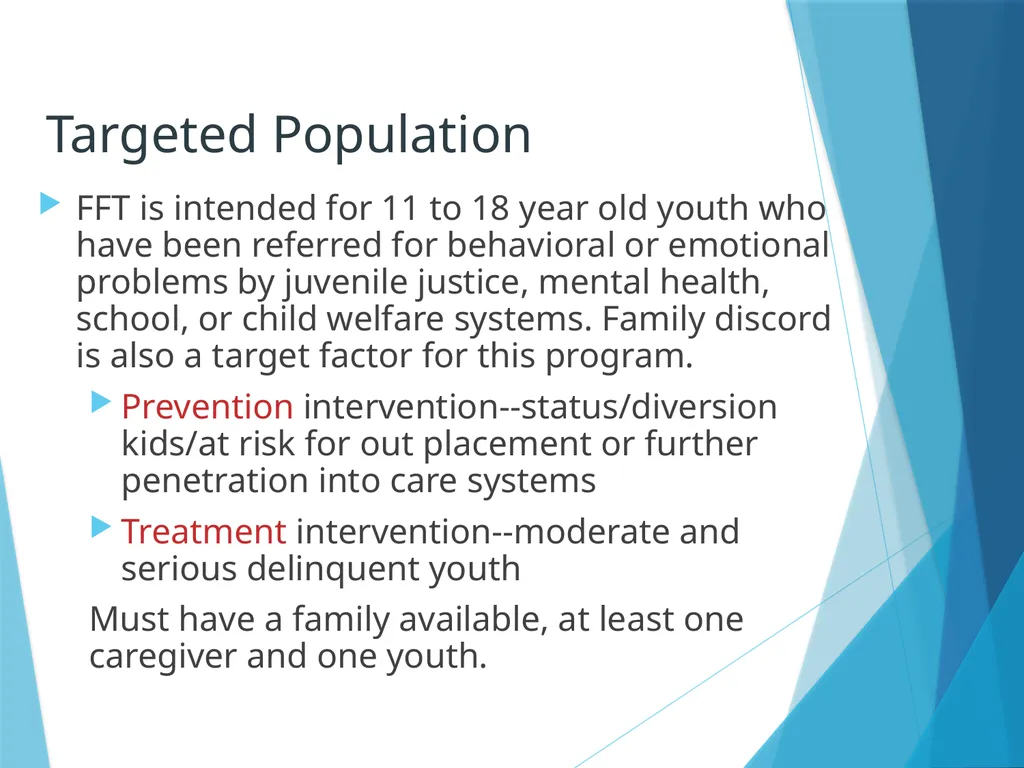
Targeted Population FFT is intended for 11 to 18 year old youth who have been referred for behavioral or emotional problems by juvenile justice, mental health, school, or child welfare systems. Family discord is also a target factor for this program.
Prevention intervention--status/diversion kids/at risk for out placement or further penetration into care systems
Treatment intervention--moderate and serious delinquent youth
Must have a family available, at least one caregiver and one youth.<br>
Prevention intervention--status/diversion kids/at risk for out placement or further penetration into care systems
Treatment intervention--moderate and serious delinquent youth
Must have a family available, at least one caregiver and one youth.<br>
06
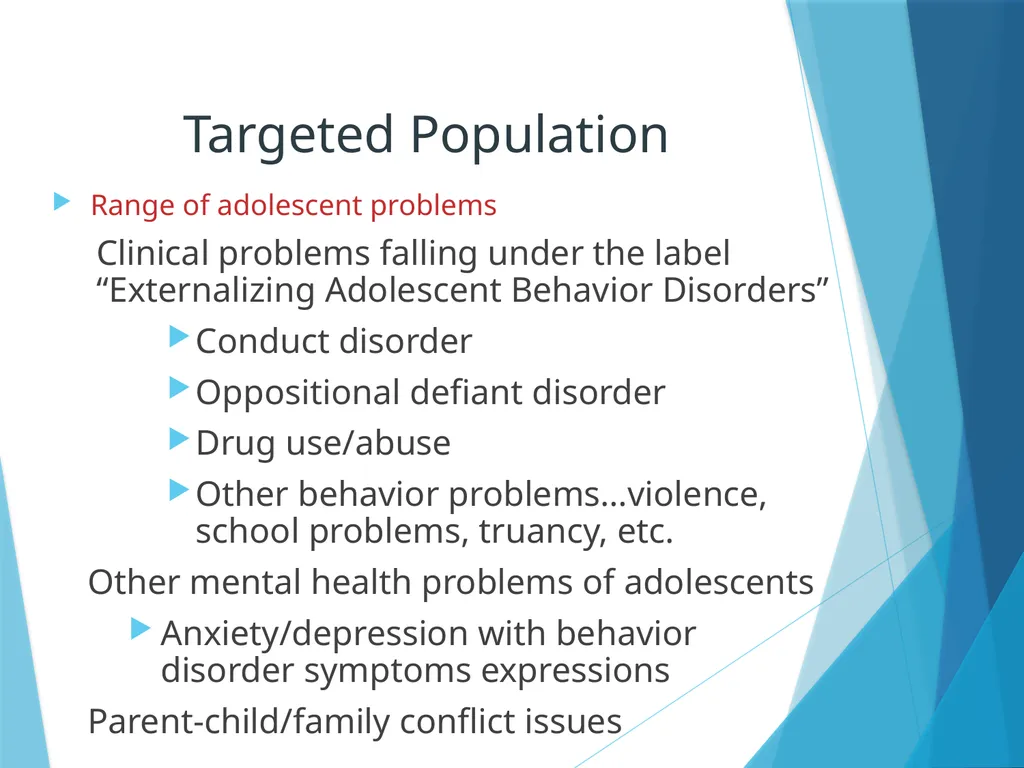
Targeted Population Range of adolescent problems
Clinical problems falling under the label “Externalizing Adolescent Behavior Disorders”
Conduct disorder
Oppositional defiant disorder
Drug use/abuse
Other behavior problems…violence, school problems, truancy, etc.
Other mental health problems of adolescents
Anxiety/depression with behavior disorder symptoms expressions
Parent-child/family conflict issues<br>
Clinical problems falling under the label “Externalizing Adolescent Behavior Disorders”
Conduct disorder
Oppositional defiant disorder
Drug use/abuse
Other behavior problems…violence, school problems, truancy, etc.
Other mental health problems of adolescents
Anxiety/depression with behavior disorder symptoms expressions
Parent-child/family conflict issues<br>
07
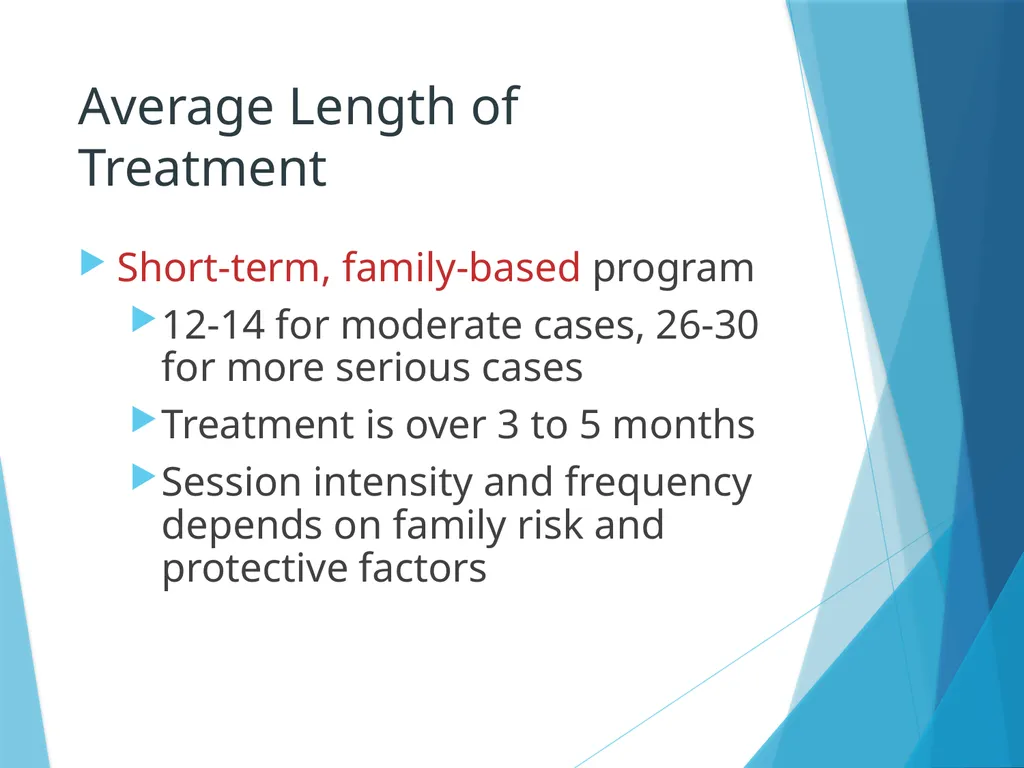
Average Length of Treatment Short-term, family-based program
12-14 for moderate cases, 26-30 for more serious cases
Treatment is over 3 to 5 months
Session intensity and frequency depends on family risk and protective factors<br>
12-14 for moderate cases, 26-30 for more serious cases
Treatment is over 3 to 5 months
Session intensity and frequency depends on family risk and protective factors<br>
08
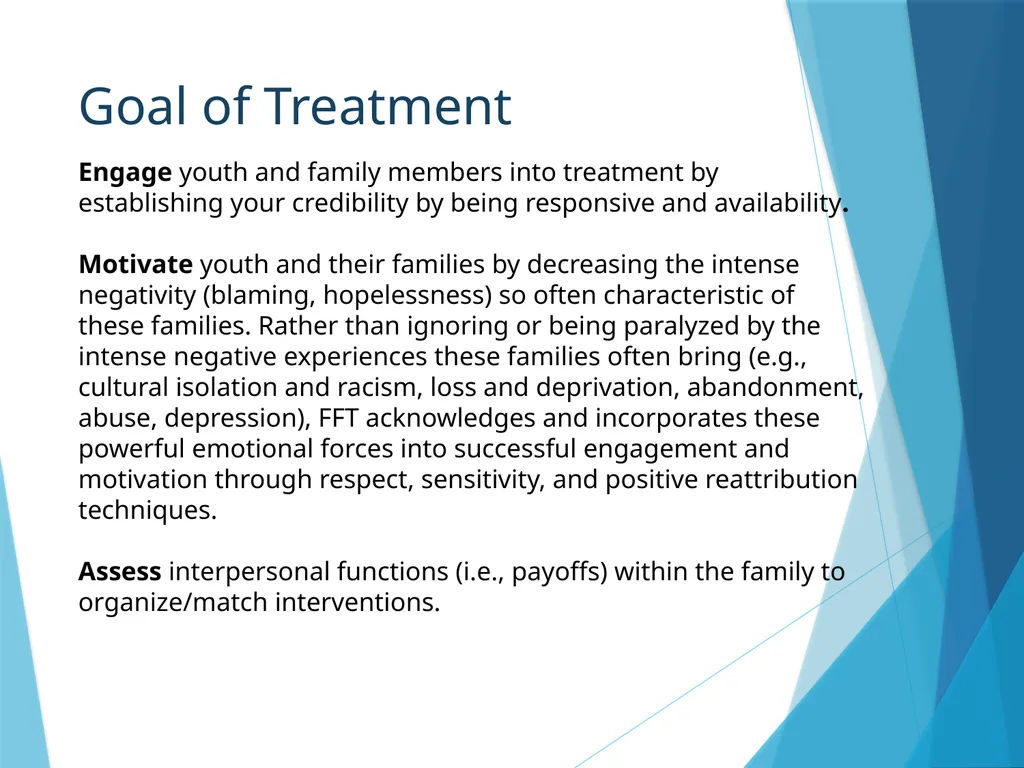
Goal of Treatment Engage youth and family members into treatment by establishing your credibility by being responsive and availability.
Motivate youth and their families by decreasing the intense negativity (blaming, hopelessness) so often characteristic of these families. Rather than ignoring or being paralyzed by the intense negative experiences these families often bring (e.g., cultural isolation and racism, loss and deprivation, abandonment, abuse, depression), FFT acknowledges and incorporates these powerful emotional forces into successful engagement and motivation through respect, sensitivity, and positive reattribution techniques.
Assess interpersonal functions (i.e., payoffs) within the family to organize/match interventions.<br>
Motivate youth and their families by decreasing the intense negativity (blaming, hopelessness) so often characteristic of these families. Rather than ignoring or being paralyzed by the intense negative experiences these families often bring (e.g., cultural isolation and racism, loss and deprivation, abandonment, abuse, depression), FFT acknowledges and incorporates these powerful emotional forces into successful engagement and motivation through respect, sensitivity, and positive reattribution techniques.
Assess interpersonal functions (i.e., payoffs) within the family to organize/match interventions.<br>
09
Goal of Treatment Behavior Change: Reduce and eliminate the problem behaviors and accompanying family relational patterns through individualized behavior change interventions, including cognitive/attributional interventions, systematic skill-training in family communication, parenting, problem solving, and conflict management.
Generalize changes across problem situations by increasing the family’s capacity to utilize multisystem community resources adequately, and to engage in relapse planning.<br>
Generalize changes across problem situations by increasing the family’s capacity to utilize multisystem community resources adequately, and to engage in relapse planning.<br>
10
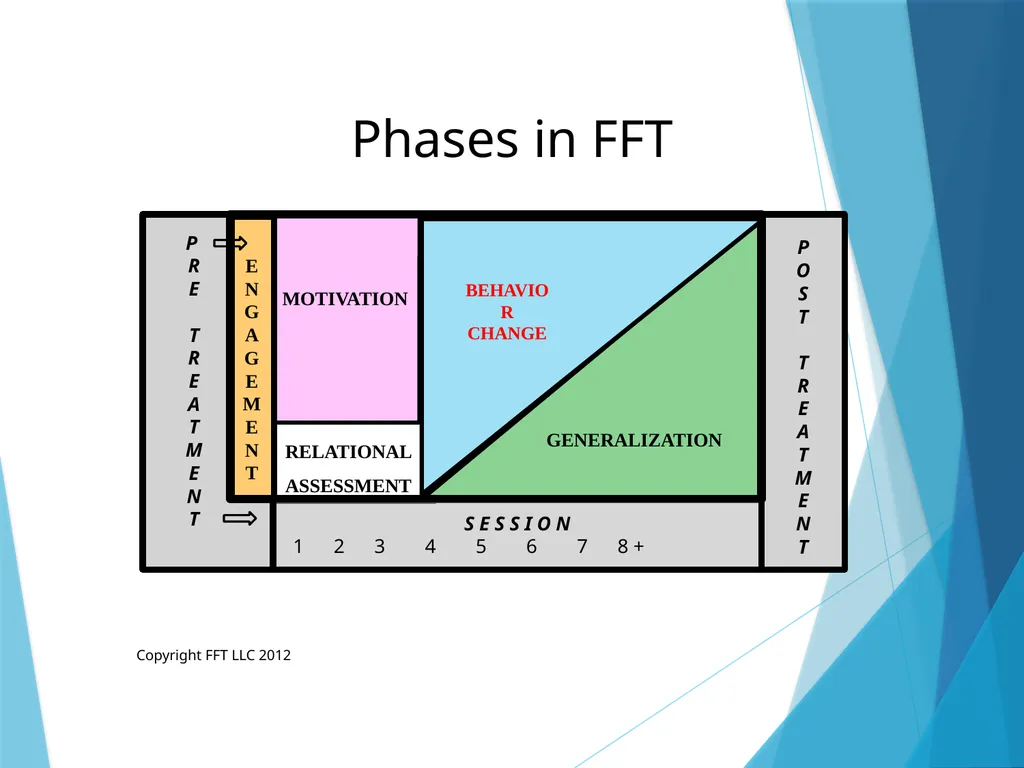
Phases in FFT P
O
S
T
T
R
E
A
T
M
E
N
T MOTIVATION RELATIONAL ASSESSMENT P OO
ROO
EOO
TOO
ROO
EOO
AOO
TOO
MOO
EOO
NOO
TOO E
N
G
A
G
E
M
E
N
T GENERALIZATION BEHAVIOR
CHANGE S E S S I O N
1 2 3 4 5 6 7 8 + Copyright FFT LLC 2012<br>
O
S
T
T
R
E
A
T
M
E
N
T MOTIVATION RELATIONAL ASSESSMENT P OO
ROO
EOO
TOO
ROO
EOO
AOO
TOO
MOO
EOO
NOO
TOO E
N
G
A
G
E
M
E
N
T GENERALIZATION BEHAVIOR
CHANGE S E S S I O N
1 2 3 4 5 6 7 8 + Copyright FFT LLC 2012<br>
11
Outcomes of Treatment Reduction in out of home placements
Reduction in recidivism
Significant reduction in crime severity for those who do reoffend
Dropout rates between 9-12%
Significant reductions in youth, caregiver
interpersonal distress/somatic complaints
Reduction in siblings of referred youth going into care services
Reduction in violent felony crimes
Significant reduction in drug use as compared to CBT, psycho-education and group treatment
Improved family functioning
Significant cost effectiveness<br>
Reduction in recidivism
Significant reduction in crime severity for those who do reoffend
Dropout rates between 9-12%
Significant reductions in youth, caregiver
interpersonal distress/somatic complaints
Reduction in siblings of referred youth going into care services
Reduction in violent felony crimes
Significant reduction in drug use as compared to CBT, psycho-education and group treatment
Improved family functioning
Significant cost effectiveness<br>
12
Where Services are Provided Recommended Locations/Delivery Settings
Typically, FFT is conducted in home and clinic settings.
It can also be delivered in schools, child welfare facilities, probation and parole offices, aftercare systems, and mental health facilities.
Most importantly is who is in the room, however homebased services are always preferred as long as it matches to the family.<br>
Typically, FFT is conducted in home and clinic settings.
It can also be delivered in schools, child welfare facilities, probation and parole offices, aftercare systems, and mental health facilities.
Most importantly is who is in the room, however homebased services are always preferred as long as it matches to the family.<br>
13
Agenda: Requirements for Clinicians Education level/License or license-eligible
Time commitment
Location commitment<br>
Time commitment
Location commitment<br>
14
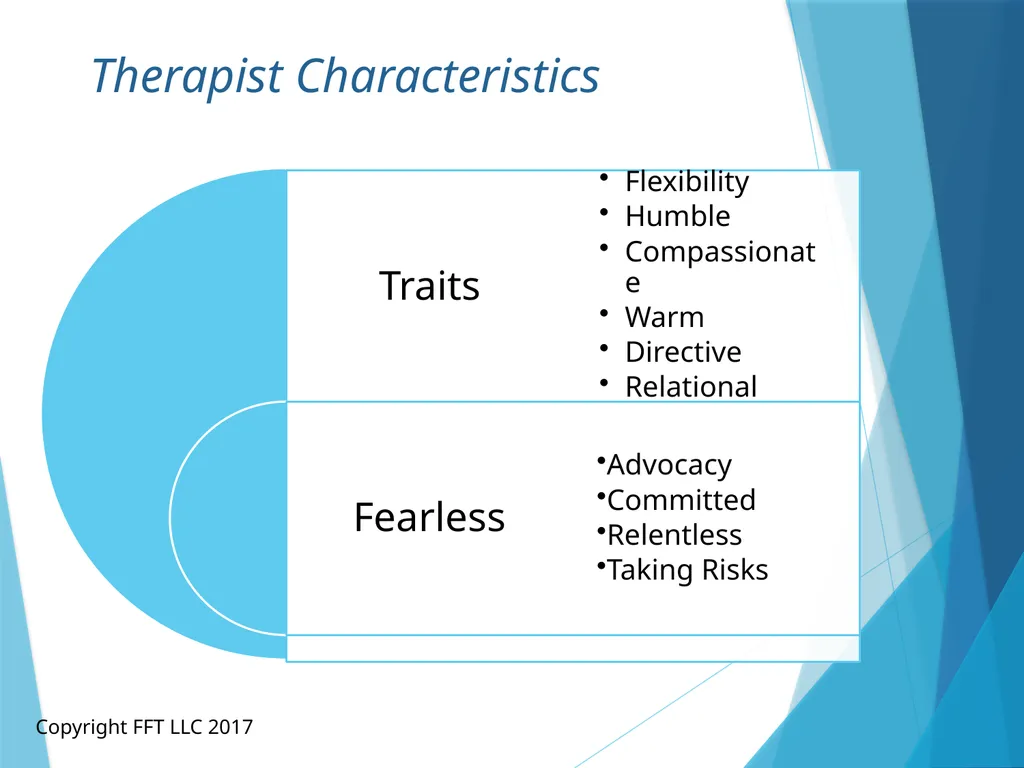
Therapist Characteristics Copyright FFT LLC 2017<br>
15
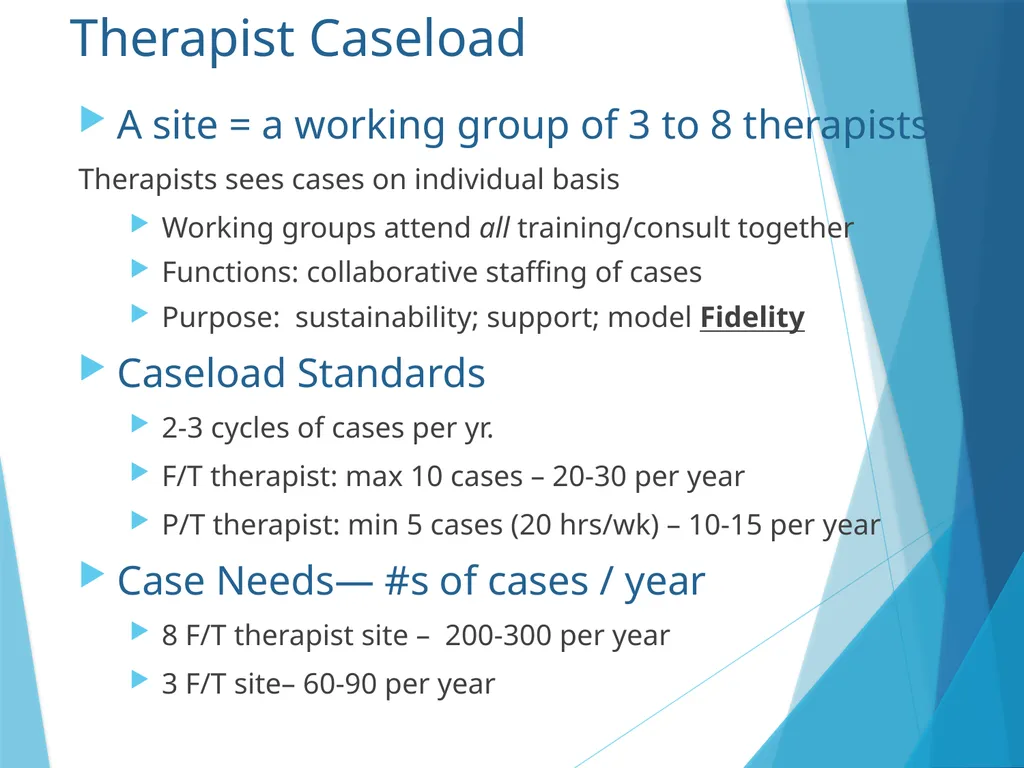
Therapist Caseload A site = a working group of 3 to 8 therapists
Therapists sees cases on individual basis
Working groups attend all training/consult together
Functions: collaborative staffing of cases
Purpose: sustainability; support; model Fidelity
Caseload Standards
2-3 cycles of cases per yr.
F/T therapist: max 10 cases – 20-30 per year
P/T therapist: min 5 cases (20 hrs/wk) – 10-15 per year
Case Needs— #s of cases / year
8 F/T therapist site – 200-300 per year
3 F/T site– 60-90 per year<br>
Therapists sees cases on individual basis
Working groups attend all training/consult together
Functions: collaborative staffing of cases
Purpose: sustainability; support; model Fidelity
Caseload Standards
2-3 cycles of cases per yr.
F/T therapist: max 10 cases – 20-30 per year
P/T therapist: min 5 cases (20 hrs/wk) – 10-15 per year
Case Needs— #s of cases / year
8 F/T therapist site – 200-300 per year
3 F/T site– 60-90 per year<br>
16
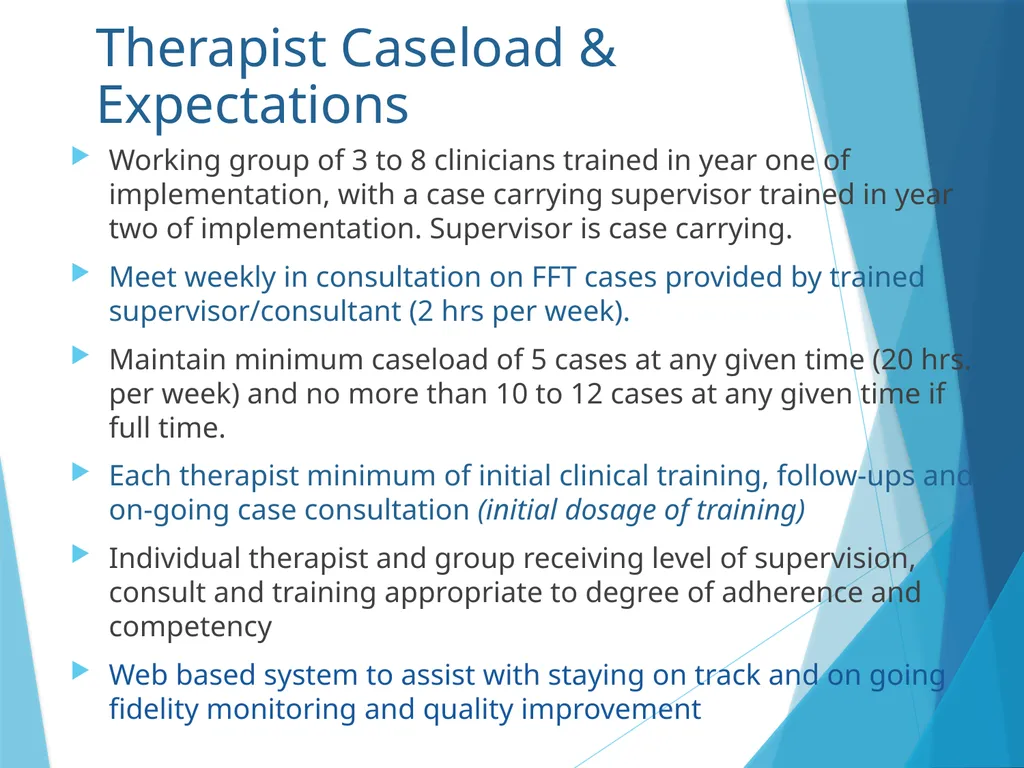
Therapist Caseload & Expectations Working group of 3 to 8 clinicians trained in year one of implementation, with a case carrying supervisor trained in year two of implementation. Supervisor is case carrying.
Meet weekly in consultation on FFT cases provided by trained supervisor/consultant (2 hrs per week).
Maintain minimum caseload of 5 cases at any given time (20 hrs. per week) and no more than 10 to 12 cases at any given time if full time.
Each therapist minimum of initial clinical training, follow-ups and on-going case consultation (initial dosage of training)
Individual therapist and group receiving level of supervision, consult and training appropriate to degree of adherence and competency
Web based system to assist with staying on track and on going fidelity monitoring and quality improvement<br>
Meet weekly in consultation on FFT cases provided by trained supervisor/consultant (2 hrs per week).
Maintain minimum caseload of 5 cases at any given time (20 hrs. per week) and no more than 10 to 12 cases at any given time if full time.
Each therapist minimum of initial clinical training, follow-ups and on-going case consultation (initial dosage of training)
Individual therapist and group receiving level of supervision, consult and training appropriate to degree of adherence and competency
Web based system to assist with staying on track and on going fidelity monitoring and quality improvement<br>
17
Agenda: Training and Technical Assistance Length of time of training and TA
Training paid for by VDSS; lodging and travel, if needed, paid for by agency
Need for senior leadership/executive level involvement
Successful completion of training<br>
Training paid for by VDSS; lodging and travel, if needed, paid for by agency
Need for senior leadership/executive level involvement
Successful completion of training<br>
18
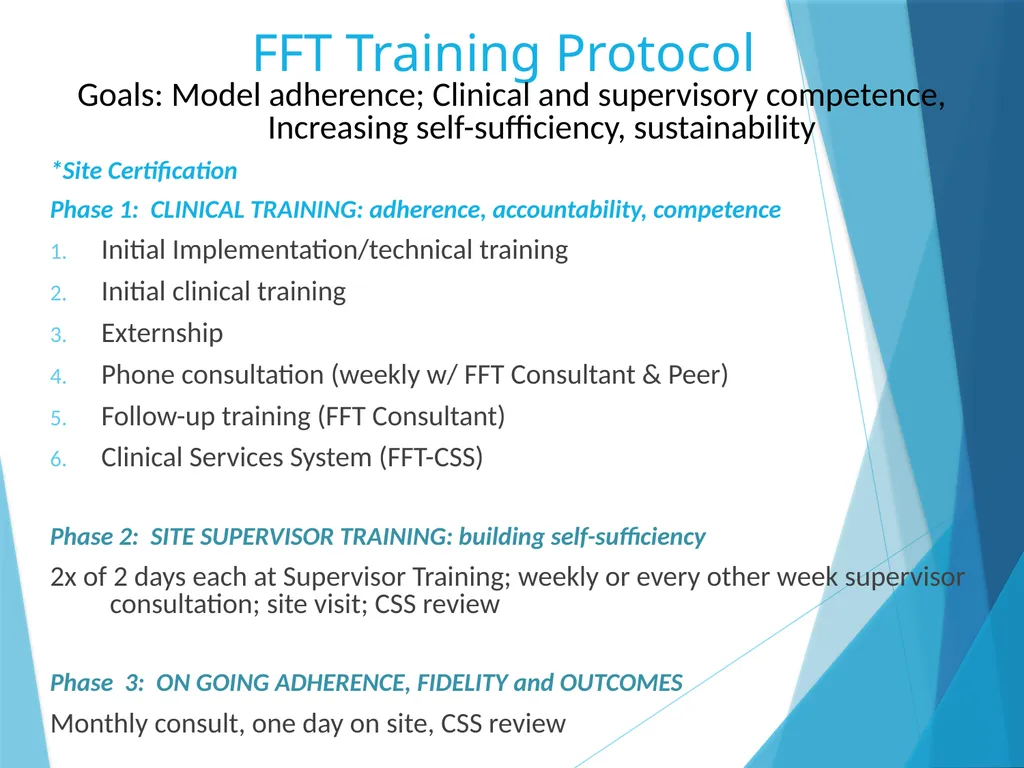
FFT Training Protocol Goals: Model adherence; Clinical and supervisory competence, Increasing self-sufficiency, sustainability
*Site Certification
Phase 1: CLINICAL TRAINING: adherence, accountability, competence
Initial Implementation/technical training
Initial clinical training
Externship
Phone consultation (weekly w/ FFT Consultant & Peer)
Follow-up training (FFT Consultant)
Clinical Services System (FFT-CSS)
Phase 2: SITE SUPERVISOR TRAINING: building self-sufficiency
2x of 2 days each at Supervisor Training; weekly or every other week supervisor consultation; site visit; CSS review
Phase 3: ON GOING ADHERENCE, FIDELITY and OUTCOMES
Monthly consult, one day on site, CSS review<br>
*Site Certification
Phase 1: CLINICAL TRAINING: adherence, accountability, competence
Initial Implementation/technical training
Initial clinical training
Externship
Phone consultation (weekly w/ FFT Consultant & Peer)
Follow-up training (FFT Consultant)
Clinical Services System (FFT-CSS)
Phase 2: SITE SUPERVISOR TRAINING: building self-sufficiency
2x of 2 days each at Supervisor Training; weekly or every other week supervisor consultation; site visit; CSS review
Phase 3: ON GOING ADHERENCE, FIDELITY and OUTCOMES
Monthly consult, one day on site, CSS review<br>
19
FFT Clinical Services System (CSS) Web-based system
Client menu
Contacts / Sessions menu
Assessment menu
Reports menu
Functions:
Teaching (FFT specific progress notes and process questionnaires)
Supervision/monitoring
Service Delivery information
Client Change
Outcome assessment (therapist, youth, parent)
Process assessment<br>
Client menu
Contacts / Sessions menu
Assessment menu
Reports menu
Functions:
Teaching (FFT specific progress notes and process questionnaires)
Supervision/monitoring
Service Delivery information
Client Change
Outcome assessment (therapist, youth, parent)
Process assessment<br>
20
Agenda: How Teams are Chosen FFT reviews all of the applications
Conversations/virtual site visits by FFT, if needed
VDSS will have final decision as would like representation throughout state<br>
Conversations/virtual site visits by FFT, if needed
VDSS will have final decision as would like representation throughout state<br>
21
FFT Organizational Components Model selection fits with the agency mission; support for doing evidence-based/family-based interventions
Therapist/supervisor selection and support: willingness to learn, ability to apply protocols
Broad Organizational Commitment to
training and FFT site standards
FFT assessment-web system
QA – QI protocols
Commitment of resources to support program
Strong relationships with referral agents/funders<br>
Therapist/supervisor selection and support: willingness to learn, ability to apply protocols
Broad Organizational Commitment to
training and FFT site standards
FFT assessment-web system
QA – QI protocols
Commitment of resources to support program
Strong relationships with referral agents/funders<br>
22
FFT External Influence Factors Support for evaluated programs -- evidence based and outcome focused practice
Support for adequate referral numbers
Systemic support for fidelity: training & QA (funders, referral agents…)
Sustainable funding strategies (for services and QI)
Support for FFT-CW congruent assessment / documentation
Ongoing support for outcomes<br>
Support for adequate referral numbers
Systemic support for fidelity: training & QA (funders, referral agents…)
Sustainable funding strategies (for services and QI)
Support for FFT-CW congruent assessment / documentation
Ongoing support for outcomes<br>
23
Site Readiness Process FFT Site Application-from FFT, LLC
FFT Application Review Call
Ongoing pre-implementation planning with FFT, LLC
Scheduling Trainings through Holly DeMaranville, FFT Communications Director
hollyfft@Comcast.net
-for application and scheduling training<br>
FFT Application Review Call
Ongoing pre-implementation planning with FFT, LLC
Scheduling Trainings through Holly DeMaranville, FFT Communications Director
hollyfft@Comcast.net
-for application and scheduling training<br>
24
Agenda: Next Steps Application available November 7th
Next Informational Webinars will be November 19th; FFT will be from 2:00 to 4:00.
Application deadline is December 20th<br>
Next Informational Webinars will be November 19th; FFT will be from 2:00 to 4:00.
Application deadline is December 20th<br>