Oxidation-Reduction Titrations Redox Titration Assay of ferrous sulfate (FeSO4.7H2O) Lecturer Luma Amer Department of Pharmaceutical ChemistryCollage of pharmacy 3 rd stage: 4tlab. ferrous sulfate is the chemical compound with the formula
"Oxidation-Reduction Titrations Redox Titration" is the property of its rightful owner. Permission is granted to
download and print the materials on this website for personal, non-commercial use only, and to display it
on your personal computer provided you do not modify the materials and that you retain all copyright
notices contained in the materials. By downloading content from our website, you accept the terms of this
agreement.
Presentation Transcript
01
Oxidation-Reduction Titrations Redox Titration Assay of ferrous sulfate
(FeSO4.7H2O) Lecturer Luma Amer
Department of Pharmaceutical Chemistry/Collage of pharmacy 3 rd stage: 4tlab.<br>
02
ferrous sulfate is the chemical compound with the formula FeSO4.Its molecular weight 278.05,melting point 329.9ºC. It has a pale green color as a powder, and as crystals it has a bluish green color, freely soluble in water.
The medical uses:
It is used medically to treat iron deficiency
Together with other iron compounds, ferrous sulfate is used to fortify foods and to treat iron-deficiency anemia.<br>
03
side effect of ferrous sulfate tablets: Constipation is a frequent and uncomfortable side effect associated with the administration of oral iron supplements. Stool softeners often are prescribed to prevent constipation.
Chemical principle:
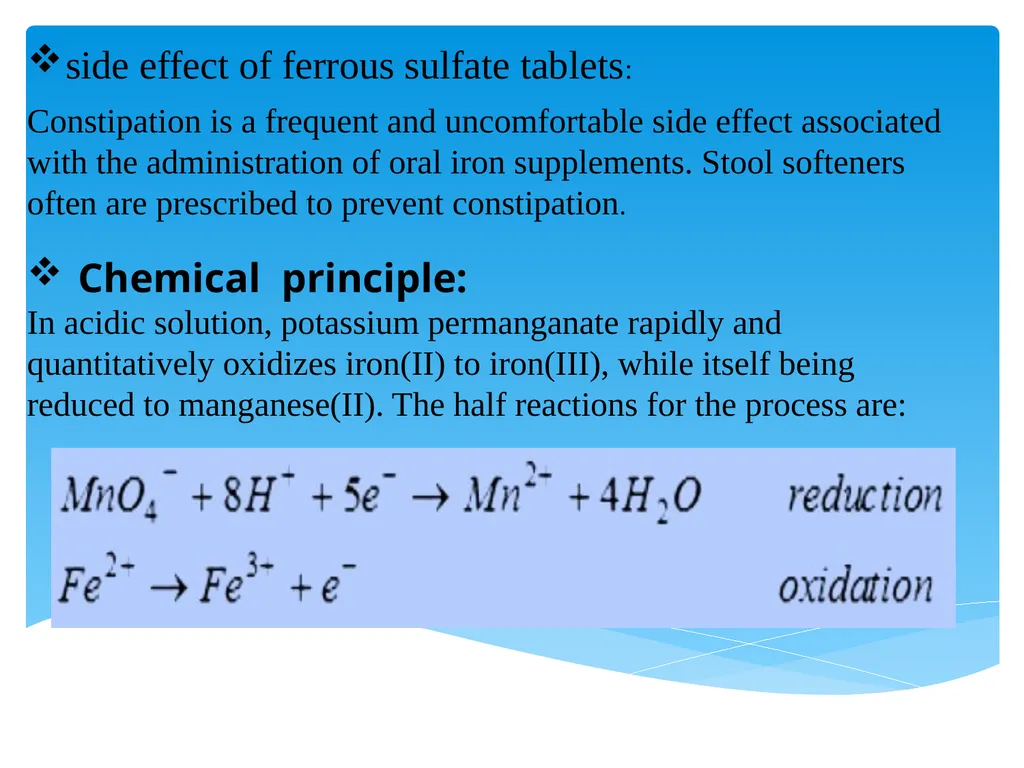
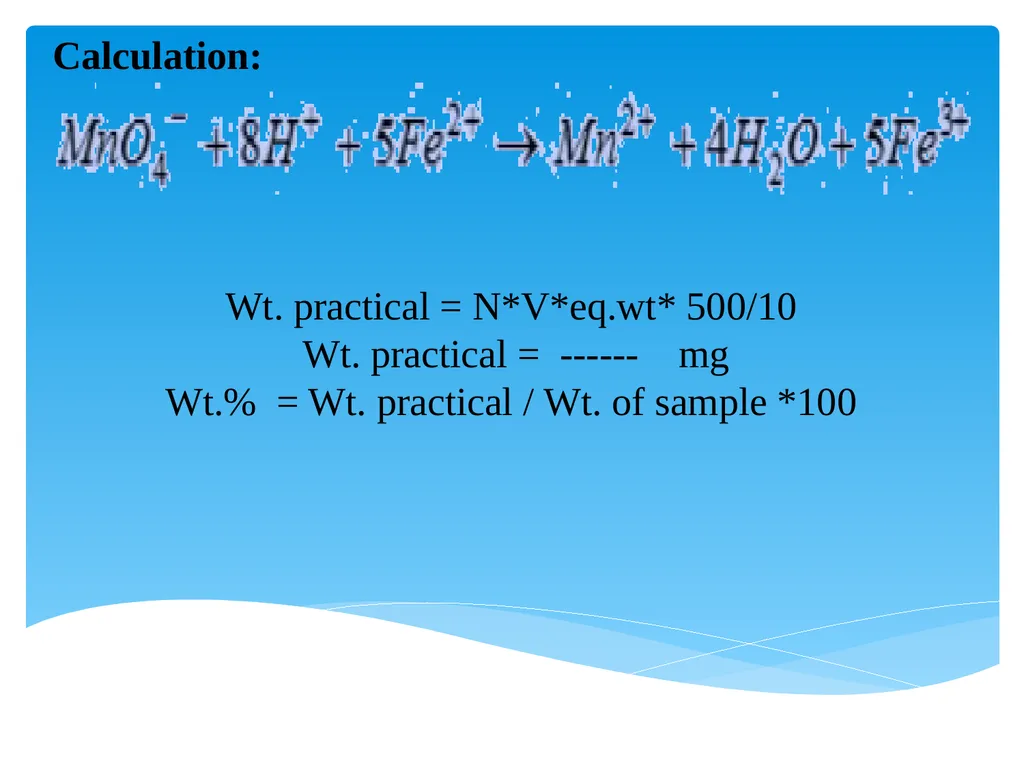
In acidic solution, potassium permanganate rapidly and quantitatively oxidizes iron(II) to iron(III), while itself being reduced to manganese(II). The half reactions for the process are:<br>
04
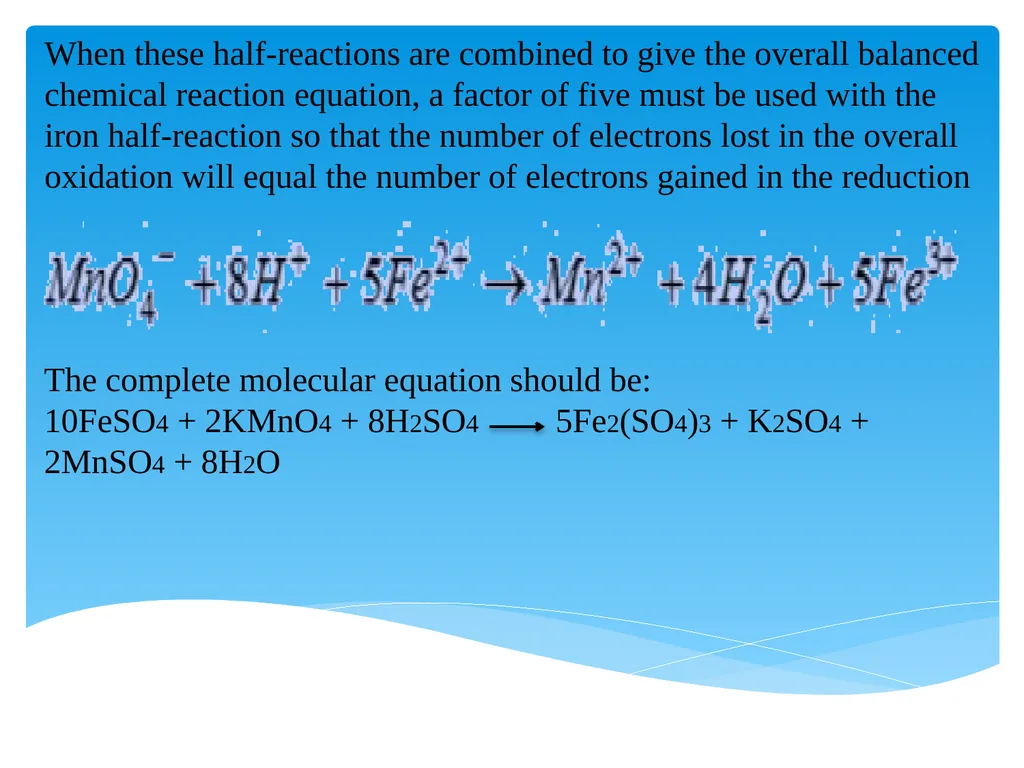
When these half-reactions are combined to give the overall balanced chemical reaction equation, a factor of five must be used with the iron half-reaction so that the number of electrons lost in the overall oxidation will equal the number of electrons gained in the reduction The complete molecular equation should be:
10FeSO4 + 2KMnO4 + 8H2SO4 5Fe2(SO4)3 + K2SO4 + 2MnSO4 + 8H2O<br>
05
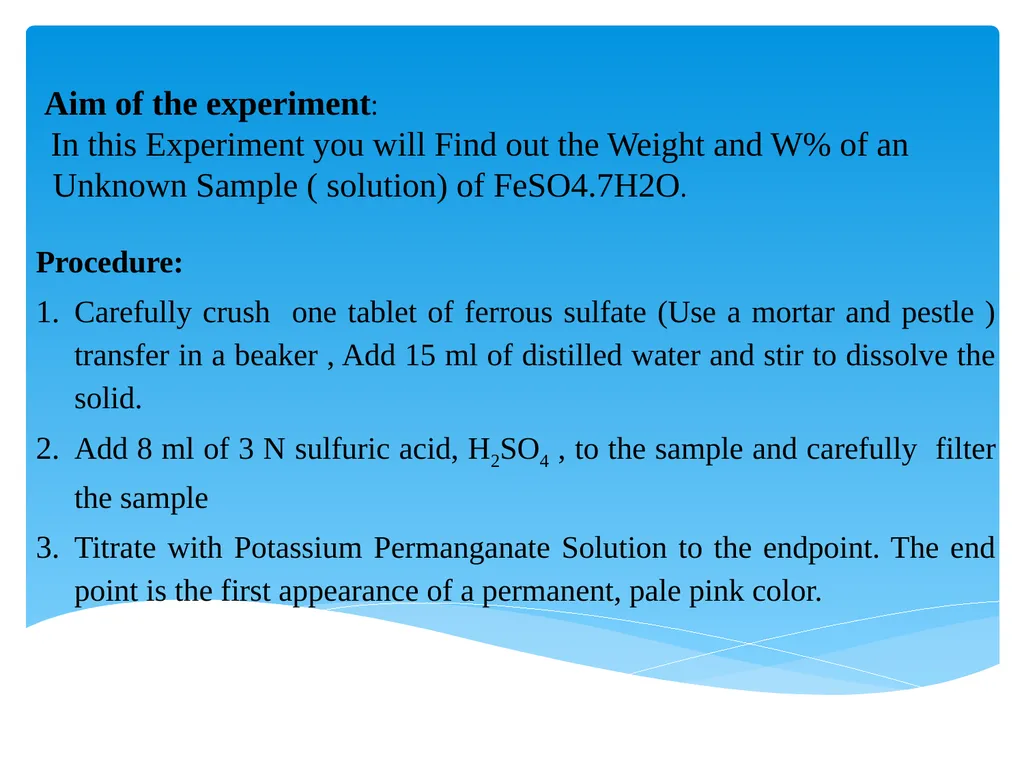
Procedure:
Carefully crush one tablet of ferrous sulfate (Use a mortar and pestle ) transfer in a beaker , Add 15 ml of distilled water and stir to dissolve the solid.
Add 8 ml of 3 N sulfuric acid, H2SO4 , to the sample and carefully filter the sample
Titrate with Potassium Permanganate Solution to the endpoint. The end point is the first appearance of a permanent, pale pink color. Aim of the experiment:
In this Experiment you will Find out the Weight and W% of an
Unknown Sample ( solution) of FeSO4.7H2O.<br>
06
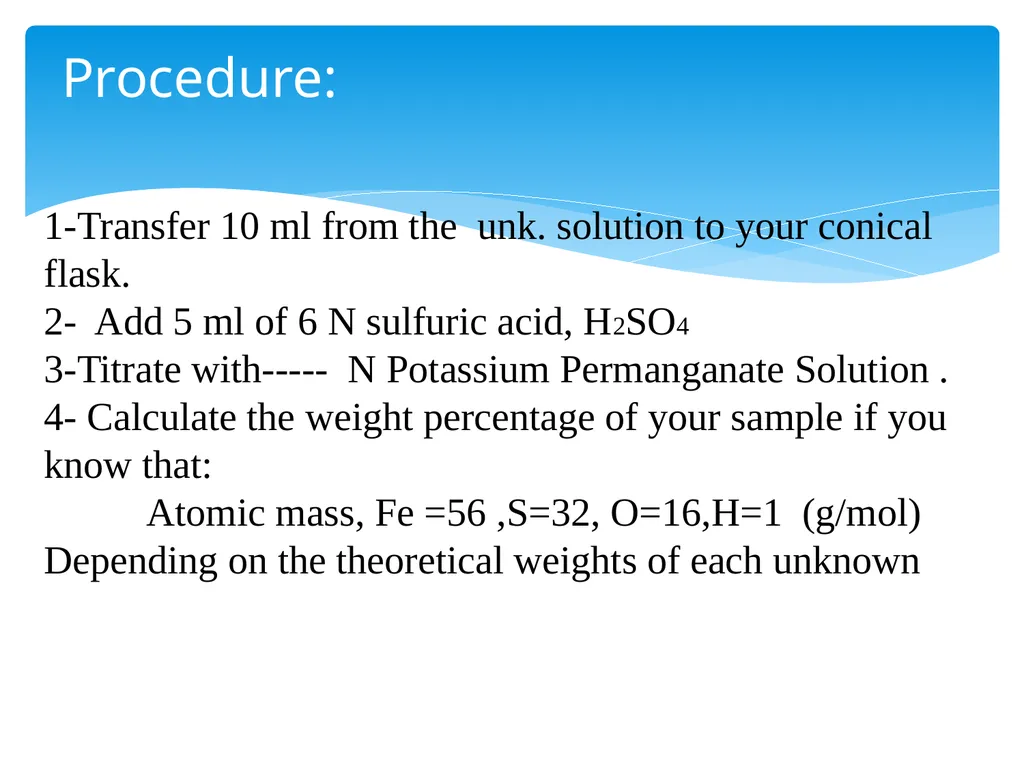
Procedure: 1-Transfer 10 ml from the unk. solution to your conical flask.
2- Add 5 ml of 6 N sulfuric acid, H2SO4
3-Titrate with----- N Potassium Permanganate Solution .
4- Calculate the weight percentage of your sample if you know that:
Atomic mass, Fe =56 ,S=32, O=16,H=1 (g/mol)
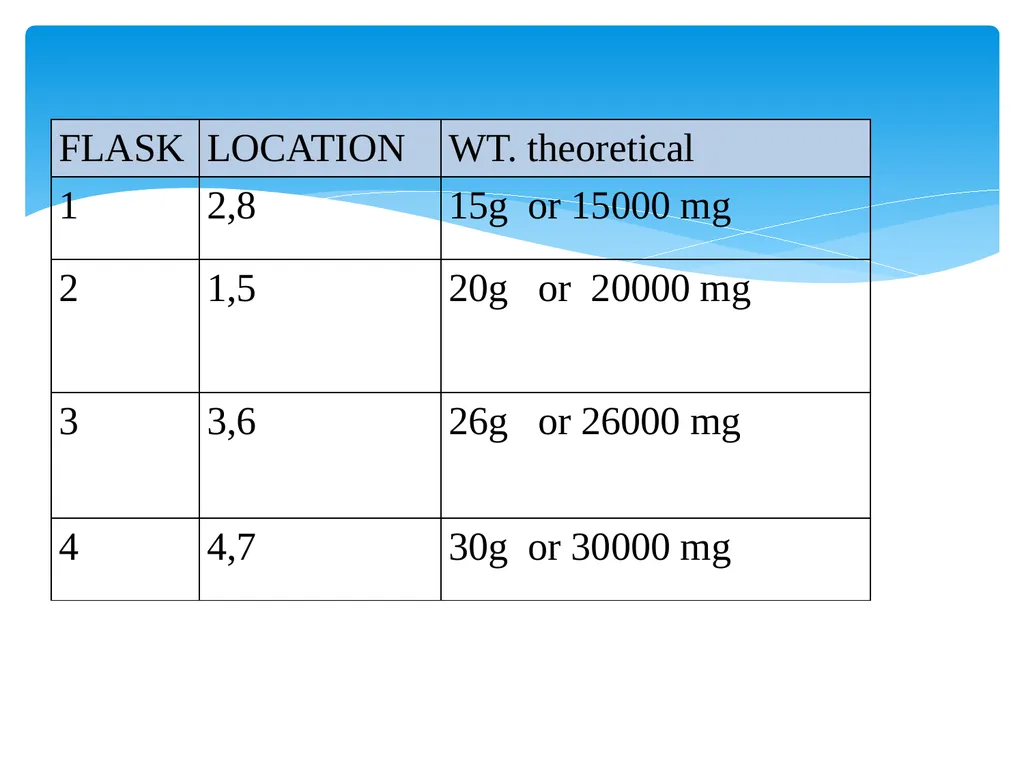
Depending on the theoretical weights of each unknown<br>
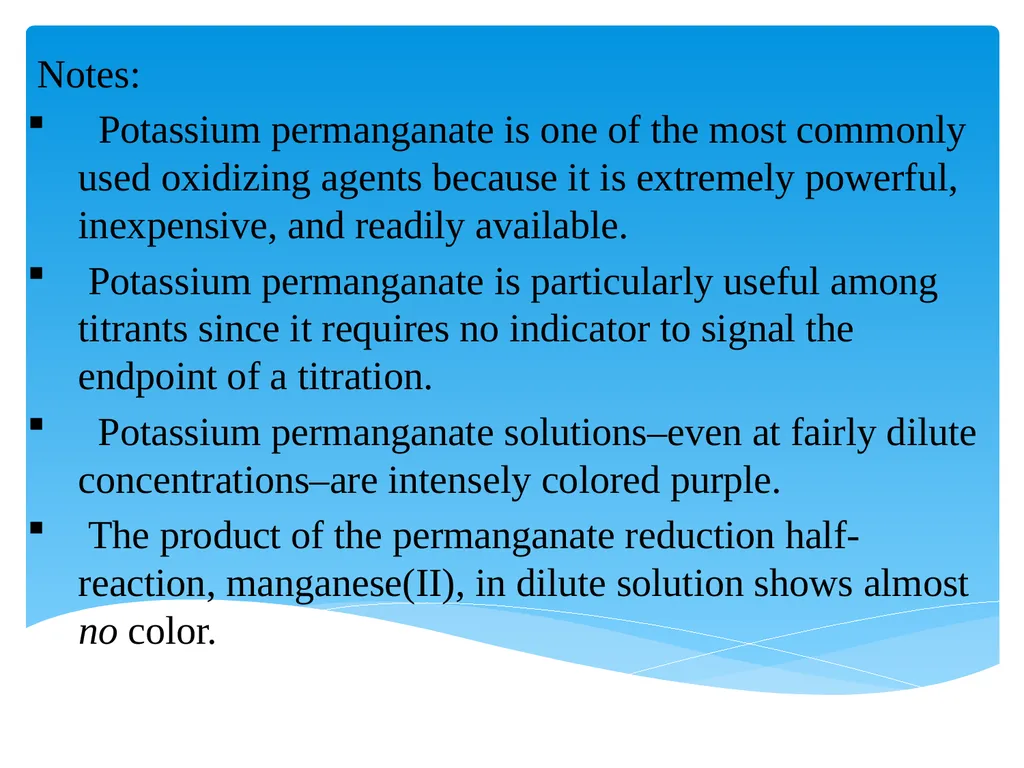
Notes:
Potassium permanganate is one of the most commonly used oxidizing agents because it is extremely powerful, inexpensive, and readily available.
Potassium permanganate is particularly useful among titrants since it requires no indicator to signal the endpoint of a titration.
Potassium permanganate solutions–even at fairly dilute concentrations–are intensely colored purple.
The product of the permanganate reduction half-reaction, manganese(II), in dilute solution shows almost no color.<br>