04
A patient can require oxygen for a variety of medical needs. There are five typical examples in which the application of oxygen is indicated:
Heart failure/heart attack
Respiratory deficiency
Bleeding
Complications in childbirth
Poisoning<br>
05
HAZARDS ASSOCIATED WITH OXYGEN USE Fire: Do not allow smoking or the use of a flame when using oxygen. Oxygen is not combustible, but it does increase the intensity of a fire and will cause fire to flare up.
Explosion: Never use oil or grease around an oxygen cylinder. Oil and grease near high concentrations of oxygen can cause an explosion.
Valve damage: Avoid dropping or placing a cylinder where it can fall. The regulator or valve can be damaged and the cylinder can become a projectile.<br>
06
OXYGEN DELIVERY SYSTEM An oxygen delivery system consists of the following parts:
Oxygen cylinder with valve
Low pressure regulator
Flowmeter with humidifier
Appropriate oxygen delivery device Cont…<br>
07
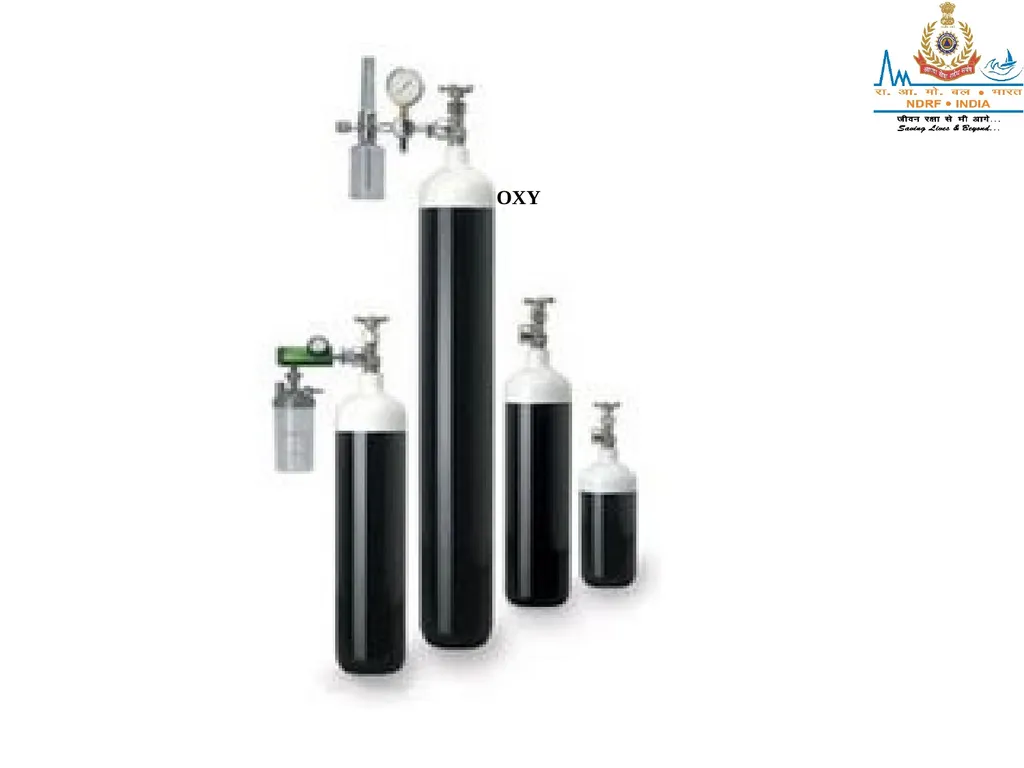
A. OXYGEN CYLINDER WITH VALVE When providing oxygen in the field, the standard source is a seamless steel or lightweight alloy cylinder filled with pressurized oxygen. A green (steel) or gray (aluminum) cylinder identifies oxygen. In India oxygen cylinders are black with white neck.
The cylinders should be inspected daily and pressure-tested annually due to the high-pressure contents (2,000 psi).<br>
08
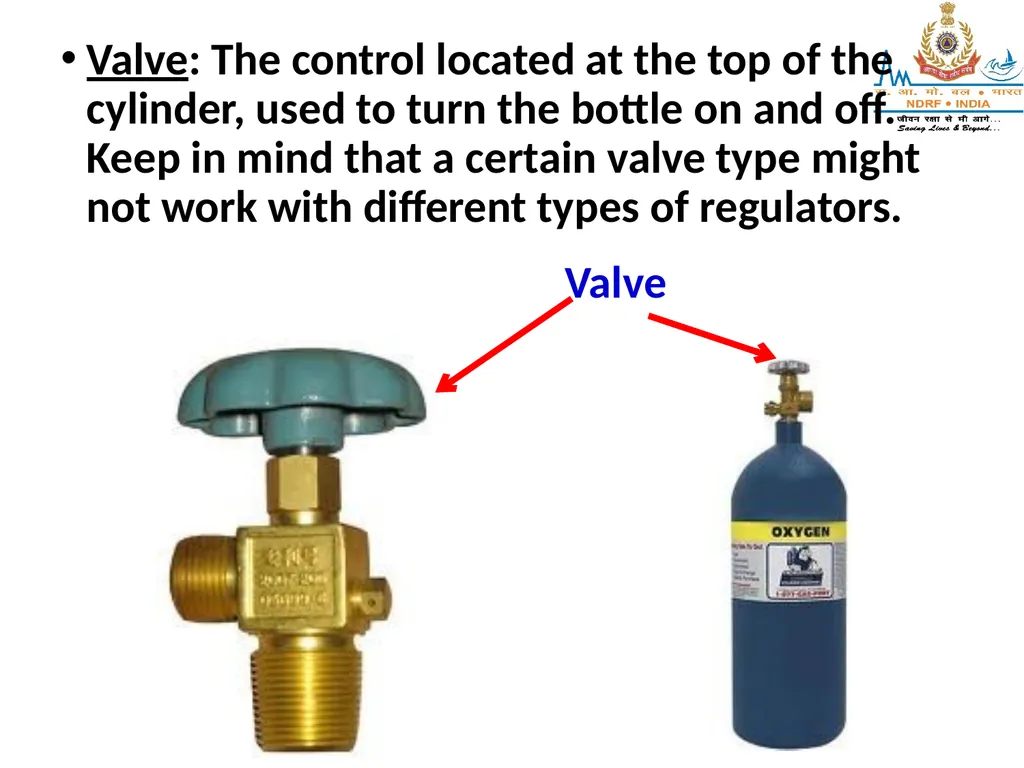
Valve: The control located at the top of the cylinder, used to turn the bottle on and off. Keep in mind that a certain valve type might not work with different types of regulators. Valve<br>
09
Most common cylinder types:
Cylinder D – 350 liters
Cylinder E – 625 liters
Cylinder M – 3,000 liters
In India most commonly used cylinders are –
100 liters ,320 liters ,600 liters ,720 liters<br>
11
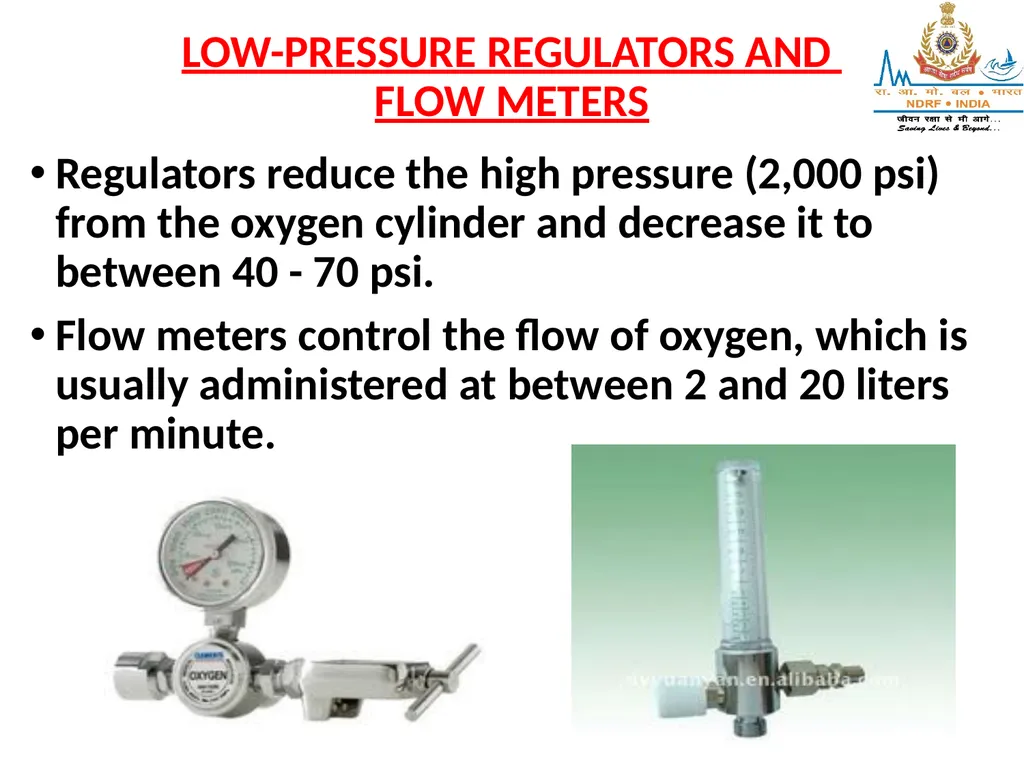
LOW-PRESSURE REGULATORS AND �FLOW METERS Regulators reduce the high pressure (2,000 psi) from the oxygen cylinder and decrease it to between 40 - 70 psi.
Flow meters control the flow of oxygen, which is usually administered at between 2 and 20 liters per minute.<br>
12
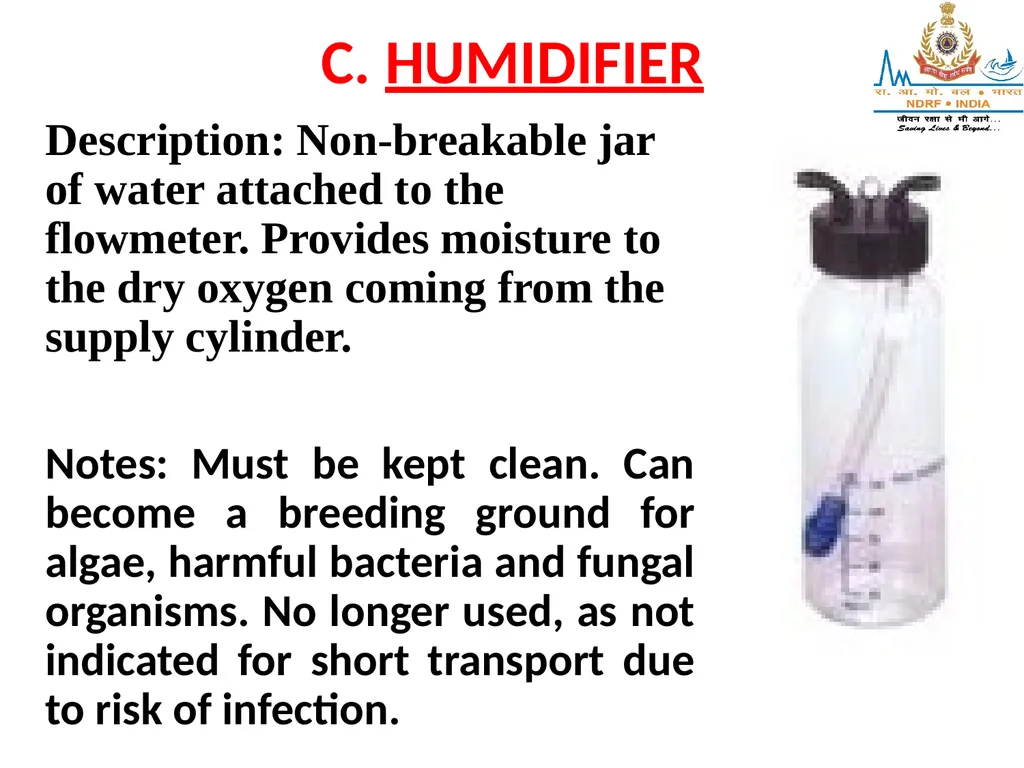
C. HUMIDIFIER Description: Non-breakable jar of water attached to the flowmeter. Provides moisture to the dry oxygen coming from the supply cylinder.
Notes: Must be kept clean. Can become a breeding ground for algae, harmful bacteria and fungal organisms. No longer used, as not indicated for short transport due to risk of infection.<br>
13
PRECAUTIONS WHEN GIVING OXYGEN The pressure in a full cylinder is between 2000 and 2200 psi. Reduce the pressure to 40-70 psi before administering oxygen to a patient.
Appropriate delivery of oxygen to a patient is achieved by using a flowmeter and regulator. They are usually connected as one piece.
Oxygen is considered a medication.<br>
14
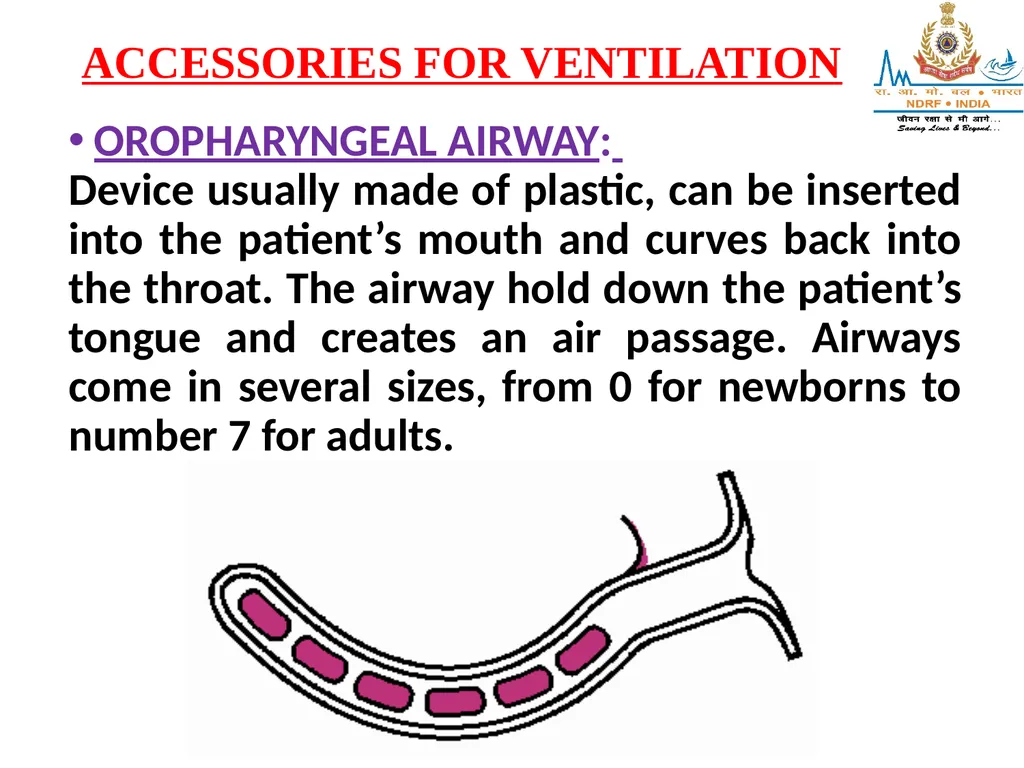
ACCESSORIES FOR VENTILATION OROPHARYNGEAL AIRWAY:
Device usually made of plastic, can be inserted into the patient’s mouth and curves back into the throat. The airway hold down the patient’s tongue and creates an air passage. Airways come in several sizes, from 0 for newborns to number 7 for adults.<br>
15
PROCEDURE FOR INSERTING AIRWAY Select proper size. If the patient is child, use a tongue depressor to help insert the device.
Open the patient’s mouth.
Insert the adjunct upside-down (tip facing the roof of the mouth).<br>
16
Advance the adjunct gently until you encounter slight resistance (when the adjunct touches the back of the roof of the mouth).
Turn the airway 180 degrees.
Advance the adjunct until the flange rests on the patient’s teeth, then secure it with tape.
If the patient exhibit a gag reflex during insertion or after it is in place, remove the adjunct.<br>
17
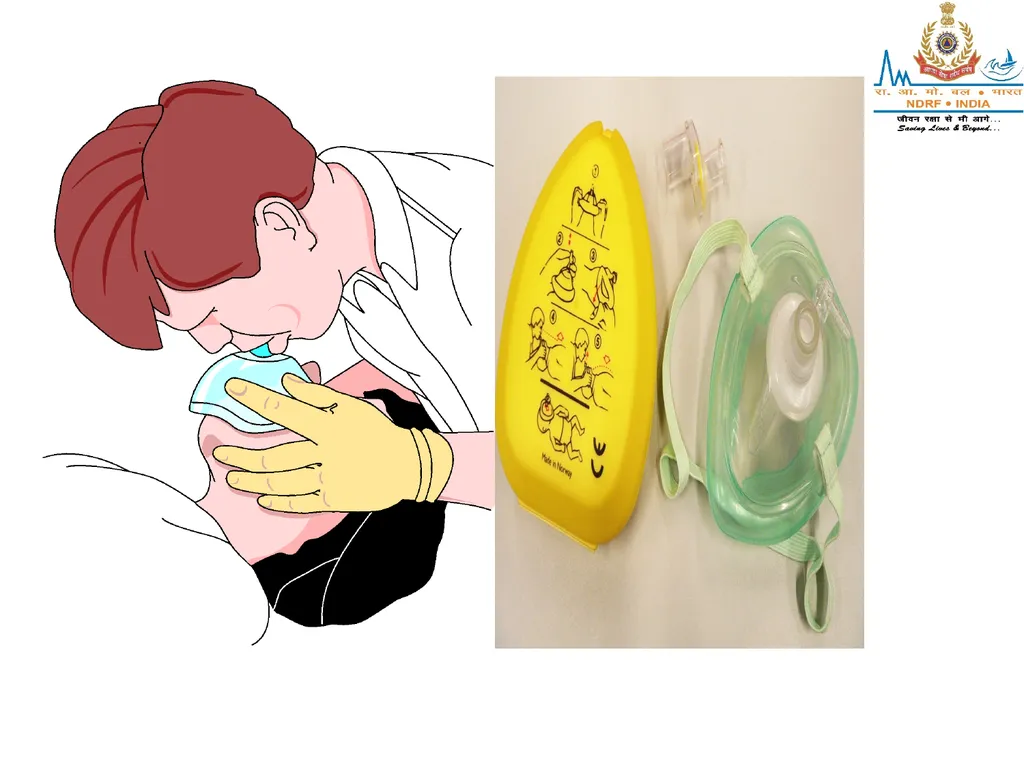
CPR Mask
The pocket face mask is designed to aid the rescuer when providing ventilations during CPR. It is made of a soft plastic that conforms to the patient’s face. The mask can come both with or without an oxygen inlet. Its use avoids direct contact with the patient’s mouth and decreases the chance of contamination.<br>
18
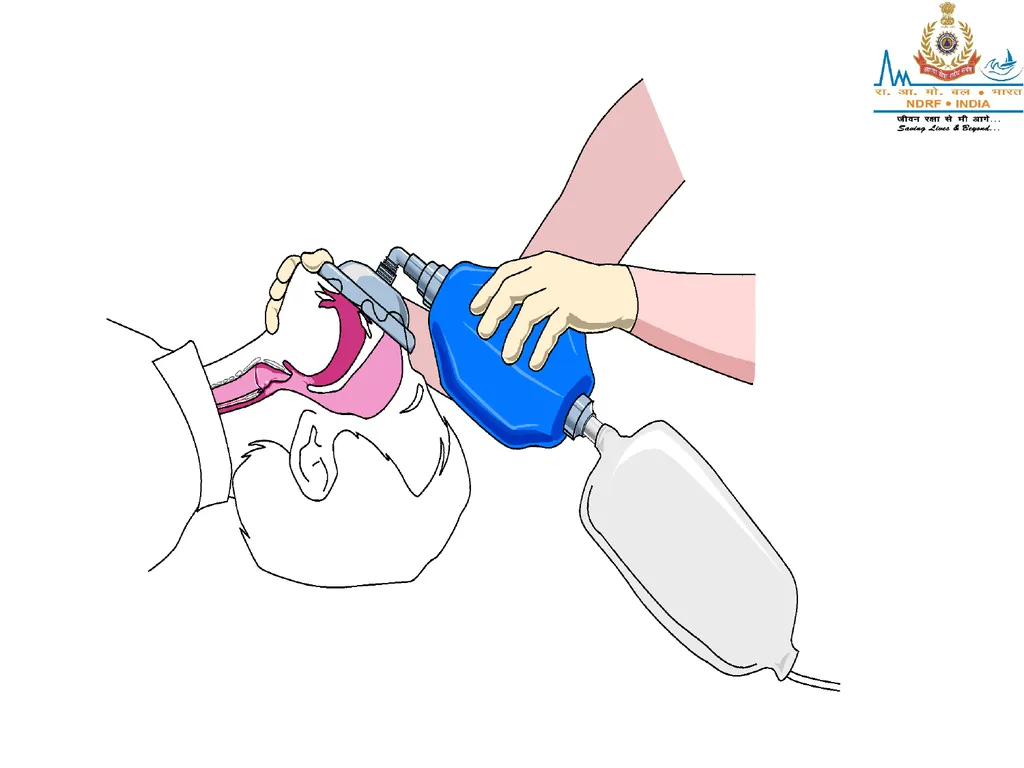
BAG-VALVE-MASK (BVM) (MANUAL RESUSCITATOR)
Many different types are available. The bag-valve-mask is a hand-held device you squeeze to ventilate a patient. It comes in adult, child and infant sizes. All have the same basic parts: face mask, non-rebreather patient valve, a bag (rubber or vinyl), intake valve/oxygen reservoir valve, oxygen supply connection tube, and oxygen reservoir.<br>
19
Adjunct Equipment for Administering Oxygen NASAL CANNULA
Description: Has two stems that are placed into the patient‘s nostrils. Used most often in a hospital setting. Most patients tolerate it well and it is the best accessory for administration of low-concentration oxygen.<br>
20
Flow Rate: 1-6 lpm (each liter increases O2 concentration 3-4%)
O2 Delivered: 24-44% oxygen concentration.
Note: May cause the nasal mucus membranes to dry at higher flow rates. Appropriate for patients who cannot tolerate a mask.<br>
21
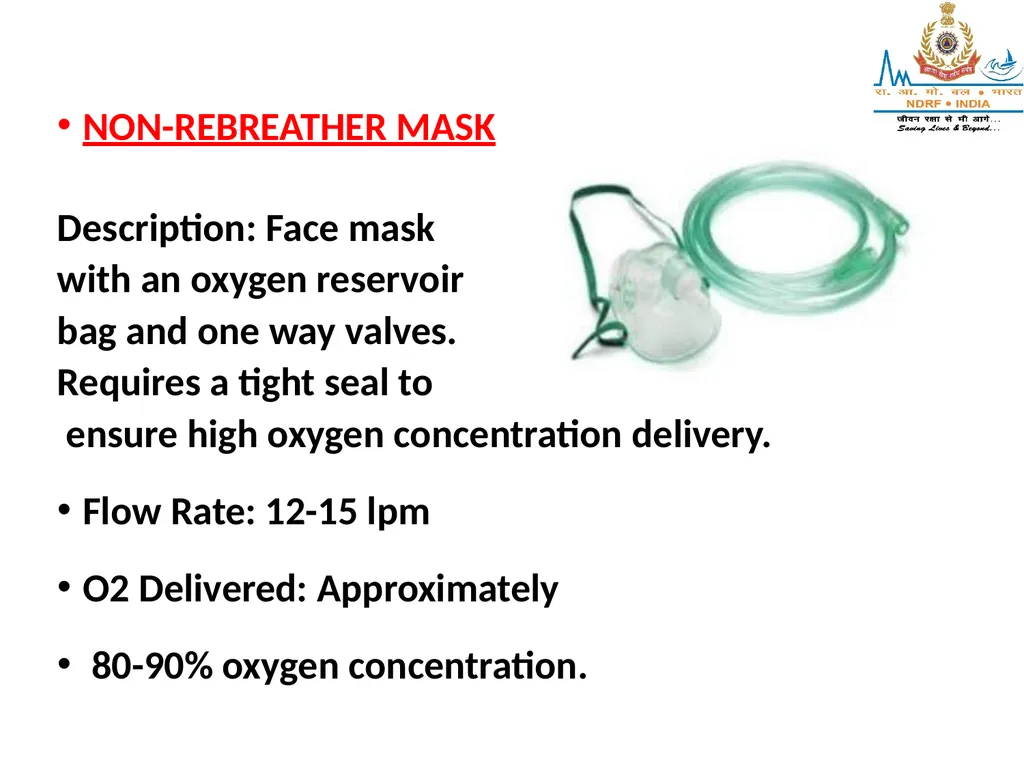
NON-REBREATHER MASK
Description: Face mask
with an oxygen reservoir
bag and one way valves.
Requires a tight seal to
ensure high oxygen concentration delivery.
Flow Rate: 12-15 lpm
O2 Delivered: Approximately
80-90% oxygen concentration.<br>
22
Note: Reservoir must always contain enough oxygen so that it does not deflate by more than one third when patient inhales (must maintain proper flow rate). Delivery system of choice for patients requiring high O2 concentration.
Safety feature: Exhalation port is open in case oxygen supply fails (prevents 100% O2 delivery).<br>
23
MECHANICAL SUCTION Maintain airway at all times – keep free of blood, vomit, secretions and other liquids or objects. Use mechanical suction to remove these substances or objects.
Solid objects such as food, teeth or very thick secretions cannot always be removed with suction, & may require alternative equipment or a finger sweep.
Suction should be performed rapidly to decrease the chance of blood or other foreign matter from moving into the lungs, which may cause pneumonia or complete airway obstruction.<br>
24
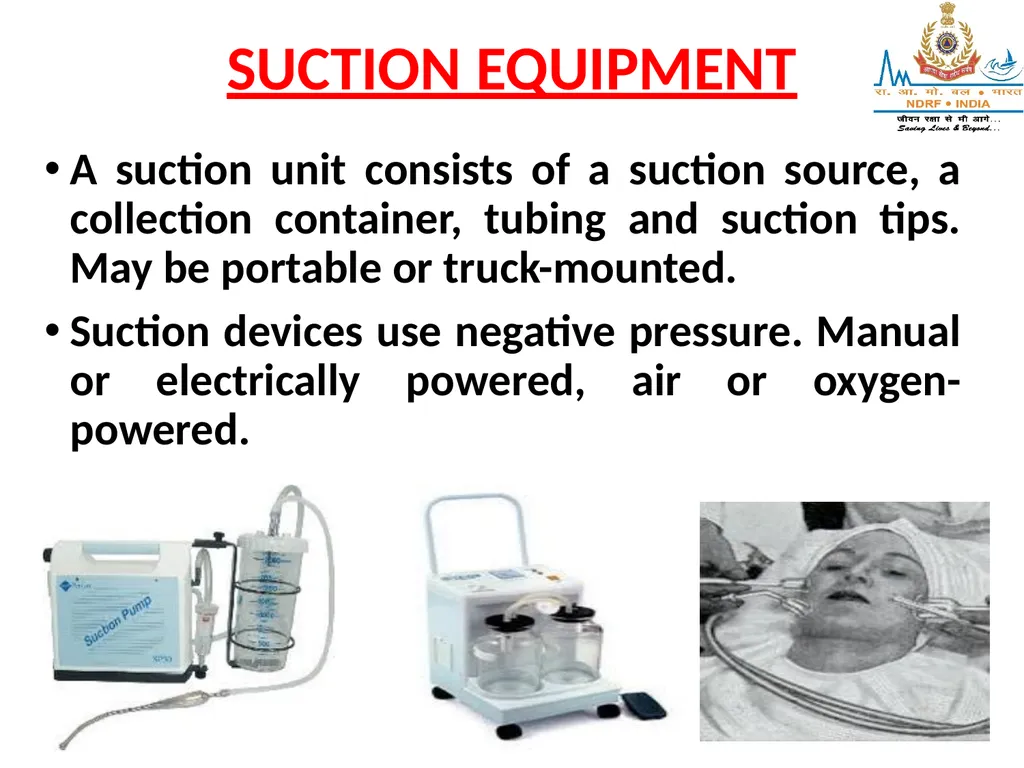
SUCTION EQUIPMENT A suction unit consists of a suction source, a collection container, tubing and suction tips. May be portable or truck-mounted.
Suction devices use negative pressure. Manual or electrically powered, air or oxygen-powered.<br>
25
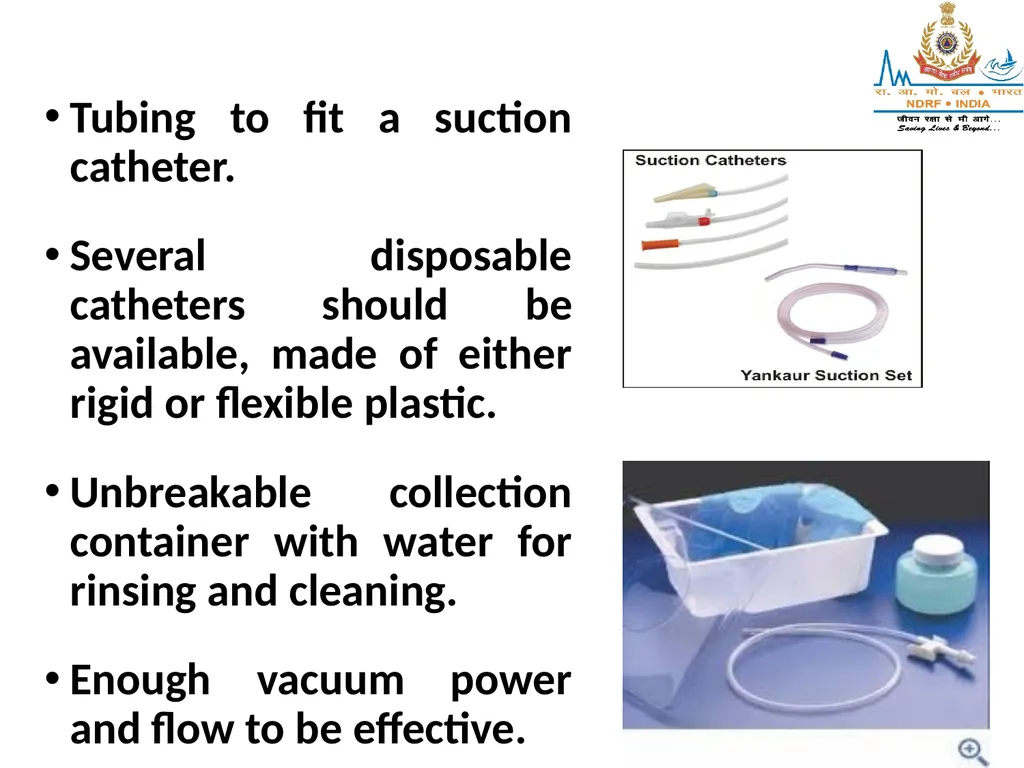
Tubing to fit a suction catheter.
Several disposable catheters should be available, made of either rigid or flexible plastic.
Unbreakable collection container with water for rinsing and cleaning.
Enough vacuum power and flow to be effective.<br>