EXCRETORY SYSTEM LESSON -8 BY JITENDER YADAV INSPPH EXCRETORY SYSTEM OBJECTIVES Upon completion of this lesson you will be able to: An introduction to the excretory system To learn about the various minor organs of excretion To learn more
"EXCRETORY SYSTEM LESSON -8 BY JITENDER YADAV" is the property of its rightful owner. Permission is granted to
download and print the materials on this website for personal, non-commercial use only, and to display it
on your personal computer provided you do not modify the materials and that you retain all copyright
notices contained in the materials. By downloading content from our website, you accept the terms of this
agreement.
Presentation Transcript
01
EXCRETORY SYSTEM LESSON -8 BY
JITENDER YADAV
INSP/PH<br>
02
EXCRETORY SYSTEM
OBJECTIVES
Upon completion of this lesson you will be able to:
An introduction to the excretory system
To learn about the various minor organs of excretion
To learn more about the structure & functions of skin<br>
03
Excretory system deals with the removal of waste products from the body so that they do not have any harmful effects on the body INTRODUCTION The urinary system is the major system which deals with excretion. Waste products which are formed in the body as a result of metabolism & other activities of the body are collected by the blood from the tissues and they are then removed from the blood in the kidneys, from where they are further removed from the body in the form of urine.<br>
04
However, there are various other minor organs through which excretion of waste products takes place. They are:
SKIN – which excretes sweat
LUNGS – which excrete CO2 & water
LARGE INTESTINES – which excrete faeces
SKIN--
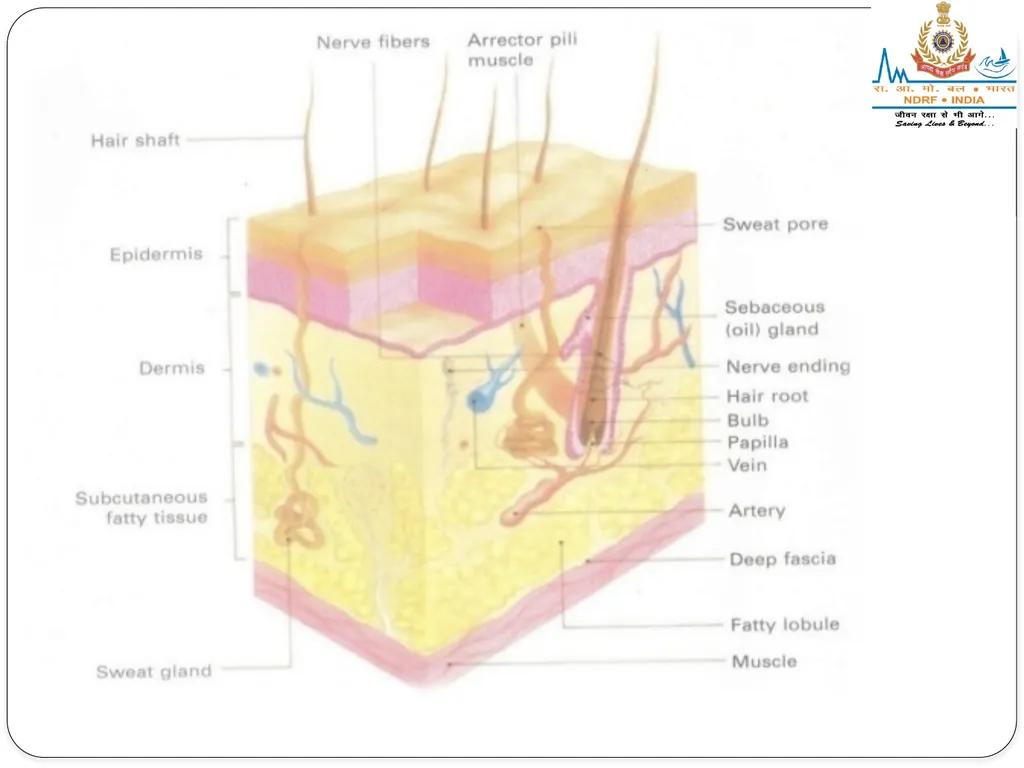
Skin is the outer-most covering of the body.<br>
05
1. Epidermis –
Most superficial layer which is thick & hard
Thickness depends on the area which it covers (thickest on the sole of foot & palm of hand)
Composed of stratified epithelial cells
Consists of several layers of cells in 2 fairly well defined zones<br>
06
Horny zone –
Stratum corneum
Stratum lucidum
Stratum granulosum
Germinative zone –
Prickle cells
Basal cells<br>
07
Does not contain any blood vessels
Duct of sweat glands passes through it
It accommodates the hair
Surface is marked by lines & ridges which are concerned with the papillae of dermis which lies beneath<br>
08
2. Dermis –
Made up of fibrous or elastic connective tissue
Surface is arranged in small papillae which contain a loop of capillaries
The tactile sensory nerve endings lie in the dermis
Sweat glands –
Lie in the deep part of the dermis
The ducts from the sweat gland pass through the dermis & epidermis as a<br>
09
spiral canal to reach the surface of the skin through minute openings called pores
Sebaceous glands –
Sac-like glands that open into the hair follicle
Flask-shaped
Secrete sebum (a fatty substance) which keeps the skin soft & smooth<br>
10
SKIN-APPENDAGES:
1. Hair –
Grows from the hair-follicles which lie deep in the epidermis
At the base, it is slightly thickened to form a hair-bulb
The part of the hair which projects from the surface of the skin is called the hair-shaft
Minute erector-muscles are associated with the hair follicles which make the hair to vertically stand up (for eg, in cold weather conditions)<br>
11
2. Nail –
Composed of modified skin
Lies on the nail-bed which is well supplied with blood vessels
The proximal part lies in a groove of skin
The white part is known as the lunula because of its moon-shape and is the portion from which the nail grows forward<br>
12
The uncovered part is the body of the nail & is firmly attached to the nail-bed
The distal part of the nail is free-hanging
Each side of the nail is bounded by a fold of skin known as the nail-wall<br>
13
FUNCTIONS OF SKIN:
Forms a protective covering over the body
Acts as a excretory organ by means of sweat
Important organ for regulation of body temperature
Manufactures Vitamin D in the presence of sun-rays
Some drugs can be absorbed through the skin
Organ of touch<br>
14
SWEAT
Sweat is formed by the waste products from the blood, which is secreted to the exterior through sweat glands present in the skin. Numerous sweat glands are present all over the body skin, more so in the palms & soles.<br>
15
Acidic in nature
Salty in taste
Composition of sweat –
Water = 99.4%
Chlorides & sulphates of Na & K = 0.2%
Other substances = 0.4%
Main function is regulation of body temperature by evaporation<br>