
P3.5-050 The Multichannel Maximum-Likelihood
Description: P3.5-050 The Multichannel Maximum-Likelihood Method: Towards a Multisource Detection and Wave Parameters Estimation Using Deep Learning B. Poste1, M. Charbit2, A. Janela Cameijo1, A. Le Pichon1, C. Listowski1, F. Roueff2, J. Vergoz1 1CEA,
Related Topics
Download Presentation
"P3.5-050 The Multichannel Maximum-Likelihood" is the property of its rightful owner. Permission is granted to download and print the materials on this website for personal, non-commercial use only, and to display it on your personal computer provided you do not modify the materials and that you retain all copyright notices contained in the materials. By downloading content from our website, you accept the terms of this agreement.
Presentation Transcript
slide1. P3.5-050 The Multichannel Maximum-Likelihood Method: Towards a Multisource Detection and Wave Parameters Estimation Using Deep Learning
B. Poste1, M. Charbit2, A. Janela Cameijo1, A. Le Pichon1, C. Listowski1, F. Roueff2, J. Vergoz1 1CEA, DAM, DIF, F-91297 Arpajon, France
2 Institut Mines-Telecom, 91120 Palaiseau We present an improvement to the multichannel maximum-likelihood (MCML) method. The initially single source approach is extended to a multisource detection and wave parameters estimation algorithm.
For this aim, several maxima on the likelihood function are selected in accordance to the likelihood amplitude and the errors on the maxima. The number of sources to select is fixed by a deep learning approach.
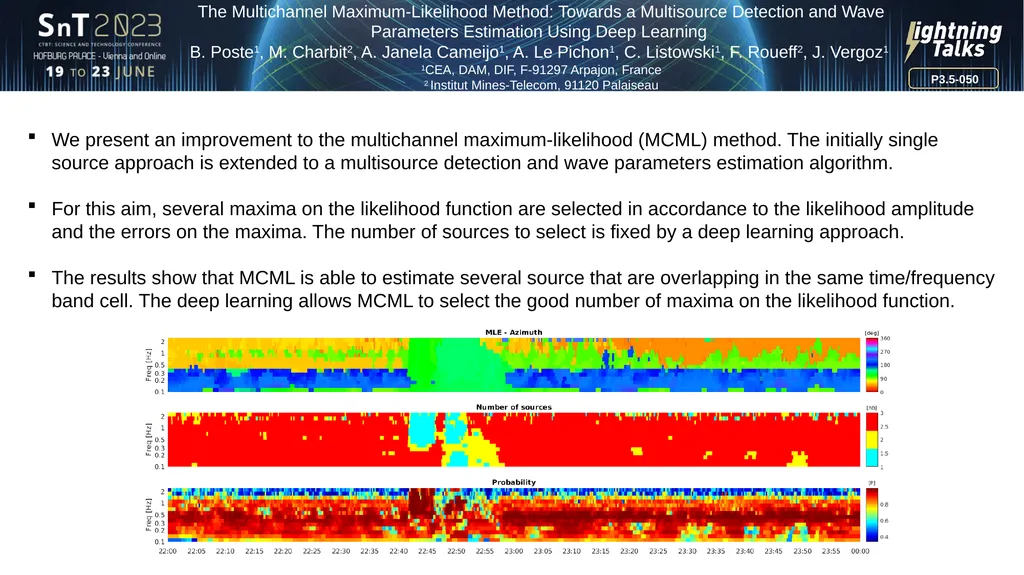
The results show that MCML is able to estimate several source that are overlapping in the same time/frequency band cell. The deep learning allows MCML to select the good number of maxima on the likelihood function.<br>
B. Poste1, M. Charbit2, A. Janela Cameijo1, A. Le Pichon1, C. Listowski1, F. Roueff2, J. Vergoz1 1CEA, DAM, DIF, F-91297 Arpajon, France
2 Institut Mines-Telecom, 91120 Palaiseau We present an improvement to the multichannel maximum-likelihood (MCML) method. The initially single source approach is extended to a multisource detection and wave parameters estimation algorithm.
For this aim, several maxima on the likelihood function are selected in accordance to the likelihood amplitude and the errors on the maxima. The number of sources to select is fixed by a deep learning approach.
The results show that MCML is able to estimate several source that are overlapping in the same time/frequency band cell. The deep learning allows MCML to select the good number of maxima on the likelihood function.<br>