
P3M3® Facilitated Self-Assessment Programme
MT
Published · 38 slides · 0 views
1 / 1
Description
P3M3 Facilitated Self-Assessment Programme Management The AXELOS Consulting Partner logoTM is a trade mark, and P3M3 is a registered trade mark of AXELOS Limited, used under permission of AXELOS Limited. All rights reserved. P3M3
Related Topics
Share
Embed code
Download this presentation From Below
"P3M3® Facilitated Self-Assessment Programme" is the property of its rightful owner. Permission is granted to download and print the materials on this website for personal, non-commercial use only, and to display it on your personal computer provided you do not modify the materials and that you retain all copyright notices contained in the materials. By downloading content from our website, you accept the terms of this agreement.
Presentation Transcript
01
P3M3® Facilitated Self-Assessment Programme Management The AXELOS Consulting Partner logoTM is a trade mark, and P3M3® is a registered trade mark of AXELOS Limited,
used under permission of AXELOS Limited. All rights reserved.<br>
used under permission of AXELOS Limited. All rights reserved.<br>
02
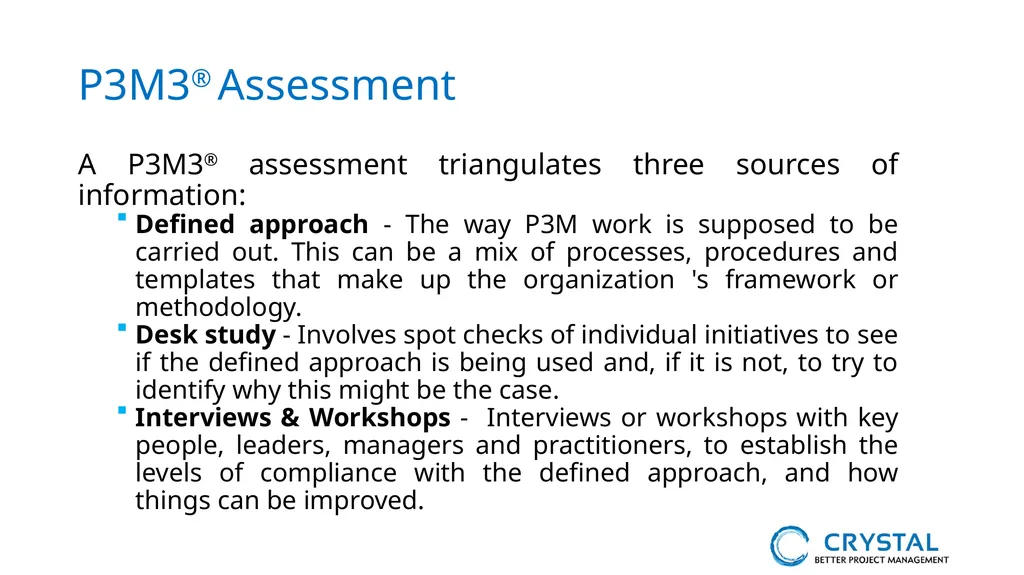
P3M3® Assessment A P3M3® assessment triangulates three sources of information:
Defined approach - The way P3M work is supposed to be carried out. This can be a mix of processes, procedures and templates that make up the organization 's framework or methodology.
Desk study - Involves spot checks of individual initiatives to see if the defined approach is being used and, if it is not, to try to identify why this might be the case.
Interviews & Workshops - Interviews or workshops with key people, leaders, managers and practitioners, to establish the levels of compliance with the defined approach, and how things can be improved.<br>
Defined approach - The way P3M work is supposed to be carried out. This can be a mix of processes, procedures and templates that make up the organization 's framework or methodology.
Desk study - Involves spot checks of individual initiatives to see if the defined approach is being used and, if it is not, to try to identify why this might be the case.
Interviews & Workshops - Interviews or workshops with key people, leaders, managers and practitioners, to establish the levels of compliance with the defined approach, and how things can be improved.<br>
03
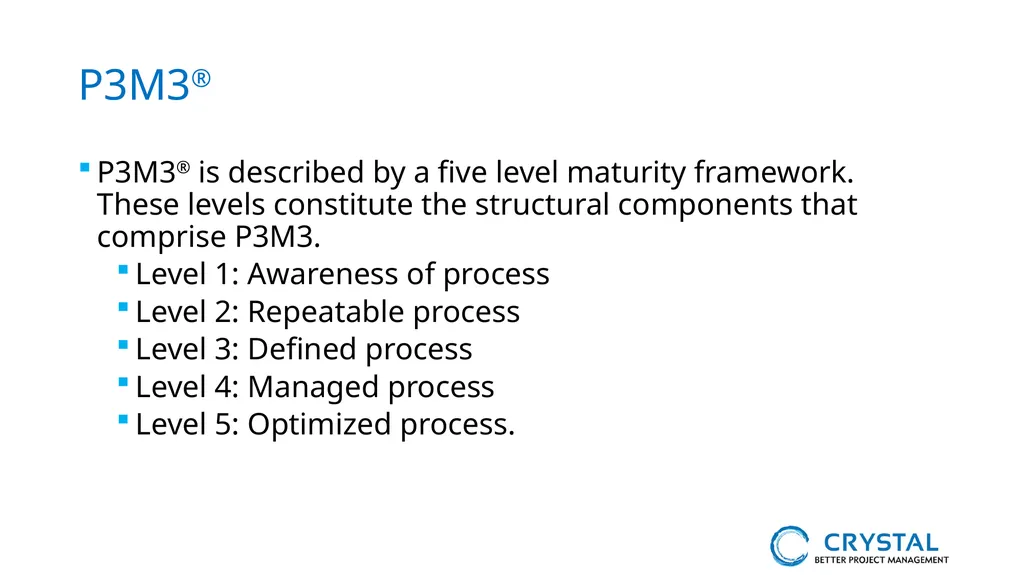
P3M3® P3M3® is described by a five level maturity framework. These levels constitute the structural components that comprise P3M3.
Level 1: Awareness of process
Level 2: Repeatable process
Level 3: Defined process
Level 4: Managed process
Level 5: Optimized process.<br>
Level 1: Awareness of process
Level 2: Repeatable process
Level 3: Defined process
Level 4: Managed process
Level 5: Optimized process.<br>
04
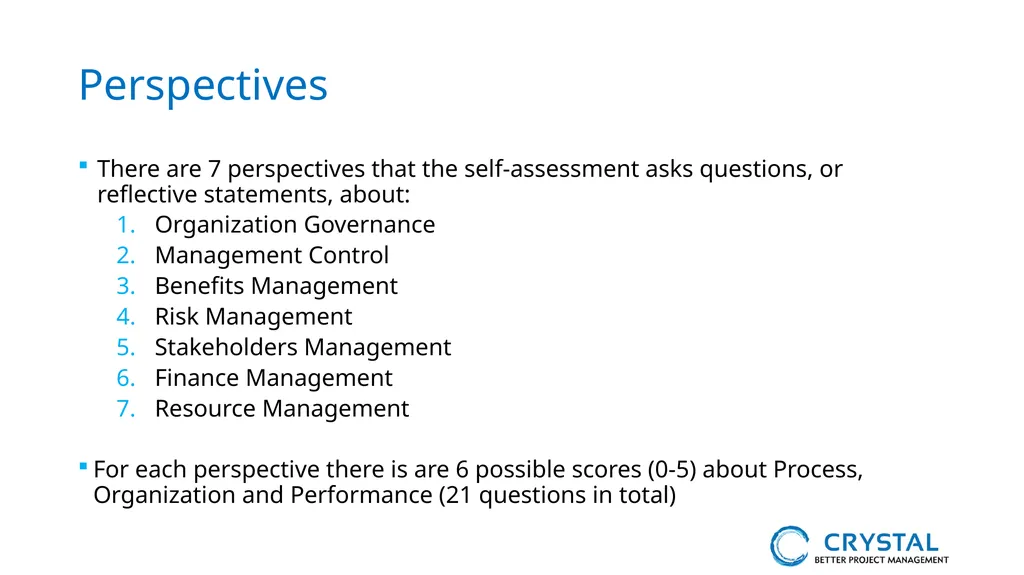
Perspectives There are 7 perspectives that the self-assessment asks questions, or reflective statements, about:
Organization Governance
Management Control
Benefits Management
Risk Management
Stakeholders Management
Finance Management
Resource Management
For each perspective there is are 6 possible scores (0-5) about Process, Organization and Performance (21 questions in total)<br>
Organization Governance
Management Control
Benefits Management
Risk Management
Stakeholders Management
Finance Management
Resource Management
For each perspective there is are 6 possible scores (0-5) about Process, Organization and Performance (21 questions in total)<br>
05
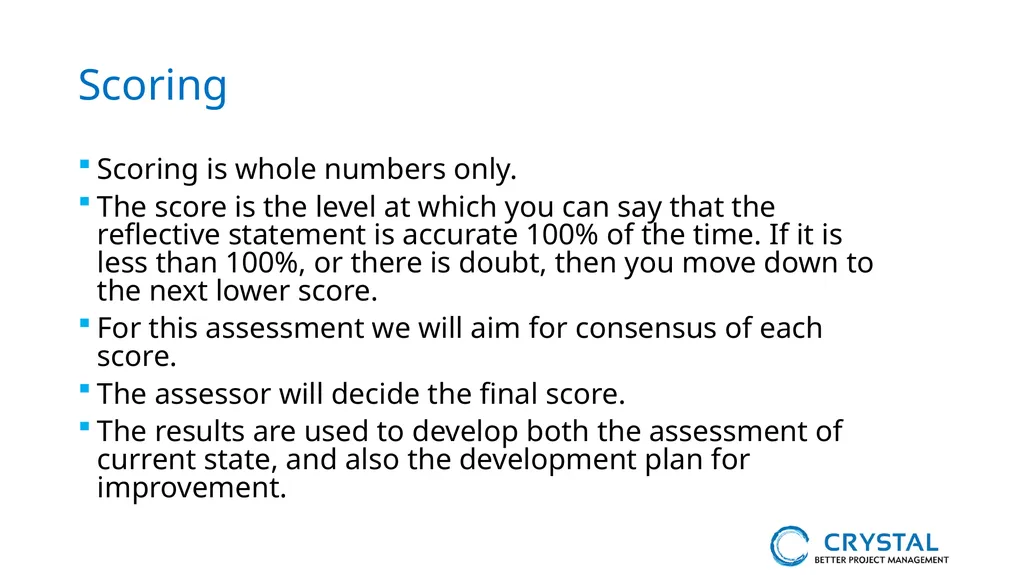
Scoring Scoring is whole numbers only.
The score is the level at which you can say that the reflective statement is accurate 100% of the time. If it is less than 100%, or there is doubt, then you move down to the next lower score.
For this assessment we will aim for consensus of each score.
The assessor will decide the final score.
The results are used to develop both the assessment of current state, and also the development plan for improvement.<br>
The score is the level at which you can say that the reflective statement is accurate 100% of the time. If it is less than 100%, or there is doubt, then you move down to the next lower score.
For this assessment we will aim for consensus of each score.
The assessor will decide the final score.
The results are used to develop both the assessment of current state, and also the development plan for improvement.<br>
06
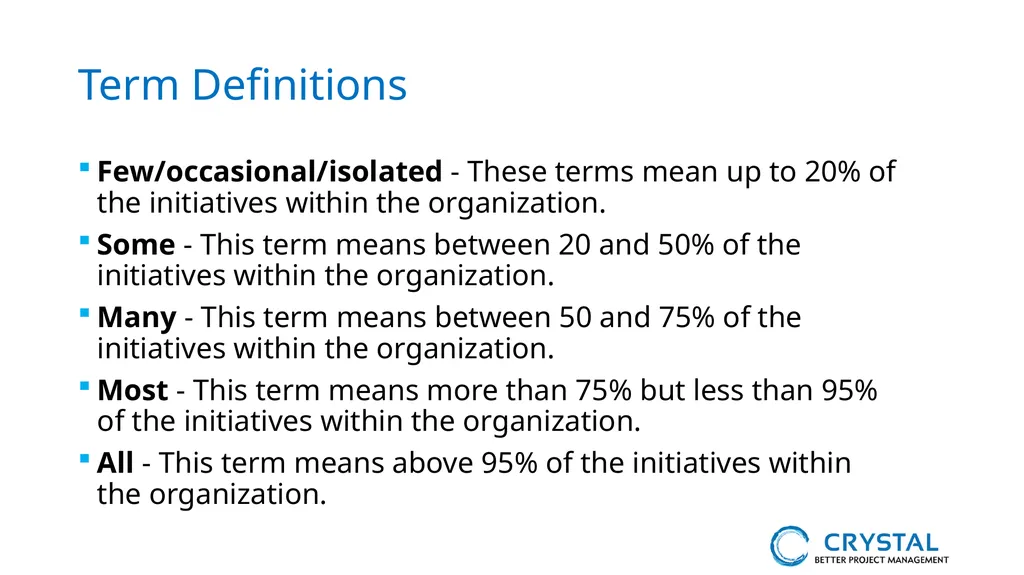
Term Definitions Few/occasional/isolated - These terms mean up to 20% of the initiatives within the organization.
Some - This term means between 20 and 50% of the initiatives within the organization.
Many - This term means between 50 and 75% of the initiatives within the organization.
Most - This term means more than 75% but less than 95% of the initiatives within the organization.
All - This term means above 95% of the initiatives within the organization.<br>
Some - This term means between 20 and 50% of the initiatives within the organization.
Many - This term means between 50 and 75% of the initiatives within the organization.
Most - This term means more than 75% but less than 95% of the initiatives within the organization.
All - This term means above 95% of the initiatives within the organization.<br>
07
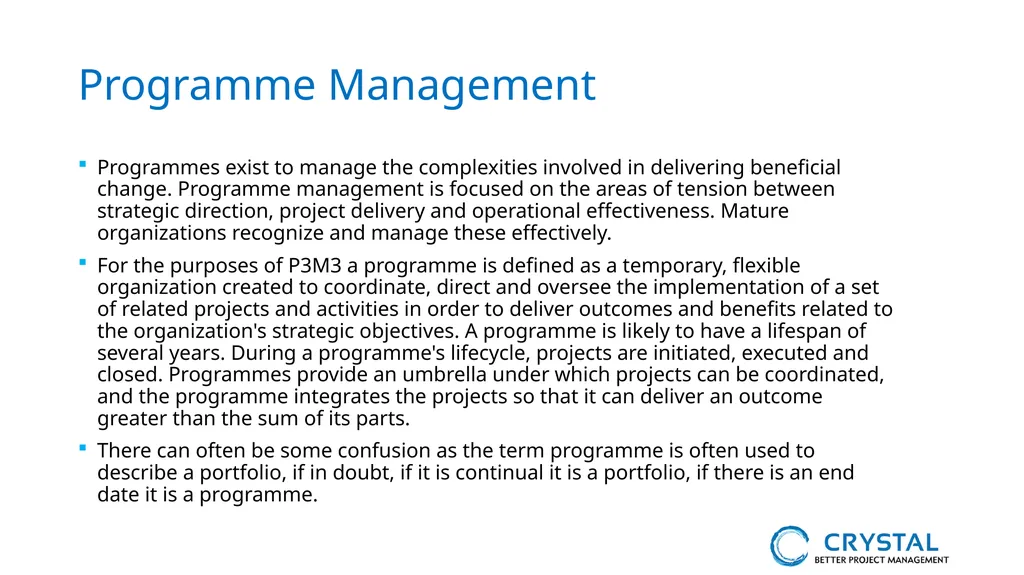
Programme Management Programmes exist to manage the complexities involved in delivering beneficial change. Programme management is focused on the areas of tension between strategic direction, project delivery and operational effectiveness. Mature organizations recognize and manage these effectively.
For the purposes of P3M3 a programme is defined as a temporary, flexible organization created to coordinate, direct and oversee the implementation of a set of related projects and activities in order to deliver outcomes and benefits related to the organization's strategic objectives. A programme is likely to have a lifespan of several years. During a programme's lifecycle, projects are initiated, executed and closed. Programmes provide an umbrella under which projects can be coordinated, and the programme integrates the projects so that it can deliver an outcome greater than the sum of its parts.
There can often be some confusion as the term programme is often used to describe a portfolio, if in doubt, if it is continual it is a portfolio, if there is an end date it is a programme.<br>
For the purposes of P3M3 a programme is defined as a temporary, flexible organization created to coordinate, direct and oversee the implementation of a set of related projects and activities in order to deliver outcomes and benefits related to the organization's strategic objectives. A programme is likely to have a lifespan of several years. During a programme's lifecycle, projects are initiated, executed and closed. Programmes provide an umbrella under which projects can be coordinated, and the programme integrates the projects so that it can deliver an outcome greater than the sum of its parts.
There can often be some confusion as the term programme is often used to describe a portfolio, if in doubt, if it is continual it is a portfolio, if there is an end date it is a programme.<br>
08
Reflective Statements<br>
09
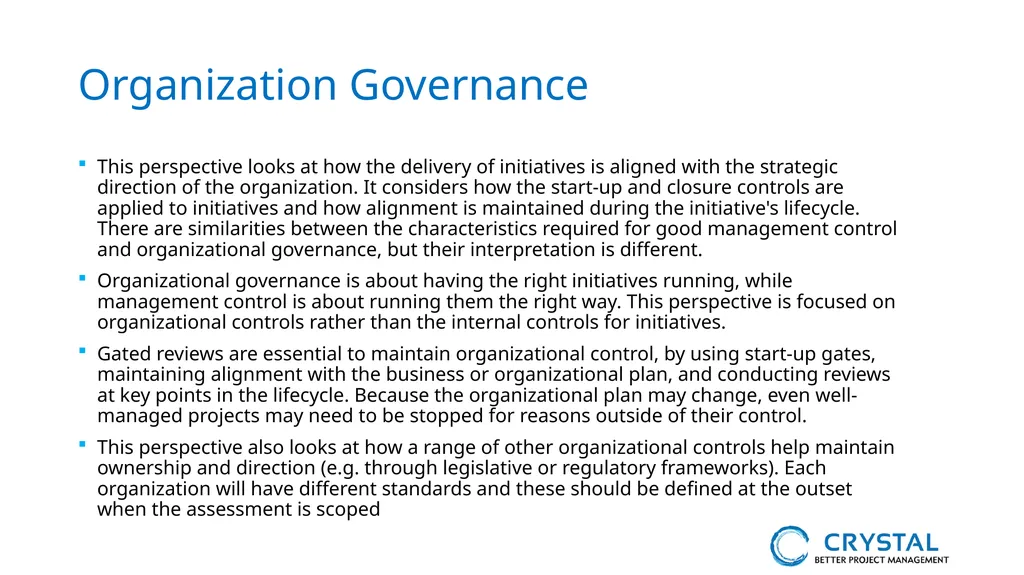
Organization Governance This perspective looks at how the delivery of initiatives is aligned with the strategic direction of the organization. It considers how the start-up and closure controls are applied to initiatives and how alignment is maintained during the initiative's lifecycle. There are similarities between the characteristics required for good management control and organizational governance, but their interpretation is different.
Organizational governance is about having the right initiatives running, while management control is about running them the right way. This perspective is focused on organizational controls rather than the internal controls for initiatives.
Gated reviews are essential to maintain organizational control, by using start-up gates, maintaining alignment with the business or organizational plan, and conducting reviews at key points in the lifecycle. Because the organizational plan may change, even well-managed projects may need to be stopped for reasons outside of their control.
This perspective also looks at how a range of other organizational controls help maintain ownership and direction (e.g. through legislative or regulatory frameworks). Each organization will have different standards and these should be defined at the outset when the assessment is scoped<br>
Organizational governance is about having the right initiatives running, while management control is about running them the right way. This perspective is focused on organizational controls rather than the internal controls for initiatives.
Gated reviews are essential to maintain organizational control, by using start-up gates, maintaining alignment with the business or organizational plan, and conducting reviews at key points in the lifecycle. Because the organizational plan may change, even well-managed projects may need to be stopped for reasons outside of their control.
This perspective also looks at how a range of other organizational controls help maintain ownership and direction (e.g. through legislative or regulatory frameworks). Each organization will have different standards and these should be defined at the outset when the assessment is scoped<br>
10
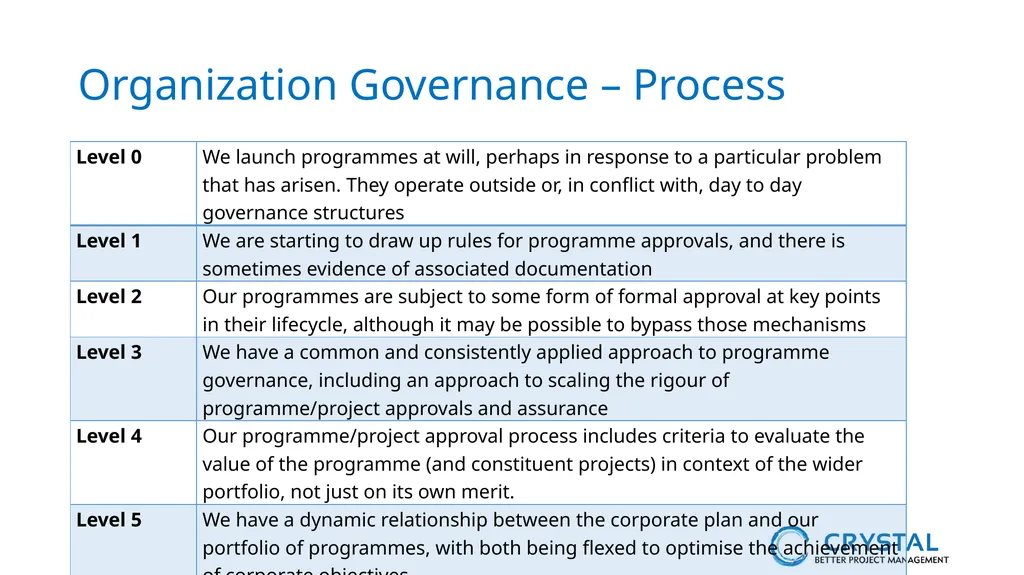
Organization Governance – Process<br>
11
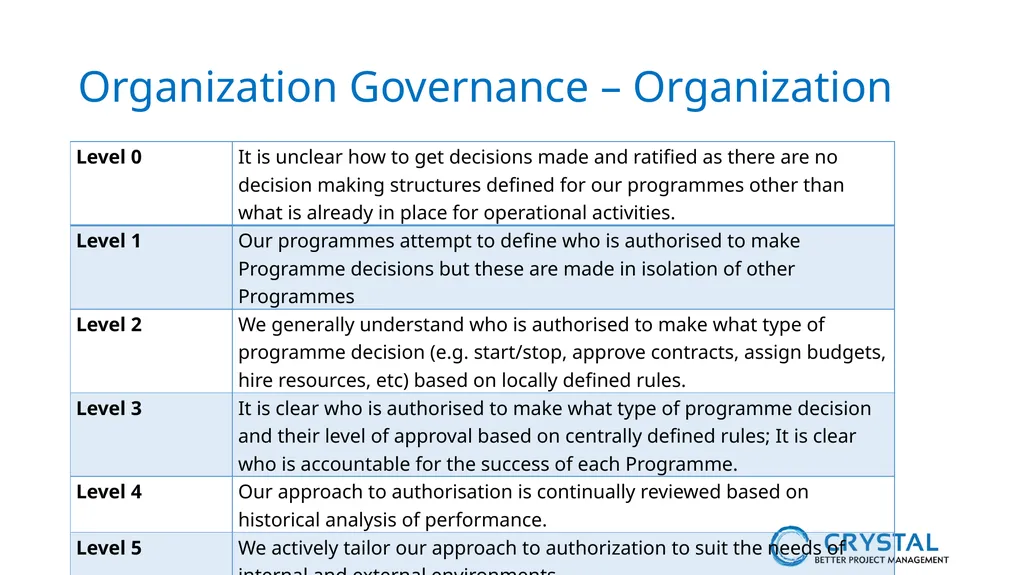
Organization Governance – Organization<br>
12
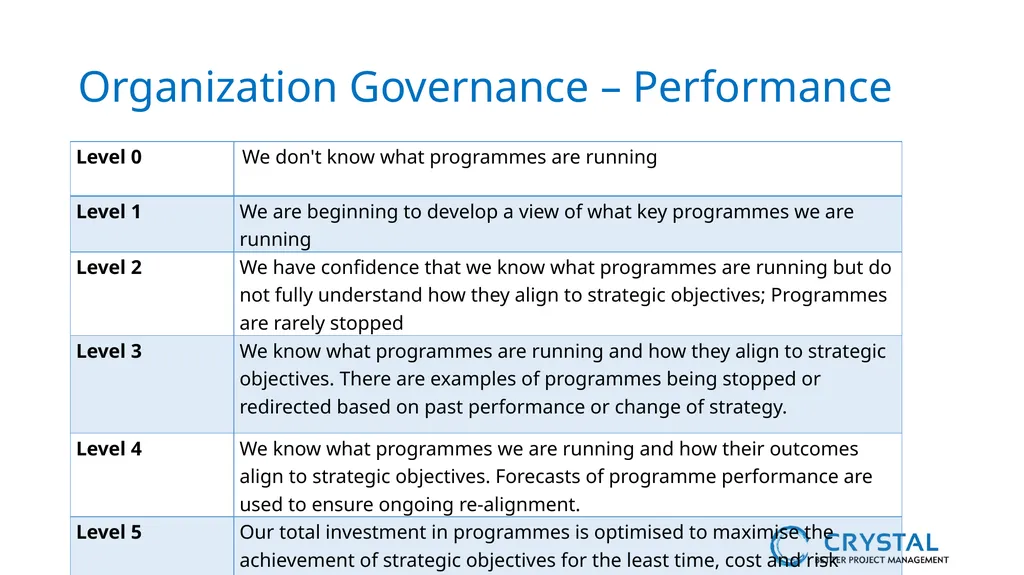
Organization Governance – Performance<br>
13
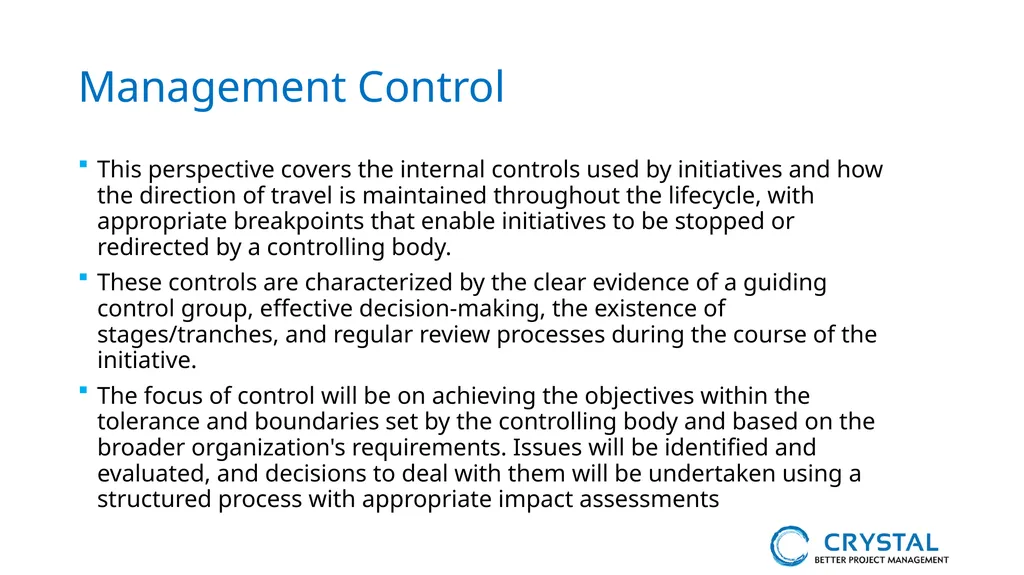
Management Control This perspective covers the internal controls used by initiatives and how the direction of travel is maintained throughout the lifecycle, with appropriate breakpoints that enable initiatives to be stopped or redirected by a controlling body.
These controls are characterized by the clear evidence of a guiding control group, effective decision-making, the existence of stages/tranches, and regular review processes during the course of the initiative.
The focus of control will be on achieving the objectives within the tolerance and boundaries set by the controlling body and based on the broader organization's requirements. Issues will be identified and evaluated, and decisions to deal with them will be undertaken using a structured process with appropriate impact assessments<br>
These controls are characterized by the clear evidence of a guiding control group, effective decision-making, the existence of stages/tranches, and regular review processes during the course of the initiative.
The focus of control will be on achieving the objectives within the tolerance and boundaries set by the controlling body and based on the broader organization's requirements. Issues will be identified and evaluated, and decisions to deal with them will be undertaken using a structured process with appropriate impact assessments<br>
14
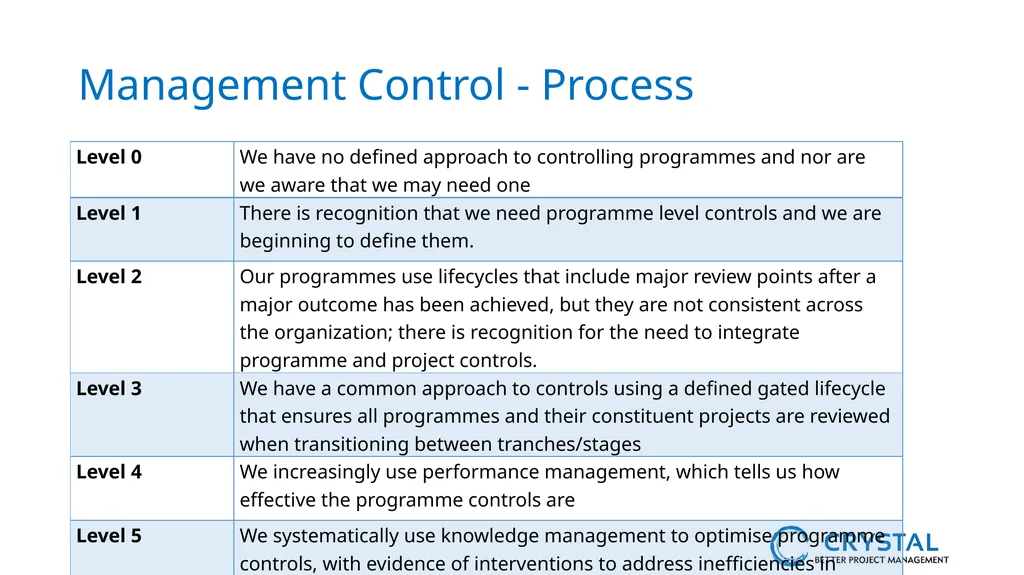
Management Control - Process<br>
15
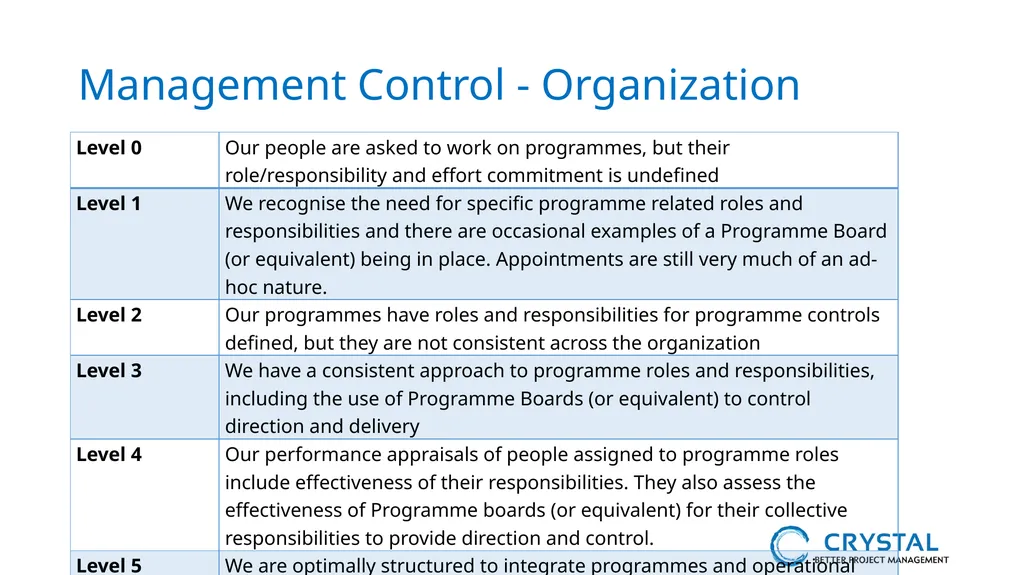
Management Control - Organization<br>
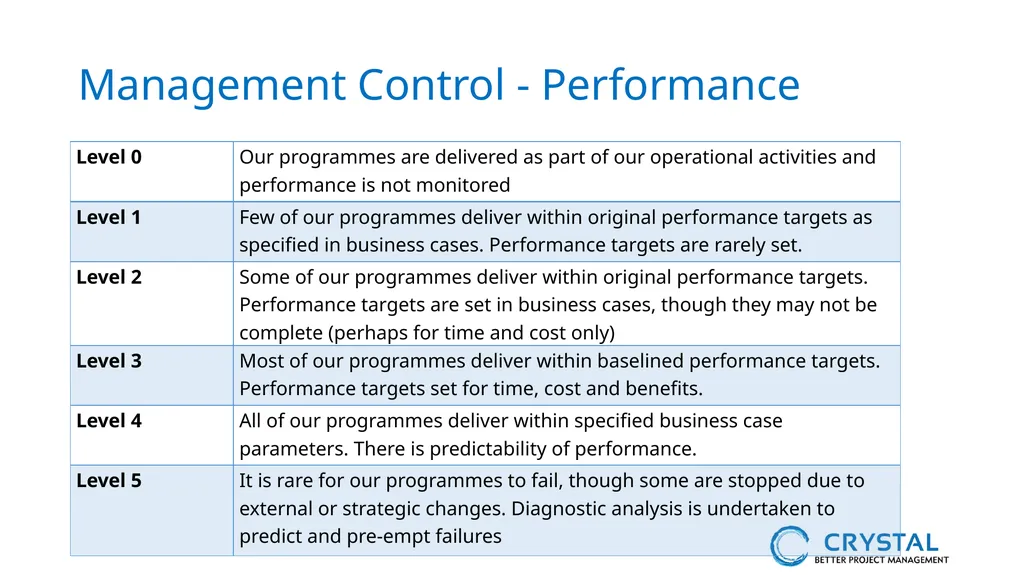
16
Management Control - Performance<br>
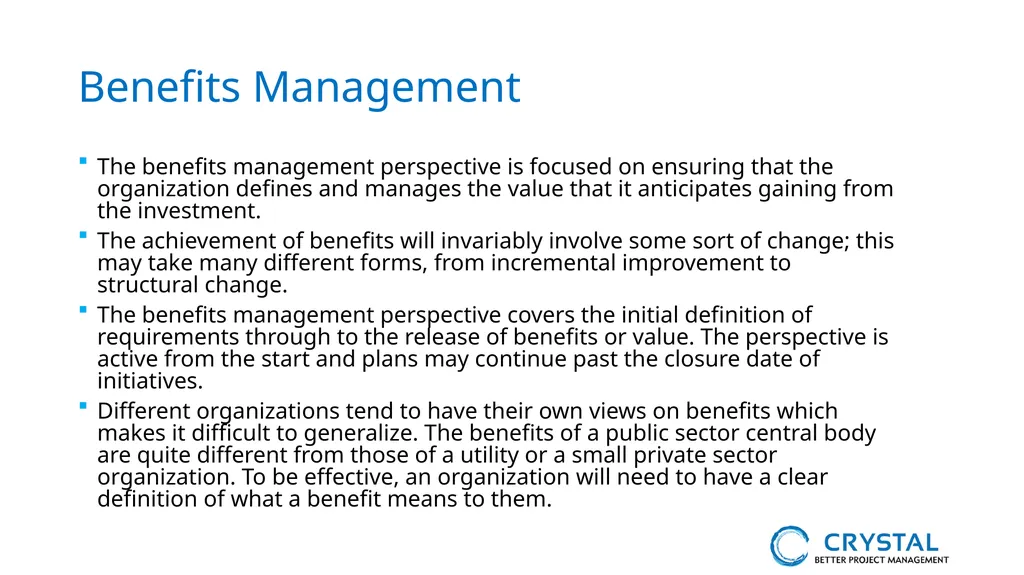
17
Benefits Management The benefits management perspective is focused on ensuring that the organization defines and manages the value that it anticipates gaining from the investment.
The achievement of benefits will invariably involve some sort of change; this may take many different forms, from incremental improvement to structural change.
The benefits management perspective covers the initial definition of requirements through to the release of benefits or value. The perspective is active from the start and plans may continue past the closure date of initiatives.
Different organizations tend to have their own views on benefits which makes it difficult to generalize. The benefits of a public sector central body are quite different from those of a utility or a small private sector organization. To be effective, an organization will need to have a clear definition of what a benefit means to them.<br>
The achievement of benefits will invariably involve some sort of change; this may take many different forms, from incremental improvement to structural change.
The benefits management perspective covers the initial definition of requirements through to the release of benefits or value. The perspective is active from the start and plans may continue past the closure date of initiatives.
Different organizations tend to have their own views on benefits which makes it difficult to generalize. The benefits of a public sector central body are quite different from those of a utility or a small private sector organization. To be effective, an organization will need to have a clear definition of what a benefit means to them.<br>
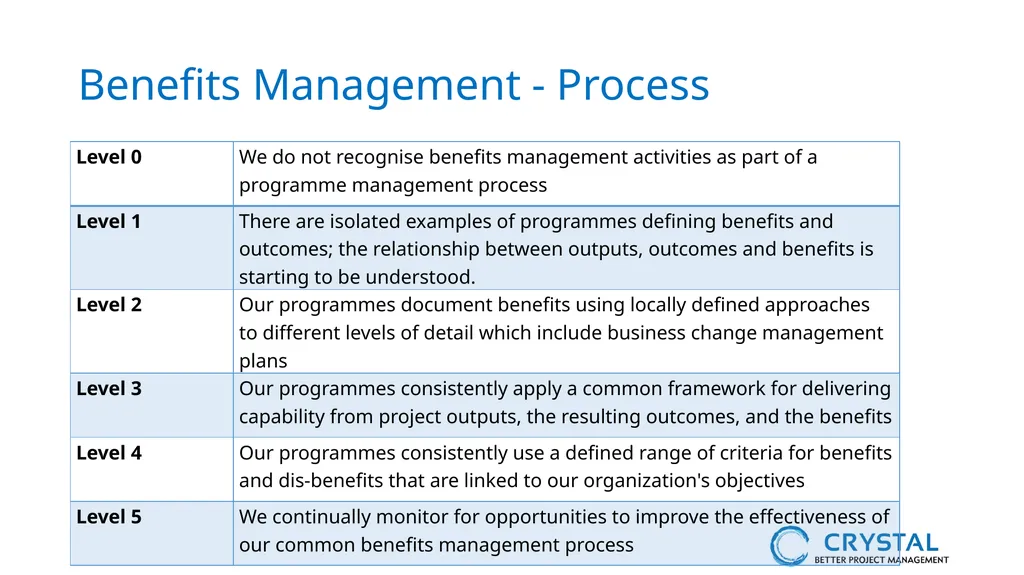
18
Benefits Management - Process<br>
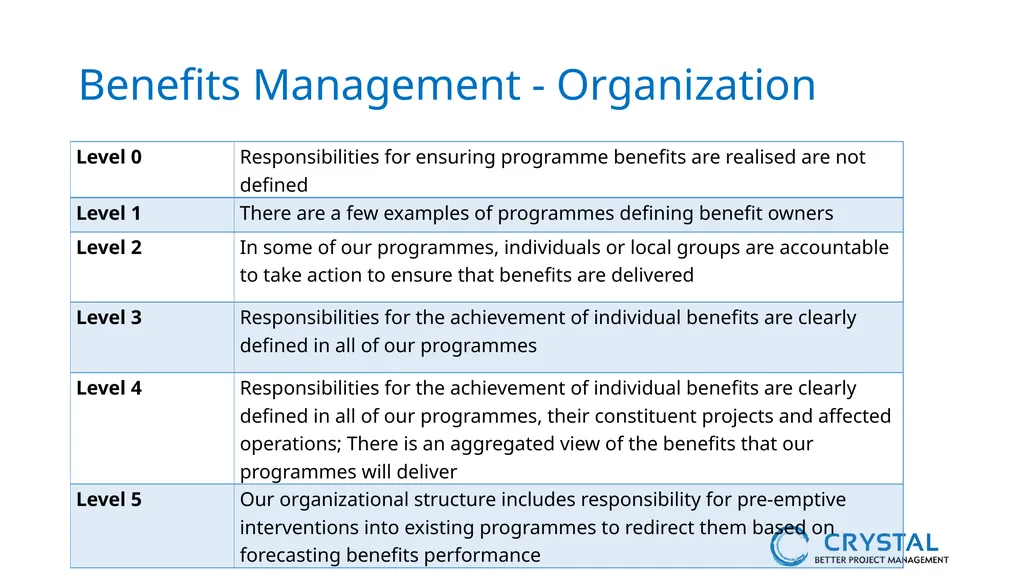
19
Benefits Management - Organization<br>
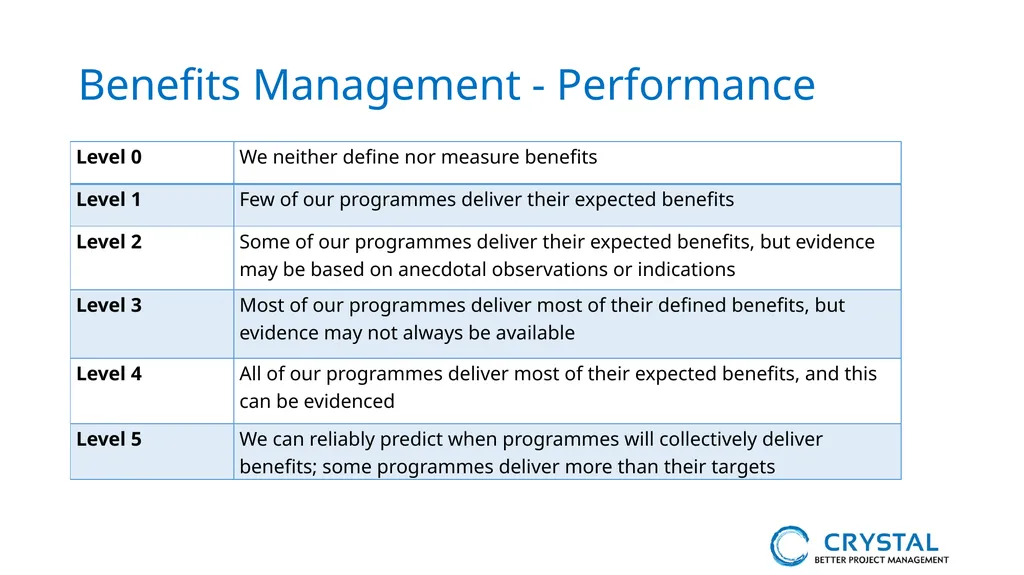
20
Benefits Management - Performance<br>
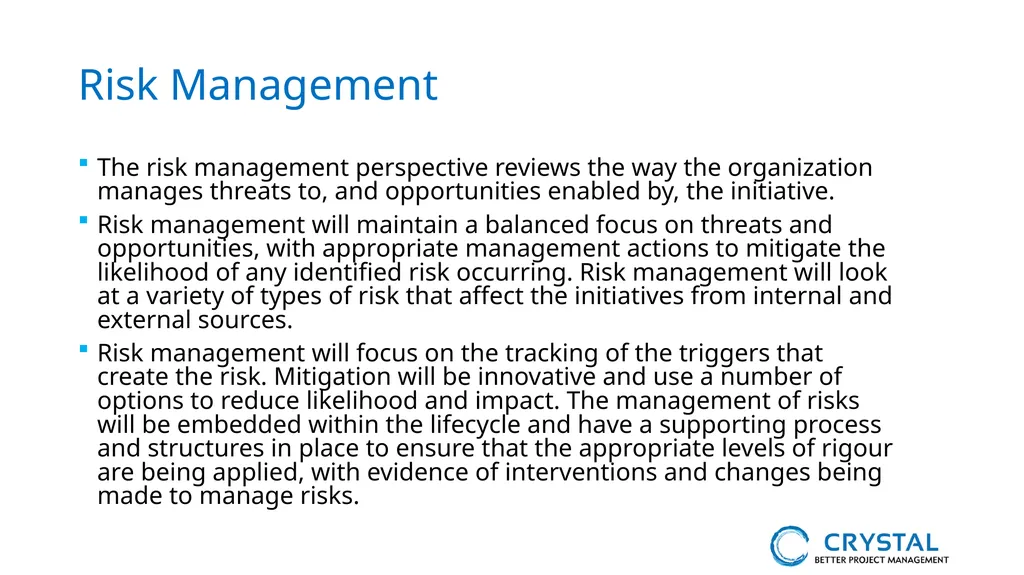
21
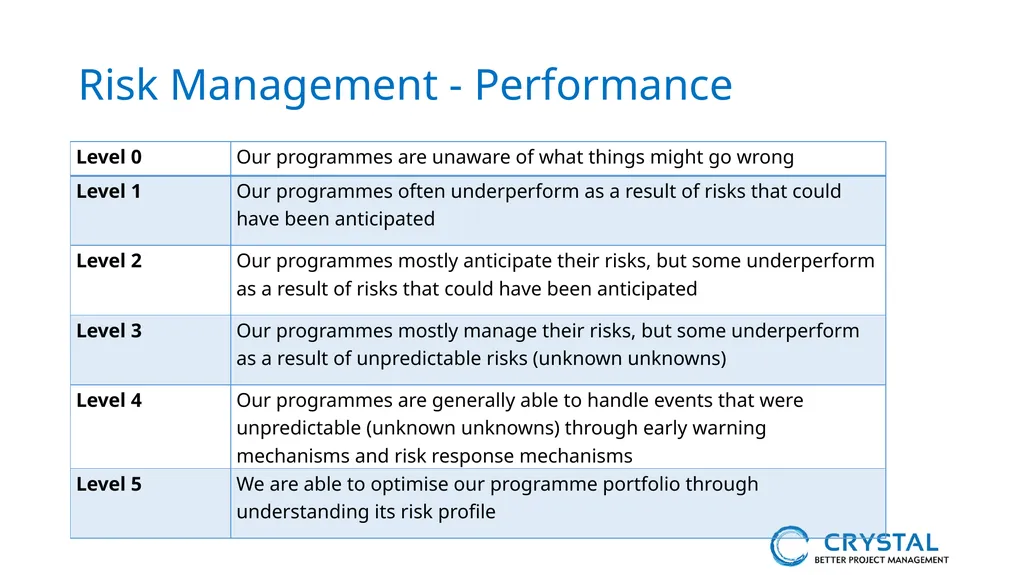
Risk Management The risk management perspective reviews the way the organization manages threats to, and opportunities enabled by, the initiative.
Risk management will maintain a balanced focus on threats and opportunities, with appropriate management actions to mitigate the likelihood of any identified risk occurring. Risk management will look at a variety of types of risk that affect the initiatives from internal and external sources.
Risk management will focus on the tracking of the triggers that create the risk. Mitigation will be innovative and use a number of options to reduce likelihood and impact. The management of risks will be embedded within the lifecycle and have a supporting process and structures in place to ensure that the appropriate levels of rigour are being applied, with evidence of interventions and changes being made to manage risks.<br>
Risk management will maintain a balanced focus on threats and opportunities, with appropriate management actions to mitigate the likelihood of any identified risk occurring. Risk management will look at a variety of types of risk that affect the initiatives from internal and external sources.
Risk management will focus on the tracking of the triggers that create the risk. Mitigation will be innovative and use a number of options to reduce likelihood and impact. The management of risks will be embedded within the lifecycle and have a supporting process and structures in place to ensure that the appropriate levels of rigour are being applied, with evidence of interventions and changes being made to manage risks.<br>
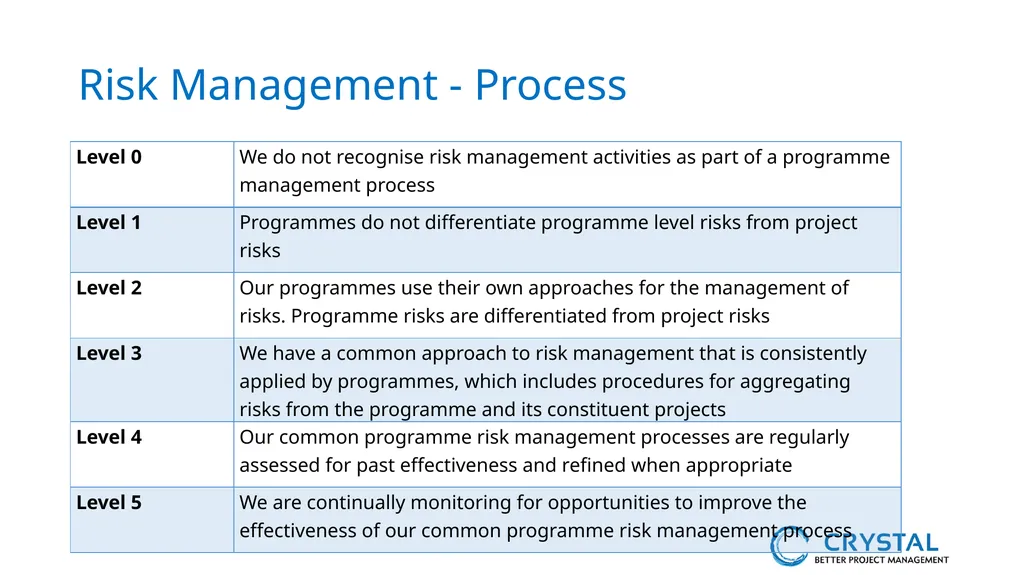
22
Risk Management - Process<br>
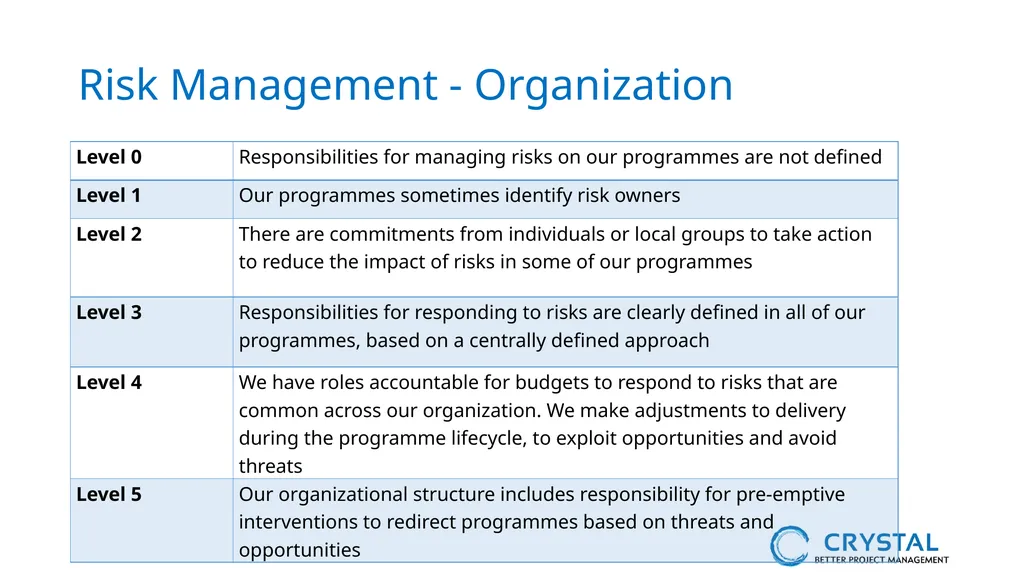
23
Risk Management - Organization<br>
24
Risk Management - Performance<br>
25
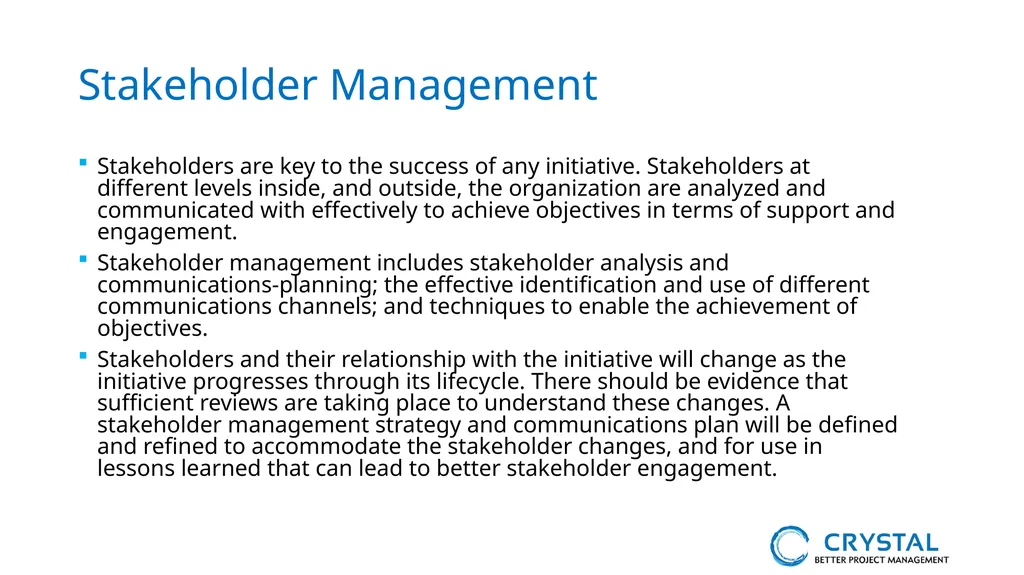
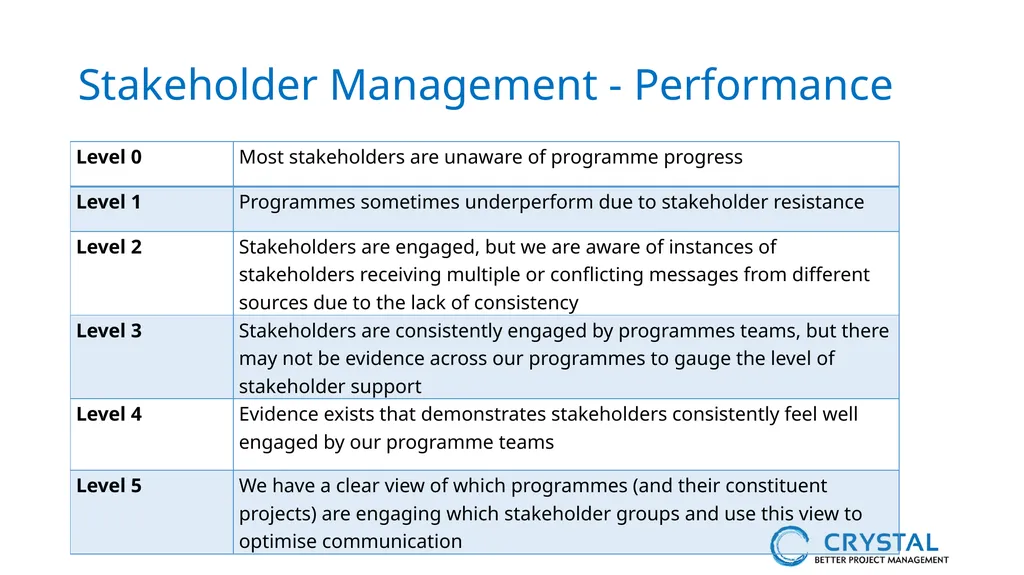
Stakeholder Management Stakeholders are key to the success of any initiative. Stakeholders at different levels inside, and outside, the organization are analyzed and communicated with effectively to achieve objectives in terms of support and engagement.
Stakeholder management includes stakeholder analysis and communications-planning; the effective identification and use of different communications channels; and techniques to enable the achievement of objectives.
Stakeholders and their relationship with the initiative will change as the initiative progresses through its lifecycle. There should be evidence that sufficient reviews are taking place to understand these changes. A stakeholder management strategy and communications plan will be defined and refined to accommodate the stakeholder changes, and for use in lessons learned that can lead to better stakeholder engagement.<br>
Stakeholder management includes stakeholder analysis and communications-planning; the effective identification and use of different communications channels; and techniques to enable the achievement of objectives.
Stakeholders and their relationship with the initiative will change as the initiative progresses through its lifecycle. There should be evidence that sufficient reviews are taking place to understand these changes. A stakeholder management strategy and communications plan will be defined and refined to accommodate the stakeholder changes, and for use in lessons learned that can lead to better stakeholder engagement.<br>
26
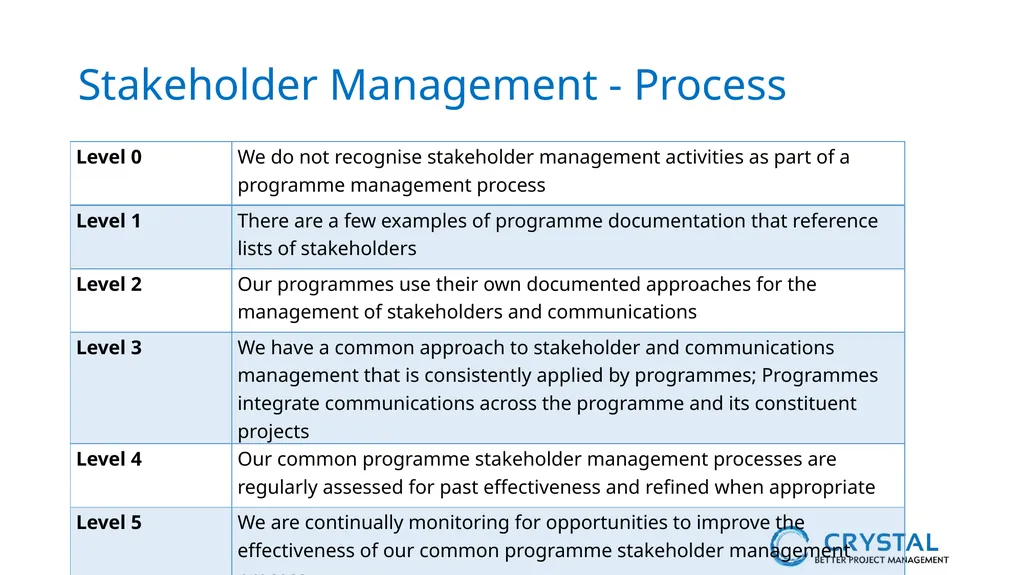
Stakeholder Management - Process<br>
27
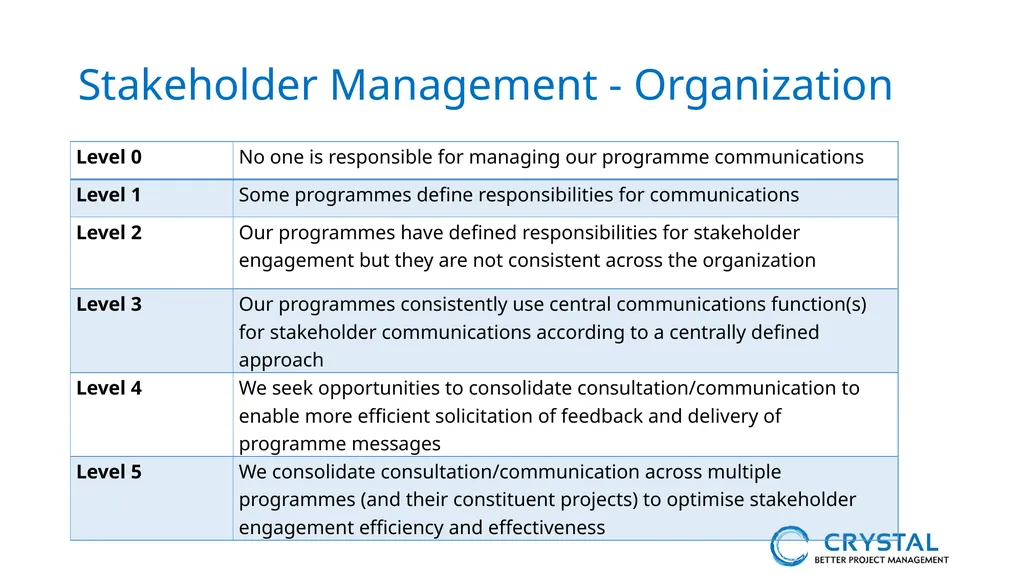
Stakeholder Management - Organization<br>
28
Stakeholder Management - Performance<br>
29
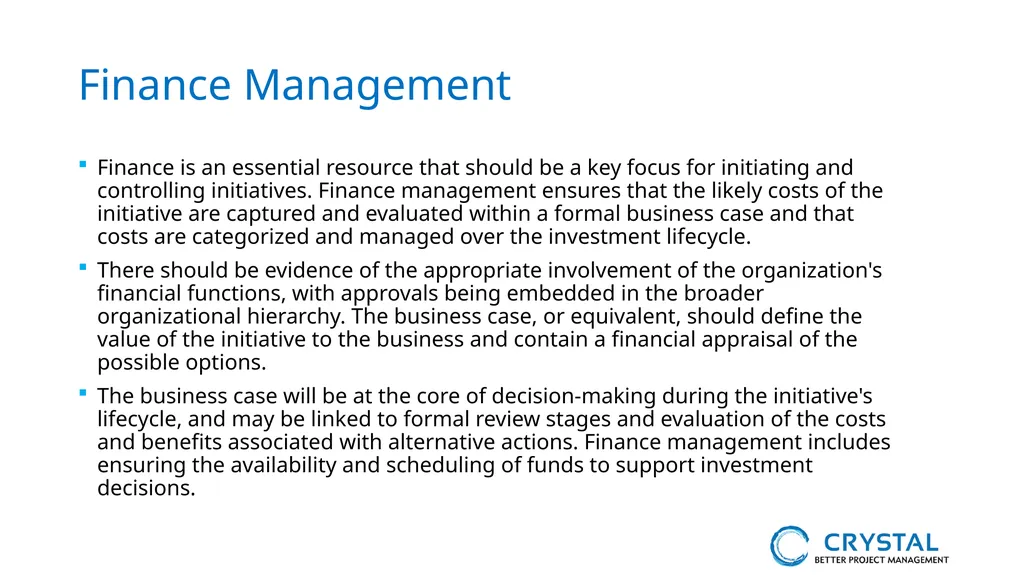
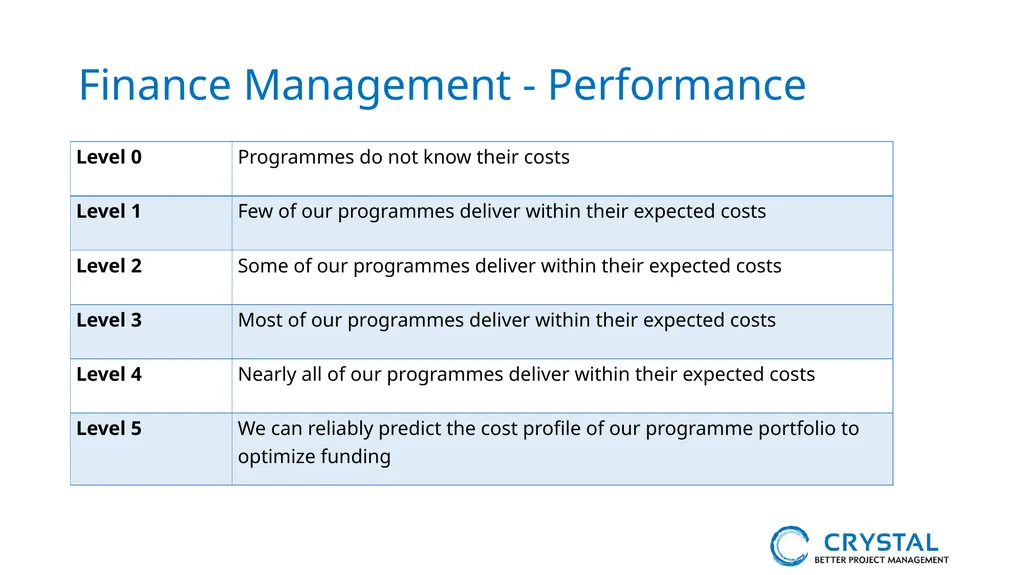
Finance Management Finance is an essential resource that should be a key focus for initiating and controlling initiatives. Finance management ensures that the likely costs of the initiative are captured and evaluated within a formal business case and that costs are categorized and managed over the investment lifecycle.
There should be evidence of the appropriate involvement of the organization's financial functions, with approvals being embedded in the broader organizational hierarchy. The business case, or equivalent, should define the value of the initiative to the business and contain a financial appraisal of the possible options.
The business case will be at the core of decision-making during the initiative's lifecycle, and may be linked to formal review stages and evaluation of the costs and benefits associated with alternative actions. Finance management includes ensuring the availability and scheduling of funds to support investment decisions.<br>
There should be evidence of the appropriate involvement of the organization's financial functions, with approvals being embedded in the broader organizational hierarchy. The business case, or equivalent, should define the value of the initiative to the business and contain a financial appraisal of the possible options.
The business case will be at the core of decision-making during the initiative's lifecycle, and may be linked to formal review stages and evaluation of the costs and benefits associated with alternative actions. Finance management includes ensuring the availability and scheduling of funds to support investment decisions.<br>
30
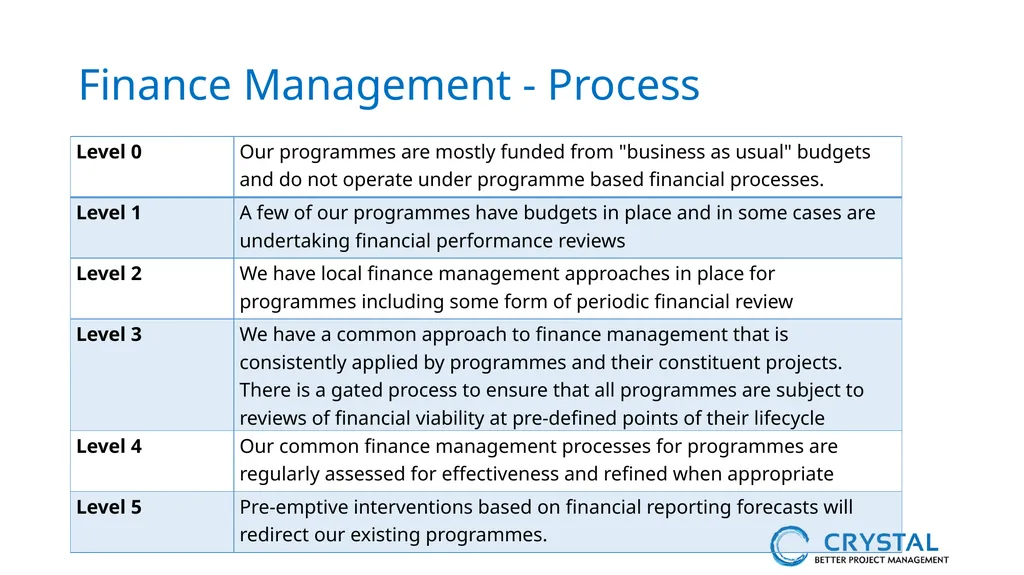
Finance Management - Process<br>
31
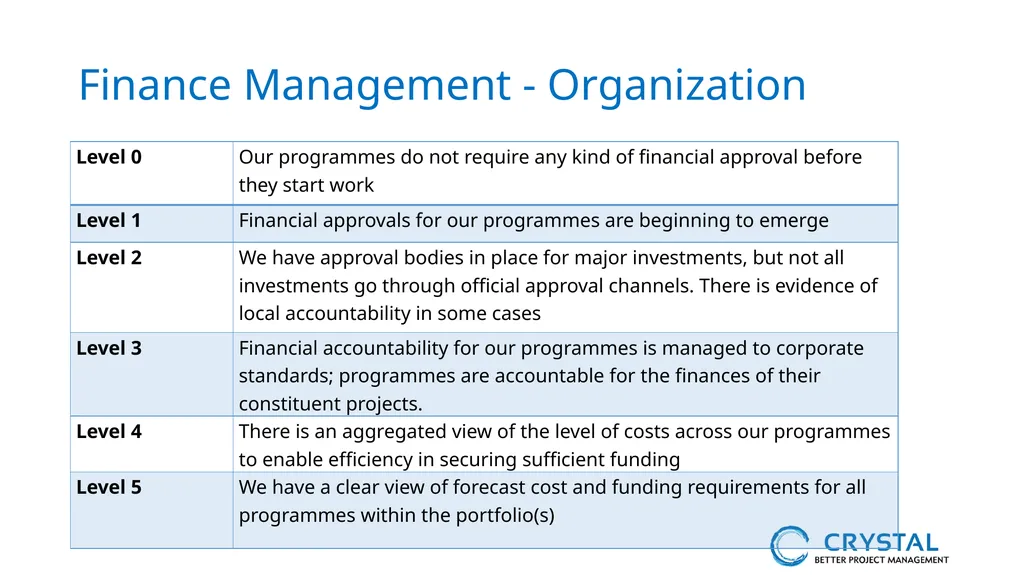
Finance Management - Organization<br>
32
Finance Management - Performance<br>
33
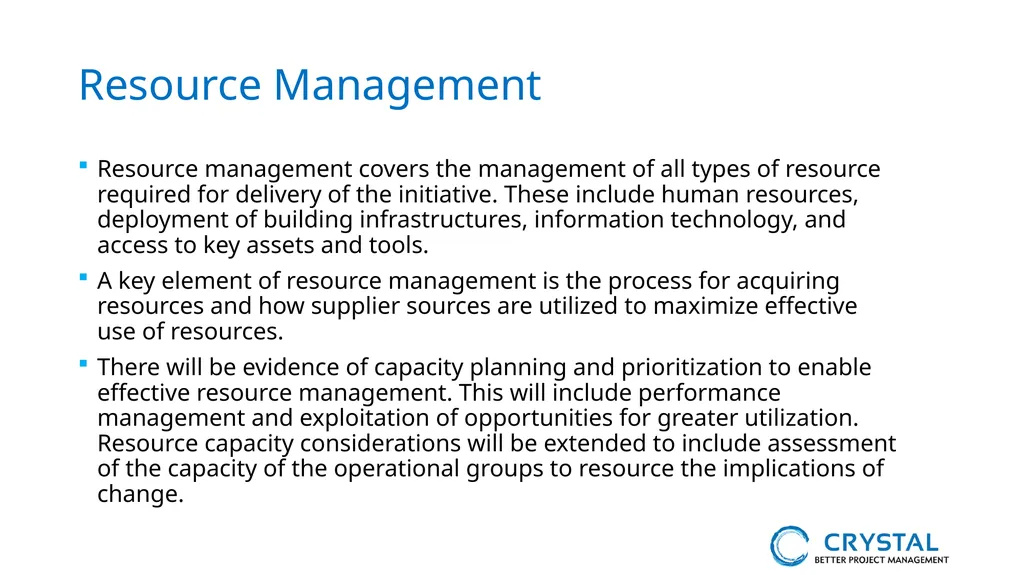
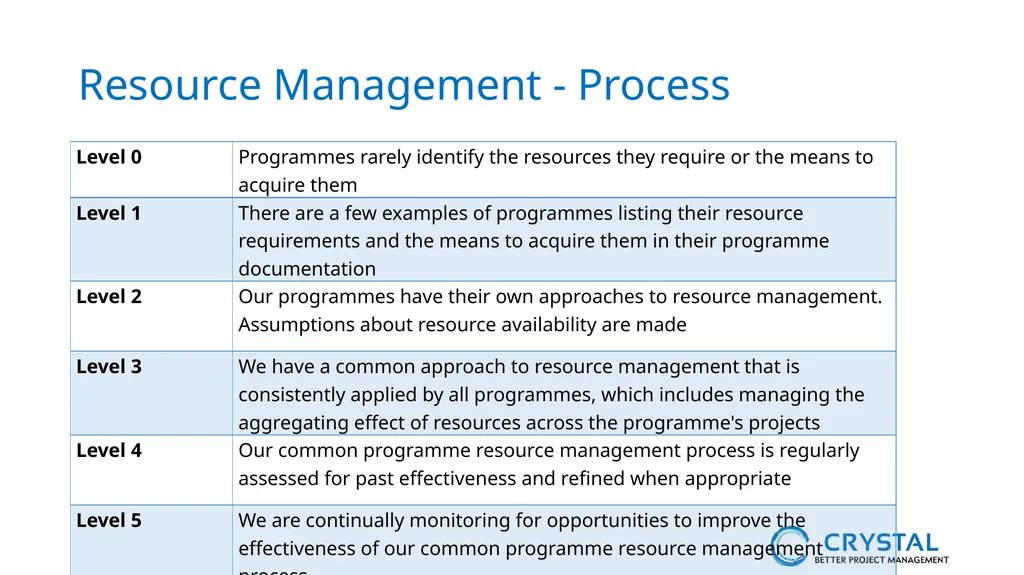
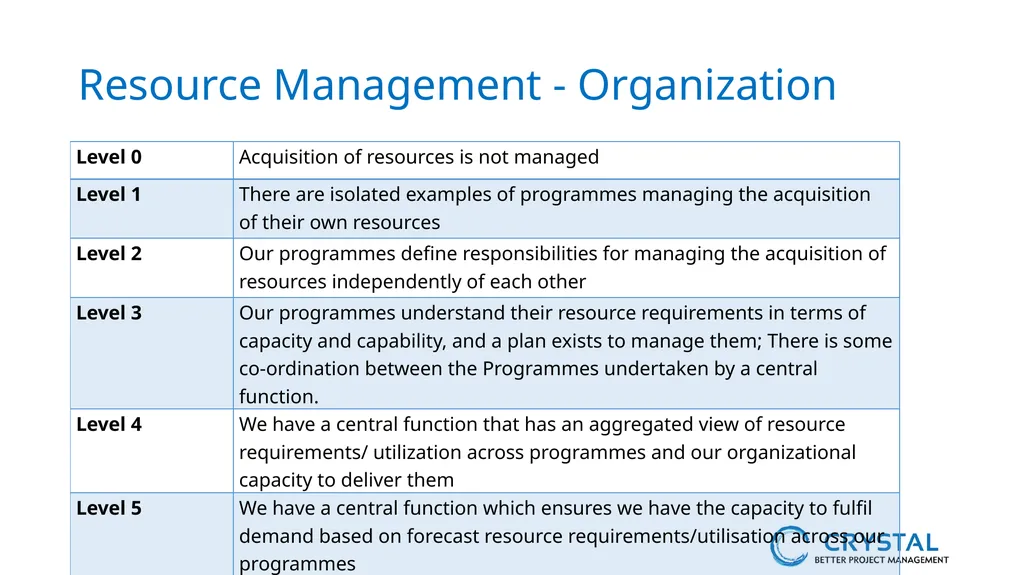
Resource Management Resource management covers the management of all types of resource required for delivery of the initiative. These include human resources, deployment of building infrastructures, information technology, and access to key assets and tools.
A key element of resource management is the process for acquiring resources and how supplier sources are utilized to maximize effective use of resources.
There will be evidence of capacity planning and prioritization to enable effective resource management. This will include performance management and exploitation of opportunities for greater utilization. Resource capacity considerations will be extended to include assessment of the capacity of the operational groups to resource the implications of change.<br>
A key element of resource management is the process for acquiring resources and how supplier sources are utilized to maximize effective use of resources.
There will be evidence of capacity planning and prioritization to enable effective resource management. This will include performance management and exploitation of opportunities for greater utilization. Resource capacity considerations will be extended to include assessment of the capacity of the operational groups to resource the implications of change.<br>
34
Resource Management - Process<br>
35
Resource Management - Organization<br>
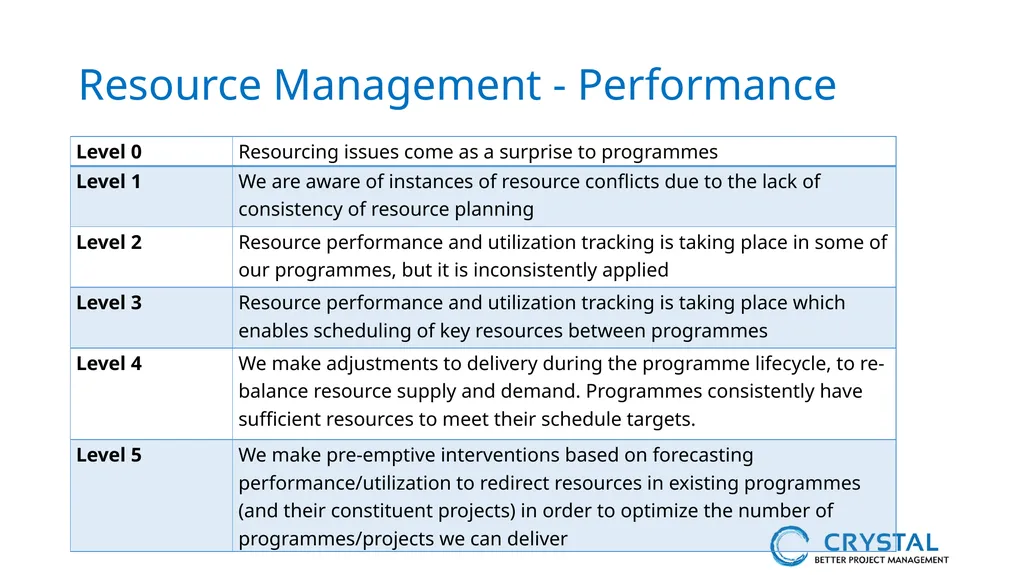
36
Resource Management - Performance<br>
37
End of Reflective Statements<br>
38
Thank You If you have any questions at all please do not hesitate to contact me.
Sean Whitaker
sean@crystal.consulting
Ph: +64 21633592 The AXELOS Consulting Partner logoTM is a trade mark, and P3M3® is a registered trade mark of AXELOS Limited,
used under permission of AXELOS Limited. All rights reserved.<br>
Sean Whitaker
sean@crystal.consulting
Ph: +64 21633592 The AXELOS Consulting Partner logoTM is a trade mark, and P3M3® is a registered trade mark of AXELOS Limited,
used under permission of AXELOS Limited. All rights reserved.<br>