
Pacific Behavioral Health Collaborating Council
LD
Published · 132 slides · 0 views

1 / 1
Description
Pacific Behavioral Health Collaborating Council Alcohol and Drug Counselor (ADC) Academy, Day 3 Core Competencies of Addiction Counselors: Knowledge and Skill Acquisition of Case Management, Crisis Intervention, Client and Family Education,
Related Topics
Share
Embed code
Download this presentation From Below
"Pacific Behavioral Health Collaborating Council" is the property of its rightful owner. Permission is granted to download and print the materials on this website for personal, non-commercial use only, and to display it on your personal computer provided you do not modify the materials and that you retain all copyright notices contained in the materials. By downloading content from our website, you accept the terms of this agreement.
Presentation Transcript
01
Pacific Behavioral Health Collaborating Council
Alcohol and Drug Counselor (ADC) Academy, Day 3
Core Competencies of Addiction Counselors: Knowledge and Skill Acquisition of Case Management, Crisis Intervention, Client and Family Education, Referral, Report and Record Keeping, and Consultation
Enter location here
Enter dates here Enter trainer names and credentials here<br>
02
Acknowledgements This training was developed by Dr. Thomas E. Freese, PhD (Director of Training of UCLA ISAP and Director of the Pacific Southwest ATTC), Alex R. Ngiraingas, MEd, CSAC II, ICADC, ICPS, and Dr. Christopher C. C. Rocchio, PhD, LCSW, CSAC, ICADC (Clinical Specialist, UCLA) in August of 2018 under contract number 2018-002 by the University of California Los Angeles, Integrated Substance Abuse Programs (UCLA ISAP) and the Pacific Southwest Addiction Technology Center (PSATTC) for the Pacific Behavioral Health Collaborating Council (PBHCC). Additional resource provided by SAMHSA, grant number UR1TI080211. 2<br>
03
Disclaimer for Training The UCLA, its employees, contractors, and affiliates shall not be liable for any damages, claims, liabilities, costs, or obligations arising from the use or misuse of materials or information contained in this presentation. Any use, copying, or distribution without written permission from the UCLA and the PBHCC is prohibited. 3<br>
04
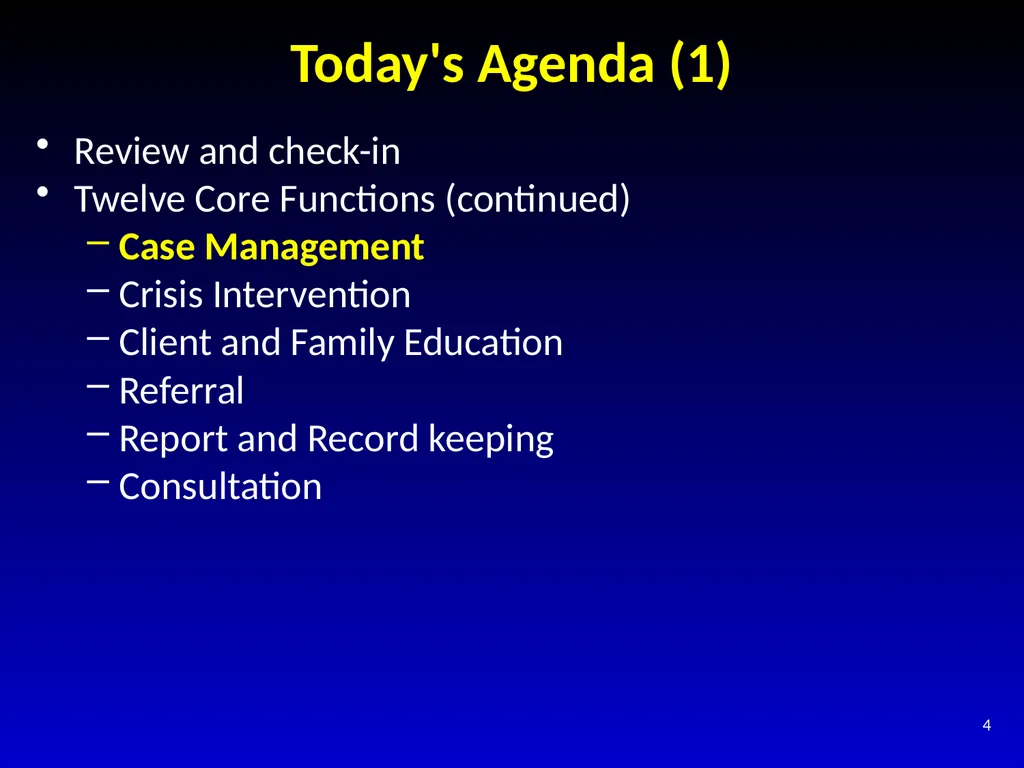
Today's Agenda (1) Review and check-in
Twelve Core Functions (continued)
Case Management
Crisis Intervention
Client and Family Education
Referral
Report and Record keeping
Consultation 4<br>
Twelve Core Functions (continued)
Case Management
Crisis Intervention
Client and Family Education
Referral
Report and Record keeping
Consultation 4<br>
05
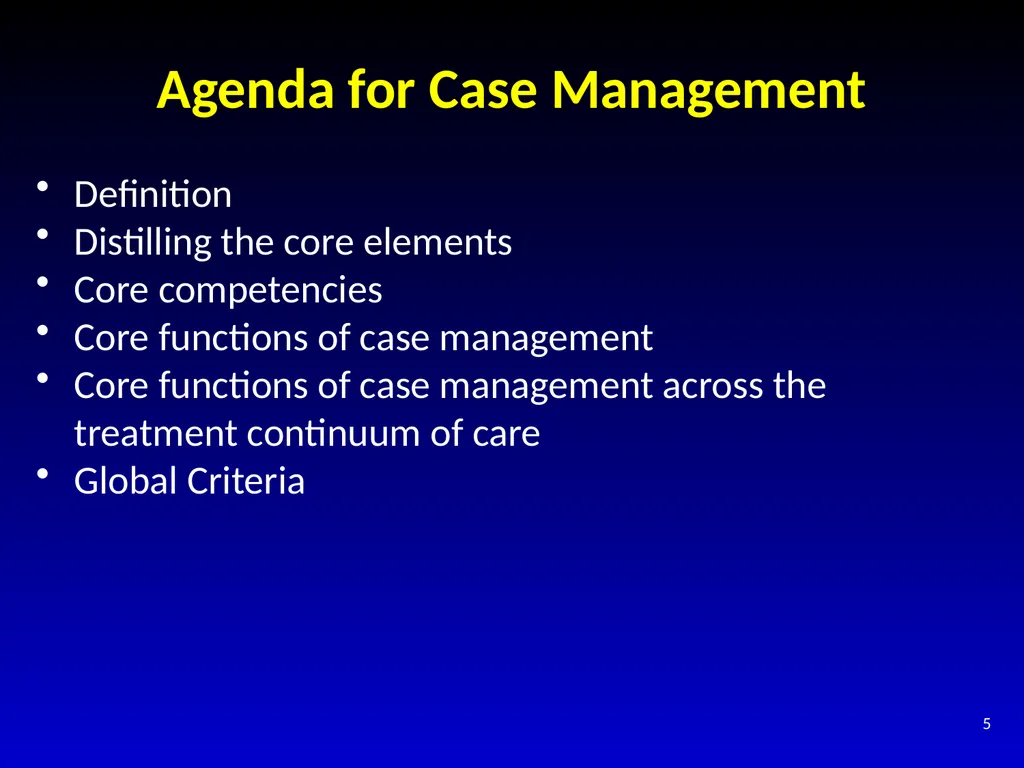
Agenda for Case Management Definition
Distilling the core elements
Core competencies
Core functions of case management
Core functions of case management across the treatment continuum of care
Global Criteria 5<br>
Distilling the core elements
Core competencies
Core functions of case management
Core functions of case management across the treatment continuum of care
Global Criteria 5<br>
06
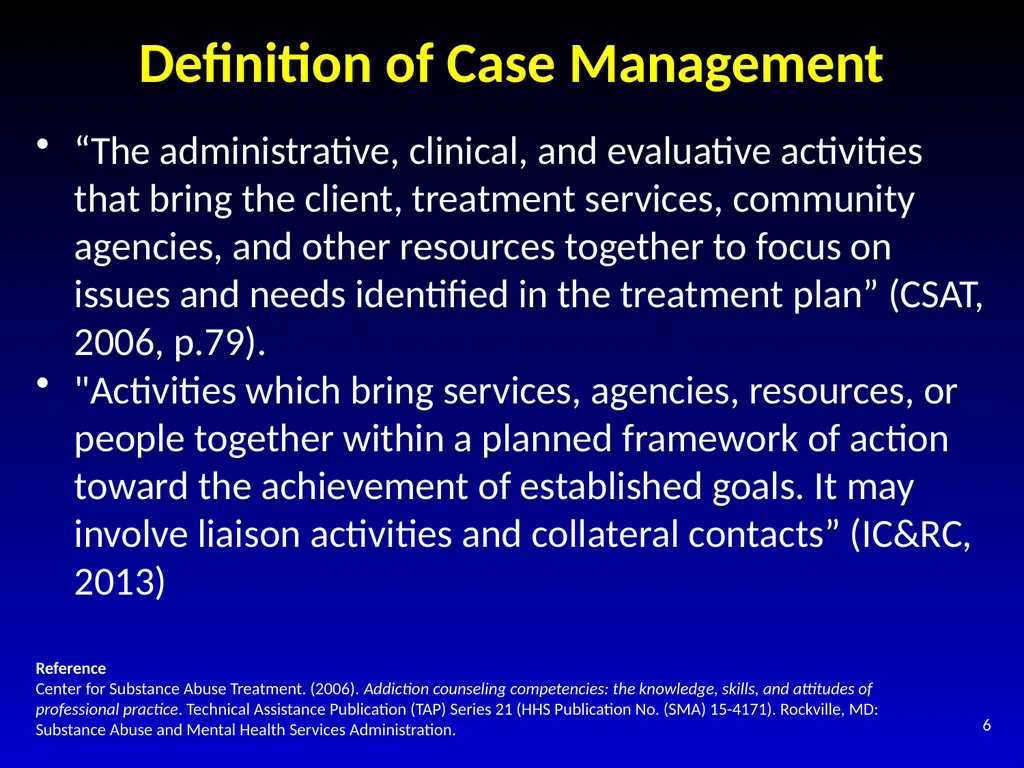
Definition of Case Management “The administrative, clinical, and evaluative activities that bring the client, treatment services, community agencies, and other resources together to focus on issues and needs identified in the treatment plan” (CSAT, 2006, p.79).
"Activities which bring services, agencies, resources, or people together within a planned framework of action toward the achievement of established goals. It may involve liaison activities and collateral contacts” (IC&RC, 2013) Reference
Center for Substance Abuse Treatment. (2006). Addiction counseling competencies: the knowledge, skills, and attitudes of professional practice. Technical Assistance Publication (TAP) Series 21 (HHS Publication No. (SMA) 15-4171). Rockville, MD: Substance Abuse and Mental Health Services Administration. 6<br>
"Activities which bring services, agencies, resources, or people together within a planned framework of action toward the achievement of established goals. It may involve liaison activities and collateral contacts” (IC&RC, 2013) Reference
Center for Substance Abuse Treatment. (2006). Addiction counseling competencies: the knowledge, skills, and attitudes of professional practice. Technical Assistance Publication (TAP) Series 21 (HHS Publication No. (SMA) 15-4171). Rockville, MD: Substance Abuse and Mental Health Services Administration. 6<br>
07
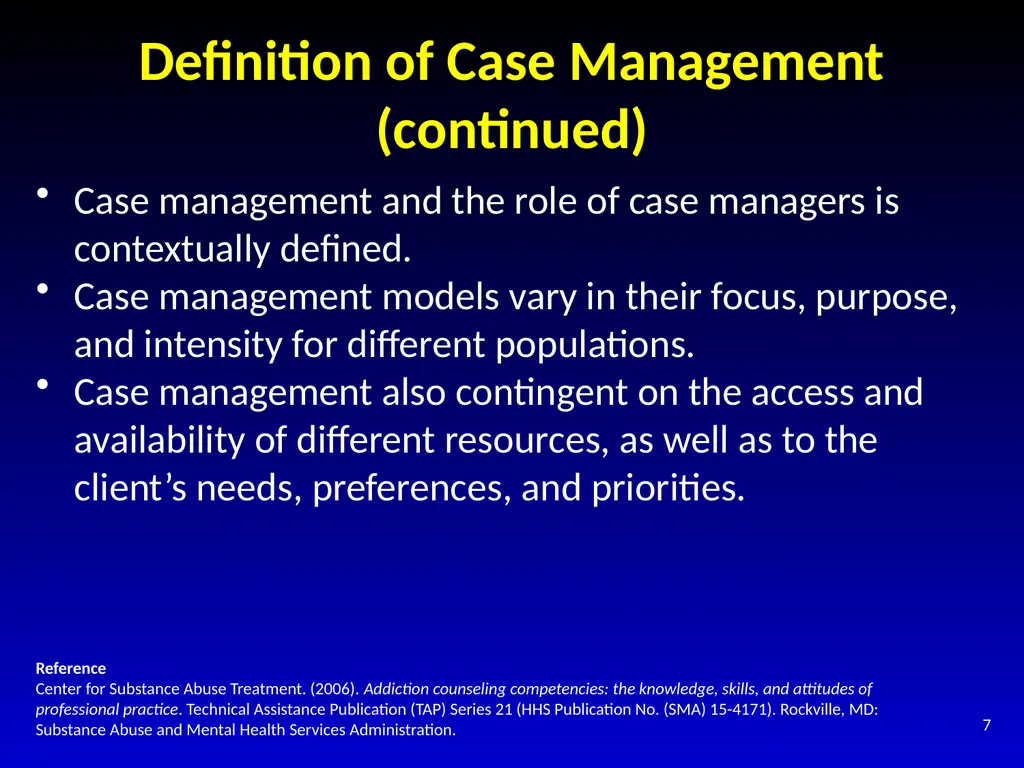
Definition of Case Management (continued) Case management and the role of case managers is contextually defined.
Case management models vary in their focus, purpose, and intensity for different populations.
Case management also contingent on the access and availability of different resources, as well as to the client’s needs, preferences, and priorities. Reference
Center for Substance Abuse Treatment. (2006). Addiction counseling competencies: the knowledge, skills, and attitudes of professional practice. Technical Assistance Publication (TAP) Series 21 (HHS Publication No. (SMA) 15-4171). Rockville, MD: Substance Abuse and Mental Health Services Administration. 7<br>
Case management models vary in their focus, purpose, and intensity for different populations.
Case management also contingent on the access and availability of different resources, as well as to the client’s needs, preferences, and priorities. Reference
Center for Substance Abuse Treatment. (2006). Addiction counseling competencies: the knowledge, skills, and attitudes of professional practice. Technical Assistance Publication (TAP) Series 21 (HHS Publication No. (SMA) 15-4171). Rockville, MD: Substance Abuse and Mental Health Services Administration. 7<br>
08
Distilling the Core Elements of
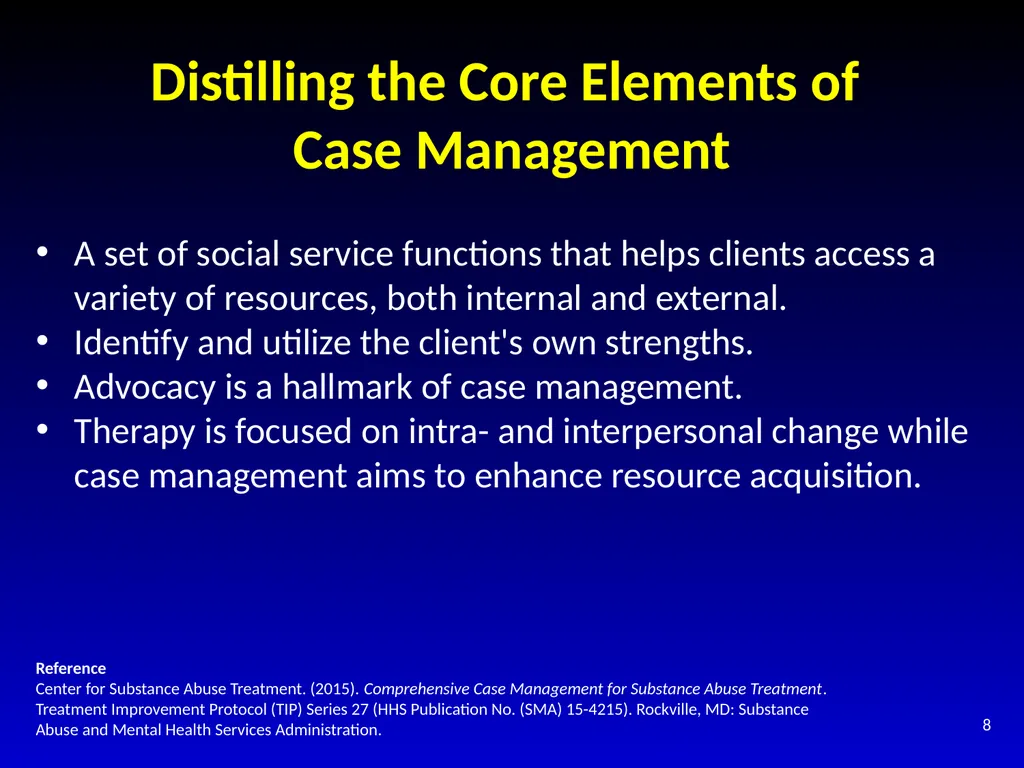
Case Management A set of social service functions that helps clients access a variety of resources, both internal and external.
Identify and utilize the client's own strengths.
Advocacy is a hallmark of case management.
Therapy is focused on intra- and interpersonal change while case management aims to enhance resource acquisition. Reference
Center for Substance Abuse Treatment. (2015). Comprehensive Case Management for Substance Abuse Treatment. Treatment Improvement Protocol (TIP) Series 27 (HHS Publication No. (SMA) 15-4215). Rockville, MD: Substance Abuse and Mental Health Services Administration. 8<br>
Identify and utilize the client's own strengths.
Advocacy is a hallmark of case management.
Therapy is focused on intra- and interpersonal change while case management aims to enhance resource acquisition. Reference
Center for Substance Abuse Treatment. (2015). Comprehensive Case Management for Substance Abuse Treatment. Treatment Improvement Protocol (TIP) Series 27 (HHS Publication No. (SMA) 15-4215). Rockville, MD: Substance Abuse and Mental Health Services Administration. 8<br>
09
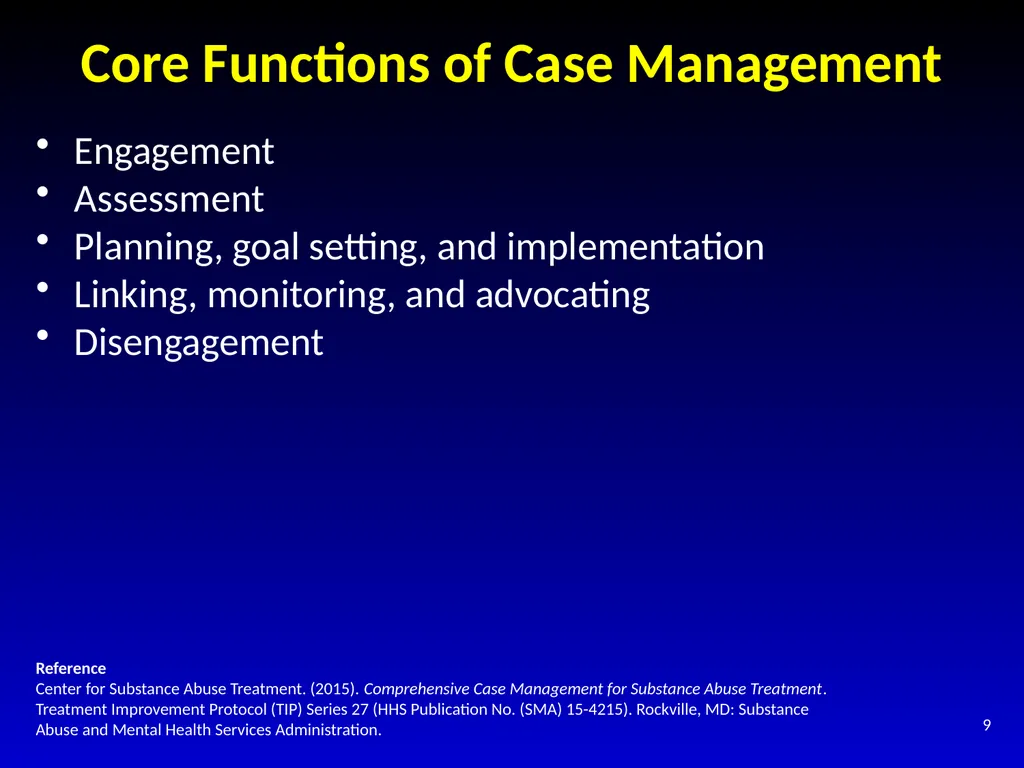
Core Functions of Case Management Engagement
Assessment
Planning, goal setting, and implementation
Linking, monitoring, and advocating
Disengagement Reference
Center for Substance Abuse Treatment. (2015). Comprehensive Case Management for Substance Abuse Treatment. Treatment Improvement Protocol (TIP) Series 27 (HHS Publication No. (SMA) 15-4215). Rockville, MD: Substance Abuse and Mental Health Services Administration. 9<br>
Assessment
Planning, goal setting, and implementation
Linking, monitoring, and advocating
Disengagement Reference
Center for Substance Abuse Treatment. (2015). Comprehensive Case Management for Substance Abuse Treatment. Treatment Improvement Protocol (TIP) Series 27 (HHS Publication No. (SMA) 15-4215). Rockville, MD: Substance Abuse and Mental Health Services Administration. 9<br>
10
Core Functions Across
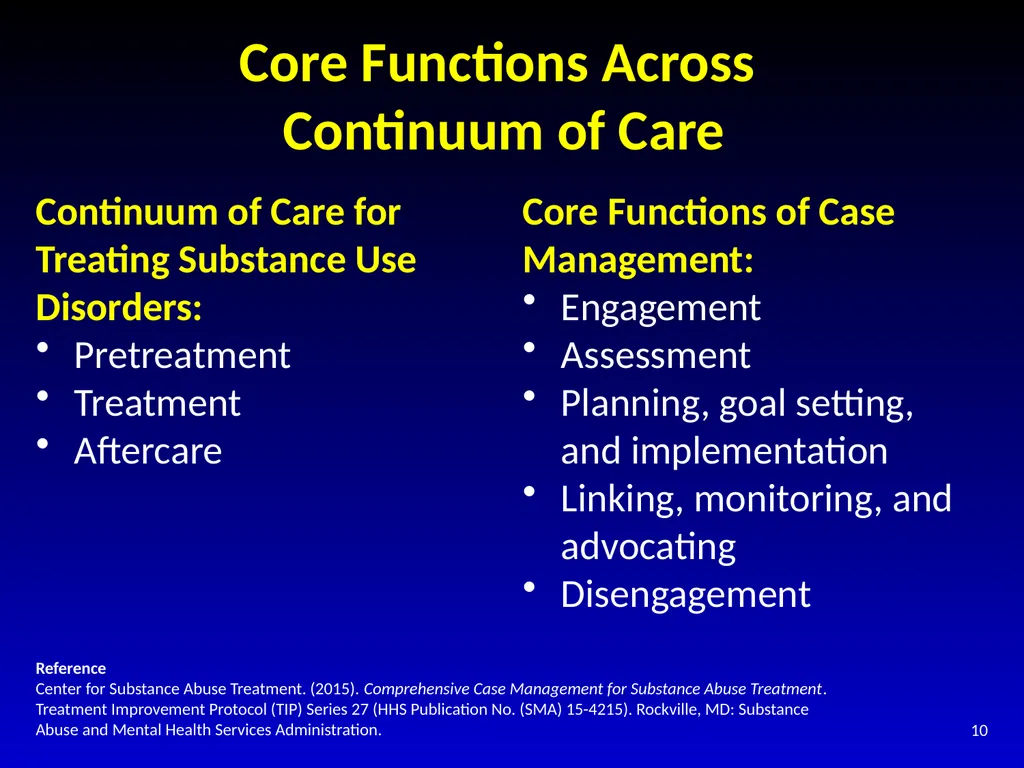
Continuum of Care Continuum of Care for Treating Substance Use Disorders:
Pretreatment
Treatment
Aftercare Core Functions of Case Management:
Engagement
Assessment
Planning, goal setting, and implementation
Linking, monitoring, and advocating
Disengagement Reference
Center for Substance Abuse Treatment. (2015). Comprehensive Case Management for Substance Abuse Treatment. Treatment Improvement Protocol (TIP) Series 27 (HHS Publication No. (SMA) 15-4215). Rockville, MD: Substance Abuse and Mental Health Services Administration. 10<br>
Pretreatment
Treatment
Aftercare Core Functions of Case Management:
Engagement
Assessment
Planning, goal setting, and implementation
Linking, monitoring, and advocating
Disengagement Reference
Center for Substance Abuse Treatment. (2015). Comprehensive Case Management for Substance Abuse Treatment. Treatment Improvement Protocol (TIP) Series 27 (HHS Publication No. (SMA) 15-4215). Rockville, MD: Substance Abuse and Mental Health Services Administration. 10<br>
11
Pre-Treatment and
Case Management<br>
12
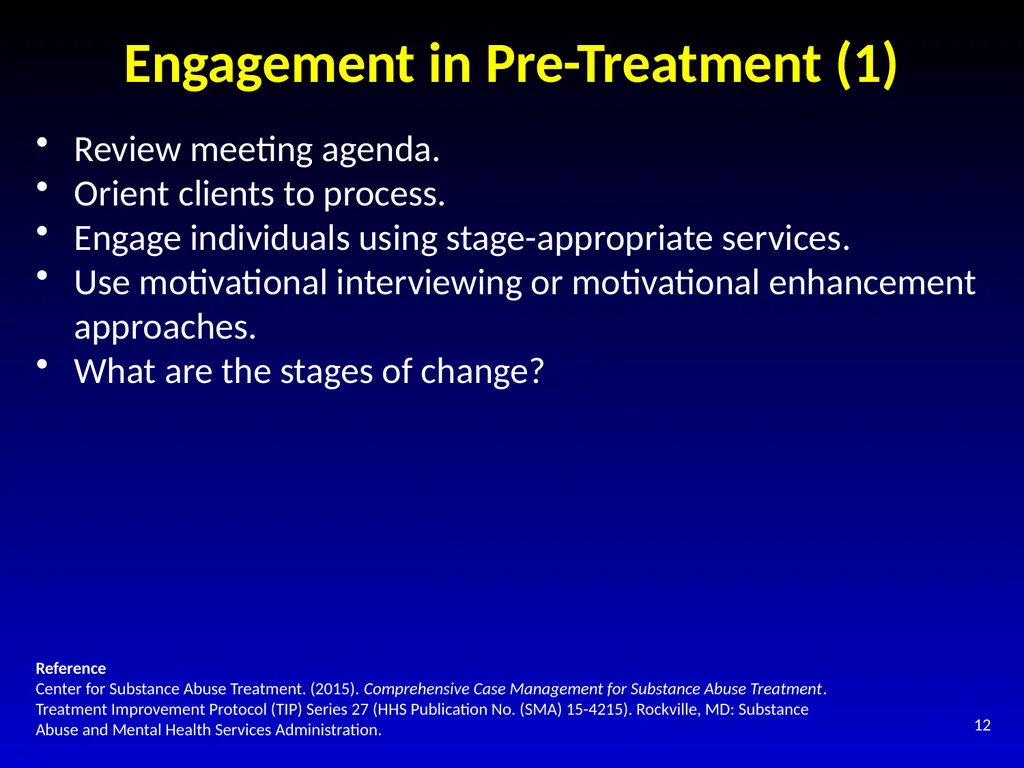
Engagement in Pre-Treatment (1) Review meeting agenda.
Orient clients to process.
Engage individuals using stage-appropriate services.
Use motivational interviewing or motivational enhancement approaches.
What are the stages of change? Reference
Center for Substance Abuse Treatment. (2015). Comprehensive Case Management for Substance Abuse Treatment. Treatment Improvement Protocol (TIP) Series 27 (HHS Publication No. (SMA) 15-4215). Rockville, MD: Substance Abuse and Mental Health Services Administration. 12<br>
Orient clients to process.
Engage individuals using stage-appropriate services.
Use motivational interviewing or motivational enhancement approaches.
What are the stages of change? Reference
Center for Substance Abuse Treatment. (2015). Comprehensive Case Management for Substance Abuse Treatment. Treatment Improvement Protocol (TIP) Series 27 (HHS Publication No. (SMA) 15-4215). Rockville, MD: Substance Abuse and Mental Health Services Administration. 12<br>
13
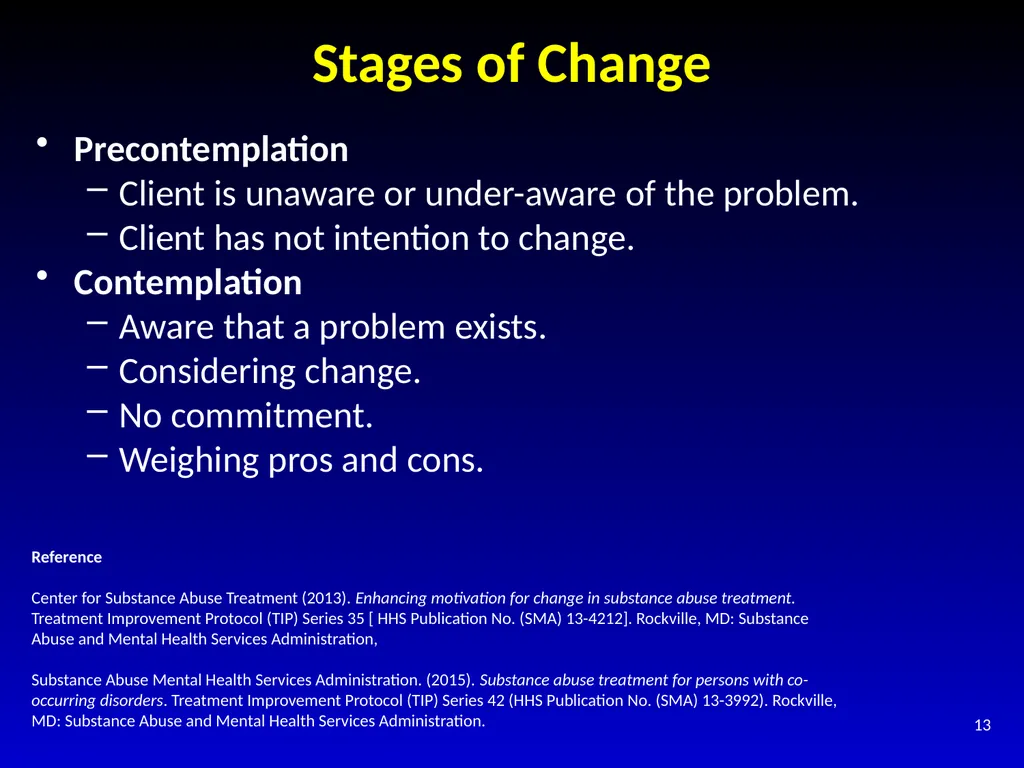
Stages of Change Precontemplation
Client is unaware or under-aware of the problem.
Client has not intention to change.
Contemplation
Aware that a problem exists.
Considering change.
No commitment.
Weighing pros and cons. Reference
Center for Substance Abuse Treatment (2013). Enhancing motivation for change in substance abuse treatment. Treatment Improvement Protocol (TIP) Series 35 [ HHS Publication No. (SMA) 13-4212]. Rockville, MD: Substance Abuse and Mental Health Services Administration,
Substance Abuse Mental Health Services Administration. (2015). Substance abuse treatment for persons with co-occurring disorders. Treatment Improvement Protocol (TIP) Series 42 (HHS Publication No. (SMA) 13-3992). Rockville, MD: Substance Abuse and Mental Health Services Administration. 13<br>
Client is unaware or under-aware of the problem.
Client has not intention to change.
Contemplation
Aware that a problem exists.
Considering change.
No commitment.
Weighing pros and cons. Reference
Center for Substance Abuse Treatment (2013). Enhancing motivation for change in substance abuse treatment. Treatment Improvement Protocol (TIP) Series 35 [ HHS Publication No. (SMA) 13-4212]. Rockville, MD: Substance Abuse and Mental Health Services Administration,
Substance Abuse Mental Health Services Administration. (2015). Substance abuse treatment for persons with co-occurring disorders. Treatment Improvement Protocol (TIP) Series 42 (HHS Publication No. (SMA) 13-3992). Rockville, MD: Substance Abuse and Mental Health Services Administration. 13<br>
14
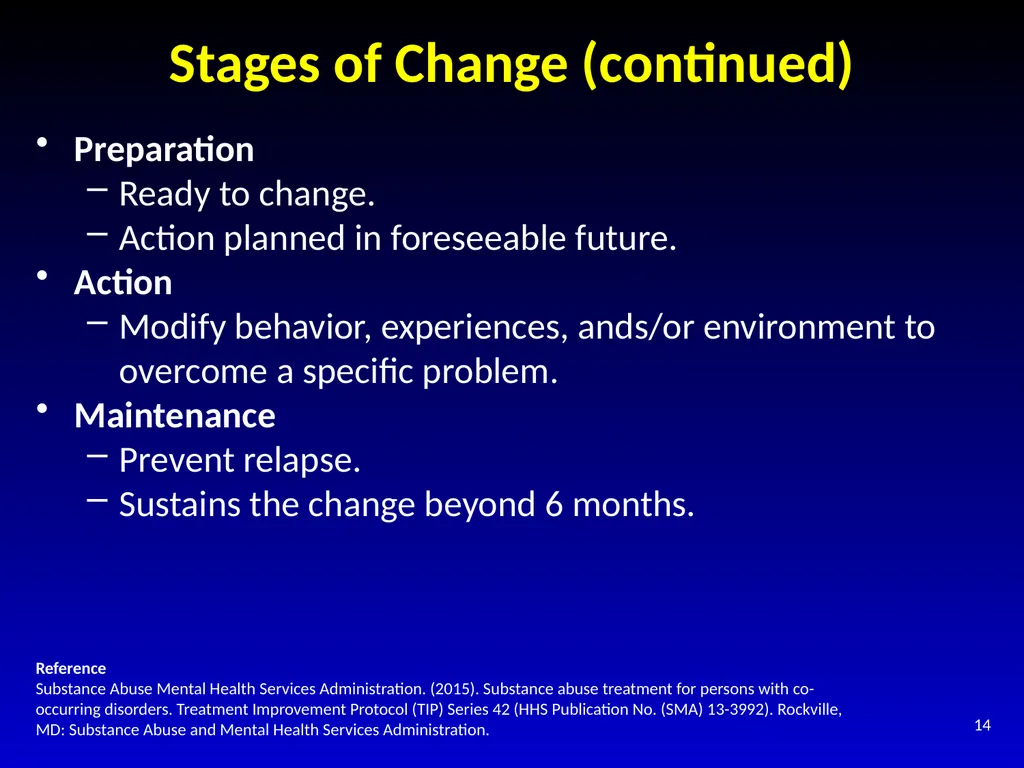
Stages of Change (continued) Preparation
Ready to change.
Action planned in foreseeable future.
Action
Modify behavior, experiences, ands/or environment to overcome a specific problem.
Maintenance
Prevent relapse.
Sustains the change beyond 6 months. Reference
Substance Abuse Mental Health Services Administration. (2015). Substance abuse treatment for persons with co-occurring disorders. Treatment Improvement Protocol (TIP) Series 42 (HHS Publication No. (SMA) 13-3992). Rockville, MD: Substance Abuse and Mental Health Services Administration. 14<br>
Ready to change.
Action planned in foreseeable future.
Action
Modify behavior, experiences, ands/or environment to overcome a specific problem.
Maintenance
Prevent relapse.
Sustains the change beyond 6 months. Reference
Substance Abuse Mental Health Services Administration. (2015). Substance abuse treatment for persons with co-occurring disorders. Treatment Improvement Protocol (TIP) Series 42 (HHS Publication No. (SMA) 13-3992). Rockville, MD: Substance Abuse and Mental Health Services Administration. 14<br>
15
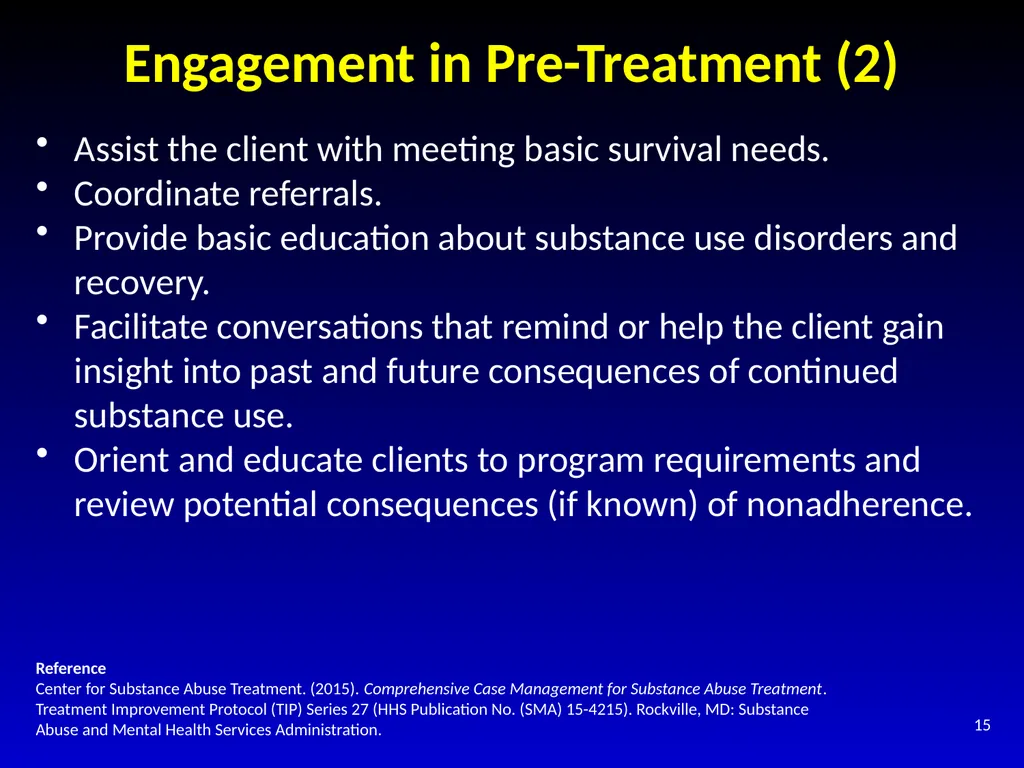
Engagement in Pre-Treatment (2) Assist the client with meeting basic survival needs.
Coordinate referrals.
Provide basic education about substance use disorders and recovery.
Facilitate conversations that remind or help the client gain insight into past and future consequences of continued substance use.
Orient and educate clients to program requirements and review potential consequences (if known) of nonadherence. Reference
Center for Substance Abuse Treatment. (2015). Comprehensive Case Management for Substance Abuse Treatment. Treatment Improvement Protocol (TIP) Series 27 (HHS Publication No. (SMA) 15-4215). Rockville, MD: Substance Abuse and Mental Health Services Administration. 15<br>
Coordinate referrals.
Provide basic education about substance use disorders and recovery.
Facilitate conversations that remind or help the client gain insight into past and future consequences of continued substance use.
Orient and educate clients to program requirements and review potential consequences (if known) of nonadherence. Reference
Center for Substance Abuse Treatment. (2015). Comprehensive Case Management for Substance Abuse Treatment. Treatment Improvement Protocol (TIP) Series 27 (HHS Publication No. (SMA) 15-4215). Rockville, MD: Substance Abuse and Mental Health Services Administration. 15<br>
16
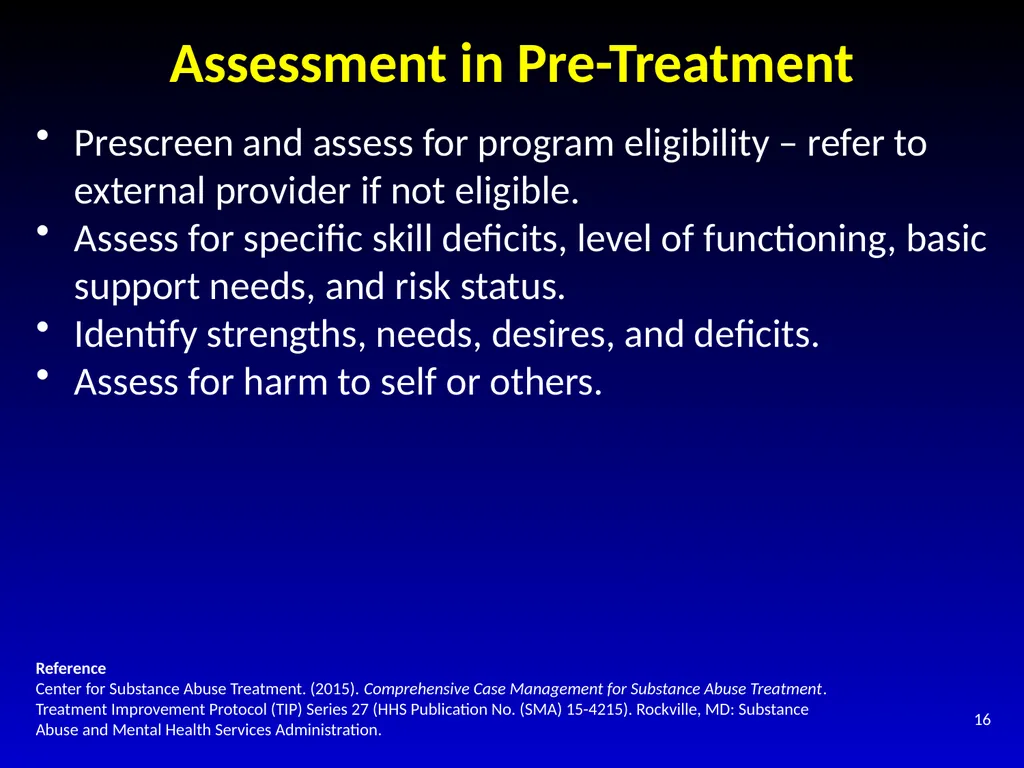
Assessment in Pre-Treatment Prescreen and assess for program eligibility – refer to external provider if not eligible.
Assess for specific skill deficits, level of functioning, basic support needs, and risk status.
Identify strengths, needs, desires, and deficits.
Assess for harm to self or others. Reference
Center for Substance Abuse Treatment. (2015). Comprehensive Case Management for Substance Abuse Treatment. Treatment Improvement Protocol (TIP) Series 27 (HHS Publication No. (SMA) 15-4215). Rockville, MD: Substance Abuse and Mental Health Services Administration. 16<br>
Assess for specific skill deficits, level of functioning, basic support needs, and risk status.
Identify strengths, needs, desires, and deficits.
Assess for harm to self or others. Reference
Center for Substance Abuse Treatment. (2015). Comprehensive Case Management for Substance Abuse Treatment. Treatment Improvement Protocol (TIP) Series 27 (HHS Publication No. (SMA) 15-4215). Rockville, MD: Substance Abuse and Mental Health Services Administration. 16<br>
17
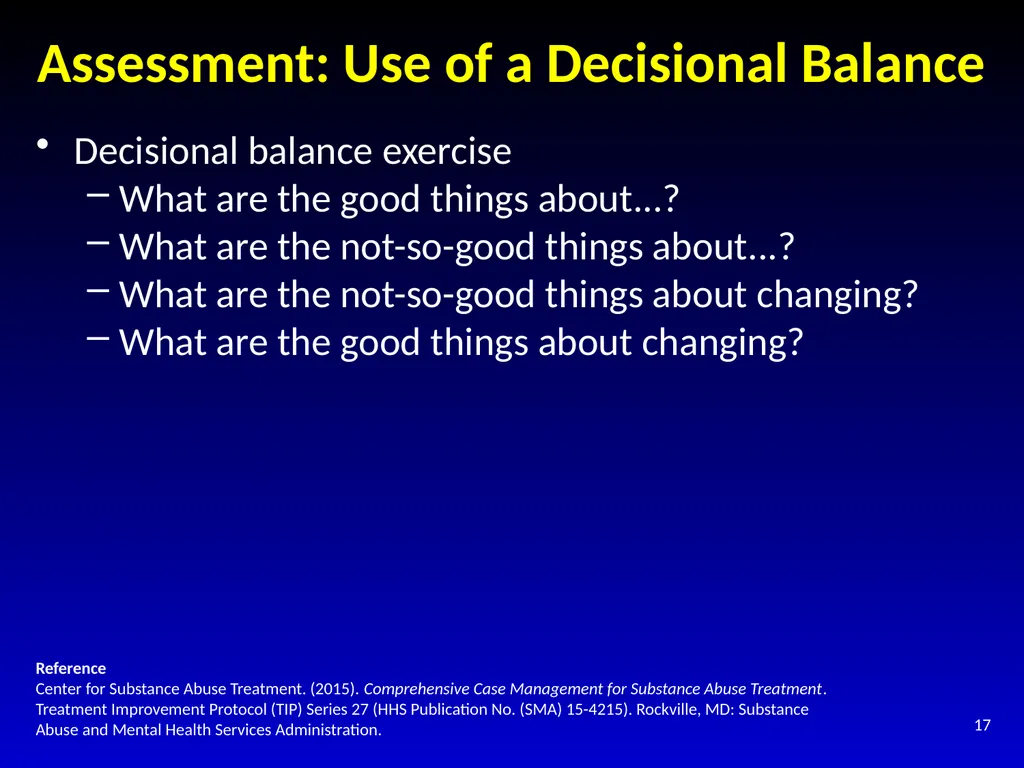
Assessment: Use of a Decisional Balance Decisional balance exercise
What are the good things about...?
What are the not-so-good things about...?
What are the not-so-good things about changing?
What are the good things about changing? Reference
Center for Substance Abuse Treatment. (2015). Comprehensive Case Management for Substance Abuse Treatment. Treatment Improvement Protocol (TIP) Series 27 (HHS Publication No. (SMA) 15-4215). Rockville, MD: Substance Abuse and Mental Health Services Administration. 17<br>
What are the good things about...?
What are the not-so-good things about...?
What are the not-so-good things about changing?
What are the good things about changing? Reference
Center for Substance Abuse Treatment. (2015). Comprehensive Case Management for Substance Abuse Treatment. Treatment Improvement Protocol (TIP) Series 27 (HHS Publication No. (SMA) 15-4215). Rockville, MD: Substance Abuse and Mental Health Services Administration. 17<br>
18
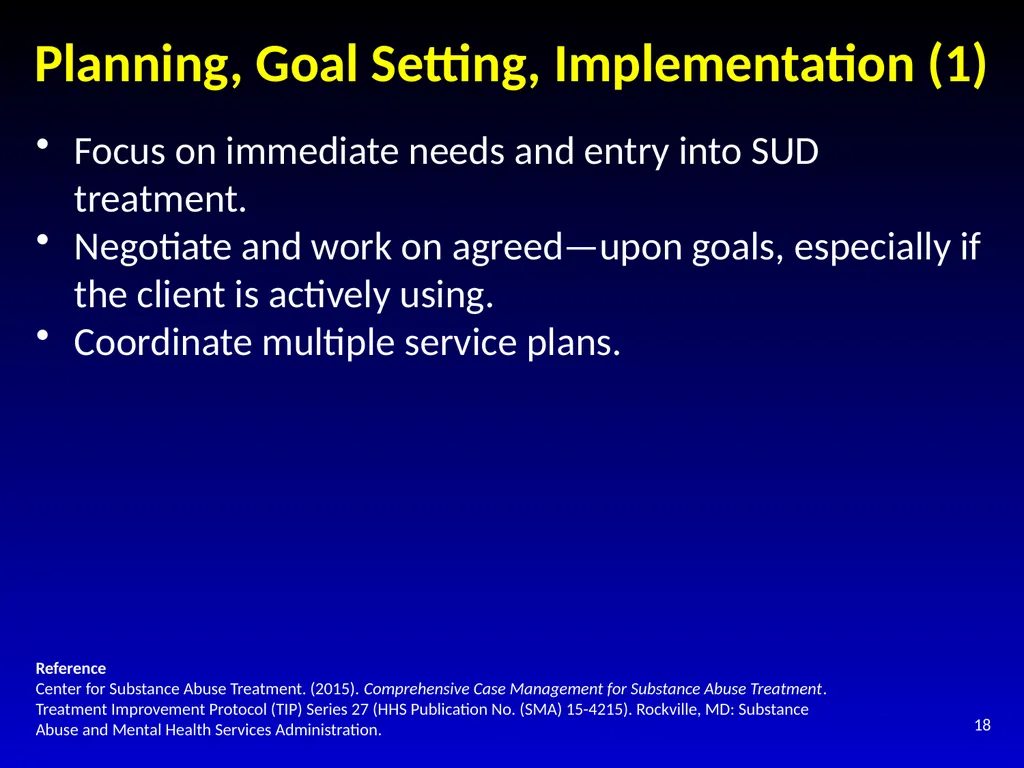
Planning, Goal Setting, Implementation (1) Focus on immediate needs and entry into SUD treatment.
Negotiate and work on agreed—upon goals, especially if the client is actively using.
Coordinate multiple service plans. Reference
Center for Substance Abuse Treatment. (2015). Comprehensive Case Management for Substance Abuse Treatment. Treatment Improvement Protocol (TIP) Series 27 (HHS Publication No. (SMA) 15-4215). Rockville, MD: Substance Abuse and Mental Health Services Administration. 18<br>
Negotiate and work on agreed—upon goals, especially if the client is actively using.
Coordinate multiple service plans. Reference
Center for Substance Abuse Treatment. (2015). Comprehensive Case Management for Substance Abuse Treatment. Treatment Improvement Protocol (TIP) Series 27 (HHS Publication No. (SMA) 15-4215). Rockville, MD: Substance Abuse and Mental Health Services Administration. 18<br>
19
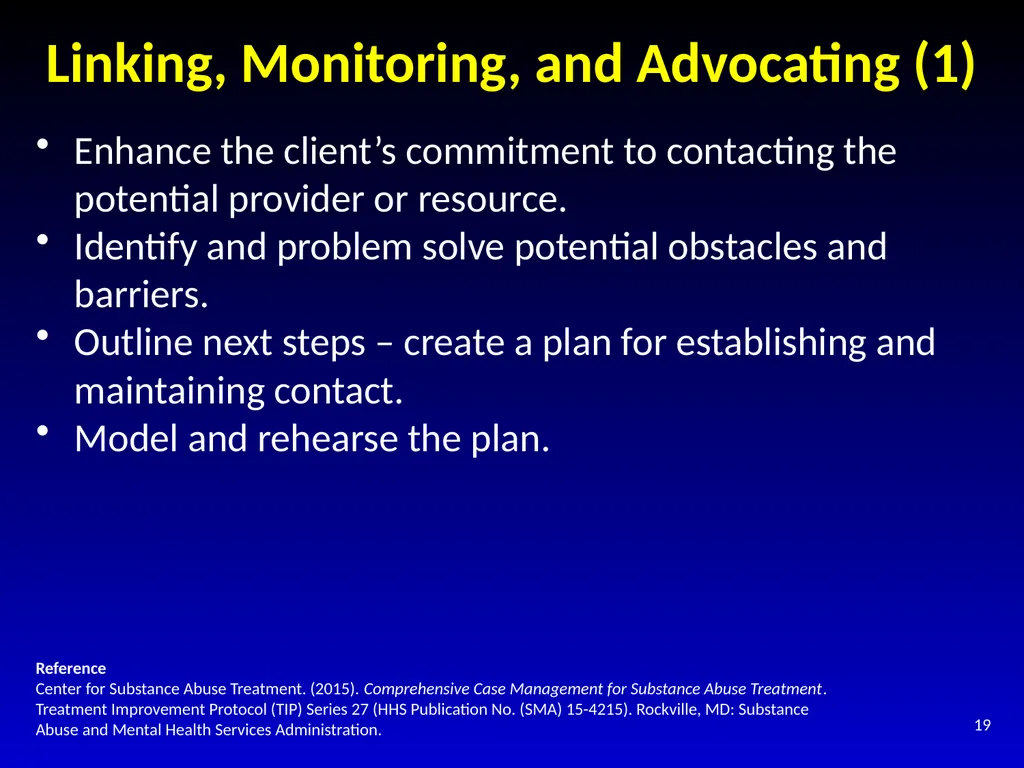
Linking, Monitoring, and Advocating (1) Enhance the client’s commitment to contacting the potential provider or resource.
Identify and problem solve potential obstacles and barriers.
Outline next steps – create a plan for establishing and maintaining contact.
Model and rehearse the plan. Reference
Center for Substance Abuse Treatment. (2015). Comprehensive Case Management for Substance Abuse Treatment. Treatment Improvement Protocol (TIP) Series 27 (HHS Publication No. (SMA) 15-4215). Rockville, MD: Substance Abuse and Mental Health Services Administration. 19<br>
Identify and problem solve potential obstacles and barriers.
Outline next steps – create a plan for establishing and maintaining contact.
Model and rehearse the plan. Reference
Center for Substance Abuse Treatment. (2015). Comprehensive Case Management for Substance Abuse Treatment. Treatment Improvement Protocol (TIP) Series 27 (HHS Publication No. (SMA) 15-4215). Rockville, MD: Substance Abuse and Mental Health Services Administration. 19<br>
20
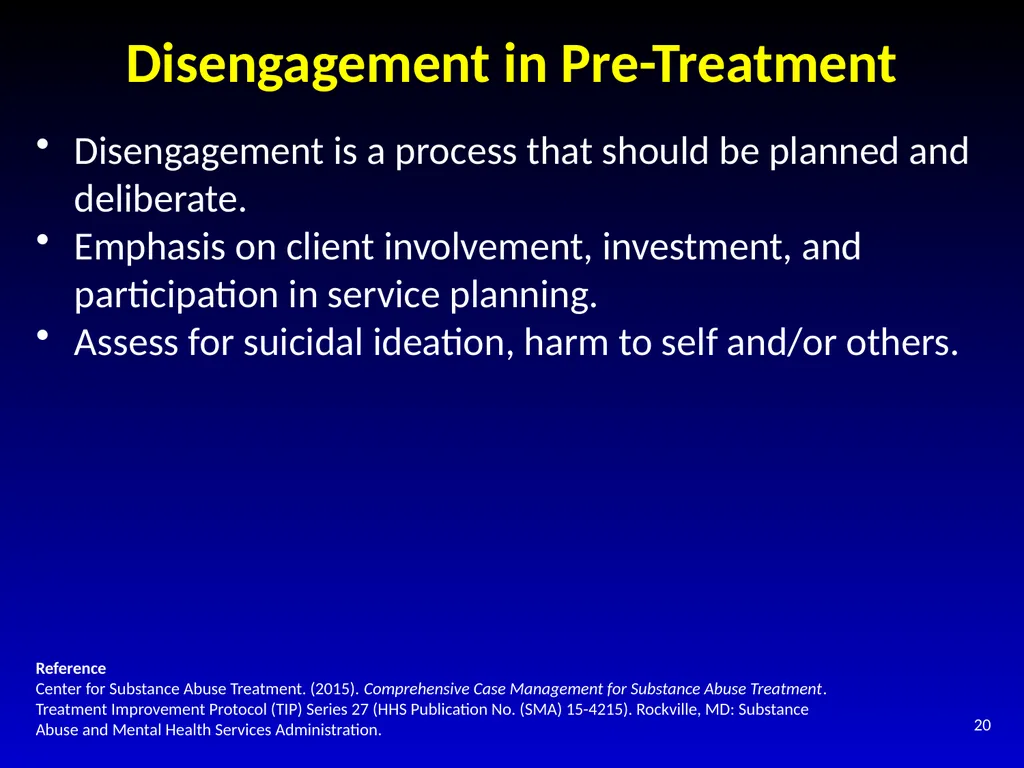
Disengagement in Pre-Treatment Disengagement is a process that should be planned and deliberate.
Emphasis on client involvement, investment, and participation in service planning.
Assess for suicidal ideation, harm to self and/or others. Reference
Center for Substance Abuse Treatment. (2015). Comprehensive Case Management for Substance Abuse Treatment. Treatment Improvement Protocol (TIP) Series 27 (HHS Publication No. (SMA) 15-4215). Rockville, MD: Substance Abuse and Mental Health Services Administration. 20<br>
Emphasis on client involvement, investment, and participation in service planning.
Assess for suicidal ideation, harm to self and/or others. Reference
Center for Substance Abuse Treatment. (2015). Comprehensive Case Management for Substance Abuse Treatment. Treatment Improvement Protocol (TIP) Series 27 (HHS Publication No. (SMA) 15-4215). Rockville, MD: Substance Abuse and Mental Health Services Administration. 20<br>
21
Treatment<br>
22
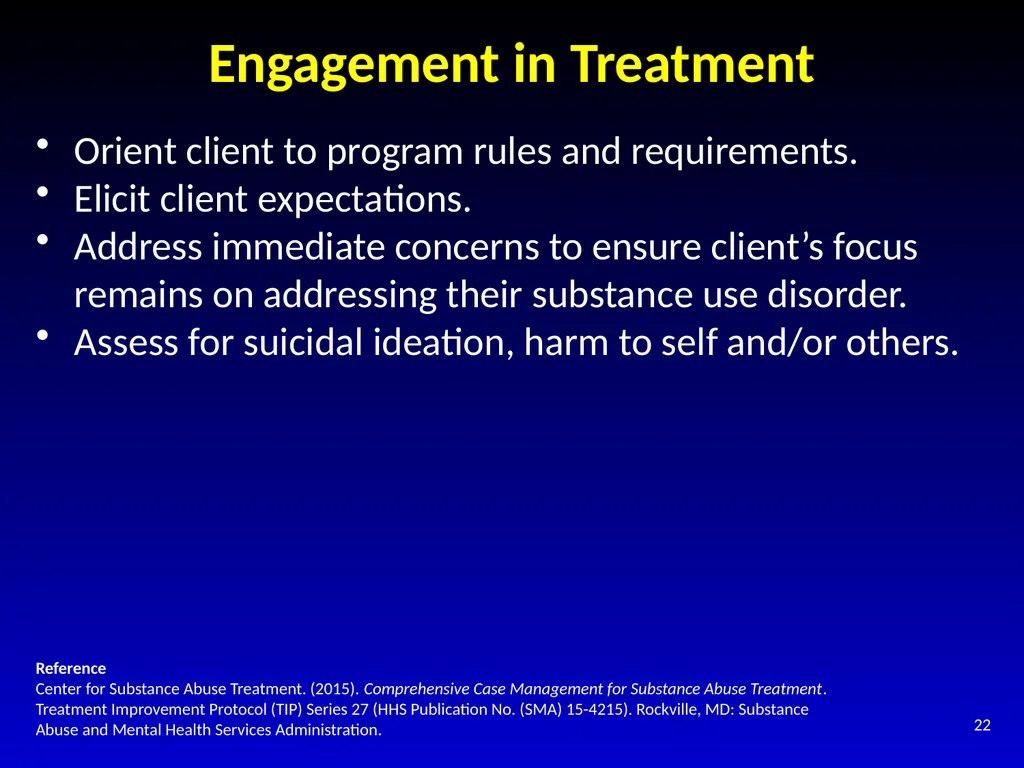
Engagement in Treatment Orient client to program rules and requirements.
Elicit client expectations.
Address immediate concerns to ensure client’s focus remains on addressing their substance use disorder.
Assess for suicidal ideation, harm to self and/or others. Reference
Center for Substance Abuse Treatment. (2015). Comprehensive Case Management for Substance Abuse Treatment. Treatment Improvement Protocol (TIP) Series 27 (HHS Publication No. (SMA) 15-4215). Rockville, MD: Substance Abuse and Mental Health Services Administration. 22<br>
Elicit client expectations.
Address immediate concerns to ensure client’s focus remains on addressing their substance use disorder.
Assess for suicidal ideation, harm to self and/or others. Reference
Center for Substance Abuse Treatment. (2015). Comprehensive Case Management for Substance Abuse Treatment. Treatment Improvement Protocol (TIP) Series 27 (HHS Publication No. (SMA) 15-4215). Rockville, MD: Substance Abuse and Mental Health Services Administration. 22<br>
23
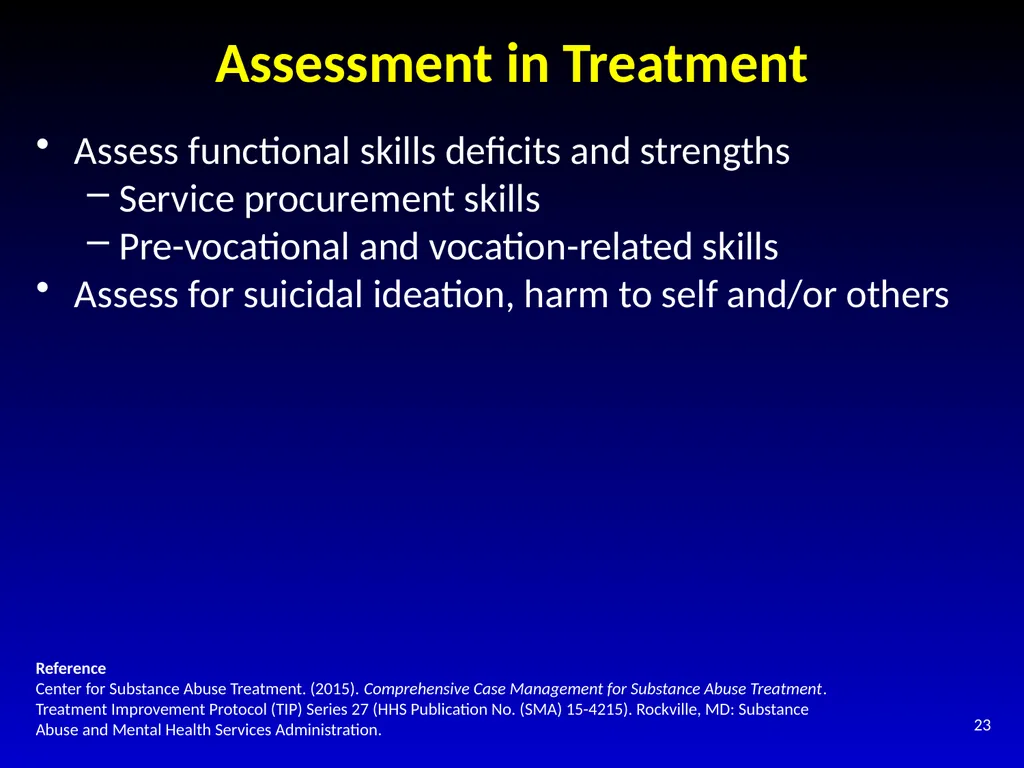
Assessment in Treatment Assess functional skills deficits and strengths
Service procurement skills
Pre-vocational and vocation-related skills
Assess for suicidal ideation, harm to self and/or others Reference
Center for Substance Abuse Treatment. (2015). Comprehensive Case Management for Substance Abuse Treatment. Treatment Improvement Protocol (TIP) Series 27 (HHS Publication No. (SMA) 15-4215). Rockville, MD: Substance Abuse and Mental Health Services Administration. 23<br>
Service procurement skills
Pre-vocational and vocation-related skills
Assess for suicidal ideation, harm to self and/or others Reference
Center for Substance Abuse Treatment. (2015). Comprehensive Case Management for Substance Abuse Treatment. Treatment Improvement Protocol (TIP) Series 27 (HHS Publication No. (SMA) 15-4215). Rockville, MD: Substance Abuse and Mental Health Services Administration. 23<br>
24
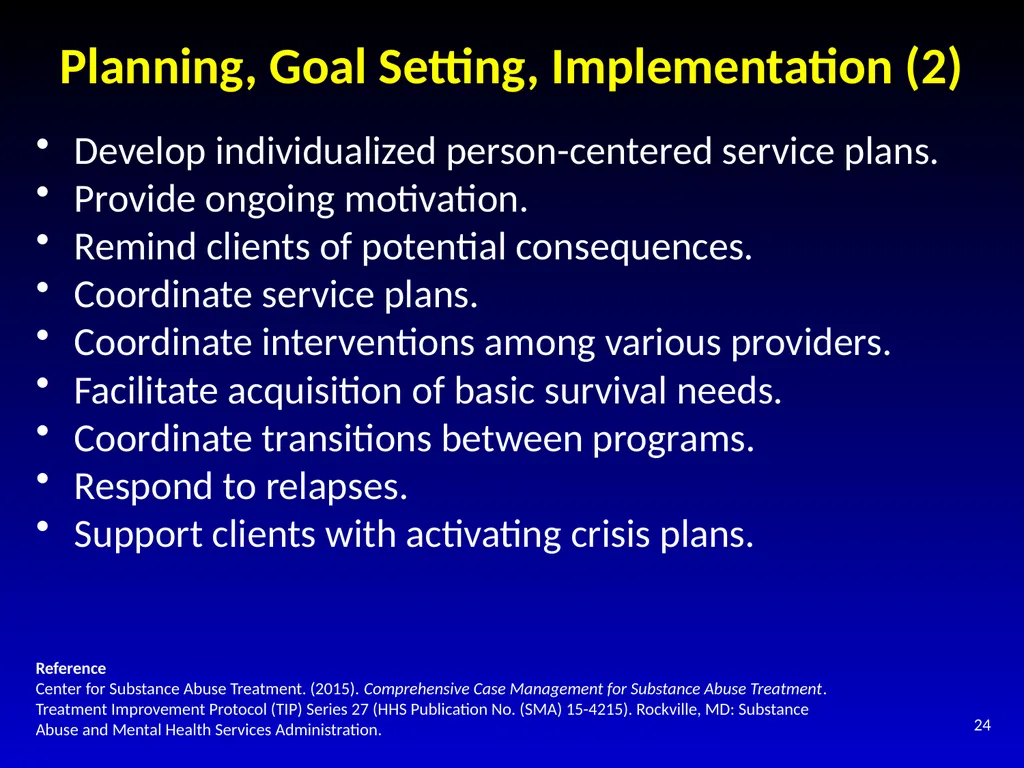
Planning, Goal Setting, Implementation (2) Develop individualized person-centered service plans.
Provide ongoing motivation.
Remind clients of potential consequences.
Coordinate service plans.
Coordinate interventions among various providers.
Facilitate acquisition of basic survival needs.
Coordinate transitions between programs.
Respond to relapses.
Support clients with activating crisis plans. Reference
Center for Substance Abuse Treatment. (2015). Comprehensive Case Management for Substance Abuse Treatment. Treatment Improvement Protocol (TIP) Series 27 (HHS Publication No. (SMA) 15-4215). Rockville, MD: Substance Abuse and Mental Health Services Administration. 24<br>
Provide ongoing motivation.
Remind clients of potential consequences.
Coordinate service plans.
Coordinate interventions among various providers.
Facilitate acquisition of basic survival needs.
Coordinate transitions between programs.
Respond to relapses.
Support clients with activating crisis plans. Reference
Center for Substance Abuse Treatment. (2015). Comprehensive Case Management for Substance Abuse Treatment. Treatment Improvement Protocol (TIP) Series 27 (HHS Publication No. (SMA) 15-4215). Rockville, MD: Substance Abuse and Mental Health Services Administration. 24<br>
25
Linking, Monitoring, and Advocating (2) Monitor client progress and adjust service plans.
Advocate for clients to support them in achieving goals established in the service plan. Reference
Center for Substance Abuse Treatment. (2015). Comprehensive Case Management for Substance Abuse Treatment. Treatment Improvement Protocol (TIP) Series 27 (HHS Publication No. (SMA) 15-4215). Rockville, MD: Substance Abuse and Mental Health Services Administration. 25<br>
Advocate for clients to support them in achieving goals established in the service plan. Reference
Center for Substance Abuse Treatment. (2015). Comprehensive Case Management for Substance Abuse Treatment. Treatment Improvement Protocol (TIP) Series 27 (HHS Publication No. (SMA) 15-4215). Rockville, MD: Substance Abuse and Mental Health Services Administration. 25<br>
26
Disengagement in Treatment Disengagement is a process that should be planned and deliberate.
Facilitate discussion and reinforce what clients have learned.
Review and summarize client progress.
Emphasize client strengths. Reference
Center for Substance Abuse Treatment. (2015). Comprehensive Case Management for Substance Abuse Treatment. Treatment Improvement Protocol (TIP) Series 27 (HHS Publication No. (SMA) 15-4215). Rockville, MD: Substance Abuse and Mental Health Services Administration.
Rapp, C.A. & Goscha, R. J. (2006). The strengths model: case management for people with psychiatric disabilities (2nd ed.). New York, NY: University Press. 26<br>
Facilitate discussion and reinforce what clients have learned.
Review and summarize client progress.
Emphasize client strengths. Reference
Center for Substance Abuse Treatment. (2015). Comprehensive Case Management for Substance Abuse Treatment. Treatment Improvement Protocol (TIP) Series 27 (HHS Publication No. (SMA) 15-4215). Rockville, MD: Substance Abuse and Mental Health Services Administration.
Rapp, C.A. & Goscha, R. J. (2006). The strengths model: case management for people with psychiatric disabilities (2nd ed.). New York, NY: University Press. 26<br>
27
Aftercare<br>
28
Engagement in Aftercare Ensure continuity between providers and among different resources.
Address needs, including but not limited to: housing, healthcare, income, education and/or employment, and social supports. Reference
Center for Substance Abuse Treatment. (2015). Comprehensive Case Management for Substance Abuse Treatment. Treatment Improvement Protocol (TIP) Series 27 (HHS Publication No. (SMA) 15-4215). Rockville, MD: Substance Abuse and Mental Health Services Administration. 28<br>
Address needs, including but not limited to: housing, healthcare, income, education and/or employment, and social supports. Reference
Center for Substance Abuse Treatment. (2015). Comprehensive Case Management for Substance Abuse Treatment. Treatment Improvement Protocol (TIP) Series 27 (HHS Publication No. (SMA) 15-4215). Rockville, MD: Substance Abuse and Mental Health Services Administration. 28<br>
29
Assessment Assess readiness for reintegration into the community throughout the treatment continuum.
Support clients with identifying relapse triggers and other stressors.
Empower clients by helping them develop action plans for managing triggers.
Help clients with activating action plans by teaching and rehearsing adaptive coping skills.
Assess for harm to self or others. Reference
Center for Substance Abuse Treatment. (2015). Comprehensive Case Management for Substance Abuse Treatment. Treatment Improvement Protocol (TIP) Series 27 (HHS Publication No. (SMA) 15-4215). Rockville, MD: Substance Abuse and Mental Health Services Administration. 29<br>
Support clients with identifying relapse triggers and other stressors.
Empower clients by helping them develop action plans for managing triggers.
Help clients with activating action plans by teaching and rehearsing adaptive coping skills.
Assess for harm to self or others. Reference
Center for Substance Abuse Treatment. (2015). Comprehensive Case Management for Substance Abuse Treatment. Treatment Improvement Protocol (TIP) Series 27 (HHS Publication No. (SMA) 15-4215). Rockville, MD: Substance Abuse and Mental Health Services Administration. 29<br>
30
Planning, Goal Setting, Implementation Help clients with mastering basic skills needed to live and function independently/interdependently in the community.
Emphasize long-term goals to support clients in their own recovery.
Ensure that service plans emphasize and reinforce emphasis on clients accepting greater responsibility for their actions. Reference
Center for Substance Abuse Treatment. (2015). Comprehensive Case Management for Substance Abuse Treatment. Treatment Improvement Protocol (TIP) Series 27 (HHS Publication No. (SMA) 15-4215). Rockville, MD: Substance Abuse and Mental Health Services Administration. 30<br>
Emphasize long-term goals to support clients in their own recovery.
Ensure that service plans emphasize and reinforce emphasis on clients accepting greater responsibility for their actions. Reference
Center for Substance Abuse Treatment. (2015). Comprehensive Case Management for Substance Abuse Treatment. Treatment Improvement Protocol (TIP) Series 27 (HHS Publication No. (SMA) 15-4215). Rockville, MD: Substance Abuse and Mental Health Services Administration. 30<br>
31
Global Criteria for Case Management Explain the rationale of case management activities to the client.
Coordinate services for client care. Reference
Herdman, J. W. (2018). Global criteria: the 12 core functions of the substance abuse counselor (7th ed.). Lincoln, NE: Parallels: Pathways to Change. 31<br>
Coordinate services for client care. Reference
Herdman, J. W. (2018). Global criteria: the 12 core functions of the substance abuse counselor (7th ed.). Lincoln, NE: Parallels: Pathways to Change. 31<br>
32
Group Activity for Case Management In yesterday’s training, you created a checklist for creating client-centered, collaborative services plans.
Create an outline or specific criteria to guide you and others in your agency to create client-centered, collaborative discharge or transition plans.
Be prepared to report out.
Be prepared to ask questions and offer suggestions to support your colleagues. 32<br>
Create an outline or specific criteria to guide you and others in your agency to create client-centered, collaborative discharge or transition plans.
Be prepared to report out.
Be prepared to ask questions and offer suggestions to support your colleagues. 32<br>
33
Today's Agenda (2) Review and check-in
Twelve Core Functions (continued)
Case Management
Crisis Intervention
Client and Family Education
Referral
Report and Record keeping
Consultation 33<br>
Twelve Core Functions (continued)
Case Management
Crisis Intervention
Client and Family Education
Referral
Report and Record keeping
Consultation 33<br>
34
Agenda for Crisis Intervention Definition
Keeping yourself and clients safe in crisis situations
Keeping others safe when clients are in crisis
Roberts (2005) Seven-Stage Crisis Intervention Model
Addressing suicidal thoughts and behaviors
Global Criteria 34<br>
Keeping yourself and clients safe in crisis situations
Keeping others safe when clients are in crisis
Roberts (2005) Seven-Stage Crisis Intervention Model
Addressing suicidal thoughts and behaviors
Global Criteria 34<br>
35
Definition of Crisis “A crisis can be defined as a period of psychological disequilibrium, experienced as a result of a hazardous event or situation that constitutes a significant problem that cannot be remedied by using familiar coping strategies. A crisis occurs when a person faces an obstacle to important life goals that generally seem insurmountable through the use of customary coping patters” (Yeager & Roberts, 2015, p. 4) Reference
Yeager, K. R. & Roberts, A. R. (2015). Crisis intervention handbook: assessment, treatment, and research (4th ed.). New York, NY: Oxford University Press. 35<br>
Yeager, K. R. & Roberts, A. R. (2015). Crisis intervention handbook: assessment, treatment, and research (4th ed.). New York, NY: Oxford University Press. 35<br>
36
Definition of Crisis Interventions The IC&RC defines crisis interventions as “those services which respond to an [individual, who meets diagnostic criteria for one or more substance use disorders,] needs during acute emotional and/or physical distress." Reference
Yeager, K. R. & Roberts, A. R. (2015). Crisis intervention handbook: assessment, treatment, and research (4th ed.). New York, NY: Oxford University Press. 36<br>
Yeager, K. R. & Roberts, A. R. (2015). Crisis intervention handbook: assessment, treatment, and research (4th ed.). New York, NY: Oxford University Press. 36<br>
37
Keeping Yourself Safe in a
Crisis Situation Draw your office and layout of your office furniture.
Note where you sit and where the client sits. 37<br>
Note where you sit and where the client sits. 37<br>
38
Keeping Yourself Safe (continued 1) Be conscious of where you are in the office.
Both you and the client must have access to the door – do not create any barriers between the client and the exit.
Be aware of ways of asking for help.
If client’s distressing behaviors are escalating, get out and get help.
Take a break, leave the office, but never leave the client alone. 38<br>
Both you and the client must have access to the door – do not create any barriers between the client and the exit.
Be aware of ways of asking for help.
If client’s distressing behaviors are escalating, get out and get help.
Take a break, leave the office, but never leave the client alone. 38<br>
39
Keeping Yourself Safe (continued 2) Know your limits.
Do I have the training to manage this situation?
Do I feel confident managing this situation?
Recognizing your limitations is a strength, not a weakness!
Know where and when to ask for help.
If necessary, contact emergency personnel.
If and when clients are in distress:
Be careful not to reflect negative emotional states.
Be aware of your body language.
Stay calm and keep your tone of voice low and soft.
Be careful not to stand over or lean into client. 39<br>
Do I have the training to manage this situation?
Do I feel confident managing this situation?
Recognizing your limitations is a strength, not a weakness!
Know where and when to ask for help.
If necessary, contact emergency personnel.
If and when clients are in distress:
Be careful not to reflect negative emotional states.
Be aware of your body language.
Stay calm and keep your tone of voice low and soft.
Be careful not to stand over or lean into client. 39<br>
40
Keeping Others Safe Remove the situation to a quiet, safe place. This will help to:
Calm the participant (and you)
Protect confidentiality
Protect other clients from direct harm
Protect other clients from “helping” 40<br>
Calm the participant (and you)
Protect confidentiality
Protect other clients from direct harm
Protect other clients from “helping” 40<br>
41
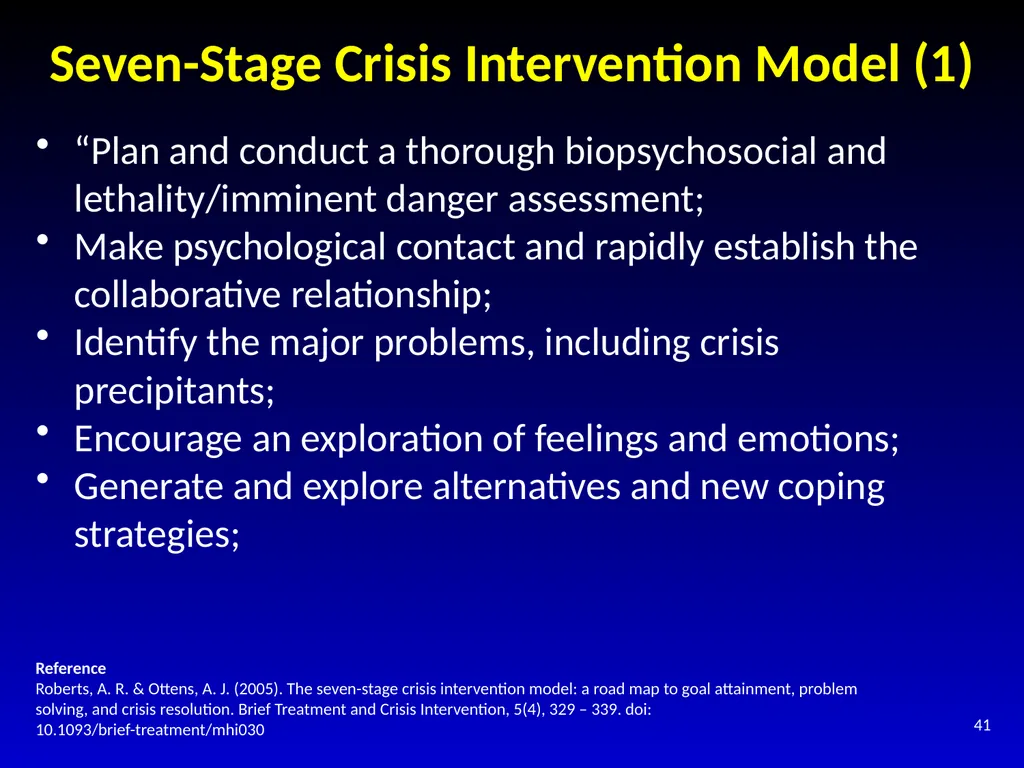
Seven-Stage Crisis Intervention Model (1) “Plan and conduct a thorough biopsychosocial and lethality/imminent danger assessment;
Make psychological contact and rapidly establish the collaborative relationship;
Identify the major problems, including crisis precipitants;
Encourage an exploration of feelings and emotions;
Generate and explore alternatives and new coping strategies; Reference
Roberts, A. R. & Ottens, A. J. (2005). The seven-stage crisis intervention model: a road map to goal attainment, problem solving, and crisis resolution. Brief Treatment and Crisis Intervention, 5(4), 329 – 339. doi: 10.1093/brief-treatment/mhi030 41<br>
Make psychological contact and rapidly establish the collaborative relationship;
Identify the major problems, including crisis precipitants;
Encourage an exploration of feelings and emotions;
Generate and explore alternatives and new coping strategies; Reference
Roberts, A. R. & Ottens, A. J. (2005). The seven-stage crisis intervention model: a road map to goal attainment, problem solving, and crisis resolution. Brief Treatment and Crisis Intervention, 5(4), 329 – 339. doi: 10.1093/brief-treatment/mhi030 41<br>
42
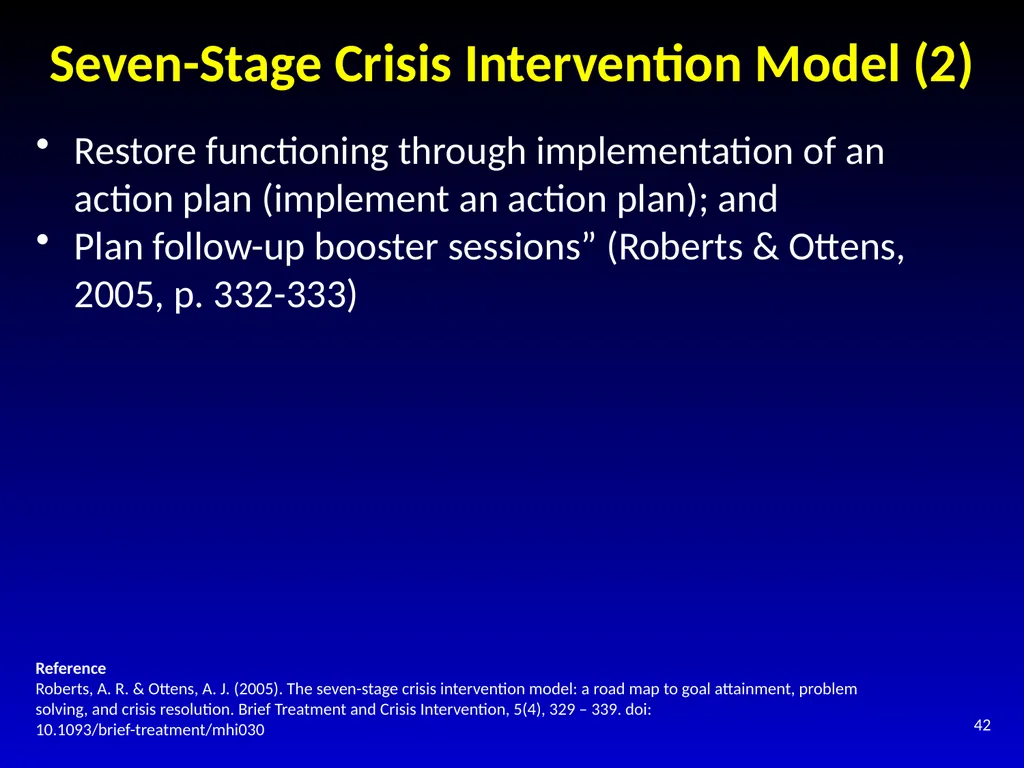
Seven-Stage Crisis Intervention Model (2) Restore functioning through implementation of an action plan (implement an action plan); and
Plan follow-up booster sessions” (Roberts & Ottens, 2005, p. 332-333) Reference
Roberts, A. R. & Ottens, A. J. (2005). The seven-stage crisis intervention model: a road map to goal attainment, problem solving, and crisis resolution. Brief Treatment and Crisis Intervention, 5(4), 329 – 339. doi: 10.1093/brief-treatment/mhi030 42<br>
Plan follow-up booster sessions” (Roberts & Ottens, 2005, p. 332-333) Reference
Roberts, A. R. & Ottens, A. J. (2005). The seven-stage crisis intervention model: a road map to goal attainment, problem solving, and crisis resolution. Brief Treatment and Crisis Intervention, 5(4), 329 – 339. doi: 10.1093/brief-treatment/mhi030 42<br>
43
Conduct a
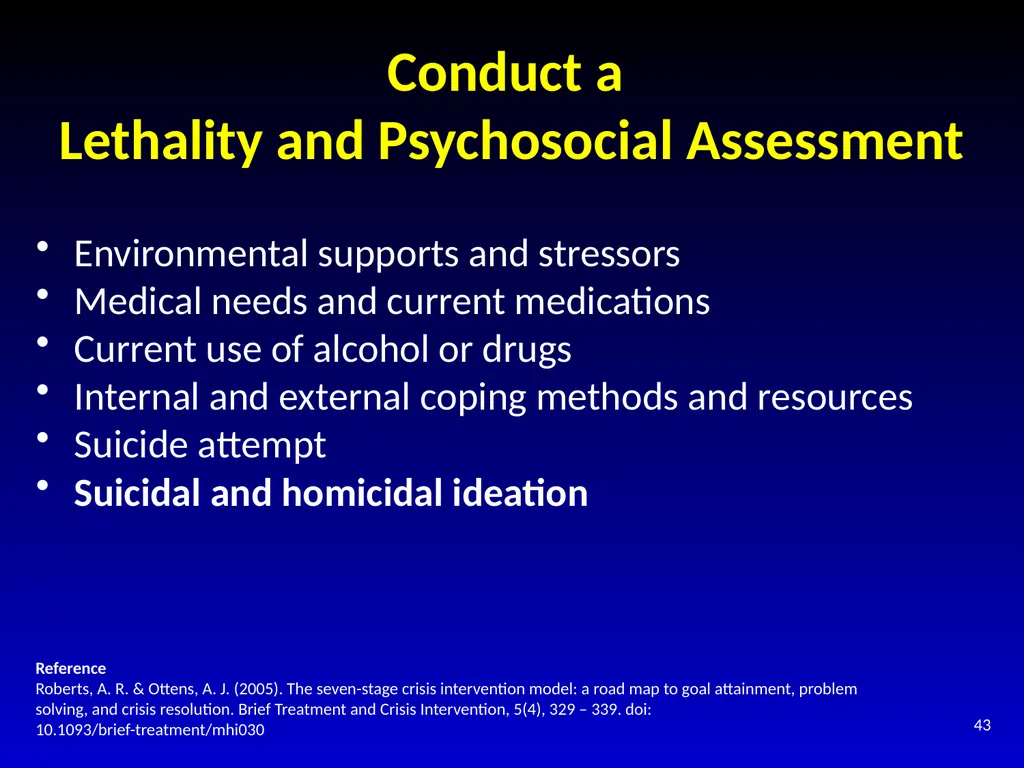
Lethality and Psychosocial Assessment Environmental supports and stressors
Medical needs and current medications
Current use of alcohol or drugs
Internal and external coping methods and resources
Suicide attempt
Suicidal and homicidal ideation Reference
Roberts, A. R. & Ottens, A. J. (2005). The seven-stage crisis intervention model: a road map to goal attainment, problem solving, and crisis resolution. Brief Treatment and Crisis Intervention, 5(4), 329 – 339. doi: 10.1093/brief-treatment/mhi030 43<br>
Medical needs and current medications
Current use of alcohol or drugs
Internal and external coping methods and resources
Suicide attempt
Suicidal and homicidal ideation Reference
Roberts, A. R. & Ottens, A. J. (2005). The seven-stage crisis intervention model: a road map to goal attainment, problem solving, and crisis resolution. Brief Treatment and Crisis Intervention, 5(4), 329 – 339. doi: 10.1093/brief-treatment/mhi030 43<br>
44
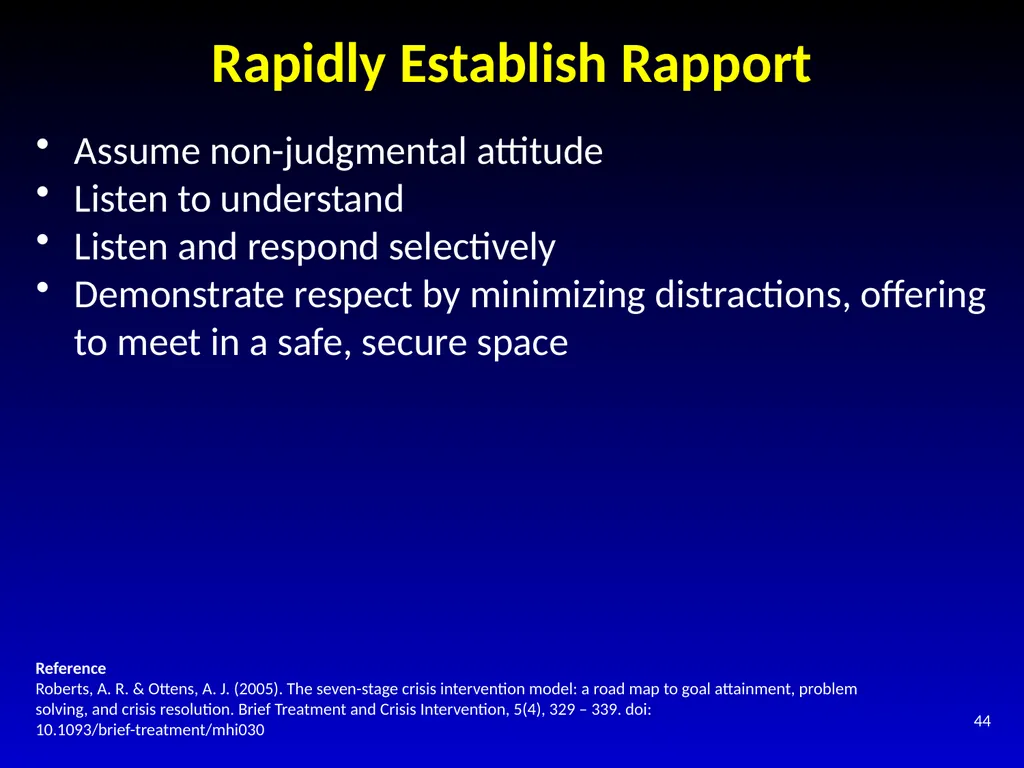
Rapidly Establish Rapport Assume non-judgmental attitude
Listen to understand
Listen and respond selectively
Demonstrate respect by minimizing distractions, offering to meet in a safe, secure space Reference
Roberts, A. R. & Ottens, A. J. (2005). The seven-stage crisis intervention model: a road map to goal attainment, problem solving, and crisis resolution. Brief Treatment and Crisis Intervention, 5(4), 329 – 339. doi: 10.1093/brief-treatment/mhi030 44<br>
Listen to understand
Listen and respond selectively
Demonstrate respect by minimizing distractions, offering to meet in a safe, secure space Reference
Roberts, A. R. & Ottens, A. J. (2005). The seven-stage crisis intervention model: a road map to goal attainment, problem solving, and crisis resolution. Brief Treatment and Crisis Intervention, 5(4), 329 – 339. doi: 10.1093/brief-treatment/mhi030 44<br>
45
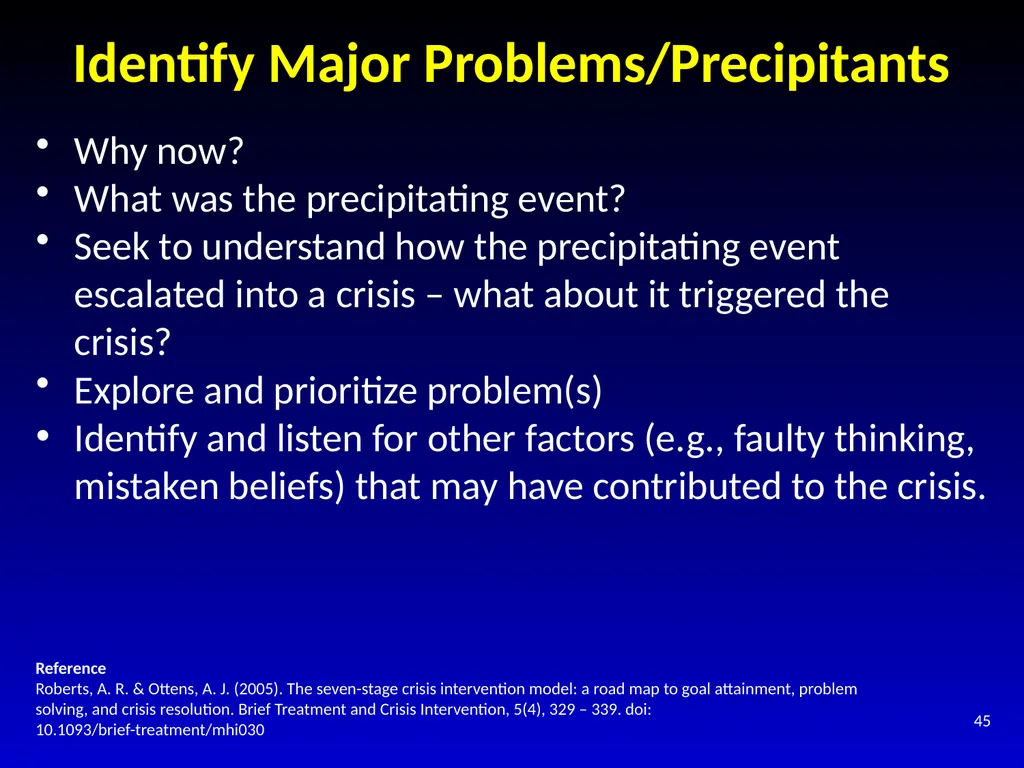
Identify Major Problems/Precipitants Why now?
What was the precipitating event?
Seek to understand how the precipitating event escalated into a crisis – what about it triggered the crisis?
Explore and prioritize problem(s)
Identify and listen for other factors (e.g., faulty thinking, mistaken beliefs) that may have contributed to the crisis. Reference
Roberts, A. R. & Ottens, A. J. (2005). The seven-stage crisis intervention model: a road map to goal attainment, problem solving, and crisis resolution. Brief Treatment and Crisis Intervention, 5(4), 329 – 339. doi: 10.1093/brief-treatment/mhi030 45<br>
What was the precipitating event?
Seek to understand how the precipitating event escalated into a crisis – what about it triggered the crisis?
Explore and prioritize problem(s)
Identify and listen for other factors (e.g., faulty thinking, mistaken beliefs) that may have contributed to the crisis. Reference
Roberts, A. R. & Ottens, A. J. (2005). The seven-stage crisis intervention model: a road map to goal attainment, problem solving, and crisis resolution. Brief Treatment and Crisis Intervention, 5(4), 329 – 339. doi: 10.1093/brief-treatment/mhi030 45<br>
46
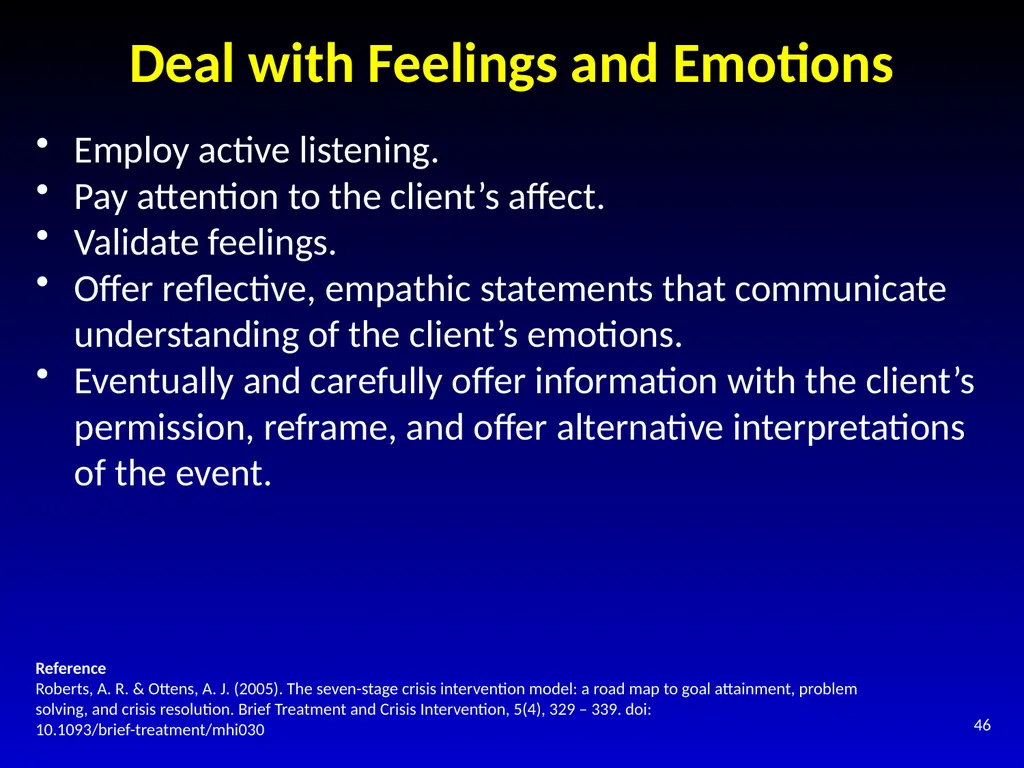
Deal with Feelings and Emotions Employ active listening.
Pay attention to the client’s affect.
Validate feelings.
Offer reflective, empathic statements that communicate understanding of the client’s emotions.
Eventually and carefully offer information with the client’s permission, reframe, and offer alternative interpretations of the event. Reference
Roberts, A. R. & Ottens, A. J. (2005). The seven-stage crisis intervention model: a road map to goal attainment, problem solving, and crisis resolution. Brief Treatment and Crisis Intervention, 5(4), 329 – 339. doi: 10.1093/brief-treatment/mhi030 46<br>
Pay attention to the client’s affect.
Validate feelings.
Offer reflective, empathic statements that communicate understanding of the client’s emotions.
Eventually and carefully offer information with the client’s permission, reframe, and offer alternative interpretations of the event. Reference
Roberts, A. R. & Ottens, A. J. (2005). The seven-stage crisis intervention model: a road map to goal attainment, problem solving, and crisis resolution. Brief Treatment and Crisis Intervention, 5(4), 329 – 339. doi: 10.1093/brief-treatment/mhi030 46<br>
47
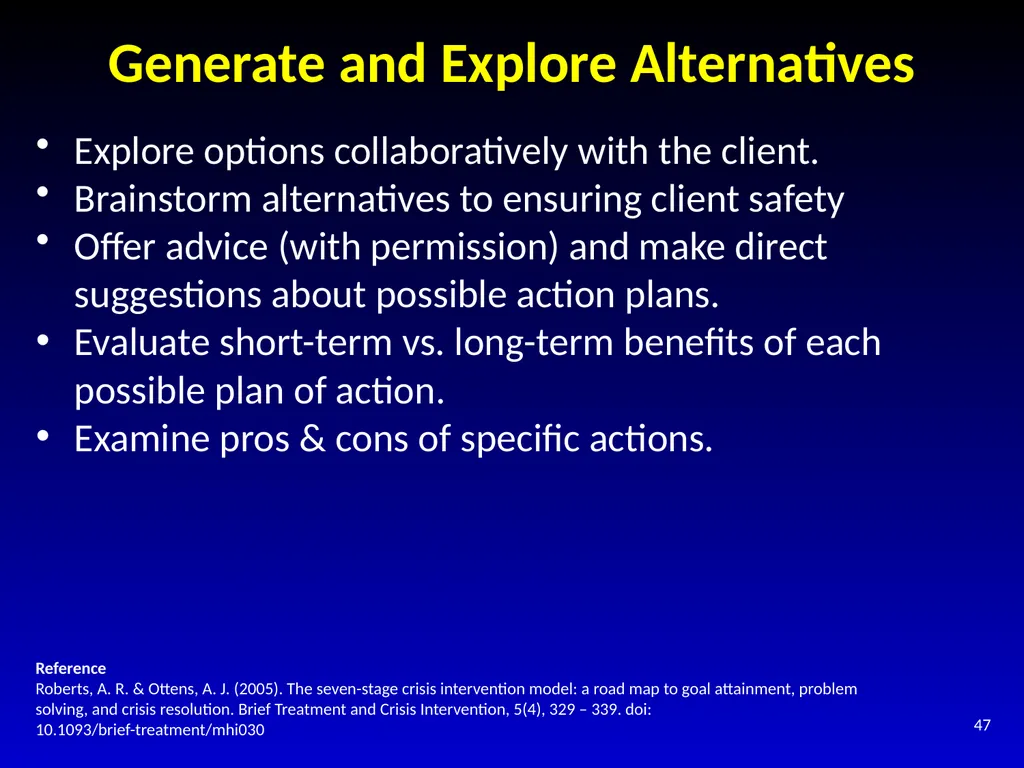
Generate and Explore Alternatives Explore options collaboratively with the client.
Brainstorm alternatives to ensuring client safety
Offer advice (with permission) and make direct suggestions about possible action plans.
Evaluate short-term vs. long-term benefits of each possible plan of action.
Examine pros & cons of specific actions. Reference
Roberts, A. R. & Ottens, A. J. (2005). The seven-stage crisis intervention model: a road map to goal attainment, problem solving, and crisis resolution. Brief Treatment and Crisis Intervention, 5(4), 329 – 339. doi: 10.1093/brief-treatment/mhi030 47<br>
Brainstorm alternatives to ensuring client safety
Offer advice (with permission) and make direct suggestions about possible action plans.
Evaluate short-term vs. long-term benefits of each possible plan of action.
Examine pros & cons of specific actions. Reference
Roberts, A. R. & Ottens, A. J. (2005). The seven-stage crisis intervention model: a road map to goal attainment, problem solving, and crisis resolution. Brief Treatment and Crisis Intervention, 5(4), 329 – 339. doi: 10.1093/brief-treatment/mhi030 47<br>
48
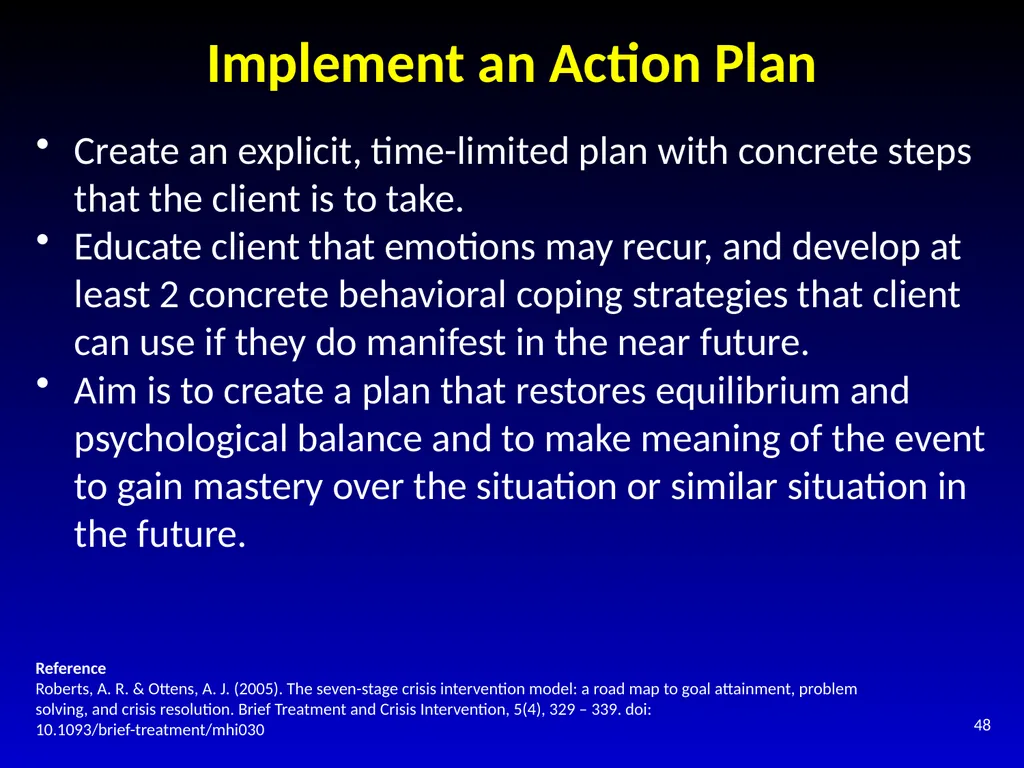
Implement an Action Plan Create an explicit, time-limited plan with concrete steps that the client is to take.
Educate client that emotions may recur, and develop at least 2 concrete behavioral coping strategies that client can use if they do manifest in the near future.
Aim is to create a plan that restores equilibrium and psychological balance and to make meaning of the event to gain mastery over the situation or similar situation in the future. Reference
Roberts, A. R. & Ottens, A. J. (2005). The seven-stage crisis intervention model: a road map to goal attainment, problem solving, and crisis resolution. Brief Treatment and Crisis Intervention, 5(4), 329 – 339. doi: 10.1093/brief-treatment/mhi030 48<br>
Educate client that emotions may recur, and develop at least 2 concrete behavioral coping strategies that client can use if they do manifest in the near future.
Aim is to create a plan that restores equilibrium and psychological balance and to make meaning of the event to gain mastery over the situation or similar situation in the future. Reference
Roberts, A. R. & Ottens, A. J. (2005). The seven-stage crisis intervention model: a road map to goal attainment, problem solving, and crisis resolution. Brief Treatment and Crisis Intervention, 5(4), 329 – 339. doi: 10.1093/brief-treatment/mhi030 48<br>
49
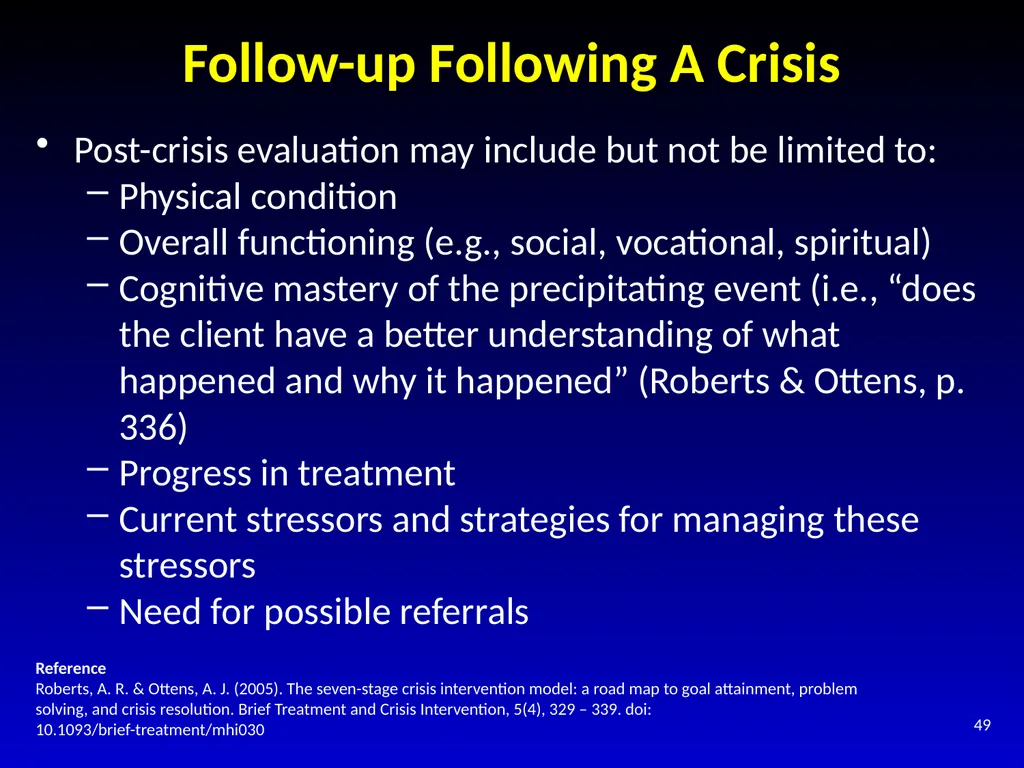
Follow-up Following A Crisis Post-crisis evaluation may include but not be limited to:
Physical condition
Overall functioning (e.g., social, vocational, spiritual)
Cognitive mastery of the precipitating event (i.e., “does the client have a better understanding of what happened and why it happened” (Roberts & Ottens, p. 336)
Progress in treatment
Current stressors and strategies for managing these stressors
Need for possible referrals Reference
Roberts, A. R. & Ottens, A. J. (2005). The seven-stage crisis intervention model: a road map to goal attainment, problem solving, and crisis resolution. Brief Treatment and Crisis Intervention, 5(4), 329 – 339. doi: 10.1093/brief-treatment/mhi030 49<br>
Physical condition
Overall functioning (e.g., social, vocational, spiritual)
Cognitive mastery of the precipitating event (i.e., “does the client have a better understanding of what happened and why it happened” (Roberts & Ottens, p. 336)
Progress in treatment
Current stressors and strategies for managing these stressors
Need for possible referrals Reference
Roberts, A. R. & Ottens, A. J. (2005). The seven-stage crisis intervention model: a road map to goal attainment, problem solving, and crisis resolution. Brief Treatment and Crisis Intervention, 5(4), 329 – 339. doi: 10.1093/brief-treatment/mhi030 49<br>
50
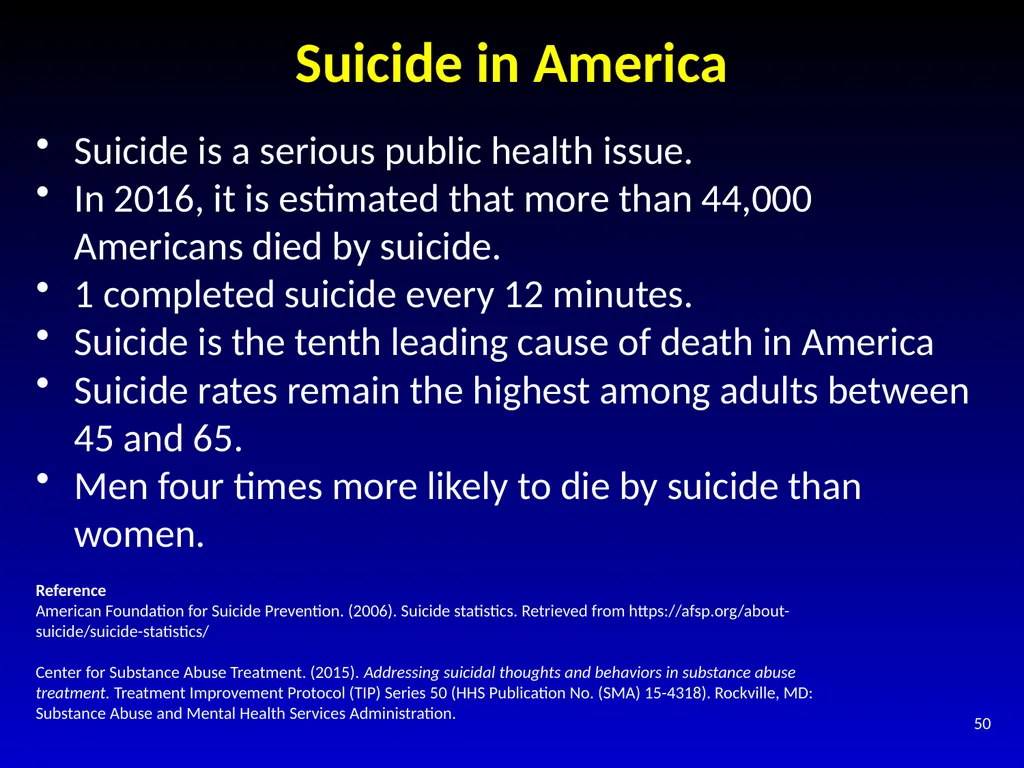
Suicide in America Suicide is a serious public health issue.
In 2016, it is estimated that more than 44,000 Americans died by suicide.
1 completed suicide every 12 minutes.
Suicide is the tenth leading cause of death in America
Suicide rates remain the highest among adults between 45 and 65.
Men four times more likely to die by suicide than women. Reference
American Foundation for Suicide Prevention. (2006). Suicide statistics. Retrieved from https://afsp.org/about-suicide/suicide-statistics/
Center for Substance Abuse Treatment. (2015). Addressing suicidal thoughts and behaviors in substance abuse treatment. Treatment Improvement Protocol (TIP) Series 50 (HHS Publication No. (SMA) 15-4318). Rockville, MD: Substance Abuse and Mental Health Services Administration. 50<br>
In 2016, it is estimated that more than 44,000 Americans died by suicide.
1 completed suicide every 12 minutes.
Suicide is the tenth leading cause of death in America
Suicide rates remain the highest among adults between 45 and 65.
Men four times more likely to die by suicide than women. Reference
American Foundation for Suicide Prevention. (2006). Suicide statistics. Retrieved from https://afsp.org/about-suicide/suicide-statistics/
Center for Substance Abuse Treatment. (2015). Addressing suicidal thoughts and behaviors in substance abuse treatment. Treatment Improvement Protocol (TIP) Series 50 (HHS Publication No. (SMA) 15-4318). Rockville, MD: Substance Abuse and Mental Health Services Administration. 50<br>
51
Increased Risk of Suicide for
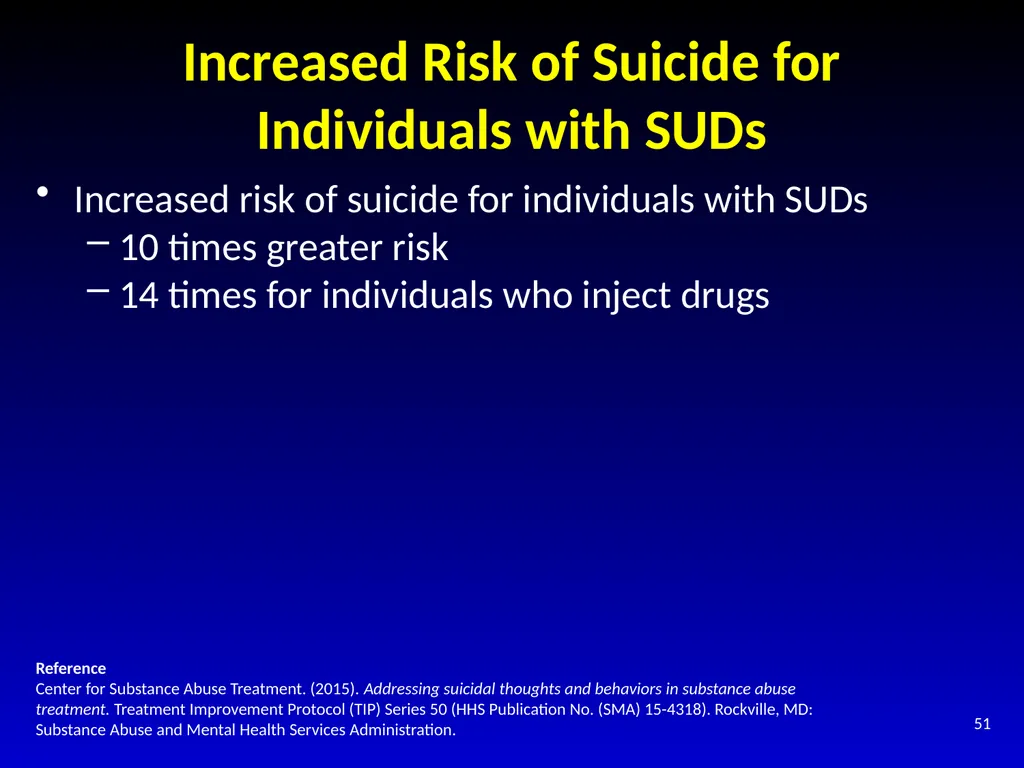
Individuals with SUDs Increased risk of suicide for individuals with SUDs
10 times greater risk
14 times for individuals who inject drugs Reference
Center for Substance Abuse Treatment. (2015). Addressing suicidal thoughts and behaviors in substance abuse treatment. Treatment Improvement Protocol (TIP) Series 50 (HHS Publication No. (SMA) 15-4318). Rockville, MD: Substance Abuse and Mental Health Services Administration. 51<br>
10 times greater risk
14 times for individuals who inject drugs Reference
Center for Substance Abuse Treatment. (2015). Addressing suicidal thoughts and behaviors in substance abuse treatment. Treatment Improvement Protocol (TIP) Series 50 (HHS Publication No. (SMA) 15-4318). Rockville, MD: Substance Abuse and Mental Health Services Administration. 51<br>
52
Types of Suicidal Thoughts
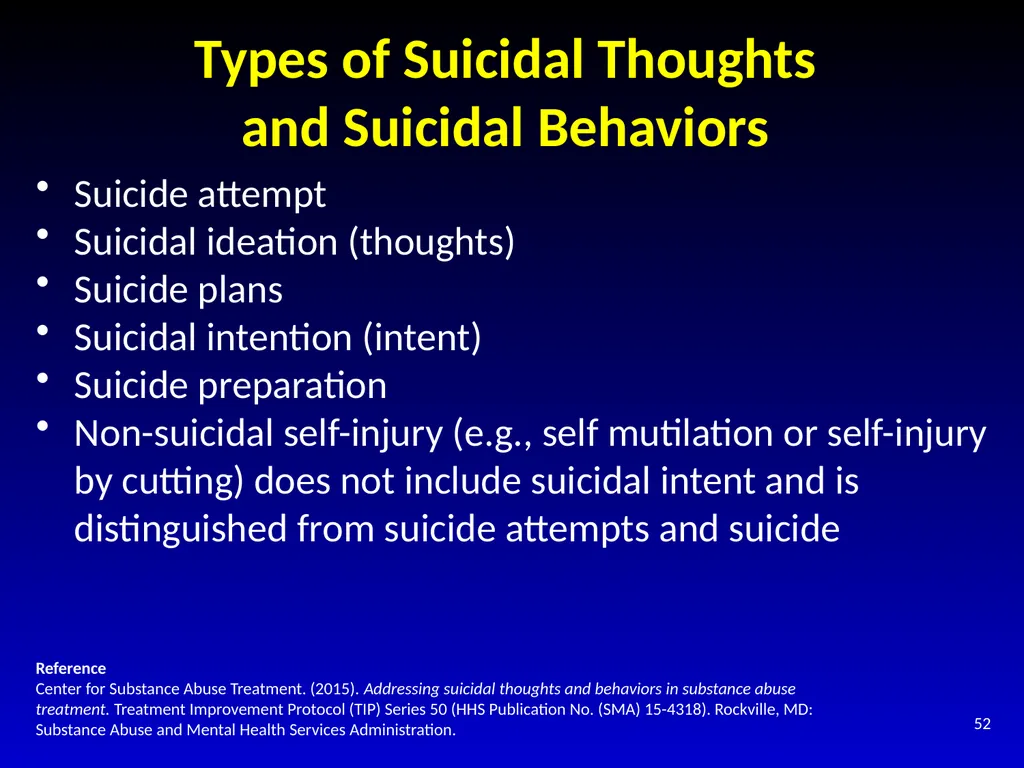
and Suicidal Behaviors Suicide attempt
Suicidal ideation (thoughts)
Suicide plans
Suicidal intention (intent)
Suicide preparation
Non-suicidal self-injury (e.g., self mutilation or self-injury by cutting) does not include suicidal intent and is distinguished from suicide attempts and suicide Reference
Center for Substance Abuse Treatment. (2015). Addressing suicidal thoughts and behaviors in substance abuse treatment. Treatment Improvement Protocol (TIP) Series 50 (HHS Publication No. (SMA) 15-4318). Rockville, MD: Substance Abuse and Mental Health Services Administration. 52<br>
Suicidal ideation (thoughts)
Suicide plans
Suicidal intention (intent)
Suicide preparation
Non-suicidal self-injury (e.g., self mutilation or self-injury by cutting) does not include suicidal intent and is distinguished from suicide attempts and suicide Reference
Center for Substance Abuse Treatment. (2015). Addressing suicidal thoughts and behaviors in substance abuse treatment. Treatment Improvement Protocol (TIP) Series 50 (HHS Publication No. (SMA) 15-4318). Rockville, MD: Substance Abuse and Mental Health Services Administration. 52<br>
53
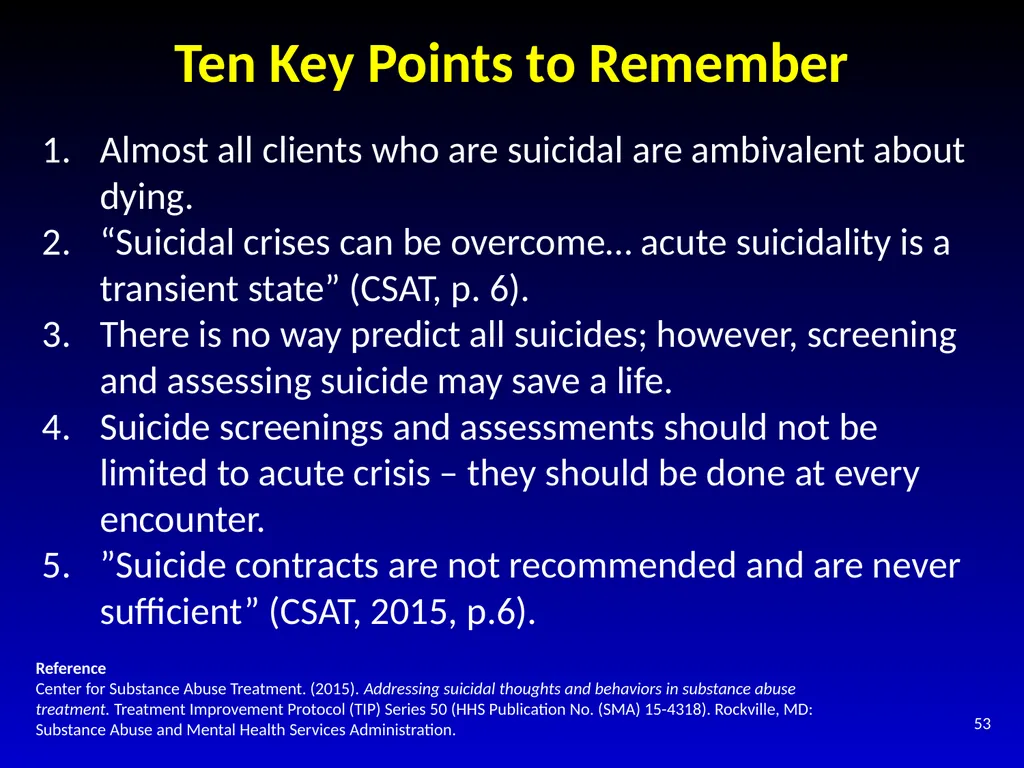
Ten Key Points to Remember Almost all clients who are suicidal are ambivalent about dying.
“Suicidal crises can be overcome… acute suicidality is a transient state” (CSAT, p. 6).
There is no way predict all suicides; however, screening and assessing suicide may save a life.
Suicide screenings and assessments should not be limited to acute crisis – they should be done at every encounter.
”Suicide contracts are not recommended and are never sufficient” (CSAT, 2015, p.6). Reference
Center for Substance Abuse Treatment. (2015). Addressing suicidal thoughts and behaviors in substance abuse treatment. Treatment Improvement Protocol (TIP) Series 50 (HHS Publication No. (SMA) 15-4318). Rockville, MD: Substance Abuse and Mental Health Services Administration. 53<br>
“Suicidal crises can be overcome… acute suicidality is a transient state” (CSAT, p. 6).
There is no way predict all suicides; however, screening and assessing suicide may save a life.
Suicide screenings and assessments should not be limited to acute crisis – they should be done at every encounter.
”Suicide contracts are not recommended and are never sufficient” (CSAT, 2015, p.6). Reference
Center for Substance Abuse Treatment. (2015). Addressing suicidal thoughts and behaviors in substance abuse treatment. Treatment Improvement Protocol (TIP) Series 50 (HHS Publication No. (SMA) 15-4318). Rockville, MD: Substance Abuse and Mental Health Services Administration. 53<br>
54
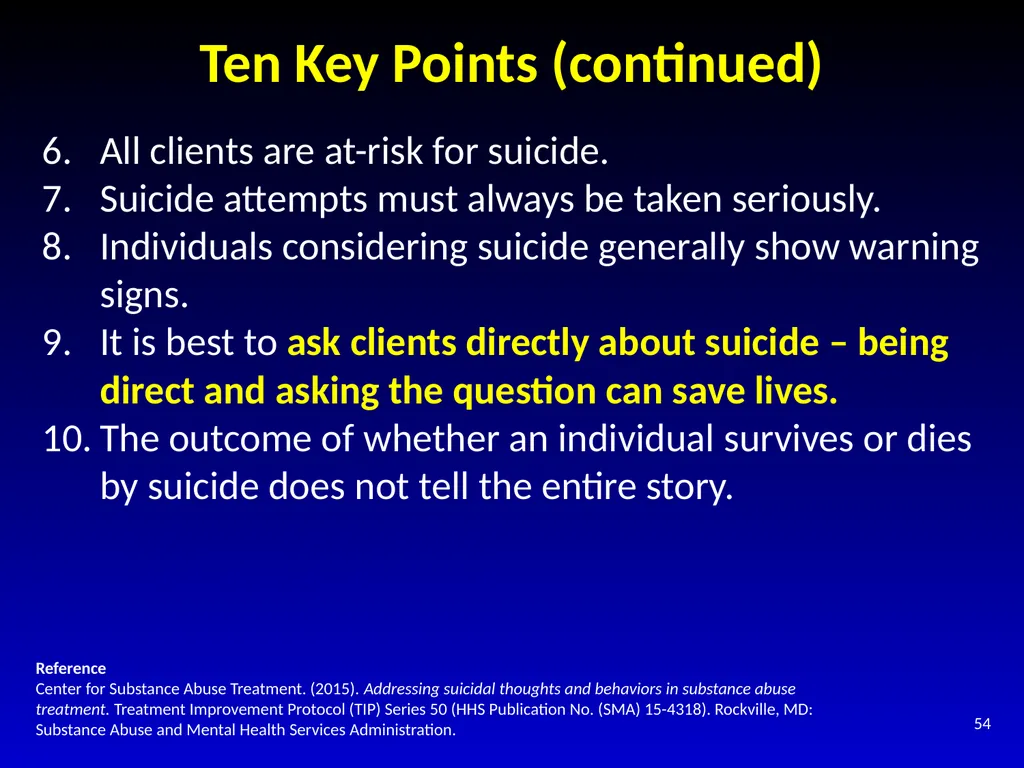
Ten Key Points (continued) All clients are at-risk for suicide.
Suicide attempts must always be taken seriously.
Individuals considering suicide generally show warning signs.
It is best to ask clients directly about suicide – being direct and asking the question can save lives.
The outcome of whether an individual survives or dies by suicide does not tell the entire story. Reference
Center for Substance Abuse Treatment. (2015). Addressing suicidal thoughts and behaviors in substance abuse treatment. Treatment Improvement Protocol (TIP) Series 50 (HHS Publication No. (SMA) 15-4318). Rockville, MD: Substance Abuse and Mental Health Services Administration. 54<br>
Suicide attempts must always be taken seriously.
Individuals considering suicide generally show warning signs.
It is best to ask clients directly about suicide – being direct and asking the question can save lives.
The outcome of whether an individual survives or dies by suicide does not tell the entire story. Reference
Center for Substance Abuse Treatment. (2015). Addressing suicidal thoughts and behaviors in substance abuse treatment. Treatment Improvement Protocol (TIP) Series 50 (HHS Publication No. (SMA) 15-4318). Rockville, MD: Substance Abuse and Mental Health Services Administration. 54<br>
55
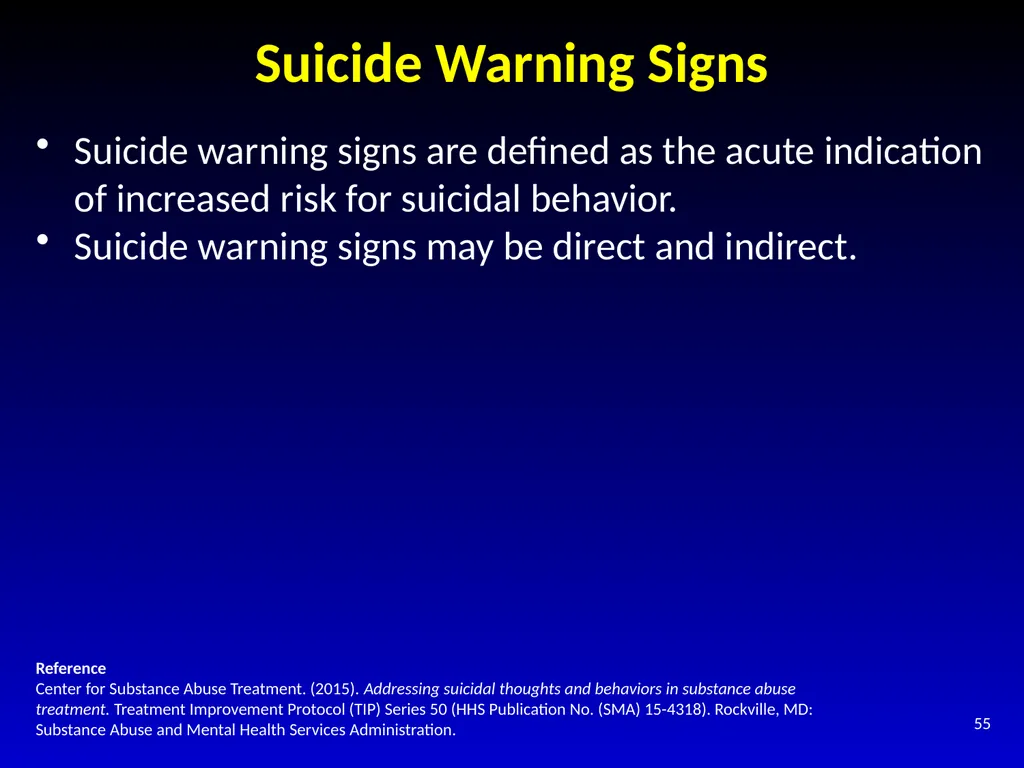
Suicide Warning Signs Suicide warning signs are defined as the acute indication of increased risk for suicidal behavior.
Suicide warning signs may be direct and indirect. Reference
Center for Substance Abuse Treatment. (2015). Addressing suicidal thoughts and behaviors in substance abuse treatment. Treatment Improvement Protocol (TIP) Series 50 (HHS Publication No. (SMA) 15-4318). Rockville, MD: Substance Abuse and Mental Health Services Administration. 55<br>
Suicide warning signs may be direct and indirect. Reference
Center for Substance Abuse Treatment. (2015). Addressing suicidal thoughts and behaviors in substance abuse treatment. Treatment Improvement Protocol (TIP) Series 50 (HHS Publication No. (SMA) 15-4318). Rockville, MD: Substance Abuse and Mental Health Services Administration. 55<br>
56
Direct and Indirect
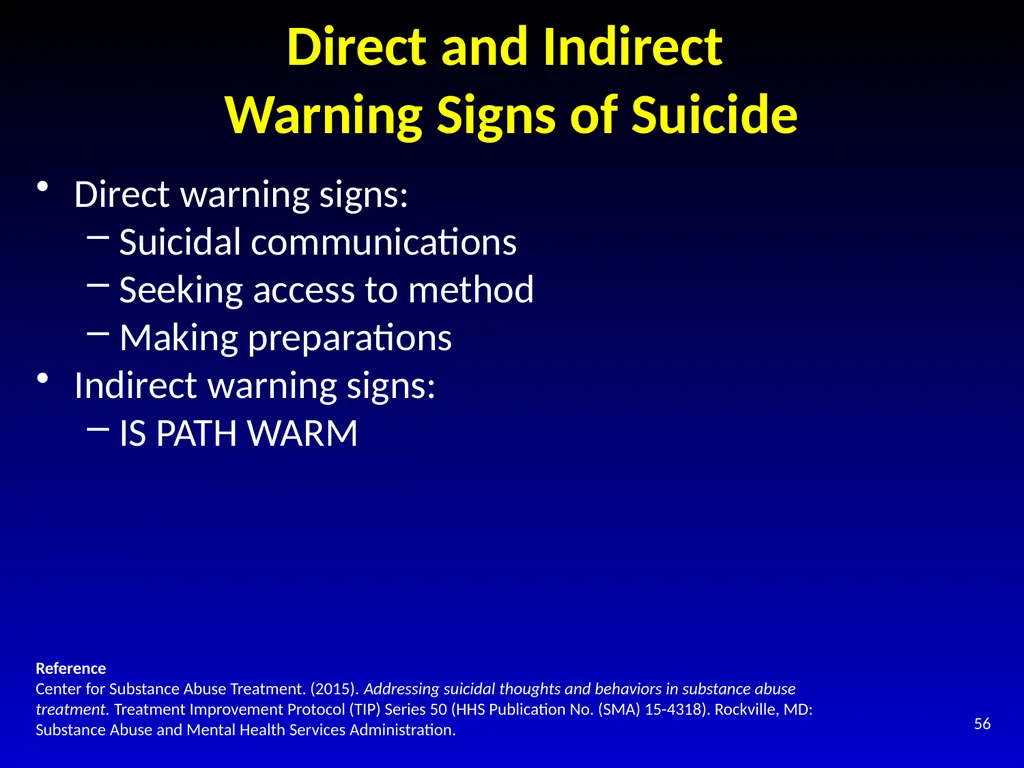
Warning Signs of Suicide Direct warning signs:
Suicidal communications
Seeking access to method
Making preparations
Indirect warning signs:
IS PATH WARM Reference
Center for Substance Abuse Treatment. (2015). Addressing suicidal thoughts and behaviors in substance abuse treatment. Treatment Improvement Protocol (TIP) Series 50 (HHS Publication No. (SMA) 15-4318). Rockville, MD: Substance Abuse and Mental Health Services Administration. 56<br>
Suicidal communications
Seeking access to method
Making preparations
Indirect warning signs:
IS PATH WARM Reference
Center for Substance Abuse Treatment. (2015). Addressing suicidal thoughts and behaviors in substance abuse treatment. Treatment Improvement Protocol (TIP) Series 50 (HHS Publication No. (SMA) 15-4318). Rockville, MD: Substance Abuse and Mental Health Services Administration. 56<br>
57
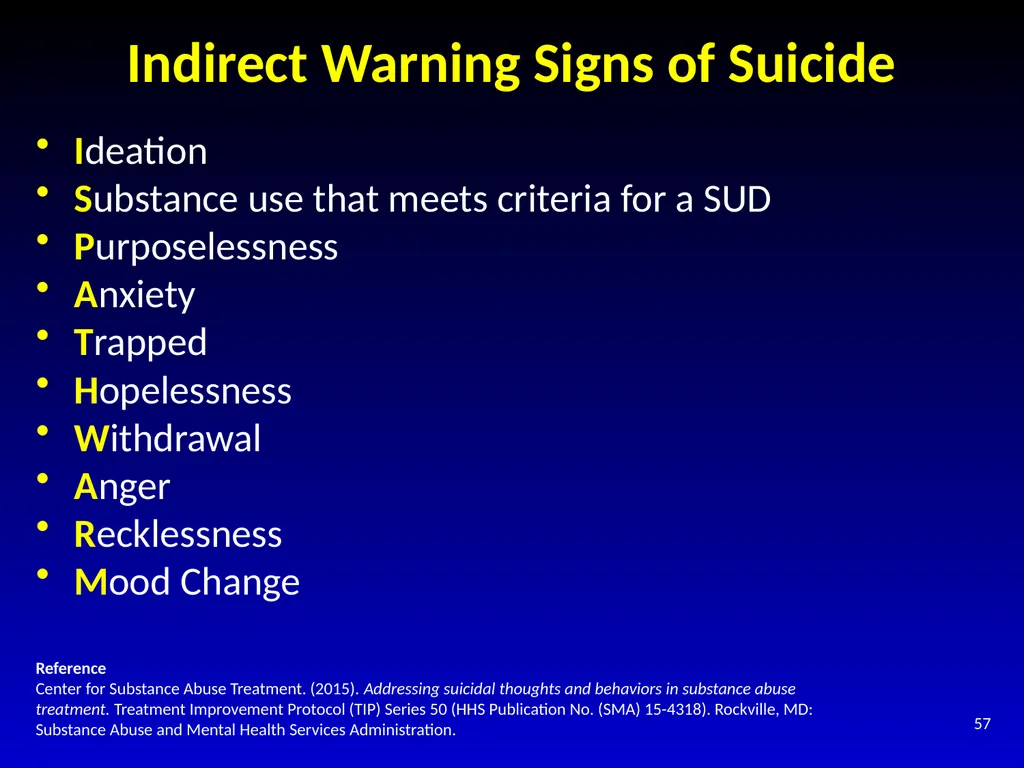
Indirect Warning Signs of Suicide Ideation
Substance use that meets criteria for a SUD
Purposelessness
Anxiety
Trapped
Hopelessness
Withdrawal
Anger
Recklessness
Mood Change Reference
Center for Substance Abuse Treatment. (2015). Addressing suicidal thoughts and behaviors in substance abuse treatment. Treatment Improvement Protocol (TIP) Series 50 (HHS Publication No. (SMA) 15-4318). Rockville, MD: Substance Abuse and Mental Health Services Administration. 57<br>
Substance use that meets criteria for a SUD
Purposelessness
Anxiety
Trapped
Hopelessness
Withdrawal
Anger
Recklessness
Mood Change Reference
Center for Substance Abuse Treatment. (2015). Addressing suicidal thoughts and behaviors in substance abuse treatment. Treatment Improvement Protocol (TIP) Series 50 (HHS Publication No. (SMA) 15-4318). Rockville, MD: Substance Abuse and Mental Health Services Administration. 57<br>
58
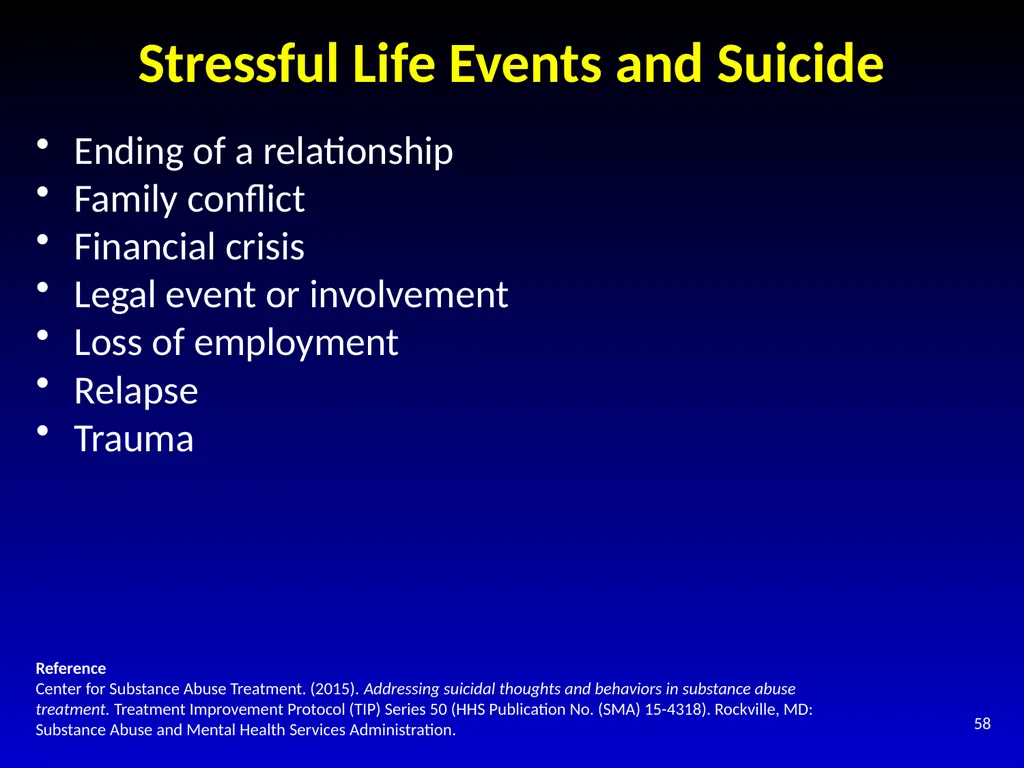
Stressful Life Events and Suicide Ending of a relationship
Family conflict
Financial crisis
Legal event or involvement
Loss of employment
Relapse
Trauma Reference
Center for Substance Abuse Treatment. (2015). Addressing suicidal thoughts and behaviors in substance abuse treatment. Treatment Improvement Protocol (TIP) Series 50 (HHS Publication No. (SMA) 15-4318). Rockville, MD: Substance Abuse and Mental Health Services Administration. 58<br>
Family conflict
Financial crisis
Legal event or involvement
Loss of employment
Relapse
Trauma Reference
Center for Substance Abuse Treatment. (2015). Addressing suicidal thoughts and behaviors in substance abuse treatment. Treatment Improvement Protocol (TIP) Series 50 (HHS Publication No. (SMA) 15-4318). Rockville, MD: Substance Abuse and Mental Health Services Administration. 58<br>
59
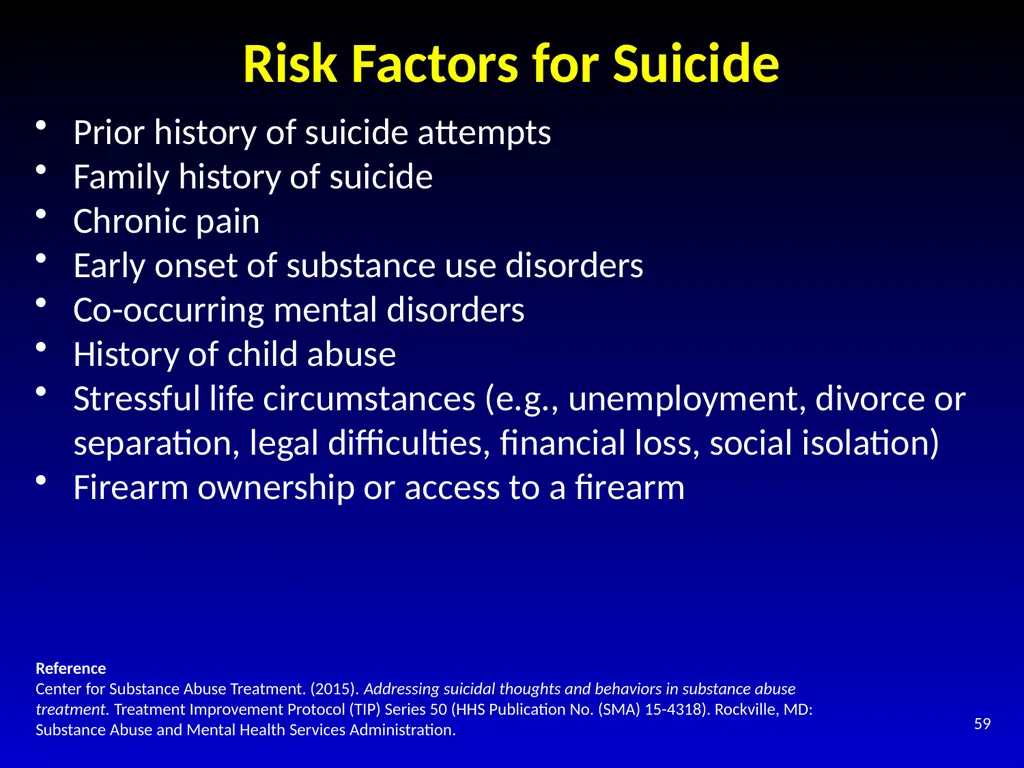
Risk Factors for Suicide Prior history of suicide attempts
Family history of suicide
Chronic pain
Early onset of substance use disorders
Co-occurring mental disorders
History of child abuse
Stressful life circumstances (e.g., unemployment, divorce or separation, legal difficulties, financial loss, social isolation)
Firearm ownership or access to a firearm Reference
Center for Substance Abuse Treatment. (2015). Addressing suicidal thoughts and behaviors in substance abuse treatment. Treatment Improvement Protocol (TIP) Series 50 (HHS Publication No. (SMA) 15-4318). Rockville, MD: Substance Abuse and Mental Health Services Administration. 59<br>
Family history of suicide
Chronic pain
Early onset of substance use disorders
Co-occurring mental disorders
History of child abuse
Stressful life circumstances (e.g., unemployment, divorce or separation, legal difficulties, financial loss, social isolation)
Firearm ownership or access to a firearm Reference
Center for Substance Abuse Treatment. (2015). Addressing suicidal thoughts and behaviors in substance abuse treatment. Treatment Improvement Protocol (TIP) Series 50 (HHS Publication No. (SMA) 15-4318). Rockville, MD: Substance Abuse and Mental Health Services Administration. 59<br>
60
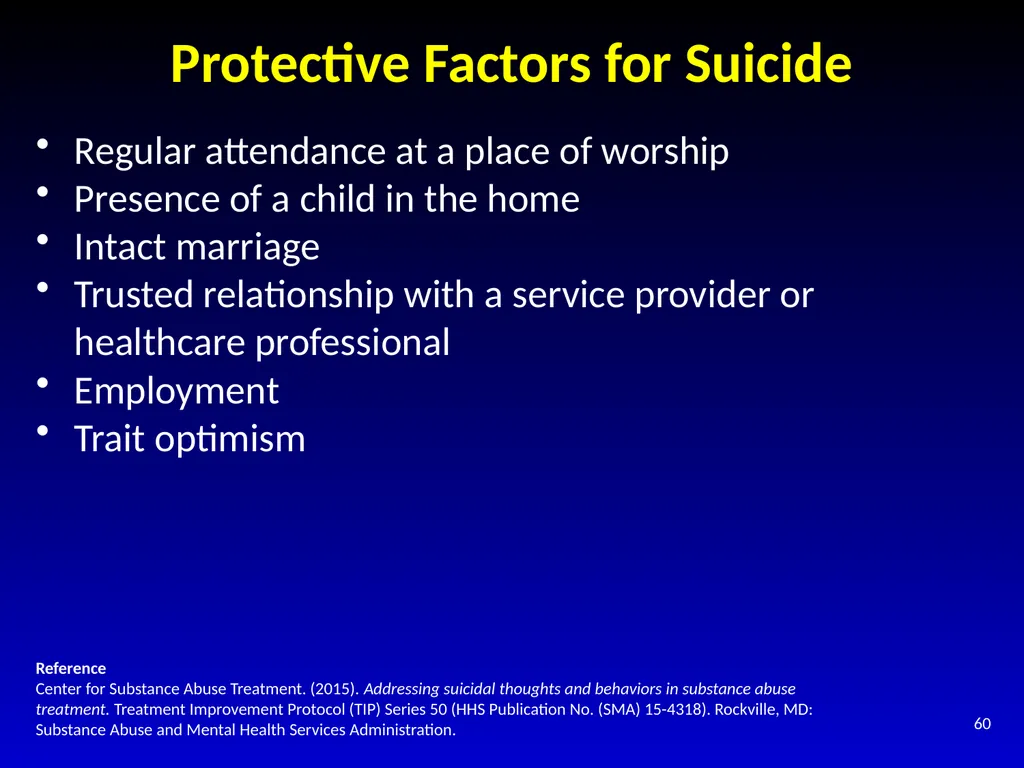
Protective Factors for Suicide Regular attendance at a place of worship
Presence of a child in the home
Intact marriage
Trusted relationship with a service provider or healthcare professional
Employment
Trait optimism Reference
Center for Substance Abuse Treatment. (2015). Addressing suicidal thoughts and behaviors in substance abuse treatment. Treatment Improvement Protocol (TIP) Series 50 (HHS Publication No. (SMA) 15-4318). Rockville, MD: Substance Abuse and Mental Health Services Administration. 60<br>
Presence of a child in the home
Intact marriage
Trusted relationship with a service provider or healthcare professional
Employment
Trait optimism Reference
Center for Substance Abuse Treatment. (2015). Addressing suicidal thoughts and behaviors in substance abuse treatment. Treatment Improvement Protocol (TIP) Series 50 (HHS Publication No. (SMA) 15-4318). Rockville, MD: Substance Abuse and Mental Health Services Administration. 60<br>
61
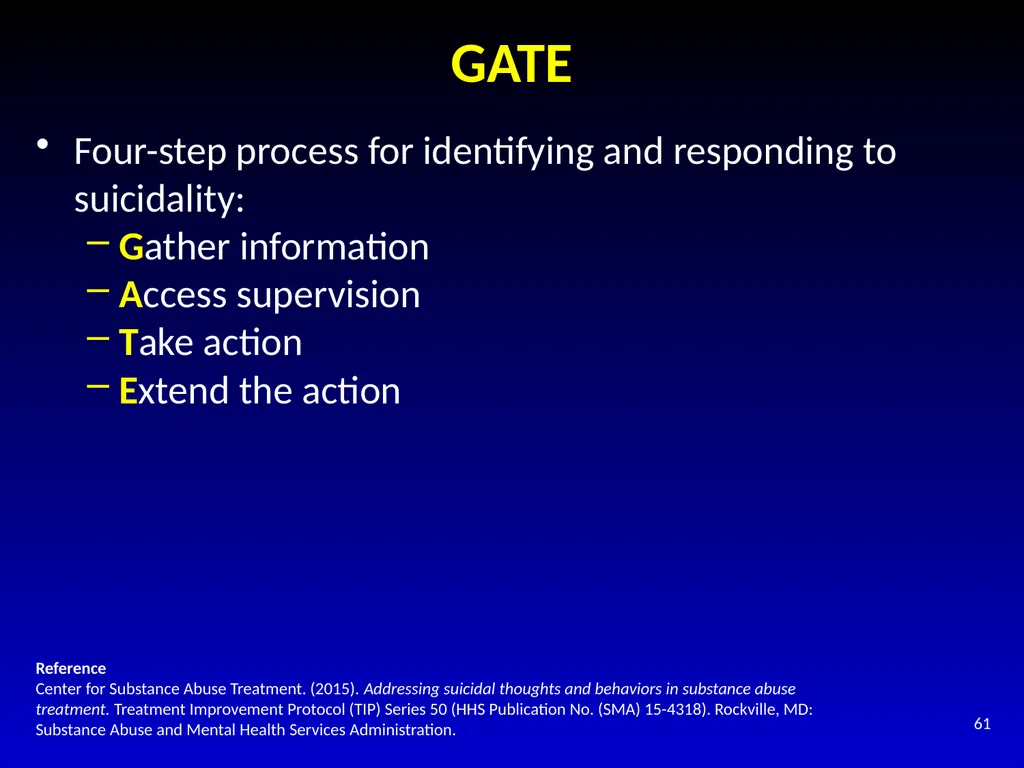
GATE Four-step process for identifying and responding to suicidality:
Gather information
Access supervision
Take action
Extend the action Reference
Center for Substance Abuse Treatment. (2015). Addressing suicidal thoughts and behaviors in substance abuse treatment. Treatment Improvement Protocol (TIP) Series 50 (HHS Publication No. (SMA) 15-4318). Rockville, MD: Substance Abuse and Mental Health Services Administration. 61<br>
Gather information
Access supervision
Take action
Extend the action Reference
Center for Substance Abuse Treatment. (2015). Addressing suicidal thoughts and behaviors in substance abuse treatment. Treatment Improvement Protocol (TIP) Series 50 (HHS Publication No. (SMA) 15-4318). Rockville, MD: Substance Abuse and Mental Health Services Administration. 61<br>
62
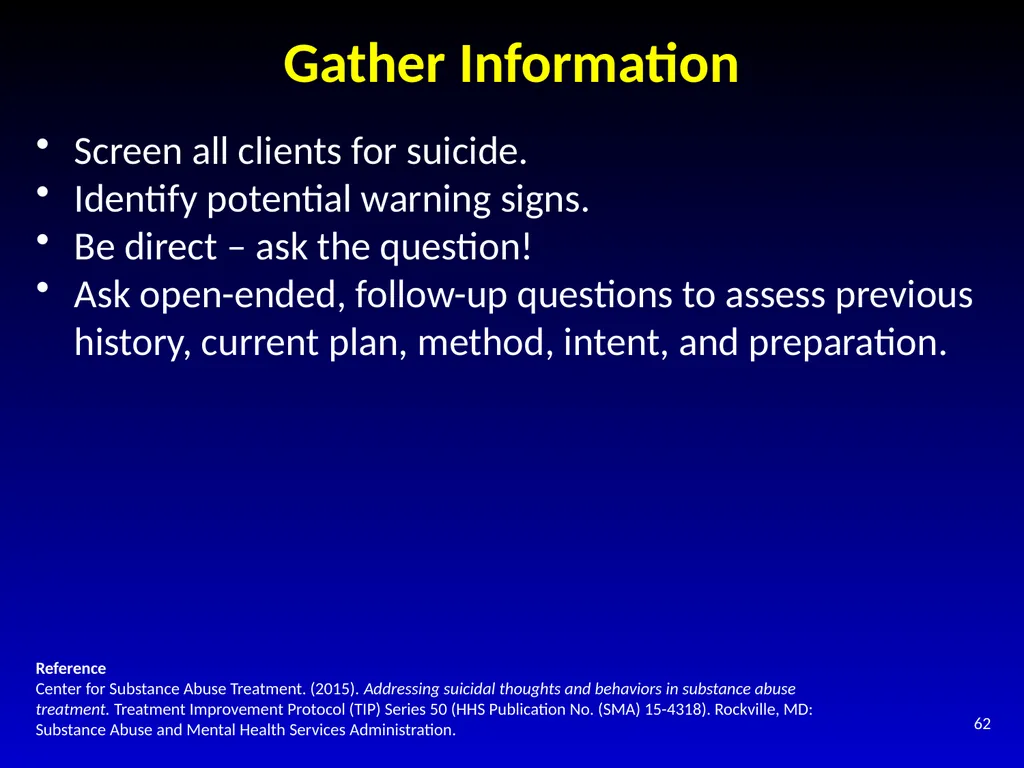
Gather Information Screen all clients for suicide.
Identify potential warning signs.
Be direct – ask the question!
Ask open-ended, follow-up questions to assess previous history, current plan, method, intent, and preparation. Reference
Center for Substance Abuse Treatment. (2015). Addressing suicidal thoughts and behaviors in substance abuse treatment. Treatment Improvement Protocol (TIP) Series 50 (HHS Publication No. (SMA) 15-4318). Rockville, MD: Substance Abuse and Mental Health Services Administration. 62<br>
Identify potential warning signs.
Be direct – ask the question!
Ask open-ended, follow-up questions to assess previous history, current plan, method, intent, and preparation. Reference
Center for Substance Abuse Treatment. (2015). Addressing suicidal thoughts and behaviors in substance abuse treatment. Treatment Improvement Protocol (TIP) Series 50 (HHS Publication No. (SMA) 15-4318). Rockville, MD: Substance Abuse and Mental Health Services Administration. 62<br>
63
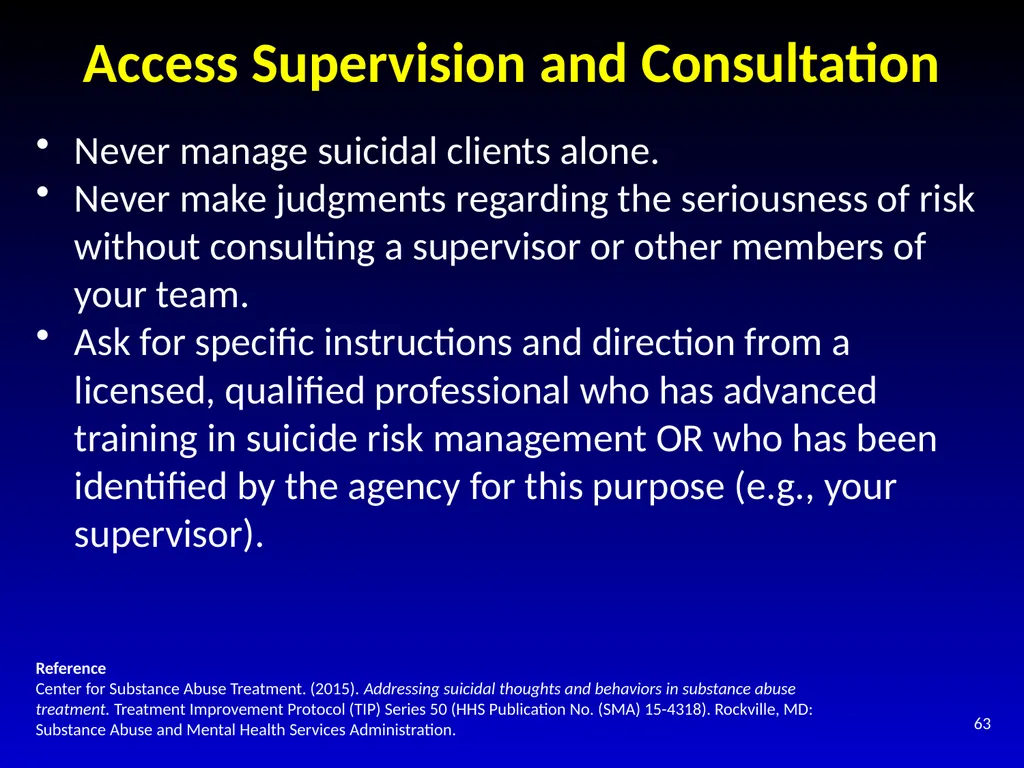
Access Supervision and Consultation Never manage suicidal clients alone.
Never make judgments regarding the seriousness of risk without consulting a supervisor or other members of your team.
Ask for specific instructions and direction from a licensed, qualified professional who has advanced training in suicide risk management OR who has been identified by the agency for this purpose (e.g., your supervisor). Reference
Center for Substance Abuse Treatment. (2015). Addressing suicidal thoughts and behaviors in substance abuse treatment. Treatment Improvement Protocol (TIP) Series 50 (HHS Publication No. (SMA) 15-4318). Rockville, MD: Substance Abuse and Mental Health Services Administration. 63<br>
Never make judgments regarding the seriousness of risk without consulting a supervisor or other members of your team.
Ask for specific instructions and direction from a licensed, qualified professional who has advanced training in suicide risk management OR who has been identified by the agency for this purpose (e.g., your supervisor). Reference
Center for Substance Abuse Treatment. (2015). Addressing suicidal thoughts and behaviors in substance abuse treatment. Treatment Improvement Protocol (TIP) Series 50 (HHS Publication No. (SMA) 15-4318). Rockville, MD: Substance Abuse and Mental Health Services Administration. 63<br>
64
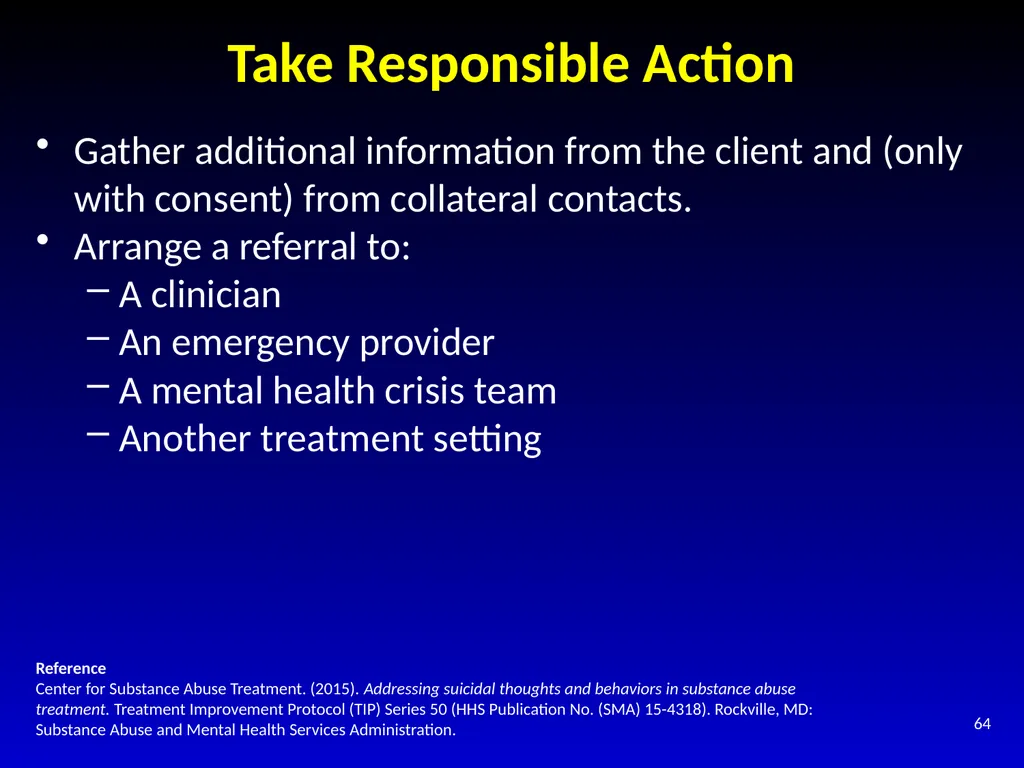
Take Responsible Action Gather additional information from the client and (only with consent) from collateral contacts.
Arrange a referral to:
A clinician
An emergency provider
A mental health crisis team
Another treatment setting Reference
Center for Substance Abuse Treatment. (2015). Addressing suicidal thoughts and behaviors in substance abuse treatment. Treatment Improvement Protocol (TIP) Series 50 (HHS Publication No. (SMA) 15-4318). Rockville, MD: Substance Abuse and Mental Health Services Administration. 64<br>
Arrange a referral to:
A clinician
An emergency provider
A mental health crisis team
Another treatment setting Reference
Center for Substance Abuse Treatment. (2015). Addressing suicidal thoughts and behaviors in substance abuse treatment. Treatment Improvement Protocol (TIP) Series 50 (HHS Publication No. (SMA) 15-4318). Rockville, MD: Substance Abuse and Mental Health Services Administration. 64<br>
65
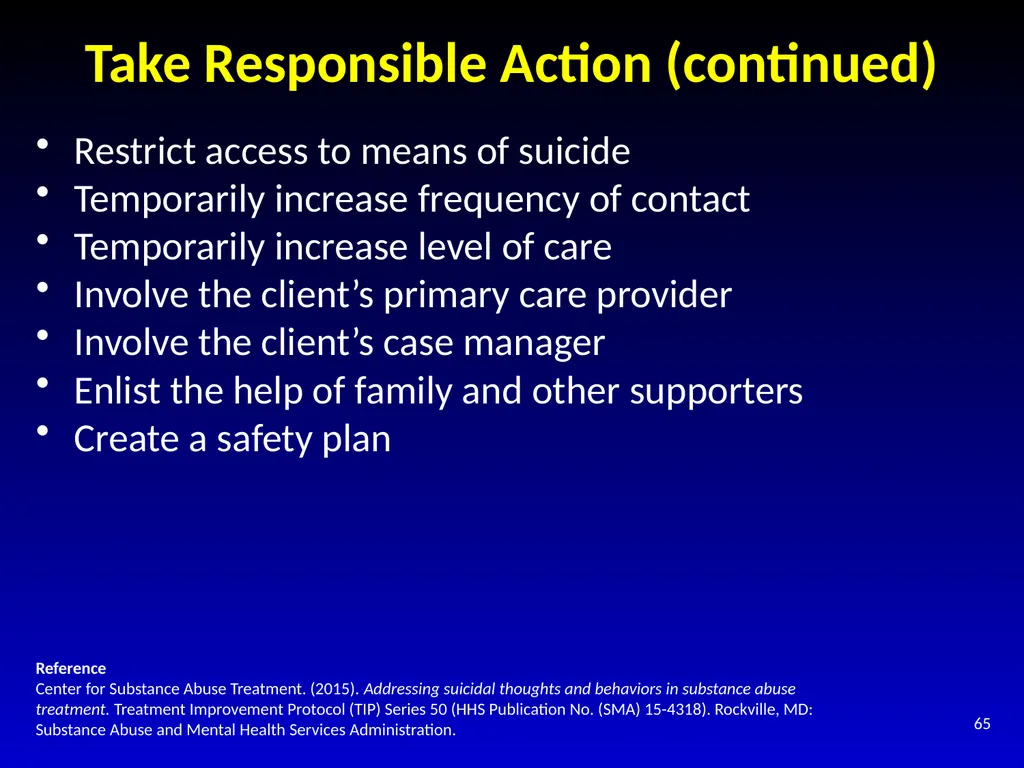
Take Responsible Action (continued) Restrict access to means of suicide
Temporarily increase frequency of contact
Temporarily increase level of care
Involve the client’s primary care provider
Involve the client’s case manager
Enlist the help of family and other supporters
Create a safety plan Reference
Center for Substance Abuse Treatment. (2015). Addressing suicidal thoughts and behaviors in substance abuse treatment. Treatment Improvement Protocol (TIP) Series 50 (HHS Publication No. (SMA) 15-4318). Rockville, MD: Substance Abuse and Mental Health Services Administration. 65<br>
Temporarily increase frequency of contact
Temporarily increase level of care
Involve the client’s primary care provider
Involve the client’s case manager
Enlist the help of family and other supporters
Create a safety plan Reference
Center for Substance Abuse Treatment. (2015). Addressing suicidal thoughts and behaviors in substance abuse treatment. Treatment Improvement Protocol (TIP) Series 50 (HHS Publication No. (SMA) 15-4318). Rockville, MD: Substance Abuse and Mental Health Services Administration. 65<br>
66
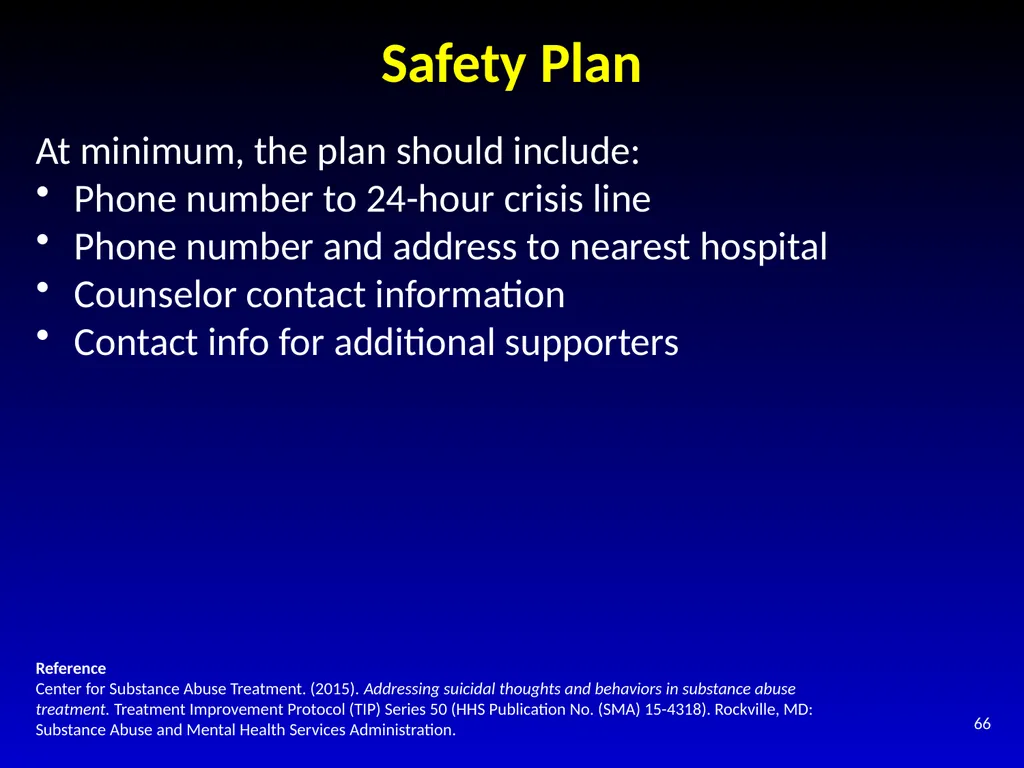
Safety Plan At minimum, the plan should include:
Phone number to 24-hour crisis line
Phone number and address to nearest hospital
Counselor contact information
Contact info for additional supporters Reference
Center for Substance Abuse Treatment. (2015). Addressing suicidal thoughts and behaviors in substance abuse treatment. Treatment Improvement Protocol (TIP) Series 50 (HHS Publication No. (SMA) 15-4318). Rockville, MD: Substance Abuse and Mental Health Services Administration. 66<br>
Phone number to 24-hour crisis line
Phone number and address to nearest hospital
Counselor contact information
Contact info for additional supporters Reference
Center for Substance Abuse Treatment. (2015). Addressing suicidal thoughts and behaviors in substance abuse treatment. Treatment Improvement Protocol (TIP) Series 50 (HHS Publication No. (SMA) 15-4318). Rockville, MD: Substance Abuse and Mental Health Services Administration. 66<br>
67
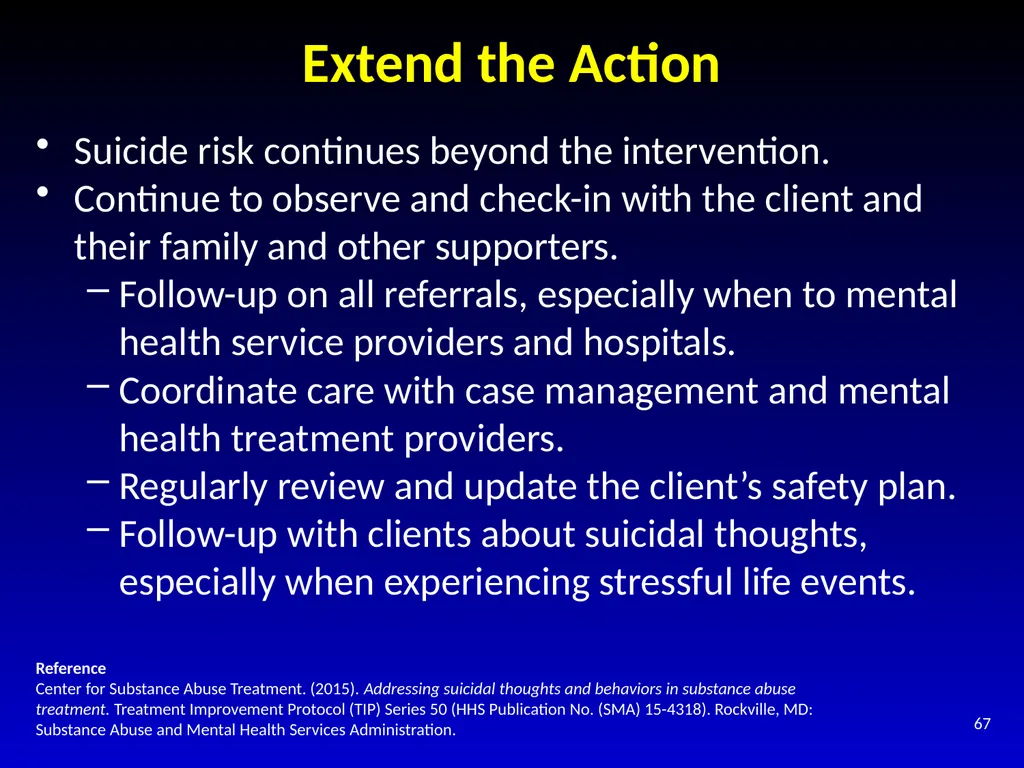
Extend the Action Suicide risk continues beyond the intervention.
Continue to observe and check-in with the client and their family and other supporters.
Follow-up on all referrals, especially when to mental health service providers and hospitals.
Coordinate care with case management and mental health treatment providers.
Regularly review and update the client’s safety plan.
Follow-up with clients about suicidal thoughts, especially when experiencing stressful life events. Reference
Center for Substance Abuse Treatment. (2015). Addressing suicidal thoughts and behaviors in substance abuse treatment. Treatment Improvement Protocol (TIP) Series 50 (HHS Publication No. (SMA) 15-4318). Rockville, MD: Substance Abuse and Mental Health Services Administration. 67<br>
Continue to observe and check-in with the client and their family and other supporters.
Follow-up on all referrals, especially when to mental health service providers and hospitals.
Coordinate care with case management and mental health treatment providers.
Regularly review and update the client’s safety plan.
Follow-up with clients about suicidal thoughts, especially when experiencing stressful life events. Reference
Center for Substance Abuse Treatment. (2015). Addressing suicidal thoughts and behaviors in substance abuse treatment. Treatment Improvement Protocol (TIP) Series 50 (HHS Publication No. (SMA) 15-4318). Rockville, MD: Substance Abuse and Mental Health Services Administration. 67<br>
68
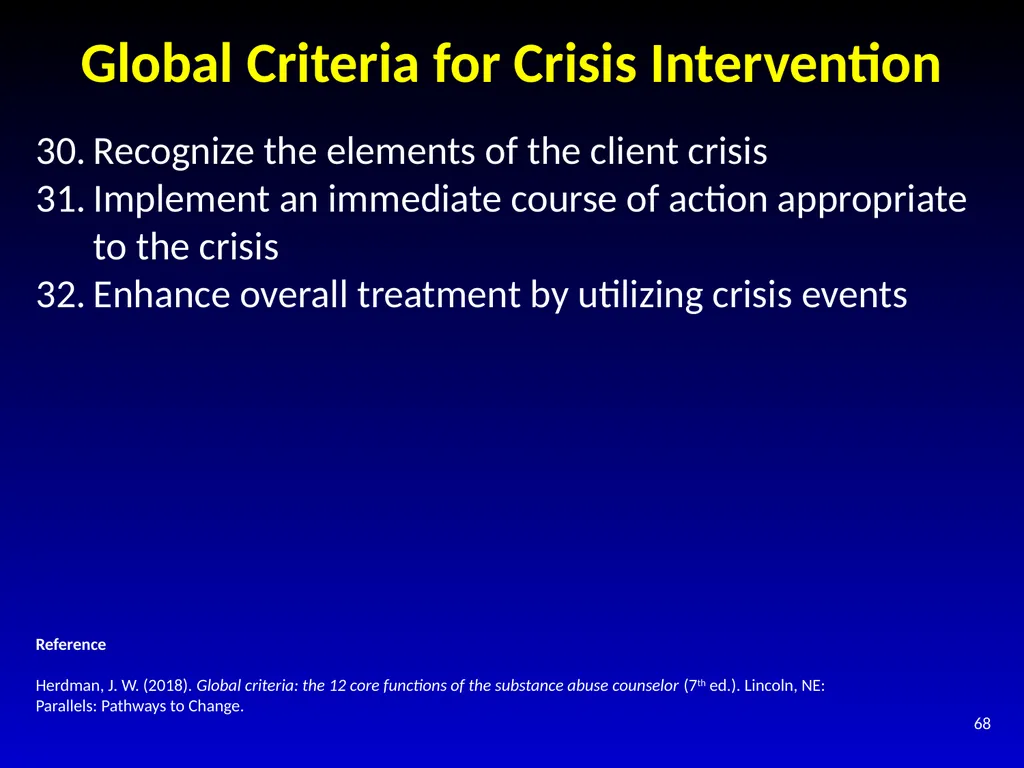
Global Criteria for Crisis Intervention Recognize the elements of the client crisis
Implement an immediate course of action appropriate to the crisis
Enhance overall treatment by utilizing crisis events Reference
Herdman, J. W. (2018). Global criteria: the 12 core functions of the substance abuse counselor (7th ed.). Lincoln, NE: Parallels: Pathways to Change. 68<br>
Implement an immediate course of action appropriate to the crisis
Enhance overall treatment by utilizing crisis events Reference
Herdman, J. W. (2018). Global criteria: the 12 core functions of the substance abuse counselor (7th ed.). Lincoln, NE: Parallels: Pathways to Change. 68<br>
69
Group Activity for Crisis Intervention Outline your program’s procedures for managing crisis situations.
Begin with outlining procedures for systematically screening clients for suicide.
After, outline procedures for managing clients who are actively suicidal in your agency.
Be prepared to discuss these processes with the larger group. 69<br>
Begin with outlining procedures for systematically screening clients for suicide.
After, outline procedures for managing clients who are actively suicidal in your agency.
Be prepared to discuss these processes with the larger group. 69<br>
70
Today's Agenda (3) Review and check-in
Twelve Core Functions (continued)
Case Management
Crisis Intervention
Client and Family Education
Referral
Report and Record keeping
Consultation 70<br>
Twelve Core Functions (continued)
Case Management
Crisis Intervention
Client and Family Education
Referral
Report and Record keeping
Consultation 70<br>
71
Agenda for
Client and Family Education Definition
Cultural and linguistic considerations
Education on drug use and addiction
Impact of addiction on families
Education on the treatment continuum of care
Global Criteria 71<br>
Cultural and linguistic considerations
Education on drug use and addiction
Impact of addiction on families
Education on the treatment continuum of care
Global Criteria 71<br>
72
Definition for
Client and Family Education “The process of providing clients, families, significant others, and community groups with information on risks related to psychoactive substance use, as well as available prevention, treatment and recovery resources” (CSAT, 2006, p.133) Reference
Center for Substance Abuse Treatment. (2006). Addiction counseling competencies: the knowledge, skills, and attitudes of professional practice. Technical Assistance Publication (TAP) Series 21 (HHS Publication No. (SMA) 15-4171). Rockville, MD: Substance Abuse and Mental Health Services Administration. 72<br>
Center for Substance Abuse Treatment. (2006). Addiction counseling competencies: the knowledge, skills, and attitudes of professional practice. Technical Assistance Publication (TAP) Series 21 (HHS Publication No. (SMA) 15-4171). Rockville, MD: Substance Abuse and Mental Health Services Administration. 72<br>
73
Cultural and Linguistic Considerations Knowledge of cultural attitudes towards consumption of alcohol and drugs.
Identifying, creating, and modifying information and client education materials to meet the needs of the intended audience.
Format and delivery (e.g., individual, group, formal, lecture, online, public presentations).
Clarify the purpose for educating or disseminating information.
Consider different learning styles. Reference
Center for Substance Abuse Treatment. (2006). Addiction counseling competencies: the knowledge, skills, and attitudes of professional practice. Technical Assistance Publication (TAP) Series 21 (HHS Publication No. (SMA) 15-4171). Rockville, MD: Substance Abuse and Mental Health Services Administration. 73<br>
Identifying, creating, and modifying information and client education materials to meet the needs of the intended audience.
Format and delivery (e.g., individual, group, formal, lecture, online, public presentations).
Clarify the purpose for educating or disseminating information.
Consider different learning styles. Reference
Center for Substance Abuse Treatment. (2006). Addiction counseling competencies: the knowledge, skills, and attitudes of professional practice. Technical Assistance Publication (TAP) Series 21 (HHS Publication No. (SMA) 15-4171). Rockville, MD: Substance Abuse and Mental Health Services Administration. 73<br>
74
Education on Drug Use and Addiction Drug addiction is a chronic brain disorder.
The brain shows distinct changes after drug use that can persist long after the drug use has stopped.
Prolonged drug use changes the brain in fundamental and long-lasting ways. Reference
National Institute on Drug Abuse (2018). Drugs, brains, and behavior: the science of addiction. Retrieved from https://www.drugabuse.gov/publications/drugs-brains-behavior-science-addiction/drug-misuse-addiction
National Institute on Drug Abuse (2016). The science of drug abuse and addiction: the basics. Retrieved from https://www.drugabuse.gov/publications/media-guide/science-drug-abuse-addiction-basics 74<br>
The brain shows distinct changes after drug use that can persist long after the drug use has stopped.
Prolonged drug use changes the brain in fundamental and long-lasting ways. Reference
National Institute on Drug Abuse (2018). Drugs, brains, and behavior: the science of addiction. Retrieved from https://www.drugabuse.gov/publications/drugs-brains-behavior-science-addiction/drug-misuse-addiction
National Institute on Drug Abuse (2016). The science of drug abuse and addiction: the basics. Retrieved from https://www.drugabuse.gov/publications/media-guide/science-drug-abuse-addiction-basics 74<br>
75
Impact of Addiction on Families Effects on nuclear and extended family.
Effects of addiction may continue for generations.
“Intergenerational effects of substance abuse can have a negative impact on role modeling, trust, and concepts of normative behavior” (CSAT, 2015, p. 22).
Encourage all members of the family to participate in family therapy. Reference
Center for Substance Abuse Treatment (2015). Substance abuse treatment and family therapy. Treatment Improvement Protocol (TIP) 39 (HHS Publication No. (SMA) 15-4219). Rockville, MD: Substance Abuse and Mental Health Services Administration.
Center for Substance Abuse Treatment. (2006). Addiction counseling competencies: the knowledge, skills, and attitudes of professional practice. Technical Assistance Publication (TAP) Series 21 (HHS Publication No. (SMA) 15-4171). Rockville, MD: Substance Abuse and Mental Health Services Administration.
Substance Abuse and Mental Health Services Administration (2013). Family therapy can help: for people in recovery from mental illness or addiction. Retrieved from https://store.samhsa.gov/shin/content//SMA13-4784/SMA13-4784.pdf 75<br>
Effects of addiction may continue for generations.
“Intergenerational effects of substance abuse can have a negative impact on role modeling, trust, and concepts of normative behavior” (CSAT, 2015, p. 22).
Encourage all members of the family to participate in family therapy. Reference
Center for Substance Abuse Treatment (2015). Substance abuse treatment and family therapy. Treatment Improvement Protocol (TIP) 39 (HHS Publication No. (SMA) 15-4219). Rockville, MD: Substance Abuse and Mental Health Services Administration.
Center for Substance Abuse Treatment. (2006). Addiction counseling competencies: the knowledge, skills, and attitudes of professional practice. Technical Assistance Publication (TAP) Series 21 (HHS Publication No. (SMA) 15-4171). Rockville, MD: Substance Abuse and Mental Health Services Administration.
Substance Abuse and Mental Health Services Administration (2013). Family therapy can help: for people in recovery from mental illness or addiction. Retrieved from https://store.samhsa.gov/shin/content//SMA13-4784/SMA13-4784.pdf 75<br>
76
Education on the SUD
Continuum of Care Levels of care (e.g., inpatient, residential, partial hospitalization, outpatient and intensive outpatient)
Treatment modalities
Self-help and mutual support groups Reference
Center for Substance Abuse Treatment (2014). What is substance abuse treatment: a booklet for families (HHS Publication No. (SMA) 14-4126). Rockville, MD: Substance Abuse and Mental Health Services Administration.
Center for Substance Abuse Treatment. (2006). Addiction counseling competencies: the knowledge, skills, and attitudes of professional practice. Technical Assistance Publication (TAP) Series 21 (HHS Publication No. (SMA) 15-4171). Rockville, MD: Substance Abuse and Mental Health Services Administration. 76<br>
Treatment modalities
Self-help and mutual support groups Reference
Center for Substance Abuse Treatment (2014). What is substance abuse treatment: a booklet for families (HHS Publication No. (SMA) 14-4126). Rockville, MD: Substance Abuse and Mental Health Services Administration.
Center for Substance Abuse Treatment. (2006). Addiction counseling competencies: the knowledge, skills, and attitudes of professional practice. Technical Assistance Publication (TAP) Series 21 (HHS Publication No. (SMA) 15-4171). Rockville, MD: Substance Abuse and Mental Health Services Administration. 76<br>
77
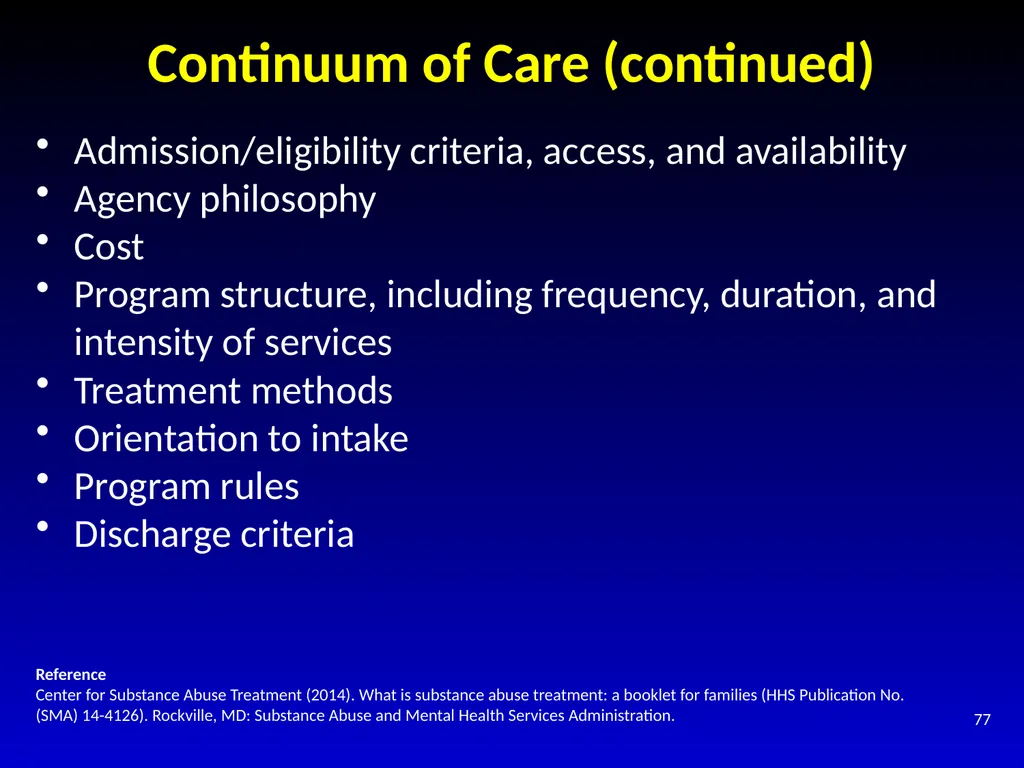
Continuum of Care (continued) Admission/eligibility criteria, access, and availability
Agency philosophy
Cost
Program structure, including frequency, duration, and intensity of services
Treatment methods
Orientation to intake
Program rules
Discharge criteria Reference
Center for Substance Abuse Treatment (2014). What is substance abuse treatment: a booklet for families (HHS Publication No. (SMA) 14-4126). Rockville, MD: Substance Abuse and Mental Health Services Administration. 77<br>
Agency philosophy
Cost
Program structure, including frequency, duration, and intensity of services
Treatment methods
Orientation to intake
Program rules
Discharge criteria Reference
Center for Substance Abuse Treatment (2014). What is substance abuse treatment: a booklet for families (HHS Publication No. (SMA) 14-4126). Rockville, MD: Substance Abuse and Mental Health Services Administration. 77<br>
78
Global Criteria
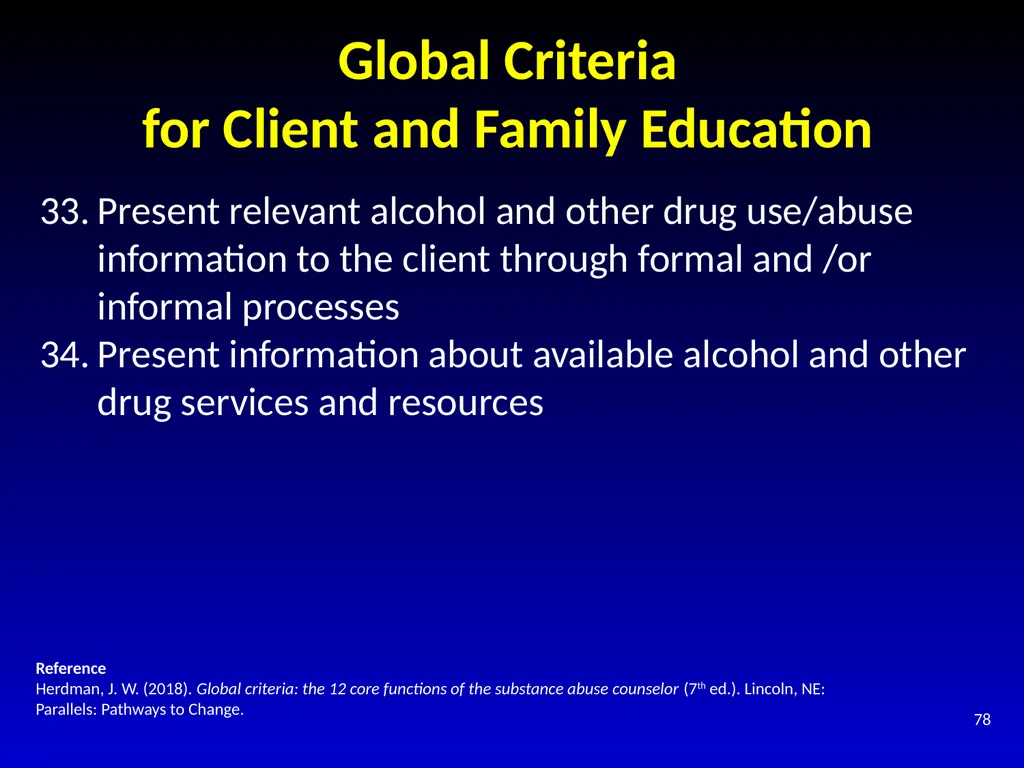
for Client and Family Education Present relevant alcohol and other drug use/abuse information to the client through formal and /or informal processes
Present information about available alcohol and other drug services and resources Reference
Herdman, J. W. (2018). Global criteria: the 12 core functions of the substance abuse counselor (7th ed.). Lincoln, NE: Parallels: Pathways to Change. 78<br>
Present information about available alcohol and other drug services and resources Reference
Herdman, J. W. (2018). Global criteria: the 12 core functions of the substance abuse counselor (7th ed.). Lincoln, NE: Parallels: Pathways to Change. 78<br>
79
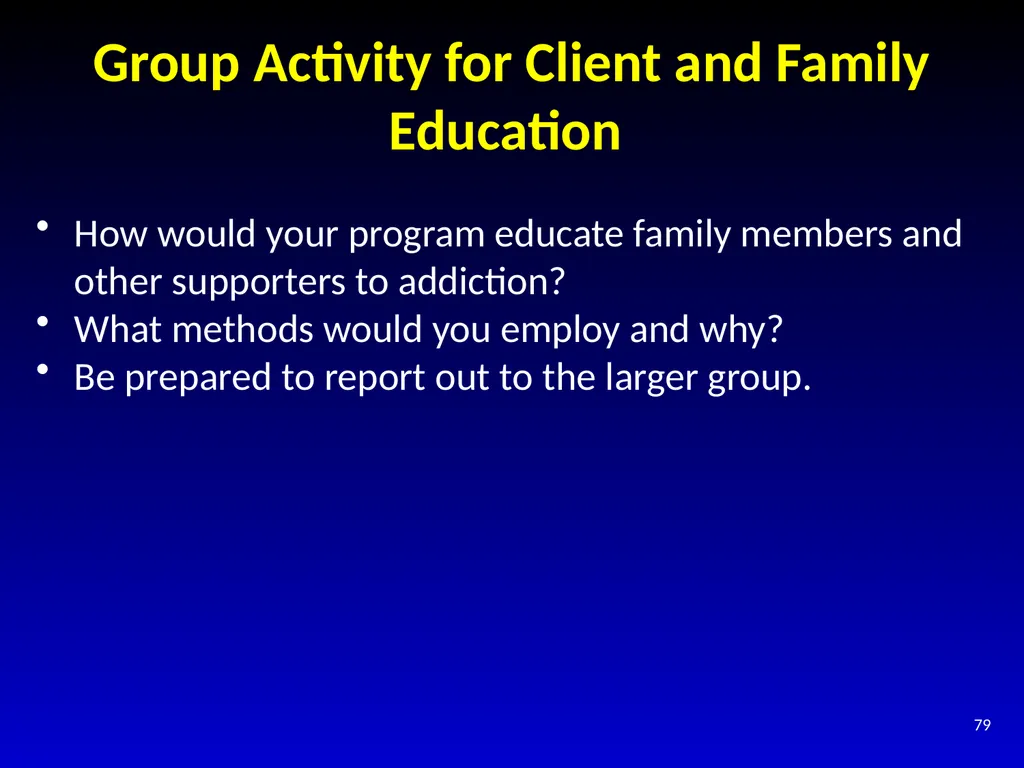
Group Activity for Client and Family Education How would your program educate family members and other supporters to addiction?
What methods would you employ and why?
Be prepared to report out to the larger group. 79<br>
What methods would you employ and why?
Be prepared to report out to the larger group. 79<br>
80
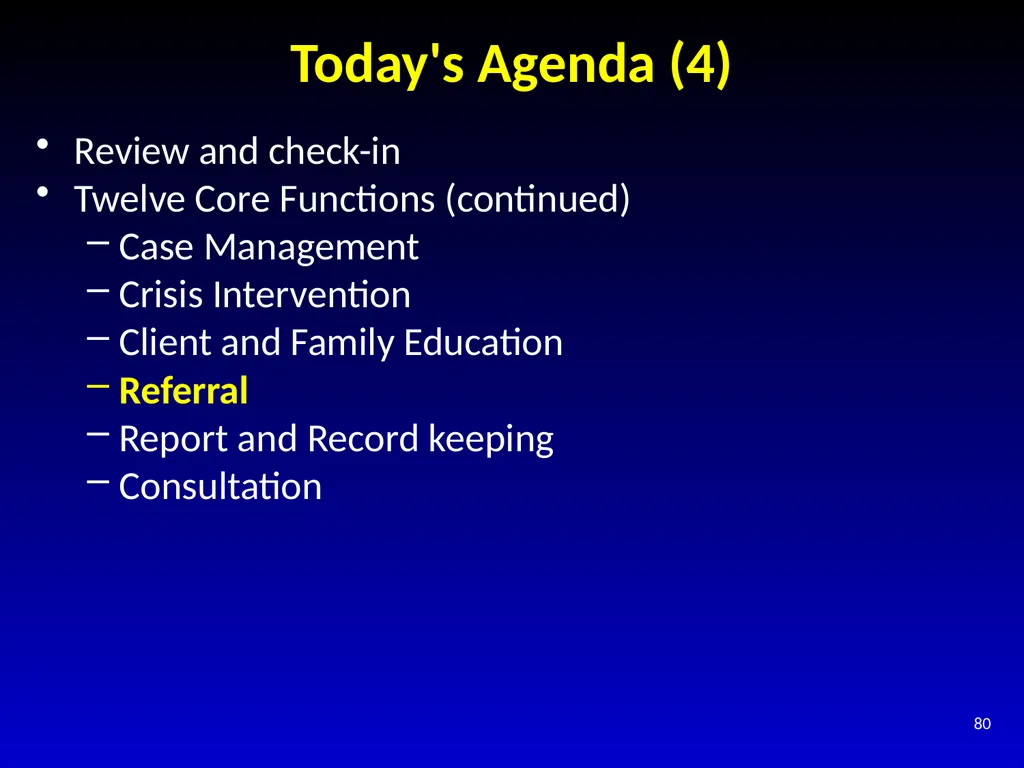
Today's Agenda (4) Review and check-in
Twelve Core Functions (continued)
Case Management
Crisis Intervention
Client and Family Education
Referral
Report and Record keeping
Consultation 80<br>
Twelve Core Functions (continued)
Case Management
Crisis Intervention
Client and Family Education
Referral
Report and Record keeping
Consultation 80<br>
81
Agenda for Referral Definition
Referral versus consultation
Establishing a referral network
Evaluating referral network
Knowing when to refer
Arranging referrals
Evaluating outcomes of referrals
Global Criteria 81<br>
Referral versus consultation
Establishing a referral network
Evaluating referral network
Knowing when to refer
Arranging referrals
Evaluating outcomes of referrals
Global Criteria 81<br>
82
Definition of Referral “The process of facilitating the client’s use of available support systems and community resources to meet needs identified in clinical evaluation or treatment planning” (CSAT, 2006, p. 69) Reference
Center for Substance Abuse Treatment. (2006). Addiction counseling competencies: the knowledge, skills, and attitudes of professional practice. Technical Assistance Publication (TAP) Series 21 (HHS Publication No. (SMA) 15-4171). Rockville, MD: Substance Abuse and Mental Health Services Administration. 82<br>
Center for Substance Abuse Treatment. (2006). Addiction counseling competencies: the knowledge, skills, and attitudes of professional practice. Technical Assistance Publication (TAP) Series 21 (HHS Publication No. (SMA) 15-4171). Rockville, MD: Substance Abuse and Mental Health Services Administration. 82<br>
83
Establishing a Referral Network Establish and maintain relations with different providers and community organizations.
Core function(s)
Eligibility
Access-related issues or concerns
Costs
Establish and nurture relationships with key contacts/points of contact. Reference
Center for Substance Abuse Treatment. (2006). Addiction counseling competencies: the knowledge, skills, and attitudes of professional practice. Technical Assistance Publication (TAP) Series 21 (HHS Publication No. (SMA) 15-4171). Rockville, MD: Substance Abuse and Mental Health Services Administration. 83<br>
Core function(s)
Eligibility
Access-related issues or concerns
Costs
Establish and nurture relationships with key contacts/points of contact. Reference
Center for Substance Abuse Treatment. (2006). Addiction counseling competencies: the knowledge, skills, and attitudes of professional practice. Technical Assistance Publication (TAP) Series 21 (HHS Publication No. (SMA) 15-4171). Rockville, MD: Substance Abuse and Mental Health Services Administration. 83<br>
84
Evaluating Referral Network Review publicly-available, agency-specific performance indicators (e.g., client satisfaction) or outcomes reports.
Confirm accreditation status (if applicable) and licensing. Reference
Center for Substance Abuse Treatment. (2006). Addiction counseling competencies: the knowledge, skills, and attitudes of professional practice. Technical Assistance Publication (TAP) Series 21 (HHS Publication No. (SMA) 15-4171). Rockville, MD: Substance Abuse and Mental Health Services Administration. 84<br>
Confirm accreditation status (if applicable) and licensing. Reference
Center for Substance Abuse Treatment. (2006). Addiction counseling competencies: the knowledge, skills, and attitudes of professional practice. Technical Assistance Publication (TAP) Series 21 (HHS Publication No. (SMA) 15-4171). Rockville, MD: Substance Abuse and Mental Health Services Administration. 84<br>
85
Knowing When to Make a Referral Initiate and clarify whether the referral is:
For an outside entity to provide concurrent services
For an outside entity to provide services because the client will no longer receive services from you
Assess capacity, ambivalence, and motivation (readiness, importance, confidence.
Educate and orient the client about the referral process (e.g., signing consent forms).
Educate the client about the specific individual, program or activity and its requirements. Reference
Center for Substance Abuse Treatment. (2006). Addiction counseling competencies: the knowledge, skills, and attitudes of professional practice. Technical Assistance Publication (TAP) Series 21 (HHS Publication No. (SMA) 15-4171). Rockville, MD: Substance Abuse and Mental Health Services Administration. 85<br>
For an outside entity to provide concurrent services
For an outside entity to provide services because the client will no longer receive services from you
Assess capacity, ambivalence, and motivation (readiness, importance, confidence.
Educate and orient the client about the referral process (e.g., signing consent forms).
Educate the client about the specific individual, program or activity and its requirements. Reference
Center for Substance Abuse Treatment. (2006). Addiction counseling competencies: the knowledge, skills, and attitudes of professional practice. Technical Assistance Publication (TAP) Series 21 (HHS Publication No. (SMA) 15-4171). Rockville, MD: Substance Abuse and Mental Health Services Administration. 85<br>
86
Arranging Referrals Conform to all applicable protocols, rules, regulations, and laws (confidentiality) on consent and transmitting client-level information and data.
Provide pertinent documentation, if necessary, and remember to only provide what is necessary
Document the referral process.
Maintain oral and written communication throughout the referral process to ensure successful referrals. Reference
Center for Substance Abuse Treatment. (2006). Addiction counseling competencies: the knowledge, skills, and attitudes of professional practice. Technical Assistance Publication (TAP) Series 21 (HHS Publication No. (SMA) 15-4171). Rockville, MD: Substance Abuse and Mental Health Services Administration. 86<br>
Provide pertinent documentation, if necessary, and remember to only provide what is necessary
Document the referral process.
Maintain oral and written communication throughout the referral process to ensure successful referrals. Reference
Center for Substance Abuse Treatment. (2006). Addiction counseling competencies: the knowledge, skills, and attitudes of professional practice. Technical Assistance Publication (TAP) Series 21 (HHS Publication No. (SMA) 15-4171). Rockville, MD: Substance Abuse and Mental Health Services Administration. 86<br>
87
Arranging Referrals (continued) Review informed consent form with client.
Only release info that is applicable and within the parameters set by the client.
Always include consent forms in all fax transmissions
Never use email when communicating with other programs.
Never use patient identifiers (e.g., client initials) in the subject line of any email (internal and external)
Exercise caution when emailing protected health information when sending emails within a secure network.
Never send protected health information via text messages. 87<br>
Only release info that is applicable and within the parameters set by the client.
Always include consent forms in all fax transmissions
Never use email when communicating with other programs.
Never use patient identifiers (e.g., client initials) in the subject line of any email (internal and external)
Exercise caution when emailing protected health information when sending emails within a secure network.
Never send protected health information via text messages. 87<br>
88
Evaluating Referral Outcomes Systematically collect, report on, and document objective data?
How long did it take from the referral being made to the client being screened/assessed by the outside entity?
Systematically collect, report on, and document subjective data.
Use standardized processes (measures).
What was the client’s experience?
What was the outcome of the referral? Reference
Center for Substance Abuse Treatment. (2006). Addiction counseling competencies: the knowledge, skills, and attitudes of professional practice. Technical Assistance Publication (TAP) Series 21 (HHS Publication No. (SMA) 15-4171). Rockville, MD: Substance Abuse and Mental Health Services Administration. 88<br>
How long did it take from the referral being made to the client being screened/assessed by the outside entity?
Systematically collect, report on, and document subjective data.
Use standardized processes (measures).
What was the client’s experience?
What was the outcome of the referral? Reference
Center for Substance Abuse Treatment. (2006). Addiction counseling competencies: the knowledge, skills, and attitudes of professional practice. Technical Assistance Publication (TAP) Series 21 (HHS Publication No. (SMA) 15-4171). Rockville, MD: Substance Abuse and Mental Health Services Administration. 88<br>
89
Global Criteria for Referrals Identify needs and or problems that the agency and/or counselor cannot meet.
Explain the rationale for the referral process to the client,
Match client needs and/or problems to appropriate resources.
Adhere to applicable laws, regulations and agency policies governing procedures related to the protection of the client’s confidentiality.
Assist the client in utilizing the support systems and community resources available. Reference
Herdman, J. W. (2018). Global criteria: the 12 core functions of the substance abuse counselor (7th ed.). Lincoln, NE: Parallels: Pathways to Change. 89<br>
Explain the rationale for the referral process to the client,
Match client needs and/or problems to appropriate resources.
Adhere to applicable laws, regulations and agency policies governing procedures related to the protection of the client’s confidentiality.
Assist the client in utilizing the support systems and community resources available. Reference
Herdman, J. W. (2018). Global criteria: the 12 core functions of the substance abuse counselor (7th ed.). Lincoln, NE: Parallels: Pathways to Change. 89<br>
90
Group Activity for Referrals Outline your program’s procedures making referrals
What processes will your program employ to ensure referrals are timely and relevant?
Be prepared to discuss these processes with the larger group 90<br>
What processes will your program employ to ensure referrals are timely and relevant?
Be prepared to discuss these processes with the larger group 90<br>
91
Today's Agenda (5) Review and check-in
Twelve Core Functions (continued)
Case Management
Crisis Intervention
Client and Family Education
Referral
Report and Record keeping
Consultation 91<br>
Twelve Core Functions (continued)
Case Management
Crisis Intervention
Client and Family Education
Referral
Report and Record keeping
Consultation 91<br>
92
Agenda for
Report and Record Keeping Definition
Purpose of documentation
Case records: basic elements
Client contact/encounter or progress notes
Quality standards in documentation
Structured formats
Confidentiality
Global Criteria 92<br>
Purpose of documentation
Case records: basic elements
Client contact/encounter or progress notes
Quality standards in documentation
Structured formats
Confidentiality
Global Criteria 92<br>
93
Definition of
Report and Record Keeping The CSAT (2006) defines documentation as “the recording of the screening and intake process, assessment, treatment plan, clinical reports, clinical progress notes, discharge summaries, and other client-related data” (p. 143) Reference
Center for Substance Abuse Treatment. (2006). Addiction counseling competencies: the knowledge, skills, and attitudes of professional practice. Technical Assistance Publication (TAP) Series 21 (HHS Publication No. (SMA) 15-4171). Rockville, MD: Substance Abuse and Mental Health Services Administration. 93<br>
Center for Substance Abuse Treatment. (2006). Addiction counseling competencies: the knowledge, skills, and attitudes of professional practice. Technical Assistance Publication (TAP) Series 21 (HHS Publication No. (SMA) 15-4171). Rockville, MD: Substance Abuse and Mental Health Services Administration. 93<br>
94
Purpose of Reports and Record Keeping Document services rendered.
Ensures compliance to various federal and state laws and regulations, accreditation standards, and licensing requirements to protect the client, agency, and community.
Supports the rationale, justification, and organization for the delivery of services.
Decreases risk.
Establishes medical necessity.
Establishes appropriate level of care. Reference
Council on Accreditation. (2018). Risk prevention and management (RPM): Case records. Retrieved from http://coanet.org/standard/rpm/7/ 94<br>
Ensures compliance to various federal and state laws and regulations, accreditation standards, and licensing requirements to protect the client, agency, and community.
Supports the rationale, justification, and organization for the delivery of services.
Decreases risk.
Establishes medical necessity.
Establishes appropriate level of care. Reference
Council on Accreditation. (2018). Risk prevention and management (RPM): Case records. Retrieved from http://coanet.org/standard/rpm/7/ 94<br>
95
Basics Elements of Case Records Demographic and contact information
Reason why the client requested or was referred for services
Assessments
Service plan or treatment plan
Consents
Legal information
Court reports
Court documents
Legal directives
Advanced directives Reference
Council on Accreditation. (2018). Risk prevention and management (RPM): Case records. Retrieved from http://coanet.org/standard/rpm/7/ 95<br>
Reason why the client requested or was referred for services
Assessments
Service plan or treatment plan
Consents
Legal information
Court reports
Court documents
Legal directives
Advanced directives Reference
Council on Accreditation. (2018). Risk prevention and management (RPM): Case records. Retrieved from http://coanet.org/standard/rpm/7/ 95<br>
96
Elements of Case Records (continued 1) Medical information
Psychological, medical, diagnostic and other evaluations
Prescribed and over the counter medications
Physician orders
Allergies
Adverse treatment responses
Description of services provided to the client
Routine documentation (see next slide)
Referrals Reference
Council on Accreditation. (2018). Risk prevention and management (RPM): Case records. Retrieved from http://coanet.org/standard/rpm/7/ 96<br>
Psychological, medical, diagnostic and other evaluations
Prescribed and over the counter medications
Physician orders
Allergies
Adverse treatment responses
Description of services provided to the client
Routine documentation (see next slide)
Referrals Reference
Council on Accreditation. (2018). Risk prevention and management (RPM): Case records. Retrieved from http://coanet.org/standard/rpm/7/ 96<br>
97
Elements of Case Records (continued 2) Routine documentation
Client encounters and progress notes (see next slide)
Consultation with other helping professionals
Collateral contacts
Missed appointment and other non-adherent behaviors
Telephone encounters, including non-routine calls and reminder appointments
Unauthorized discharges & elopements
Discharge or aftercare plan Reference
Council on Accreditation. (2018). Risk prevention and management (RPM): Case records. Retrieved from http://coanet.org/standard/rpm/7/ 97<br>
Client encounters and progress notes (see next slide)
Consultation with other helping professionals
Collateral contacts
Missed appointment and other non-adherent behaviors
Telephone encounters, including non-routine calls and reminder appointments
Unauthorized discharges & elopements
Discharge or aftercare plan Reference
Council on Accreditation. (2018). Risk prevention and management (RPM): Case records. Retrieved from http://coanet.org/standard/rpm/7/ 97<br>
98
Client Encounters/Progress Notes Client name and unique identifier
Date, location, purpose and reason for client contact/encounter/interaction
Start and stop times (length)
Service type (e.g., individual counseling, group therapy)
Specific problem, goal, objective or action step being addressed
Content and topics covered
Observed behaviors of client (info about client’s presentation)
Intervention(s) used
Client response to intervention 98<br>
Date, location, purpose and reason for client contact/encounter/interaction
Start and stop times (length)
Service type (e.g., individual counseling, group therapy)
Specific problem, goal, objective or action step being addressed
Content and topics covered
Observed behaviors of client (info about client’s presentation)
Intervention(s) used
Client response to intervention 98<br>
99
Progress Notes (continued) Progress towards and/or completion of goals or objectives
Identification of new problems, goals, or objectives
Client status
Plan going forward
Name and signature of clinician/counselor and credentials Reference
Council on Accreditation. (2018). Risk prevention and management (RPM): Case records. Retrieved from http://coanet.org/standard/rpm/7/ 99<br>
Identification of new problems, goals, or objectives
Client status
Plan going forward
Name and signature of clinician/counselor and credentials Reference
Council on Accreditation. (2018). Risk prevention and management (RPM): Case records. Retrieved from http://coanet.org/standard/rpm/7/ 99<br>
100
Quality Standards for Progress Notes Be clear, concise, specific, descriptive and succinct.
Be current!
Organize information using headings.
Use direct quotes from the client and other sources when relevant.
Use relevant information – avoid superfluous details.
Write in the present tense.
Document facts and observations written in behavior specific terms. Reference
Council on Accreditation. (2018). Risk prevention and management (RPM): Case records. Retrieved from http://coanet.org/standard/rpm/7/ 100<br>
Be current!
Organize information using headings.
Use direct quotes from the client and other sources when relevant.
Use relevant information – avoid superfluous details.
Write in the present tense.
Document facts and observations written in behavior specific terms. Reference
Council on Accreditation. (2018). Risk prevention and management (RPM): Case records. Retrieved from http://coanet.org/standard/rpm/7/ 100<br>
101
Quality Standards (continued) Avoid vague and value-laden terms (e.g., inappropriate)
If applicable, document what was seen, heard and smelled
Clearly label impressions – provide evidence to substantiate them
Consider using a case record checklist Reference
Council on Accreditation. (2018). Risk prevention and management (RPM): Case records. Retrieved from http://coanet.org/standard/rpm/7/ 101<br>
If applicable, document what was seen, heard and smelled
Clearly label impressions – provide evidence to substantiate them
Consider using a case record checklist Reference
Council on Accreditation. (2018). Risk prevention and management (RPM): Case records. Retrieved from http://coanet.org/standard/rpm/7/ 101<br>
102
Structured Format SOAP
Subjective, Objective, Assessment, Plan
GIRP
Goal, Intervention, Response, Plan
SIRP
Situation, Intervention, Response, Plan
BIRP
Behavior, Intervention, Response, Plan 102<br>
Subjective, Objective, Assessment, Plan
GIRP
Goal, Intervention, Response, Plan
SIRP
Situation, Intervention, Response, Plan
BIRP
Behavior, Intervention, Response, Plan 102<br>
103
Confidentiality of
Records and Report Keeping Health Insurance Portability and Accountability Act (HIPAA) Privacy Rule
42 Code of Federal Regulations (CFR) Part 2
State defined confidentiality rules and regulations 103<br>
42 Code of Federal Regulations (CFR) Part 2
State defined confidentiality rules and regulations 103<br>
104
HIPAA Privacy Rule Protects confidentiality and security of individually identifiable health information (i.e., Protected Health Information [PHI]).
PHI is any information that can be used to identify an individual that was created, used, or disclosed in the course of providing health care services.
Sets minimum privacy protections for all health information held by health plans, healthcare clearinghouses, healthcare providers and those who transmit PHI.
Allows the sharing of info between organizations for the purpose of healthcare coordination. Reference
US Department of Health and Human Services. (2016). Summary of the HIPAA Privacy Rule. Retrieved from https://www.hhs.gov/hipaa/for-professionals/privacy/laws-regulations/index.html 104<br>
PHI is any information that can be used to identify an individual that was created, used, or disclosed in the course of providing health care services.
Sets minimum privacy protections for all health information held by health plans, healthcare clearinghouses, healthcare providers and those who transmit PHI.
Allows the sharing of info between organizations for the purpose of healthcare coordination. Reference
US Department of Health and Human Services. (2016). Summary of the HIPAA Privacy Rule. Retrieved from https://www.hhs.gov/hipaa/for-professionals/privacy/laws-regulations/index.html 104<br>
105
What is Protected Health Information? Identifies the client.
Any information that is oral, written, electronic, created or received by a health care provider, health plan, public health authority, employer, insurer, or others (see law for covered entities).
Relating to past, present or future physical or mental health status, health care, and payment for such services. Reference
US Department of Health and Human Services. (2016). Summary of the HIPAA Privacy Rule. Retrieved from https://www.hhs.gov/hipaa/for-professionals/privacy/laws-regulations/index.html 105<br>
Any information that is oral, written, electronic, created or received by a health care provider, health plan, public health authority, employer, insurer, or others (see law for covered entities).
Relating to past, present or future physical or mental health status, health care, and payment for such services. Reference
US Department of Health and Human Services. (2016). Summary of the HIPAA Privacy Rule. Retrieved from https://www.hhs.gov/hipaa/for-professionals/privacy/laws-regulations/index.html 105<br>
106
Eighteen Identifiers of PHI (1) Names;
All geographic subdivisions smaller than a state, with the exception of the first three digits of a zip code ONLY if and when there are more than 20,000 people that can be accounted for when combining all zip codes with the first three digits;
All elements of dates (except year) for dates directly related to an individual, including date of birth, admission and discharge dates, and date of death;
Phone numbers;
Fax numbers; Reference
US Department of Health and Human Services. (2015). Guidance regarding methods for de-identification of protected heath information in accordance with the Health Insurance Portability and Accountability Act (HIPAA) Privacy Rule. Retrieved from https://www.hhs.gov/hipaa/for-professionals/privacy/special-topics/de-identification/index.html?language=es 106<br>
All geographic subdivisions smaller than a state, with the exception of the first three digits of a zip code ONLY if and when there are more than 20,000 people that can be accounted for when combining all zip codes with the first three digits;
All elements of dates (except year) for dates directly related to an individual, including date of birth, admission and discharge dates, and date of death;
Phone numbers;
Fax numbers; Reference
US Department of Health and Human Services. (2015). Guidance regarding methods for de-identification of protected heath information in accordance with the Health Insurance Portability and Accountability Act (HIPAA) Privacy Rule. Retrieved from https://www.hhs.gov/hipaa/for-professionals/privacy/special-topics/de-identification/index.html?language=es 106<br>
107
Eighteen Identifiers of PHI (2) Email addresses;
Vehicle identifiers and serial numbers, including license plates;
Device identifiers and serial numbers;
Social Security Numbers;
Web Universal Resource locators (URLs);
Internet Protocol (IP) addresses;
Medical record numbers;
Health plan beneficiary numbers;
Full face photographs and other comparable images;
Account numbers; Reference
US Department of Health and Human Services. (2015). Guidance regarding methods for de-identification of protected heath information in accordance with the Health Insurance Portability and Accountability Act (HIPAA) Privacy Rule. Retrieved from https://www.hhs.gov/hipaa/for-professionals/privacy/special-topics/de-identification/index.html?language=es 107<br>
Vehicle identifiers and serial numbers, including license plates;
Device identifiers and serial numbers;
Social Security Numbers;
Web Universal Resource locators (URLs);
Internet Protocol (IP) addresses;
Medical record numbers;
Health plan beneficiary numbers;
Full face photographs and other comparable images;
Account numbers; Reference
US Department of Health and Human Services. (2015). Guidance regarding methods for de-identification of protected heath information in accordance with the Health Insurance Portability and Accountability Act (HIPAA) Privacy Rule. Retrieved from https://www.hhs.gov/hipaa/for-professionals/privacy/special-topics/de-identification/index.html?language=es 107<br>
108
18 identifiers of PHI (3) Biometric identifiers, including fingerprint and voice prints;
Certificate or license numbers; and
An other identifying number, characteristic or code (see law or exceptions) Reference
US Department of Health and Human Services. (2015). Guidance regarding methods for de-identification of protected heath information in accordance with the Health Insurance Portability and Accountability Act (HIPAA) Privacy Rule. Retrieved from https://www.hhs.gov/hipaa/for-professionals/privacy/special-topics/de-identification/index.html?language=es 108<br>
Certificate or license numbers; and
An other identifying number, characteristic or code (see law or exceptions) Reference
US Department of Health and Human Services. (2015). Guidance regarding methods for de-identification of protected heath information in accordance with the Health Insurance Portability and Accountability Act (HIPAA) Privacy Rule. Retrieved from https://www.hhs.gov/hipaa/for-professionals/privacy/special-topics/de-identification/index.html?language=es 108<br>
109
Authorized Uses and Disclosures Obtain an individual’s written authorization for any use or disclosure of PHI.
Use plain language.
Ensure the client understands:
Who is disclosing the information?
What is it being used for?
When will the consent expire?
How to revoke the consent? Reference
US Department of Health and Human Services. (2016). Summary of the HIPAA Privacy Rule. Retrieved from https://www.hhs.gov/hipaa/for-professionals/privacy/laws-regulations/index.html 109<br>
Use plain language.
Ensure the client understands:
Who is disclosing the information?
What is it being used for?
When will the consent expire?
How to revoke the consent? Reference
US Department of Health and Human Services. (2016). Summary of the HIPAA Privacy Rule. Retrieved from https://www.hhs.gov/hipaa/for-professionals/privacy/laws-regulations/index.html 109<br>
110
Principle of “Minimum Necessary” “A covered entity must make reasonable efforts to use, disclose, and request only the minimum amount of protected health information needed to accomplish the intended purpose of the use, disclosure, or the request” (HHS, 2015).
Justify the use, disclosure or request of medical information. Reference
US Department of Health and Human Services. (2016). Summary of the HIPAA Privacy Rule. Retrieved from https://www.hhs.gov/hipaa/for-professionals/privacy/laws-regulations/index.html 110<br>
Justify the use, disclosure or request of medical information. Reference
US Department of Health and Human Services. (2016). Summary of the HIPAA Privacy Rule. Retrieved from https://www.hhs.gov/hipaa/for-professionals/privacy/laws-regulations/index.html 110<br>
111
Permitted Uses and Disclosures An individual’s authorization for a covered entity to use and disclose PHI is not require in the following cases:
To the individual,
Treatment, payment, health care operations,
Uses and disclosure with opportunity to agree or object,
Incidental use and disclosure,
Public interest and benefit activities, and
Limited data set
All covered entities are required to document when PHI was used or obtained regardless of whether the individual authorized it. Reference
US Department of Health and Human Services. (2016). Summary of the HIPAA Privacy Rule. Retrieved from https://www.hhs.gov/hipaa/for-professionals/privacy/laws-regulations/index.html 111<br>
To the individual,
Treatment, payment, health care operations,
Uses and disclosure with opportunity to agree or object,
Incidental use and disclosure,
Public interest and benefit activities, and
Limited data set
All covered entities are required to document when PHI was used or obtained regardless of whether the individual authorized it. Reference
US Department of Health and Human Services. (2016). Summary of the HIPAA Privacy Rule. Retrieved from https://www.hhs.gov/hipaa/for-professionals/privacy/laws-regulations/index.html 111<br>
112
42 Code of Federal Regulations (CFR) Part 2 Federal law specific to the confidentiality of substance use disorder patient records.
“Disclosure” includes any communication of information (writing, orally, electronically, or by other means) that contains PHI related to having past or current substance use disorders. Reference
US Government Publishing Office. (2006). Electronic code of federal regulations: Title 42, Chapter 1, Subchapter A, Part 2: Confidentiality of substance use disorder patient records. Retrieved from https://www.ecfr.gov/cgi-bin/text-idx?SID=0f9b2a146b539944f00b5ec90117d296&mc=true&node=pt42.1.2&rgn=div5 112<br>
“Disclosure” includes any communication of information (writing, orally, electronically, or by other means) that contains PHI related to having past or current substance use disorders. Reference
US Government Publishing Office. (2006). Electronic code of federal regulations: Title 42, Chapter 1, Subchapter A, Part 2: Confidentiality of substance use disorder patient records. Retrieved from https://www.ecfr.gov/cgi-bin/text-idx?SID=0f9b2a146b539944f00b5ec90117d296&mc=true&node=pt42.1.2&rgn=div5 112<br>
113
42 CFR Part 2: Disclosures All entities that meet criteria for 42 CFR Part 2 may NOT disclose PHI directly or indirectly (including referral and intake) unless:
Informed consent is provided by client in writing and the informed includes required elements
Crimes (or threats of) on program premises or against program personnel
Suspected child abuse or neglect
Court order meeting specifications of 42 CFR
Qualified service organizations
External auditors, evaluators, registries, and researchers Reference
US Government Publishing Office. (2006). Electronic code of federal regulations: Title 42, Chapter 1, Subchapter A, Part 2: Confidentiality of substance use disorder patient records. Retrieved from https://www.ecfr.gov/cgi-bin/text-idx?SID=0f9b2a146b539944f00b5ec90117d296&mc=true&node=pt42.1.2&rgn=div5 113<br>
Informed consent is provided by client in writing and the informed includes required elements
Crimes (or threats of) on program premises or against program personnel
Suspected child abuse or neglect
Court order meeting specifications of 42 CFR
Qualified service organizations
External auditors, evaluators, registries, and researchers Reference
US Government Publishing Office. (2006). Electronic code of federal regulations: Title 42, Chapter 1, Subchapter A, Part 2: Confidentiality of substance use disorder patient records. Retrieved from https://www.ecfr.gov/cgi-bin/text-idx?SID=0f9b2a146b539944f00b5ec90117d296&mc=true&node=pt42.1.2&rgn=div5 113<br>
114
Disclosures and Medical Emergencies Disclosure of PHI is permitted to medical personnel - but not family - if the client is experiencing a medical emergency.
Documentation of disclosure must occur immediately afterward to include (1) Name of medical personnel and healthcare facility to who disclosure was made; (2) Name of individual making disclosure; date & time, and (3) Nature of Medical Emergency. Reference
US Government Publishing Office. (2006). Electronic code of federal regulations: Title 42, Chapter 1, Subchapter A, Part 2: Confidentiality of substance use disorder patient records. Retrieved from https://www.ecfr.gov/cgi-bin/text-idx?SID=0f9b2a146b539944f00b5ec90117d296&mc=true&node=pt42.1.2&rgn=div5 114<br>
Documentation of disclosure must occur immediately afterward to include (1) Name of medical personnel and healthcare facility to who disclosure was made; (2) Name of individual making disclosure; date & time, and (3) Nature of Medical Emergency. Reference
US Government Publishing Office. (2006). Electronic code of federal regulations: Title 42, Chapter 1, Subchapter A, Part 2: Confidentiality of substance use disorder patient records. Retrieved from https://www.ecfr.gov/cgi-bin/text-idx?SID=0f9b2a146b539944f00b5ec90117d296&mc=true&node=pt42.1.2&rgn=div5 114<br>
115
Disclosures and Crimes on
Premises or Against Personnel If a crime is committed, or threatened, on program premises or against program personnel, staff may disclose identifying information including:
suspect’s name, address, last known whereabouts, and status as a client in the program.
Duty to warn others Reference
US Government Publishing Office. (2006). Electronic code of federal regulations: Title 42, Chapter 1, Subchapter A, Part 2: Confidentiality of substance use disorder patient records. Retrieved from https://www.ecfr.gov/cgi-bin/text-idx?SID=0f9b2a146b539944f00b5ec90117d296&mc=true&node=pt42.1.2&rgn=div5 115<br>
suspect’s name, address, last known whereabouts, and status as a client in the program.
Duty to warn others Reference
US Government Publishing Office. (2006). Electronic code of federal regulations: Title 42, Chapter 1, Subchapter A, Part 2: Confidentiality of substance use disorder patient records. Retrieved from https://www.ecfr.gov/cgi-bin/text-idx?SID=0f9b2a146b539944f00b5ec90117d296&mc=true&node=pt42.1.2&rgn=div5 115<br>
116
Disclosures and Child and Elder Abuse Reporting of child and elder abuse and neglect are governed by state laws.
42 CFR Part 2 allows for initial reporting and written confirmation of the report, but does not permit programs to disclose PHI for on-going investigations, without a court order. Reference
US Government Publishing Office. (2006). Electronic code of federal regulations: Title 42, Chapter 1, Subchapter A, Part 2: Confidentiality of substance use disorder patient records. Retrieved from https://www.ecfr.gov/cgi-bin/text-idx?SID=0f9b2a146b539944f00b5ec90117d296&mc=true&node=pt42.1.2&rgn=div5 116<br>
42 CFR Part 2 allows for initial reporting and written confirmation of the report, but does not permit programs to disclose PHI for on-going investigations, without a court order. Reference
US Government Publishing Office. (2006). Electronic code of federal regulations: Title 42, Chapter 1, Subchapter A, Part 2: Confidentiality of substance use disorder patient records. Retrieved from https://www.ecfr.gov/cgi-bin/text-idx?SID=0f9b2a146b539944f00b5ec90117d296&mc=true&node=pt42.1.2&rgn=div5 116<br>
117
Required Elements for Written Consent A written consent to disclose under 42 CFR Part 2 may be paper or electronic and must include:
Name of client;
Name and description of the program making disclosure;
How much & what kind of information will be disclosed, including an explicit description of the SUD information that may be disclosed;
Name and title of the individual(s) to whom a disclosure is to be made; Reference
US Government Publishing Office. (2006). Electronic code of federal regulations: Title 42, Chapter 1, Subchapter A, Part 2: Confidentiality of substance use disorder patient records. Retrieved from https://www.ecfr.gov/cgi-bin/text-idx?SID=0f9b2a146b539944f00b5ec90117d296&mc=true&node=pt42.1.2&rgn=div5 117<br>
Name of client;
Name and description of the program making disclosure;
How much & what kind of information will be disclosed, including an explicit description of the SUD information that may be disclosed;
Name and title of the individual(s) to whom a disclosure is to be made; Reference
US Government Publishing Office. (2006). Electronic code of federal regulations: Title 42, Chapter 1, Subchapter A, Part 2: Confidentiality of substance use disorder patient records. Retrieved from https://www.ecfr.gov/cgi-bin/text-idx?SID=0f9b2a146b539944f00b5ec90117d296&mc=true&node=pt42.1.2&rgn=div5 117<br>
118
Required Elements
for Written Consent (continued) Purpose of disclosure;
Statement of the client’s right to revoke the consent
Date, event, or condition upon which the consent will expire if not revoked – the date, event, or condition “will last no longer than reasonably necessary to service the purpose for which it is provide);
Signature of client; and
Date of which the client signed the consent Reference
US Government Publishing Office. (2006). Electronic code of federal regulations: Title 42, Chapter 1, Subchapter A, Part 2: Confidentiality of substance use disorder patient records. Retrieved from https://www.ecfr.gov/cgi-bin/text-idx?SID=0f9b2a146b539944f00b5ec90117d296&mc=true&node=pt42.1.2&rgn=div5 118<br>
Statement of the client’s right to revoke the consent
Date, event, or condition upon which the consent will expire if not revoked – the date, event, or condition “will last no longer than reasonably necessary to service the purpose for which it is provide);
Signature of client; and
Date of which the client signed the consent Reference
US Government Publishing Office. (2006). Electronic code of federal regulations: Title 42, Chapter 1, Subchapter A, Part 2: Confidentiality of substance use disorder patient records. Retrieved from https://www.ecfr.gov/cgi-bin/text-idx?SID=0f9b2a146b539944f00b5ec90117d296&mc=true&node=pt42.1.2&rgn=div5 118<br>
119
Global Criteria for
Reports and Record Keeping Prepare reports and relevant records integrating available information to facilitate the continuum of care
Chart pertinent ongoing information pertaining to the client
Utilize relevant information from written documents for client care Reference
Herdman, J. W. (2018). Global criteria: the 12 core functions of the substance abuse counselor (7th ed.). Lincoln, NE: Parallels: Pathways to Change. 119<br>
Chart pertinent ongoing information pertaining to the client
Utilize relevant information from written documents for client care Reference
Herdman, J. W. (2018). Global criteria: the 12 core functions of the substance abuse counselor (7th ed.). Lincoln, NE: Parallels: Pathways to Change. 119<br>
120
Group Activity for
Reports and Record Keeping You have been tasked to build your program’s electronic health record.
Without reviewing the slides, what elements will your program include in client progress notes?
Be prepared to discuss these processes with the larger group. 120<br>
Without reviewing the slides, what elements will your program include in client progress notes?
Be prepared to discuss these processes with the larger group. 120<br>
121
Today's Agenda (6) Review and check-in
Twelve Core Functions (continued)
Case Management
Crisis Intervention
Client and Family Education
Referral
Report and Record keeping
Consultation 121<br>
Twelve Core Functions (continued)
Case Management
Crisis Intervention
Client and Family Education
Referral
Report and Record keeping
Consultation 121<br>
122
Agenda for Consultation Definition
Referral versus consultation
Purpose
When and how to consult
Global Criteria 122<br>
Referral versus consultation
Purpose
When and how to consult
Global Criteria 122<br>
123
Definition of Consultation “The administrative, clinical, and evaluative activities that bring the client, treatment services, community agencies, and other resources together to focus on issues and needs identified in the treatment plan” (CSAT, 2006, p.79).
Consultation is “relating with counselors and other professionals in regard to client treatment (services) to assure comprehensive quality care for the client” Reference
Center for Substance Abuse Treatment. (2006). Addiction counseling competencies: the knowledge, skills, and attitudes of professional practice. Technical Assistance Publication (TAP) Series 21 (HHS Publication No. (SMA) 15-4171). Rockville, MD: Substance Abuse and Mental Health Services Administration. 123<br>
Consultation is “relating with counselors and other professionals in regard to client treatment (services) to assure comprehensive quality care for the client” Reference
Center for Substance Abuse Treatment. (2006). Addiction counseling competencies: the knowledge, skills, and attitudes of professional practice. Technical Assistance Publication (TAP) Series 21 (HHS Publication No. (SMA) 15-4171). Rockville, MD: Substance Abuse and Mental Health Services Administration. 123<br>
124
Referral versus Consultation Referral
“I can’t do it, but somebody else can.”
Consultation:
“I can do it, but I can do it better with another’s help.” Reference
Carney, J. M. & Jefferson, J. F. (2014). Consultation for mental health counselors: opportunities and guidelines for private practice. Journal of Mental Health Counseling, 36(4), 302 – 314. 124<br>
“I can’t do it, but somebody else can.”
Consultation:
“I can do it, but I can do it better with another’s help.” Reference
Carney, J. M. & Jefferson, J. F. (2014). Consultation for mental health counselors: opportunities and guidelines for private practice. Journal of Mental Health Counseling, 36(4), 302 – 314. 124<br>
125
Purpose of Consultation Consultation aims to empower consultees to address a challenging situation or case, function more independently, and to improve their overall effectiveness. Reference
Carney, J. M. & Jefferson, J. F. (2014). Consultation for mental health counselors: opportunities and guidelines for private practice. Journal of Mental Health Counseling, 36(4), 302 – 314. 125<br>
Carney, J. M. & Jefferson, J. F. (2014). Consultation for mental health counselors: opportunities and guidelines for private practice. Journal of Mental Health Counseling, 36(4), 302 – 314. 125<br>
126
When to Seek Formal Consultation? When decisions or actions for treating clients with SUDs have serious uncertainty.
When decisions or actions for treating clients with SUDs have legal or ethical dimensions.
When care requires special expertise that is outside the scope, training, knowledge, and skills of the counselor. Reference
Carney, J. M. & Jefferson, J. F. (2014). Consultation for mental health counselors: opportunities and guidelines for private practice. Journal of Mental Health Counseling, 36(4), 302 – 314. 126<br>
When decisions or actions for treating clients with SUDs have legal or ethical dimensions.
When care requires special expertise that is outside the scope, training, knowledge, and skills of the counselor. Reference
Carney, J. M. & Jefferson, J. F. (2014). Consultation for mental health counselors: opportunities and guidelines for private practice. Journal of Mental Health Counseling, 36(4), 302 – 314. 126<br>
127
Questions to Ask Ourselves
Prior to Seeking Consultation “What purpose is the consultation needed?”
“Would informal peer consultation meet this need?”
”Would formal expert consultation be more appropriate?” Reference
Carney, J. M. & Jefferson, J. F. (2014). Consultation for mental health counselors: opportunities and guidelines for private practice. Journal of Mental Health Counseling, 36(4), 302 – 314. 127<br>
“Would informal peer consultation meet this need?”
”Would formal expert consultation be more appropriate?” Reference
Carney, J. M. & Jefferson, J. F. (2014). Consultation for mental health counselors: opportunities and guidelines for private practice. Journal of Mental Health Counseling, 36(4), 302 – 314. 127<br>
128
Finding the Right Consultant Subject matter expert.
Culturally and linguistically intelligence.
Experience in planning and implementing change initiatives and interventions.
Interpersonal skills (e.g., actively listens, seeks out contextual meaning and nuances). Reference
Carney, J. M. & Jefferson, J. F. (2014). Consultation for mental health counselors: opportunities and guidelines for private practice. Journal of Mental Health Counseling, 36(4), 302 – 314. 128<br>
Culturally and linguistically intelligence.
Experience in planning and implementing change initiatives and interventions.
Interpersonal skills (e.g., actively listens, seeks out contextual meaning and nuances). Reference
Carney, J. M. & Jefferson, J. F. (2014). Consultation for mental health counselors: opportunities and guidelines for private practice. Journal of Mental Health Counseling, 36(4), 302 – 314. 128<br>
129
Consultee Responsibilities Be open to feedback.
Maintain ongoing and collaborative communication.
Provide pertinent information to support the consultant in making informed decisions and guidance.
Be honest with the consultant whether recommendations are feasible.
Provide evaluation feedback to the consultant throughout the process. Reference
Carney, J. M. & Jefferson, J. F. (2014). Consultation for mental health counselors: opportunities and guidelines for private practice. Journal of Mental Health Counseling, 36(4), 302 – 314. 129<br>
Maintain ongoing and collaborative communication.
Provide pertinent information to support the consultant in making informed decisions and guidance.
Be honest with the consultant whether recommendations are feasible.
Provide evaluation feedback to the consultant throughout the process. Reference
Carney, J. M. & Jefferson, J. F. (2014). Consultation for mental health counselors: opportunities and guidelines for private practice. Journal of Mental Health Counseling, 36(4), 302 – 314. 129<br>
130
Global Criteria for Consultation Recognize issues that are beyond the counselor’s base of knowledge and/or skill
Explain the rationale for the consultation to the client, if appropriate
Consult with appropriate resources to ensure the provision of effective treatment services
Adhere to applicable laws, regulations and agency policies governing the disclosure of client-identifying data Reference
Herdman, J. W. (2018). Global criteria: the 12 core functions of the substance abuse counselor (7th ed.). Lincoln, NE: Parallels: Pathways to Change. 130<br>
Explain the rationale for the consultation to the client, if appropriate
Consult with appropriate resources to ensure the provision of effective treatment services
Adhere to applicable laws, regulations and agency policies governing the disclosure of client-identifying data Reference
Herdman, J. W. (2018). Global criteria: the 12 core functions of the substance abuse counselor (7th ed.). Lincoln, NE: Parallels: Pathways to Change. 130<br>
131
Group Activity for Consultation When and how will you seek formal consultation?
Be prepared to discuss these processes with the larger group 131<br>
Be prepared to discuss these processes with the larger group 131<br>
132
Questions 132<br>