
Paper 1: Robert Quick – Q1 & 2 Add in

Description: Paper 1: Robert Quick Q1 2 Add in punctuation to the following text: robert quick coming home after a business trip found a note from his wife she would be back at four but the children were in the garden he had missed his two small
Related Topics
Download Presentation
"Paper 1: Robert Quick – Q1 & 2 Add in" is the property of its rightful owner. Permission is granted to download and print the materials on this website for personal, non-commercial use only, and to display it on your personal computer provided you do not modify the materials and that you retain all copyright notices contained in the materials. By downloading content from our website, you accept the terms of this agreement.
Presentation Transcript
slide1. Paper 1: Robert Quick – Q1 & 2 Add in punctuation to the following text:
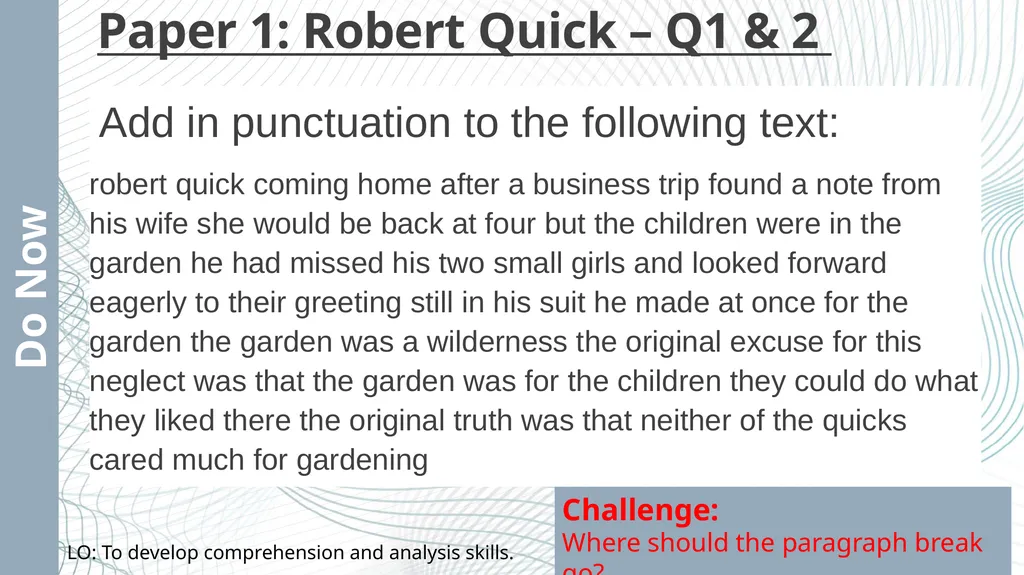
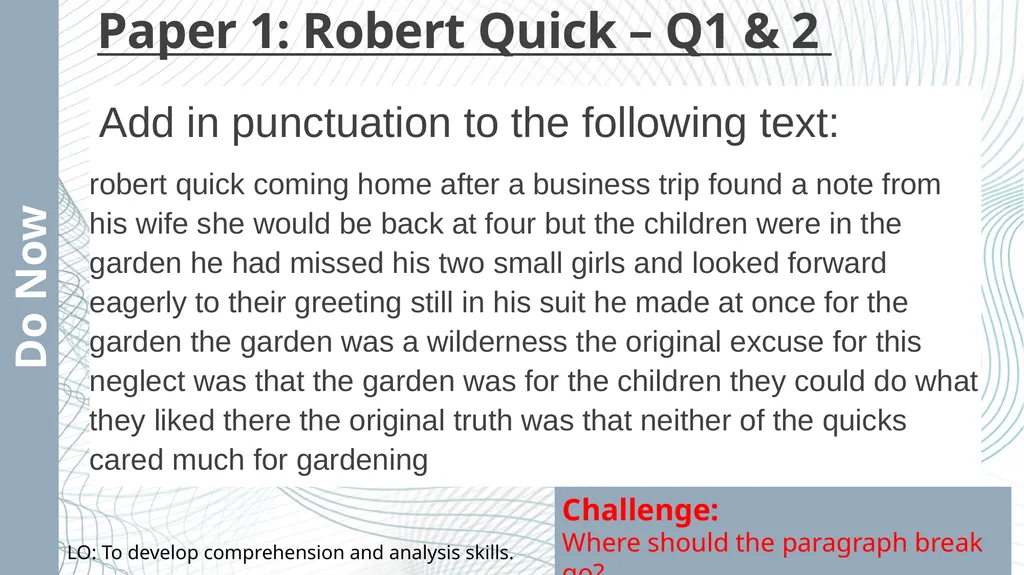
robert quick coming home after a business trip found a note from his wife she would be back at four but the children were in the garden he had missed his two small girls and looked forward eagerly to their greeting still in his suit he made at once for the garden the garden was a wilderness the original excuse for this neglect was that the garden was for the children they could do what they liked there the original truth was that neither of the quicks cared much for gardening Do Now Challenge:
Where should the paragraph break go? LO: To develop comprehension and analysis skills.<br>
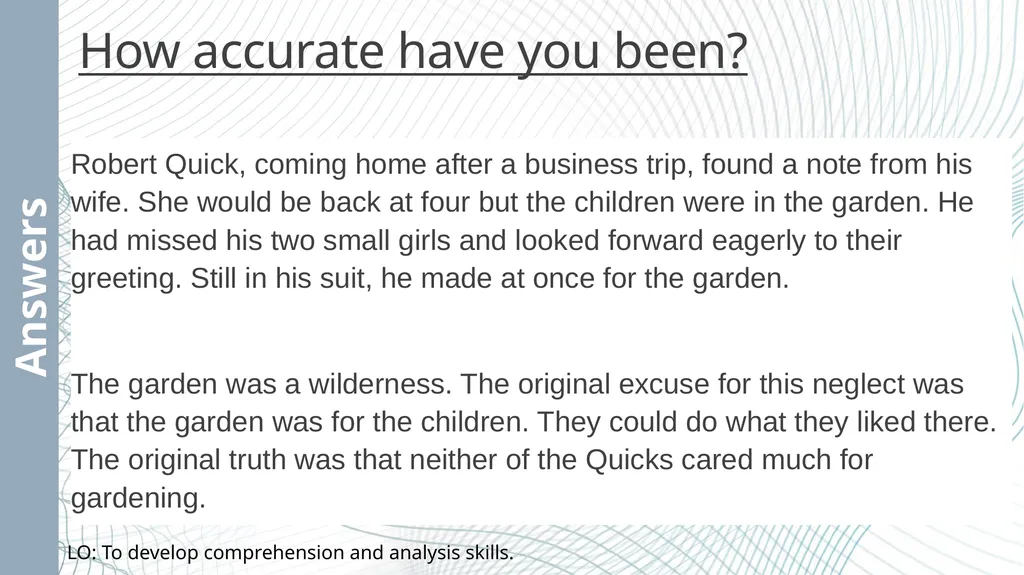
slide2. How accurate have you been? Robert Quick, coming home after a business trip, found a note from his wife. She would be back at four but the children were in the garden. He had missed his two small girls and looked forward eagerly to their greeting. Still in his suit, he made at once for the garden.
The garden was a wilderness. The original excuse for this neglect was that the garden was for the children. They could do what they liked there. The original truth was that neither of the Quicks cared much for gardening. Answers LO: To develop comprehension and analysis skills.<br>
slide3. Match the vocabulary to the correct definitions. having or showing a strong or unreasoning desire for revenge.
of the earliest time in history.
relating to human society at a very early stage of development, with people living in a simple way
the extreme limit of settled land beyond which lies wilderness
(of a woman or her behaviour) reserved, modest, and shy.
feeling or showing anger or annoyance at what is perceived as unfair treatment.
Frontier Primeval Vindictive Indignant Primitive Demure Unlocking Vocabulary LO: To develop comprehension and analysis skills.<br>
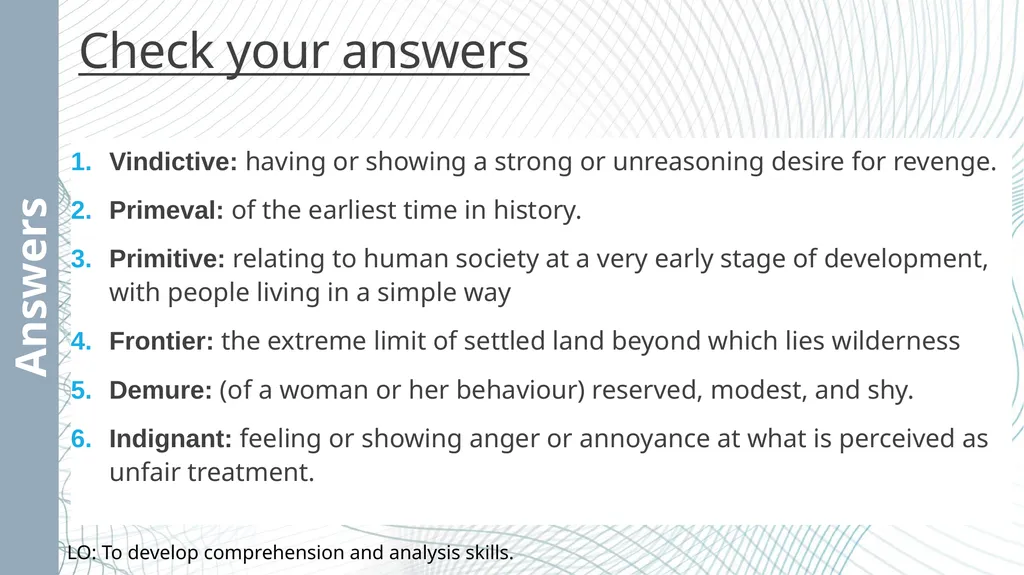
slide4. Check your answers Vindictive: having or showing a strong or unreasoning desire for revenge.
Primeval: of the earliest time in history.
Primitive: relating to human society at a very early stage of development, with people living in a simple way
Frontier: the extreme limit of settled land beyond which lies wilderness
Demure: (of a woman or her behaviour) reserved, modest, and shy.
Indignant: feeling or showing anger or annoyance at what is perceived as unfair treatment. Answers LO: To develop comprehension and analysis skills.<br>
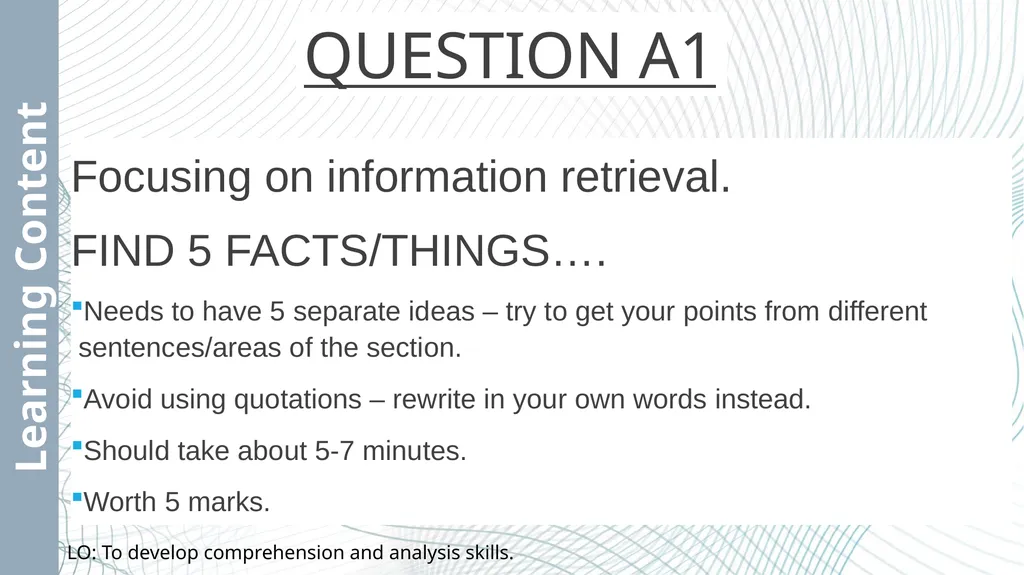
slide5. QUESTION A1 Focusing on information retrieval.
FIND 5 FACTS/THINGS….
Needs to have 5 separate ideas – try to get your points from different sentences/areas of the section.
Avoid using quotations – rewrite in your own words instead.
Should take about 5-7 minutes.
Worth 5 marks. Learning Content LO: To develop comprehension and analysis skills.<br>
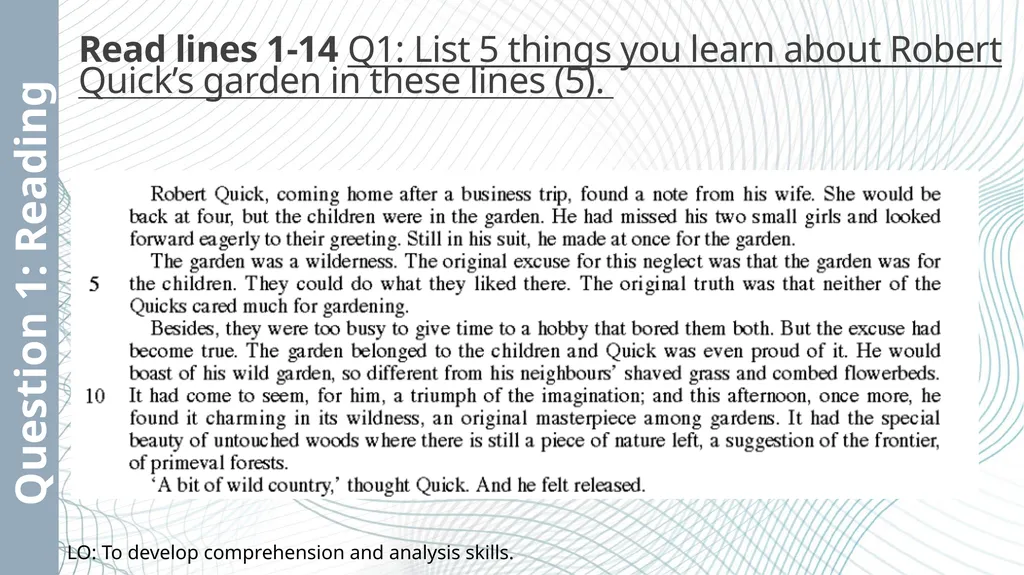
slide6. Read lines 1-14 Q1: List 5 things you learn about Robert Quick’s garden in these lines (5). Question 1: Reading LO: To develop comprehension and analysis skills.<br>
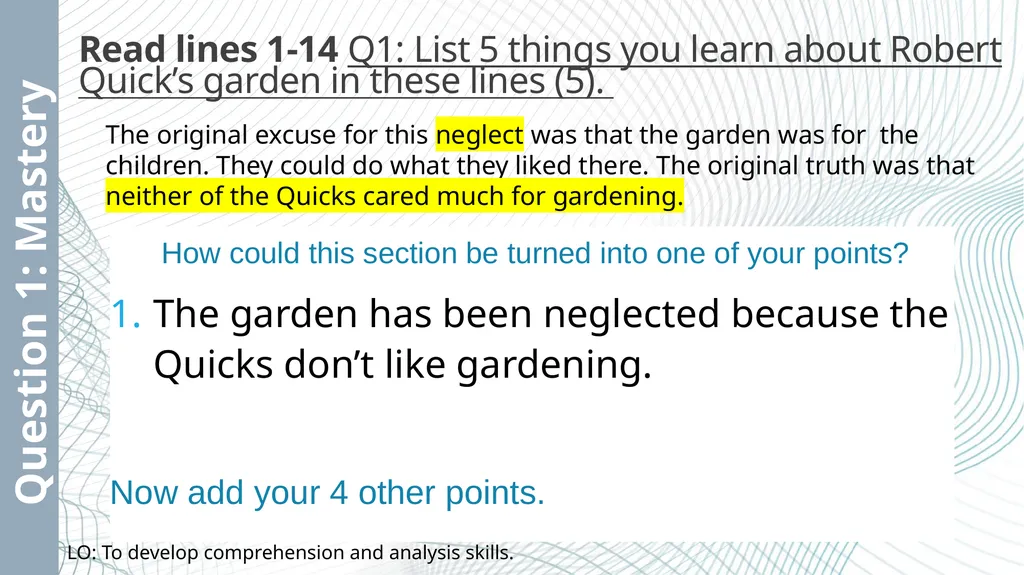
slide7. Read lines 1-14 Q1: List 5 things you learn about Robert Quick’s garden in these lines (5). Question 1: Mastery How could this section be turned into one of your points?
The garden has been neglected because the Quicks don’t like gardening.
Now add your 4 other points. The original excuse for this neglect was that the garden was for the children. They could do what they liked there. The original truth was that neither of the Quicks cared much for gardening. LO: To develop comprehension and analysis skills.<br>
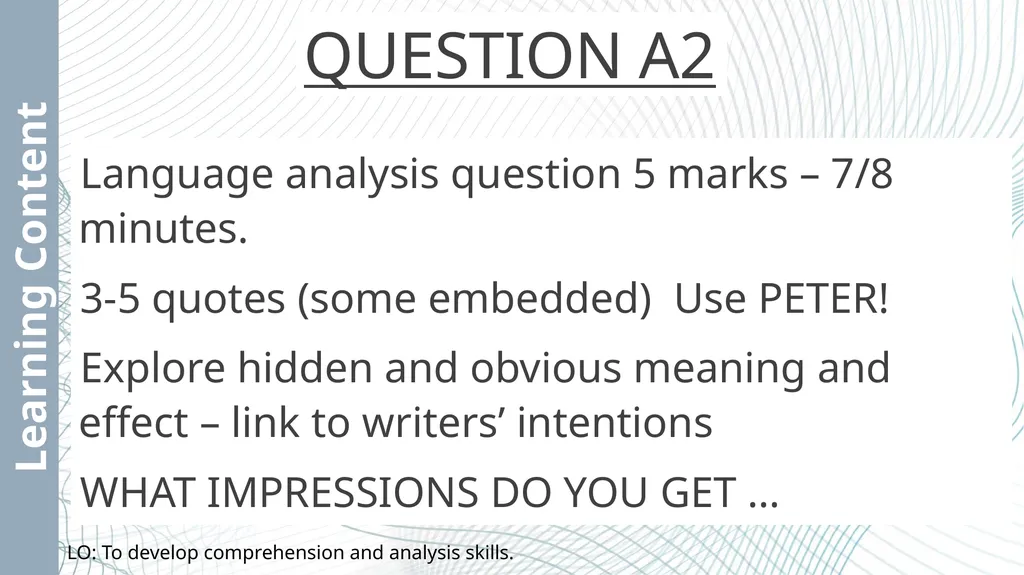
slide8. QUESTION A2 Language analysis question 5 marks – 7/8 minutes.
3-5 quotes (some embedded) Use PETER!
Explore hidden and obvious meaning and effect – link to writers’ intentions
WHAT IMPRESSIONS DO YOU GET … Learning Content LO: To develop comprehension and analysis skills.<br>
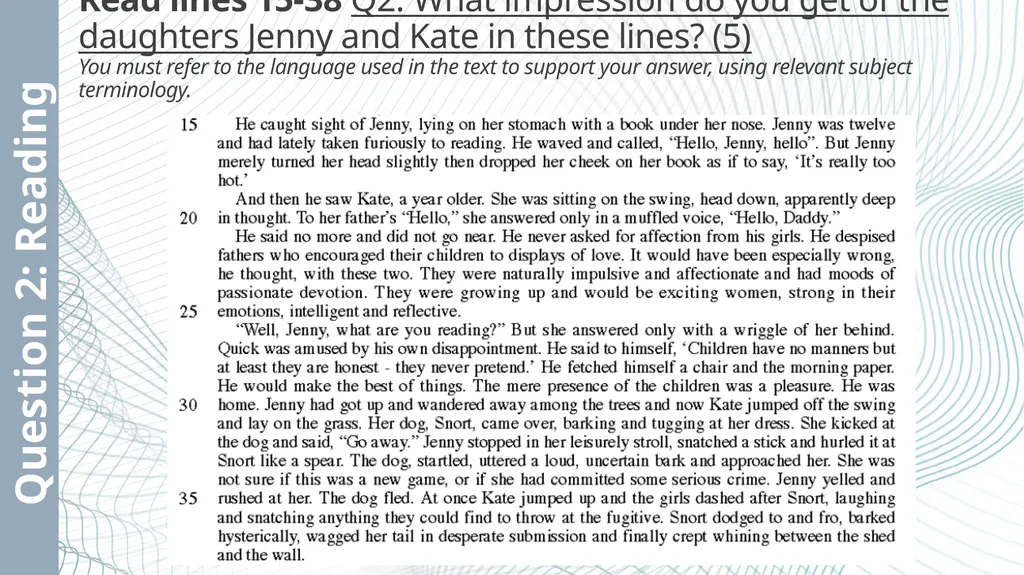
slide9. Read lines 15-38 Q2: What impression do you get of the daughters Jenny and Kate in these lines? (5) You must refer to the language used in the text to support your answer, using relevant subject terminology. Question 2: Reading<br>
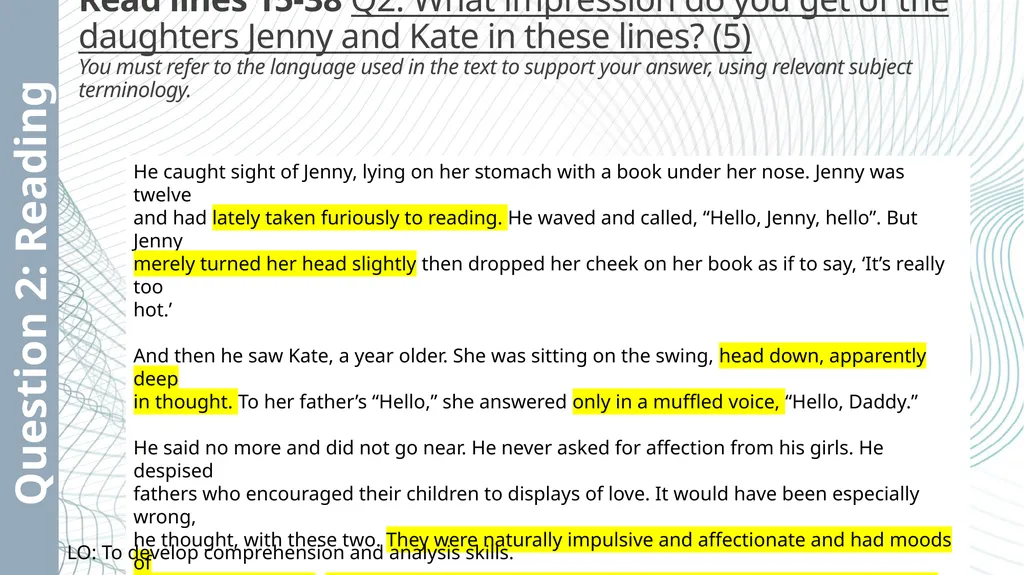
slide10. Read lines 15-38 Q2: What impression do you get of the daughters Jenny and Kate in these lines? (5) You must refer to the language used in the text to support your answer, using relevant subject terminology. Question 2: Reading He caught sight of Jenny, lying on her stomach with a book under her nose. Jenny was twelve
and had lately taken furiously to reading. He waved and called, “Hello, Jenny, hello”. But Jenny
merely turned her head slightly then dropped her cheek on her book as if to say, ‘It’s really too
hot.’
And then he saw Kate, a year older. She was sitting on the swing, head down, apparently deep
in thought. To her father’s “Hello,” she answered only in a muffled voice, “Hello, Daddy.”
He said no more and did not go near. He never asked for affection from his girls. He despised
fathers who encouraged their children to displays of love. It would have been especially wrong,
he thought, with these two. They were naturally impulsive and affectionate and had moods of
passionate devotion. They were growing up and would be exciting women, strong in their
emotions, intelligent and reflective. LO: To develop comprehension and analysis skills.<br>
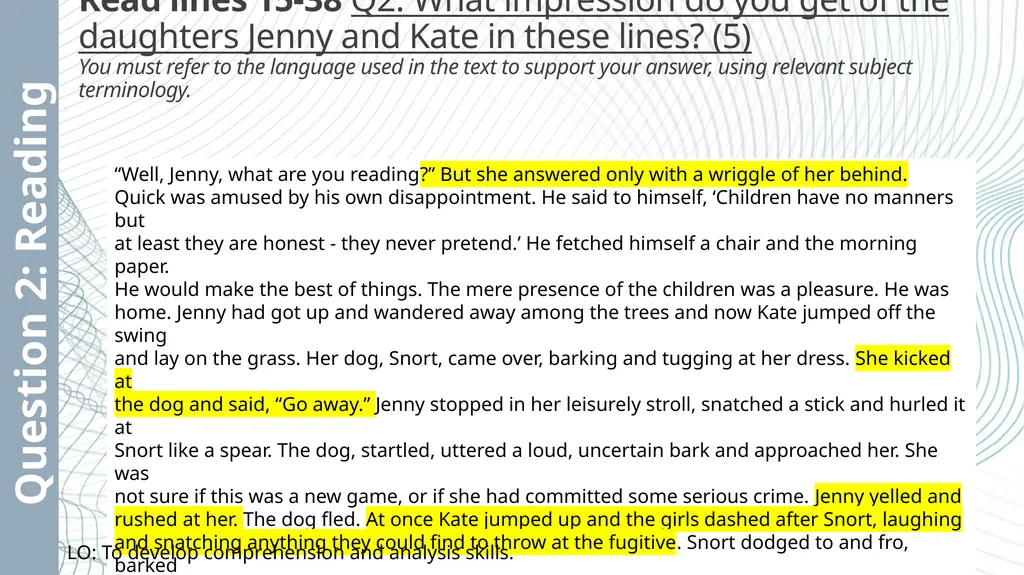
slide11. Read lines 15-38 Q2: What impression do you get of the daughters Jenny and Kate in these lines? (5) You must refer to the language used in the text to support your answer, using relevant subject terminology. Question 2: Reading “Well, Jenny, what are you reading?” But she answered only with a wriggle of her behind.
Quick was amused by his own disappointment. He said to himself, ‘Children have no manners but
at least they are honest - they never pretend.’ He fetched himself a chair and the morning paper.
He would make the best of things. The mere presence of the children was a pleasure. He was
home. Jenny had got up and wandered away among the trees and now Kate jumped off the swing
and lay on the grass. Her dog, Snort, came over, barking and tugging at her dress. She kicked at
the dog and said, “Go away.” Jenny stopped in her leisurely stroll, snatched a stick and hurled it at
Snort like a spear. The dog, startled, uttered a loud, uncertain bark and approached her. She was
not sure if this was a new game, or if she had committed some serious crime. Jenny yelled and
rushed at her. The dog fled. At once Kate jumped up and the girls dashed after Snort, laughing
and snatching anything they could find to throw at the fugitive. Snort dodged to and fro, barked
hysterically, wagged her tail in desperate submission and finally crept whining between the shed
and the wall. LO: To develop comprehension and analysis skills.<br>
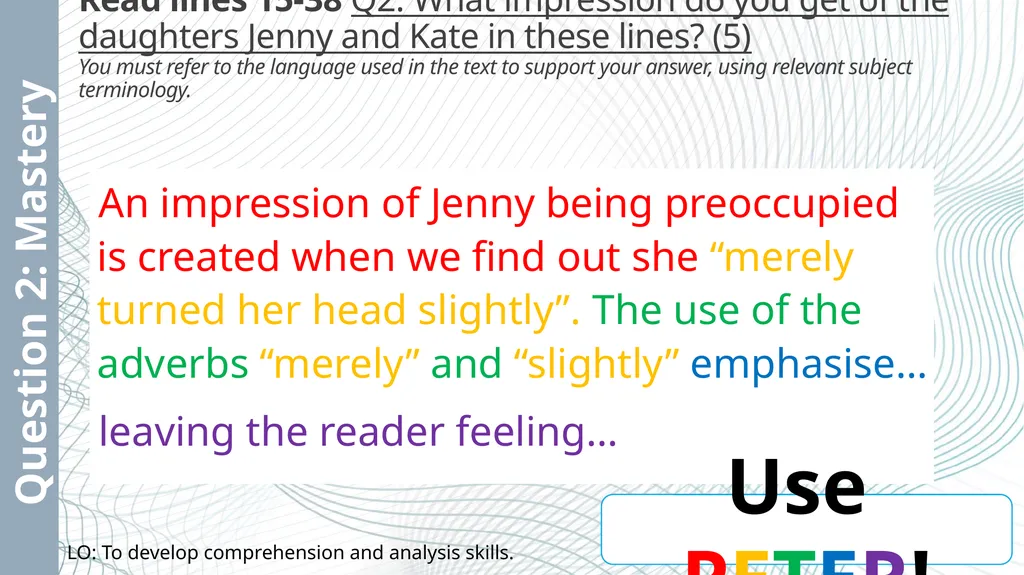
slide12. Read lines 15-38 Q2: What impression do you get of the daughters Jenny and Kate in these lines? (5) You must refer to the language used in the text to support your answer, using relevant subject terminology. Question 2: Mastery An impression of Jenny being preoccupied is created when we find out she “merely turned her head slightly”. The use of the adverbs “merely” and “slightly” emphasise…
leaving the reader feeling… Use PETER! LO: To develop comprehension and analysis skills.<br>
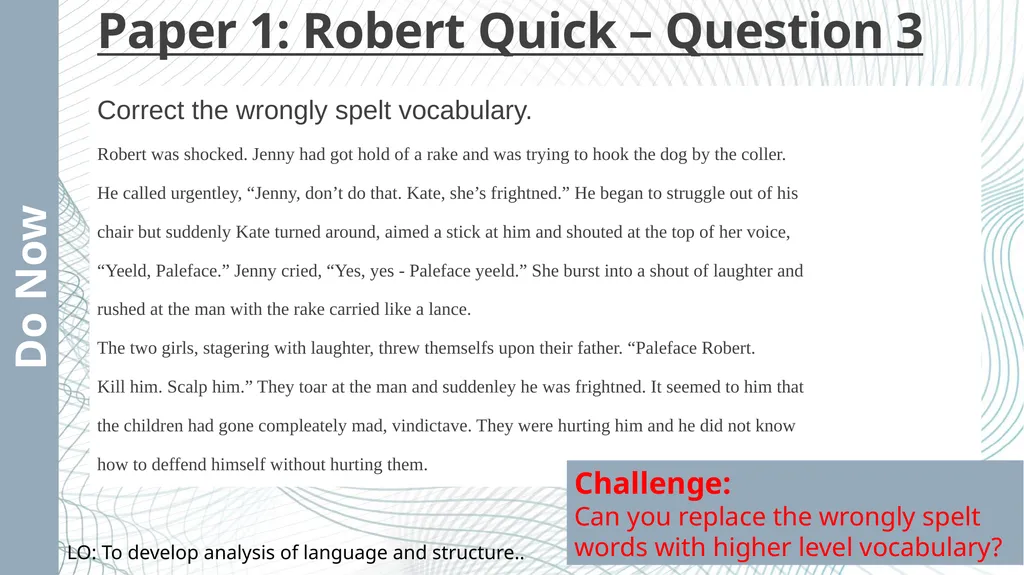
slide13. Paper 1: Robert Quick – Question 3 Correct the wrongly spelt vocabulary.
Robert was shocked. Jenny had got hold of a rake and was trying to hook the dog by the coller.
He called urgentley, “Jenny, don’t do that. Kate, she’s frightned.” He began to struggle out of his
chair but suddenly Kate turned around, aimed a stick at him and shouted at the top of her voice,
“Yeeld, Paleface.” Jenny cried, “Yes, yes - Paleface yeeld.” She burst into a shout of laughter and
rushed at the man with the rake carried like a lance.
The two girls, stagering with laughter, threw themselfs upon their father. “Paleface Robert.
Kill him. Scalp him.” They toar at the man and suddenley he was frightned. It seemed to him that
the children had gone compleately mad, vindictave. They were hurting him and he did not know
how to deffend himself without hurting them. Do Now Challenge:
Can you replace the wrongly spelt words with higher level vocabulary? LO: To develop analysis of language and structure..<br>
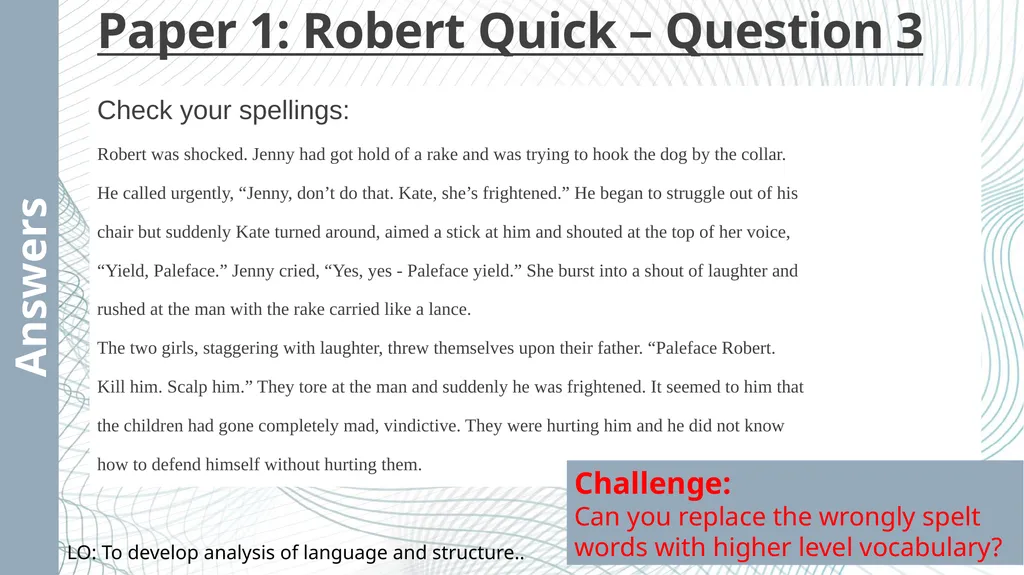
slide14. Paper 1: Robert Quick – Question 3 Check your spellings:
Robert was shocked. Jenny had got hold of a rake and was trying to hook the dog by the collar.
He called urgently, “Jenny, don’t do that. Kate, she’s frightened.” He began to struggle out of his
chair but suddenly Kate turned around, aimed a stick at him and shouted at the top of her voice,
“Yield, Paleface.” Jenny cried, “Yes, yes - Paleface yield.” She burst into a shout of laughter and
rushed at the man with the rake carried like a lance.
The two girls, staggering with laughter, threw themselves upon their father. “Paleface Robert.
Kill him. Scalp him.” They tore at the man and suddenly he was frightened. It seemed to him that
the children had gone completely mad, vindictive. They were hurting him and he did not know
how to defend himself without hurting them. Answers Challenge:
Can you replace the wrongly spelt words with higher level vocabulary? LO: To develop analysis of language and structure..<br>
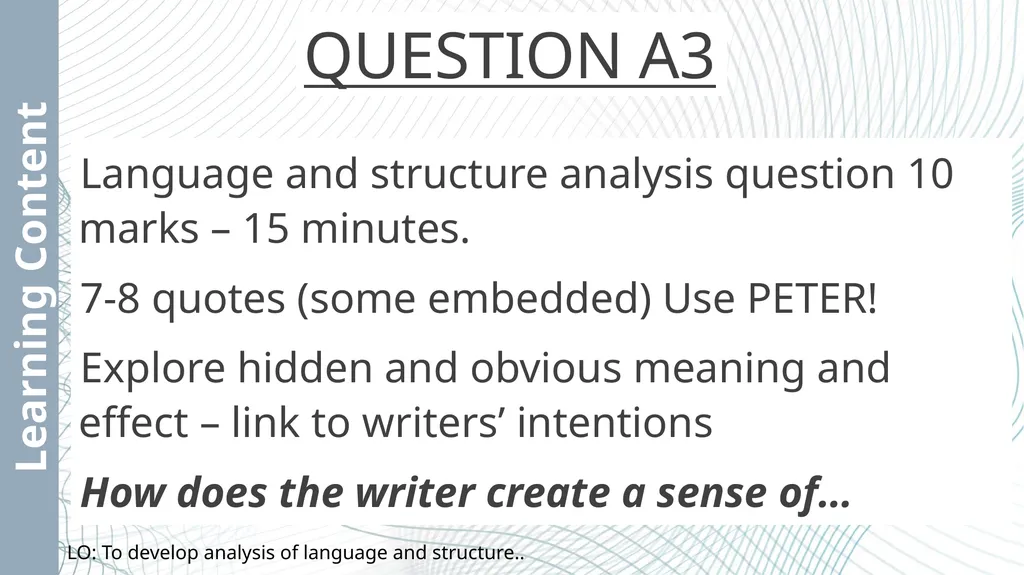
slide15. QUESTION A3 Language and structure analysis question 10 marks – 15 minutes.
7-8 quotes (some embedded) Use PETER!
Explore hidden and obvious meaning and effect – link to writers’ intentions
How does the writer create a sense of… Learning Content LO: To develop analysis of language and structure..<br>
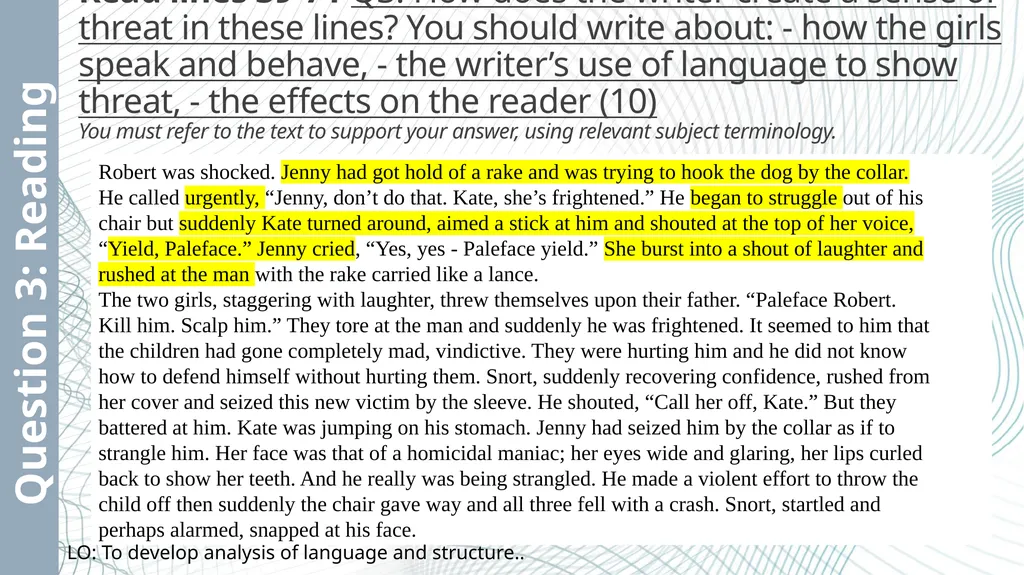
slide16. Read lines 39-71 Q3: How does the writer create a sense of threat in these lines? You should write about: - how the girls speak and behave, - the writer’s use of language to show threat, - the effects on the reader (10) You must refer to the text to support your answer, using relevant subject terminology. Question 3: Reading Robert was shocked. Jenny had got hold of a rake and was trying to hook the dog by the collar.
He called urgently, “Jenny, don’t do that. Kate, she’s frightened.” He began to struggle out of his
chair but suddenly Kate turned around, aimed a stick at him and shouted at the top of her voice,
“Yield, Paleface.” Jenny cried, “Yes, yes - Paleface yield.” She burst into a shout of laughter and
rushed at the man with the rake carried like a lance.
The two girls, staggering with laughter, threw themselves upon their father. “Paleface Robert.
Kill him. Scalp him.” They tore at the man and suddenly he was frightened. It seemed to him that
the children had gone completely mad, vindictive. They were hurting him and he did not know
how to defend himself without hurting them. Snort, suddenly recovering confidence, rushed from
her cover and seized this new victim by the sleeve. He shouted, “Call her off, Kate.” But they
battered at him. Kate was jumping on his stomach. Jenny had seized him by the collar as if to
strangle him. Her face was that of a homicidal maniac; her eyes wide and glaring, her lips curled
back to show her teeth. And he really was being strangled. He made a violent effort to throw the
child off then suddenly the chair gave way and all three fell with a crash. Snort, startled and
perhaps alarmed, snapped at his face. LO: To develop analysis of language and structure..<br>
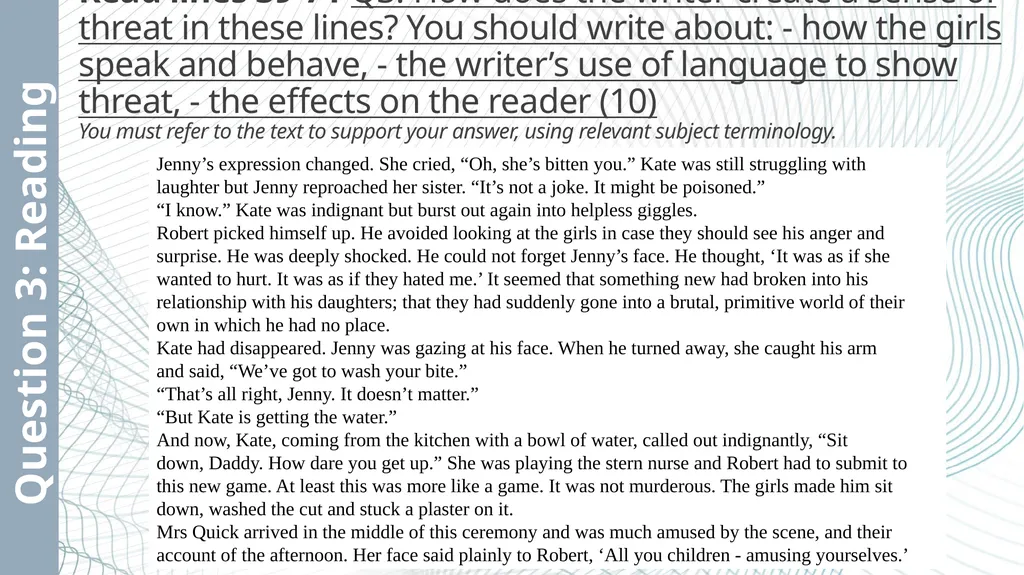
slide17. Read lines 39-71 Q3: How does the writer create a sense of threat in these lines? You should write about: - how the girls speak and behave, - the writer’s use of language to show threat, - the effects on the reader (10) You must refer to the text to support your answer, using relevant subject terminology. Question 3: Reading Jenny’s expression changed. She cried, “Oh, she’s bitten you.” Kate was still struggling with
laughter but Jenny reproached her sister. “It’s not a joke. It might be poisoned.”
“I know.” Kate was indignant but burst out again into helpless giggles.
Robert picked himself up. He avoided looking at the girls in case they should see his anger and
surprise. He was deeply shocked. He could not forget Jenny’s face. He thought, ‘It was as if she
wanted to hurt. It was as if they hated me.’ It seemed that something new had broken into his
relationship with his daughters; that they had suddenly gone into a brutal, primitive world of their
own in which he had no place.
Kate had disappeared. Jenny was gazing at his face. When he turned away, she caught his arm
and said, “We’ve got to wash your bite.”
“That’s all right, Jenny. It doesn’t matter.”
“But Kate is getting the water.”
And now, Kate, coming from the kitchen with a bowl of water, called out indignantly, “Sit
down, Daddy. How dare you get up.” She was playing the stern nurse and Robert had to submit to
this new game. At least this was more like a game. It was not murderous. The girls made him sit
down, washed the cut and stuck a plaster on it.
Mrs Quick arrived in the middle of this ceremony and was much amused by the scene, and their
account of the afternoon. Her face said plainly to Robert, ‘All you children - amusing yourselves.’<br>
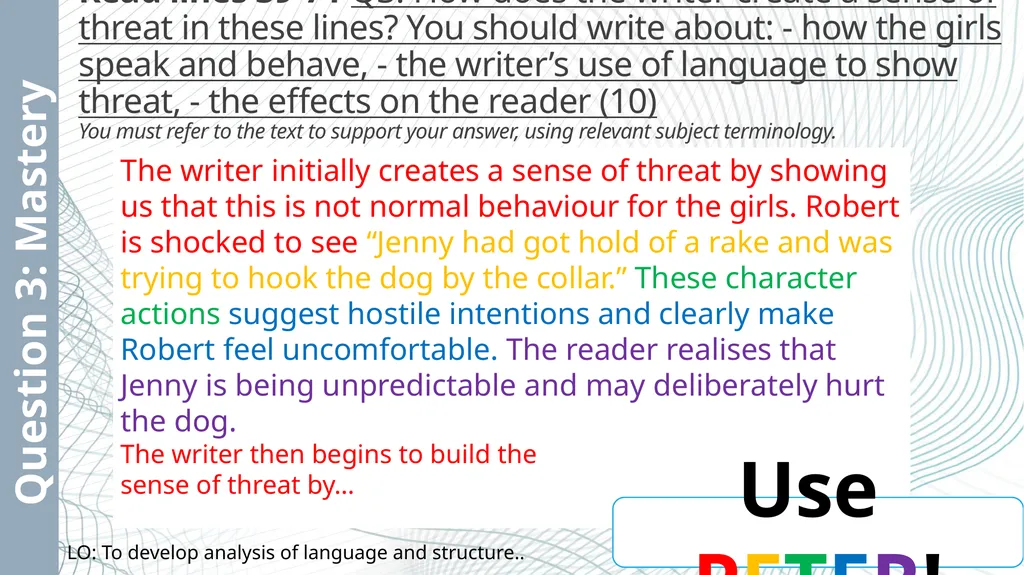
slide18. Read lines 39-71 Q3: How does the writer create a sense of threat in these lines? You should write about: - how the girls speak and behave, - the writer’s use of language to show threat, - the effects on the reader (10) You must refer to the text to support your answer, using relevant subject terminology. Question 3: Mastery The writer initially creates a sense of threat by showing us that this is not normal behaviour for the girls. Robert is shocked to see “Jenny had got hold of a rake and was trying to hook the dog by the collar.” These character actions suggest hostile intentions and clearly make Robert feel uncomfortable. The reader realises that Jenny is being unpredictable and may deliberately hurt the dog.
The writer then begins to build the
sense of threat by… Use PETER! LO: To develop analysis of language and structure..<br>
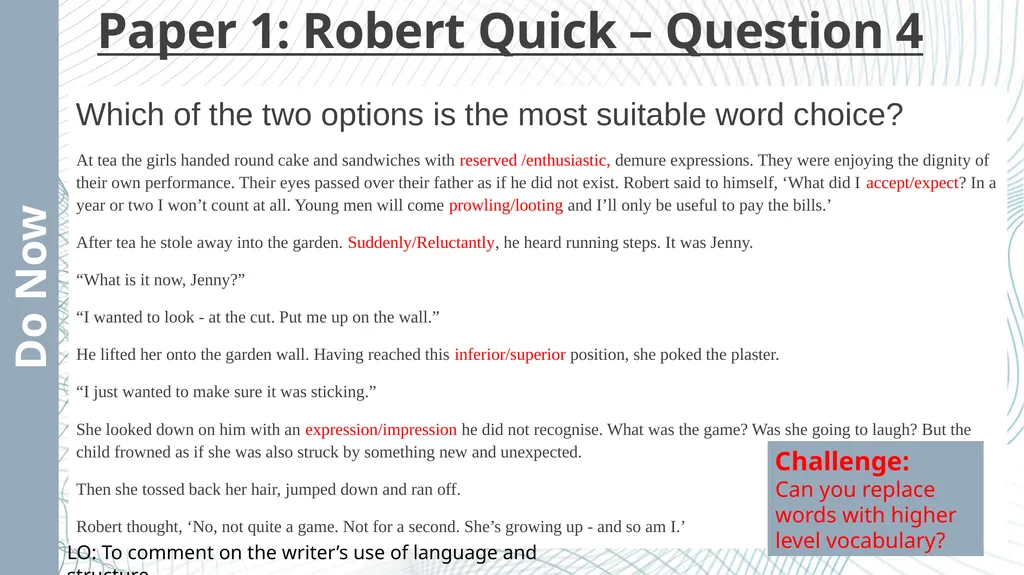
slide19. Paper 1: Robert Quick – Question 4 Which of the two options is the most suitable word choice?
At tea the girls handed round cake and sandwiches with reserved /enthusiastic, demure expressions. They were enjoying the dignity of their own performance. Their eyes passed over their father as if he did not exist. Robert said to himself, ‘What did I accept/expect? In a year or two I won’t count at all. Young men will come prowling/looting and I’ll only be useful to pay the bills.’
After tea he stole away into the garden. Suddenly/Reluctantly, he heard running steps. It was Jenny.
“What is it now, Jenny?”
“I wanted to look - at the cut. Put me up on the wall.”
He lifted her onto the garden wall. Having reached this inferior/superior position, she poked the plaster.
“I just wanted to make sure it was sticking.”
She looked down on him with an expression/impression he did not recognise. What was the game? Was she going to laugh? But the child frowned as if she was also struck by something new and unexpected.
Then she tossed back her hair, jumped down and ran off.
Robert thought, ‘No, not quite a game. Not for a second. She’s growing up - and so am I.’ Do Now Challenge:
Can you replace words with higher level vocabulary? LO: To comment on the writer’s use of language and structure.<br>
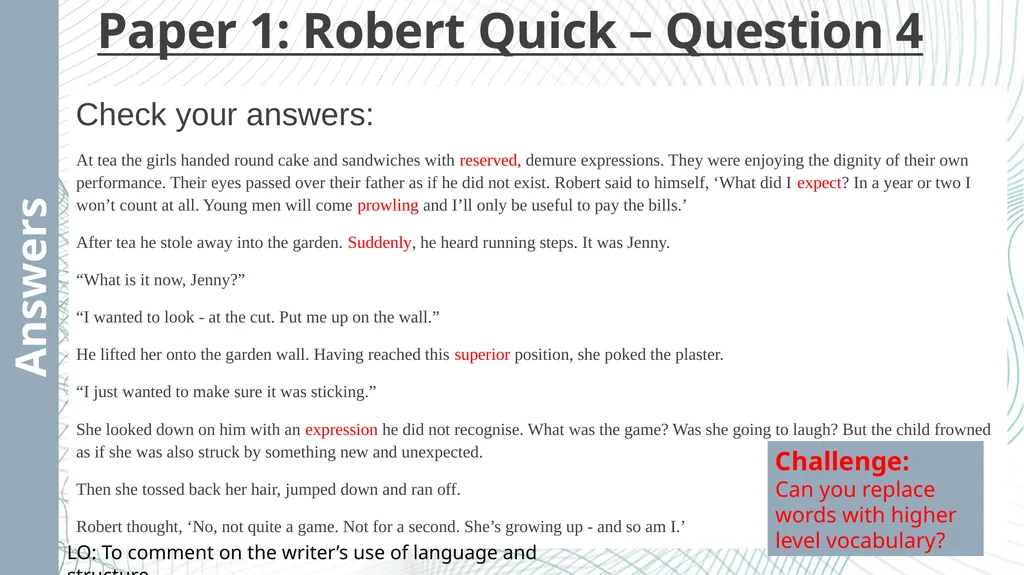
slide20. Paper 1: Robert Quick – Question 4 Check your answers:
At tea the girls handed round cake and sandwiches with reserved, demure expressions. They were enjoying the dignity of their own performance. Their eyes passed over their father as if he did not exist. Robert said to himself, ‘What did I expect? In a year or two I won’t count at all. Young men will come prowling and I’ll only be useful to pay the bills.’
After tea he stole away into the garden. Suddenly, he heard running steps. It was Jenny.
“What is it now, Jenny?”
“I wanted to look - at the cut. Put me up on the wall.”
He lifted her onto the garden wall. Having reached this superior position, she poked the plaster.
“I just wanted to make sure it was sticking.”
She looked down on him with an expression he did not recognise. What was the game? Was she going to laugh? But the child frowned as if she was also struck by something new and unexpected.
Then she tossed back her hair, jumped down and ran off.
Robert thought, ‘No, not quite a game. Not for a second. She’s growing up - and so am I.’ Answers Challenge:
Can you replace words with higher level vocabulary? LO: To comment on the writer’s use of language and structure.<br>
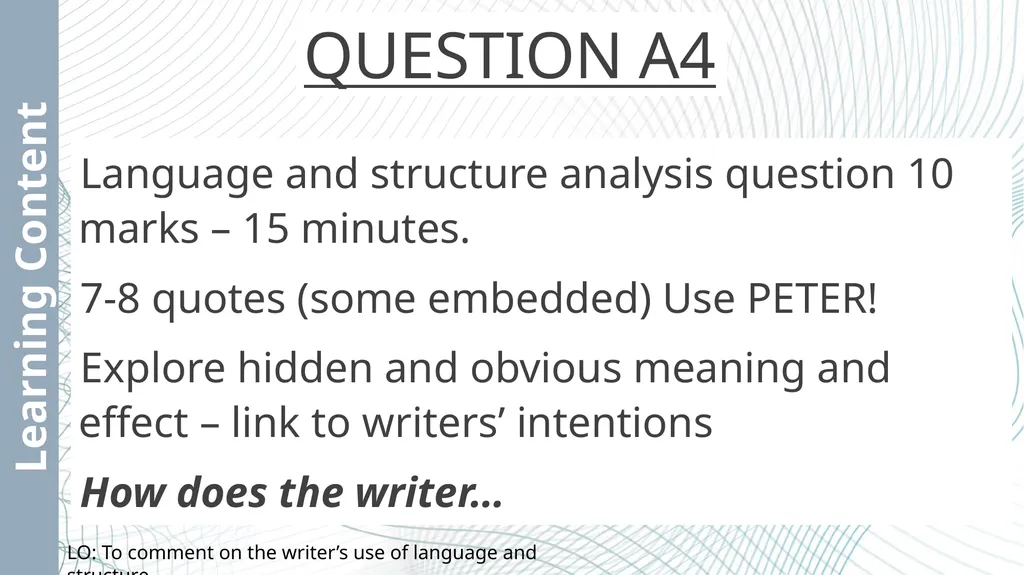
slide21. QUESTION A4 Language and structure analysis question 10 marks – 15 minutes.
7-8 quotes (some embedded) Use PETER!
Explore hidden and obvious meaning and effect – link to writers’ intentions
How does the writer… Learning Content LO: To comment on the writer’s use of language and structure.<br>
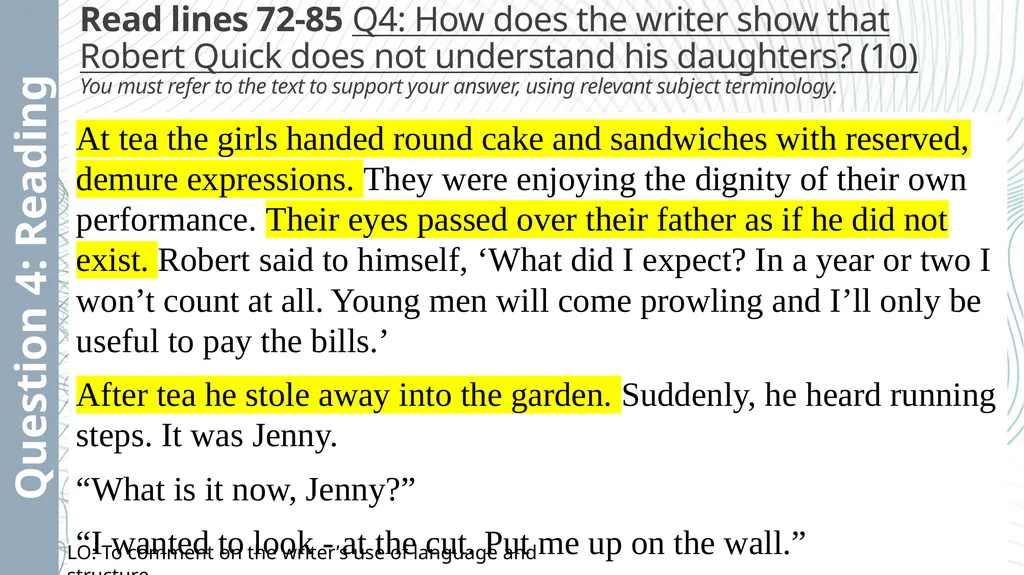
slide22. Read lines 72-85 Q4: How does the writer show that Robert Quick does not understand his daughters? (10) You must refer to the text to support your answer, using relevant subject terminology. At tea the girls handed round cake and sandwiches with reserved, demure expressions. They were enjoying the dignity of their own performance. Their eyes passed over their father as if he did not exist. Robert said to himself, ‘What did I expect? In a year or two I won’t count at all. Young men will come prowling and I’ll only be useful to pay the bills.’
After tea he stole away into the garden. Suddenly, he heard running steps. It was Jenny.
“What is it now, Jenny?”
“I wanted to look - at the cut. Put me up on the wall.” Question 4: Reading LO: To comment on the writer’s use of language and structure.<br>
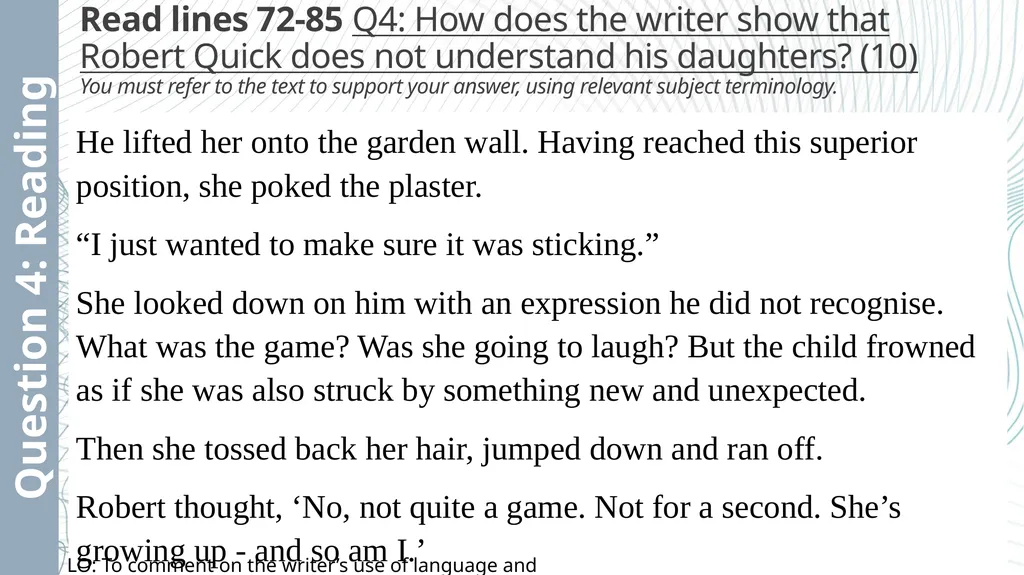
slide23. Read lines 72-85 Q4: How does the writer show that Robert Quick does not understand his daughters? (10) You must refer to the text to support your answer, using relevant subject terminology. He lifted her onto the garden wall. Having reached this superior position, she poked the plaster.
“I just wanted to make sure it was sticking.”
She looked down on him with an expression he did not recognise. What was the game? Was she going to laugh? But the child frowned as if she was also struck by something new and unexpected.
Then she tossed back her hair, jumped down and ran off.
Robert thought, ‘No, not quite a game. Not for a second. She’s growing up - and so am I.’ Question 4: Reading LO: To comment on the writer’s use of language and structure.<br>
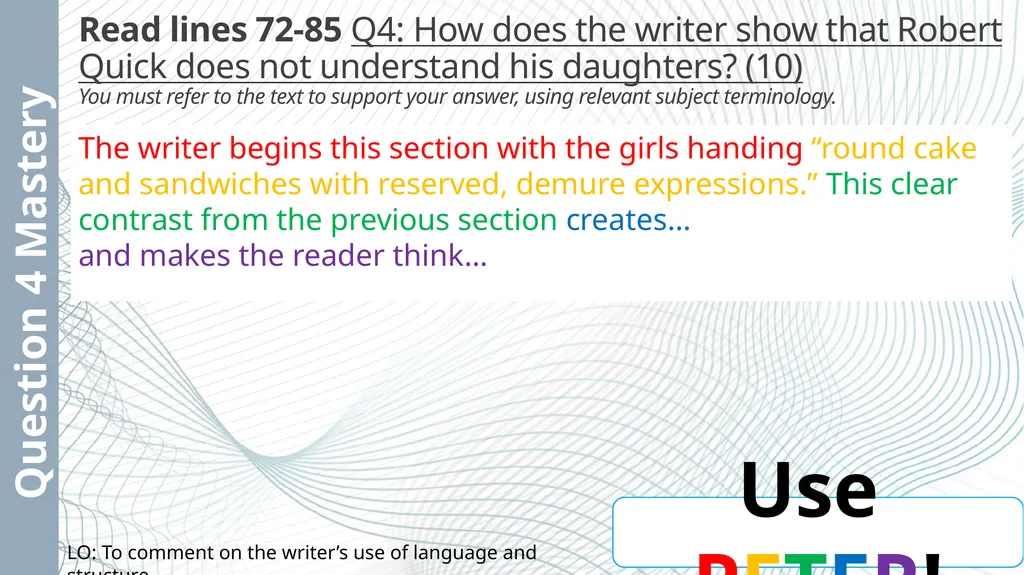
slide24. Read lines 72-85 Q4: How does the writer show that Robert Quick does not understand his daughters? (10) You must refer to the text to support your answer, using relevant subject terminology. Question 4 Mastery The writer begins this section with the girls handing “round cake and sandwiches with reserved, demure expressions.” This clear contrast from the previous section creates…
and makes the reader think… Use PETER! LO: To comment on the writer’s use of language and structure.<br>
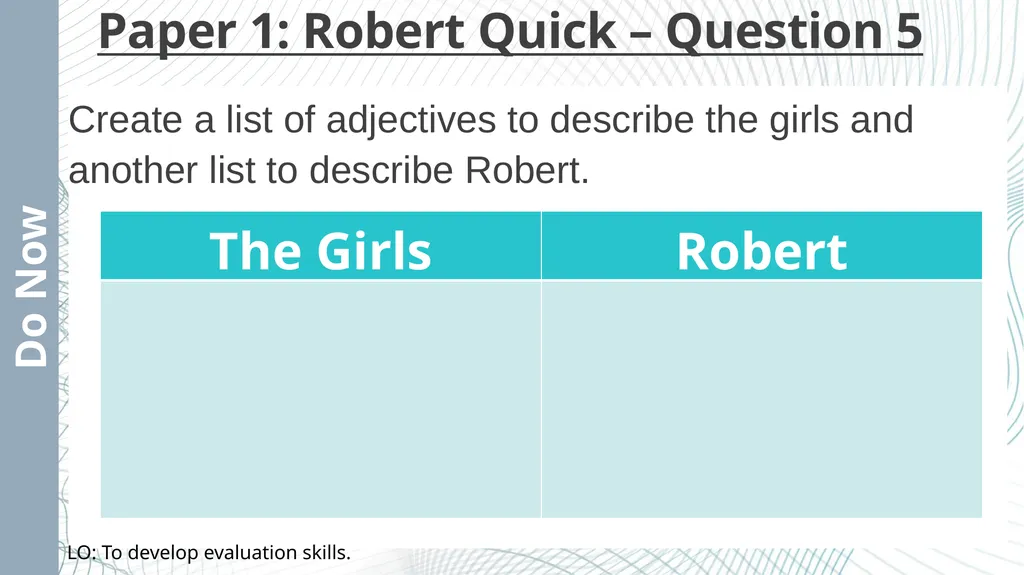
slide25. Paper 1: Robert Quick – Question 5 Create a list of adjectives to describe the girls and another list to describe Robert. Do Now LO: To develop evaluation skills.<br>
slide26. QUESTION A5 Question focused on evaluation and your own opinions 10 marks – 15 minutes.
7-8 quotes (some embedded) Use PETER!
Clearly show your opinion (I think.../I agree… etc)
Use the WHOLE of the text when selecting quotations.
How far do you agree with the statement provided? Learning Content LO: To develop evaluation skills.<br>
slide27. Now consider the passage as a whole.
Q5: “At the end of the story we are left uncertain if what happens is a game or not.” How far do you agree with this statement?
You should write about:
- your own thoughts and feelings about how the writer presents the game
- how the writer has created these thoughts and feelings (10)
You must refer to the text to support your answer. Question 5: Reading LO: To develop evaluation skills.<br>
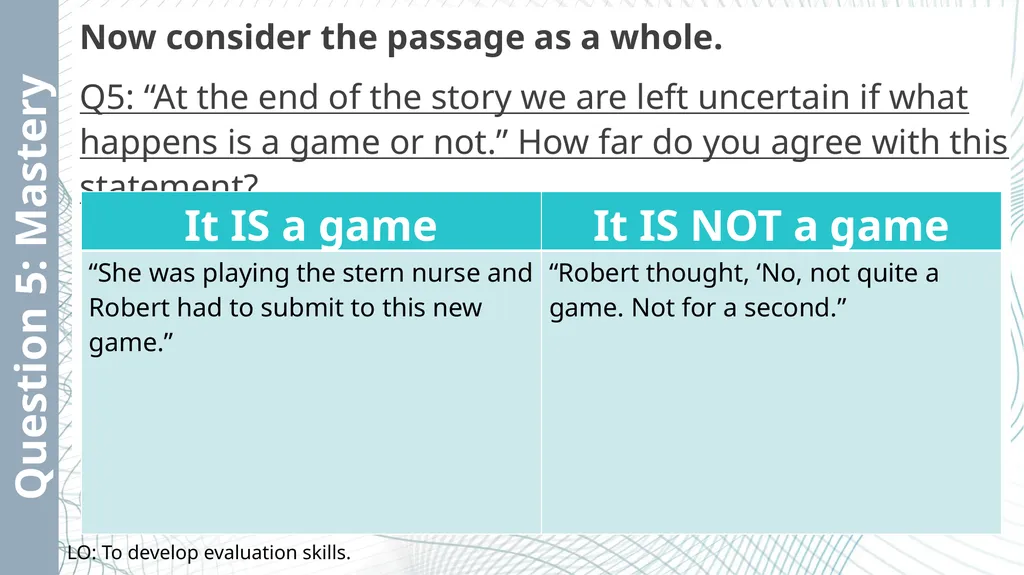
slide28. Now consider the passage as a whole.
Q5: “At the end of the story we are left uncertain if what happens is a game or not.” How far do you agree with this statement? Question 5: Mastery LO: To develop evaluation skills.<br>
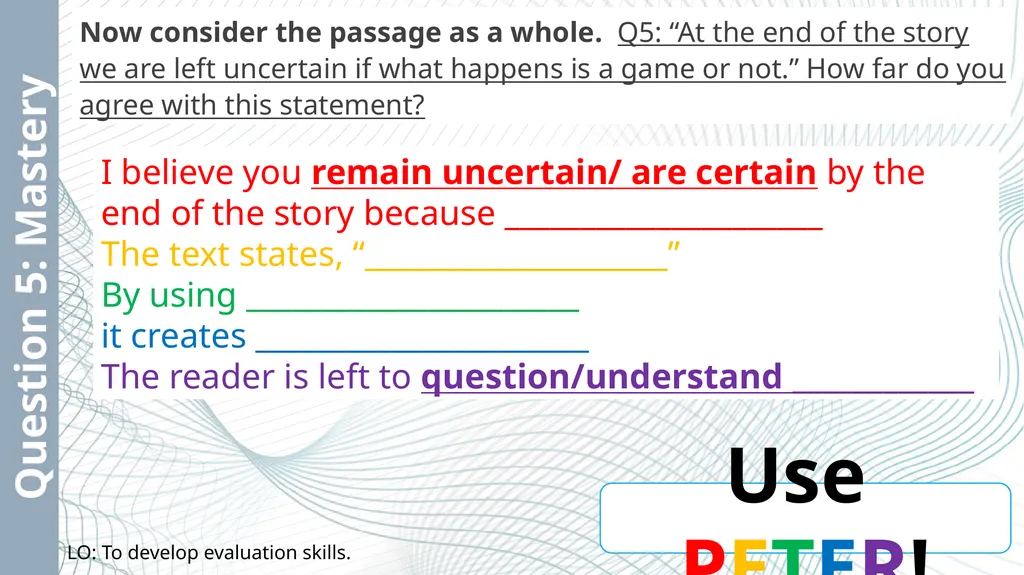
slide29. Now consider the passage as a whole. Q5: “At the end of the story we are left uncertain if what happens is a game or not.” How far do you agree with this statement? Question 5: Mastery Use PETER! I believe you remain uncertain/ are certain by the end of the story because _____________________
The text states, “____________________”
By using ______________________
it creates ______________________
The reader is left to question/understand ____________ LO: To develop evaluation skills.<br>
robert quick coming home after a business trip found a note from his wife she would be back at four but the children were in the garden he had missed his two small girls and looked forward eagerly to their greeting still in his suit he made at once for the garden the garden was a wilderness the original excuse for this neglect was that the garden was for the children they could do what they liked there the original truth was that neither of the quicks cared much for gardening Do Now Challenge:
Where should the paragraph break go? LO: To develop comprehension and analysis skills.<br>
slide2. How accurate have you been? Robert Quick, coming home after a business trip, found a note from his wife. She would be back at four but the children were in the garden. He had missed his two small girls and looked forward eagerly to their greeting. Still in his suit, he made at once for the garden.
The garden was a wilderness. The original excuse for this neglect was that the garden was for the children. They could do what they liked there. The original truth was that neither of the Quicks cared much for gardening. Answers LO: To develop comprehension and analysis skills.<br>
slide3. Match the vocabulary to the correct definitions. having or showing a strong or unreasoning desire for revenge.
of the earliest time in history.
relating to human society at a very early stage of development, with people living in a simple way
the extreme limit of settled land beyond which lies wilderness
(of a woman or her behaviour) reserved, modest, and shy.
feeling or showing anger or annoyance at what is perceived as unfair treatment.
Frontier Primeval Vindictive Indignant Primitive Demure Unlocking Vocabulary LO: To develop comprehension and analysis skills.<br>
slide4. Check your answers Vindictive: having or showing a strong or unreasoning desire for revenge.
Primeval: of the earliest time in history.
Primitive: relating to human society at a very early stage of development, with people living in a simple way
Frontier: the extreme limit of settled land beyond which lies wilderness
Demure: (of a woman or her behaviour) reserved, modest, and shy.
Indignant: feeling or showing anger or annoyance at what is perceived as unfair treatment. Answers LO: To develop comprehension and analysis skills.<br>
slide5. QUESTION A1 Focusing on information retrieval.
FIND 5 FACTS/THINGS….
Needs to have 5 separate ideas – try to get your points from different sentences/areas of the section.
Avoid using quotations – rewrite in your own words instead.
Should take about 5-7 minutes.
Worth 5 marks. Learning Content LO: To develop comprehension and analysis skills.<br>
slide6. Read lines 1-14 Q1: List 5 things you learn about Robert Quick’s garden in these lines (5). Question 1: Reading LO: To develop comprehension and analysis skills.<br>
slide7. Read lines 1-14 Q1: List 5 things you learn about Robert Quick’s garden in these lines (5). Question 1: Mastery How could this section be turned into one of your points?
The garden has been neglected because the Quicks don’t like gardening.
Now add your 4 other points. The original excuse for this neglect was that the garden was for the children. They could do what they liked there. The original truth was that neither of the Quicks cared much for gardening. LO: To develop comprehension and analysis skills.<br>
slide8. QUESTION A2 Language analysis question 5 marks – 7/8 minutes.
3-5 quotes (some embedded) Use PETER!
Explore hidden and obvious meaning and effect – link to writers’ intentions
WHAT IMPRESSIONS DO YOU GET … Learning Content LO: To develop comprehension and analysis skills.<br>
slide9. Read lines 15-38 Q2: What impression do you get of the daughters Jenny and Kate in these lines? (5) You must refer to the language used in the text to support your answer, using relevant subject terminology. Question 2: Reading<br>
slide10. Read lines 15-38 Q2: What impression do you get of the daughters Jenny and Kate in these lines? (5) You must refer to the language used in the text to support your answer, using relevant subject terminology. Question 2: Reading He caught sight of Jenny, lying on her stomach with a book under her nose. Jenny was twelve
and had lately taken furiously to reading. He waved and called, “Hello, Jenny, hello”. But Jenny
merely turned her head slightly then dropped her cheek on her book as if to say, ‘It’s really too
hot.’
And then he saw Kate, a year older. She was sitting on the swing, head down, apparently deep
in thought. To her father’s “Hello,” she answered only in a muffled voice, “Hello, Daddy.”
He said no more and did not go near. He never asked for affection from his girls. He despised
fathers who encouraged their children to displays of love. It would have been especially wrong,
he thought, with these two. They were naturally impulsive and affectionate and had moods of
passionate devotion. They were growing up and would be exciting women, strong in their
emotions, intelligent and reflective. LO: To develop comprehension and analysis skills.<br>
slide11. Read lines 15-38 Q2: What impression do you get of the daughters Jenny and Kate in these lines? (5) You must refer to the language used in the text to support your answer, using relevant subject terminology. Question 2: Reading “Well, Jenny, what are you reading?” But she answered only with a wriggle of her behind.
Quick was amused by his own disappointment. He said to himself, ‘Children have no manners but
at least they are honest - they never pretend.’ He fetched himself a chair and the morning paper.
He would make the best of things. The mere presence of the children was a pleasure. He was
home. Jenny had got up and wandered away among the trees and now Kate jumped off the swing
and lay on the grass. Her dog, Snort, came over, barking and tugging at her dress. She kicked at
the dog and said, “Go away.” Jenny stopped in her leisurely stroll, snatched a stick and hurled it at
Snort like a spear. The dog, startled, uttered a loud, uncertain bark and approached her. She was
not sure if this was a new game, or if she had committed some serious crime. Jenny yelled and
rushed at her. The dog fled. At once Kate jumped up and the girls dashed after Snort, laughing
and snatching anything they could find to throw at the fugitive. Snort dodged to and fro, barked
hysterically, wagged her tail in desperate submission and finally crept whining between the shed
and the wall. LO: To develop comprehension and analysis skills.<br>
slide12. Read lines 15-38 Q2: What impression do you get of the daughters Jenny and Kate in these lines? (5) You must refer to the language used in the text to support your answer, using relevant subject terminology. Question 2: Mastery An impression of Jenny being preoccupied is created when we find out she “merely turned her head slightly”. The use of the adverbs “merely” and “slightly” emphasise…
leaving the reader feeling… Use PETER! LO: To develop comprehension and analysis skills.<br>
slide13. Paper 1: Robert Quick – Question 3 Correct the wrongly spelt vocabulary.
Robert was shocked. Jenny had got hold of a rake and was trying to hook the dog by the coller.
He called urgentley, “Jenny, don’t do that. Kate, she’s frightned.” He began to struggle out of his
chair but suddenly Kate turned around, aimed a stick at him and shouted at the top of her voice,
“Yeeld, Paleface.” Jenny cried, “Yes, yes - Paleface yeeld.” She burst into a shout of laughter and
rushed at the man with the rake carried like a lance.
The two girls, stagering with laughter, threw themselfs upon their father. “Paleface Robert.
Kill him. Scalp him.” They toar at the man and suddenley he was frightned. It seemed to him that
the children had gone compleately mad, vindictave. They were hurting him and he did not know
how to deffend himself without hurting them. Do Now Challenge:
Can you replace the wrongly spelt words with higher level vocabulary? LO: To develop analysis of language and structure..<br>
slide14. Paper 1: Robert Quick – Question 3 Check your spellings:
Robert was shocked. Jenny had got hold of a rake and was trying to hook the dog by the collar.
He called urgently, “Jenny, don’t do that. Kate, she’s frightened.” He began to struggle out of his
chair but suddenly Kate turned around, aimed a stick at him and shouted at the top of her voice,
“Yield, Paleface.” Jenny cried, “Yes, yes - Paleface yield.” She burst into a shout of laughter and
rushed at the man with the rake carried like a lance.
The two girls, staggering with laughter, threw themselves upon their father. “Paleface Robert.
Kill him. Scalp him.” They tore at the man and suddenly he was frightened. It seemed to him that
the children had gone completely mad, vindictive. They were hurting him and he did not know
how to defend himself without hurting them. Answers Challenge:
Can you replace the wrongly spelt words with higher level vocabulary? LO: To develop analysis of language and structure..<br>
slide15. QUESTION A3 Language and structure analysis question 10 marks – 15 minutes.
7-8 quotes (some embedded) Use PETER!
Explore hidden and obvious meaning and effect – link to writers’ intentions
How does the writer create a sense of… Learning Content LO: To develop analysis of language and structure..<br>
slide16. Read lines 39-71 Q3: How does the writer create a sense of threat in these lines? You should write about: - how the girls speak and behave, - the writer’s use of language to show threat, - the effects on the reader (10) You must refer to the text to support your answer, using relevant subject terminology. Question 3: Reading Robert was shocked. Jenny had got hold of a rake and was trying to hook the dog by the collar.
He called urgently, “Jenny, don’t do that. Kate, she’s frightened.” He began to struggle out of his
chair but suddenly Kate turned around, aimed a stick at him and shouted at the top of her voice,
“Yield, Paleface.” Jenny cried, “Yes, yes - Paleface yield.” She burst into a shout of laughter and
rushed at the man with the rake carried like a lance.
The two girls, staggering with laughter, threw themselves upon their father. “Paleface Robert.
Kill him. Scalp him.” They tore at the man and suddenly he was frightened. It seemed to him that
the children had gone completely mad, vindictive. They were hurting him and he did not know
how to defend himself without hurting them. Snort, suddenly recovering confidence, rushed from
her cover and seized this new victim by the sleeve. He shouted, “Call her off, Kate.” But they
battered at him. Kate was jumping on his stomach. Jenny had seized him by the collar as if to
strangle him. Her face was that of a homicidal maniac; her eyes wide and glaring, her lips curled
back to show her teeth. And he really was being strangled. He made a violent effort to throw the
child off then suddenly the chair gave way and all three fell with a crash. Snort, startled and
perhaps alarmed, snapped at his face. LO: To develop analysis of language and structure..<br>
slide17. Read lines 39-71 Q3: How does the writer create a sense of threat in these lines? You should write about: - how the girls speak and behave, - the writer’s use of language to show threat, - the effects on the reader (10) You must refer to the text to support your answer, using relevant subject terminology. Question 3: Reading Jenny’s expression changed. She cried, “Oh, she’s bitten you.” Kate was still struggling with
laughter but Jenny reproached her sister. “It’s not a joke. It might be poisoned.”
“I know.” Kate was indignant but burst out again into helpless giggles.
Robert picked himself up. He avoided looking at the girls in case they should see his anger and
surprise. He was deeply shocked. He could not forget Jenny’s face. He thought, ‘It was as if she
wanted to hurt. It was as if they hated me.’ It seemed that something new had broken into his
relationship with his daughters; that they had suddenly gone into a brutal, primitive world of their
own in which he had no place.
Kate had disappeared. Jenny was gazing at his face. When he turned away, she caught his arm
and said, “We’ve got to wash your bite.”
“That’s all right, Jenny. It doesn’t matter.”
“But Kate is getting the water.”
And now, Kate, coming from the kitchen with a bowl of water, called out indignantly, “Sit
down, Daddy. How dare you get up.” She was playing the stern nurse and Robert had to submit to
this new game. At least this was more like a game. It was not murderous. The girls made him sit
down, washed the cut and stuck a plaster on it.
Mrs Quick arrived in the middle of this ceremony and was much amused by the scene, and their
account of the afternoon. Her face said plainly to Robert, ‘All you children - amusing yourselves.’<br>
slide18. Read lines 39-71 Q3: How does the writer create a sense of threat in these lines? You should write about: - how the girls speak and behave, - the writer’s use of language to show threat, - the effects on the reader (10) You must refer to the text to support your answer, using relevant subject terminology. Question 3: Mastery The writer initially creates a sense of threat by showing us that this is not normal behaviour for the girls. Robert is shocked to see “Jenny had got hold of a rake and was trying to hook the dog by the collar.” These character actions suggest hostile intentions and clearly make Robert feel uncomfortable. The reader realises that Jenny is being unpredictable and may deliberately hurt the dog.
The writer then begins to build the
sense of threat by… Use PETER! LO: To develop analysis of language and structure..<br>
slide19. Paper 1: Robert Quick – Question 4 Which of the two options is the most suitable word choice?
At tea the girls handed round cake and sandwiches with reserved /enthusiastic, demure expressions. They were enjoying the dignity of their own performance. Their eyes passed over their father as if he did not exist. Robert said to himself, ‘What did I accept/expect? In a year or two I won’t count at all. Young men will come prowling/looting and I’ll only be useful to pay the bills.’
After tea he stole away into the garden. Suddenly/Reluctantly, he heard running steps. It was Jenny.
“What is it now, Jenny?”
“I wanted to look - at the cut. Put me up on the wall.”
He lifted her onto the garden wall. Having reached this inferior/superior position, she poked the plaster.
“I just wanted to make sure it was sticking.”
She looked down on him with an expression/impression he did not recognise. What was the game? Was she going to laugh? But the child frowned as if she was also struck by something new and unexpected.
Then she tossed back her hair, jumped down and ran off.
Robert thought, ‘No, not quite a game. Not for a second. She’s growing up - and so am I.’ Do Now Challenge:
Can you replace words with higher level vocabulary? LO: To comment on the writer’s use of language and structure.<br>
slide20. Paper 1: Robert Quick – Question 4 Check your answers:
At tea the girls handed round cake and sandwiches with reserved, demure expressions. They were enjoying the dignity of their own performance. Their eyes passed over their father as if he did not exist. Robert said to himself, ‘What did I expect? In a year or two I won’t count at all. Young men will come prowling and I’ll only be useful to pay the bills.’
After tea he stole away into the garden. Suddenly, he heard running steps. It was Jenny.
“What is it now, Jenny?”
“I wanted to look - at the cut. Put me up on the wall.”
He lifted her onto the garden wall. Having reached this superior position, she poked the plaster.
“I just wanted to make sure it was sticking.”
She looked down on him with an expression he did not recognise. What was the game? Was she going to laugh? But the child frowned as if she was also struck by something new and unexpected.
Then she tossed back her hair, jumped down and ran off.
Robert thought, ‘No, not quite a game. Not for a second. She’s growing up - and so am I.’ Answers Challenge:
Can you replace words with higher level vocabulary? LO: To comment on the writer’s use of language and structure.<br>
slide21. QUESTION A4 Language and structure analysis question 10 marks – 15 minutes.
7-8 quotes (some embedded) Use PETER!
Explore hidden and obvious meaning and effect – link to writers’ intentions
How does the writer… Learning Content LO: To comment on the writer’s use of language and structure.<br>
slide22. Read lines 72-85 Q4: How does the writer show that Robert Quick does not understand his daughters? (10) You must refer to the text to support your answer, using relevant subject terminology. At tea the girls handed round cake and sandwiches with reserved, demure expressions. They were enjoying the dignity of their own performance. Their eyes passed over their father as if he did not exist. Robert said to himself, ‘What did I expect? In a year or two I won’t count at all. Young men will come prowling and I’ll only be useful to pay the bills.’
After tea he stole away into the garden. Suddenly, he heard running steps. It was Jenny.
“What is it now, Jenny?”
“I wanted to look - at the cut. Put me up on the wall.” Question 4: Reading LO: To comment on the writer’s use of language and structure.<br>
slide23. Read lines 72-85 Q4: How does the writer show that Robert Quick does not understand his daughters? (10) You must refer to the text to support your answer, using relevant subject terminology. He lifted her onto the garden wall. Having reached this superior position, she poked the plaster.
“I just wanted to make sure it was sticking.”
She looked down on him with an expression he did not recognise. What was the game? Was she going to laugh? But the child frowned as if she was also struck by something new and unexpected.
Then she tossed back her hair, jumped down and ran off.
Robert thought, ‘No, not quite a game. Not for a second. She’s growing up - and so am I.’ Question 4: Reading LO: To comment on the writer’s use of language and structure.<br>
slide24. Read lines 72-85 Q4: How does the writer show that Robert Quick does not understand his daughters? (10) You must refer to the text to support your answer, using relevant subject terminology. Question 4 Mastery The writer begins this section with the girls handing “round cake and sandwiches with reserved, demure expressions.” This clear contrast from the previous section creates…
and makes the reader think… Use PETER! LO: To comment on the writer’s use of language and structure.<br>
slide25. Paper 1: Robert Quick – Question 5 Create a list of adjectives to describe the girls and another list to describe Robert. Do Now LO: To develop evaluation skills.<br>
slide26. QUESTION A5 Question focused on evaluation and your own opinions 10 marks – 15 minutes.
7-8 quotes (some embedded) Use PETER!
Clearly show your opinion (I think.../I agree… etc)
Use the WHOLE of the text when selecting quotations.
How far do you agree with the statement provided? Learning Content LO: To develop evaluation skills.<br>
slide27. Now consider the passage as a whole.
Q5: “At the end of the story we are left uncertain if what happens is a game or not.” How far do you agree with this statement?
You should write about:
- your own thoughts and feelings about how the writer presents the game
- how the writer has created these thoughts and feelings (10)
You must refer to the text to support your answer. Question 5: Reading LO: To develop evaluation skills.<br>
slide28. Now consider the passage as a whole.
Q5: “At the end of the story we are left uncertain if what happens is a game or not.” How far do you agree with this statement? Question 5: Mastery LO: To develop evaluation skills.<br>
slide29. Now consider the passage as a whole. Q5: “At the end of the story we are left uncertain if what happens is a game or not.” How far do you agree with this statement? Question 5: Mastery Use PETER! I believe you remain uncertain/ are certain by the end of the story because _____________________
The text states, “____________________”
By using ______________________
it creates ______________________
The reader is left to question/understand ____________ LO: To develop evaluation skills.<br>