Part II Knowing How to Assess Chapter 5 Minimizing
Description: Part II Knowing How to Assess Chapter 5 Minimizing Error Review of Appl 644 Personnel Psychology Measurement Theory Reliability Validity Assessment is broader term than Measurement What does this mean? chapter 5 Minimizing Error 1
Related Topics
Download Presentation
"Part II Knowing How to Assess Chapter 5 Minimizing" is the property of its rightful owner. Permission is granted to download and print the materials on this website for personal, non-commercial use only, and to display it on your personal computer provided you do not modify the materials and that you retain all copyright notices contained in the materials. By downloading content from our website, you accept the terms of this agreement.
Presentation Transcript
slide1. Part II Knowing How to AssessChapter 5 Minimizing Error Review of Appl 644 Personnel Psychology
Measurement Theory
Reliability
Validity
Assessment is broader term than Measurement
What does this mean? chapter 5 Minimizing Error 1<br>
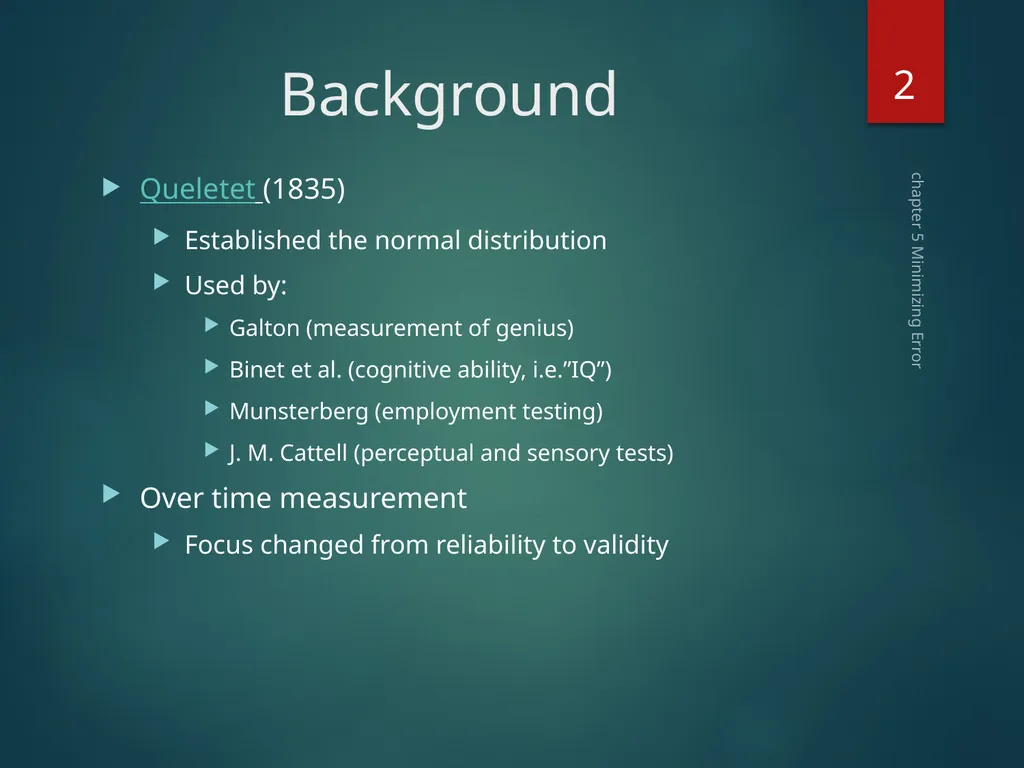
slide2. Background Queletet (1835)
Established the normal distribution
Used by:
Galton (measurement of genius)
Binet et al. (cognitive ability, i.e.”IQ”)
Munsterberg (employment testing)
J. M. Cattell (perceptual and sensory tests)
Over time measurement
Focus changed from reliability to validity chapter 5 Minimizing Error 2<br>
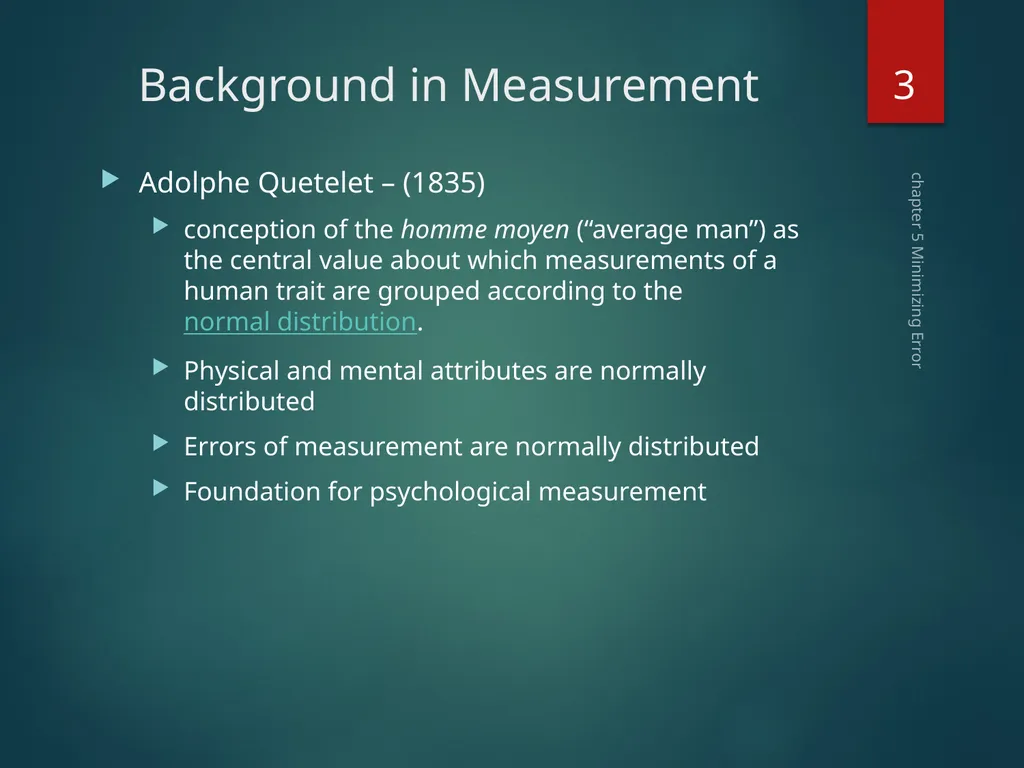
slide3. Background in Measurement Adolphe Quetelet – (1835)
conception of the homme moyen (“average man”) as the central value about which measurements of a human trait are grouped according to the normal distribution.
Physical and mental attributes are normally distributed
Errors of measurement are normally distributed
Foundation for psychological measurement chapter 5 Minimizing Error 3<br>
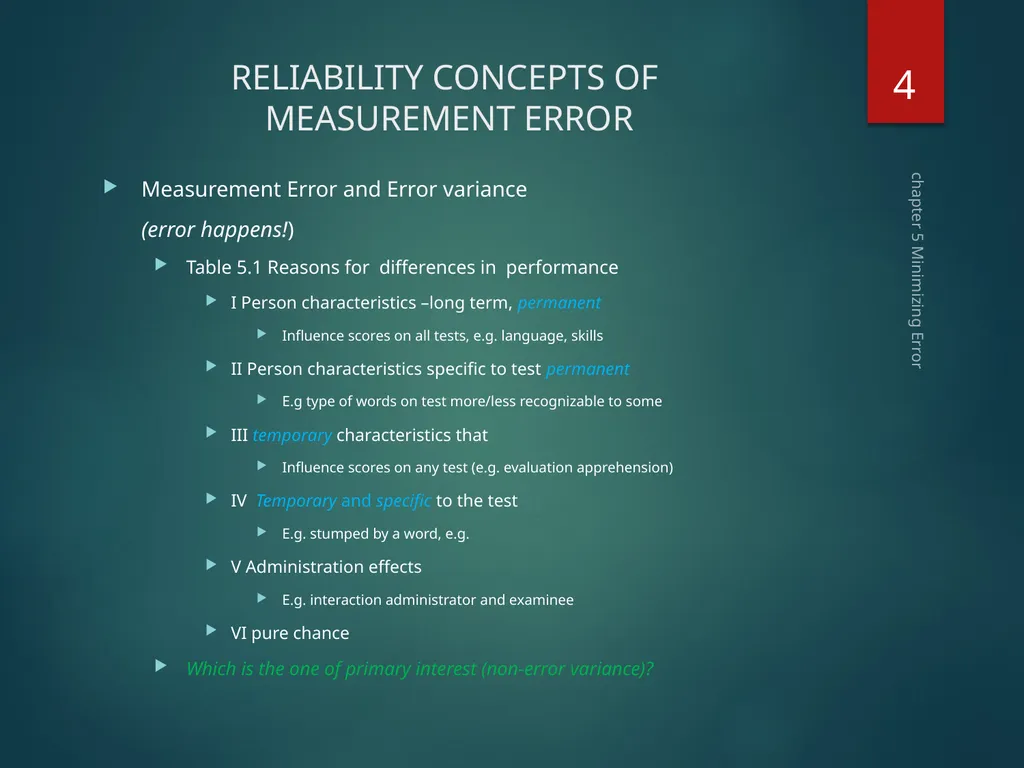
slide4. RELIABILITY CONCEPTS OF MEASUREMENT ERROR Measurement Error and Error variance
(error happens!)
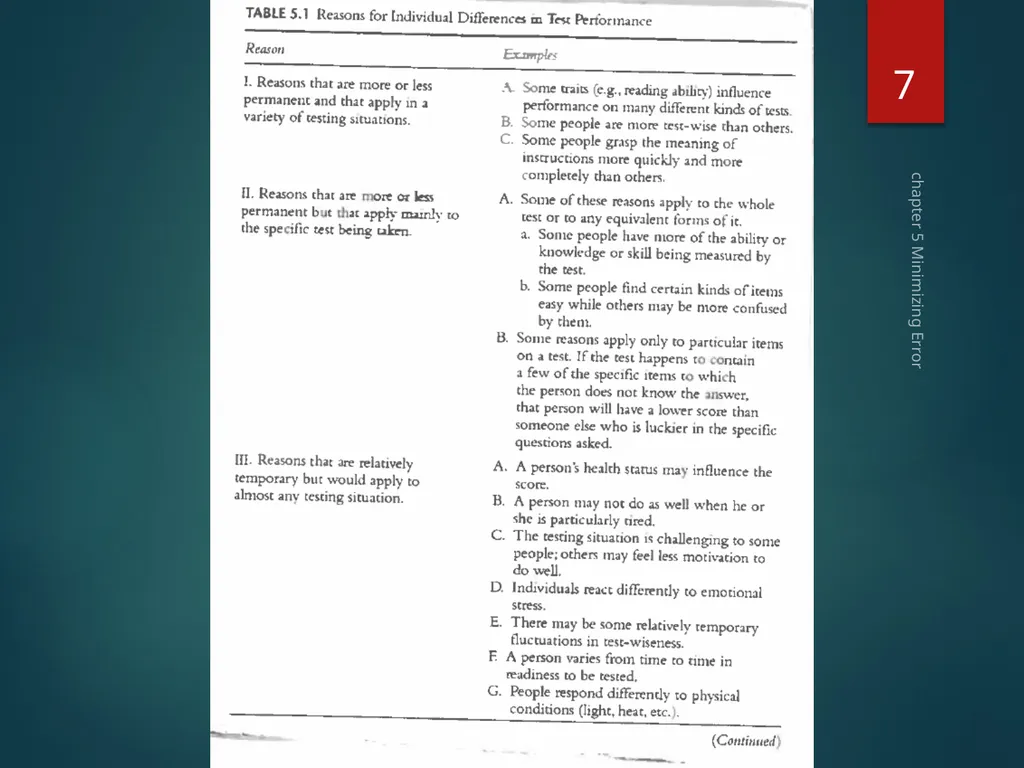
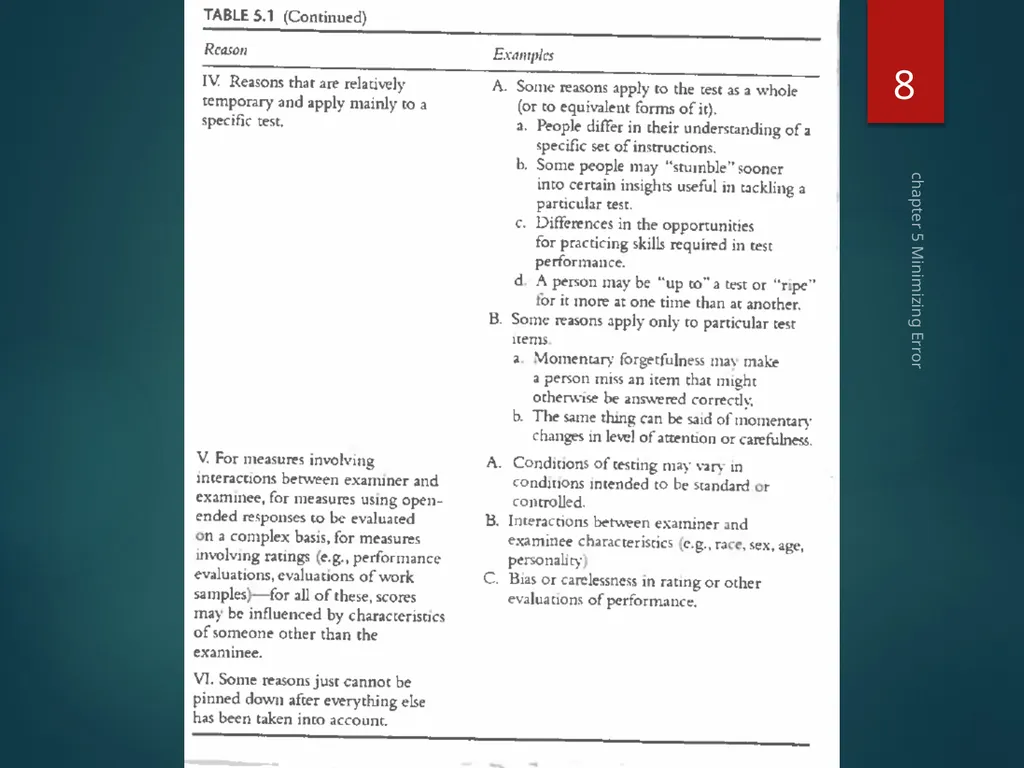
Table 5.1 Reasons for differences in performance
I Person characteristics –long term, permanent
Influence scores on all tests, e.g. language, skills
II Person characteristics specific to test permanent
E.g type of words on test more/less recognizable to some
III temporary characteristics that
Influence scores on any test (e.g. evaluation apprehension)
IV Temporary and specific to the test
E.g. stumped by a word, e.g.
V Administration effects
E.g. interaction administrator and examinee
VI pure chance
Which is the one of primary interest (non-error variance)? chapter 5 Minimizing Error 4<br>
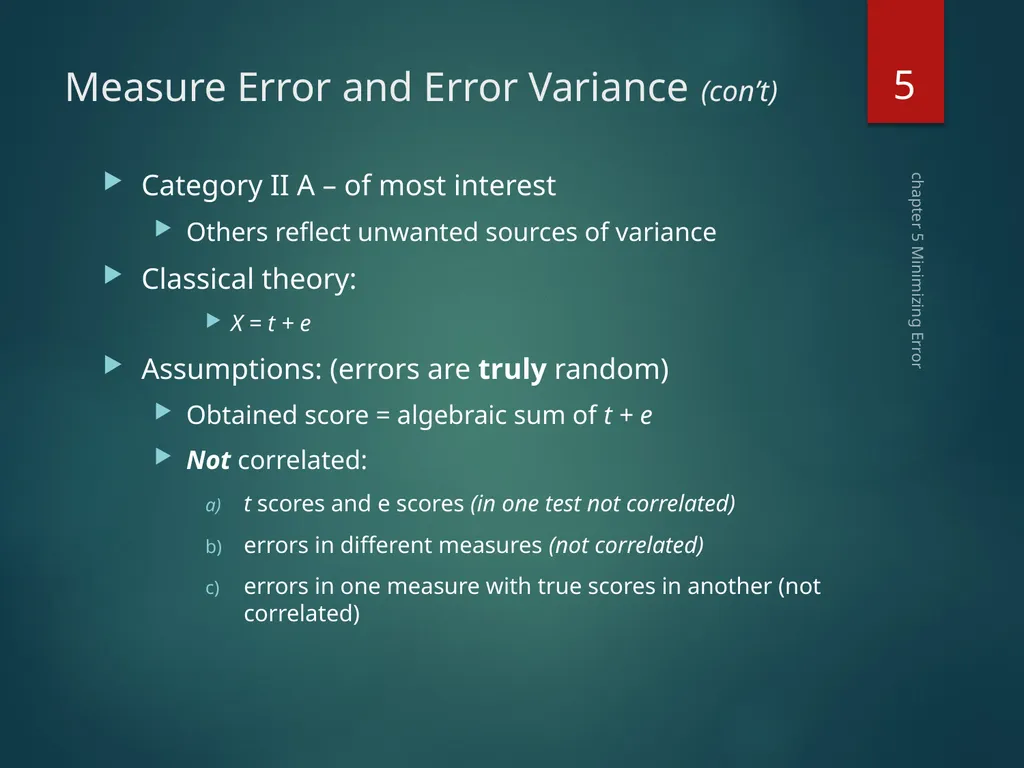
slide5. Measure Error and Error Variance (con’t) Category II A – of most interest
Others reflect unwanted sources of variance
Classical theory:
X = t + e
Assumptions: (errors are truly random)
Obtained score = algebraic sum of t + e
Not correlated:
t scores and e scores (in one test not correlated)
errors in different measures (not correlated)
errors in one measure with true scores in another (not correlated) chapter 5 Minimizing Error 5<br>
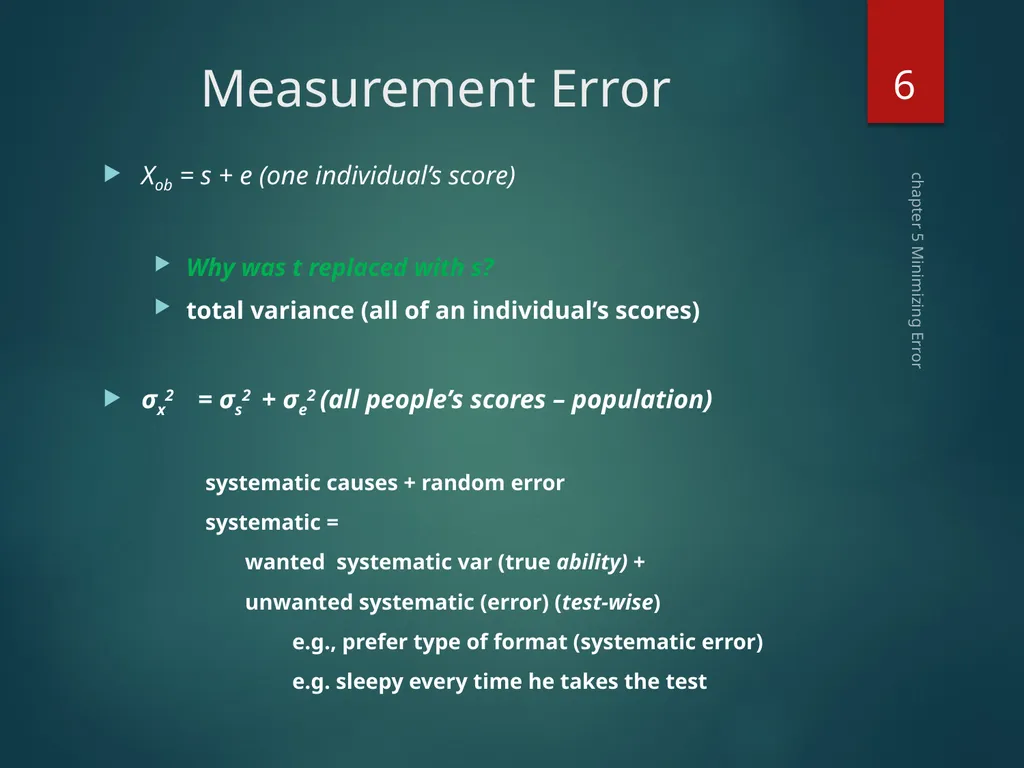
slide6. Measurement Error Xob = s + e (one individual’s score)
Why was t replaced with s?
total variance (all of an individual’s scores)
σx2 = σs2 + σe2 (all people’s scores – population)
systematic causes + random error
systematic =
wanted systematic var (true ability) +
unwanted systematic (error) (test-wise)
e.g., prefer type of format (systematic error)
e.g. sleepy every time he takes the test chapter 5 Minimizing Error 6<br>
slide7. chapter 5 Minimizing Error 7<br>
slide8. chapter 5 Minimizing Error 8<br>
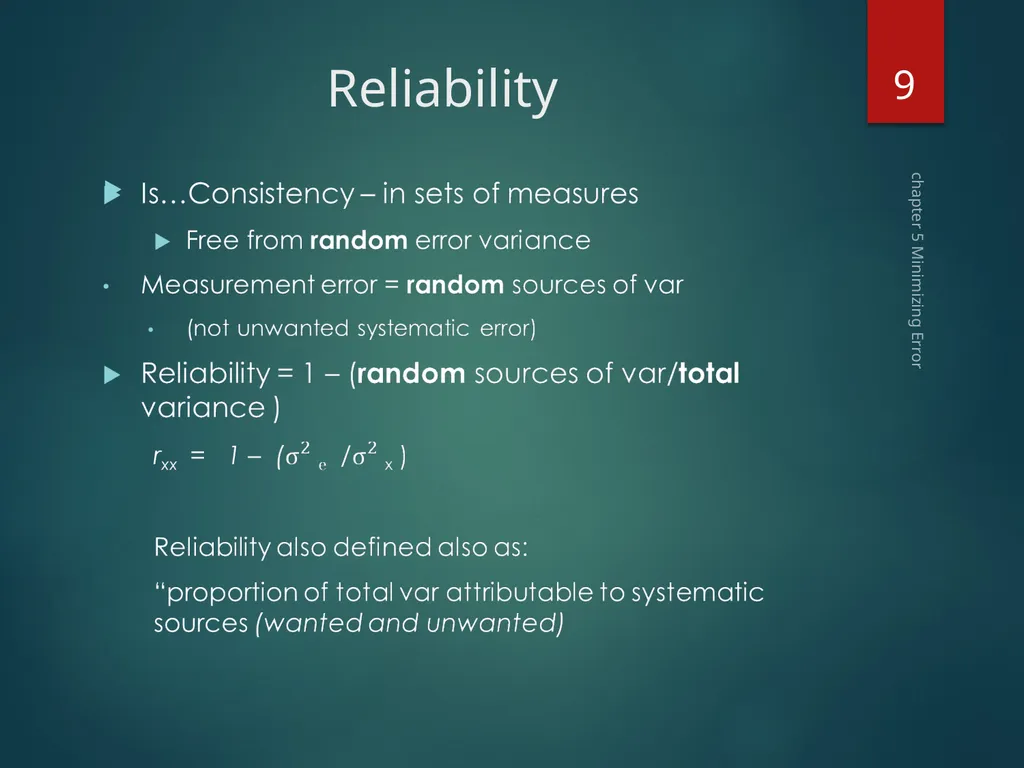
slide9. Reliability chapter 5 Minimizing Error 9<br>
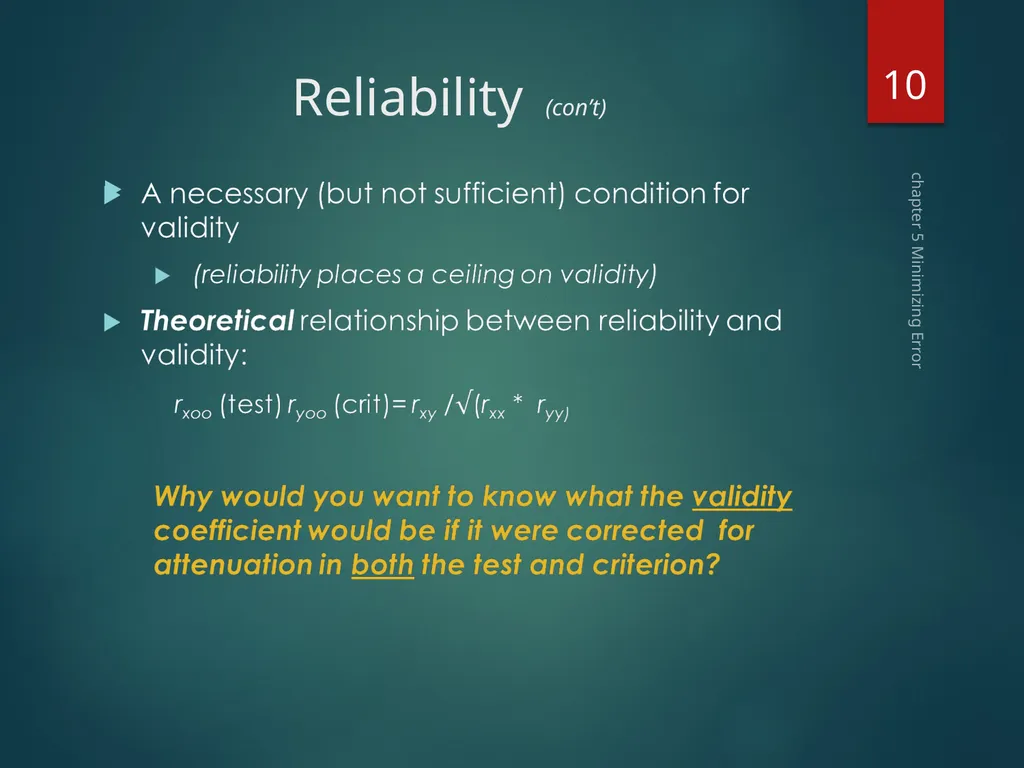
slide10. Reliability (con’t) chapter 5 Minimizing Error 10<br>
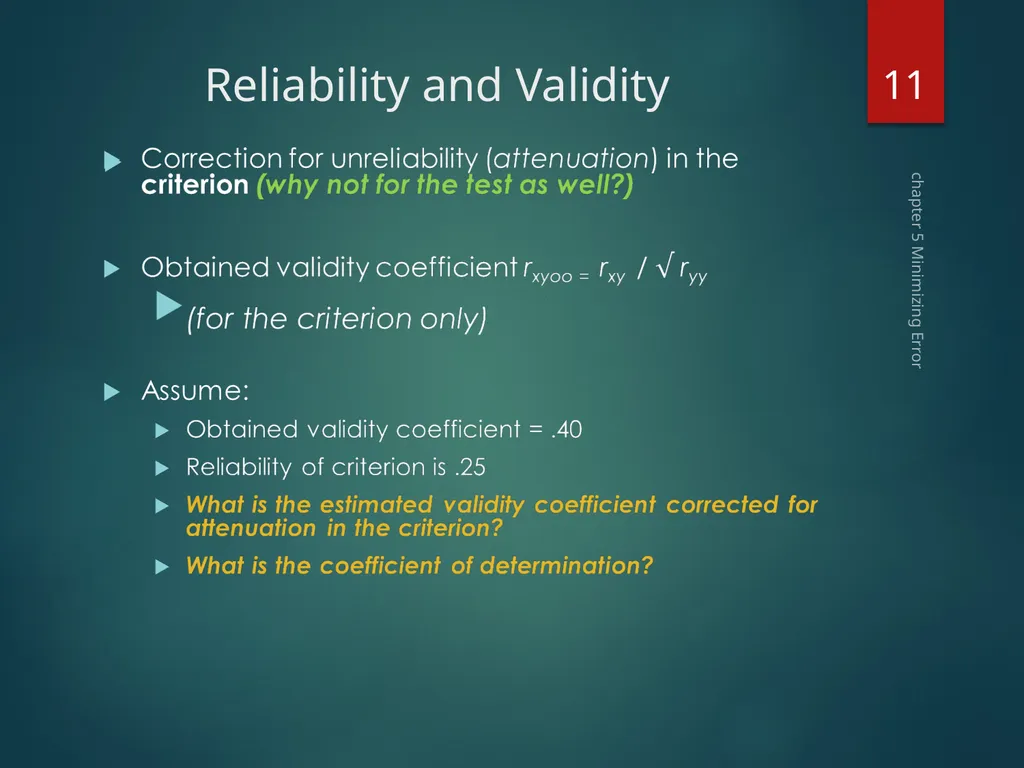
slide11. Reliability and Validity chapter 5 Minimizing Error 11<br>
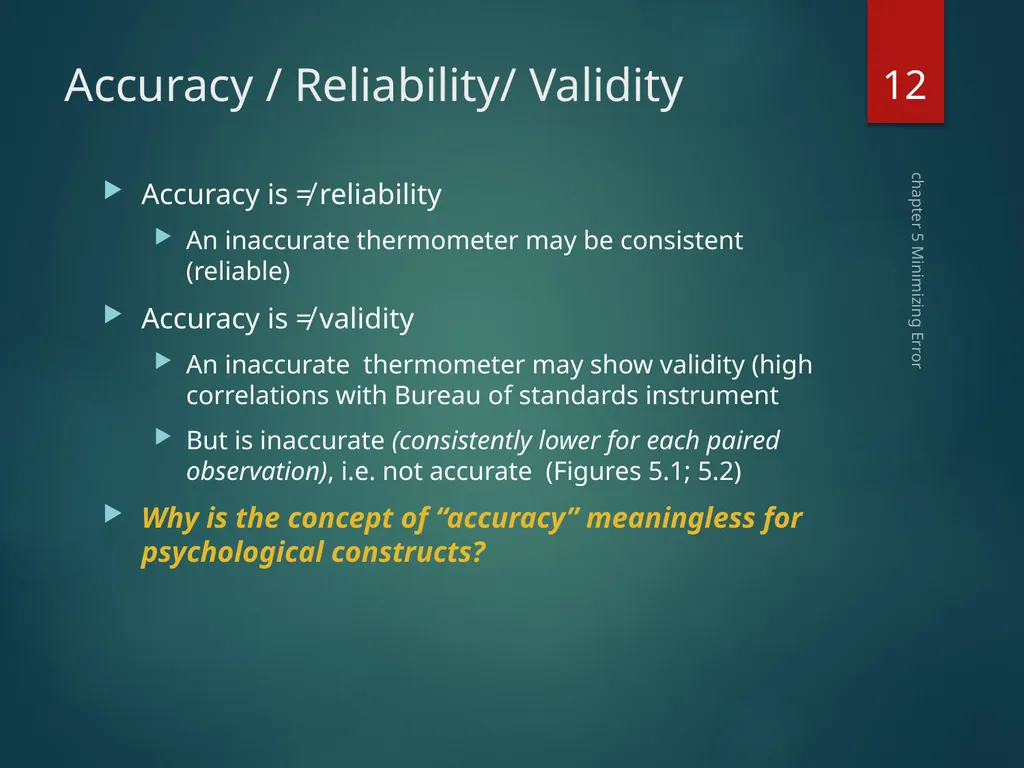
slide12. Accuracy / Reliability/ Validity Accuracy is ≠ reliability
An inaccurate thermometer may be consistent (reliable)
Accuracy is ≠ validity
An inaccurate thermometer may show validity (high correlations with Bureau of standards instrument
But is inaccurate (consistently lower for each paired observation), i.e. not accurate (Figures 5.1; 5.2)
Why is the concept of “accuracy” meaningless for psychological constructs? chapter 5 Minimizing Error 12<br>
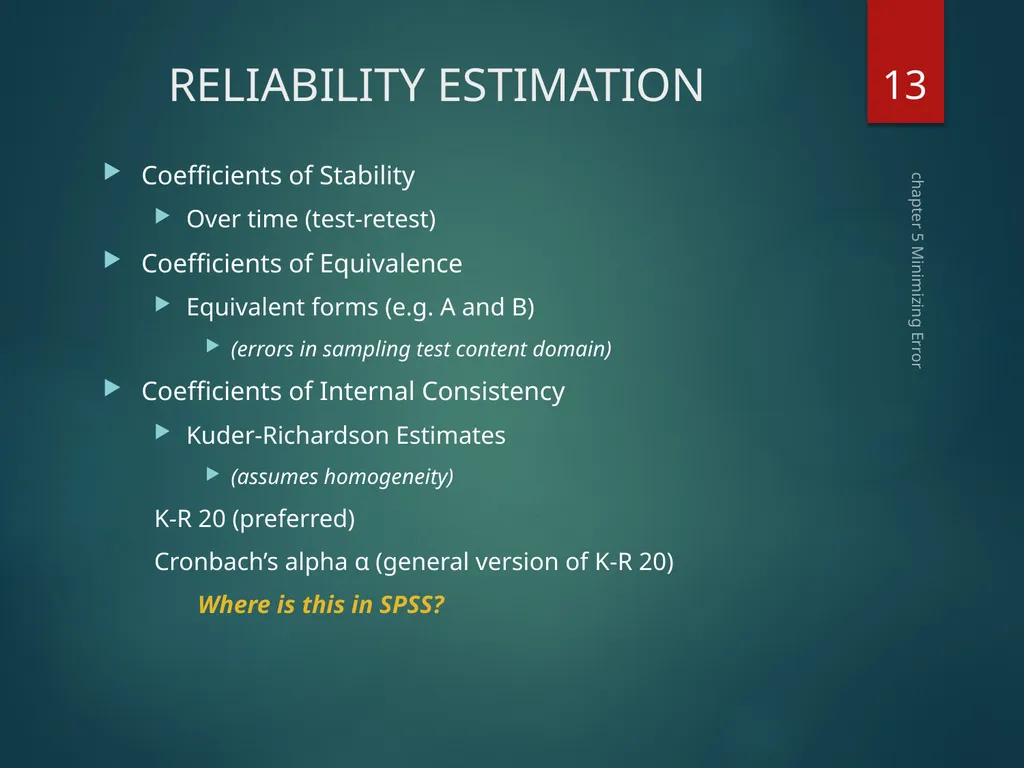
slide13. RELIABILITY ESTIMATION Coefficients of Stability
Over time (test-retest)
Coefficients of Equivalence
Equivalent forms (e.g. A and B)
(errors in sampling test content domain)
Coefficients of Internal Consistency
Kuder-Richardson Estimates
(assumes homogeneity)
K-R 20 (preferred)
Cronbach’s alpha α (general version of K-R 20)
Where is this in SPSS? chapter 5 Minimizing Error 13<br>
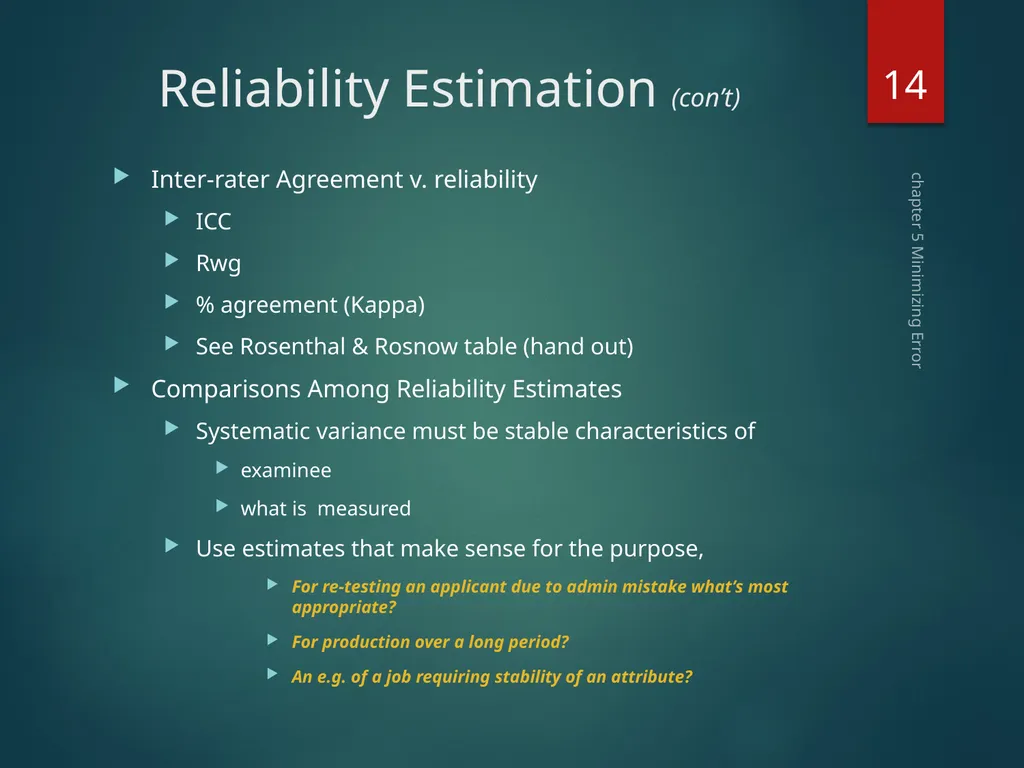
slide14. Reliability Estimation (con’t) Inter-rater Agreement v. reliability
ICC
Rwg
% agreement (Kappa)
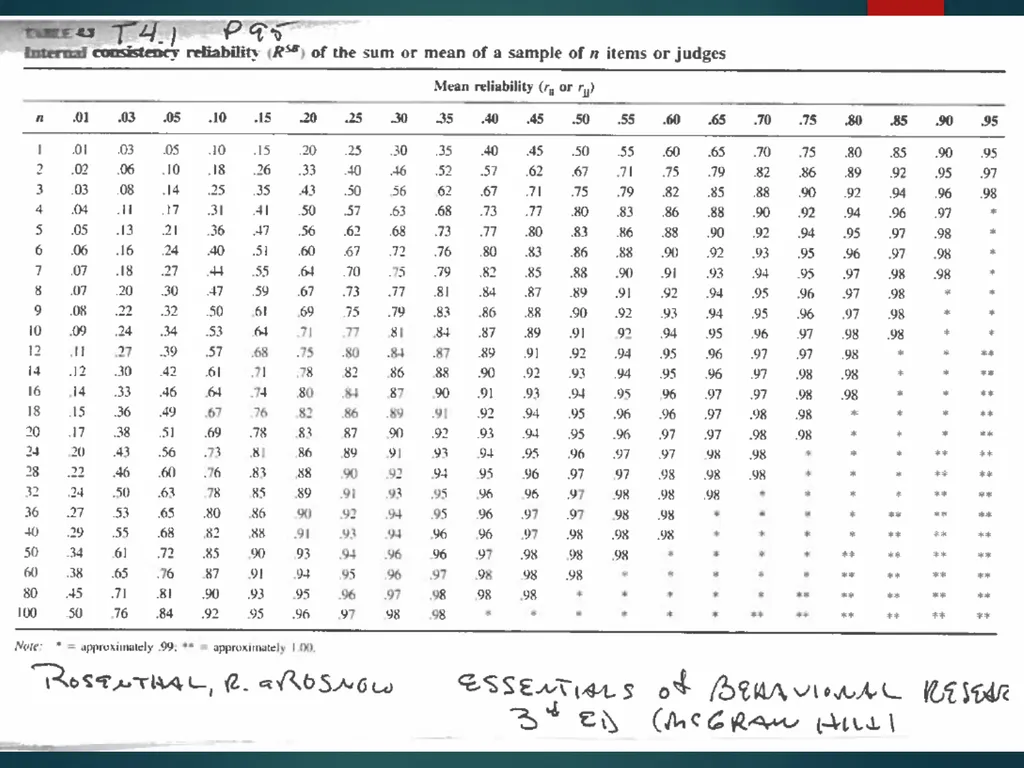
See Rosenthal & Rosnow table (hand out)
Comparisons Among Reliability Estimates
Systematic variance must be stable characteristics of
examinee
what is measured
Use estimates that make sense for the purpose,
For re-testing an applicant due to admin mistake what’s most appropriate?
For production over a long period?
An e.g. of a job requiring stability of an attribute? chapter 5 Minimizing Error 14<br>
slide15. chapter 5 Minimizing Error 15<br>
slide16. chapter 5 Minimizing Error 16<br>
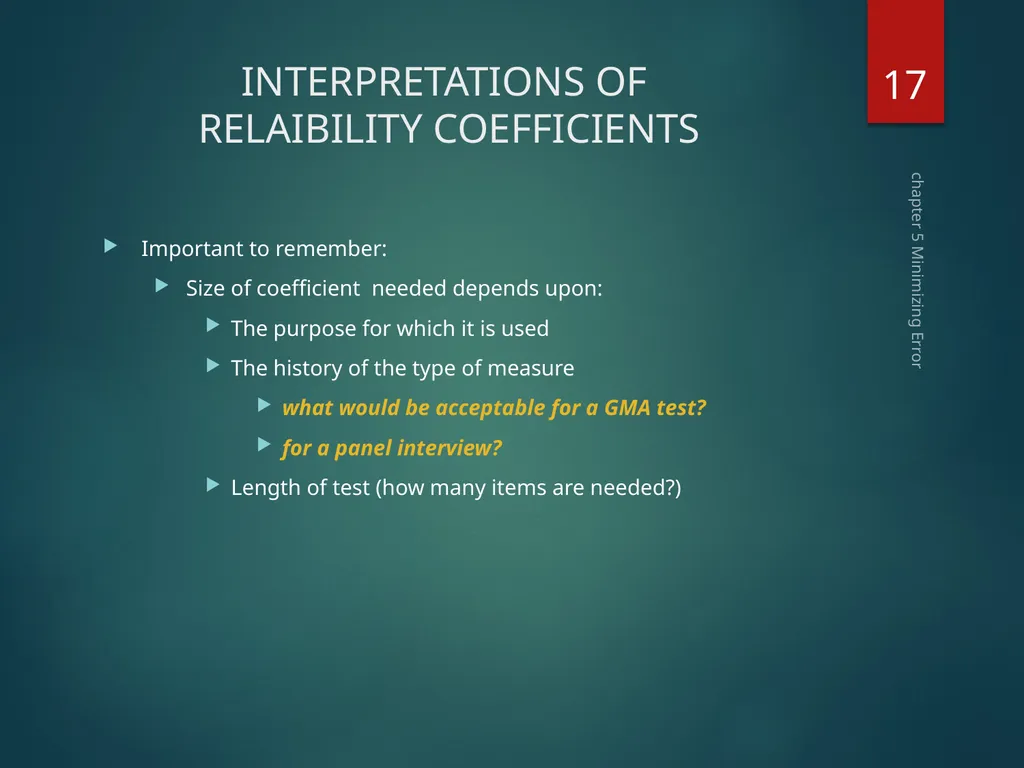
slide17. INTERPRETATIONS OF RELAIBILITY COEFFICIENTS Important to remember:
Size of coefficient needed depends upon:
The purpose for which it is used
The history of the type of measure
what would be acceptable for a GMA test?
for a panel interview?
Length of test (how many items are needed?) chapter 5 Minimizing Error 17<br>
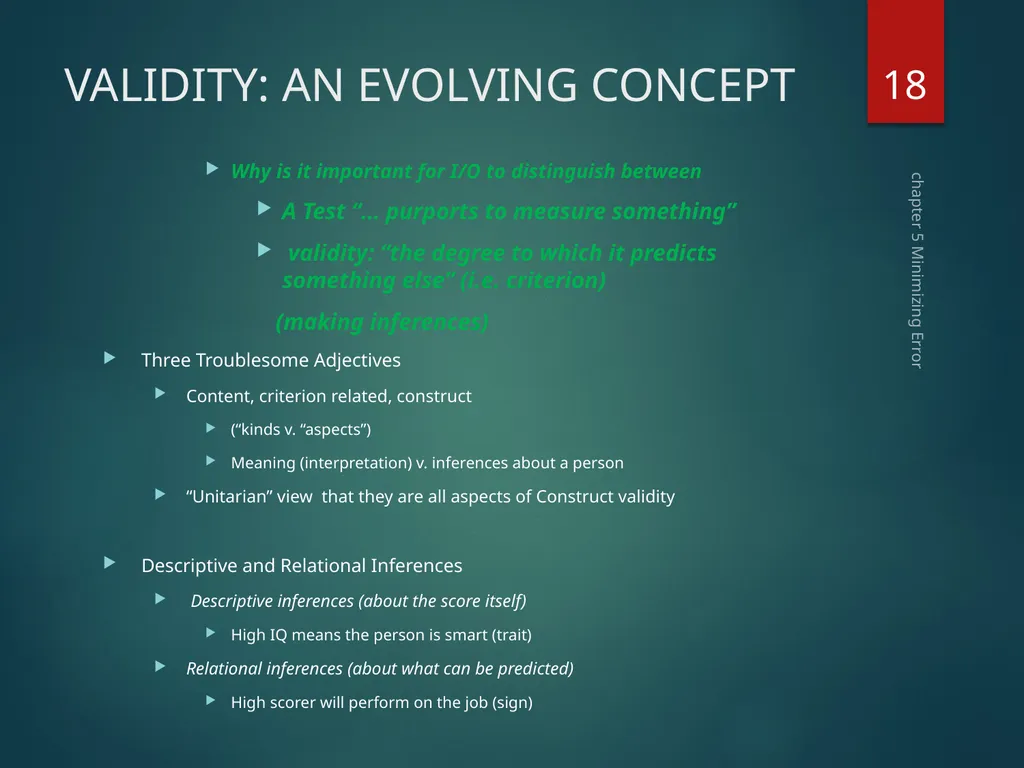
slide18. VALIDITY: AN EVOLVING CONCEPT Why is it important for I/O to distinguish between
A Test “… purports to measure something”
validity: “the degree to which it predicts something else” (i.e. criterion)
(making inferences)
Three Troublesome Adjectives
Content, criterion related, construct
(“kinds v. “aspects”)
Meaning (interpretation) v. inferences about a person
“Unitarian” view that they are all aspects of Construct validity
Descriptive and Relational Inferences
Descriptive inferences (about the score itself)
High IQ means the person is smart (trait)
Relational inferences (about what can be predicted)
High scorer will perform on the job (sign) chapter 5 Minimizing Error 18<br>
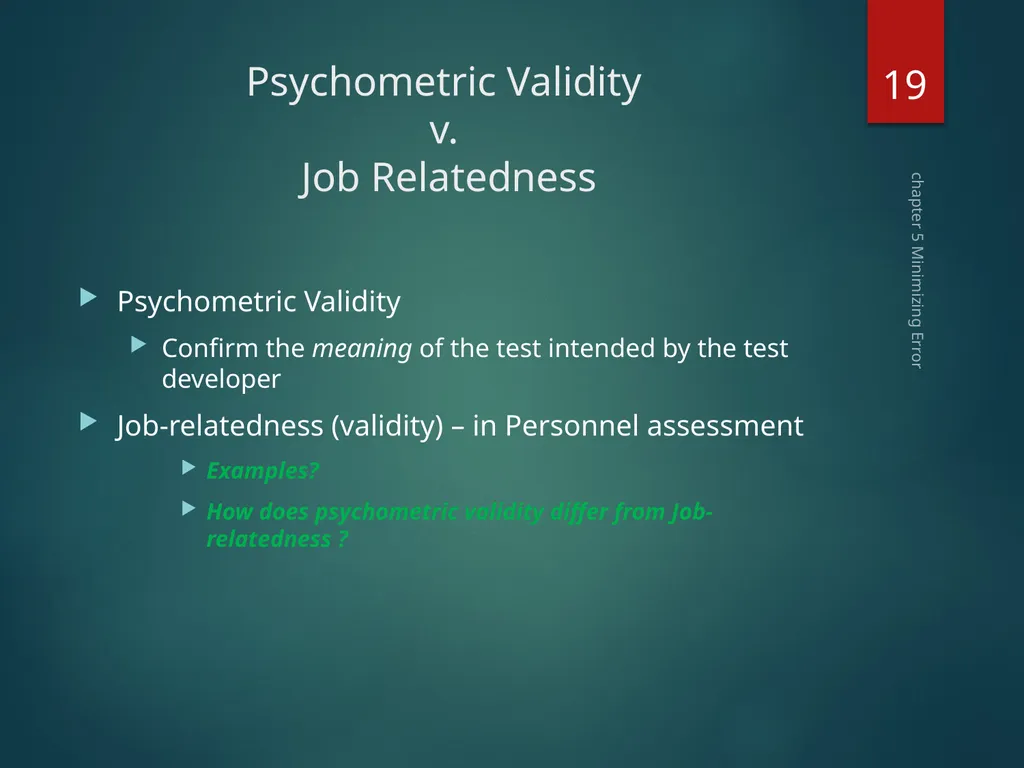
slide19. Psychometric Validity v. Job Relatedness Psychometric Validity
Confirm the meaning of the test intended by the test developer
Job-relatedness (validity) – in Personnel assessment
Examples?
How does psychometric validity differ from Job-relatedness ? chapter 5 Minimizing Error 19<br>
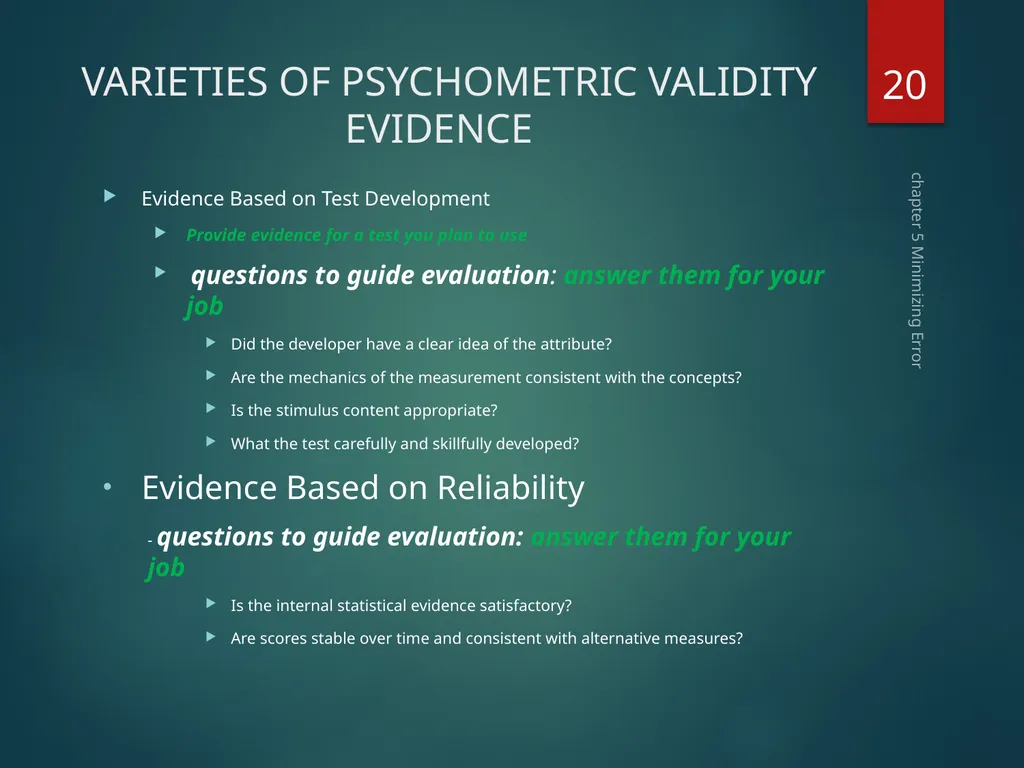
slide20. VARIETIES OF PSYCHOMETRIC VALIDITY EVIDENCE Evidence Based on Test Development
Provide evidence for a test you plan to use
questions to guide evaluation: answer them for your job
Did the developer have a clear idea of the attribute?
Are the mechanics of the measurement consistent with the concepts?
Is the stimulus content appropriate?
What the test carefully and skillfully developed?
Evidence Based on Reliability
- questions to guide evaluation: answer them for your job
Is the internal statistical evidence satisfactory?
Are scores stable over time and consistent with alternative measures? chapter 5 Minimizing Error 20<br>
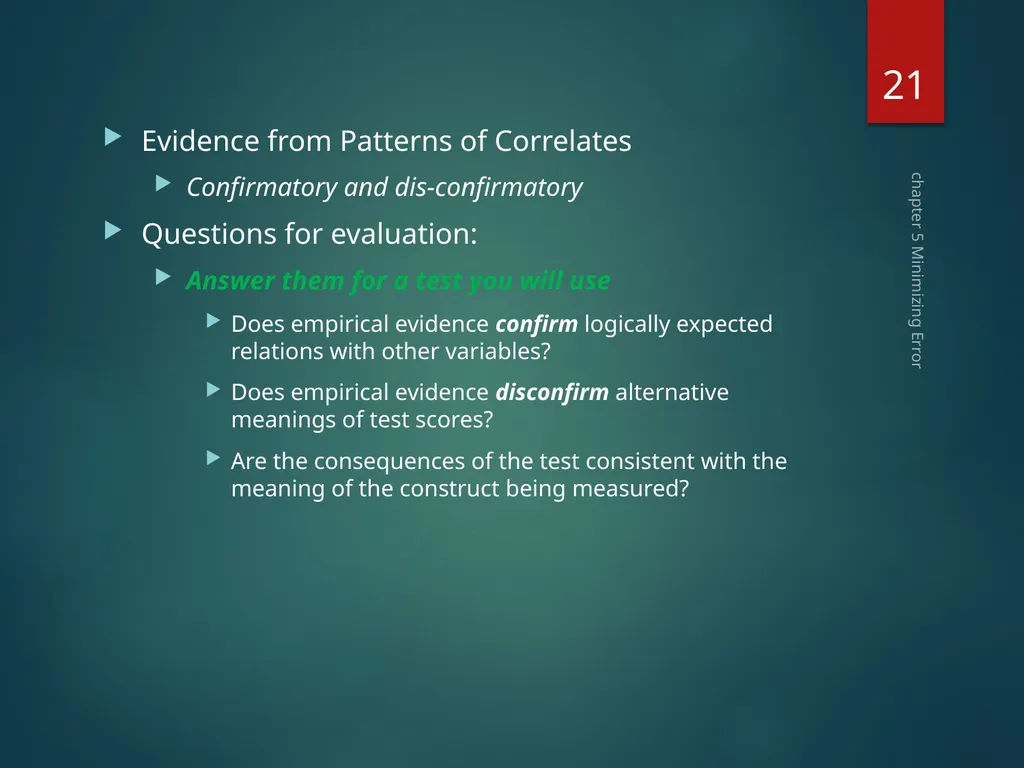
slide21. Evidence from Patterns of Correlates
Confirmatory and dis-confirmatory
Questions for evaluation:
Answer them for a test you will use
Does empirical evidence confirm logically expected relations with other variables?
Does empirical evidence disconfirm alternative meanings of test scores?
Are the consequences of the test consistent with the meaning of the construct being measured? chapter 5 Minimizing Error 21<br>
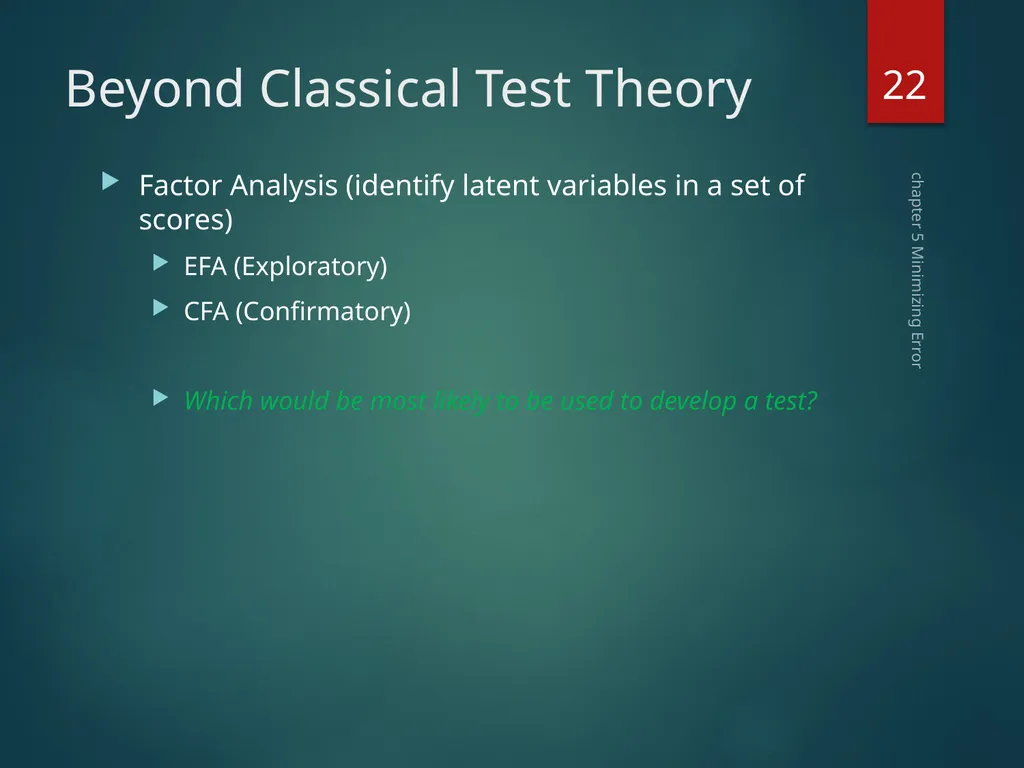
slide22. Beyond Classical Test Theory Factor Analysis (identify latent variables in a set of scores)
EFA (Exploratory)
CFA (Confirmatory)
Which would be most likely to be used to develop a test? chapter 5 Minimizing Error 22<br>
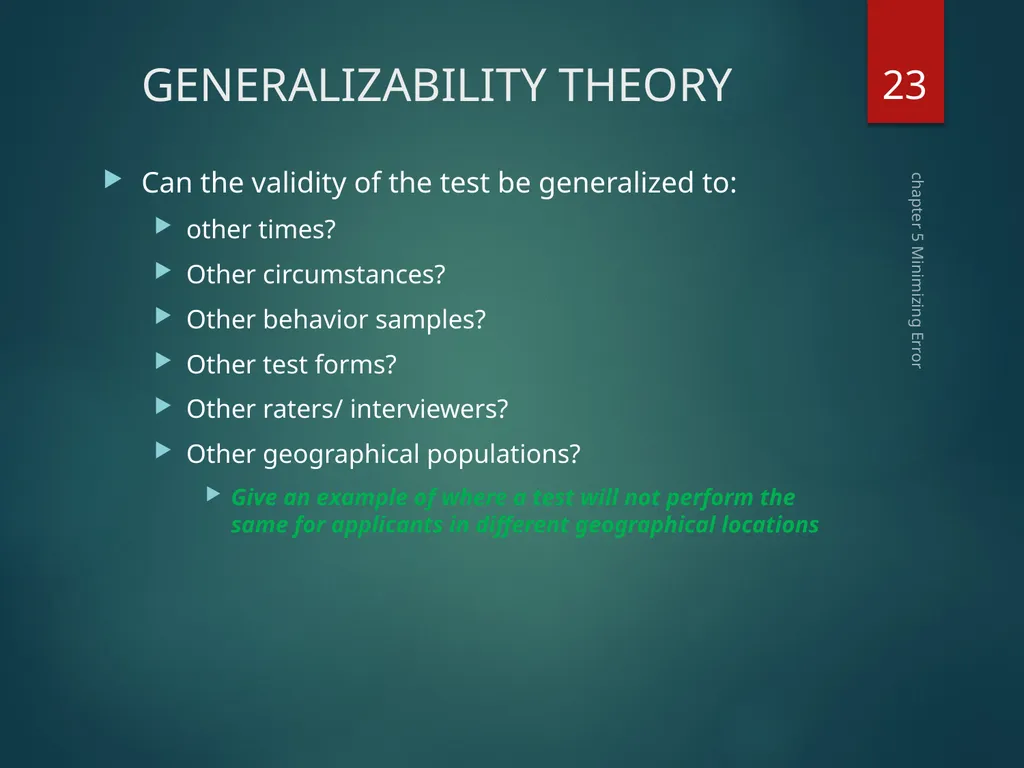
slide23. GENERALIZABILITY THEORY Can the validity of the test be generalized to:
other times?
Other circumstances?
Other behavior samples?
Other test forms?
Other raters/ interviewers?
Other geographical populations?
Give an example of where a test will not perform the same for applicants in different geographical locations chapter 5 Minimizing Error 23<br>
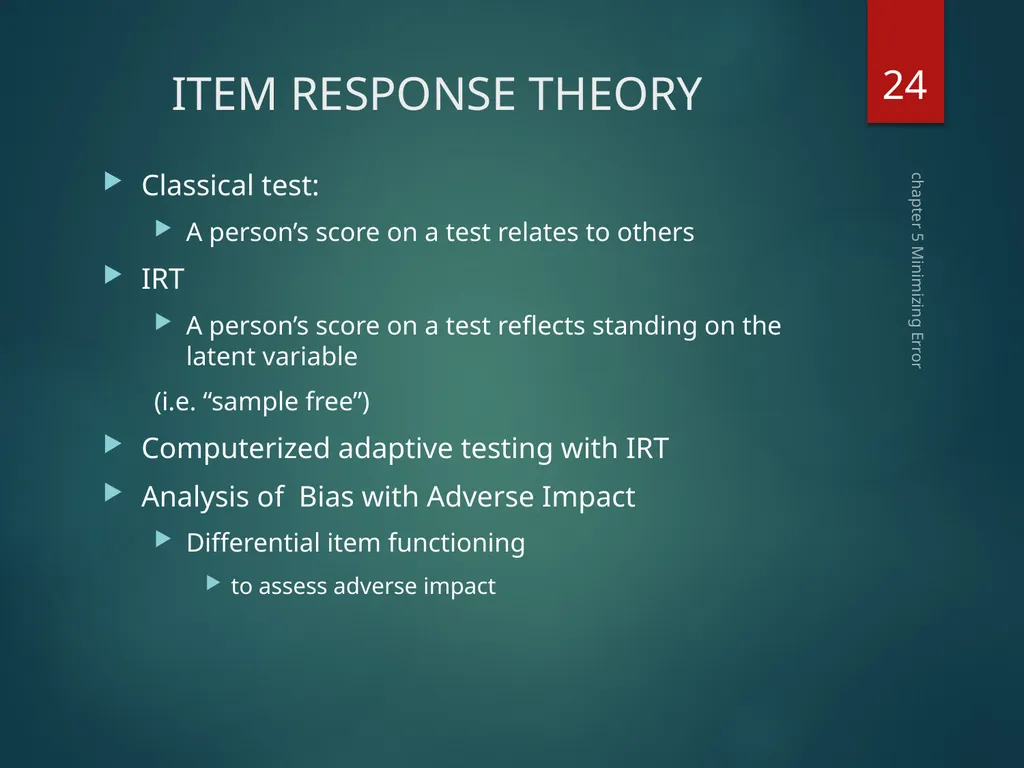
slide24. ITEM RESPONSE THEORY Classical test:
A person’s score on a test relates to others
IRT
A person’s score on a test reflects standing on the latent variable
(i.e. “sample free”)
Computerized adaptive testing with IRT
Analysis of Bias with Adverse Impact
Differential item functioning
to assess adverse impact chapter 5 Minimizing Error 24<br>

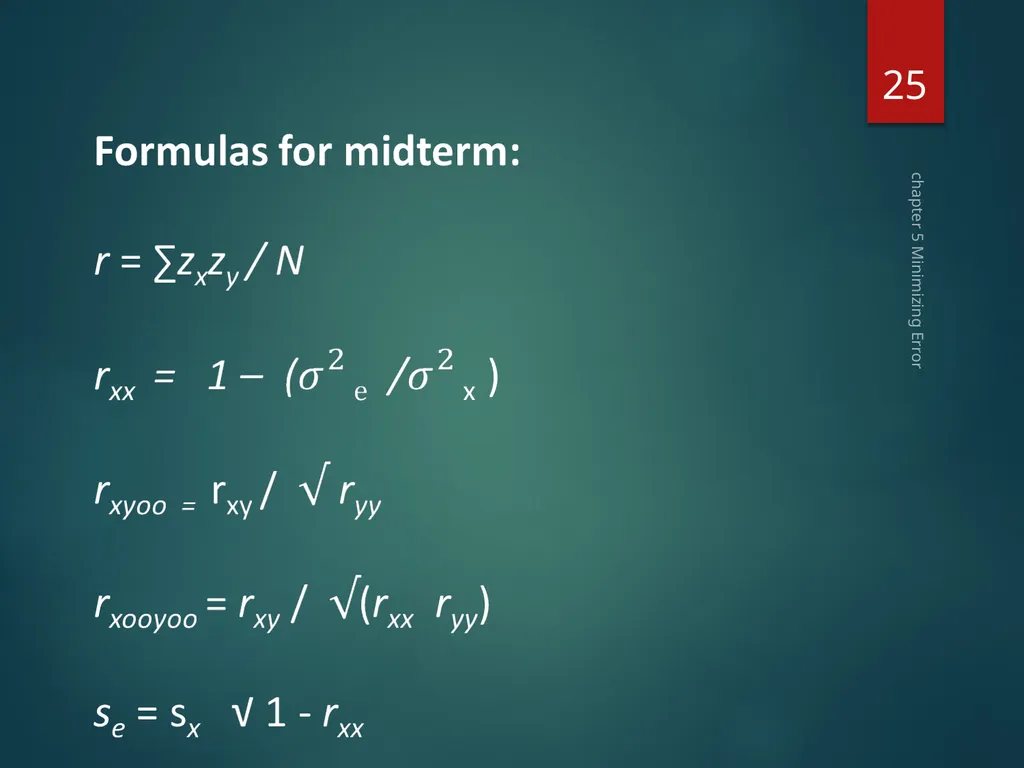
slide25. chapter 5 Minimizing Error 25<br>
Measurement Theory
Reliability
Validity
Assessment is broader term than Measurement
What does this mean? chapter 5 Minimizing Error 1<br>
slide2. Background Queletet (1835)
Established the normal distribution
Used by:
Galton (measurement of genius)
Binet et al. (cognitive ability, i.e.”IQ”)
Munsterberg (employment testing)
J. M. Cattell (perceptual and sensory tests)
Over time measurement
Focus changed from reliability to validity chapter 5 Minimizing Error 2<br>
slide3. Background in Measurement Adolphe Quetelet – (1835)
conception of the homme moyen (“average man”) as the central value about which measurements of a human trait are grouped according to the normal distribution.
Physical and mental attributes are normally distributed
Errors of measurement are normally distributed
Foundation for psychological measurement chapter 5 Minimizing Error 3<br>
slide4. RELIABILITY CONCEPTS OF MEASUREMENT ERROR Measurement Error and Error variance
(error happens!)
Table 5.1 Reasons for differences in performance
I Person characteristics –long term, permanent
Influence scores on all tests, e.g. language, skills
II Person characteristics specific to test permanent
E.g type of words on test more/less recognizable to some
III temporary characteristics that
Influence scores on any test (e.g. evaluation apprehension)
IV Temporary and specific to the test
E.g. stumped by a word, e.g.
V Administration effects
E.g. interaction administrator and examinee
VI pure chance
Which is the one of primary interest (non-error variance)? chapter 5 Minimizing Error 4<br>
slide5. Measure Error and Error Variance (con’t) Category II A – of most interest
Others reflect unwanted sources of variance
Classical theory:
X = t + e
Assumptions: (errors are truly random)
Obtained score = algebraic sum of t + e
Not correlated:
t scores and e scores (in one test not correlated)
errors in different measures (not correlated)
errors in one measure with true scores in another (not correlated) chapter 5 Minimizing Error 5<br>
slide6. Measurement Error Xob = s + e (one individual’s score)
Why was t replaced with s?
total variance (all of an individual’s scores)
σx2 = σs2 + σe2 (all people’s scores – population)
systematic causes + random error
systematic =
wanted systematic var (true ability) +
unwanted systematic (error) (test-wise)
e.g., prefer type of format (systematic error)
e.g. sleepy every time he takes the test chapter 5 Minimizing Error 6<br>
slide7. chapter 5 Minimizing Error 7<br>
slide8. chapter 5 Minimizing Error 8<br>
slide9. Reliability chapter 5 Minimizing Error 9<br>
slide10. Reliability (con’t) chapter 5 Minimizing Error 10<br>
slide11. Reliability and Validity chapter 5 Minimizing Error 11<br>
slide12. Accuracy / Reliability/ Validity Accuracy is ≠ reliability
An inaccurate thermometer may be consistent (reliable)
Accuracy is ≠ validity
An inaccurate thermometer may show validity (high correlations with Bureau of standards instrument
But is inaccurate (consistently lower for each paired observation), i.e. not accurate (Figures 5.1; 5.2)
Why is the concept of “accuracy” meaningless for psychological constructs? chapter 5 Minimizing Error 12<br>
slide13. RELIABILITY ESTIMATION Coefficients of Stability
Over time (test-retest)
Coefficients of Equivalence
Equivalent forms (e.g. A and B)
(errors in sampling test content domain)
Coefficients of Internal Consistency
Kuder-Richardson Estimates
(assumes homogeneity)
K-R 20 (preferred)
Cronbach’s alpha α (general version of K-R 20)
Where is this in SPSS? chapter 5 Minimizing Error 13<br>
slide14. Reliability Estimation (con’t) Inter-rater Agreement v. reliability
ICC
Rwg
% agreement (Kappa)
See Rosenthal & Rosnow table (hand out)
Comparisons Among Reliability Estimates
Systematic variance must be stable characteristics of
examinee
what is measured
Use estimates that make sense for the purpose,
For re-testing an applicant due to admin mistake what’s most appropriate?
For production over a long period?
An e.g. of a job requiring stability of an attribute? chapter 5 Minimizing Error 14<br>
slide15. chapter 5 Minimizing Error 15<br>
slide16. chapter 5 Minimizing Error 16<br>
slide17. INTERPRETATIONS OF RELAIBILITY COEFFICIENTS Important to remember:
Size of coefficient needed depends upon:
The purpose for which it is used
The history of the type of measure
what would be acceptable for a GMA test?
for a panel interview?
Length of test (how many items are needed?) chapter 5 Minimizing Error 17<br>
slide18. VALIDITY: AN EVOLVING CONCEPT Why is it important for I/O to distinguish between
A Test “… purports to measure something”
validity: “the degree to which it predicts something else” (i.e. criterion)
(making inferences)
Three Troublesome Adjectives
Content, criterion related, construct
(“kinds v. “aspects”)
Meaning (interpretation) v. inferences about a person
“Unitarian” view that they are all aspects of Construct validity
Descriptive and Relational Inferences
Descriptive inferences (about the score itself)
High IQ means the person is smart (trait)
Relational inferences (about what can be predicted)
High scorer will perform on the job (sign) chapter 5 Minimizing Error 18<br>
slide19. Psychometric Validity v. Job Relatedness Psychometric Validity
Confirm the meaning of the test intended by the test developer
Job-relatedness (validity) – in Personnel assessment
Examples?
How does psychometric validity differ from Job-relatedness ? chapter 5 Minimizing Error 19<br>
slide20. VARIETIES OF PSYCHOMETRIC VALIDITY EVIDENCE Evidence Based on Test Development
Provide evidence for a test you plan to use
questions to guide evaluation: answer them for your job
Did the developer have a clear idea of the attribute?
Are the mechanics of the measurement consistent with the concepts?
Is the stimulus content appropriate?
What the test carefully and skillfully developed?
Evidence Based on Reliability
- questions to guide evaluation: answer them for your job
Is the internal statistical evidence satisfactory?
Are scores stable over time and consistent with alternative measures? chapter 5 Minimizing Error 20<br>
slide21. Evidence from Patterns of Correlates
Confirmatory and dis-confirmatory
Questions for evaluation:
Answer them for a test you will use
Does empirical evidence confirm logically expected relations with other variables?
Does empirical evidence disconfirm alternative meanings of test scores?
Are the consequences of the test consistent with the meaning of the construct being measured? chapter 5 Minimizing Error 21<br>
slide22. Beyond Classical Test Theory Factor Analysis (identify latent variables in a set of scores)
EFA (Exploratory)
CFA (Confirmatory)
Which would be most likely to be used to develop a test? chapter 5 Minimizing Error 22<br>
slide23. GENERALIZABILITY THEORY Can the validity of the test be generalized to:
other times?
Other circumstances?
Other behavior samples?
Other test forms?
Other raters/ interviewers?
Other geographical populations?
Give an example of where a test will not perform the same for applicants in different geographical locations chapter 5 Minimizing Error 23<br>
slide24. ITEM RESPONSE THEORY Classical test:
A person’s score on a test relates to others
IRT
A person’s score on a test reflects standing on the latent variable
(i.e. “sample free”)
Computerized adaptive testing with IRT
Analysis of Bias with Adverse Impact
Differential item functioning
to assess adverse impact chapter 5 Minimizing Error 24<br>
slide25. chapter 5 Minimizing Error 25<br>