
Passive Solar passive solar Except where otherwise
CS
Published · 17 slides · 0 views
1 / 1
Description
Passive Solar passive solar Except where otherwise noted these materials are licensed Creative Commons Attribution 4.0 (CC BY) Objectives The objective of this unit is to present the student with some basic terms relating to passive solar
Related Topics
Share
Embed code
Download this presentation From Below
"Passive Solar passive solar Except where otherwise" is the property of its rightful owner. Permission is granted to download and print the materials on this website for personal, non-commercial use only, and to display it on your personal computer provided you do not modify the materials and that you retain all copyright notices contained in the materials. By downloading content from our website, you accept the terms of this agreement.
Presentation Transcript
01
Passive Solar passive solar Except where otherwise noted these materials
are licensed Creative Commons Attribution 4.0 (CC BY)<br>
02
Objectives The objective of this unit is to present the student with some basic terms relating to passive solar and design components. Upon completion, the student will have an understanding of the following:
Passive solar design
Seasonal sun paths
Sun altitudes
Benefits of passive solar
Passive design elements
Direct, indirect and sunspaces<br>
Passive solar design
Seasonal sun paths
Sun altitudes
Benefits of passive solar
Passive design elements
Direct, indirect and sunspaces<br>
03
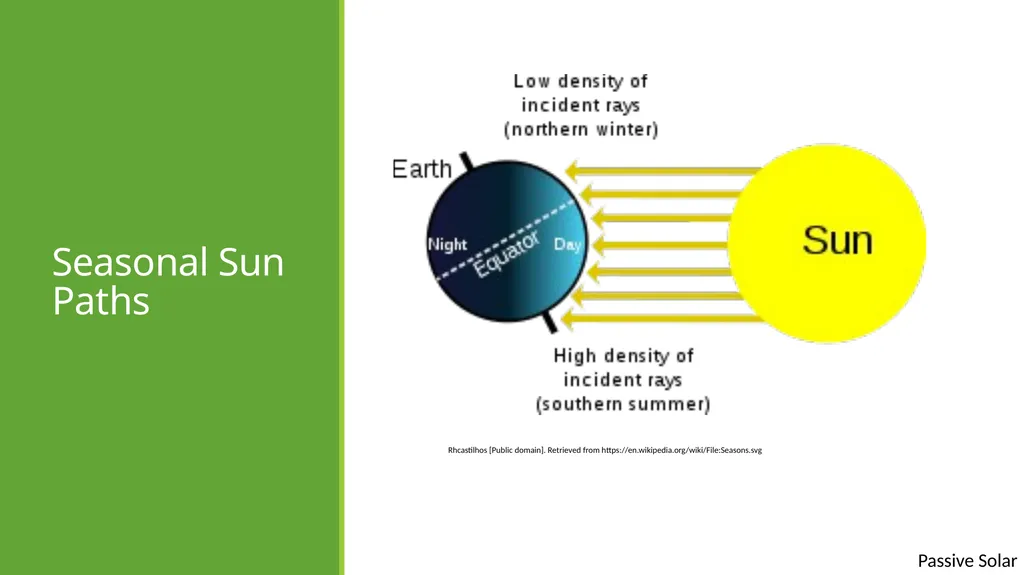
Passive Solar Design Passive solar design uses seasonal changes in the path of the sun to create structures that are heated by natural means.
The earth rotates once each day about an axis that is tilted 23.5° with respect to its orbit around the sun.
The direction of tilt remains fixed as the earth moves, thus changing the earth’s orientation with respect to the sun.
The direction and tilt are what creates seasons. When the hemisphere is tilted towards the sun, the days are longer and warmer. When the hemisphere is tilted away from the sun, the days are shorter and colder.
The hemisphere tilted toward the sun experiences summer.
The hemisphere tilted away from the sun experiences winter.
The seasons spring and fall occur when tilt is parallel to the orbital direction.
Spring and fall equinoxes occur when there is no hemisphere tilt toward or away from the sun.<br>
The earth rotates once each day about an axis that is tilted 23.5° with respect to its orbit around the sun.
The direction of tilt remains fixed as the earth moves, thus changing the earth’s orientation with respect to the sun.
The direction and tilt are what creates seasons. When the hemisphere is tilted towards the sun, the days are longer and warmer. When the hemisphere is tilted away from the sun, the days are shorter and colder.
The hemisphere tilted toward the sun experiences summer.
The hemisphere tilted away from the sun experiences winter.
The seasons spring and fall occur when tilt is parallel to the orbital direction.
Spring and fall equinoxes occur when there is no hemisphere tilt toward or away from the sun.<br>
04
Seasonal Sun Paths Rhcastilhos [Public domain]. Retrieved from https://en.wikipedia.org/wiki/File:Seasons.svg<br>
05
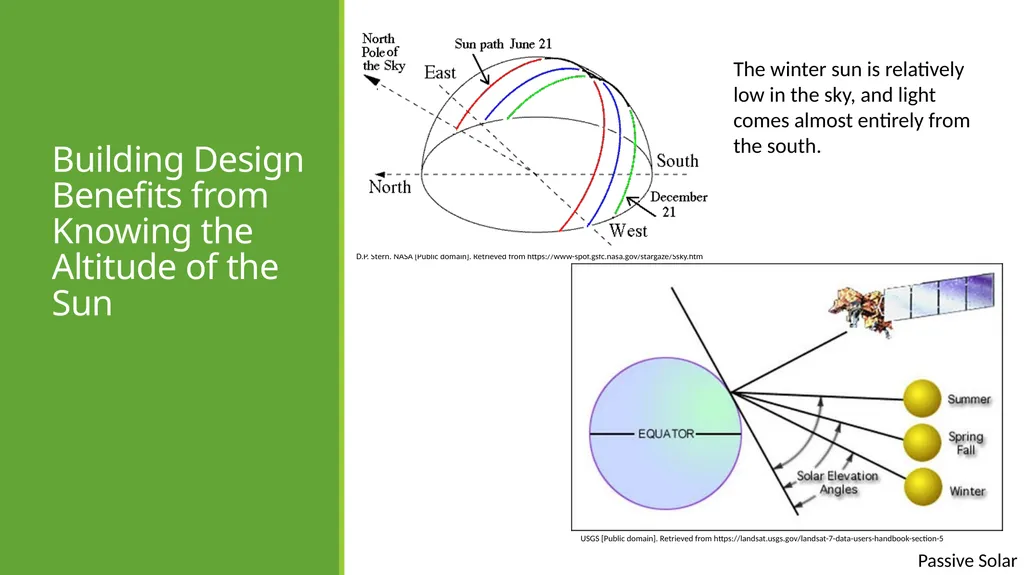
Building Design Benefits from Knowing the Altitude of the Sun The winter sun is relatively low in the sky, and light comes almost entirely from the south. USGS [Public domain]. Retrieved from https://landsat.usgs.gov/landsat-7-data-users-handbook-section-5 D.P. Stern. NASA [Public domain]. Retrieved from https://www-spof.gsfc.nasa.gov/stargaze/Ssky.htm<br>
06
Passive Solar Design Best known for capturing the warmth of the sun in the winter months and preventing unwanted heat gain in the summer.
Can help cool buildings in the summer by establishing sun-induced ventilation
Provides the ability to reduce energy use, which in turn will reduce the impact on the environment
Will allow for smaller heating, ventilation and cooling units
Provides some insurance against spikes in utility costs
Reduces lighting needs and costs<br>
Can help cool buildings in the summer by establishing sun-induced ventilation
Provides the ability to reduce energy use, which in turn will reduce the impact on the environment
Will allow for smaller heating, ventilation and cooling units
Provides some insurance against spikes in utility costs
Reduces lighting needs and costs<br>
07
Passive Solar Design Parameters Site specific
Adapted to local climate
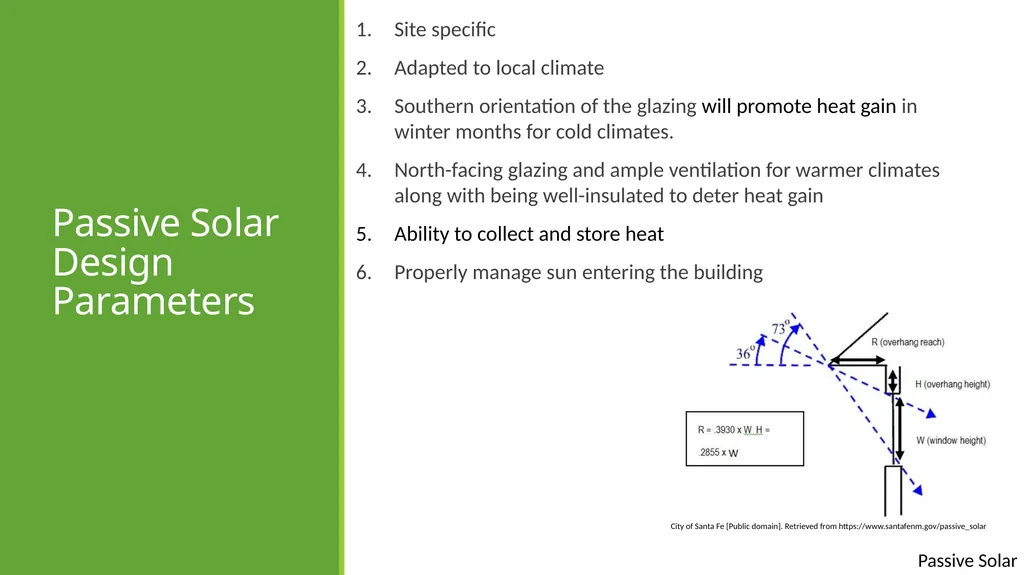
Southern orientation of the glazing will promote heat gain in winter months for cold climates.
North-facing glazing and ample ventilation for warmer climates along with being well-insulated to deter heat gain
Ability to collect and store heat
Properly manage sun entering the building City of Santa Fe [Public domain]. Retrieved from https://www.santafenm.gov/passive_solar<br>
Adapted to local climate
Southern orientation of the glazing will promote heat gain in winter months for cold climates.
North-facing glazing and ample ventilation for warmer climates along with being well-insulated to deter heat gain
Ability to collect and store heat
Properly manage sun entering the building City of Santa Fe [Public domain]. Retrieved from https://www.santafenm.gov/passive_solar<br>
08
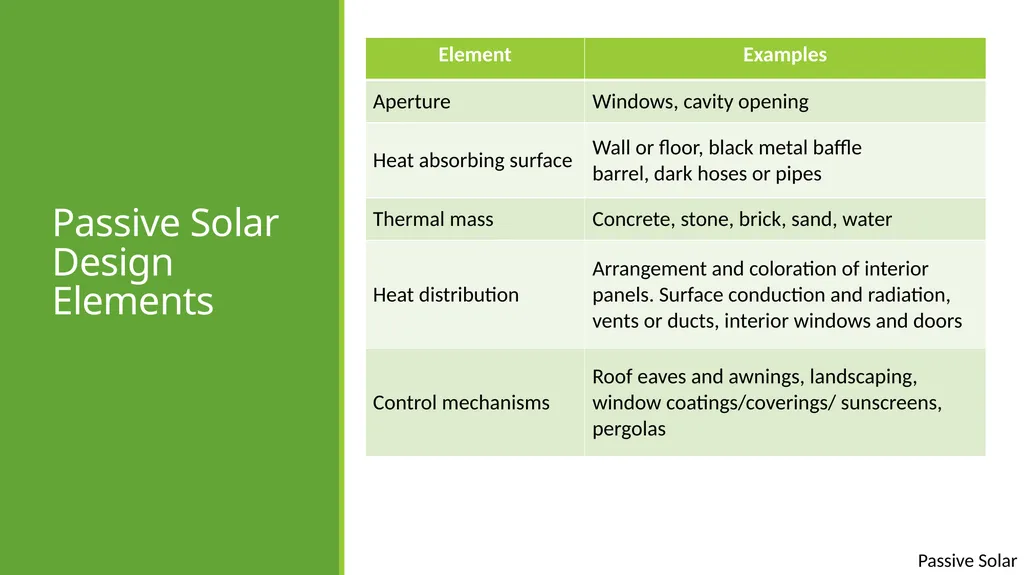
Passive Solar Design Elements<br>
09
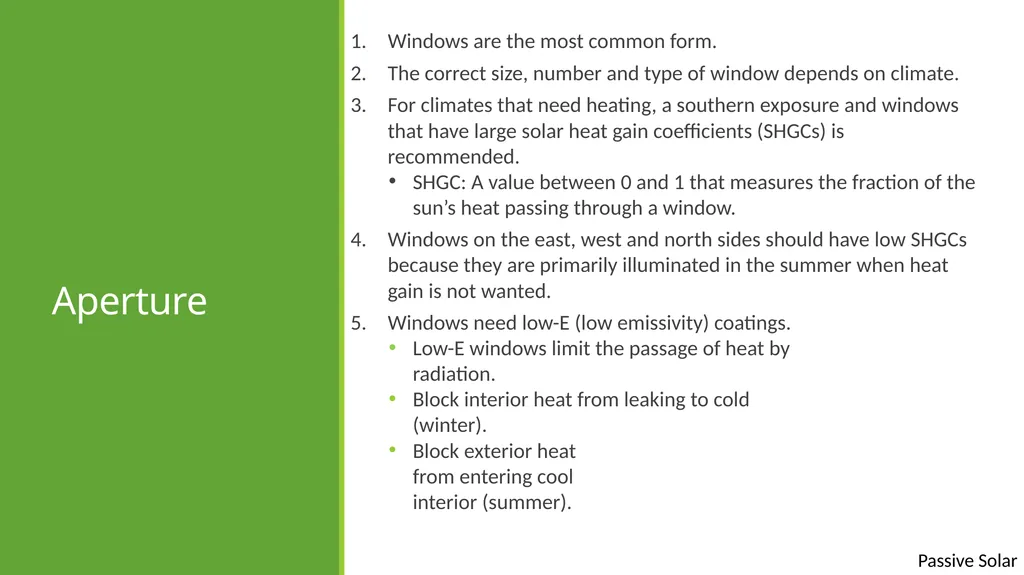
Aperture Windows are the most common form.
The correct size, number and type of window depends on climate.
For climates that need heating, a southern exposure and windows that have large solar heat gain coefficients (SHGCs) is recommended.
SHGC: A value between 0 and 1 that measures the fraction of the sun’s heat passing through a window.
Windows on the east, west and north sides should have low SHGCs because they are primarily illuminated in the summer when heat gain is not wanted.
Windows need low-E (low emissivity) coatings.
Low-E windows limit the passage of heat by radiation.
Block interior heat from leaking to cold (winter).
Block exterior heat from entering cool interior (summer).<br>
The correct size, number and type of window depends on climate.
For climates that need heating, a southern exposure and windows that have large solar heat gain coefficients (SHGCs) is recommended.
SHGC: A value between 0 and 1 that measures the fraction of the sun’s heat passing through a window.
Windows on the east, west and north sides should have low SHGCs because they are primarily illuminated in the summer when heat gain is not wanted.
Windows need low-E (low emissivity) coatings.
Low-E windows limit the passage of heat by radiation.
Block interior heat from leaking to cold (winter).
Block exterior heat from entering cool interior (summer).<br>
10
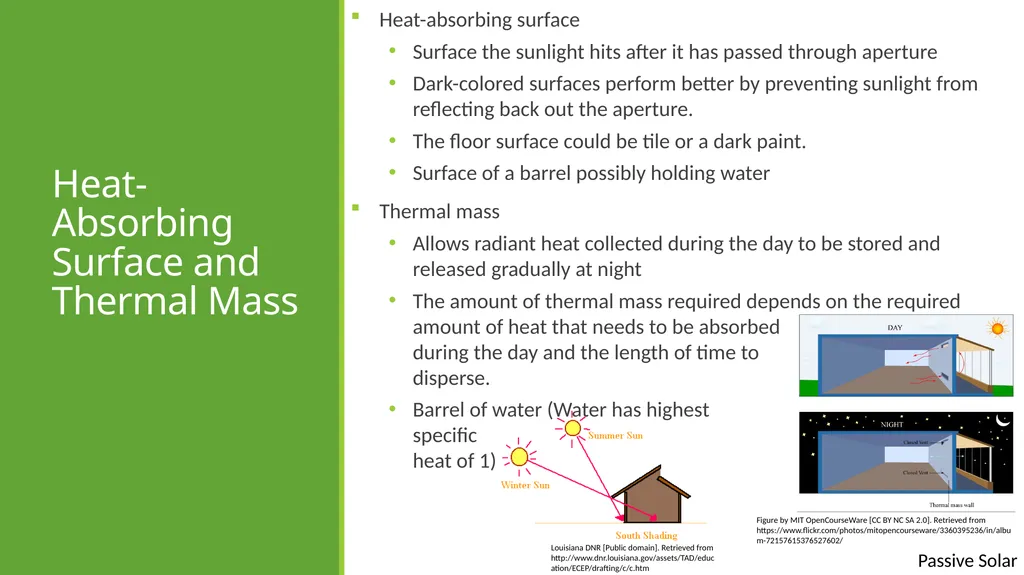
Heat-Absorbing Surface and Thermal Mass Heat-absorbing surface
Surface the sunlight hits after it has passed through aperture
Dark-colored surfaces perform better by preventing sunlight from reflecting back out the aperture.
The floor surface could be tile or a dark paint.
Surface of a barrel possibly holding water
Thermal mass
Allows radiant heat collected during the day to be stored and released gradually at night
The amount of thermal mass required depends on the required amount of heat that needs to be absorbed during the day and the length of time to disperse.
Barrel of water (Water has highest specific heat of 1) Louisiana DNR [Public domain]. Retrieved from http://www.dnr.louisiana.gov/assets/TAD/education/ECEP/drafting/c/c.htm Figure by MIT OpenCourseWare [CC BY NC SA 2.0]. Retrieved from https://www.flickr.com/photos/mitopencourseware/3360395236/in/album-72157615376527602/<br>
Surface the sunlight hits after it has passed through aperture
Dark-colored surfaces perform better by preventing sunlight from reflecting back out the aperture.
The floor surface could be tile or a dark paint.
Surface of a barrel possibly holding water
Thermal mass
Allows radiant heat collected during the day to be stored and released gradually at night
The amount of thermal mass required depends on the required amount of heat that needs to be absorbed during the day and the length of time to disperse.
Barrel of water (Water has highest specific heat of 1) Louisiana DNR [Public domain]. Retrieved from http://www.dnr.louisiana.gov/assets/TAD/education/ECEP/drafting/c/c.htm Figure by MIT OpenCourseWare [CC BY NC SA 2.0]. Retrieved from https://www.flickr.com/photos/mitopencourseware/3360395236/in/album-72157615376527602/<br>
11
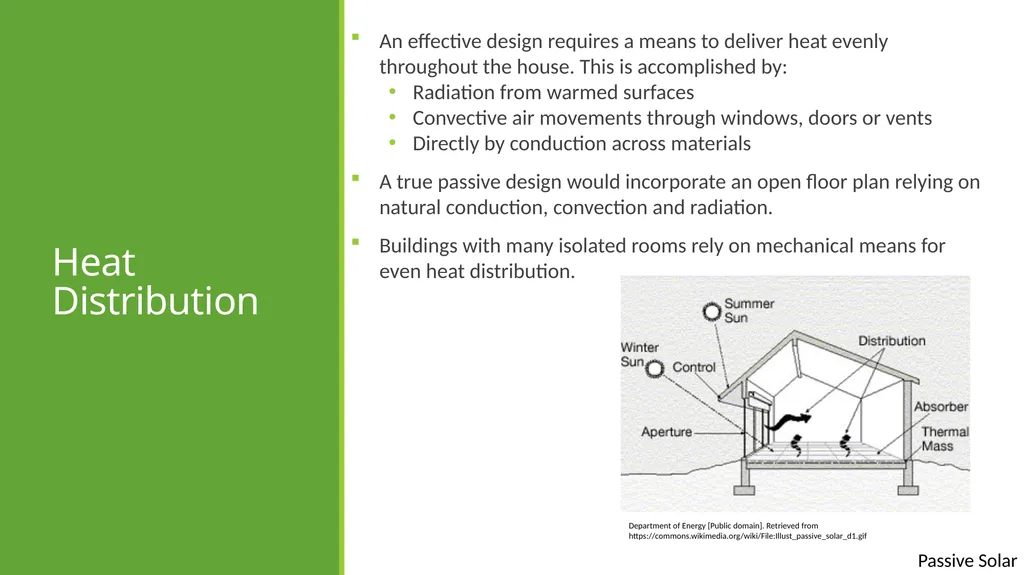
Heat Distribution An effective design requires a means to deliver heat evenly throughout the house. This is accomplished by:
Radiation from warmed surfaces
Convective air movements through windows, doors or vents
Directly by conduction across materials
A true passive design would incorporate an open floor plan relying on natural conduction, convection and radiation.
Buildings with many isolated rooms rely on mechanical means for even heat distribution. Department of Energy [Public domain]. Retrieved from https://commons.wikimedia.org/wiki/File:Illust_passive_solar_d1.gif<br>
Radiation from warmed surfaces
Convective air movements through windows, doors or vents
Directly by conduction across materials
A true passive design would incorporate an open floor plan relying on natural conduction, convection and radiation.
Buildings with many isolated rooms rely on mechanical means for even heat distribution. Department of Energy [Public domain]. Retrieved from https://commons.wikimedia.org/wiki/File:Illust_passive_solar_d1.gif<br>
12
Control Mechanisms Control mechanisms regulate when and how much solar energy enters a structure.
The most common mechanisms in passive design are awnings and roof eaves.
The size of the windows and geometry of the eaves and awnings determine when sunlight enters.
Awnings work well because they can be positioned in the winter to let sun in and repositioned in the summer.
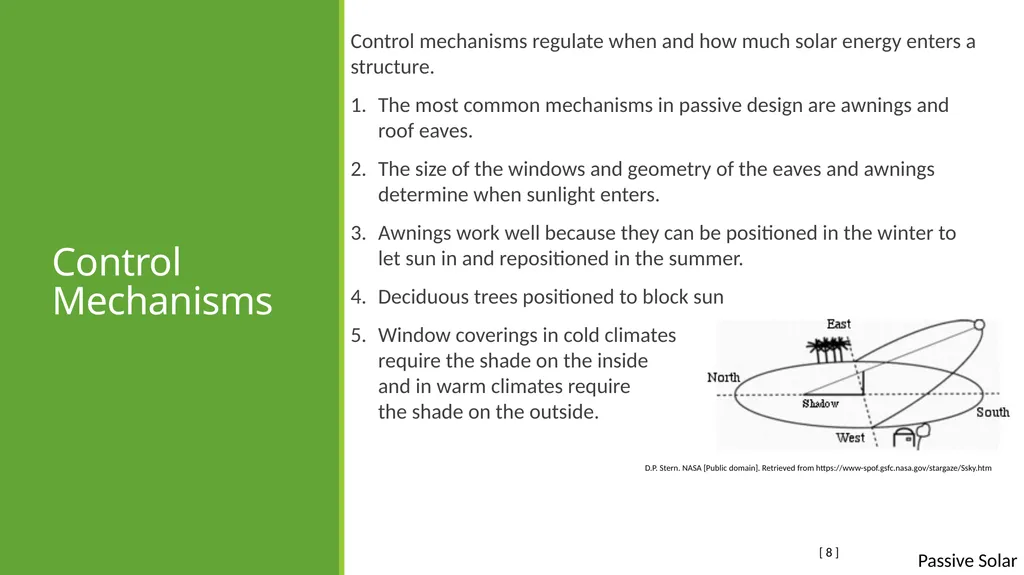
Deciduous trees positioned to block sun
Window coverings in cold climates require the shade on the inside and in warm climates require the shade on the outside. [ 8 ] D.P. Stern. NASA [Public domain]. Retrieved from https://www-spof.gsfc.nasa.gov/stargaze/Ssky.htm<br>
The most common mechanisms in passive design are awnings and roof eaves.
The size of the windows and geometry of the eaves and awnings determine when sunlight enters.
Awnings work well because they can be positioned in the winter to let sun in and repositioned in the summer.
Deciduous trees positioned to block sun
Window coverings in cold climates require the shade on the inside and in warm climates require the shade on the outside. [ 8 ] D.P. Stern. NASA [Public domain]. Retrieved from https://www-spof.gsfc.nasa.gov/stargaze/Ssky.htm<br>
13
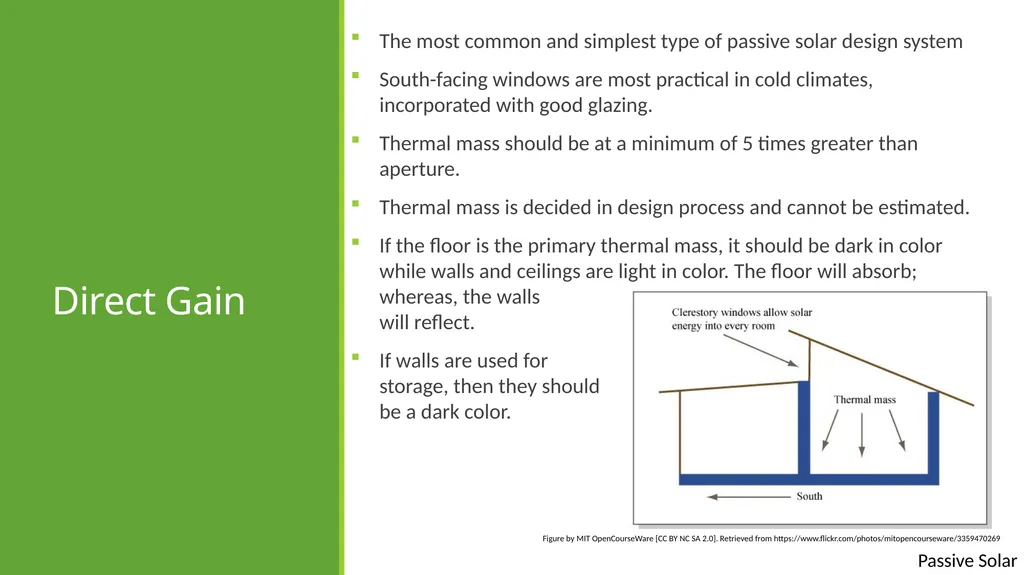
Direct Gain The most common and simplest type of passive solar design system
South-facing windows are most practical in cold climates, incorporated with good glazing.
Thermal mass should be at a minimum of 5 times greater than aperture.
Thermal mass is decided in design process and cannot be estimated.
If the floor is the primary thermal mass, it should be dark in color while walls and ceilings are light in color. The floor will absorb; whereas, the walls will reflect.
If walls are used for storage, then they should be a dark color. Figure by MIT OpenCourseWare [CC BY NC SA 2.0]. Retrieved from https://www.flickr.com/photos/mitopencourseware/3359470269<br>
South-facing windows are most practical in cold climates, incorporated with good glazing.
Thermal mass should be at a minimum of 5 times greater than aperture.
Thermal mass is decided in design process and cannot be estimated.
If the floor is the primary thermal mass, it should be dark in color while walls and ceilings are light in color. The floor will absorb; whereas, the walls will reflect.
If walls are used for storage, then they should be a dark color. Figure by MIT OpenCourseWare [CC BY NC SA 2.0]. Retrieved from https://www.flickr.com/photos/mitopencourseware/3359470269<br>
14
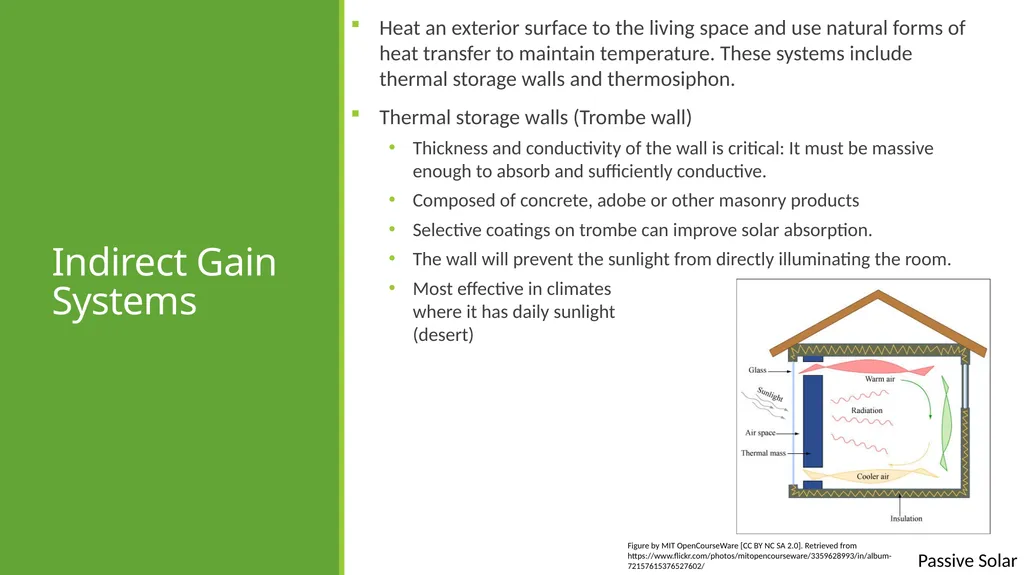
Indirect Gain Systems Heat an exterior surface to the living space and use natural forms of heat transfer to maintain temperature. These systems include thermal storage walls and thermosiphon.
Thermal storage walls (Trombe wall)
Thickness and conductivity of the wall is critical: It must be massive enough to absorb and sufficiently conductive.
Composed of concrete, adobe or other masonry products
Selective coatings on trombe can improve solar absorption.
The wall will prevent the sunlight from directly illuminating the room.
Most effective in climates where it has daily sunlight (desert) Figure by MIT OpenCourseWare [CC BY NC SA 2.0]. Retrieved from https://www.flickr.com/photos/mitopencourseware/3359628993/in/album-72157615376527602/<br>
Thermal storage walls (Trombe wall)
Thickness and conductivity of the wall is critical: It must be massive enough to absorb and sufficiently conductive.
Composed of concrete, adobe or other masonry products
Selective coatings on trombe can improve solar absorption.
The wall will prevent the sunlight from directly illuminating the room.
Most effective in climates where it has daily sunlight (desert) Figure by MIT OpenCourseWare [CC BY NC SA 2.0]. Retrieved from https://www.flickr.com/photos/mitopencourseware/3359628993/in/album-72157615376527602/<br>
15
Thermosiphons A form of indirect gain that relies on sunlight and natural convection to move air without mechanical assistance
Can either warm or cool depending on the system
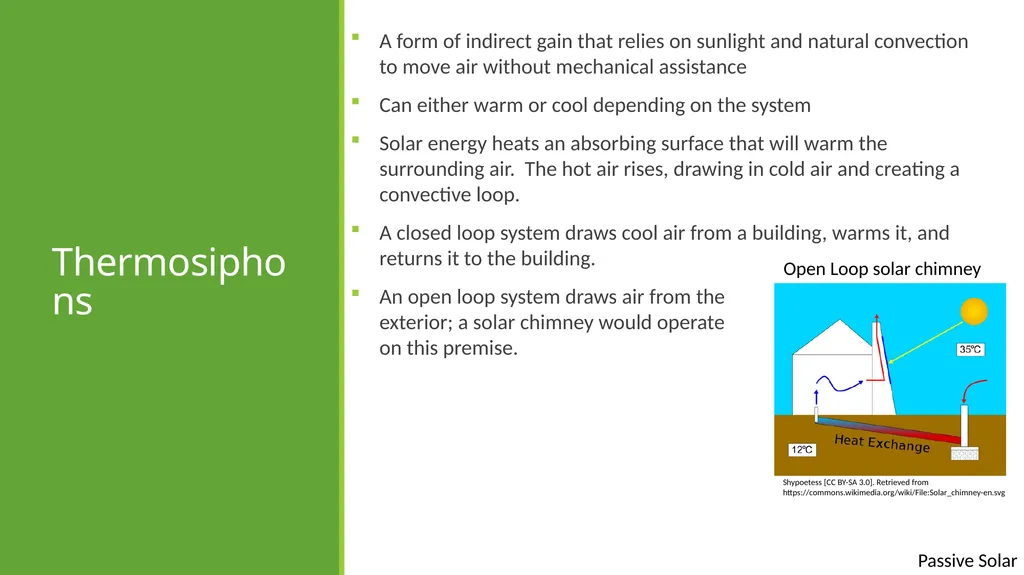
Solar energy heats an absorbing surface that will warm the surrounding air. The hot air rises, drawing in cold air and creating a convective loop.
A closed loop system draws cool air from a building, warms it, and returns it to the building.
An open loop system draws air from the exterior; a solar chimney would operate on this premise. Open Loop solar chimney Shypoetess [CC BY-SA 3.0]. Retrieved from https://commons.wikimedia.org/wiki/File:Solar_chimney-en.svg<br>
Can either warm or cool depending on the system
Solar energy heats an absorbing surface that will warm the surrounding air. The hot air rises, drawing in cold air and creating a convective loop.
A closed loop system draws cool air from a building, warms it, and returns it to the building.
An open loop system draws air from the exterior; a solar chimney would operate on this premise. Open Loop solar chimney Shypoetess [CC BY-SA 3.0]. Retrieved from https://commons.wikimedia.org/wiki/File:Solar_chimney-en.svg<br>
16
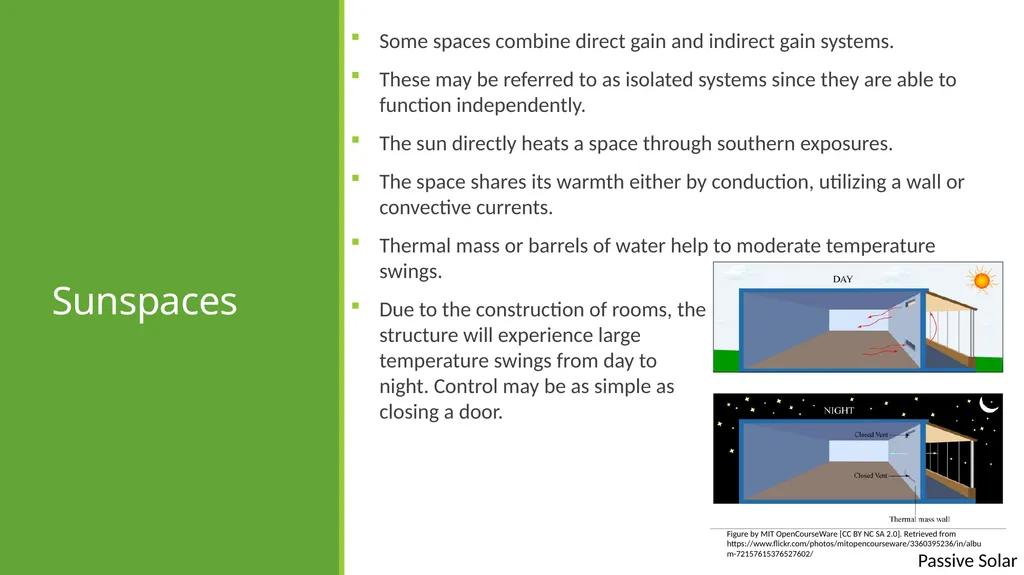
Sunspaces Some spaces combine direct gain and indirect gain systems.
These may be referred to as isolated systems since they are able to function independently.
The sun directly heats a space through southern exposures.
The space shares its warmth either by conduction, utilizing a wall or convective currents.
Thermal mass or barrels of water help to moderate temperature swings.
Due to the construction of rooms, the structure will experience large temperature swings from day to night. Control may be as simple as closing a door. Figure by MIT OpenCourseWare [CC BY NC SA 2.0]. Retrieved from https://www.flickr.com/photos/mitopencourseware/3360395236/in/album-72157615376527602/<br>
These may be referred to as isolated systems since they are able to function independently.
The sun directly heats a space through southern exposures.
The space shares its warmth either by conduction, utilizing a wall or convective currents.
Thermal mass or barrels of water help to moderate temperature swings.
Due to the construction of rooms, the structure will experience large temperature swings from day to night. Control may be as simple as closing a door. Figure by MIT OpenCourseWare [CC BY NC SA 2.0]. Retrieved from https://www.flickr.com/photos/mitopencourseware/3360395236/in/album-72157615376527602/<br>
17
Conclusions Upon completion of this unit, students should be able to
Discuss and define components of a passive solar design
Define the seasonal sun path around the sun
Understand the importance of sun altitude when designing
Identify the five components of design and provide examples
Define indirect, direct, thermosiphon, and sunspaces
Provide examples of indirect, direct, thermosiphon, and sunspaces and explain how they operate “This presentation was prepared by Northeast Iowa Community College under award EG-17-004 from the Iowa Energy Center. Any opinions, findings, and conclusions or recommendations expressed in this material are those of the author(s) and do not necessarily reflect the views of the Iowa Energy Center.”<br>
Discuss and define components of a passive solar design
Define the seasonal sun path around the sun
Understand the importance of sun altitude when designing
Identify the five components of design and provide examples
Define indirect, direct, thermosiphon, and sunspaces
Provide examples of indirect, direct, thermosiphon, and sunspaces and explain how they operate “This presentation was prepared by Northeast Iowa Community College under award EG-17-004 from the Iowa Energy Center. Any opinions, findings, and conclusions or recommendations expressed in this material are those of the author(s) and do not necessarily reflect the views of the Iowa Energy Center.”<br>