PBIS Play-by-Play: Reinforcement Campus Name Here PBIS Play-By-Play: Reviewing The Big 6 Visual representation of the connection between: PBIS in the Classroom T-TESS Domain 3 (Learning Environment) PBIS in the Classroom is also connected
"PBIS Play-by-Play: Reinforcement Campus Name Here" is the property of its rightful owner. Permission is granted to
download and print the materials on this website for personal, non-commercial use only, and to display it
on your personal computer provided you do not modify the materials and that you retain all copyright
notices contained in the materials. By downloading content from our website, you accept the terms of this
agreement.
Presentation Transcript
01
PBIS Play-by-Play: Reinforcement Campus Name Here<br>
02
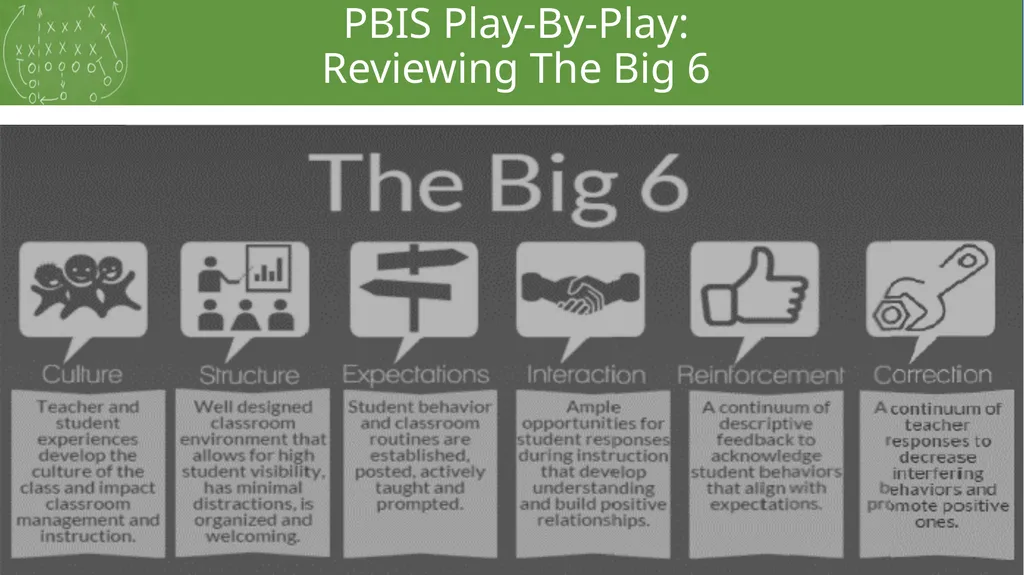
PBIS Play-By-Play: Reviewing The Big 6<br>
03
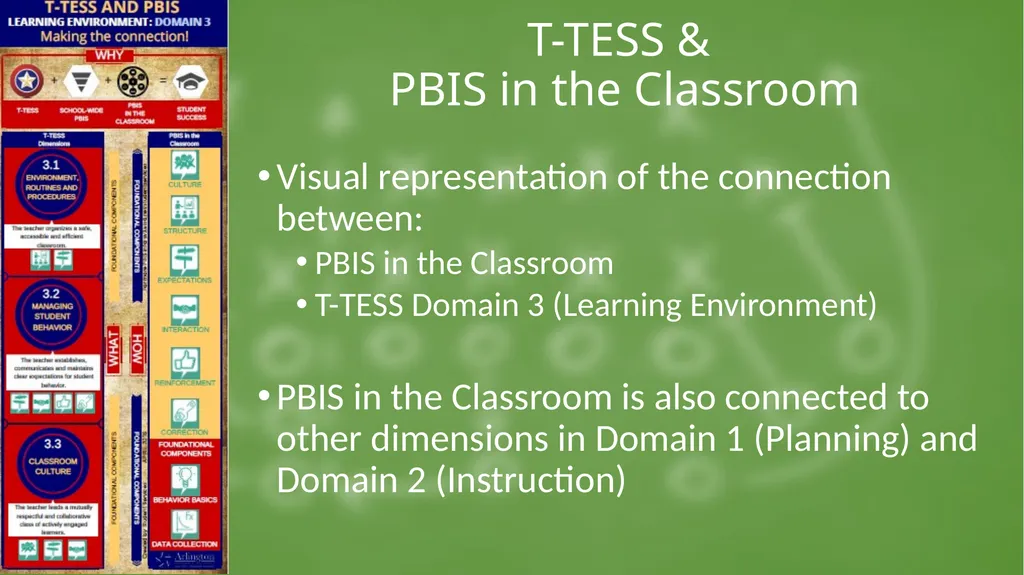
Visual representation of the connection between:
PBIS in the Classroom
T-TESS Domain 3 (Learning Environment)
PBIS in the Classroom is also connected to other dimensions in Domain 1 (Planning) and Domain 2 (Instruction) T-TESS & PBIS in the Classroom<br>
04
PBIS Play-By-Play Reinforcement Reinforcement only occurs if the behavior is likely to increase in the future.
When providing reinforcers, we should make the connection between the reinforcement and the appropriate behavior. Then, we can shift toward natural reinforcement.
In many cases, the natural reinforcers aren’t enough to maintain the behaviors we want!<br>
05
PBIS Play-By-Play Reinforcement Teachers should use a continuum of strategies to reinforce appropriate behavior, including:
Specific and contingent praise
Group contingencies
Behavior contracts
Token economies
Praise is the most widely used reinforcer in the classroom.
The most effective praise is specific and contingent.
At a minimum, all teachers should be using specific and contingent praise in the classroom.<br>
06
Think-Pair-Share Think – about the following sentiment some teachers may believe about their classrooms.
Pair -- with your shoulder partner, discuss at least “2” reinforcement strategies you would recommend to him/her.
Share – with your team and document (completed by recorder) the strategies on the “Reinforcement” section of your chart paper.<br>
07
“Besides specific praise and using the school-wide reinforcement system, what other reinforcers can I use to acknowledge student behavior?” PBIS Play-by-Play:
Reinforcement<br>
08
PBIS Play-by-Play:
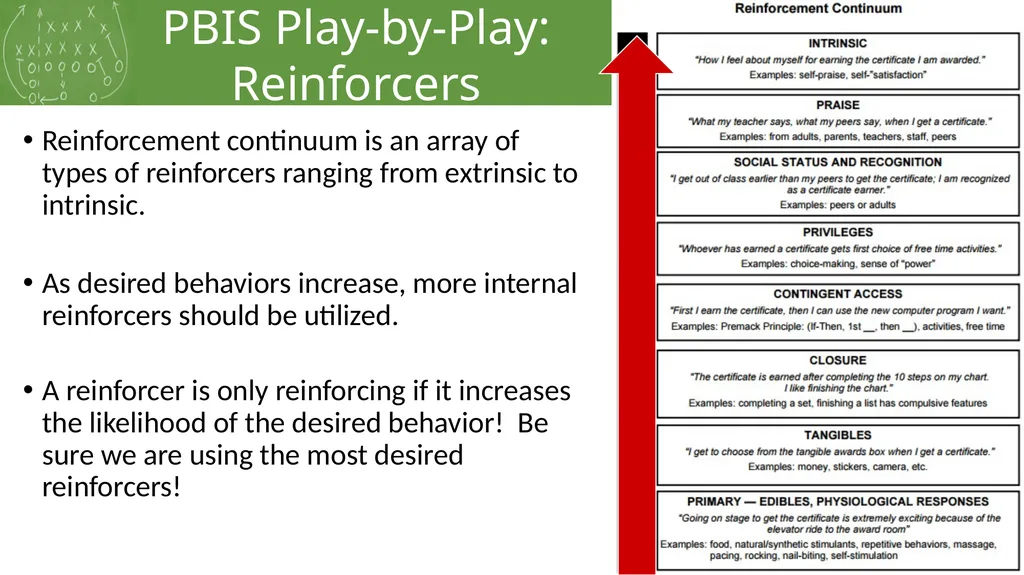
Reinforcers Reinforcement continuum is an array of types of reinforcers ranging from extrinsic to intrinsic.
As desired behaviors increase, more internal reinforcers should be utilized.
A reinforcer is only reinforcing if it increases the likelihood of the desired behavior! Be sure we are using the most desired reinforcers!<br>
09
If you were facilitating this activity, what would you do differently? PBIS Play-by-Play:
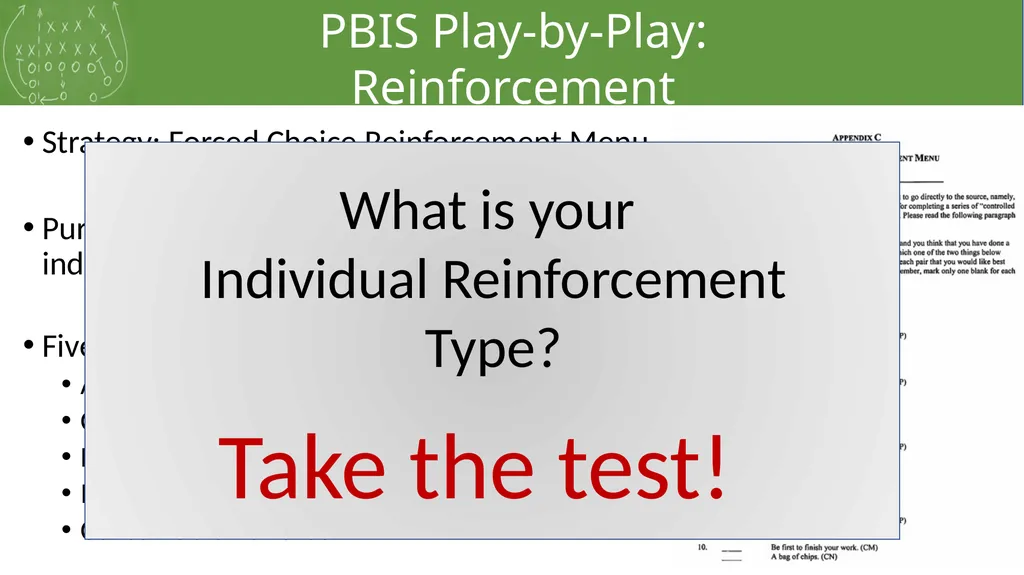
Reinforcement Strategy: Forced Choice Reinforcement Menu
Purpose: A method to informally assess an individual’s reinforcement preferences.
Five Types:
Adult Approval
Competitive Approval
Peer Approval
Independent Rewards
Consumable Rewards Take the test!<br>
10
Think, Write-Pair, Write-Share Think – about how you may use one or more of these strategy in your classroom.
Write-Pair – write about how the strategy can positively impact your classroom. Discuss with your shoulder partner.
Write-Share – As a team/group, discuss the benefits of the strategy and determine your level of commitment. NOTE: optional activity<br>
11
Other Strategies… PBIS Team can enter additional plays from the playbook decided upon in the PBIS team training. NOTE: optional slide<br>
12
Time Out…I May Need More Support! Consider...
Collaborating with a PBIS team member.
Visiting the Office of Student Behavioral Support Services intranet page.
Seeking out appropriate sessions in Eduphoria.
Conversing with campus administration and support staff.<br>