
Peabody Individual Achievement Test- Revised
Description: Peabody Individual Achievement Test- Revised (PIAT-R) By: Melissa Stevenson, Rachel Piereson, Tracy Tossi, Courtney Ruhno, Katie Guikema, Lindsey Johnson, and Caroline Brohn Basic Information Name: Peabody Individual Achievement Test-
Related Topics
Download Presentation
"Peabody Individual Achievement Test- Revised" is the property of its rightful owner. Permission is granted to download and print the materials on this website for personal, non-commercial use only, and to display it on your personal computer provided you do not modify the materials and that you retain all copyright notices contained in the materials. By downloading content from our website, you accept the terms of this agreement.
Presentation Transcript
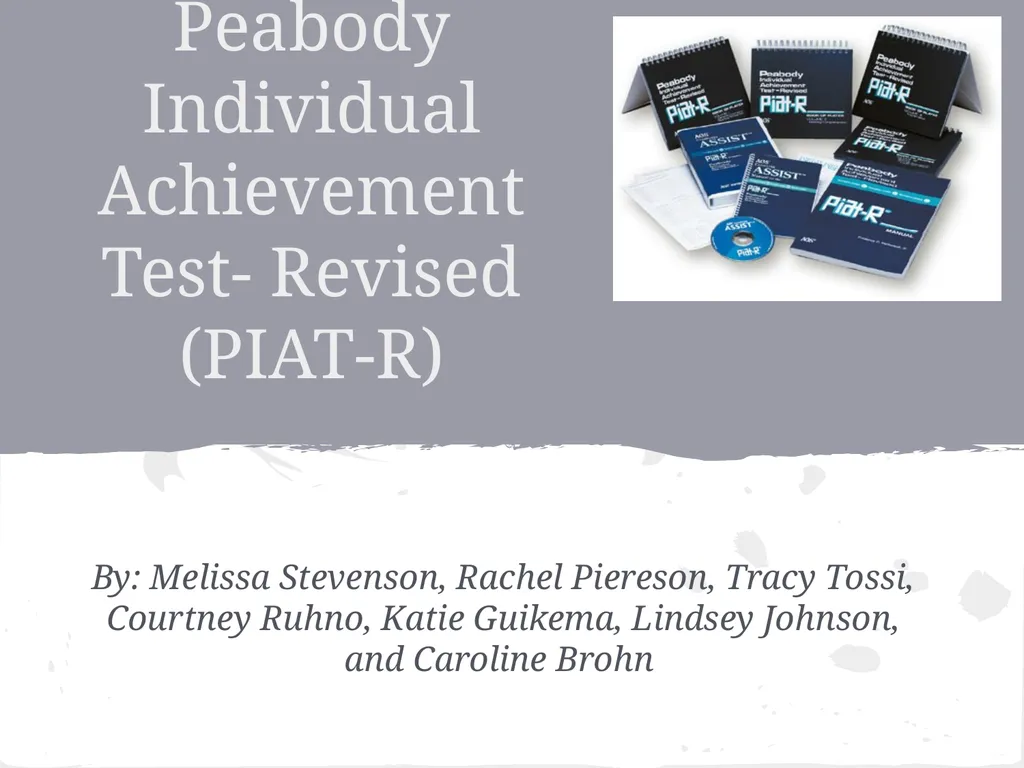
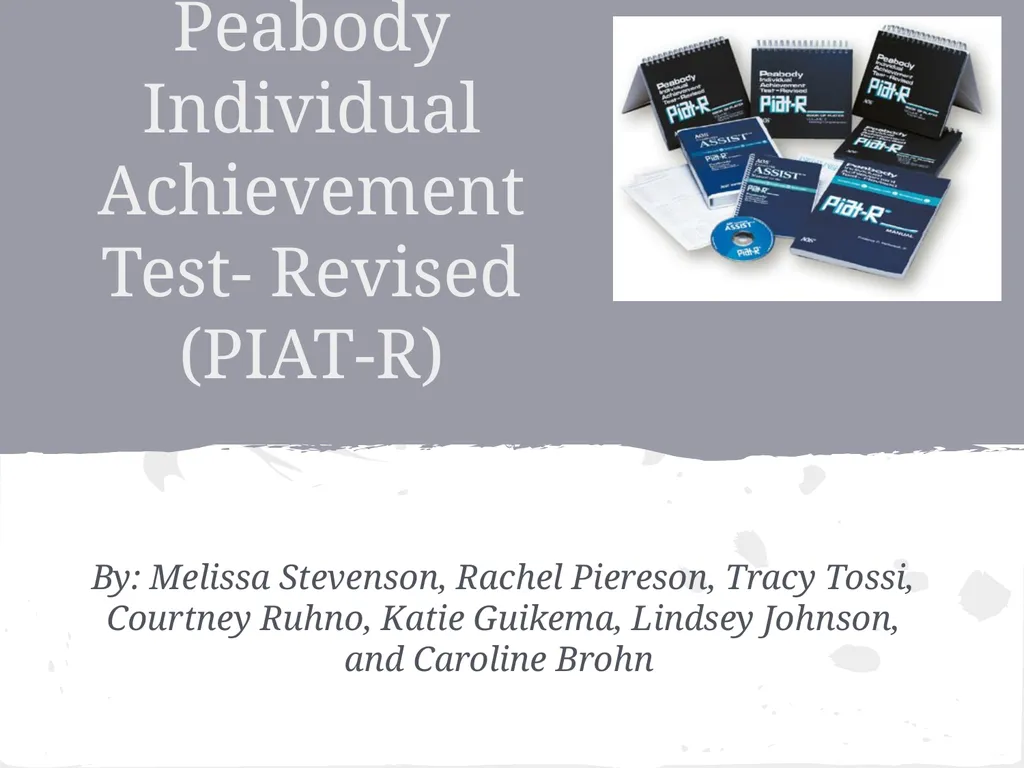
slide1. Peabody Individual Achievement Test- Revised (PIAT-R) By: Melissa Stevenson, Rachel Piereson, Tracy Tossi, Courtney Ruhno, Katie Guikema, Lindsey Johnson, and Caroline Brohn<br>
slide2. Basic Information Name: Peabody Individual Achievement Test- Revised (PIAT-R)
Cost:
-$461.00 per complete kit including 4 easels, 50 combined test record and written expression, booklists, NU Manual, carry bag.
-$630.00 per complete kit with ASSIST-includes ASSIST kit, 4 easels, 50 combined test record and written expression, booklists, NU Manual, carry bag.
General Purpose:The purpose of PIAT-R, is to measure the academic achievement of students ages 5 through 22 years old. It is made up of six subtests. The PIAT-R is designed to be employed in an educational or research setting. It offers a multiple-choice format which makes it ideal for assessing low individuals.
Administration Time: Approximately 50 to 70 minutes
Domains Assessed:
-General Information -Reading Recognition
-Reading Comprehension -Written Expression
-Mathematics -Spelling<br>
slide3. Description and Example of Assessment Task: (Reading) General Information-
-100 open-ended questions
-Areas assessed: science, social studies, fine arts, humanities, and recreation
-Example questions: “What is the chemical formula of water?” or “Name a color”.<br>
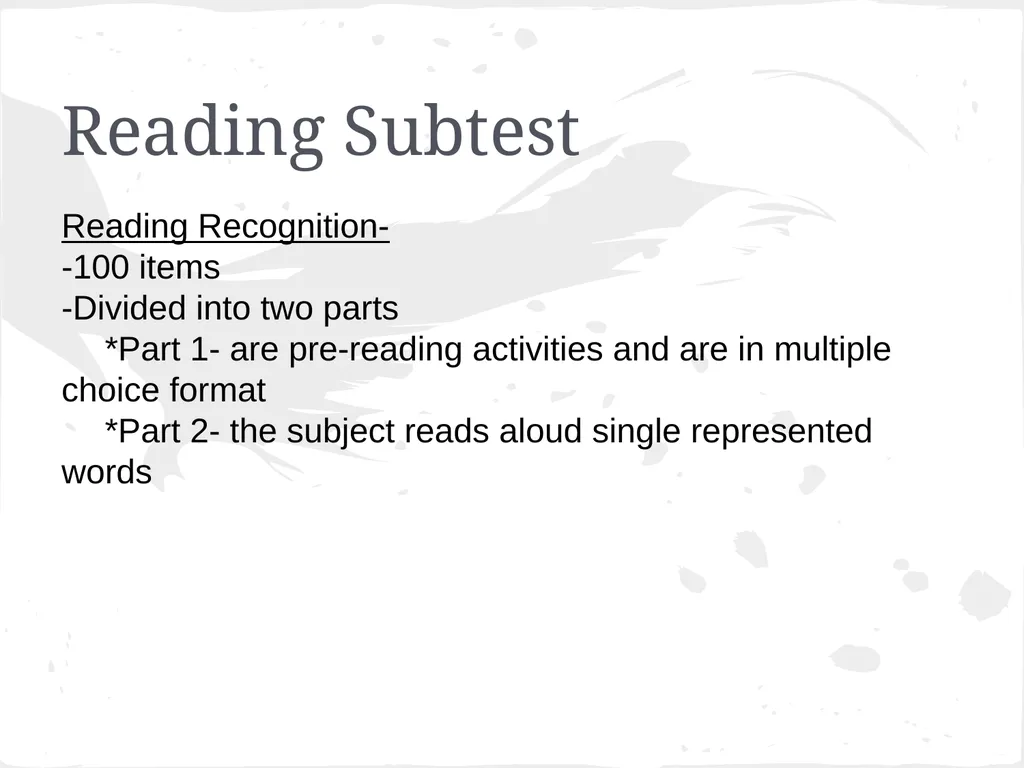
slide4. Reading Subtest Reading Recognition-
-100 items
-Divided into two parts
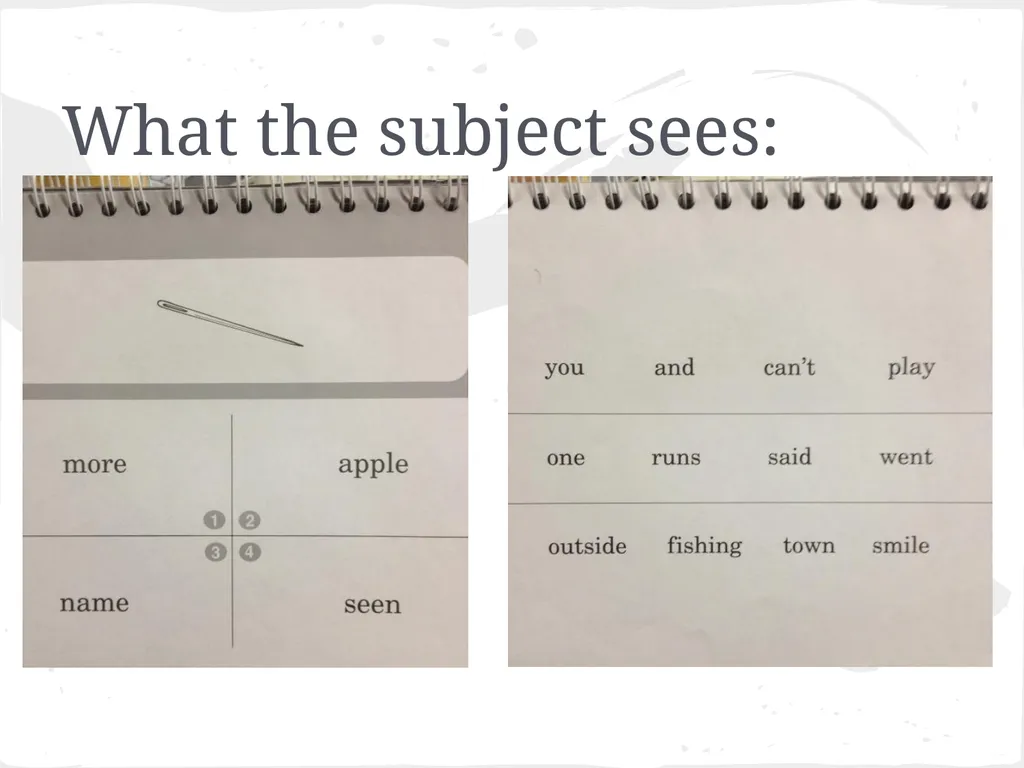
*Part 1- are pre-reading activities and are in multiple choice format
*Part 2- the subject reads aloud single represented words<br>
slide5. What the subject sees: Part 1 Part 2<br>
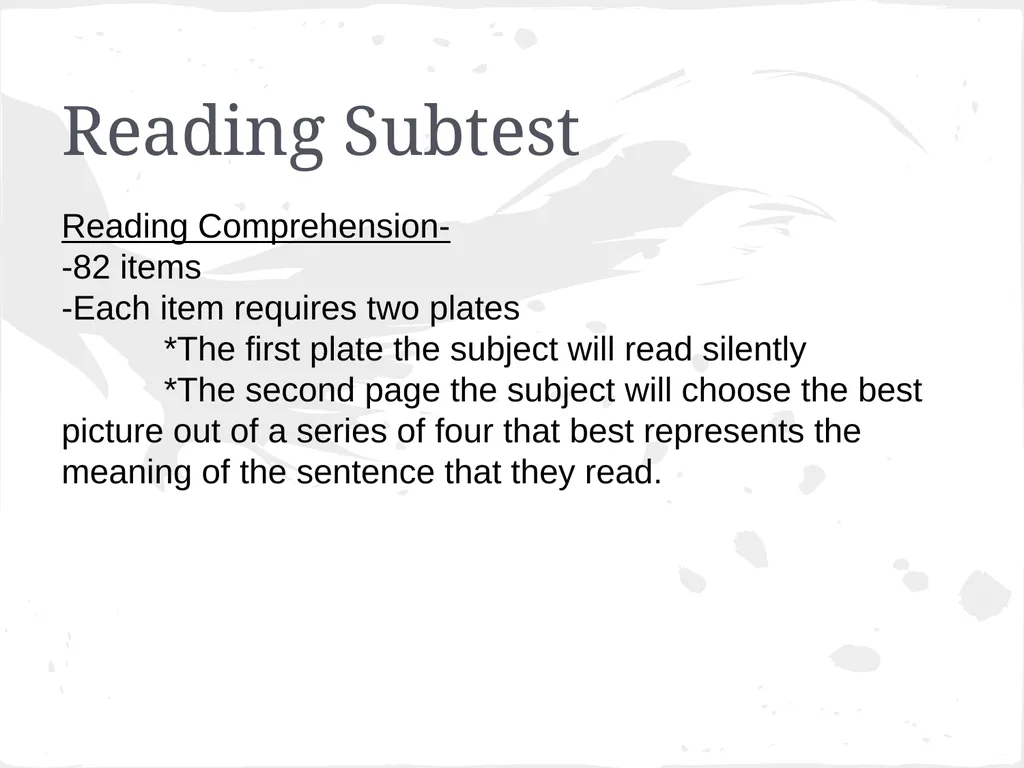
slide6. Reading Subtest Reading Comprehension-
-82 items
-Each item requires two plates
*The first plate the subject will read silently
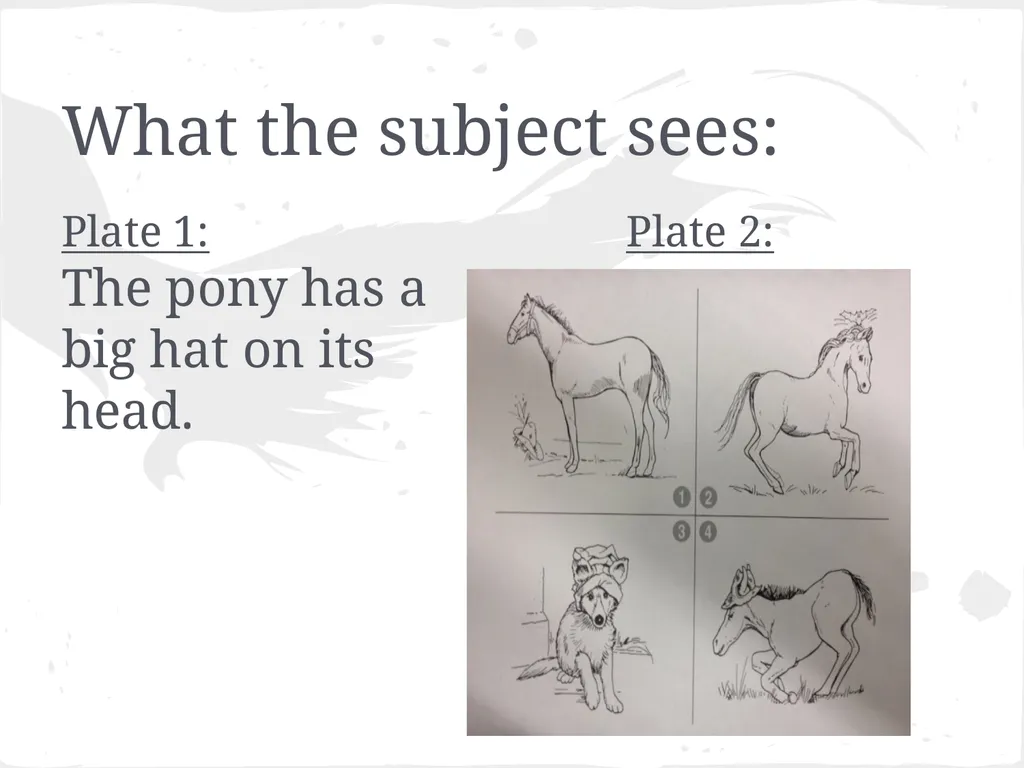
*The second page the subject will choose the best picture out of a series of four that best represents the meaning of the sentence that they read.<br>
slide7. What the subject sees: Plate 1: Plate 2:
The pony has a
big hat on its
head.<br>
slide8. Demonstration of the test: PIAT-R Demonstration<br>
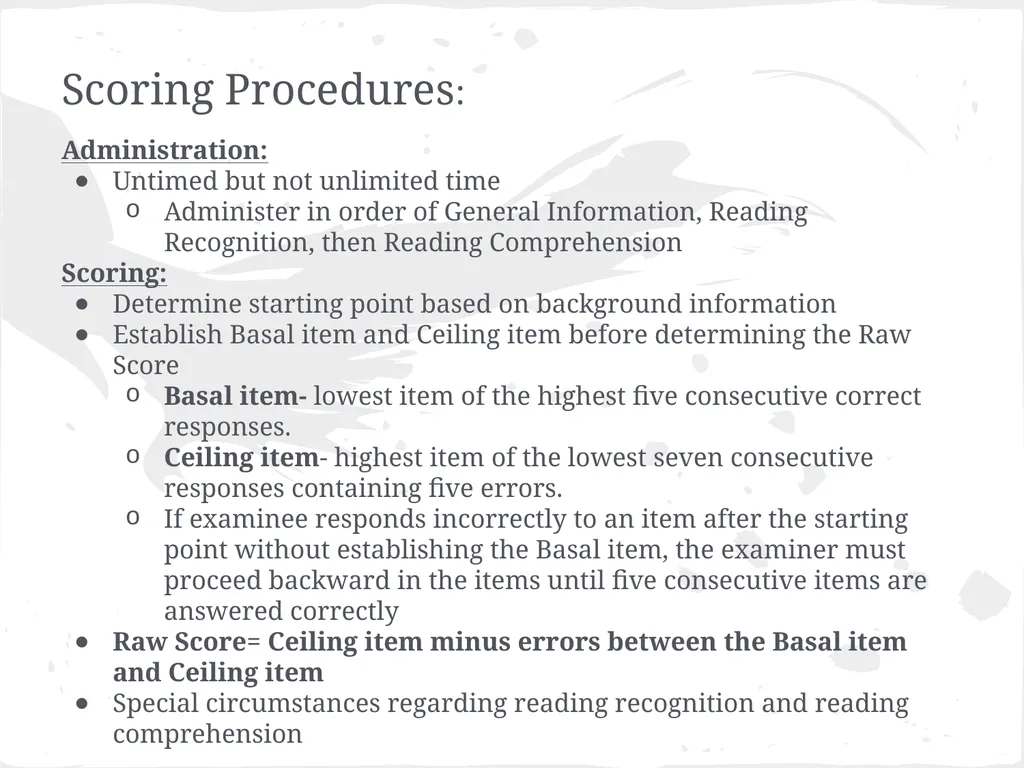
slide9. Scoring Procedures: Administration:
Untimed but not unlimited time
Administer in order of General Information, Reading Recognition, then Reading Comprehension
Scoring:
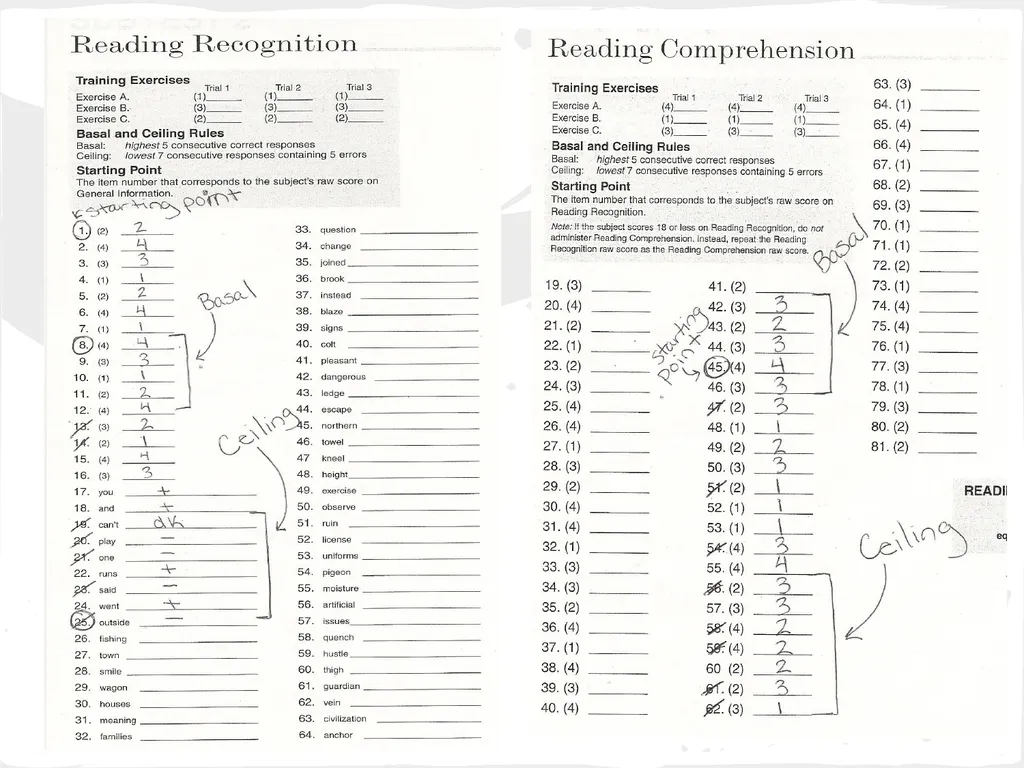
Determine starting point based on background information
Establish Basal item and Ceiling item before determining the Raw Score
Basal item- lowest item of the highest five consecutive correct responses.
Ceiling item- highest item of the lowest seven consecutive responses containing five errors.
If examinee responds incorrectly to an item after the starting point without establishing the Basal item, the examiner must proceed backward in the items until five consecutive items are answered correctly
Raw Score= Ceiling item minus errors between the Basal item and Ceiling item
Special circumstances regarding reading recognition and reading comprehension<br>
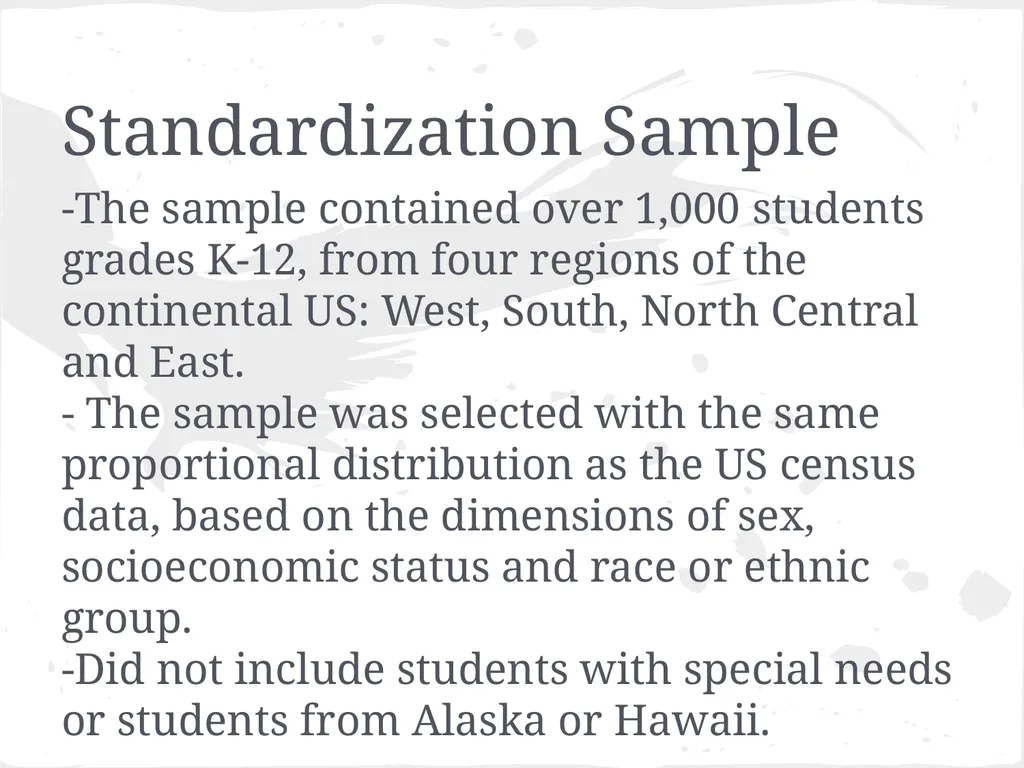
slide11. Standardization Sample -The sample contained over 1,000 students grades K-12, from four regions of the continental US: West, South, North Central and East.
- The sample was selected with the same proportional distribution as the US census data, based on the dimensions of sex, socioeconomic status and race or ethnic group.
-Did not include students with special needs or students from Alaska or Hawaii.<br>
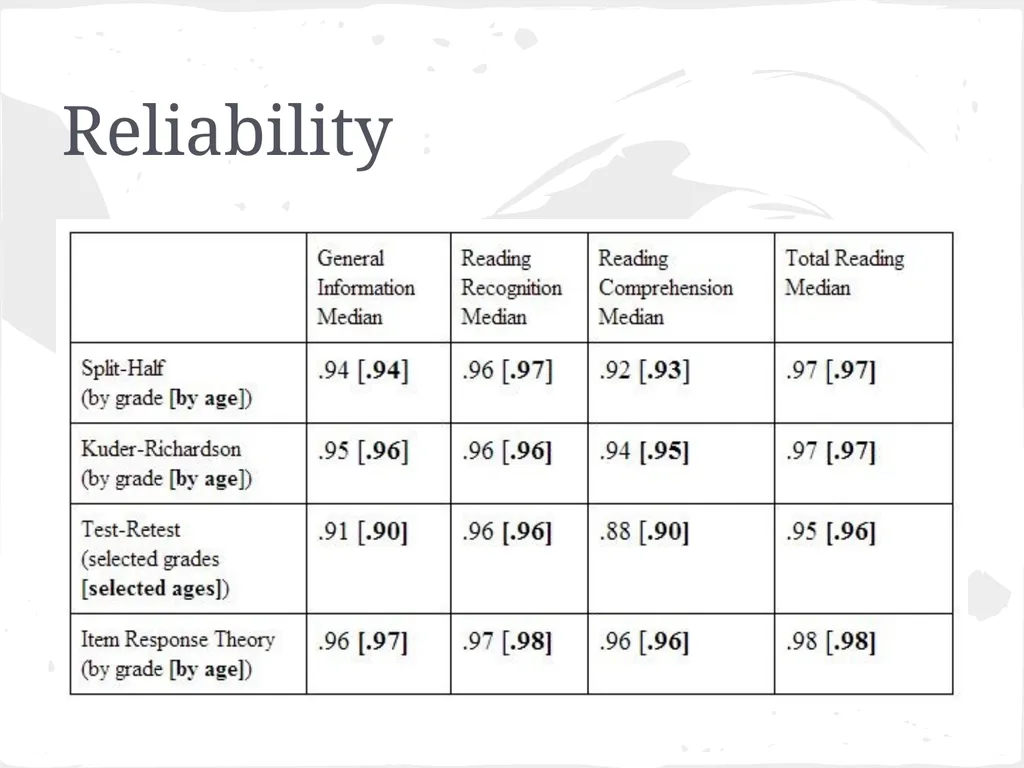
slide12. Reliability<br>
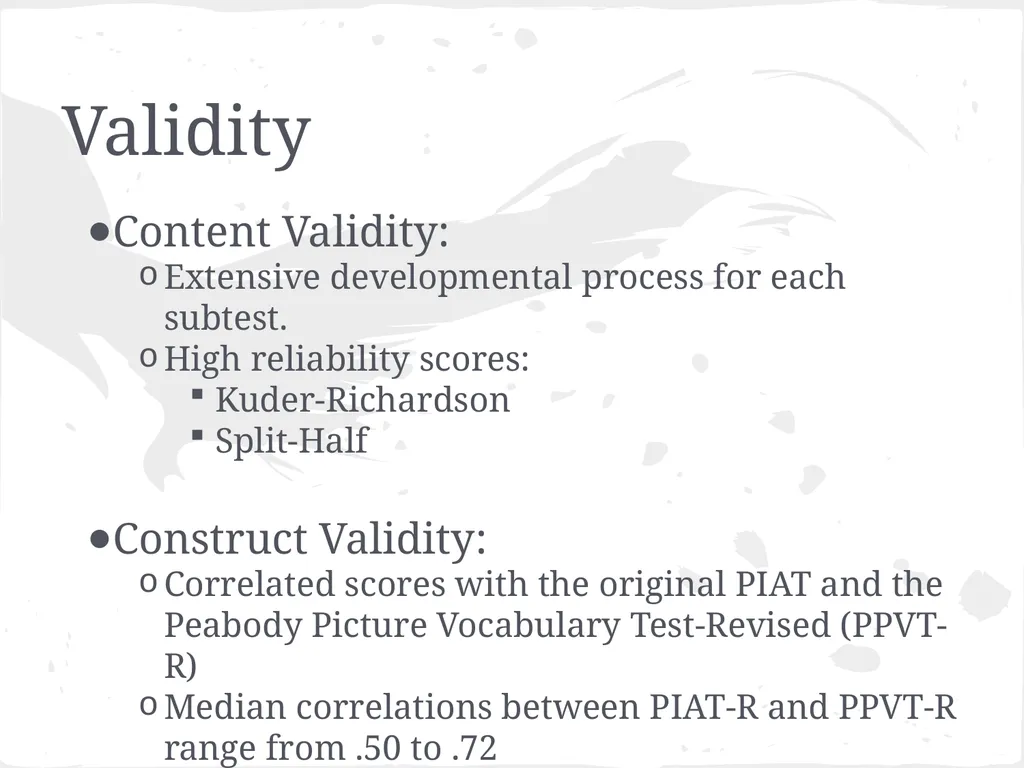
slide13. Validity Content Validity:
Extensive developmental process for each subtest.
High reliability scores:
Kuder-Richardson
Split-Half
Construct Validity:
Correlated scores with the original PIAT and the Peabody Picture Vocabulary Test-Revised (PPVT-R)
Median correlations between PIAT-R and PPVT-R range from .50 to .72<br>
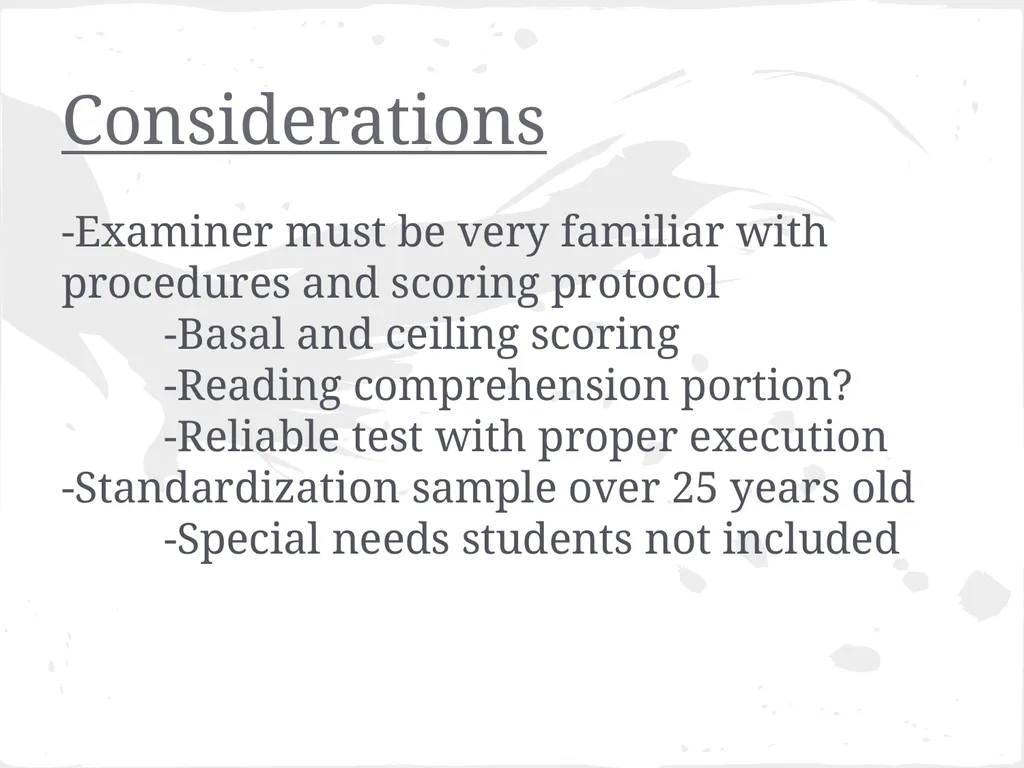
slide14. Considerations -Examiner must be very familiar with procedures and scoring protocol
-Basal and ceiling scoring
-Reading comprehension portion?
-Reliable test with proper execution
-Standardization sample over 25 years old
-Special needs students not included<br>
slide2. Basic Information Name: Peabody Individual Achievement Test- Revised (PIAT-R)
Cost:
-$461.00 per complete kit including 4 easels, 50 combined test record and written expression, booklists, NU Manual, carry bag.
-$630.00 per complete kit with ASSIST-includes ASSIST kit, 4 easels, 50 combined test record and written expression, booklists, NU Manual, carry bag.
General Purpose:The purpose of PIAT-R, is to measure the academic achievement of students ages 5 through 22 years old. It is made up of six subtests. The PIAT-R is designed to be employed in an educational or research setting. It offers a multiple-choice format which makes it ideal for assessing low individuals.
Administration Time: Approximately 50 to 70 minutes
Domains Assessed:
-General Information -Reading Recognition
-Reading Comprehension -Written Expression
-Mathematics -Spelling<br>
slide3. Description and Example of Assessment Task: (Reading) General Information-
-100 open-ended questions
-Areas assessed: science, social studies, fine arts, humanities, and recreation
-Example questions: “What is the chemical formula of water?” or “Name a color”.<br>
slide4. Reading Subtest Reading Recognition-
-100 items
-Divided into two parts
*Part 1- are pre-reading activities and are in multiple choice format
*Part 2- the subject reads aloud single represented words<br>
slide5. What the subject sees: Part 1 Part 2<br>
slide6. Reading Subtest Reading Comprehension-
-82 items
-Each item requires two plates
*The first plate the subject will read silently
*The second page the subject will choose the best picture out of a series of four that best represents the meaning of the sentence that they read.<br>
slide7. What the subject sees: Plate 1: Plate 2:
The pony has a
big hat on its
head.<br>
slide8. Demonstration of the test: PIAT-R Demonstration<br>
slide9. Scoring Procedures: Administration:
Untimed but not unlimited time
Administer in order of General Information, Reading Recognition, then Reading Comprehension
Scoring:
Determine starting point based on background information
Establish Basal item and Ceiling item before determining the Raw Score
Basal item- lowest item of the highest five consecutive correct responses.
Ceiling item- highest item of the lowest seven consecutive responses containing five errors.
If examinee responds incorrectly to an item after the starting point without establishing the Basal item, the examiner must proceed backward in the items until five consecutive items are answered correctly
Raw Score= Ceiling item minus errors between the Basal item and Ceiling item
Special circumstances regarding reading recognition and reading comprehension<br>
slide11. Standardization Sample -The sample contained over 1,000 students grades K-12, from four regions of the continental US: West, South, North Central and East.
- The sample was selected with the same proportional distribution as the US census data, based on the dimensions of sex, socioeconomic status and race or ethnic group.
-Did not include students with special needs or students from Alaska or Hawaii.<br>
slide12. Reliability<br>
slide13. Validity Content Validity:
Extensive developmental process for each subtest.
High reliability scores:
Kuder-Richardson
Split-Half
Construct Validity:
Correlated scores with the original PIAT and the Peabody Picture Vocabulary Test-Revised (PPVT-R)
Median correlations between PIAT-R and PPVT-R range from .50 to .72<br>
slide14. Considerations -Examiner must be very familiar with procedures and scoring protocol
-Basal and ceiling scoring
-Reading comprehension portion?
-Reliable test with proper execution
-Standardization sample over 25 years old
-Special needs students not included<br>