
Pediatric Trauma Kampala Advanced Trauma Care
MY
Published · 37 slides · 0 views

1 / 1




Description
Pediatric Trauma Kampala Advanced Trauma Care Course Outline Global context Epidemiology Local epidemiology Pathophysiology Management strategies Ideal treatment Adaptations for resource-limited settings context appropriate treatment
Related Topics
Share
Embed code
Download this presentation From Below
"Pediatric Trauma Kampala Advanced Trauma Care" is the property of its rightful owner. Permission is granted to download and print the materials on this website for personal, non-commercial use only, and to display it on your personal computer provided you do not modify the materials and that you retain all copyright notices contained in the materials. By downloading content from our website, you accept the terms of this agreement.
Presentation Transcript
01
Pediatric Trauma Kampala Advanced Trauma Care Course<br>
02
Outline Global context
Epidemiology & Local epidemiology
Pathophysiology
Management strategies/ Ideal treatment
Adaptations for resource-limited settings/ context appropriate treatment
Case for discussion<br>
Epidemiology & Local epidemiology
Pathophysiology
Management strategies/ Ideal treatment
Adaptations for resource-limited settings/ context appropriate treatment
Case for discussion<br>
03
Global context and epidemiology Injury is the most common cause of death and disability in childhood worldwide surpassing all major diseases in children and young adults.
Motor vehicle associated injuries are the most common cause of death in children of all ages.
8% of all injuries in children involve the chest
Chest injury serves as a marker for other organ system injury since >2/3rds of children with chest injury will have multiple injuries<br>
Motor vehicle associated injuries are the most common cause of death in children of all ages.
8% of all injuries in children involve the chest
Chest injury serves as a marker for other organ system injury since >2/3rds of children with chest injury will have multiple injuries<br>
04
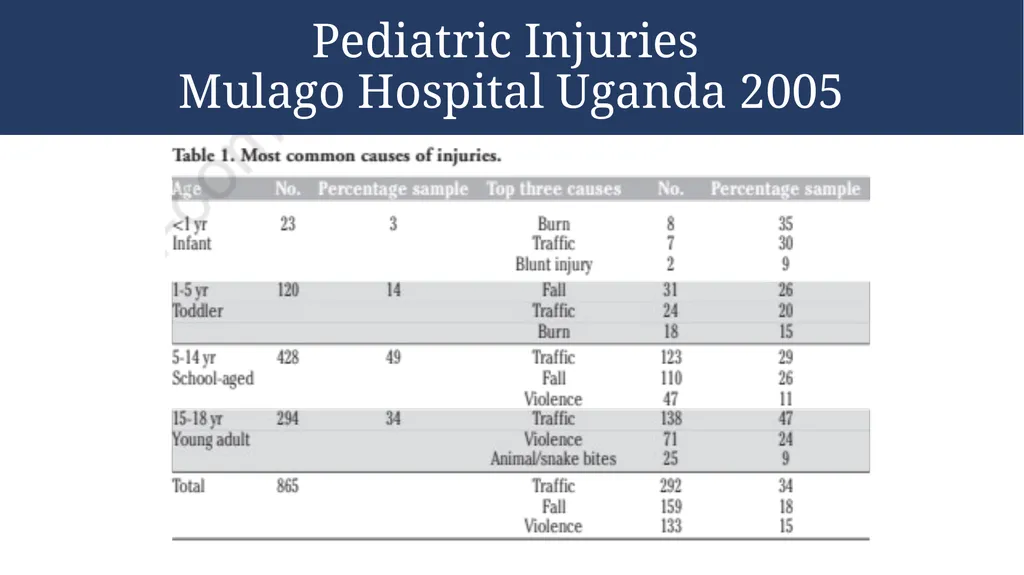
LMIC Epidemiology Road traffic crashes involving pedestrians predominate in most African trauma registries
Children compose >50% of the population in many of these countries
More children die of road traffic crashes than of TB, HIV, malaria combined in the age 5-14 year age group
Falls are more common in children under the age of 1<br>
Children compose >50% of the population in many of these countries
More children die of road traffic crashes than of TB, HIV, malaria combined in the age 5-14 year age group
Falls are more common in children under the age of 1<br>
05
Pediatric Injuries
Mulago Hospital Uganda 2005<br>
06
Initial Trauma Assessment Kampala Advanced Trauma Care Course
Last Edited August 2016 by Maija Cheung MD & Michael DeWane MD Pediatric Trauma
Unique Issues/ Pathophysiology<br>
Last Edited August 2016 by Maija Cheung MD & Michael DeWane MD Pediatric Trauma
Unique Issues/ Pathophysiology<br>
07
Unique Problems in Children: Blunt trauma and children’s physical characteristics result in multisystem injury being much more common than single system injury.
Children may not demonstrate changes in hemodynamics until severe derangements are present.<br>
Children may not demonstrate changes in hemodynamics until severe derangements are present.<br>
08
Unique Problems in Children Continued: Size
Smaller mass = greater force per unit of body area
Less fat, connective tissue, closer proximity to multiple organs = high frequency of multiple organ injury
Large head proportionate to body = higher frequency of brain injuries
Skeleton
Incompletely calcified = more flexible = internal organ damage without overlying bony fracture
Equipment
Broselow Pediatric Emergency Tape (length-based resuscitation tape)
Pediatric ETT<br>
Smaller mass = greater force per unit of body area
Less fat, connective tissue, closer proximity to multiple organs = high frequency of multiple organ injury
Large head proportionate to body = higher frequency of brain injuries
Skeleton
Incompletely calcified = more flexible = internal organ damage without overlying bony fracture
Equipment
Broselow Pediatric Emergency Tape (length-based resuscitation tape)
Pediatric ETT<br>
09
Unique Problems in Children Continued: Surface Area
Higher surface area/ body volume = greater heat loss and increased risk of hypothermia
Temperature control: baer hugger, heat lamps, wrap arms and legs, warm IVF
Psychological Stress
Trauma may lead to regressive psychological behavior
Limited history taking and cooperation
Long-term effects
Injury can have effects on subsequent growth and development<br>
Higher surface area/ body volume = greater heat loss and increased risk of hypothermia
Temperature control: baer hugger, heat lamps, wrap arms and legs, warm IVF
Psychological Stress
Trauma may lead to regressive psychological behavior
Limited history taking and cooperation
Long-term effects
Injury can have effects on subsequent growth and development<br>
10
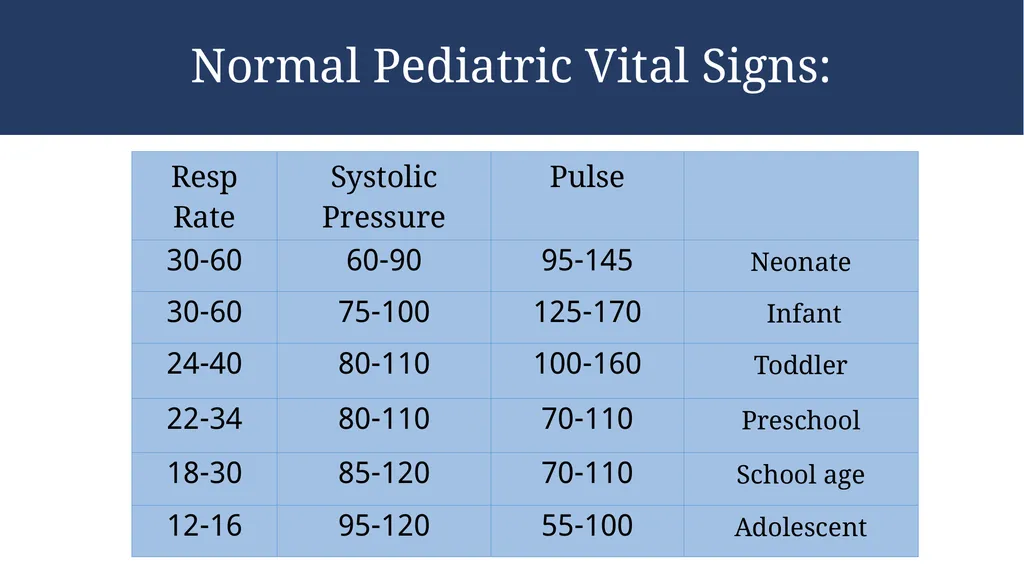
Normal Pediatric Vital Signs:<br>
11
Initial Trauma Assessment Kampala Advanced Trauma Care Course
Last Edited August 2016 by Maija Cheung MD & Michael DeWane MD Pediatric Trauma
Initial Assessment & Management<br>
Last Edited August 2016 by Maija Cheung MD & Michael DeWane MD Pediatric Trauma
Initial Assessment & Management<br>
12
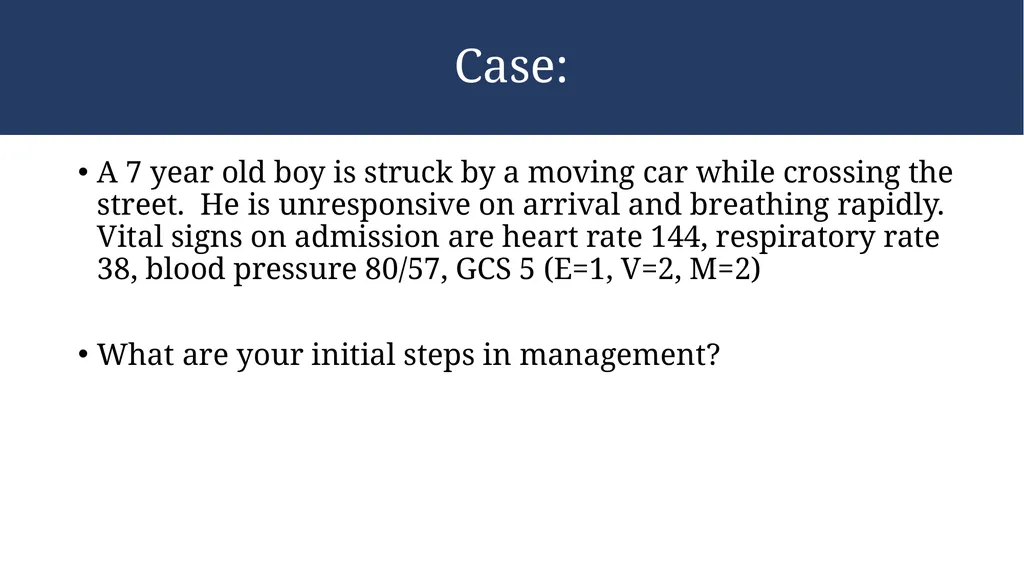
Case: A 7 year old boy is struck by a moving car while crossing the street. He is unresponsive on arrival and breathing rapidly. Vital signs on admission are heart rate 144, respiratory rate 38, blood pressure 80/57, GCS 5 (E=1, V=2, M=2)
What are your initial steps in management?<br>
What are your initial steps in management?<br>
13
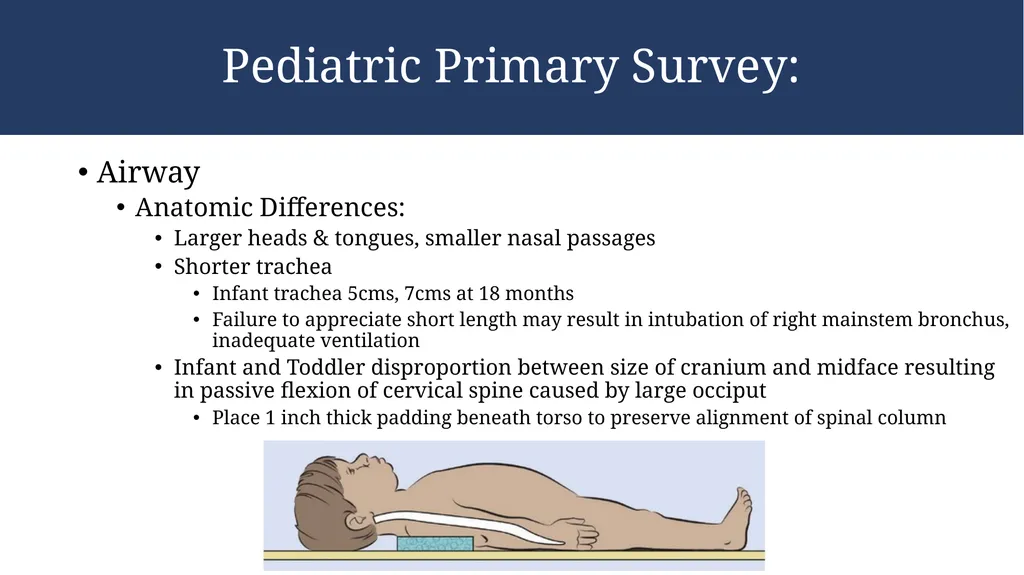
Pediatric Primary Survey: Airway
Anatomic Differences:
Larger heads & tongues, smaller nasal passages
Shorter trachea
Infant trachea 5cms, 7cms at 18 months
Failure to appreciate short length may result in intubation of right mainstem bronchus, inadequate ventilation
Infant and Toddler disproportion between size of cranium and midface resulting in passive flexion of cervical spine caused by large occiput
Place 1 inch thick padding beneath torso to preserve alignment of spinal column<br>
Anatomic Differences:
Larger heads & tongues, smaller nasal passages
Shorter trachea
Infant trachea 5cms, 7cms at 18 months
Failure to appreciate short length may result in intubation of right mainstem bronchus, inadequate ventilation
Infant and Toddler disproportion between size of cranium and midface resulting in passive flexion of cervical spine caused by large occiput
Place 1 inch thick padding beneath torso to preserve alignment of spinal column<br>
14
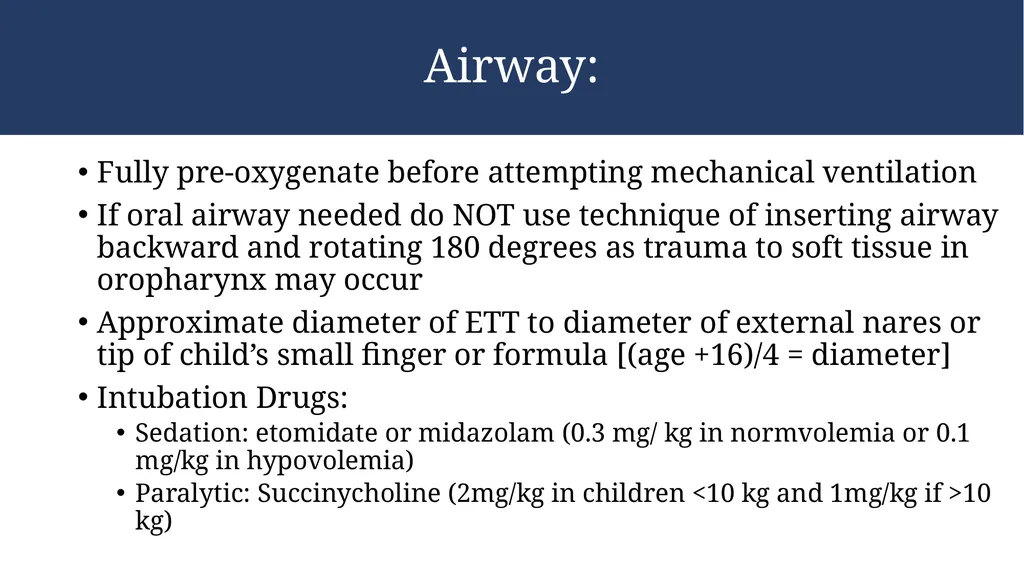
Airway: Fully pre-oxygenate before attempting mechanical ventilation
If oral airway needed do NOT use technique of inserting airway backward and rotating 180 degrees as trauma to soft tissue in oropharynx may occur
Approximate diameter of ETT to diameter of external nares or tip of child’s small finger or formula [(age +16)/4 = diameter]
Intubation Drugs:
Sedation: etomidate or midazolam (0.3 mg/ kg in normvolemia or 0.1 mg/kg in hypovolemia)
Paralytic: Succinycholine (2mg/kg in children <10 kg and 1mg/kg if >10 kg)<br>
If oral airway needed do NOT use technique of inserting airway backward and rotating 180 degrees as trauma to soft tissue in oropharynx may occur
Approximate diameter of ETT to diameter of external nares or tip of child’s small finger or formula [(age +16)/4 = diameter]
Intubation Drugs:
Sedation: etomidate or midazolam (0.3 mg/ kg in normvolemia or 0.1 mg/kg in hypovolemia)
Paralytic: Succinycholine (2mg/kg in children <10 kg and 1mg/kg if >10 kg)<br>
15
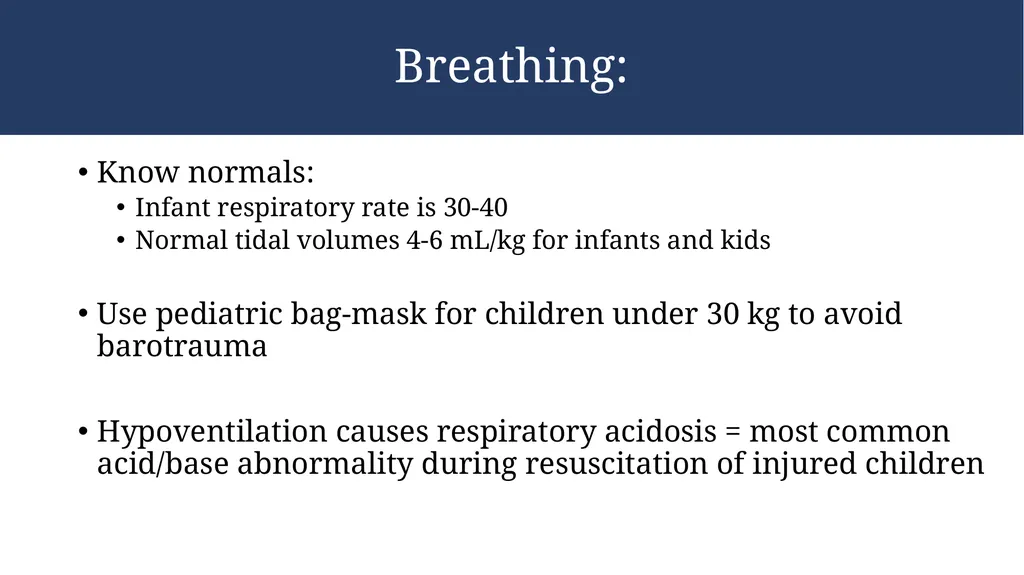
Breathing: Know normals:
Infant respiratory rate is 30-40
Normal tidal volumes 4-6 mL/kg for infants and kids
Use pediatric bag-mask for children under 30 kg to avoid barotrauma
Hypoventilation causes respiratory acidosis = most common acid/base abnormality during resuscitation of injured children<br>
Infant respiratory rate is 30-40
Normal tidal volumes 4-6 mL/kg for infants and kids
Use pediatric bag-mask for children under 30 kg to avoid barotrauma
Hypoventilation causes respiratory acidosis = most common acid/base abnormality during resuscitation of injured children<br>
16
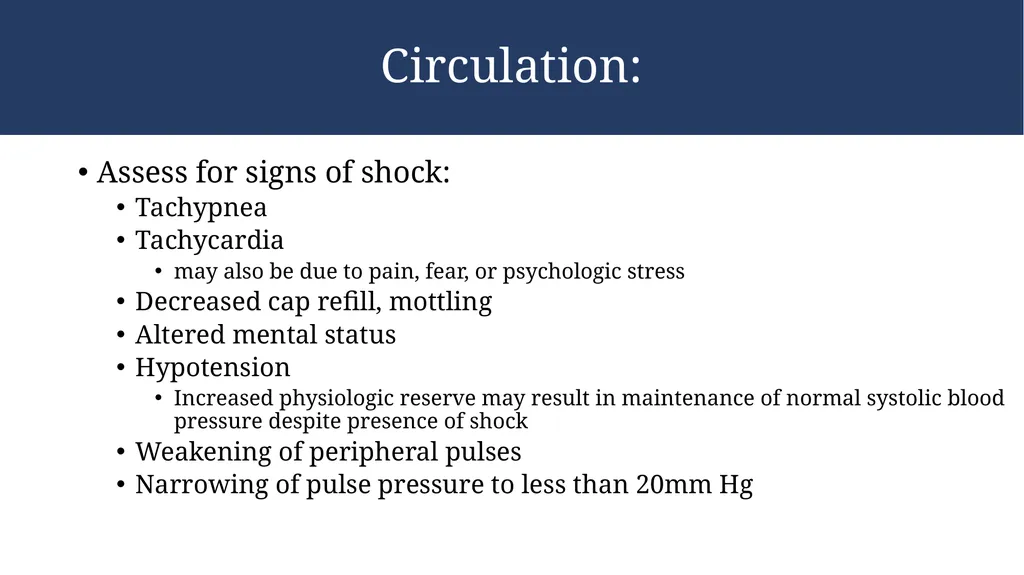
Circulation: Assess for signs of shock:
Tachypnea
Tachycardia
may also be due to pain, fear, or psychologic stress
Decreased cap refill, mottling
Altered mental status
Hypotension
Increased physiologic reserve may result in maintenance of normal systolic blood pressure despite presence of shock
Weakening of peripheral pulses
Narrowing of pulse pressure to less than 20mm Hg<br>
Tachypnea
Tachycardia
may also be due to pain, fear, or psychologic stress
Decreased cap refill, mottling
Altered mental status
Hypotension
Increased physiologic reserve may result in maintenance of normal systolic blood pressure despite presence of shock
Weakening of peripheral pulses
Narrowing of pulse pressure to less than 20mm Hg<br>
17
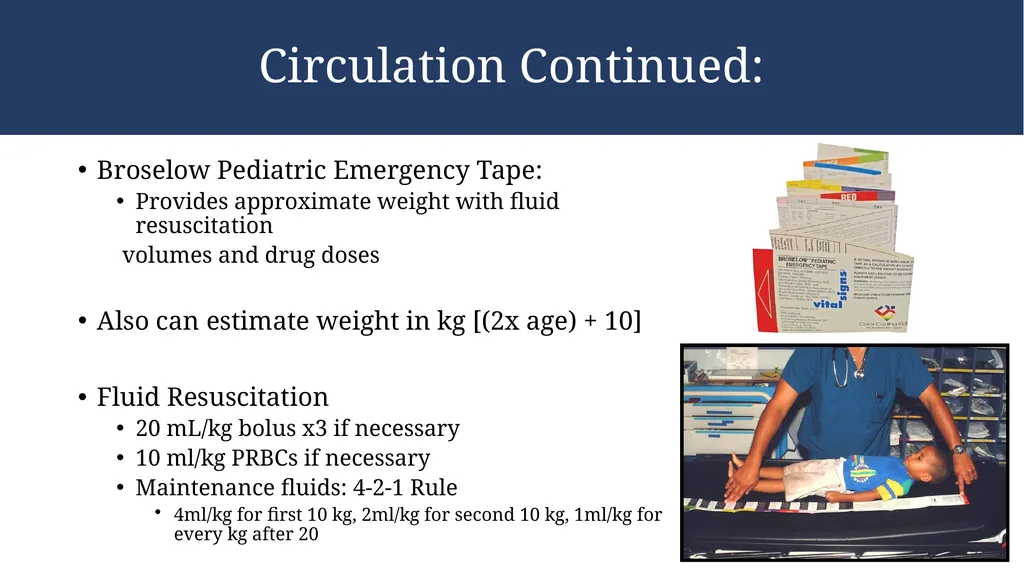
Circulation Continued: Broselow Pediatric Emergency Tape:
Provides approximate weight with fluid resuscitation
volumes and drug doses
Also can estimate weight in kg [(2x age) + 10]
Fluid Resuscitation
20 mL/kg bolus x3 if necessary
10 ml/kg PRBCs if necessary
Maintenance fluids: 4-2-1 Rule
4ml/kg for first 10 kg, 2ml/kg for second 10 kg, 1ml/kg for every kg after 20<br>
Provides approximate weight with fluid resuscitation
volumes and drug doses
Also can estimate weight in kg [(2x age) + 10]
Fluid Resuscitation
20 mL/kg bolus x3 if necessary
10 ml/kg PRBCs if necessary
Maintenance fluids: 4-2-1 Rule
4ml/kg for first 10 kg, 2ml/kg for second 10 kg, 1ml/kg for every kg after 20<br>
18
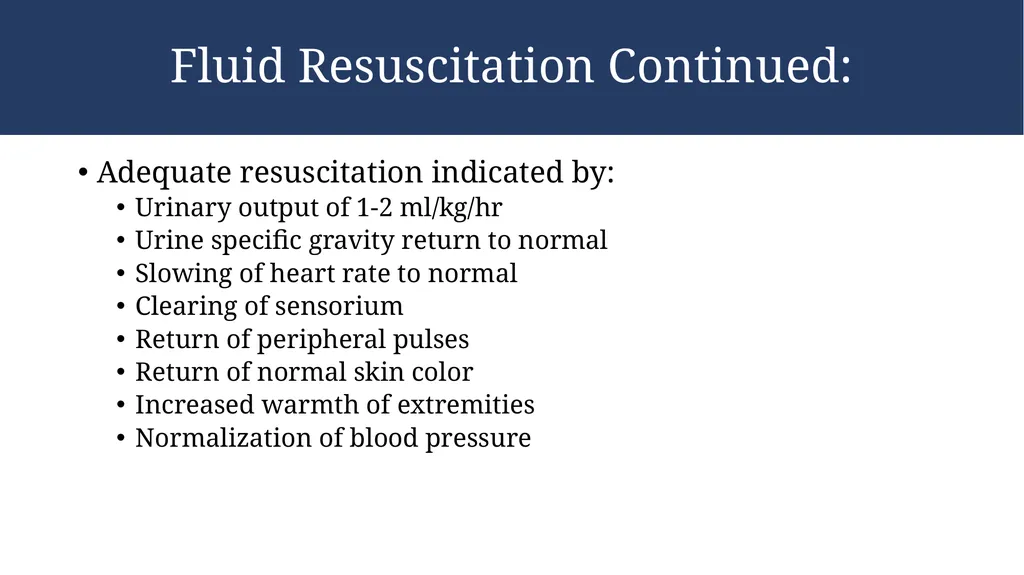
Fluid Resuscitation Continued: Adequate resuscitation indicated by:
Urinary output of 1-2 ml/kg/hr
Urine specific gravity return to normal
Slowing of heart rate to normal
Clearing of sensorium
Return of peripheral pulses
Return of normal skin color
Increased warmth of extremities
Normalization of blood pressure<br>
Urinary output of 1-2 ml/kg/hr
Urine specific gravity return to normal
Slowing of heart rate to normal
Clearing of sensorium
Return of peripheral pulses
Return of normal skin color
Increased warmth of extremities
Normalization of blood pressure<br>
19
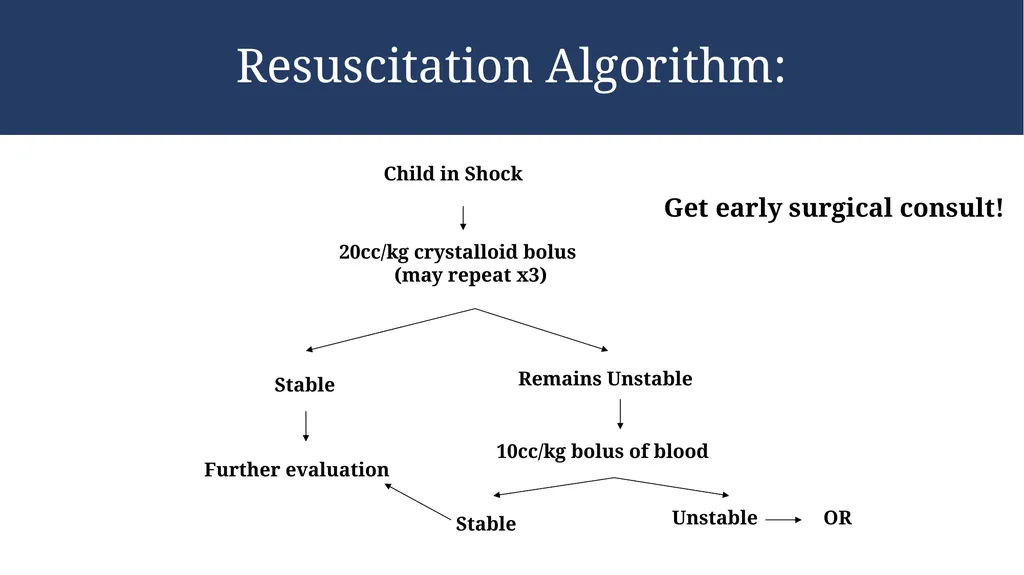
Resuscitation Algorithm: Child in Shock 20cc/kg crystalloid bolus
(may repeat x3) Stable Further evaluation Remains Unstable 10cc/kg bolus of blood Stable Unstable OR Get early surgical consult!<br>
(may repeat x3) Stable Further evaluation Remains Unstable 10cc/kg bolus of blood Stable Unstable OR Get early surgical consult!<br>
20
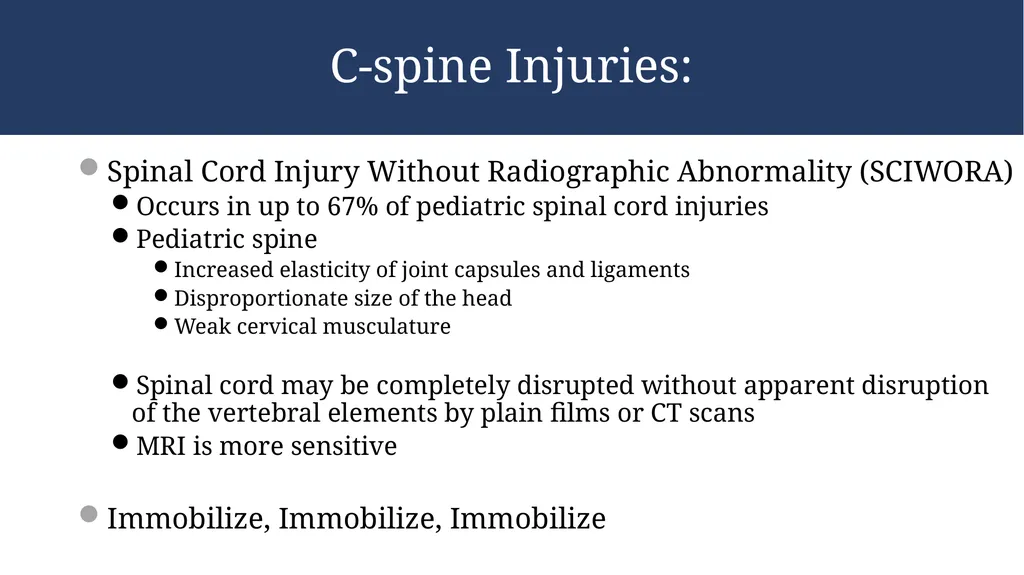
C-spine Injuries: Spinal Cord Injury Without Radiographic Abnormality (SCIWORA)
Occurs in up to 67% of pediatric spinal cord injuries
Pediatric spine
Increased elasticity of joint capsules and ligaments
Disproportionate size of the head
Weak cervical musculature
Spinal cord may be completely disrupted without apparent disruption of the vertebral elements by plain films or CT scans
MRI is more sensitive
Immobilize, Immobilize, Immobilize<br>
Occurs in up to 67% of pediatric spinal cord injuries
Pediatric spine
Increased elasticity of joint capsules and ligaments
Disproportionate size of the head
Weak cervical musculature
Spinal cord may be completely disrupted without apparent disruption of the vertebral elements by plain films or CT scans
MRI is more sensitive
Immobilize, Immobilize, Immobilize<br>
21
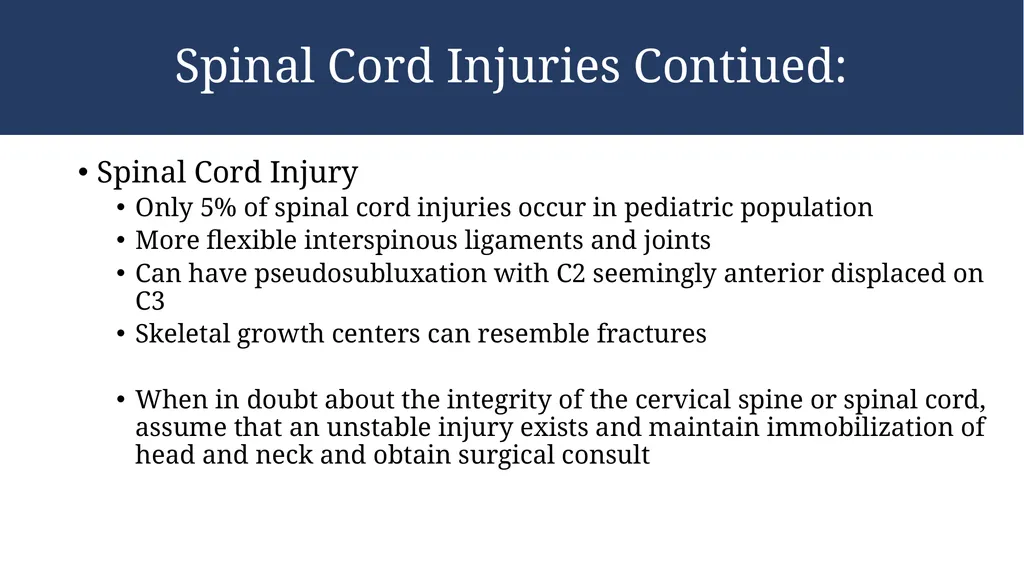
Spinal Cord Injuries Contiued: Spinal Cord Injury
Only 5% of spinal cord injuries occur in pediatric population
More flexible interspinous ligaments and joints
Can have pseudosubluxation with C2 seemingly anterior displaced on C3
Skeletal growth centers can resemble fractures
When in doubt about the integrity of the cervical spine or spinal cord, assume that an unstable injury exists and maintain immobilization of head and neck and obtain surgical consult<br>
Only 5% of spinal cord injuries occur in pediatric population
More flexible interspinous ligaments and joints
Can have pseudosubluxation with C2 seemingly anterior displaced on C3
Skeletal growth centers can resemble fractures
When in doubt about the integrity of the cervical spine or spinal cord, assume that an unstable injury exists and maintain immobilization of head and neck and obtain surgical consult<br>
22
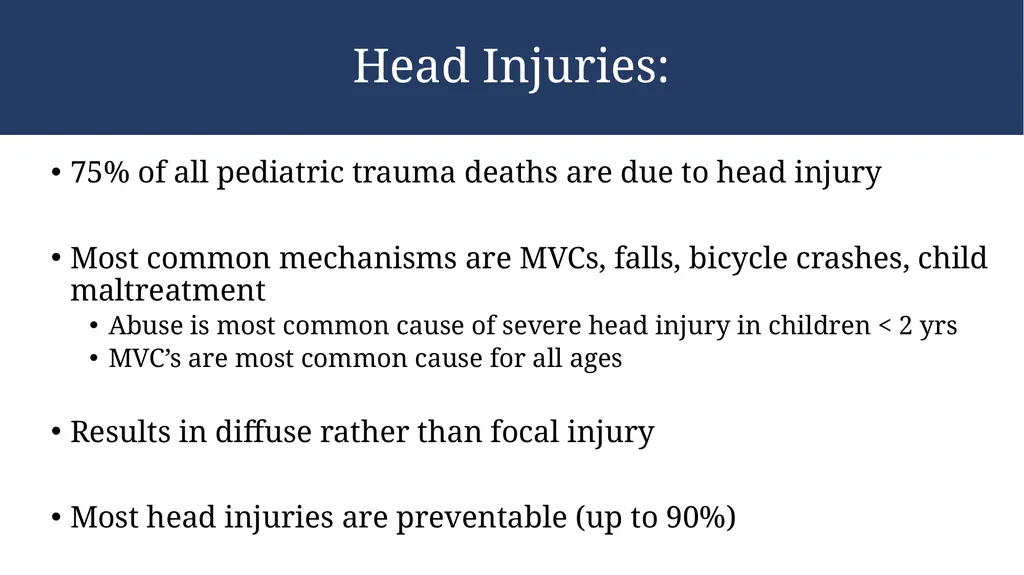
Head Injuries: 75% of all pediatric trauma deaths are due to head injury
Most common mechanisms are MVCs, falls, bicycle crashes, child maltreatment
Abuse is most common cause of severe head injury in children < 2 yrs
MVC’s are most common cause for all ages
Results in diffuse rather than focal injury
Most head injuries are preventable (up to 90%)<br>
Most common mechanisms are MVCs, falls, bicycle crashes, child maltreatment
Abuse is most common cause of severe head injury in children < 2 yrs
MVC’s are most common cause for all ages
Results in diffuse rather than focal injury
Most head injuries are preventable (up to 90%)<br>
23
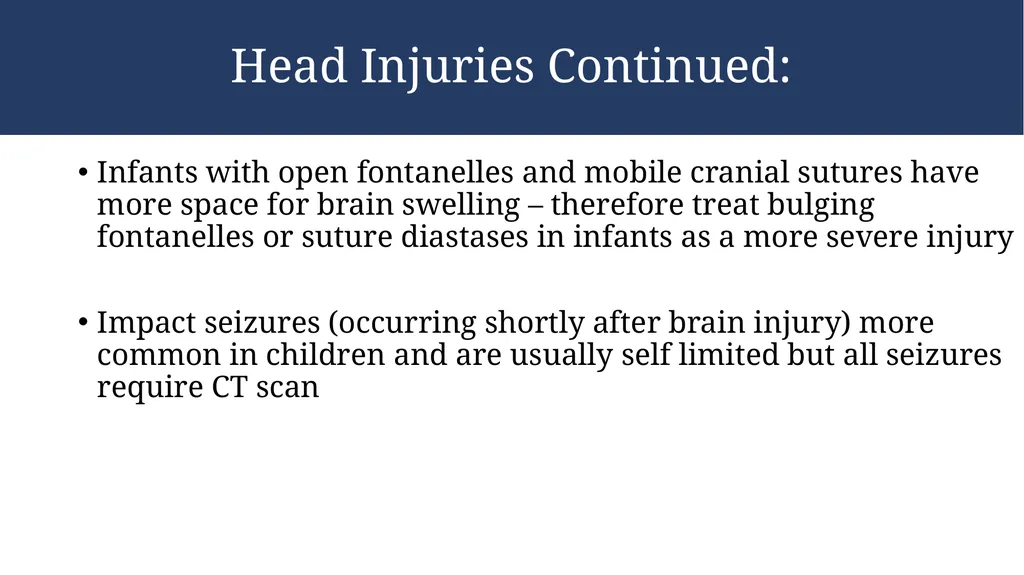
Head Injuries Continued: Infants with open fontanelles and mobile cranial sutures have more space for brain swelling – therefore treat bulging fontanelles or suture diastases in infants as a more severe injury
Impact seizures (occurring shortly after brain injury) more common in children and are usually self limited but all seizures require CT scan<br>
Impact seizures (occurring shortly after brain injury) more common in children and are usually self limited but all seizures require CT scan<br>
24
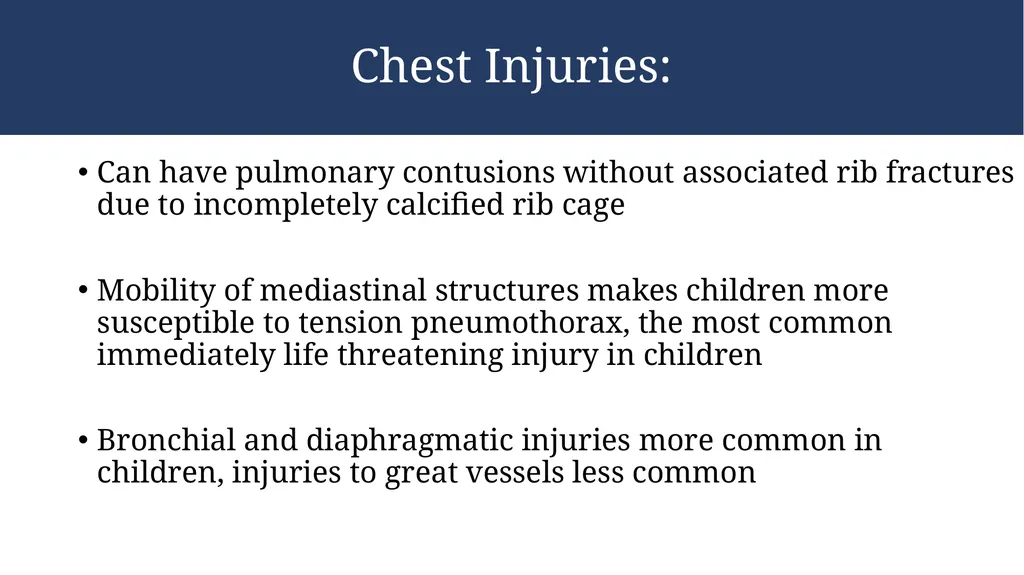
Chest Injuries: Can have pulmonary contusions without associated rib fractures due to incompletely calcified rib cage
Mobility of mediastinal structures makes children more susceptible to tension pneumothorax, the most common immediately life threatening injury in children
Bronchial and diaphragmatic injuries more common in children, injuries to great vessels less common<br>
Mobility of mediastinal structures makes children more susceptible to tension pneumothorax, the most common immediately life threatening injury in children
Bronchial and diaphragmatic injuries more common in children, injuries to great vessels less common<br>
25
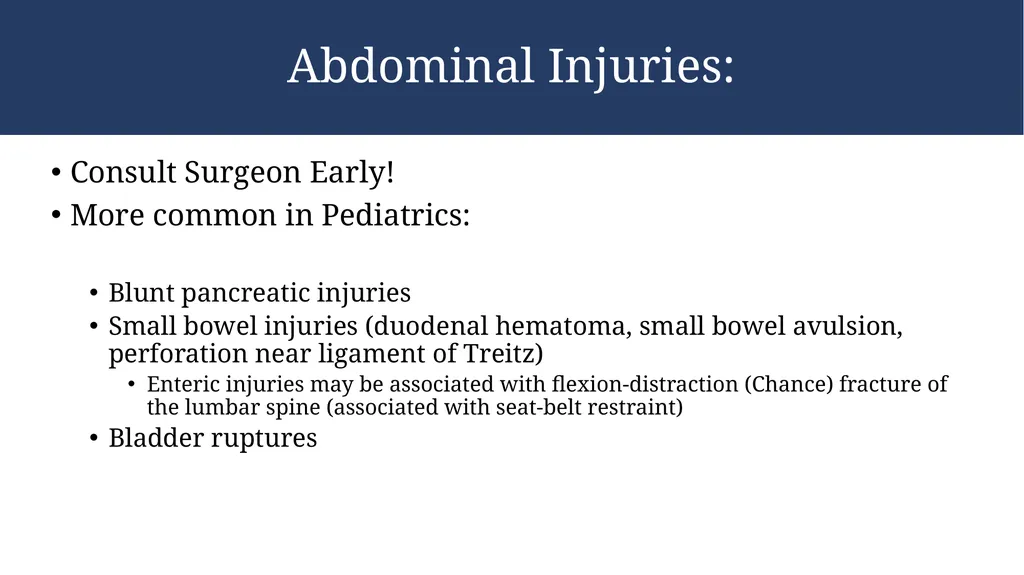
Abdominal Injuries: Consult Surgeon Early!
More common in Pediatrics:
Blunt pancreatic injuries
Small bowel injuries (duodenal hematoma, small bowel avulsion, perforation near ligament of Treitz)
Enteric injuries may be associated with flexion-distraction (Chance) fracture of the lumbar spine (associated with seat-belt restraint)
Bladder ruptures<br>
More common in Pediatrics:
Blunt pancreatic injuries
Small bowel injuries (duodenal hematoma, small bowel avulsion, perforation near ligament of Treitz)
Enteric injuries may be associated with flexion-distraction (Chance) fracture of the lumbar spine (associated with seat-belt restraint)
Bladder ruptures<br>
26
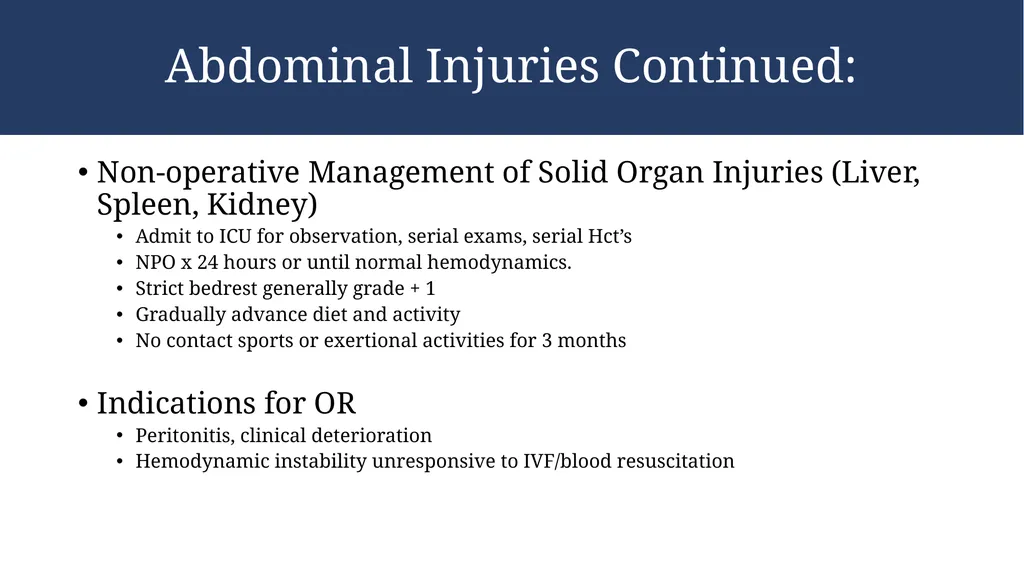
Abdominal Injuries Continued: Non-operative Management of Solid Organ Injuries (Liver, Spleen, Kidney)
Admit to ICU for observation, serial exams, serial Hct’s
NPO x 24 hours or until normal hemodynamics.
Strict bedrest generally grade + 1
Gradually advance diet and activity
No contact sports or exertional activities for 3 months
Indications for OR
Peritonitis, clinical deterioration
Hemodynamic instability unresponsive to IVF/blood resuscitation<br>
Admit to ICU for observation, serial exams, serial Hct’s
NPO x 24 hours or until normal hemodynamics.
Strict bedrest generally grade + 1
Gradually advance diet and activity
No contact sports or exertional activities for 3 months
Indications for OR
Peritonitis, clinical deterioration
Hemodynamic instability unresponsive to IVF/blood resuscitation<br>
27
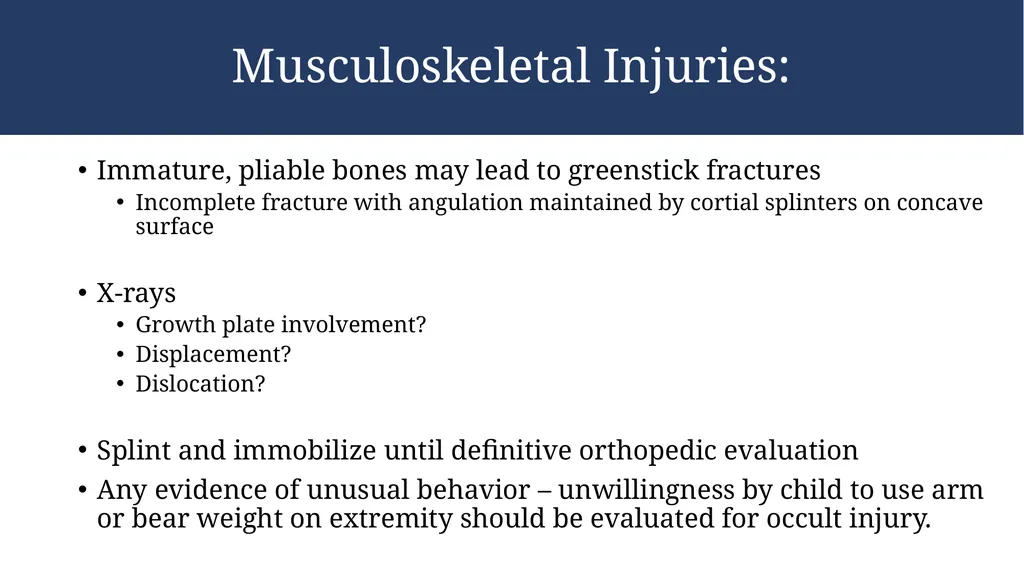
Musculoskeletal Injuries: Immature, pliable bones may lead to greenstick fractures
Incomplete fracture with angulation maintained by cortial splinters on concave surface
X-rays
Growth plate involvement?
Displacement?
Dislocation?
Splint and immobilize until definitive orthopedic evaluation
Any evidence of unusual behavior – unwillingness by child to use arm or bear weight on extremity should be evaluated for occult injury.<br>
Incomplete fracture with angulation maintained by cortial splinters on concave surface
X-rays
Growth plate involvement?
Displacement?
Dislocation?
Splint and immobilize until definitive orthopedic evaluation
Any evidence of unusual behavior – unwillingness by child to use arm or bear weight on extremity should be evaluated for occult injury.<br>
28
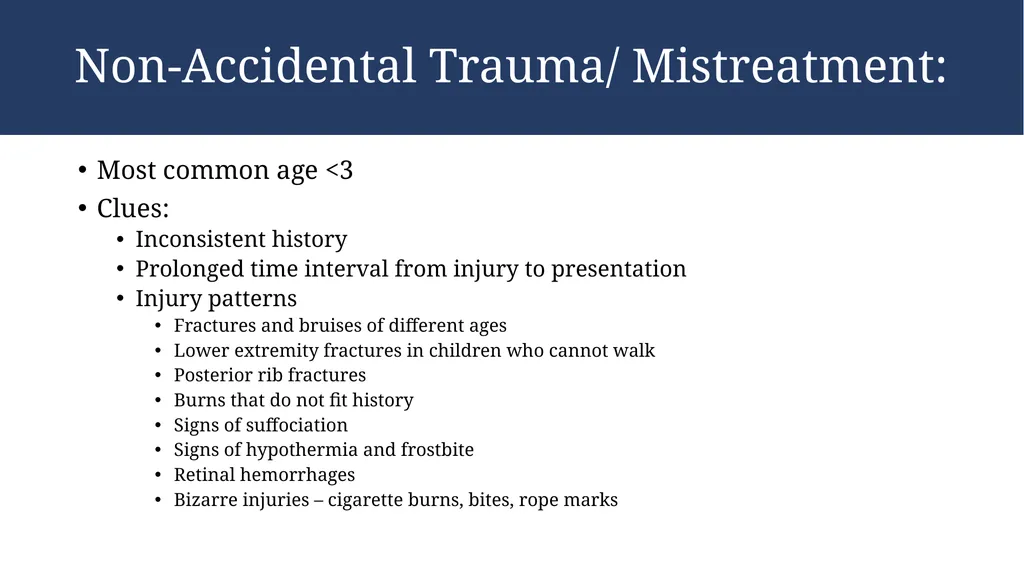
Non-Accidental Trauma/ Mistreatment: Most common age <3
Clues:
Inconsistent history
Prolonged time interval from injury to presentation
Injury patterns
Fractures and bruises of different ages
Lower extremity fractures in children who cannot walk
Posterior rib fractures
Burns that do not fit history
Signs of suffociation
Signs of hypothermia and frostbite
Retinal hemorrhages
Bizarre injuries – cigarette burns, bites, rope marks<br>
Clues:
Inconsistent history
Prolonged time interval from injury to presentation
Injury patterns
Fractures and bruises of different ages
Lower extremity fractures in children who cannot walk
Posterior rib fractures
Burns that do not fit history
Signs of suffociation
Signs of hypothermia and frostbite
Retinal hemorrhages
Bizarre injuries – cigarette burns, bites, rope marks<br>
29
Initial Trauma Assessment Kampala Advanced Trauma Care Course
Last Edited August 2016 by Maija Cheung MD & Michael DeWane MD Pediatric Trauma
Injury Prevention<br>
Last Edited August 2016 by Maija Cheung MD & Michael DeWane MD Pediatric Trauma
Injury Prevention<br>
30
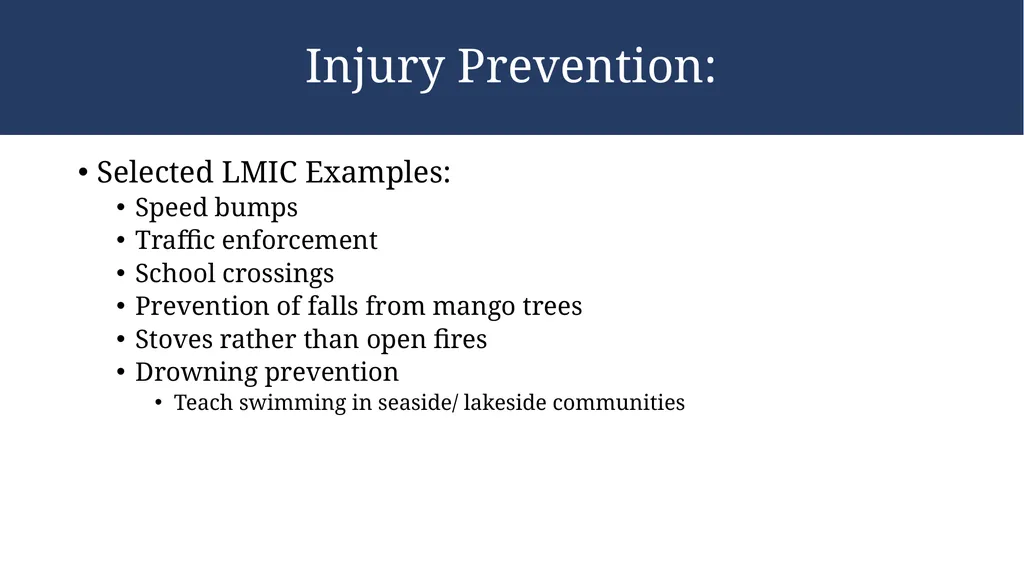
Injury Prevention: Selected LMIC Examples:
Speed bumps
Traffic enforcement
School crossings
Prevention of falls from mango trees
Stoves rather than open fires
Drowning prevention
Teach swimming in seaside/ lakeside communities<br>
Speed bumps
Traffic enforcement
School crossings
Prevention of falls from mango trees
Stoves rather than open fires
Drowning prevention
Teach swimming in seaside/ lakeside communities<br>
31
Initial Trauma Assessment Kampala Advanced Trauma Care Course
Last Edited August 2016 by Maija Cheung MD & Michael DeWane MD Adaptations for Resource Limited Settings<br>
Last Edited August 2016 by Maija Cheung MD & Michael DeWane MD Adaptations for Resource Limited Settings<br>
32
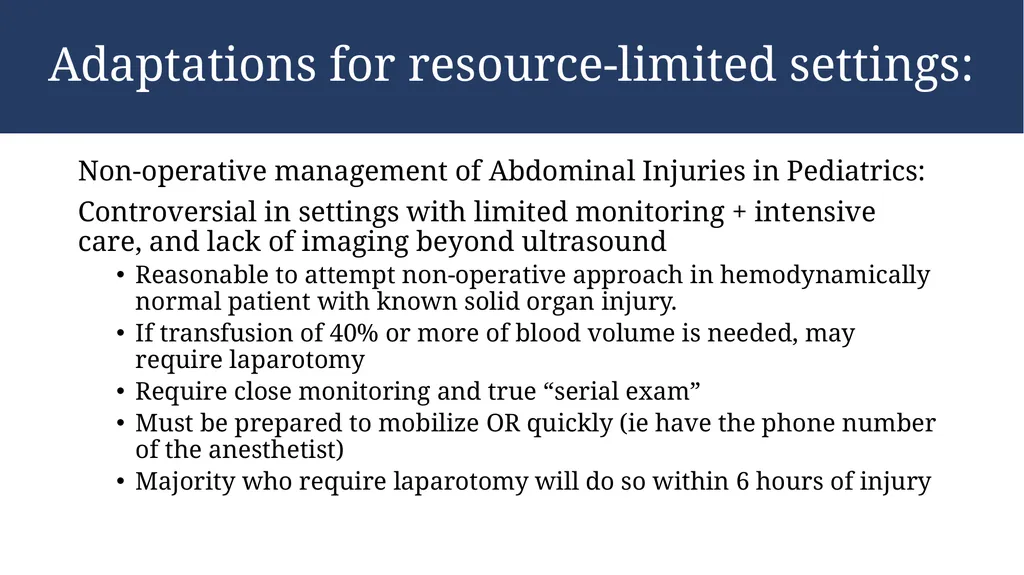
Adaptations for resource-limited settings: Non-operative management of Abdominal Injuries in Pediatrics:
Controversial in settings with limited monitoring + intensive care, and lack of imaging beyond ultrasound
Reasonable to attempt non-operative approach in hemodynamically normal patient with known solid organ injury.
If transfusion of 40% or more of blood volume is needed, may require laparotomy
Require close monitoring and true “serial exam”
Must be prepared to mobilize OR quickly (ie have the phone number of the anesthetist)
Majority who require laparotomy will do so within 6 hours of injury<br>
Controversial in settings with limited monitoring + intensive care, and lack of imaging beyond ultrasound
Reasonable to attempt non-operative approach in hemodynamically normal patient with known solid organ injury.
If transfusion of 40% or more of blood volume is needed, may require laparotomy
Require close monitoring and true “serial exam”
Must be prepared to mobilize OR quickly (ie have the phone number of the anesthetist)
Majority who require laparotomy will do so within 6 hours of injury<br>
33
Adaptations for resource-limited settings: No fluid pumps or pediatric size fluid bottles
Danger is overhydration
Give fluid boluses every 2 hours as opposed to letting drip run unattended
Can use syringe to give bolus
Hypothermia
Large polyethylene paper can be put between sheets to encourage heat retention and used to cover child
Put warm water in plastic gloves and pack around child’s body<br>
Danger is overhydration
Give fluid boluses every 2 hours as opposed to letting drip run unattended
Can use syringe to give bolus
Hypothermia
Large polyethylene paper can be put between sheets to encourage heat retention and used to cover child
Put warm water in plastic gloves and pack around child’s body<br>
34
Initial Trauma Assessment Kampala Advanced Trauma Care Course
Last Edited August 2016 by Maija Cheung MD & Michael DeWane MD Case Study<br>
Last Edited August 2016 by Maija Cheung MD & Michael DeWane MD Case Study<br>
35
Case: A 7 year old boy is struck by a moving car while crossing the street. He is unresponsive on arrival and breathing rapidly. Vital signs on admission are heart rate 144, respiratory rate 38, blood pressure 80/57, GCS 5 (E=1, V=2, M=2)
What are your initial steps in management?<br>
What are your initial steps in management?<br>
36
Useful Resources Trauma.org
Trauma Care Manual - Ian Greaves, Keith Porter, Jim Ryan
Trauma Management- Demetrios Demetriades, Juan A. Asenio<br>
Trauma Care Manual - Ian Greaves, Keith Porter, Jim Ryan
Trauma Management- Demetrios Demetriades, Juan A. Asenio<br>
37
Collaborators Maija Cheung, MD - Yale General Surgery Resident
Michael DeWane, MD - Yale General Surgery Resident
Naomi Kebba, MD – Surgeon, Uganda Heart Institute
Phyllis Kisa, MD – Pediatric Surgeon, Mulago Hospital
Michael Lipnick, MD - UCSF Anesthesiologist
Doruk Ozgediz, MD - Yale Pediatric Surgeon Last Edited February 2017 by Maija Cheung MD & Michael DeWane MD<br>
Michael DeWane, MD - Yale General Surgery Resident
Naomi Kebba, MD – Surgeon, Uganda Heart Institute
Phyllis Kisa, MD – Pediatric Surgeon, Mulago Hospital
Michael Lipnick, MD - UCSF Anesthesiologist
Doruk Ozgediz, MD - Yale Pediatric Surgeon Last Edited February 2017 by Maija Cheung MD & Michael DeWane MD<br>