
PEER | CSSR | INDIA PPT 2 - 1 HRVC
LO
Published · 55 slides · 0 views
1 / 1



Description
PEER CSSR INDIA PPT 2 - 1 HRVC ANALYSIS Presented by:- Amit Kumar, AC OBJECTIVE After completion of this lesson you will be able to :- What is HVRC. Need of HVRC analysis Structural hazard assessment non structural assessment. HVRC
Related Topics
Share
Embed code
Download this presentation From Below
"PEER | CSSR | INDIA PPT 2 - 1 HRVC" is the property of its rightful owner. Permission is granted to download and print the materials on this website for personal, non-commercial use only, and to display it on your personal computer provided you do not modify the materials and that you retain all copyright notices contained in the materials. By downloading content from our website, you accept the terms of this agreement.
Presentation Transcript
01
PEER | CSSR | INDIA PPT 2 - 1 HRVC ANALYSIS Presented by:- Amit Kumar, AC<br>
02
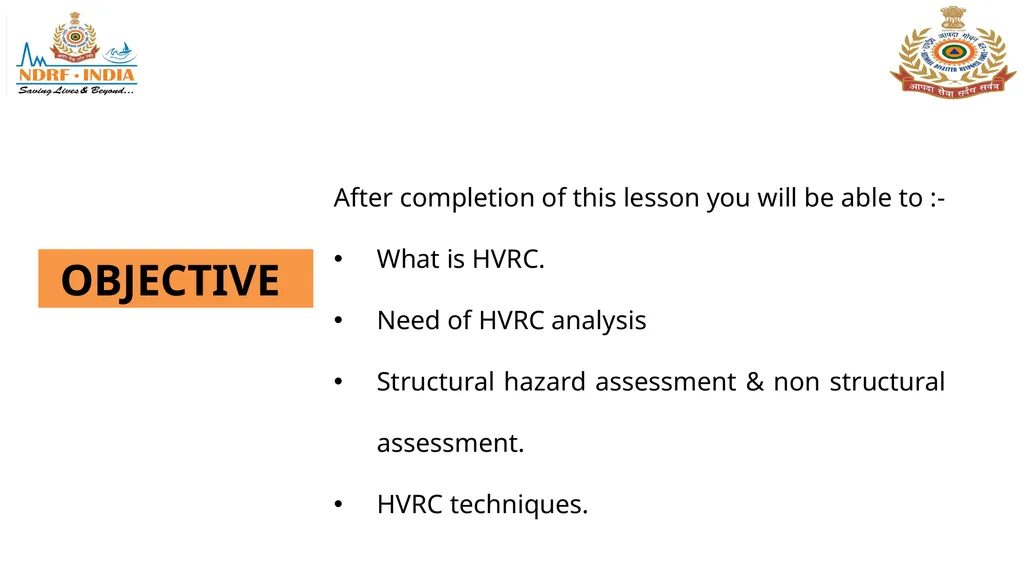
OBJECTIVE After completion of this lesson you will be able to :-
What is HVRC.
Need of HVRC analysis
Structural hazard assessment & non structural assessment.
HVRC techniques.<br>
What is HVRC.
Need of HVRC analysis
Structural hazard assessment & non structural assessment.
HVRC techniques.<br>
03
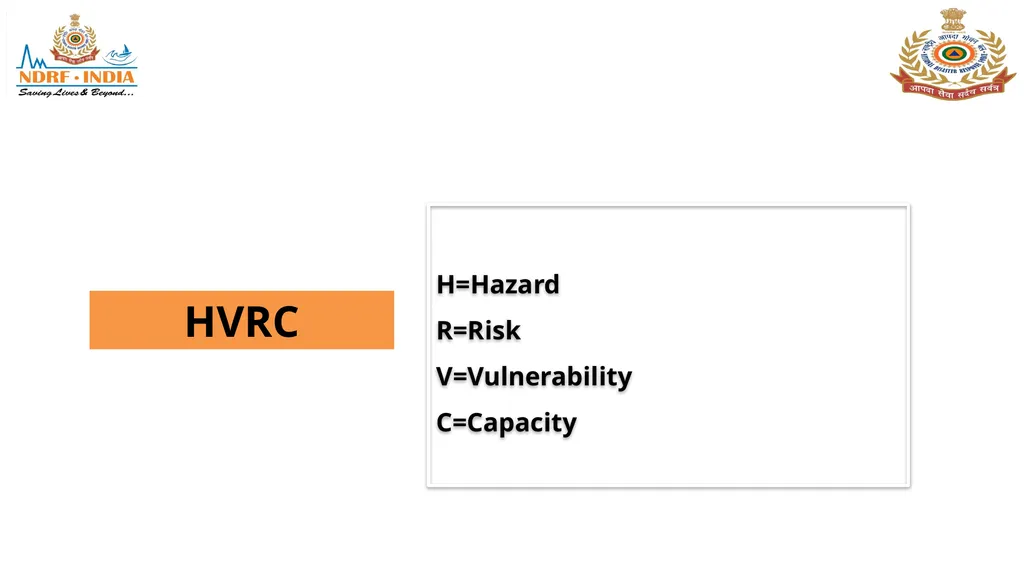
H=Hazard
R=Risk
V=Vulnerability
C=Capacity HVRC<br>
04
Hazard A dangerous
event, substance, human activity or condition
that may cause
loss of life,
injury or other health impacts,
property damage,
loss of livelihoods & services,
social and economic disruption,
environmental damage.<br>
event, substance, human activity or condition
that may cause
loss of life,
injury or other health impacts,
property damage,
loss of livelihoods & services,
social and economic disruption,
environmental damage.<br>
05
Hazard Category Natural origin hazards
Man Made hazards<br>
Man Made hazards<br>
06
What are School Specific Hazard?<br>
07
School Specific Hazards Transformer at entry of school
High tension wire passing near school
Open drain or well nearby
Open or loose wires
Explosion in chemistry lab
Burn in Home Science class
Fire due to short circuit
Accident during picnic or in play area etc<br>
High tension wire passing near school
Open drain or well nearby
Open or loose wires
Explosion in chemistry lab
Burn in Home Science class
Fire due to short circuit
Accident during picnic or in play area etc<br>
08
Risk Measurement of Expected Losses
due to a Hazard
(in Definite Area over a Definite Time Period)<br>
due to a Hazard
(in Definite Area over a Definite Time Period)<br>
09
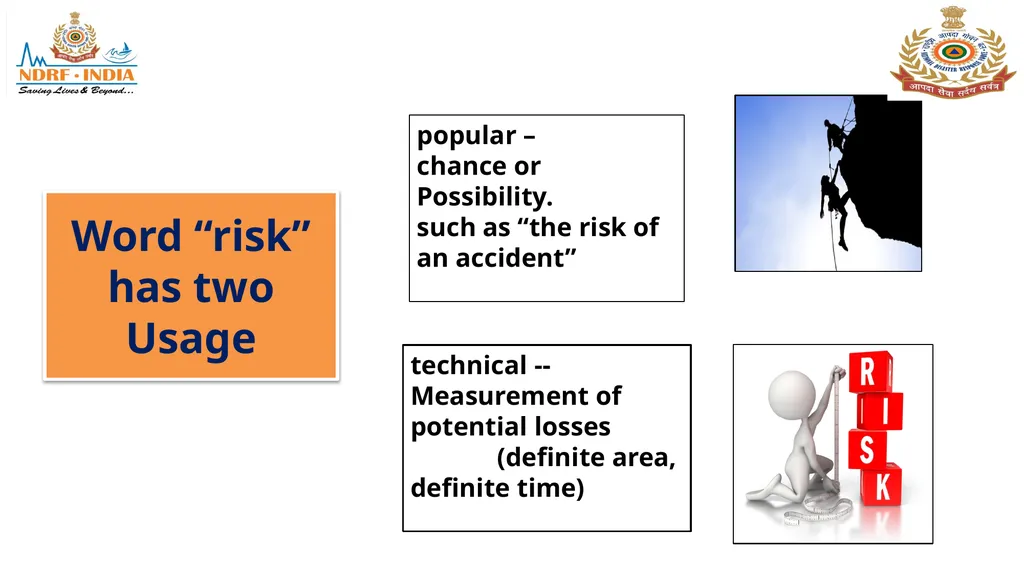
Word “risk” has two Usage popular –
chance or Possibility.
such as “the risk of an accident” technical -- Measurement of potential losses (definite area, definite time)<br>
chance or Possibility.
such as “the risk of an accident” technical -- Measurement of potential losses (definite area, definite time)<br>
10
Vulnerability The characteristics & circumstances of
a community, system or asset
that
makes it susceptible to the damaging effects of a Hazard
****************
(Potential to be easily hurt or harmed)<br>
a community, system or asset
that
makes it susceptible to the damaging effects of a Hazard
****************
(Potential to be easily hurt or harmed)<br>
11
Vulnerability arising from various factors like
physical
social
economic &
Environmental
Systemic<br>
physical
social
economic &
Environmental
Systemic<br>
12
Capacity Strengths, Attributes And Resources available within a community or organization that can be used to Cope With, Withstand, Prepare for, prevent, mitigate or quickly recover from a disaster.
Capacity is an ability to cope with a difficult situation. It means having skills and knowledge to respond and prepare for a risk<br>
Capacity is an ability to cope with a difficult situation. It means having skills and knowledge to respond and prepare for a risk<br>
13
Capacity Capacity may include
infrastructure
physical means
institutions
societal coping abilities
human knowledge, skills<br>
infrastructure
physical means
institutions
societal coping abilities
human knowledge, skills<br>
14
Structural Elements That carries weight of the building
Load Bearing masonry walls,
RC columns,
beams,
slabs and
foundations etc.<br>
Load Bearing masonry walls,
RC columns,
beams,
slabs and
foundations etc.<br>
15
Non-Structural Elements: Building contents All items that user bring into a building:
desks, furniture,
appliances, equipments,
electronics, computers,
coolers, air conditioners,
files cabinets, Almirahs
water tanks,
generators, acid items,
stored inventories, library stocks,
kitchen facilities,
moveable wooden partition etc.<br>
desks, furniture,
appliances, equipments,
electronics, computers,
coolers, air conditioners,
files cabinets, Almirahs
water tanks,
generators, acid items,
stored inventories, library stocks,
kitchen facilities,
moveable wooden partition etc.<br>
16
Non-Structural Hazard Non-structural components may become hazards when
They slide, break, fall or tip over during earthquake
They can be torn away, fly away or be battered during cyclone/high winds<br>
They slide, break, fall or tip over during earthquake
They can be torn away, fly away or be battered during cyclone/high winds<br>
17
Objectives of HVRC analysis Diagnosis of Problems & Capacities<br>
18
Objectives of HVRC analysis to anticipate problems
To find out possible solutions
to help save lives and property,
reduce damage,
speed up recovery.
THUS
to help us work towards disaster resilient communities.<br>
To find out possible solutions
to help save lives and property,
reduce damage,
speed up recovery.
THUS
to help us work towards disaster resilient communities.<br>
19
The need for HVRC Analysis You may think that your number one hazard is flooding because it occurs frequently.
However, you may find that your greatest risk is an earthquake.
Even though the chance of a large earthquake might be “highly unlikely”, the consequences could be devastating,
so the overall risk in case of earthquake is great
You have limited time and resources, so identify risk reduction action items for your greatest risks first.<br>
However, you may find that your greatest risk is an earthquake.
Even though the chance of a large earthquake might be “highly unlikely”, the consequences could be devastating,
so the overall risk in case of earthquake is great
You have limited time and resources, so identify risk reduction action items for your greatest risks first.<br>
20
HRVC Analysis: Explore Answers To Q-1: What can happen and why?
Q-2: What are the consequences?
Q-3: What is the recurrence probability ?
Q-4: What are mitigation measures for consequences or for reducing recurrence probability?<br>
Q-2: What are the consequences?
Q-3: What is the recurrence probability ?
Q-4: What are mitigation measures for consequences or for reducing recurrence probability?<br>
21
Activity (Group Wise) Write Answers to following questions on Paper
Hazards in your area or in schools in your area
Risk due to these hazards
Vulnerability in your area and school increasing Risk<br>
Hazards in your area or in schools in your area
Risk due to these hazards
Vulnerability in your area and school increasing Risk<br>
22
Structural Hazard Assessment<br>
23
Structural Hazard Assessment Structural Safety Assessment with regard to
Earthquake
Flood
Cyclone
Fire<br>
Earthquake
Flood
Cyclone
Fire<br>
24
Structural Hazard Assessment Is School Building very old?
Latest Building Codes may have been revised
Hence
Building may be unsafe
with respect to latest safety standards<br>
Latest Building Codes may have been revised
Hence
Building may be unsafe
with respect to latest safety standards<br>
25
Structural Hazard Assessment Does your school building looks strong & safe?
Only way out to be assured is
to
Get tested by a
qualified structural engineer
Knowing earthquake engineering<br>
Only way out to be assured is
to
Get tested by a
qualified structural engineer
Knowing earthquake engineering<br>
26
Structural Hazard Assessment To be got done thoroughly by
School Bldg Architect
Local DDMA
Distt Authorities
Professional Structural Engineer<br>
School Bldg Architect
Local DDMA
Distt Authorities
Professional Structural Engineer<br>
27
Non- Structural Hazard Assessment<br>
28
Why is it important?<br>
29
Summarise Non-Structural Risks<br>
30
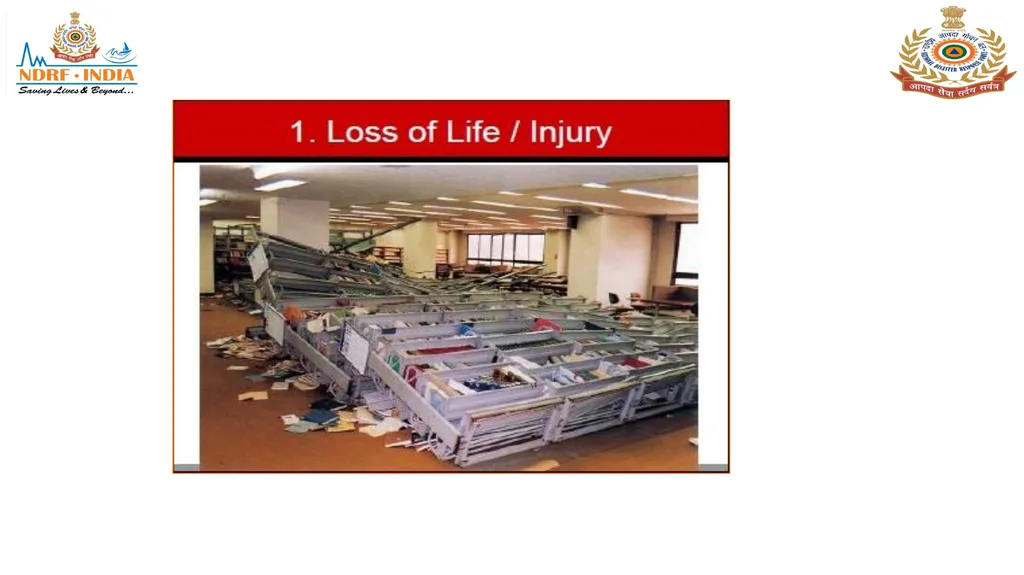
Object can fall, slide or topple
injuring or even killing children,
blocking exits & thus hindering evacuation
Loss of Expensive equipment or important records
Hinder Rescue and Relief
Cause great economic loss
We can easily prevent this with simple, inexpensive measures.
But, before that identify Hazards.<br>
injuring or even killing children,
blocking exits & thus hindering evacuation
Loss of Expensive equipment or important records
Hinder Rescue and Relief
Cause great economic loss
We can easily prevent this with simple, inexpensive measures.
But, before that identify Hazards.<br>
31
How to do
Non- Structural Hazard Assessment<br>
32
Document 20-25 years history of disasters in school as well as surrounding area
Take a walk along the entire evacuation route and pen down things/activities that may become hazard during earthquake/fire Non-Structural Hazard Assessment<br>
Take a walk along the entire evacuation route and pen down things/activities that may become hazard during earthquake/fire Non-Structural Hazard Assessment<br>
33
Non-Structural Hazard Assessment observation
Power failure
(is there back-up or emergency lighting)<br>
Power failure
(is there back-up or emergency lighting)<br>
34
Non-Structural Hazard Assessment Observation: Outside Potential Hazards
Power lines
Trees
Nearby building having debris, roof tiles, chimneys, glass
Covered walkways
Places with underground gas main lines
Chain link fenced areas (may be hazardous when live electric wire falls on them)<br>
Power lines
Trees
Nearby building having debris, roof tiles, chimneys, glass
Covered walkways
Places with underground gas main lines
Chain link fenced areas (may be hazardous when live electric wire falls on them)<br>
35
Non-Structural Hazard Assessment Points to remember while conducting survey
Different teams to do survey of buildings, grounds, rooms etc
A coordination committee comprising teachers, head boy/girl etc to collect & collate information
Area which may be dangerous during earthquake, fire, floods, cyclone etc should be clearly marked
Seasonality of hazards to be considered while listing them<br>
Different teams to do survey of buildings, grounds, rooms etc
A coordination committee comprising teachers, head boy/girl etc to collect & collate information
Area which may be dangerous during earthquake, fire, floods, cyclone etc should be clearly marked
Seasonality of hazards to be considered while listing them<br>
36
Non-Structural Hazard Assessment Points to remember while conducting survey :-
more an object weighs, more forcefully it moves in earthquake
more slender object, more likely to tip over
higher the object, greater the hazard
anchorage or restraint is only as strong as its weakest link
A rough test of the adequacy of a restraint:
You should be able to pull horizontally on the object with a force equal to its weight.<br>
more an object weighs, more forcefully it moves in earthquake
more slender object, more likely to tip over
higher the object, greater the hazard
anchorage or restraint is only as strong as its weakest link
A rough test of the adequacy of a restraint:
You should be able to pull horizontally on the object with a force equal to its weight.<br>
37
Activity
Identify Hazards<br>
38
Is there something that can
fall on someone?
block our exits or evacuation?
be expensive to be lost?
Cause of fire INDENTIFY HAZARDS<br>
fall on someone?
block our exits or evacuation?
be expensive to be lost?
Cause of fire INDENTIFY HAZARDS<br>
39
Risk Analysis<br>
40
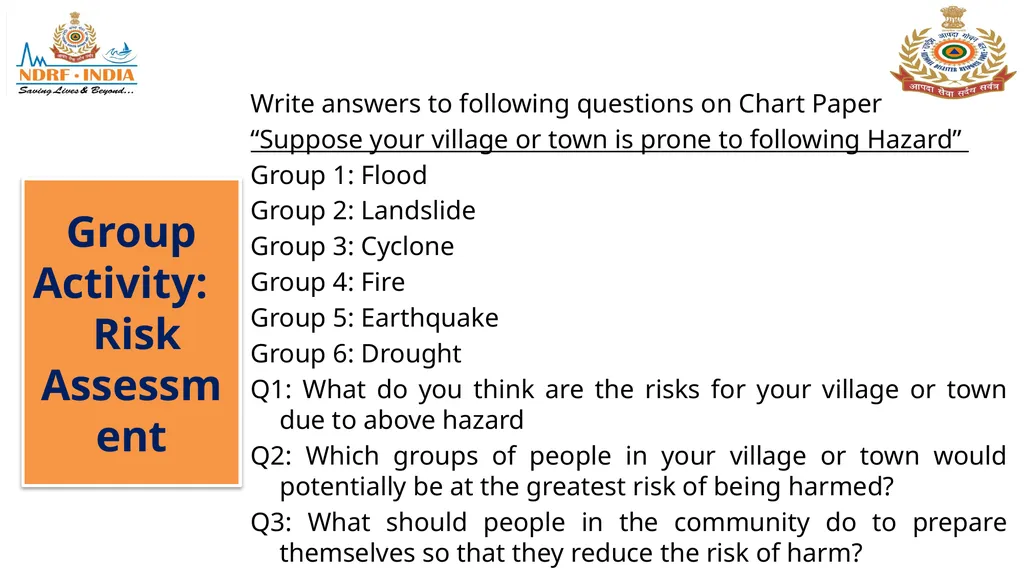
Group Activity: Risk Assessment Write answers to following questions on Chart Paper
“Suppose your village or town is prone to following Hazard”
Group 1: Flood
Group 2: Landslide
Group 3: Cyclone
Group 4: Fire
Group 5: Earthquake
Group 6: Drought
Q1: What do you think are the risks for your village or town due to above hazard
Q2: Which groups of people in your village or town would potentially be at the greatest risk of being harmed?
Q3: What should people in the community do to prepare themselves so that they reduce the risk of harm?<br>
“Suppose your village or town is prone to following Hazard”
Group 1: Flood
Group 2: Landslide
Group 3: Cyclone
Group 4: Fire
Group 5: Earthquake
Group 6: Drought
Q1: What do you think are the risks for your village or town due to above hazard
Q2: Which groups of people in your village or town would potentially be at the greatest risk of being harmed?
Q3: What should people in the community do to prepare themselves so that they reduce the risk of harm?<br>
41
Vulnerability Analysis<br>
42
Vulnerable Locations Vulnerable Classrooms in school
Drinking water taps in vulnerable pockets in school
Main switch board & electrical wires
If school is in hilly area (slopes) then vulnerability to be decided based upon the soil condition
Low lying areas within the premises
Kitchen area
Chemistry Lab
Swimming Pool
Transformer, Generator etc
Library<br>
Drinking water taps in vulnerable pockets in school
Main switch board & electrical wires
If school is in hilly area (slopes) then vulnerability to be decided based upon the soil condition
Low lying areas within the premises
Kitchen area
Chemistry Lab
Swimming Pool
Transformer, Generator etc
Library<br>
43
Vulnerable Groups Children in age group 5 to 10 Yrs
Children in age group 11 to 15 yrs
Children in age group 16 to 18 yrs
Girl Students
Special Needs Students<br>
Children in age group 11 to 15 yrs
Children in age group 16 to 18 yrs
Girl Students
Special Needs Students<br>
44
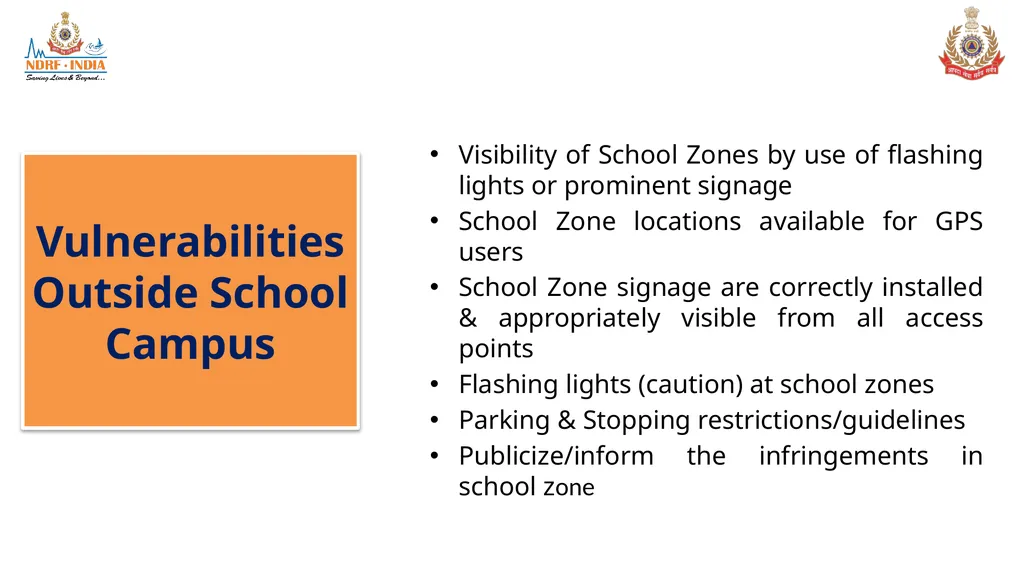
Vulnerabilities Outside School Campus Visibility of School Zones by use of flashing lights or prominent signage
School Zone locations available for GPS users
School Zone signage are correctly installed & appropriately visible from all access points
Flashing lights (caution) at school zones
Parking & Stopping restrictions/guidelines
Publicize/inform the infringements in school zone<br>
School Zone locations available for GPS users
School Zone signage are correctly installed & appropriately visible from all access points
Flashing lights (caution) at school zones
Parking & Stopping restrictions/guidelines
Publicize/inform the infringements in school zone<br>
45
Capacity Analysis<br>
46
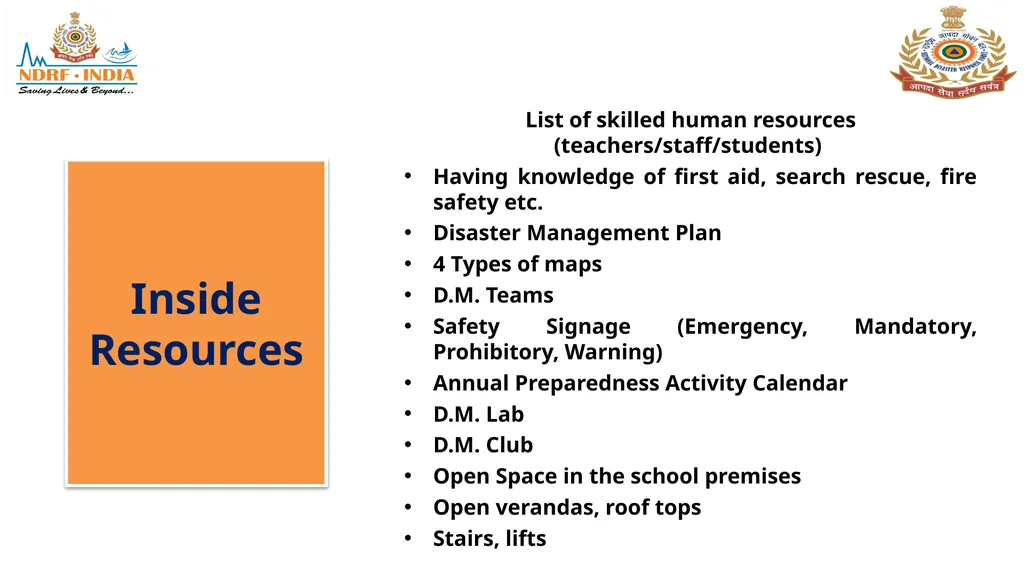
Inside Resources List of skilled human resources (teachers/staff/students)
Having knowledge of first aid, search rescue, fire safety etc.
Disaster Management Plan
4 Types of maps
D.M. Teams
Safety Signage (Emergency, Mandatory, Prohibitory, Warning)
Annual Preparedness Activity Calendar
D.M. Lab
D.M. Club
Open Space in the school premises
Open verandas, roof tops
Stairs, lifts<br>
Having knowledge of first aid, search rescue, fire safety etc.
Disaster Management Plan
4 Types of maps
D.M. Teams
Safety Signage (Emergency, Mandatory, Prohibitory, Warning)
Annual Preparedness Activity Calendar
D.M. Lab
D.M. Club
Open Space in the school premises
Open verandas, roof tops
Stairs, lifts<br>
47
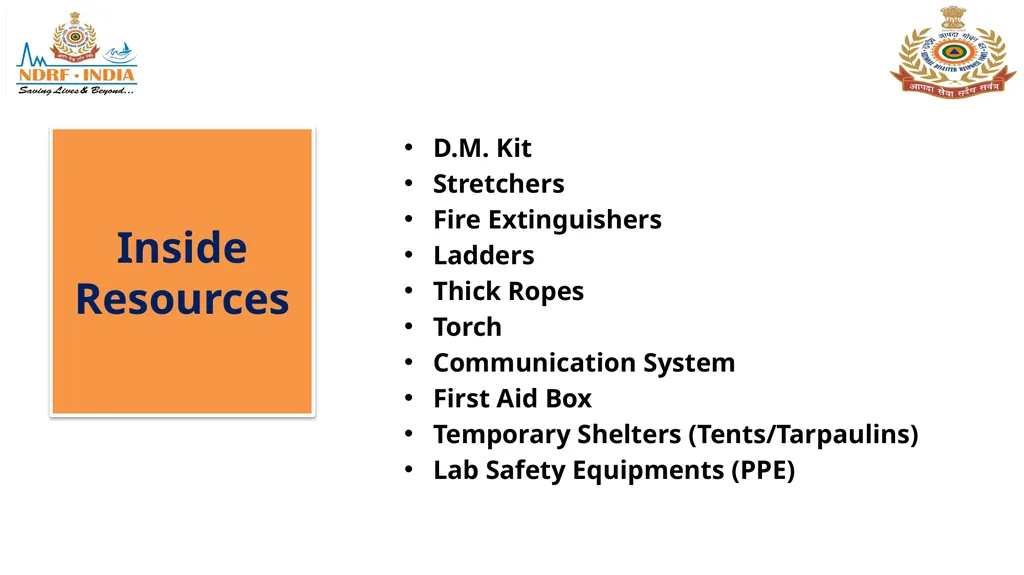
Inside Resources D.M. Kit
Stretchers
Fire Extinguishers
Ladders
Thick Ropes
Torch
Communication System
First Aid Box
Temporary Shelters (Tents/Tarpaulins)
Lab Safety Equipments (PPE)<br>
Stretchers
Fire Extinguishers
Ladders
Thick Ropes
Torch
Communication System
First Aid Box
Temporary Shelters (Tents/Tarpaulins)
Lab Safety Equipments (PPE)<br>
48
Nearest Available Outside Critical Resource Fire Station
Hospital/health Centre
Medical Shop/Medical College
DM/DC/DDMA office
Police Station
Ambulance Services
NCC/NYKS/NSS office
Local Area Representative/MP/MLA/Councilor office
RWAs/ Panchayats office<br>
Hospital/health Centre
Medical Shop/Medical College
DM/DC/DDMA office
Police Station
Ambulance Services
NCC/NYKS/NSS office
Local Area Representative/MP/MLA/Councilor office
RWAs/ Panchayats office<br>
49
Skills Capability to do HRVC analysis
Fire & Earthquake safety
Search & Rescue and Evacuation Techniques
Emergency Medical Assistance/Response
Psycho-socio care & support for children and Gender based issues in disaster management
Conducting Mock drill/Daily drill
Crowd & Media Management during emergencies
Response to terror strikes
Safeguarding measures against CBRN Emergencies
Skilled D.M. Teams<br>
Fire & Earthquake safety
Search & Rescue and Evacuation Techniques
Emergency Medical Assistance/Response
Psycho-socio care & support for children and Gender based issues in disaster management
Conducting Mock drill/Daily drill
Crowd & Media Management during emergencies
Response to terror strikes
Safeguarding measures against CBRN Emergencies
Skilled D.M. Teams<br>
50
REVIEW After completion of this lesson you will be able to :-
What is HVRC.
Need of HVRC analysis
Structural hazard assessment & non structural assessment.
HVRC techniques.<br>
What is HVRC.
Need of HVRC analysis
Structural hazard assessment & non structural assessment.
HVRC techniques.<br>
51
ANY QUESTION?<br>
52
Evaluation HVRC means?
Ans;-
H=Hazard R=Risk V=Vulnerability C=Capacity<br>
Ans;-
H=Hazard R=Risk V=Vulnerability C=Capacity<br>
53
55 THANK YOU<br>