Peer-Support A model of supported decision-making for people with intellectual disabilities Training Opportunities for Peer Supporters with Intellectual Disabilities in Europe TOPSIDE (2011-2013): develop a new component in informal adult
"Peer-Support A model of supported decision-making" is the property of its rightful owner. Permission is granted to
download and print the materials on this website for personal, non-commercial use only, and to display it
on your personal computer provided you do not modify the materials and that you retain all copyright
notices contained in the materials. By downloading content from our website, you accept the terms of this
agreement.
Presentation Transcript
01
Peer-Support A model of supported decision-making for people with intellectual disabilities Training Opportunities for Peer Supporters with Intellectual Disabilities in Europe<br>
02
TOPSIDE (2011-2013): develop a new component in informal adult education
Develop the capacity of adults with intellectual disabilities to provide support and training to their peers.
Supported by the EU Life Long Learning Programme TOPSIDE and TOPSIDE+<br>
03
TOPSIDE+ (2014 to 2016):
Four new countries: Germany, France, Lithuania and Portugal.
To make the curriculum accessible to persons with intellectual disabilities so that they can work as trainers
To develop Policy Recommendations at national and European level
Co-financing from Erasmus+ of the European Union TOPSIDE and TOPSIDE+<br>
04
The supporter is a “peer” with similar life experiences.
Support relationship is one of equality.
Exchange practical advice and suggestions for strategies that professionals may not offer or even know about.
Offers more authentic empathy and support.
New and empowering experience. Peer Support<br>
05
The word “peer” is not used very often.
In our project it means a person who has some of the same life experiences as you.
Peers often understand you better because they share the same experiences. They often understand better how you feel.
You often feel more comfortable to talk with them than with other people. What is a „Peer“?<br>
06
“Peer support“ is about getting support from people you can trust, getting support from people you can understand. It is about support from people with intellectual disabilities who share common experiences with you. Peer support is about being included in your community. To give the support in the best way, people need some training. What is „Peer-Support“?<br>
07
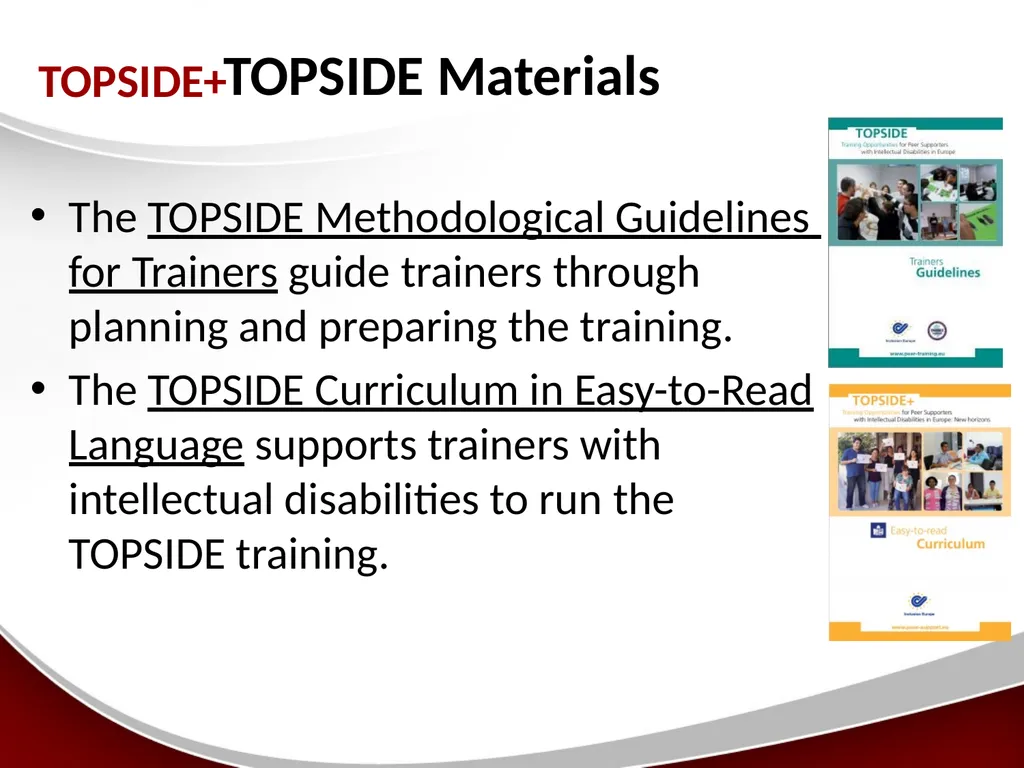
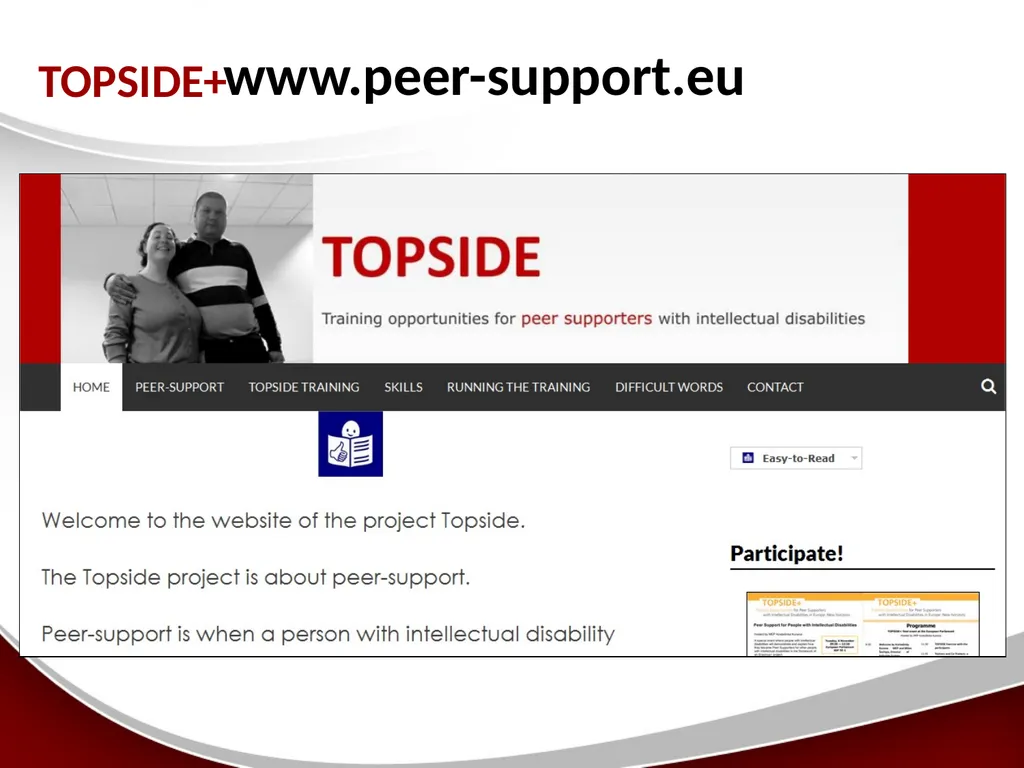
The TOPSIDE Methodological Guidelines for Trainers guide trainers through planning and preparing the training.
The TOPSIDE Curriculum in Easy-to-Read Language supports trainers with intellectual disabilities to run the TOPSIDE training. TOPSIDE Materials<br>
08
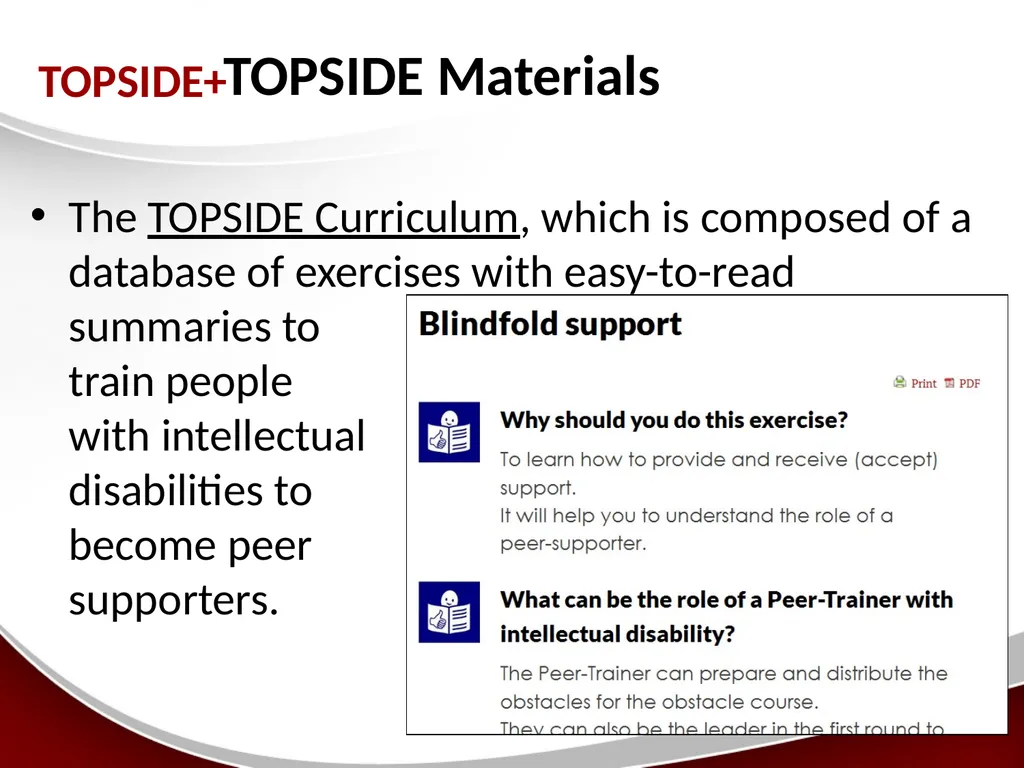
The TOPSIDE Curriculum, which is composed of a database of exercises with easy-to-read summaries to train people with intellectual disabilities to become peer supporters. TOPSIDE Materials<br>
09
The TOPSIDE Material for Peers, which contains examples of portfolios and materials peers will keep.
The TOPSIDE Guidelines for Mentors, which should advise and direct the activities of mentors to peer supporters TOPSIDE Materials<br>
10
States Parties shall take appropriate measures to provide access by persons with disabilities to the support they may require in exercising their legal capacity. (Art. 12 CRPD)
States parties must […] provide persons with disabilities access to the support necessary to enable them to make decisions […]. (General Comment No. 1) Supported Decision-Making<br>
11
“The Committee notes with deep concern that across the European Union, the full legal capacity of a large number of persons with disabilities is restricted.
The Committee […] recommends that the European Union step up efforts to foster research, data collection and exchange of good practices on supported decision-making […].” CRPD Concluding Observations<br>
12
TOPSIDE has demonstrated that peer support is effective and appropriate to help people with intellectual disabilities to take decisions.
However, „the type and intensity of support to be provided will vary significantly from one person to another owing to the diversity of persons with disabilities” (GC No. 1) Peer support in decision-making<br>
13
Peer support cannot replace other support systems.
It is not suitable for every individual.
Peer support can provide social support, but it is not suitable for treating existing mental health problems.
Peer support will require regular assistance and mentoring, sometimes even the presence of a mentor or tutor . Peer support in decision-making<br>
14
Peer support is not the one and only solution for the support needs of citizens with intellectual disabilities.
It is absolutely necessary to develop, create and maintain a number of different flexible options that can be used in different situations, e.g.
Universal design and accessibility
Empowerment through education and training
Informal or formal support arrangements
Assistance in communication Peer support in decision-making<br>