Peer Support and Involuntary Treatment Annette Hanson, MD Assistant Professor Director, Forensic Psychiatry Fellowship University of Maryland Eighteenth and Nineteenth Centuries: Era of Social Reform Dorothea Dix An 1841 visit to a
"Peer Support and Involuntary Treatment Annette" is the property of its rightful owner. Permission is granted to
download and print the materials on this website for personal, non-commercial use only, and to display it
on your personal computer provided you do not modify the materials and that you retain all copyright
notices contained in the materials. By downloading content from our website, you accept the terms of this
agreement.
Presentation Transcript
01
Peer Support and Involuntary Treatment Annette Hanson, MD
Assistant Professor
Director, Forensic Psychiatry Fellowship
University of Maryland<br>
02
Eighteenth and Nineteenth Centuries:
Era of Social Reform<br>
03
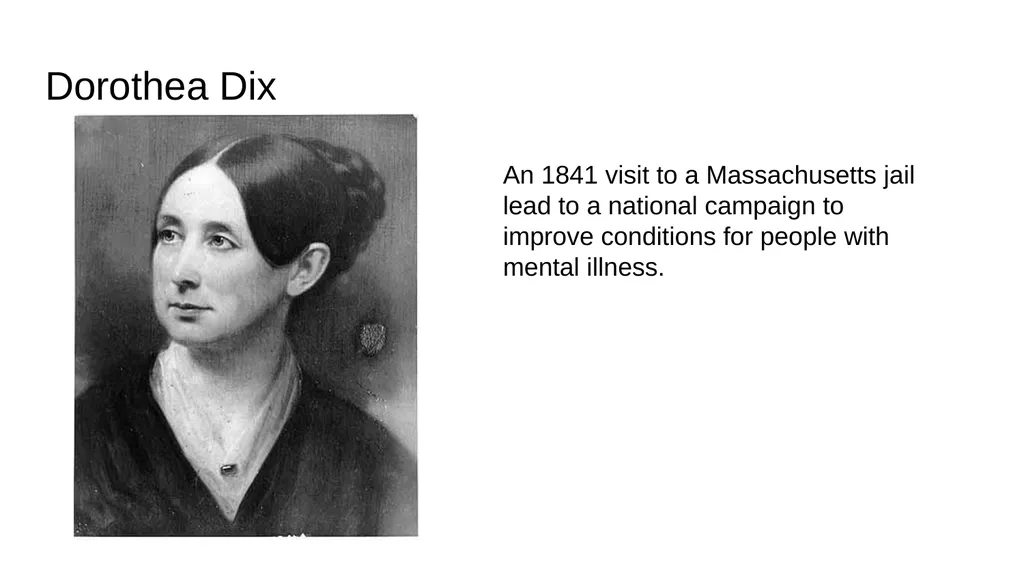
Dorothea Dix An 1841 visit to a Massachusetts jail lead to a national campaign to improve conditions for people with mental illness.<br>
04
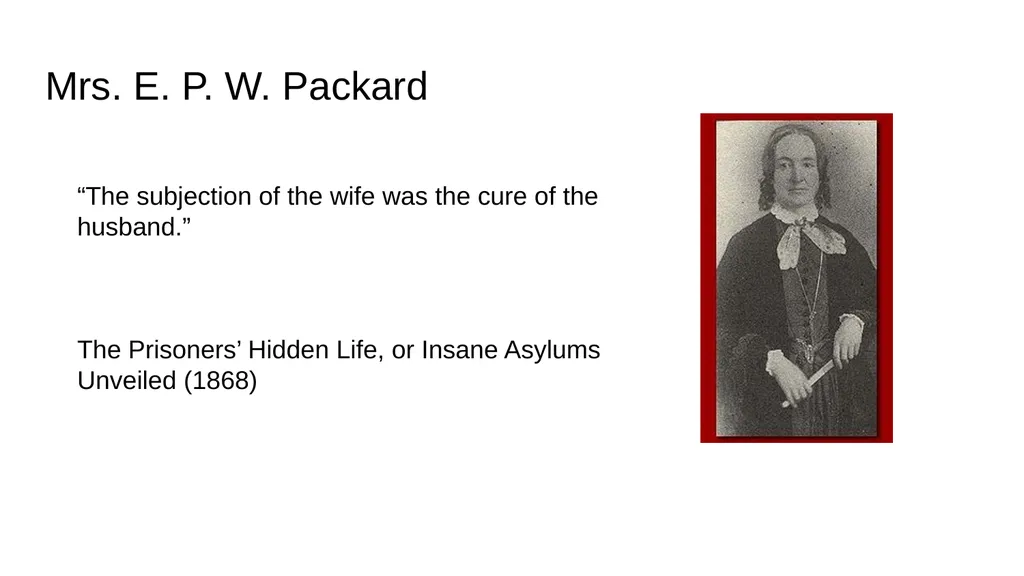
Mrs. E. P. W. Packard “The subjection of the wife was the cure of the husband.”
The Prisoners’ Hidden Life, or Insane Asylums Unveiled (1868)<br>
05
Late Twentieth Century<br>
06
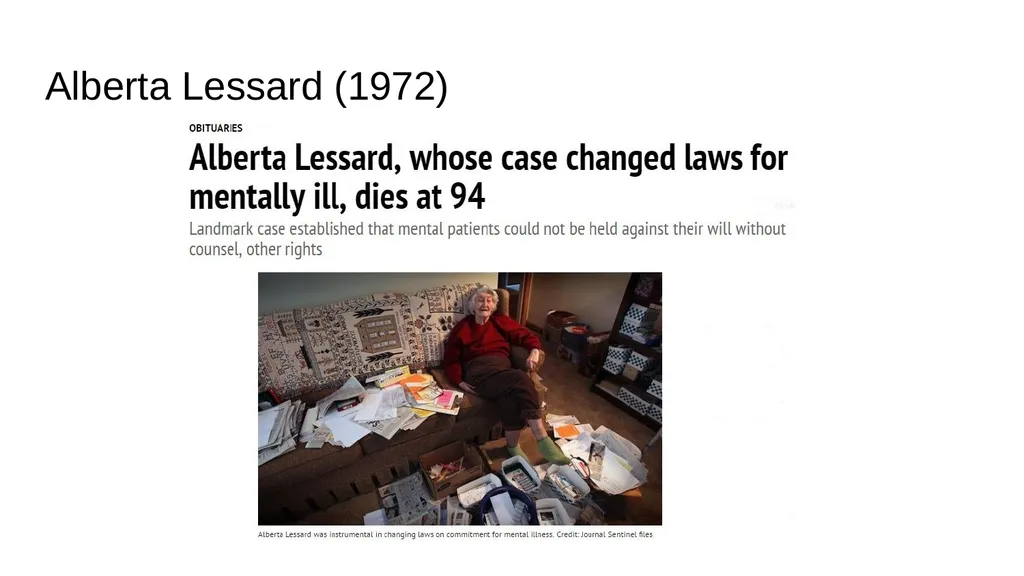
Alberta Lessard (1972)<br>
07
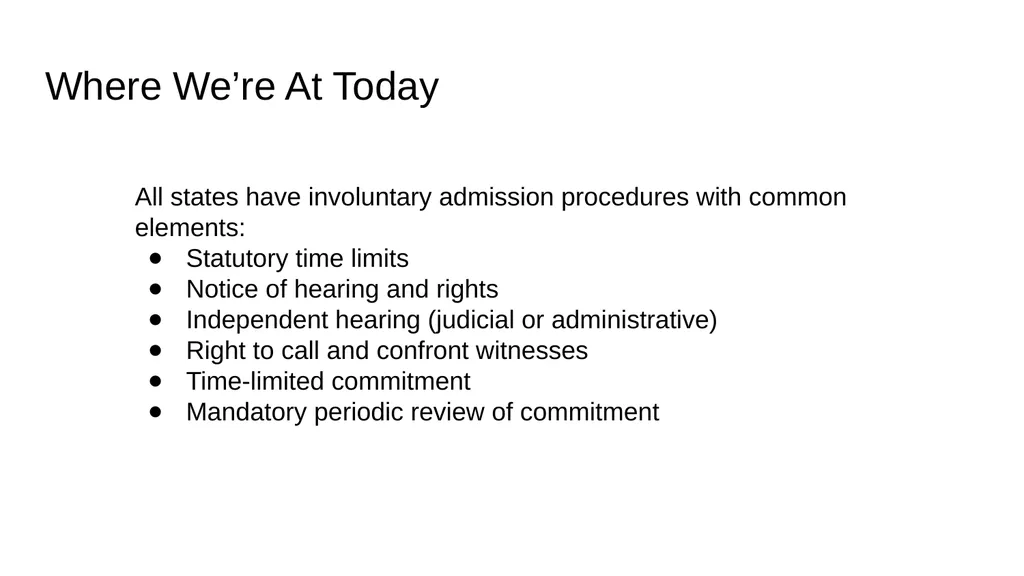
Where We’re At Today All states have involuntary admission procedures with common elements:
Statutory time limits
Notice of hearing and rights
Independent hearing (judicial or administrative)
Right to call and confront witnesses
Time-limited commitment
Mandatory periodic review of commitment<br>
08
Current Events and Mental Health Law<br>
09
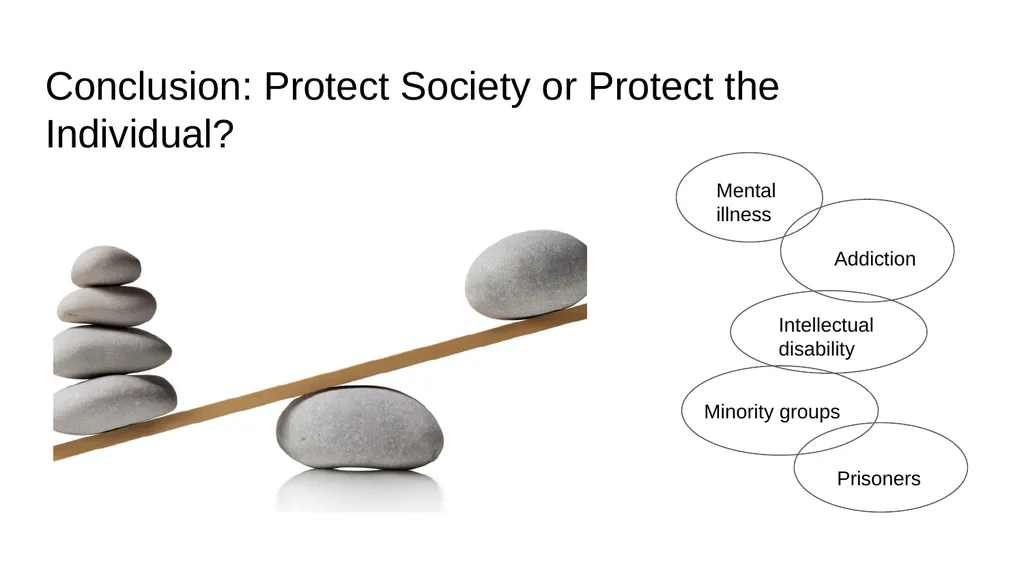
Conclusion: Protect Society or Protect the Individual? Mental illness Addiction Intellectual disability Minority groups Prisoners<br>
10
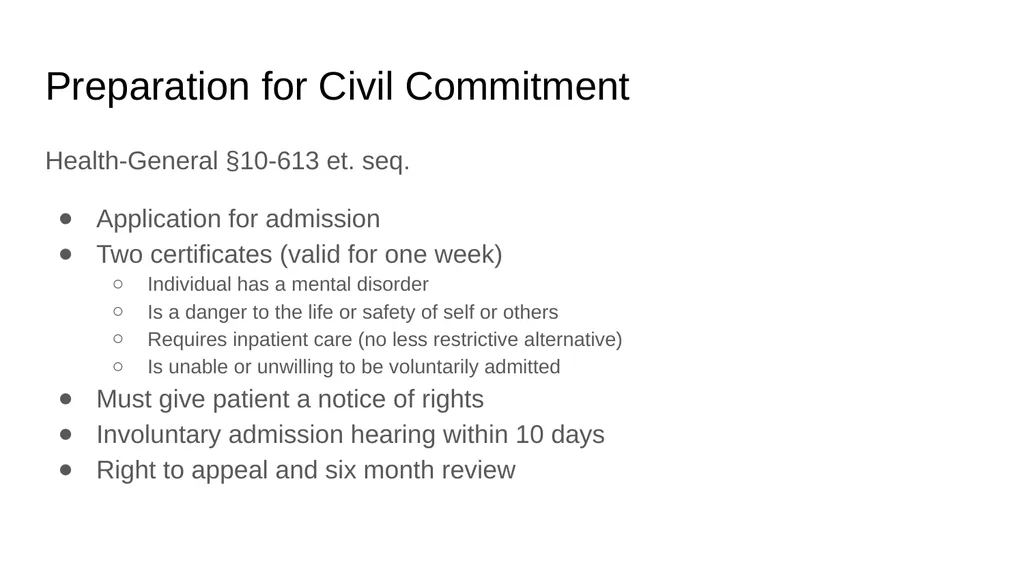
Preparation for Civil Commitment Health-General §10-613 et. seq.
Application for admission
Two certificates (valid for one week)
Individual has a mental disorder
Is a danger to the life or safety of self or others
Requires inpatient care (no less restrictive alternative)
Is unable or unwilling to be voluntarily admitted
Must give patient a notice of rights
Involuntary admission hearing within 10 days
Right to appeal and six month review<br>
11
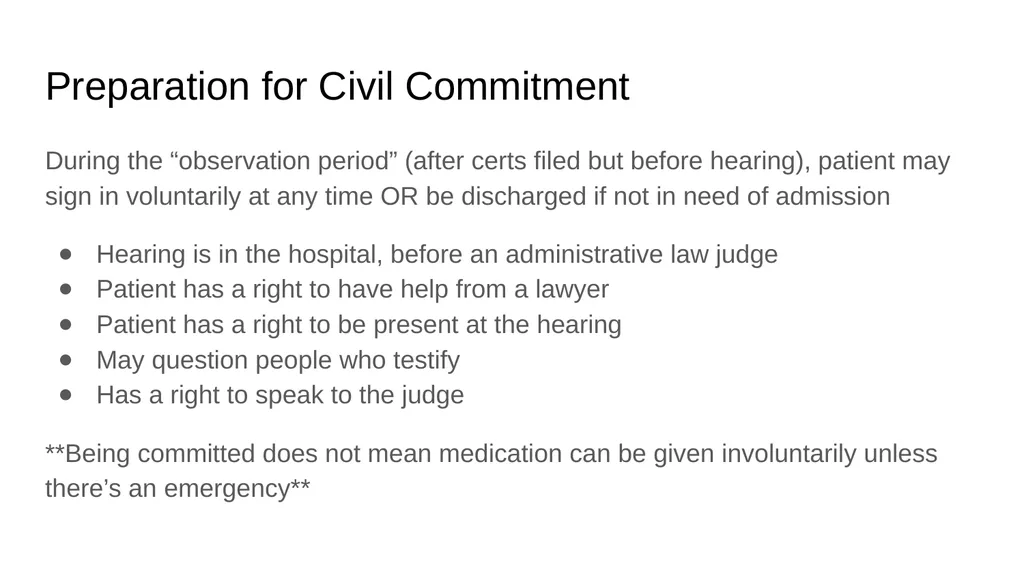
Preparation for Civil Commitment During the “observation period” (after certs filed but before hearing), patient may sign in voluntarily at any time OR be discharged if not in need of admission
Hearing is in the hospital, before an administrative law judge
Patient has a right to have help from a lawyer
Patient has a right to be present at the hearing
May question people who testify
Has a right to speak to the judge
**Being committed does not mean medication can be given involuntarily unless there’s an emergency**<br>
12
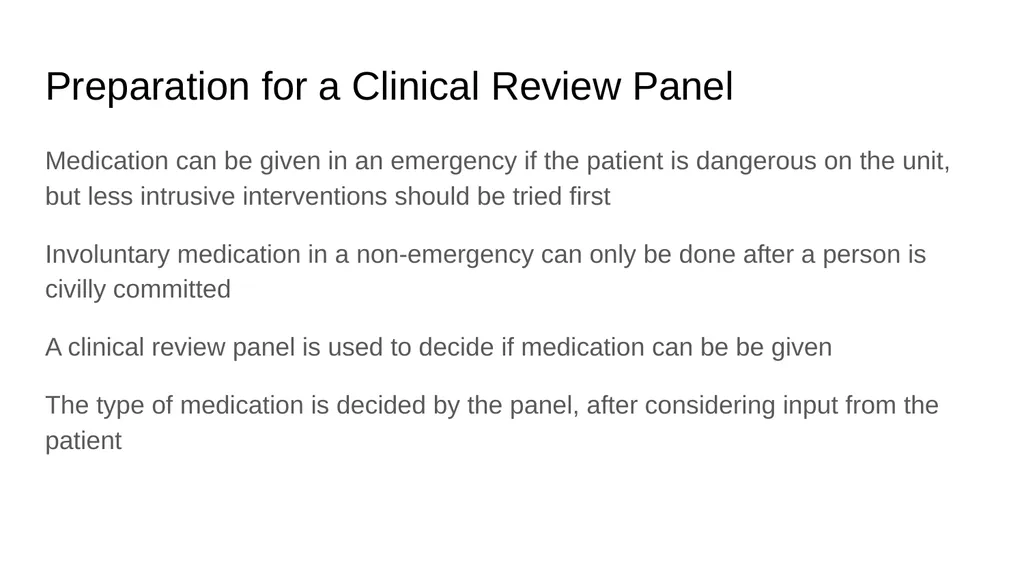
Preparation for a Clinical Review Panel Medication can be given in an emergency if the patient is dangerous on the unit, but less intrusive interventions should be tried first
Involuntary medication in a non-emergency can only be done after a person is civilly committed
A clinical review panel is used to decide if medication can be be given
The type of medication is decided by the panel, after considering input from the patient<br>
13
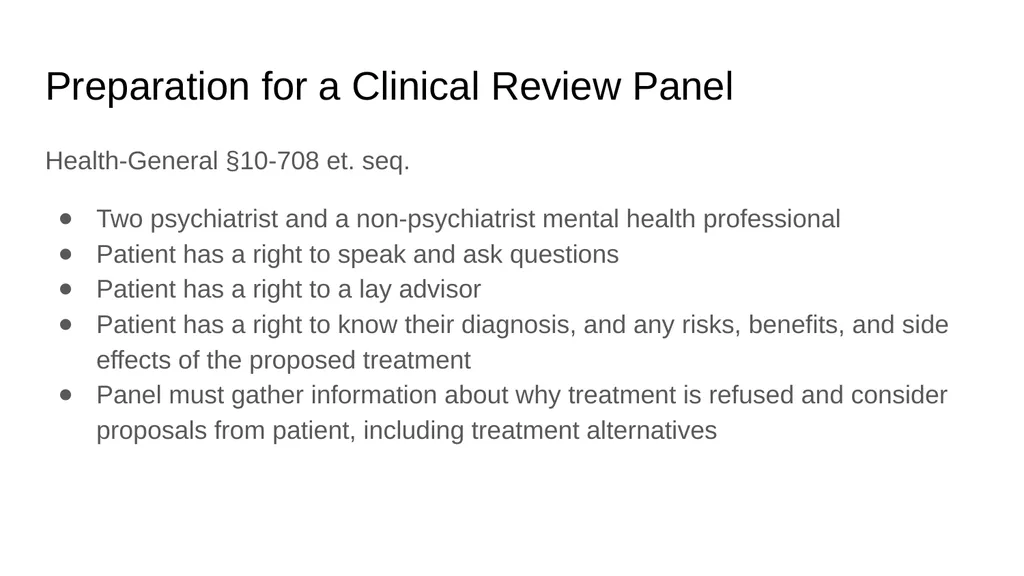
Preparation for a Clinical Review Panel Health-General §10-708 et. seq.
Two psychiatrist and a non-psychiatrist mental health professional
Patient has a right to speak and ask questions
Patient has a right to a lay advisor
Patient has a right to know their diagnosis, and any risks, benefits, and side effects of the proposed treatment
Panel must gather information about why treatment is refused and consider proposals from patient, including treatment alternatives<br>
14
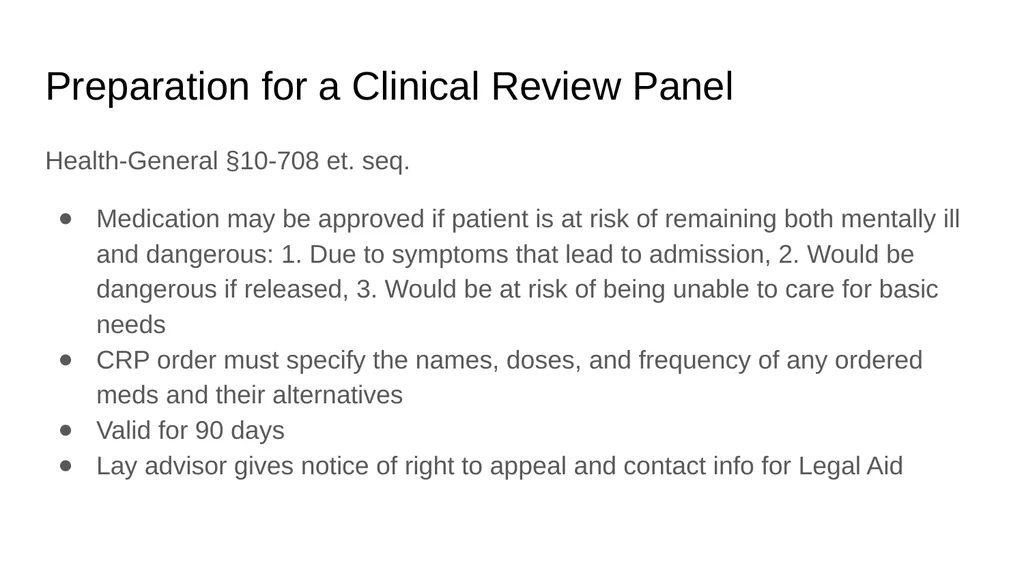
Preparation for a Clinical Review Panel Health-General §10-708 et. seq.
Medication may be approved if patient is at risk of remaining both mentally ill and dangerous: 1. Due to symptoms that lead to admission, 2. Would be dangerous if released, 3. Would be at risk of being unable to care for basic needs
CRP order must specify the names, doses, and frequency of any ordered meds and their alternatives
Valid for 90 days
Lay advisor gives notice of right to appeal and contact info for Legal Aid<br>
15
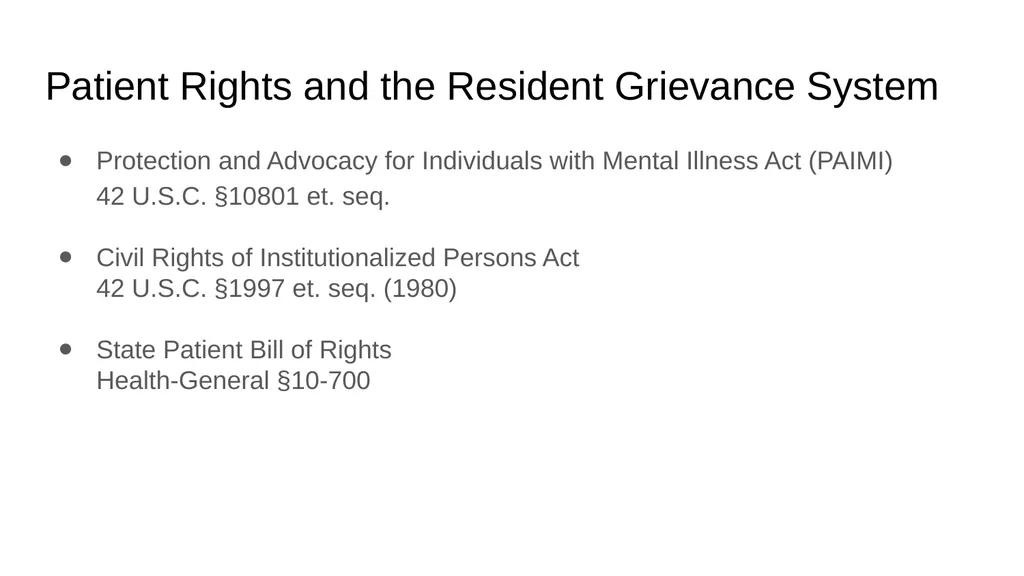
Patient Rights and the Resident Grievance System<br>
16
Patient Rights and the Resident Grievance System Protection and Advocacy for Individuals with Mental Illness Act (PAIMI) 42 U.S.C. §10801 et. seq.
Civil Rights of Institutionalized Persons Act
42 U.S.C. §1997 et. seq. (1980)
State Patient Bill of Rights
Health-General §10-700<br>
17
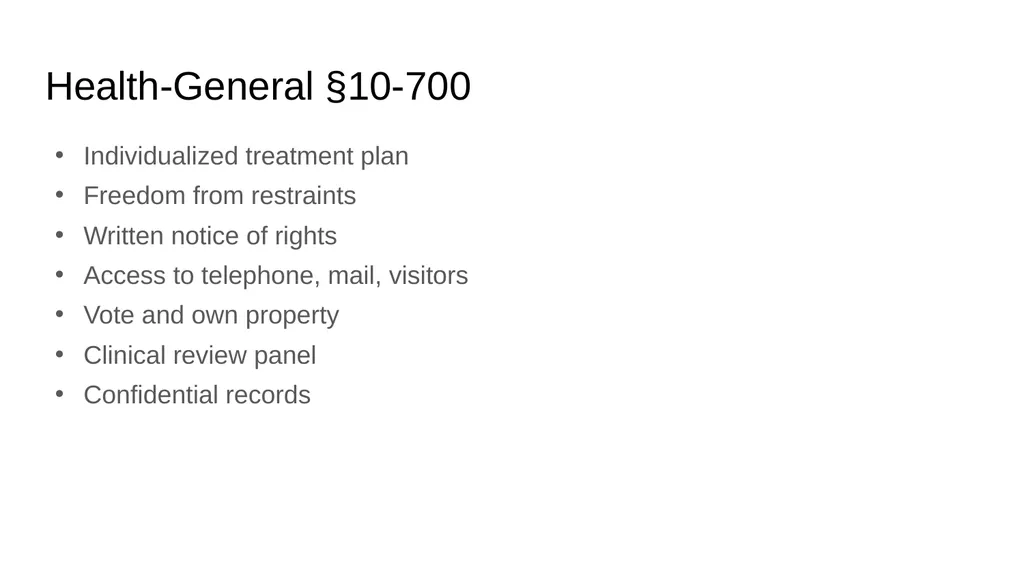
Health-General §10-700 Individualized treatment plan
Freedom from restraints
Written notice of rights
Access to telephone, mail, visitors
Vote and own property
Clinical review panel
Confidential records<br>
18
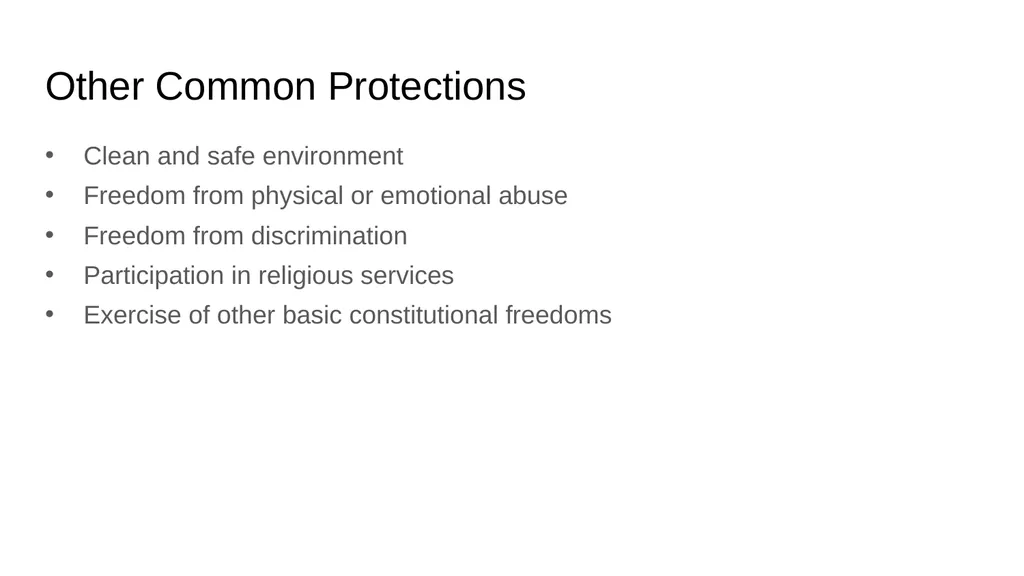
Other Common Protections Clean and safe environment
Freedom from physical or emotional abuse
Freedom from discrimination
Participation in religious services
Exercise of other basic constitutional freedoms<br>
19
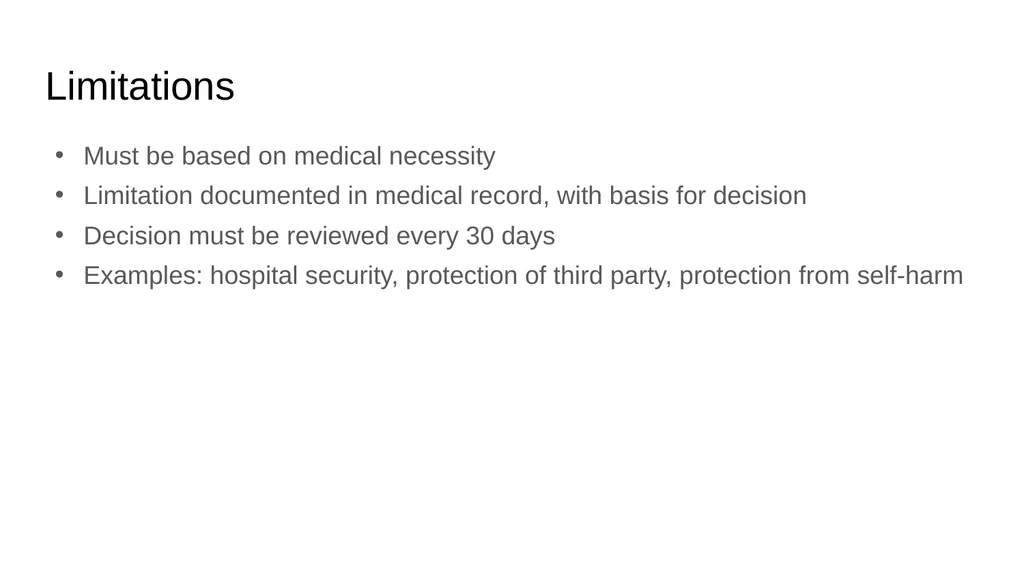
Limitations Must be based on medical necessity
Limitation documented in medical record, with basis for decision
Decision must be reviewed every 30 days
Examples: hospital security, protection of third party, protection from self-harm<br>
20
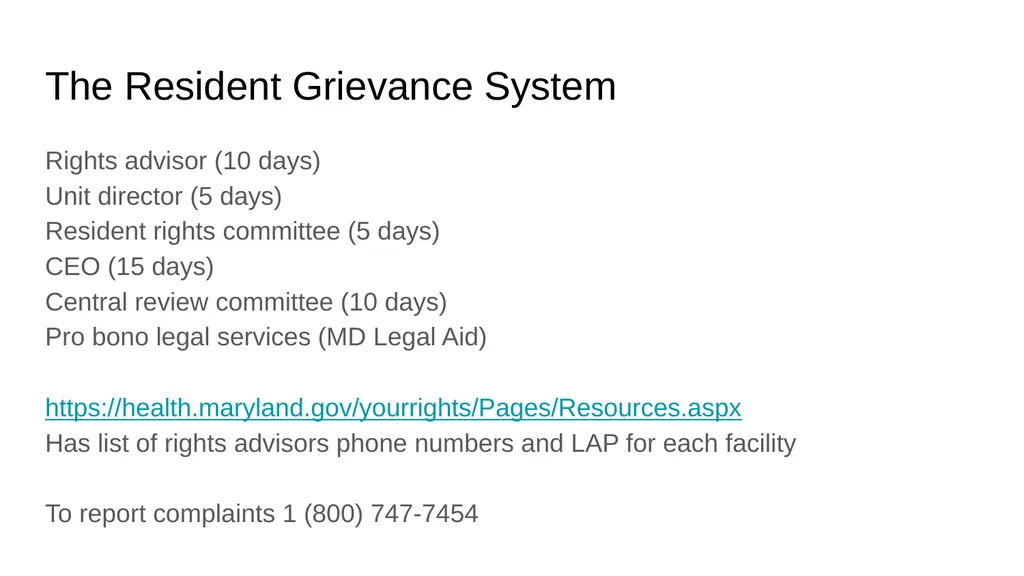
The Resident Grievance System Rights advisor (10 days)
Unit director (5 days)
Resident rights committee (5 days)
CEO (15 days)
Central review committee (10 days)
Pro bono legal services (MD Legal Aid)
https://health.maryland.gov/yourrights/Pages/Resources.aspx
Has list of rights advisors phone numbers and LAP for each facility
To report complaints 1 (800) 747-7454<br>
21
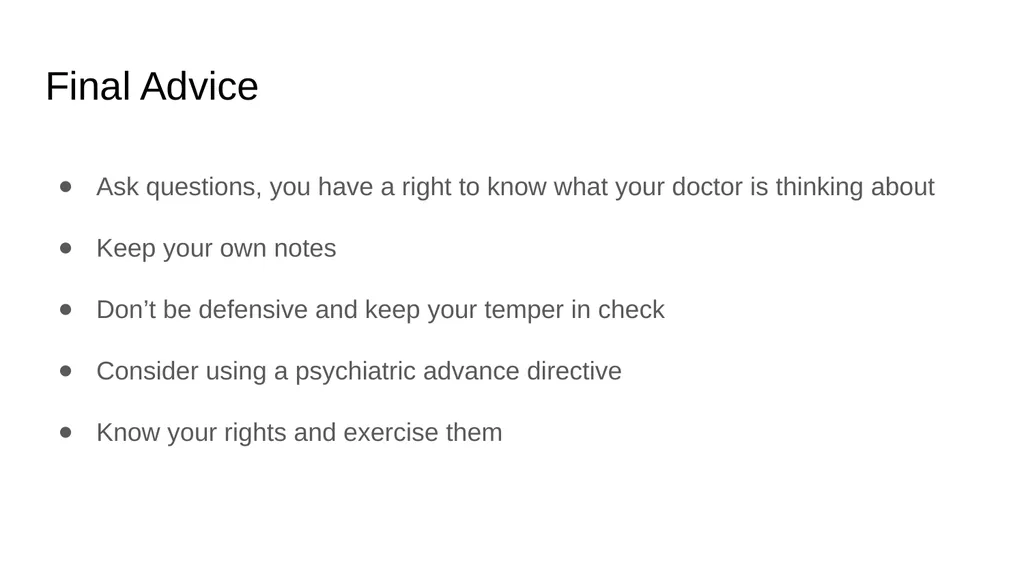
Final Advice Ask questions, you have a right to know what your doctor is thinking about
Keep your own notes
Don’t be defensive and keep your temper in check
Consider using a psychiatric advance directive
Know your rights and exercise them<br>