Per AB 203 this training is required for employees working in the following California counties Fresno Kern Kings Madera Merced Monterey These 11 counties have the highest rates of Valley fever where activities disturb the soil. San
"Per AB 203 this training is required for employees" is the property of its rightful owner. Permission is granted to
download and print the materials on this website for personal, non-commercial use only, and to display it
on your personal computer provided you do not modify the materials and that you retain all copyright
notices contained in the materials. By downloading content from our website, you accept the terms of this
agreement.
Presentation Transcript
01
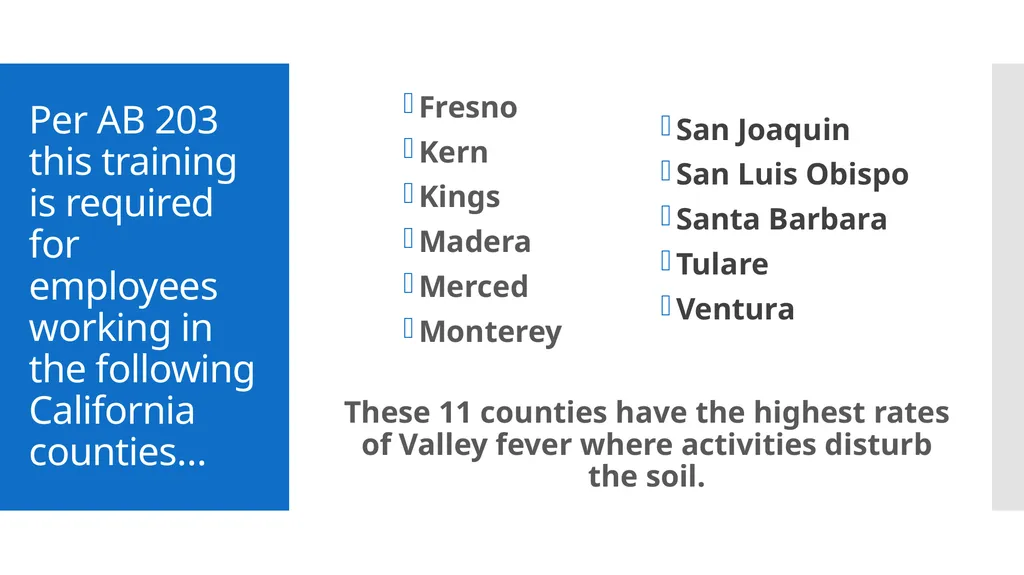
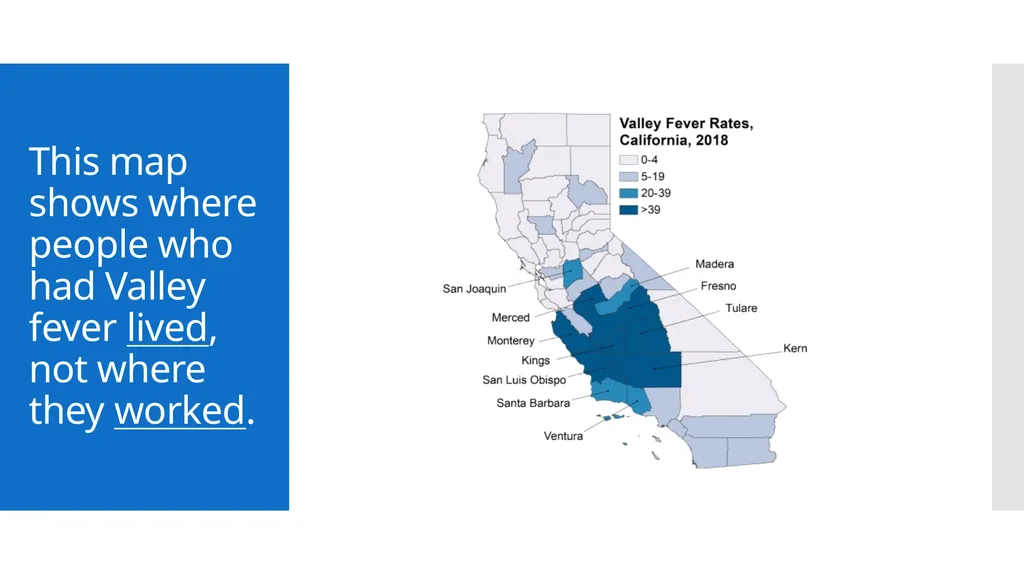
Per AB 203 this training is required for employees working in the following California counties… Fresno
Kern
Kings
Madera
Merced
Monterey These 11 counties have the highest rates of Valley fever where activities disturb the soil. San Joaquin
San Luis Obispo
Santa Barbara
Tulare
Ventura<br>
02
What do you already know about Valley fever? Valley fever is an illness that usually affects the lungs. It is caused by fungus that lives in the soil in many parts of California.
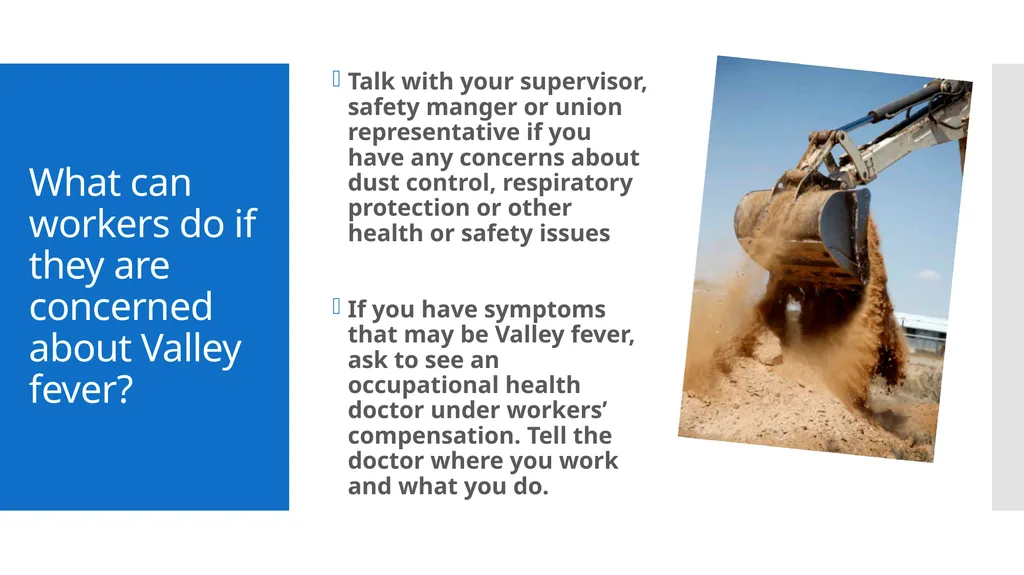
When the soil is disturbed by digging, vehicles, or wind, the fungus spores get into the air. Spores are like tiny seeds that are too small to see
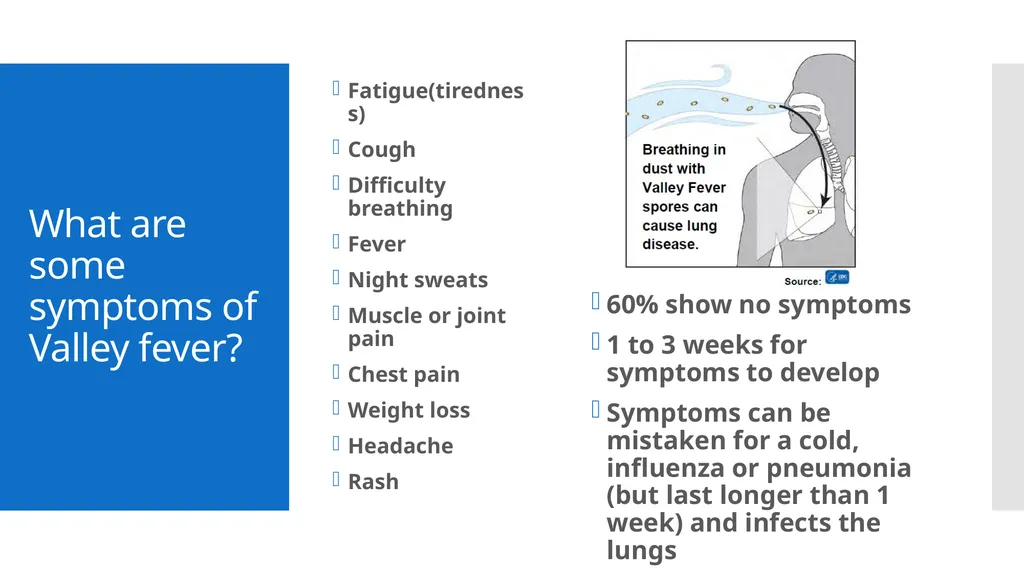
People can breathe the spores into their lungs and get Valley fever
Valley fever affects people differently. While many people who get Valley fever have no symptoms or only very mild ones, others can get very sick or even die
Valley fever is not a contagious disease - it cannot be spread from person to person. It is almost always caused by breathing in the fungus from dust in the air<br>
03
What are some symptoms of Valley fever? Fatigue(tiredness)
Cough
Difficulty breathing
Fever
Night sweats
Muscle or joint pain
Chest pain
Weight loss
Headache
Rash 60% show no symptoms
1 to 3 weeks for symptoms to develop
Symptoms can be mistaken for a cold, influenza or pneumonia (but last longer than 1 week) and infects the lungs<br>
04
How long do Valley fever symptoms last? Valley fever can affect people in different ways. Some people may only have mild symptoms that get better on their own within a few weeks.
Some symptoms, especially fatigue can take longer to go away and can last for several months
In rare cases Valley fever can cause severe infections in the lungs or in other parts of the body including the brain, skin, bones or joints. This could lead to hospitalization and follow up medical care for months to years
In very rare instances, severe Valley fever can be fatal<br>
05
Who can get sick? Anyone! Healthy adults to children
Living, working and even driving around outside in dust can put you at risk Are any people more likely to get very sick with Valley fever? Older adults (60+), pregnant women and people with diabetes
Certain racial/ethnic groups: African Americans and Filipinos
People with weakened immune systems: cancer, HIV, auto immune illnesses, chemotherapy or steroid treatment and organ transplants<br>
06
How is Valley fever diagnosed and treated? Valley fever can be diagnosed with a blood test or other laboratory test.
It is very important that you report symptoms that might be Valley fever as soon as you suspect it, so that a doctor can evaluate you
Be sure to tell your doctor if, in the month before you got sick, you were in an area where Valley fever has been reported and if you were exposed to dirt or dust in that area (you were at a worksite where digging was occurring or if you were outdoors during a dust storm)
Your doctor will consider a number of factors when deciding if you need testing, treatment or neither<br>
07
How is Valley fever diagnosed and treated? Some people will get better without treatment because their bodies will fight off the infection naturally
Antifungal medications used to treat Valley fever will be given and may need to be taken for months or even years
Not everyone with Valley fever needs to take these medications<br>
08
How do you know if the fungus is present in the soil? Fungus in the soil is too small to see. There is no reliable way to test the dirt around a worksite.
Valley fever is most common in the Central Valley and Central Coast
Best practice is to prevent dust form getting in the air on all jobsites<br>
09
This map shows where people who had Valley fever lived, not where they worked.<br>
10
What are some things we can do to prevent worker exposure to the Valley fever fungus? Use enough water on open dirt areas to keep dust down
Avoid work during dust storms or high winds
Stay upwind of digging and other dust-producing activities, such as dumping soil, drilling or blasting
Heavy equipment should have enclosed cabs, air conditioning and filters that clean the air coming in. Operators should have a way to communicate without opening windows
Use water to clean dusty equipment whenever you can<br>
11
What are some things we can do to prevent worker exposure to the Valley fever fungus? Keep dust away from your food and drinks. Take dusty clothes off and wash up before you take a break or eat lunch
Change into clean clothes and shoes before leaving a dusty job site. Keep dusty clothes and shoes in a plastic bag
Shower and wash your hair at work or as soon as you get home
If controlling dust is not possible, workers should be protected by respirators with particulate filters under a respirator program. Bandanas and simple dust masks are not protective against Valley fever<br>
12
Scenario It’s a hot, windy day at a new housing development. A trenching crew is installing a sewer main while a surveyor measures the location of property lines next to them. The trenching crew was trained on Valley fever prior to beginning excavation. The surveyor was not trained. Before digging, the laborers in the trenching crew put on their respirators and the heavy equipment operator confirmed with the foreman that his cab had clean HEPA filters. During the excavation, no water was used for dust suppression. The surveyor, who was downwind, was bothered by the dust. She shouted for the digging to stop until the wind died down but could not be heard, so she kept working.<br>
13
What went right in the Scenario ? The trenching crew was trained on Valley fever prevention
The crew had respirators
The heavy equipment operator was in an enclosed cab with clean HEPA filters
The surveyor tried to speak up about the dust<br>
14
What could have been done to prevent the surveyor from possible exposure to Valley fever? EVERYONE in a dusty area should be trained on Valley fever before working
Water should be used to keep dust down
The work should have been postponed until it was less windy
The supervisor should have made sure no one was downwind
The surveyor should have been included in the respirator program so she would be able to wear a respirator<br>
15
What can workers do if they are concerned about Valley fever? Talk with your supervisor, safety manger or union representative if you have any concerns about dust control, respiratory protection or other health or safety issues
If you have symptoms that may be Valley fever, ask to see an occupational health doctor under workers’ compensation. Tell the doctor where you work and what you do.<br>