
Percent Composition, Empirical Formulas, Molecular
TA
Published · 29 slides · 0 views
1 / 1
Description
Percent Composition, Empirical Formulas, Molecular Formulas Percent Composition Percent Composition the percentage by mass of each element in a compound (note: not the ratio of elements in the compound) Law of Definite Proportions
Related Topics
Share
Embed code
Download this presentation From Below
"Percent Composition, Empirical Formulas, Molecular" is the property of its rightful owner. Permission is granted to download and print the materials on this website for personal, non-commercial use only, and to display it on your personal computer provided you do not modify the materials and that you retain all copyright notices contained in the materials. By downloading content from our website, you accept the terms of this agreement.
Presentation Transcript
01
Percent Composition, Empirical Formulas, Molecular Formulas<br>
02
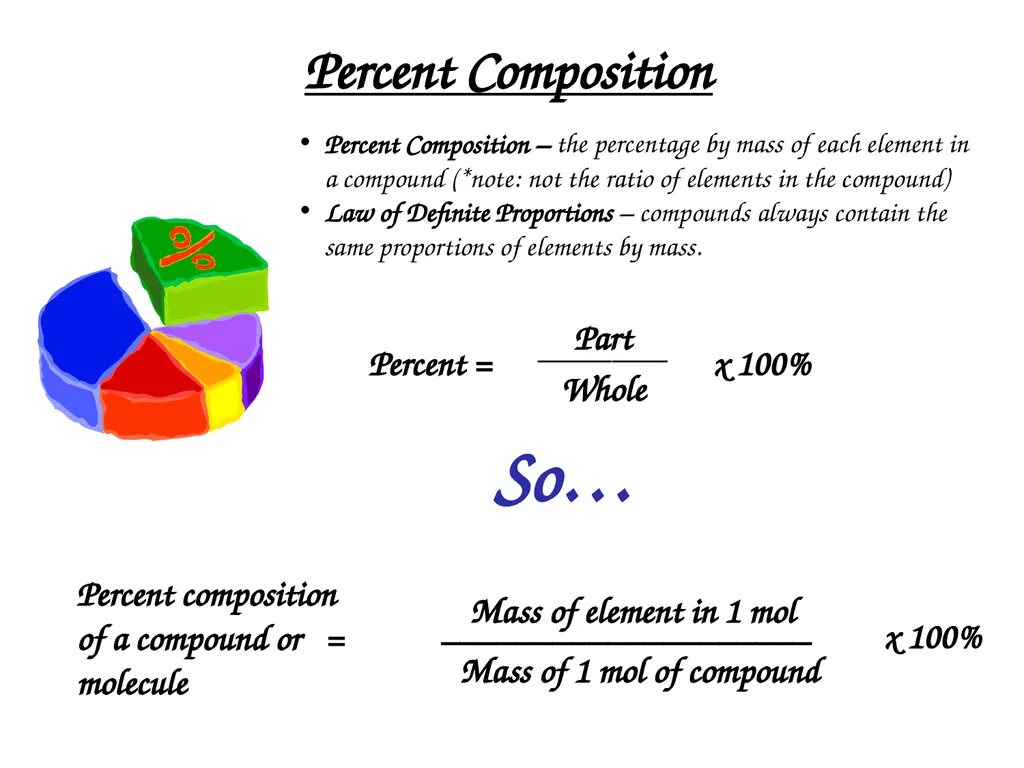
Percent Composition Percent Composition – the percentage by mass of each element in a compound (*note: not the ratio of elements in the compound)
Law of Definite Proportions – compounds always contain the same proportions of elements by mass. Percent = _______ Part Whole x 100% So… Percent composition
of a compound or =
molecule Mass of element in 1 mol ____________________ Mass of 1 mol of compound x 100%<br>
Law of Definite Proportions – compounds always contain the same proportions of elements by mass. Percent = _______ Part Whole x 100% So… Percent composition
of a compound or =
molecule Mass of element in 1 mol ____________________ Mass of 1 mol of compound x 100%<br>
03
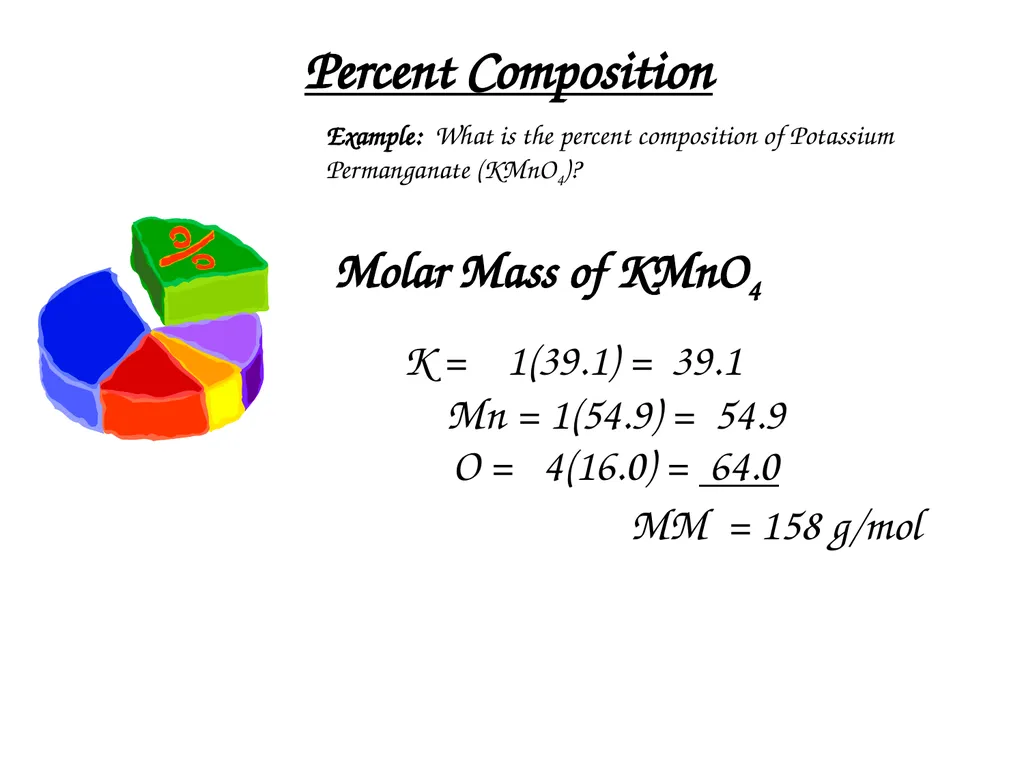
Percent Composition Example: What is the percent composition of Potassium Permanganate (KMnO4)? Molar Mass of KMnO4 K = 1(39.1) = 39.1 Mn = 1(54.9) = 54.9 O = 4(16.0) = 64.0 MM = 158 g/mol<br>
04
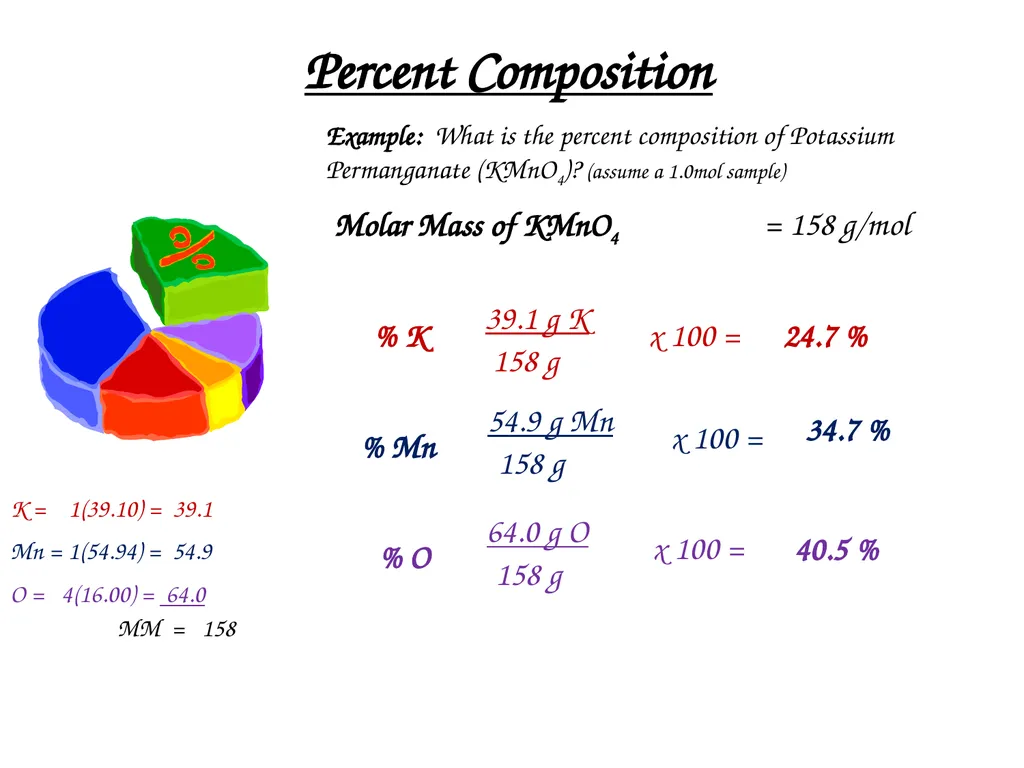
Percent Composition Example: What is the percent composition of Potassium Permanganate (KMnO4)? (assume a 1.0mol sample) = 158 g/mol % K Molar Mass of KMnO4 39.1 g K 158 g x 100 = 24.7 % % Mn 54.9 g Mn 158 g x 100 = 34.7 % % O 64.0 g O 158 g x 100 = 40.5 % K = 1(39.10) = 39.1 Mn = 1(54.94) = 54.9 O = 4(16.00) = 64.0 MM = 158<br>
05
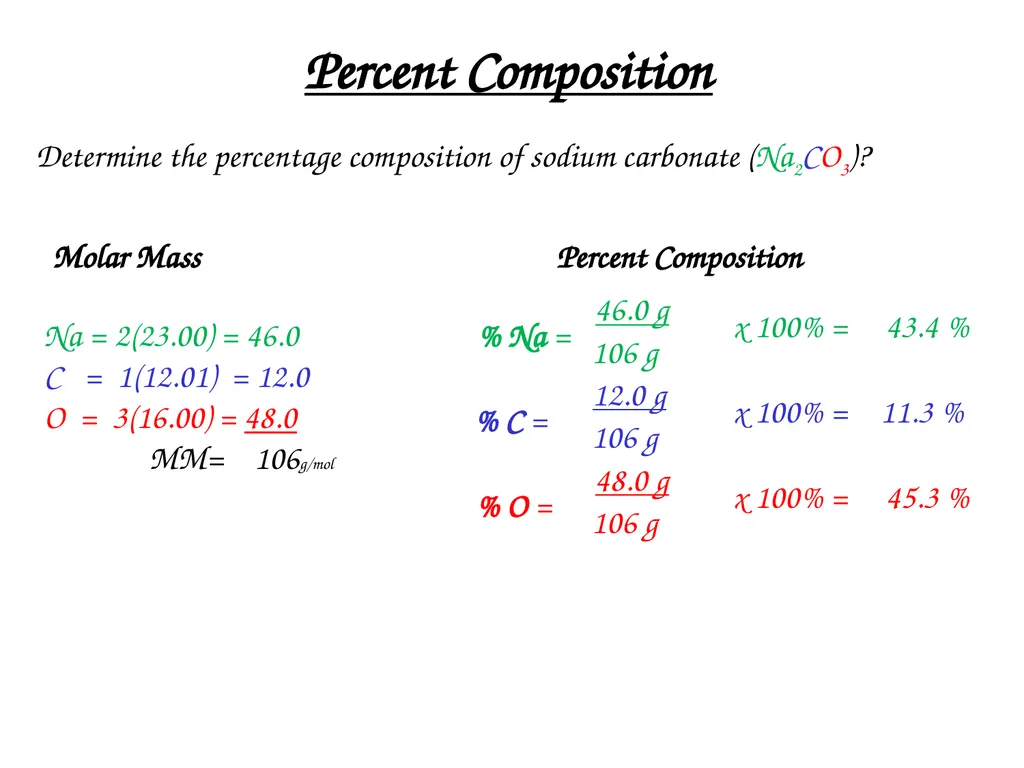
Percent Composition Determine the percentage composition of sodium carbonate (Na2CO3)? Molar Mass Percent Composition % Na = 46.0 g 106 g x 100% = 43.4 % % C = 12.0 g 106 g x 100% = 11.3 % % O = 48.0 g 106 g x 100% = 45.3 % Na = 2(23.00) = 46.0
C = 1(12.01) = 12.0
O = 3(16.00) = 48.0
MM= 106g/mol<br>
C = 1(12.01) = 12.0
O = 3(16.00) = 48.0
MM= 106g/mol<br>
06
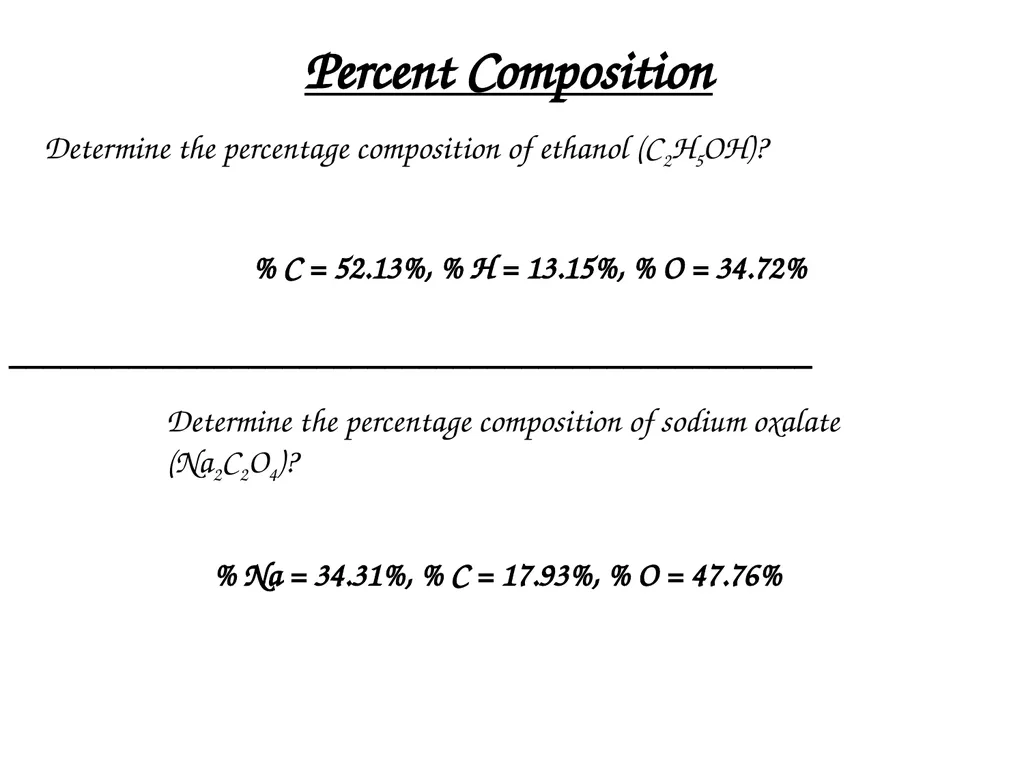
Percent Composition Determine the percentage composition of ethanol (C2H5OH)? % C = 52.13%, % H = 13.15%, % O = 34.72% _______________________________________________ Determine the percentage composition of sodium oxalate
(Na2C2O4)? % Na = 34.31%, % C = 17.93%, % O = 47.76%<br>
(Na2C2O4)? % Na = 34.31%, % C = 17.93%, % O = 47.76%<br>
07
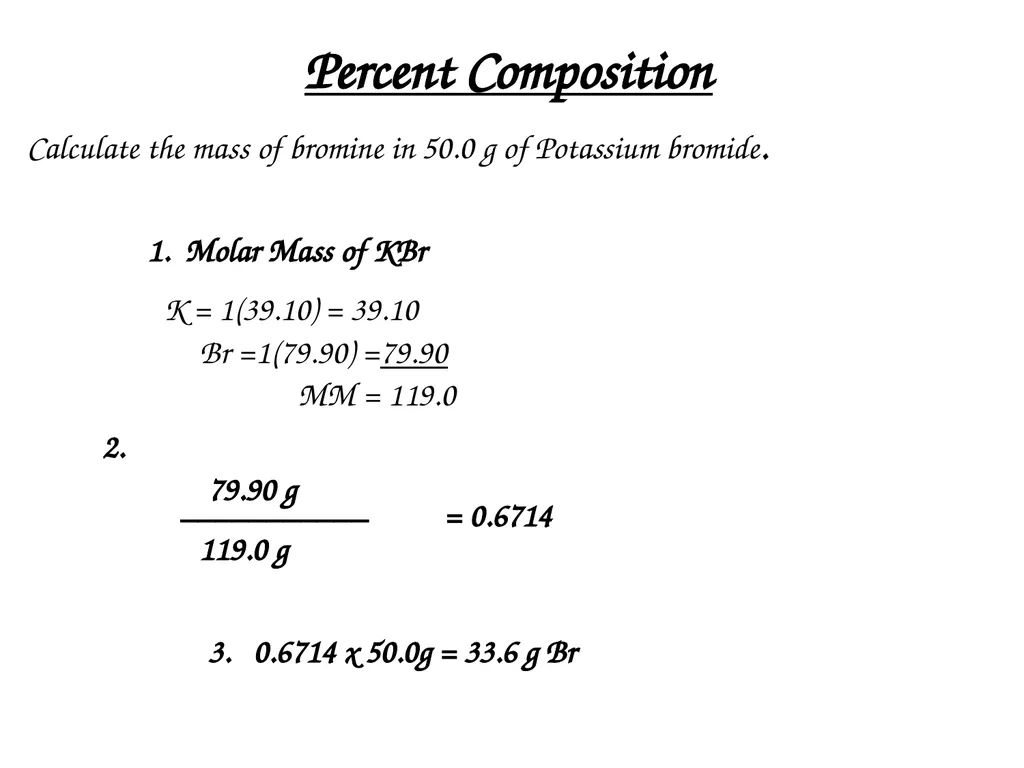
Percent Composition Calculate the mass of bromine in 50.0 g of Potassium bromide. 1. Molar Mass of KBr K = 1(39.10) = 39.10 Br =1(79.90) =79.90 MM = 119.0 79.90 g ___________ 119.0 g = 0.6714 3. 0.6714 x 50.0g = 33.6 g Br 2.<br>
08
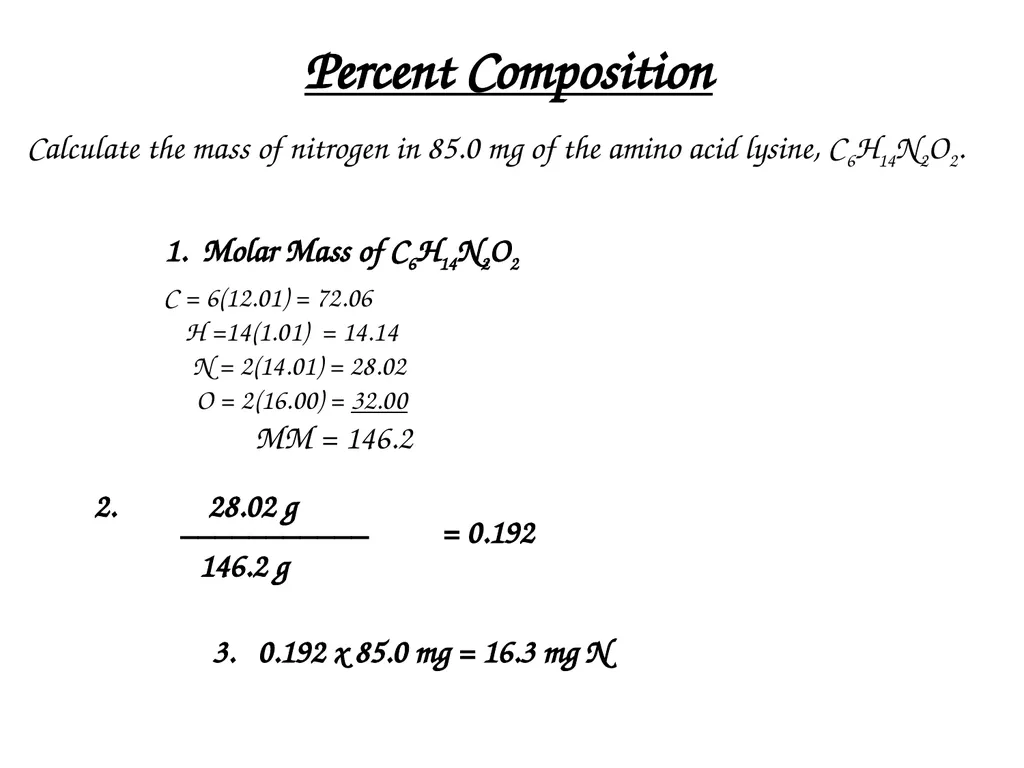
Percent Composition Calculate the mass of nitrogen in 85.0 mg of the amino acid lysine, C6H14N2O2. 1. Molar Mass of C6H14N2O2 C = 6(12.01) = 72.06 H =14(1.01) = 14.14 MM = 146.2 28.02 g ___________ 146.2 g = 0.192 3. 0.192 x 85.0 mg = 16.3 mg N 2. N = 2(14.01) = 28.02 O = 2(16.00) = 32.00<br>
09
Homework Read section 6.6
Page 286 #1,2
Page 287 #3
Page 288 # 1-5,7,8<br>
Page 286 #1,2
Page 287 #3
Page 288 # 1-5,7,8<br>
10
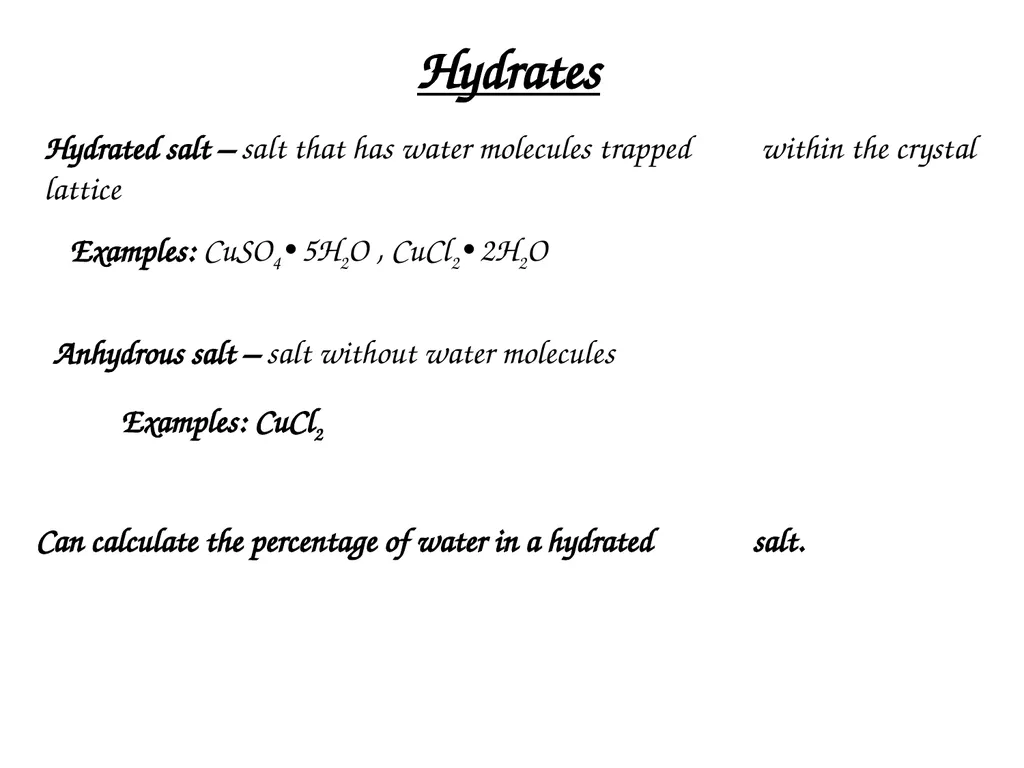
Hydrates Hydrated salt – salt that has water molecules trapped within the crystal lattice Examples: CuSO4•5H2O , CuCl2•2H2O Anhydrous salt – salt without water molecules Examples: CuCl2 Can calculate the percentage of water in a hydrated salt.<br>
11
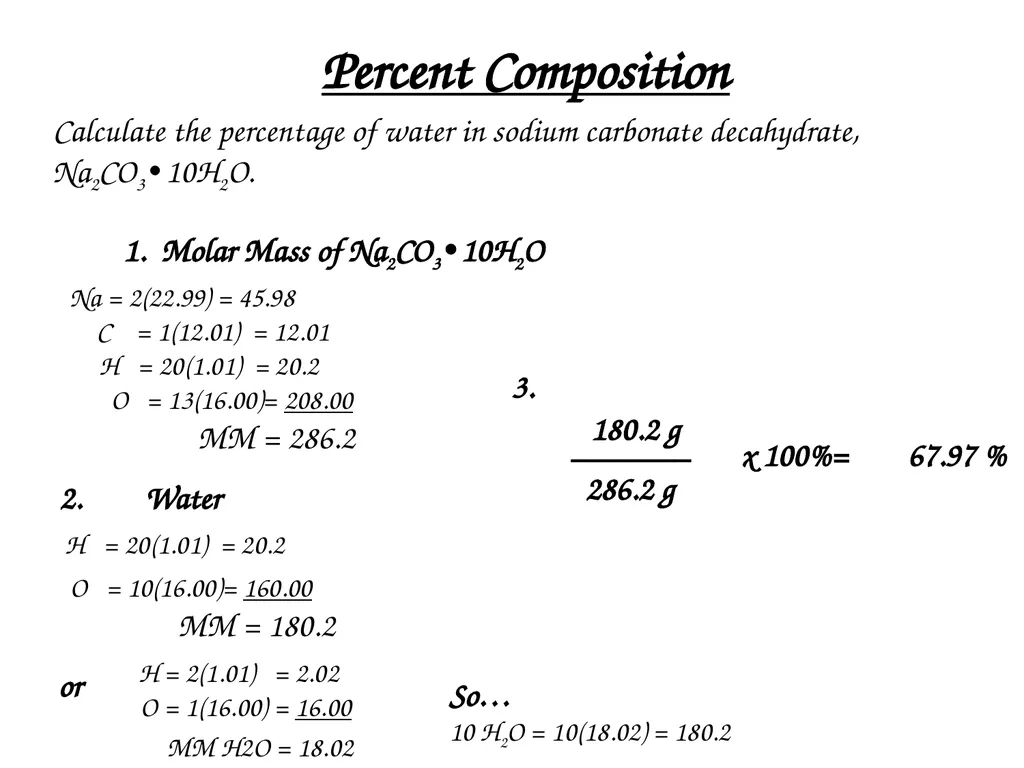
Percent Composition Calculate the percentage of water in sodium carbonate decahydrate, Na2CO3•10H2O. 1. Molar Mass of Na2CO3•10H2O Na = 2(22.99) = 45.98 C = 1(12.01) = 12.01 MM = 286.2 H = 20(1.01) = 20.2 O = 13(16.00)= 208.00 H = 20(1.01) = 20.2 Water O = 10(16.00)= 160.00 MM = 180.2 2. 3. 180.2 g _______ 286.2 g 67.97 % x 100%= or H = 2(1.01) = 2.02 O = 1(16.00) = 16.00 MM H2O = 18.02 So…
10 H2O = 10(18.02) = 180.2<br>
10 H2O = 10(18.02) = 180.2<br>
12
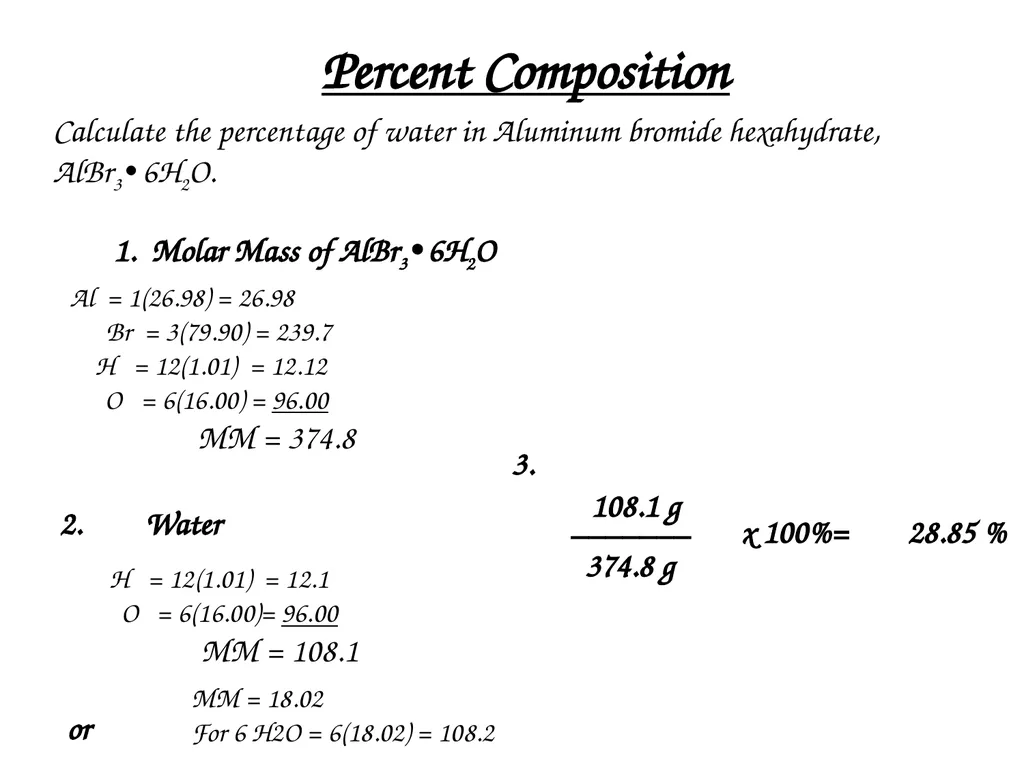
Percent Composition Calculate the percentage of water in Aluminum bromide hexahydrate, AlBr3•6H2O. 1. Molar Mass of AlBr3•6H2O Al = 1(26.98) = 26.98 Br = 3(79.90) = 239.7 MM = 374.8 H = 12(1.01) = 12.12 O = 6(16.00) = 96.00 H = 12(1.01) = 12.1 Water O = 6(16.00)= 96.00 MM = 108.1 2. 3. 108.1 g _______ 374.8 g 28.85 % x 100%= or MM = 18.02
For 6 H2O = 6(18.02) = 108.2<br>
For 6 H2O = 6(18.02) = 108.2<br>
13
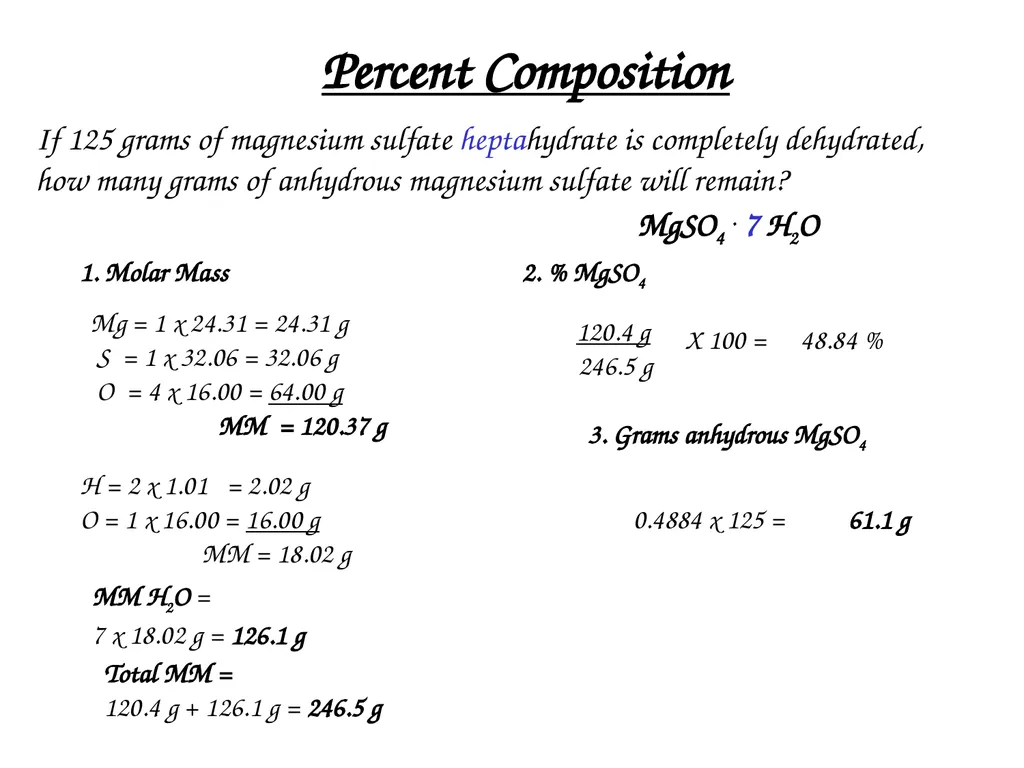
Percent Composition If 125 grams of magnesium sulfate heptahydrate is completely dehydrated, how many grams of anhydrous magnesium sulfate will remain? MgSO4 . 7 H2O 1. Molar Mass Mg = 1 x 24.31 = 24.31 g
S = 1 x 32.06 = 32.06 g
O = 4 x 16.00 = 64.00 g
MM = 120.37 g H = 2 x 1.01 = 2.02 g
O = 1 x 16.00 = 16.00 g
MM = 18.02 g MM H2O =
7 x 18.02 g = 126.1 g Total MM =
120.4 g + 126.1 g = 246.5 g 2. % MgSO4 120.4 g 246.5 g X 100 = 48.84 % 3. Grams anhydrous MgSO4 0.4884 x 125 = 61.1 g<br>
S = 1 x 32.06 = 32.06 g
O = 4 x 16.00 = 64.00 g
MM = 120.37 g H = 2 x 1.01 = 2.02 g
O = 1 x 16.00 = 16.00 g
MM = 18.02 g MM H2O =
7 x 18.02 g = 126.1 g Total MM =
120.4 g + 126.1 g = 246.5 g 2. % MgSO4 120.4 g 246.5 g X 100 = 48.84 % 3. Grams anhydrous MgSO4 0.4884 x 125 = 61.1 g<br>
14
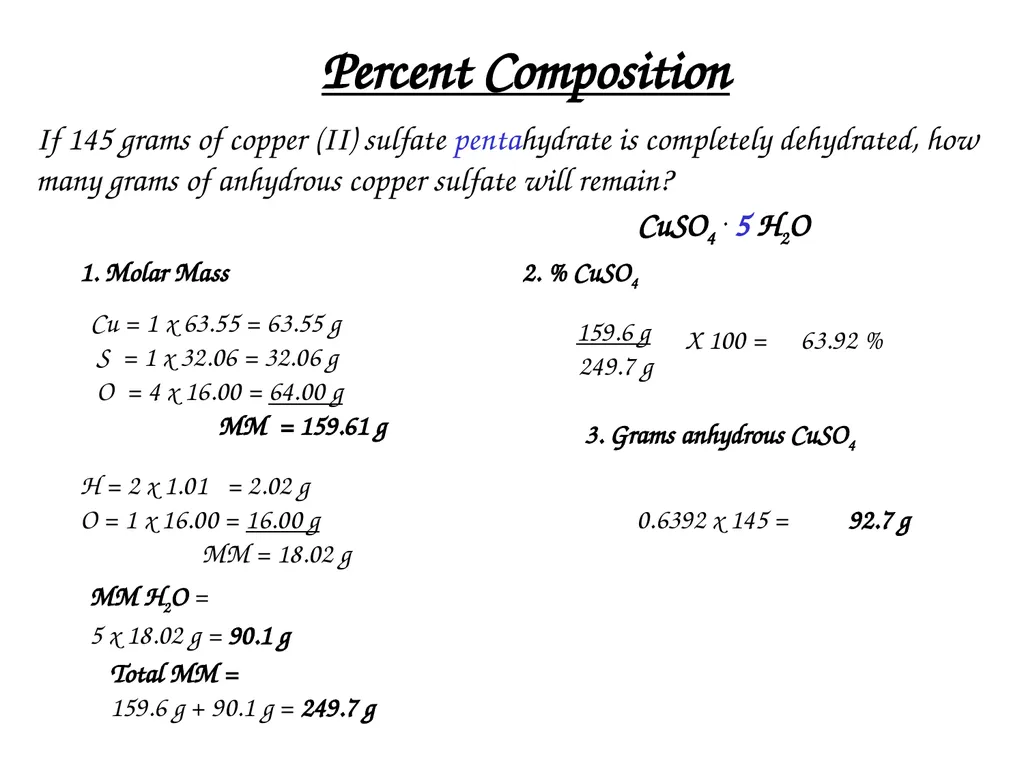
Percent Composition If 145 grams of copper (II) sulfate pentahydrate is completely dehydrated, how many grams of anhydrous copper sulfate will remain? CuSO4 . 5 H2O 1. Molar Mass Cu = 1 x 63.55 = 63.55 g
S = 1 x 32.06 = 32.06 g
O = 4 x 16.00 = 64.00 g
MM = 159.61 g H = 2 x 1.01 = 2.02 g
O = 1 x 16.00 = 16.00 g
MM = 18.02 g MM H2O =
5 x 18.02 g = 90.1 g Total MM =
159.6 g + 90.1 g = 249.7 g 2. % CuSO4 159.6 g 249.7 g X 100 = 63.92 % 3. Grams anhydrous CuSO4 0.6392 x 145 = 92.7 g<br>
S = 1 x 32.06 = 32.06 g
O = 4 x 16.00 = 64.00 g
MM = 159.61 g H = 2 x 1.01 = 2.02 g
O = 1 x 16.00 = 16.00 g
MM = 18.02 g MM H2O =
5 x 18.02 g = 90.1 g Total MM =
159.6 g + 90.1 g = 249.7 g 2. % CuSO4 159.6 g 249.7 g X 100 = 63.92 % 3. Grams anhydrous CuSO4 0.6392 x 145 = 92.7 g<br>
15
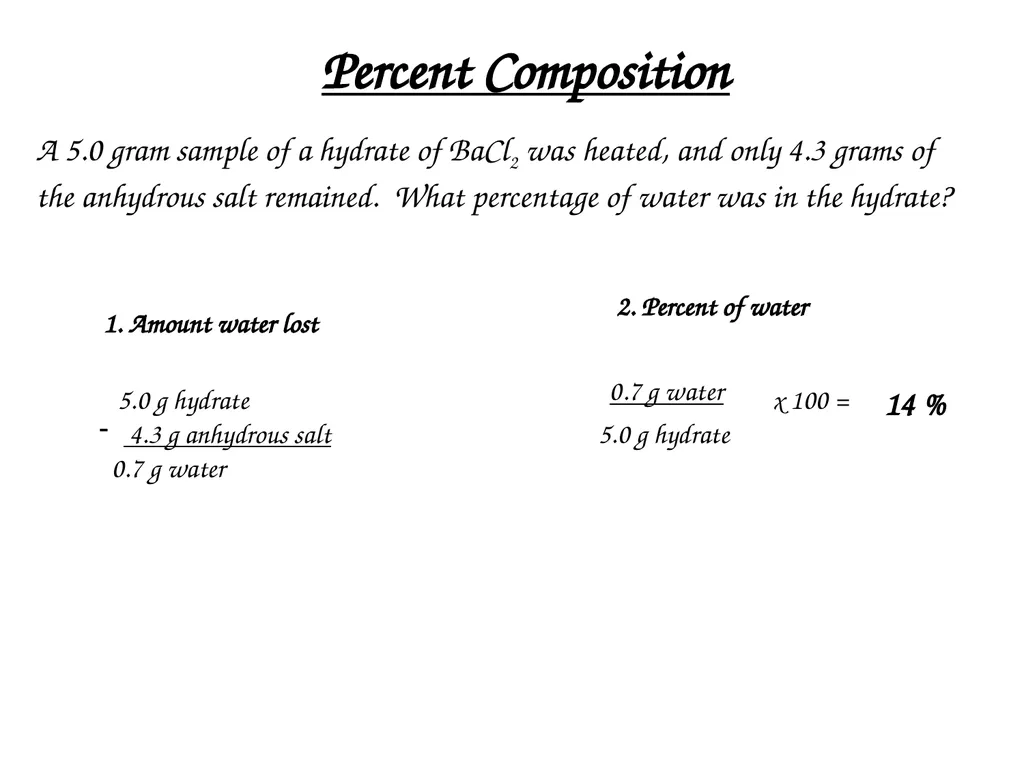
Percent Composition A 5.0 gram sample of a hydrate of BaCl2 was heated, and only 4.3 grams of the anhydrous salt remained. What percentage of water was in the hydrate? 1. Amount water lost 5.0 g hydrate
4.3 g anhydrous salt
0.7 g water 2. Percent of water 0.7 g water 5.0 g hydrate x 100 = 14 %<br>
4.3 g anhydrous salt
0.7 g water 2. Percent of water 0.7 g water 5.0 g hydrate x 100 = 14 %<br>
16
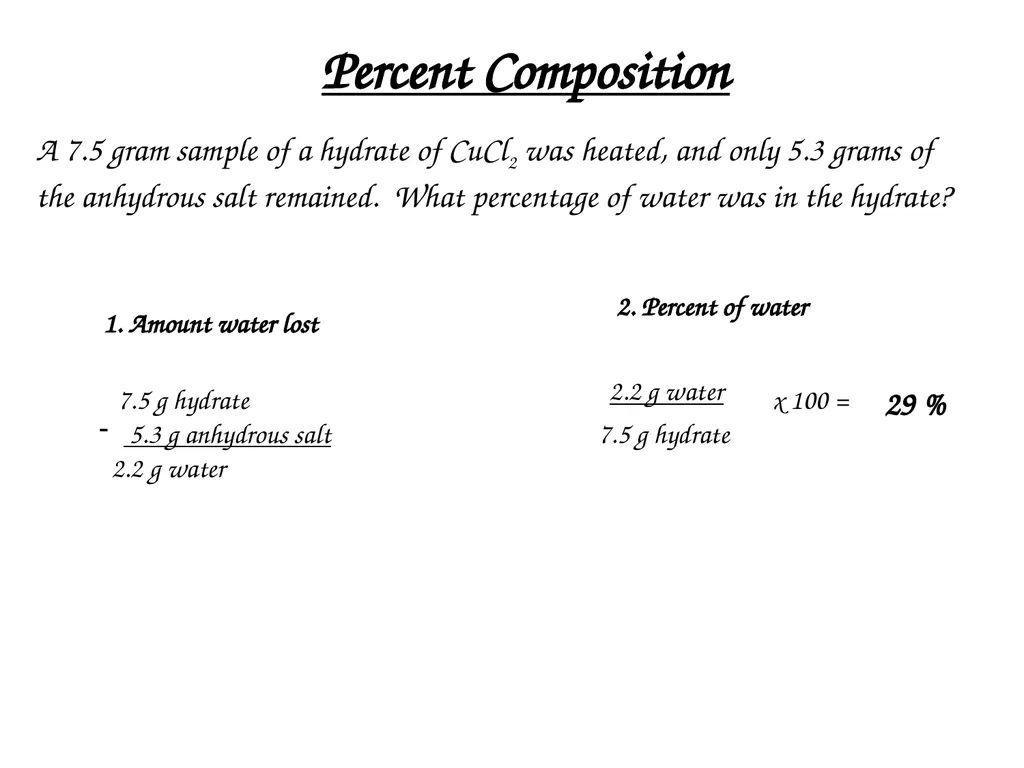
Percent Composition A 7.5 gram sample of a hydrate of CuCl2 was heated, and only 5.3 grams of the anhydrous salt remained. What percentage of water was in the hydrate? 1. Amount water lost 7.5 g hydrate
5.3 g anhydrous salt
2.2 g water 2. Percent of water 2.2 g water 7.5 g hydrate x 100 = 29 %<br>
5.3 g anhydrous salt
2.2 g water 2. Percent of water 2.2 g water 7.5 g hydrate x 100 = 29 %<br>
17
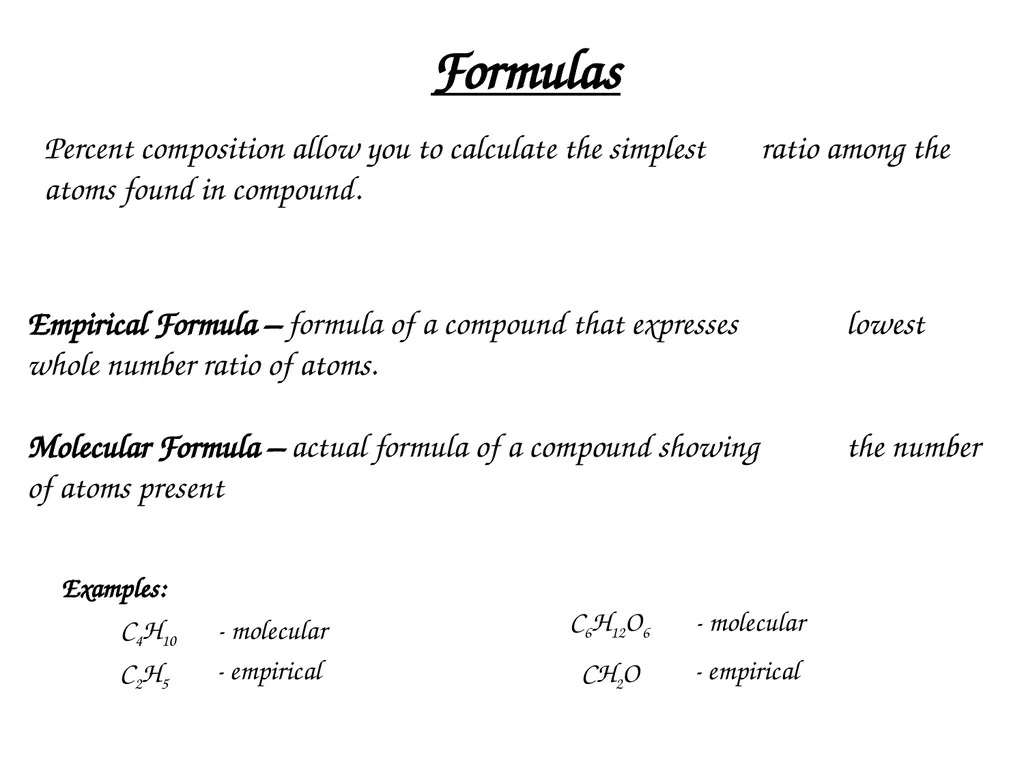
Formulas Empirical Formula – formula of a compound that expresses lowest whole number ratio of atoms.
Molecular Formula – actual formula of a compound showing the number of atoms present Percent composition allow you to calculate the simplest ratio among the atoms found in compound. Examples: C4H10 - molecular C2H5 - empirical C6H12O6 - molecular CH2O - empirical<br>
Molecular Formula – actual formula of a compound showing the number of atoms present Percent composition allow you to calculate the simplest ratio among the atoms found in compound. Examples: C4H10 - molecular C2H5 - empirical C6H12O6 - molecular CH2O - empirical<br>
18
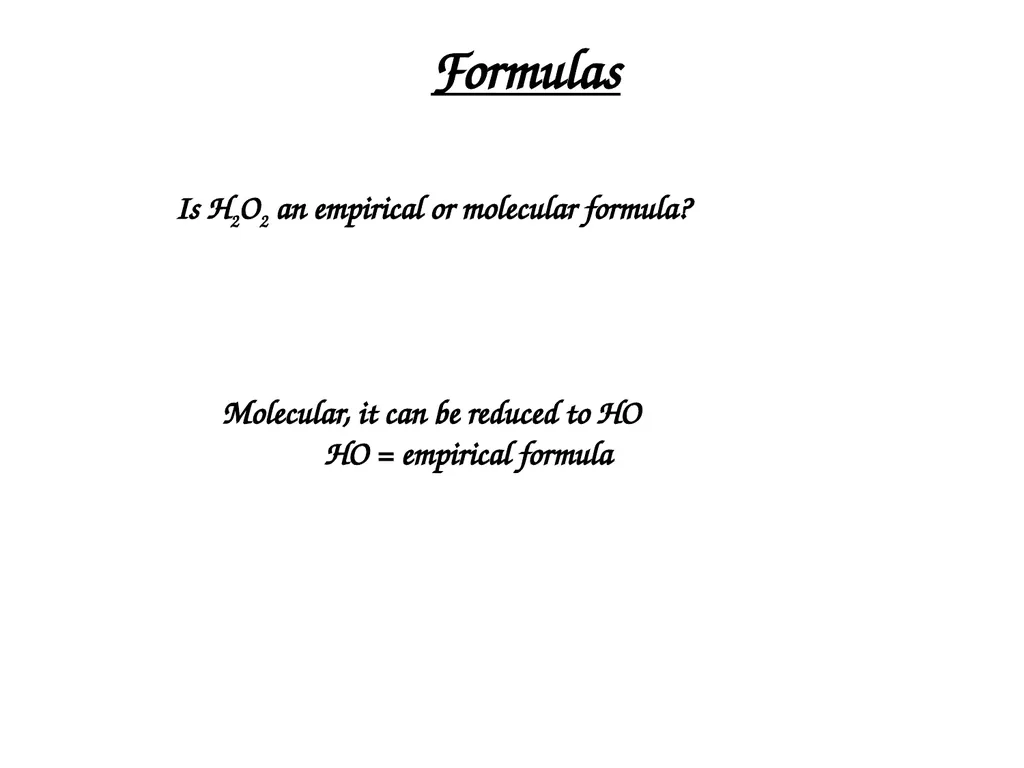
Formulas Is H2O2 an empirical or molecular formula? Molecular, it can be reduced to HO
HO = empirical formula<br>
HO = empirical formula<br>
19
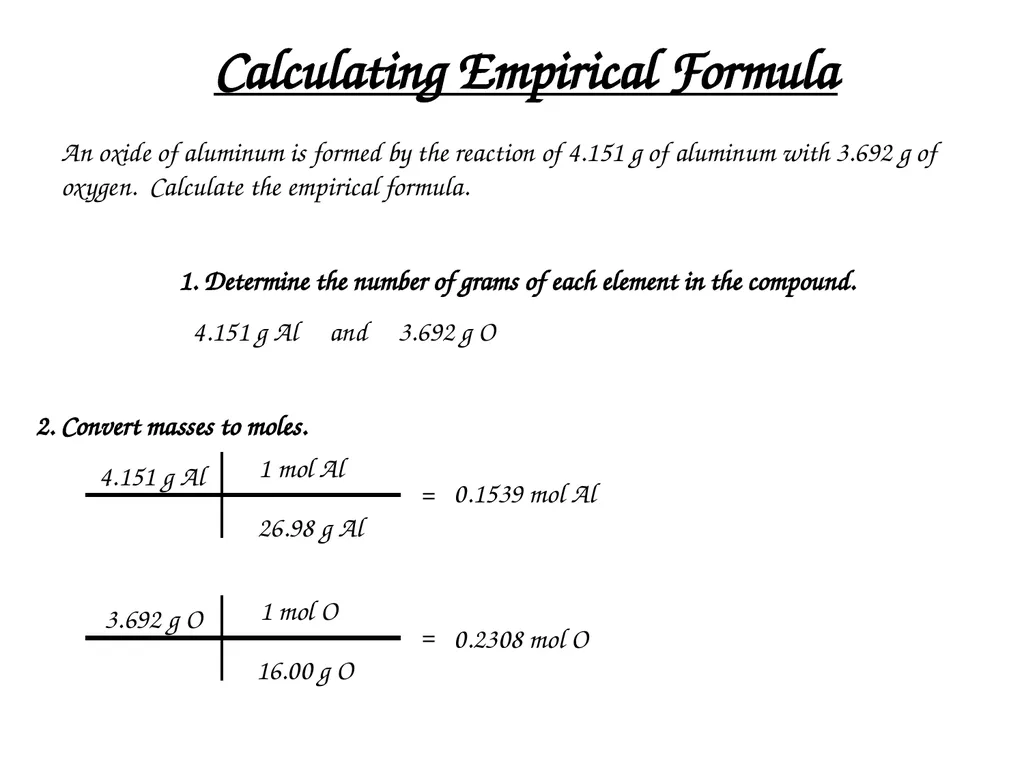
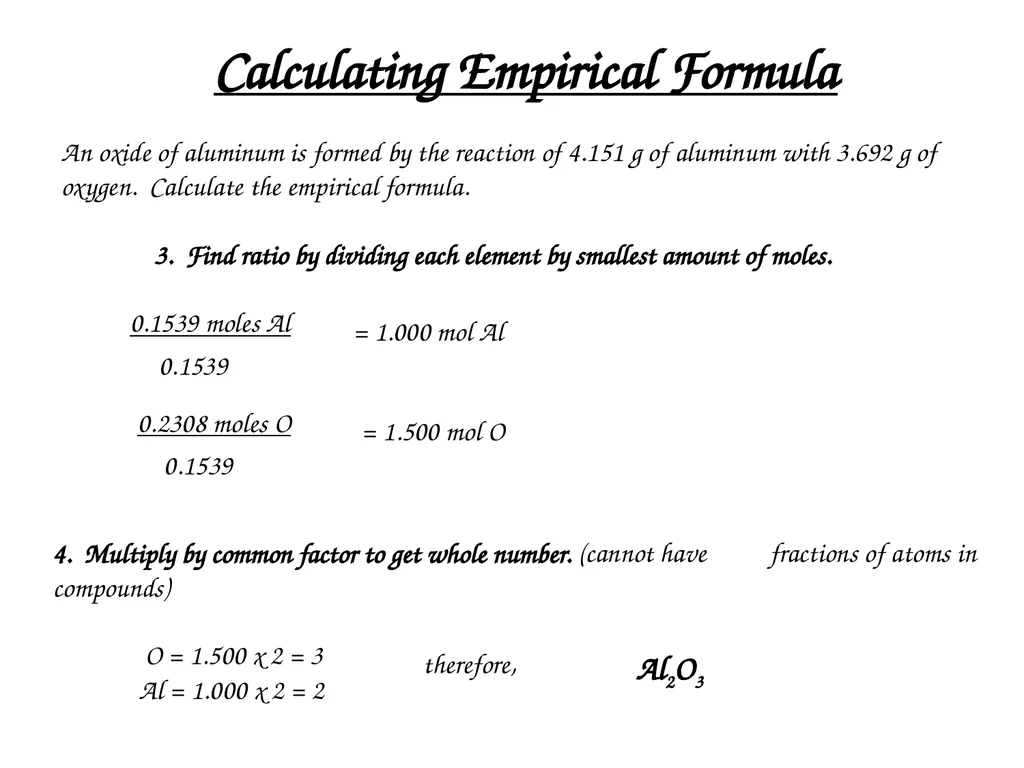
Calculating Empirical Formula An oxide of aluminum is formed by the reaction of 4.151 g of aluminum with 3.692 g of oxygen. Calculate the empirical formula. 1. Determine the number of grams of each element in the compound. 4.151 g Al and 3.692 g O 2. Convert masses to moles. 4.151 g Al 1 mol Al 26.98 g Al = 0.1539 mol Al 3.692 g O 1 mol O 16.00 g O = 0.2308 mol O<br>
20
Calculating Empirical Formula An oxide of aluminum is formed by the reaction of 4.151 g of aluminum with 3.692 g of oxygen. Calculate the empirical formula. 3. Find ratio by dividing each element by smallest amount of moles. 0.1539 moles Al 0.1539 = 1.000 mol Al 0.2308 moles O 0.1539 = 1.500 mol O 4. Multiply by common factor to get whole number. (cannot have fractions of atoms in compounds) O = 1.500 x 2 = 3
Al = 1.000 x 2 = 2 therefore, Al2O3<br>
Al = 1.000 x 2 = 2 therefore, Al2O3<br>
21
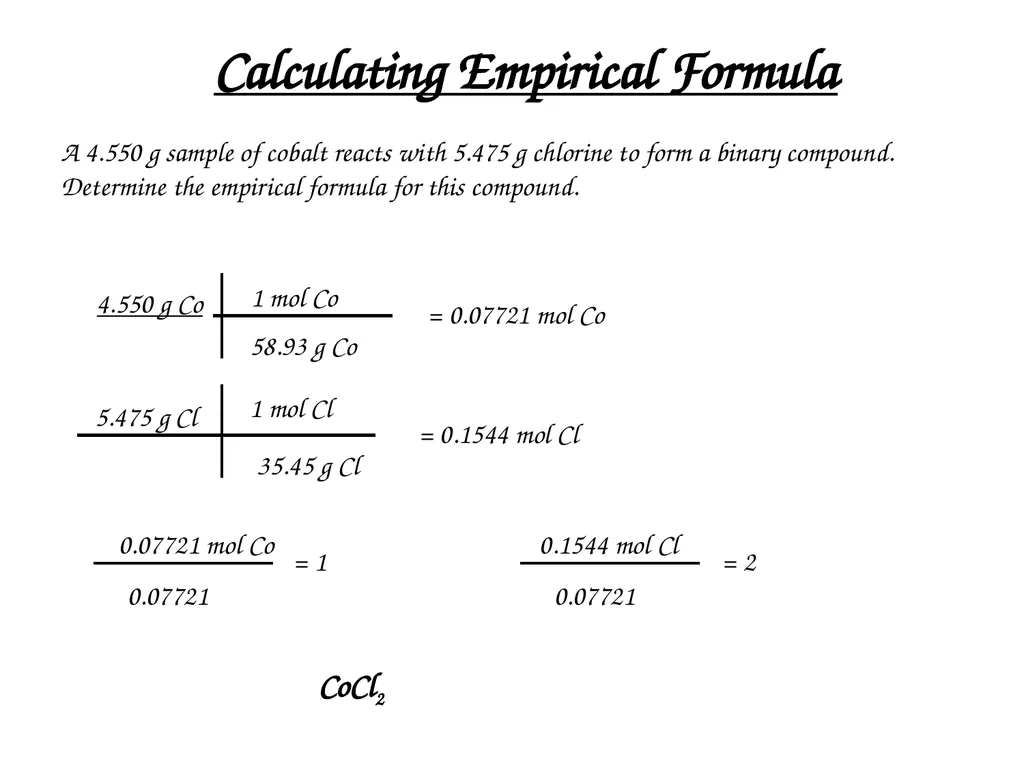
Calculating Empirical Formula A 4.550 g sample of cobalt reacts with 5.475 g chlorine to form a binary compound. Determine the empirical formula for this compound. 4.550 g Co 1 mol Co 58.93 g Co = 0.07721 mol Co 5.475 g Cl 1 mol Cl 35.45 g Cl = 0.1544 mol Cl 0.07721 mol Co 0.1544 mol Cl 0.07721 0.07721 = 2 = 1 CoCl2<br>
22
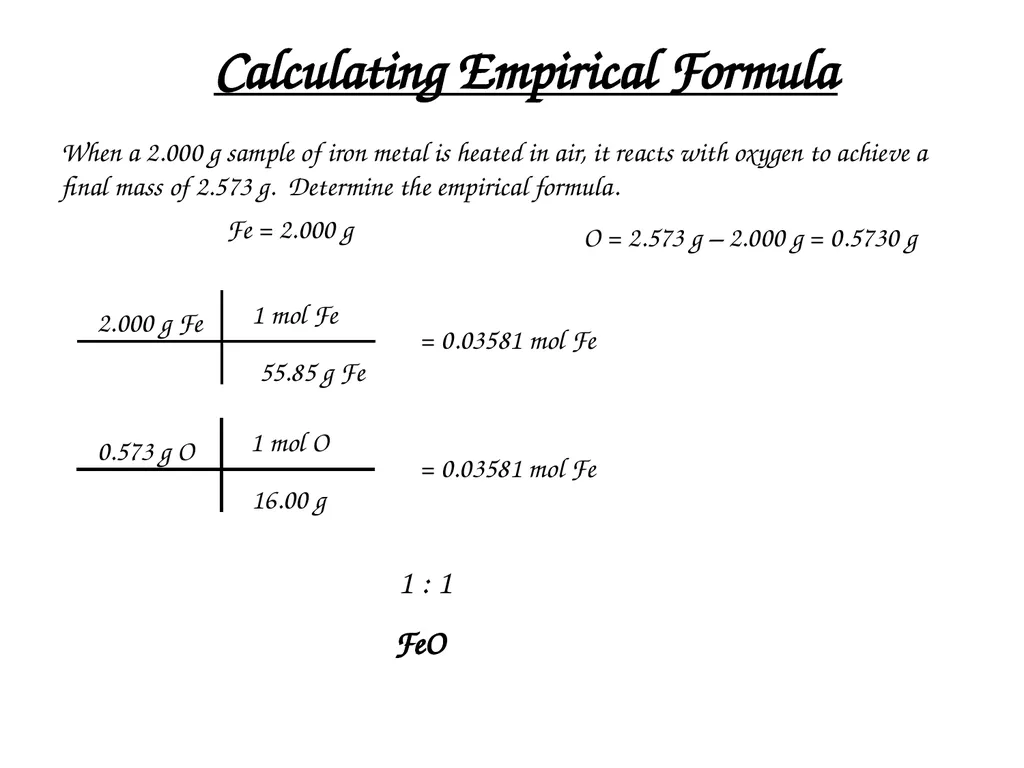
Calculating Empirical Formula When a 2.000 g sample of iron metal is heated in air, it reacts with oxygen to achieve a final mass of 2.573 g. Determine the empirical formula. 2.000 g Fe 1 mol Fe 55.85 g Fe = 0.03581 mol Fe 0.573 g O 1 mol O 16.00 g = 0.03581 mol Fe Fe = 2.000 g O = 2.573 g – 2.000 g = 0.5730 g 1 : 1 FeO<br>
23
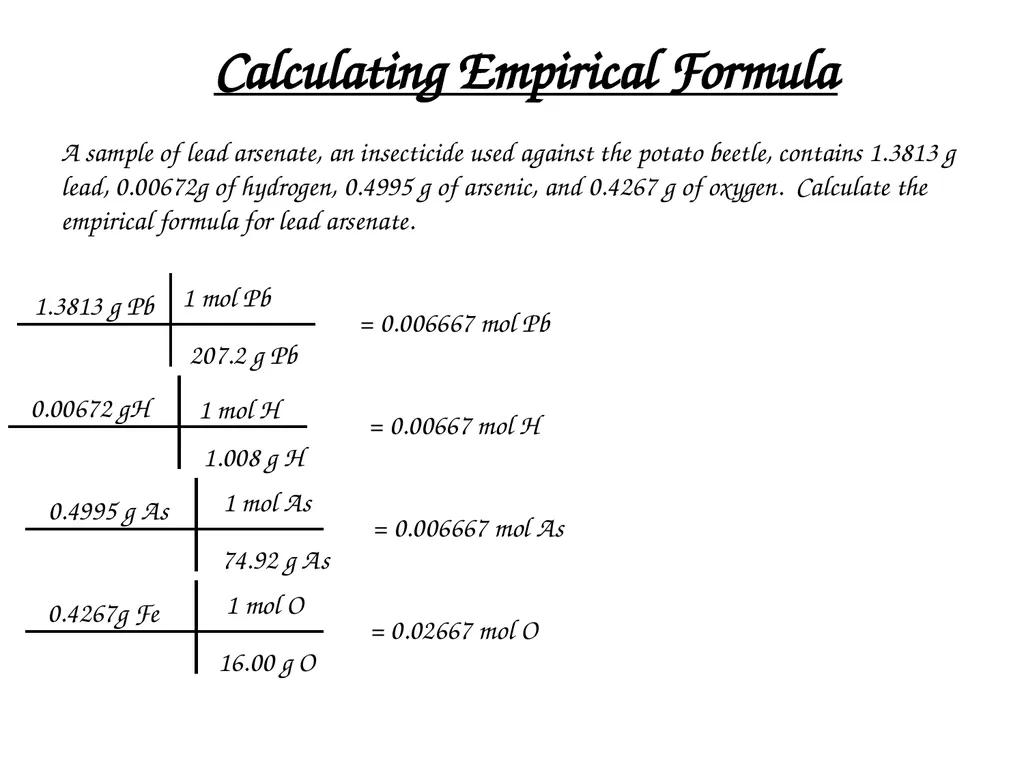
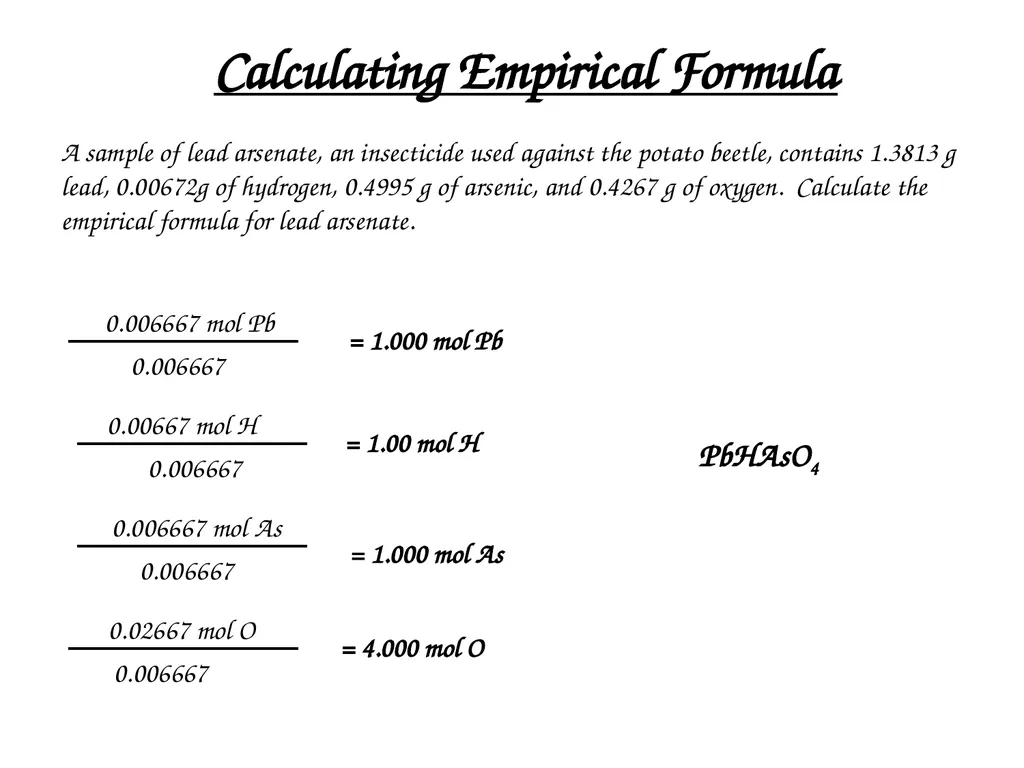
Calculating Empirical Formula A sample of lead arsenate, an insecticide used against the potato beetle, contains 1.3813 g lead, 0.00672g of hydrogen, 0.4995 g of arsenic, and 0.4267 g of oxygen. Calculate the empirical formula for lead arsenate. 1.3813 g Pb 1 mol Pb 207.2 g Pb = 0.006667 mol Pb 0.00672 gH 1 mol H 1.008 g H = 0.00667 mol H 0.4995 g As 1 mol As 74.92 g As = 0.006667 mol As 0.4267g Fe 1 mol O 16.00 g O = 0.02667 mol O<br>
24
Calculating Empirical Formula A sample of lead arsenate, an insecticide used against the potato beetle, contains 1.3813 g lead, 0.00672g of hydrogen, 0.4995 g of arsenic, and 0.4267 g of oxygen. Calculate the empirical formula for lead arsenate. 0.006667 mol Pb 0.00667 mol H 0.006667 mol As 0.02667 mol O 0.006667 0.006667 0.006667 0.006667 = 1.000 mol Pb = 1.00 mol H = 1.000 mol As = 4.000 mol O PbHAsO4<br>
25
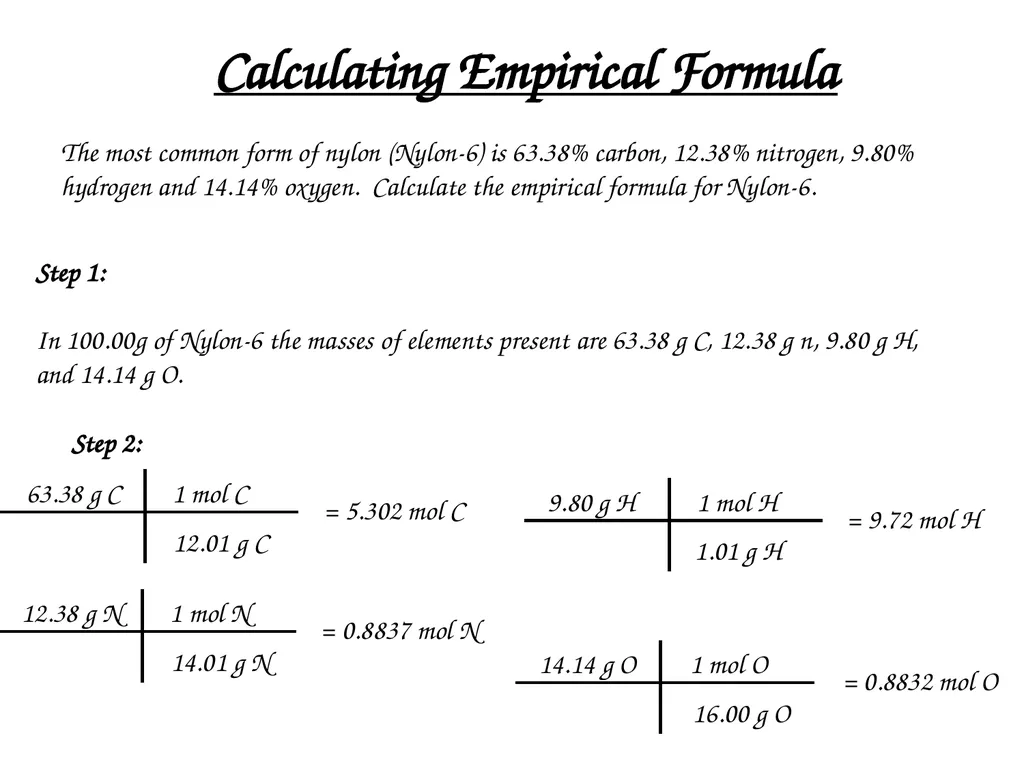
Calculating Empirical Formula The most common form of nylon (Nylon-6) is 63.38% carbon, 12.38% nitrogen, 9.80% hydrogen and 14.14% oxygen. Calculate the empirical formula for Nylon-6. Step 1:
In 100.00g of Nylon-6 the masses of elements present are 63.38 g C, 12.38 g n, 9.80 g H, and 14.14 g O. Step 2: 63.38 g C 1 mol C 12.01 g C = 5.302 mol C 12.38 g N 1 mol N 14.01 g N = 0.8837 mol N 9.80 g H 1 mol H 1.01 g H = 9.72 mol H 14.14 g O 1 mol O 16.00 g O = 0.8832 mol O<br>
In 100.00g of Nylon-6 the masses of elements present are 63.38 g C, 12.38 g n, 9.80 g H, and 14.14 g O. Step 2: 63.38 g C 1 mol C 12.01 g C = 5.302 mol C 12.38 g N 1 mol N 14.01 g N = 0.8837 mol N 9.80 g H 1 mol H 1.01 g H = 9.72 mol H 14.14 g O 1 mol O 16.00 g O = 0.8832 mol O<br>
26
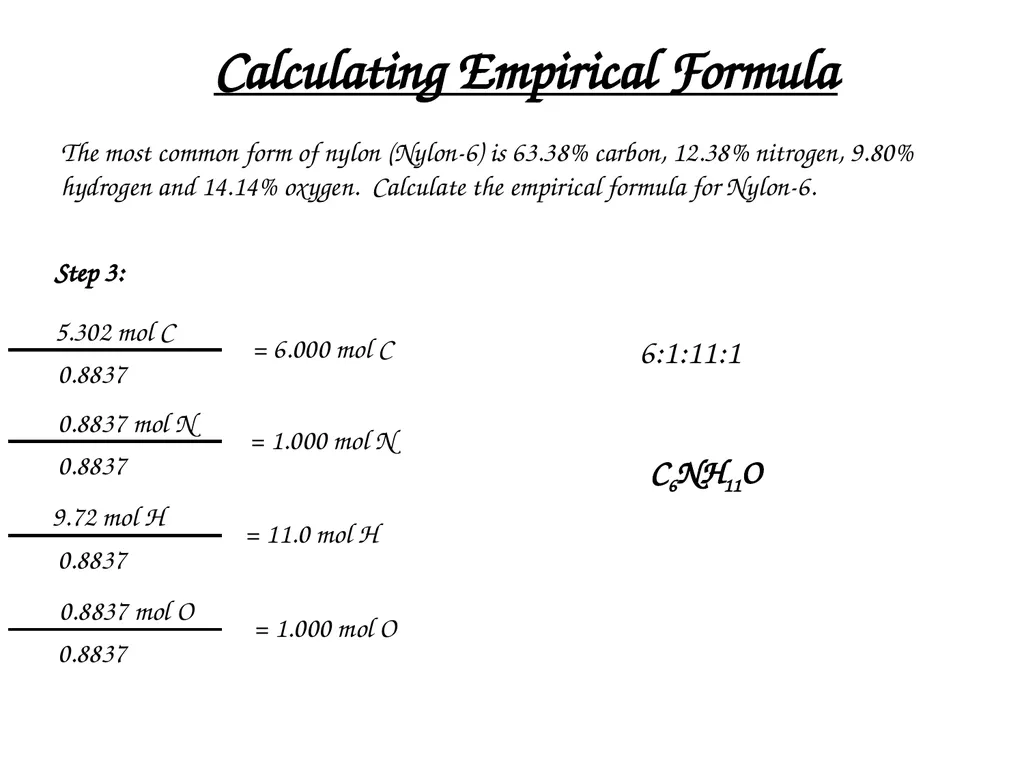
Calculating Empirical Formula The most common form of nylon (Nylon-6) is 63.38% carbon, 12.38% nitrogen, 9.80% hydrogen and 14.14% oxygen. Calculate the empirical formula for Nylon-6. Step 3: 5.302 mol C 0.8837 = 6.000 mol C 0.8837 mol N 0.8837 = 1.000 mol N 9.72 mol H 0.8837 = 11.0 mol H 0.8837 mol O 0.8837 = 1.000 mol O 6:1:11:1 C6NH11O<br>
27
Homework Read section 6.7
Page 292 #1
Page 293 #2-9<br>
Page 292 #1
Page 293 #2-9<br>
28
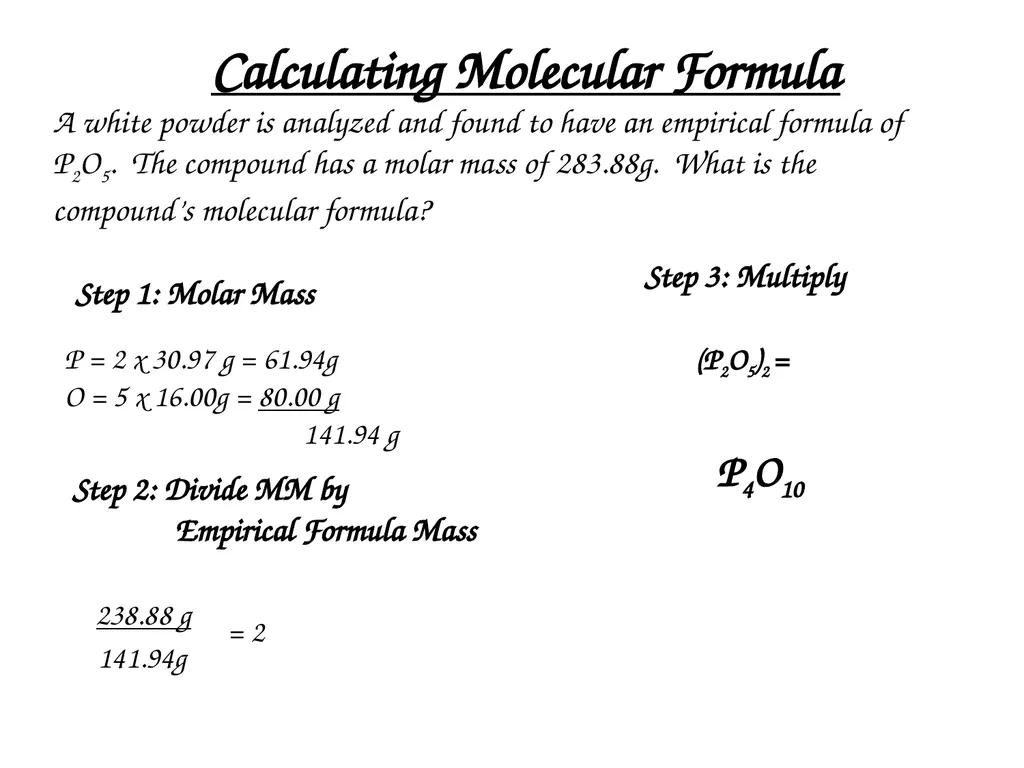
Calculating Molecular Formula A white powder is analyzed and found to have an empirical formula of P2O5. The compound has a molar mass of 283.88g. What is the compound’s molecular formula? Step 1: Molar Mass P = 2 x 30.97 g = 61.94g
O = 5 x 16.00g = 80.00 g
141.94 g Step 2: Divide MM by
Empirical Formula Mass 238.88 g 141.94g = 2 Step 3: Multiply (P2O5)2 = P4O10<br>
O = 5 x 16.00g = 80.00 g
141.94 g Step 2: Divide MM by
Empirical Formula Mass 238.88 g 141.94g = 2 Step 3: Multiply (P2O5)2 = P4O10<br>
29
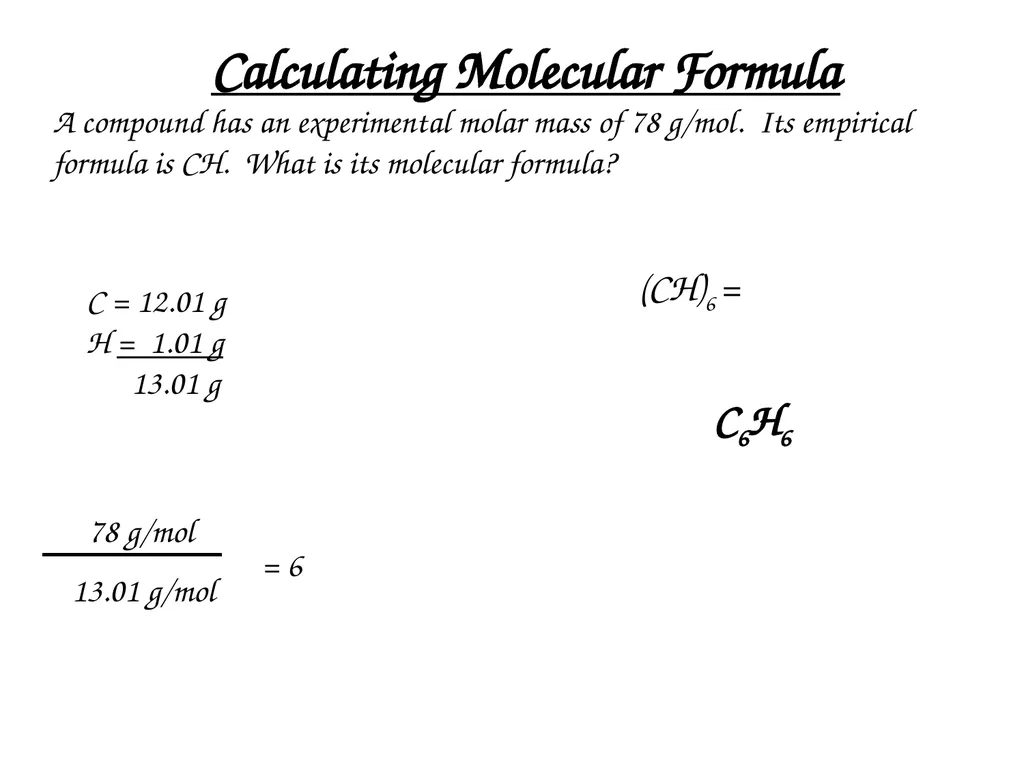
Calculating Molecular Formula A compound has an experimental molar mass of 78 g/mol. Its empirical formula is CH. What is its molecular formula? C = 12.01 g
H = 1.01 g
13.01 g 78 g/mol 13.01 g/mol = 6 (CH)6 = C6H6<br>
H = 1.01 g
13.01 g 78 g/mol 13.01 g/mol = 6 (CH)6 = C6H6<br>