
Performance Evaluation for USAID/West
CS
Published · 68 slides · 0 views
1 / 1






Description
Performance Evaluation for USAIDWest AfricaRegional Health Office AmplifyPF Regional Project: Phase 1 December 19, 2022 Martha Silva and Janna Wisniewski With assistance from Abdou Louché Ado (Niger) Session Agenda Overview of Evaluation
Related Topics
Share
Embed code
Download this presentation From Below
"Performance Evaluation for USAID/West" is the property of its rightful owner. Permission is granted to download and print the materials on this website for personal, non-commercial use only, and to display it on your personal computer provided you do not modify the materials and that you retain all copyright notices contained in the materials. By downloading content from our website, you accept the terms of this agreement.
Presentation Transcript
01
Performance Evaluation for USAID/West Africa/Regional Health Office AmplifyPF Regional Project: Phase 1 December 19, 2022
Martha Silva and Janna Wisniewski
With assistance from Abdou Louché Ado (Niger)<br>
Martha Silva and Janna Wisniewski
With assistance from Abdou Louché Ado (Niger)<br>
02
Session Agenda Overview of Evaluation Phase 1
Findings by research question
Qualitative data
Desk review
Implications for Evaluation Phase 2 2<br>
Findings by research question
Qualitative data
Desk review
Implications for Evaluation Phase 2 2<br>
03
Acronyms AMPLIFYPF - Amplify Family Planning and Sexual and Reproductive Health project
CHW - Community Health Worker
CTAR - Comité Technique d’Appui au RIA (Technical Support Committee)
CYP - Couple-Years Protection
FP - Family Planning
DHIS2 - District Health Information Software 2
DQA - Data Quality Assessment
HIP - High Impact Practice
ILN - Integrated Learning Network 3<br>
CHW - Community Health Worker
CTAR - Comité Technique d’Appui au RIA (Technical Support Committee)
CYP - Couple-Years Protection
FP - Family Planning
DHIS2 - District Health Information Software 2
DQA - Data Quality Assessment
HIP - High Impact Practice
ILN - Integrated Learning Network 3<br>
04
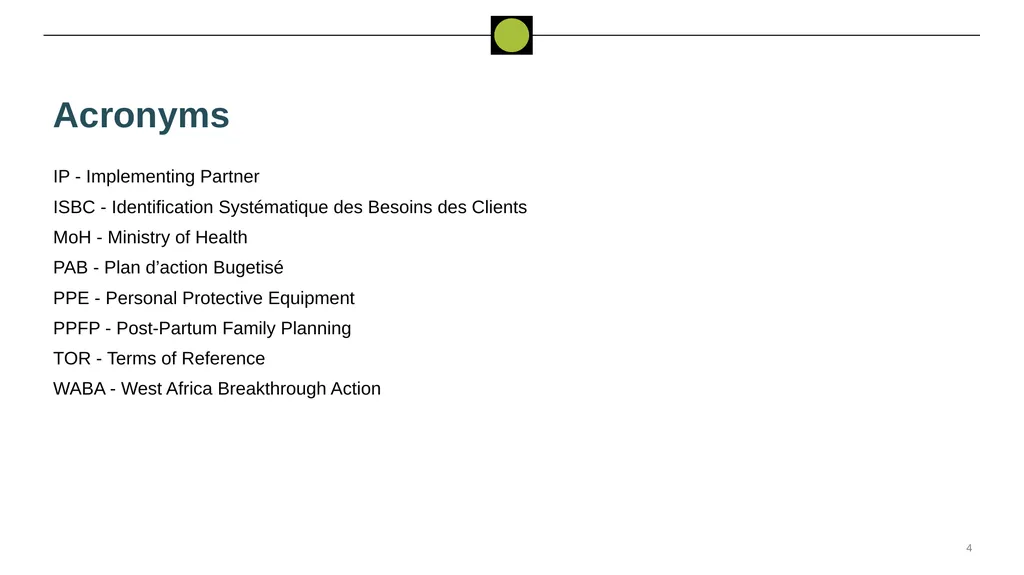
Acronyms IP - Implementing Partner
ISBC - Identification Systématique des Besoins des Clients
MoH - Ministry of Health
PAB - Plan d’action Bugetisé
PPE - Personal Protective Equipment
PPFP - Post-Partum Family Planning
TOR - Terms of Reference
WABA - West Africa Breakthrough Action 4<br>
ISBC - Identification Systématique des Besoins des Clients
MoH - Ministry of Health
PAB - Plan d’action Bugetisé
PPE - Personal Protective Equipment
PPFP - Post-Partum Family Planning
TOR - Terms of Reference
WABA - West Africa Breakthrough Action 4<br>
05
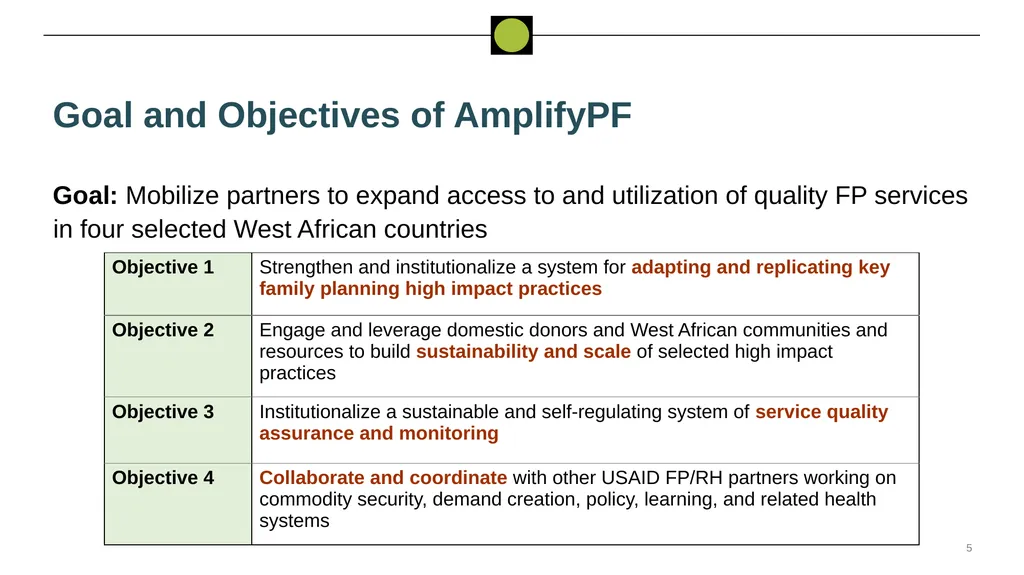
Goal and Objectives of AmplifyPF Goal: Mobilize partners to expand access to and utilization of quality FP services in four selected West African countries 5<br>
06
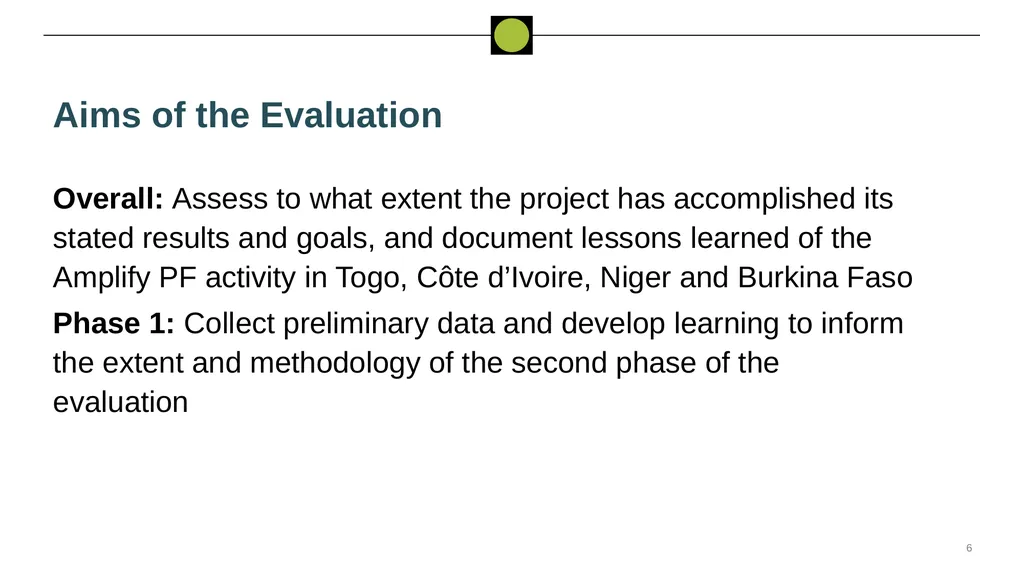
Aims of the Evaluation Overall: Assess to what extent the project has accomplished its stated results and goals, and document lessons learned of the Amplify PF activity in Togo, Côte d’Ivoire, Niger and Burkina Faso
Phase 1: Collect preliminary data and develop learning to inform the extent and methodology of the second phase of the evaluation 6<br>
Phase 1: Collect preliminary data and develop learning to inform the extent and methodology of the second phase of the evaluation 6<br>
07
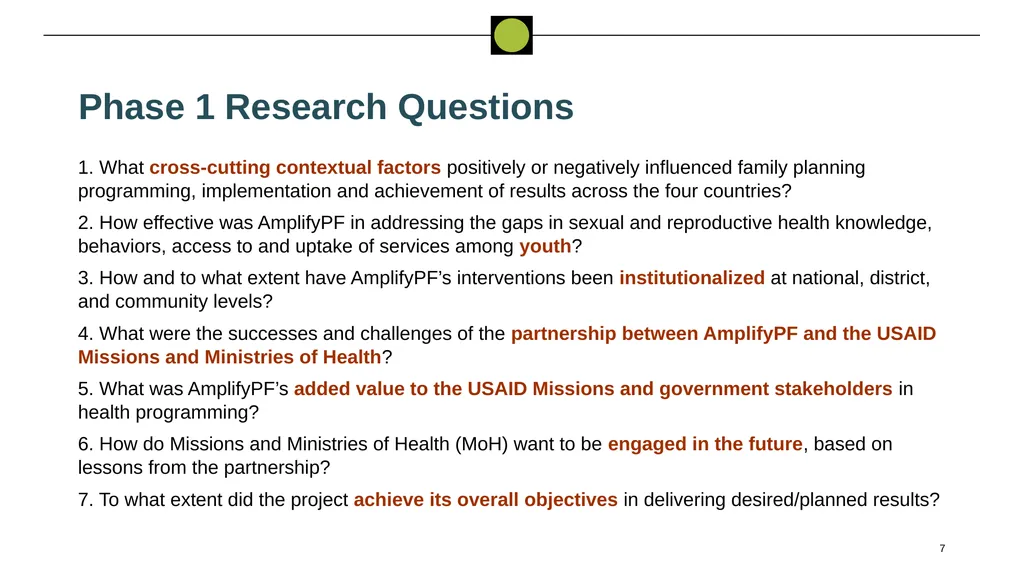
Phase 1 Research Questions 1. What cross-cutting contextual factors positively or negatively influenced family planning programming, implementation and achievement of results across the four countries?
2. How effective was AmplifyPF in addressing the gaps in sexual and reproductive health knowledge, behaviors, access to and uptake of services among youth?
3. How and to what extent have AmplifyPF’s interventions been institutionalized at national, district, and community levels?
4. What were the successes and challenges of the partnership between AmplifyPF and the USAID Missions and Ministries of Health?
5. What was AmplifyPF’s added value to the USAID Missions and government stakeholders in health programming?
6. How do Missions and Ministries of Health (MoH) want to be engaged in the future, based on lessons from the partnership?
7. To what extent did the project achieve its overall objectives in delivering desired/planned results? 7<br>
2. How effective was AmplifyPF in addressing the gaps in sexual and reproductive health knowledge, behaviors, access to and uptake of services among youth?
3. How and to what extent have AmplifyPF’s interventions been institutionalized at national, district, and community levels?
4. What were the successes and challenges of the partnership between AmplifyPF and the USAID Missions and Ministries of Health?
5. What was AmplifyPF’s added value to the USAID Missions and government stakeholders in health programming?
6. How do Missions and Ministries of Health (MoH) want to be engaged in the future, based on lessons from the partnership?
7. To what extent did the project achieve its overall objectives in delivering desired/planned results? 7<br>
08
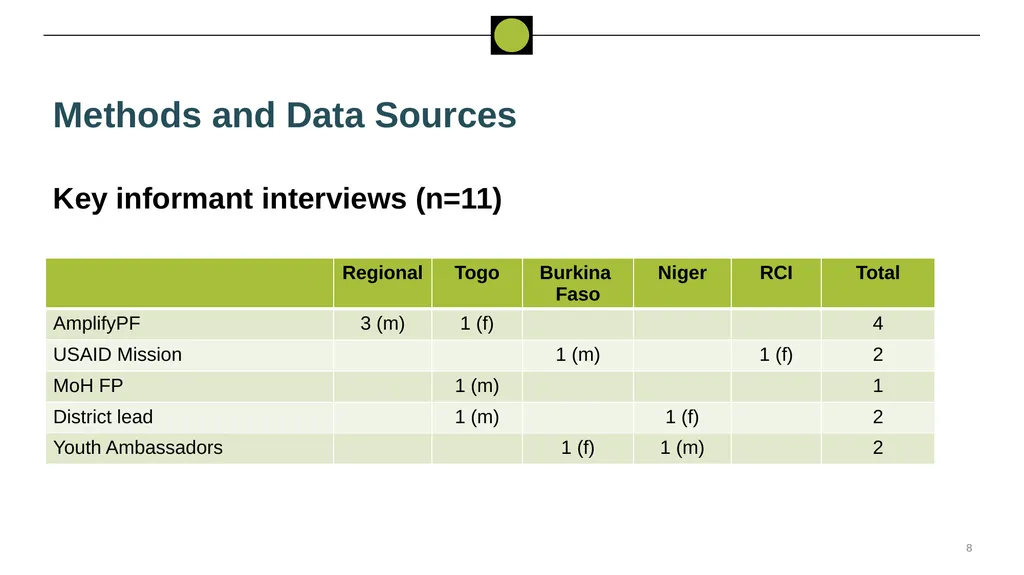
Methods and Data Sources Key informant interviews (n=11) 8<br>
09
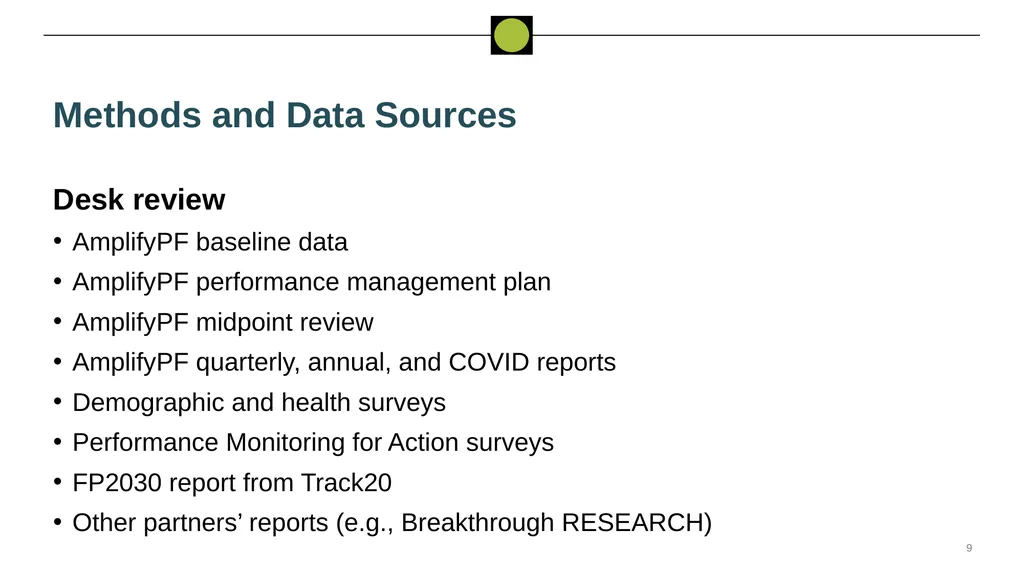
Methods and Data Sources Desk review
AmplifyPF baseline data
AmplifyPF performance management plan
AmplifyPF midpoint review
AmplifyPF quarterly, annual, and COVID reports
Demographic and health surveys
Performance Monitoring for Action surveys
FP2030 report from Track20
Other partners’ reports (e.g., Breakthrough RESEARCH) 9<br>
AmplifyPF baseline data
AmplifyPF performance management plan
AmplifyPF midpoint review
AmplifyPF quarterly, annual, and COVID reports
Demographic and health surveys
Performance Monitoring for Action surveys
FP2030 report from Track20
Other partners’ reports (e.g., Breakthrough RESEARCH) 9<br>
10
1. What cross-cutting contextual factors positively or negatively influenced family planning programming, implementation and achievement of results across the four countries? 10<br>
11
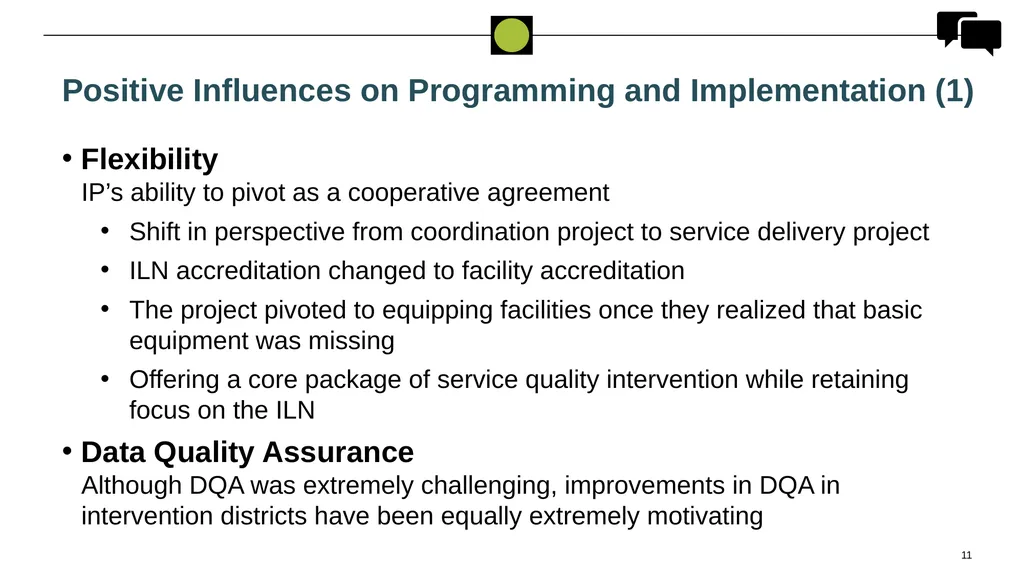
Flexibility
IP’s ability to pivot as a cooperative agreement
Shift in perspective from coordination project to service delivery project
ILN accreditation changed to facility accreditation
The project pivoted to equipping facilities once they realized that basic equipment was missing
Offering a core package of service quality intervention while retaining focus on the ILN
Data Quality Assurance Although DQA was extremely challenging, improvements in DQA in intervention districts have been equally extremely motivating Positive Influences on Programming and Implementation (1) 11<br>
Shift in perspective from coordination project to service delivery project
ILN accreditation changed to facility accreditation
The project pivoted to equipping facilities once they realized that basic equipment was missing
Offering a core package of service quality intervention while retaining focus on the ILN
Data Quality Assurance Although DQA was extremely challenging, improvements in DQA in intervention districts have been equally extremely motivating Positive Influences on Programming and Implementation (1) 11<br>
12
Close collaboration at multiple levels (regional partners [notably West African Breakthrough Action], national, district, and health facility)
Coordination mechanisms with regional and national USAID implementing partners, with AmplifyFP as secretariat
Integration of AmplifyFP into local implementation plans (Niger)
Comité Technique d'Appui aux RIA (CETAR) as an innovation— importance of identifying the right people to be part of CETAR
Site walkthroughs increased engagement and problem solving Positive Influences on Programming and Implementation (2) 12<br>
Coordination mechanisms with regional and national USAID implementing partners, with AmplifyFP as secretariat
Integration of AmplifyFP into local implementation plans (Niger)
Comité Technique d'Appui aux RIA (CETAR) as an innovation— importance of identifying the right people to be part of CETAR
Site walkthroughs increased engagement and problem solving Positive Influences on Programming and Implementation (2) 12<br>
13
Ongoing Challenges Identified IP perception of lack of a clear strategy for how activities and progress would be sustained after the program’s end
Commodity stockouts at the health facility level
High MoH staff turnover and other human resource shortages
Loaded workplans threatening the accomplishment of project activities in timely fashion
Intensification of project activities
Completing the process of providing medical and technical equipment to health facilities
Rapid setting up phase of new activities in Amplify PF’s portfolio following an increase in project funding’s envelope 13<br>
Commodity stockouts at the health facility level
High MoH staff turnover and other human resource shortages
Loaded workplans threatening the accomplishment of project activities in timely fashion
Intensification of project activities
Completing the process of providing medical and technical equipment to health facilities
Rapid setting up phase of new activities in Amplify PF’s portfolio following an increase in project funding’s envelope 13<br>
14
USAID's internal structure, communication, and staff turnover
Coordination and communication between regional office and country mission was insufficient, leaving the IP to mediate
"We are asked to present a project in a country…and we find ourselves in a conflict situation...with the USAID health team. You see that's not comfortable, and we've been through that.” (Amplify 3)
"[AmplifyPF] do the work planning without our involvement that much…sometimes they share the work plan with us for our review. But I think that we should frankly, we should be more involved." (USAID Country)
Change of regional team—one team designed the project with one vision in mind, another arrived with a different vision Negative Influences on Programming and Implementation (1) 14<br>
Coordination and communication between regional office and country mission was insufficient, leaving the IP to mediate
"We are asked to present a project in a country…and we find ourselves in a conflict situation...with the USAID health team. You see that's not comfortable, and we've been through that.” (Amplify 3)
"[AmplifyPF] do the work planning without our involvement that much…sometimes they share the work plan with us for our review. But I think that we should frankly, we should be more involved." (USAID Country)
Change of regional team—one team designed the project with one vision in mind, another arrived with a different vision Negative Influences on Programming and Implementation (1) 14<br>
15
Perceptions of a top-down approach within country-level planning and lack of flexibility when developing workplans
"But the project comes with the ToR. It's true that there is a sharing of ToR, either in hard (copy). That's what's been happening lately. At the beginning, it was by mail... and I can give my amendment, I can say no, that I propose that we put such amount, etc. But [now] it comes with an approved ToR which must be executed. That is a point that needs to be improved, I think.” (Niamey district head) Negative Influences on Programming and Implementation (2) 15<br>
"But the project comes with the ToR. It's true that there is a sharing of ToR, either in hard (copy). That's what's been happening lately. At the beginning, it was by mail... and I can give my amendment, I can say no, that I propose that we put such amount, etc. But [now] it comes with an approved ToR which must be executed. That is a point that needs to be improved, I think.” (Niamey district head) Negative Influences on Programming and Implementation (2) 15<br>
16
COVID-19 pandemic. No USAID mechanism to procure PPE, which was at odds with AmplifyPF's request and advocacy that health services remain open
The coup d'état and insecurity in Burkina Faso meant that the project had to shift to working only with the private sector in that country
However, both COVID-19 and insecurity led to innovations:
"With this insecurity they developed virtual monitoring and we really love that because we can use that for the other project that we are supporting, where they go with the camera, even with COVID, because with COVID sometimes you cannot travel. So, they plan is a virtual monitoring we did with the healthcare facilities. And then they go there with the camera. We see they interview, you know, the nurse, the interview, the one taking care of the drugs. And they can show all the drugs that are in the room. We can see that in the camera, and we can do some monitoring like this." (Burkina Mission) Negative Influences on Programming and Implementation (3) 16<br>
The coup d'état and insecurity in Burkina Faso meant that the project had to shift to working only with the private sector in that country
However, both COVID-19 and insecurity led to innovations:
"With this insecurity they developed virtual monitoring and we really love that because we can use that for the other project that we are supporting, where they go with the camera, even with COVID, because with COVID sometimes you cannot travel. So, they plan is a virtual monitoring we did with the healthcare facilities. And then they go there with the camera. We see they interview, you know, the nurse, the interview, the one taking care of the drugs. And they can show all the drugs that are in the room. We can see that in the camera, and we can do some monitoring like this." (Burkina Mission) Negative Influences on Programming and Implementation (3) 16<br>
17
CETAR membership and district staff turnover
Côte d'Ivoire: Less historical focus/investment in FP, and not having a full Mission meant that the necessary staff/experience was not there from the beginning Negative Influences on Programming and Implementation (4) 17<br>
Côte d'Ivoire: Less historical focus/investment in FP, and not having a full Mission meant that the necessary staff/experience was not there from the beginning Negative Influences on Programming and Implementation (4) 17<br>
18
2. How effective was Amplify PF in addressing the gaps in sexual and reproductive health knowledge, behaviors, access to and uptake of services among youth? 18<br>
19
Respondents agree that the Youth Champion approach has been very successful; project targets have been exceeded (>200%)
The approach is viewed as empowering to youth rather than something designed by adults and handed to them
Youth benefit from practical, engaging training
In Togo, youth contributed to implementing activities in PAB (plan d’action bugetisé)
"The primary objective of this project for young people is to strengthen their leadership and their visibility.” (Youth 2 – Burkina Faso) Positive Aspects of Youth Approach (1) 19<br>
The approach is viewed as empowering to youth rather than something designed by adults and handed to them
Youth benefit from practical, engaging training
In Togo, youth contributed to implementing activities in PAB (plan d’action bugetisé)
"The primary objective of this project for young people is to strengthen their leadership and their visibility.” (Youth 2 – Burkina Faso) Positive Aspects of Youth Approach (1) 19<br>
20
Both males and females are Young Champions
Youth use creative approaches for demand creation
Social media literacy classes
Produce content on multiple social media channels
Referral coupons with follow-up
Film showings and discussions
Parental engagement
Young Champions conduct their own evaluations of their activities and report close collaboration with AmplifyPF staff Positive Aspects of Youth Approach (2) 20<br>
Youth use creative approaches for demand creation
Social media literacy classes
Produce content on multiple social media channels
Referral coupons with follow-up
Film showings and discussions
Parental engagement
Young Champions conduct their own evaluations of their activities and report close collaboration with AmplifyPF staff Positive Aspects of Youth Approach (2) 20<br>
21
Coordination among youth groups needs to improve
Difficulty managing the action plan
Implementation budget is necessary to gain legitimacy
Youth informants were concerned that program coverage was not more extensive; youth were being missed
In Togo, services are still not set up to serve young people well
Opening hours not set outside of school hours
Youth are not well-received Challenges in Implementing the Youth Approach 21<br>
Difficulty managing the action plan
Implementation budget is necessary to gain legitimacy
Youth informants were concerned that program coverage was not more extensive; youth were being missed
In Togo, services are still not set up to serve young people well
Opening hours not set outside of school hours
Youth are not well-received Challenges in Implementing the Youth Approach 21<br>
22
3. How and to what extent have Amplify PF’s interventions been institutionalized at national, district, and community levels? 22<br>
23
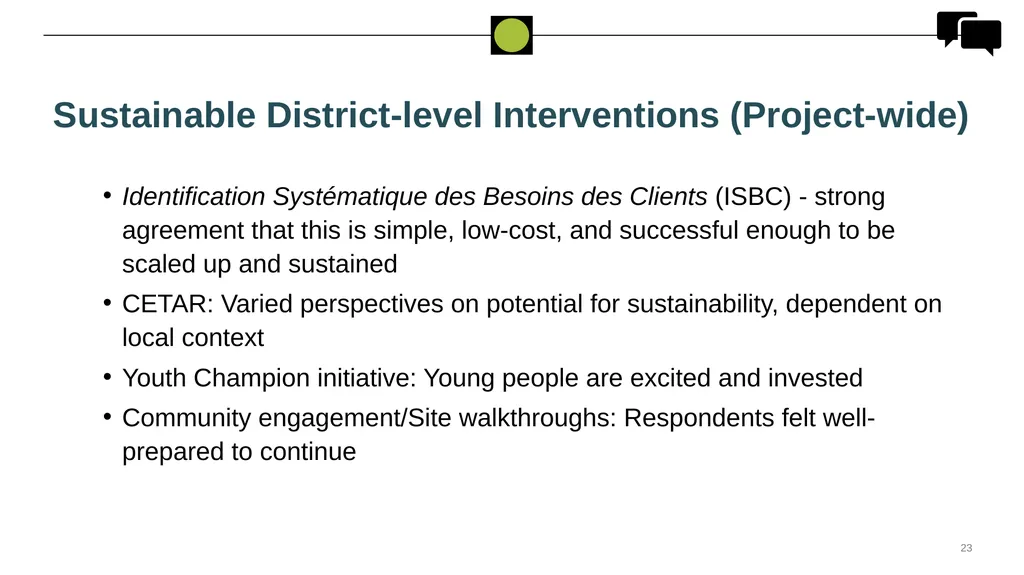
Sustainable District-level Interventions (Project-wide) Identification Systématique des Besoins des Clients (ISBC) - strong agreement that this is simple, low-cost, and successful enough to be scaled up and sustained
CETAR: Varied perspectives on potential for sustainability, dependent on local context
Youth Champion initiative: Young people are excited and invested
Community engagement/Site walkthroughs: Respondents felt well-prepared to continue 23<br>
CETAR: Varied perspectives on potential for sustainability, dependent on local context
Youth Champion initiative: Young people are excited and invested
Community engagement/Site walkthroughs: Respondents felt well-prepared to continue 23<br>
24
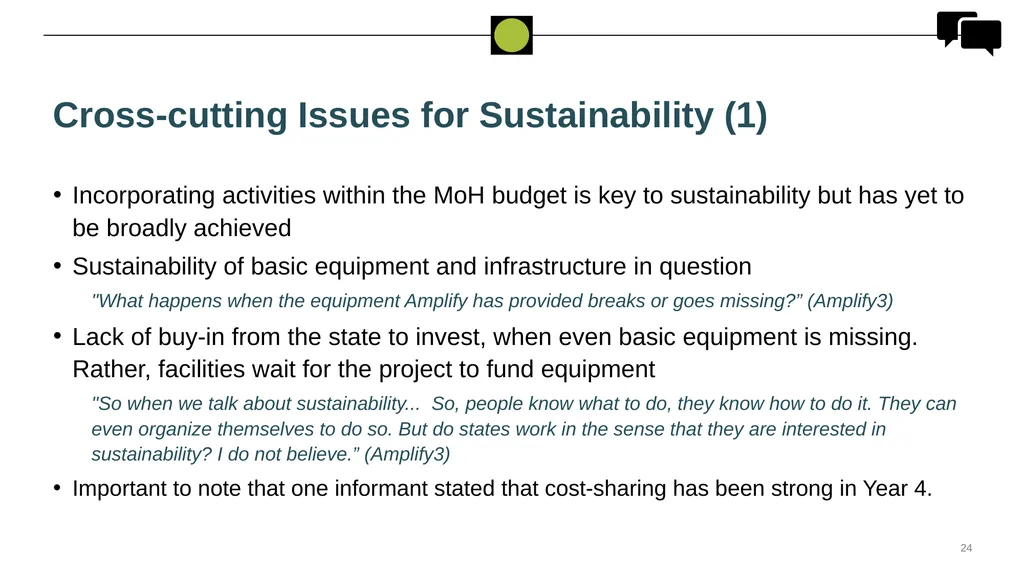
Cross-cutting Issues for Sustainability (1) Incorporating activities within the MoH budget is key to sustainability but has yet to be broadly achieved
Sustainability of basic equipment and infrastructure in question
"What happens when the equipment Amplify has provided breaks or goes missing?” (Amplify3)
Lack of buy-in from the state to invest, when even basic equipment is missing. Rather, facilities wait for the project to fund equipment
"So when we talk about sustainability... So, people know what to do, they know how to do it. They can even organize themselves to do so. But do states work in the sense that they are interested in sustainability? I do not believe.” (Amplify3)
Important to note that one informant stated that cost-sharing has been strong in Year 4. 24<br>
Sustainability of basic equipment and infrastructure in question
"What happens when the equipment Amplify has provided breaks or goes missing?” (Amplify3)
Lack of buy-in from the state to invest, when even basic equipment is missing. Rather, facilities wait for the project to fund equipment
"So when we talk about sustainability... So, people know what to do, they know how to do it. They can even organize themselves to do so. But do states work in the sense that they are interested in sustainability? I do not believe.” (Amplify3)
Important to note that one informant stated that cost-sharing has been strong in Year 4. 24<br>
25
Cross-cutting Issues for Sustainability (2) Data quality assurance: development of SOPs
In Niamey, the district head feels she is not ready to continue the DAQ without AmplifyPF 25<br>
In Niamey, the district head feels she is not ready to continue the DAQ without AmplifyPF 25<br>
26
Burkina Faso (1) Task-sharing
Guidelines have been developed to train CHWs to provide FP services
Plans for continued training of new CHW (yet untested)
Insufficient capacity for supervision
There is substantial resistance for task sharing among clinicians. Informants expressed a need to show that it is safe and advocate for evidence-based programming. 26<br>
Guidelines have been developed to train CHWs to provide FP services
Plans for continued training of new CHW (yet untested)
Insufficient capacity for supervision
There is substantial resistance for task sharing among clinicians. Informants expressed a need to show that it is safe and advocate for evidence-based programming. 26<br>
27
Burkina Faso (2) Post-partum family planning
Less progress than that seen in task-sharing. There is a need for greater emphasis on provider behavior change (e.g., respectful care).
Postpartum family planning. There is a long way to go. Postpartum, post-abortion. There's a long way to go. I don't think the project is doing that much like they are doing in the task shifting (Burkina Mission) 27<br>
Less progress than that seen in task-sharing. There is a need for greater emphasis on provider behavior change (e.g., respectful care).
Postpartum family planning. There is a long way to go. Postpartum, post-abortion. There's a long way to go. I don't think the project is doing that much like they are doing in the task shifting (Burkina Mission) 27<br>
28
Côte d'Ivoire Task-sharing
Although policies are in place, behavior change is slow due to the medicalized nature of the health care system
Historical under-investment in family planning thought to have slowed institutionalization of HIPs 28<br>
Although policies are in place, behavior change is slow due to the medicalized nature of the health care system
Historical under-investment in family planning thought to have slowed institutionalization of HIPs 28<br>
29
Niger Task-sharing
Perception of lower effort and lower performance compared to PPFP
A major challenge is that Niamey district does not hire midwives, rather they are unpaid volunteers
Post-partum family planning
Identification Systématique des Besoins des Clients (ISBC) has revolutionized their practice and is sustainable due to its simplicity 29<br>
Perception of lower effort and lower performance compared to PPFP
A major challenge is that Niamey district does not hire midwives, rather they are unpaid volunteers
Post-partum family planning
Identification Systématique des Besoins des Clients (ISBC) has revolutionized their practice and is sustainable due to its simplicity 29<br>
30
Togo (1) Task-sharing
Documented SoPs and regulations provide clarity for roles and responsibilities
Sustained pre-clinical and clinical training is harder to solve but the structure to supervise (once per quarter) already exists, with or without external support
There is substantial resistance to task sharing among clinicians. Informants expressed a need to show that it's safe and advocate for evidence-based programming 30<br>
Documented SoPs and regulations provide clarity for roles and responsibilities
Sustained pre-clinical and clinical training is harder to solve but the structure to supervise (once per quarter) already exists, with or without external support
There is substantial resistance to task sharing among clinicians. Informants expressed a need to show that it's safe and advocate for evidence-based programming 30<br>
31
Togo (2) Post-partum family planning
"It’s clear and there is no turning back.” (Togo MoH)
But there are several challenges, including continued training and supervision
Pre-service training in PPFP is not yet widespread 31<br>
"It’s clear and there is no turning back.” (Togo MoH)
But there are several challenges, including continued training and supervision
Pre-service training in PPFP is not yet widespread 31<br>
32
4. What were the successes and challenges of the partnership between AmplifyPF and the USAID Missions and Ministries of Health? 32<br>
33
AmplifyPF came in with an innovative approach that required working towards buy-in, and MoHs have embraced and adopted
In Togo, long-standing relationships are leveraged and parties understand each other well (Amplify and MoH)
"I consider that all the partners who are in the country, they are there to support us in implementing our action plans, that we call on to solve our problems. And the minimum that we can do is to be available to work with them and their partners together, to pose our problems clearly. Say what is available, what is left, what we expect from them, and it is also up to them to tell us the conditions under which they can support us.” (Togo MoH) Successes in Partnerships 33<br>
In Togo, long-standing relationships are leveraged and parties understand each other well (Amplify and MoH)
"I consider that all the partners who are in the country, they are there to support us in implementing our action plans, that we call on to solve our problems. And the minimum that we can do is to be available to work with them and their partners together, to pose our problems clearly. Say what is available, what is left, what we expect from them, and it is also up to them to tell us the conditions under which they can support us.” (Togo MoH) Successes in Partnerships 33<br>
34
Overall, very positive feedback in partnership, despite "growing pains" in early engagement
Niger: Discomfort expressed about changes in reference and workplans with less opportunity than expected to influence these changes
Burkina Faso: Staffing challenges made it difficult to be as engaged as they would have liked Challenges in Partnerships 34<br>
Niger: Discomfort expressed about changes in reference and workplans with less opportunity than expected to influence these changes
Burkina Faso: Staffing challenges made it difficult to be as engaged as they would have liked Challenges in Partnerships 34<br>
35
5. What was AmplifyPF’s added value to the USAID Missions and government stakeholders in health programming? 35<br>
36
Improved district level performance—districts gained notoriety / recognition
ILN approach mobilizing funding for health facilities is innovative and making a difference (Burkina Mission)
Site walkthrough activity building capacity of the communities and staff to sustain engagement (Burkina Mission)
"…and there are some who have never visited a peripheral structure, and seeing what they saw, they put their hand in their pocket and they filled some gaps.” (Niger district head) Added Value to Districts 36<br>
ILN approach mobilizing funding for health facilities is innovative and making a difference (Burkina Mission)
Site walkthrough activity building capacity of the communities and staff to sustain engagement (Burkina Mission)
"…and there are some who have never visited a peripheral structure, and seeing what they saw, they put their hand in their pocket and they filled some gaps.” (Niger district head) Added Value to Districts 36<br>
37
Harmonized indicator definitions
Improved data availability and quality Added Value to Countries 37<br>
Improved data availability and quality Added Value to Countries 37<br>
38
6. How do Missions and Ministries of Health want to be engaged in the future, based on lessons from the partnership? 38<br>
39
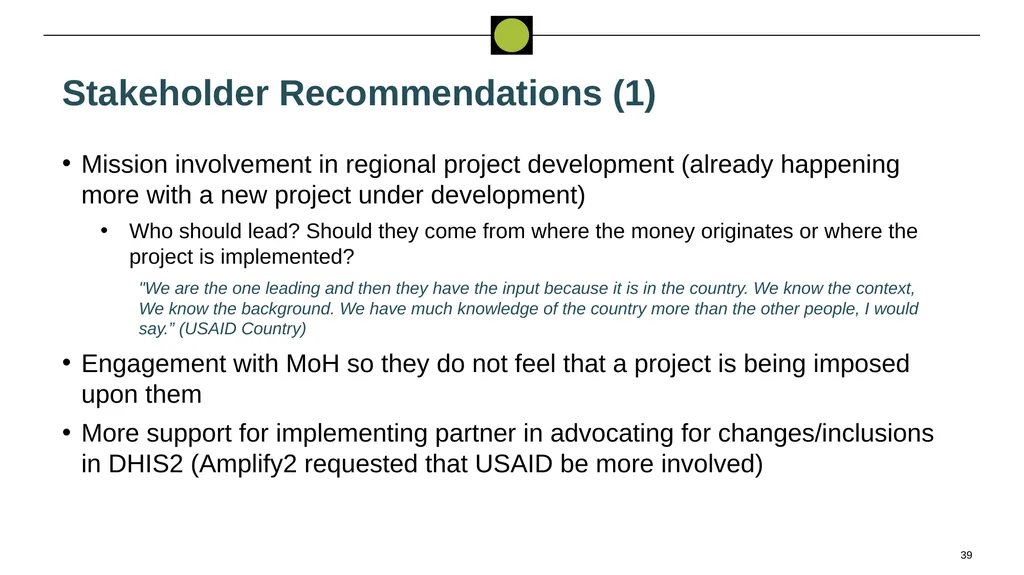
Mission involvement in regional project development (already happening more with a new project under development)
Who should lead? Should they come from where the money originates or where the project is implemented?
"We are the one leading and then they have the input because it is in the country. We know the context, We know the background. We have much knowledge of the country more than the other people, I would say.” (USAID Country)
Engagement with MoH so they do not feel that a project is being imposed upon them
More support for implementing partner in advocating for changes/inclusions in DHIS2 (Amplify2 requested that USAID be more involved) Stakeholder Recommendations (1) 39<br>
Who should lead? Should they come from where the money originates or where the project is implemented?
"We are the one leading and then they have the input because it is in the country. We know the context, We know the background. We have much knowledge of the country more than the other people, I would say.” (USAID Country)
Engagement with MoH so they do not feel that a project is being imposed upon them
More support for implementing partner in advocating for changes/inclusions in DHIS2 (Amplify2 requested that USAID be more involved) Stakeholder Recommendations (1) 39<br>
40
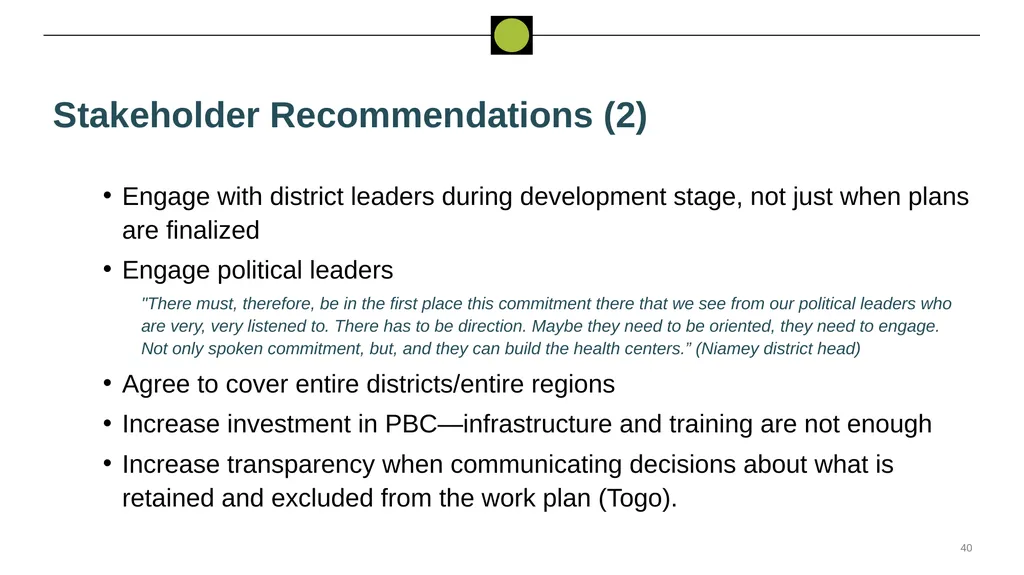
Stakeholder Recommendations (2) Engage with district leaders during development stage, not just when plans are finalized
Engage political leaders
"There must, therefore, be in the first place this commitment there that we see from our political leaders who are very, very listened to. There has to be direction. Maybe they need to be oriented, they need to engage. Not only spoken commitment, but, and they can build the health centers.” (Niamey district head)
Agree to cover entire districts/entire regions
Increase investment in PBC—infrastructure and training are not enough
Increase transparency when communicating decisions about what is retained and excluded from the work plan (Togo). 40<br>
Engage political leaders
"There must, therefore, be in the first place this commitment there that we see from our political leaders who are very, very listened to. There has to be direction. Maybe they need to be oriented, they need to engage. Not only spoken commitment, but, and they can build the health centers.” (Niamey district head)
Agree to cover entire districts/entire regions
Increase investment in PBC—infrastructure and training are not enough
Increase transparency when communicating decisions about what is retained and excluded from the work plan (Togo). 40<br>
41
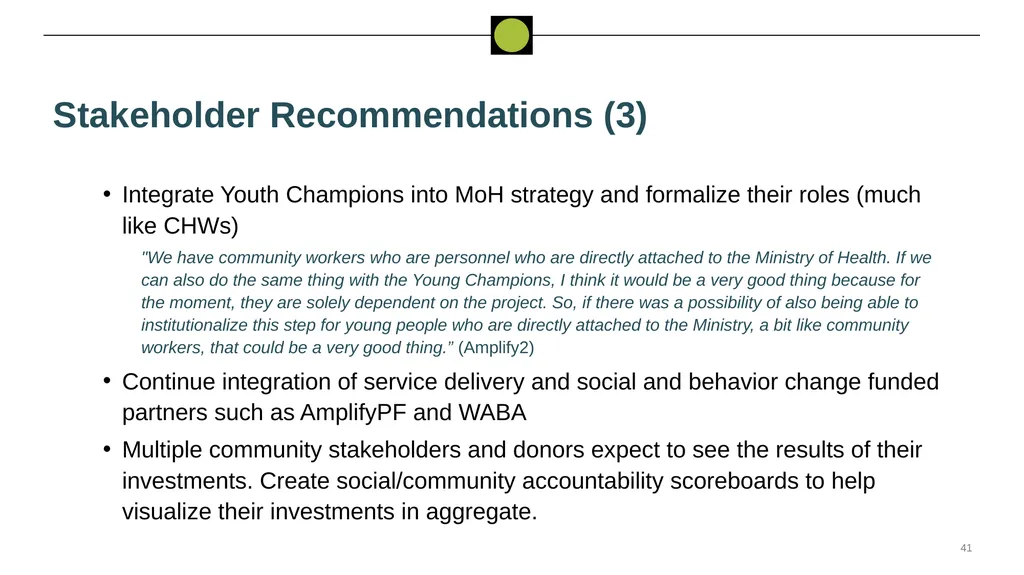
Stakeholder Recommendations (3) Integrate Youth Champions into MoH strategy and formalize their roles (much like CHWs)
"We have community workers who are personnel who are directly attached to the Ministry of Health. If we can also do the same thing with the Young Champions, I think it would be a very good thing because for the moment, they are solely dependent on the project. So, if there was a possibility of also being able to institutionalize this step for young people who are directly attached to the Ministry, a bit like community workers, that could be a very good thing.” (Amplify2)
Continue integration of service delivery and social and behavior change funded partners such as AmplifyPF and WABA
Multiple community stakeholders and donors expect to see the results of their investments. Create social/community accountability scoreboards to help visualize their investments in aggregate. 41<br>
"We have community workers who are personnel who are directly attached to the Ministry of Health. If we can also do the same thing with the Young Champions, I think it would be a very good thing because for the moment, they are solely dependent on the project. So, if there was a possibility of also being able to institutionalize this step for young people who are directly attached to the Ministry, a bit like community workers, that could be a very good thing.” (Amplify2)
Continue integration of service delivery and social and behavior change funded partners such as AmplifyPF and WABA
Multiple community stakeholders and donors expect to see the results of their investments. Create social/community accountability scoreboards to help visualize their investments in aggregate. 41<br>
42
7. To what extent did the project achieve its overall objectives in delivering desired/planned results? 42<br>
43
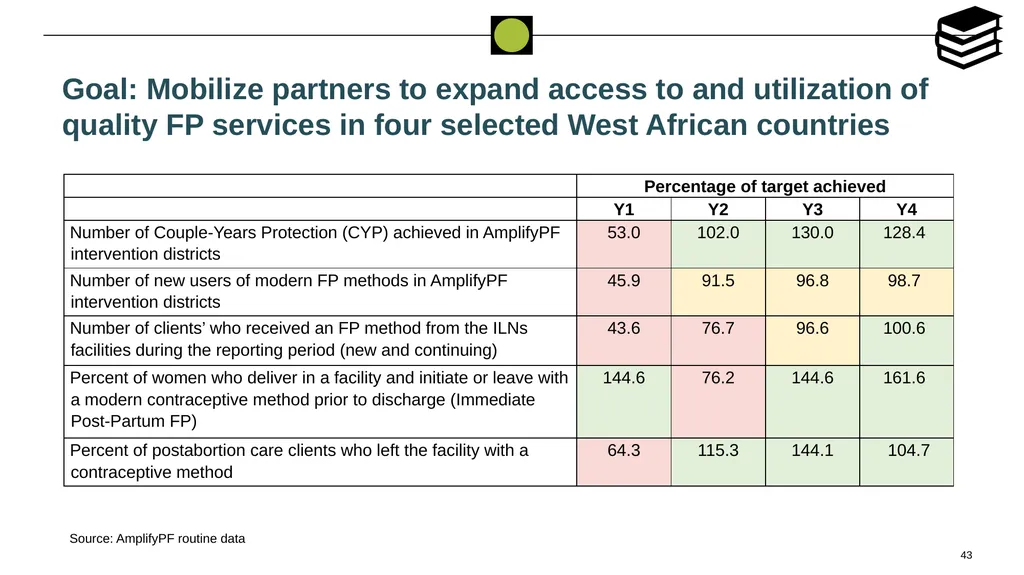
Goal: Mobilize partners to expand access to and utilization of quality FP services in four selected West African countries 43 Source: AmplifyPF routine data<br>
44
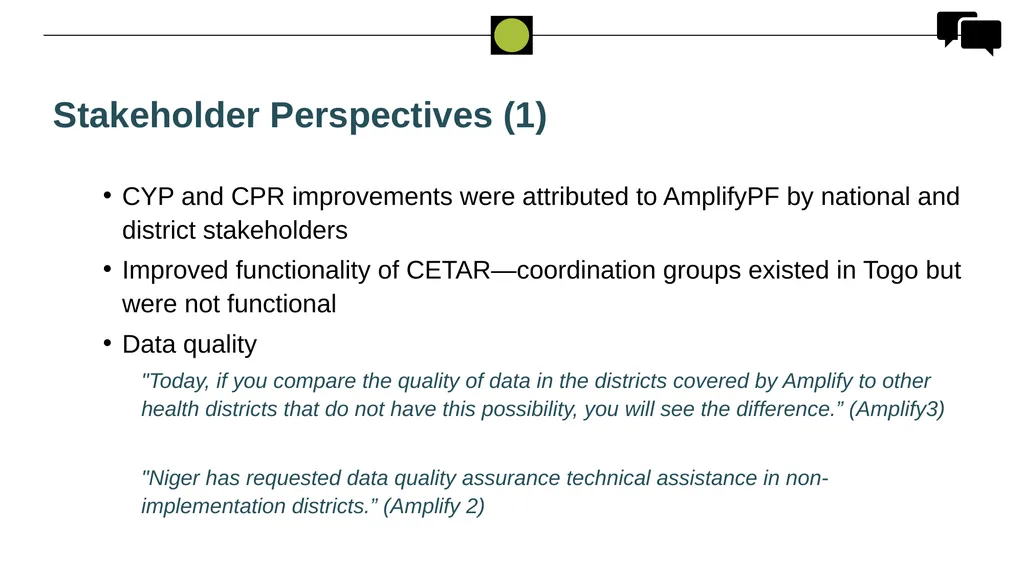
Stakeholder Perspectives (1) CYP and CPR improvements were attributed to AmplifyPF by national and district stakeholders
Improved functionality of CETAR—coordination groups existed in Togo but were not functional
Data quality
"Today, if you compare the quality of data in the districts covered by Amplify to other health districts that do not have this possibility, you will see the difference.” (Amplify3)
"Niger has requested data quality assurance technical assistance in non-implementation districts.” (Amplify 2)<br>
Improved functionality of CETAR—coordination groups existed in Togo but were not functional
Data quality
"Today, if you compare the quality of data in the districts covered by Amplify to other health districts that do not have this possibility, you will see the difference.” (Amplify3)
"Niger has requested data quality assurance technical assistance in non-implementation districts.” (Amplify 2)<br>
45
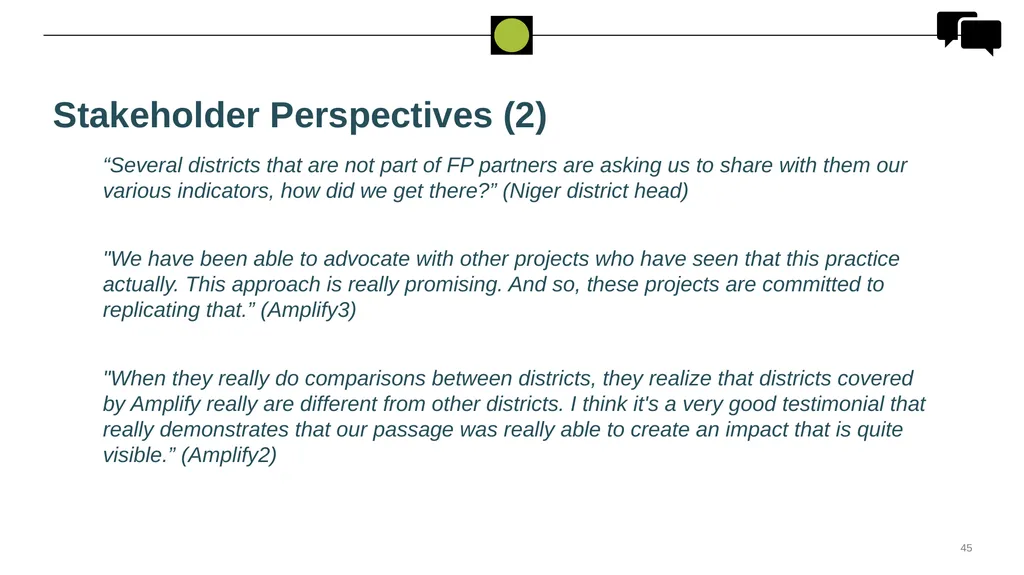
Stakeholder Perspectives (2) “Several districts that are not part of FP partners are asking us to share with them our various indicators, how did we get there?” (Niger district head)
"We have been able to advocate with other projects who have seen that this practice actually. This approach is really promising. And so, these projects are committed to replicating that.” (Amplify3)
"When they really do comparisons between districts, they realize that districts covered by Amplify really are different from other districts. I think it's a very good testimonial that really demonstrates that our passage was really able to create an impact that is quite visible.” (Amplify2) 45<br>
"We have been able to advocate with other projects who have seen that this practice actually. This approach is really promising. And so, these projects are committed to replicating that.” (Amplify3)
"When they really do comparisons between districts, they realize that districts covered by Amplify really are different from other districts. I think it's a very good testimonial that really demonstrates that our passage was really able to create an impact that is quite visible.” (Amplify2) 45<br>
46
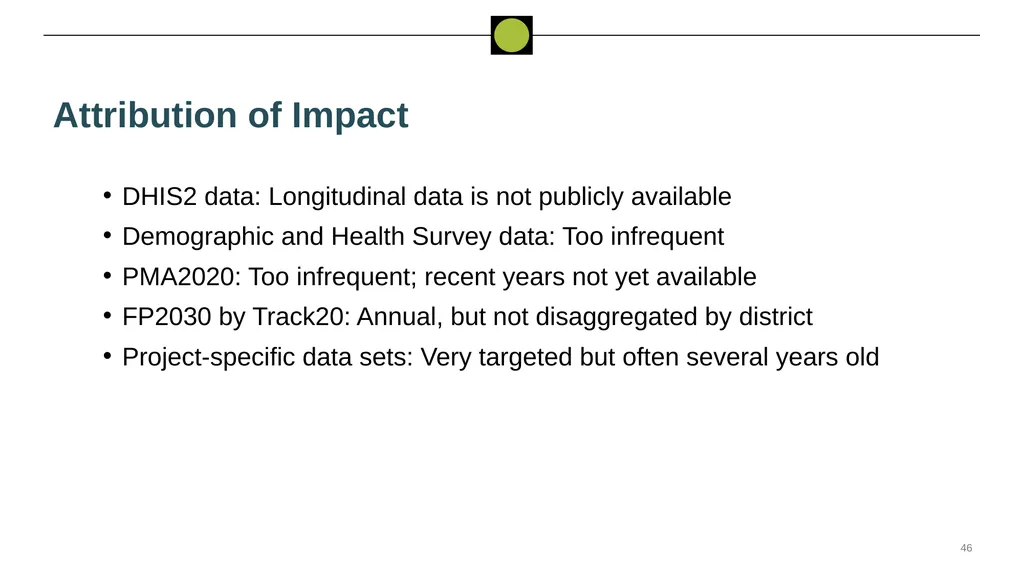
Attribution of Impact DHIS2 data: Longitudinal data is not publicly available
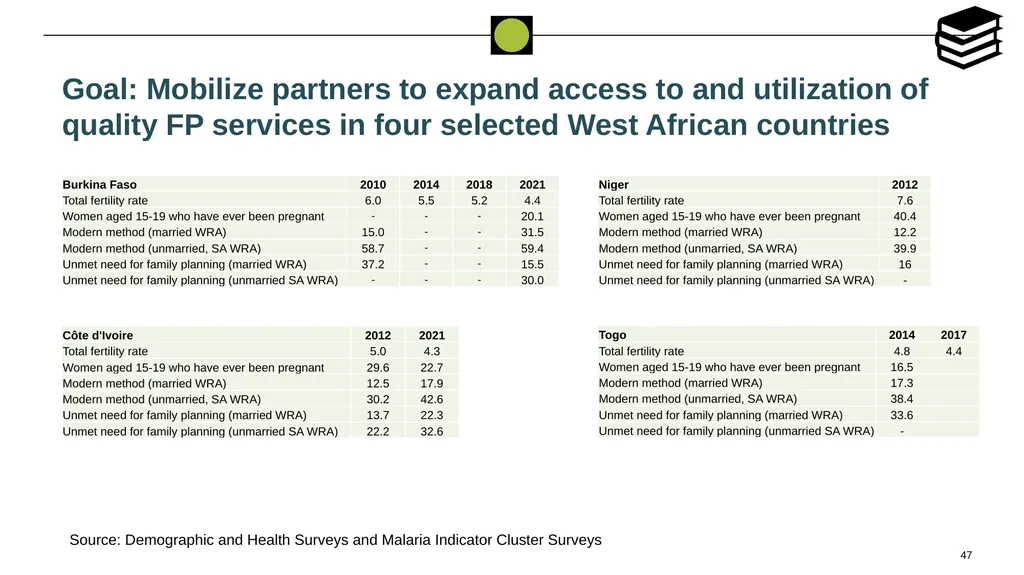
Demographic and Health Survey data: Too infrequent
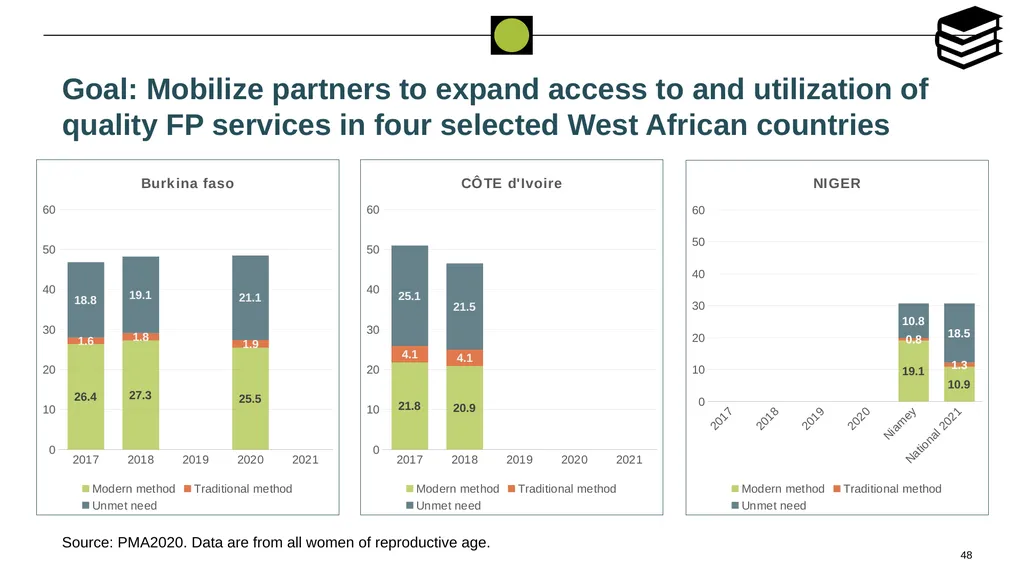
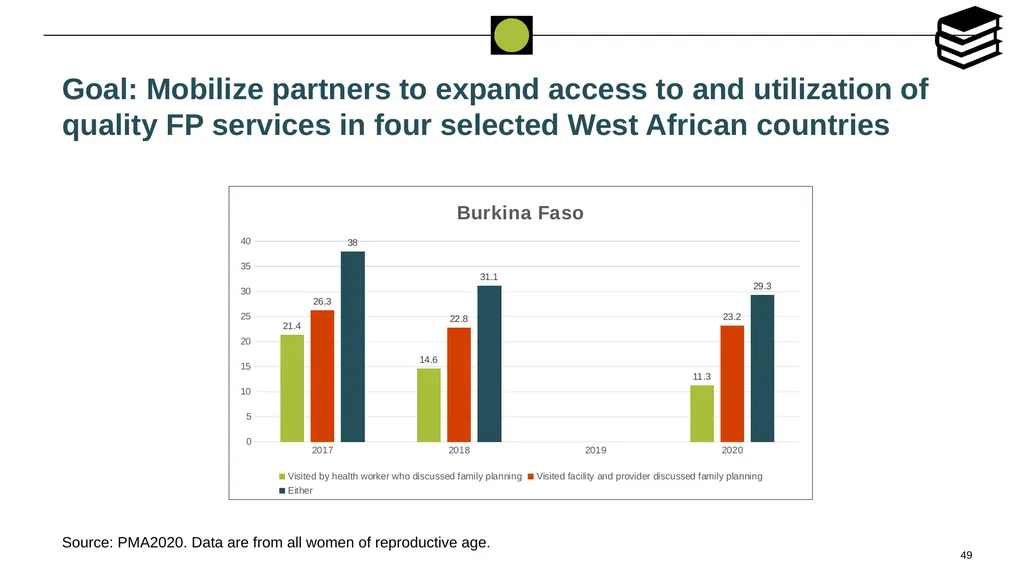
PMA2020: Too infrequent; recent years not yet available
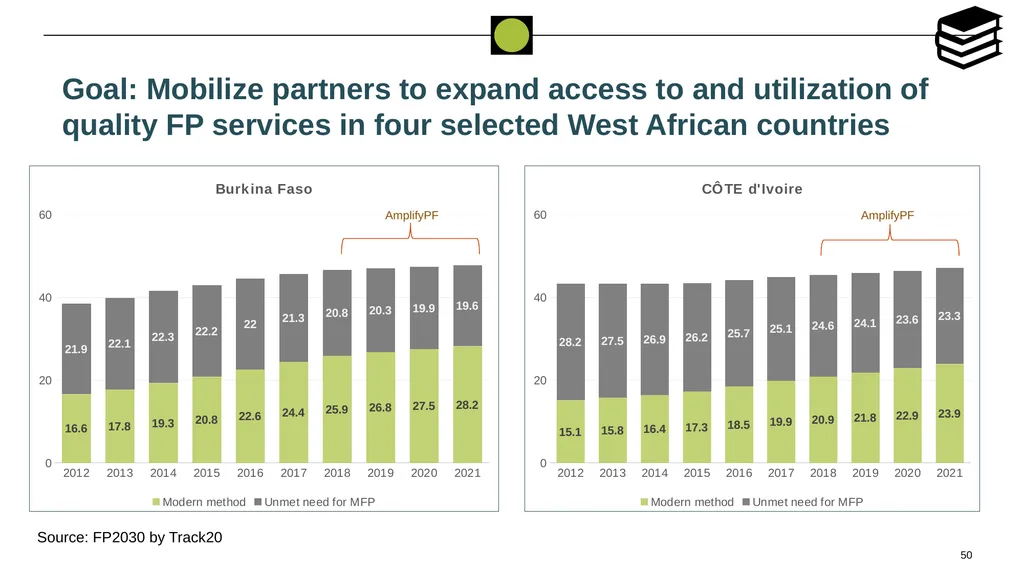
FP2030 by Track20: Annual, but not disaggregated by district
Project-specific data sets: Very targeted but often several years old 46<br>
Demographic and Health Survey data: Too infrequent
PMA2020: Too infrequent; recent years not yet available
FP2030 by Track20: Annual, but not disaggregated by district
Project-specific data sets: Very targeted but often several years old 46<br>
47
Goal: Mobilize partners to expand access to and utilization of quality FP services in four selected West African countries 47 Source: Demographic and Health Surveys and Malaria Indicator Cluster Surveys<br>
48
Goal: Mobilize partners to expand access to and utilization of quality FP services in four selected West African countries 48 Source: PMA2020. Data are from all women of reproductive age.<br>
49
Goal: Mobilize partners to expand access to and utilization of quality FP services in four selected West African countries 49 Source: PMA2020. Data are from all women of reproductive age.<br>
50
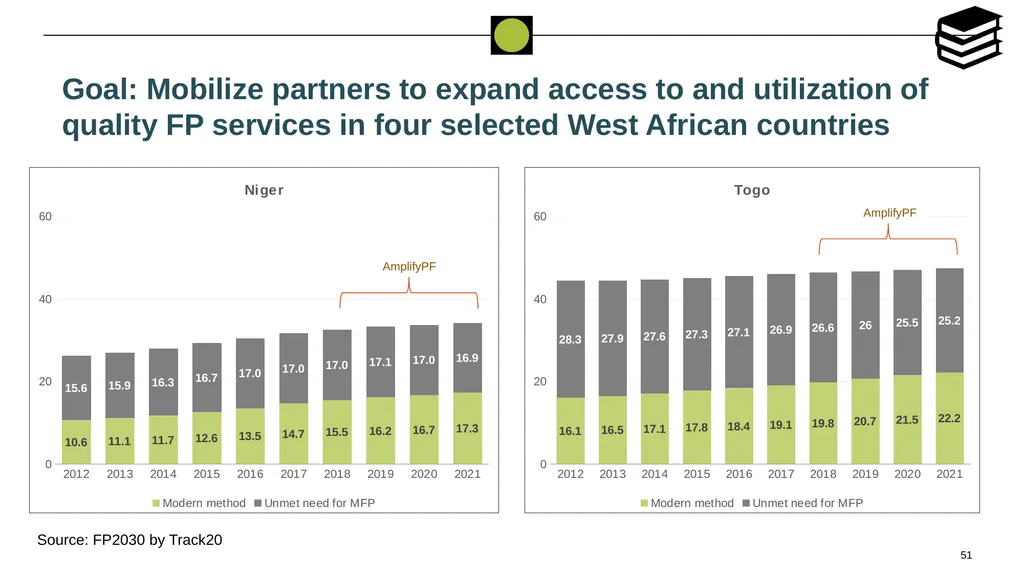
Goal: Mobilize partners to expand access to and utilization of quality FP services in four selected West African countries 50 AmplifyPF AmplifyPF Source: FP2030 by Track20<br>
51
Goal: Mobilize partners to expand access to and utilization of quality FP services in four selected West African countries 51 AmplifyPF AmplifyPF Source: FP2030 by Track20<br>
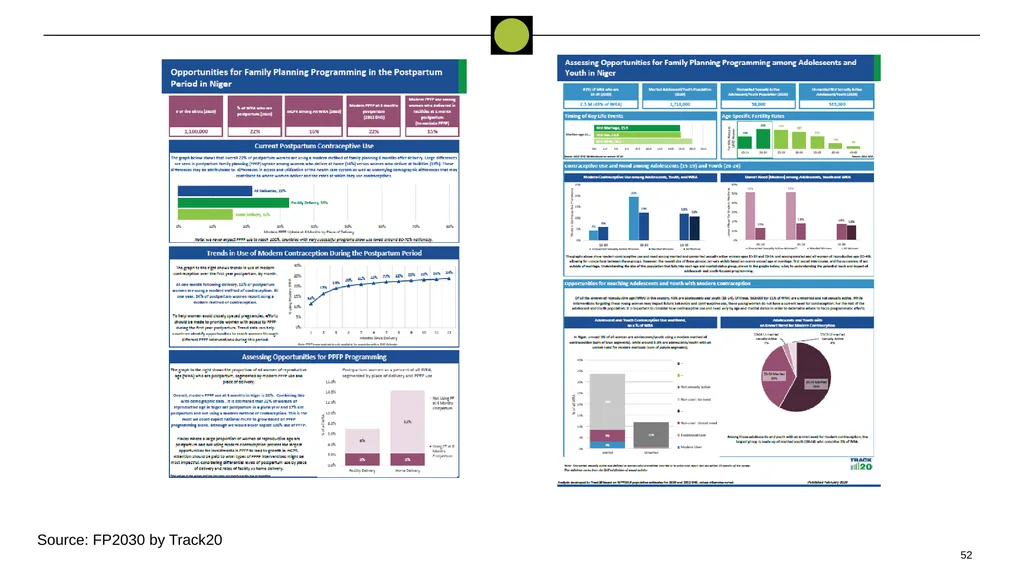
52
52 Source: FP2030 by Track20<br>
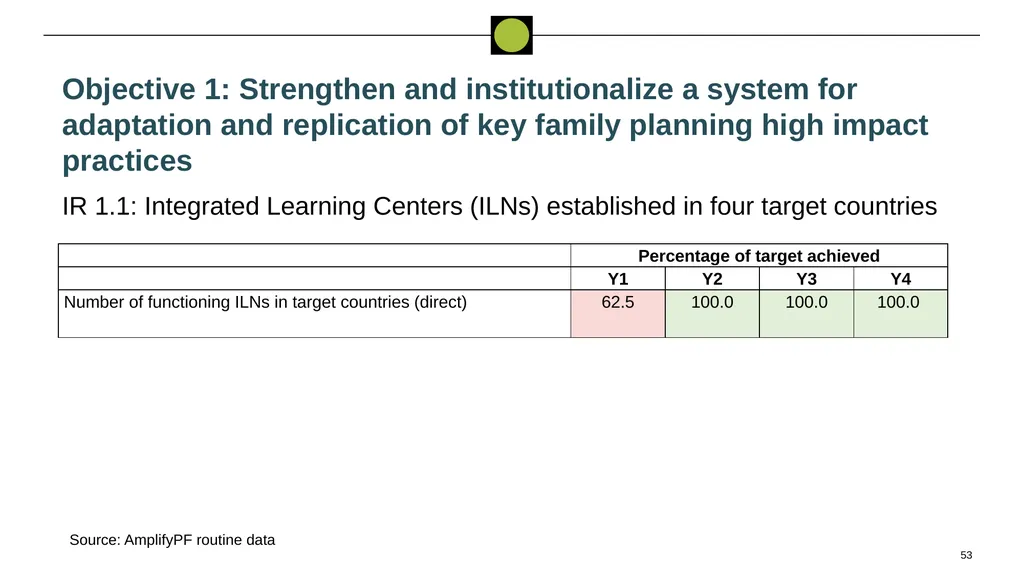
53
IR 1.1: Integrated Learning Centers (ILNs) established in four target countries Objective 1: Strengthen and institutionalize a system for adaptation and replication of key family planning high impact practices 53 Source: AmplifyPF routine data<br>
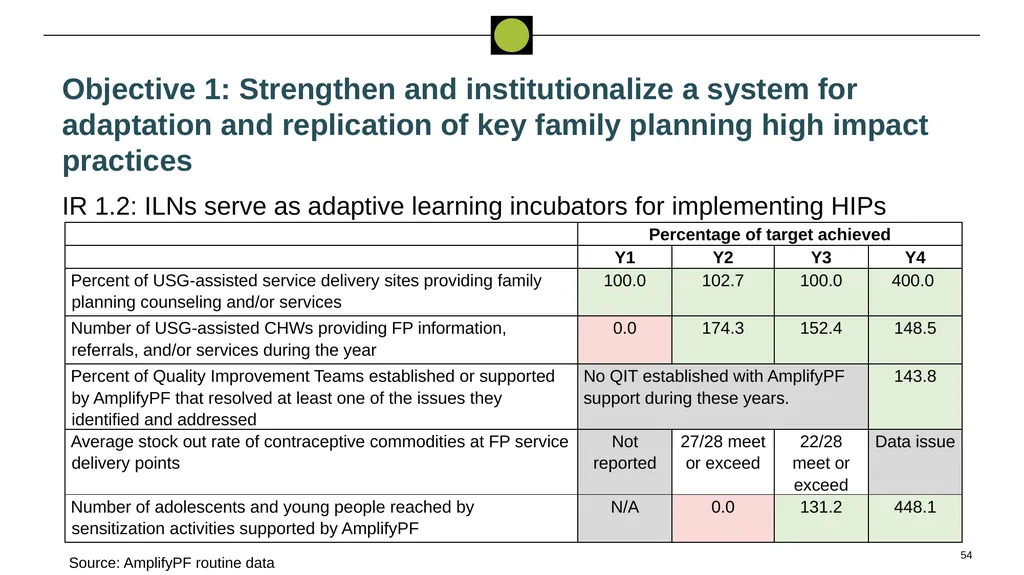
54
IR 1.2: ILNs serve as adaptive learning incubators for implementing HIPs Objective 1: Strengthen and institutionalize a system for adaptation and replication of key family planning high impact practices 54 Source: AmplifyPF routine data<br>
55
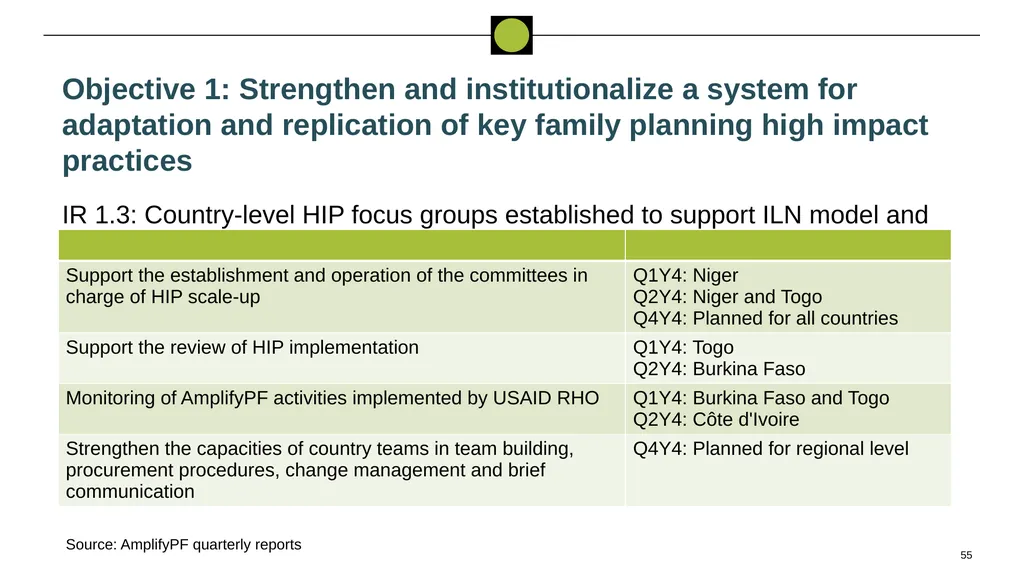
IR 1.3: Country-level HIP focus groups established to support ILN model and HIP replication Objective 1: Strengthen and institutionalize a system for adaptation and replication of key family planning high impact practices 55 Source: AmplifyPF quarterly reports<br>
56
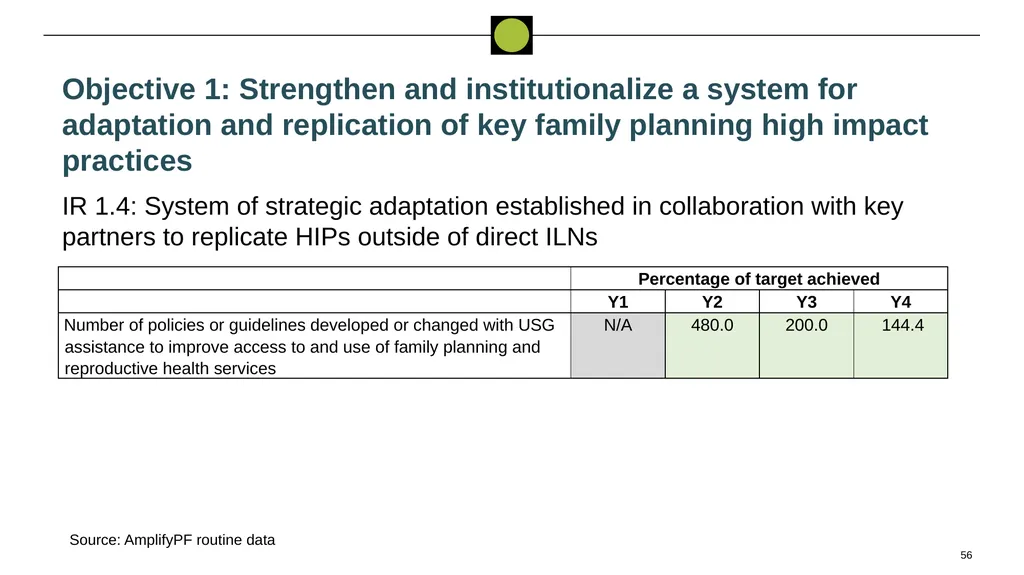
IR 1.4: System of strategic adaptation established in collaboration with key partners to replicate HIPs outside of direct ILNs Objective 1: Strengthen and institutionalize a system for adaptation and replication of key family planning high impact practices 56 Source: AmplifyPF routine data<br>
57
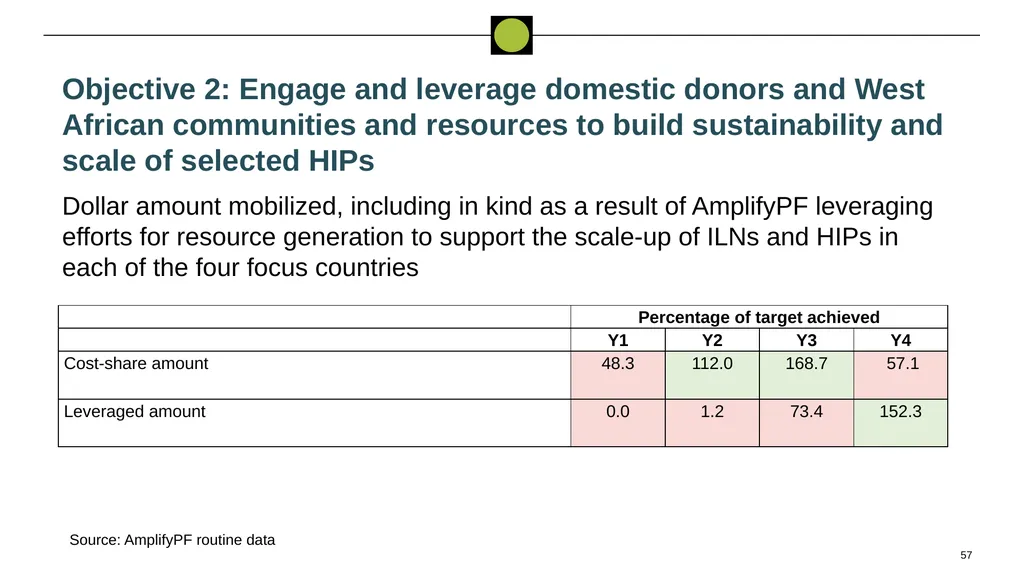
Dollar amount mobilized, including in kind as a result of AmplifyPF leveraging efforts for resource generation to support the scale-up of ILNs and HIPs in each of the four focus countries Objective 2: Engage and leverage domestic donors and West African communities and resources to build sustainability and scale of selected HIPs 57 Source: AmplifyPF routine data<br>
58
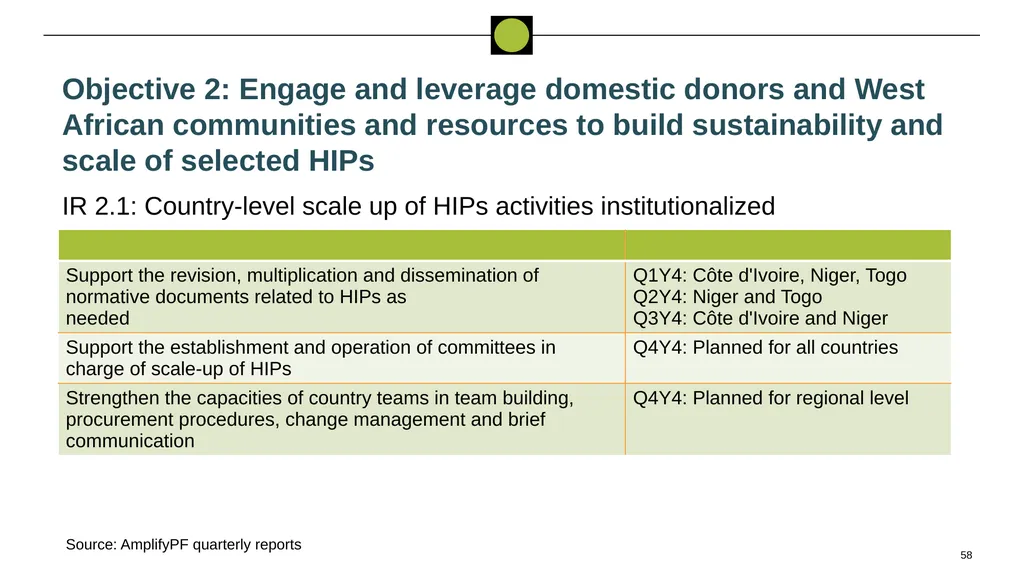
IR 2.1: Country-level scale up of HIPs activities institutionalized Objective 2: Engage and leverage domestic donors and West African communities and resources to build sustainability and scale of selected HIPs 58 Source: AmplifyPF quarterly reports<br>
59
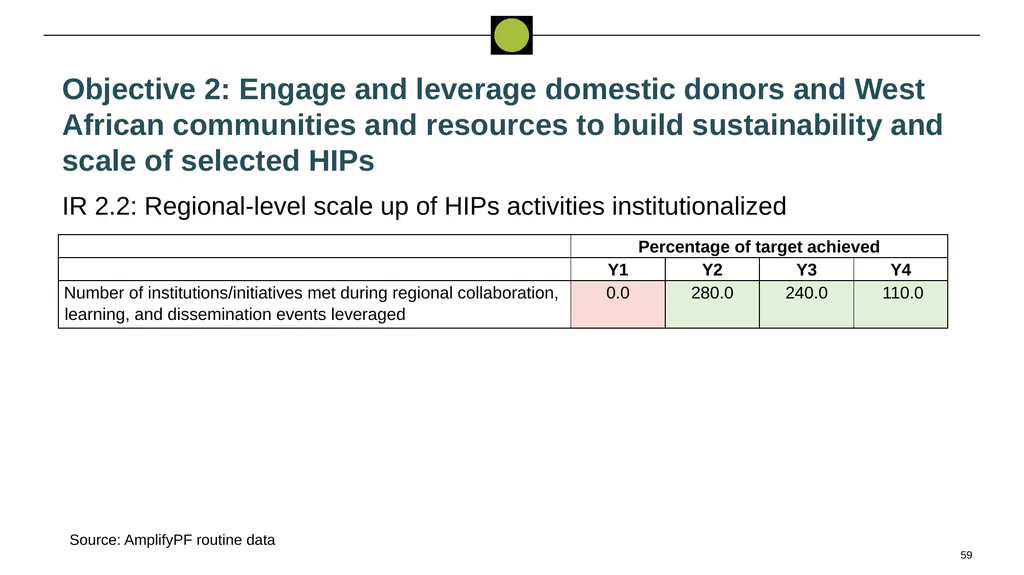
IR 2.2: Regional-level scale up of HIPs activities institutionalized Objective 2: Engage and leverage domestic donors and West African communities and resources to build sustainability and scale of selected HIPs 59 Source: AmplifyPF routine data<br>
60
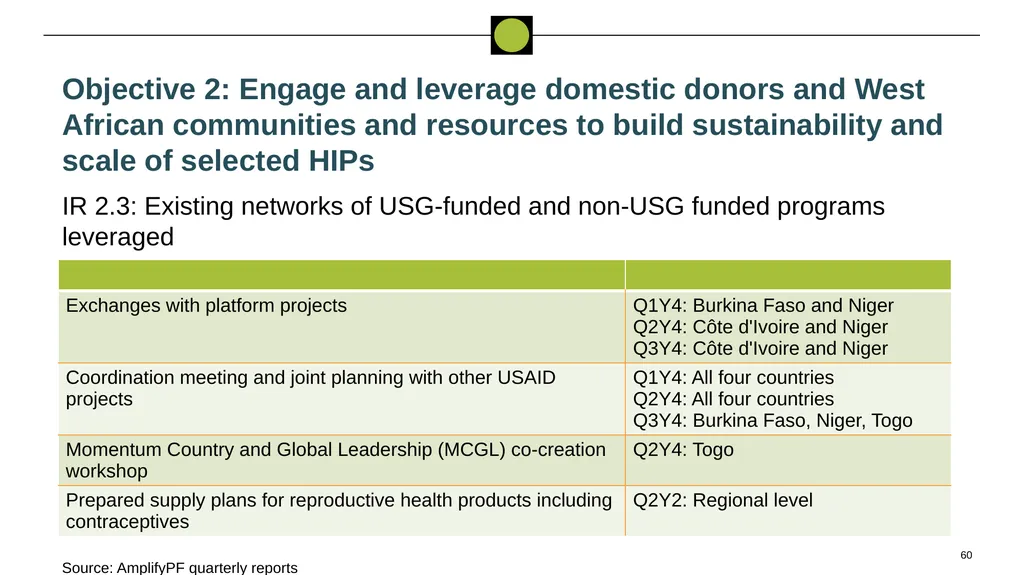
IR 2.3: Existing networks of USG-funded and non-USG funded programs leveraged Objective 2: Engage and leverage domestic donors and West African communities and resources to build sustainability and scale of selected HIPs 60 Source: AmplifyPF quarterly reports<br>
61
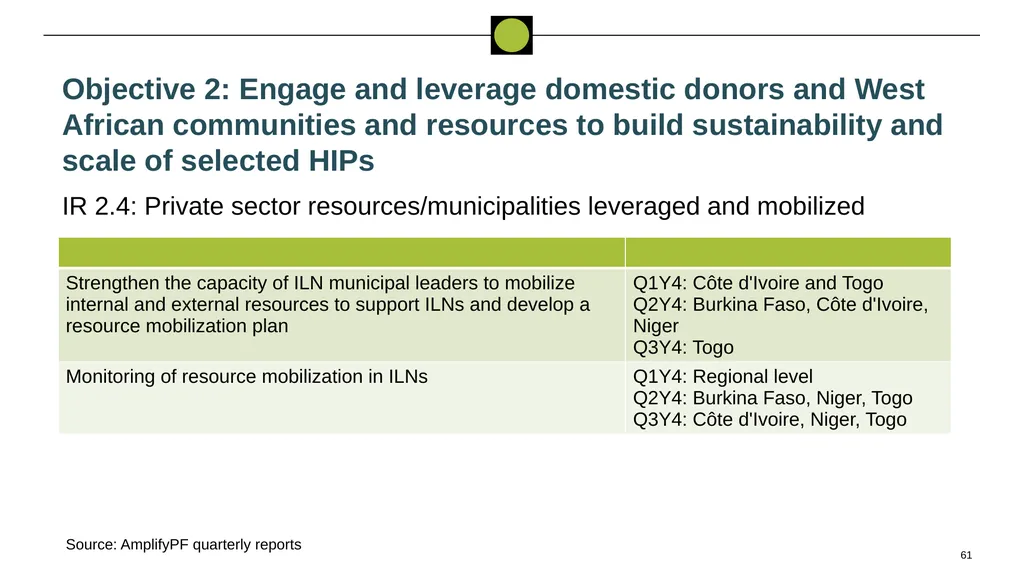
IR 2.4: Private sector resources/municipalities leveraged and mobilized Objective 2: Engage and leverage domestic donors and West African communities and resources to build sustainability and scale of selected HIPs 61 Source: AmplifyPF quarterly reports<br>
62
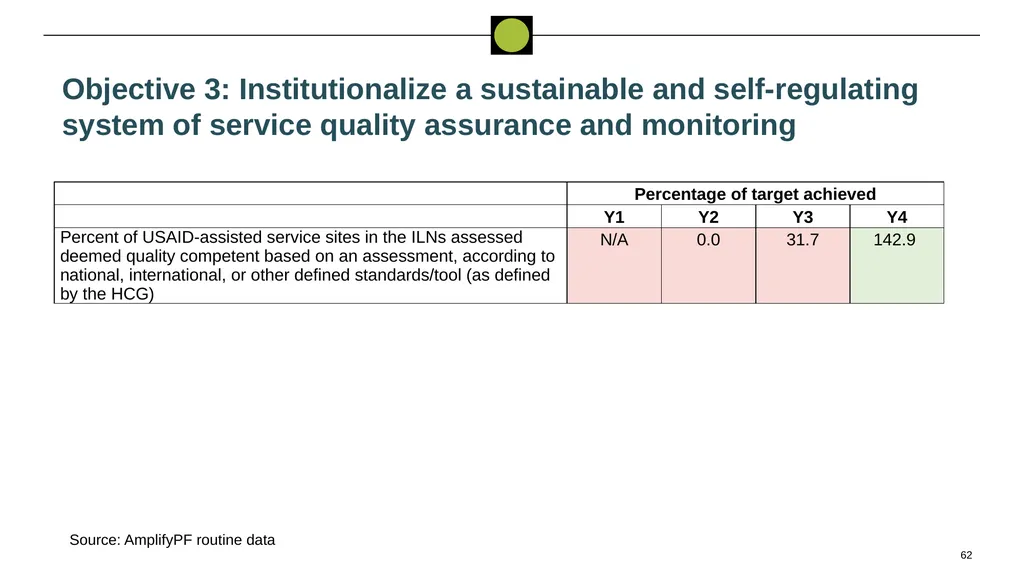
Objective 3: Institutionalize a sustainable and self-regulating system of service quality assurance and monitoring 62 Source: AmplifyPF routine data<br>
63
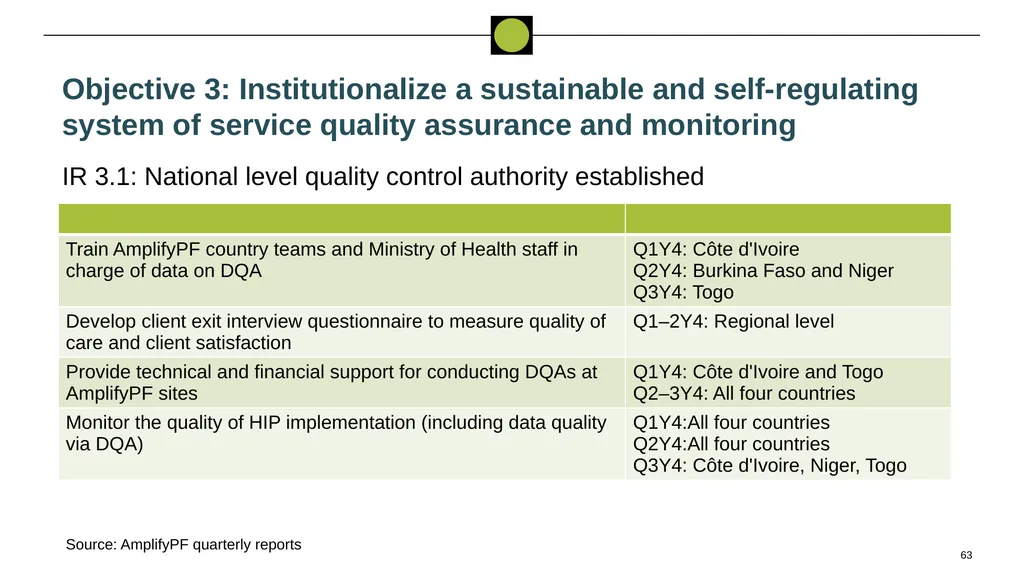
IR 3.1: National level quality control authority established Objective 3: Institutionalize a sustainable and self-regulating system of service quality assurance and monitoring 63 Source: AmplifyPF quarterly reports<br>
64
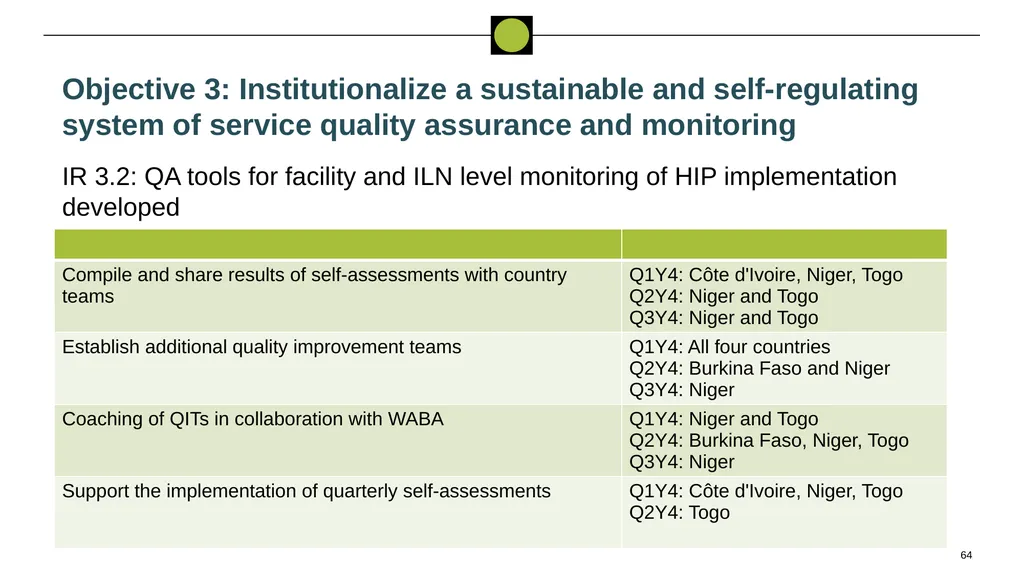
IR 3.2: QA tools for facility and ILN level monitoring of HIP implementation developed Objective 3: Institutionalize a sustainable and self-regulating system of service quality assurance and monitoring 64<br>
65
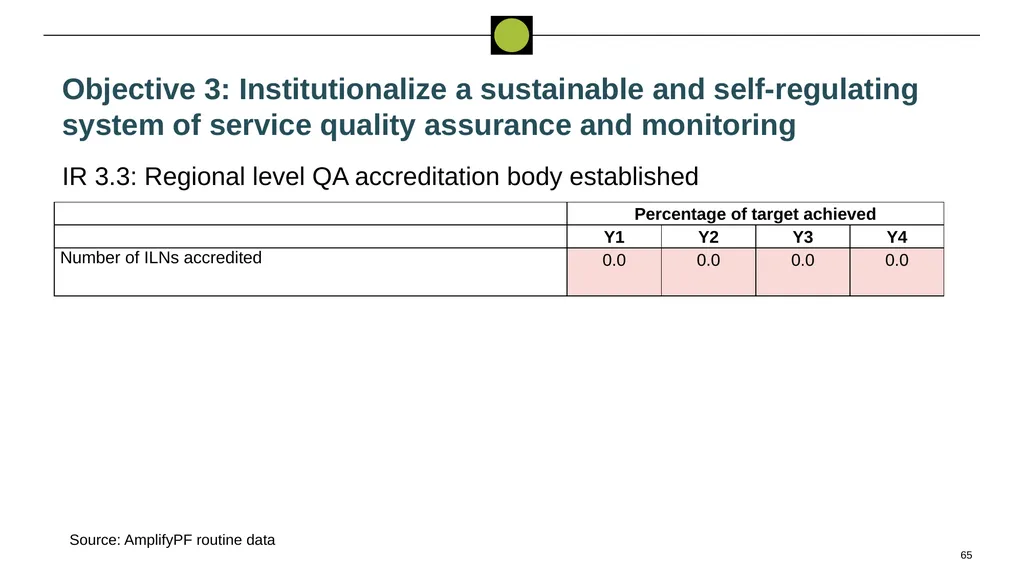
IR 3.3: Regional level QA accreditation body established Objective 3: Institutionalize a sustainable and self-regulating system of service quality assurance and monitoring 65 Source: AmplifyPF routine data<br>
66
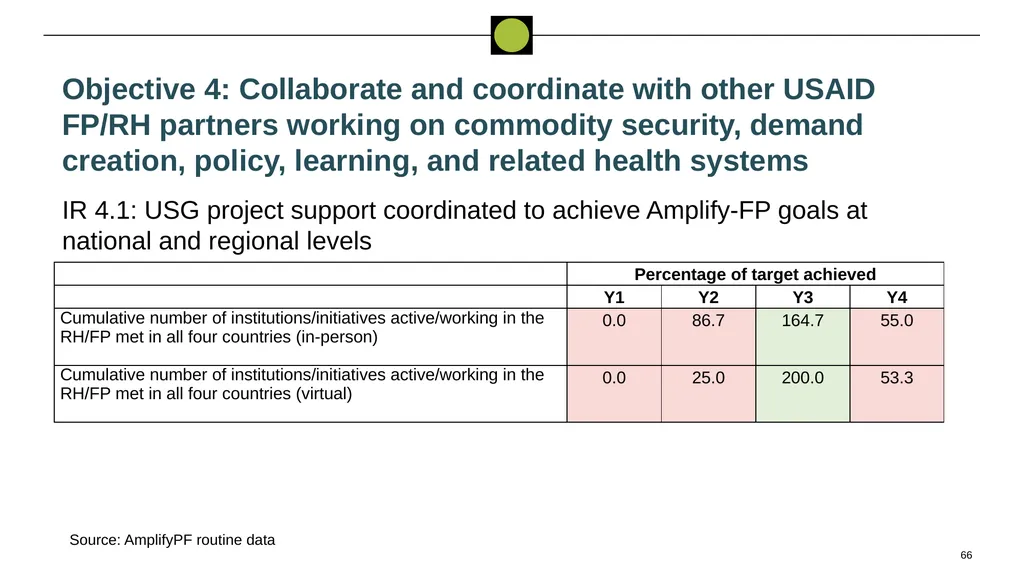
IR 4.1: USG project support coordinated to achieve Amplify-FP goals at national and regional levels Objective 4: Collaborate and coordinate with other USAID FP/RH partners working on commodity security, demand creation, policy, learning, and related health systems 66 Source: AmplifyPF routine data<br>
67
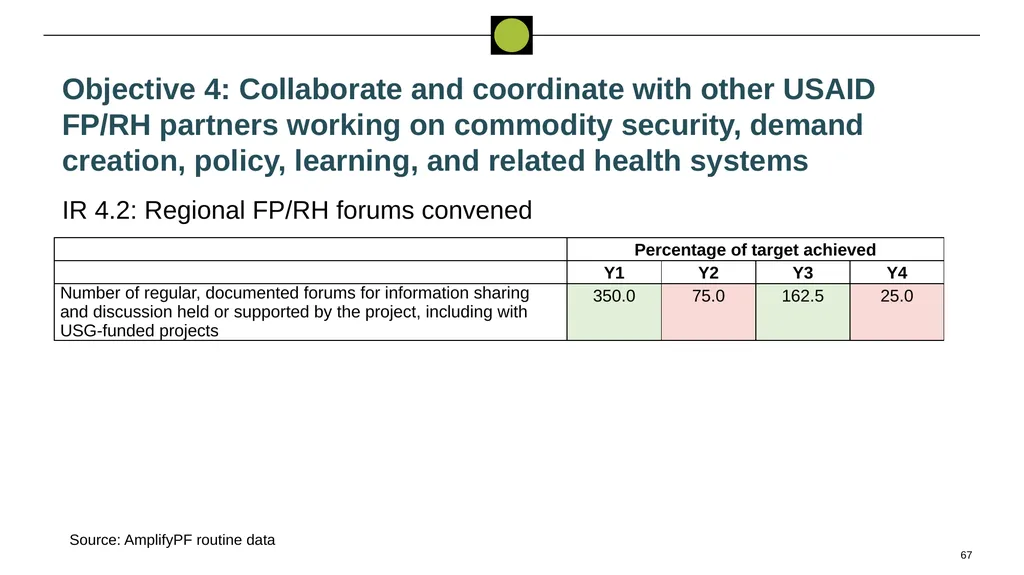
IR 4.2: Regional FP/RH forums convened Objective 4: Collaborate and coordinate with other USAID FP/RH partners working on commodity security, demand creation, policy, learning, and related health systems 67 Source: AmplifyPF routine data<br>