
Performance scheme additional features Freight and
LD
Published · 15 slides · 0 views
1 / 1





Description
Performance scheme additional features Freight and charter operators Please note, these slides will be published online and will be available, here. 1 22 September 2026 Introduction and purpose Caitlin Scarlett Workshop purpose This
Related Topics
Share
Embed code
Download this presentation From Below
"Performance scheme additional features Freight and" is the property of its rightful owner. Permission is granted to download and print the materials on this website for personal, non-commercial use only, and to display it on your personal computer provided you do not modify the materials and that you retain all copyright notices contained in the materials. By downloading content from our website, you accept the terms of this agreement.
Presentation Transcript
01
Performance scheme additional features
Freight and charter operators Please note, these slides will be published online and will be available, here. 1 22 September 2026<br>
Freight and charter operators Please note, these slides will be published online and will be available, here. 1 22 September 2026<br>
02
Introduction and purpose – Caitlin Scarlett<br>
03
Workshop purpose This workshop is part of our wider programme of work exploring options for GBR’s future performance schemes.
Today’s session focuses on the additional features that could support the freight and charter performance schemes (i.e. those which fall outside the core components of the performance scheme, that seek to address specific limitations within the scheme). An example of what we mean by an “additional feature” would be the Incident Cap mechanism.
We understand freight operators’ preference to retain the existing performance scheme arrangements. We are therefore not proposing material changes to these arrangements for FP1, unless there was significant appetite to do so. However, we would welcome views on whether the features presented could have value over the longer term or should circumstances change in a future funding period.
In the workshop we will:
Discuss what we mean by additional scheme features, the value they provide, and whether existing arrangements should be retained, amended or removed.
Explore whether any additional features could be considered for use in the schemes from Funding Period 1 (FP1), or future funding periods, and seek industry views on these.
Set out our planned next steps and wider programme of work. Important caveat: All policy options discussed during the workshop carry no legal weight or commitment that they will come into effect. We are seeking industry views to help shape our proposals, ahead of formal consultation.<br>
Today’s session focuses on the additional features that could support the freight and charter performance schemes (i.e. those which fall outside the core components of the performance scheme, that seek to address specific limitations within the scheme). An example of what we mean by an “additional feature” would be the Incident Cap mechanism.
We understand freight operators’ preference to retain the existing performance scheme arrangements. We are therefore not proposing material changes to these arrangements for FP1, unless there was significant appetite to do so. However, we would welcome views on whether the features presented could have value over the longer term or should circumstances change in a future funding period.
In the workshop we will:
Discuss what we mean by additional scheme features, the value they provide, and whether existing arrangements should be retained, amended or removed.
Explore whether any additional features could be considered for use in the schemes from Funding Period 1 (FP1), or future funding periods, and seek industry views on these.
Set out our planned next steps and wider programme of work. Important caveat: All policy options discussed during the workshop carry no legal weight or commitment that they will come into effect. We are seeking industry views to help shape our proposals, ahead of formal consultation.<br>
04
Overview of the existing additional features and how they add value to performance schemes – George Willicombe<br>
05
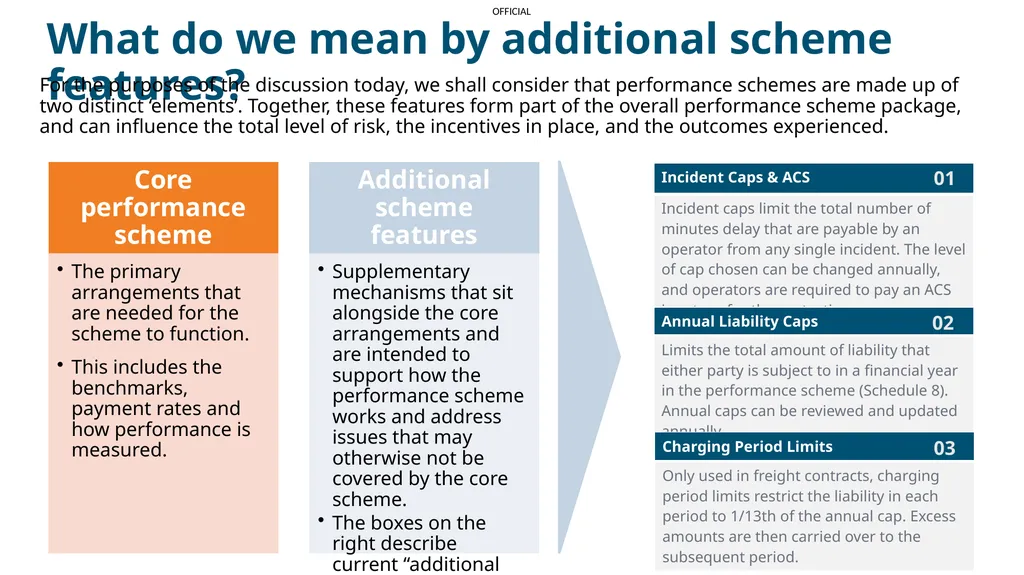
What do we mean by additional scheme features? For the purposes of the discussion today, we shall consider that performance schemes are made up of two distinct ‘elements’. Together, these features form part of the overall performance scheme package, and can influence the total level of risk, the incentives in place, and the outcomes experienced. 01 02 03<br>
06
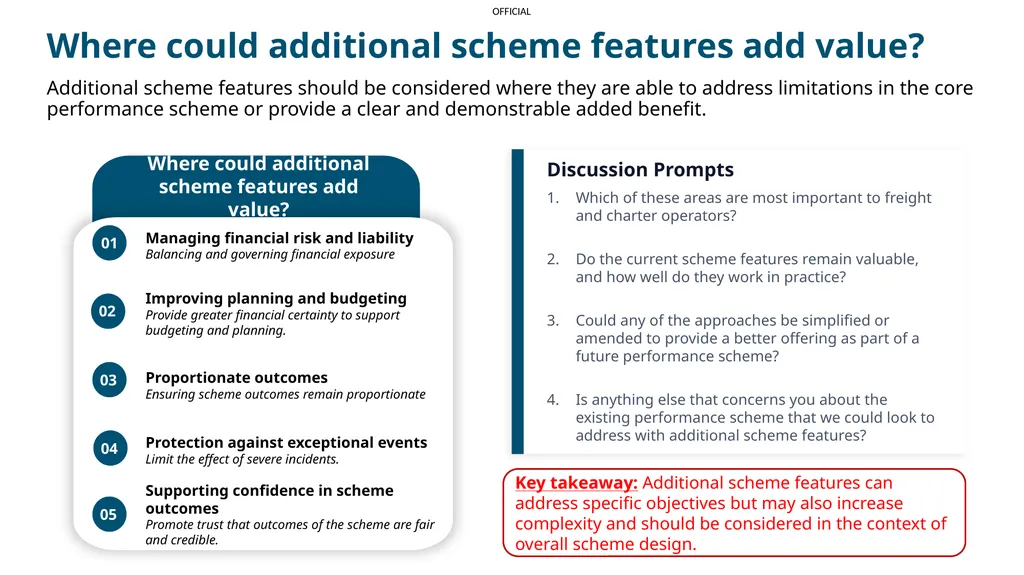
Where could additional scheme features add value? Additional scheme features should be considered where they are able to address limitations in the core performance scheme or provide a clear and demonstrable added benefit. Key takeaway: Additional scheme features can address specific objectives but may also increase complexity and should be considered in the context of overall scheme design.<br>
07
Additional scheme features for discussion – George Willicombe<br>
08
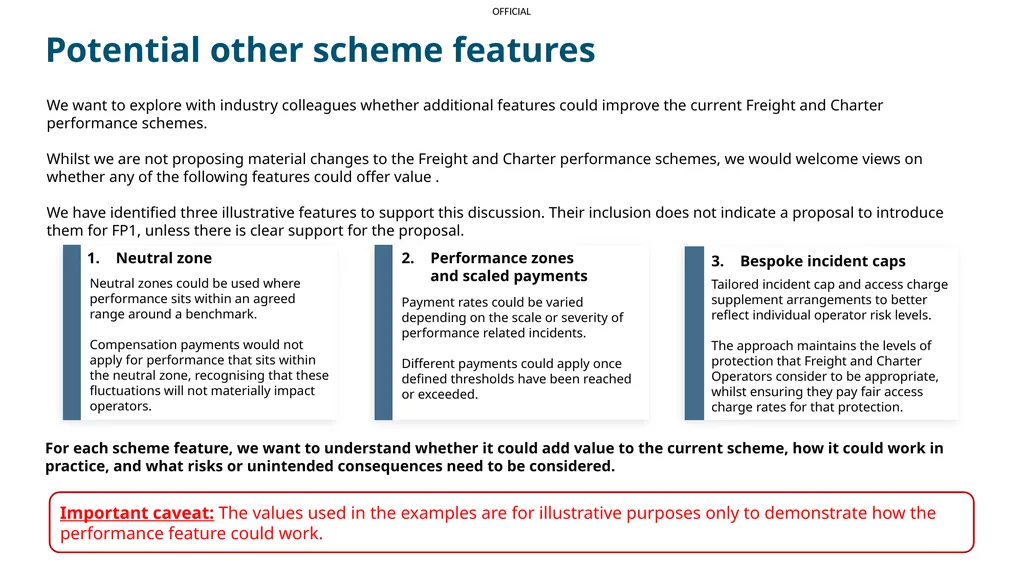
Potential other scheme features We want to explore with industry colleagues whether additional features could improve the current Freight and Charter performance schemes.
Whilst we are not proposing material changes to the Freight and Charter performance schemes, we would welcome views on whether any of the following features could offer value .
We have identified three illustrative features to support this discussion. Their inclusion does not indicate a proposal to introduce them for FP1, unless there is clear support for the proposal. For each scheme feature, we want to understand whether it could add value to the current scheme, how it could work in practice, and what risks or unintended consequences need to be considered. Important caveat: The values used in the examples are for illustrative purposes only to demonstrate how the performance feature could work.<br>
Whilst we are not proposing material changes to the Freight and Charter performance schemes, we would welcome views on whether any of the following features could offer value .
We have identified three illustrative features to support this discussion. Their inclusion does not indicate a proposal to introduce them for FP1, unless there is clear support for the proposal. For each scheme feature, we want to understand whether it could add value to the current scheme, how it could work in practice, and what risks or unintended consequences need to be considered. Important caveat: The values used in the examples are for illustrative purposes only to demonstrate how the performance feature could work.<br>
09
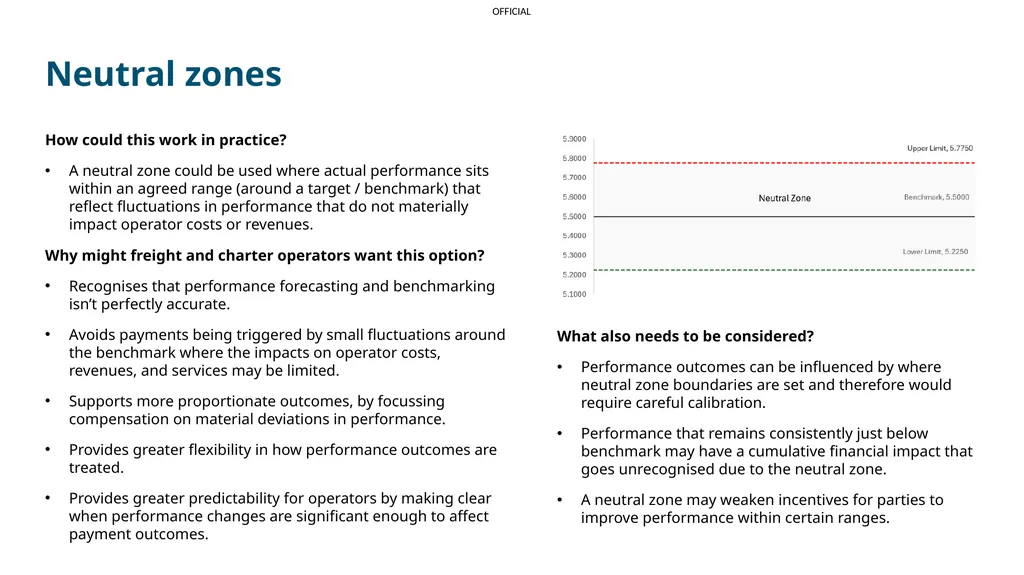
Neutral zones How could this work in practice?
A neutral zone could be used where actual performance sits within an agreed range (around a target / benchmark) that reflect fluctuations in performance that do not materially impact operator costs or revenues.
Why might freight and charter operators want this option?
Recognises that performance forecasting and benchmarking isn’t perfectly accurate.
Avoids payments being triggered by small fluctuations around the benchmark where the impacts on operator costs, revenues, and services may be limited.
Supports more proportionate outcomes, by focussing compensation on material deviations in performance.
Provides greater flexibility in how performance outcomes are treated.
Provides greater predictability for operators by making clear when performance changes are significant enough to affect payment outcomes. What also needs to be considered?
Performance outcomes can be influenced by where neutral zone boundaries are set and therefore would require careful calibration.
Performance that remains consistently just below benchmark may have a cumulative financial impact that goes unrecognised due to the neutral zone.
A neutral zone may weaken incentives for parties to improve performance within certain ranges.<br>
A neutral zone could be used where actual performance sits within an agreed range (around a target / benchmark) that reflect fluctuations in performance that do not materially impact operator costs or revenues.
Why might freight and charter operators want this option?
Recognises that performance forecasting and benchmarking isn’t perfectly accurate.
Avoids payments being triggered by small fluctuations around the benchmark where the impacts on operator costs, revenues, and services may be limited.
Supports more proportionate outcomes, by focussing compensation on material deviations in performance.
Provides greater flexibility in how performance outcomes are treated.
Provides greater predictability for operators by making clear when performance changes are significant enough to affect payment outcomes. What also needs to be considered?
Performance outcomes can be influenced by where neutral zone boundaries are set and therefore would require careful calibration.
Performance that remains consistently just below benchmark may have a cumulative financial impact that goes unrecognised due to the neutral zone.
A neutral zone may weaken incentives for parties to improve performance within certain ranges.<br>
10
Performance zones and scaled payments How could this work?
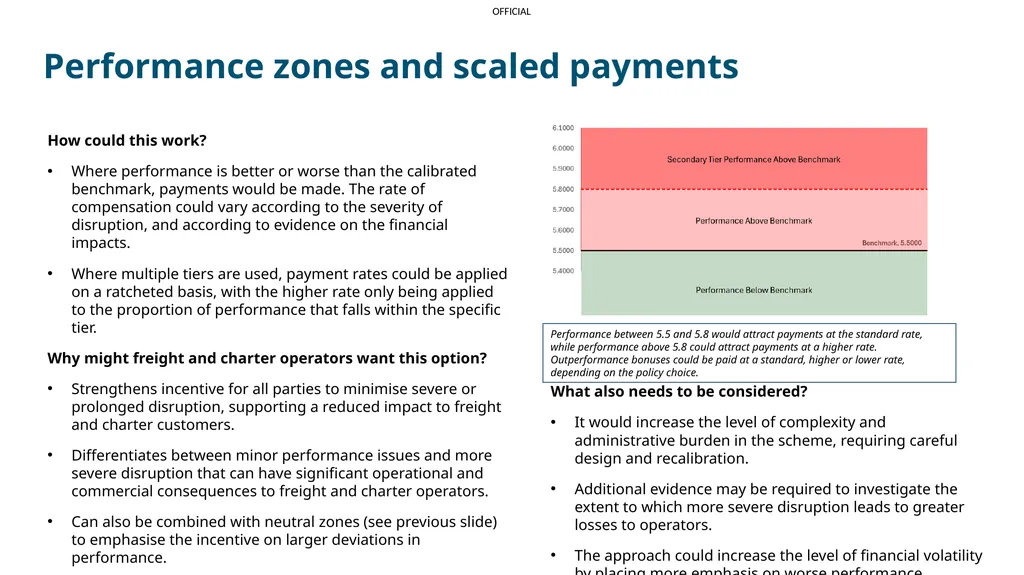
Where performance is better or worse than the calibrated benchmark, payments would be made. The rate of compensation could vary according to the severity of disruption, and according to evidence on the financial impacts.
Where multiple tiers are used, payment rates could be applied on a ratcheted basis, with the higher rate only being applied to the proportion of performance that falls within the specific tier.
Why might freight and charter operators want this option?
Strengthens incentive for all parties to minimise severe or prolonged disruption, supporting a reduced impact to freight and charter customers.
Differentiates between minor performance issues and more severe disruption that can have significant operational and commercial consequences to freight and charter operators.
Can also be combined with neutral zones (see previous slide) to emphasise the incentive on larger deviations in performance. What also needs to be considered?
It would increase the level of complexity and administrative burden in the scheme, requiring careful design and recalibration.
Additional evidence may be required to investigate the extent to which more severe disruption leads to greater losses to operators.
The approach could increase the level of financial volatility by placing more emphasis on worse performance outcomes. Performance between 5.5 and 5.8 would attract payments at the standard rate, while performance above 5.8 could attract payments at a higher rate. Outperformance bonuses could be paid at a standard, higher or lower rate, depending on the policy choice.<br>
Where performance is better or worse than the calibrated benchmark, payments would be made. The rate of compensation could vary according to the severity of disruption, and according to evidence on the financial impacts.
Where multiple tiers are used, payment rates could be applied on a ratcheted basis, with the higher rate only being applied to the proportion of performance that falls within the specific tier.
Why might freight and charter operators want this option?
Strengthens incentive for all parties to minimise severe or prolonged disruption, supporting a reduced impact to freight and charter customers.
Differentiates between minor performance issues and more severe disruption that can have significant operational and commercial consequences to freight and charter operators.
Can also be combined with neutral zones (see previous slide) to emphasise the incentive on larger deviations in performance. What also needs to be considered?
It would increase the level of complexity and administrative burden in the scheme, requiring careful design and recalibration.
Additional evidence may be required to investigate the extent to which more severe disruption leads to greater losses to operators.
The approach could increase the level of financial volatility by placing more emphasis on worse performance outcomes. Performance between 5.5 and 5.8 would attract payments at the standard rate, while performance above 5.8 could attract payments at a higher rate. Outperformance bonuses could be paid at a standard, higher or lower rate, depending on the policy choice.<br>
11
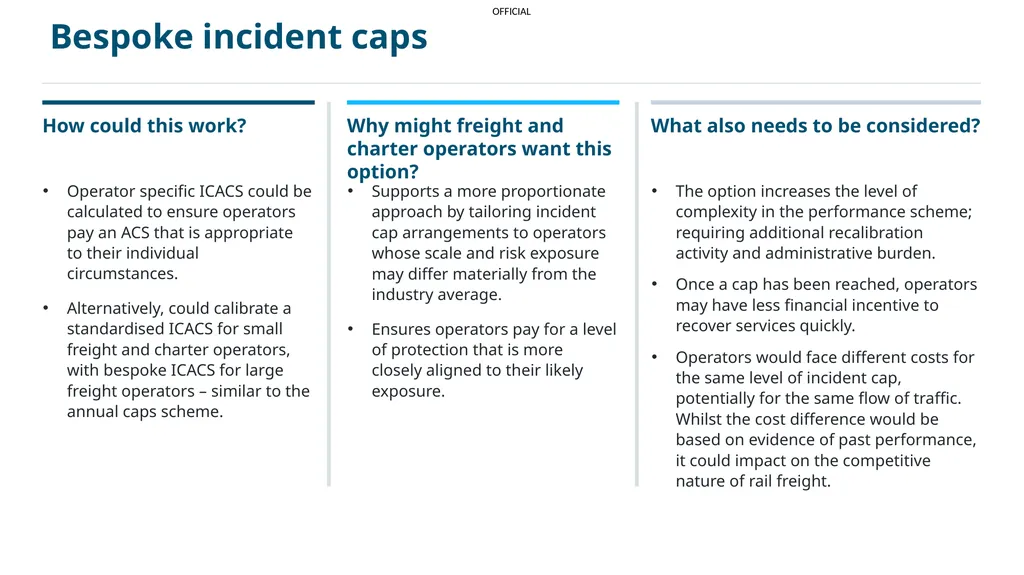
Bespoke incident caps How could this work? Operator specific ICACS could be calculated to ensure operators pay an ACS that is appropriate to their individual circumstances.
Alternatively, could calibrate a standardised ICACS for small freight and charter operators, with bespoke ICACS for large freight operators – similar to the annual caps scheme. Why might freight and charter operators want this option? Supports a more proportionate approach by tailoring incident cap arrangements to operators whose scale and risk exposure may differ materially from the industry average.
Ensures operators pay for a level of protection that is more closely aligned to their likely exposure. What also needs to be considered? The option increases the level of complexity in the performance scheme; requiring additional recalibration activity and administrative burden.
Once a cap has been reached, operators may have less financial incentive to recover services quickly.
Operators would face different costs for the same level of incident cap, potentially for the same flow of traffic. Whilst the cost difference would be based on evidence of past performance, it could impact on the competitive nature of rail freight.<br>
Alternatively, could calibrate a standardised ICACS for small freight and charter operators, with bespoke ICACS for large freight operators – similar to the annual caps scheme. Why might freight and charter operators want this option? Supports a more proportionate approach by tailoring incident cap arrangements to operators whose scale and risk exposure may differ materially from the industry average.
Ensures operators pay for a level of protection that is more closely aligned to their likely exposure. What also needs to be considered? The option increases the level of complexity in the performance scheme; requiring additional recalibration activity and administrative burden.
Once a cap has been reached, operators may have less financial incentive to recover services quickly.
Operators would face different costs for the same level of incident cap, potentially for the same flow of traffic. Whilst the cost difference would be based on evidence of past performance, it could impact on the competitive nature of rail freight.<br>
12
Workshop summary and opportunity for further discussion The features discussed today are intended to help inform the future development of GBR's performance schemes. We will consider the feedback received on the relative merits of each option, whether any features warrant further development, and are open to exploring alternative options that would provide clear benefits to the performance scheme.
We recognise freight operators’ preference to retain the existing arrangements for FP1. The questions below are intended to confirm that position and gather views on whether any proposed features could have value over the longer term.<br>
We recognise freight operators’ preference to retain the existing arrangements for FP1. The questions below are intended to confirm that position and gather views on whether any proposed features could have value over the longer term.<br>
13
Next steps – Caitlin Scarlett<br>
14
We are in the early stages of developing the additional performance scheme features that could be included in the future performance schemes.
Today’s session has been focussed on gathering industry feedback on the additional scheme features proposed, their structure, and how they could be used in practice. Similarly, we sought views on whether industry had any alternative features they thought should be considered.
We are aware of freight operators’ preference to retain the existing performance scheme arrangements and understand the industry’s position ahead of FP1. We are not proposing material changes for FP1, but welcome views on whether these features could be useful ahead of FP1, or for future performance schemes.
We will reflect on the feedback and discussions in this workshop when considering the additional features that could be used in a future performance scheme; developing initial policy proposals ahead of the formal consultation in April 2027. 14 Summary and next steps For more information on our charges and performance workshops, please visit this link: GBR's Charges and Performance Schemes.<br>
Today’s session has been focussed on gathering industry feedback on the additional scheme features proposed, their structure, and how they could be used in practice. Similarly, we sought views on whether industry had any alternative features they thought should be considered.
We are aware of freight operators’ preference to retain the existing performance scheme arrangements and understand the industry’s position ahead of FP1. We are not proposing material changes for FP1, but welcome views on whether these features could be useful ahead of FP1, or for future performance schemes.
We will reflect on the feedback and discussions in this workshop when considering the additional features that could be used in a future performance scheme; developing initial policy proposals ahead of the formal consultation in April 2027. 14 Summary and next steps For more information on our charges and performance workshops, please visit this link: GBR's Charges and Performance Schemes.<br>
15
15 How you can help shape GBR’s Charges Scheme and Performance Scheme Statements for FP1 For more information on our emerging proposals for charges and performance , please visit this link: https://www.networkrail.co.uk/industry-and-commercial/developing-gbrs-charges-and-performance-schemes/
If you have any questions or would like to discuss this further, you can contact the team via our dedicated inbox: chargesandperformanceschemes@networkrail.co.uk Ways to get involved:
Technical workshops on important charges and performance scheme topics.
Targeted engagement with freight, devolved bodies, open access, other infrastructure managers, and funders.
We are committed to:<br>
If you have any questions or would like to discuss this further, you can contact the team via our dedicated inbox: chargesandperformanceschemes@networkrail.co.uk Ways to get involved:
Technical workshops on important charges and performance scheme topics.
Targeted engagement with freight, devolved bodies, open access, other infrastructure managers, and funders.
We are committed to:<br>