
Period 6: Part 2 Accelerating Global Change and




Description: Period 6: Part 2 Accelerating Global Change and Realignments, c. 1900 C.E. - Present Key Concept 6.3 New Conceptualizations of Global Economy, Society, Culture 6.3 What new governmental institutions emerged as a result of the 20th century
Related Topics
Download Presentation
"Period 6: Part 2 Accelerating Global Change and" is the property of its rightful owner. Permission is granted to download and print the materials on this website for personal, non-commercial use only, and to display it on your personal computer provided you do not modify the materials and that you retain all copyright notices contained in the materials. By downloading content from our website, you accept the terms of this agreement.
Presentation Transcript
slide1. Period 6: Part 2 Accelerating Global Change and Realignments,
c. 1900 C.E. - Present<br>
slide2. Key Concept 6.3 New Conceptualizations of Global Economy, Society, & Culture<br>
slide3. 6.3 What new governmental institutions emerged as a result of the 20th century conflicts? What made these new institutions possible? What role did they play in the world during the 20th century? Conflict, scientific changes and changing relationships between humans and the environment led to new ideas about government, culture and society<br>
slide4. 6.3.I How did states respond to the 20th century’s economic challenges? Communist States (Soviet Union and China)
Five Year Plans
Under Joseph Stalin
Rapid Industrialization
Collectivization of Agriculture: organization of land into large state run farms Famine (Holodomor in the Ukraine)
Led to mass murder and deportation to get people to comply
Great Leap Forward
Mao
Agarian (farming society)industrialized society
Collectivization and Industrialization
Harvest left uncollected in areasfamine
Beatings and killings for rebelling against government policies<br>
slide5. 6.3.I.B How did the Great Depression affect governments’ relationship to the(ir) economy? Pre-Depression: Governments played minimal role in the economy
Depression: Started in the 1930s beginning in the United States due to the Stock Market Crash of 1929
Unemployment rose, Global Trade declined, GDPs fell)
Post-Depression (Around WWII): Greater Role (New Deal: created jobs, government support for people struggling in the United States)<br>
slide6. 6.3.II How did new international organizations affect the relationship of states and peoples around the world? East Asia
Export Focused Economies
Free Markets and Economic Liberalism
international trade without tariffs, or other restrictions.
United Nations
Formed to keep world peace after WWII<br>
slide7. 6.3.II.B What were the economic effects of new international organizations? Free Market Economics Spread
IMF (International Monetary Fund): consisting of 189 countries working to foster global monetary cooperation, secure financial stability, facilitate international trade, promote high employment and sustainable economic growth, and reduce poverty around the world<br>
slide8. 6.3.II.C What were the humanitarian effects of new international organizations? Humanitarian Organizations
Amnesty International: end human rights abuses
Red Cross: responding to emergencies and disasters
Doctor’s Without Borders: Doctors sent to combat zones and to fight epidemic diseases
UNICEF: provide emergency food and healthcare to children and mothers<br>
slide9. 6.3.II.E How did these economic develop- ments affect the distribution of world resources? Regional Trade Agreements move goods across borders
European Union
Political and Economic union of 28 European countries
free movement of people, goods, services and capital
NAFTA: North American Free Trade Agreement
Canada, Mexico, United States
Multi-national corporations challenge state authority
Nigeria leases oil fields to Shell
Ex: Shell made payments to Nigerian military to help avoid protests over their policies in that country<br>
slide10. 6.3.III What new social and cultural ideologies developed, and what were the conse- quences and reactions to these ideologies? Human Rights
UN Declaration of Human Rights
End of the White Australia Policy
Policy that aimed to exclude people of non-European origin, especially Asians and Pacific Islanders from immigrating to Australia<br>
slide11. 6.3.III What new social and cultural ideologies developed, and what were the conse- quences and reactions to these ideologies? New Cultural Identities
Négritude:the affirmation or consciousness of the value of black or African culture, heritage, and identity.
Exclusionary Reactions
Xenophobia: dislike of or prejudice against people from other countries.
Ex: Refugees from Central America into the United States<br>
slide12. 6.3.III.A How did communities of faith respond to the rapid changes in the 20th century? New Forms of Spirituality
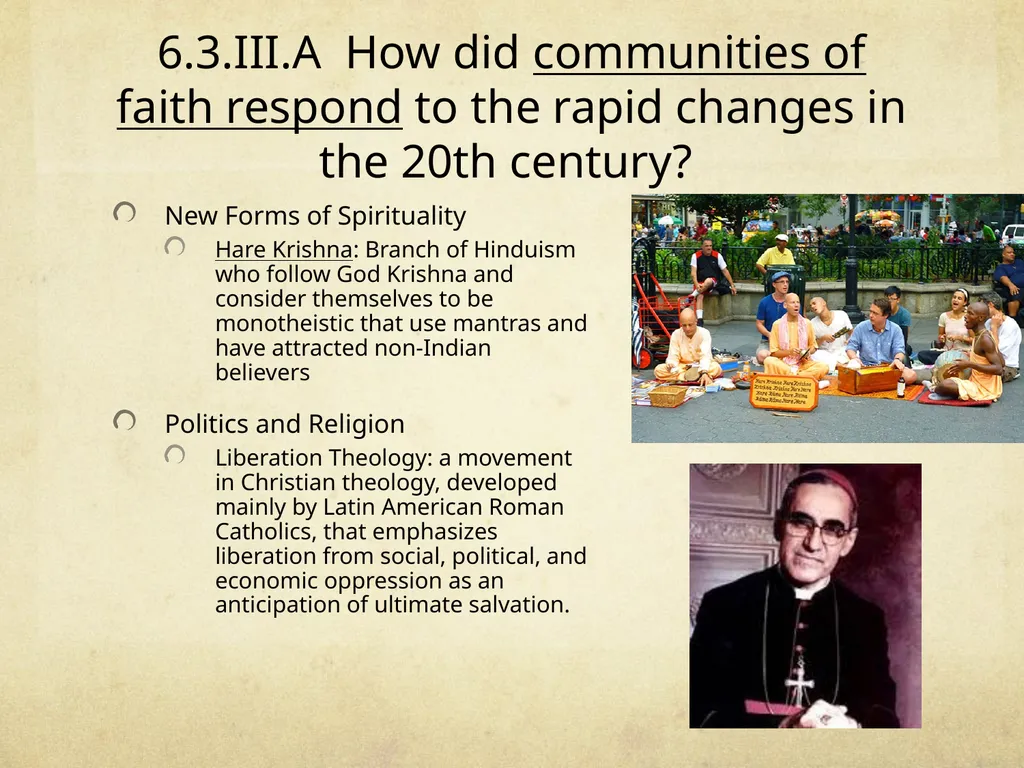
Hare Krishna: Branch of Hinduism who follow God Krishna and consider themselves to be monotheistic that use mantras and have attracted non-Indian believers
Politics and Religion
Liberation Theology: a movement in Christian theology, developed mainly by Latin American Roman Catholics, that emphasizes liberation from social, political, and economic oppression as an anticipation of ultimate salvation.<br>
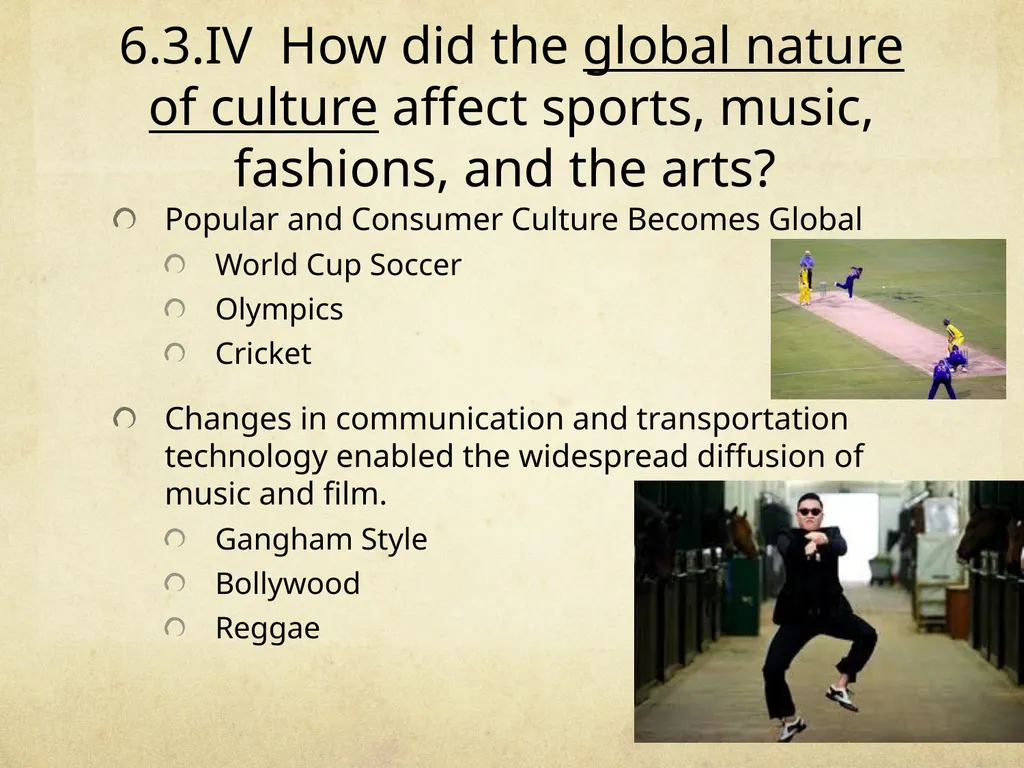
slide13. 6.3.IV How did the global nature of culture affect sports, music, fashions, and the arts? Popular and Consumer Culture Becomes Global
World Cup Soccer
Olympics
Cricket
Changes in communication and transportation technology enabled the widespread diffusion of music and film.
Gangham Style
Bollywood
Reggae<br>
c. 1900 C.E. - Present<br>
slide2. Key Concept 6.3 New Conceptualizations of Global Economy, Society, & Culture<br>
slide3. 6.3 What new governmental institutions emerged as a result of the 20th century conflicts? What made these new institutions possible? What role did they play in the world during the 20th century? Conflict, scientific changes and changing relationships between humans and the environment led to new ideas about government, culture and society<br>
slide4. 6.3.I How did states respond to the 20th century’s economic challenges? Communist States (Soviet Union and China)
Five Year Plans
Under Joseph Stalin
Rapid Industrialization
Collectivization of Agriculture: organization of land into large state run farms Famine (Holodomor in the Ukraine)
Led to mass murder and deportation to get people to comply
Great Leap Forward
Mao
Agarian (farming society)industrialized society
Collectivization and Industrialization
Harvest left uncollected in areasfamine
Beatings and killings for rebelling against government policies<br>
slide5. 6.3.I.B How did the Great Depression affect governments’ relationship to the(ir) economy? Pre-Depression: Governments played minimal role in the economy
Depression: Started in the 1930s beginning in the United States due to the Stock Market Crash of 1929
Unemployment rose, Global Trade declined, GDPs fell)
Post-Depression (Around WWII): Greater Role (New Deal: created jobs, government support for people struggling in the United States)<br>
slide6. 6.3.II How did new international organizations affect the relationship of states and peoples around the world? East Asia
Export Focused Economies
Free Markets and Economic Liberalism
international trade without tariffs, or other restrictions.
United Nations
Formed to keep world peace after WWII<br>
slide7. 6.3.II.B What were the economic effects of new international organizations? Free Market Economics Spread
IMF (International Monetary Fund): consisting of 189 countries working to foster global monetary cooperation, secure financial stability, facilitate international trade, promote high employment and sustainable economic growth, and reduce poverty around the world<br>
slide8. 6.3.II.C What were the humanitarian effects of new international organizations? Humanitarian Organizations
Amnesty International: end human rights abuses
Red Cross: responding to emergencies and disasters
Doctor’s Without Borders: Doctors sent to combat zones and to fight epidemic diseases
UNICEF: provide emergency food and healthcare to children and mothers<br>
slide9. 6.3.II.E How did these economic develop- ments affect the distribution of world resources? Regional Trade Agreements move goods across borders
European Union
Political and Economic union of 28 European countries
free movement of people, goods, services and capital
NAFTA: North American Free Trade Agreement
Canada, Mexico, United States
Multi-national corporations challenge state authority
Nigeria leases oil fields to Shell
Ex: Shell made payments to Nigerian military to help avoid protests over their policies in that country<br>
slide10. 6.3.III What new social and cultural ideologies developed, and what were the conse- quences and reactions to these ideologies? Human Rights
UN Declaration of Human Rights
End of the White Australia Policy
Policy that aimed to exclude people of non-European origin, especially Asians and Pacific Islanders from immigrating to Australia<br>
slide11. 6.3.III What new social and cultural ideologies developed, and what were the conse- quences and reactions to these ideologies? New Cultural Identities
Négritude:the affirmation or consciousness of the value of black or African culture, heritage, and identity.
Exclusionary Reactions
Xenophobia: dislike of or prejudice against people from other countries.
Ex: Refugees from Central America into the United States<br>
slide12. 6.3.III.A How did communities of faith respond to the rapid changes in the 20th century? New Forms of Spirituality
Hare Krishna: Branch of Hinduism who follow God Krishna and consider themselves to be monotheistic that use mantras and have attracted non-Indian believers
Politics and Religion
Liberation Theology: a movement in Christian theology, developed mainly by Latin American Roman Catholics, that emphasizes liberation from social, political, and economic oppression as an anticipation of ultimate salvation.<br>
slide13. 6.3.IV How did the global nature of culture affect sports, music, fashions, and the arts? Popular and Consumer Culture Becomes Global
World Cup Soccer
Olympics
Cricket
Changes in communication and transportation technology enabled the widespread diffusion of music and film.
Gangham Style
Bollywood
Reggae<br>