
Personal Protective Equipment CHAPTER 8 Knowledge
DP
Published · 41 slides · 0 views
1 / 1
Description
Personal Protective Equipment CHAPTER 8 Knowledge Objectives Discuss the similarities and differences in how single-use and reusable personal protective equipment (PPE) are used. Explain how to select, use, and maintain PPE. Explain how PPE
Related Topics
Share
Embed code
Download this presentation From Below
"Personal Protective Equipment CHAPTER 8 Knowledge" is the property of its rightful owner. Permission is granted to download and print the materials on this website for personal, non-commercial use only, and to display it on your personal computer provided you do not modify the materials and that you retain all copyright notices contained in the materials. By downloading content from our website, you accept the terms of this agreement.
Presentation Transcript
01
Personal Protective Equipment CHAPTER 8<br>
02
Knowledge Objectives Discuss the similarities and differences in how single-use and reusable personal protective equipment (PPE) are used.
Explain how to select, use, and maintain PPE.
Explain how PPE needs are determined.
Identify and describe specific PPE for hazardous materials response.
Describe OSHA/EPA levels of chemical-protective clothing.
Explain the safety considerations when wearing PPE.
Explain the inclusion of PPE in reporting and documenting the incident.<br>
03
Introduction (1 of 4) Core responsibilities for mission-specific responsibilities
Job performance details are found in NFPA 470, chapter 9, 9.2.1
Operations level training
Responsibilities at awareness and operations levels
Mission-specific requirements for PPE
Requirements in NFPA 470, chapter 8, Section 8.2<br>
Job performance details are found in NFPA 470, chapter 9, 9.2.1
Operations level training
Responsibilities at awareness and operations levels
Mission-specific requirements for PPE
Requirements in NFPA 470, chapter 8, Section 8.2<br>
04
Introduction (2 of 4) Operations level guidance
Hazardous materials technician
Allied professional
Standard operating procedures (SOPs)
Responder familiarity
AHJ PPE policy and procedures
Local procedures for technical decontamination
Manufacturer guidelines for care
AHJ documentation procedures for PPE<br>
Hazardous materials technician
Allied professional
Standard operating procedures (SOPs)
Responder familiarity
AHJ PPE policy and procedures
Local procedures for technical decontamination
Manufacturer guidelines for care
AHJ documentation procedures for PPE<br>
05
Introduction (3 of 4) Standards and Revisions
NFPA document consolidation
NFP 1990
Standard consolidation
NFPA 1990 as main reference standard
Covers PPE used by responders
Three main types of PPE:
Vapor-protective ensembles and ensemble elements
Liquid splash–protective ensembles and ensemble elements
Hazardous materials CBRN-protective ensembles and ensemble elements<br>
06
Introduction (4 of 4) Ease of access and understanding
NFPA 1990 and NFPA 1891
OSHA Title 29, Code of Federal Regulations
Overview and correlation<br>
NFPA 1990 and NFPA 1891
OSHA Title 29, Code of Federal Regulations
Overview and correlation<br>
07
Single-Use PPE and Reusable PPE (1 of 3) Single-use PPE
Disposable
Significant percentage of PPE is intended for single use
Discarded along with other hazardous wastes
Should be decontaminated enough for safe removal
Advantages and disadvantages
Less expensive than reusable gear
Needs to be restocked<br>
Disposable
Significant percentage of PPE is intended for single use
Discarded along with other hazardous wastes
Should be decontaminated enough for safe removal
Advantages and disadvantages
Less expensive than reusable gear
Needs to be restocked<br>
08
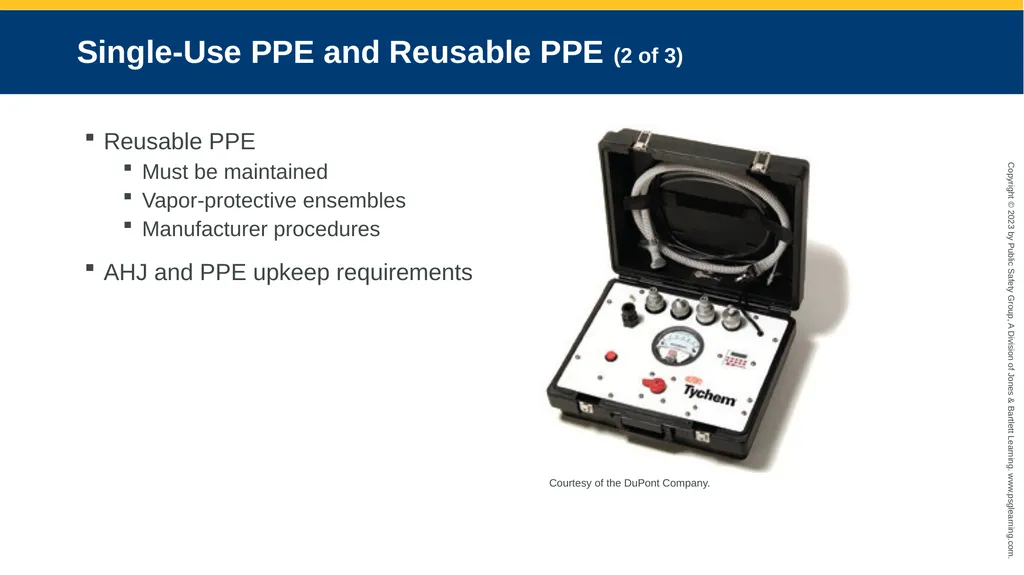
Single-Use PPE and Reusable PPE (2 of 3) Reusable PPE
Must be maintained
Vapor-protective ensembles
Manufacturer procedures
AHJ and PPE upkeep requirements Courtesy of the DuPont Company.<br>
Must be maintained
Vapor-protective ensembles
Manufacturer procedures
AHJ and PPE upkeep requirements Courtesy of the DuPont Company.<br>
09
Single-Use PPE and Reusable PPE (3 of 3) Important considerations
PPE is not intended to be purchased and ignored.
Serves as barrier between responders and hazardous materials.
Single-use and reusable garments have a shelf life.
Time frame should be noted and adhered to.
PPE that is beyond its shelf life should not be used.<br>
PPE is not intended to be purchased and ignored.
Serves as barrier between responders and hazardous materials.
Single-use and reusable garments have a shelf life.
Time frame should be noted and adhered to.
PPE that is beyond its shelf life should not be used.<br>
10
Maintaining PPE (1 of 2) Testing chemical-protective garments
Manufacturer’s recommendation
HAZWOPER standard (9 CFR 1910.120, Appendix A)
NFPA 1891
Pressure test
Specially designed kit
Uses soapy water to identify leaks
Any garment with a leak should be removed from service<br>
Manufacturer’s recommendation
HAZWOPER standard (9 CFR 1910.120, Appendix A)
NFPA 1891
Pressure test
Specially designed kit
Uses soapy water to identify leaks
Any garment with a leak should be removed from service<br>
11
Maintaining PPE (2 of 2) Storage
PPE must be stored in clean, cool, dry area away from sunlight.
Regular inspections must be performed.
Repairs
Consult with manufacturer.
Manufacturers have well-defined repair procedures.
AHJ and PPE have upkeep requirements.<br>
PPE must be stored in clean, cool, dry area away from sunlight.
Regular inspections must be performed.
Repairs
Consult with manufacturer.
Manufacturers have well-defined repair procedures.
AHJ and PPE have upkeep requirements.<br>
12
Determining PPE Needs (1 of 4) Correlating mission and anticipated hazards
Ammonia is corrosive and flammable.
300 parts per million is immediately dangerous to life and health (IDLH).
Ammonia concentration exceeding 300 ppm (SCBA) is required.<br>
Ammonia is corrosive and flammable.
300 parts per million is immediately dangerous to life and health (IDLH).
Ammonia concentration exceeding 300 ppm (SCBA) is required.<br>
13
Determining PPE Needs (2 of 4) SCBA
Positive-pressure, CBRN-certified units
Required when exposed to hazardous substances
Incident commander (IC) is required to ensure the use of SCBA.
Only one piece of needed equipment
Manufacturers’ recommendations<br>
Positive-pressure, CBRN-certified units
Required when exposed to hazardous substances
Incident commander (IC) is required to ensure the use of SCBA.
Only one piece of needed equipment
Manufacturers’ recommendations<br>
14
Determining PPE Needs (3 of 4) AHJ determination
PPE available
Procedures and requirements for selecting and using PPE
Firefighting gear
Responders must assess ability of structural firefighting of gear.
Ammonia presents a flammability hazard.
Firefighting gear does not address the hazard of skin irritation.<br>
PPE available
Procedures and requirements for selecting and using PPE
Firefighting gear
Responders must assess ability of structural firefighting of gear.
Ammonia presents a flammability hazard.
Firefighting gear does not address the hazard of skin irritation.<br>
15
Determining PPE Needs (4 of 4) Impact of the operating environment
Gathering information on the scene is pivotal.
Balancing hazards and the risk of the mission
Hazards, variables, and potential gains
Not all structural firefighters’ gear is created equal or intended for use in hazardous materials incidents.
Old gear vs. new gear
Choosing PPE
Understand hazards and affects on PPE requirements<br>
16
Specific PPE for Hazardous Materials Response (1 of 3) Needed levels of PPE
Identified mitigation strategy, associated tactics
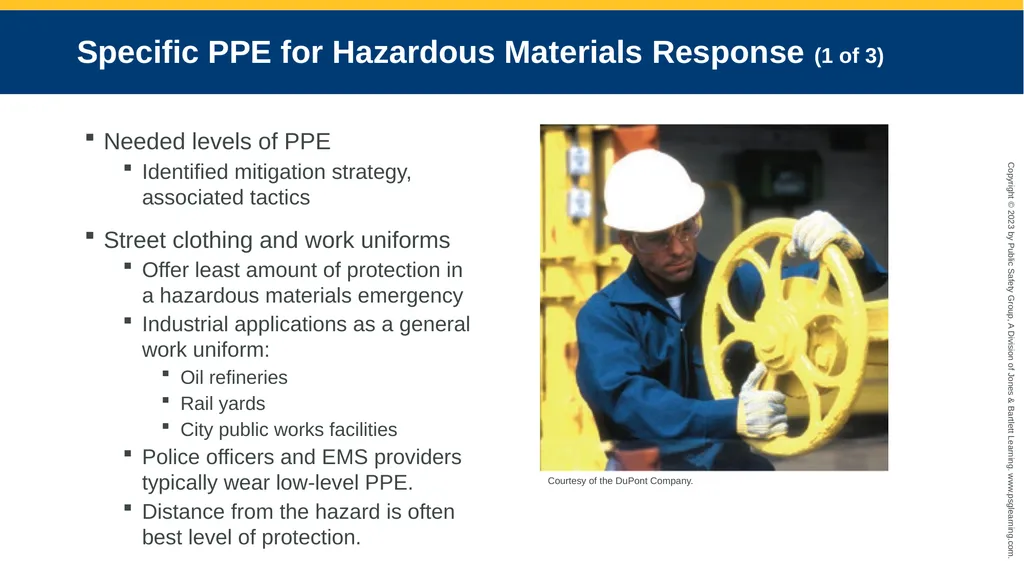
Street clothing and work uniforms
Offer least amount of protection in a hazardous materials emergency
Industrial applications as a general work uniform:
Oil refineries
Rail yards
City public works facilities
Police officers and EMS providers typically wear low-level PPE.
Distance from the hazard is often best level of protection. Courtesy of the DuPont Company.<br>
17
Specific PPE for Hazardous Materials Response (2 of 3) Safety tip
AHJ must properly outfit all responders.
IC must ensure that appropriate personal protective clothing is worn.
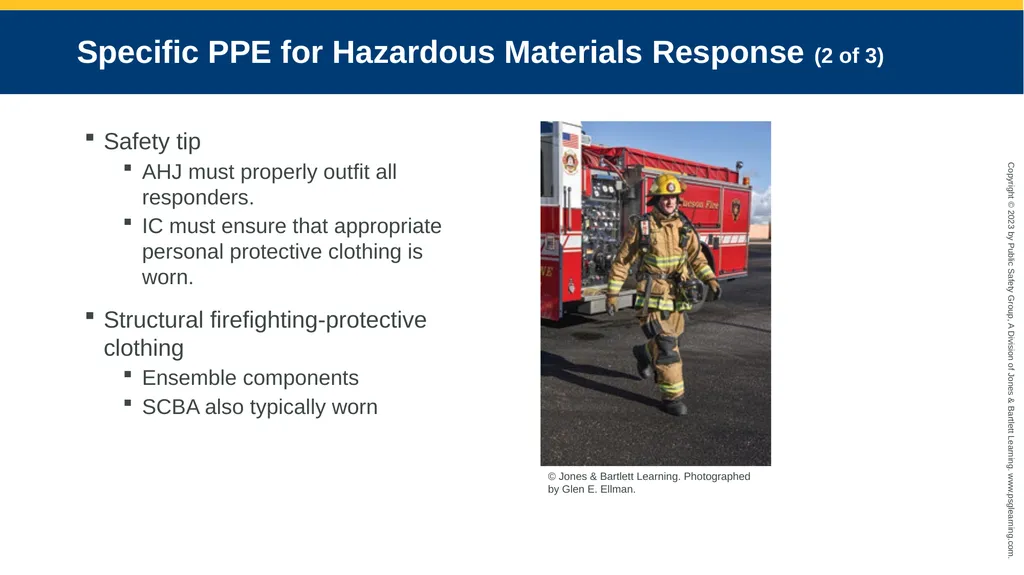
Structural firefighting-protective clothing
Ensemble components
SCBA also typically worn © Jones & Bartlett Learning. Photographed by Glen E. Ellman.<br>
AHJ must properly outfit all responders.
IC must ensure that appropriate personal protective clothing is worn.
Structural firefighting-protective clothing
Ensemble components
SCBA also typically worn © Jones & Bartlett Learning. Photographed by Glen E. Ellman.<br>
18
Specific PPE for Hazardous Materials Response (3 of 3) Standard firefighting turnout gear
Fabric can break down when exposed to chemicals.
When compromised, the level of protection decreases.
Level of protection during outdoor incident
Structural firefighting gear intent
Thermal and mechanical hazards
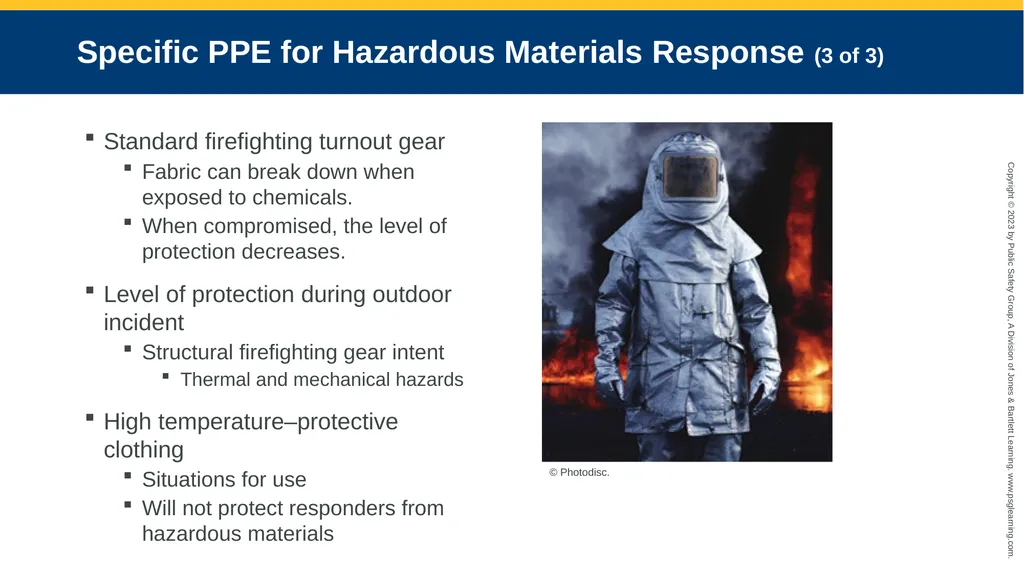
High temperature–protective clothing
Situations for use
Will not protect responders from hazardous materials © Photodisc.<br>
19
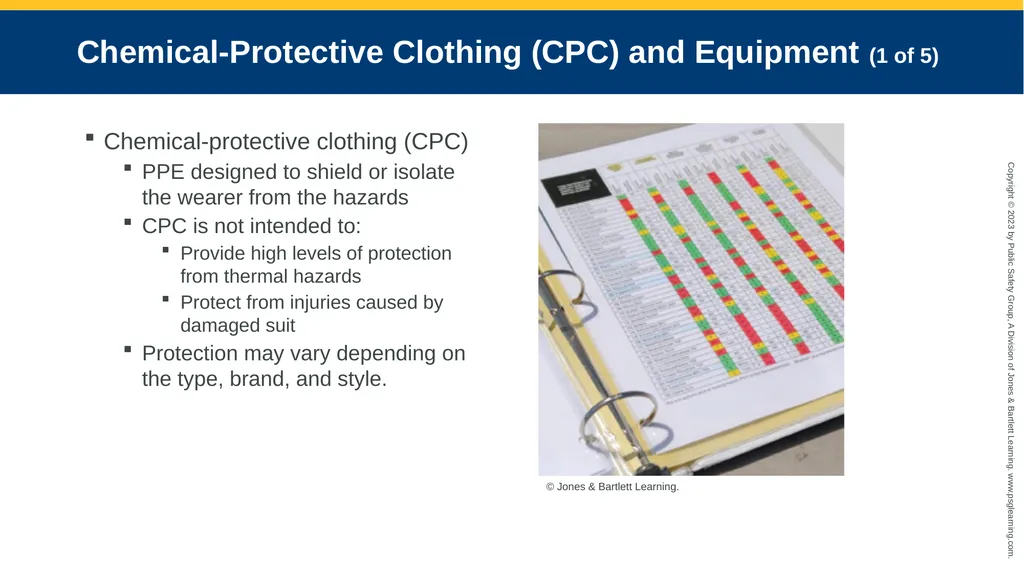
Chemical-Protective Clothing (CPC) and Equipment (1 of 5) Chemical-protective clothing (CPC)
PPE designed to shield or isolate the wearer from the hazards
CPC is not intended to:
Provide high levels of protection from thermal hazards
Protect from injuries caused by damaged suit
Protection may vary depending on the type, brand, and style. © Jones & Bartlett Learning.<br>
PPE designed to shield or isolate the wearer from the hazards
CPC is not intended to:
Provide high levels of protection from thermal hazards
Protect from injuries caused by damaged suit
Protection may vary depending on the type, brand, and style. © Jones & Bartlett Learning.<br>
20
Chemical-Protective Clothing (CPC) and Equipment (2 of 5) Chemical-resistant material
Fabric designed to inhibit chemicals
Designated as CPC
Factors that affect the chemical resistance:
Storage conditions
Temperature
Resistance to cuts, tears, and abrasions
Flexibility
Shelf life
Sizing criteria<br>
Fabric designed to inhibit chemicals
Designated as CPC
Factors that affect the chemical resistance:
Storage conditions
Temperature
Resistance to cuts, tears, and abrasions
Flexibility
Shelf life
Sizing criteria<br>
21
Chemical-Protective Clothing (CPC) and Equipment (3 of 5) Penetration is the flow or movement of a substance through closures.
Responders should carefully evaluate their CPC.
Use buddy system to examine parts that wearer cannot see.
Permeation is the process by which a hazardous chemical moves through a material on the molecular level.
Can occur through the material itself
May be impossible to identify visually<br>
Responders should carefully evaluate their CPC.
Use buddy system to examine parts that wearer cannot see.
Permeation is the process by which a hazardous chemical moves through a material on the molecular level.
Can occur through the material itself
May be impossible to identify visually<br>
22
Chemical-Protective Clothing (CPC) and Equipment (4 of 5) Degradation
Physical destruction or decomposition of a clothing material
Visible signs of degradation:
Charring
Shrinking
Swelling
Color changes
Dissolving
Can occur when:
Chemicals are highly aggressive
Suit fabric is poor match for substance
The risk of injury is high if suit dissolves<br>
Physical destruction or decomposition of a clothing material
Visible signs of degradation:
Charring
Shrinking
Swelling
Color changes
Dissolving
Can occur when:
Chemicals are highly aggressive
Suit fabric is poor match for substance
The risk of injury is high if suit dissolves<br>
23
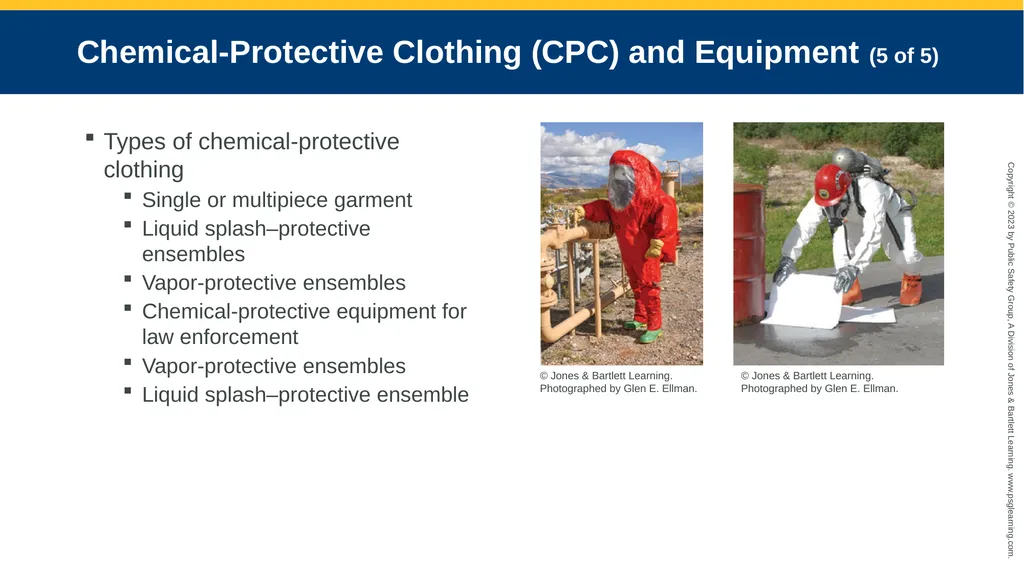
Chemical-Protective Clothing (CPC) and Equipment (5 of 5) Types of chemical-protective clothing
Single or multipiece garment
Liquid splash–protective ensembles
Vapor-protective ensembles
Chemical-protective equipment for law enforcement
Vapor-protective ensembles
Liquid splash–protective ensemble © Jones & Bartlett Learning. Photographed by Glen E. Ellman. © Jones & Bartlett Learning. Photographed by Glen E. Ellman.<br>
24
OSHA/EPA Levels of Protection (1 of 5) CFR 1910.120, Appendix A
PPE selection
Levels of protection
Maintenance
NFPA 1990 and OSHA 1910.120
Donning and doffing
Decontamination linked to PPE use
Refer to the AHJ<br>
PPE selection
Levels of protection
Maintenance
NFPA 1990 and OSHA 1910.120
Donning and doffing
Decontamination linked to PPE use
Refer to the AHJ<br>
25
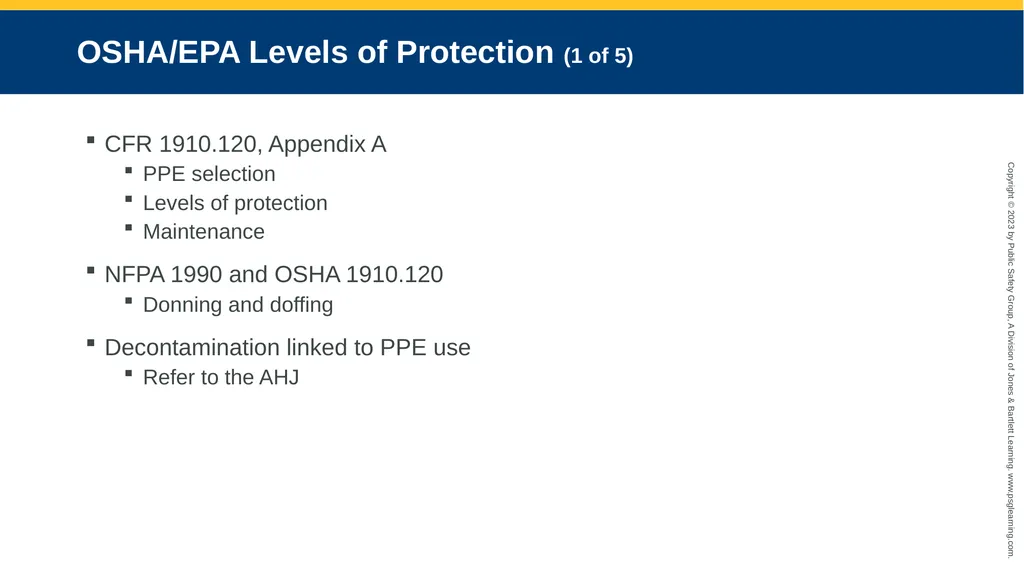
OSHA/EPA Levels of Protection (2 of 5) Level A
Fully encapsulates the wearer and the selected respiratory protection
Used when hazardous material requires highest level of protection
NFPA and OSHA/EPA intersection
Approach thermal environments with extreme caution.
Must pass a particular set of testing challenges
Difficult to ensure good field of vision. © Jones & Bartlett Learning. Courtesy of Rob Schnepp.<br>
26
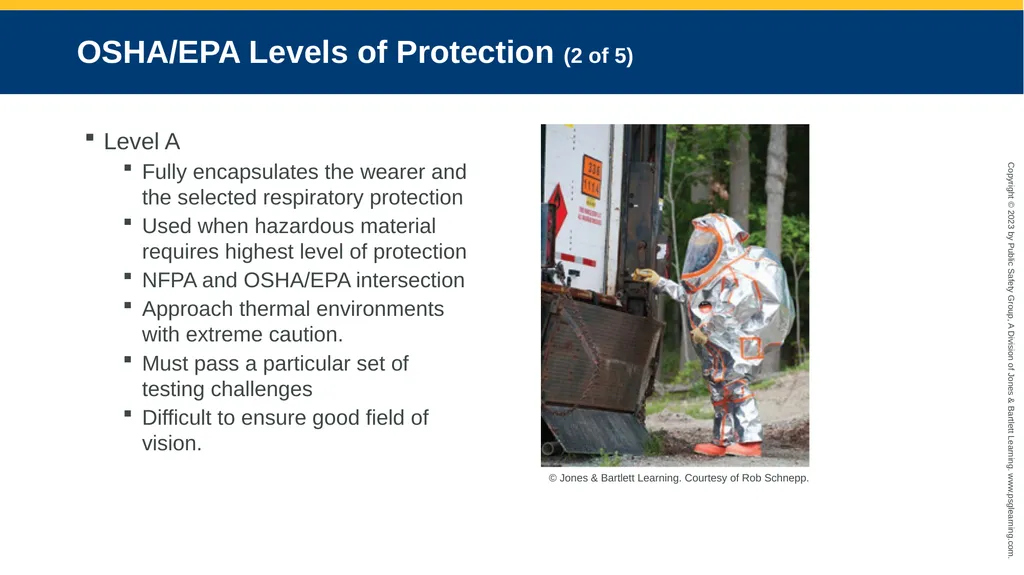
OSHA/EPA Levels of Protection (3 of 5) Level B (liquid splash–protective ensemble)
Single-piece chemical protective garment (encapsulating level B garments)
Multipiece chemical protective garment
Minimum level of protection worn in unknown environment © Jones & Bartlett Learning. Photographed by Glen E. Ellman.<br>
Single-piece chemical protective garment (encapsulating level B garments)
Multipiece chemical protective garment
Minimum level of protection worn in unknown environment © Jones & Bartlett Learning. Photographed by Glen E. Ellman.<br>
27
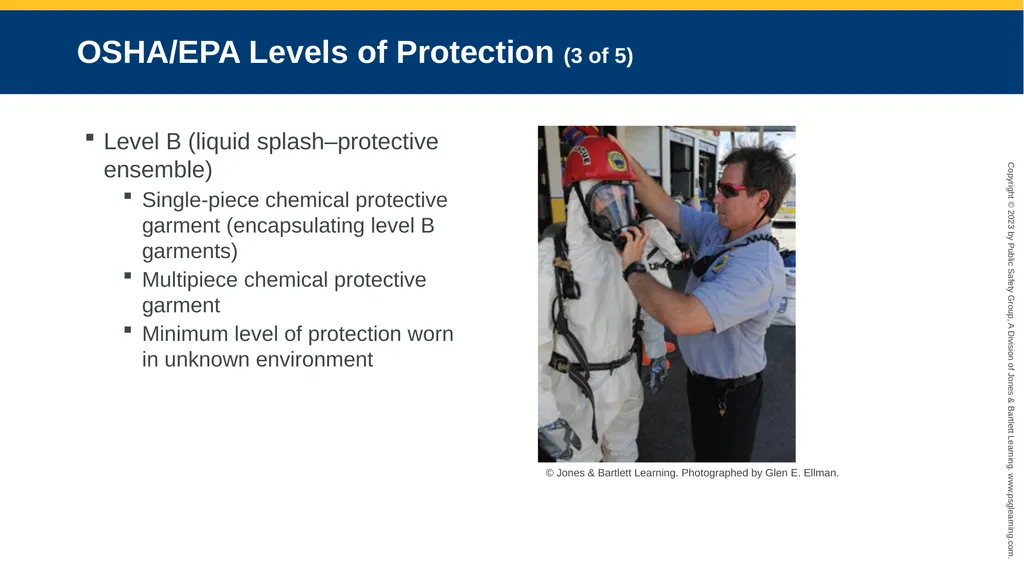
OSHA/EPA Levels of Protection (4 of 5) Level C (liquid splash–protective ensemble)
Type of airborne contamination is known, its concentration is measured, and criteria for using APR are met
NIOSH–approved CBRN APR or PAPR
Specific performance-based testing standards
Standard work clothing, CPC, chemical-resistant gloves, and a form of respiratory protection
Appropriate when potentially harmful dermal or respiratory exposure is unlikely
Often worn in low-hazard situations
Law enforcement
Must be NFPA-1990 compliant
Respiratory protection may be provided by a half-face or full-face mask © Jones & Bartlett Learning. Photographed by Glen E. Ellman.<br>
28
OSHA/EPA Levels of Protection (5 of 5) Level D
Lowest level of protection
Coveralls, work shoes, hard hat, gloves, and standard work clothing
Atmosphere contains no known hazard and when work functions preclude splashes, immersion, or the potential for unexpected inhalation of or contact with hazardous levels of chemicals
Used when situation involves nuisance contamination only
Not worn on any site where respiratory or skin hazards exist
Doffing reverse of donning
Nonhazardous process<br>
29
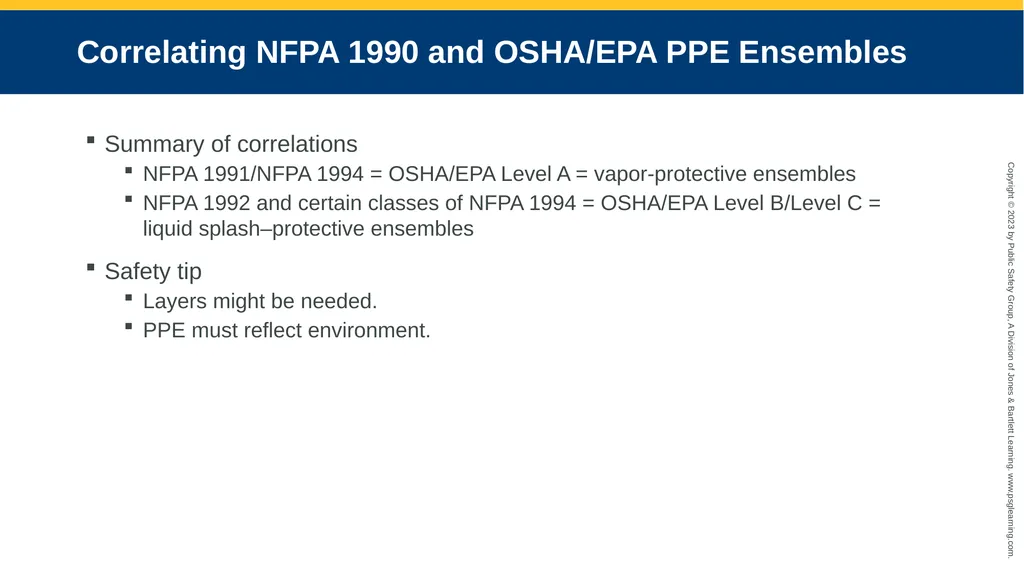
Correlating NFPA 1990 and OSHA/EPA PPE Ensembles Summary of correlations
NFPA 1991/NFPA 1994 = OSHA/EPA Level A = vapor-protective ensembles
NFPA 1992 and certain classes of NFPA 1994 = OSHA/EPA Level B/Level C = liquid splash–protective ensembles
Safety tip
Layers might be needed.
PPE must reflect environment.<br>
NFPA 1991/NFPA 1994 = OSHA/EPA Level A = vapor-protective ensembles
NFPA 1992 and certain classes of NFPA 1994 = OSHA/EPA Level B/Level C = liquid splash–protective ensembles
Safety tip
Layers might be needed.
PPE must reflect environment.<br>
30
Safety Addressing PPE-related hazards
NFPA performance requirements
Safety considerations
Responder safety
Levels of PPE-related hazards
Assumed danger
Added stress<br>
NFPA performance requirements
Safety considerations
Responder safety
Levels of PPE-related hazards
Assumed danger
Added stress<br>
31
PPE-Related Hazards Limited field of vision
Hazard-causing components
Affects of limited vision
Limited mobility
Hazard-causing components
Affects of limited mobility
Limited grip strength
Hazard-causing components
Affects of limited grip strength
Safety Tip
Taking breaks
Acknowledging psychological and emotional stress<br>
Hazard-causing components
Affects of limited vision
Limited mobility
Hazard-causing components
Affects of limited mobility
Limited grip strength
Hazard-causing components
Affects of limited grip strength
Safety Tip
Taking breaks
Acknowledging psychological and emotional stress<br>
32
Mitigating Risks Pre-entry medical evaluation
Identify risk factors.
Use NFPA 470 as a resource.
Medical monitoring
Establish medical monitoring station.
Evaluate entry team, backup team, and personnel performing decontamination.
Buddy system is an OSHA HAZWOPER requirement.<br>
Identify risk factors.
Use NFPA 470 as a resource.
Medical monitoring
Establish medical monitoring station.
Evaluate entry team, backup team, and personnel performing decontamination.
Buddy system is an OSHA HAZWOPER requirement.<br>
33
In-Suit Cooling Technologies (1 of 4) Heat-related maladies are most common illnesses.
PPE-covered body
Dehydration can occur quickly.
Responders must stay hydrated.
In-suit cooling technologies
Air-, ice-, and water-cooled vests
Phase-change cooling technology
Goal is to reduce heat stress.<br>
PPE-covered body
Dehydration can occur quickly.
Responders must stay hydrated.
In-suit cooling technologies
Air-, ice-, and water-cooled vests
Phase-change cooling technology
Goal is to reduce heat stress.<br>
34
In-Suit Cooling Technologies (2 of 4) Air-cooled vests
Cooler air passes by the skin, heat is drawn away—by convection—from the body and released into the atmosphere.
Function as the first level of cooling the body would naturally employ.
Lightweight and provide long-term cooling benefits.
Mobility is limited because the umbilical is attached to an external, fixed compressor.
Ice-cooled or gel-packed vests
Vest-like garments designed to be worn around the torso.
Vest absorbs the heat generated by the body.
Bulky and heavy and may cause discomfort to the wearer due to the nature of the ice-cold vest near the skin
May actually fool the body into thinking it is cold instead of hot, thereby encouraging retention of even more heat<br>
35
In-Suit Cooling Technologies (3 of 4) Fluid-chilled systems
Pump ice-chilled liquids from a reservoir, through a series of tubes held within a vest-like garment, and back to the reservoir
Mobility may be limited with some varieties of this system<br>
Pump ice-chilled liquids from a reservoir, through a series of tubes held within a vest-like garment, and back to the reservoir
Mobility may be limited with some varieties of this system<br>
36
In-Suit Cooling Technologies (4 of 4) Phase-change cooling technology verses ice or gel-packed vests
Temperature
Fabric
Recharge time<br>
Temperature
Fabric
Recharge time<br>
37
Communication and Hand Signals PPE can compromise communication.
Try to minimize problems.
Sort out and test radio communications.
Test all AHJ-required equipment.
Hand signals
Backup for radio communication.
Review at safety briefing and IAP.
Everyone should know fall back signal.<br>
Try to minimize problems.
Sort out and test radio communications.
Test all AHJ-required equipment.
Hand signals
Backup for radio communication.
Review at safety briefing and IAP.
Everyone should know fall back signal.<br>
38
Reporting and Documenting the Incident Documentation is important part of response.
Good documentation is correlated with how well response was organized.
Exposure records
Name of substance
Level of protection used
Exposure history
Exposure records
Medical surveillance
AHJ policies and procedures<br>
Good documentation is correlated with how well response was organized.
Exposure records
Name of substance
Level of protection used
Exposure history
Exposure records
Medical surveillance
AHJ policies and procedures<br>
39
Summary (1 of 3) The operations level responder assigned to use PPE must be trained to meet all competencies and job performance requirements at the operations level and in the PPE section in NFPA 470, chapters 8 and 9.
Much of the chemical-protective equipment on the market today is intended for a single use (i.e., it is disposable) and is usually discarded along with the other hazardous wastes generated by the incident.
Chemical-protective garments are tested in accordance with the manufacturer’s recommendation or following the methods outlined in OSHA’s HAZWOPER standard (29 CFR 1910.120).
Your AHJ will determine the PPE available for use as well as the procedures and requirements for selecting and using PPE on the incident scene as part of the incident action plan.<br>
40
Summary (2 of 3) At the lowest end of the protective spectrum are street clothing and normal work uniforms (Level D), which offer the least amount of protection in a hazardous materials emergency.
The next higher level of protection is provided by structural firefighting–protective equipment.
Chemical-protective clothing is unique in that it is designed to prevent chemicals from coming in contact with the body.
To help you safely estimate the chemical resistance of a particular garment, manufacturers supply compatibility charts with all of their protective equipment.
Typical chemical-protective equipment performance requirements include tests for durability, barrier integrity after flex and abrasion challenges, cold-temperature flex, and flammability.<br>
41
Summary (3 of 3) By wearing PPE, the responder acknowledges that some degree of danger exists. Additionally, simply wearing the PPE puts stress on the responder, separate and apart from the stress imposed by the operating environment.
Hazardous materials responders commonly experience a variety of heat-related illnesses. Those complications may include heat exhaustion, heat cramps, and heat stroke, all of which are usually preceded by dehydration.
Along with the formal written accounts of the event, some agencies require that personnel fill out exposure records, which include information such as the name of the substances involved in the incident and the level of protection used.<br>