
Personality UNIT-2 Personality & Consumer Behavior
AM
Published · 49 slides · 0 views
1 / 1

Description
Personality UNIT-2 Personality Consumer Behavior MEANING The overall profile or combination of characteristics that capture the unique nature of a person as that person reacts and interacts with others. It combines a set of physical and
Related Topics
Share
Embed code
Download this presentation From Below
"Personality UNIT-2 Personality & Consumer Behavior" is the property of its rightful owner. Permission is granted to download and print the materials on this website for personal, non-commercial use only, and to display it on your personal computer provided you do not modify the materials and that you retain all copyright notices contained in the materials. By downloading content from our website, you accept the terms of this agreement.
Presentation Transcript
01
Personality UNIT-2<br>
02
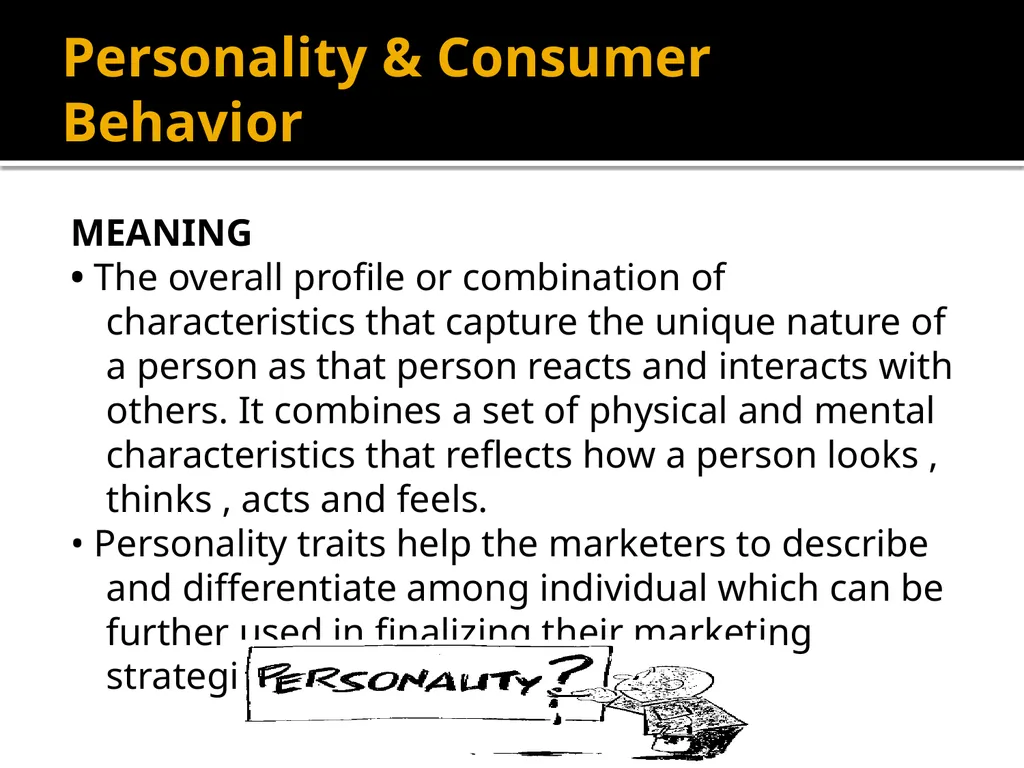
Personality & Consumer Behavior MEANING
• The overall profile or combination of characteristics that capture the unique nature of a person as that person reacts and interacts with others. It combines a set of physical and mental characteristics that reflects how a person looks , thinks , acts and feels.
• Personality traits help the marketers to describe and differentiate among individual which can be further used in finalizing their marketing strategies.<br>
• The overall profile or combination of characteristics that capture the unique nature of a person as that person reacts and interacts with others. It combines a set of physical and mental characteristics that reflects how a person looks , thinks , acts and feels.
• Personality traits help the marketers to describe and differentiate among individual which can be further used in finalizing their marketing strategies.<br>
03
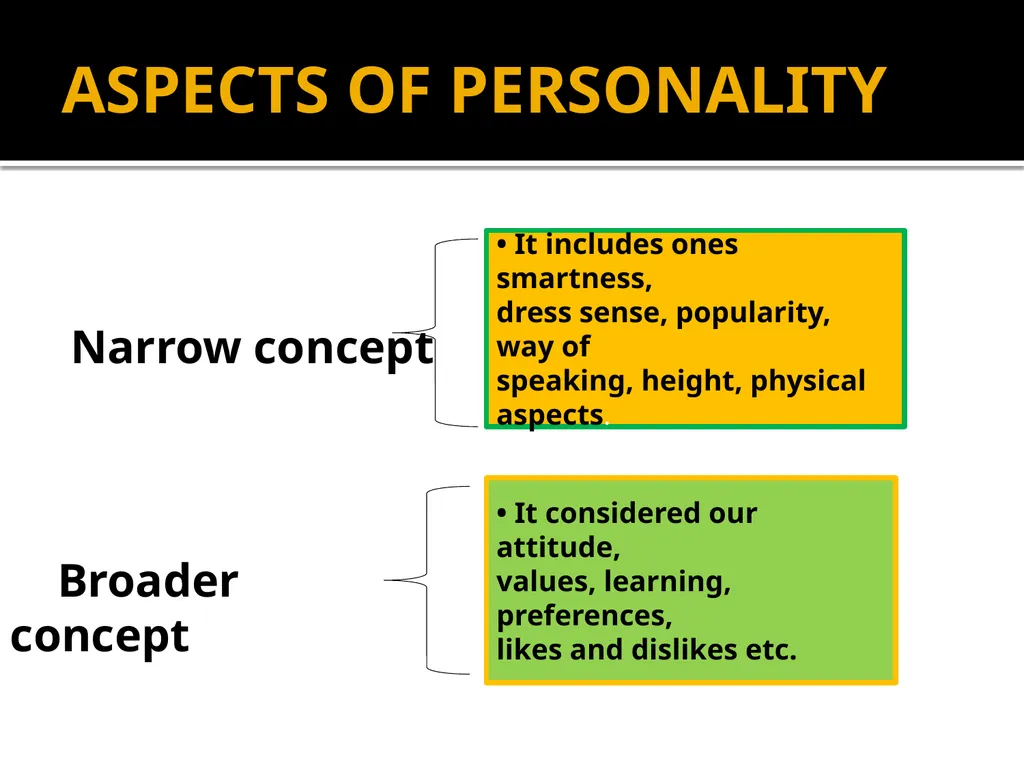
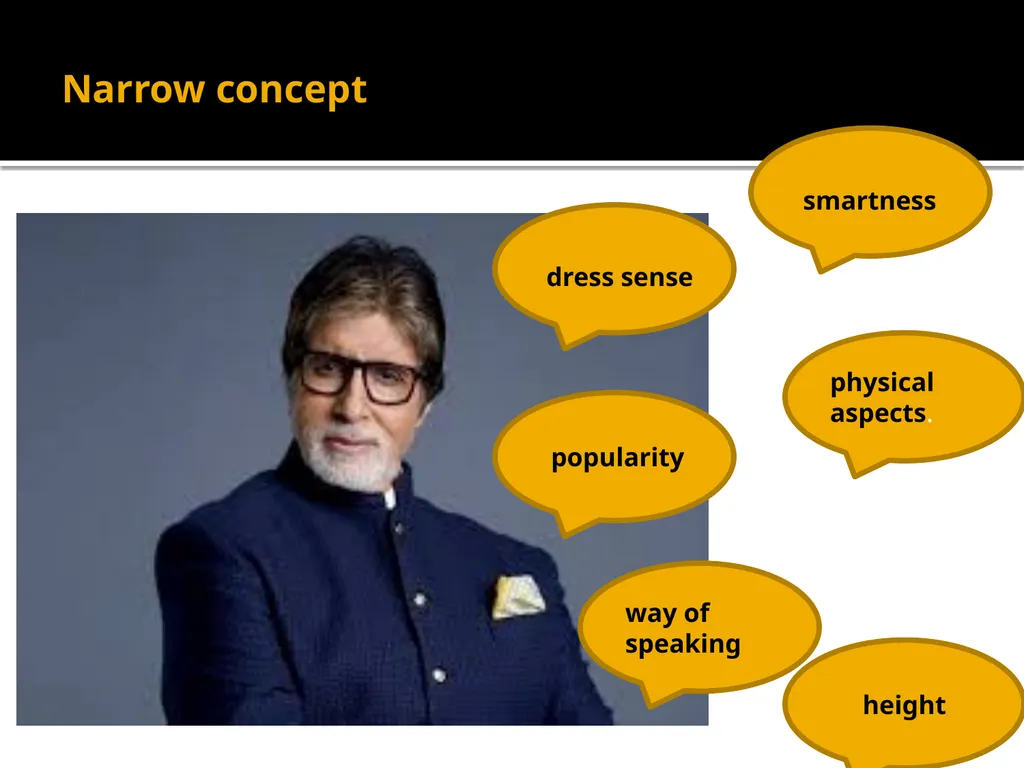
ASPECTS OF PERSONALITY Narrow concept • It includes ones smartness,
dress sense, popularity, way of
speaking, height, physical
aspects. • It considered our attitude,
values, learning, preferences,
likes and dislikes etc. Broader concept<br>
dress sense, popularity, way of
speaking, height, physical
aspects. • It considered our attitude,
values, learning, preferences,
likes and dislikes etc. Broader concept<br>
04
Narrow concept popularity way of
speaking height smartness dress sense physical
aspects.<br>
speaking height smartness dress sense physical
aspects.<br>
05
DEFINITION • “Personality may be understood as the characteristics pattern of behavior and modes of thinking that determine a person’s adjustment to the environment.”
HILGARD
• “Personality is, existence as a person , the assemblage of qualities , physical , mental and moral that set one apart from others , distinctive individually , as he is a man of strong personality , too.” WEBSTER’S NEW AMERICAN DICTIONARY<br>
HILGARD
• “Personality is, existence as a person , the assemblage of qualities , physical , mental and moral that set one apart from others , distinctive individually , as he is a man of strong personality , too.” WEBSTER’S NEW AMERICAN DICTIONARY<br>
06
PERSONALITY IS
WHAT A
FRAGNANCE TO A FLOWER…..<br>
WHAT A
FRAGNANCE TO A FLOWER…..<br>
07
Personality<br>
08
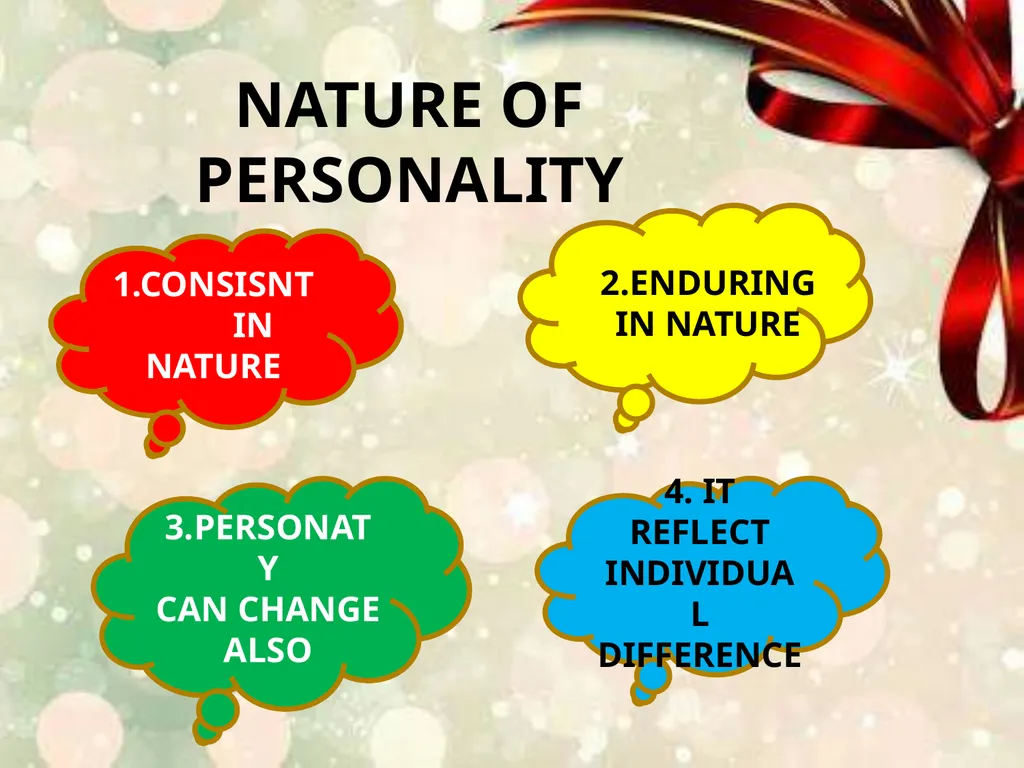
NATURE OF PERSONALITY 1.CONSISNT IN NATURE 3.PERSONATY
CAN CHANGE
ALSO 4. IT REFLECT
INDIVIDUAL
DIFFERENCE 2.ENDURING
IN NATURE<br>
CAN CHANGE
ALSO 4. IT REFLECT
INDIVIDUAL
DIFFERENCE 2.ENDURING
IN NATURE<br>
09
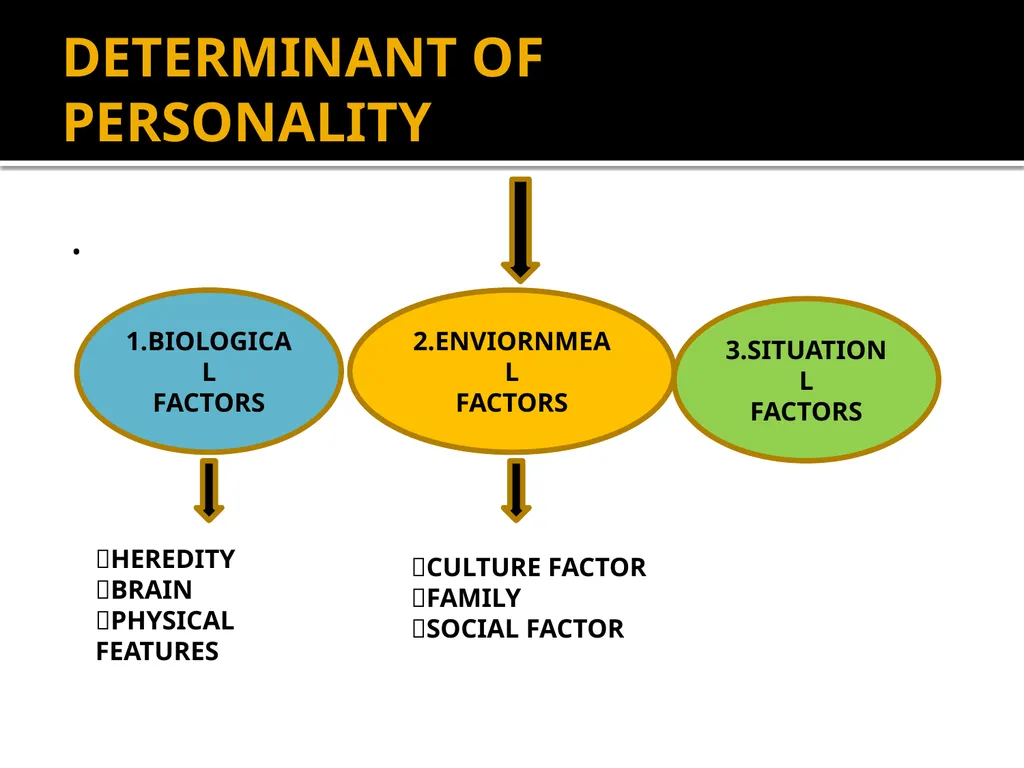
DETERMINANT OF
PERSONALITY . 1.BIOLOGICAL
FACTORS 2.ENVIORNMEAL
FACTORS 3.SITUATIONL
FACTORS HEREDITY
BRAIN
PHYSICAL FEATURES CULTURE FACTOR
FAMILY
SOCIAL FACTOR<br>
FACTORS 2.ENVIORNMEAL
FACTORS 3.SITUATIONL
FACTORS HEREDITY
BRAIN
PHYSICAL FEATURES CULTURE FACTOR
FAMILY
SOCIAL FACTOR<br>
10
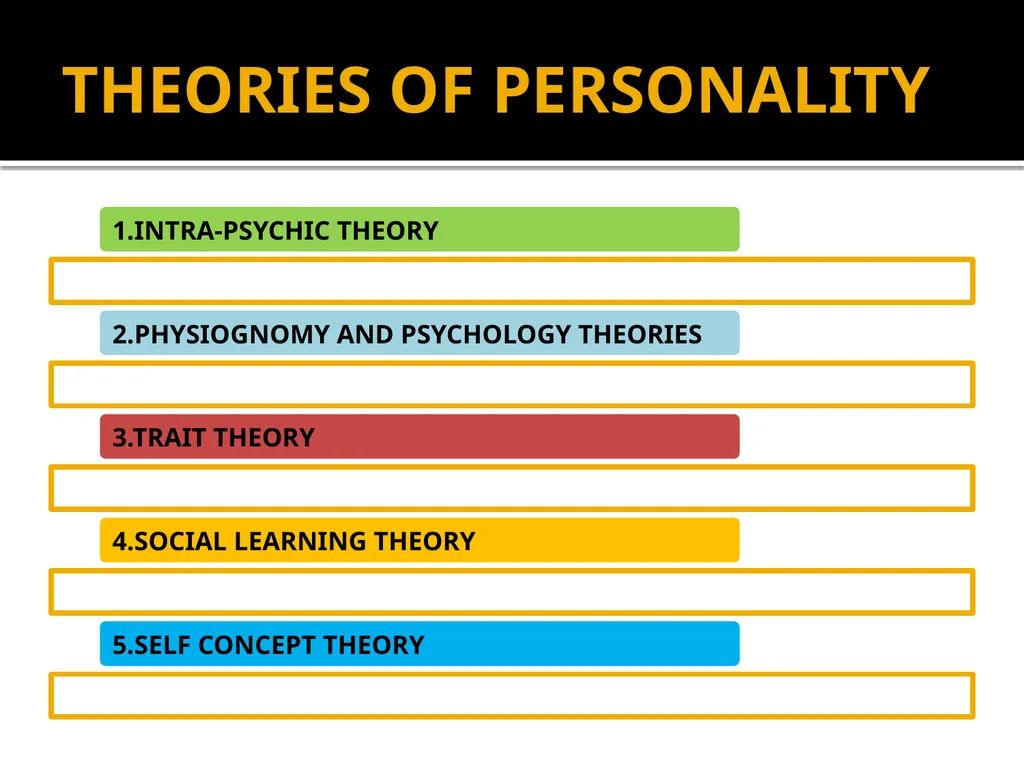
THEORIES OF PERSONALITY<br>
11
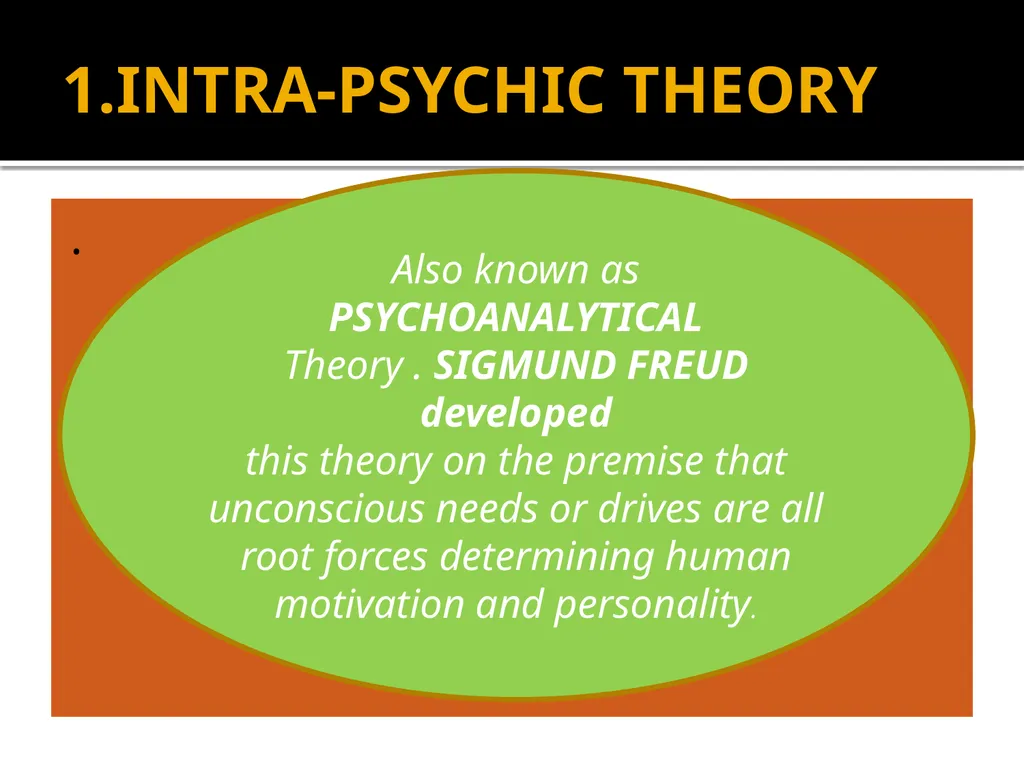
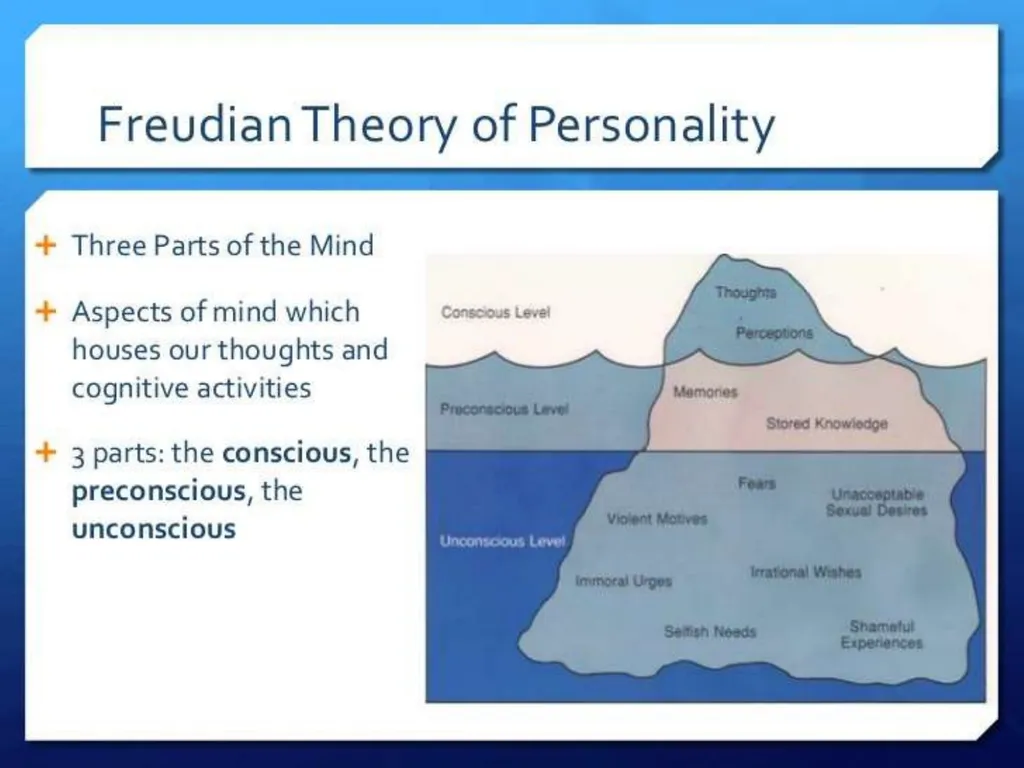
1.INTRA-PSYCHIC THEORY . Also known as PSYCHOANALYTICAL
Theory . SIGMUND FREUD developed
this theory on the premise that
unconscious needs or drives are all
root forces determining human
motivation and personality.<br>
Theory . SIGMUND FREUD developed
this theory on the premise that
unconscious needs or drives are all
root forces determining human
motivation and personality.<br>
12
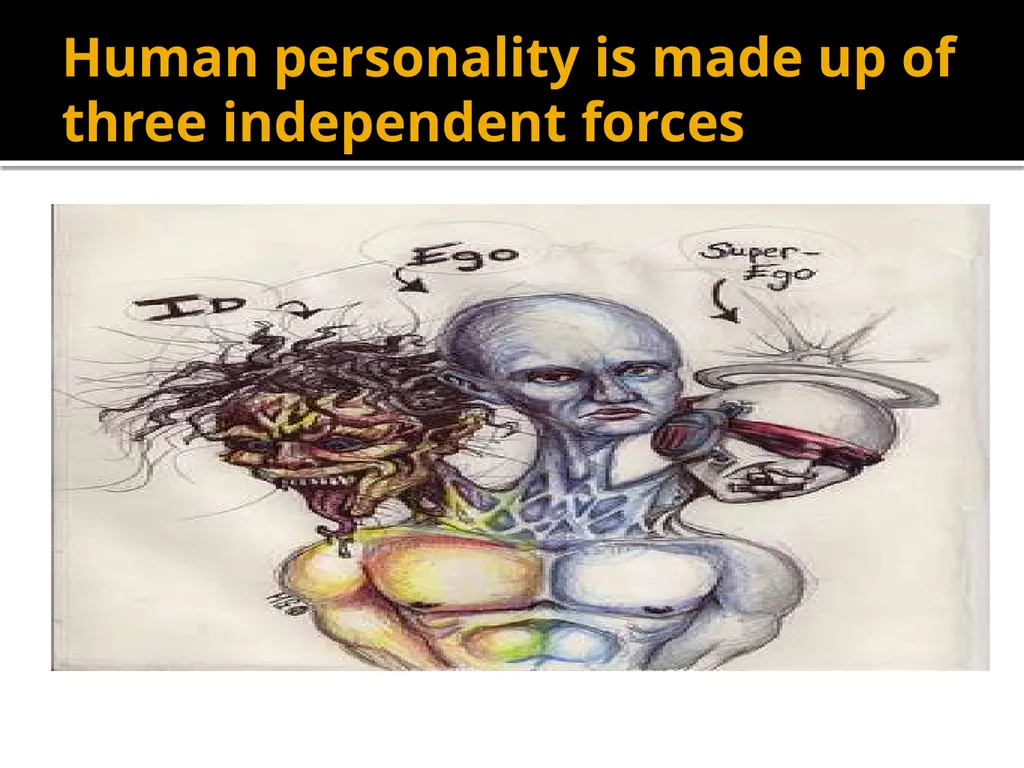
Human personality is made up of
three independent forces<br>
13
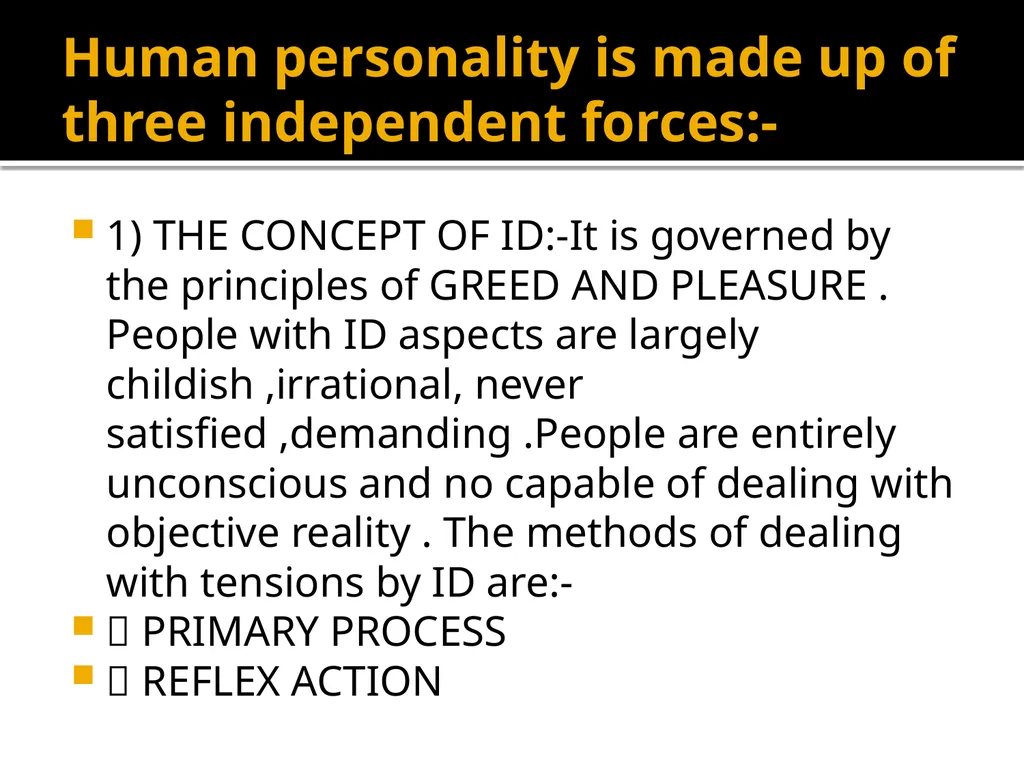
Human personality is made up of
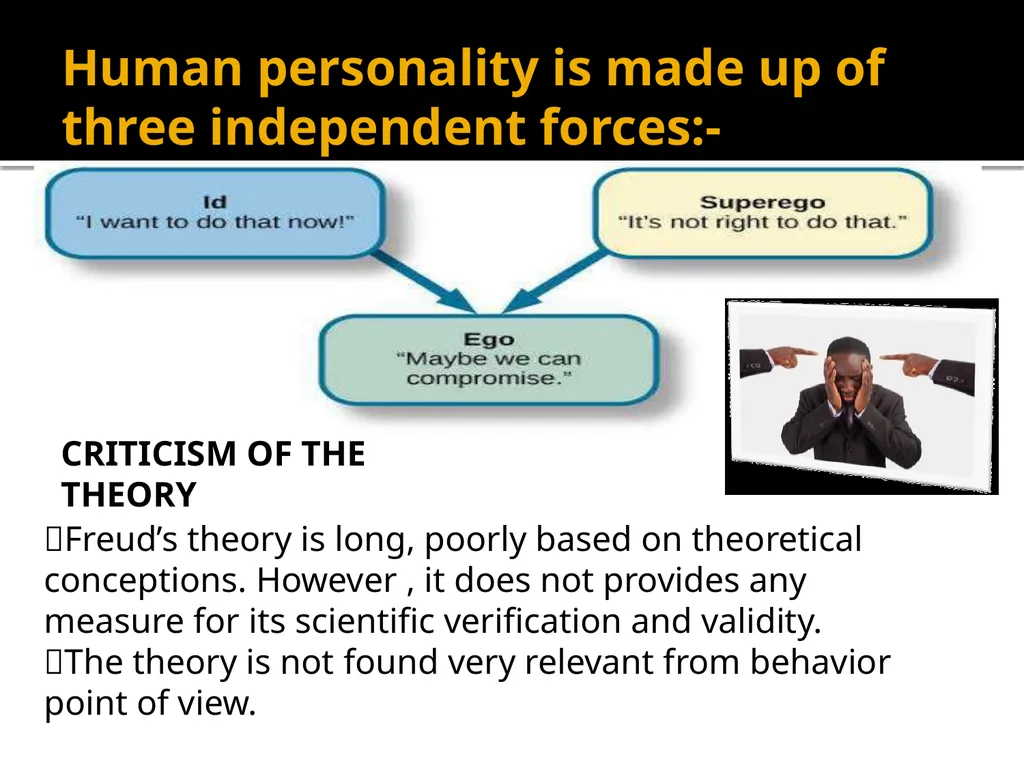
three independent forces:- 1) THE CONCEPT OF ID:-It is governed by the principles of GREED AND PLEASURE . People with ID aspects are largely childish ,irrational, never satisfied ,demanding .People are entirely unconscious and no capable of dealing with objective reality . The methods of dealing with tensions by ID are:-
PRIMARY PROCESS
REFLEX ACTION<br>
PRIMARY PROCESS
REFLEX ACTION<br>
14
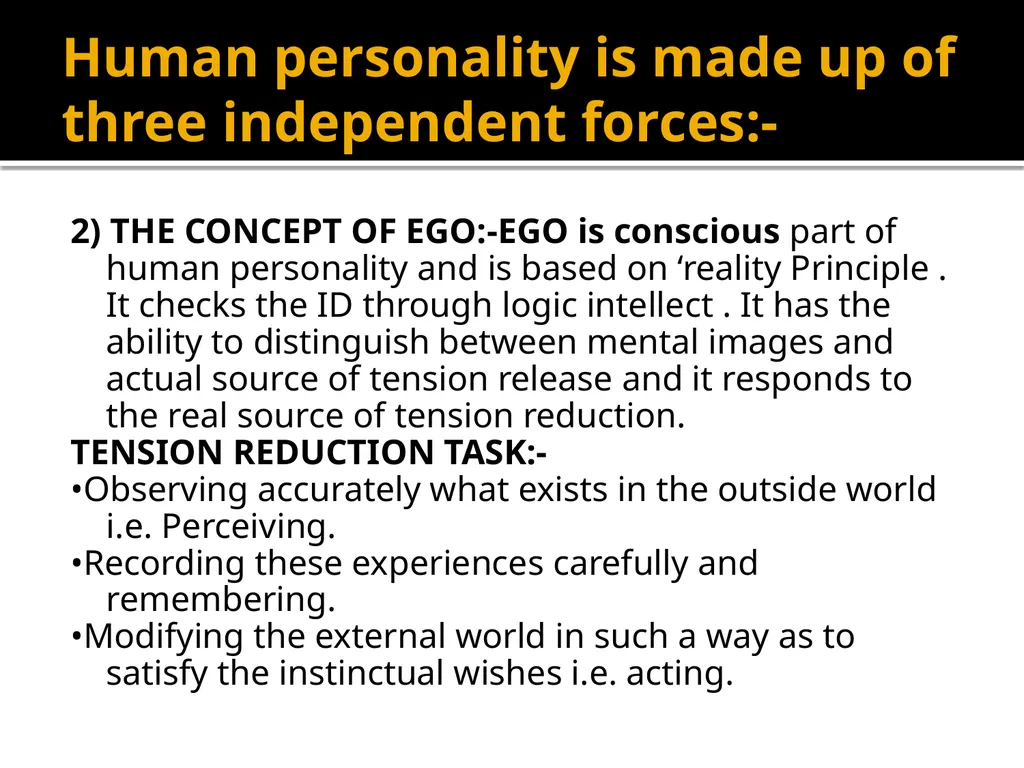
Human personality is made up of
three independent forces:- 2) THE CONCEPT OF EGO:-EGO is conscious part of human personality and is based on ‘reality Principle . It checks the ID through logic intellect . It has the ability to distinguish between mental images and actual source of tension release and it responds to the real source of tension reduction.
TENSION REDUCTION TASK:-
•Observing accurately what exists in the outside world i.e. Perceiving.
•Recording these experiences carefully and remembering.
•Modifying the external world in such a way as to satisfy the instinctual wishes i.e. acting.<br>
TENSION REDUCTION TASK:-
•Observing accurately what exists in the outside world i.e. Perceiving.
•Recording these experiences carefully and remembering.
•Modifying the external world in such a way as to satisfy the instinctual wishes i.e. acting.<br>
15
Human personality is made up of
three independent forces:- 3) THE CONCEPT OF SUPER EGO:-It represents system of values , norms and ethics that guide and govern a person to behave properly in the society . It represents the ideal rather than real , defines what is right and good and it influences the individual to strive for perfection.
EXAMPLE OF SUPER EGO
Sarah knew that she could steal the supplies from work and no one would know about it. However she knew that stealing was wrong, so she decided not to take anything even though she would probably never get caught…….<br>
EXAMPLE OF SUPER EGO
Sarah knew that she could steal the supplies from work and no one would know about it. However she knew that stealing was wrong, so she decided not to take anything even though she would probably never get caught…….<br>
16
Human personality is made up of
three independent forces:- CRITICISM OF THE THEORY Freud’s theory is long, poorly based on theoretical conceptions. However , it does not provides any measure for its scientific verification and validity.
The theory is not found very relevant from behavior point of view.<br>
The theory is not found very relevant from behavior point of view.<br>
17
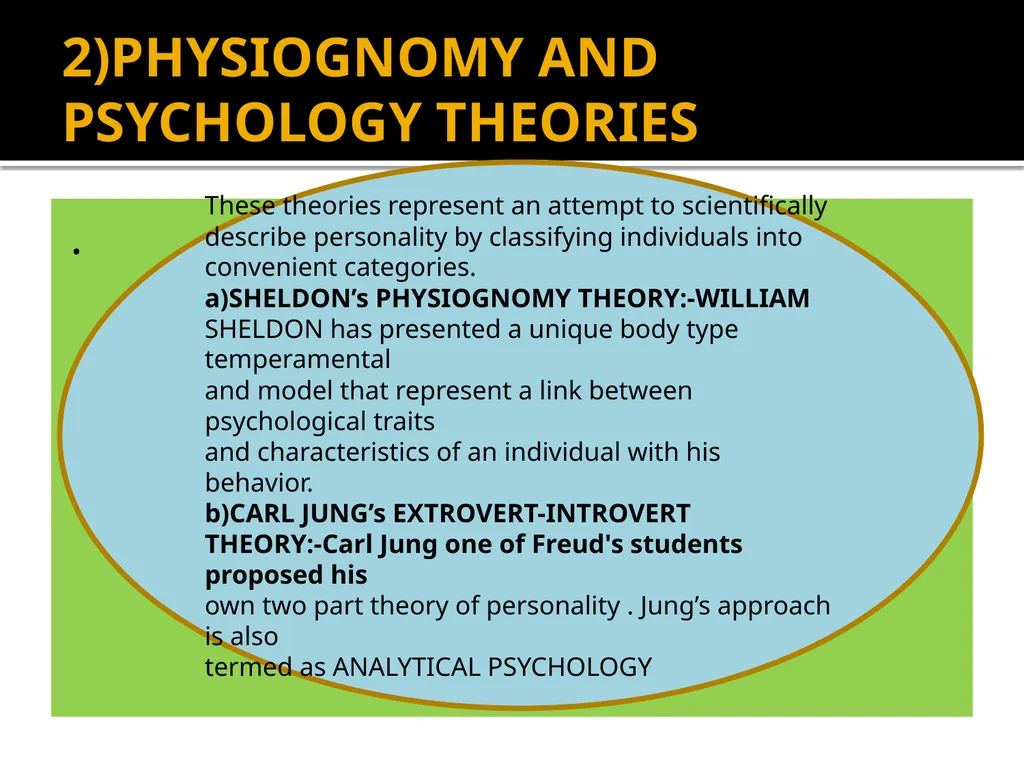
2)PHYSIOGNOMY AND PSYCHOLOGY THEORIES . These theories represent an attempt to scientifically
describe personality by classifying individuals into
convenient categories.
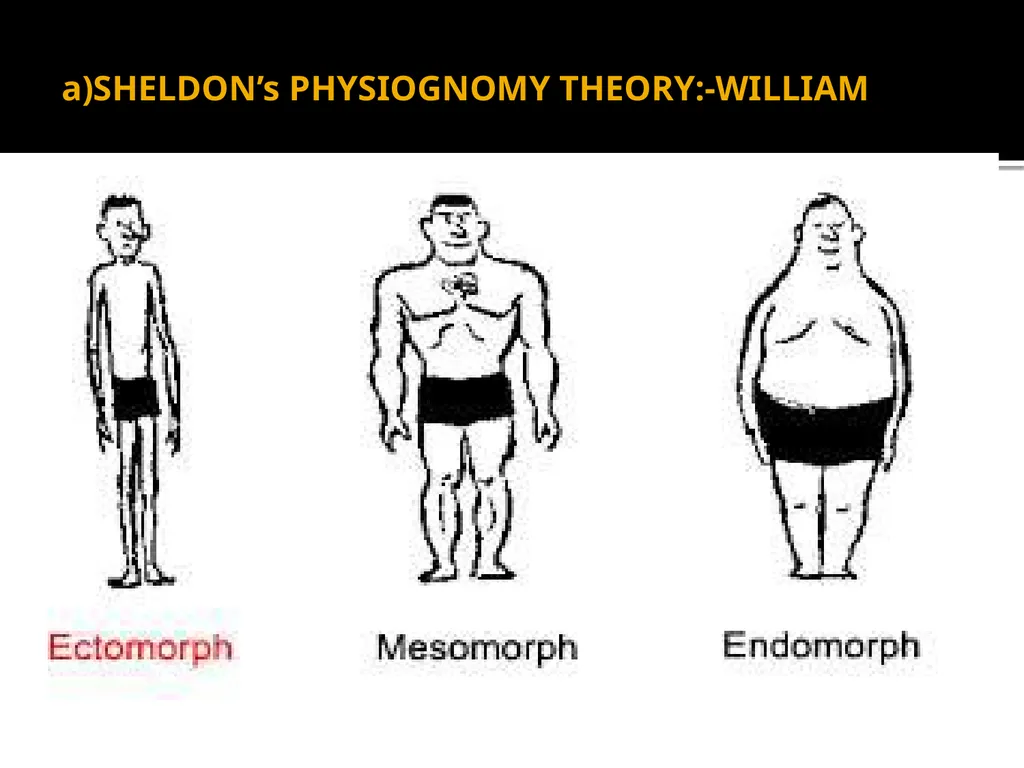
a)SHELDON’s PHYSIOGNOMY THEORY:-WILLIAM
SHELDON has presented a unique body type temperamental
and model that represent a link between psychological traits
and characteristics of an individual with his behavior.
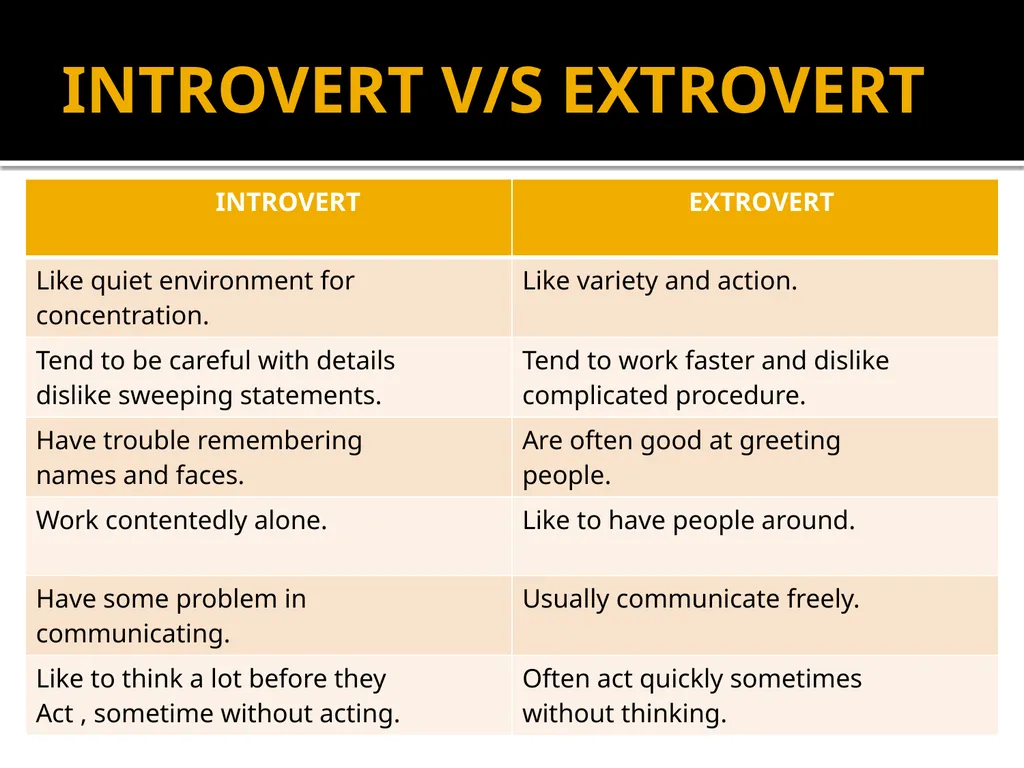
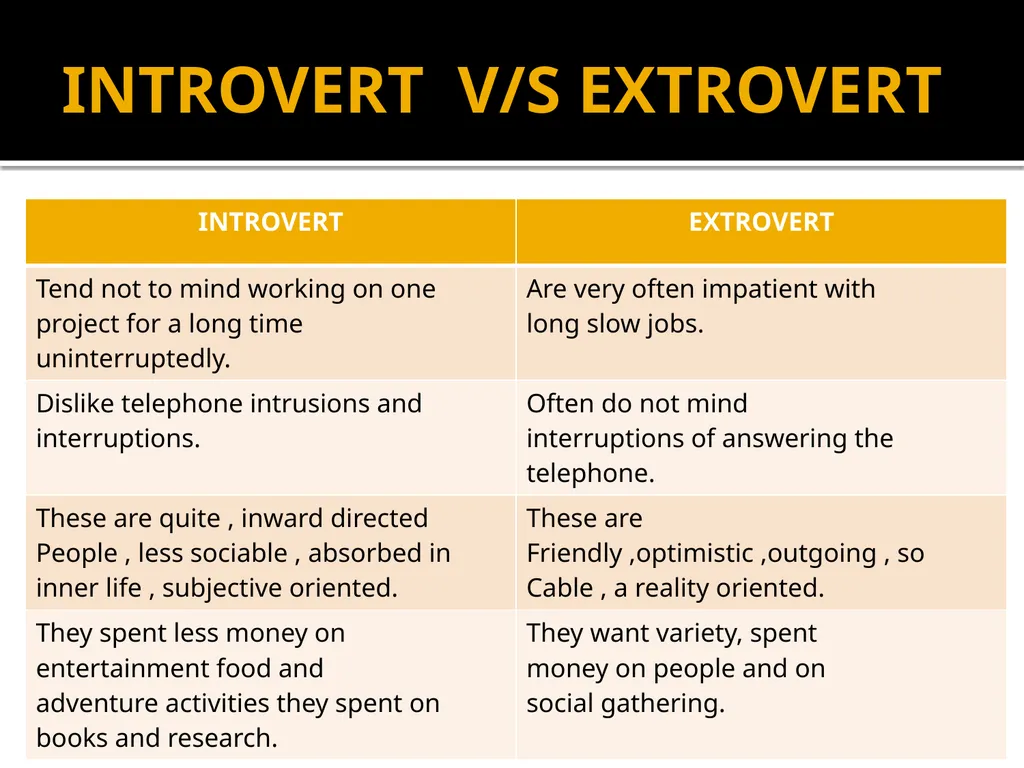
b)CARL JUNG’s EXTROVERT-INTROVERT
THEORY:-Carl Jung one of Freud's students proposed his
own two part theory of personality . Jung’s approach is also
termed as ANALYTICAL PSYCHOLOGY<br>
describe personality by classifying individuals into
convenient categories.
a)SHELDON’s PHYSIOGNOMY THEORY:-WILLIAM
SHELDON has presented a unique body type temperamental
and model that represent a link between psychological traits
and characteristics of an individual with his behavior.
b)CARL JUNG’s EXTROVERT-INTROVERT
THEORY:-Carl Jung one of Freud's students proposed his
own two part theory of personality . Jung’s approach is also
termed as ANALYTICAL PSYCHOLOGY<br>
18
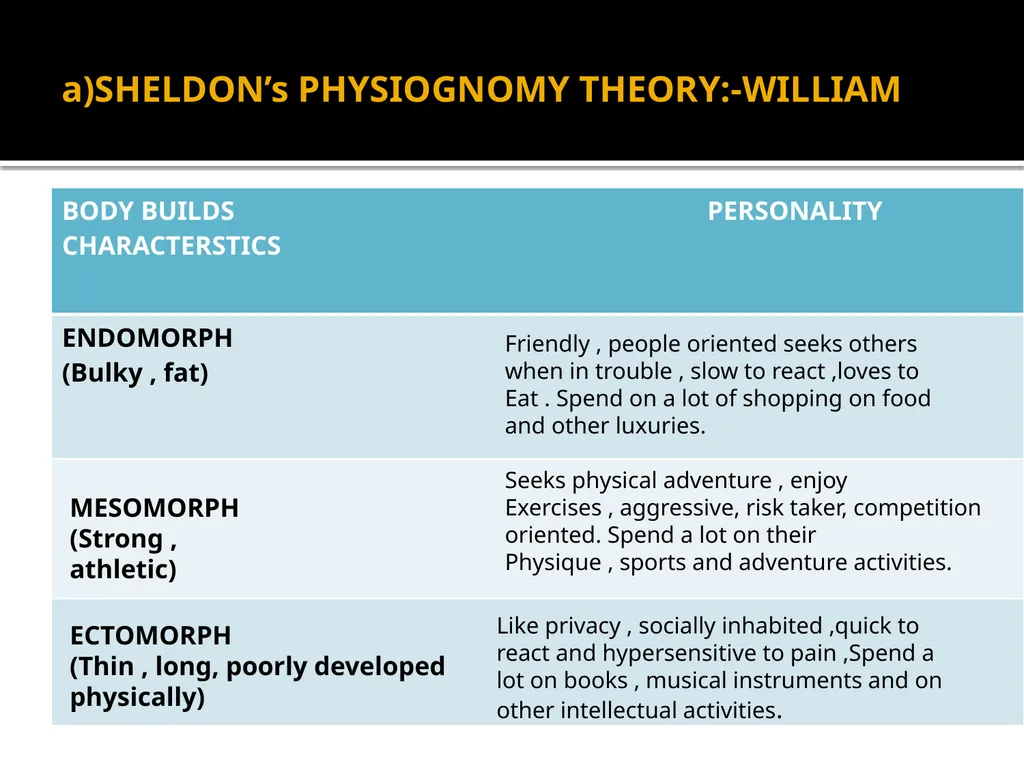
a)SHELDON’s PHYSIOGNOMY THEORY:-WILLIAM Friendly , people oriented seeks others
when in trouble , slow to react ,loves to
Eat . Spend on a lot of shopping on food
and other luxuries. MESOMORPH
(Strong , athletic) Seeks physical adventure , enjoy
Exercises , aggressive, risk taker, competition
oriented. Spend a lot on their
Physique , sports and adventure activities. ECTOMORPH
(Thin , long, poorly developed physically) Like privacy , socially inhabited ,quick to
react and hypersensitive to pain ,Spend a
lot on books , musical instruments and on
other intellectual activities.<br>
when in trouble , slow to react ,loves to
Eat . Spend on a lot of shopping on food
and other luxuries. MESOMORPH
(Strong , athletic) Seeks physical adventure , enjoy
Exercises , aggressive, risk taker, competition
oriented. Spend a lot on their
Physique , sports and adventure activities. ECTOMORPH
(Thin , long, poorly developed physically) Like privacy , socially inhabited ,quick to
react and hypersensitive to pain ,Spend a
lot on books , musical instruments and on
other intellectual activities.<br>
19
a)SHELDON’s PHYSIOGNOMY THEORY:-WILLIAM<br>
20
INTROVERT V/S EXTROVERT<br>
21
INTROVERT V/S EXTROVERT<br>
22
JUNG’s FOUR DIMENSIONS<br>
23
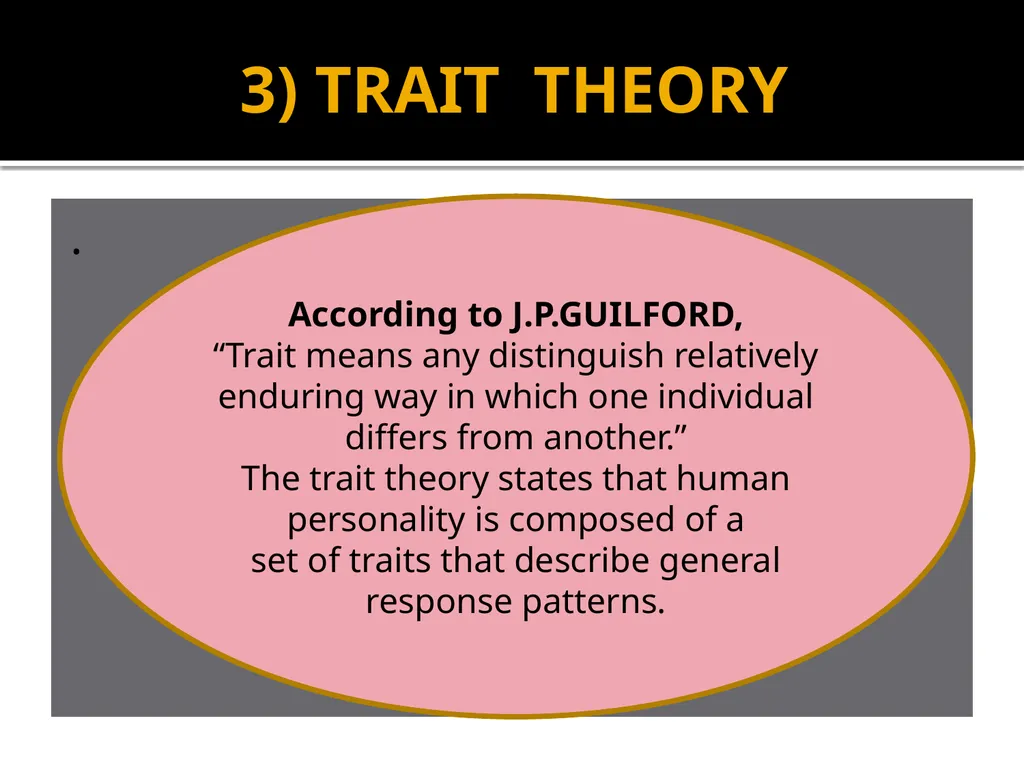
3) TRAIT THEORY . According to J.P.GUILFORD,
“Trait means any distinguish relatively
enduring way in which one individual differs from another.”
The trait theory states that human personality is composed of a
set of traits that describe general response patterns.<br>
“Trait means any distinguish relatively
enduring way in which one individual differs from another.”
The trait theory states that human personality is composed of a
set of traits that describe general response patterns.<br>
24
ASSUMPTION BASED ON TRAITS Traits are common to many individuals but vary in absolute amounts between two individuals.
Traits are relatively stable , their consistent occurrence influence the human behavior.
One’s trait can be inferred by measuring his/her behavioral indicators.<br>
Traits are relatively stable , their consistent occurrence influence the human behavior.
One’s trait can be inferred by measuring his/her behavioral indicators.<br>
25
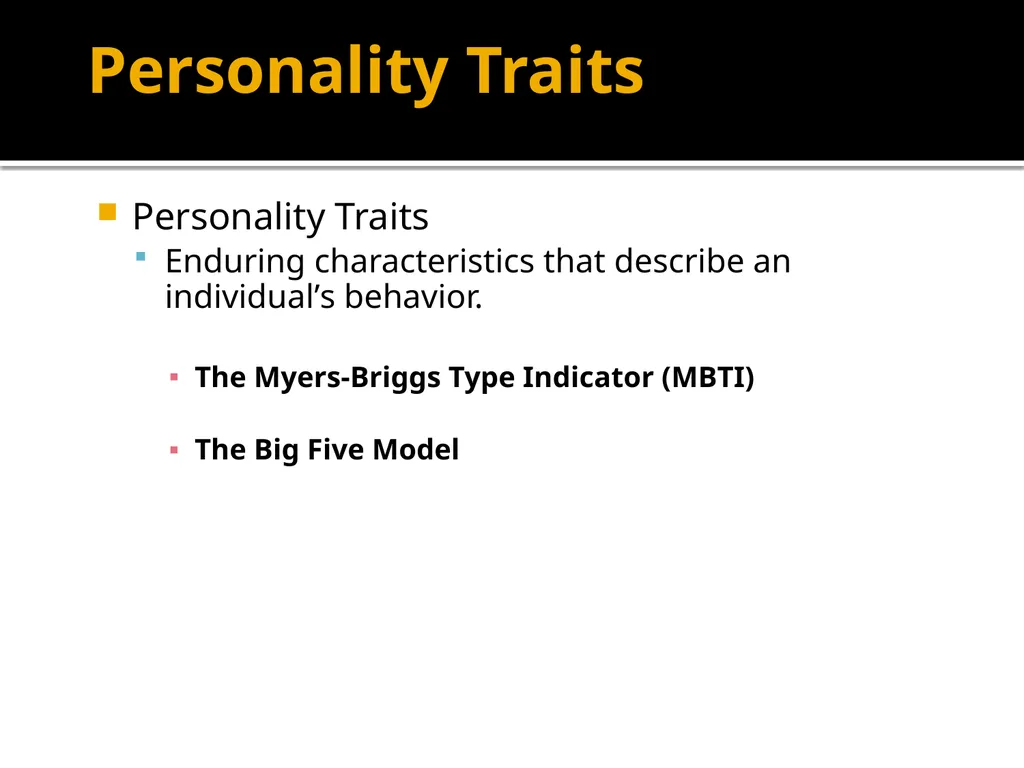
Personality Traits Personality Traits
Enduring characteristics that describe an individual’s behavior.
The Myers-Briggs Type Indicator (MBTI)
The Big Five Model<br>
Enduring characteristics that describe an individual’s behavior.
The Myers-Briggs Type Indicator (MBTI)
The Big Five Model<br>
26
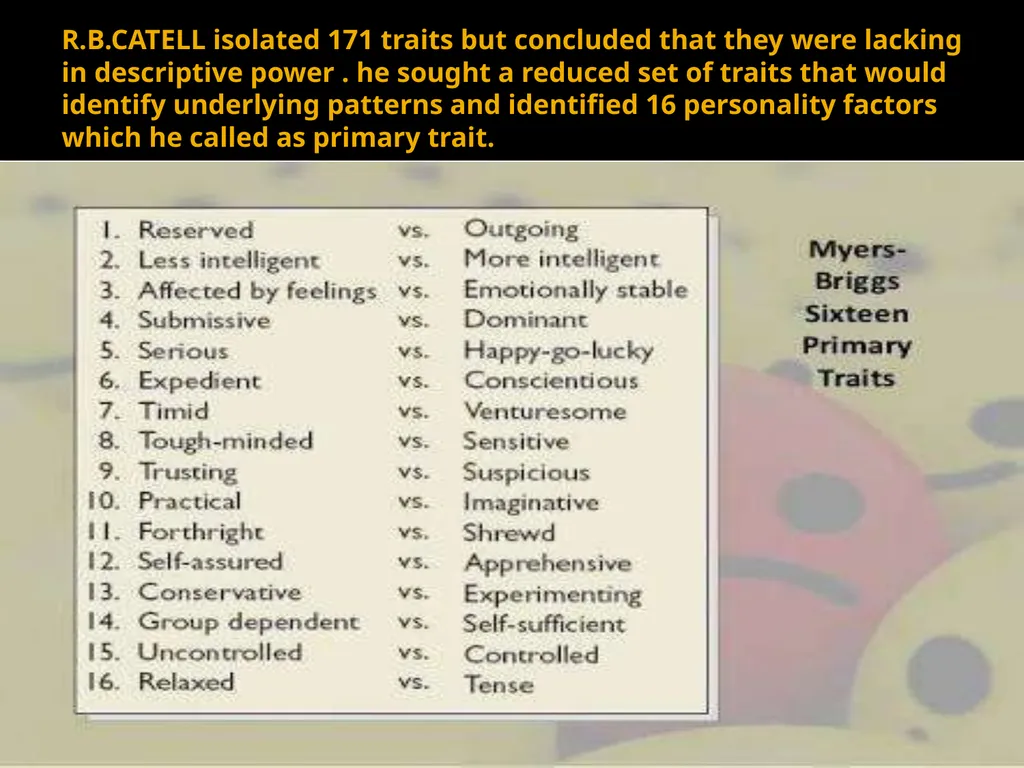
R.B.CATELL isolated 171 traits but concluded that they were lacking in descriptive power . he sought a reduced set of traits that would identify underlying patterns and identified 16 personality factors which he called as primary trait.<br>
27
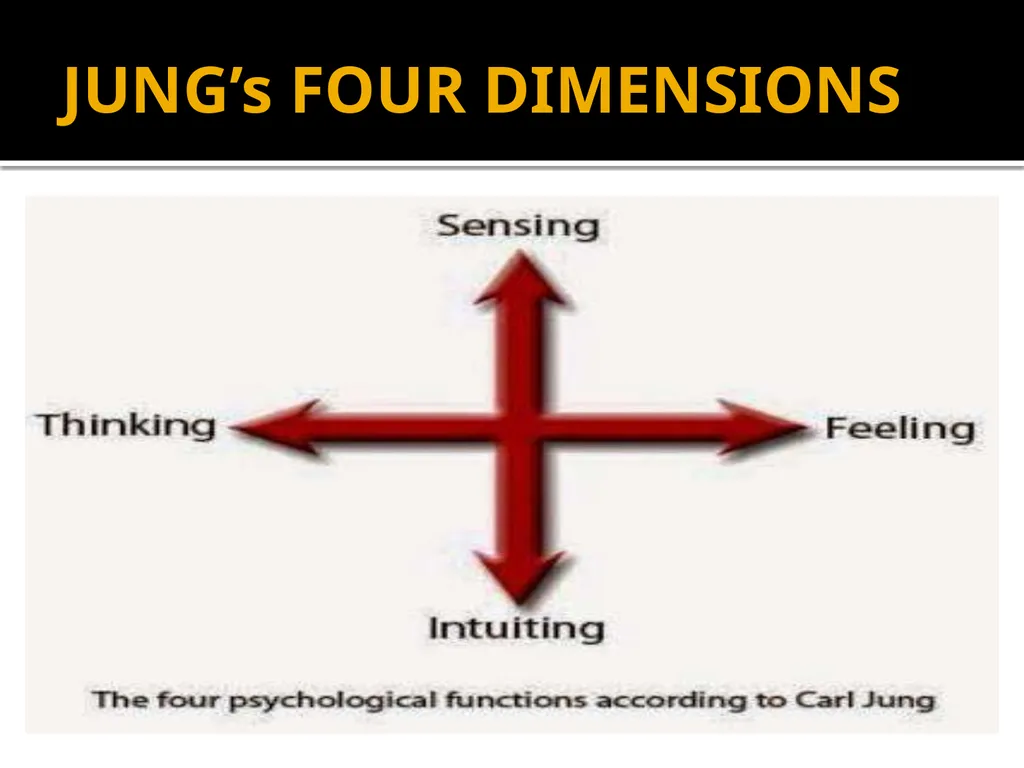
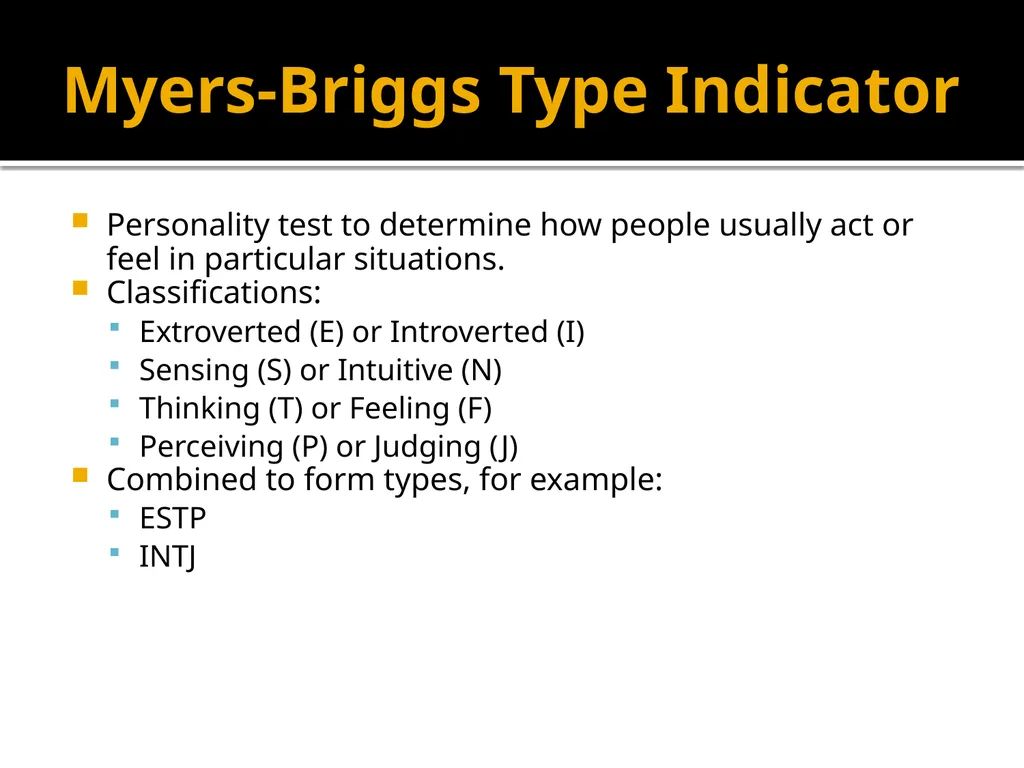
Myers-Briggs Type Indicator Personality test to determine how people usually act or feel in particular situations.
Classifications:
Extroverted (E) or Introverted (I)
Sensing (S) or Intuitive (N)
Thinking (T) or Feeling (F)
Perceiving (P) or Judging (J)
Combined to form types, for example:
ESTP
INTJ<br>
Classifications:
Extroverted (E) or Introverted (I)
Sensing (S) or Intuitive (N)
Thinking (T) or Feeling (F)
Perceiving (P) or Judging (J)
Combined to form types, for example:
ESTP
INTJ<br>
28
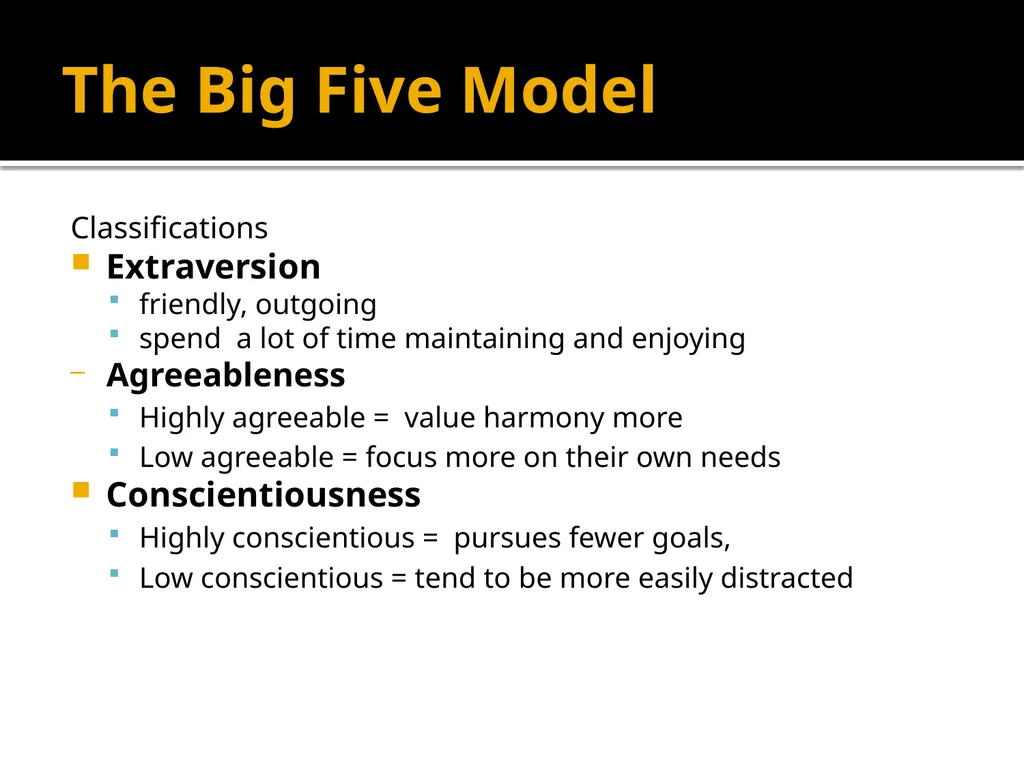
The Big Five Model Classifications
Extraversion
friendly, outgoing
spend a lot of time maintaining and enjoying
Agreeableness
Highly agreeable = value harmony more
Low agreeable = focus more on their own needs
Conscientiousness
Highly conscientious = pursues fewer goals,
Low conscientious = tend to be more easily distracted<br>
Extraversion
friendly, outgoing
spend a lot of time maintaining and enjoying
Agreeableness
Highly agreeable = value harmony more
Low agreeable = focus more on their own needs
Conscientiousness
Highly conscientious = pursues fewer goals,
Low conscientious = tend to be more easily distracted<br>
29
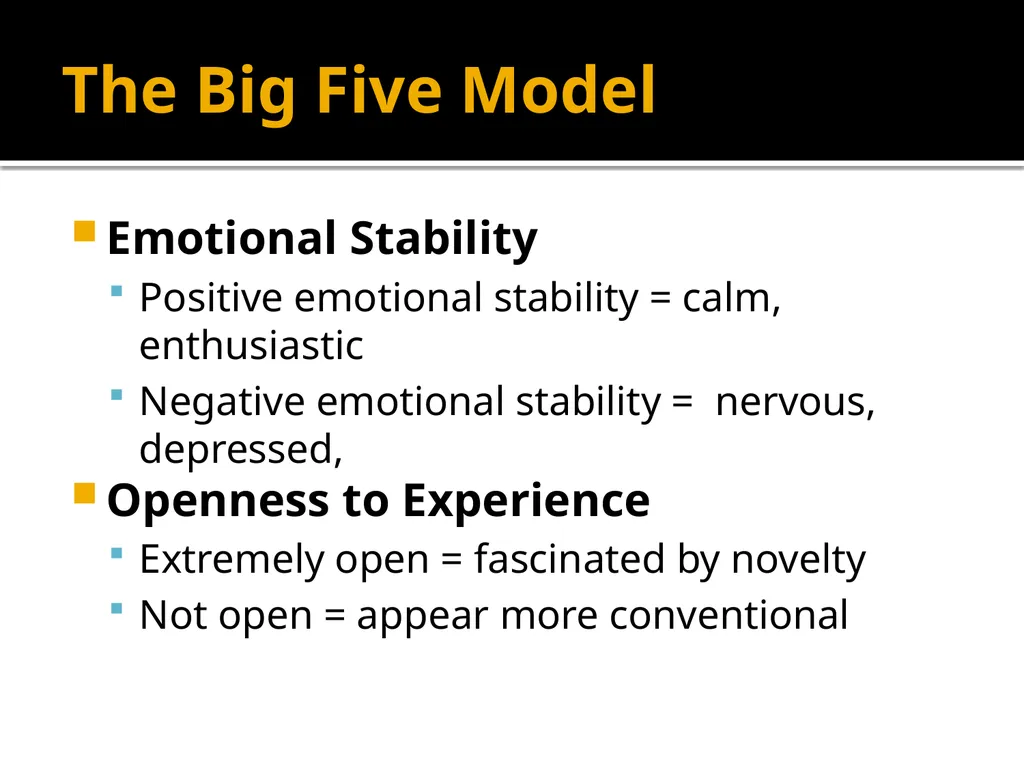
The Big Five Model Emotional Stability
Positive emotional stability = calm, enthusiastic
Negative emotional stability = nervous, depressed,
Openness to Experience
Extremely open = fascinated by novelty
Not open = appear more conventional<br>
Positive emotional stability = calm, enthusiastic
Negative emotional stability = nervous, depressed,
Openness to Experience
Extremely open = fascinated by novelty
Not open = appear more conventional<br>
30
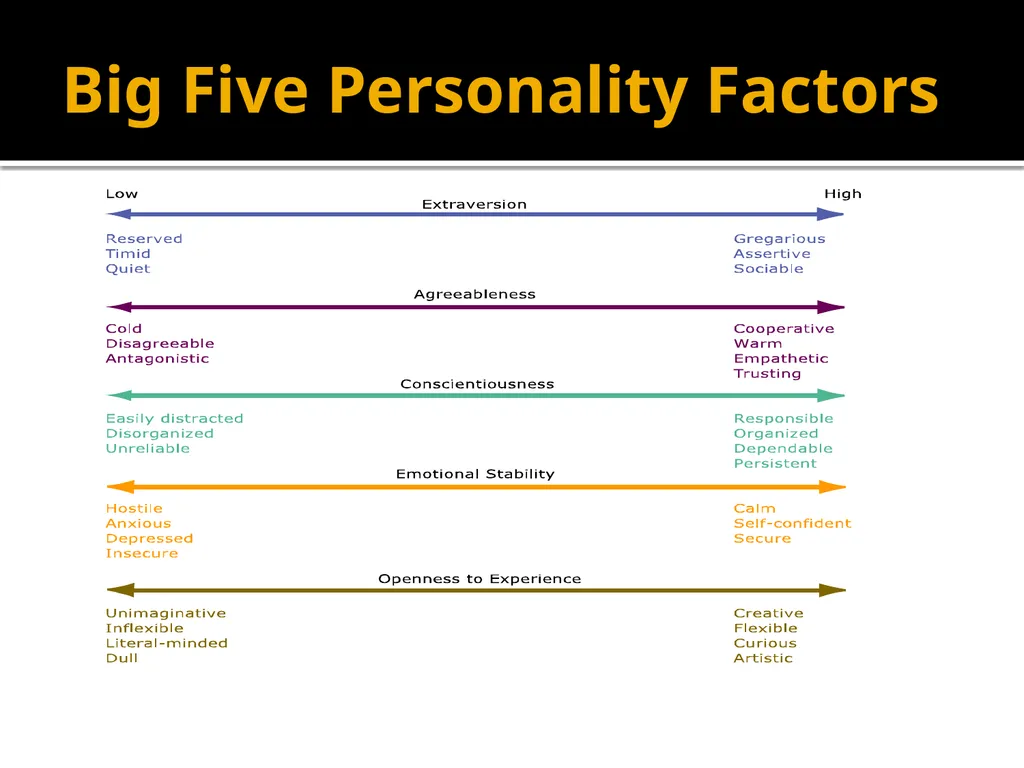
Big Five Personality Factors<br>
31
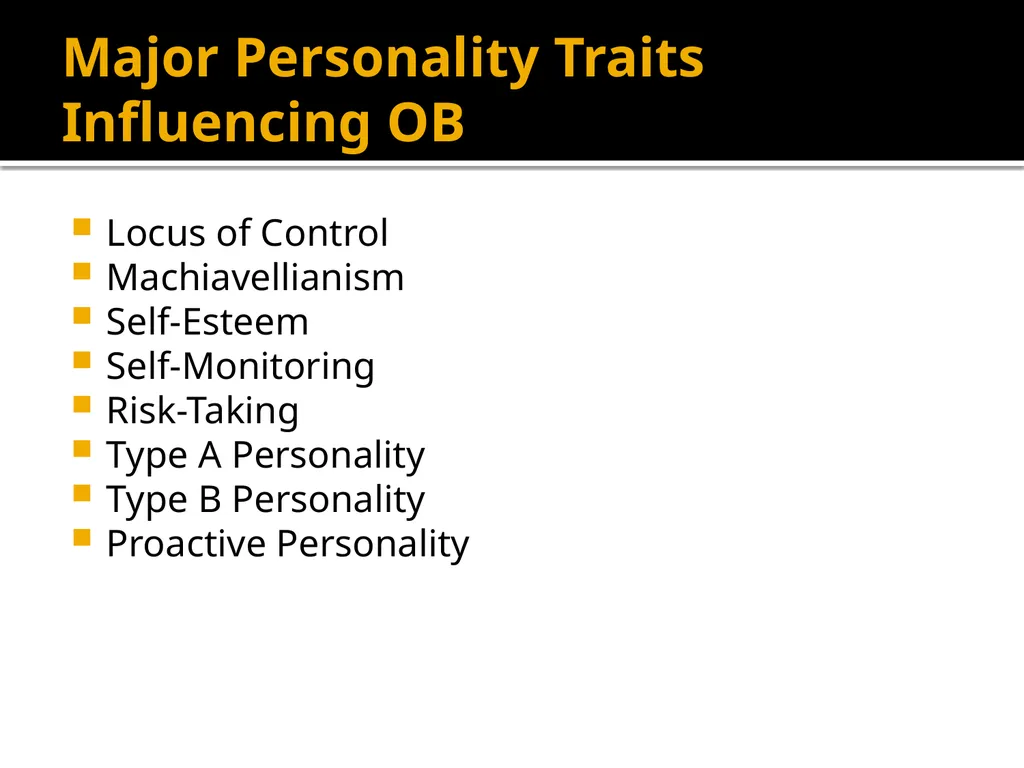
Major Personality Traits Influencing OB Locus of Control
Machiavellianism
Self-Esteem
Self-Monitoring
Risk-Taking
Type A Personality
Type B Personality
Proactive Personality<br>
Machiavellianism
Self-Esteem
Self-Monitoring
Risk-Taking
Type A Personality
Type B Personality
Proactive Personality<br>
32
Locus of Control The degree to which people believe they are in control of their own fate.
Internals
Individuals who believe that they control what happens to them.
Externals
Individuals who believe that what happens to them is controlled by outside forces such as luck or chance.<br>
Internals
Individuals who believe that they control what happens to them.
Externals
Individuals who believe that what happens to them is controlled by outside forces such as luck or chance.<br>
33
Machiavellianism Degree to which an individual is pragmatic, maintains emotional distance, and believes that ends can justify means.<br>
34
Self-Esteem Individuals’ degree of liking or disliking of themselves.<br>
35
Self-Monitoring A personality trait that measures an individual’s ability to adjust behaviour to external situational factors.<br>
36
Risk-Taking Refers to a person’s willingness to take chances or risks.<br>
37
Type A Personality Moves,
Impatient
Multitasks
Dislikes leisure<br>
Impatient
Multitasks
Dislikes leisure<br>
38
Type B Personality Never suffers
Doesn’t need to display
Plays for fun
Can relax<br>
Doesn’t need to display
Plays for fun
Can relax<br>
39
Proactive Personality A person who identifies opportunities, shows initiative, takes action, and perseveres until meaningful change occurs.<br>
40
EVALUATION OF TRAIT
THEORY Traits may be too abstract.
Trait approach focus on isolated trait without
specifying how these traits are organized within the
personality.
Without knowing which trait are more important
and how they are related to other traits of an
individual it is not possible to make adequate
description of an individual’s personality.
Another fundamental problem of trait theories is
that they are essentially descriptive rather than
analytical.<br>
Trait approach focus on isolated trait without
specifying how these traits are organized within the
personality.
Without knowing which trait are more important
and how they are related to other traits of an
individual it is not possible to make adequate
description of an individual’s personality.
Another fundamental problem of trait theories is
that they are essentially descriptive rather than
analytical.<br>
41
4) SOCIAL LEARNING THEORY The main focus on social learning approach is on the pattern of behaviour the individual learn in
copying with environments. .<br>
copying with environments. .<br>
42
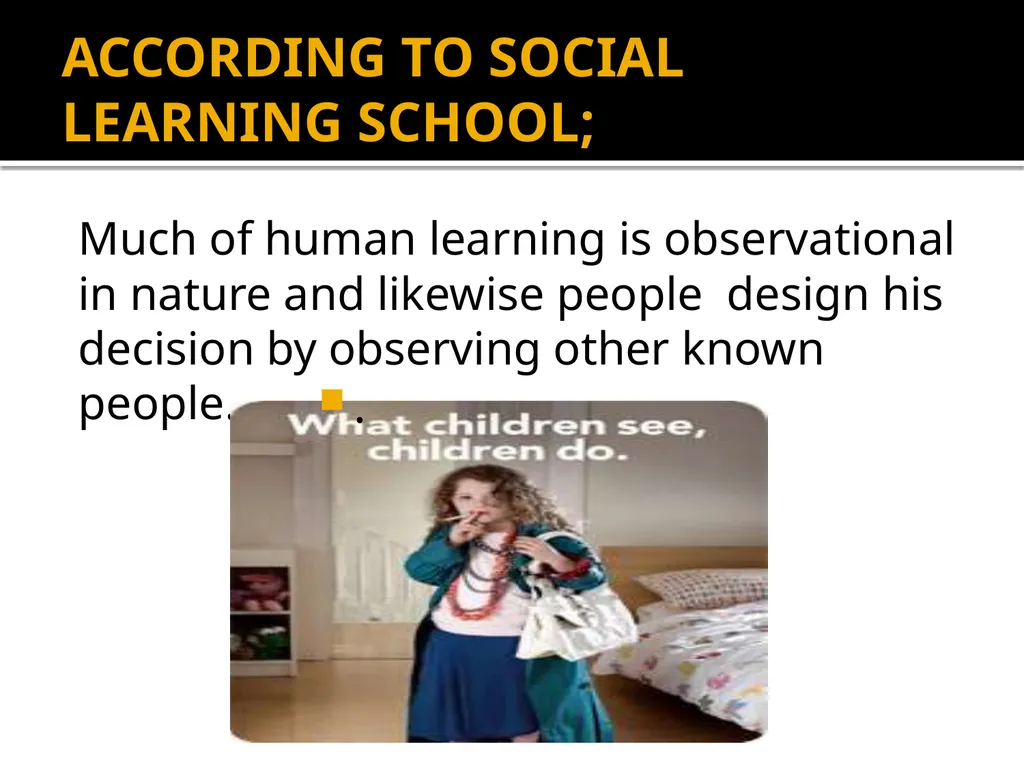
ACCORDING TO SOCIAL LEARNING SCHOOL; Much of human learning is observational in nature and likewise people design his decision by observing other known people. .<br>
43
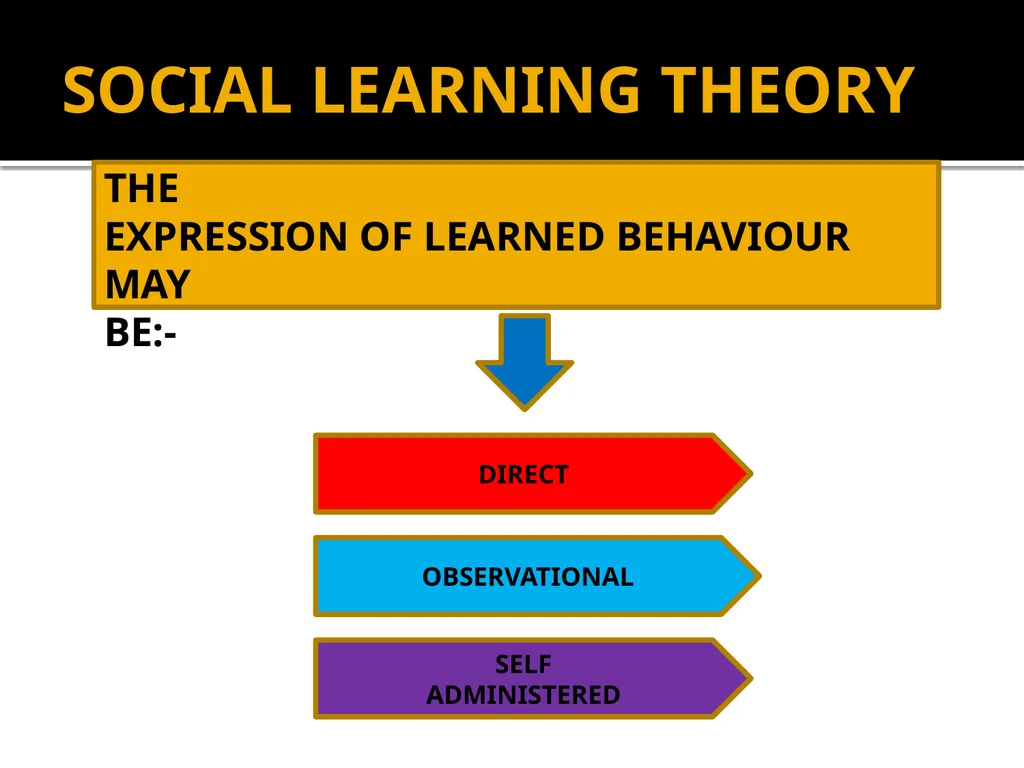
SOCIAL LEARNING THEORY THE REINFORCEMENT THAT CONTROLS THE
EXPRESSION OF LEARNED BEHAVIOUR MAY
BE:- DIRECT OBSERVATIONAL SELF
ADMINISTERED<br>
EXPRESSION OF LEARNED BEHAVIOUR MAY
BE:- DIRECT OBSERVATIONAL SELF
ADMINISTERED<br>
44
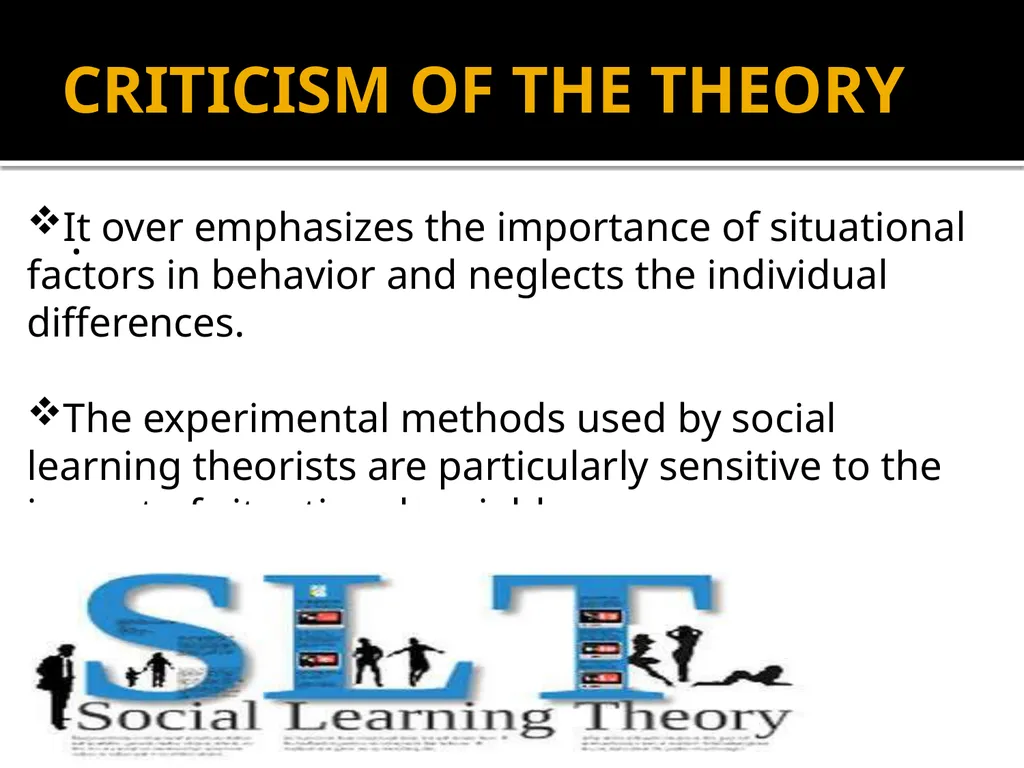
CRITICISM OF THE THEORY It over emphasizes the importance of situational factors in behavior and neglects the individual differences.
The experimental methods used by social learning theorists are particularly sensitive to the impact of situational variable. .<br>
The experimental methods used by social learning theorists are particularly sensitive to the impact of situational variable. .<br>
45
5) SELF CONCEPT THEORY • Self concept is defined as ” the totality of the individuals thoughts and feelings having reference to herself / himself as an object.” .<br>
46
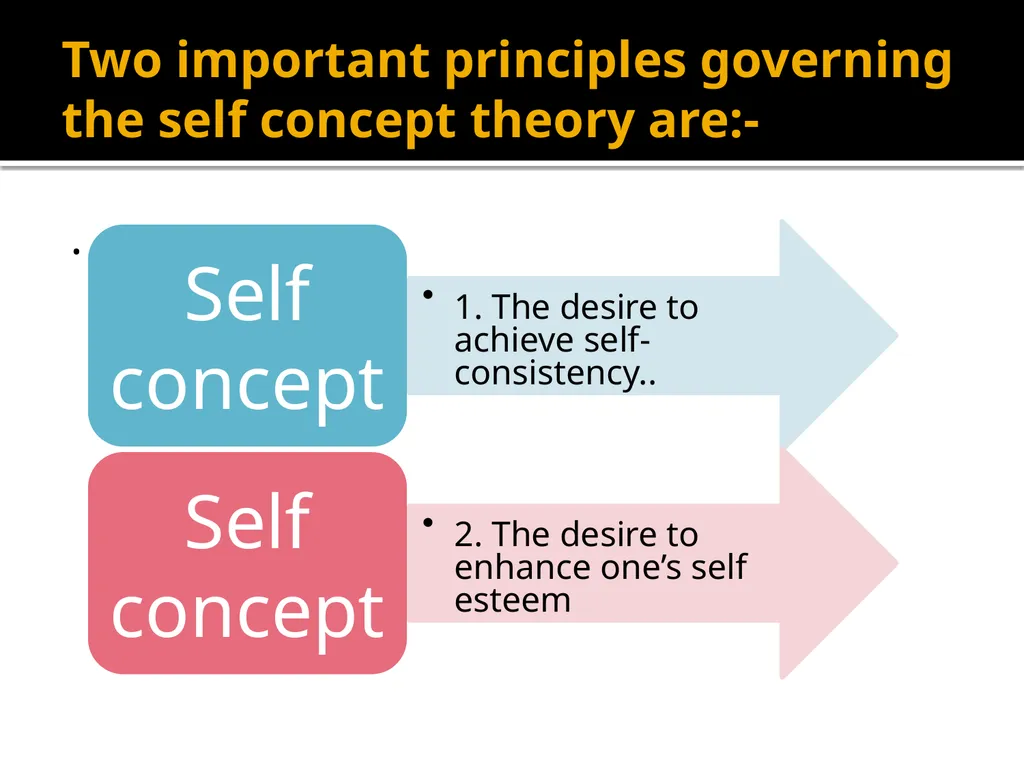
Two important principles governing the self concept theory are:- .<br>
47
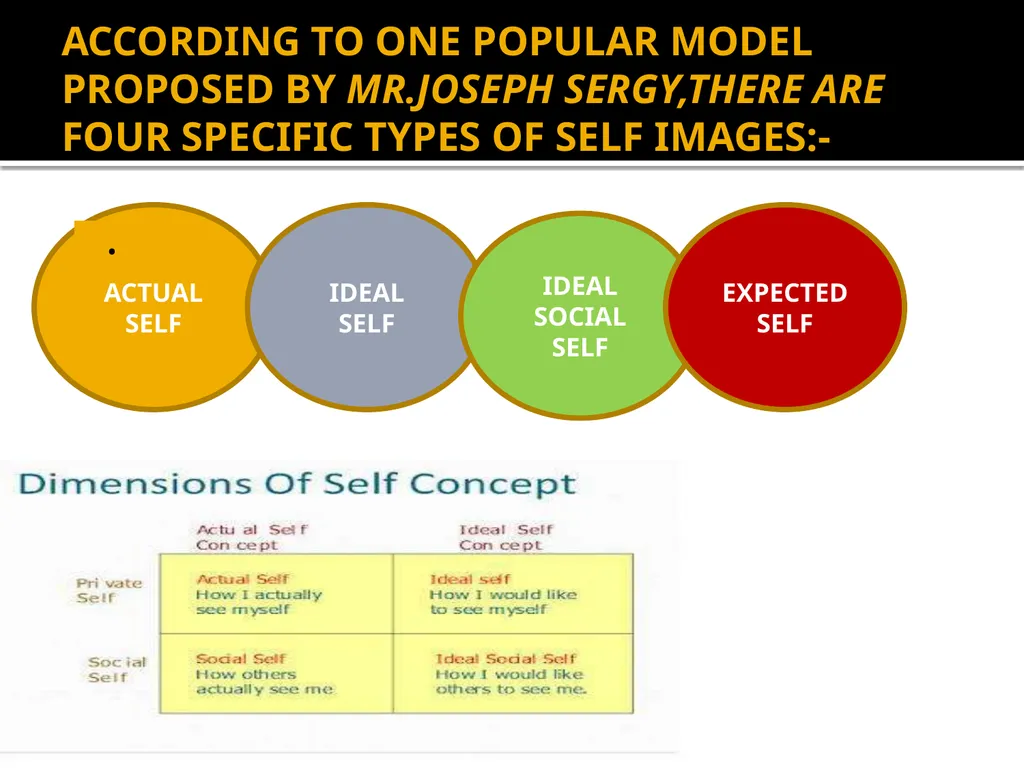
ACCORDING TO ONE POPULAR MODEL
PROPOSED BY MR.JOSEPH SERGY,THERE ARE FOUR SPECIFIC TYPES OF SELF IMAGES:- ACTUAL
SELF IDEAL
SELF IDEAL
SOCIAL
SELF EXPECTED
SELF .<br>
SELF IDEAL
SELF IDEAL
SOCIAL
SELF EXPECTED
SELF .<br>
48
Any Question ?<br>