
Persuasive Writing LESSON 2 Identifying and using
LD
Published · 44 slides · 0 views

1 / 1



Description
Persuasive Writing LESSON 2 Identifying and using persuasive techniques in a text Navigating NAPLAN A Voiceless Teaching and Learning Program Years 7 9 Persuasive writing devices Emotive language includes nouns, adjectives and even
Related Topics
Share
Embed code
Download this presentation From Below
"Persuasive Writing LESSON 2 Identifying and using" is the property of its rightful owner. Permission is granted to download and print the materials on this website for personal, non-commercial use only, and to display it on your personal computer provided you do not modify the materials and that you retain all copyright notices contained in the materials. By downloading content from our website, you accept the terms of this agreement.
Presentation Transcript
01
Persuasive Writing
LESSON 2
Identifying and using persuasive techniques in a text Navigating NAPLAN
A Voiceless Teaching and Learning Program Years 7 & 9<br>
LESSON 2
Identifying and using persuasive techniques in a text Navigating NAPLAN
A Voiceless Teaching and Learning Program Years 7 & 9<br>
02
Persuasive writing devices Emotive language includes nouns, adjectives and even punctuation marks.
It is language that makes you feel something. EMOTIVE LANGUAGE<br>
It is language that makes you feel something. EMOTIVE LANGUAGE<br>
03
Persuasive writing devices For example, describing a car crash as ‘horrific’ could make you feel shocked. Describing a holiday as ‘exhilarating’ might make you feel inspired.
Advertisements often use the nouns of positive adjectives, such as ‘happiness’ instead of ‘happy’ i.e. ‘Happiness is a new car’. This is called nominalisation and carries more weight. EMOTIVE LANGUAGE<br>
Advertisements often use the nouns of positive adjectives, such as ‘happiness’ instead of ‘happy’ i.e. ‘Happiness is a new car’. This is called nominalisation and carries more weight. EMOTIVE LANGUAGE<br>
04
Persuasive writing devices The rhetorical question is very useful in asking the responder to question themselves.
For example: ‘What can you do to help prevent global warming?’ RHETORICAL QUESTION<br>
For example: ‘What can you do to help prevent global warming?’ RHETORICAL QUESTION<br>
05
Persuasive writing devices The use of the second person pronoun ‘you’ makes the responder feel they are being personally addressed and that the message is for them alone.
It is often used in conjunction with the rhetorical question. USE OF THE SECOND PERSON PRONOUN ‘YOU’<br>
It is often used in conjunction with the rhetorical question. USE OF THE SECOND PERSON PRONOUN ‘YOU’<br>
06
Persuasive writing devices These are adjectives which take a comparison to the highest degree.
This is when you use phrases such as, ‘the best’, ‘the most comfortable’ or ‘the fittest’. USE OF SUPERLATIVE ADJECTIVES<br>
This is when you use phrases such as, ‘the best’, ‘the most comfortable’ or ‘the fittest’. USE OF SUPERLATIVE ADJECTIVES<br>
07
Persuasive writing devices For example, a car advertisement may say that the car is ‘the best performer’ or ‘the most spacious’.
Look at advertising for cosmetics. Have you seen advertisements claim that the product’s effects are ‘the longest lasting’? USE OF SUPERLATIVE ADJECTIVES<br>
Look at advertising for cosmetics. Have you seen advertisements claim that the product’s effects are ‘the longest lasting’? USE OF SUPERLATIVE ADJECTIVES<br>
08
Persuasive writing devices Using generalisations can help to make your writing more convincing.
For example, common generalisations often use the words ‘all’ or ‘everyone’.
Suggesting that ‘everyone’ does something may appeal to our human desire to conform. It may also help to convince the reader that the particular practice is normal and well-accepted. USE OF GENERALISATIONS<br>
For example, common generalisations often use the words ‘all’ or ‘everyone’.
Suggesting that ‘everyone’ does something may appeal to our human desire to conform. It may also help to convince the reader that the particular practice is normal and well-accepted. USE OF GENERALISATIONS<br>
09
Persuasive writing devices Repetition of a word or statement can be used to emphasise and enforce a message or argument.
It can also be used for stylistic effect. For example, consider the famous ‘I Have a Dream’ speech by Martin Luther King.
Sometimes repetition can be used to convey irony. For example, consider the famous speech by Marc Antony ‘Friends, Romans, countrymen, lend me your ears’, in which he repeats that Brutus is an ‘honourable man’ so often that the crowd begin to believe the opposite. USE OF REPETITION<br>
10
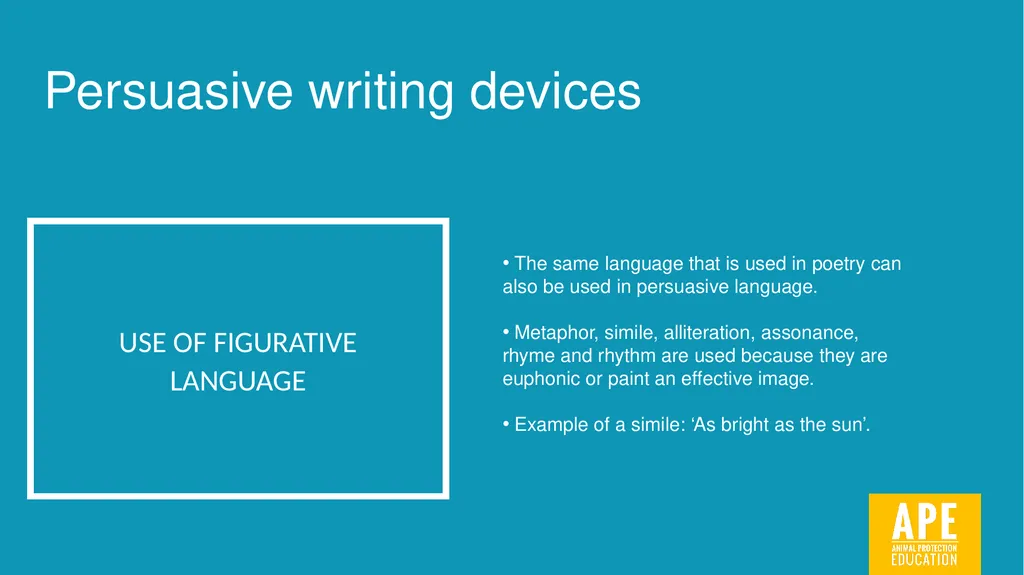
Persuasive writing devices The same language that is used in poetry can also be used in persuasive language.
Metaphor, simile, alliteration, assonance, rhyme and rhythm are used because they are euphonic or paint an effective image.
Example of a simile: ‘As bright as the sun’. USE OF FIGURATIVE LANGUAGE<br>
Metaphor, simile, alliteration, assonance, rhyme and rhythm are used because they are euphonic or paint an effective image.
Example of a simile: ‘As bright as the sun’. USE OF FIGURATIVE LANGUAGE<br>
11
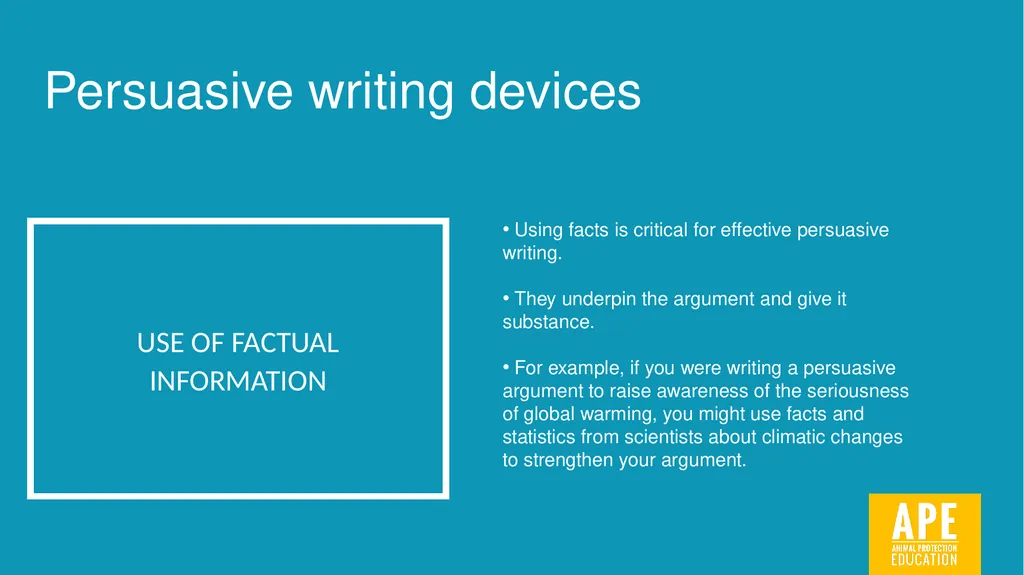
Persuasive writing devices Using facts is critical for effective persuasive writing.
They underpin the argument and give it substance.
For example, if you were writing a persuasive argument to raise awareness of the seriousness of global warming, you might use facts and statistics from scientists about climatic changes to strengthen your argument. USE OF FACTUAL INFORMATION<br>
They underpin the argument and give it substance.
For example, if you were writing a persuasive argument to raise awareness of the seriousness of global warming, you might use facts and statistics from scientists about climatic changes to strengthen your argument. USE OF FACTUAL INFORMATION<br>
12
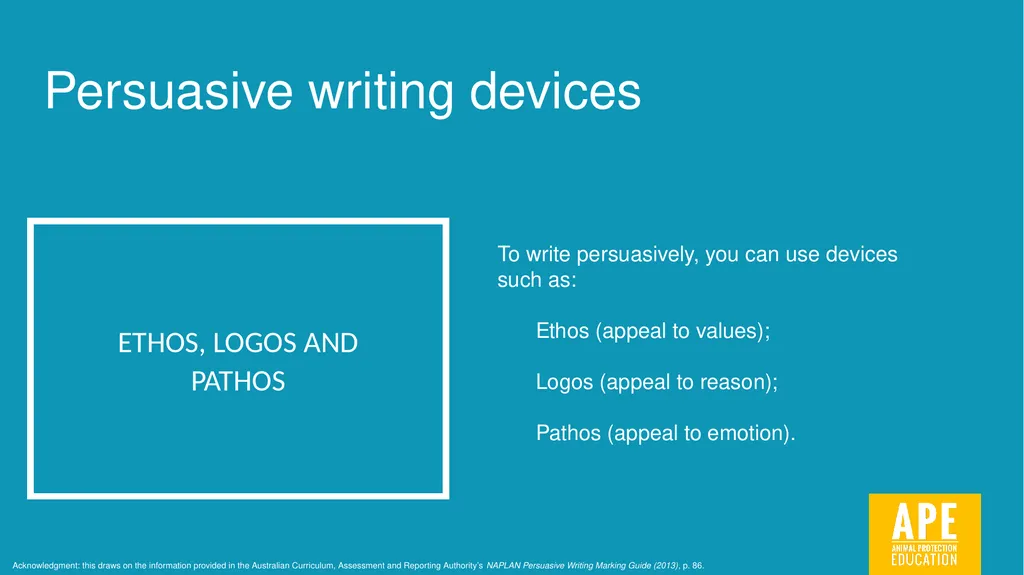
Persuasive writing devices To write persuasively, you can use devices such as:
Ethos (appeal to values);
Logos (appeal to reason);
Pathos (appeal to emotion). ETHOS, LOGOS AND PATHOS Acknowledgment: this draws on the information provided in the Australian Curriculum, Assessment and Reporting Authority’s NAPLAN Persuasive Writing Marking Guide (2013), p. 86.<br>
Ethos (appeal to values);
Logos (appeal to reason);
Pathos (appeal to emotion). ETHOS, LOGOS AND PATHOS Acknowledgment: this draws on the information provided in the Australian Curriculum, Assessment and Reporting Authority’s NAPLAN Persuasive Writing Marking Guide (2013), p. 86.<br>
13
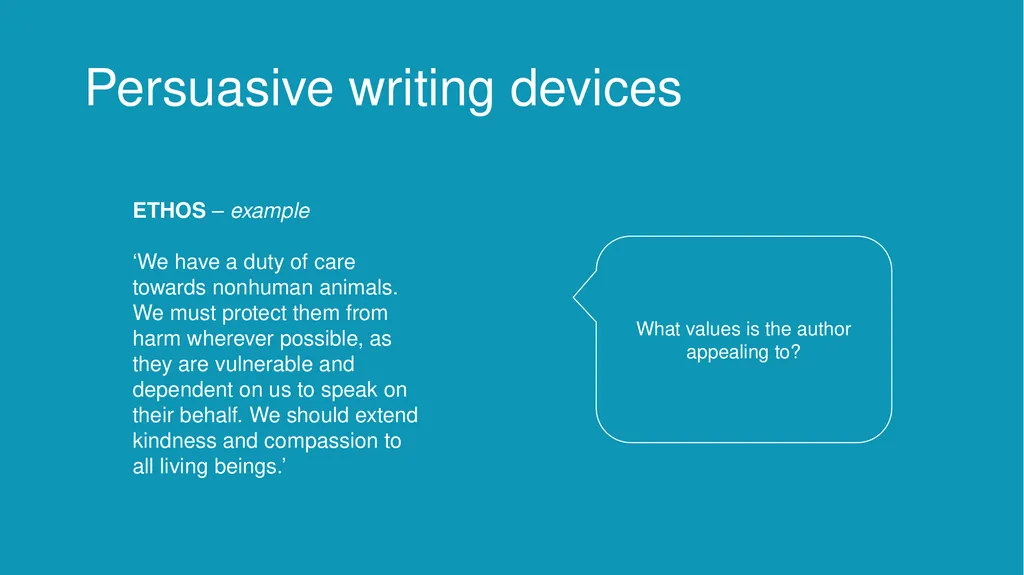
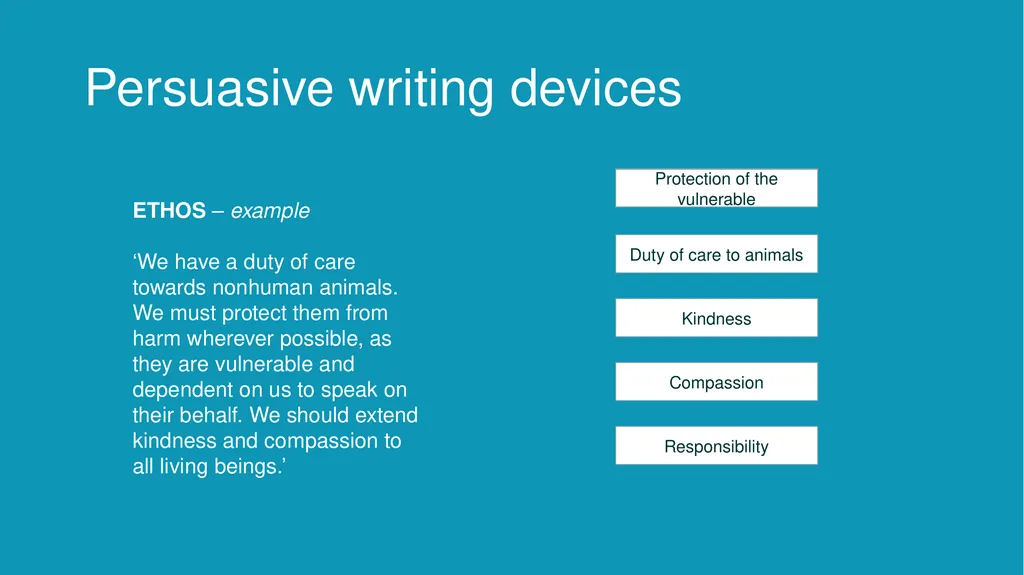
Persuasive writing devices ETHOS – example
‘We have a duty of care towards nonhuman animals. We must protect them from harm wherever possible, as they are vulnerable and dependent on us to speak on their behalf. We should extend kindness and compassion to all living beings.’ What values is the author appealing to?<br>
‘We have a duty of care towards nonhuman animals. We must protect them from harm wherever possible, as they are vulnerable and dependent on us to speak on their behalf. We should extend kindness and compassion to all living beings.’ What values is the author appealing to?<br>
14
Persuasive writing devices ETHOS – example
‘We have a duty of care towards nonhuman animals. We must protect them from harm wherever possible, as they are vulnerable and dependent on us to speak on their behalf. We should extend kindness and compassion to all living beings.’ Duty of care to animals Kindness Compassion Protection of the vulnerable Responsibility<br>
‘We have a duty of care towards nonhuman animals. We must protect them from harm wherever possible, as they are vulnerable and dependent on us to speak on their behalf. We should extend kindness and compassion to all living beings.’ Duty of care to animals Kindness Compassion Protection of the vulnerable Responsibility<br>
15
Persuasive writing devices LOGOS – example
‘We have a duty of care towards nonhuman animals. This duty of care is recognised under the law. It requires human beings to ensure that they do not intentionally cause pain and suffering to animals. Therefore, it is against the law to be cruel to animals.’ What logic is the author appealing to?<br>
‘We have a duty of care towards nonhuman animals. This duty of care is recognised under the law. It requires human beings to ensure that they do not intentionally cause pain and suffering to animals. Therefore, it is against the law to be cruel to animals.’ What logic is the author appealing to?<br>
16
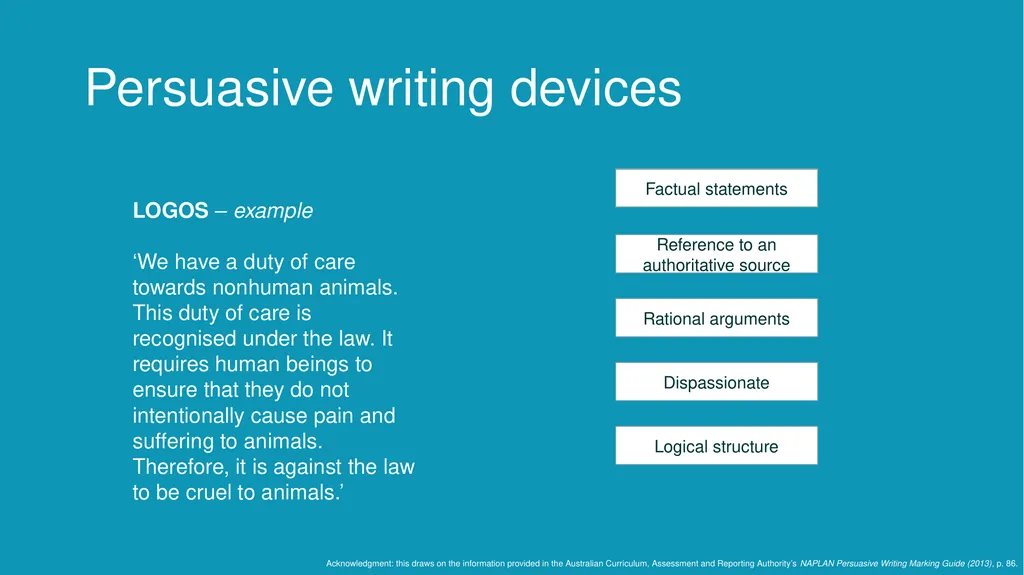
Persuasive writing devices Reference to an authoritative source Rational arguments Dispassionate Factual statements Logical structure LOGOS – example
‘We have a duty of care towards nonhuman animals. This duty of care is recognised under the law. It requires human beings to ensure that they do not intentionally cause pain and suffering to animals. Therefore, it is against the law to be cruel to animals.’ Acknowledgment: this draws on the information provided in the Australian Curriculum, Assessment and Reporting Authority’s NAPLAN Persuasive Writing Marking Guide (2013), p. 86.<br>
‘We have a duty of care towards nonhuman animals. This duty of care is recognised under the law. It requires human beings to ensure that they do not intentionally cause pain and suffering to animals. Therefore, it is against the law to be cruel to animals.’ Acknowledgment: this draws on the information provided in the Australian Curriculum, Assessment and Reporting Authority’s NAPLAN Persuasive Writing Marking Guide (2013), p. 86.<br>
17
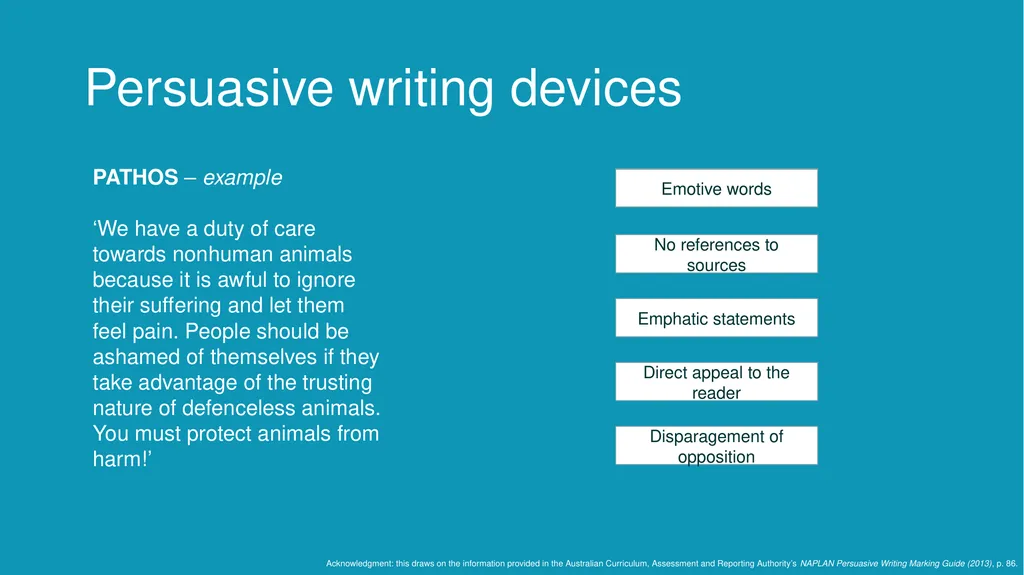
Persuasive writing devices PATHOS – example
‘We have a duty of care towards nonhuman animals because it is awful to ignore their suffering and let them feel pain. People should be ashamed of themselves if they take advantage of the trusting nature of defenceless animals. You must protect animals from harm!’ What emotions is the author appealing to?<br>
‘We have a duty of care towards nonhuman animals because it is awful to ignore their suffering and let them feel pain. People should be ashamed of themselves if they take advantage of the trusting nature of defenceless animals. You must protect animals from harm!’ What emotions is the author appealing to?<br>
18
Persuasive writing devices No references to sources Emphatic statements Direct appeal to the reader Emotive words Disparagement of opposition PATHOS – example
‘We have a duty of care towards nonhuman animals because it is awful to ignore their suffering and let them feel pain. People should be ashamed of themselves if they take advantage of the trusting nature of defenceless animals. You must protect animals from harm!’ Acknowledgment: this draws on the information provided in the Australian Curriculum, Assessment and Reporting Authority’s NAPLAN Persuasive Writing Marking Guide (2013), p. 86.<br>
‘We have a duty of care towards nonhuman animals because it is awful to ignore their suffering and let them feel pain. People should be ashamed of themselves if they take advantage of the trusting nature of defenceless animals. You must protect animals from harm!’ Acknowledgment: this draws on the information provided in the Australian Curriculum, Assessment and Reporting Authority’s NAPLAN Persuasive Writing Marking Guide (2013), p. 86.<br>
19
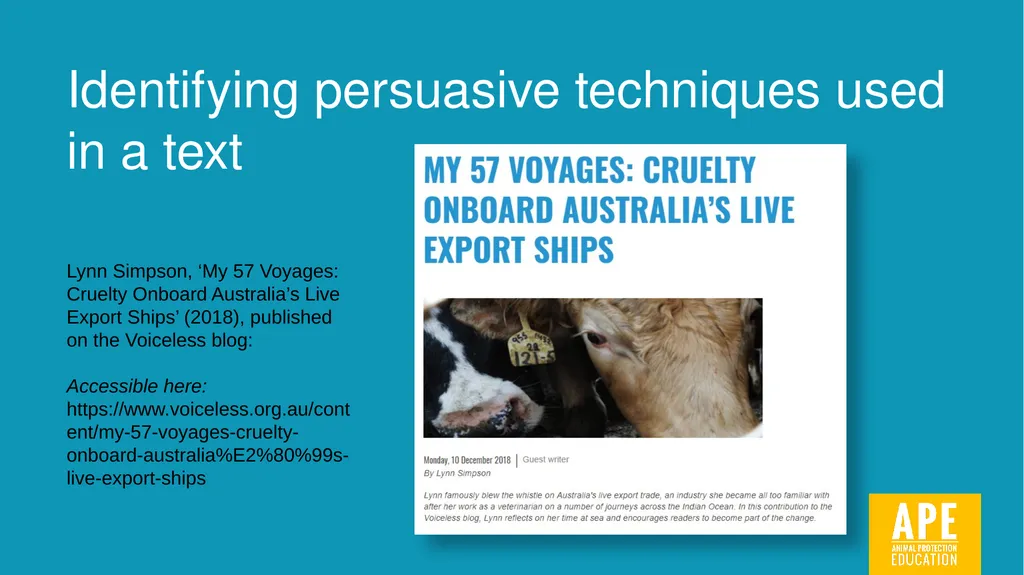
Identifying persuasive techniques used in a text Lynn Simpson, ‘My 57 Voyages: Cruelty Onboard Australia’s Live Export Ships’ (2018), published on the Voiceless blog:
Accessible here: https://www.voiceless.org.au/content/my-57-voyages-cruelty-onboard-australia%E2%80%99s-live-export-ships<br>
Accessible here: https://www.voiceless.org.au/content/my-57-voyages-cruelty-onboard-australia%E2%80%99s-live-export-ships<br>
20
Which techniques of persuasion did you identify in the text?<br>
21
Did you identify any examples of emotive language?<br>
22
‘cruelty’
‘horrendous injuries, starvation, and unnecessary suffering, stress and fear on every voyage’
‘biggest floating ‘death row’ in the world’
‘descriptions that made them want to puke’
‘I was so nauseated by how ‘interesting’ people found my job’
‘There was too much I couldn’t ‘un-see’, and frighteningly, peoples lack of understanding or care was one of the most alarming’ Use of emotive language<br>
23
Does the use of ‘cruelty’ in the title create the tone for the whole article?
What is the effect of the use of negative emotive language throughout (e.g. ‘injuries, starvation and unnecessary suffering, stress and fear on every voyage’)?
What is the effect of using the term ‘death row’? Is this usually used in reference to humans?
Does the use of personification make the responder think of the cattle as people? Use of emotive language<br>
24
Did you identify any examples of rhetorical questions?<br>
25
Use of the rhetorical question ‘57 voyages, I must be nuts right? Why not get off, get a ‘real job?’, make it stop?’
‘How was I going to change the score from the sidelines?’<br>
‘How was I going to change the score from the sidelines?’<br>
26
Use of the rhetorical question What is the effect of the author Lynn Simpson using rhetorical questions three times in the line: ‘57 voyages, I must be nuts right? Why not get off, get a ‘real job?’ make it stop?’
Does it show her self-questioning?
Does it raise any answers in the mind of the reader?<br>
Does it show her self-questioning?
Does it raise any answers in the mind of the reader?<br>
27
Did you identify any examples of the use of first/second person pronouns?<br>
28
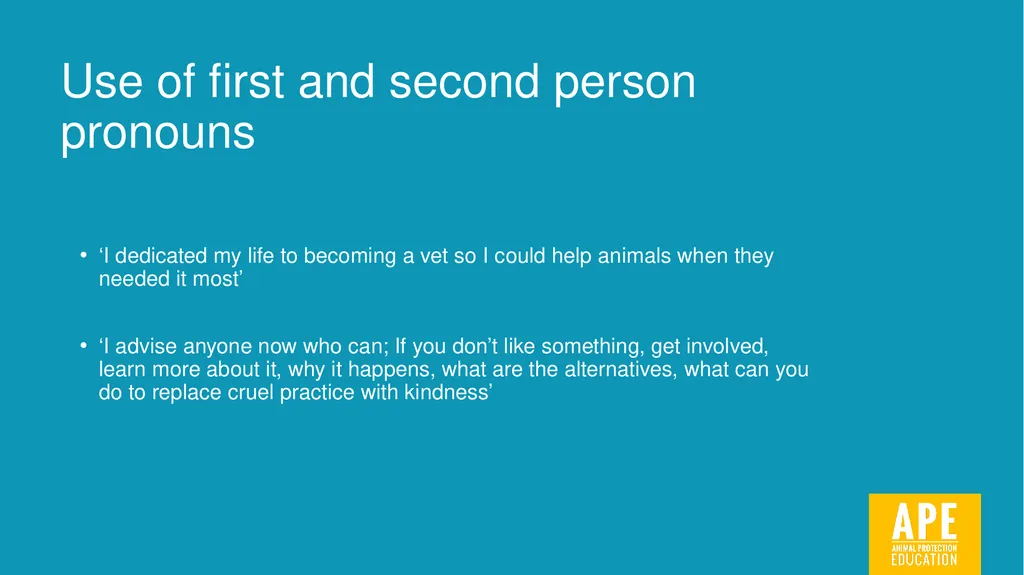
Use of first and second person pronouns ‘I dedicated my life to becoming a vet so I could help animals when they needed it most’
‘I advise anyone now who can; If you don’t like something, get involved, learn more about it, why it happens, what are the alternatives, what can you do to replace cruel practice with kindness’<br>
‘I advise anyone now who can; If you don’t like something, get involved, learn more about it, why it happens, what are the alternatives, what can you do to replace cruel practice with kindness’<br>
29
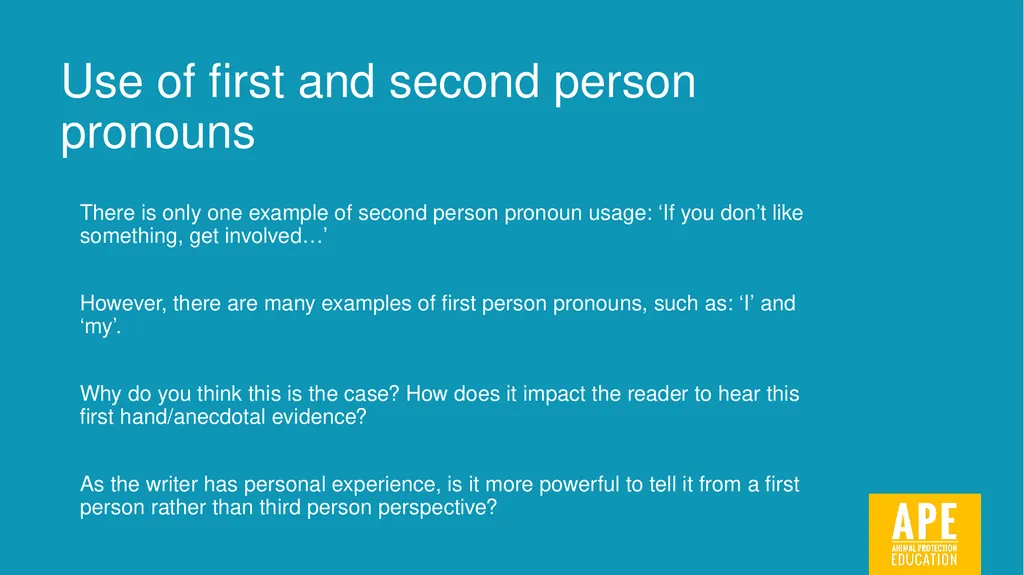
Use of first and second person pronouns There is only one example of second person pronoun usage: ‘If you don’t like something, get involved…’
However, there are many examples of first person pronouns, such as: ‘I’ and ‘my’.
Why do you think this is the case? How does it impact the reader to hear this first hand/anecdotal evidence?
As the writer has personal experience, is it more powerful to tell it from a first person rather than third person perspective?<br>
30
Did you identify any examples of the use of superlative adjectives?<br>
31
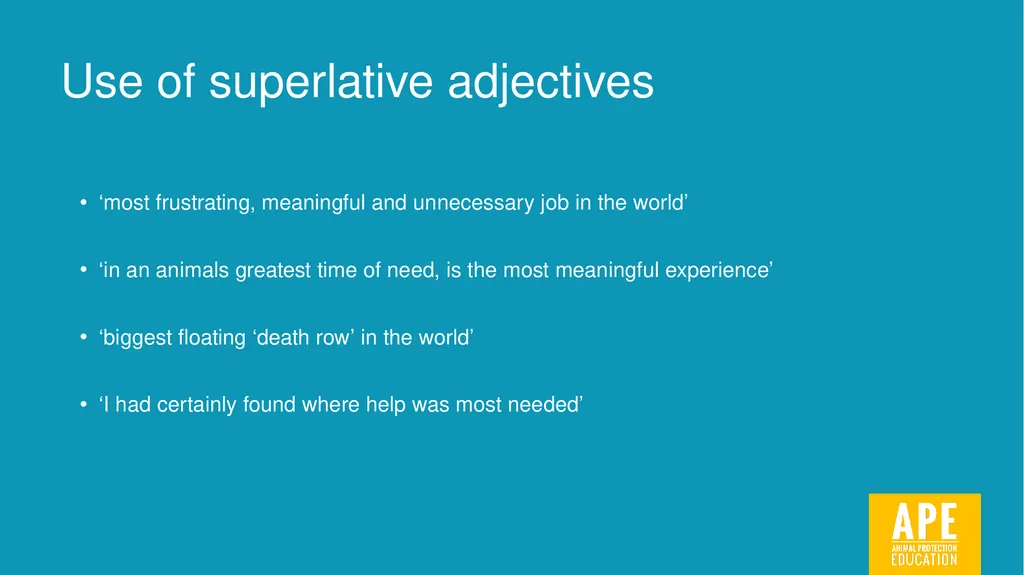
Use of superlative adjectives ‘most frustrating, meaningful and unnecessary job in the world’
‘in an animals greatest time of need, is the most meaningful experience’
‘biggest floating ‘death row’ in the world’
‘I had certainly found where help was most needed’<br>
‘in an animals greatest time of need, is the most meaningful experience’
‘biggest floating ‘death row’ in the world’
‘I had certainly found where help was most needed’<br>
32
Use of superlative adjectives Lynn Simpson writes that her job was the ‘most frustrating’, and in ‘the greatest time of need’.
She says it was ‘the most meaningful experience’ of her life.
Do these statements give emphasis to her observations?
Which is the most powerful superlative adjective used, and why?<br>
She says it was ‘the most meaningful experience’ of her life.
Do these statements give emphasis to her observations?
Which is the most powerful superlative adjective used, and why?<br>
33
Did you identify any examples of the use of generalisations?<br>
34
Use of generalisations ‘The animals should never have been at sea’
‘horrendous injuries, starvation, and unnecessary suffering, stress and fear on every voyage’<br>
‘horrendous injuries, starvation, and unnecessary suffering, stress and fear on every voyage’<br>
35
Use of generalisations Why does the author use ‘never’ in the sentence: ‘The animals should never have been at sea’?
Does it give more impact to the plight of the animals?
She also writes that this starvation, stress and fear happen on ‘every’ voyage.
What effect might this have on the reader?<br>
Does it give more impact to the plight of the animals?
She also writes that this starvation, stress and fear happen on ‘every’ voyage.
What effect might this have on the reader?<br>
36
Did you identify any examples of the use of repetition?<br>
37
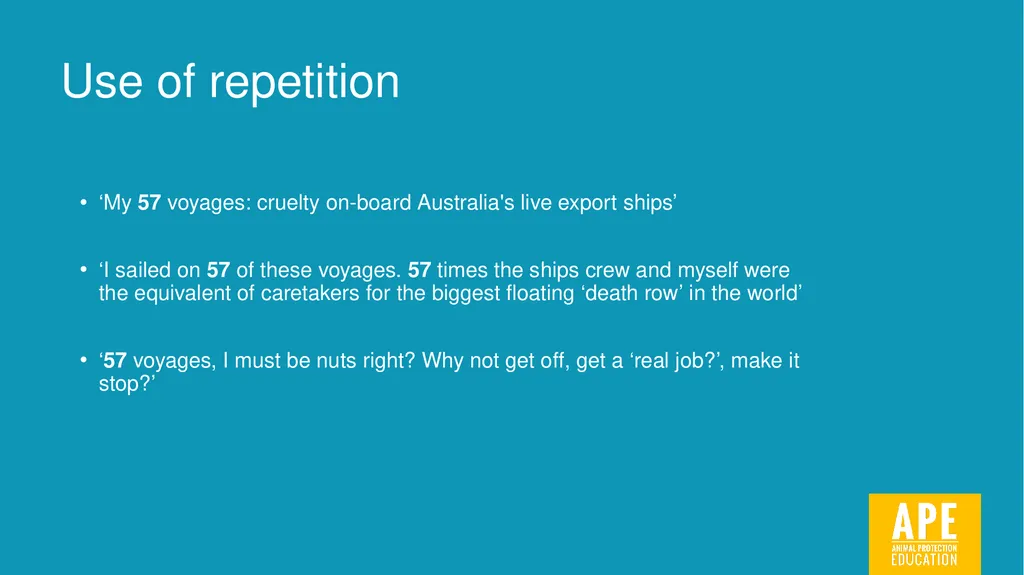
Use of repetition ‘My 57 voyages: cruelty on-board Australia's live export ships’
‘I sailed on 57 of these voyages. 57 times the ships crew and myself were the equivalent of caretakers for the biggest floating ‘death row’ in the world’
‘57 voyages, I must be nuts right? Why not get off, get a ‘real job?’, make it stop?’<br>
‘I sailed on 57 of these voyages. 57 times the ships crew and myself were the equivalent of caretakers for the biggest floating ‘death row’ in the world’
‘57 voyages, I must be nuts right? Why not get off, get a ‘real job?’, make it stop?’<br>
38
Use of repetition Why does the author repeat the number 57 a number of times?
Is she trying to emphasise that she witnessed the events repeatedly, i.e. that it was not an unfortunate one-off incident?
Is this relevant to the weight and credibility of her claims?
By using repetition, is she trying to ensure that the reader takes note of this important fact?<br>
Is she trying to emphasise that she witnessed the events repeatedly, i.e. that it was not an unfortunate one-off incident?
Is this relevant to the weight and credibility of her claims?
By using repetition, is she trying to ensure that the reader takes note of this important fact?<br>
39
Did you identify any examples of the use of figurative language?<br>
40
Use of figurative language ‘Animals are not designed to travel in floating ships, built like multi story car-parks, vulnerable to mechanical breakdowns, environmental extremes and at the whim of the sea.’<br>
41
Use of figurative language Why does the author use the phrase: ‘whim of the sea’?
Does it create the sense that the ocean is an unpredictable human who cannot be trusted?
She also uses a simile: ‘built like multi story car-parks’.
Does this help the responder to more easily imagine the size of the ships and the image of the cattle cramped in a small space?<br>
Does it create the sense that the ocean is an unpredictable human who cannot be trusted?
She also uses a simile: ‘built like multi story car-parks’.
Does this help the responder to more easily imagine the size of the ships and the image of the cattle cramped in a small space?<br>
42
Did you identify any examples of the use of factual information?<br>
43
Use of factual information ‘being the sole vet on live export ships carrying up to 120,000 sheep, 20,000 cattle or any combination in between’<br>
44
Use of factual information The author cites relevant factual information, such as: ‘120,00 sheep, 20,000 cattle’.
What does this emphasise to the reader?
Does the enormity of the numbers emphasise the large number of animals involved?
Why is this important?<br>
What does this emphasise to the reader?
Does the enormity of the numbers emphasise the large number of animals involved?
Why is this important?<br>