PFAS Reduction Initiative for Wastewater Dischargers Keegan MacDonna, P.E. Environmental Protection Engineer Division of Water Pollution Control, Permit Section What is PFAS? Perfluoroalkyl and polyfluoroalkyl substances (together known as
"PFAS Reduction Initiative for Wastewater" is the property of its rightful owner. Permission is granted to
download and print the materials on this website for personal, non-commercial use only, and to display it
on your personal computer provided you do not modify the materials and that you retain all copyright
notices contained in the materials. By downloading content from our website, you accept the terms of this
agreement.
Presentation Transcript
01
PFAS Reduction Initiative for Wastewater Dischargers Keegan MacDonna, P.E.
Environmental Protection Engineer
Division of Water Pollution Control, Permit Section<br>
02
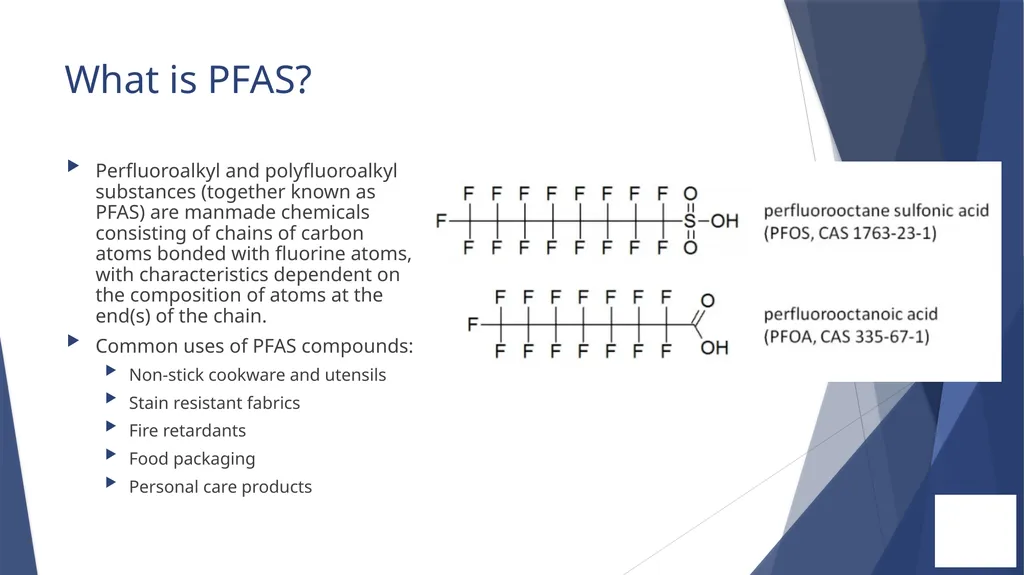
What is PFAS? Perfluoroalkyl and polyfluoroalkyl substances (together known as PFAS) are manmade chemicals consisting of chains of carbon atoms bonded with fluorine atoms, with characteristics dependent on the composition of atoms at the end(s) of the chain.
Common uses of PFAS compounds:
Non-stick cookware and utensils
Stain resistant fabrics
Fire retardants
Food packaging
Personal care products<br>
03
Environmental Impacts of PFAS According to USEPA, exposure to certain levels of PFAS may lead to:
Increased risk of some cancers
Developmental defects or delays in children
Reproductive effects such as decreased fertility or increased blood pressure in pregnant women
Accumulation of PFAS:
PFAS compounds can take hundreds or thousand of years to break down due to the strength of the carbon-fluorine bonds in their chemical structures.
Referred to by some as “forever chemicals”<br>
04
Illinois EPA’s Approach to Reduction of PFAS in Wastewater Discharges NPDES Permits
Quarterly discharge monitoring requirements
Development of Best Management Practices (BMPs) to reduce PFAS concentrations in wastewater
Targeted approach based on facility industrial classification
PFAS reduction conditions applied in 61 NPDES permits so far State Construction and Operating Permits
Monitoring and BMP requirements for targeted industries, for discharges to smaller POTWs
Adoption of new groundwater standards promulgated by the Illinois Pollution Control Board
Permitting of treatment systems designed for removal of PFAS<br>
05
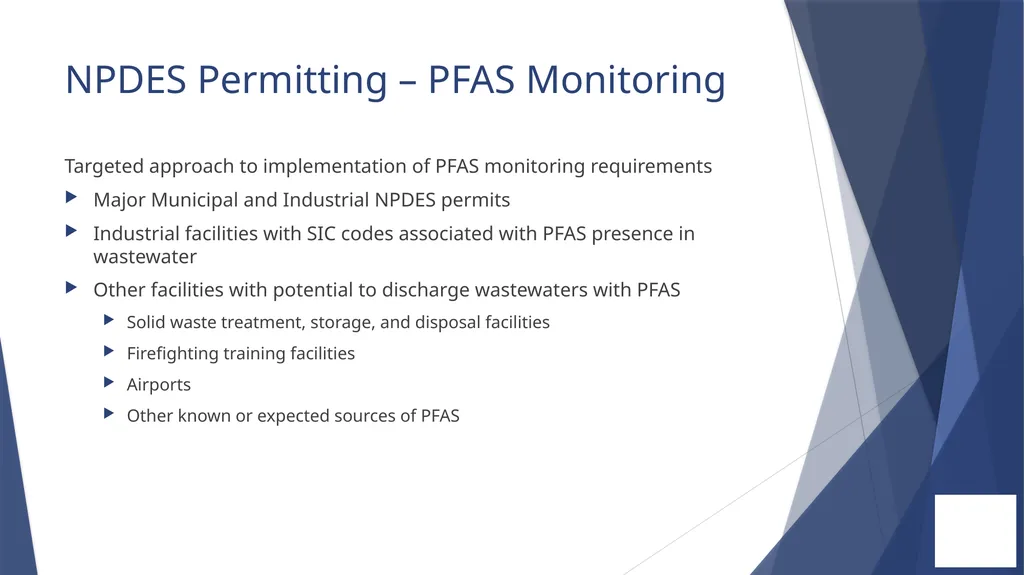
NPDES Permitting – PFAS Monitoring Targeted approach to implementation of PFAS monitoring requirements
Major Municipal and Industrial NPDES permits
Industrial facilities with SIC codes associated with PFAS presence in wastewater
Other facilities with potential to discharge wastewaters with PFAS
Solid waste treatment, storage, and disposal facilities
Firefighting training facilities
Airports
Other known or expected sources of PFAS<br>
06
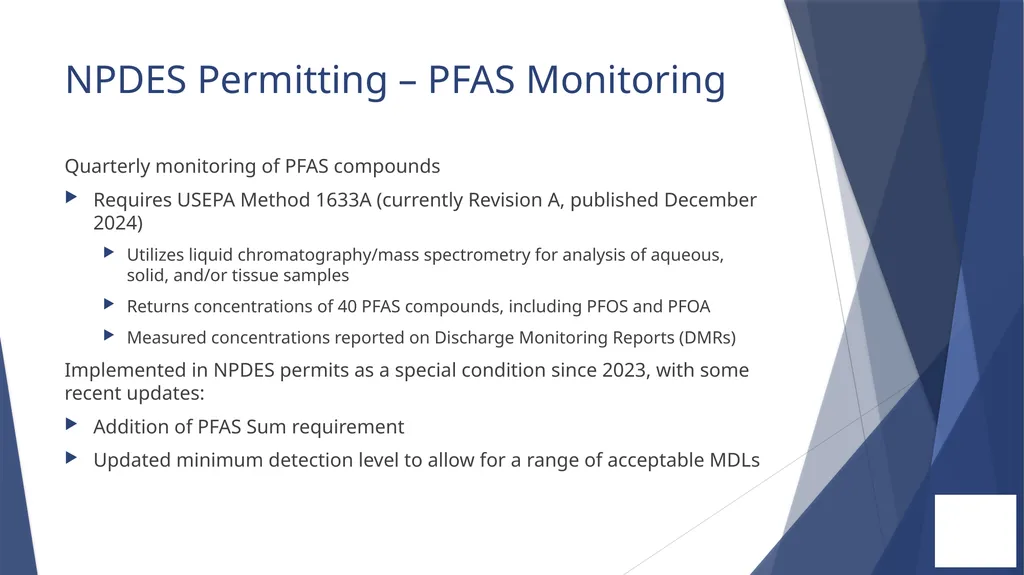
NPDES Permitting – PFAS Monitoring Quarterly monitoring of PFAS compounds
Requires USEPA Method 1633A (currently Revision A, published December 2024)
Utilizes liquid chromatography/mass spectrometry for analysis of aqueous, solid, and/or tissue samples
Returns concentrations of 40 PFAS compounds, including PFOS and PFOA
Measured concentrations reported on Discharge Monitoring Reports (DMRs)
Implemented in NPDES permits as a special condition since 2023, with some recent updates:
Addition of PFAS Sum requirement
Updated minimum detection level to allow for a range of acceptable MDLs<br>
07
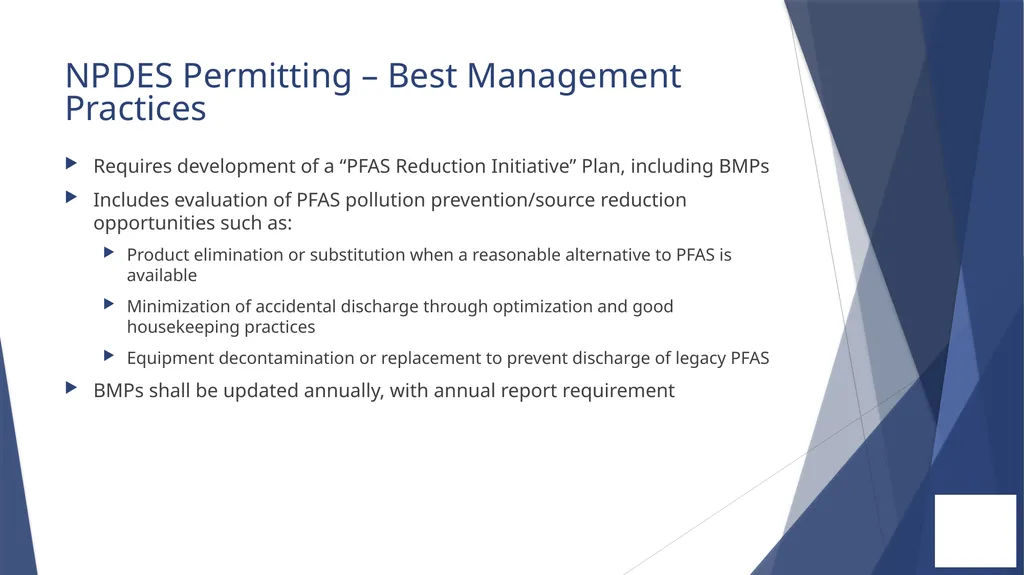
NPDES Permitting – Best Management Practices Requires development of a “PFAS Reduction Initiative” Plan, including BMPs
Includes evaluation of PFAS pollution prevention/source reduction opportunities such as:
Product elimination or substitution when a reasonable alternative to PFAS is available
Minimization of accidental discharge through optimization and good housekeeping practices
Equipment decontamination or replacement to prevent discharge of legacy PFAS
BMPs shall be updated annually, with annual report requirement<br>
08
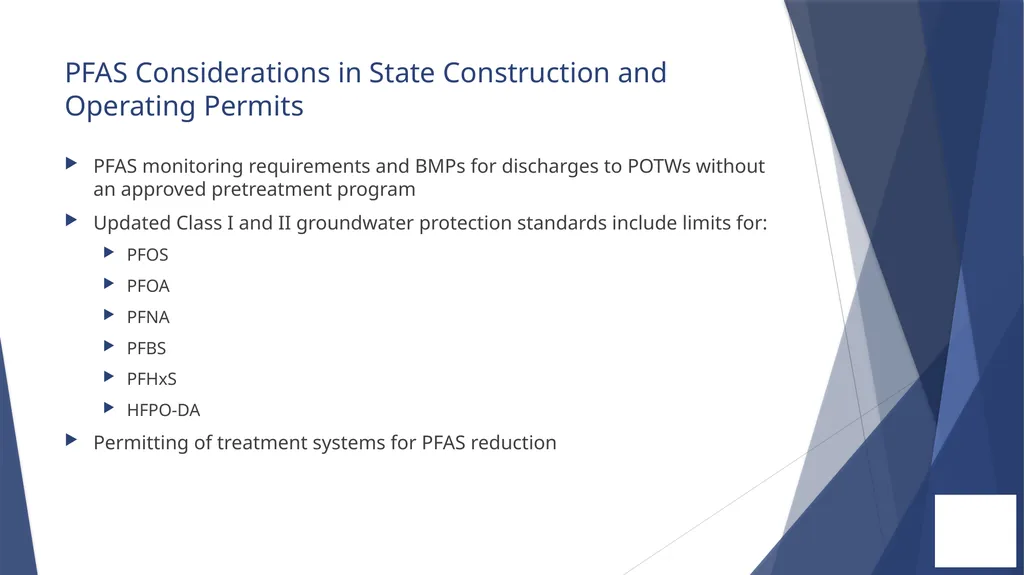
PFAS Considerations in State Construction and Operating Permits PFAS monitoring requirements and BMPs for discharges to POTWs without an approved pretreatment program
Updated Class I and II groundwater protection standards include limits for:
PFOS
PFOA
PFNA
PFBS
PFHxS
HFPO-DA
Permitting of treatment systems for PFAS reduction<br>
09
Questions? Keegan MacDonna, P.E.
Environmental Protection Engineer
Division of Water Pollution Control, Permit Section, Industrial Unit
keegan.macdonna@illinois.gov
DWPC Permit Section PFAS Contact
Steve F. Nightingale, P.E.
Industrial Unit Manager
DWPC, Permit Section
steve.nightingale@illinois.gov<br>