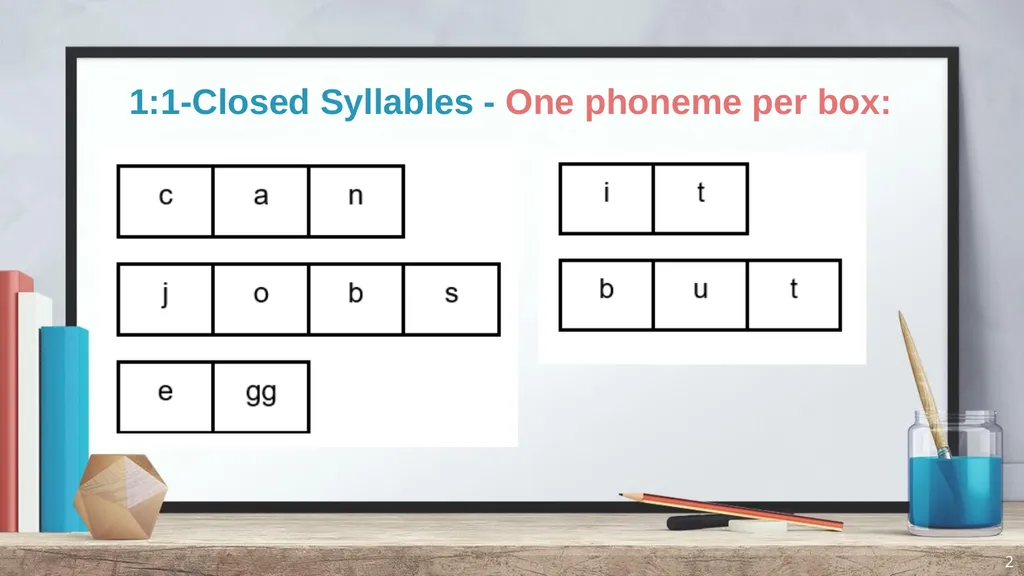
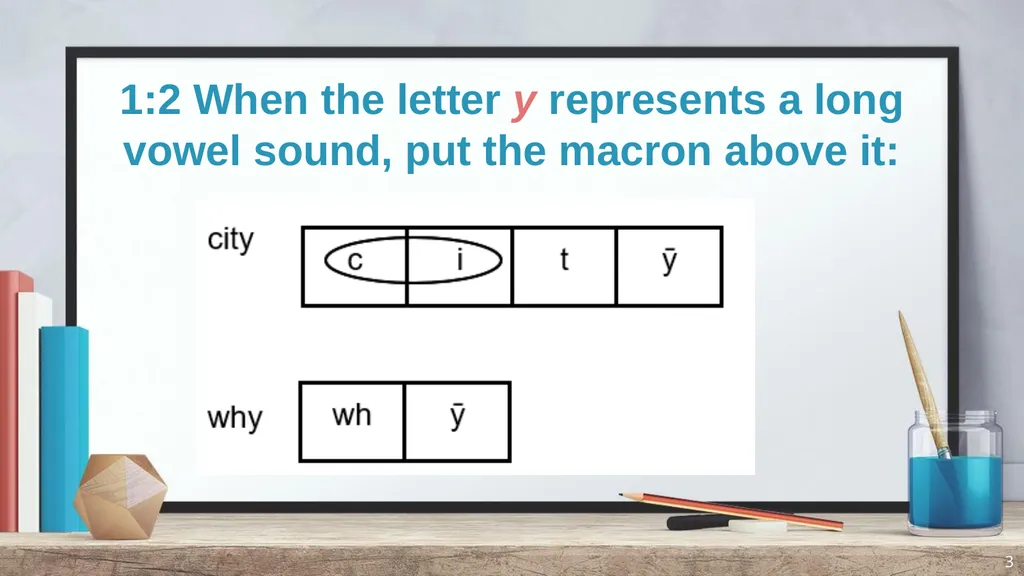
04
1:3 When a vowel sound is a schwa, the schwa symbol is wrapped around the vowel: 4<br>
05
1:10 The letter q is never written without his partner u, so they are written in 2 boxes, but close and looped together: 5<br>
06
1:11 When the letter x is in the middle or end of a word, it has 2 sounds /k/ /s/, so it takes 2 boxes: 6<br>
07
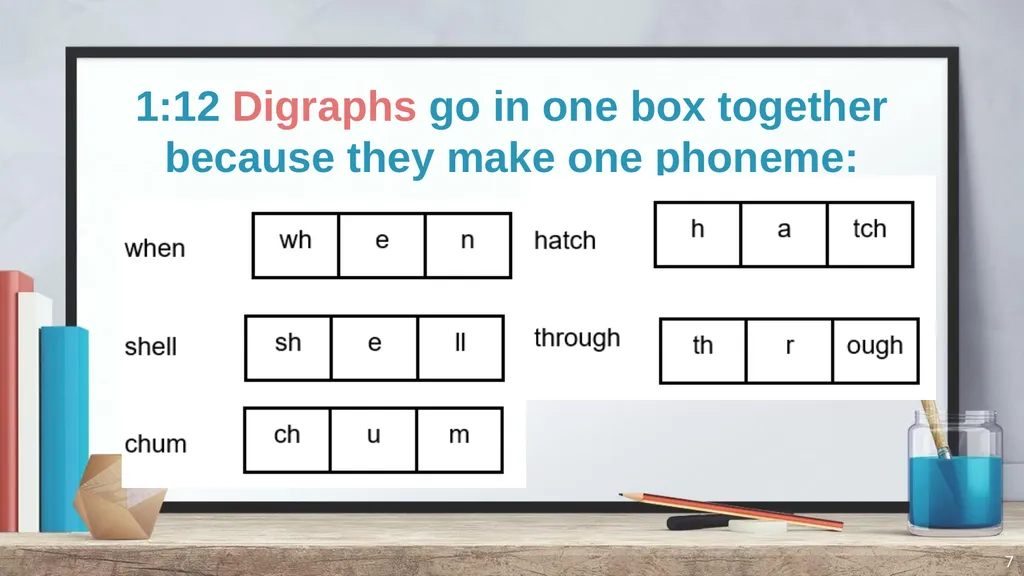
1:12 Digraphs go in one box together because they make one phoneme: 7<br>
08
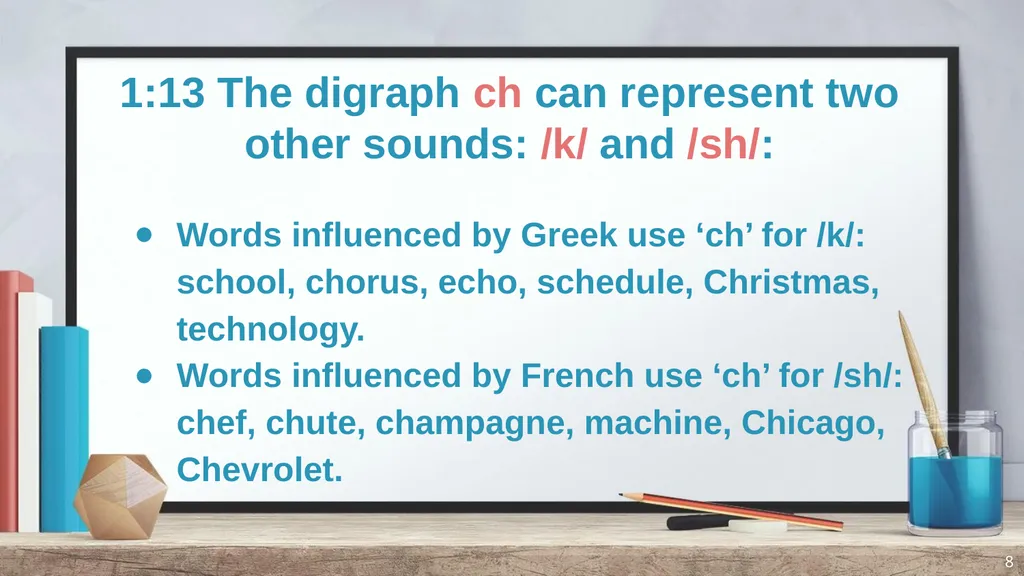
1:13 The digraph ch can represent two other sounds: /k/ and /sh/: 8 Words influenced by Greek use ‘ch’ for /k/: school, chorus, echo, schedule, Christmas, technology.
Words influenced by French use ‘ch’ for /sh/: chef, chute, champagne, machine, Chicago, Chevrolet.<br>
09
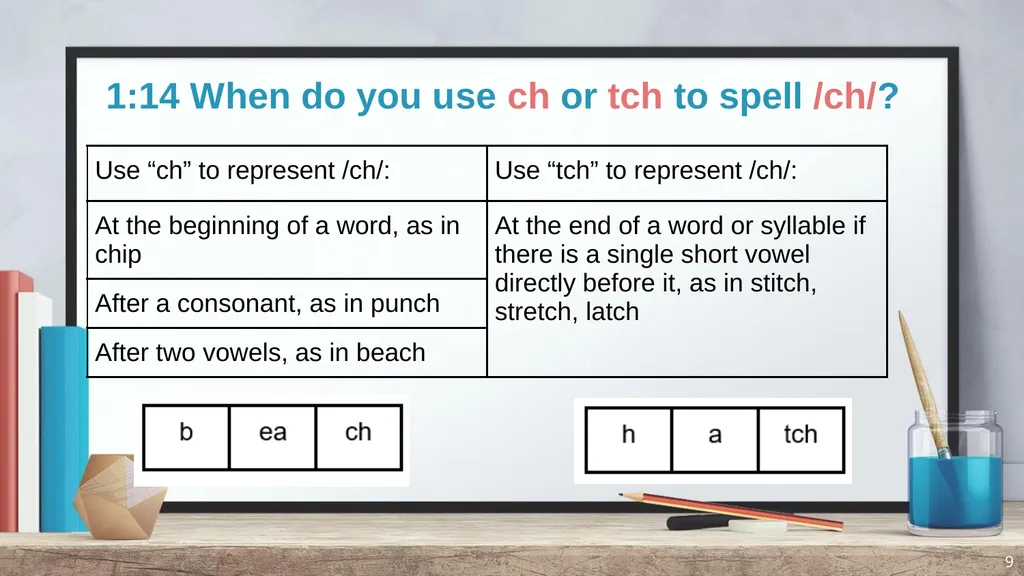
1:14 When do you use ch or tch to spell /ch/? 9<br>
10
1:16 When do you use k or ck to represent /k/? 10<br>
11
1:17 When the letters c and g are followed by e, i, or y, the consonant is soft, so they need to be looped together. 11<br>
12
1:18 Now that you know the rules for e, i, and y with c and g, it’s time to learn the roles of a, o, and u: They are placeholders that help c and g keep their hard sounds. So, they are actually silent! Write the vowel that is acting as a placeholder in the same box as the c or g and slash out the unnecessary vowel. 12<br>
13
1:19 When do you use -ge or -dge to represent /j/?
The letter j can never be at the end of a word! 13<br>
14
Remember, the -ge is looped together because the e makes the g soft. Shade the box of the preceding vowel orange. If it is a short sound, write the breve so they know to use -dge: 14<br>
15
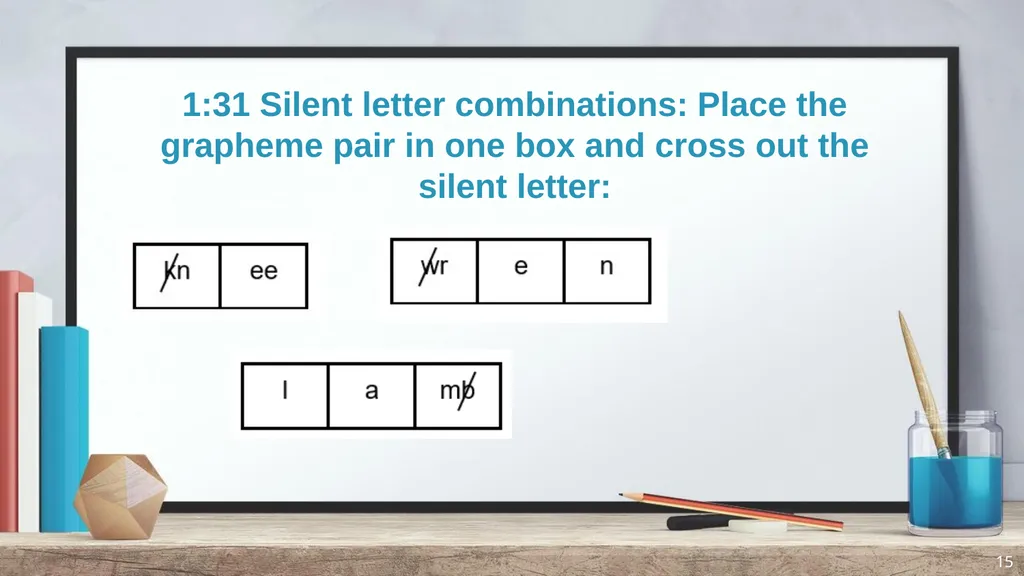
1:31 Silent letter combinations: Place the grapheme pair in one box and cross out the silent letter: 15<br>
16
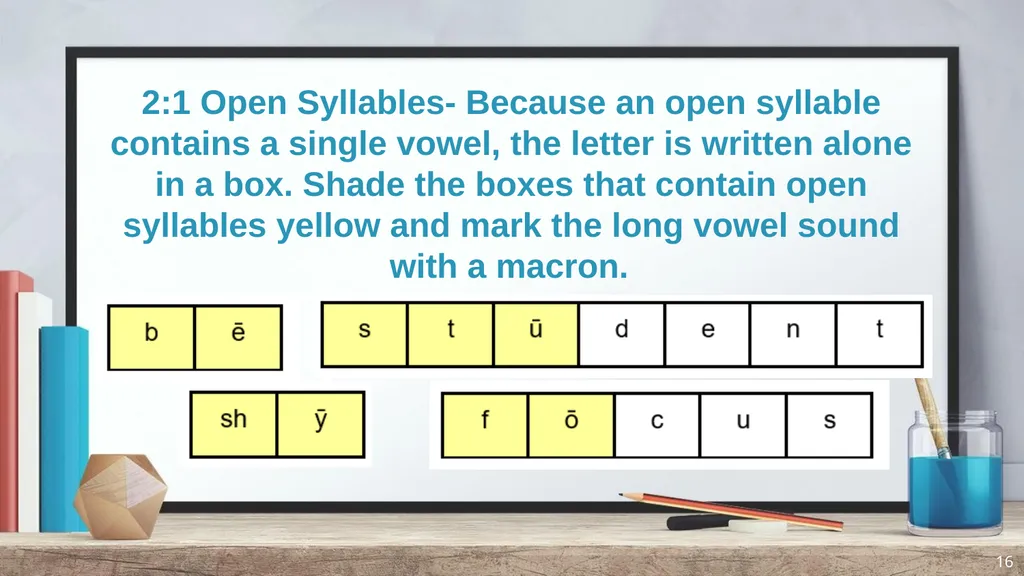
2:1 Open Syllables- Because an open syllable contains a single vowel, the letter is written alone in a box. Shade the boxes that contain open syllables yellow and mark the long vowel sound with a macron. 16<br>
17
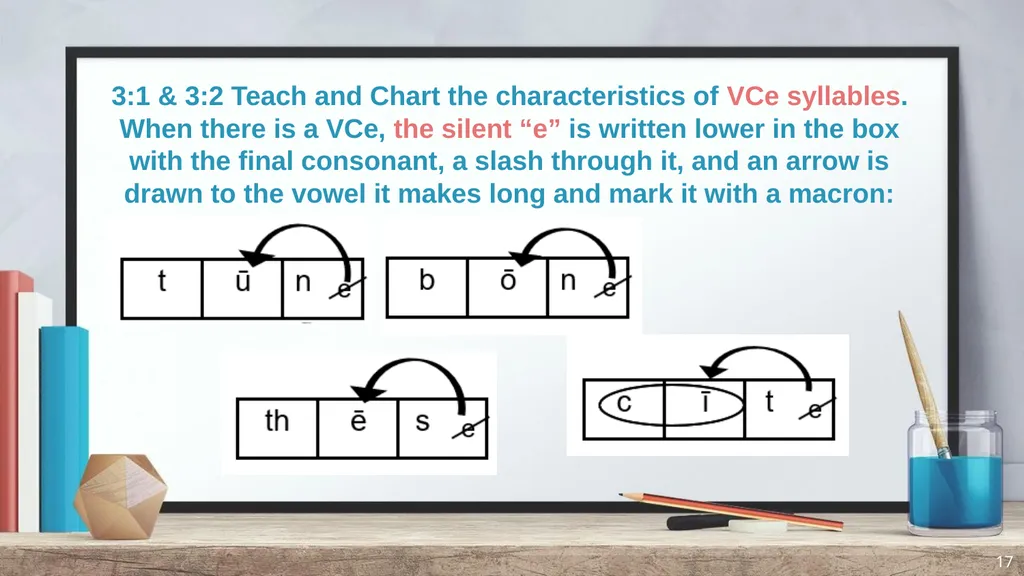
3:1 & 3:2 Teach and Chart the characteristics of VCe syllables.
When there is a VCe, the silent “e” is written lower in the box with the final consonant, a slash through it, and an arrow is drawn to the vowel it makes long and mark it with a macron: 17<br>
18
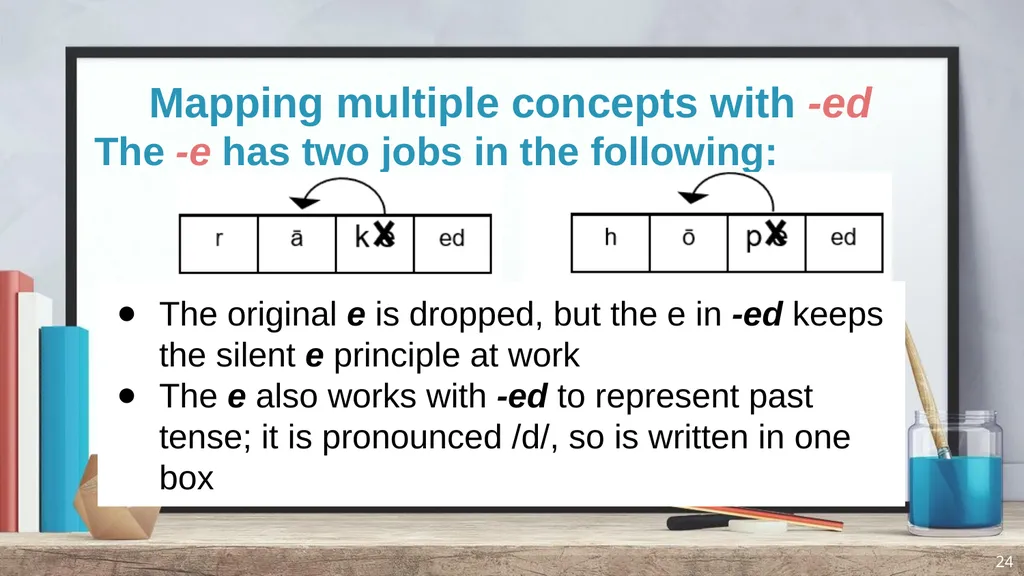
3:5 VCe with a past tense -ed 18 Past tense -ed can be pronounced as one sound, /d/ or /t/. If a base word ends in silent e but has dropped the e to add the ending, still show and slash out the silent e and write the -ed in one box.
Both the silent e and the past-tense spelling are shown.<br>
19
3:6 The -ve rule:
English words do NOT end with the letter v.
Therefore, the letter e is written at the end of words that end with v to preserve the rule. Usually words ending in -ve are NOT following the silent e rule. When it is mapped, the e is written in the same box with the v and an x is put over it. 19<br>
20
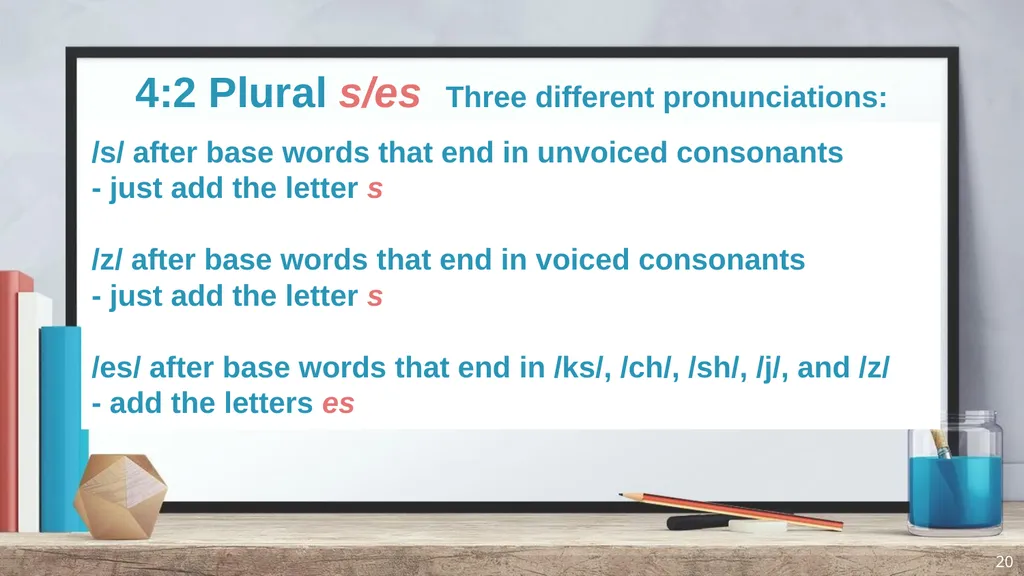
4:2 Plural s/es Three different pronunciations: 20 /s/ after base words that end in unvoiced consonants
- just add the letter s
/z/ after base words that end in voiced consonants
- just add the letter s
/es/ after base words that end in /ks/, /ch/, /sh/, /j/, and /z/
- add the letters es<br>
21
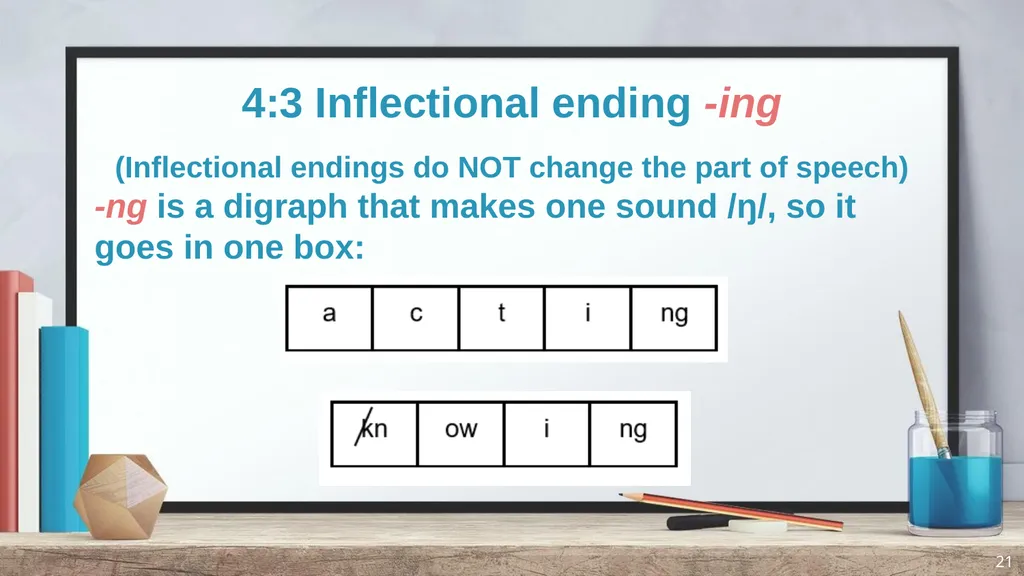
4:3 Inflectional ending -ing 21 (Inflectional endings do NOT change the part of speech)
-ng is a digraph that makes one sound /ŋ/, so it goes in one box:<br>
22
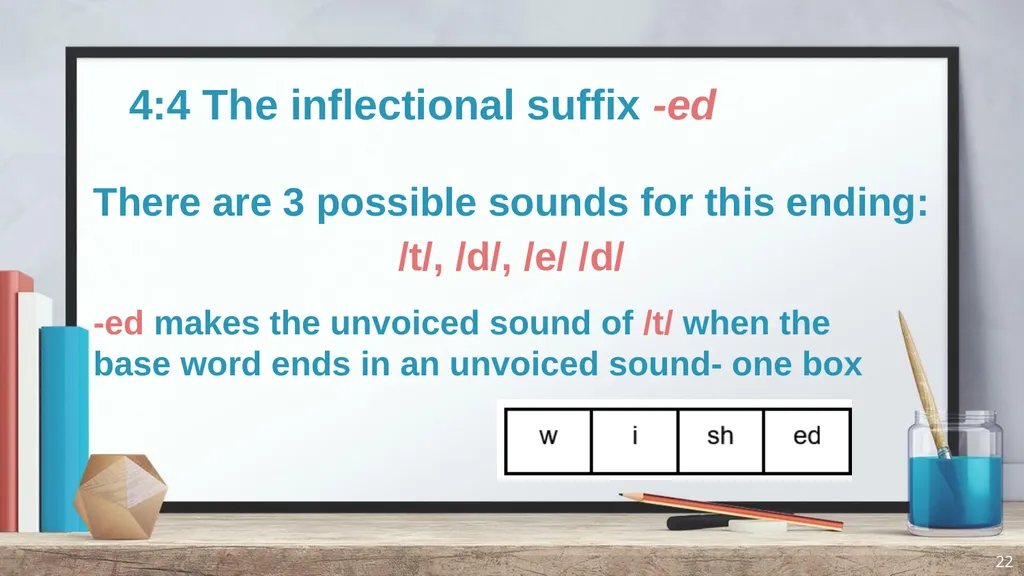
4:4 The inflectional suffix -ed 22 There are 3 possible sounds for this ending: /t/, /d/, /e/ /d/ -ed makes the unvoiced sound of /t/ when the base word ends in an unvoiced sound- one box<br>
23
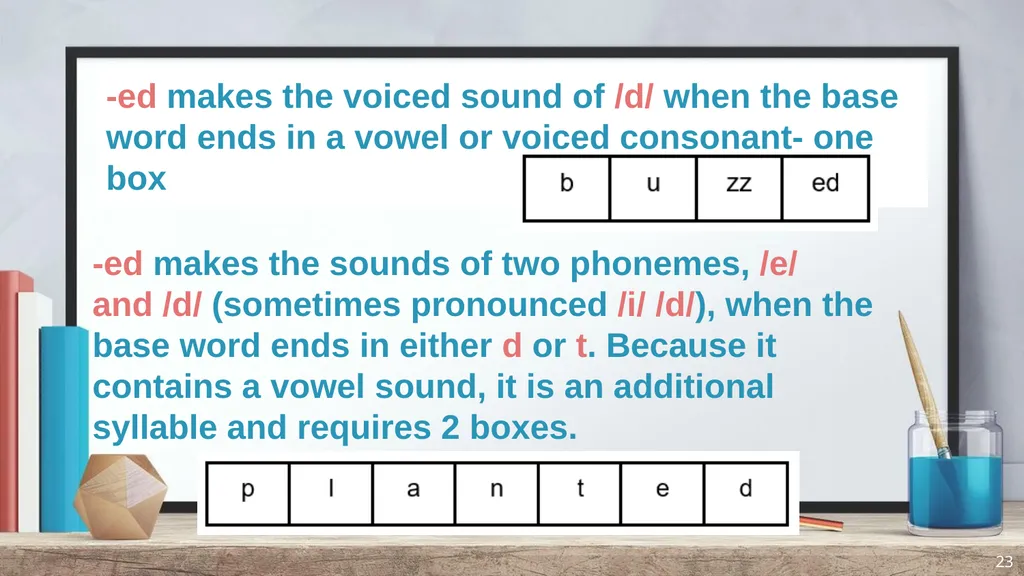
23 -ed makes the voiced sound of /d/ when the base word ends in a vowel or voiced consonant- one box -ed makes the sounds of two phonemes, /e/ and /d/ (sometimes pronounced /i/ /d/), when the base word ends in either d or t. Because it contains a vowel sound, it is an additional syllable and requires 2 boxes.<br>
24
Mapping multiple concepts with -ed
The -e has two jobs in the following: 24 The original e is dropped, but the e in -ed keeps the silent e principle at work
The e also works with -ed to represent past tense; it is pronounced /d/, so is written in one box<br>
25
The -e has 3 jobs in the following: 25 The original e is dropped, but the e in -ed keeps the silent e principle at work
The e works with -ed to represent past tense
The e works with c and g to create the soft sound of /s/ and /j/<br>
26
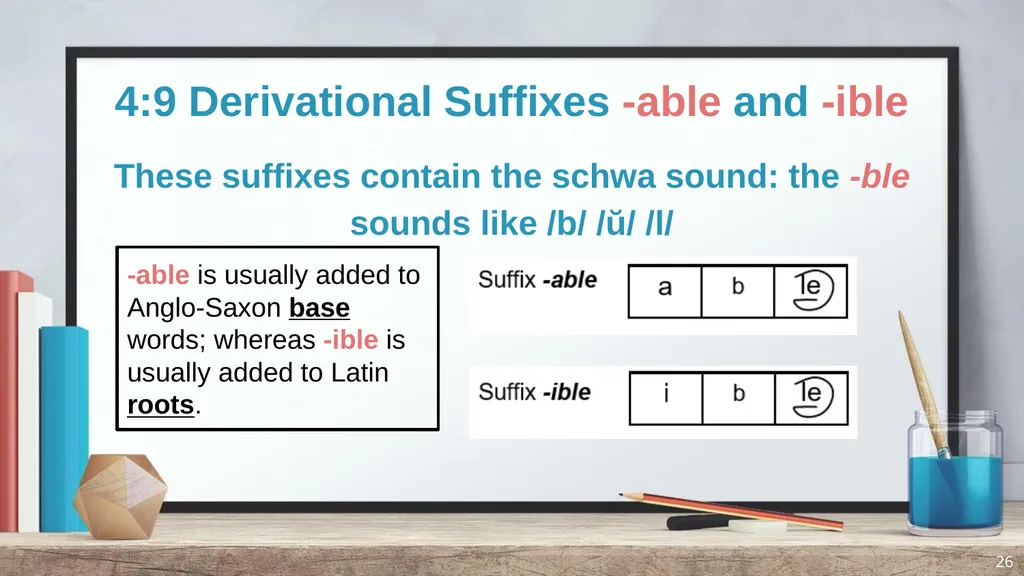
4:9 Derivational Suffixes -able and -ible 26 These suffixes contain the schwa sound: the -ble sounds like /b/ /ŭ/ /l/ -able is usually added to Anglo-Saxon base words; whereas -ible is usually added to Latin roots.<br>
27
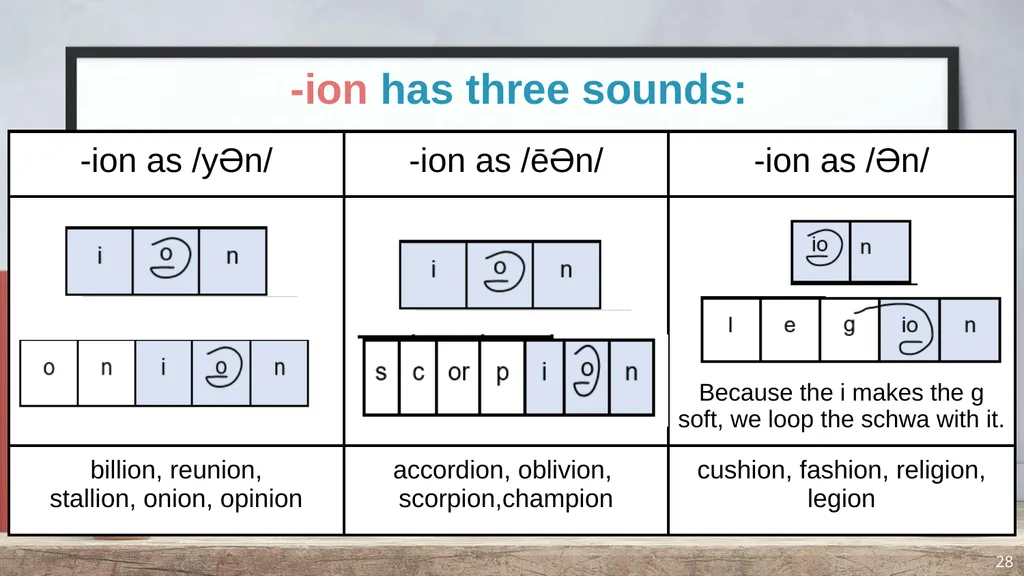
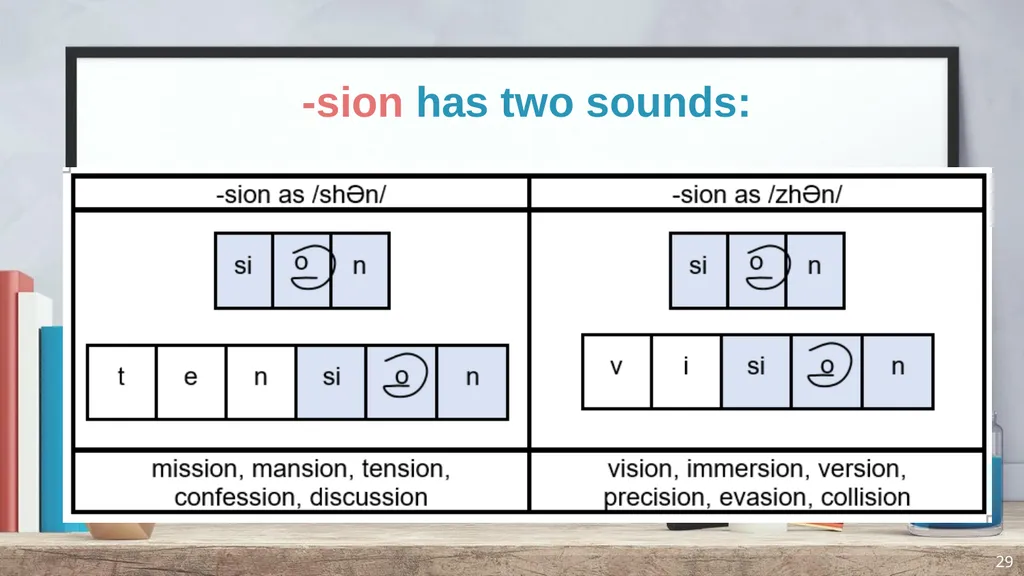
4:10 Suffixes -ion, -sion, and -tion 27 These three suffixes contain the schwa vowel sound.
Usually you will hear three sounds with these suffixes; however, in a few words- such as cushion, fashion, and legion- the suffix makes two sounds because the i and o combine to make the schwa vowel.<br>
28
-ion has three sounds: 28<br>
29
-sion has two sounds: 29<br>
30
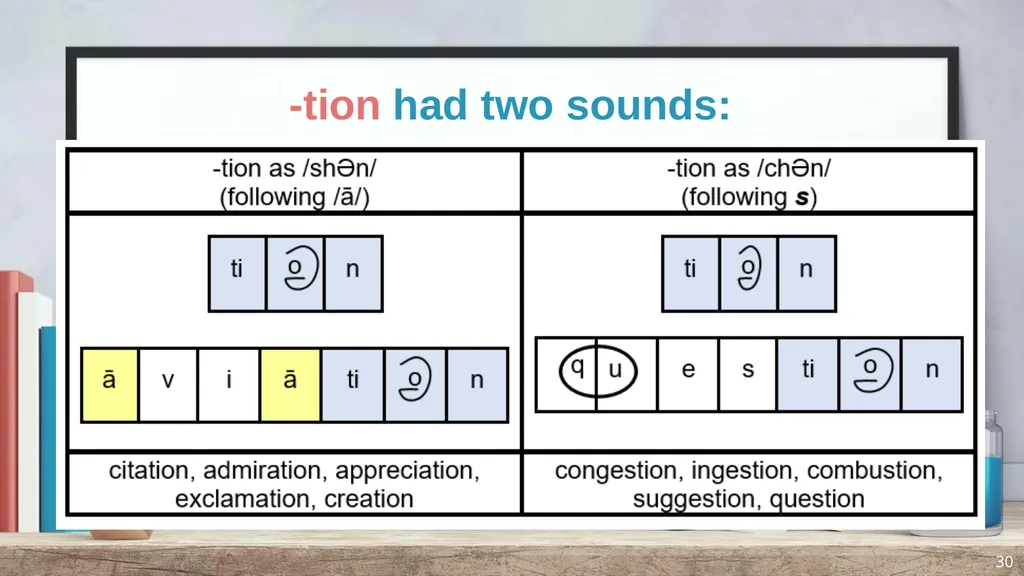
-tion had two sounds: 30<br>
31
5:1 Consonant -le syllable (Cle) 31 Remember, the -le sounds like /ŭ/ /l/, which is a schwa, so the le is always mapped in one box with the schwa wrapped around it.<br>
32
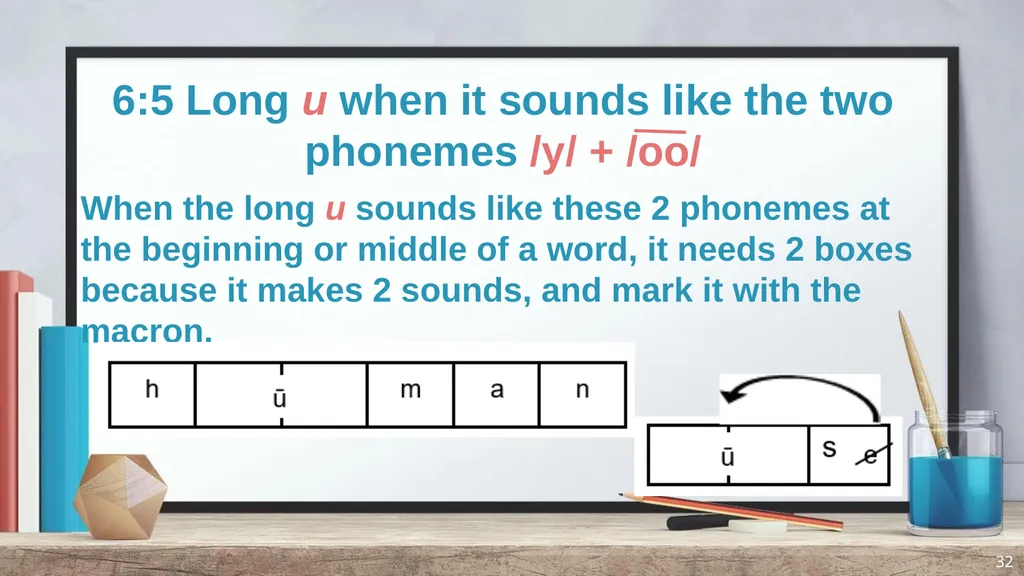
6:5 Long u when it sounds like the two phonemes /y/ + /oo/ 32 When the long u sounds like these 2 phonemes at the beginning or middle of a word, it needs 2 boxes because it makes 2 sounds, and mark it with the macron.<br>
33
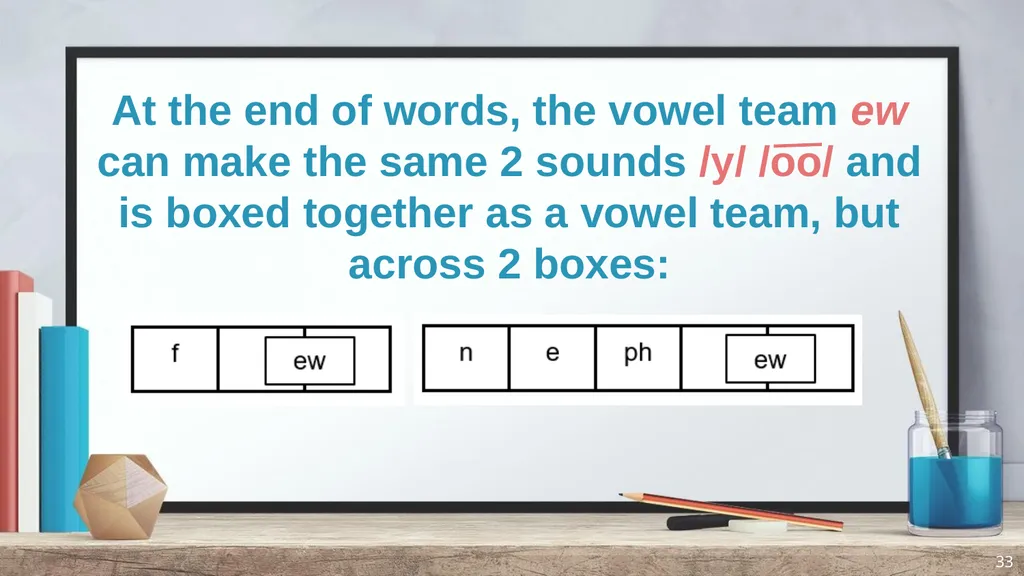
At the end of words, the vowel team ew can make the same 2 sounds /y/ /oo/ and is boxed together as a vowel team, but across 2 boxes: 33<br>
34
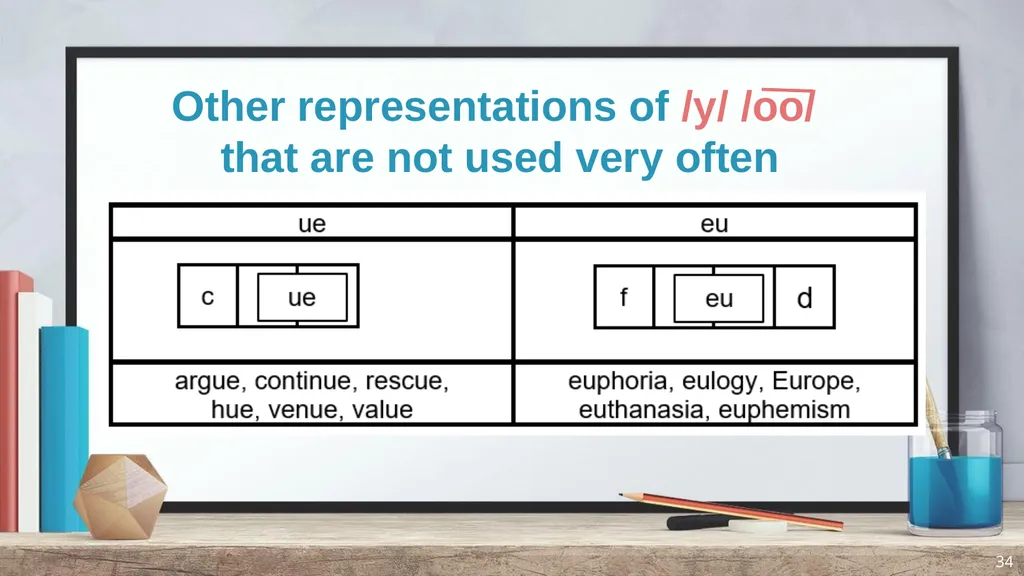
Other representations of /y/ /oo/
that are not used very often 34<br>
35
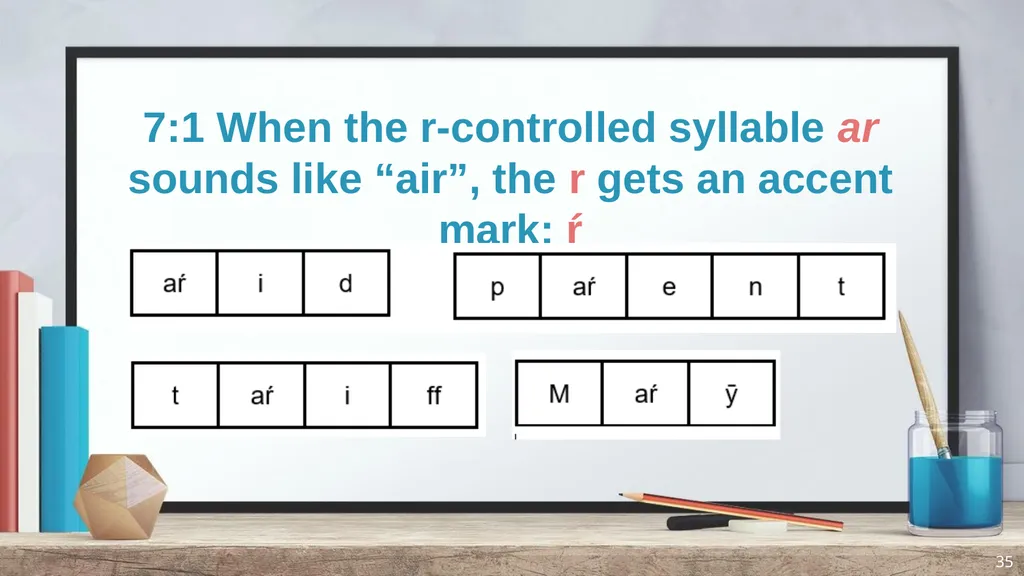
7:1 When the r-controlled syllable ar sounds like “air”, the r gets an accent mark: ŕ 35<br>
36
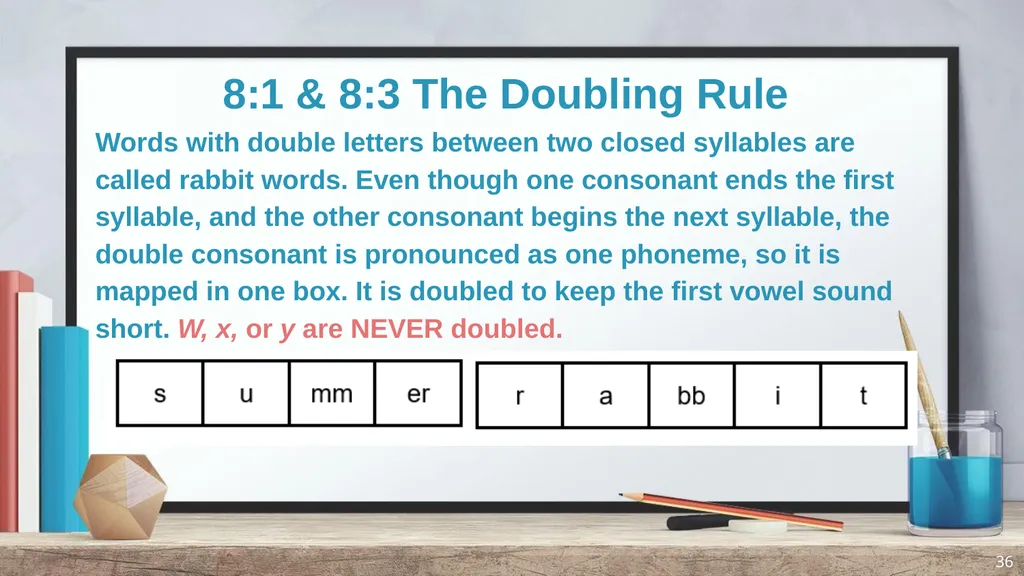
8:1 & 8:3 The Doubling Rule 36 Words with double letters between two closed syllables are called rabbit words. Even though one consonant ends the first syllable, and the other consonant begins the next syllable, the double consonant is pronounced as one phoneme, so it is mapped in one box. It is doubled to keep the first vowel sound short. W, x, or y are NEVER doubled.<br>
37
Thanks! Any questions?
You can find me at:
jludwig@gisd.k12.nm.us
All information is from
By Kathryn E.S.Grace 37<br>