
PHY418 Particle Astrophysics Acceleration
LO
Published · 41 slides · 0 views
1 / 1


Description
PHY418 Particle Astrophysics Acceleration Mechanisms 1 Acceleration Mechanisms There is clear observational evidence that hadrons and electrons are accelerated to extreme energies by astrophysical objects direct evidence: charged cosmic
Related Topics
Share
Embed code
Download this presentation From Below
"PHY418 Particle Astrophysics Acceleration" is the property of its rightful owner. Permission is granted to download and print the materials on this website for personal, non-commercial use only, and to display it on your personal computer provided you do not modify the materials and that you retain all copyright notices contained in the materials. By downloading content from our website, you accept the terms of this agreement.
Presentation Transcript
01
PHY418 Particle Astrophysics Acceleration Mechanisms 1<br>
02
Acceleration Mechanisms There is clear observational evidence that hadrons and electrons are accelerated to extreme energies by astrophysical objects
direct evidence: charged cosmic rays
indirect evidence: synchrotron emission, inverse Compton emission, TeV photons, evidence of pion production and decay
Charged particles are accelerated by electric fields, but large-scale permanent electric fields do not exist in nature
there are too many charged particles about—space is surprisingly conductive!
Therefore our source must be magnetic fields
stable magnetic fields cannot induce acceleration, but varying magnetic fields can 2<br>
direct evidence: charged cosmic rays
indirect evidence: synchrotron emission, inverse Compton emission, TeV photons, evidence of pion production and decay
Charged particles are accelerated by electric fields, but large-scale permanent electric fields do not exist in nature
there are too many charged particles about—space is surprisingly conductive!
Therefore our source must be magnetic fields
stable magnetic fields cannot induce acceleration, but varying magnetic fields can 2<br>
03
Acceleration Mechanisms Suggested mechanisms for acceleration in astrophysical sources:
Fermi second-order acceleration
diffusive shock acceleration (DSA)
shock drift acceleration (SDA)
acceleration by relativistic shocks
magnetic reconnection
Most favoured candidates are DSA and acceleration by relativistic shocks, but probably all of these mechanisms contribute to some degree 3<br>
Fermi second-order acceleration
diffusive shock acceleration (DSA)
shock drift acceleration (SDA)
acceleration by relativistic shocks
magnetic reconnection
Most favoured candidates are DSA and acceleration by relativistic shocks, but probably all of these mechanisms contribute to some degree 3<br>
04
Acceleration Mechanisms Fermi second-order acceleration 4<br>
05
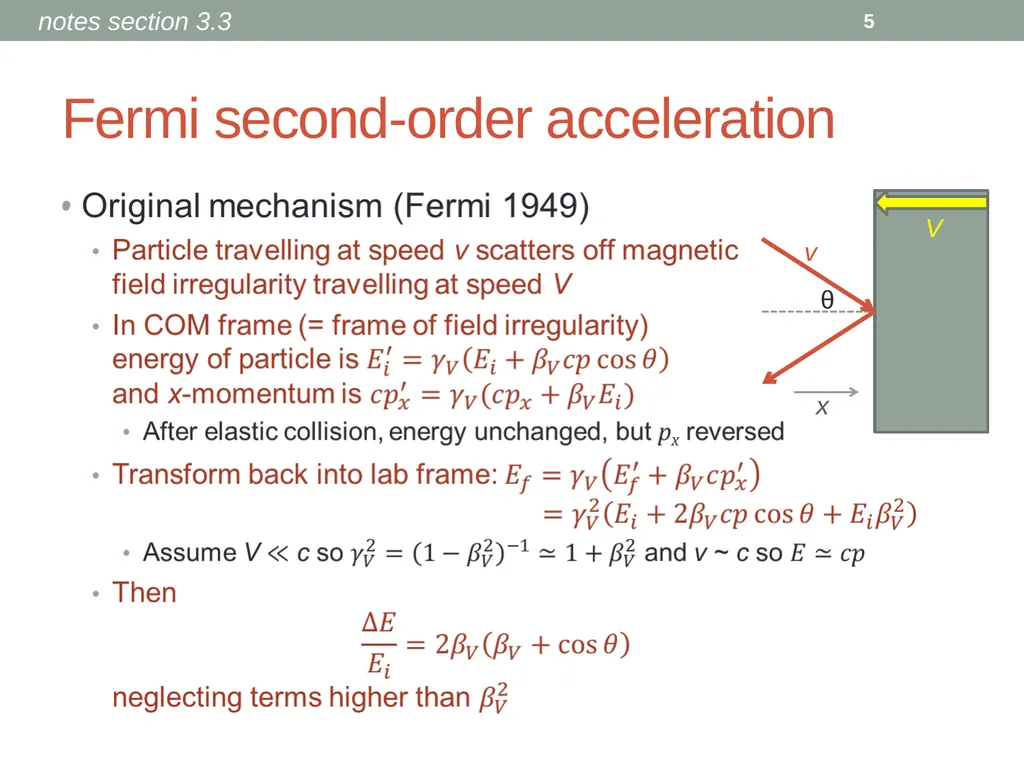
Fermi second-order acceleration 5 x notes section 3.3<br>
06
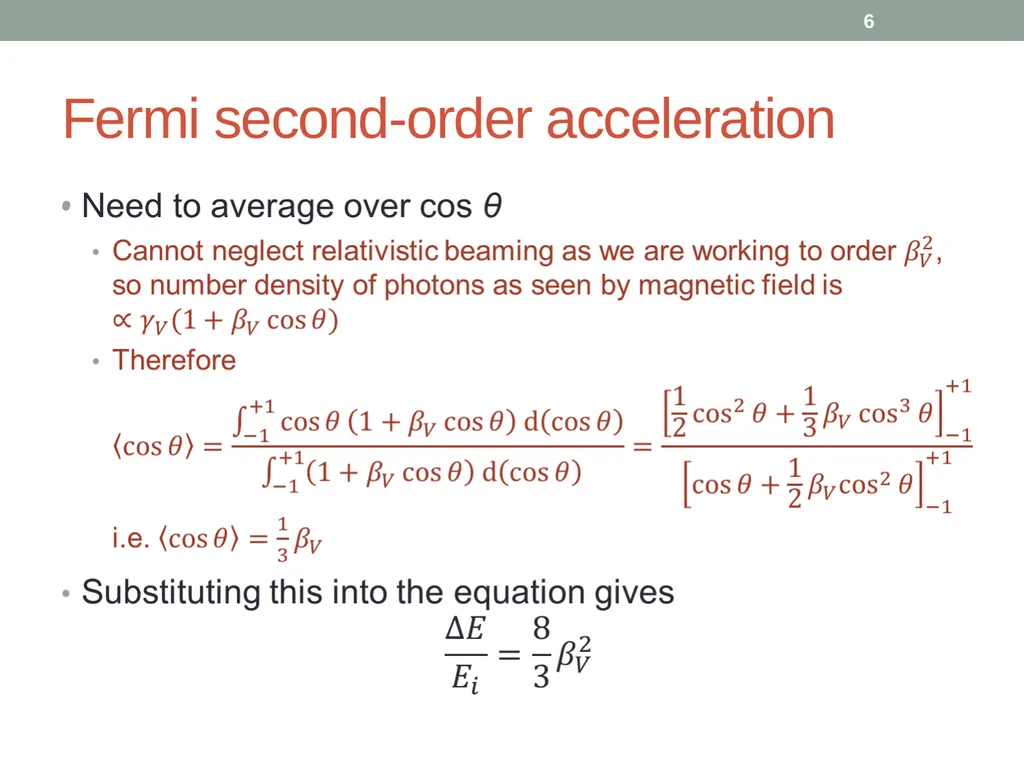
Fermi second-order acceleration 6<br>
07
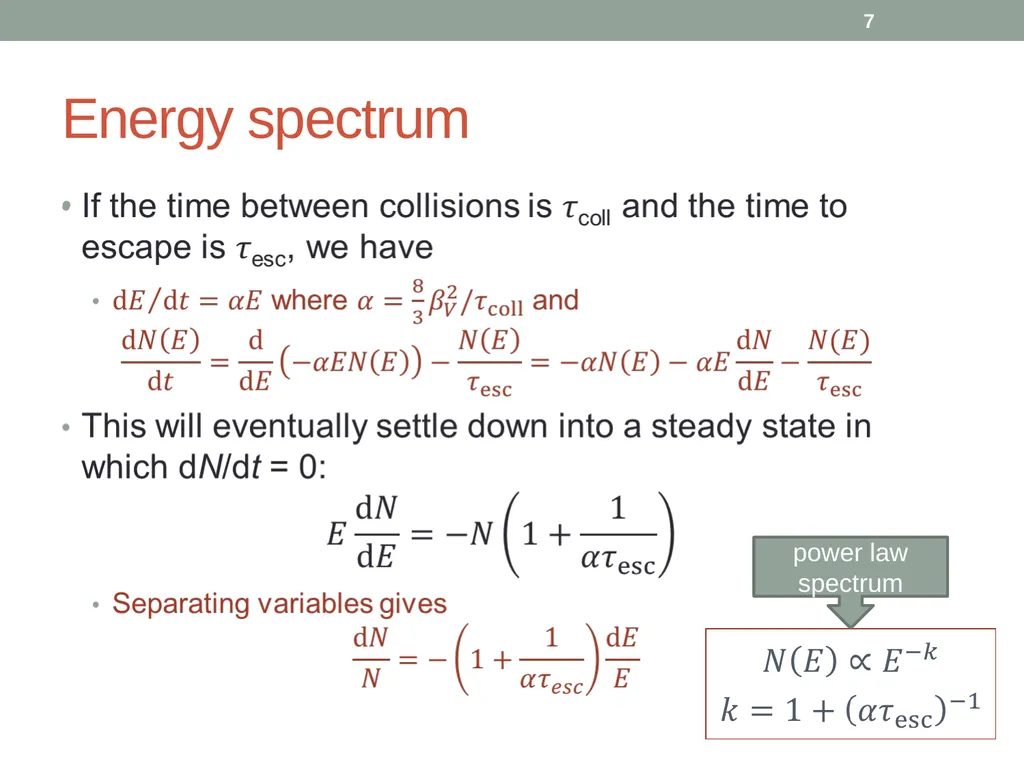
Energy spectrum 7 power law spectrum<br>
08
Issues with Fermi 2nd order It’s too slow
relative velocities of objects in Galactic disc are only 10s of km/s, so fractional energy gain per reflection is only ~10−8
There is no obvious reason why different sources should yield same spectral index
but the fact that the CR spectrum is close to E−2.7 over many orders of magnitude suggests that they do
It is very difficult to get started (“injection problem”)
at low energies, ionisation losses exceed predicted energy gain
need seed population to have energies of ~200 MeV or more
worse for particles heavier than protons as ionisation loss ∝ z2
this is far higher than thermal energies
Solution to these problems is acceleration near shocks 8<br>
relative velocities of objects in Galactic disc are only 10s of km/s, so fractional energy gain per reflection is only ~10−8
There is no obvious reason why different sources should yield same spectral index
but the fact that the CR spectrum is close to E−2.7 over many orders of magnitude suggests that they do
It is very difficult to get started (“injection problem”)
at low energies, ionisation losses exceed predicted energy gain
need seed population to have energies of ~200 MeV or more
worse for particles heavier than protons as ionisation loss ∝ z2
this is far higher than thermal energies
Solution to these problems is acceleration near shocks 8<br>
09
Acceleration Mechanisms Astrophysical shocks 9<br>
10
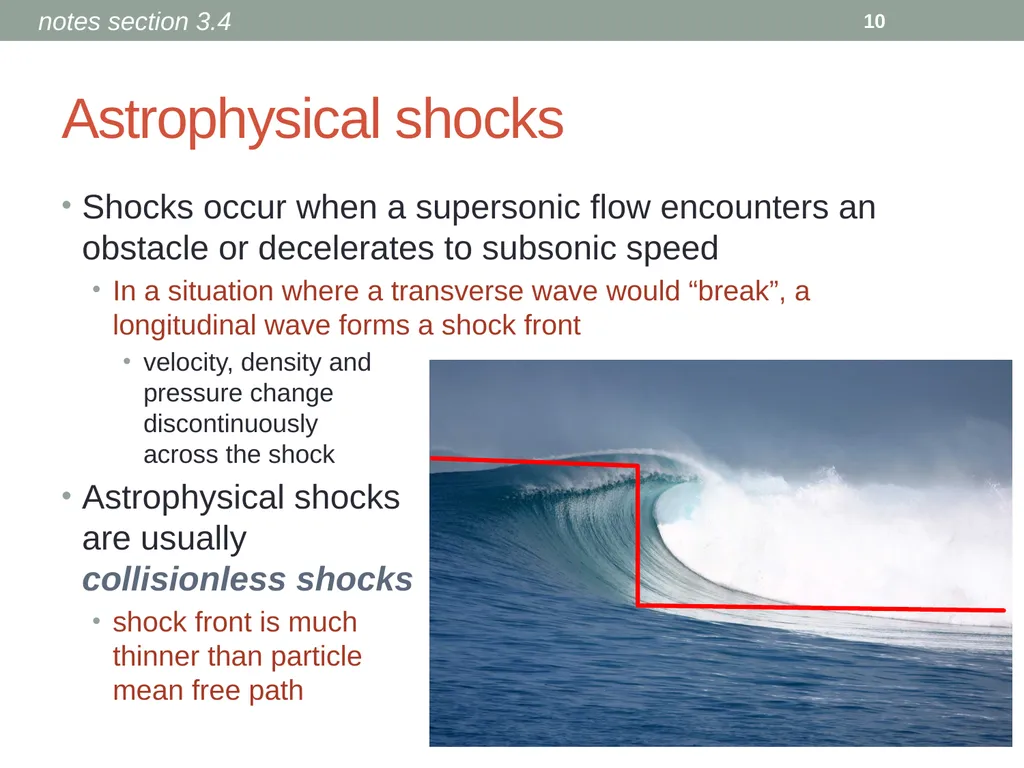
Astrophysical shocks Shocks occur when a supersonic flow encounters an obstacle or decelerates to subsonic speed
In a situation where a transverse wave would “break”, a longitudinal wave forms a shock front
velocity, density and pressure change discontinuously across the shock
Astrophysical shocks are usually collisionless shocks
shock front is much thinner than particle mean free path 10 notes section 3.4<br>
In a situation where a transverse wave would “break”, a longitudinal wave forms a shock front
velocity, density and pressure change discontinuously across the shock
Astrophysical shocks are usually collisionless shocks
shock front is much thinner than particle mean free path 10 notes section 3.4<br>
11
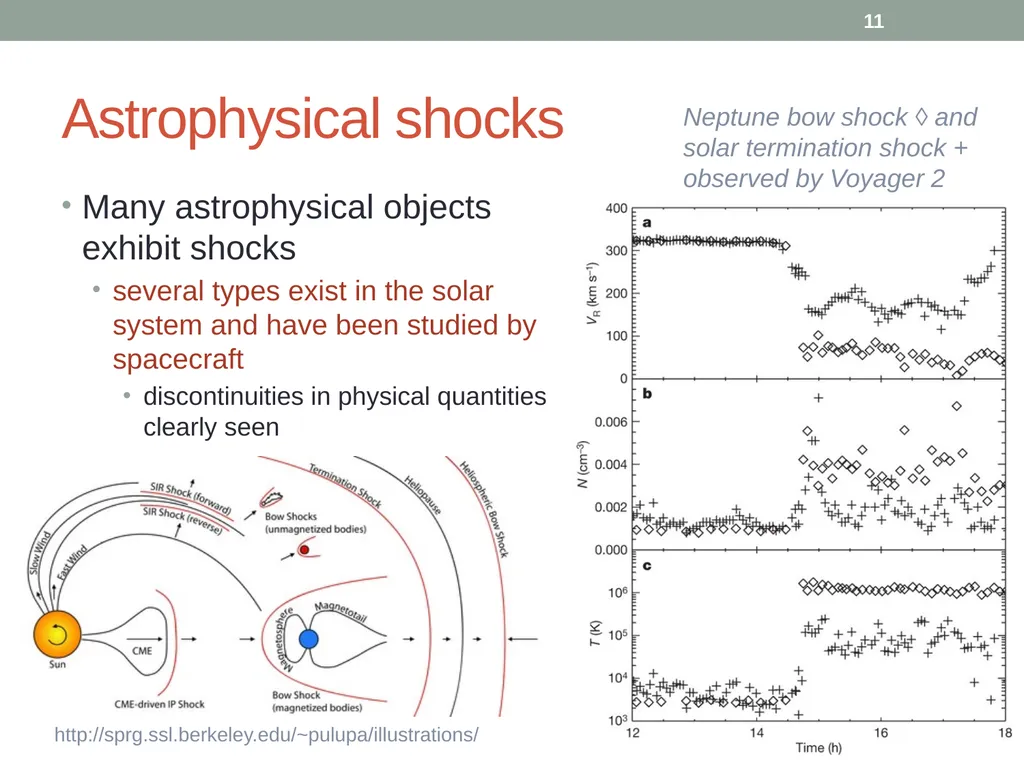
Astrophysical shocks Many astrophysical objects exhibit shocks
several types exist in the solar system and have been studied by spacecraft
discontinuities in physical quantities clearly seen 11 Neptune bow shock ◊ and solar termination shock + observed by Voyager 2 http://sprg.ssl.berkeley.edu/~pulupa/illustrations/<br>
several types exist in the solar system and have been studied by spacecraft
discontinuities in physical quantities clearly seen 11 Neptune bow shock ◊ and solar termination shock + observed by Voyager 2 http://sprg.ssl.berkeley.edu/~pulupa/illustrations/<br>
12
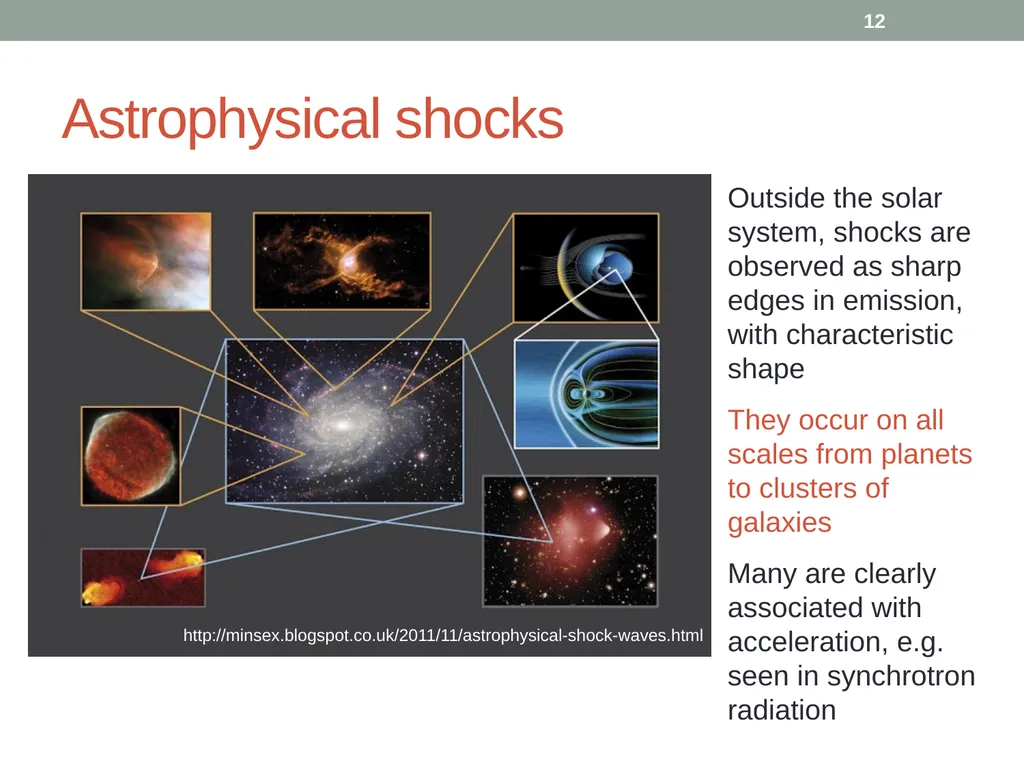
Astrophysical shocks 12 Outside the solar system, shocks are observed as sharp edges in emission, with characteristic shape
They occur on all scales from planets to clusters of galaxies
Many are clearly associated with acceleration, e.g. seen in synchrotron radiation<br>
They occur on all scales from planets to clusters of galaxies
Many are clearly associated with acceleration, e.g. seen in synchrotron radiation<br>
13
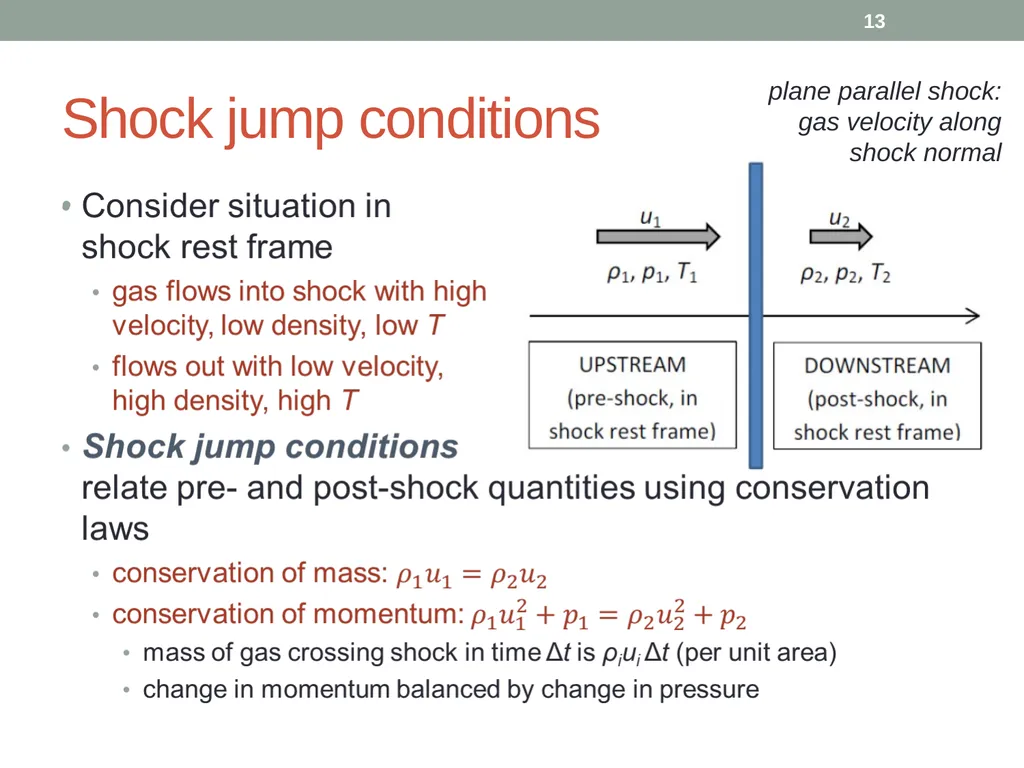
Shock jump conditions 13 plane parallel shock:
gas velocity along shock normal<br>
gas velocity along shock normal<br>
14
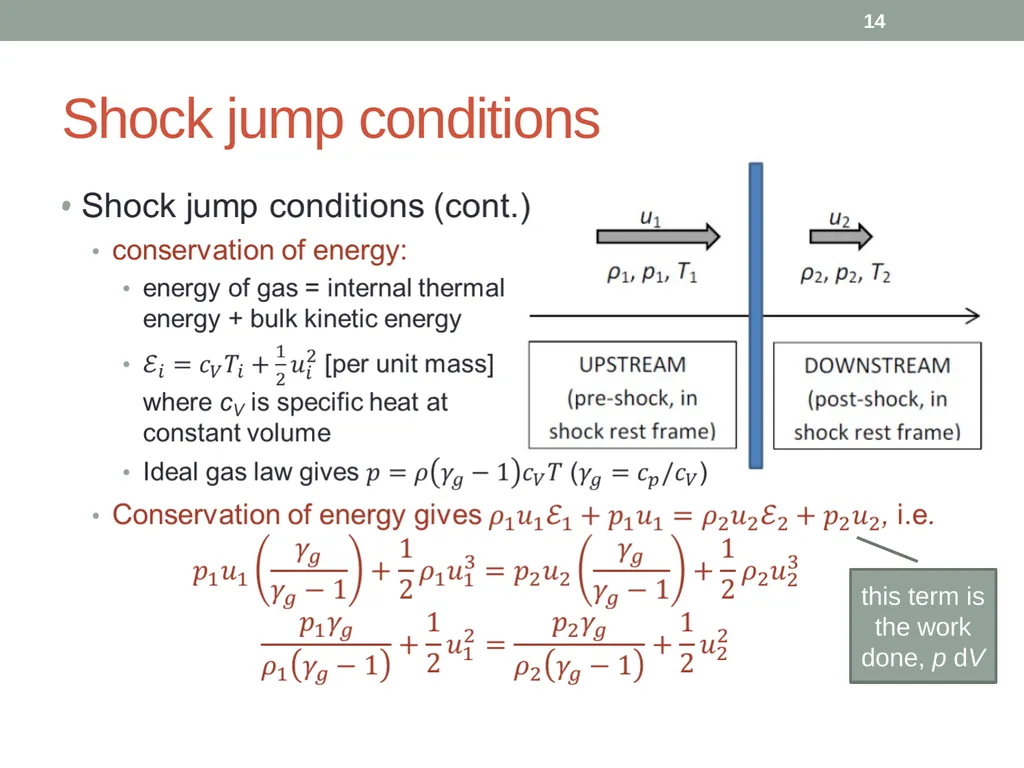
Shock jump conditions 14 this term is the work done, p dV<br>
15
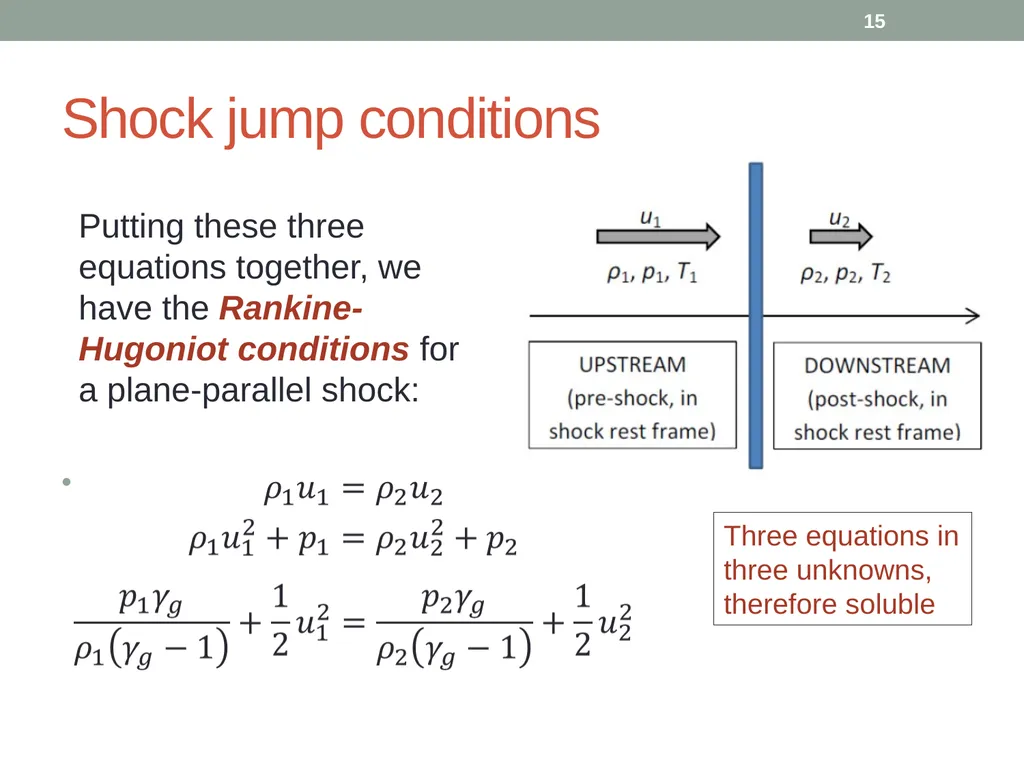
Shock jump conditions 15 Putting these three equations together, we have the Rankine-Hugoniot conditions for a plane-parallel shock: Three equations in three unknowns, therefore soluble<br>
16
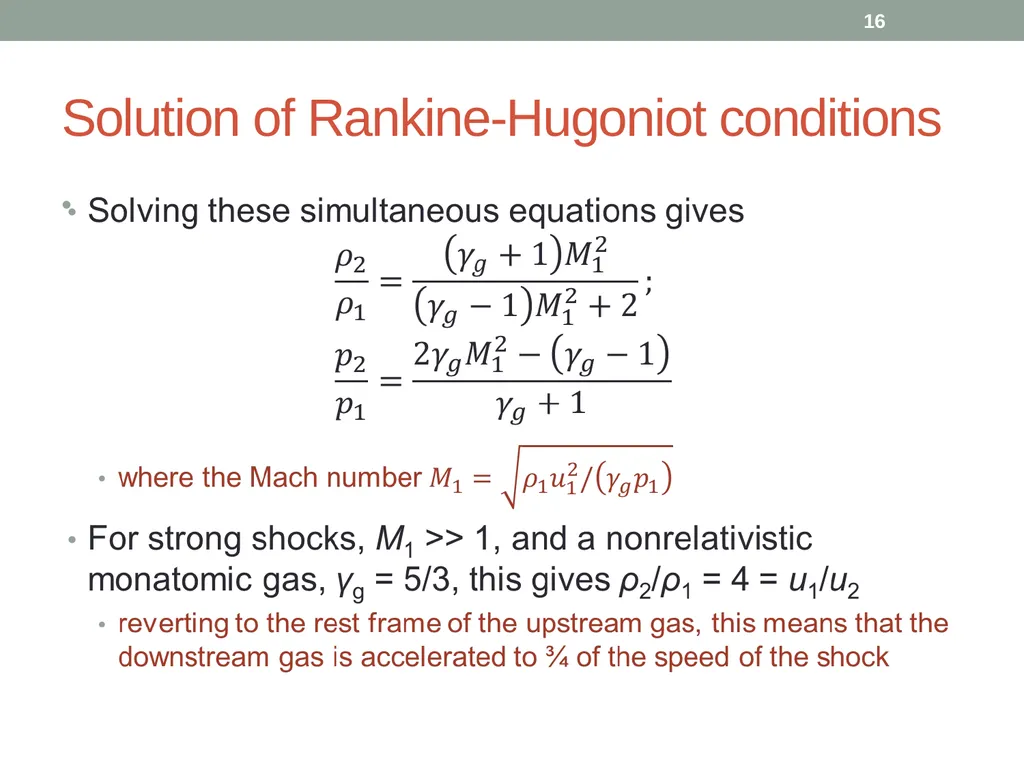
Solution of Rankine-Hugoniot conditions 16<br>
17
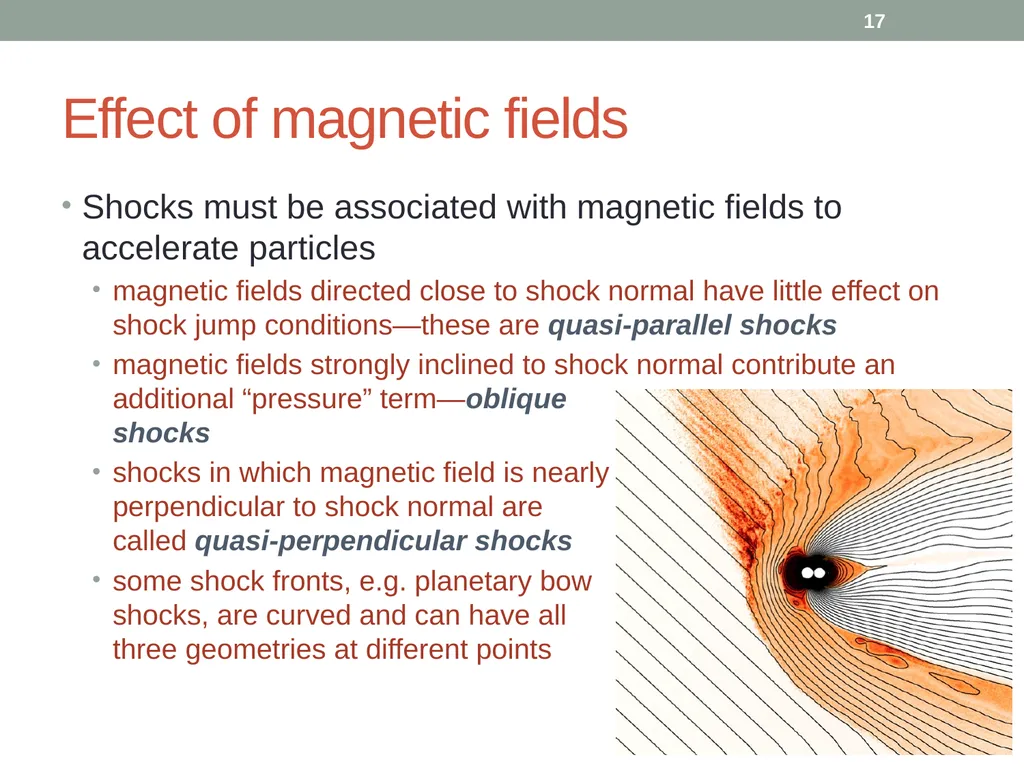
Effect of magnetic fields Shocks must be associated with magnetic fields to accelerate particles
magnetic fields directed close to shock normal have little effect on shock jump conditions—these are quasi-parallel shocks
magnetic fields strongly inclined to shock normal contribute an additional “pressure” term—oblique shocks
shocks in which magnetic field is nearly perpendicular to shock normal are called quasi-perpendicular shocks
some shock fronts, e.g. planetary bow shocks, are curved and can have all three geometries at different points 17<br>
magnetic fields directed close to shock normal have little effect on shock jump conditions—these are quasi-parallel shocks
magnetic fields strongly inclined to shock normal contribute an additional “pressure” term—oblique shocks
shocks in which magnetic field is nearly perpendicular to shock normal are called quasi-perpendicular shocks
some shock fronts, e.g. planetary bow shocks, are curved and can have all three geometries at different points 17<br>
18
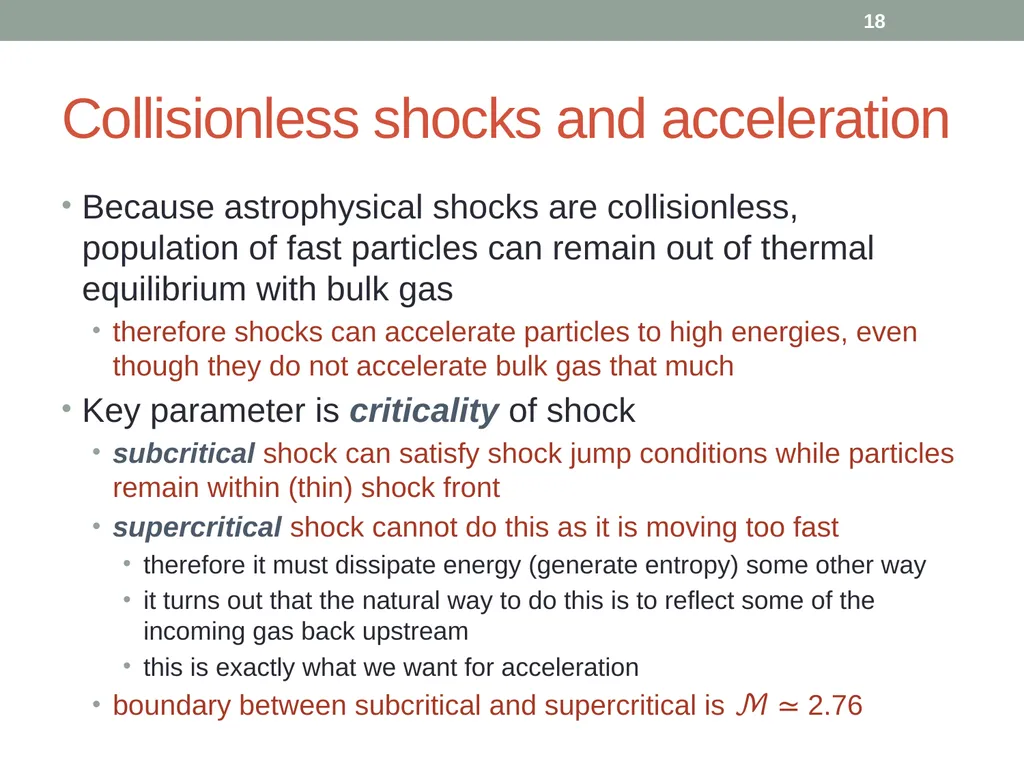
Collisionless shocks and acceleration Because astrophysical shocks are collisionless, population of fast particles can remain out of thermal equilibrium with bulk gas
therefore shocks can accelerate particles to high energies, even though they do not accelerate bulk gas that much
Key parameter is criticality of shock
subcritical shock can satisfy shock jump conditions while particles remain within (thin) shock front
supercritical shock cannot do this as it is moving too fast
therefore it must dissipate energy (generate entropy) some other way
it turns out that the natural way to do this is to reflect some of the incoming gas back upstream
this is exactly what we want for acceleration
boundary between subcritical and supercritical is ℳ ≃ 2.76 18<br>
therefore shocks can accelerate particles to high energies, even though they do not accelerate bulk gas that much
Key parameter is criticality of shock
subcritical shock can satisfy shock jump conditions while particles remain within (thin) shock front
supercritical shock cannot do this as it is moving too fast
therefore it must dissipate energy (generate entropy) some other way
it turns out that the natural way to do this is to reflect some of the incoming gas back upstream
this is exactly what we want for acceleration
boundary between subcritical and supercritical is ℳ ≃ 2.76 18<br>
19
Acceleration Mechanisms Diffusive Shock Acceleration 19<br>
20
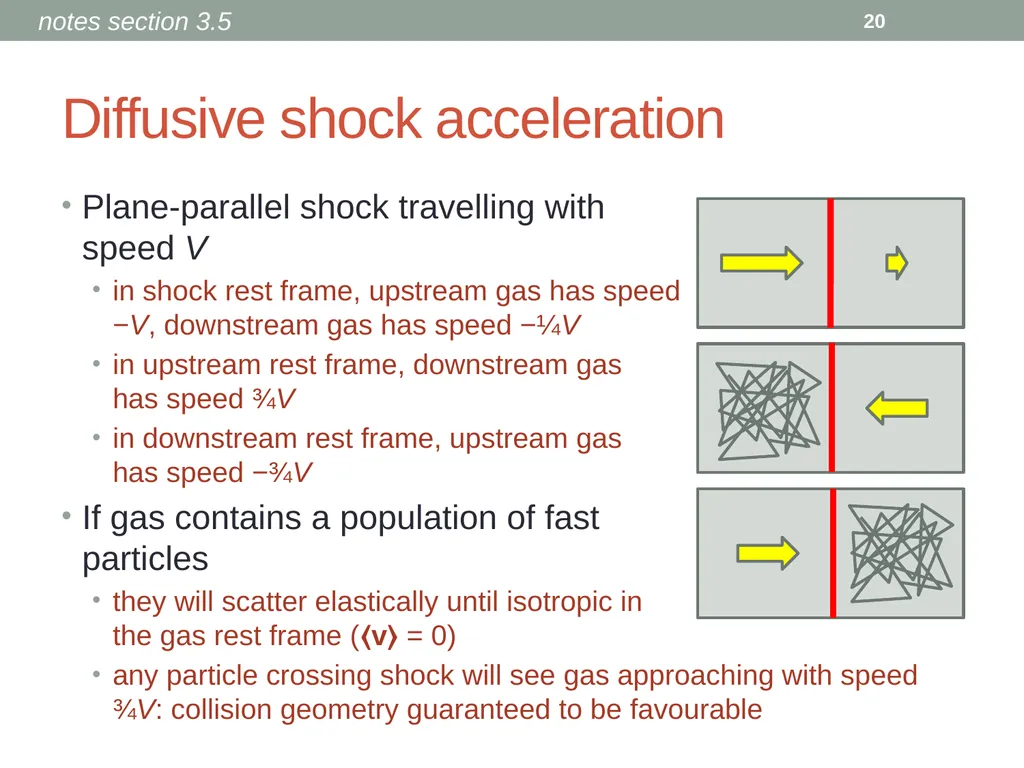
Diffusive shock acceleration Plane-parallel shock travelling with
speed V
in shock rest frame, upstream gas has speed −V, downstream gas has speed −¼V
in upstream rest frame, downstream gas has speed ¾V
in downstream rest frame, upstream gas has speed −¾V
If gas contains a population of fast particles
they will scatter elastically until isotropic in the gas rest frame (⟨v⟩ = 0)
any particle crossing shock will see gas approaching with speed ¾V: collision geometry guaranteed to be favourable 20 notes section 3.5<br>
in shock rest frame, upstream gas has speed −V, downstream gas has speed −¼V
in upstream rest frame, downstream gas has speed ¾V
in downstream rest frame, upstream gas has speed −¾V
If gas contains a population of fast particles
they will scatter elastically until isotropic in the gas rest frame (⟨v⟩ = 0)
any particle crossing shock will see gas approaching with speed ¾V: collision geometry guaranteed to be favourable 20 notes section 3.5<br>
21
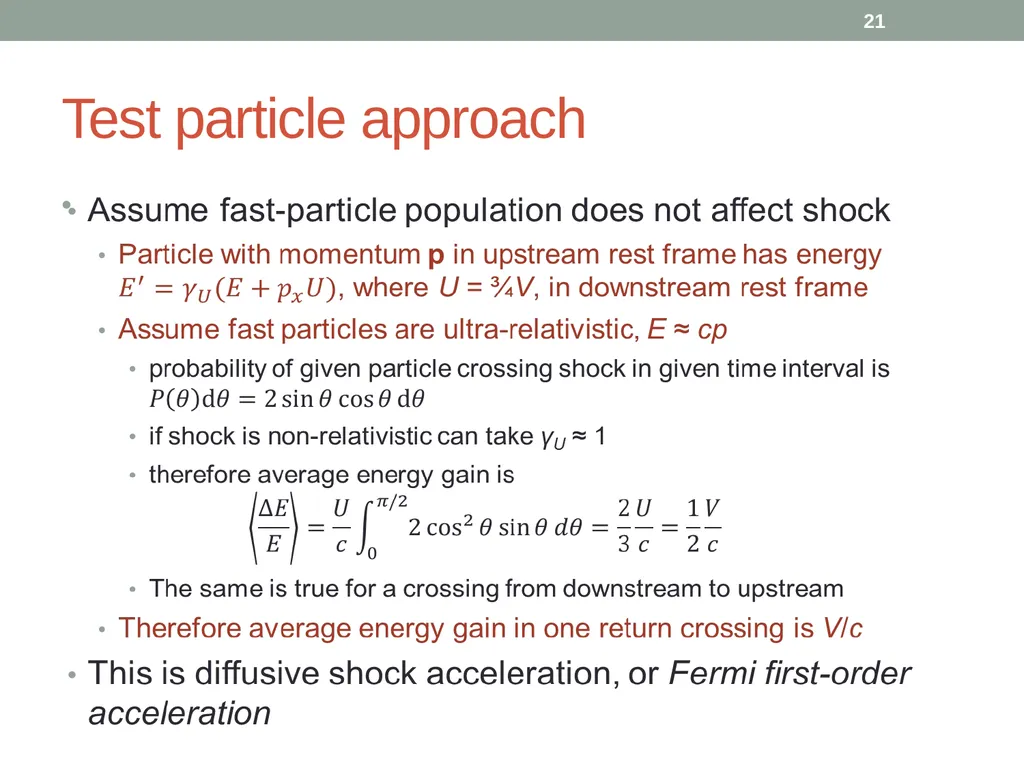
Test particle approach 21<br>
22
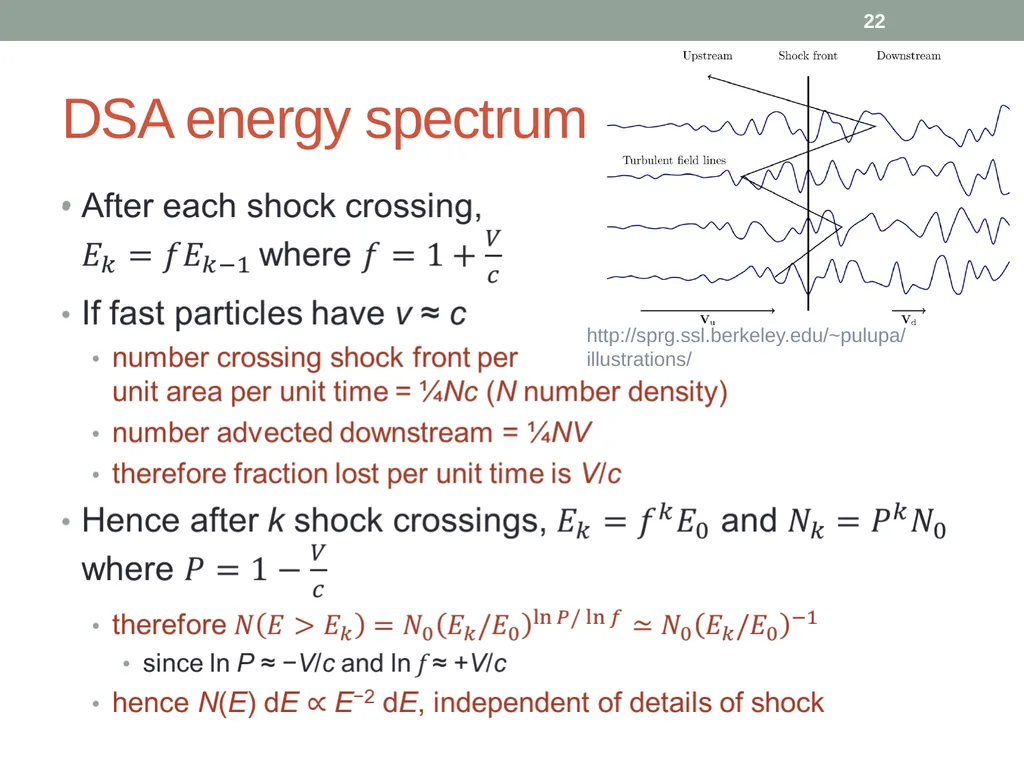
DSA energy spectrum 22 http://sprg.ssl.berkeley.edu/~pulupa/illustrations/<br>
23
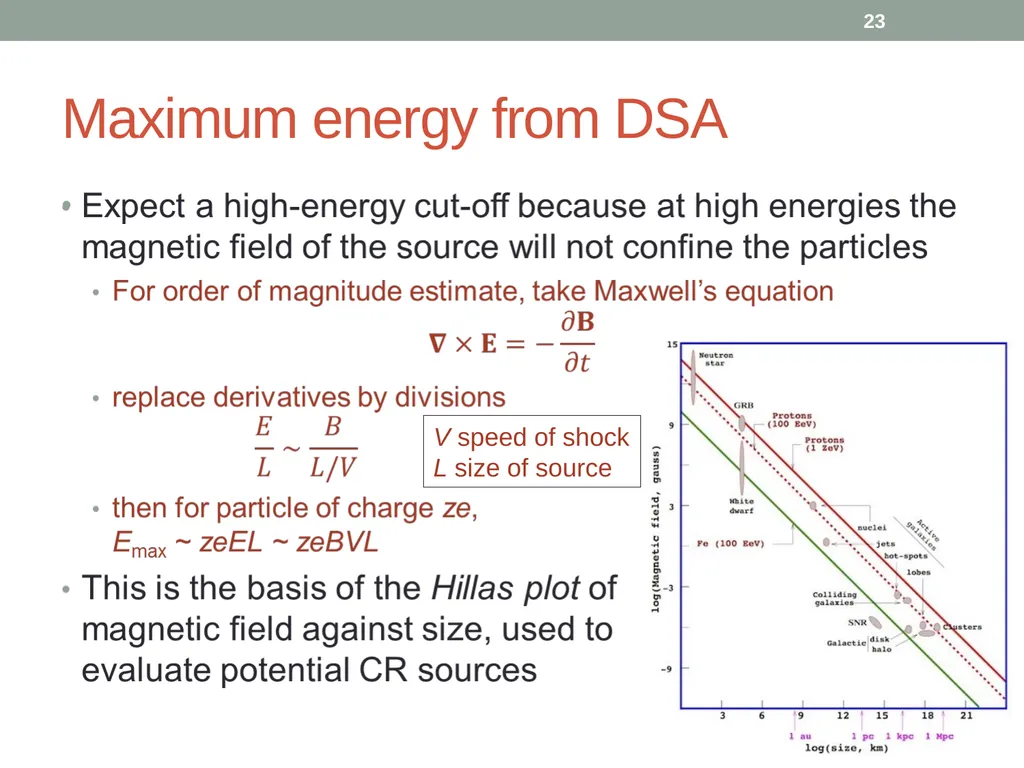
Maximum energy from DSA 23 V speed of shock
L size of source<br>
24
Realistic DSA Test particle approach assumes fast particles are negligible as regards their effect on the shock
but for supercritical shocks this cannot be right as we know that such shocks need a significant reflected flux to conserve energy and momentum across the shock front
also, measurements in solar system shocks indicate that acceleration is quite efficient—as much as 20% of the kinetic energy of the bulk gas is used in accelerating high-energy particles
Therefore the test-particle approach is inadequate and we need a more realistic treatment
this is highly non-linear and cannot be done analytically
detailed 3D computer simulations are needed
3D because particle distributions are highly anisotropic and turbulence is involved 24<br>
but for supercritical shocks this cannot be right as we know that such shocks need a significant reflected flux to conserve energy and momentum across the shock front
also, measurements in solar system shocks indicate that acceleration is quite efficient—as much as 20% of the kinetic energy of the bulk gas is used in accelerating high-energy particles
Therefore the test-particle approach is inadequate and we need a more realistic treatment
this is highly non-linear and cannot be done analytically
detailed 3D computer simulations are needed
3D because particle distributions are highly anisotropic and turbulence is involved 24<br>
25
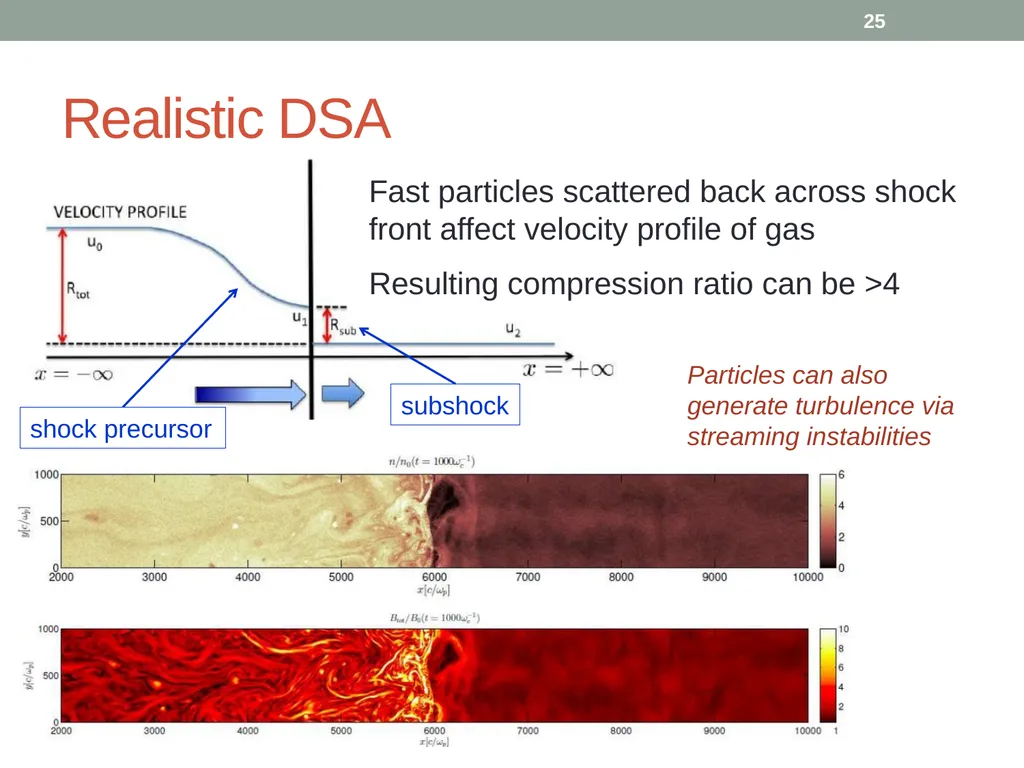
Realistic DSA 25 Fast particles scattered back across shock front affect velocity profile of gas
Resulting compression ratio can be >4 shock precursor subshock Particles can also generate turbulence via streaming instabilities<br>
Resulting compression ratio can be >4 shock precursor subshock Particles can also generate turbulence via streaming instabilities<br>
26
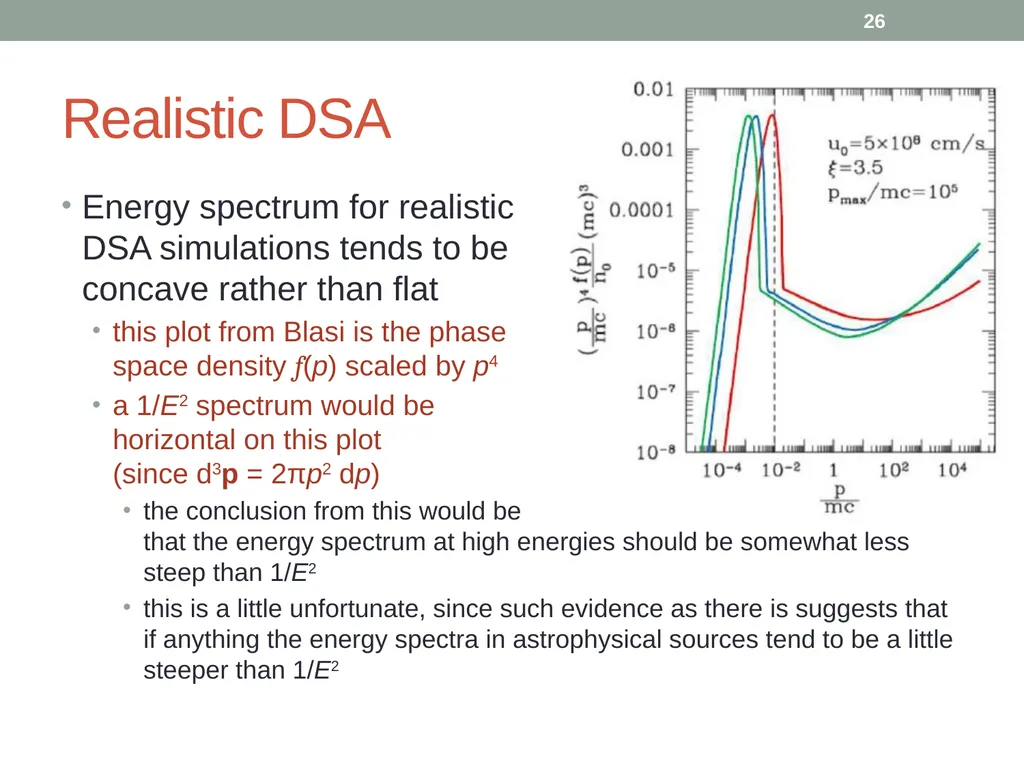
Realistic DSA Energy spectrum for realistic
DSA simulations tends to be
concave rather than flat
this plot from Blasi is the phase space density f(p) scaled by p4
a 1/E2 spectrum would be horizontal on this plot (since d3p = 2πp2 dp)
the conclusion from this would be that the energy spectrum at high energies should be somewhat less steep than 1/E2
this is a little unfortunate, since such evidence as there is suggests that if anything the energy spectra in astrophysical sources tend to be a little steeper than 1/E2 26<br>
this plot from Blasi is the phase space density f(p) scaled by p4
a 1/E2 spectrum would be horizontal on this plot (since d3p = 2πp2 dp)
the conclusion from this would be that the energy spectrum at high energies should be somewhat less steep than 1/E2
this is a little unfortunate, since such evidence as there is suggests that if anything the energy spectra in astrophysical sources tend to be a little steeper than 1/E2 26<br>
27
DSA: Conclusions Diffusive shock acceleration across non-relativistic shocks can accelerate particles to high energy with high efficiency
It produces a power-law spectrum ~E−2 with little dependence on details of shock
The maximum energy is of order zeBVL for a shock of speed V in magnetic field B in a source of size L
Required magnetic field strengths and level of turbulence can be generated by non-linear effects in realistic simulations
There do appear to be unsolved issues in getting the energy spectrum exactly right, but these calculations require extremely sophisticated simulations with high CPU requirements, so future work may resolve this 27<br>
It produces a power-law spectrum ~E−2 with little dependence on details of shock
The maximum energy is of order zeBVL for a shock of speed V in magnetic field B in a source of size L
Required magnetic field strengths and level of turbulence can be generated by non-linear effects in realistic simulations
There do appear to be unsolved issues in getting the energy spectrum exactly right, but these calculations require extremely sophisticated simulations with high CPU requirements, so future work may resolve this 27<br>
28
Acceleration Mechanisms Shock Drift Acceleration (SDA) 28<br>
29
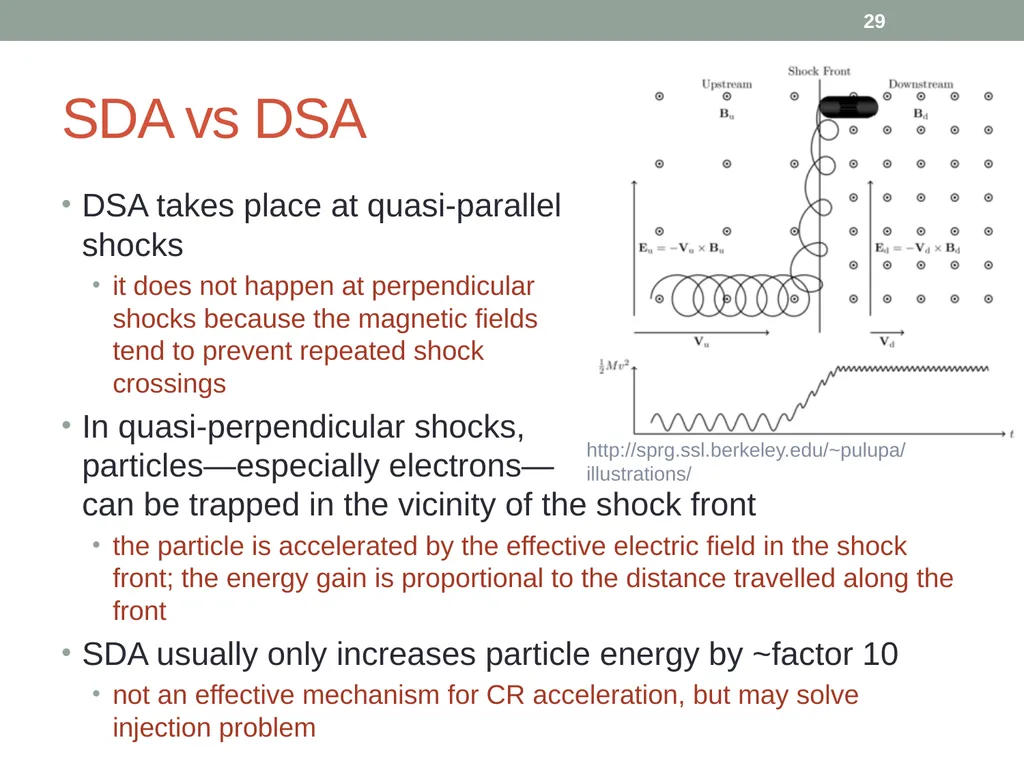
SDA vs DSA DSA takes place at quasi-parallel
shocks
it does not happen at perpendicular shocks because the magnetic fields tend to prevent repeated shock crossings
In quasi-perpendicular shocks, particles—especially electrons— can be trapped in the vicinity of the shock front
the particle is accelerated by the effective electric field in the shock front; the energy gain is proportional to the distance travelled along the front
SDA usually only increases particle energy by ~factor 10
not an effective mechanism for CR acceleration, but may solve injection problem 29 http://sprg.ssl.berkeley.edu/~pulupa/illustrations/<br>
it does not happen at perpendicular shocks because the magnetic fields tend to prevent repeated shock crossings
In quasi-perpendicular shocks, particles—especially electrons— can be trapped in the vicinity of the shock front
the particle is accelerated by the effective electric field in the shock front; the energy gain is proportional to the distance travelled along the front
SDA usually only increases particle energy by ~factor 10
not an effective mechanism for CR acceleration, but may solve injection problem 29 http://sprg.ssl.berkeley.edu/~pulupa/illustrations/<br>
30
Acceleration Mechanisms Acceleration at Relativistic Shocks 30<br>
31
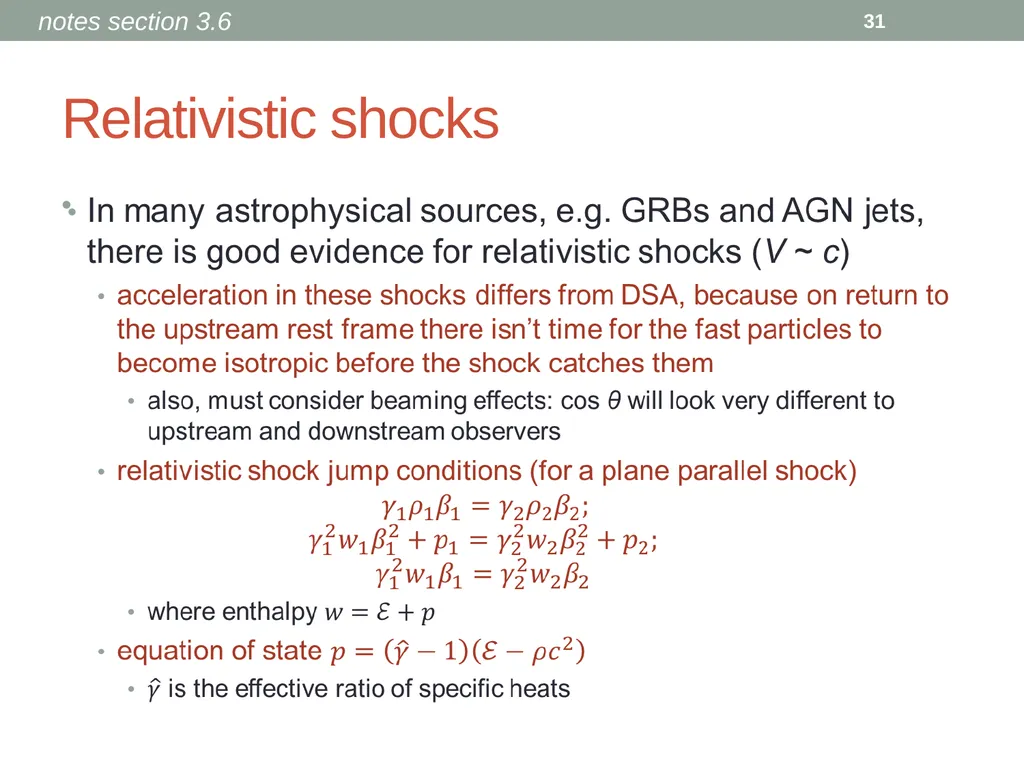
Relativistic shocks 31 notes section 3.6<br>
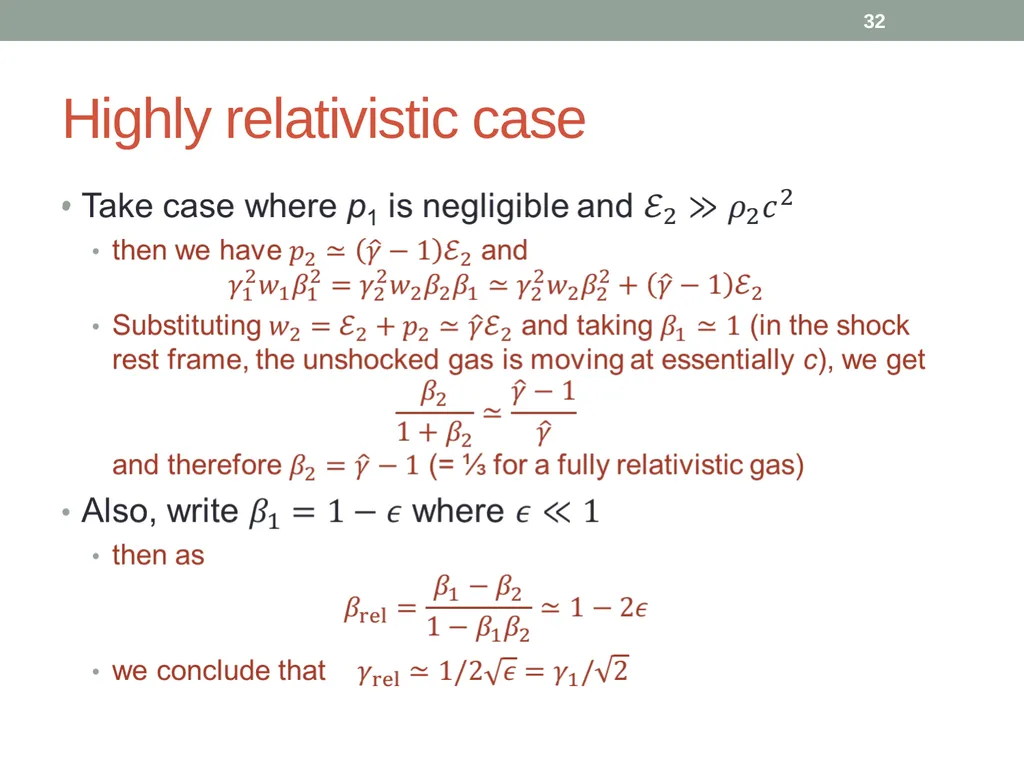
32
Highly relativistic case 32<br>
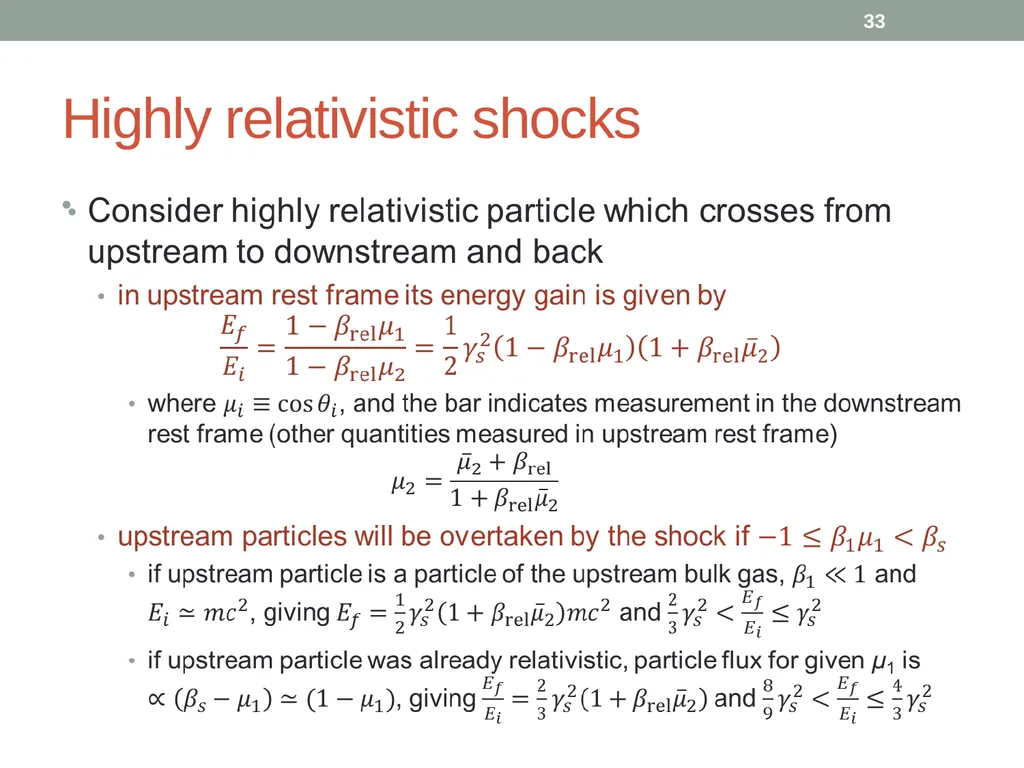
33
Highly relativistic shocks 33<br>
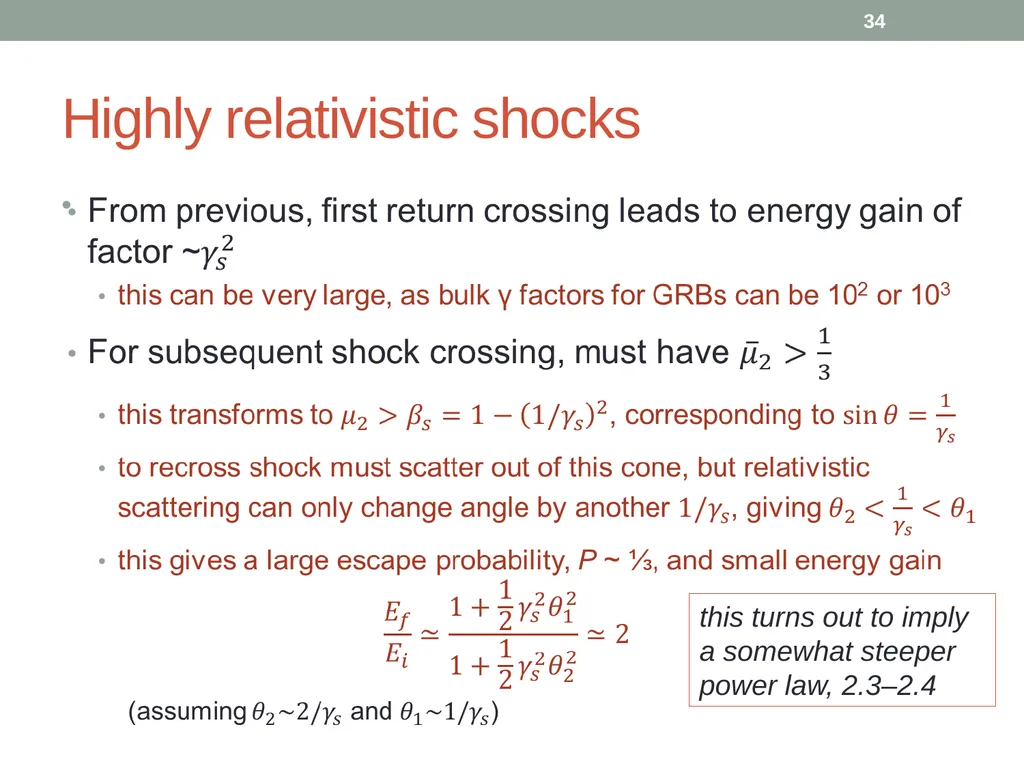
34
Highly relativistic shocks 34 this turns out to imply a somewhat steeper power law, 2.3–2.4<br>
35
Acceleration Mechanisms Magnetic Reconnection 35<br>
36
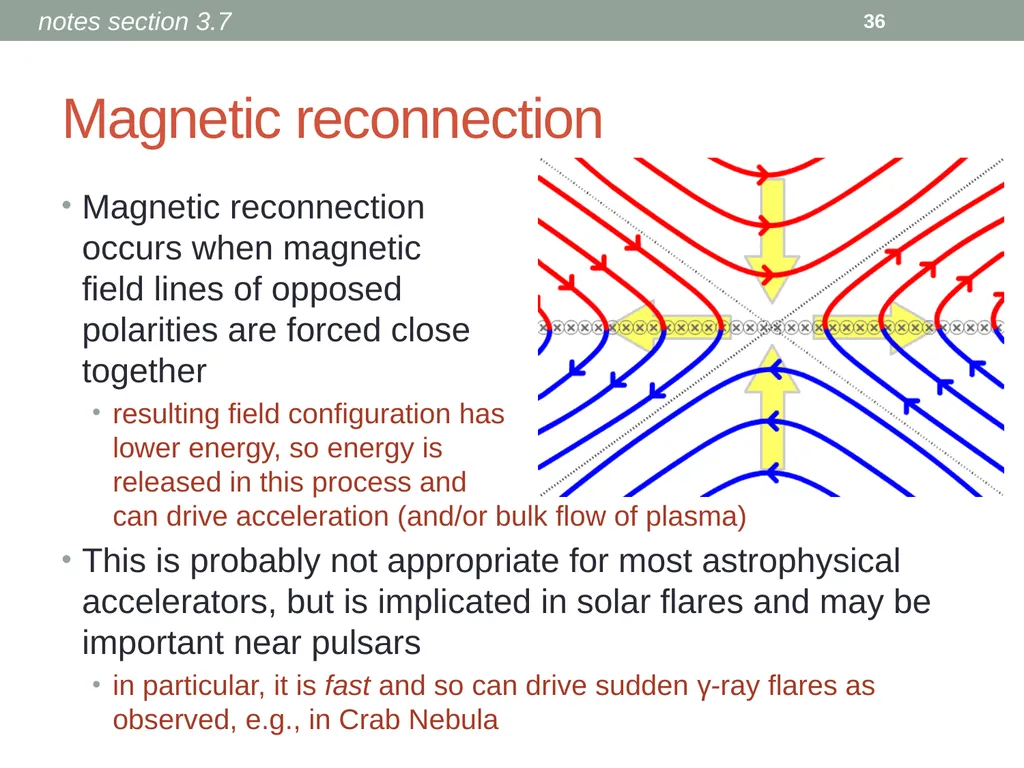
Magnetic reconnection Magnetic reconnection
occurs when magnetic
field lines of opposed
polarities are forced close
together
resulting field configuration has lower energy, so energy is released in this process and can drive acceleration (and/or bulk flow of plasma)
This is probably not appropriate for most astrophysical accelerators, but is implicated in solar flares and may be important near pulsars
in particular, it is fast and so can drive sudden γ-ray flares as observed, e.g., in Crab Nebula 36 notes section 3.7<br>
resulting field configuration has lower energy, so energy is released in this process and can drive acceleration (and/or bulk flow of plasma)
This is probably not appropriate for most astrophysical accelerators, but is implicated in solar flares and may be important near pulsars
in particular, it is fast and so can drive sudden γ-ray flares as observed, e.g., in Crab Nebula 36 notes section 3.7<br>
37
Acceleration Mechanisms Propagation through the Galaxy 37<br>
38
Propagation of CRs in Galaxy 38 notes section 3.7<br>
39
Propagation of CRs in Galaxy 39<br>
40
Summary Particle acceleration in astrophysical sources must involve magnetic fields
but scattering off magnetic fields in interstellar space is too inefficient
Most popular mechanisms are diffusive shock acceleration and acceleration by relativistic shocks
both of these rely on favourable kinematics created by presence of shock
observational evidence does link shocks to acceleration (e.g. X-ray synchrotron emission from edges of supernova remnants)
Magnetic reconnection may well be important in some sources
especially those associated with pulsars
Propagation through Galaxy produces steeper energy spectrum You should read chapter 3 of the notes
You should know about
Fermi 2nd order mechanism
shocks and shock jump conditions
diffusive shock acceleration
relativistic shocks
magnetic reconnection
propagation effects 40<br>
but scattering off magnetic fields in interstellar space is too inefficient
Most popular mechanisms are diffusive shock acceleration and acceleration by relativistic shocks
both of these rely on favourable kinematics created by presence of shock
observational evidence does link shocks to acceleration (e.g. X-ray synchrotron emission from edges of supernova remnants)
Magnetic reconnection may well be important in some sources
especially those associated with pulsars
Propagation through Galaxy produces steeper energy spectrum You should read chapter 3 of the notes
You should know about
Fermi 2nd order mechanism
shocks and shock jump conditions
diffusive shock acceleration
relativistic shocks
magnetic reconnection
propagation effects 40<br>
41
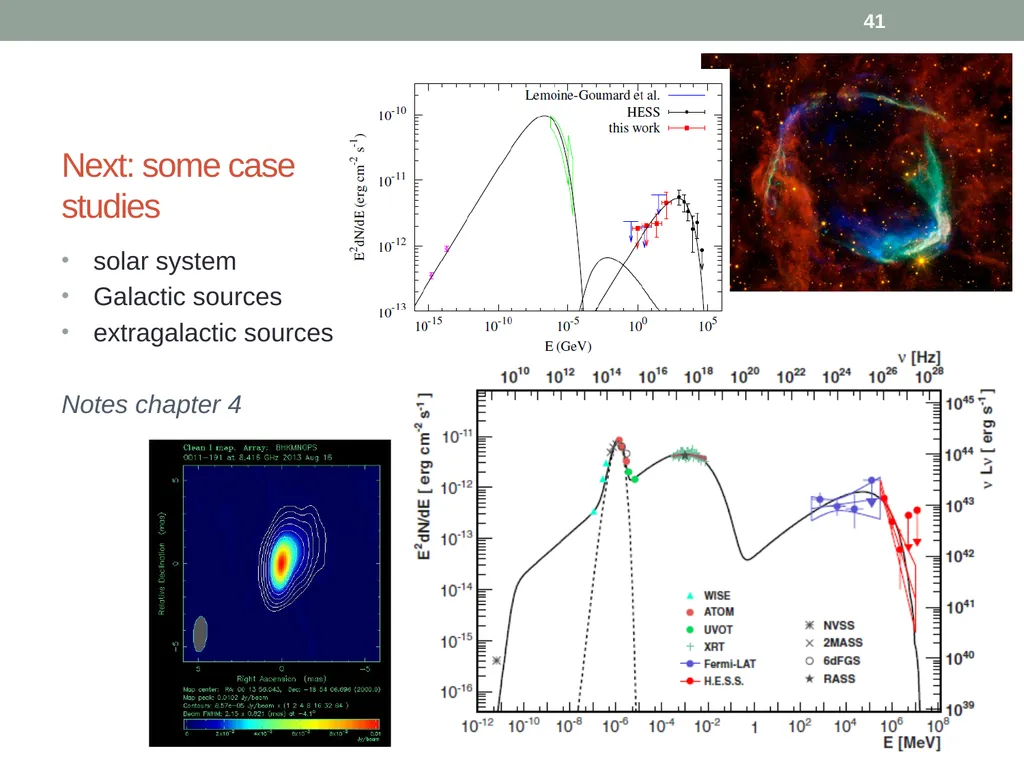
Next: some case studies solar system
Galactic sources
extragalactic sources
Notes chapter 4 41<br>
Galactic sources
extragalactic sources
Notes chapter 4 41<br>